Hiring Chair Covers: Your Ultimate 2026 Cape Town Guide

You've found the venue. The lighting works. The menu is sorted. Then you look at the chairs and realise they're the one thing pulling the whole room backwards. Maybe they're scuffed banquet chairs from the venue store room. Maybe they're a mix of styles from previous functions. Maybe they're perfectly serviceable, but they don't belong at your wedding, awards evening, matric dance, or birthday dinner.

That's usually the moment people start taking chair covers seriously.

In Cape Town and the Winelands, hiring chair covers isn't just about hiding an ugly chair. It's about getting a room to feel finished. At the right venue, with the right fabric, fit, and setup plan, chair covers can pull together a formal hall, soften a winery function room, or make a plain conference setup look deliberate and polished. At the wrong venue, with the wrong material, they can crease, shift, stain, or look like an afterthought.

The difference comes down to matching the cover to the chair, the venue, and the conditions on the day.

Why Chair Covers Are a Game-Changer for Your Event

A lot of clients start with florals, table linen, and lighting. Then they visit the venue again and notice the chairs. That's when the problem becomes obvious. You can have beautiful glassware and carefully chosen centrepieces, but if the guest seating looks mismatched or tired, the room won't read as cohesive.

Chair covers solve that quickly. They create visual consistency across the room, even when the underlying chairs are ordinary. That matters at weddings where every photo angle counts, and it matters just as much at corporate functions where the room needs to look organised and brand-conscious rather than improvised.

They change the feel of the whole room

A chair is repeated dozens of times, sometimes hundreds. That repetition gives it more visual weight than people expect. If every chair looks clean, uniform, and intentional, the room feels more premium. If the chairs are random, the room feels less considered, even if everything else is well chosen.

That's one reason event rentals stay busy across the Western Cape. South Africa welcomed 2,793,981 international tourist arrivals in 2023, which supports destination weddings, conferences, and functions that rely on polished event presentation in places like Cape Town and the Winelands, according to South Africa tourism context noted here.

They do more than hide the chair

Good chair covers can:

  • Unify mixed stock by making different venue chairs look consistent
  • Support your colour palette through covers, sashes, or bands
  • Lift plain venues that need more softness and formality
  • Improve photography by reducing visual clutter in wide shots
  • Help styling read clearly from the entrance right through to the head table

For weddings especially, chair covers often work best when they support the room rather than compete with it. In a vineyard venue, that might mean soft neutrals and textured linen elsewhere. In a ballroom-style setting, it may mean crisp white covers with a more formal sash treatment.

If you're planning a broader styling scheme, it helps to view chair covers alongside other elegant party rentals for Cape Town events rather than as a last-minute add-on.

The fastest way to make a venue look organised is to remove visual inconsistency. Chairs are usually the biggest repeated element in the room.

Choosing Your Perfect Style and Fabric

Style matters, but fit and fabric matter more. A beautiful cover on the wrong chair looks sloppy. The right cover in the wrong fabric can crease by setup time or struggle with coastal conditions. In Cape Town, that choice is never purely aesthetic.
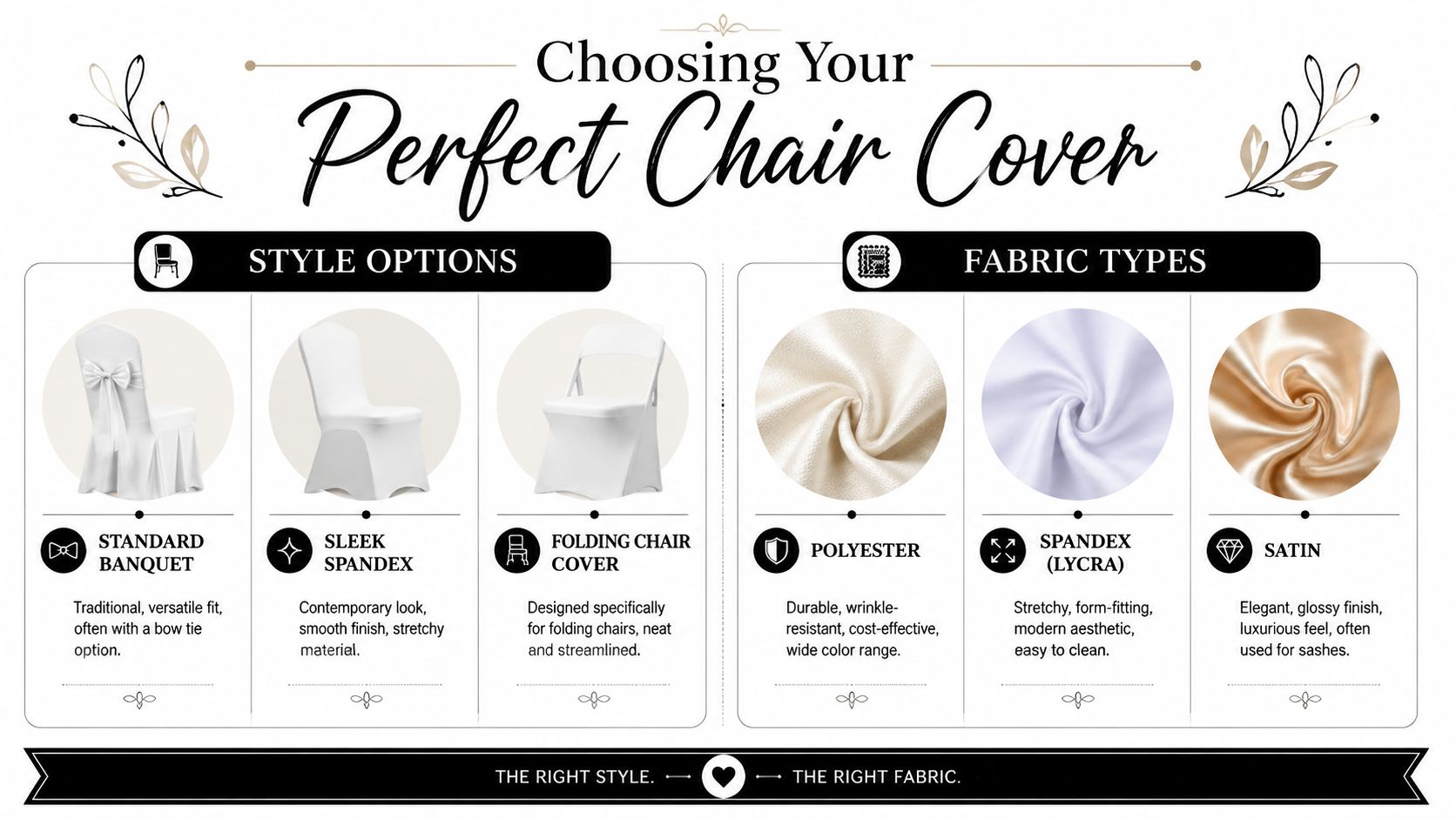
A guide illustrating different styles and fabric types for event chair covers to help you choose.

The main style options

Most enquiries fall into three broad categories.

Style Best for What works well What to watch
Standard banquet cover Traditional banquet chairs Formal weddings, gala dinners, classic reception rooms Needs the correct chair dimensions and back shape
Spandex cover Banquet and folding chairs with a compatible frame Modern, clean lines, quick setup, contemporary events Less forgiving in sandy settings if the venue is exposed
Folding chair cover Specifically shaped folding chairs Outdoor ceremonies, practical venue stock, neat narrow profile Must match folding-chair proportions properly

Standard banquet covers give the most classic look. They soften a room and work well where you want the chair to disappear into the overall styling.

Spandex covers are sharper and more fitted. They suit product launches, conferences, modern weddings, and venues where you want the setup to feel structured rather than romantic.

Fabric is where Cape Town conditions come in

In the Western Cape, climate changes the recommendation. Coastal air, morning damp, sea breeze, and dust from farm roads all affect how a cover performs after delivery.

For Cape Town and similar coastal conditions, polyester is technically superior for 92% of outdoor events because it resists wrinkles and handles humidity well, according to the event-fabric guidance referenced in this material comparison. The same guidance notes that spandex offers a near-universal fit but can be more prone to staining in sandy environments.

A practical way to choose

Use the venue first, not the Pinterest board, as your decision point.

For humid halls and coastal venues

Choose polyester if the venue sits close to the ocean, gets damp air through open doors, or has a long setup window where creasing becomes obvious. Polyester keeps its shape better and usually arrives looking more event-ready with less fuss.

That makes it a dependable option for:

  • Beachfront function spaces
  • City venues near the Atlantic Seaboard
  • Hotel ballrooms with heavy guest traffic
  • Winter events where conditions change during setup

For dry estates and fitted modern styling

Choose spandex when the look needs to be sleek and the chair type suits stretch covers properly. In the Winelands, especially at drier outdoor settings, that fitted finish can look excellent for ceremonies, long-table dinners, and clean corporate styling.

Spandex usually works best when:

  • The chair stock is consistent
  • The event style is modern rather than draped
  • Setup time is tight and easy fitting matters
  • You want a tidy silhouette from every angle

Where satin belongs

Satin can still have a place, but usually as an accent rather than the main cover. It's often more effective in a sash, band, or detail piece where you want sheen without making the full chair difficult to manage.

If the venue is exposed to humidity, don't choose your fabric on appearance alone. Choose the fabric that still looks good an hour after setup.

Matching style to the venue mood

Cape Town venues vary wildly. A wine estate, a hotel ballroom, a school hall, and a private home all ask for different treatment. The best results come from restraint.

A plain white or neutral cover can be enough if the table decor carries the statement. If the venue already has strong architecture, chair covers should support the space, not fight it. In more practical venues, they often do the opposite. They become the element that brings elegance into an otherwise plain room.

The Practicalities of Measuring Counting and Budgeting

Most problems with hiring chair covers start before delivery. They start with a rushed count, a guessed chair type, or a venue that says “standard chairs” when the chairs are anything but standard.

South Africa's formal sector employed 10.3 million people in Q4 2023, which helps explain why corporate events, awards evenings, staff functions, and activations create steady demand for tidy, uniform furniture presentation, as noted in this overview of event-rental demand.
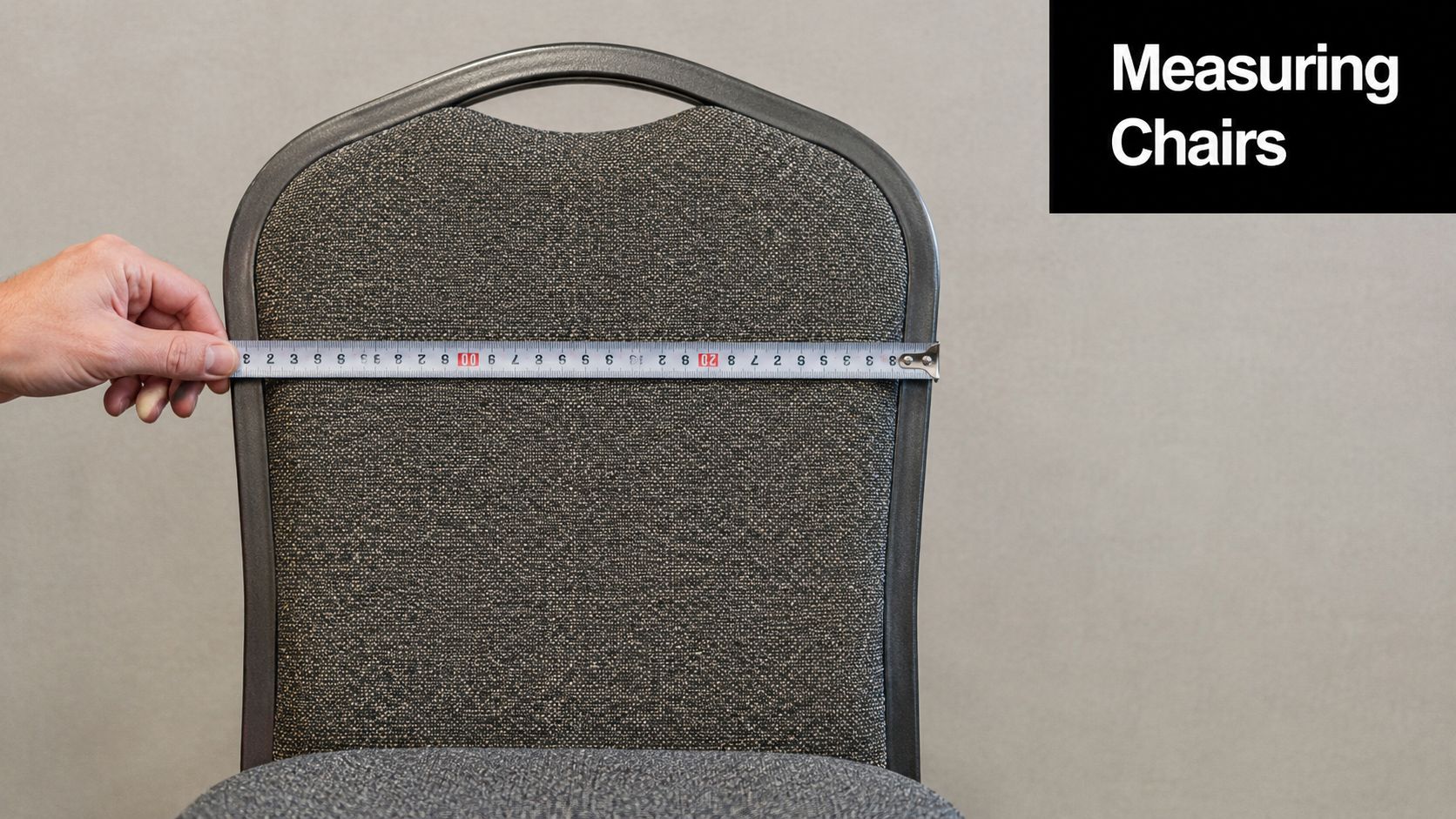
A person using a tape measure to check the width of a grey upholstered banquet chair back.

What to measure before you book

Don't rely on the venue's wording alone. Ask for photos and measure at least one actual chair if possible.

Take these measurements:

  1. Back height
    Measure from the top of the chair back to where the seat begins.

  2. Back width
    The widest point matters, especially with rounded or flared backs.

  3. Seat width and depth
    This tells you whether the cover will sit smoothly or pull awkwardly.

  4. Leg shape and spacing
    Important for fitted or stretch covers.

  5. Chair style
    Banquet, folding, stacking, conference, Tiffany-style, or upholstered. That category changes everything.

Measure twice, order once. The most expensive chair cover is the one that fits badly and has to be replaced in a rush.

Counting properly

Chair numbers change more often than people expect. Ceremony seating, reception seating, vendor meals, DJ placement, sweetheart tables, and extra seats for late confirmations all affect the count.

A clean counting method looks like this:

  • Start with the final guest list and separate adults, children, and service seats
  • Add venue-use chairs such as registration, gift table, stage, and signing table positions
  • Confirm ceremony and reception overlap if the same chairs are reused
  • Check backup stock if the venue swaps chairs at the last minute
  • Ask whether odd chairs need covering for side tables or family tables

If you're hiring the seating as well, it helps to look at the chair stock early rather than treat covers as a separate job. This guide to chair hire options for events is useful for lining up those decisions together.

Budgeting without guesswork

Pricing varies by chair type, fabric, condition expectations, transport distance, and whether setup is included. Because rates differ from one supplier and venue route to the next, the safest approach is to budget by components rather than assume a flat all-in number.

Focus on these line items:

Cost area Why it changes
Cover style Banquet, fitted, or chair-specific cuts carry different handling needs
Fabric choice Some materials are easier to prep, transport, and clean than others
Sashes or bands Decorative extras add labour and styling time
Delivery route Remote estates and limited-access venues affect logistics
Installation Setup and strike can be charged separately
Cleaning and damage terms Important when food, dust, red wine, or candle wax are involved

For a typical event, build your budget from the chair count upward, then add transport and labour after the venue has been confirmed. That's more reliable than asking for a generic estimate before anyone knows whether the venue has stairs, gravel, long carrying distances, or strict access times.

The mistakes that cause overruns

Three issues cause most headaches:

  • Wrong chair identification. A stacking chair is not the same as a banquet chair.
  • Late count changes. Small changes become difficult when linen has already been allocated.
  • Forgetting setup labour. Covers still need to be fitted neatly, especially if sashes are included.

If you want the room to look crisp, budgeting for proper fitting is often money better spent than adding another decorative extra.

Your Booking Timeline and Supplier Checklist

The smoothest chair-cover jobs are the ones booked before the rest of the timeline becomes crowded. Once florists, caterers, transport, staff access, and venue turnaround all start competing for the same day, small omissions become expensive.

For weddings in the Cape Town and Winelands peak period, earlier is better. For corporate functions, school formals, and private events, lead times can be shorter, but leaving it too late narrows your colour, fabric, and setup options.

A practical booking rhythm

Here's the timeline I'd recommend in real-world terms.

Early planning stage

As soon as the venue is confirmed, ask for chair photos. Don't wait until the decor meeting. Chair covers depend on chair shape, and the supplier can't advise properly from a vague venue description.

This is also the moment to confirm:

  • Indoor or outdoor use
  • Ceremony and reception layout
  • Access times for setup
  • Whether venue chairs stay in one place or get moved

Mid-planning stage

Once your colour palette is more settled, request swatches or reference photos where needed. If you're adding sashes or bands, test whether they suit the overall room. Not every chair cover needs a bow. In some venues, the cleaner look is the better one.

This is also when clients should confirm whether they need plain covers, fitted covers, or a mix for different spaces.

What to ask a supplier before you commit

The right questions save more stress than any last-minute rescue.
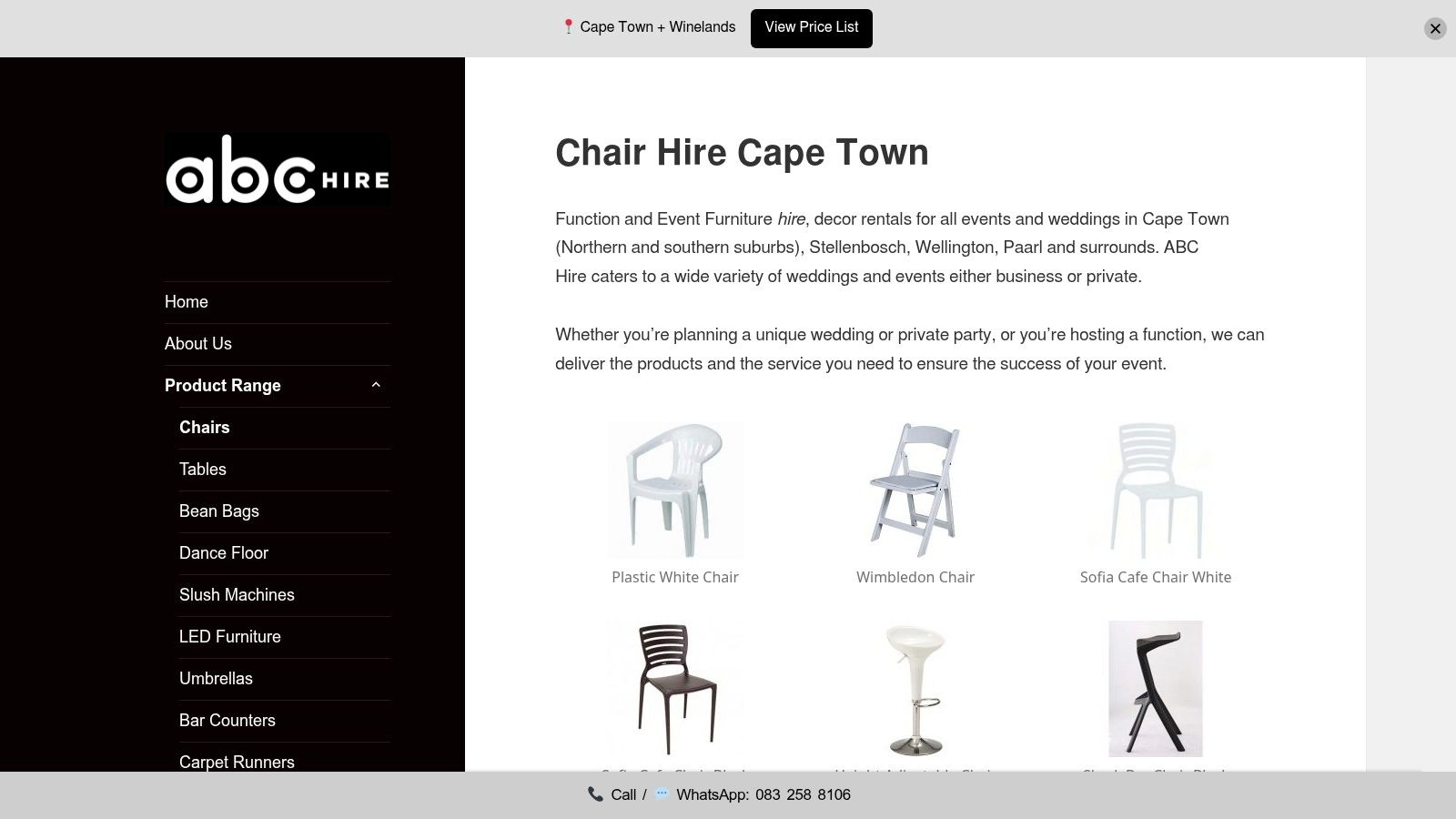
Screenshot from https://abchire.co.za/chairs/

Ask these directly:

  • Can you confirm fit for my exact chair type
    Send venue photos. Better still, send measurements.

  • What fabric do you recommend for this venue
    A good supplier should ask where the event is taking place before recommending style.

  • Is setup included or optional
    This affects timing, labour, and final finish.

  • How are stained or heavily soiled items handled
    You want this in plain language before the event.

  • What are your delivery and collection windows
    Critical for venues with strict loading times.

  • Can you handle remote estates or limited-access venues
    Stellenbosch, Franschhoek, and farm venues often need more detailed planning.

  • What happens if the chair count changes close to the event
    Small flexibility matters.

The best supplier response is specific. If the answer sounds generic, the planning probably is too.

Red flags to notice early

A few warning signs usually point to trouble later:

Red flag Why it matters
No interest in chair measurements Fit problems are likely
No clear collection policy You may face confusion after the event
No questions about venue access Delivery delays become more likely
No distinction between fabric options The recommendation may be stock-led, not venue-led

The right supplier doesn't just take an order. They check whether the order makes sense.

Navigating Day-Of Logistics and Post-Event Policies

By event week, the chair covers should already be the easy part. The only way that happens is if setup, handling, and return expectations were agreed in advance.

The practical questions are simple. Who fits the covers. When do they arrive. Where are they staged. Who checks them after the event. Most of the avoidable stress sits inside those details.
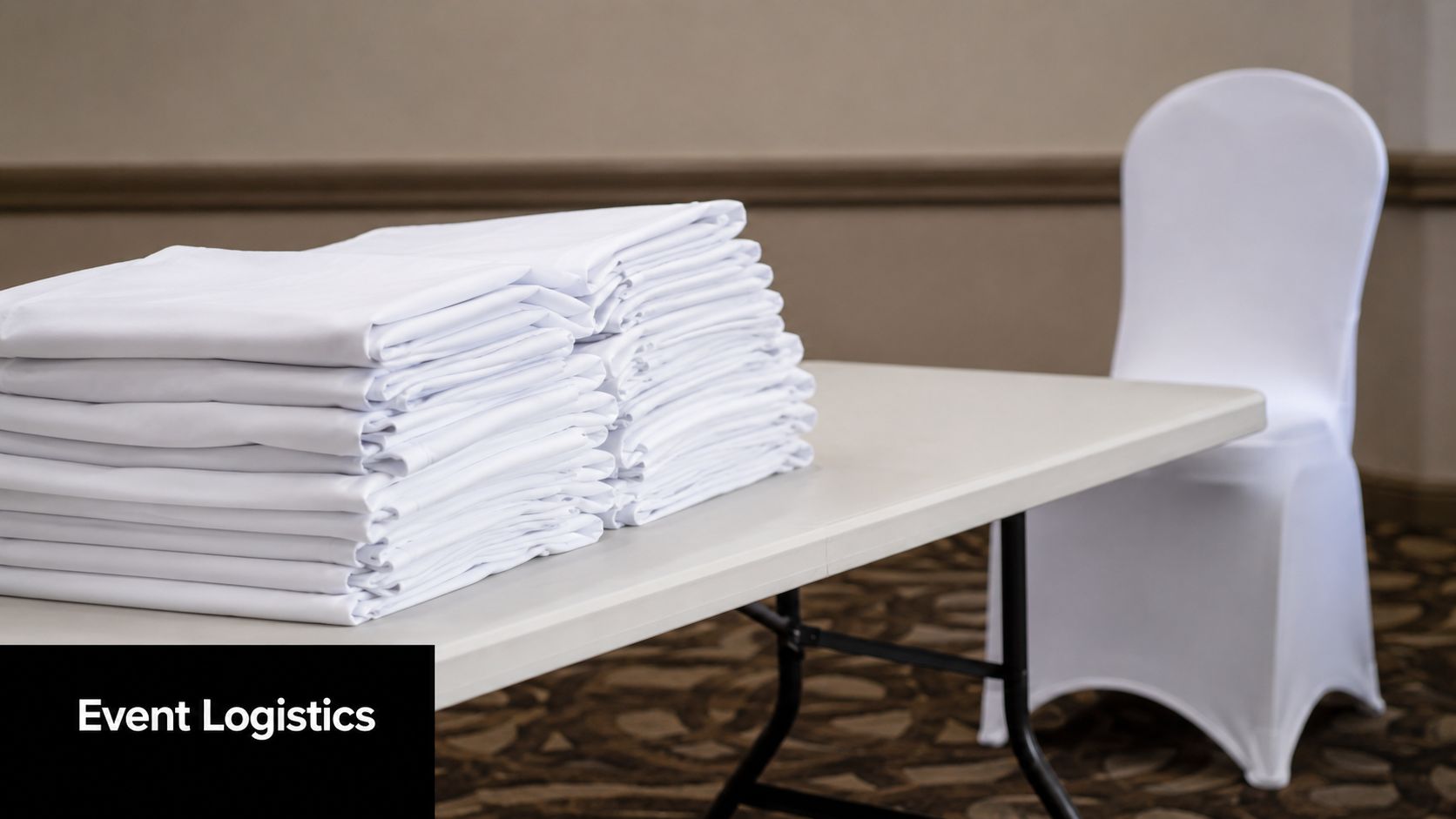
A stack of folded white tablecloths sitting on a plastic folding table next to a covered chair.

DIY setup versus professional installation

Some hosts assume chair covers are quick to put on. Sometimes they are. Sometimes they absolutely aren't.

DIY setup can work if:

  • The event is small
  • The chair type is simple and already tested
  • You've got enough hands on site
  • The room can be set long before guests arrive

Professional setup makes more sense when:

  • The event is formal or high-visibility
  • The venue has a tight turnaround
  • You're using fitted covers or detailed sash styling
  • The client doesn't want volunteers adjusting crooked bows at the last minute

The expert event guidance provided in the source material notes that 50% of rental providers in the region offer installation services, reducing setup time by 45%, and it also points out that 30% of cover failures are due to incorrect sash installation. The same guidance stresses proper sash alignment with the back seam for a balanced finish.

Pro tip
For weddings, gala dinners, and brand events, professional fitting usually pays for itself in appearance alone. Chair covers only look premium when every row is consistent.

What a smooth setup looks like

Good setup runs in a sequence:

  1. Covers are staged in the correct area
  2. Chairs are laid out in final formation first
  3. Covers go on after major dust-making setup is done
  4. Sashes and bands are tied consistently
  5. A final visual check happens before guests enter

Putting covers on too early is a common mistake, especially at venues where other suppliers are still moving gear through the space.

Understanding return condition and damage terms

Most rental policies distinguish between ordinary event use and preventable damage. That difference matters.

Normal wear usually means the item was used as intended and came back with standard signs of handling. Damage usually means something happened that cleaning or normal laundry processes won't easily solve. Think wax, burns, tears, heavy mildew from being packed wet, or stains left untreated for too long.

Ask these questions before signing:

Policy point What to clarify
Soiled items Should they be shaken out, bagged separately, or left dry on collection
Wet returns What happens if rain or dew affects the covers
Breakdown duties Must the client remove covers or will the supplier handle strike
Missing items How missing pieces are counted and reconciled

The post-event handover

After the event, don't pack damp covers into sealed bags and leave them overnight. If weather or spillage affected them, notify the supplier quickly. That gives everyone a better chance of dealing with the issue fairly and practically.

The easiest events to close out are the ones where one person is assigned to linen and decor returns. Not five people. Not the cousin with the car keys. One responsible handover point.

Insider Tips for Cape Town and Winelands Venues

Cape Town venues reward planning and punish assumptions. What looks simple on a mood board can become awkward on-site if you haven't accounted for wind, access, dust, and the way local light changes fabric colour through the day.

Work with the venue, not against it

At outdoor venues, the Cape Doctor can make anything lightweight feel less controlled. If the ceremony is exposed, fitted covers often behave better than looser styles. If the dinner is indoors but doors stay open to the garden, choose a fabric that still looks tidy after airflow and guest movement.

Historic estates around Stellenbosch and Franschhoek bring a different issue. Access can be narrow, parking can be limited, and setup teams may need to carry stock further than expected. If your timeline is tight, keep chair-cover styling clean rather than overly complicated.

Colour reads differently in the Winelands

The Winelands' late-afternoon light is warm and flattering, but it also changes how whites, ivories, and neutrals appear. Bright white can look crisp and formal. Softer tones can feel more relaxed and romantic. The best choice depends on the venue walls, table linen, and floral palette, not just the sample swatch.

For broader styling ideas, it helps to look at event decoration hire for Western Cape functions as one coordinated picture instead of choosing chair covers in isolation.

Don't overlook cleanliness planning

Outdoor and high-traffic venues need a practical hygiene plan, especially where food service, dust, children, or multiple function transitions are involved. If you're dealing with a festival-style space, busy venue turnover, or large outdoor guest movement, this guide to managing event space hygiene is worth a read because clean setup conditions make linen and chair covers perform better from the start.

The local rule is simple. In Cape Town, the prettier the venue, the more the logistics still matter.

Frequently Asked Questions About Hiring Chair Covers

Do I need sashes or bands with chair covers

Not always. If the room already has strong styling through florals, table settings, or lighting, plain covers often look smarter. Sashes work best when they repeat a colour already used elsewhere rather than introducing a new one.

What if my venue has unusual chairs

Ask for a fit check before booking. Send clear side and front photos, plus basic measurements. Oddly shaped chairs can still be covered well, but only if the supplier matches the style properly.

Can I mix chair-cover colours

Yes, but do it with intention. Mixed colours usually work best when they identify a zone, such as VIP seating, a bridal table, or a ceremony section. Random mixing tends to look accidental.

Are chair covers worth it for corporate events

Often, yes. They can make a standard conference or awards setup feel more polished, especially in venues with practical stock chairs that don't suit the brand presentation.

Who should handle setup on the day

If the event is formal, time-sensitive, or design-led, professional setup is usually the safer option. For smaller private events, self-fitting can work if the chair type is straightforward and you've confirmed the fit beforehand.


If you're planning an event in Cape Town, Stellenbosch, Franschhoek, Paarl, or the surrounding areas, ABC Hire can help with event furniture, seating, and the practical rental details that make a room come together properly. Whether you're organising a wedding, corporate function, school formal, or private celebration, the right hire partner makes the setup smoother and the final look far more polished.
Gas Stove Plates: A Pro Guide for Event Planners

Two hours before service, the room usually looks calm to guests and frantic to everyone working behind it. In Cape Town that pressure often lands hardest at venues with a beautiful view and limited back-of-house infrastructure. The marquee is up, the bar is stocked, the florist has finished, and the caterer is still trying to get stock to a proper boil on a weak cooktop.

That's where gas stove plates stop being a line item and become operational equipment.

For temporary events, they carry more responsibility than many planners realise. They need to light consistently, hold heat under pressure, survive transport, suit the available fuel, and fit a service plan that won't unravel once guests are seated. A stove plate that works perfectly in a permanent kitchen can become awkward, unstable, or slow in a field kitchen, a wine estate prep area, or a loading-bay service zone.

In the Cape Town and Winelands event circuit, that matters. Mobile setups are common. LPG is often the practical choice away from fixed services. Weather changes quickly. Access windows are tight. If the cooking line loses rhythm, the whole event feels it.

Your Guide to Flawless Event Catering

A common event-day problem isn't dramatic. It's gradual. The canapés start a few minutes late because pans are taking too long to recover heat. Sauces aren't holding properly because one burner runs softer than the others. The chef shifts pots around, staff begin queueing for the usable burner, and the service team starts making quiet adjustments in the background.

Guests rarely know the source. They only notice that food arrives unevenly.

For wedding planners in the Winelands, brand teams running outdoor activations, and coordinators managing campus or corporate events around Cape Town, gas stove plates often sit at the centre of that pressure. They're the bridge between menu ambition and what the site can support. A polished service plan on paper means very little if the catering team can't sear, boil, reduce, and hold with confidence on site.

Practical rule: If the menu depends on timing, the cooking equipment must be chosen around service pace, not just headcount.

Temporary kitchens punish weak equipment. Domestic units often struggle with repeated heavy pots, quick turnarounds, and long holding periods. Event kitchens also deal with uneven ground, rushed installs, transport handling, and teams who may not know the quirks of a specific unit until they're already under pressure.

The reliable approach is simple. Choose for output, fuel suitability, stability, and easy recovery after transport. Then test the setup exactly as it will run on the day. That means actual pans, actual gas supply, actual wind exposure if any part of the line is semi-open, and actual staffing.

When planners get this right, the improvement shows up everywhere. Service steadies. Caterers work faster. Safety checks are easier. Cleanup is less chaotic. Above all, the kitchen stops improvising and starts producing.

Understanding Professional Gas Stove Plates

Professional gas stove plates are built for volume, repetition, and hard use. They aren't just domestic stoves in a tougher frame. The difference is visible in the burner design, the support structure, the materials, and the way they cope with sustained service.

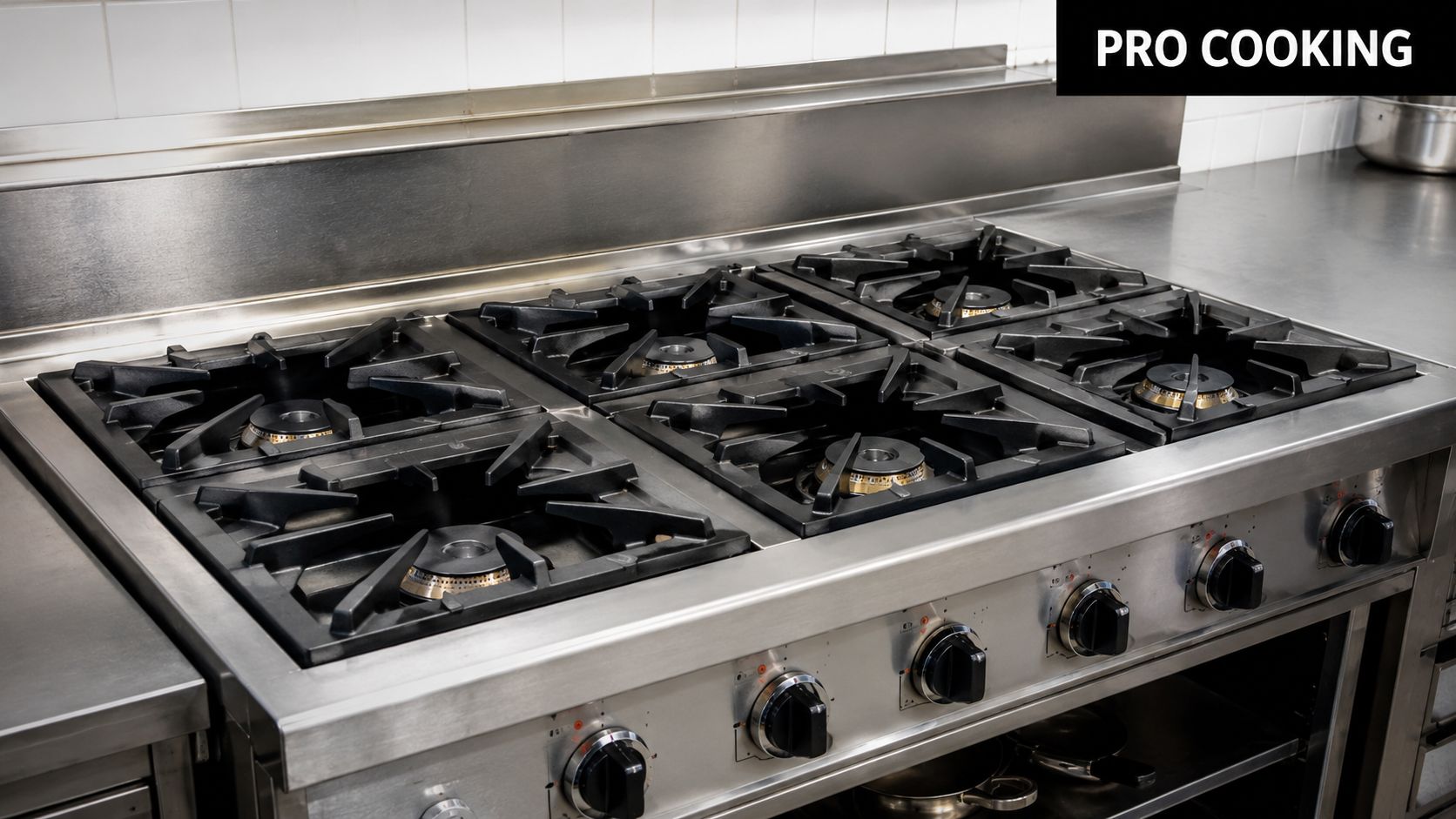
A professional industrial gas stove with six heavy-duty burners and stainless steel finishes in a commercial kitchen.

What separates commercial from domestic

The easiest way to think about heat output is horsepower. A unit might light and cook in both settings, but one is designed for family dinner and the other is designed for repeated event service with stockpots, sauté pans, and rapid refires.

Commercial gas stove plates can be specified at 25,000 BTU per burner in four-burner configurations, while typical residential cooktop burners often range from 500 to 20,000 BTU according to the Star-Max four-burner hot plate specification. That extra output is what supports fast heat-up, stronger searing, quicker boil recovery, and better throughput when the kitchen is turning out plates without pause.

Higher output isn't automatically better in every situation, though. More burner power also means more thermal load on the top surface and more demand on ventilation. If the pan is too small for the burner, or the extractor plan is poor, you lose efficiency and control.

The questions planners should ask

Before approving a unit for an event, ask practical questions that non-specialists often skip:

  • Burner purpose: Is the caterer using it for stockpots, finishing pans, or both?
  • Pan match: Do the pan bases suit the burner size, or will heat spill around the edges?
  • Surface stability: Will it sit level on the event flooring or temporary prep table?
  • Flame behaviour: Does it hold a steady flame once the kitchen is fully running?

The right stove plate is the one that keeps performing after the third pan change, not the one that looks impressive at load-in.

Open burner or sealed style

In event use, operators often prefer configurations that are easy to wipe down and easy to inspect after transport. Open styles can make access and cleaning simpler. More enclosed designs can help contain mess around the top. Neither is universally better. What matters is whether the team can clean, relight, and monitor the unit fast during service.

For planners, the practical lesson is straightforward. Don't hire or approve a gas stove plate based only on burner count. Ask how it behaves under pressure, what fuel it's configured for, and whether the caterer has used that exact type before.

Choosing the Right Stove Plate Material

The material on and around the cooking surface affects more than appearance. In event work, it changes how the unit travels, how quickly it cleans up, how forgiving it is during heavy service, and how much abuse it can take over a season of weddings, launches, and off-site catering jobs.

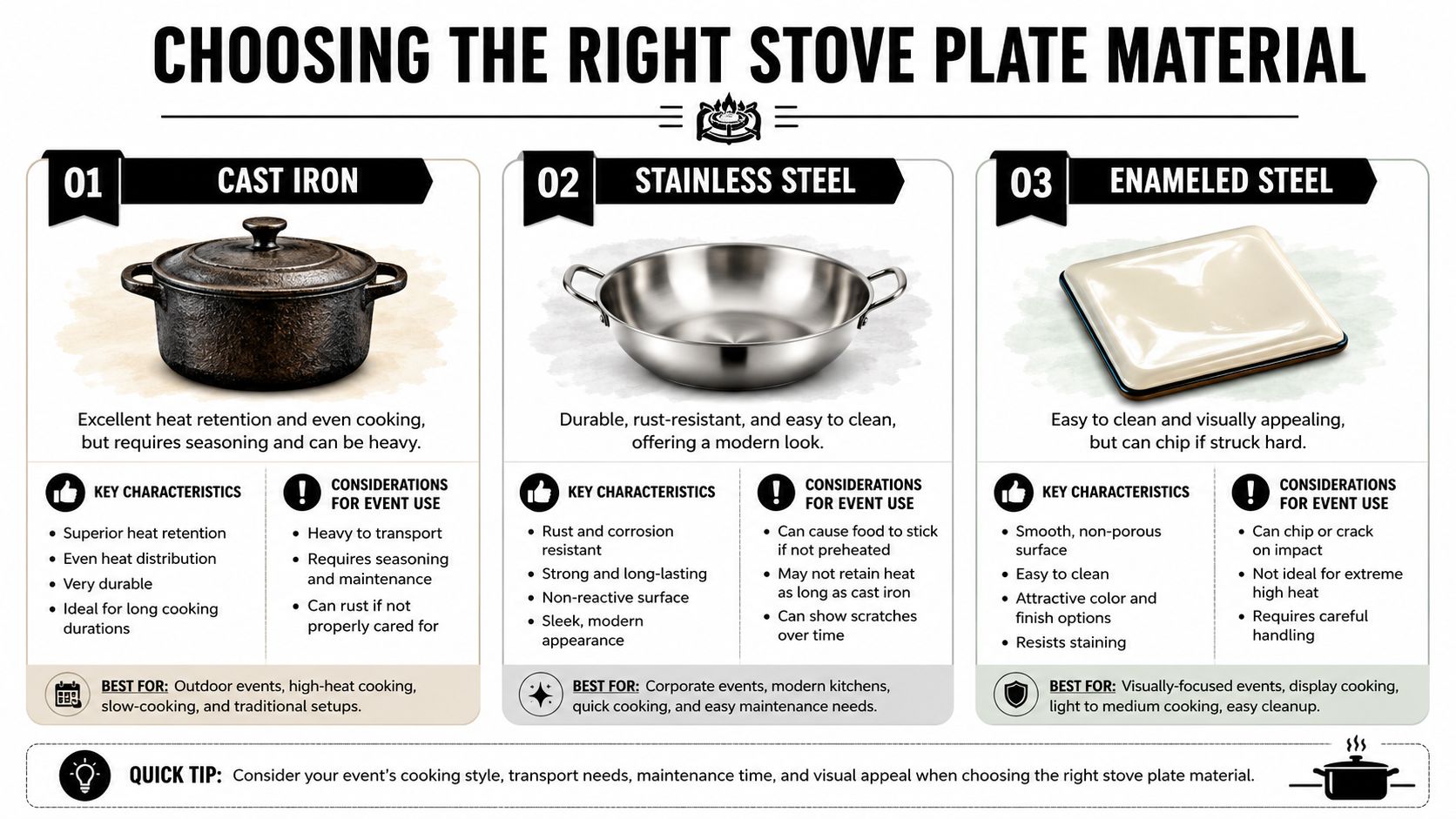
An infographic comparing three types of stove plate materials: cast iron, stainless steel, and enameled steel.

Cast iron for hard kitchen use

Cast iron makes sense when stability and heat retention matter most. Once hot, it tends to hold temperature well, which helps when a busy kitchen is moving heavy pots on and off the flame. That can be useful for menus with repeated pan work, reductions, or high-heat finishing.

The trade-off is obvious to anyone who's loaded a truck at midnight. It's heavy. It also needs more deliberate cleaning and drying if you want it to stay in good condition. If staff rush post-event breakdown and leave moisture sitting on it, the surface won't thank you.

Cast iron suits teams that already run disciplined kitchen pack-downs. It's less forgiving if the unit will pass through many hands.

Stainless steel for quick reset and easy presentation

Stainless steel is often the most practical choice for event operations where turnaround speed matters. It's straightforward to wipe down, it looks clean in open prep areas, and it handles repeated transport well when packed properly.

For temporary kitchens, that matters more than many buyers expect. A unit that can be cleaned quickly between hire periods or event days reduces friction for everyone. It also helps front-of-house adjacent cooking stations maintain a more polished look.

This is usually the easiest material to live with if the setup changes every week.

Site insight: If a unit will be loaded, unloaded, cleaned fast, and sent back out regularly, stainless steel usually creates the fewest headaches.

Enamelled steel for lighter-duty use

Enamelled steel often appeals to teams that want a tidy, smart appearance without the weight of cast iron. It's generally easier to wipe than rougher surfaces and can look good in visible service areas.

Its weakness is impact. In event environments, equipment gets nudged by crates, stacked too tightly, or knocked during strike. If the enamel chips, the finish starts losing its advantage quickly. That doesn't make it a bad option. It means it needs gentler handling and a more controlled transport routine.

A quick comparison

Material Best fit for events Main strength Main drawback
Cast iron Heavy-duty catering lines Strong heat retention Heavier and slower to maintain
Stainless steel Frequent rentals and mobile events Easy cleaning and professional appearance Shows marks quickly if cleaned poorly
Enamelled steel Lower-impact or presentation-led setups Clean visual finish Can chip if struck hard

How to choose for the menu

Don't choose material in isolation. Match it to how the event will run.

  • For production-heavy catering: Cast iron earns its place when the stove plate will run hard for long periods.
  • For frequent transport and fast turnaround: Stainless steel is often the safest operational bet.
  • For lighter service with careful handling: Enamelled steel can work well where appearance matters and movement is limited.

A lot of planners focus on style first because the event itself is style-led. The kitchen doesn't work that way. The right material is the one that survives the truck, the install, the service window, and the clean-down without creating extra problems for the team.

Sourcing and Setup for Your Cape Town Event

In Cape Town, the first sourcing question isn't usually how many burners you want. It's whether the stove plate matches the site's actual fuel reality. Estate venues, school grounds, beaches, farms, warehouses, and private homes all create different constraints, and temporary catering setups don't get the luxury of assuming a fixed kitchen connection is available.

Start with fuel, not hardware

For South African event use, fuel compatibility often decides whether a setup is practical. A commercial hotplate sold for this market can be specified with natural gas consumption of 1.999 m³/h and LPG consumption of 0.567 m³/h for a single-burner unit, as shown in the South Africa market gas burner listing. That difference matters because it affects running cost, cylinder planning, and how long the kitchen can operate without interruption.

For mobile catering in Cape Town and the Winelands, LPG is often the realistic answer when the event is off-grid or semi-remote. Natural gas can suit sites with established infrastructure, but it's not something you want to assume at the last minute. Different gas types also mean the appliance may need the right jets or regulator settings to perform properly.

Choosing the wrong setup usually shows up fast. Flames become unstable. Heat transfer suffers. Service slows.

The rent versus buy decision

Buying makes sense when the same team runs repeated events, has proper storage, and can manage routine checks, cleaning, and transport protection. Hiring makes more sense when demand changes by season, event scale varies, or the caterer needs different configurations for different sites.

Here's a useful consideration:

  • Buy if your operation is standardised and the unit will stay in regular use.
  • Hire if your venues change often, your menus vary, or you don't want idle equipment taking up storage space.
  • Mix both if you keep core equipment in-house and bring in specialist pieces for larger jobs.

For planners building an equipment list from scratch, a broader guide to catering equipment for hire can help map the stove plate into the rest of the temporary kitchen.

Don't leave gas supply to the final week

The most common setup mistake is treating gas as an accessory instead of infrastructure. It should be confirmed as early as power, water, refrigeration, and prep space.

If your event may need a quick utility solution, it's worth reviewing options for securing temporary gas supply quickly so the catering plan isn't forced into a rushed workaround. Even when LPG is the likely route, that planning mindset is useful. The earlier fuel is locked in, the fewer unpleasant surprises appear at load-in.

Temporary kitchens fail in the gaps between suppliers. The stove plate, the regulator, the hose, the gas type, and the site conditions all have to agree with each other.

Maintenance for Quick Event Turnaround

A stove plate that cooks well but cleans badly creates trouble on the back end. In event work, that trouble usually lands when the team is tired, transport is waiting, and everyone wants to leave. Good maintenance isn't about perfection. It's about getting the equipment safely clean, ready for return or storage, and fit for the next booking without creating damage in the process.

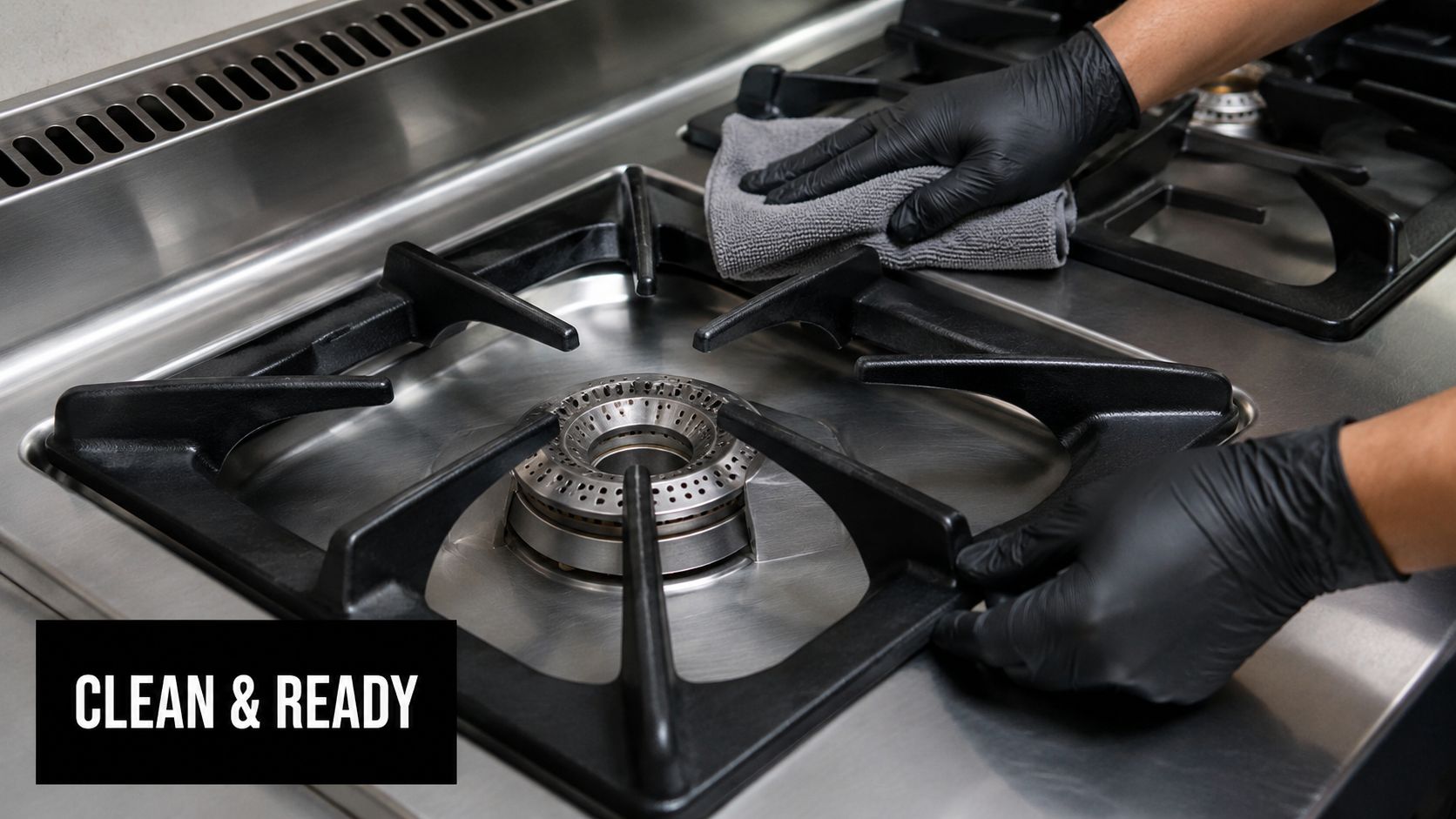
A professional cleaner wearing black gloves wipes a stainless steel gas stove top with a grey cloth.

The fast post-service routine

The safest routine is simple and repeatable:

  1. Shut down fully: Turn off burners, isolate the gas supply, and let the unit cool enough to clean safely.
  2. Remove loose debris: Lift off grates or removable top parts and clear food debris before it hardens further.
  3. Separate grease from carbon: Wipe grease first with a cloth or paper towel. Then deal with stuck residue.
  4. Dry everything properly: Moisture left on metal parts causes avoidable wear and messy storage.

The mistake teams make is jumping straight to aggressive scrubbing. That often wastes time and can damage finishes.

Cleaning by surface type

Different surfaces want different treatment.

  • Stainless steel: Use a soft cloth with mild cleaner, then dry it well so the surface doesn't streak or spot.
  • Cast iron components: Brush off residue, wipe carefully, and make sure parts are thoroughly dry before packing.
  • Enamelled areas: Avoid harsh impact and overly aggressive abrasives that can damage the finish.

If your team manages larger catering operations, broader advice on commercial kitchen maintenance and smooth operations is useful reading because it frames cleaning as part of reliability, not just hygiene.

What helps service on the next job

A well-maintained stove plate does more than look presentable. It relights more predictably, keeps burner areas clearer, and makes fault-checking easier when something goes wrong on site.

For events that also rely on holding equipment, it helps to think about the whole hot line together. Practical planning around catering food warmers often improves turnaround because the cooking and holding equipment are cleaned, packed, and redeployed as one system.

Clean enough to inspect. That's the standard that matters most after an event.

If staff can clearly see the burner parts, supports, and connection points, they're much more likely to spot a problem before the next load-out.

Troubleshooting Common On-Site Issues

When a burner starts misbehaving during service, teams often lose time by guessing. The better approach is to check the obvious mechanical issues first. In event environments, the cause is often simple: transport shifted a burner cap, debris is blocking a port, or a connection wasn't set up cleanly during a rushed install.

A recurring gap in public guidance is uneven flame troubleshooting. Problems such as clogged gas ports, misaligned burner caps, and corrosion affect flame quality and cooking performance, as highlighted in this burner troubleshooting reference video.

If the flame is weak or uneven

Start with the burner assembly itself. Don't assume the gas supply is the problem straight away.

  • Check cap alignment: If the cap isn't seated properly after transport or cleaning, the flame can burn unevenly.
  • Inspect the ports: Grease, carbon, or food debris can block sections of the burner and distort the flame.
  • Look for visible corrosion: Older or hard-used parts can degrade and stop burning cleanly.

If one burner is behaving differently from the others on the same unit, the issue is often local to that burner.

If the burner won't light cleanly

A no-light situation needs a calm sequence, not repeated clicking and frustration.

First confirm the gas is on and the unit is isolated correctly for safe inspection. Then check whether the burner parts were reassembled properly after cleaning. If the igniter clicks but the burner doesn't catch, look for blockage or poor cap seating before assuming a larger fault.

If there's no reliable ignition and staff start reaching for improvised lighting methods without a proper safety process, stop and escalate to a qualified technician or the equipment provider.

A quick field checklist

Symptom First check Likely practical cause
Yellow or patchy flame Burner cap position Misalignment after transport
Flame missing on one side Burner ports Blockage from debris or grease
Repeated lighting failure Assembly and ignition point Dirty parts or poor reassembly

The key is restraint. Minor burner issues can often be diagnosed quickly, but event staff shouldn't dismantle beyond routine user-level parts or attempt repairs that belong to a gas professional. On a live event, the smart move is to solve what's simple and stop where safety starts becoming uncertain.

Essential Gas Safety for Temporary Events

Temporary gas setups need stricter habits than permanent kitchens because the environment changes every time. Different flooring, different airflow, different staff, different access, different pressure. If the team treats each setup as routine, that's when small oversights slip through.

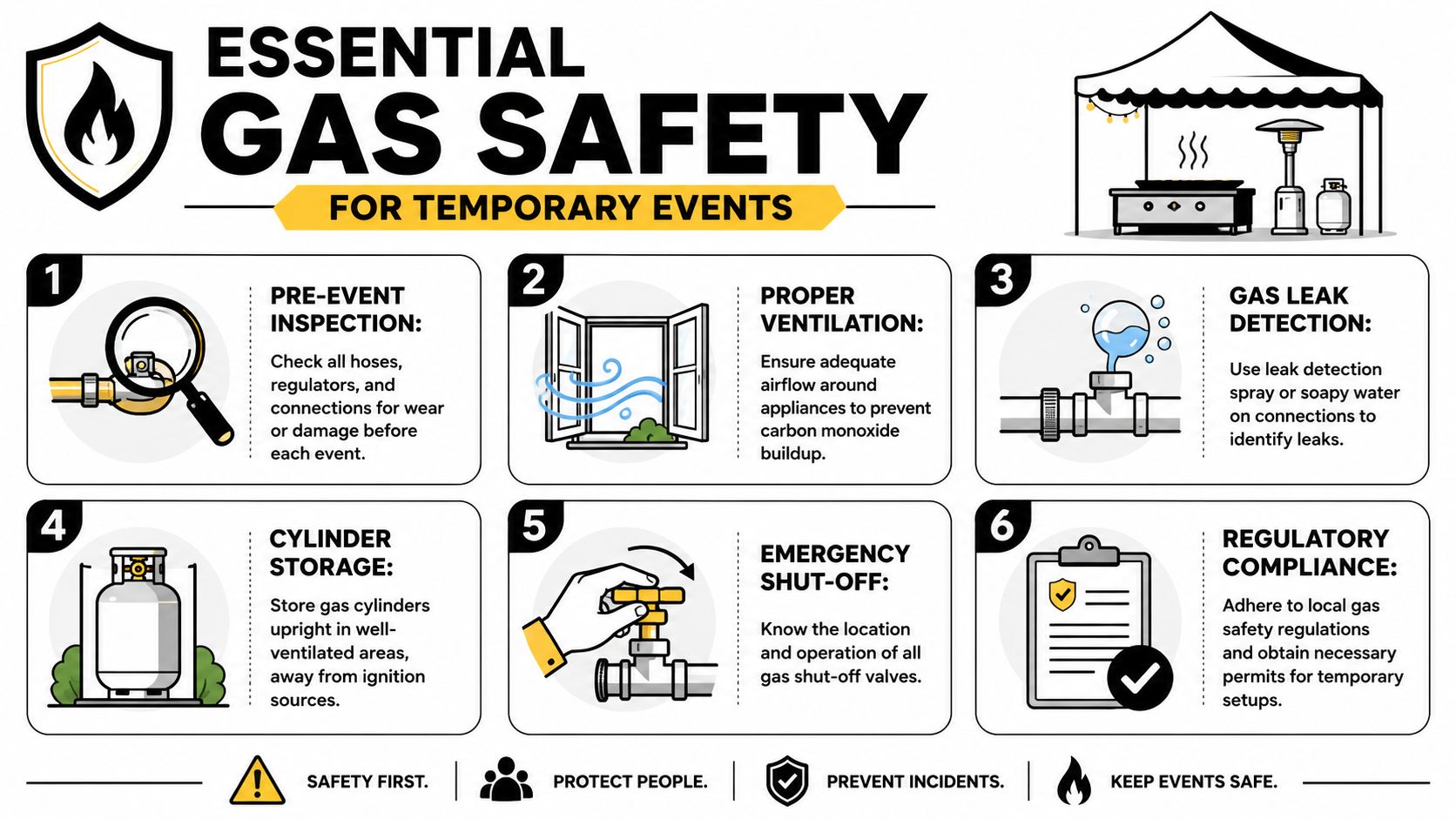
A safety infographic titled Essential Gas Safety for Temporary Events showing six key gas handling procedures.

A frequently asked but poorly answered issue for South African users is the safe operation and shut-off of gas appliances, especially in temporary setups, as discussed in this South African gas safety conversation. Event teams need a clear checklist, not informal guesswork.

The non-negotiables on site

  • Inspect before every event: Check hoses, regulators, and visible connection points before the kitchen goes live.
  • Ventilate properly: Never treat a tent or marquee like a normal indoor kitchen unless airflow has been considered properly.
  • Store cylinders upright: Keep them in a suitable ventilated area away from obvious ignition risks and unnecessary traffic.
  • Know the shut-off point: Every supervisor on site should know where the supply is isolated and how to stop it quickly.
  • Check for leaks safely: Use an appropriate leak-check method before service starts.
  • Respect local requirements: Temporary event setups still need to align with local safety expectations and venue rules.

Why planners should care personally

If you're managing the event, this isn't something to leave vaguely with “the kitchen team”. Safety responsibility in live environments overlaps. The venue, planner, caterer, rental provider, and on-site manager all influence whether the setup is sensible.

For a wider operational view, this resource on comprehensive event safety guidance is useful because it places gas risk inside the bigger event safety picture. If your event also includes guest comfort equipment, planning around items like a gas outdoor heater should follow the same disciplined approach.

The safest temporary kitchen is rarely the fanciest. It's the one with clear access, stable equipment, competent setup, visible shut-off control, and no guesswork.


If you're planning an event in Cape Town, Stellenbosch, Franschhoek, Paarl, or the surrounding areas, ABC Hire can help you pull together the practical event equipment that makes service run smoothly. From core event infrastructure to reliable hire solutions for demanding setups, they're a strong local partner when you need equipment that arrives ready, looks professional, and works under pressure.

Brighten Your Event: Choose the Best Rechargeable LED Lamp

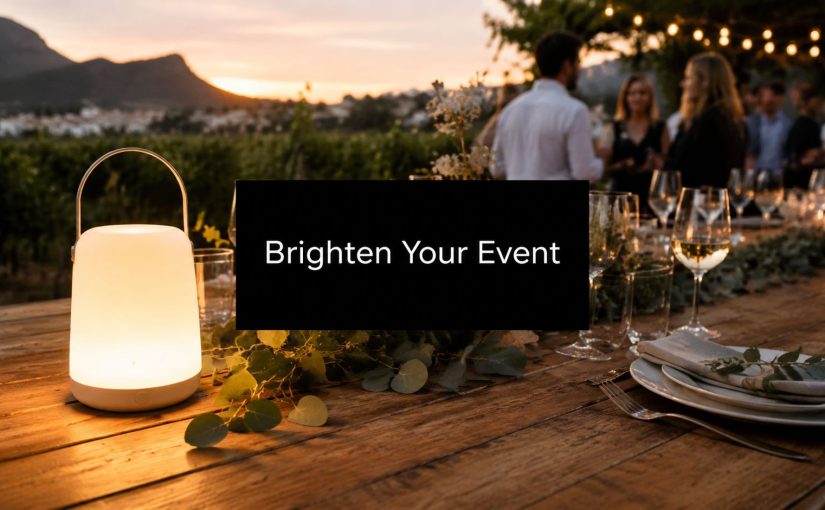
A late-afternoon setup in the Winelands can look calm right up until it isn't. The florist is still adjusting the long tables, the band is asking where they can plug in, the wind starts moving through the vines, and everyone's watching the sky because the best part of the event only starts after sunset. That's exactly when lighting decisions stop being decorative and start being operational.

A good rechargeable LED lamp solves two Cape Town event problems at once. It removes cabling from spaces where cables look terrible, and it gives you a layer of resilience when load-shedding or a short-notice outage threatens the mood of the room. For planners working across Stellenbosch, Franschhoek, Paarl, the CBD, and the Atlantic Seaboard, that matters more than any showroom feature list.

What's changed is accessibility. LED pricing dropped hard over time, with the per-lumen price falling by a factor of 10 each decade according to US Department of Energy research on LED price declines. That's a big reason rechargeable event lighting moved from a niche extra to a normal line item for weddings, launches, and private functions.

Setting the Scene with Cordless Brilliance

Sunset is where Cape Town events either come together or start showing their weak points. At a Winelands wedding, daylight carries the setup for most of the afternoon. Then the ambient light drops fast, the venue's fixed lighting feels too harsh or too limited, and every visible extension lead suddenly looks like a planning mistake.

That's where a rechargeable LED lamp earns its keep. On a farm venue lawn, it can mark a pathway without trenching cables across gravel. On a dinner table, it can create warm, controlled light without forcing the stylist to hide plugs and adapters. In a city corporate venue, it lets you light a registration desk, cocktail cluster, or branded product plinth without redesigning the room around wall sockets.

The local advantage is flexibility. Cape Town venues aren't all built for modern event power planning. Some are heritage properties with awkward plug placement. Some have beautiful outdoor sections with almost no practical power access. Some are polished urban spaces where the client wants a clean, contemporary look and won't tolerate cable clutter.

Practical rule: If guests can see the cable, the lamp probably should have been cordless.

Cordless lighting also layers well with other decorative light sources. If the brief calls for softness rather than spectacle, a lamp works better than blasting the whole venue with overhead fill. If you're building atmosphere in stages, pairing lamps with details like battery-operated LED fairy lights for event styling gives you texture without locking the whole event into one lighting look.

What works in practice is using rechargeable lamps as intentional light, not emergency afterthoughts. They're strongest when they support guest flow, table ambience, and key feature areas at the same time. They don't replace every fixture on site. They cover the parts of an event where mobility, appearance, and backup readiness matter most.

Matching the Lamp to Your Cape Town Event

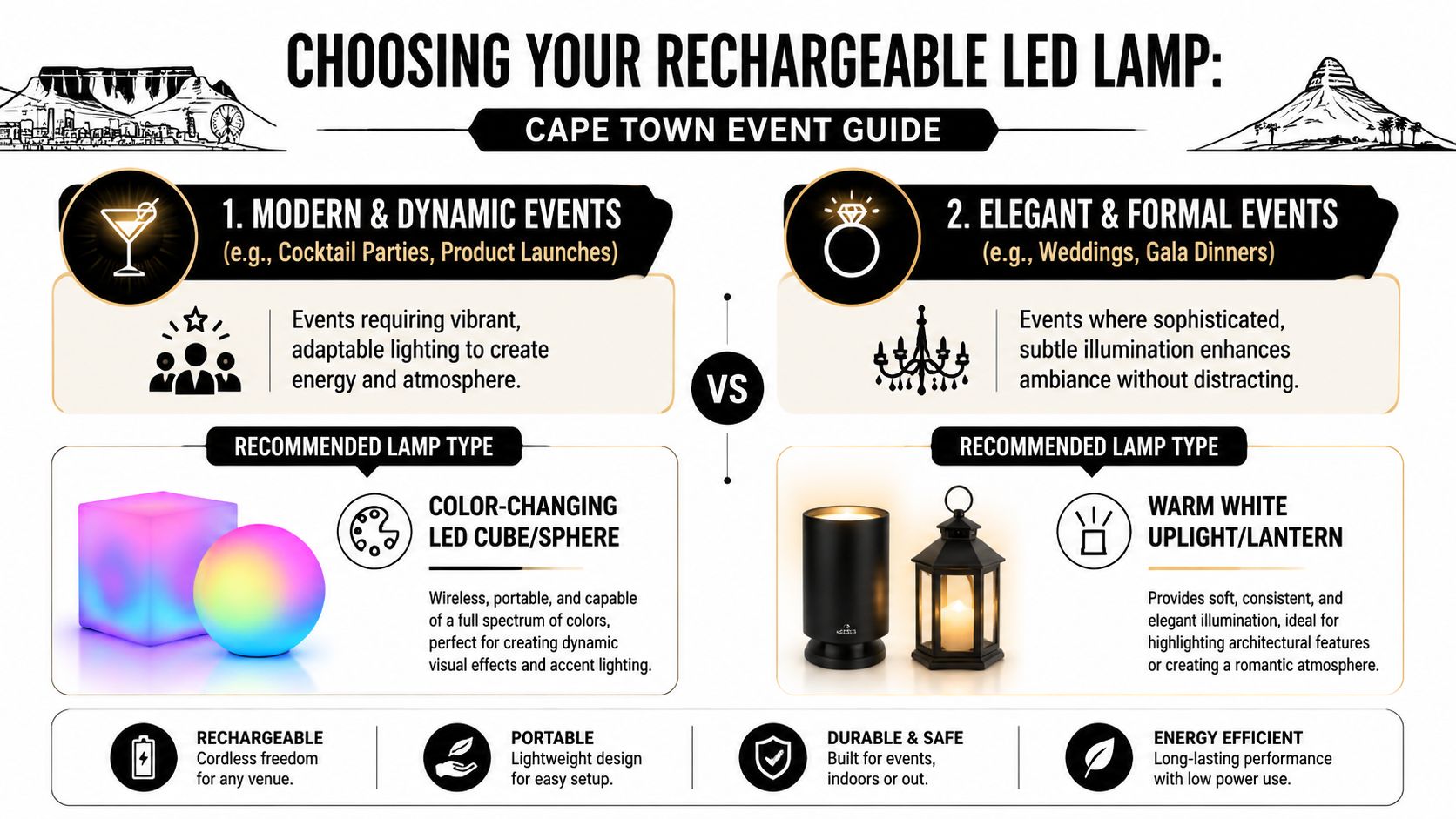
The wrong lamp can make a beautiful event feel off. A glowing cube might be perfect for a brand activation in Woodstock and completely wrong for a formal dinner in Franschhoek. Selection starts with the event style, but in South African conditions the decision should lean heavily on usable brightness during an outage and recharge time between uses, as highlighted in consumer guidance on battery-operated lamps.

A guide comparing rechargeable LED lamps for modern events versus elegant formal occasions in Cape Town.

Winelands weddings

For weddings, the lamp should disappear into the atmosphere rather than call attention to itself. Warm-white table lamps, compact lanterns, and discreet uplight-style units usually do the job better than novelty shapes.

Priorities tend to be:

  • Soft flattering light: Guests need to see faces, menus, and place settings without feeling like they're sitting under a security light.
  • Stable outdoor performance: Grass, stone, uneven surfaces, and wind all punish flimsy units.
  • Quiet design: Brass, black, white, neutral, or frosted finishes usually integrate better than highly saturated housings.

A wedding planner should also think about sequence. Ceremony, canapés, dinner, speeches, and dance floor all ask different things of the same venue. A lamp that can move from welcome drinks to the bar or gift table is more useful than one that only works in a single setup.

Corporate launches and gala events

Corporate events usually need cleaner lines and more control. If branding matters, colour consistency matters. If the venue has multiple zones, the lamp should fit the technical brief rather than just look good in isolation.

For launches and galas, I'd prioritise:

  • Colour control: For branded palettes, basic warm white may not be enough.
  • Fast reset between programme segments: Lamps sometimes need to move from foyer to stage-adjacent networking areas.
  • Professional finish: Corporate clients notice mismatched housings, inconsistent brightness, and scratched diffuser surfaces.

If the event includes scenic lighting, feature lighting, and programmable elements, don't expect decorative rechargeable lamps to do the job of a full production rig. Use them for tables, satellite areas, lounges, and backup elegance around the edges.

Private parties and milestone celebrations

Birthday parties, engagement dinners, and home events can be more forgiving. That opens the door to colour-changing cubes, spheres, decorative lanterns, or compact table lamps that add personality.

These events benefit from portability more than formal precision. Hosts often change layouts mid-event, move furniture, or open a second area outdoors once the weather settles. Rechargeable units make that possible without calling an electrician or rerouting cables through a living room.

Here's a quick selection framework.

Event Type Primary Goal Top Spec Priority Recommended Lamp Style
Winelands wedding Atmosphere and elegance Usable brightness through dinner service Warm white table lamp or lantern
Corporate launch Brand-aligned presentation Control and recharge practicality Sleek table lamp or colour-capable accent unit
Private party Flexible mood creation Portability and visual impact LED cube, sphere, or casual cordless lamp

Don't choose by appearance alone. The lamp that looks best at noon on a supplier sheet can perform worst after sunset on a windy terrace.

Decoding the Technical Specifications

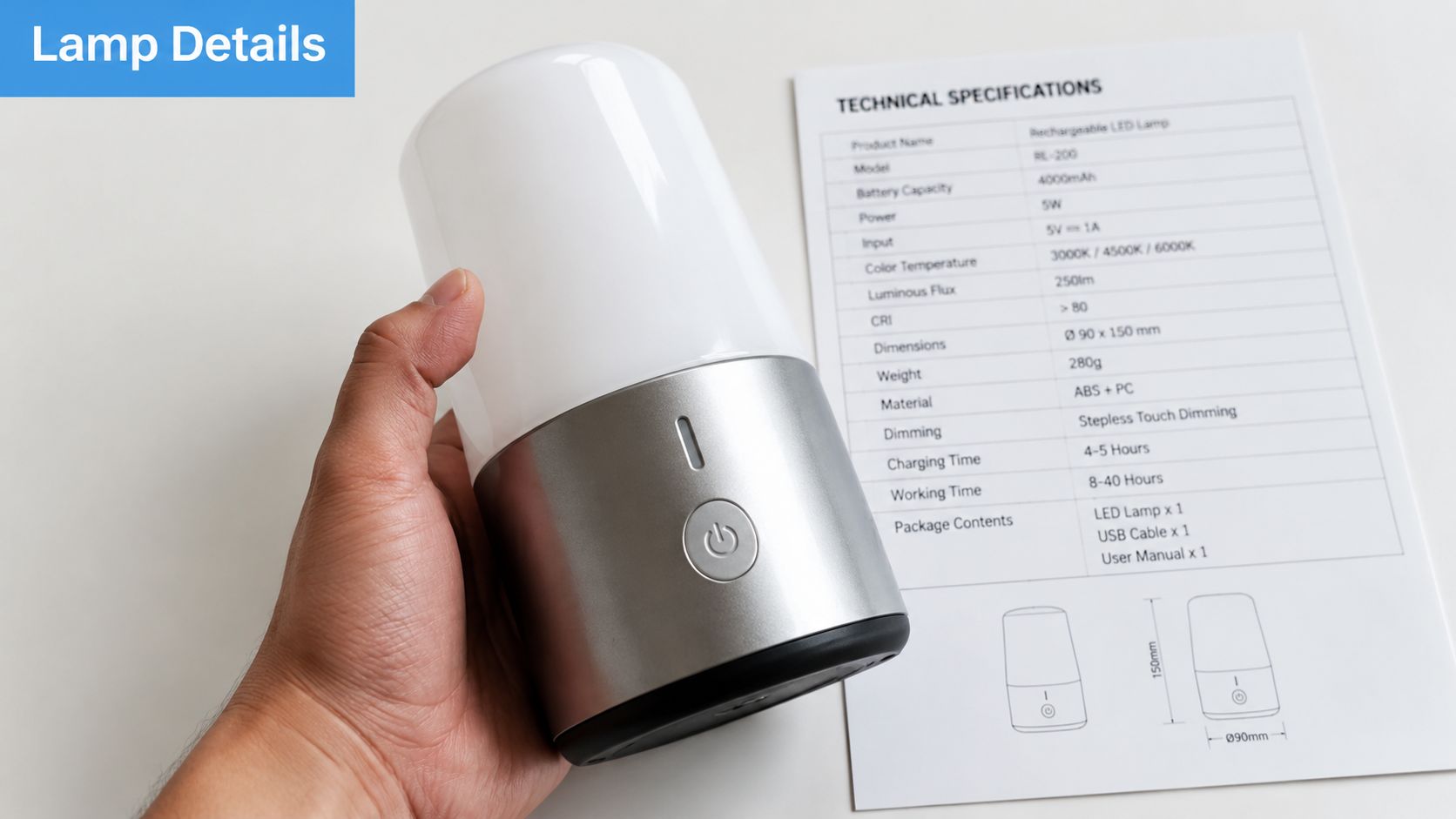
Spec sheets can be misleading if you read them like a retailer reads them. Event people need to read them like operators. The question isn't whether a rechargeable LED lamp sounds impressive. The question is whether it will survive transport, setup, weather, dimming, and a long service window without creating work for the crew.

A hand holding a rechargeable LED lamp next to its technical specification sheet on a table.

Brightness and light quality

Start with lumens, not watts. Watts tell you power draw. Lumens tell you light output. That matters because modern LED performance improved steadily, with efficacy improving by about 6 to 8 lumens per watt each year since 2010, and average LED lighting products reaching 102 lm/W in 2018, according to the European Commission Joint Research Centre report on the LED lighting market.

That progress is why compact rechargeable units can now produce useful light without bulky battery packs. But brightness alone isn't enough. For weddings, food service, and brand-sensitive activations, colour rendering matters too. If you want a practical explainer on how light affects the way flowers, skin tones, and fabrics appear, Golden Lighting's guide to CRI is worth reading.

A few practical checks:

  • Warm white for dining: It's usually safer for formal tables and portraits.
  • Neutral or adjustable white for mixed-use spaces: Better where a lamp may shift between service and guest zones.
  • RGB only where it serves the brief: Colour-changing features are useful, but not every event wants nightclub energy.

Battery and runtime reality

A common pitfall for buyers involves runtime. “Runtime” often means very little until you know the brightness setting and the age of the battery pack. A lamp can be technically functional and still too dim to be useful by the point you need it most.

Look for:

  • USB charging: Easier to manage across large batches.
  • Lithium-ion or LiFePO4 battery options: Better suited to repeat event use than vague, unlisted battery specs.
  • Cycle-life information: If the supplier can't explain battery replacement or service planning, that's a warning sign.

Control, casing, and event durability

Remote control sounds handy until remotes go missing on site. DMX sounds complex until the event doesn't have the crew or time to programme it. Match the control method to the actual production level of the event.

For more theatrical or architectural environments, it helps to understand how decorative cordless lighting sits alongside conventional event fixtures such as PAR can lighting used in venue washes and feature illumination. They do different jobs. One gives mobility and intimacy. The other gives broad scenic coverage.

A lamp spec is only useful if it answers a setup question. Can it stay bright enough? Can it be moved quickly? Can it cope with the venue?

Also inspect the body. Metal housings usually wear better than cheap plastic. Weighted bases matter on outdoor tables. Sealed buttons, solid charging ports, and easy-clean surfaces save a lot of trouble after multiple rental cycles.

Creative Setup and Placement for Maximum Impact

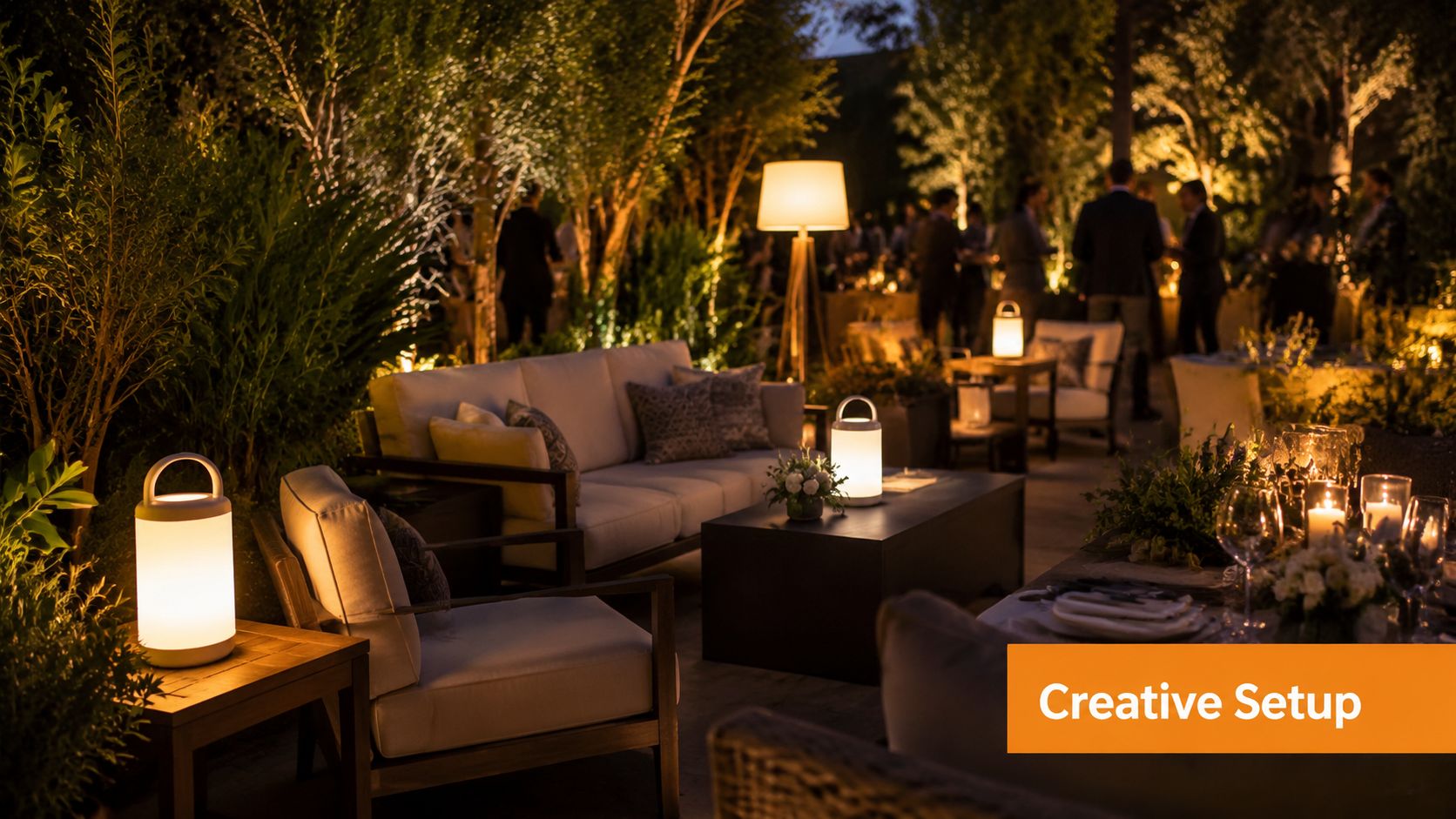
Most bad event lighting doesn't fail because the fixtures are poor. It fails because the placement is lazy. A rechargeable LED lamp works best when it shapes movement and mood rather than just filling darkness.

A luxurious outdoor lounge area illuminated by several warm rechargeable LED lamps at a evening garden party.

Use lamps to guide the room

At a lawn reception in Constantia or Stellenbosch, the cleanest move is often to light the route before the destination. Guests remember how a space felt as they entered it. A row of low cordless units along a path, stair edge, or transition from drinks area to dinner space does two jobs at once. It adds atmosphere and reduces uncertainty.

For waterfront and city venues, place lamps where overhead lighting usually leaves dead patches. Think lounge pockets, sideboards, registration points, restroom corridors, and bar fringes. Those transitional areas often make a venue feel unfinished after dark.

Good placement usually follows this sequence:

  1. Arrival line: Gate, pathway, host point.
  2. Social anchor points: Bar, canapé station, lounge seating.
  3. Emotional centre: Head table, cake table, speech zone, branded reveal area.

Keep table lighting disciplined

Table lamps can make a dinner look polished, but they can also ruin sightlines if they're too tall, too bright, or too cold in colour. For round tables, one central cordless lamp often works better than several competing points of light. For long banquet tables, repeated low-profile lamps create rhythm without turning the table into a runway.

A few placement rules help:

  • Keep the glow below eye line: Guests should see each other before they see the fixture.
  • Avoid direct glare into seated faces: Frosted diffusers and shade-style lamps are easier to live with.
  • Balance with candles or florals carefully: Too many decorative light sources can flatten the overall look.

On-site note: If diners start rotating lamps away from themselves, the setup was too bright or badly positioned.

Highlight features, not everything

You don't need to light every object in the venue. In fact, selective darkness usually makes an event look more expensive. Use rechargeable units to pick out trees, signage, product displays, or a DJ front rather than flooding the whole space evenly.

At a private estate, that might mean lighting a single olive tree near the dance floor and leaving the far garden in shadow. At a V&A venue, it might mean creating warm islands of light in lounge areas while the city and harbour provide the background atmosphere.

The best setups feel intentional. Guests should think the event is beautifully lit, not notice how many individual lamps you used.

Charging and Maintenance for Flawless Performance

A rechargeable LED lamp is only as reliable as the charging discipline behind it. Mid-event failures aren't usually bad luck. They're process failures. Somebody trusted the indicator light, skipped runtime testing, mixed charged and uncharged stock, or packed old and new batteries into the same job without tracking them.

The battery is the first thing to plan around. The LED element can last up to 50,000 hours, while a rechargeable LED bulb example is rated at about 20,000 hours and draws 4 watts while matching the brightness of a 50W incandescent, according to LED professional coverage of rechargeable LED bulb design and lifespan. In practice, that means the light source often outlasts the battery pack, so replacement planning matters more than people think.

Build a charging workflow, not a charging corner

The safest approach is to treat charging like inventory control. Every lamp needs a status, a position, and a test record. If your team just plugs everything in the night before and hopes for the best, you're inviting uneven performance.

A workable pre-event system usually includes:

  • Label each lamp: Number the unit and its charger so faults can be traced.
  • Separate tested stock from untested stock: Never pack from the charging area directly.
  • Log weak performers: Any unit with suspect runtime should be removed from premium placements.

If you're dealing with venues that have limited power access, it also helps to understand broader portable power solutions for events and off-grid setups. Not because every lamp needs a power station on site, but because charging strategy becomes part of event power planning when access is tight.

Test for the event, not for the brochure

A lamp that works in the warehouse can still fail at the venue. Brightness settings change battery draw. Cold evenings can expose weak packs. Older stock often looks fine until it's asked to hold output through the critical dinner window.

What works:

  • Run lamps at the intended brightness before the job
  • Test colour-change and remote functions, not just power-on
  • Clean diffusers and bodies before packing
  • Carry a small reserve of matched units for swaps

This is also where buying decisions matter. Replaceable batteries, accessible charging ports, and durable housings save money and stress over time. Sealed disposable units with vague battery specs usually become dead stock faster than expected.

If a supplier can't tell you how battery servicing works, don't assume there is a service plan.

Protect the finish as well as the battery

For weddings and formal corporate work, cosmetic condition matters almost as much as function. Fingerprints on metallic finishes, scratched diffusers, and dented bases are visible under close dining light.

Pack lamps upright where possible. Keep charging cables organised by model. Don't let damp units go back into closed cases after a coastal event. Salt air, mist, and rough load-ins punish neglected stock quickly in Cape Town conditions.

Rental Logistics in Cape Town and the Winelands

Renting usually makes more sense than owning if rechargeable lamps aren't on jobs every week. Cape Town events vary too much. One weekend calls for elegant cordless table lamps at a vineyard. The next needs sturdy portable units for a school function or a corporate rooftop where weather and access are harder on equipment. Rental lets you match the stock to the brief instead of forcing one inventory style onto every event.

Screenshot from https://abchire.co.za

Ask better supplier questions

Local logistics matter. A city hotel with a loading bay is one thing. A remote Winelands venue with gravel access, limited turnaround space, and restricted setup hours is another. Your lighting supplier should understand both.

Ask these questions before confirming:

  • How is runtime tested before dispatch?
  • What happens if a unit fails on site?
  • How are remote venues handled for delivery and collection?
  • Are replacement units packed as part of the job?
  • How are charged and tested units separated from returned stock?

A local South African study and user guidance highlighted why this matters. One rechargeable desk lamp recorded about 3.5 hours of continuous use on a full charge, while a user manual specified up to 8 hours of cordless use. For reliable event planning, test runtime at the intended brightness and add a 20 to 30% buffer for battery ageing and real-world use, as discussed in this design and performance analysis of rechargeable desk lamps.

Plan for the venue, not just the inventory

Winelands venues often stretch crews in ways city planners underestimate. Long distances between prep area and reception space. Limited charging access. Late-night pack-down over uneven ground. Those conditions change what “easy” means.

If lamps are part of the visual plan, they should also be part of the contingency plan. Key areas like entrances, bathrooms routes, bars, and dining tables shouldn't depend entirely on venue power. That's where a local rental partner with experience in event styling and practical operations is useful. For example, ABC Hire's event decoration hire resources sit in the same decision space as rechargeable table lamps, LED furniture, and other portable event elements used across Cape Town and the Winelands.

The strongest rental setups combine aesthetics, transport practicality, and backup thinking. That's the difference between lighting that looks good in a catalogue and lighting that still works when the schedule slips, the weather turns, or the power drops at the wrong moment.


If you're planning a wedding, corporate function, matric dance, or private celebration in Cape Town or the Winelands, ABC Hire can help you match rechargeable lighting to the venue, layout, and load-shedding realities of the job. Ask for a practical setup recommendation based on your event style, not just a product list.

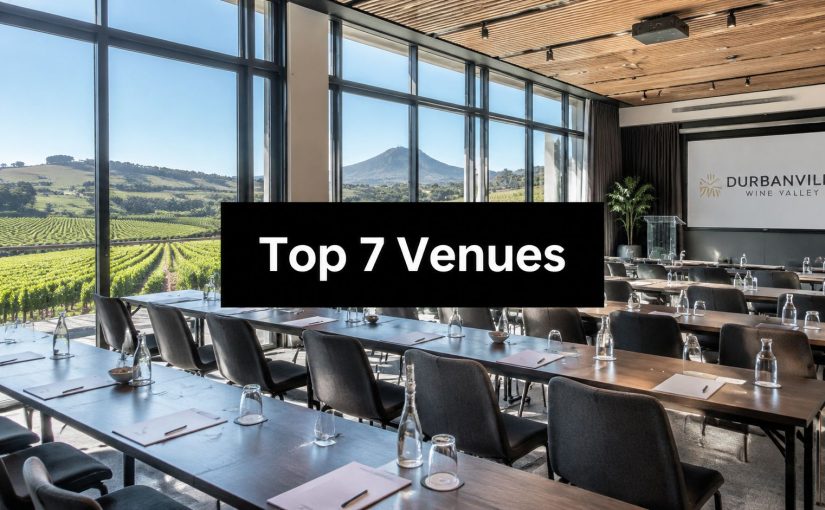
Top 7 Conference Venues Durbanville for 2026

You've got a Durbanville brief, a delegate count that keeps shifting, and venue replies that still leave out the details that decide whether the day runs properly. Parking. Breakout flow. In-house AV. Ceiling height. Whether the room still works once registration desks, coffee stations, sponsor banners, and a lectern are in place.

That is the reality with conference venues in Durbanville. The area has solid options, but the market leans toward small and mid-sized conference spaces rather than large convention inventory. One local venue overview notes a mix that ranges from compact meeting rooms to multi-room facilities with auditorium capacity in the Durbanville area local market overview. For planners, that usually means a better fit for training days, leadership sessions, client presentations, launches, and corporate dinners than for expo-style events.

This guide focuses on the shortlist planners compare once the practical questions start. I've kept the attention on trade-offs. Where overnight stays reduce admin. Where wine-farm settings add atmosphere but need firmer transport planning. Where a venue looks polished on arrival but needs extra kit to handle registration, overflow seating, speech audio, or weather control.

That is also where the ABC Hire pairing matters. A standard room can perform far better with the right add-ons, whether that means LED furniture for a welcome function, portable climate control for a marquee or warm afternoon session, extra seating for layout changes, or cleaner sound support for presentations. If you want a clearer sense of how hospitality spaces present themselves before site visits, Virtual Tour Easy's hotel guide is a useful reference point.

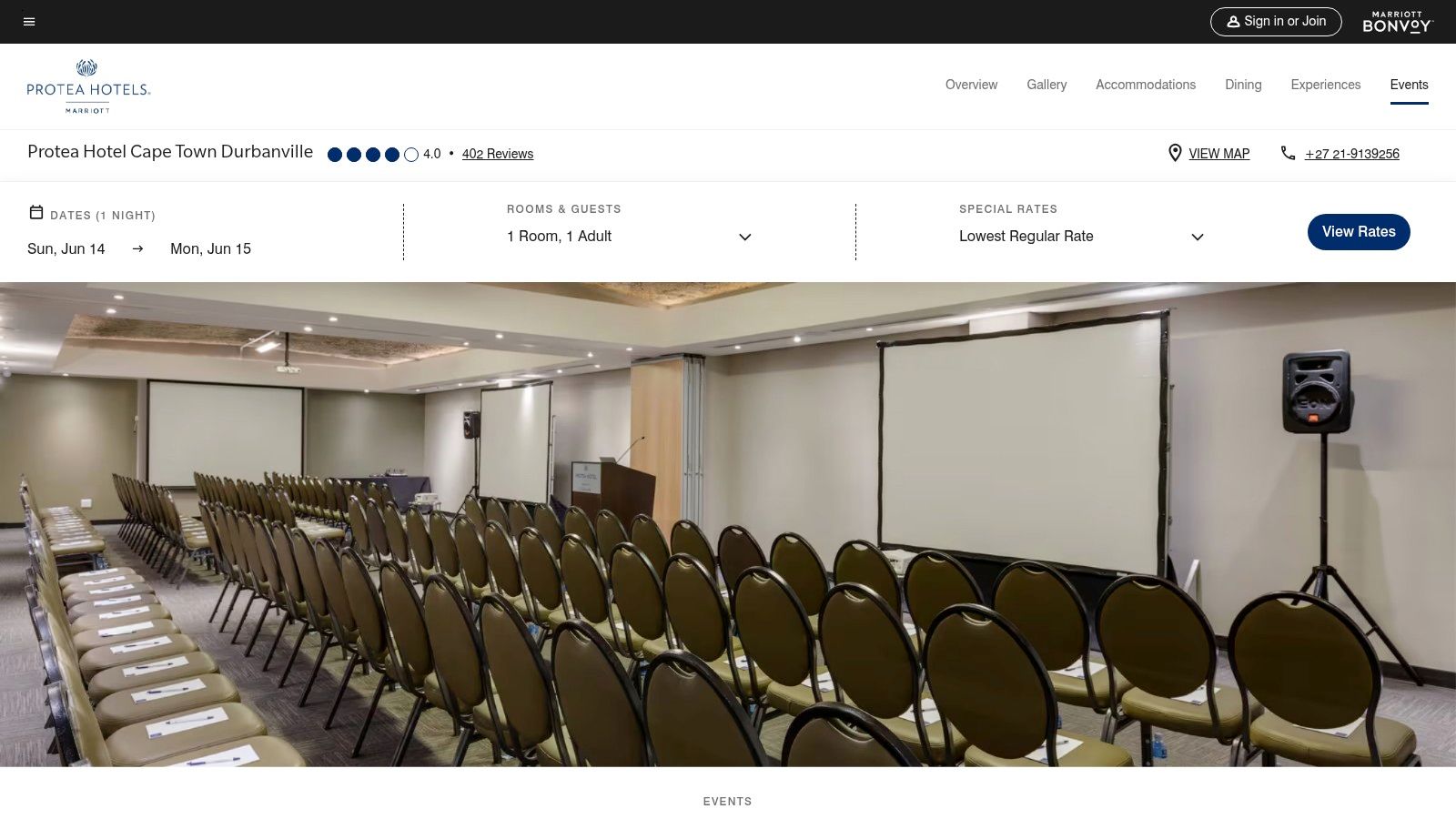
1. Protea Hotel Cape Town Durbanville

Protea Hotel Cape Town Durbanville (Marriott)

If your event includes overnight delegates, this is one of the easiest Durbanville options to manage. Hotel venues remove a lot of friction. Delegates sleep on site, catering stays centralised, and the events process tends to be tighter than at venues that only do conferencing occasionally.

Protea Hotel Cape Town Durbanville lists a maximum event-room capacity of 100, which puts it firmly in the reliable small to medium conference bracket. That's a strong fit for board presentations, training cohorts, internal launches, and multi-day meetings where accommodation matters as much as the room itself.

Where it works best

The strength here is operational ease. You've got hotel-standard coordination, in-house food and beverage, and fewer moving parts on event day. For corporate clients, that usually means fewer supplier headaches and less risk around timing.

What it doesn't do is scale into a large convention-style brief. If you need a very large plenary, exhibition-style circulation, or heavy custom staging, you'll feel the ceiling quickly.

Practical rule: Choose a hotel venue when your biggest planning risk is delegate logistics, not room customisation.

A useful ABC Hire pairing here is LED cocktail furniture for the pre-function area. It helps separate arrivals, networking, and post-session drinks from the formal conference room without fighting the hotel's existing look. If you're hosting a recognition dinner after the conference, bar units and lounge furniture can also shift the atmosphere from daytime business to evening social without needing a venue change.

For hotel operators looking at layout inspiration and guest-facing presentation, Virtual Tour Easy's hotel guide is a useful reference point.

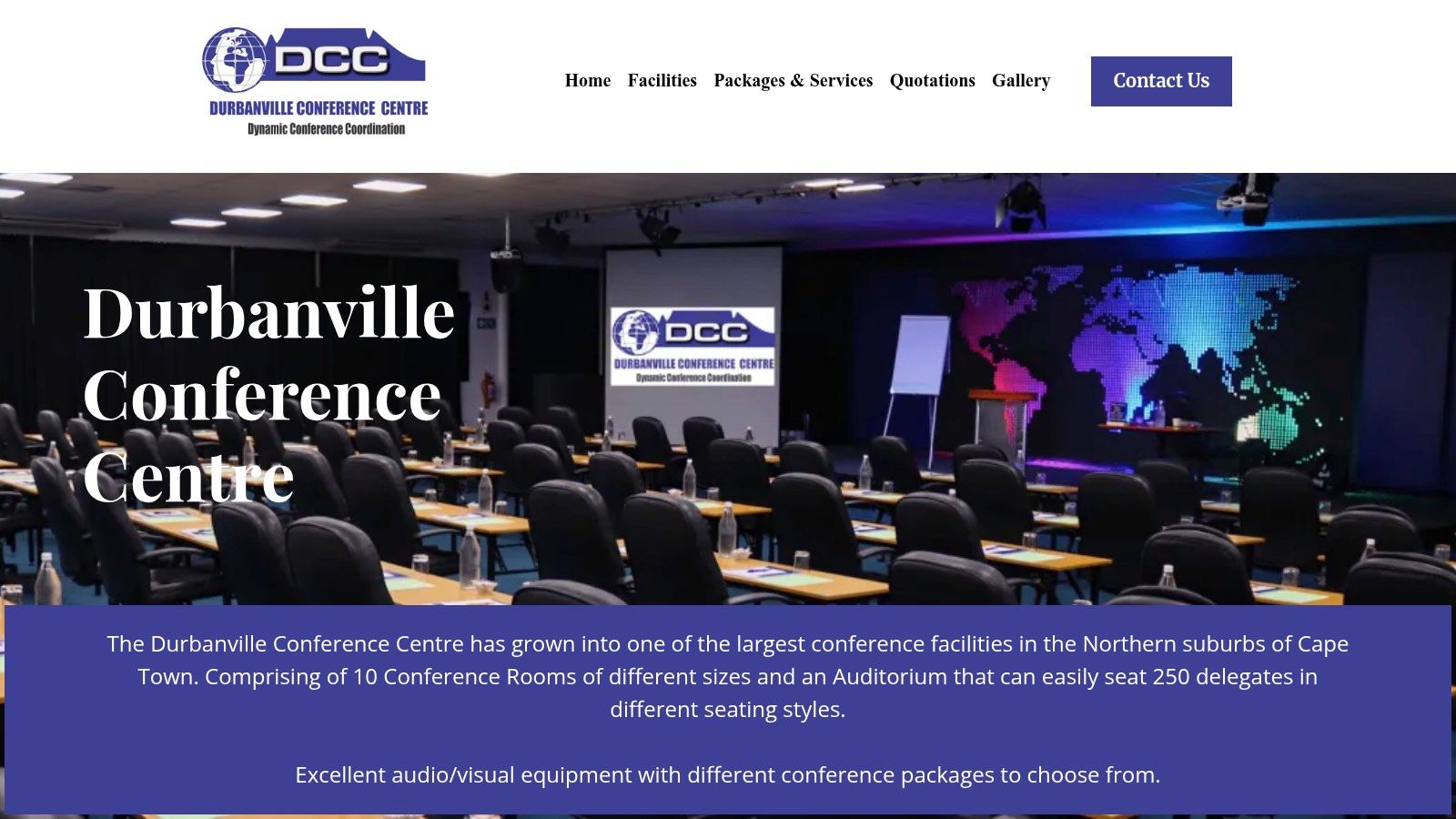
2. Durbanville Conference Centre

Durbanville Conference Centre (DCC)

When a client says they need breakouts, assessments, plenary sessions, and clean movement between rooms, Durbanville Conference Centre usually rises fast on the shortlist. It's a practical venue, and that's a compliment. It's built for programmes that need structure, not just a pretty backdrop.

The venue reports 10 air-conditioned conference and training rooms ranging from 25 m² to 470 m². That spread is exactly why it works for training days, seminars, exams, workshops, and mixed-format corporate events.

Why planners book it

The key advantage is room variety in one place. You can run a main session, split into working groups, bring everyone back together, and do it without bussing delegates between sites. In conference operations, that saves time and avoids late starts after breaks.

It's less compelling if your event brief is heavily hospitality-led or brand-aesthetic-led. The décor is functional, and that won't bother serious training clients, but it matters for client entertainment or luxury-facing events.

  • Best fit: Training-heavy programmes, multi-stream agendas, staff development, accreditation sessions
  • Watch for: Off-site accommodation planning if delegates are travelling in
  • Rental pairing: Extra registration counters, branded furniture, queue-control setup, and portable fans or heaters if your guest flow spills into transitional areas

For teams building a broader event plan around the venue, this guide to hosting a corporate event is worth using as a practical planning companion.

The right venue isn't always the prettiest one. It's the one that lets your agenda run on time.

3. Cassia Restaurant & Venues at Nitida Wine Farm

Cassia Restaurant & Venues at Nitida Wine Farm

Some events need more than a room. They need a setting that helps the room sell itself. Cassia at Nitida sits in that category. It's especially strong for client-facing events, strategy sessions with leadership teams, product reveals, and awards functions where the environment contributes to the experience.

The trade-off is straightforward. Wine-estate venues often feel more memorable than hotel conference stock, but you need to verify technical delivery early. AV, room reset timing, weather contingency, and access for hired equipment matter more here than they do in purely corporate venues.

Best use case

Cassia works well when hospitality is part of the programme, not an add-on. If lunch, wine service, outdoor mingling, and a polished dinner matter to the brief, this kind of venue can outperform a standard boardroom setup.

Where planners get caught is assuming the installed AV will cover a full conference spec. Sometimes it does. Sometimes it handles the basics, and you still need stronger sound, staging support, confidence monitors, or extra microphones.

That's where a smart rental overlay makes a difference. Pair the venue with additional sound support, freestanding cocktail tables for terrace networking, and lounge furniture for a softer reception flow. If your programme includes speeches in a larger room or outdoors, it's sensible to plan audio properly from the start instead of relying on light built-in coverage. Consequently, speaker hire options become part of the venue decision, not an afterthought.

A scenic venue lifts energy fast. Poor audio kills it just as fast.

For conference venues Durbanville planners often compare on atmosphere alone, Cassia is one of the better examples of a place where experience value can justify a little extra technical coordination.

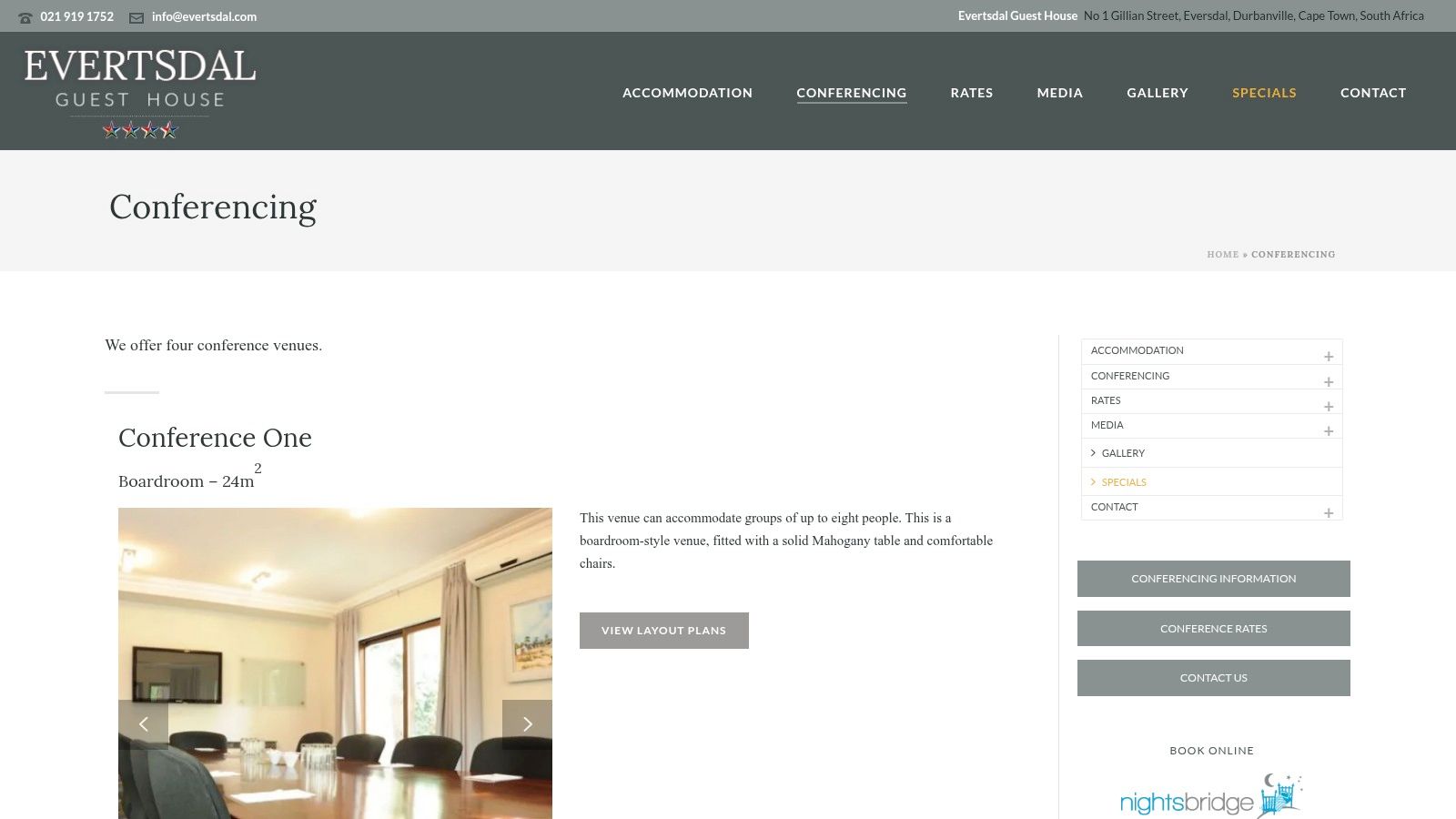
4. Evertsdal Guest House

Evertsdal Guest House – Conferencing

Evertsdal is a good reminder that not every successful conference needs scale. Some of the most productive sessions happen in smaller rooms where people can concentrate, talk plainly, and get through real work without the noise that comes with a bigger venue.

This is the sort of place that suits management workshops, interviews, off-site planning, and compact training groups. The residential setting tends to feel calmer than business-park stock, which helps when the agenda requires focus rather than spectacle.

What stands out

The appeal here is clarity. Smaller venues that publish layout guidance and package structure make life easier for planners, especially when the brief needs quick approval. You're not trying to reverse-engineer what the room can realistically hold.

It won't work for a broad plenary, and it isn't trying to. If your group needs multiple large sessions or significant production, move on. But for intimate conferencing, this is exactly the right kind of venue.

A useful ABC Hire pairing is flexible seating and support furniture. Extra café tables for breaks, upgraded chairs for longer sessions, or outdoor furniture for informal team discussions can make a smaller venue feel more generous without overcomplicating the footprint. If you need that flexibility, this guide to tables and chairs rental is a practical starting point.

  • Works well for: Workshops, coaching sessions, leadership meetings, interview panels
  • Less suitable for: Large plenaries, expo-style setups, heavy production
  • Helpful rental add-ons: Coffee station furniture, registration tables, outdoor seating, portable heating for winter garden breakaways

In Durbanville, small-format venues often outperform larger rooms when the goal is discussion, not presentation.

5. Cape Pillars Boutique Hotel

Cape Pillars Boutique Hotel – Conference

Cape Pillars is the executive-offsite option. If you're hosting a leadership team, a private strategy session, or a planning retreat where confidentiality and quiet matter, boutique hotels like this can work far better than a busier conferencing property.

Its limitation is also its strength. The room is compact, which keeps discussion tight and reduces distraction. For groups that need privacy and overnight convenience, that's often enough.

Who should book it

Book this when everyone in the room needs to contribute. Senior management sessions, tender evaluations, partnership meetings, and planning workshops all benefit from a smaller space with a controlled environment.

Don't book it if the programme might grow. Compact conference rooms are unforgiving once you add media gear, extra catering, or observers who weren't in the original brief.

A sensible rental pairing here is subtle rather than dramatic. Think upgraded boardroom chairs, a neat registration table if guests are arriving separately, and climate-control backup if you want the room to stay steady through a full day. In boutique spaces, comfort details are more visible because there's nowhere for poor setup to hide.

This is also one of the better fits if your client wants conferencing without the corporate feel of a larger hotel. That's a real advantage in Durbanville, where many event briefs sit between formal business and hospitality.

6. D'Aria Winery

D'Aria suits events that need breathing room around the agenda. If your conference brief includes a retreat feel, relationship building, or an incentive element, a winery setting can do work that a standard conference room cannot.

That said, estate venues demand better pre-production from the planner. You need to ask sharper questions about room flow, power, weather backup, loading, and what's included versus what must be brought in.

The real trade-off

The upside is obvious. A vineyard setting changes how the event feels the moment guests arrive. That matters for executive retreats, client entertainment, and culture-focused internal events.

The downside is that not every winery publishes detailed conferencing specifications online. When capacities, AV inventory, and package detail aren't fully transparent, the planner has to fill the gap through site visits and detailed enquiry.

Rentals can turn a beautiful venue into a functional one. At D'Aria, I'd look first at furniture zoning. Use lounge groupings for arrivals, bar furniture for networking, and portable cooling or heating for any transitional spaces. If part of the event moves outdoors, climate control becomes operational, not decorative.

One local content gap across conference venues Durbanville searches is room-fit transparency. Venue listings often mention broad descriptors, but they don't always compare practical factors like breakout suitability, parking, accessibility, or hybrid readiness clearly, as noted in this Durbanville venue planning overview. D'Aria is a good example of why planners should ask for specifics before signing.

7. Durbanville Golf Club

Golf club venues are useful when the event isn't just a conference. If you need a presentation, lunch, prizegiving, fundraiser, or team day with a social component, Durbanville Golf Club can be more effective than a conventional business venue because the setting already supports interaction.

That's especially true for networking-heavy briefs. People move differently in these spaces. They linger on balconies, circulate around the bar area, and settle into conversations more naturally than they do in a formal conference foyer.

When it makes sense

This venue makes sense when relationship building sits alongside the agenda. Sales functions, sponsor events, team recognition, and client golf days fit naturally here.

It's less ideal for technical conferences that need a published AV spec, multiple breakouts, or integrated accommodation. Those details usually need direct confirmation, so the venue works best when the event format is simpler.

Another consideration in the broader Cape Town region is weather planning. Indoor and outdoor venue choices can shift quickly with heat, wind, or rain, and that's one of the more useful overlooked planning angles in local conferencing. The need for backup indoor space, heating, cooling, and furniture flexibility is highlighted in this Ruslamere venue perspective on adaptable event setups.

If part of the appeal is the balcony, lawn, or bar spill-out, build a weather backup before guests arrive. Not after the forecast changes.

For ABC Hire pairings, cocktail tables, outdoor seating, portable heaters, and clean PA support usually add the most value. You don't need to overproduce the room. You need to support the social flow the venue already does well.

Durbanville Conference Venues, 7-Point Comparison

Venue Implementation Complexity 🔄 Resources & Efficiency ⚡ Expected Outcomes 📊 Ideal Use Cases 💡 Key Advantages ⭐
Protea Hotel Cape Town Durbanville (Marriott) Moderate, managed by hotel events team; brand procedures In-house accommodation, catering and basic AV; minimal external vendors Professional delivery; comfortable multi-day delegate experience; max plenary ~80 theatre Board meetings, multi-day training, corporate dinners Reliable brand standards; on-site rooms; Marriott Bonvoy benefits
Durbanville Conference Centre (DCC) Medium–High, multi-room scheduling and larger logistics Purpose-built AV and many rooms; accommodation off-site may require transport High-capacity, scalable delivery; auditorium up to ~250–280 Large trainings, examinations, multi-track conferences Flexible room sizes; high dedicated conferencing capacity
Cassia Restaurant & Venues at Nitida Wine Farm Moderate, event coordination plus outdoor/seasonal factors Strong in-house hospitality and F&B; installed AV; additional AV may be rented High-impact, memorable events; flexible combos up to ~200 banquet/300 cocktail Product launches, awards dinners, strategy days with client entertainment Scenic Winelands setting; food & wine experiences; flexible spaces
Evertsdal Guest House – Conferencing Low, straightforward, intimate operations Inclusive packages with published pricing, basic AV and garden breakouts Predictable costs and personalised delivery for small groups Board meetings, focused workshops, small training sessions Transparent 2026 rates; personalised service; pleasant break areas
Cape Pillars Boutique Hotel – Conference Low, compact single-room logistics Single equipped room, backup power for load-shedding, in-house catering Reliable, private executive sessions for up to ~15 delegates Leadership offsites tied to overnight stays Backup power; boutique privacy; clear published pricing
D'Aria Winery – Function Venue Moderate, bespoke packages require bespoke coordination On-site cottages and estate experiences; AV and capacities provided on enquiry Strong experiential outcomes for retreats and galas; bespoke logistics Multi-day retreats, incentives, gala dinners with on-site accommodation Historic Cape Dutch setting; on-site cottages; immersive experiences
Durbanville Golf Club – Function Room Low–Medium, simple function logistics with event add-ons Function room, private bar, balcony views; golf-day packages; no on-site rooms Good networking/team-building outcomes when combined with golf activities Award lunches, fundraisers, corporate golf days and meetings Course views, integrate golf activities, in-house catering

Bringing Your Durbanville Event to Life

Durbanville gives planners a strong spread of venue styles. You've got hotel-backed conference space, purpose-built training infrastructure, intimate guesthouses, boutique executive settings, wineries with hospitality appeal, and lifestyle venues that work for hybrid business-social events. That range is useful because most conference briefs in this area aren't looking for a massive convention hall. They're looking for a venue that fits the agenda cleanly.

That's also why venue choice shouldn't stop at capacity. A room can technically fit your delegates and still be the wrong venue if registration bottlenecks, breakout movement is awkward, the AV is too light, or the space feels flat once the chairs are in. Durbanville Conference Centre, for example, is strong when you need multiple room formats in one place. Protea Hotel Cape Town Durbanville is easier when accommodation logistics matter. Wine-estate venues such as Cassia and D'Aria make more sense when hospitality and atmosphere are part of the outcome.

The Western Cape remains a major meetings and events destination, and that raises the standard for execution. In practical terms, that means your edge often comes from setup decisions, not just venue selection. Lighting, furniture zoning, speaker coverage, registration flow, and climate-control planning are the details guests experience.

That's where rental support becomes useful. A standard room can feel significantly more polished with the right furniture layout, and an outdoor or mixed-use venue becomes safer to run when you've planned for weather shifts properly. For planners looking to tighten the full event strategy, these professional event planning strategies are worth reviewing alongside venue selection.

If you're comparing conference venues Durbanville options now, start with the format of the day. Ask how the event needs to feel, how delegates need to move, and what the venue doesn't include. Once those answers are clear, the shortlist usually gets much simpler. ABC Hire is one practical option for adding furniture, climate control, and event equipment that helps tailor the venue to the programme rather than forcing the programme to fit the room.


If you've chosen the venue but still need the room to work harder, ABC Hire can help with conference furniture, LED pieces for networking areas, seating, tables, speakers, and climate-control equipment for Durbanville events and the wider Cape Town area.

Small Conference Venues Cape Town: Top 7 for 2026

Planning a small conference, workshop, or executive offsite in Cape Town usually starts the same way. You open a few venue tabs, everything looks polished, and then the practical questions hit. Will the room feel right for a group that's too big for a boardroom but too small for a ballroom? Is the AV built in, or are you about to patch together screens, speakers, and extra furniture at the last minute?

That's where most generic venue round-ups fall short. Cape Town has real depth in its meetings market, from purpose-built convention infrastructure to compact hotel boardrooms, which is part of why the city is so adaptable for different event formats. The Cape Town International Convention Centre profile lists 49 meeting rooms, a largest room capacity of 1,080, and 21,237 square metres of exhibit space, while city venues also include much smaller rooms such as the 14-delegate boardroom at Cape Grace and a 6-delegate boardroom at Pepperclub. If you're weighing format, flow, and setup, that breadth matters.

This guide gets to the useful part quickly. These are strong small conference venues Cape Town planners can work with, paired with practical furniture rental ideas so the room functions properly on the day. For broader planning context, it's also worth skimming these venue planning tips from Corporate Challenge.

1. Workshop17 Watershed (V&A Waterfront)

Workshop17 Watershed (V&A Waterfront)

If your event needs to feel modern, efficient, and low-friction, Workshop17 Watershed is one of the easiest venues to work with. It suits the kind of meeting where people need to arrive, plug in, and start. That makes it a strong fit for training sessions, founder meetups, leadership workshops, and compact conference formats that don't need hotel-style formality.

The biggest win here is operational simplicity. The V&A Waterfront location is easy to sell to delegates, and coworking venues usually understand that timing, connectivity, and room turnaround matter as much as décor.

Best-fit setup

For this venue, I'd keep the furniture package clean and modular. A practical ABC Hire setup is trestle tables or slim conference tables, conference chairs that can stay comfortable through a full morning session, a registration table near the entrance, and a few cocktail tables outside the room for breaks and informal chats.

That works especially well when you're running a session with notes, laptops, and a short catering break between blocks.

  • Best for corporate workshops, team training, startup presentations, and planning sessions
  • Furniture pairing conference tables, stackable conference chairs, a welcome desk, and a water station setup
  • What to avoid bulky lounge furniture inside the room, it eats floor space fast

Practical rule: In a coworking venue, rent only what improves flow. Don't fill the room because there's empty space on the floor plan.

There is a trade-off. External catering can be restrictive in this kind of venue, so if your agenda depends on a branded food experience or a custom drinks station, confirm that before you sign. Waterfront parking can also become annoying at peak times, so I'd put arrival instructions into the calendar invite, not a follow-up email people won't read.

If your conference has a team-bonding component before or after the formal session, these corporate team building event ideas can help shape the programme around the venue.

You can enquire directly with Workshop17 Watershed.

2. The Bay Hotel – Boardroom & Conference Room (Camps Bay)

The Bay Hotel – Boardroom & Conference Room (Camps Bay)

Some venues help because they remove decision fatigue. The Bay Hotel is one of them. If you're organising a senior team offsite, a client-facing session, or a strategy day where setting matters almost as much as content, this is a sensible option.

The venue has an executive boardroom for 12 and a 90 m² conference room that can handle a small conference format without feeling oversized. That size range is useful because the awkward middle is where many planners lose budget. You don't want delegates rattling around in a room built for a much bigger event, and you also don't want to squeeze presentation seating into a boardroom just because the hotel looks good online.

Where it works best

The Bay Hotel works when you want a polished day package and a location people are happy to attend. For client presentations, leadership reviews, or a private planning day, the beachfront setting helps. So do the breakout options, especially if you want lunch or coffee to feel like a reset rather than a queue in a corridor.

For furniture, I'd use ABC Hire selectively here. The venue already carries hospitality polish, so the rental package should solve function, not compete with the hotel interior.

  • Recommended add-ons a branded registration desk, café tables for networking, and a few lounge pieces for sponsor or speaker holding areas
  • Good room format classroom or cabaret for content-heavy sessions, boardroom for decision-making meetings
  • Skip this overdecorating with too many soft seating zones if the session is only a half-day event

The best small conference venues Cape Town offers don't just look good in photos. They reduce friction in timing, catering, and room reset.

The downside is straightforward. Camps Bay traffic can throw off arrivals, and parking can be tighter than delegates expect. I'd never run a sharp 08:00 start here without giving guests a realistic arrival window and backup parking guidance.

If your guest list is compact and the mood needs to be premium without becoming stiff, The Bay Hotel is a strong contender.

3. Vineyard Hotel – Conference Centre (Newlands)

Vineyard Hotel – Conference Centre (Newlands)

When planners ask for a venue that's dependable rather than flashy, I often think of places like Vineyard Hotel. Newlands gives you a calmer delegate experience than the Waterfront or Camps Bay, and that matters if the day is built around concentration, conversation, and not losing people to city distractions.

This is the kind of venue that works well for strategy days, internal workshops, education sessions, and multi-part agendas with breakouts. The gardens and terraces help break the rhythm of the day, which is useful when the programme runs longer than a quick morning meeting.

Why planners keep shortlisting it

The practical advantage here is stability. If you're running presentations, panel discussions, or hybrid elements, you want a venue team that knows conference operations rather than one that treats your booking like a side function between restaurant covers and weekend leisure traffic.

A sensible ABC Hire package here would include:

  • Conference chairs for all-day comfort, especially if your standard hotel stock feels too banquet-oriented
  • Small stage furniture such as lecterns, side tables, and speaker stools for panel or keynote segments
  • Outdoor breakout pieces like cocktail tables for terrace coffee breaks

The room layout matters more than the furniture count. For a training-heavy agenda, classroom works. For discussion-led sessions, cabaret is usually the better choice because it keeps note-taking practical without forcing everyone into a rigid boardroom posture.

The city's broader conference market supports this kind of layered venue choice. Wesgro's destination guide describes Cape Town as having “arguably the most advanced infrastructure on the continent of Africa” and also highlights venue depth, including hotel conference inventory with 11 meeting rooms, 4,342 square feet of event space, and rates ranging from $21 to $5,636 in the market mix shown in the guide (Wesgro conference guide).

If your programme includes presenters or panel discussions, renting reliable speakers for conference sessions is worth planning early instead of assuming the in-house system will cover every room format.

You can review the venue options at Vineyard Hotel meetings and events.

4. Mount Nelson, A Belmond Hotel – Small Rooms & Salons (Gardens)

Mount Nelson is for events where perception is part of the brief. Not in a superficial way. In the practical sense that some meetings need quiet prestige, careful service, and a setting that tells guests this conversation matters.

That makes it well suited to board meetings, investor discussions, premium brand briefings, and high-touch executive events. If your delegates are flying in, meeting clients, or making decisions that require privacy and focus, the environment does real work before the first slide appears.

The right rental approach

At a heritage luxury venue, the mistake is bringing in furniture that feels temporary or too commercial. Keep the rental package restrained. Think polished registration furniture, elegant occasional tables, additional conference chairs only if needed for a specific configuration, and subtle outdoor pieces for terrace networking or post-session drinks.

I'd also consider climate support and soft layout zoning if the schedule moves between formal discussion and relaxed breakout.

“Premium venue” doesn't automatically mean “perfect conference flow”. Walk the path from arrival to registration to breakaway before you finalise the setup.

Service is a major strength here, but premium hotels come with premium expectations. You'll need to lock in timing, menu format, and room use properly because late changes tend to be expensive in this class of venue. Availability can also tighten quickly when leisure demand is strong.

One of Cape Town's useful planning advantages is that small premium rooms are part of the city's normal meetings inventory, not an afterthought. For example, the Cape Grace meetings page lists a boardroom for up to 14 delegates with integrated audio-visual capability, which shows how strongly the local market supports intimate business events with built-in infrastructure.

If your event needs understated luxury and you don't want the room to feel transactional, Mount Nelson event venues deserve a serious look.

5. Two Oceans Aquarium – Conferences & Meetings (V&A Waterfront)

Two Oceans Aquarium – Conferences & Meetings (V&A Waterfront)

If your event needs memorability, not just meeting space, the Two Oceans Aquarium gives you something most venues can't. Delegates remember it. Sponsors photograph well in it. Client events feel less scripted in it.

That makes it especially good for launches, stakeholder gatherings, creative industry sessions, and conference formats where networking matters as much as presentations. It can also work for internal events when the brief is to get people out of standard hotel mode.

What works and what doesn't

This venue suits a furniture plan that creates clear zones. Don't try to force every activity into one room layout. Use ABC Hire pieces to separate registration, content seating, pause areas, and evening networking if the event rolls on after the formal programme.

A practical package might include:

  • Reception furniture for check-in and branded collateral
  • Cocktail tables for sponsor mingling or pre-function drinks
  • Conference seating arranged cleanly for talks or short plenary segments
  • LED furniture only if the event extends into a launch or evening format where lighting becomes part of the atmosphere

Some of the most successful events here treat the conference portion as one part of a broader experience. A morning talk, then guided interaction, then drinks. That sequence feels natural in an experiential venue.

The trade-off is that not every aquarium space is ideal for dense all-day training. If your delegates need laptops open for hours, heavy note-taking, and repeated breakout reshuffles, a more conventional venue may perform better. Bespoke timing and after-hours access can also complicate logistics.

Still, for planners who want small conference venues Cape Town guests will talk about afterwards, Two Oceans Aquarium conferences and meetings offers a distinctive option.

6. Ideas Cartel – The Old Foundry (Green Point)

Ideas Cartel – The Old Foundry (Green Point)

Ideas Cartel works well when the room needs personality. Not gimmicks. Just a more design-led environment than a standard hotel conference floor. That's useful for founder sessions, executive workshops, agency presentations, and compact offsites where you want people alert and engaged rather than mentally filing the day under “another meeting room”.

The Green Point position also helps. It's close enough to the CBD and Waterfront to stay convenient, but it often feels less corporate than a pure business district venue.

Best package for a boutique space

These rooms usually cap out quickly, so furniture has to be chosen with discipline. My preference here is to rent only the pieces the venue can't flex on demand. That might mean extra seminar chairs, a signing table, a narrow registration desk, or room dividers to create a holding area, green room, or breakout edge without booking an extra room.

For many planners, screens and partitions are the hidden fix in spaces like this. If you need to split a room visually or improve privacy, room screen dividers for events can change the usability of a boutique venue without making it feel cluttered.

  • Strong fit board meetings, investor updates, product demos, and creative workshops
  • Rental sweet spot compact furniture, presentation support items, and mobile zoning pieces
  • Potential issue if your delegate count creeps up, the room can feel full before the schedule starts

On-site reality: In design-led venues, one extra table in the wrong place can make the room feel smaller than it is.

The city's practical conference geography matters here too. Cape Town's convention ecosystem is anchored around the Foreshore and CBD, with the CTICC operating two connected buildings in that core, which is one reason nearby smaller venues benefit from being plugged into the same business and transport network (CTICC venue context).

For stylish small-group sessions, Ideas Cartel events and enquiries is worth exploring.

7. The Twelve Apostles Hotel & Spa – Meetings & Events (near Camps Bay)

This is a venue for offsites where you want people away from the city noise. The Twelve Apostles works best when the agenda includes strategy, leadership discussion, or client hospitality that benefits from privacy and a more secluded setting.

The appeal is obvious. Ocean, mountain, premium service, and a setting that nudges people into a slower, more focused rhythm. That's useful for executive planning days and multi-day small conferences where overnight stay, dining, and relaxation are part of the event design.

How to make the space work harder

I'd use an ABC Hire package here to sharpen function inside an already beautiful setting. Add what supports the programme: boardroom tables if the conversation needs a tighter shape, comfortable conference chairs, branded lecterns, and outdoor cocktail furniture for terrace breaks or end-of-day networking. If the event stretches across a full day, climate control support can also be worth considering depending on the exact room and season.

This venue rewards thoughtful scheduling. Build in arrival time. Keep sessions focused. Use the scenery as part of the cadence of the day instead of trying to cram too much into the timetable.

The broader Cape Town market also shows why this sort of hybrid planning matters. Many venue pages still focus on room listings instead of true small-event fit, even though planners often need a configurable space for roughly 10 to 60 people, along with practical items like seating layout, breakout furniture, AV, and climate support. The Pepperclub meetings context reflects that gap, including intimate rooms and a mid-size option, while pointing to the need for a more customized setup approach.

The only real caution is access. It's not the venue for delegates who need quick in-and-out public transport convenience. Travel time, parking, or shuttles need active planning.

For private, high-service events near Camps Bay, The Twelve Apostles meetings and events is one of the more compelling premium options.

7 Small Conference Venues in Cape Town, Comparison

Venue 🔄 Implementation complexity ⚡ Resource requirements ⭐ Expected outcomes / 📊 Impact Ideal use cases 💡 Key advantages
Workshop17 Watershed (V&A Waterfront) 🔄🔄, Simple booking, standard AV & support ⚡⚡, On-site AV, events team, Wi‑Fi ⭐⭐⭐⭐ / 📊 Reliable professional small events 4–40 pax meetings, training, small conferences 💡 Central Waterfront, fast Wi‑Fi, member discounts
The Bay Hotel – Boardroom & Conference Room (Camps Bay) 🔄🔄, Packaged setup simplifies logistics ⚡⚡⚡, AV, F&B packages, venue staff ⭐⭐⭐⭐ / 📊 Strong delegate satisfaction, scenic appeal Senior offsites, client sessions (≤60), executive meetings 💡 Beachfront views, all‑in packages aid budgeting
Vineyard Hotel – Conference Centre (Newlands) 🔄🔄, Established conferencing workflows ⚡⚡, Professional events team, generator backup ⭐⭐⭐⭐ / 📊 Dependable operations, good for strategy days Workshops, strategy sessions, 8–40 delegates 💡 Tranquil gardens, generator-backed reliability
Mount Nelson, A Belmond Hotel – Small Rooms & Salons (Gardens) 🔄🔄🔄, High‑touch, concierge coordination ⚡⚡⚡, Premium F&B, concierge/event staff ⭐⭐⭐⭐⭐ / 📊 Impressive, premium board-level outcomes Board meetings, VIP client events, premium small gatherings 💡 Heritage ambiance and top-tier service
Two Oceans Aquarium – Conferences & Meetings (V&A Waterfront) 🔄🔄🔄, Event-specific logistics and timing ⚡⚡⚡, Themed setup, venue-specific staff ⭐⭐⭐⭐⭐ / 📊 Very high “wow” factor; memorable brand events Launches, client entertainment, evening receptions 💡 Immersive marine backdrop; strong experiential appeal
Ideas Cartel – The Old Foundry (Green Point) 🔄🔄, Flexible, pay‑as‑you‑use coordination ⚡⚡, Coworking amenities, café, optional rooms ⭐⭐⭐⭐ / 📊 Stylish, creative small‑group outcomes Offsites, client presentations, executive sessions ≤20 💡 Design-led spaces, on-site hotel and café for multi‑day events
The Twelve Apostles Hotel & Spa – Meetings & Events (near Camps Bay) 🔄🔄🔄, Premium event planning and logistics ⚡⚡⚡, Dedicated events team, generator, F&B ⭐⭐⭐⭐⭐ / 📊 High-quality, focused offsite outcomes Leadership offsites, private client meetings, incentives 💡 Scenic ocean/mountain views, spa and bespoke service

Your Event, Perfectly Equipped

Choosing the venue is only half the job. The room still has to work once people arrive. That means registration has to make sense, seating has to support the agenda, breakout areas need to feel intentional, and the event can't fall apart because a venue's built-in furniture doesn't match the format you need.

That's why small conference planning in Cape Town usually works best when you treat the venue and the room setup as one decision, not two. A coworking space may already have the right energy and AV, but need better registration furniture and cleaner breakout zones. A premium hotel may look impeccable, but still benefit from extra conference chairs, branded lecterns, café tables, or terrace furniture that makes networking feel natural. An experiential venue may need the most discipline of all, with furniture used to create flow instead of visual clutter.

The city is particularly strong for this approach because its conference ecosystem isn't limited to one venue type. You can run a polished executive session in a luxury hotel, a workshop in a coworking space, a strategy day in the Southern Suburbs, or a memorable client event at the Waterfront. The best choice depends less on headline prestige and more on whether the venue supports your agenda, delegate profile, and service expectations.

The practical lesson is simple. Match the room to the job, then rent only what improves the event. That usually means tables and chairs first, then presentation support, then breakout and comfort elements. If you get that order right, the event feels smooth. If you get it wrong, even a beautiful venue can feel awkward and underprepared.

If you're comparing small conference venues Cape Town planners regularly use, build your shortlist around flow, not just photos. Once the venue is locked in, a rental partner can help translate the brief into the actual room experience. ABC Hire is one option for conference furniture and related event equipment in Cape Town, including chairs, tables, LED furniture, and climate-control items that can help adapt a venue to the format you're running.


If you've chosen the venue and now need the room to function properly on the day, speak to ABC Hire about a customized conference furniture and equipment setup for your Cape Town event.

Deck and Patio Furniture: A Cape Town Event Guide 2026

The venue looks perfect at first glance. A timber terrace on a wine farm. A sea-facing deck in Camps Bay. A lawn in Franschhoek with mountain light dropping softly behind the vines. Then the practical questions arrive. What will still look polished after a full afternoon of sun? Which lounge chairs won't shuffle across the paving when the wind picks up? What survives salt in the air without looking tired by the second event?

That's where deck and patio furniture stops being décor and starts becoming event infrastructure.

Planners are under pressure to deliver outdoor spaces that feel as comfortable as an interior lounge. That expectation isn't anecdotal. The global outdoor furniture market was valued at USD 52.96 billion in 2025, driven by growing interest in stylish outdoor living spaces, according to The Business Research Company's outdoor furniture market report. Guests want softness, layout, lighting, and detail. They don't want an outdoor setup that feels improvised.

Cape Town and the Winelands reward good choices and punish lazy ones. The right rental mix gives you flexibility without forcing you to own, store, maintain, and replace furniture that only suits some venues and some seasons. That's usually the smarter route if you want a high-end result without tying up budget in stock that may be wrong for the next site.

Crafting Unforgettable Outdoor Events in Cape Town

A new planner often starts with the mood board. That's normal. You see pale timber, woven textures, low lounges, scattered side tables, candles, maybe a long outdoor dining run under festoon lights. Then the site visit changes the brief.

On a Clifton deck, the breeze isn't a detail. It changes what you can safely place near the edge and what needs more weight. In Stellenbosch, hard afternoon sun affects fabric choice, guest comfort, and where lounge clusters should sit once speeches begin. On a Winelands terrace, the furniture has to look refined from the first guest arrival to the final collection, even after service staff, photographers, and guests have moved through it all evening.

That pressure is why deck and patio furniture needs to be selected as a system, not as isolated pieces.

The look has to work with the site

A beautiful outdoor event usually has three things in balance:

  • Comfort: Guests need somewhere to settle, not just perch.
  • Visual order: The space has to feel designed from every approach angle.
  • Practical resilience: Furniture must still perform when wind, moisture, or heat start interfering.

If you're still shaping the broader surface and design direction, these insights for your patio decking project are useful because they help you think about how the deck itself influences furniture style, flow, and atmosphere.

Outdoor furniture at an event doesn't succeed because it photographs well. It succeeds because guests use it easily and the setup still looks intentional under real weather conditions.

Why rental usually makes more sense

Owning stock sounds efficient until the venue changes. One weekend needs clean-lined aluminium lounges for a rooftop launch. The next needs warmer timber tones for a wedding on a farm. Then a private party wants LED cubes and soft seating that can move from sunset drinks to late-night dancing.

Rental keeps your options open. It also removes the hidden burden that planners underestimate. Storage, cleaning, transport, repairs, fading cushions, chipped finishes, and missing components all eat time. Hiring the right pieces for the venue, season, and guest profile is usually a better decision than trying to make one permanent stock list solve every brief.

Choosing the Right Furniture Material for the Cape Climate

Material choice is where many outdoor events are won or lost. In Cape Town, furniture isn't just dealing with occasional weather. It's dealing with high UV, wind-driven moisture, and saline air at coastal venues. For timber-based products, proper treatment matters, and corrosion-resistant fasteners such as stainless steel matter too, as noted in this guidance on outdoor material durability in South African conditions.

A planner who chooses only by colour or shape usually pays for it later. The finish degrades, the hardware stains, the cushions age unevenly, or the setup starts looking worn long before guests arrive.

What each material does well

Below is the working comparison I'd use for Cape Town events.

Material Pros for Cape Town Cons for Cape Town Best For
Powder-coated aluminium Handles coastal air well when properly finished. Lightweight for transport and fast setup. Clean, modern look. Can be too light for exposed windy sites unless the design has enough footprint or weight. Lower-end coatings show wear quickly. Rooftops, terraces, corporate events, modern lounges
Hardwood such as teak Strong visual warmth. Good choice where a natural look matters. Better suited to outdoor exposure than decorative indoor timber. Heavier and usually more expensive. Needs consistent care if you want it to keep a polished look. Poor hardware choices create problems. Weddings, wine farms, premium dining and lounge areas
All-weather wicker or synthetic rattan Softer resort-style feel. Works well for relaxed lounges. Better than natural wicker outdoors if the weave and frame are good quality. Cheap versions fade, sag, or crack. Can collect dust and grime in the weave. Wind can move lighter pieces. Poolside events, garden parties, casual luxury setups
High-grade plastic or resin Easy to clean. Useful for back-of-house or flexible seating plans. Can be practical for wet conditions. Lower-end pieces can look temporary, become brittle, or cheapen a premium event. Large functions, support zones, practical overflow seating

The Cape Town trade-offs that matter

Aluminium is often the safest broad-choice material for event hire because it travels well, looks neat, and resists many of the issues that attack ordinary metal near the coast. But planners make a mistake when they assume all aluminium furniture suits all outdoor sites. On a calm courtyard, that's fine. On an exposed Atlantic-facing venue, it may need heavier table bases, denser grouping, or sheltered placement.

Teak and other outdoor hardwoods work beautifully in the Winelands because they sit naturally against stone, vineyard views, and timber decks. They tend to look more expensive, too. If you want a good primer on what makes teak attractive outdoors, Urban Man Caves on teak furniture gives a useful overview. The catch is maintenance. Timber that's neglected doesn't age romantically at events. It just looks tired.

Don't confuse outdoor-looking with outdoor-grade

Many planners hire from photos. That's risky. A woven armchair may look coastal and premium online, but if the weave is low-grade or the frame fixings aren't suited to marine air, the piece won't hold up. The same goes for timber items with decorative steel hardware that starts staining in damp conditions.

A simple filter helps:

  • For coastal venues: Prioritise aluminium, marine-sensible hardware, and timber only if it's properly suited to outdoor exposure.
  • For inland Winelands venues: Use timber more confidently, but still watch UV, dust, and cushion fade.
  • For highly exposed lawns and terraces: Avoid anything too light unless it's part of a controlled, sheltered arrangement.
  • For fast turnaround events: Choose materials that wipe clean quickly and still look sharp under bright daylight.

For a broader practical view on pieces built to handle the elements, this guide to weather-resistant outdoor furniture is worth keeping in your planning file.

Practical rule: If a piece needs perfect weather and careful handling to look good, it's not the right hero item for an outdoor event.

Furniture Sizing and Layout for Flawless Event Flow

The most expensive lounge setup can still fail if guests don't know how to move through it. Outdoor events need breathing room, sightlines, and enough flexibility that the space still works once catering, bars, photographers, and speeches start sharing the same footprint.

In the Western Cape, wind also affects layout. Stability matters. Furniture with a low centre of gravity, wide bases, or sufficient mass is the safer choice for exposed venues, following the same practical wind logic discussed in this note on outdoor furniture stability and SANS 10160 context.

A social outdoor evening event on a patio with guests mingling, fire pits, and comfortable lounge seating.

Build in zones, not rows

A strong outdoor layout usually has clear use areas rather than one continuous spread of furniture. Guests read zones instinctively when the furniture is organised properly.

For most events, I'd separate the space into:

  • Arrival or welcome zone: A clean first impression with standing tables or a small seating pocket.
  • Main social zone: The largest lounge or dining area where guests naturally gather.
  • Transition zone: Space between bar, food, and seating that keeps traffic moving.
  • View or premium zone: The best-positioned seating cluster, reserved for the strongest visual payoff.

If every piece is pushed to the perimeter, the centre often dies. If everything is clustered too tightly, service becomes awkward and guests hesitate to sit.

Different events need different flow

Weddings

Wedding guests need softness and intimacy. Use smaller seating groups rather than one oversized lounge block. That creates conversation pockets and keeps the event from feeling like a waiting area.

Keep ceremony, drinks, and reception transitions obvious. Guests shouldn't have to guess where to move next.

Corporate functions

Corporate events need cleaner circulation and stronger visual discipline. Leave obvious paths for networking, branded moments, and staff movement. Cocktail tables can help bridge between standing conversation and seated lounge use.

Avoid over-furnishing. If the setup is too dense, people stop moving and the event loses momentum.

Private parties

Private celebrations can be looser, but they still need structure. Create one energetic zone near music or the bar, then soften the perimeter with lower lounge pieces. People want options. Some guests dance, some talk, some sit and stay.

Low seating works best outdoors when it's anchored by tables, rugs, planters, or lighting. Otherwise it can look like furniture was simply dropped into the venue.

Use furniture to shelter people from wind

You can't eliminate the south-easter, but you can reduce how it affects the guest experience.

Try these placement decisions:

  • Turn lounge backs toward prevailing wind where possible.
  • Use lower profiles on exposed edges of decks and terraces.
  • Choose wider-based tables so they feel planted.
  • Place the most comfortable soft seating in naturally protected corners, behind screens, walls, or planting.
  • Avoid tall, top-heavy combinations in open positions.

A good outdoor layout feels relaxed because somebody has already solved the practical problems before guests notice them.

Styling Your Space With LED Accents and Lounge Pieces

The quickest way to make an outdoor event feel expensive is to layer comfort with controlled lighting. The quickest way to make it feel messy is to throw in glowing furniture without a visual plan.

LED pieces work best when they support the layout rather than dominate it. They should define edges, draw attention to key zones, and help the event transition from daylight to evening. They shouldn't turn a vineyard dinner into a nightclub unless that's exactly what the brief calls for.

Screenshot from https://abchire.co.za

Keep one element calm

If the LED furniture is the statement, the lounge pieces should do the grounding. Neutral sofas, clean-lined ottomans, and simple coffee tables let the lighting feature read as deliberate. If the upholstery is already bold, scale the lighting back.

A simple styling balance works well:

  • Soft seating sets the tone
  • LED pieces create punctuation
  • Textiles bring warmth
  • Small tables make the lounge usable

That last point gets ignored constantly. Guests need somewhere to place a drink, clutch, phone, or canapé plate. A beautiful lounge without enough surface area always underperforms.

Use light for shape, not novelty

LED cubes, benches, and bar elements can divide space very effectively after dark. They help signal where the party continues once natural light fades. But the light colour matters. Cool, harsh tones can flatten the atmosphere. Warmer or controlled tones usually sit better with timber decks, natural stone, and vineyard or coastal settings.

If the venue design already includes railing or deck-edge lighting, this guide to Ultra Modern Rails cable railing systems is a useful reference for thinking about how line lighting can support the broader look of the outdoor environment.

For lounge-focused styling ideas that feel polished rather than overdone, this article on modern lounge furniture for events is a practical place to start.

Fabrics and colour need to work in daylight first

Cape Town light is unforgiving. Cushions that look rich indoors can look flat outside. White and oatmeal tones are elegant, but they show marks quickly. Charcoal and taupe hide wear better, but can feel heavy in full sun if the rest of the palette is dark.

I'd usually steer planners toward:

  • Stone, sand, olive, charcoal, or muted navy for broad versatility
  • Quick-drying outdoor fabrics when pieces may sit out through dew or coastal moisture
  • Accent cushions used sparingly, not everywhere
  • Texture over pattern when the setting already provides the drama

Evening styling works best when guests notice the mood before they notice the furniture.

Mastering Rental Logistics and Budgeting

Furniture rental goes wrong long before delivery day. It goes wrong when planners don't define the venue properly, don't allocate budget by priority, or don't confirm access and timing early enough.

The strongest rental process is boring in the best way. The right items arrive on time, fit the venue, suit the weather risk, and leave without creating a post-event mess for the planner to absorb.

Budget by function, not by category alone

If you only budget by item type, you can end up with plenty of seating and no coherence. Start by assigning budget according to what the event must do.

A practical breakdown looks like this:

  • Guest comfort: Main seating, dining, or lounge requirements
  • Visual impact: Hero pieces, statement bar elements, lighting accents
  • Operational necessity: Registration tables, service support, bar backs, waiting areas
  • Contingency: Last-minute weather shifts, add-ons, replacements, access complications

This approach protects the essentials first. It also stops decorative pieces from consuming budget that should have gone to guest flow or comfort.

Site details matter more than planners think

Before confirming deck and patio furniture, check the things that cause real problems on setup day:

  1. Access route. Can large lounge pieces get from truck to site without stairs, narrow gates, or gravel slowing everything down?
  2. Surface type. Timber deck, grass, cobble, and stone all change what sits level and what needs protective feet.
  3. Exposure. Is the site shielded, partially exposed, or fully open to coastal wind?
  4. Venue timing. What are the delivery and collection windows, and who is opening the site?
  5. Power points. If you're using LED pieces, bars, or other powered items, the power plan can't be an afterthought.

What a planner should confirm with a rental partner

Good rental management reduces risk. Great rental management also saves time because the planner doesn't have to keep solving predictable issues.

Ask for clarity on:

  • Condition expectations: What level of wear is normal for event hire stock?
  • Placement support: Who is positioning furniture on site?
  • Weather contingency: What happens if the layout has to change?
  • Damage responsibility: Is there a waiver, and what does it precisely cover?
  • Collection timing: Can the venue accommodate next-day collection if the event ends late?

If you want a practical overview of why hiring often beats buying for events, this guide to renting furniture for events covers the operational side well.

A planner's best move is to treat rental as part of event design and risk management, not as an isolated supplier line item. That's when the process becomes easier and the result looks more professional.

Actionable Checklists for Your Next Outdoor Event

A solid outdoor event usually comes down to a few disciplined checks done early. The furniture should support the event type, venue conditions, and guest behaviour. If any one of those is ignored, the setup starts fighting the function.

Keep these checklists close when you're briefing suppliers or reviewing a site.

A wedding outdoor event planning checklist with seven essential steps for a successful ceremony and reception.

Wedding checklist

  • Define the emotional zones: Ceremony, drinks, dinner, lounge, and dancing should each feel intentional.
  • Match furniture to the setting: Timber and softer textures usually sit well on wine farms and garden venues.
  • Check shade and sunset direction: Guest comfort changes fast during the late afternoon.
  • Keep lounge groupings intimate: Smaller clusters encourage conversation and look better in photographs.
  • Confirm backup for cushions and soft goods: If dew or wind arrives, staff should know what gets moved first.
  • Reserve premium seating positions: Parents, older guests, and key family members shouldn't be left with awkward overflow options.

Corporate event checklist

Start with brand behaviour, not furniture style. A product launch, networking evening, and staff celebration all need different movement patterns.

Make sure you've covered these points:

  • Arrival sequence and registration flow
  • Branded focal moments near bars, stages, or media walls
  • A mix of standing and seated interaction zones
  • Furniture finishes that fit the brand image
  • Service routes that don't cut through guest conversations
  • Practical surfaces for drinks, laptops, samples, or brochures

The best corporate layouts don't force people to choose between comfort and networking. They support both.

Private party checklist

Private hosts often want the biggest visual payoff with the least stress. That's achievable if the setup stays flexible.

Check the following:

  • Guest mix: Older family, teenagers, and party-focused adults won't all use the space the same way.
  • Day-to-night transition: The event should still feel warm once natural light disappears.
  • Furniture mobility: Some pieces may need repositioning after food service or speeches.
  • Entertainment footprint: Leave room for music, a dance zone, or activity area.
  • Breakage risk: Avoid fragile styling pieces if the event will get lively.
  • Comfort at the edges: Quiet seating away from the main sound zone keeps people at the event longer.

Final pre-event review

Do one last run-through before sign-off:

  • Venue conditions confirmed
  • Material choice checked against exposure
  • Layout tested against guest movement
  • Lighting and power accounted for
  • Delivery and collection times signed off
  • Contingency plan in place for wind, moisture, or temperature shifts

That final review catches most expensive mistakes before they leave the warehouse.

Your Partner in Creating Exceptional Outdoor Experiences

A polished outdoor event in Cape Town doesn't happen by accident. It comes from choosing deck and patio furniture that suits the venue, the weather pattern, and the way guests will use the space. Material matters. Layout matters. Styling matters. Logistics matter just as much.

The planners who get the best results usually make fewer assumptions. They don't choose lightweight pieces for exposed terraces just because they look elegant in a catalogue. They don't overfill a lawn with seating that blocks movement. They don't leave lighting and collection logistics to the final week. They make deliberate decisions early, and the event feels calm because of it.

If you're planning a wedding, corporate function, matric dance, or private celebration in Cape Town or the Winelands, the smartest move is to work with a rental specialist who understands local venues, outdoor conditions, and what holds up under real event pressure.


ABC Hire helps planners create polished outdoor setups with event furniture that suits Cape Town venues, changing weather, and high guest expectations. If you need practical advice on lounge layouts, LED features, seating mixes, or the right deck and patio furniture for your next event, explore ABC Hire and start the conversation early.

How to Host a Corporate Event: A 2026 Cape Town Guide

That email usually arrives with very little ceremony. “We need to host a corporate event.” No brief. No real timeline. Sometimes no budget either.

In Cape Town, that request can mean anything from a leadership off-site in the Winelands to a client showcase in the CBD, a product launch in Woodstock, or an end-of-year function that still needs to feel commercially sharp. The mistake is treating all of them as room-booking exercises. They're not. A corporate event is a business tool, and if you plan it like a casual gathering, the gaps show immediately.

The local context raises the stakes. You're not only managing guests, speakers, suppliers, and brand expectations. You're also dealing with venue access, traffic patterns, possible permits, summer heat, hybrid expectations, and the one operational issue that can wreck a polished programme in minutes: power disruption. Good planning in South Africa is practical planning.

Beyond the Boardroom A New Era for Corporate Events

Corporate events used to get framed as “nice to have” moments. That's no longer how serious businesses treat them. They sit much closer to sales, client retention, team alignment, and brand positioning than many companies realise.

If you've just been handed the job of organising one, the pressure probably feels familiar. You need the event to look polished, run on time, and reflect the company well. But you also need it to do something specific. Win trust. Launch something. Bring a remote team together. Start conversations that continue after the room empties.

That shift matters because the category itself is substantial. The global corporate-event market was valued at $330.9 billion in 2023 and is forecast to reach $730.7 billion by 2035 at a 7% CAGR, according to Allied Market Research's corporate event market analysis. In practice, that tells Cape Town hosts something simple. Corporate events aren't a side activity. They're part of a large, expanding business function that rewards professional execution.

What that means in Cape Town

Cape Town and the Winelands give planners a genuine advantage. You can host in a city hotel, a design-forward industrial space, a wine estate, a private venue with mountain views, or a conference setting built for all-day business sessions. Few regions offer that range within such a manageable radius.

But beautiful venues don't rescue weak planning. A stunning Stellenbosch backdrop won't fix poor registration flow. A premium room won't make up for bad acoustics. A wine estate won't help if guests are too hot, can't hear the keynote, or lose Wi-Fi during a hybrid segment.

Practical rule: If the event goal isn't clear, every later decision becomes more expensive and less effective.

The standard has changed

Attendees now expect a smoother experience than they did a few years ago. They notice bottlenecks. They compare your event to others they've attended. They expect comfort, functioning tech, purposeful networking, and a reason for being there.

That's why learning how to host a corporate event starts with business intent, not décor. The best events feel easy on the day because someone did the hard thinking early. That means defining outcomes, building a realistic budget, selecting suppliers who can deliver, and treating operational details as part of the attendee experience, not back-office admin.

Build Your Blueprint Objectives Budget and Timeline

A rushed event usually looks rushed long before guests arrive. It starts with vague objectives, a thin budget, and a timeline built on hope.

The strongest plans I've seen all start the same way. Someone decides what the event is for, what success will look like, and what the business is willing to invest to get there. Only then do venue style, furniture selection, programme design, and catering choices make sense.

A corporate event blueprint infographic outlining three phases: foundation, planning, and execution for business event management.

Start with the outcome

A product launch needs a different room layout from an executive strategy day. A staff celebration doesn't need the same pacing as a client-facing breakfast. If you don't pin this down first, you'll end up spending money on things that look good but don't help the event work.

Use a simple planning frame:

  • Primary objective: Is this about client engagement, internal collaboration, lead generation, training, or a launch?
  • Audience mix: Are you hosting staff, clients, prospects, media, partners, or a combination?
  • Desired action: What should attendees think, feel, or do after the event?
  • Non-negotiables: Which elements must be excellent for the event to succeed? This often includes AV, comfort, signage, access, and catering timing.

If you want another perspective on building that early strategy, this guide to learn event planning from Silicon Valley Speakers is useful because it keeps the focus on format and purpose before tactics.

Build a budget that expects reality

Many event budgets fail because they only count visible line items. Venue hire gets included. So does catering. Then the hidden practical costs start showing up. Crew time. Delivery windows. Extra microphones. Backup equipment. Branded check-in points. Cooling or heating. Overtime. Contingencies.

A practical benchmark from Whova's event strategy guide is to work backward from the event date with a 6 to 12 month timeline for larger corporate events and leave a 10 to 15% contingency budget. That contingency isn't padding. It protects the event when approvals slip, supplier scope changes, or technical requirements grow.

A useful way to structure your spreadsheet is by grouping costs into workstreams.

Workstream Typical inclusions
Venue and site Hire fee, cleaning, security requirements, access hours
Guest experience Registration, signage, furniture, décor, amenities
Technical AV, lighting, screens, power, internet support
Food and beverage Catering, service staff, dietary planning, bar setup
Content and programme Speakers, moderators, printing, staging needs
Operations Transport, crew, permits, contingency

If you need a practical starting point, use an event planning checklist template from ABC Hire and adapt it to your own approval process.

Work backwards from the date

The biggest timing mistake isn't booking late. It's confirming late. You can have a venue on hold and still lose weeks because nobody signed off floorplans, final headcount, or the AV scope.

Here's the rhythm that tends to work:

  1. Foundation phase
    Lock objectives, budget range, format, and ideal date window.

  2. Planning phase
    Shortlist venues and vendors, shape the programme, and settle the guest journey.

  3. Execution phase
    Finalise numbers, test systems, brief staff, and tighten every operational handoff.

If approvals are slow, treat them as part of the production schedule, not an administrative afterthought.

For larger events, that longer lead time matters because resource strain and late confirmations are where avoidable mistakes begin. The paperwork may feel unglamorous, but it's what prevents chaos later.

Secure Your Dream Team Venues and Vendors

Screenshot from https://abchire.co.za

A Winelands venue can look perfect at 10am on a site visit and become hard work by 2pm on event day. The buses arrive late from Cape Town traffic. Mobile signal drops in one corner. The generator covers the kitchen but not the registration desk. The room heats up once 180 people walk in. That is why venue and vendor selection has to start with operations.

Cape Town gives planners real range. You can book a polished city hotel with stronger weekday access, easier airport transfers, and built-in conference infrastructure. You can also book a Stellenbosch or Franschhoek estate with better views, better pause areas, and a setting that clients actually remember. The trade-off is usually complexity. The further you move from the city core, the more closely you need to check transport timing, supplier access, permit requirements, power cover, and weather exposure.

Choose a venue for function first

Good venue selection starts on the ground, not in the brochure. Walk the guest route from parking to registration. Stand where the catering staff will work. Check where your stage, screens, and power runs need to go. If a venue only works once you ignore its weak points, it does not work.

When I assess venues for corporate events, five checks come first:

  • Arrival and access: Can guests find the site, park without a fight, and enter without bottlenecks?
  • Room logic: Does the layout support plenary sessions, breakaways, catering service, and networking without constant furniture resets?
  • Technical baseline: What is already installed, and what must be hired in?
  • Venue team capability: Can the staff manage supplier arrivals, room turns, timing changes, and escalation when something slips?
  • Power resilience: In South Africa, this sits near the top of the list every time.

If you are comparing local suppliers as well as venues, this guide to events companies in Cape Town is a useful starting point for mapping who handles which part of the production load.

Ask harder questions about load shedding

“We have backup power” is too vague to sign off.

Ask what the backup system carries, how long it runs, how fast it switches over, and which circuits are excluded. A venue may keep lights on but lose air-conditioning, kitchen equipment, registration printers, or breakout room AV. In summer, climate control failure changes the whole tone of the day within minutes. In winter, poor heating in the Winelands can empty a networking area faster than a bad programme.

Put these questions in writing:

  • Backup runtime: How long can the venue hold the event at expected load?
  • Priority circuits: Are AV, Wi-Fi, registration, lighting, and climate control included?
  • Switch-over process: Is the transfer automatic, and who monitors it?
  • Generator impact: Will noise, fumes, or cable routes affect the guest experience?
  • Failure plan: If the backup system trips or underperforms, what gets cut first?

Internet deserves the same level of scrutiny. A room full of executives can forgive simple décor. They will not forgive dead payment terminals, broken check-in systems, or speakers who cannot connect to cloud-based presentations. For a practical benchmark, review this ultimate guide for event connectivity.

Build a vendor mix that solves real problems

Strong vendors do more than deliver stock. They help close operational gaps before guests ever see them.

Your AV partner should flag sightline issues, cable safety, and power draw. Your caterer should understand service speed, reset times, and dietary handling under pressure. Your furniture and equipment supplier should shape the way people move and gather in the room.

Small hire decisions prove valuable. Lounge seating can turn an underused foyer into a proper conversation area between sessions. Ottoman cubes help create flexible breakout clusters in venues that do not have enough built-in meeting furniture. LED bars and illuminated cocktail tables can give an evening function definition and energy without spending heavily on floral or set build. Climate-control units can stabilise a glass-heavy venue in February or make a drafty hall in the Winelands usable after sunset.

ABC Hire is one local supplier in this category, with event furniture, LED pieces, seating, and climate-control equipment available for Cape Town and the Winelands. The useful lesson is broader than one supplier. Furniture and equipment choices affect flow, comfort, service speed, and contingency planning just as much as they affect appearance.

Vendor agreements also need practical detail. Confirm access times, setup windows, strike deadlines, standby support, overtime rates, and who carries responsibility for damage or delays. In Cape Town, where many venues have tight residential noise rules or limited loading access, those details save far more stress than a glossy proposal ever will.

Design an Unforgettable Attendee Experience

Most guests don't judge your event by the spreadsheet behind it. They judge it by what the day feels like.

They arrive. They try to park. They look for the entrance. They scan for registration. They wonder where to put a coffee, whether there's enough space to talk, whether the room is too hot, whether the chairs are comfortable, whether the programme is dragging, and whether the event feels worth their time. That entire chain is the attendee experience.

A 2026 industry survey found that 58% of South African event professionals manage more than 20 events annually, according to Swoogo's event industry statistics roundup. In a market with that kind of event frequency, standard execution fades into the background. Distinct, comfortable, well-paced experiences stand out.

A list of seven essential elements for creating an unforgettable attendee experience at corporate events.

Plan the room from the guest's point of view

A common mistake is designing from the stage outward. Start from the door instead.

When guests enter, the first ten minutes should feel obvious. Registration must be visible. Name badge collection must move quickly. Bags, coffee stations, and ushering should not compete for the same patch of floor. If people have to stop and ask where to go, the layout is already working too hard.

Then look at the event in phases:

  • Arrival phase: Clear wayfinding, uncluttered check-in, immediate welcome.
  • Content phase: Good sightlines, enough personal space, reliable sound.
  • Networking phase: Spaces that invite small-group conversation without blocking circulation.
  • Transition moments: Easy movement between plenary, refreshment, and breakout areas.

Use furniture to shape behaviour

Furniture is one of the most underused tools in corporate event planning. People often treat it as a checklist item. Tables, chairs, done. But the furniture mix tells guests how to use a room.

Theatre seating says “listen”. Banquet seating says “stay put”. Lounge furniture says “talk”. High cocktail tables create movement and faster interaction. LED bars and illuminated cubes signal energy and work particularly well for evening networking, awards after-parties, and brand activations where you want a more contemporary look.

A few practical examples:

Event moment Smarter setup Why it works
Networking arrival Cocktail tables plus soft seating pockets Guests can circulate or settle into conversation
Leadership off-site Mixed boardroom and lounge zones Supports both formal discussion and informal breakout chats
Product launch Clean presentation seating plus branded LED features Keeps focus on the reveal while lifting visual identity
Summer Winelands event Shaded seating and active climate control Protects comfort before guests become distracted

Comfort is part of the brand

If a guest is too warm, can't hear, or has nowhere to place a drink, they remember the discomfort more than the keynote. That's why practical touches often carry more weight than decorative ones.

Reliable connectivity matters too, especially for hybrid components, guest check-in, and event apps. If you're reviewing your network setup, this ultimate guide for event connectivity is a useful operational reference because it focuses on planning Wi-Fi as part of the event experience rather than as an afterthought.

The attendee doesn't separate logistics from atmosphere. They experience one event, not two departments.

The best answer to how to host a corporate event isn't “make it impressive”. It's “make it easy, comfortable, and purposeful”. That's what guests feel.

Manage Risk in the Final Countdown

The last stretch before an event is where disciplined planners separate themselves from hopeful ones. If you're still making major decisions in the final week, you're not in execution mode. You're still planning, and that's a dangerous place to be.

This stage should be about verification. Every supplier should know their call times, access instructions, technical scope, and escalation path. Every internal stakeholder should know who owns what. Every document should answer questions before they're asked on site.

A professional female event manager wearing a headset works on a tablet in a large dark event hall.

Treat the run sheet as your control document

A good run sheet is not a rough schedule. It is a minute-by-minute operating document with names, numbers, handoffs, cues, and contingency notes. It should sit with the event lead, AV lead, venue contact, registration lead, and any producer or floor manager on the day.

Include:

  • Timing detail: Supplier load-in, rehearsal, doors open, service windows, speaker cues, reset periods.
  • Named owners: One person per task. No shared assumptions.
  • Escalation contacts: Venue, AV, power, catering, transport, security.
  • Contingency notes: What happens if a speaker is late, a mic fails, or the weather turns.

If your event includes outdoor hospitality, evening networking, or winter operations, comfort planning matters as much as safety planning. Setups such as a boma fire pit for South African events can work well when they're planned properly within venue rules, guest flow, and fire-safety controls.

Risk is operational and reputational

Planners often think about risk in narrow terms. Security. Insurance. Medical support. Those matter. But brand risk now includes guest comfort, supplier behaviour, sustainability choices, and whether the event feels responsibly organised.

Modern corporate event planning in South Africa must include reputational risk management, including lower-carbon procurement, local sourcing where practical, and event waste decisions, as discussed in this venue-focused guide to hosting successful corporate events. That doesn't mean performative green messaging. It means making procurement and format choices you can stand behind if a client, executive, or procurement team asks how the event was delivered.

A simple final-week check works well:

  1. Operational readiness
    Confirm staffing, deliveries, permits, technical tests, and backup plans.

  2. Guest-facing readiness
    Recheck signage, registration communications, dietary notes, accessibility, and weather comfort.

  3. Brand readiness
    Review sustainability choices, local supplier mix, and anything that could create avoidable reputational friction.

For the people side of risk, external perspectives can help. Overton Security's event guidance is US-based, but its practical framing around crowd management, access points, and role clarity is still useful when stress-testing your own event operations.

Measure Success After the Last Guest Leaves

If you only count attendance, you won't know whether the event worked. You'll only know that people showed up.

That's why post-event measurement needs to be built before the first invitation goes out. The event team should know what success looks like before the room is set. Otherwise, you end up with a stack of photos, a few compliments, and no credible case for future budget.

Use a staged measurement workflow

The most practical approach is staged. Define a small set of business-relevant KPIs before the event, monitor engagement during delivery, gather feedback immediately afterwards, and then track business impact over time. That workflow is the recommended method in Crea Group's guide to measuring event success.

Here's the version that works well in practice:

Stage What to measure Why it matters
Before the event KPIs tied to event purpose Gives the team a shared definition of success
During the event Attendance patterns, session engagement, live issues Shows whether the audience experience matched the plan
Immediately after Survey feedback, content relevance, operational satisfaction Captures reactions while the event is still fresh
Long after Pipeline, retention, internal adoption, relationship outcomes Connects the event to actual business value

Ask better post-event questions

Generic survey forms produce generic answers. “Did you enjoy the event?” won't tell you much. Ask questions that relate directly to the purpose you set at the beginning.

For example:

  • For a client event: Did the event improve your understanding of our offering?
  • For an internal event: Did the sessions help you act more confidently in your role?
  • For a leadership gathering: Were the discussions productive and well facilitated?
  • For a launch event: Was the product or message clear and memorable?

The point of measurement isn't to prove that everyone had a nice time. It's to learn whether the event changed anything that matters.

Track outcomes beyond the survey

The survey is only one layer. Sales teams may need to track follow-up conversations and movement in the pipeline. HR or internal comms teams may need to assess retention, morale, or training uptake. Marketing may need to look at content downloads, meeting requests, or post-event engagement.

The exact indicators differ by event type, but the principle stays the same. A corporate event should leave evidence. If it strengthened relationships, moved conversations forward, improved alignment, or opened commercial opportunities, document that properly. That's how event planning shifts from cost centre thinking to strategic contribution.

Conclusion From Planner to Strategic Partner

Hosting a corporate event well means thinking like an operator, a host, and a business partner at the same time. You're not only filling a venue. You're building an environment where a company can communicate clearly, host people well, and achieve a specific outcome.

The strongest events in Cape Town and the Winelands rarely succeed because of one dramatic idea. They succeed because dozens of practical decisions were made properly. The objective was clear. The budget had room for reality. The venue matched the format. The suppliers understood the brief. The power plan was tested. The furniture supported flow. The room was comfortable. The run sheet was tight. The follow-up happened quickly.

That's the answer to how to host a corporate event. It's structured work, done early, with local context in mind.

If you approach it that way, your role changes. You stop being the person who “organises the event” and become the person who helps the business use events well. That's a more valuable role, and frankly, it produces better events.

When the details are handled properly, guests notice the brand, the message, and the experience. They don't notice the firefighting behind the scenes, because there isn't any.


If you're planning a corporate event in Cape Town, Stellenbosch, Franschhoek, Paarl, or the surrounding Winelands, ABC Hire can support the practical setup side with event furniture, LED pieces, seating, and climate-control equipment that help improve guest flow, comfort, and on-site atmosphere.

Corporate Event Planning Services: A Cape Town Guide 2026

You've just been handed the brief for a conference, client launch, staff awards evening, or strategy session. The date is fixed. Senior management wants it polished. Guests need to leave feeling that the business is organised, credible, and worth listening to. At the same time, someone still expects you to keep costs under control, avoid supplier drama, and make the venue in Cape Town or the Winelands look better than the budget feels.
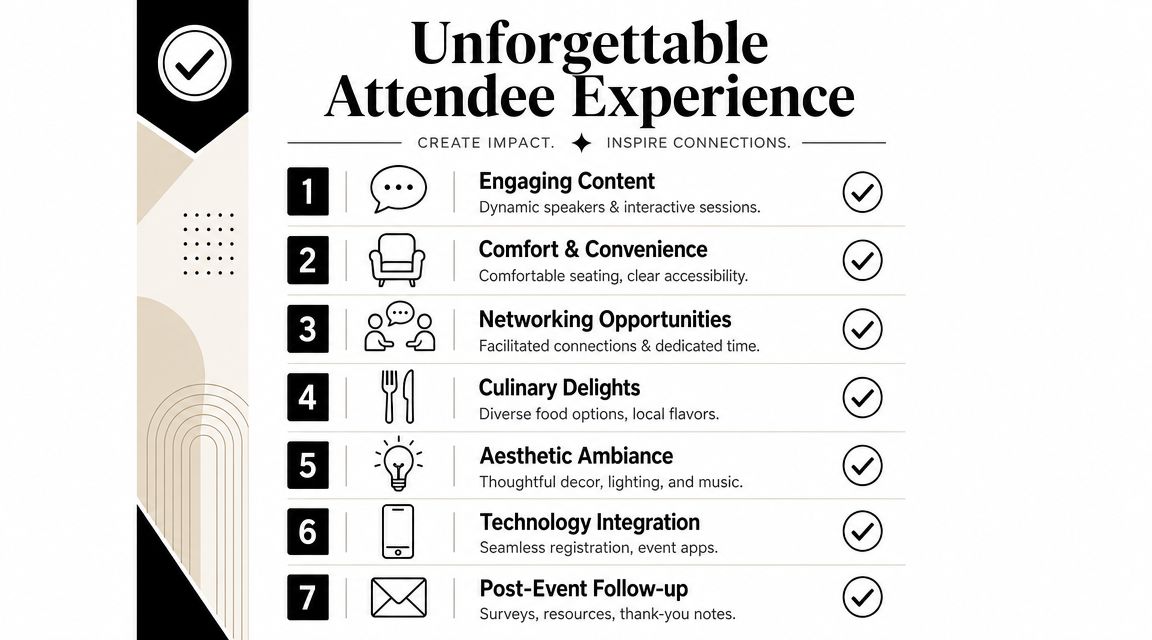
That's where most corporate events go wrong. People treat them like a checklist exercise. Book a venue. Order chairs. Confirm catering. Send invites. Then they wonder why the room feels flat, the flow is clumsy, and the day becomes a series of small recoveries instead of one smooth experience.

Corporate event planning is a proper professional discipline, not an admin side task. The wider event management industry was valued at $1,311.4 billion in 2019 and was forecast to reach $3,605.8 billion by 2027, while the corporate events and seminar segment alone was estimated at $388.4 billion in 2019 and projected to grow at a 55.3% CAGR according to Research Dive's event management market analysis. That matters locally because Cape Town businesses, Winelands venues, schools, universities, and brands all sit inside that larger demand economy. The spend is real, and so is the expectation that events must perform.

Good planning creates control. Great planning creates atmosphere, protects the budget, and makes the event feel effortless for guests.

If you're trying to get all the moving parts under one roof, it also helps to optimize event planner client interactions so approvals, questions, and handovers don't get buried in email chains. For a broader local view of how event execution works on the ground, this guide on event management in Cape Town is also worth a read.

Planning Your Next Unforgettable Corporate Event

A corporate event usually starts with a simple sentence that hides a complicated job. “We need to put something together for clients.” Or, “We're hosting the regional team in Stellenbosch.” Or, “We need the year-end function to feel premium, but not excessive.”

The brief sounds manageable until the practical questions arrive. Is the venue built for presentations or only for dining? Will guests stand with drinks first, or go straight to tables? Can the supplier deliver to Franschhoek during a tight set-up window? If the weather turns on an outdoor site, what changes and who pays for it?

That's why corporate event planning services matter. They turn a vague outcome into a controlled series of decisions. In Cape Town and the Winelands, that control matters more than many buyers realise because local events often involve moving parts that don't show up in glossy venue photos. Wind, access roads, loading restrictions, generator positioning, furniture style, heater placement, and guest flow all shape the final result.

What success looks like on the ground

A strong corporate event does three things at once:

  • It supports the business goal. A launch should feel like a launch. A conference should make content easy to follow. A gala should reward the audience, not tire them out.
  • It respects the venue reality. A wine estate and a city conference venue don't behave the same way, even if both look elegant online.
  • It feels deliberate. Guests notice when the registration desk is too small, when the stage sightlines are poor, or when lounge furniture belongs at a birthday rather than a board-level event.

A beautiful venue doesn't rescue a weak layout. It often exposes it.

Why local context changes the plan

Cape Town events often reward precision more than scale. A compact executive breakfast in the CBD can demand tighter timing than a larger casual activation because guests arrive in narrow time windows and expect everything to work immediately. In the Winelands, the pressure shifts. Transport times lengthen. Weather exposure rises. Outdoor elegance often depends on unseen infrastructure like flooring, power planning, heating, and practical furniture choices.

That's why generic event advice rarely helps enough. Local planning needs a framework that fits local venues, local supplier lead times, and the way Western Cape events run.

What Professional Event Planners Actually Do

A lot of buyers hear “event planner” and think of someone who books décor and keeps a programme on time. That's too narrow. In practice, professional planners work more like a mix of architect, project manager, negotiator, and site lead.

In a mature proxy market for event work, meeting, convention, and event planners had a median annual wage of $59,440 in May 2024, with employment projected to grow 5% from 2024 to 2034 and about 15,500 openings per year on average, according to the U.S. Bureau of Labor Statistics occupation profile. The takeaway isn't the American wage. It's that this is a formal, specialist service category with recurring demand and real operational depth.

An infographic outlining the four key service areas of professional corporate event planning services.

Full-service planning

This is the right fit when the event is high stakes, the internal team is stretched, or the venue setup is more complex than it first appears.

A full-service planner usually handles:

  • Brief translation into a clear event concept, format, and guest journey
  • Venue sourcing based on access, capacity, style, technical suitability, and set-up restrictions
  • Supplier management across catering, AV, furniture, branding, transport, staffing, and entertainment
  • Budget control with line-item oversight and approval management
  • Production planning including floor plans, stage positions, power requirements, and service timing
  • On-site leadership during load-in, guest arrival, programme execution, and breakdown

This level of service matters when one poor decision creates a chain reaction. A common Cape Town example is choosing a visually strong venue that has awkward loading access, limited power, or strict breakdown times. Full-service planning catches those issues before contracts lock you in.

Partial planning

Some teams already have a venue and a rough vision. What they lack is coordination across suppliers and enough experience to know where risk sits.

Partial planning often works well for:

Situation What the planner adds
Venue already booked Supplier matching, layout planning, run sheet control
Internal marketing team owns branding Production, furniture, registration flow, guest experience
Small in-house events team Overflow support for logistics, confirmations, and event-day management

This model is useful when the company wants hands-on involvement but still needs someone to stop gaps from opening between departments, vendors, and venue rules.

Day-of coordination

This is closer to site management than planning. The core decisions have already been made. The coordinator steps in to execute what exists.

That usually includes:

  • Final supplier confirmations
  • Load-in supervision
  • Programme cueing
  • Guest issue handling
  • Venue liaison
  • Problem-solving during the event

Day-of support can work for smaller, straightforward functions. It's less effective when the planning itself has been rushed, because event-day teams can't fix every weak decision once trucks are unloading.

If your event has a stage, multiple suppliers, VIP guests, or a remote venue, you probably need more than day-of help.

Specialist scope often gets missed

Corporate events in the Western Cape also bring specific needs that many buyers only spot late. Language support is one. If your audience spans local and international attendees, or multiple language groups, there's value in understanding the basics of planning multilingual events before content, signage, and live delivery are locked.

The strongest planners think beyond bookings. They ask how people will move, where they'll pause, what they'll see first, and what could fail under pressure.

Your Event Planning Roadmap From Concept to Execution

The easiest way to lose control of a corporate event is to treat every task as equally urgent. They aren't. Some decisions shape everything that follows. Others only matter once the framework is settled.
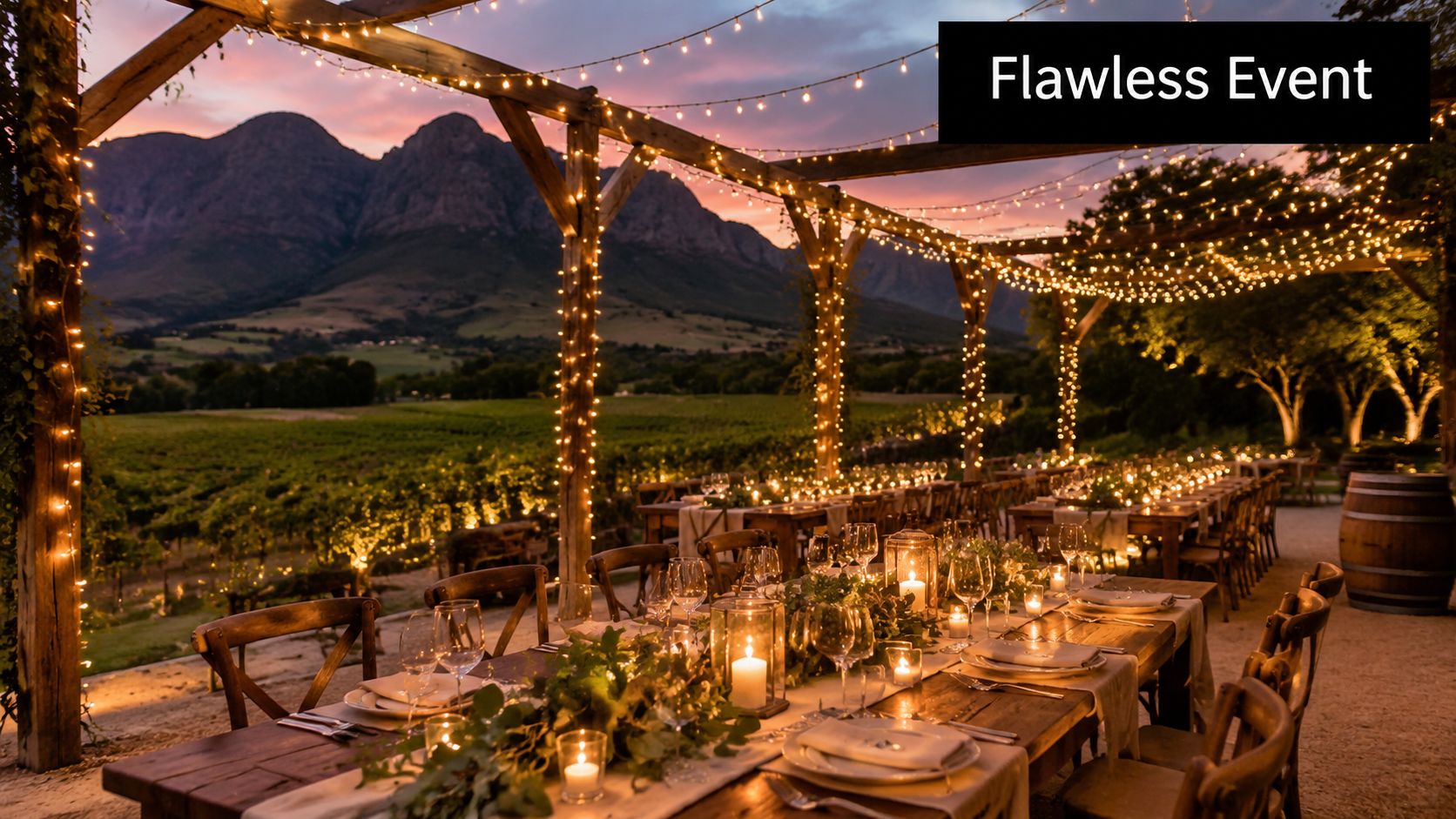
A practical benchmark from Whova is that registration, communication, and attendee engagement tasks can consume about 60% of planning time unless automation is used, which is why planners increasingly rely on software to remove repetitive coordination and protect time for higher-value decisions such as supplier negotiation and guest experience design. That benchmark appears in Whova's guide to corporate event planner responsibilities and workflow.
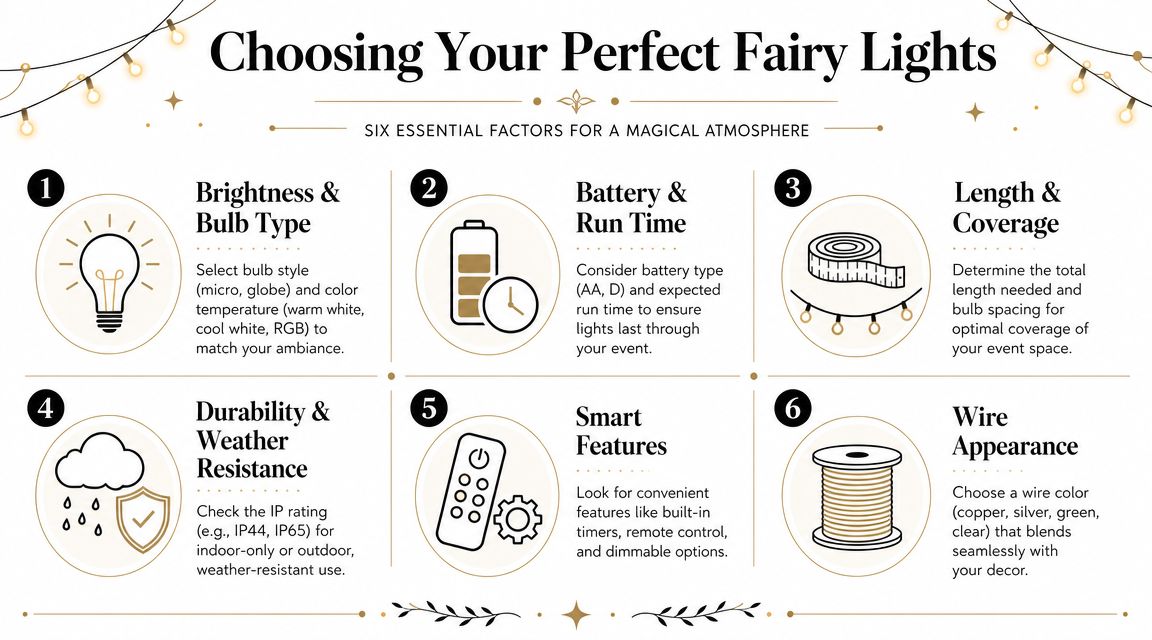
An infographic titled Your Event Planning Roadmap showing six stages from concept to post-event analysis.

Start with the event purpose

Before anyone chooses napkin colours or requests quotes, lock down the event's job.

Ask:

  • What must this event achieve
  • Who matters most in the room
  • What should guests do, feel, or understand by the end
  • What format suits that outcome best

A leadership strategy session, a sponsor lunch, a matric dance, and a product launch can all happen in beautiful venues. They still need completely different room plans, furniture choices, timing, and production levels.

Build the structure before the styling

Once the purpose is clear, the next layer is operational.

That includes:

  1. Venue selection. Not only based on appearance, but on access, weather exposure, acoustics, parking, and supplier working conditions.
  2. Budget mapping. Not exact final numbers at first, but a realistic spread across the main cost areas.
  3. Supplier shortlist. Furniture, AV, catering, branding, staffing, and any specialist equipment.
  4. Guest handling system. Registration, confirmations, dietary capture, reminders, and name requirements.

Many in-house teams lose momentum handling administrative tasks. Manual RSVP tracking, WhatsApp updates, spreadsheet edits, and repeated supplier follow-ups eat hours that should be spent improving the event itself. If you need a practical workflow to keep the admin side under control, this event planning checklist template is a useful starting point.

Use the final stretch properly

The weeks before the event aren't for redesigning the concept. They're for tightening execution.

A disciplined final phase includes:

Final-stage task What good teams check
Guest communications Arrival times, parking, dress code, venue directions
Supplier confirmations Delivery windows, quantities, contact people, access instructions
Floor plan review Registration desk size, stage sightlines, bar queues, lounge placement
Weather planning Marquees, heaters, fans, covered walkways, contingency layout
Event-day documents Run sheet, supplier list, escalation contacts, programme cues

The last two weeks should reduce uncertainty, not introduce fresh ideas.

On the day, someone must own the floor

Corporate events don't fail because one item is missing. They fail because nobody is clearly in charge once guests start arriving.

Someone needs to own:

  • the supplier arrivals
  • the room reset timing
  • the presentation handovers
  • the speaker holding area
  • the catering cues
  • the guest flow between moments

That's the difference between a room that feels calm and one that feels improvised.

How to Build a Realistic Corporate Event Budget

Budget stress usually starts because the first figure is too optimistic and the hidden costs are ignored until late. The fix isn't guesswork. It's structure.

The one benchmark that should sit inside every serious event budget is a 10–15% contingency fund on top of the core line items, because venue, AV, staffing, and logistics costs can move quickly once specifications are finalised, as noted in Lyyti's guide to key elements of corporate event planning.

A pie chart displaying the typical budget breakdown for corporate event planning services in percentage figures.

The infographic above shows one common way teams think about allocation. It's useful as a visual starting point, but in practice the split changes according to event type, venue style, and guest expectations. A seated awards dinner usually pushes harder on furniture finish, staffing, and service flow. A launch may lean more heavily into branded environment, lighting, and AV.

The line items that deserve closer attention

In the Western Cape, these categories often shift after the first quote stage:

  • Venue-related costs. Some venues include basics that others bill separately, such as cleaning, power access, security requirements, or setup supervision.
  • Furniture and layout impact. A standard conference setup and a premium networking environment aren't priced the same because they don't need the same inventory, transport pattern, or setup labour.
  • Production creep. A simple microphone setup can become a larger AV brief once staging, confidence monitors, comfort screens, and content switching enter the conversation.
  • Transport and distance. Winelands logistics can change costs fast if supplier trips, delivery windows, or crew hours expand.

Why contingency isn't optional

A contingency line is not there because planning failed. It's there because real events change under real conditions.

Typical pressure points include:

Cost pressure Why it appears late
Additional crew time Setup takes longer than the first schedule allowed
Weather response Heaters, cooling, covered access, or layout changes become necessary
AV revisions Final content needs more screens, microphones, or operator support
Venue conditions Flooring protection, extra cleaning, or revised access control is required

Practical rule: If the event depends on premium styling, remote delivery, or outdoor comfort, the budget needs room to absorb movement without damaging the guest experience.

Build from decisions, not from hope

A realistic budget starts by ranking what matters.

For example:

  1. If the event is client-facing, protect arrival experience, seating quality, and technical delivery first.
  2. If it's content-heavy, fund sound, screens, lighting clarity, and room layout before decorative extras.
  3. If it's in the Winelands, budget early for transport realities, weather cover, and crew timing.

What doesn't work is spending heavily on one visual moment, then discovering there's no flexibility left for practical support items that make the event comfortable and functional.

The best budgets are honest before they are ambitious.

The Role of Event Rentals in Creating Atmosphere

Event rentals are often treated like a procurement line. Chairs, tables, glassware, a few extras, done. That approach misses their real job.

The right rental mix shapes how guests read the event before a single speaker starts. It tells them whether the brand is formal, creative, conservative, relaxed, premium, or careless. In corporate environments, those signals matter because guests are constantly making judgments about competence and intent.

Furniture sets the tone before content does

A gala dinner and a networking launch can happen in the same venue and feel completely different based on furniture alone.

Consider the effect of a few common choices:

  • Banquet chairs and dressed tables create structure, formality, and expectation of a seated programme.
  • Cocktail tables with soft lounge pockets encourage movement, informal conversation, and shorter dwell times in one place.
  • LED furniture works best when the event needs a modern edge, especially at evening activations, launches, and branded after-hours functions.
  • Bean bags or casual seating can suit youth-facing activations or campus events, but they're wrong for executive audiences unless used in a carefully zoned breakout area.

That's why furniture selection should begin with guest behaviour, not catalogue preference.

Rentals solve operational problems as well

Atmosphere is only one side of the job. Smart rental planning also fixes practical issues that venues often leave to the organiser.

In the Winelands, for example, a beautiful outdoor setting can become uncomfortable very quickly if no one has planned for temperature changes after sunset. Climate control equipment isn't glamorous, but guests remember cold far more vividly than centrepieces.

The same principle applies to food and beverage support. Brand activations, staff socials, and outdoor corporate functions often need more than catering tables. They need equipment that helps service flow and guest engagement feel easy. Slush machines, mobile service stations, and well-placed support furniture can turn a messy service point into part of the experience.

The best rental decisions disappear into the event. Guests don't notice the logistics. They notice that the space feels right.

Match the rental strategy to the event type

A practical way to think about it is to ask what the room must do.

Event type Rental priority
Conference or seminar Clear seating plan, registration furniture, stage support, practical traffic flow
Awards evening Elegant seating, table styling support, bar areas, lounge spill-out spaces
Product launch Statement pieces, branded moments, lighting-friendly surfaces, social areas
Winelands marquee event Climate control, sturdy furniture, service stations, weather-conscious layout

Styling without function usually backfires

One of the most common mistakes in local corporate events is overcommitting to visual ambition while underfunding functionality. The room looks strong in pre-event photos, then service begins and the cracks show. There's no proper registration surface. The bar queue blocks the branded backdrop. Lounge seating is too low for guests balancing plates and drinks. Outdoor heating was added too late and placed badly.

A better approach is to combine styling and utility from the start. If you're looking at how visual elements and rental choices work together, this guide to event decoration hire gives a useful practical lens.

What works in Cape Town and the Winelands

Locally, the strongest event environments usually share a few traits:

  • They respect the venue instead of fighting it
  • They create clear guest zones for arrival, networking, dining, and programme moments
  • They use feature rentals with restraint so the room feels intentional, not cluttered
  • They plan for comfort as seriously as aesthetics

Cape Town audiences are visually literate. They know when a room has been assembled and when it has been designed.

Key Questions to Ask Your Event Vendors

Most buyers ask suppliers the easy questions first. Are you available? What do you charge? Can you send photos? Those questions are necessary, but they won't tell you how the event will feel when pressure hits.

A more useful line of questioning focuses on clarity, exclusions, and local execution risk. One major gap in South African event content is clear explanation of what planning fees include versus what they exclude. First-time buyers are often caught by hidden items like overtime staffing, AV overages, and cleaning surcharges, as discussed in Socialmon's article on corporate event planner content gaps and hidden cost concerns.

A professional infographic listing six essential questions to ask when hiring corporate event vendors in Cape Town.

The questions that reveal real competence

Ask these early, preferably before you compare headline prices.

  • What exactly is included in your quoted fee. Ask for setup, strike, standby time, delivery, collection, and on-site adjustments to be spelled out.
  • What falls outside the quote. Overtime, waiting time, cleaning, difficult access, and change requests often represent additional expenses.
  • How do you handle Cape Town and Winelands logistics. A supplier who regularly works local venues will answer clearly on travel timing, access windows, and weather response.
  • Who is my actual on-the-day contact. Sales conversations are one thing. Event-day control is another.
  • What happens if the event schedule shifts. Corporate events often run late. You need to know how vendors price and manage that reality.
  • What assumptions are built into this quote. This question exposes whether the supplier has priced for grass access, stairs, tight loading, evening collection, or basic indoor delivery only.

Compare transparency, not only price

A cheaper quote can become the more expensive option once exclusions appear.

Use a simple comparison like this:

Vendor check What you want to hear
Scope clarity Clear list of inclusions, exclusions, and assumptions
Local knowledge Specific familiarity with venues and route logistics
Flexibility Sensible process for late adjustments and event-day changes
Communication Fast, direct answers without vague wording

If a supplier avoids detail before the booking, expect more friction after it.

Ask one final question

End the conversation with this: What usually catches clients out on events like this?

Experienced vendors answer that immediately and specifically. They'll mention access, weather, power, collection windows, queue points, or staffing pressure. Inexperienced vendors answer with something generic, or they'll tell you everything is simple.

That difference matters. You're not hiring suppliers for the day everything goes perfectly. You're hiring them for the moments when the plan needs to hold.


If you're planning a corporate event in Cape Town, Stellenbosch, Franschhoek, Paarl, or the wider Winelands, ABC Hire can help with the practical rental side that shapes both atmosphere and execution. From LED furniture, tables, and chairs to climate control equipment, bean bags, and service-ready event accessories, their range is built for polished functions that need to look right and work properly on site.

LED Fairy Lights Battery Operated Your Event Guide 2026

You've booked a beautiful venue. The mountain view is perfect, the tablescape is nearly there, and sunset is going to do half the styling work for you. Then the practical problem lands. There are hardly any plug points where you need them, the ceremony flows into dinner outdoors, and nobody wants extension cords running through a reception space.

That's where LED fairy lights battery operated stop being a last-minute decorative extra and start becoming one of the most useful tools in event styling. They solve real problems. They bring light to tables, floral moments, signage, backdrops, and lounge corners without tying your design to wall sockets. In South Africa, that flexibility matters even more because venues often mix indoor and outdoor zones, remote setup areas, and the occasional load-shedding concern right when guests arrive.

Used well, battery-operated fairy lights create atmosphere fast. Used badly, they fade too early, look too small for the space, or turn into a tangle of exposed battery packs. The difference is usually planning, not budget.

The Secret to Flawless Event Lighting Anywhere

A Cape Winelands reception often looks effortless from the guest side. Long tables under trees, glassware catching the last light, mountain silhouettes behind the dance floor. The setup side is less romantic. Power access can be limited, especially once you move away from the main building. That's why battery-operated LED fairy lights have become a standard styling choice for outdoor weddings, school formals, and temporary brand activations.

They work because they remove the biggest limitation in decorative lighting. Placement no longer depends on a plug point. You can run a strand through a centrepiece, wrap it around a welcome sign, line shelving in a drinks station, or build glow into a photo area without stretching cables across guest pathways.

An outdoor evening wedding reception table setting illuminated by warm led fairy lights under a mountain backdrop.

A big reason stylists favour LED versions is longevity. One industry guide notes that LED fairy lights can last up to 60,000 hours, about 20 times longer than incandescent versions, while battery-powered models can run from 18 to 24 hours and over 100 hours in some micro-drop styles with fresh batteries, which is why they're such a practical fit for long events and venues without easy power access in the ZA market (battery-operated fairy light buying guide).

Why they solve real event problems

Battery fairy lights aren't trying to replace architectural lighting. They do a different job. They add mobility, safety, and speed during setup.

  • Portable placement: You can light awkward corners, freestanding décor, and outdoor features without hiring extra power distribution.
  • Cleaner styling: No visible extension leads across premium table settings.
  • Safer guest areas: Low-voltage decorative strings are easier to integrate than mains-powered décor lights in traffic zones.

Practical rule: If the light needs to travel with the styling item, not stay fixed to the venue, battery power is usually the cleaner choice.

For planners comparing broader lighting budgets across different event contexts, it can also help to compare Colorado Springs lighting costs just to see how location, scale, and fixture type can shift pricing logic in other markets. The local lesson is similar. Decorative lighting and functional event lighting are not the same cost category.

For larger scenes, fairy lights usually work best alongside other layers. If you're balancing ambience with stronger event illumination, it helps to understand where uplighting and wash effects fit in a lighting plan, especially for reception spaces and marquees. This practical guide to PAR can lighting for events is useful for that distinction.

How to Choose the Right Fairy Lights for Your Theme

Not all battery fairy lights behave the same way, even when they look similar online. Buyers often choose by photo first, then discover too late that the string is too short, too cool in colour, too weak for the intended area, or too demanding on batteries for a full event.

The fastest way to choose well is to match the light to the design job. Table styling needs flexibility and a discreet battery pack. A backdrop needs enough length and repetition to avoid looking sparse. Floral installations need wire that bends cleanly and disappears into the arrangement.

A guide infographic detailing six essential factors to consider when choosing battery operated LED fairy lights.

Start with runtime, not colour

Shoppers often begin with warm white versus cool white. Stylists should begin with battery demand. Product variance in this category is wide. A common format is a 33-foot string with 100 LEDs on 3 AA batteries, but one source also notes that basic strings may last only 4 to 7 hours, while quality LED battery strings can run 18 to 24 hours and some micro-drop designs can go beyond 100 hours, depending on the product and battery setup (battery runtime guide for fairy lights).

That spread changes the buying decision completely. A short private dinner and a long wedding reception don't need the same spec.

A quick selection table

Design need What usually works What usually disappoints
Centrepieces Thin wire, warm white, discreet battery pack Bulky box that can't hide in florals
Welcome signs Medium-length string with even LED spacing Very short strings that leave patchy areas
Backdrop accents Multiple matching strands layered together One sparse strand trying to fill a big frame
Outdoor table runs Battery models chosen for longer runtime Short-life decorative sets bought on appearance only

Wire, shape, and visual finish

The wire matters more than commonly realized. Silver or copper wire tends to blend well into glass, foliage, timber, and neutral linens. It also bends easily around candle sleeves, plinth edges, arches, and floral foam cages. If the wire fights the shape, setup takes longer and the result looks forced.

Bulb style changes mood too:

  • Micro-drop style: Best when you want tiny pinpoints of light and the wire to disappear.
  • Classic fairy light look: Better when you want the strand itself to read as part of the décor.
  • Globe-style decorative strings: Better for a more visible, playful statement, but less subtle on formal tables.

Match the light to the venue type

A refined indoor dinner can handle a lighter touch. A farm venue with dark pathways and broad outdoor zones can't rely on delicate strings everywhere. Theme should guide the visual language, but venue scale should decide quantity and placement.

If your theme says “soft sparkle” but the venue says “large and open”, trust the venue first. Sparse lighting reads unfinished in a big space.

For planners who work across residential and event environments, it's also useful to see how people think about long-term lighting upgrades in other contexts. This piece on how to improve property value with LED lighting is from a different use case, but it's a good reminder that LED choices are often about efficiency, usability, and appearance together, not colour alone.

A practical checklist before you rent or buy

  1. Decide the job first. Is the light for a table, a sign, a floral installation, or a backdrop?
  2. Check the battery format. If the setup needs to run for hours, avoid choosing purely by product photo.
  3. Look at strand density. More LEDs generally create a richer decorative effect than a long, sparse run.
  4. Plan where the battery box will hide. If you can't answer that quickly, the product may not fit the design.
  5. Test the tone against your other lighting. Warm fairy lights next to very cool venue lighting can clash visually.

Forecasting Battery Life for an All-Night Event

The question clients ask most is simple. Will the lights last until the event ends?

The honest answer is that battery life depends on more than the label on the packet. Event use is different from casual home use. Strings may switch on during setup, remain active through pre-drinks, dinner, speeches, and then stay on deep into the evening. In South Africa, there's another layer. Battery décor often pulls double duty during power uncertainty, which means planners need a more realistic expectation of runtime.

A major gap in most buying advice is exactly this. South African planners need real battery-life expectations, especially in load-shedding conditions and in colder Cape weather where battery efficiency can drop in outdoor setups (South African battery-life planning angle).

What changes runtime in practice

Three things usually matter most on event day.

  • LED count: More points of light usually mean more battery demand.
  • Lighting mode: Static modes and flashing modes won't always drain power the same way.
  • Conditions: Cold evening air in the Winelands can make batteries feel weaker sooner than expected.

That's why two strings that look similar in a cart can perform very differently in service.

A planner's working method

For a full-evening event, don't plan around ideal lab-style runtime. Plan around a buffer. Test one complete set before the event, using the exact batteries you intend to use on site. Then check brightness, not just whether the string is technically still on.

Decorative lights often remain visible while already looking tired. A centrepiece that glows softly by design is one thing. A backdrop that has started fading unevenly is another.

Bring spare batteries for any installation that guests will photograph closely. Dim light shows up fast in photos, even when it still looks acceptable from a distance.

The safest way to think about all-night use

Use battery fairy lights where they have a strong decorative return. Don't assign them a bigger job than they can do. For long events, that usually means:

  • Prioritise them for table styling and focal décor
  • Keep backup cells or AA sets organised by installation area
  • Switch on later where possible, especially for décor that doesn't need to glow during setup
  • Avoid treating decorative strings as emergency room lighting

If an event has critical zones such as entrances, bathrooms, stairs, or parking transitions, plan separate functional lighting. Battery fairy lights can support atmosphere brilliantly. They shouldn't carry basic guest navigation alone.

Creative Placement and Styling Techniques

Fairy lights succeed when they look intentional. The strongest setups don't scatter them randomly. They use them to shape mood, guide the eye, and pull attention toward detail.

That starts with one decision. Are the lights there for ambience or for function? Retail examples in the broader market include short strings around 6 to 6.6 feet with 20 LEDs, which strongly suggests many products are made for accent use rather than large-scale illumination. That's an important planning point for bigger Cape Town and Winelands venues where scale can swallow small decorative lights (accent-use limitation in short strings).

Elegant wedding table centerpiece featuring white roses and LED fairy lights inside a clear glass dome cloche.

Good, better, best on guest tables

Good: Coil a fine strand inside clear glass vessels, lantern bases, or around the base of a floral arrangement. This adds glow without visual clutter.

Better: Run lights through layered styling. Think bud vases, textured runners, napkin folds, and low floral groupings so the light reflects off glass and cutlery rather than sitting flat on linen.

Best: Build the entire centrepiece around concealed sparkle. A cloche, compote, or floral base works well when the battery box is fully hidden and the light appears to come from inside the arrangement itself.

Where they work beautifully

Some placements are reliable almost every time:

  • Table centres: They add depth to low-light dinners without blocking conversation.
  • Ceremony details: Wrap them through signage, plinth florals, or aisle-side accent pieces.
  • Photo backdrops: Layered behind sheer fabric or greenery, they soften the frame.
  • Bar and station styling: A little glow under shelving, around menus, or through display baskets can lift a service zone.

Where they often fail

Not every “Pinterest idea” survives real event conditions.

  • Large open walls with one or two strands: Too little coverage.
  • Outdoor wayfinding across long distances: Decorative strings don't replace practical lighting.
  • Windy exposed installations: Thin wire can shift, twist, or look messy if it isn't secured properly.
  • Busy buffet zones: Guests and staff can catch wires and battery packs if placement isn't controlled.

Soft decorative light looks magical up close. Across a large lawn or a deep hall, it can disappear almost completely.

Styling by event type

Weddings

Warm white usually suits romantic styling best because it complements candles, timber, foliage, and neutral florals. Use battery fairy lights inside compotes, under gauze runners, around statement signage, or woven into hanging installations where mains cables would ruin the look.

If you want a fuller vertical effect for entrances or photo moments, this guide to using a fairy light curtain for events is worth reviewing alongside battery strings. Curtain lights and battery strings do very different visual jobs.

Corporate events and brand activations

Corporate styling needs more restraint. Fairy lights work best when they edge a branding feature, highlight shelving, or warm up lounge vignettes that would otherwise feel hard. Avoid overusing them around logos or printed graphics. Too much sparkle can reduce clarity.

A neat trick is to place them where they create reflection on acrylic, glass, or metallic finishes rather than trying to make the lights themselves the main feature.

Matric dances and formals

Stylists can lean more theatrical. Photo walls, entry tunnels, dessert tables, and stage-edge detailing all respond well to battery fairy lights. Just avoid trying to light the whole venue with decorative strings. Students want drama in photos, but event teams still need a separate practical lighting plan.

Pairing with other décor without overdoing it

The best fairy-light styling has contrast. Pair fine points of light with fuller textures such as draping, foliage, ribbed glass, or matte linens. If every surface glows, nothing stands out.

Use this quick guide:

If the décor is… Then the fairy lights should be…
Minimal and modern Clean, sparse, and tightly placed
Rustic or garden-inspired Woven through foliage and natural texture
Glam and reflective Hidden so the reflections do the work
Youthful and high-energy Grouped in stronger visual moments like backdrops

Safe Operation and Post-Event Care

Good styling disappears into the guest experience. Poor setup shows itself through visible battery boxes, loose wire, moisture problems, and dead sections at pack-down. Safety and care aren't the dull part of event work. They're what make decorative lighting reliable.

A common battery fairy light design uses a 13 ft silver or copper wire with 3 AA batteries, and while that thin wire is easy to shape, the battery box is usually the least weather-tolerant part, even when the strand itself is suitable for decorative indoor or outdoor use (13 ft battery fairy light design details)).

Protect the weak point

The wire and LEDs are often the initial consideration. Professionals think about the battery box first. That's the part that needs hiding, securing, and shielding.

For outdoor use, keep the battery box off damp ground and away from irrigation, dripping foliage, ice buckets, and condensation-heavy surfaces. In marquees and tented spaces, don't assume “covered” means dry. Wind can push moisture into places you didn't expect.

Safe setup habits that save trouble later

  • Secure battery packs firmly: Tape, tuck, or tie them where guests and staff won't brush against them.
  • Keep joins out of walkways: Fine wire is easy to miss during service.
  • Avoid pressure points: Don't trap thin wire under heavy bases, stacked décor, or furniture legs.
  • Label grouped installations: If you're using several identical strings, mark which battery box belongs to which piece before switch-on.

A battery pack hidden well should still be reachable fast. If staff need to dismantle a centrepiece to turn it off, the setup wasn't planned cleanly.

After the event

Post-event care is where many fairy lights lose their usable life. Rushed pack-down creates kinks, snapped wire, and corrosion from old batteries left in storage.

A better routine is simple:

  1. Switch off before removal
  2. Remove batteries before storage
  3. Wipe dry if used outdoors
  4. Coil loosely, not tightly
  5. Store each set so the wire doesn't knot with others

If the strand has been shaped tightly around décor all night, don't yank it free in one pull. Reverse the wrapping gently. That small bit of patience saves a lot of replacement pain later.

Renting vs Buying The Smart Choice for Your Event

Buying makes sense when you use the same type of battery fairy lights often, on a small scale, and you're happy to manage testing, storage, replacement batteries, and post-event maintenance yourself. For everyone else, renting usually removes more problems than it creates.

That matters most for one-off hosts, venues that need occasional decorative lighting, and planners who work across very different event styles. The fairy lights for a garden wedding don't necessarily suit a matric photo wall or a clean corporate lounge. Renting gives you flexibility without leaving you with drawers full of mixed stock that only half-matches your next brief.

Screenshot from https://abchire.co.za

When buying works

Buying is usually the better fit if:

  • You style frequent small events with the same aesthetic each time
  • You already have storage systems for delicate décor stock
  • You don't mind testing and maintaining each set between uses
  • You prefer building your own kit slowly around familiar products

For private use at home or repeat personal entertaining, that can be perfectly sensible.

Why renting is often the smarter event decision

Renting shines when scale, convenience, and variation matter more than ownership.

  • No storage burden: You don't need to keep boxes of wire lights, batteries, and spares between events.
  • Less maintenance: You're not the one untangling, testing, and retiring tired-looking sets after repeated use.
  • Better fit per event: You can choose what suits this specific brief rather than forcing old stock to work.
  • Simpler logistics: Large quantities for weddings, activations, and formal functions are easier to source event by event.

A similar decision often comes up with portable table lighting. If you're comparing decorative battery fairy lights with more polished rechargeable alternatives for dining setups, this guide to rechargeable table lamps for events helps clarify when each approach makes sense.

The practical deciding question

Ask one thing before you commit. Do you want to own lighting stock, or do you want the event to look right with the least friction?

If the answer is the second one, rental is often the cleaner path. You get the visual impact without inheriting the testing, battery management, repairs, and storage discipline that good fairy-light stock demands.

For most event work, that's the smarter trade.


If you're planning a wedding, corporate event, matric dance, or private celebration in Cape Town or the Winelands, ABC Hire can help you build a lighting and décor setup that performs in actual events, not just in inspiration photos. Their range covers stylish event essentials for indoor and outdoor functions, making it easier to create a polished atmosphere without the stress of sourcing every item separately.

Your Guide to the Vintage Cocktail Table in Cape Town

You're probably looking at a floorplan right now and realising the same thing every Cape Town planner realises sooner or later. The room has enough volume, the brief calls for “mingling”, the bar will be busy, and yet the space still won't work unless guests have somewhere elegant to land a drink, a canapé, or a quick conversation.

That's where the vintage cocktail table earns its keep.

In the Cape and the Winelands, these tables do more than fill gaps. They shape movement between the bar, lounge pockets, harvest table, dance floor, and photo moments. Get them right, and the event feels considered. Get them wrong, and guests perch awkwardly on chairs, crowd service points, or abandon beautiful lounge areas because nothing there supports drinks service.

What Defines a Vintage Cocktail Table for Events

A vintage cocktail table earns its place on an event floor by doing two jobs at once. It gives guests a proper surface for a drink and a canapé, and it brings character into the room without demanding a full seating setup.

For events, function comes first. Guests need somewhere to rest a glass while they greet, chat, check a place card, or wait for the next round of service. In practice, that means a cocktail table must be stable, easy to approach from all sides, and sized for standing use or for a lounge grouping where people sit briefly rather than settle in for dinner.

The history matters less than the behaviour it supports. Earlier cocktail tables were tied to more relaxed social entertaining, rather than formal parlour furniture, and that logic still holds on a modern event floor. What planners hire as “vintage” is usually a table with older design cues, not necessarily an antique with collector value.

That distinction matters in Cape Town and the Winelands, where hire stock has to survive gravel drives, lawn installs, cellar doors, and fast turnarounds between venues.

Practical traits that matter on site

A good vintage cocktail table usually has four qualities:

  • Useful surface area: enough room for drinks, napkins, and a small styled element without forcing guests to shuffle everything around
  • Compact proportions: large enough to serve a group, small enough to keep walkways, bar queues, and service routes clear
  • Visual warmth: timber, cane, marble-look tops, brass accents, turned legs, or a softly worn finish that reads collected rather than new
  • Flexible placement: suitable beside a lounge cluster, near a bar satellite, on a veranda, or under a stretch tent

I treat durability as part of the brief too. A beautiful marble-top piece may look perfect in a studio photo, but on an uneven wine farm lawn it can be heavy to level, slower to place, and riskier in wind if the base is narrow. A timber or metal-framed option often gives better value for outdoor use.

What “vintage” usually means in the local hire market

In local styling terms, vintage usually describes a mood. It suggests age, patina, detail, and a little soul. It rarely means rare.

That is often the smarter choice. True antiques can be delicate, expensive to replace, and less consistent in height or finish across a larger order. For a 40-person private party, that can be charming. For a 180-guest wedding in Franschhoek with tight install windows, consistency usually wins.

The best rental pieces sit in the middle. They look layered and distinctive, but they are still practical for transport, setup, and repeated hire. That balance matters more than provenance on event day.

For drinks-led events, I also style the tabletop in line with the bar menu. If the brief includes botanicals, citrus garnishes, or refined G&Ts, it helps to review a few polished Craft gin drinks so the glassware, garnish vessels, and tabletop styling feel connected.

Where these tables work hardest

Vintage cocktail tables perform well in spaces built around movement and short stops, not long seated moments. In this region, that usually includes:

  • wedding pre-drinks on lawns and courtyards
  • corporate mixers in hotel foyers and function rooms
  • cellar tastings and brand launches
  • veranda spill-out areas at Winelands venues
  • reception zones for milestone birthdays and anniversaries

They are less useful in a fully seated dinner where every guest already has generous table space. Add too many, and the room starts to feel crowded, especially in heritage venues with narrow passages or uneven floor levels.

A simple test works every time. If guests need attractive, practical landing points between the bar, lounge areas, and main event spaces, a vintage cocktail table is part of the event infrastructure, not just décor.

Popular Vintage Styles and How to Match Your Theme

Not every vintage cocktail table says the same thing. Some sharpen a room. Some soften it. Some make a corporate event feel less corporate, and some make a wedding feel more grown-up in seconds.

The mistake I see most often is choosing “vintage” as a broad category and stopping there. Style only works when it supports the venue, the florals, the bar finish, the linen palette, and the tone of the guest list.

Here's the visual shorthand I use.

A visual guide illustrating three popular vintage cocktail table styles: Art Deco, Mid-Century Modern, and Industrial Chic.

Art Deco for glamour and evening polish

Art Deco works when the event wants drama without clutter. Look for geometric lines, mirrored or glass elements, metallic trim, black lacquer tones, smoked finishes, and confident symmetry.

This style suits:

  • black-tie weddings
  • gala dinners with a lounge extension
  • luxury launches
  • New Year's events
  • formal matric dance after-parties

Art Deco tables do best when the rest of the room is restrained. If the stage set, dance floor vinyl, floral work, and candle styling are all competing, the effect becomes theatrical in the wrong way.

Mid-Century Modern for tailored sophistication

This is often the safest and smartest option for Cape Town planners because it bridges old and new so well. Mid-Century tables usually bring clean lines, timber warmth, tapered legs, and a calm silhouette that doesn't dominate a room.

They're especially effective at:

Style cue Best fit
Teak or walnut tones Corporate dinners and media launches
Clean rectangular tops Lounge clusters and hotel foyers
Minimal ornament Modern weddings with soft florals
Warm wood finish Venues that need visual softness

Mid-Century is excellent when the venue architecture already has personality. Heritage buildings, cellar spaces, and white-walled reception rooms all benefit from furniture that adds character without visual noise.

A good Mid-Century table rarely shouts for attention. It makes everything around it look more resolved.

Rustic and industrial for wine farms and relaxed luxury

Cape planners often confuse rustic with rough. The better version is edited rustic or industrial chic. Think reclaimed wood, dark metal, slightly weathered finishes, and sturdy bases that can sit comfortably against stone, lawn, concrete, or timber decking.

This style works best for:

  • Winelands weddings
  • harvest-table receptions
  • cellar tastings
  • outdoor birthdays
  • urban warehouse-style launches

What doesn't work is pairing a heavy industrial table with overly delicate seating or a very formal, glossy bar build. The room starts speaking in two different accents.

Ornamental traditional for romantic events

There's also a softer vintage category that leans traditional. Curved legs, carved detail, aged brass tones, marble-look tops, and antique-inspired timber finishes fit beautifully into garden weddings, manor-house venues, or candlelit indoor receptions.

Use this route when you want:

  • romance over edge
  • softness over geometry
  • layered décor over minimalism

The trade-off is practical. Highly ornate pieces can disappear if the styling is too dense, or look fussy if they're dropped into a very sleek venue. They need the right company.

Matching style to event mood

If you're stuck between options, don't ask which table is prettiest. Ask which one helps the room tell the truth about the event.

  • For polished corporate: Mid-Century usually wins.
  • For glamorous evening events: Art Deco carries the mood.
  • For Winelands texture: Rustic or industrial sits naturally.
  • For romantic weddings: Traditional ornamental shapes feel effortless.

That decision alone solves half the styling puzzle.

Sizing and Layout Strategy for Cape Town Venues

At this stage, planning either becomes elegant or expensive. A vintage cocktail table might look like a small furniture decision, but layout errors ripple across catering, guest movement, and setup time.

The planning benchmark many teams use is simple: 1 vintage cocktail table per 8 to 10 guests for general mingling, or 1 table per 4 to 6 guests if substantial food is served, as reflected in the event-planning framework shown below. Treat that as a starting point, not a law. Guest behaviour matters just as much as headcount.

A four-step infographic showing how to plan event sizing and cocktail table layout for Cape Town venues.

Start with guest behaviour, not just numbers

A wedding canapé hour needs a different layout from a conference drinks reception. So does a brand launch where guests are filming content, carrying gift bags, or moving between activation stations.

Use these questions first:

  1. Will guests stand for long periods?
  2. Are they balancing food as well as drinks?
  3. Is there a central bar, or multiple service points?
  4. Will older guests or family groups want nearby seating?
  5. Does the event move between indoors and outdoors?

If the answer to several of those is yes, you'll usually need more landing surfaces, not more decorative furniture.

Size affects logistics more than planners expect

These aren't little side tables. Representative vintage-style examples include 46" W × 26" D × 19" H at 71.9 lb and 50" W × 30.25" D × 19.75" H at 85 lb, according to Furniture Pick's product specifications. In metric terms, that means some vintage-style cocktail tables are over 1.2 metres wide and weigh up to 40 kg, which has direct consequences for transport, labour, and placement.

That matters in the Cape for obvious reasons. Historic buildings, upstairs venues, narrow service entries, gravel courtyards, and cellar routes aren't forgiving.

Before sign-off, check:

  • Access paths: Can staff move the table from truck to final position without tight turns or stair issues?
  • Surface conditions: Lawn, gravel, uneven brick, and timber decks all affect stability.
  • Floor sensitivity: Older venues may need more cautious placement and protection.
  • Reset practicality: If the room flips after speeches or dinner, heavy pieces slow that process down.

For a different event-floor perspective, this practical note on metal cocktail tables for event layouts is useful when you're comparing visual weight against operational ease.

Placement strategy for common Cape venues

Different local venue types call for different instincts.

Wine farms and lawn receptions

On open lawns, planners often spread tables too widely because there's space available. That creates islands with no atmosphere. Keep tables in intentional clusters near bar access, edge shade, and pathways between the ceremony exit and drinks service.

A better lawn plan usually includes:

  • grouped lounge pockets rather than isolated sets
  • a few clear sightlines to the view
  • breathing room around service staff routes
  • no table directly in the main photographer path

Hotel ballrooms and function rooms

Hotels usually reward symmetry, but too much of it can feel stiff. Use cocktail tables to soften the room's geometry. Place them at natural pause points such as near pre-function bars, outside the main seating grid, and along the perimeter where quieter networking happens.

Heritage buildings and city venues

These spaces often have pillars, level changes, and narrower circulation channels. Here the goal is restraint. Fewer, better-placed tables outperform a crowded floor.

If a guest has to twist sideways to pass a table with a drink in hand, the layout is already wrong.

A practical planning method

When I map a room, I work in this order:

Planning step What to decide
Guest pattern Standing, mixed seating, or transition event
Service style Drinks only, canapés, or substantial food
Traffic lines Bar queue, catering route, entrance, bathrooms
Anchor zones Lounge pods, dance floor edge, terrace spill-out
Final count Enough tables to support use without blocking flow

That's the definitive answer to “how many, where, and how”. Count matters. Placement matters more.

Styling Your Vintage Table to Perfection

Once the layout is right, styling becomes much easier because the table already has a job. You're not decorating an object. You're refining a guest experience.

The best-looking vintage cocktail tables at events are usually styled with restraint. Too much décor makes them unusable. Too little makes them feel forgotten.

A crystal decanter, elegant glassware, and a floral arrangement displayed on a vintage round wooden side table.

Start with the tabletop

Your tabletop styling should leave enough room for actual hands, glasses, and plates. That sounds obvious, but it's where many beautiful mock-ups fail in real service.

Use a tight edit:

  • Low florals: Keep arrangements conversation-friendly and stable in wind-prone outdoor settings.
  • Purposeful glassware: If the drinks menu is premium, your table styling should support that tone.
  • One hero object: A small lamp, decanter, bud-vase cluster, or candle grouping is often enough.
  • Functional trays: They help organise garnish bowls, napkins, or votives without the top looking scattered.

Avoid tall arrangements on mingling tables. Guests don't stand around them. They stand around each other.

Pair the table with the right companions

A vintage cocktail table on its own can feel marooned. It becomes persuasive when paired with furniture that gives context.

Good combinations include:

Table setting Best pairing
Mid-Century timber table Leather-look occasional chairs or clean lounge seating
Ornamental vintage table Upholstered armchairs, soft rugs, candlelight
Industrial table Bentwood, tolix-style, or relaxed mixed seating
Deco-inspired table Velvet accents, mirrored details, polished bar styling

If you're looking at richer metallic finishes, this guide to a gold cocktail table in event styling is a useful comparison point when you want a warmer, more glamorous look than timber alone can provide.

Use décor to direct mood

A cocktail table can shift an event's tone in subtle ways.

For weddings

Lean romantic, but stay practical. Soft floral colour, candle clusters in protected holders, and elegant napkin treatment work well. Guests should still be able to place a clutch, champagne flute, or canapé plate down without hunting for space.

For corporate events

Keep the styling cleaner. Strong materials, minimal florals, a neat tray element, and consistent glassware usually outperform decorative abundance. The room should feel polished and confident, not busy.

For private celebrations

Personality can be introduced. Coloured glass, collected vessels, family photographs in miniature frames, or a thematic object can all work, as long as the table still reads as usable.

Less décor often photographs better because the furniture shape and material can actually be seen.

Don't forget the surrounding light

Vintage finishes respond beautifully to lighting, especially timber, brass-toned detail, and glass. Side lighting, candle glow, and warm ambient spill from a nearby bar can all make the piece feel more expensive than it is.

What doesn't work is harsh overhead white light with ornate table styling. It flattens everything.

For Cape Town outdoor events, remember the shift from late afternoon to evening. A table that looks complete at golden hour can feel visually empty after sunset unless there's some deliberate glow built around it.

The styling balance that usually wins

The most successful cocktail tables do three things at once:

  • they look intentional
  • they support service
  • they encourage people to gather

If one of those falls away, the table stops pulling its weight. Beauty matters, but at events, function is what makes beauty believable.

A Planner's Checklist for Renting in Cape Town

A table can look perfect on a mood board and still fail on site. I see it most often at Winelands venues with tight load-in windows, long gravel approaches, or lawns that turn soft after late-afternoon watering. Rental success comes down to matching the furniture to the venue, the timing, and the service plan.

Cape Town hires also need a realistic transport mindset. A truck heading to Franschhoek, Stellenbosch, or Paarl is not doing a casual last-minute detour because two extra tables were added after floral counts were signed off.

A five-step planning checklist for renting vintage cocktail tables for events in Cape Town, South Africa.

The checklist that saves time later

Start with a usable brief

Before asking for pricing, pin down the details that affect stock selection and delivery planning:

  • Style direction: Mid-century, Deco, rustic farmhouse, or traditional romance.
  • Event function: Welcome drinks, pre-dinner mingling, lounge support, or conference breakout use.
  • Table count: Based on guest flow and service points, not a loose sketch.
  • Venue access: Stairs, lifts, gravel, lawn, cellar doors, load-in distance, and setup hours.

A vague brief usually leads to two problems. The supplier reserves the wrong mix, or the planner spends the final week approving substitutions that should have been avoided earlier.

Ask logistics questions early

In Cape Town, logistics shape the hire more than people expect. Delivery radius, vehicle access, and placement responsibility need to be confirmed before anyone gets attached to a specific piece.

Ask the supplier:

  • Do you deliver to this exact venue and time slot?
  • Is placement included, or does the team only offload?
  • Can tables be positioned to a floor plan?
  • What is the collection procedure if the event finishes late?
  • Are outdoor placements approved for the table finish you selected?

Those answers affect staffing, setup timing, and whether you need extra hands on site.

Check consistency, condition, and quantity

Vintage stock should show character. It should not look tired, sticky, wobbly, or mismatched by accident. Ask whether the tables are a matched set, a close family of pieces, or a deliberately mixed collection.

Then ask for current images if the look matters to the design story. A supplier may carry six suitable tables, but only four may be in the same finish after a busy wedding weekend.

If you need a wider view of how local suppliers structure stock, transport, and style categories, this guide to vintage furniture hire in Cape Town is a useful starting point.

Know the commercial terms

The agreement matters as much as the table choice. Good planners read the paperwork with the venue schedule open beside them, because the primary risks sit in timing, liability, and access.

Check these points before paying a deposit:

Rental point Why it matters
Damage terms Staff need to know what counts as breakage, staining, or abnormal wear
Cancellation terms Weather shifts and venue changes can trigger costs
Hire period Multi-day setup and next-day strike often change the quote
Collection window Many Cape Town venues enforce strict breakdown times
Sign-off responsibility One person should confirm condition on delivery and collection

One last local rule. If the venue has restricted access, heritage flooring, narrow doorways, or a strict supplier induction process, send that information to the hire company in writing. It prevents day-of arguments and protects your schedule.

Good rental planning removes friction before the first crate is unloaded.

Frequently Asked Questions About Vintage Table Hire

How far in advance should I book vintage cocktail tables?

In Cape Town and the Winelands, book as soon as the venue and event date are locked in. Vintage stock is usually limited by finish, height, and condition, so the right set can disappear long before linen and florals are signed off.

For spring weddings, December functions, and harvest-season events, I prefer to place an enquiry early and confirm quantities once the floor plan settles. That gives you better odds of getting a consistent set instead of building the room around whatever is left.

Can vintage cocktail tables be used outdoors?

Yes, if the ground is stable and the weather plan is realistic.

Lawns at wine farms can look level in site photos and turn out soft or uneven on setup day. Gravel courtyards, old stone terraces, and sloped garden paths also affect balance. Ask the supplier whether the tables need floor protection, whether they can stand safely on grass, and whether the finish is suitable for uncovered use.

If the forecast looks uncertain, place the outdoor tables where they can be moved under cover fast, without rerouting staff through guest areas.

What happens if a table is damaged during the event?

The hire agreement decides that. Some suppliers treat a water ring as normal event wear. Others will charge for chipped edges, broken joints, deep scratches, or wax and red wine stains that need restoration work.

Assign one person from the planning team to check stock on arrival and again at strike. If something is damaged during service, photograph it and report it straight away. That small step saves arguments later, especially at venues with multiple suppliers loading out at once.

Can I hire vintage cocktail tables for more than one day?

Usually, yes. Multi-day hire is common for weddings with a day-before setup, conferences with branded installations, and private events at venues that only allow collection the next morning.

Confirm three points in writing: the full hire window, where the tables stay overnight, and who carries responsibility after guest departure. On estates outside central Cape Town, collection timing also affects transport fees, so ask for that cost upfront.

Should every cocktail table match exactly?

Matching tables suit formal rooms, corporate launches, and venues with strong architectural symmetry. A mixed set works better for layered lounge areas, garden receptions, and editorial wedding styling.

The key is control. Keep the heights close, repeat one or two finishes, and make sure the tops still make sense together once glassware, candles, and menus are on them. Variety looks intentional only when the scale and colour family are consistent.

Are round or rectangular shapes better?

Choose the shape by use, not by trend.

Rectangular tables usually sit more neatly into lounge groupings and against banquettes or built-in seating. Round tops soften tighter guest areas and reduce sharp corners in busy circulation routes. At Cape Town venues where space can pinch near bars, entrances, or verandas, round tables often make service easier.

Why are these tables still so relevant for events?

They solve a practical event problem. Guests need somewhere to place a drink, rest a small plate, or gather for a quick conversation without committing to a full seated setting.

That matters in local venues where one room often needs to do several jobs in a single service period. A vintage cocktail table can anchor a pre-drinks area, support a lounge cluster, or break up an empty terrace without adding visual bulk. Good pieces earn their floor space.

If you're planning a wedding, corporate function, matric dance, or private celebration and need furniture that looks refined and works hard on the floor, ABC Hire is a strong local partner in Cape Town and the surrounding Winelands. Their range covers stylish event essentials across tables, seating, lounge pieces, and accessories, with practical support for real venue conditions, delivery logistics, and polished event execution.