Small Chest Freezer Guide for Cape Town Events

Cape Town event days rarely fail because of the obvious things. The flowers arrive. The sound check gets done. The seating plan is final. Then the temperature climbs, the venue's kitchen turns out to be smaller than promised, and someone asks where the extra ice, frozen desserts, or backup canapés are meant to go.

That's usually where a small chest freezer stops being an appliance and starts becoming event insurance.

In the Winelands especially, I've seen cold storage become the quiet pressure point behind otherwise beautiful events. A wine estate in Stellenbosch can look effortless from the guest side while the operations team is juggling heat, distance between prep areas, and the fact that one power interruption can wreck timing. A compact freezer in the right place solves more than people expect. It protects product, buys breathing room for catering teams, and keeps service standards intact when the venue setup isn't ideal.

The Unsung Hero of Flawless Events

A summer wedding can unravel from the dessert station backwards.

At a farm venue, the ceremony runs late because transport between the parking area and the lawn takes longer than planned. The kitchen fridge is already full with plated starters and garnish trays. The couple has ordered artisan ice cream for dessert, plus welcome drinks that need a final hard chill before service. By the time speeches start, the team is opening and closing every cold unit on site, trying to create space that isn't there.

Guests never see the panic. They only notice soft ice cream, under-chilled bubbly, and service that suddenly feels rushed.

That's why I treat a small chest freezer as a working piece of event infrastructure, not a nice-to-have. It sits in the background, doesn't ask for attention, and handles the stock that matters most when timing slips. For weddings, that might be desserts, ice, frozen components, or backup proteins. For brand events, it might be bottled water, ice pops, or promotional product that has to arrive in perfect condition. For a private party, it often becomes the difference between a smooth bar and a constant scramble.

A freezer is most valuable when nobody talks about it. That means it did its job.

The reason it works so well in events is simple. A chest design gives you useful depth and a wide opening, so you can stage bulky items without trying to wedge them between shelves. In practice, that matters far more than showroom features. Event teams don't need showroom elegance. They need reliable cold storage that handles pressure, awkward packaging, and a service environment that changes by the hour.

Where it earns its keep

A small chest freezer is especially useful when the venue has one of these weak spots:

  • Limited kitchen space: Many beautiful venues have excellent front-of-house flow and cramped back-of-house storage.
  • Remote service areas: Outdoor bars, lawn receptions, and tented functions often sit far from the main cold room.
  • Heat-sensitive items: Ice cream cakes, frozen desserts, and large quantities of ice don't cope well with constant fridge-door traffic.
  • Uncertain power conditions: In the Western Cape, resilience matters as much as raw capacity.

The best events feel calm. Behind that calm is usually one very practical decision made early.

Choosing the Right Freezer Size and Capacity

The biggest mistake people make is choosing by guesswork. They pick the smallest unit available because it sounds easier to place, or they overbook a large unit “just in case” and then battle floor space all day.

A more useful approach is to think like you're packing a car boot for a long weekend. It's not just about total volume. It's about shape, access, and whether the items you need first end up buried underneath the rest.

A small chest freezer generally falls in the 5 to 9 cubic feet range, roughly 140 to 255 litres, and can hold about 175 to 225 lbs of food using the rule that 1 cubic foot holds roughly 25 lbs of frozen goods, according to Whirlpool's freezer size guide. That same guide notes typical dimensions of 29 to 38 inches wide, 32 to 34 inches high, and 22 to 27 inches deep, which is useful when you're checking whether a freezer will fit through a service passage or into a prep room.
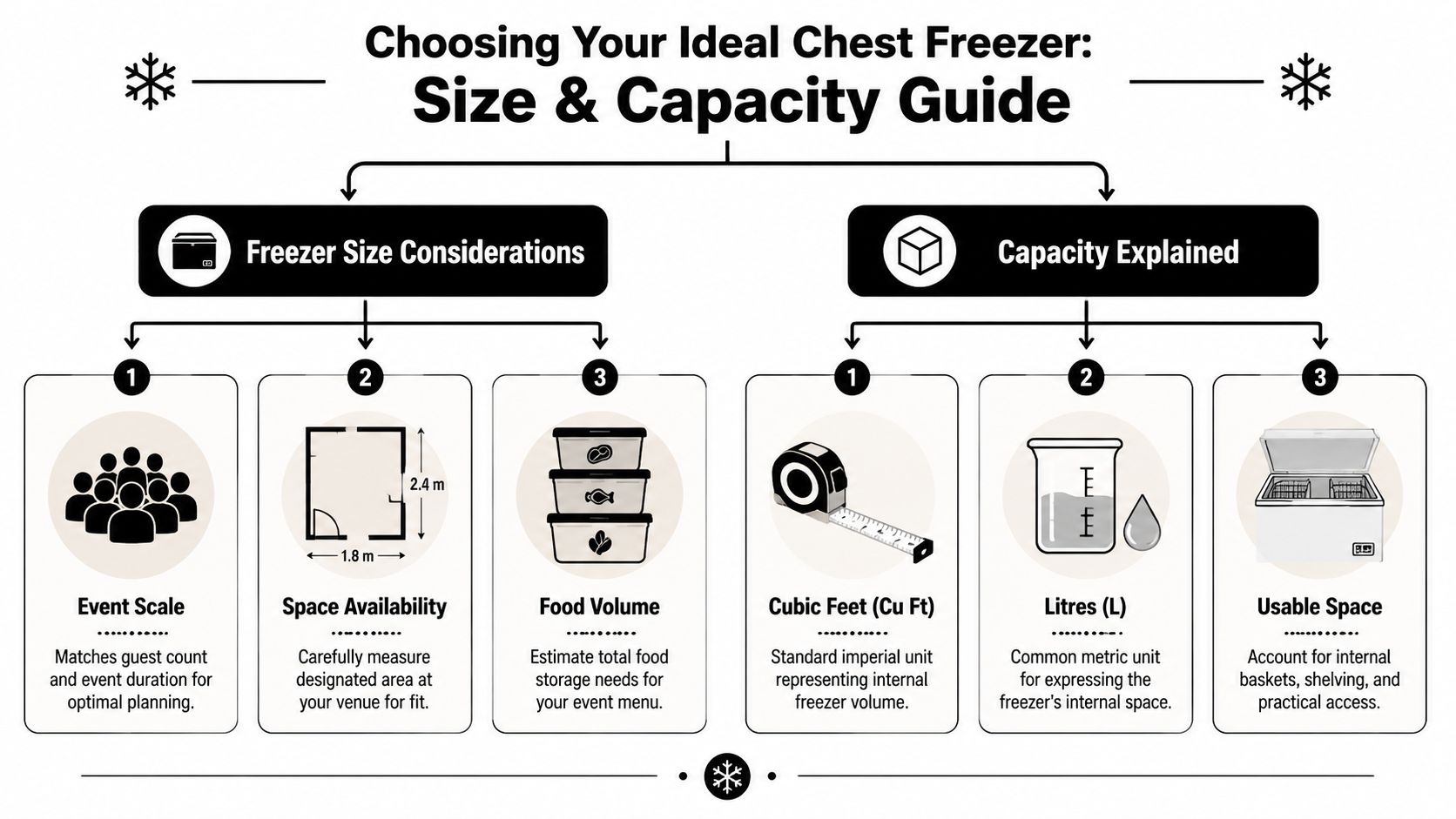
An infographic titled Choosing Your Ideal Chest Freezer explaining considerations for size and capacity.

Translate capacity into event reality

Litres sound technical. Event stock is physical. You're dealing with ice bags, tubs, trays, bottles, and cartons.

Use these practical checks instead:

  • If the freezer is for ice only: Prioritise easy access over theoretical maximum fill. Staff will open it often.
  • If it's for desserts or frozen canapés: Leave room for airflow and organised stacking. Crushed packaging and overloading create service delays.
  • If it's backup storage for catering: Separate what must stay untouched until service from stock that the team will pull throughout the day.

Practical rule: If your team has to unpack half the freezer to reach one item, the size may be right but the plan is wrong.

Match the freezer to the event type

Different events put pressure on cold storage in different ways.

A wedding usually needs freezer space for a few high-risk items. Think frozen desserts, emergency ice, or items that must stay pristine until a precise service window. A corporate launch often needs repeated access because staff are handing out chilled product all evening. A birthday party may need less variety, but constant bar support.

When I help planners think this through, I ask three questions first:

  1. What must remain frozen until the last possible moment?
  2. Who needs access during service? The chef, the bar team, or both.
  3. Where will the freezer sit in relation to guest flow and prep flow?

Those answers matter more than brand brochures.

For a broader look at cold storage options across event setups, this guide to bar fridge and freezer hire is useful because it helps frame when compact freezer capacity is enough and when you need a mixed setup.

Don't confuse internal volume with usable volume

A chest freezer's open cavity is one of its strengths. In event work, bulky stock often fits better in that format than in an upright model with fixed dividers. But usable space still drops quickly when you add baskets, awkward packaging, or poor loading discipline.

The smartest move is to assign the freezer one job. If it becomes half ice, half desserts, half backup catering, nobody will find anything fast when service starts.

Rent or Buy Your Event Freezer

The rent versus buy call usually gets made in the week after an event, not before it. That is when the freezer has to be cleaned, dried, stored, moved out of the way, and tested for the next booking. If your team cannot handle that without strain, ownership starts costing more than the purchase price.

For Cape Town planners, the primary question is frequency with control. A venue in Durbanville with weddings most weekends can justify owning a unit because it stays on site and gets used often. An independent planner working across Constantia, Stellenbosch, Franschhoek, and private homes in the city usually benefits more from hiring. Every site has different access, different kitchen support, and different cold storage gaps.

Buying does make sense in the right setup. Retail pricing in South Africa shows that compact chest freezers sit within reach for established operators, especially if the unit will work most weeks and live in a proper prep or storage area. Makro's chest freezer listings are a useful reference point for current local buying options and price bands. For a venue or caterer with predictable demand, that spend can be easier to defend than repeated short-term hires.

The operational trade-off

Ownership works best when the freezer has a home, a handler, and a schedule.

Those three things matter more than brand promises.

A bought unit gives you control. You know its condition, you can pre-chill it before event week, and you are not relying on supplier availability in peak season. That matters in November and December, when event calendars tighten and last-minute equipment requests get harder to fill across Cape Town and the Winelands.

Renting gives you flexibility instead. You match the freezer to the event, avoid storing dead stock between jobs, and keep capital free for staffing, transport, power backup, or glassware. For planners managing mixed event types, that flexibility is often the better business decision.

Consideration Renting (e.g., from ABC Hire) Buying
Upfront commitment Lower commitment for one-off or occasional events Higher upfront outlay
Flexibility by event Easier to match freezer size to each function You work with the unit you own
Storage between events No ongoing storage burden Requires secure storage space
Maintenance Usually handled by the rental provider Your responsibility
Transport logistics Often simpler if delivery and collection are available You must arrange handling and movement
Best fit Planners, private hosts, seasonal demand Venues or operators with frequent, predictable use

Who should usually rent

Rental usually suits teams dealing with changing venues, changing guest counts, or short bursts of demand:

  • Wedding planners: Estate kitchens differ wildly, and some beautiful Winelands venues still have limited freezer space once the caterer arrives.
  • Corporate teams: Product launches and brand activations often need cold storage only for a single service window.
  • Private hosts: A once-off celebration rarely justifies buying, storing, and maintaining an appliance afterward.
  • Schools and universities: Formals, prizegivings, and seasonal functions create sharp demand, then long gaps with no use.

Who may benefit from buying

Buying tends to suit operators with repeatable systems:

  • Busy venues with recurring functions
  • Caterers with dedicated prep premises
  • Operators who already have appliance storage and transport systems

I would add one more filter. Buy only if the freezer can stay plugged in, be checked regularly, and be moved by staff who know how to handle it properly. If it is going to sit in a storeroom behind decor stock and only come out before major events, rental is usually the safer call.

If you are still comparing a chest freezer with a mixed cold-storage setup, this guide to deep freezer and refrigerator combinations for event use helps clarify when frozen holding alone is enough and when you also need chilled service stock nearby.

The expensive mistake is buying for “future use” without a clear pattern of bookings. I see that most often with smaller operators who want backup equipment on hand, then discover that transport, storage space, cleaning discipline, and pre-event testing are the actual burden.

Power and Placement for Cape Town Venues

In Cape Town event work, power planning isn't separate from freezer planning. It is freezer planning.

That matters most at venues where the beautiful parts are far from the practical parts. Historic buildings in town can have awkward plug access. Marquee setups in Paarl can involve long cable routes and uneven ground. Wine estates often have excellent catering spaces for normal service, then stretch beyond those spaces when the event grows.

South Africa's energy reality has pushed buyers and operators towards efficiency and resilience. Defy's guide to chest freezers in South Africa notes the strong focus on eco-friendly, reliable brands and highlights solar-powered chest freezers as a practical solution to load-shedding, operating independently of the national grid. That's especially relevant for remote service areas and outdoor functions where backup planning has to be built in from the start.
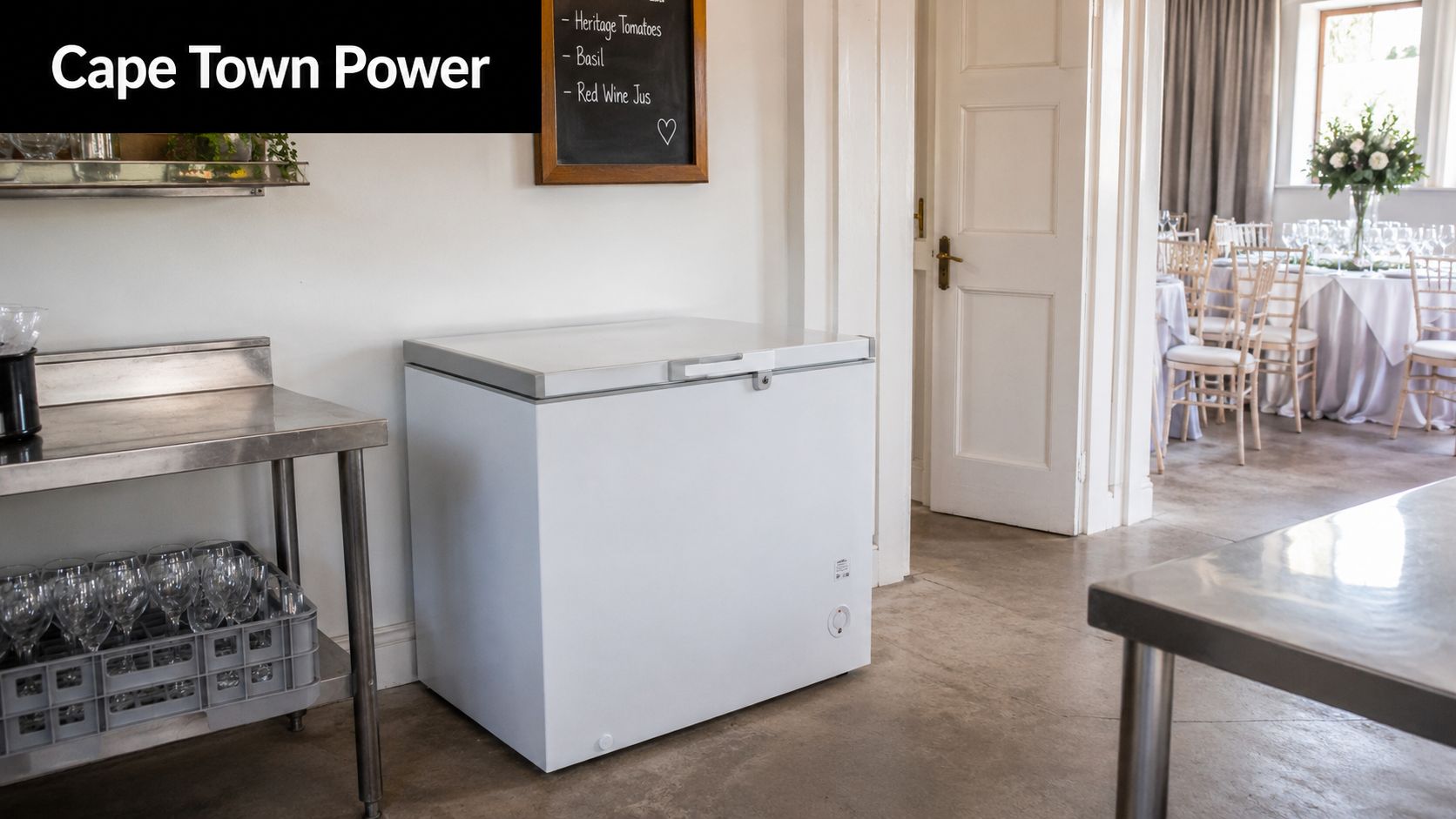
A white chest freezer sits on a concrete floor in a bright event venue or kitchen space.

Place it where staff can use it fast

The best freezer placement is rarely the most hidden corner.

You want the unit close enough to the team that they'll use it properly, but not so close to guest traffic that the lid opening becomes visible clutter or a safety issue. For a wedding, that usually means near the catering or bar support zone, not in the decorative footprint of the event itself. For a corporate activation, the ideal spot is often a back-of-house pocket directly behind the branded service point.

Check these details before the event day:

  • Level surface: A stable, flat base matters, especially at outdoor venues and temporary structures.
  • Shade and ambient heat: Keep the unit out of direct sun and away from cooking equipment.
  • Plug access: Don't assume the nearest socket is suitable or conveniently placed.
  • Lid clearance: Staff need room to open the freezer fully without hitting walls, counters, or drape lines.

Match the venue type to the risk

Cape Town venues each bring their own friction points.

A heritage building may limit placement because of narrow service entries and older electrical layouts. A Franschhoek farm venue may have excellent space but longer distances between prep, storage, and service. A tented event on an estate often creates the most moving parts because nothing is naturally fixed in place.

If the freezer is hard to reach, staff will compensate with poor habits. They'll leave it open too long, overfill nearby fridges, or create messy temporary storage.

Think beyond mains power

Solar chest freezers are getting more attention for good reason. They reduce dependence on the grid and suit venues or event formats where power stability is uncertain. They won't be the answer for every event, but they are worth considering where venue infrastructure is inconsistent or where sustainability is part of the brief.

What doesn't work is treating the freezer like a plug-and-forget item. Every event plan should include power allocation, cable path, setup timing, and a named person responsible for checking that the unit is running correctly before stock goes inside.

Essential Food Safety and Maintenance Tips

Cold storage only helps if the freezer is organised, monitored, and used with discipline. A badly run freezer creates the same kind of event risk as no freezer at all. Food quality drops. Service slows. Liability goes up.

The baseline matters. Small chest freezers maintain a temperature range of −23°C to −29°C, and some models preserve food for over 135 hours in super-freezer modes during power outages, according to the referenced Hisense H125CF market example and temperature benchmark. For event teams, the takeaway isn't to rely on the outage window as a strategy. It's to understand that good freezer performance gives you a safety margin when conditions go sideways.
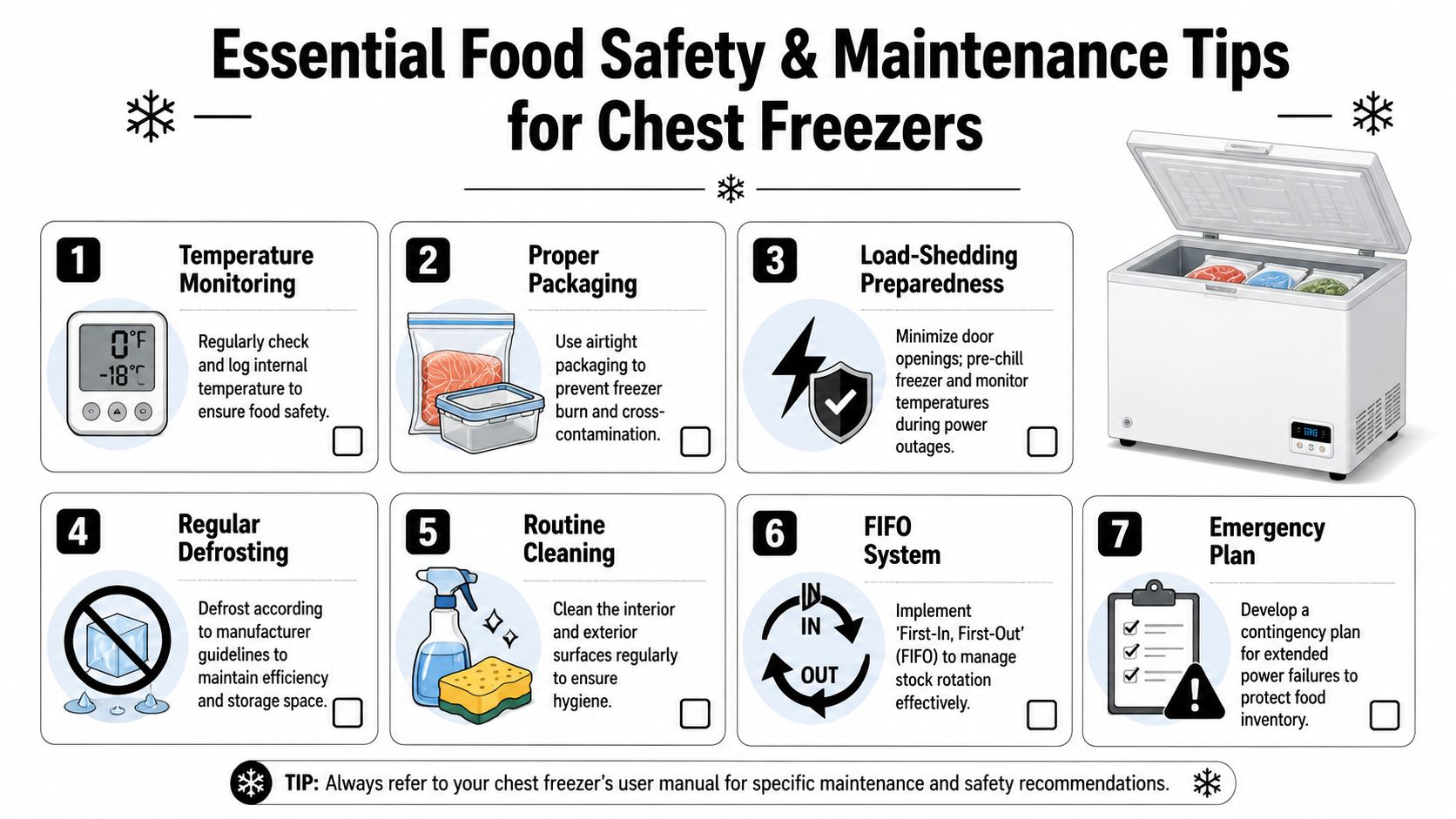
A guide listing seven essential food safety and maintenance tips for operating a chest freezer effectively.

Before the event

A freezer should never arrive on site and immediately get packed to the brim.

Do the setup properly first:

  • Pre-chill the unit: Let it reach operating temperature before loading stock.
  • Group items by service timing: Put late-service stock below or behind early-access items.
  • Use sealed packaging: This protects product quality and reduces contamination risk.
  • Label clearly: Especially important if multiple teams share one unit.

If your event includes mixed cold-chain items, kitchen discipline matters just as much as freezer performance. MODERN LYFE's food safety advice is a helpful refresher on why foods shouldn't linger in unsafe temperature ranges during prep and service.

During service

The biggest mistakes happen when the event gets busy.

Staff start “quickly checking” inside the freezer every few minutes. Someone drops warm stock into the same space as frozen desserts. The lid gets left open while people decide what they need.

Use these habits instead:

  1. Assign access: One person or one team should control the freezer during peak service.
  2. Open with purpose: Know what you're taking before the lid goes up.
  3. Separate high-value stock: Keep premium desserts, special dietary items, or backup proteins protected from constant rummaging.
  4. Monitor condition, not just temperature: Packaging collapse, frost build-up, and condensation can tell you a lot.

Cold storage works best when access is limited and intentional.

After the event

Rental or owned, the close-down routine matters.

  • Remove all stock promptly: Don't leave forgotten product behind after breakdown.
  • Wipe interior surfaces: Sticky spills and food debris turn into odour problems fast.
  • Check for damage: Hinges, baskets, and lid seals should be inspected before sign-off.
  • Leave the unit in good order: If it's a rental, this avoids disputes. If it's yours, it makes the next event easier.

Lockable lids and anti-thaw features are useful where stock security and product consistency matter, especially at larger venues with multiple crews moving through back-of-house. What doesn't work is using a freezer as a dumping zone. If nobody owns the system, the system breaks.

Small Chest Freezer Use Cases and Costs

On a Cape Town event floor, a small chest freezer usually earns its keep in the gaps the main venue fridge cannot cover. I use them for the stock that cannot be left to chance. Frozen desserts for a plated finish, backup ice for a bar that is running harder than forecast, or late-arriving product that needs holding before service all fit this job well. At Winelands venues with compact prep areas, a smaller chest unit also solves a basic space problem without forcing the kitchen team to rework their whole layout.

A small freezer makes sense in different ways depending on the event.

  • Wedding reception: Hold sorbet, ice cream cakes, frozen petit fours, or backup canapés that need to stay stable until a precise service window.
  • Corporate launch: Keep branded treats, product samples, or activation stock in controlled condition until handout.
  • Private celebration: Support the bar with bagged ice, frozen garnishes, and overflow items that would otherwise crowd the house fridge.

Some activations need more than back-of-house cold holding. If guest-facing frozen distribution is part of the concept, Mpz frozen food vending machines may suit the brief better.

Cost depends less on the sticker price and more on how often you run events with the same cold-storage pressure. For a planner handling occasional weddings or one-off brand activations, rental is usually easier to justify because delivery, pickup, and short-term use are built into the decision. For venues, caterers, and event businesses that need repeat freezer capacity through season, buying can make sense if the unit will not sit idle for long stretches.

The other cost sits in the failure points. Melted dessert stock, emergency ice runs, damaged presentation, and staff time spent fixing preventable cold-chain problems are usually more expensive than the freezer itself.

If you are weighing a fixed freezer against a more flexible cold setup, mobile fridge hire for events is a useful comparison point. In practice, chest freezers are best when you need deep cold retention in a small footprint. Fridges are often the better call when stock needs frequent access during service.

Frequently Asked Questions for Event Planners

How far in advance should I book a freezer for a Cape Town event

Book as early as you can once the venue and service plan are confirmed. Peak wedding months, year-end functions, and matric season put pressure on event equipment availability. The more specific your site needs are, the less you should leave to the last week.

Should the freezer arrive on the event day

Usually, earlier is better if access allows. That gives the unit time to settle, cool properly, and be loaded in an organised way. Same-day delivery can work, but it leaves less margin for setup delays, venue access issues, or power checks.

Do I need to transport it myself

In most professional event setups, it's better to arrange delivery and collection rather than moving the unit in a private vehicle. Small chest freezers are compact compared with commercial cold rooms, but they still need careful handling, stable transport, and sensible positioning on site.

Can a rental freezer be used at outdoor venues

Yes, provided the placement is managed properly. Keep it on a level surface, out of direct sun, and close enough to the operating team that service stays efficient. Outdoor use fails when the unit is treated like scenery instead of working equipment.

Can I use one freezer for both bar stock and catering stock

You can, but it's rarely ideal unless the contents are clearly separated and access is controlled. Mixed-use freezers tend to become disorganised quickly during service. If the event has a serious bar and a serious catering brief, split the jobs.

Can I brand a freezer for a corporate event

Sometimes, but only if branding methods won't damage the surface or interfere with operation. Always clear this with the provider first. Temporary wraps or magnets may be possible depending on the unit and the event brief.

What should I confirm before signing off on a booking

Ask about the exact unit size, delivery timing, collection timing, power requirements, and whether the freezer will arrive clean and ready for use. Also confirm who is responsible for setup position and who signs off on condition at collection.


If you're planning a wedding, corporate event, matric function, or private celebration in Cape Town or the Winelands, ABC Hire can help you secure practical event equipment that keeps service smooth and guests happy. It's a smart option when you need reliable cold storage without the hassle of buying, storing, and moving a freezer yourself.
Cape Town Venues for Conferences: Your 2026 Guide

A new conference brief usually lands with a mix of ambition and vagueness. The client wants polished, productive, memorable, and “not the same as last year”, but the venue still needs to carry registration, plenaries, breakaways, catering, branding, and all the quiet practicalities people only notice when they go wrong.

That's why venue selection is never just about finding a nice room. In Cape Town, the stronger approach is to find a venue with the right bones, then shape it around the event you're running. The floorplan, light, access, acoustics, and technical base matter more than glossy photos. The finishing layer comes from how you configure the space, what you bring in, and how well the room supports the programme from first coffee to final close.

Starting Your Search for the Ideal Conference Venue

Most planners begin with a shortlist built from reputation. That helps, but it doesn't solve the key question: can the venue support the way your event needs to work?

Cape Town gives you genuine range. South Africa has more than 1,700 meeting venues nationwide, with major convention centres in Johannesburg, Cape Town, Durban, and Pretoria, and the CTICC remains one of the country's anchor assets for large events and conferences according to South African business events venue listings. That scale matters because it means you're not searching in a thin market. You're searching in a market with options, which lets you choose for fit rather than settling for availability alone.

Start with the brief, not the brochure

A practical brief has to answer a few things before you tour anything:

  • Event purpose: Is this a sales conference, a leadership off-site, an academic gathering, or a client-facing summit?
  • Delegate behaviour: Will people sit and listen, move between sessions, network heavily, or need table space for laptops and note-taking?
  • Brand tone: Formal, premium, relaxed, technical, celebratory, or hybrid?
  • Operational pressure points: Parking, loading access, Wi-Fi reliability, catering flow, or multiple breakaway rooms?

That first filter removes a lot of unsuitable venues very quickly.

Practical rule: The perfect venue usually isn't found fully formed. It's assembled from a good shell, a realistic floorplan, and the right support around it.

A client asking for a conference that also feels collaborative may think they need a purpose-built conference centre. Sometimes they do. Sometimes they need a venue with stronger atmosphere and a better post-session networking environment. Teams comparing plenary spaces with more informal options often benefit from seeing related formats too, including ROI-driven team building venues that show how space design influences participation and energy.

What to assess before you enquire

Before sending requests, I'd narrow the list using a simple screening pass:

  1. Can the venue hold the programme comfortably?
  2. Does the venue's built-in style support the audience?
  3. Will the venue need a light enhancement or a full fit-out?
  4. Can suppliers load in efficiently without disrupting the site?

If your planning process is still taking shape, a good grounding in event management in Cape Town helps frame venue choice as one decision inside a larger operational chain, not a standalone booking.

Exploring Conference Venue Types in the Cape

Cape Town has enough variety that “venues for conferences” can mean completely different experiences. That's useful, but only if you're honest about the trade-offs.

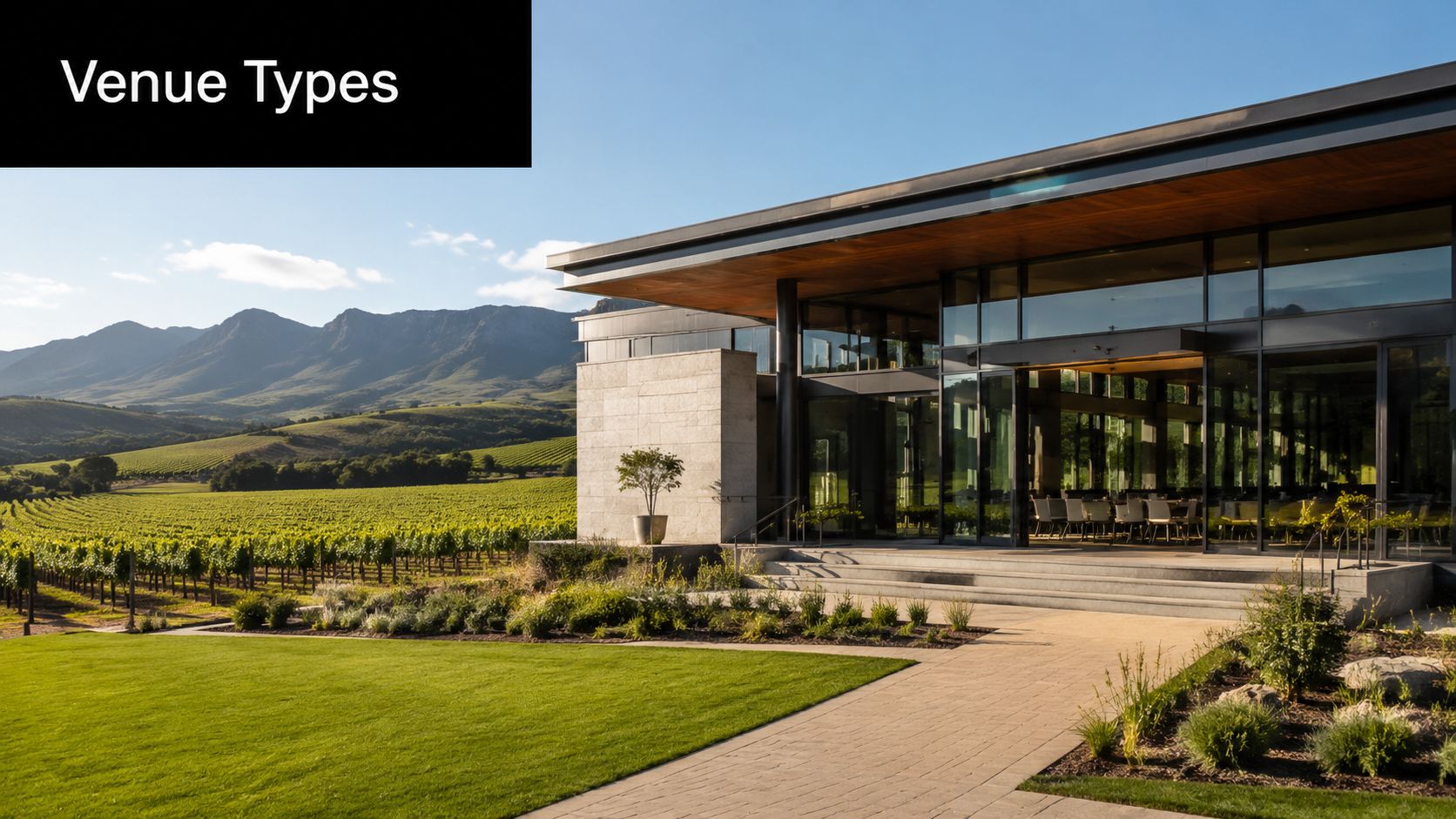
A luxurious modern venue building overlooking sprawling green vineyards and scenic mountains on a sunny day.

The city is a strong events base. Cape Town accounts for approximately 350 dedicated meeting and conference spaces, and most are equipped with projectors, wireless internet, and climate control, according to Stats SA venue infrastructure information. That gives planners three broad categories to work with.

Hotel and conference centres

These are the safe hands option. They usually offer experienced operations teams, structured loading procedures, predictable catering systems, and rooms designed for presentation-heavy programmes.

What works well

  • Multi-room conferences with breakaways
  • Corporate audiences expecting polished service
  • Tight schedules where reliability matters more than novelty
  • Events with out-of-town delegates who need accommodation nearby

What doesn't always work

  • Networking can feel sterile if foyers are purely functional
  • Standard furniture packages often look generic
  • Brand personality can get lost in neutral interiors

A conference centre is often strongest at the formal programme and weakest at warmth. If the client wants stronger interaction between sessions, the fix usually isn't changing the venue. It's adding better social zones, varied seating, and more deliberate registration and refreshment layouts.

Wine estates and Winelands venues

These are strong when the conference needs a sense of place. Cape Town, Stellenbosch, Franschhoek, and Paarl offer settings that instantly improve arrival experience, dining atmosphere, and sponsor photography.

Best for

  • Executive meetings
  • Client conferences
  • Leadership retreats
  • Programmes where the setting is part of the value

The challenge is that many scenic venues aren't built around conference movement. The boardroom or hall may be lovely, but the registration zone is too tight, the breakaway options are limited, or the networking setup feels improvised.

Scenic venues often win the first impression and lose the middle of the day. The planner's job is to protect the delegate experience after the welcome coffee.

That usually means supplementing the venue's fixed setup with lounge groupings, extra cocktail tables, practical registration furniture, and weather-conscious additions for outdoor transition spaces.

Galleries, warehouses, and blank-canvas spaces

These venues can produce the most distinctive result. They're useful for launches, thought-leadership events, design-focused brands, and conferences that need a less corporate edge.

They also require the most discipline.

Venue type Main strength Common weak point Best response
Hotel or conference centre Reliability and built-in systems Can feel standardised Improve atmosphere and networking zones
Wine estate Strong setting and guest experience Operational flow may be uneven Add functional furniture and clear zoning
Blank canvas space Maximum creative control Needs substantial planning Build the event environment from the ground up

A blank-canvas venue can look exceptional, but only if every practical layer is handled. Seating, staging, power access, climate comfort, registration flow, and catering support can't be assumed. If one of those is weak, the room feels unfinished no matter how attractive the architecture is.

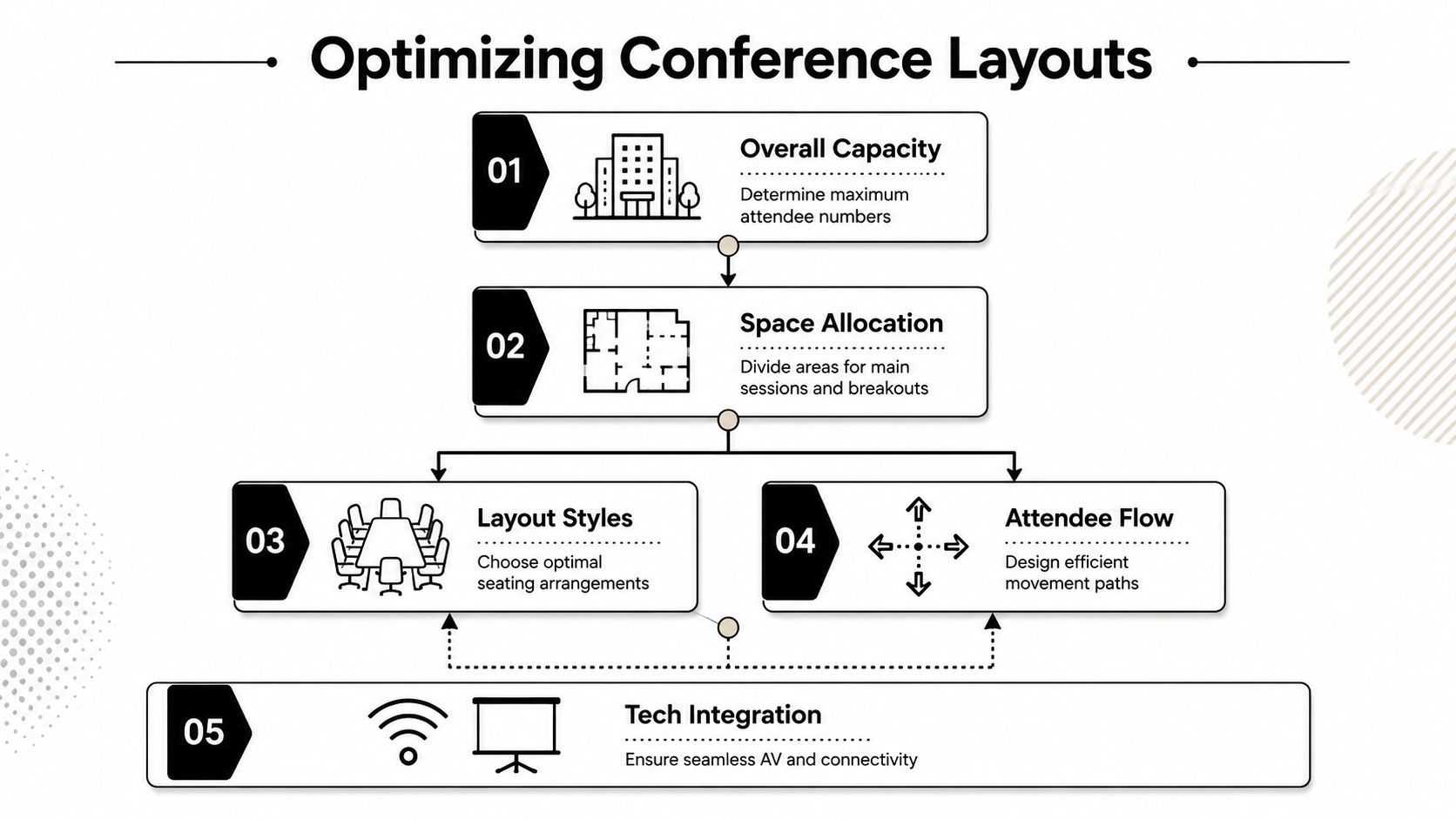
Planning Capacity Layout and Attendee Flow

A venue can fit your delegate count and still be the wrong room. Capacity is only the starting point. Layout determines whether the event feels focused, crowded, flat, or easy to move through.

A flowchart infographic outlining five key steps for optimizing conference room layouts and event space design.

Some South African venues are designed for flexible use, with setups that can scale to 160 delegates in cinema style, as outlined in conference venue technical requirement examples. That flexibility only helps if you choose the right layout for the programme.

Match the room style to the behaviour you want

A theatre setup suits keynote-heavy sessions where attention needs to stay on stage. It uses space efficiently, but it discourages note-taking and conversation.

A classroom layout gives delegates table surface and works better for training, workshops, and strategy sessions. It needs more room and careful sightline planning.

Cabaret style is useful when discussion matters. It softens the room and supports interaction, but it reduces overall capacity and can make the plenary feel less direct if the stage design is weak.

Banquet-style seating belongs to sessions that blend conferencing with dining or awards. It can work well, but only if the agenda allows for the slower movement that round tables create.

Plan in zones, not one room

Strong conference spaces are rarely experienced as a single hall. Delegates move through a sequence.

Think in zones:

  • Arrival zone: registration, badge collection, welcome coffee
  • Main session zone: stage, screen, presenter sightlines, audience seating
  • Transition zone: circulation space between plenary and refreshments
  • Networking zone: standing tables, lounge areas, sponsor moments
  • Breakaway zone: smaller rooms or partitioned areas for parallel sessions

When planners skip zoning, congestion shows up immediately. Registration backs up. Coffee service blocks doors. Delegates stand with plates because there's nowhere obvious to gather.

The easiest way to spot a weak floorplan is to ask where people will stand when they are not seated. If there's no clear answer, the room needs work.

Use movement as a design tool

Attendee flow isn't just about avoiding queues. It shapes mood. People network more naturally when there are small standing clusters, informal seating pockets, and enough room to peel away from the main crowd without leaving the event.

A helpful reference for wayfinding and movement design is this venue manager's mapping guide, which shows why route planning matters long before guests arrive.

A practical layout review should check:

  1. Door positions: Can people enter and exit without crossing in front of the stage?
  2. Service points: Are coffee stations and catering tables off the main circulation path?
  3. Sightlines: Will every delegate see the screen without turning awkwardly?
  4. Furniture density: Is there enough breathing space between rows and tables?
  5. Informal use: Where do spontaneous conversations happen?

The best layouts feel obvious when guests use them. That doesn't happen by accident.

Evaluating Essential AV and Technical Needs

A venue brochure will often say “AV included”. That phrase is too vague to be useful. For conferences, the key question is whether the in-house setup is basic convenience or professional event infrastructure.

Top-tier South African venues typically include dedicated AV features such as wall-mounted presentation speakers and large motorised screens synchronised with audio systems, as described in this overview of venue AV standards. That's a strong sign, but it still doesn't replace a proper technical check.

Base-level AV versus professional-grade AV

A base-level venue package usually covers the essentials for a simple meeting. That may be enough for a board session or a short internal briefing. It's rarely enough for a conference with multiple speakers, branded content, video playback, panel discussions, and audience questions.

Requirement Base-level venue offer Professional conference standard
Screen One fixed display option Screen sized and positioned for room depth
Audio Basic room speakers Balanced coverage across the audience
Microphones Limited handheld option Lapel, handheld, lectern, and roving support
Wi-Fi General guest network Capacity tested for delegates, presenters, and staff
Support Venue contact on call On-site technician through live sessions

If your event includes panel sessions, pre-recorded video, sponsor stings, or remote contributors, don't assume the venue package will carry it cleanly.

Questions worth asking on the first technical call

Use direct questions. They save time.

  • What microphone options are available on site?
  • Is the screen fixed, portable, or configurable for room layout?
  • How are presenters monitored for timing and playback cues?
  • Who handles transitions between speakers and media?
  • What happens if the primary presentation device fails?
  • Will a technician be physically present during the event?

Sound is usually the first weak point. A room can look excellent and still fail because the back third of the audience can't hear clearly, or a panel discussion has uneven mic levels.

If you're working through the sound side in more detail, this guide on speakers for rent is useful for understanding where venue sound ends and event-grade audio begins.

If delegates strain to hear for even ten minutes, they stop engaging. Once attention drops, the rest of the production has to work twice as hard.

Don't skip rehearsal

The rehearsal is where you catch awkward lectern placement, weak clicker range, bad confidence monitor positioning, and presentation files that don't scale correctly. It's also where speakers learn the room.

A technical run should include opening media, at least one speaker transition, panel handover, audience Q&A, and closing cues. If the venue can't support that process smoothly, it's telling you something important before event day.

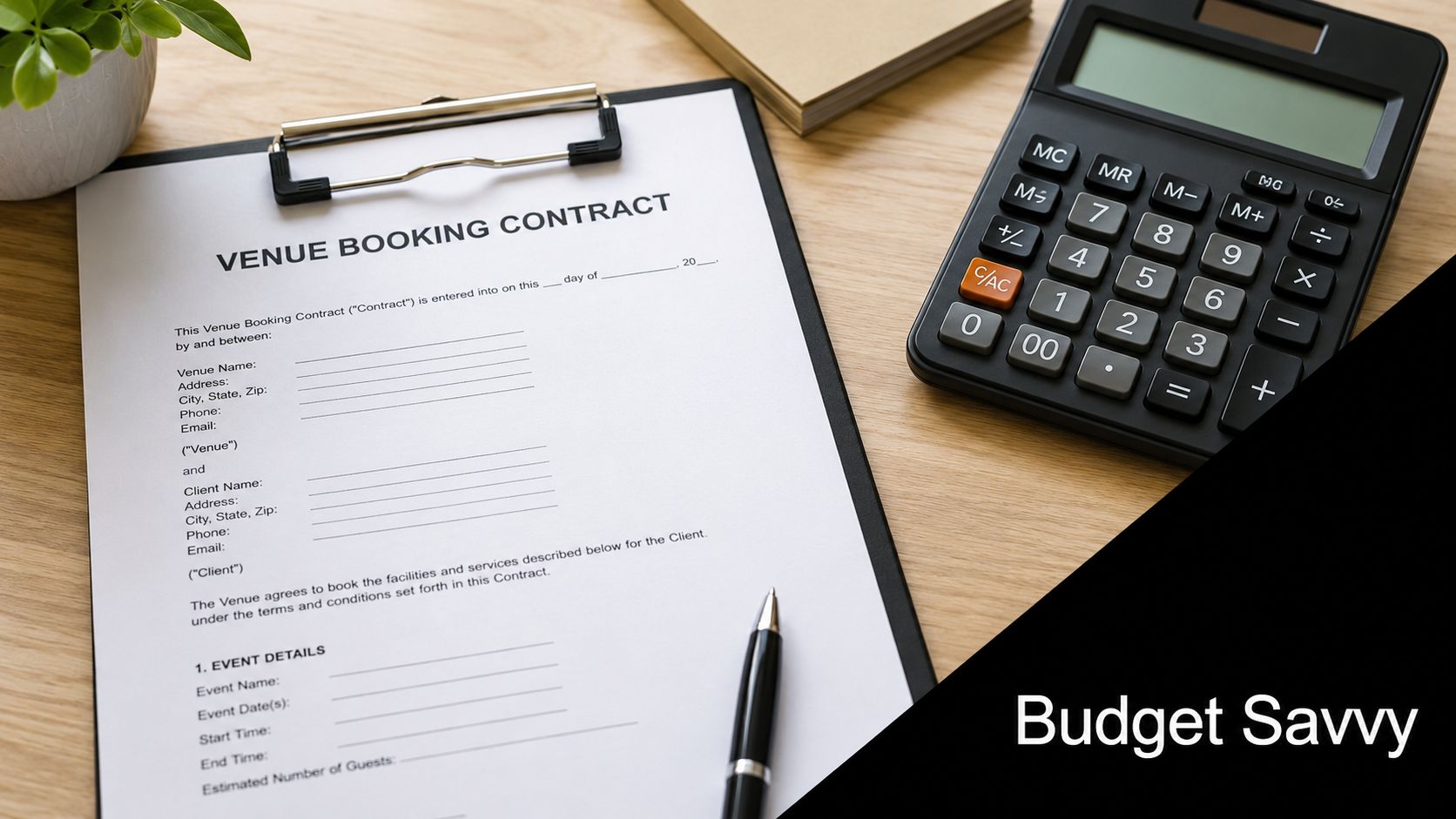
Managing Budgets Contracts and Hidden Costs

Venue hire fees can look tidy on the first proposal. The actual cost usually sits in the conditions around the hire, not the headline figure.

A venue booking contract on a clipboard with a calculator and a pen on a wooden desk.

A cheap room can become expensive once you add mandatory staffing, restricted supplier access, overtime, corkage, cleaning, security, furniture upgrades, and power-related extras. That's why budget control depends on transparency more than discounting.

What to read carefully in the contract

The most common budgeting mistakes happen when planners focus on room hire and catering, then treat everything else as minor. It isn't minor.

Check the contract for:

  • Setup and breakdown windows: Short access times increase labour pressure fast.
  • Exclusive supplier clauses: These can limit flexibility and remove pricing control.
  • Furniture inclusions: “Standard furniture” may not suit the event format or brand.
  • Cleaning and damage terms: Important for high-traffic conferences and evening functions.
  • Power and technical limitations: Especially relevant in older or non-purpose-built venues.

A strong contract gives you room to make decisions. A weak one forces you into expensive defaults.

The value question, not just the cost question

The smartest venue choice is often the one that lets you spend deliberately. If the venue has a strong shell but leaves furniture, styling, and room configuration open, you can shape the budget around what delegates will notice.

That matters for conferences because attendees remember comfort, flow, visibility, and atmosphere. They don't care whether a package was “included” if the chair is wrong for a full-day session or the networking area feels like an afterthought.

Here's where many planners get caught. A bundled venue package sounds efficient, but bundled doesn't always mean suitable. If the package includes furniture that's mismatched to the programme, you'll either live with the compromise or pay twice.

Budget pressure is easier to manage when each line item is visible. Hidden costs are harder to defend than intentional upgrades.

Sustainability needs more scrutiny

Unique venues are attractive, but they raise another practical issue. Planners increasingly need to balance atmosphere with sustainability requirements. That's harder than it should be because few venues publish verified metrics on carbon-offset partnerships or waste-reduction audits, which has become a noted challenge under South Africa's projected 2025 Green Event Act, according to venue listings discussing sustainability transparency gaps.

That means you need to ask direct questions rather than relying on broad green claims.

Try these during negotiation:

  1. Do you document waste handling after events?
  2. Can you verify sustainability partnerships or only describe them?
  3. Do you allow reusable or externally sourced service solutions?
  4. How do you manage power usage and climate control during long conference days?

If a venue can't answer clearly, treat sustainability as an unresolved risk rather than a confirmed strength.

Your Ultimate Site Visit Checklist

A site visit tells you whether the venue can deliver the experience the proposal promises. Walk the venue as a delegate, then again as an event manager. Those are two different routes, and both matter.

The first pass should check comfort, access, light, sound, and atmosphere. The second should check loading, service circulation, storage, staff responsiveness, and all the hidden practicalities that determine whether the day runs smoothly.

If you want a broader planning companion to use alongside your venue notes, this event planning checklist template is a useful working document.

What to inspect in person

Don't let the venue team guide you so tightly that you miss the edges of the experience. Pause in corridors. Check bathrooms. Stand at the back of the room. Look for plugs. Listen for road noise and kitchen spill.

Also inspect the existing furniture. Wobbly cocktail tables, worn conference chairs, and tired registration desks don't always appear in presentation decks, but they shape how professional the event feels.

Walk the route your delegates will take from parking to registration to seating. Friction always shows up in transitions first.

Conference Venue Site Visit Checklist

Category Item to Check Notes / Rating (1-5)
Access Parking convenience and drop-off flow
Access Step-free access, ramps, lifts, accessible toilets
Arrival Registration area size and queue space
Arrival Shelter for bad weather at entrance
Main room Sightlines to screen and stage from all sections
Main room Ceiling height and room proportions
Main room Condition of existing chairs and tables
Acoustics Echo, outside noise, and sound spill from adjacent spaces
Lighting Natural light control and blackout options
Power Plug point locations for AV, registration, and charging
Connectivity Wi-Fi signal consistency across key areas
Breakaways Number, privacy, and ease of movement between rooms
Catering Space for coffee breaks without blocking circulation
Restrooms Cleanliness, access, and adequacy for event size
Branding Walls, foyers, entrances, and screens available for signage
Operations Loading access, storage space, and supplier route
Staff Responsiveness and practical knowledge of the venue team
Safety Emergency exits and clarity of evacuation routes

Questions to ask before you leave

A site visit should end with answers, not just impressions.

Ask these before you go:

  • What changes in the room are allowed on event day?
  • Where can suppliers stage equipment before setup?
  • Which areas are shared with other bookings?
  • What's the contingency if weather affects outdoor use?
  • Who is the operational contact on the day itself?

Take photos from delegate eye level, not only wide architectural angles. Those are the images that help later when you're planning registration furniture, signage points, lounge areas, and traffic routes.

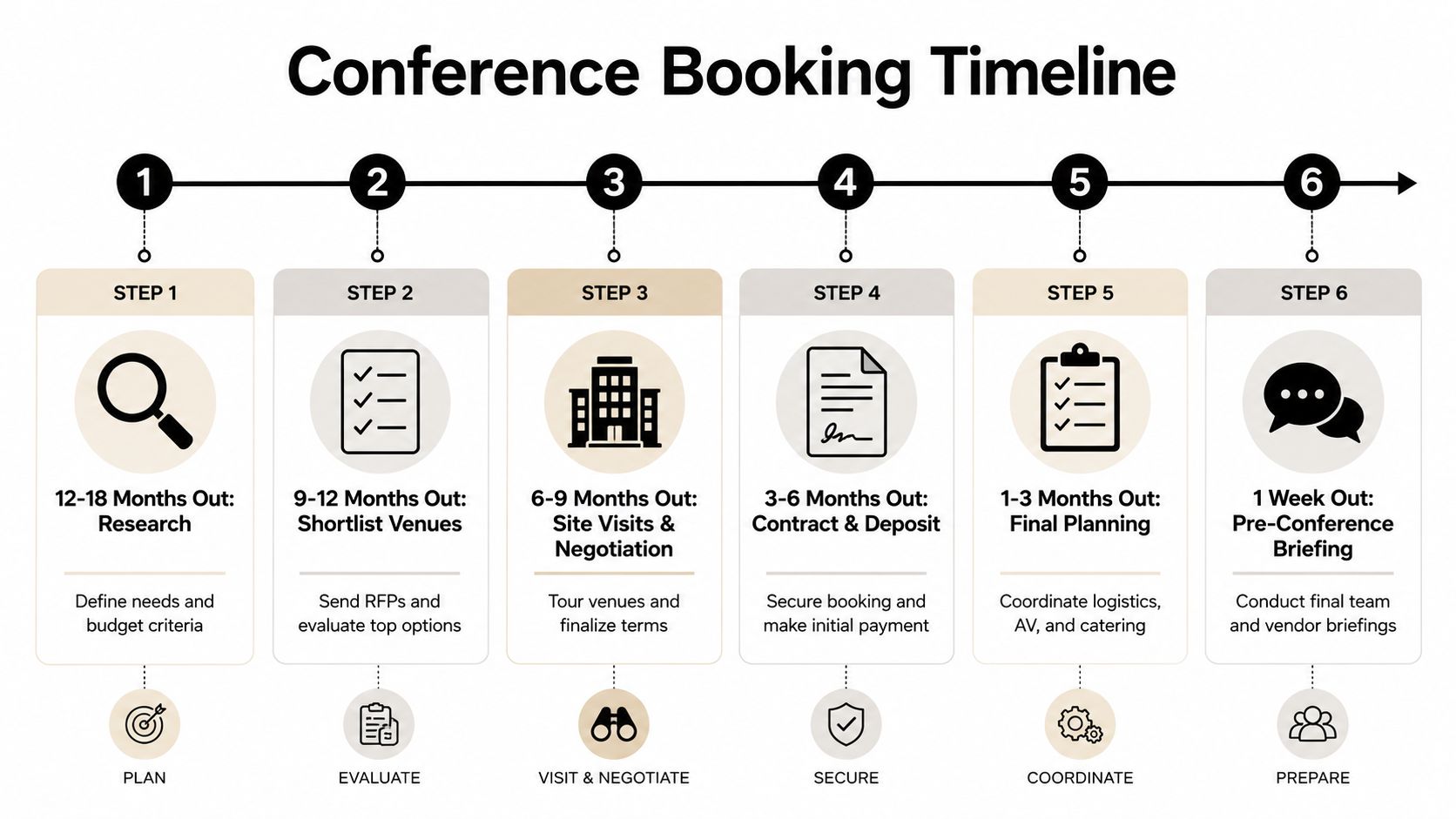
Creating Your Booking Timeline and Final Steps

The cleanest conference bookings happen when venue selection runs on a timeline, not on urgency. Once dates tighten, the conversation changes from “what fits the event best?” to “what's left?” That's when compromises creep in.

A sensible planning rhythm helps. Industry guidance often points planners to start venue research well ahead of the event, and this broader resource on how to organize a conference is a useful companion if you're mapping venue choice against speakers, registration, and programme build.

A six-step conference booking timeline infographic detailing the planning process from initial research to final pre-conference briefing.

A workable planning sequence

Use the venue process as a chain of decisions:

  1. Research phase
    Clarify audience, format, technical needs, and essential requirements.

  2. Shortlisting phase
    Compare venues by fit, not just appearance. Eliminate anything that can't support the core programme.

  3. Site visit and negotiation phase
    Test the room in person. Review access, service flow, AV base, and contract flexibility.

  4. Contract phase
    Confirm hire terms, timings, inclusions, restrictions, and decision deadlines.

  5. Production planning phase
    Lock layouts, registration flow, staging, furniture, catering positions, and branding points.

  6. Final briefing phase
    Bring venue, suppliers, and internal teams into one operating plan.

The final filter before you sign

Before confirming the booking, ask one last question: does this venue work only if everything goes perfectly, or does it still work when the day gets busy?

That test usually exposes the difference between a photogenic option and a practical one. The best venues for conferences aren't always the most dramatic. They're the ones that let delegates move easily, hear clearly, connect comfortably, and stay focused on the content.

Once the contract is signed, the next decision is straightforward. Now the room needs to become your event.


With the venue secured, it's the right time to plan the layer guests experience minute by minute: seating, lounge areas, registration furniture, climate control, and event atmosphere. ABC Hire helps Cape Town planners turn a good venue into a well-equipped conference environment with furniture and event rental options that suit corporate events, formal functions, and premium gatherings across the city and Winelands.

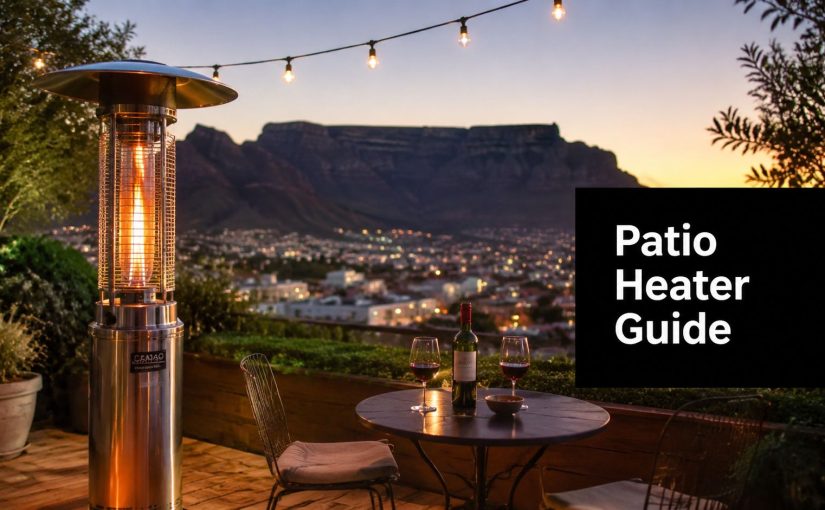
Patio Space Heater Guide for Cape Town Events

A patio space heater usually becomes urgent at the exact wrong moment. The ceremony is done, the canapés are moving, the bar is busy, and the venue looks perfect. Then the sun drops behind the mountain, the damp air settles in, and guests start choosing corners that feel less exposed instead of using the spaces you spent hours planning.

That shift happens fast in Cape Town and the Winelands. A courtyard that felt mild at sunset can feel sharply colder once wind moves through it. A terrace in town behaves differently from a lawn in Franschhoek. A covered area can hold comfort well, while an open gravel section can lose heat almost immediately.

Good event heating isn't about blasting warmth into the night and hoping for the best. It's about matching the heater type to the venue, the layout, the wind direction, the guest flow, and the length of the event. When planners get that right, guests stay where they should stay. They linger at the cocktail area, sit through speeches comfortably, and keep using the outdoor zones that make the event memorable.

Keeping Guests Warm at Your Cape Town Event

A winter wedding in the Winelands often looks effortless from the guest side. Candlelight flickers, glassware catches the last of the sunset, and the outdoor section feels like the best part of the venue. Then the cold starts working against the atmosphere.

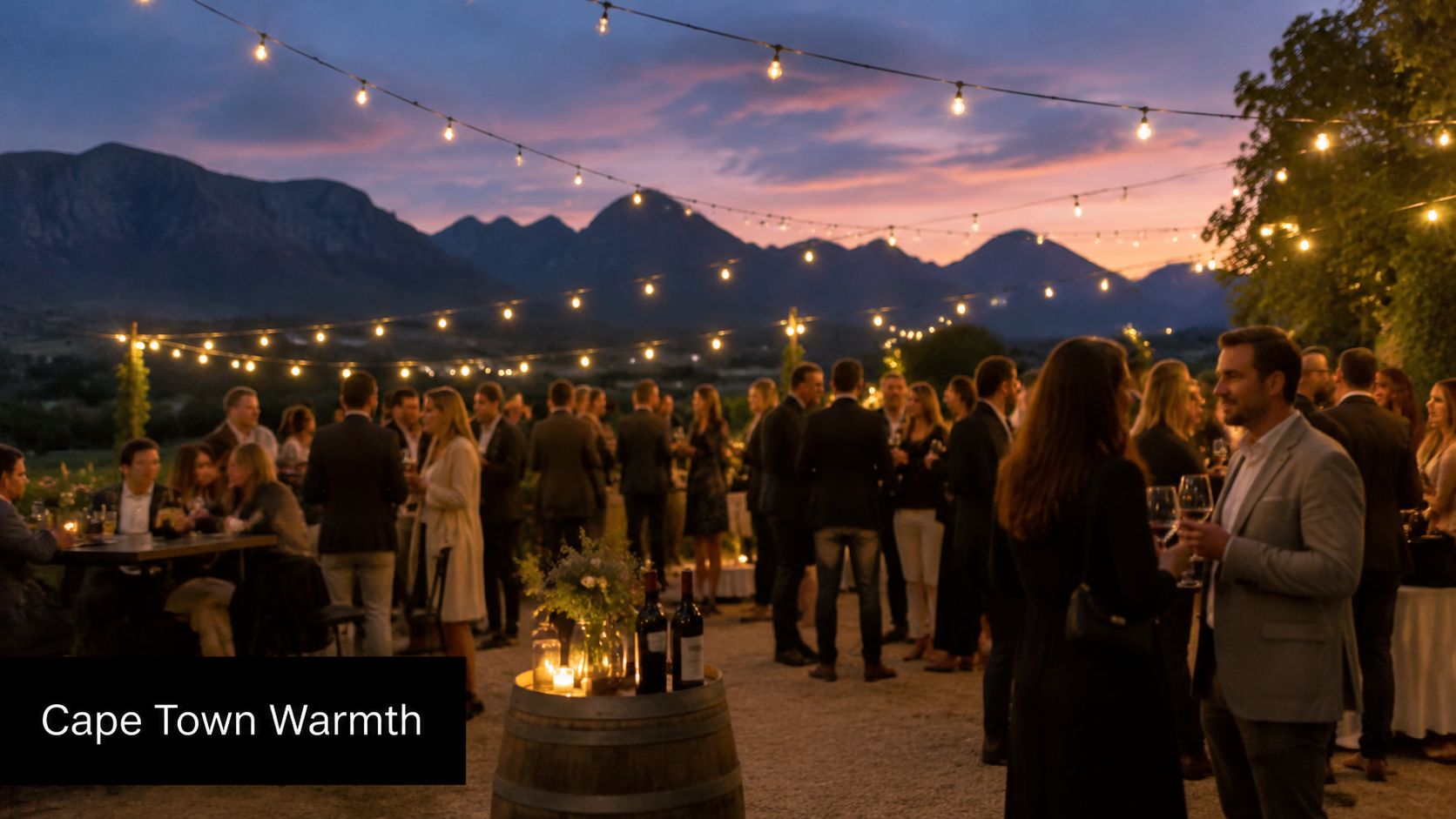
A social gathering with people at an outdoor winery event at sunset with mountain views.

I've seen the same pattern across weddings, corporate launches, and private parties. Guests don't always say they're cold. They stop using the outdoor lounge, pull chairs closer together, or drift indoors earlier than planned. That's when the patio space heater stops being a background rental item and becomes part of the event design itself.
The practical goal isn't to make the entire outdoors feel like an indoor room. It's to keep key guest areas comfortable enough that people want to stay in them. That means focusing on cocktail pockets, dining edges, smoking areas, waiting zones, and any spot where people stand still for longer than a few minutes.

Comfort has to match the look of the event

Planners usually worry, rightly, that heating equipment can ruin a clean layout. Oversized units in the wrong spot can interrupt sightlines, crowd furniture, and compete with floral or lighting elements. The answer isn't to skip heating. It's to choose fewer, better-positioned units and support them with softer comfort layers.

For seated events, textiles still matter. If you want to enhance your outdoor comfort without changing the visual tone of the venue, throws and blankets can help bridge the gap between decorative styling and thermal comfort.

Practical rule: Guests forgive cool air. They don't forgive being cold while seated, waiting, or trying to socialise.

A well-planned heating setup protects the event flow. It keeps speeches from feeling rushed, dinner from turning stiff, and open-air mingling from collapsing into one crowded indoor fallback space.

Choosing Your Heater Type Gas vs Electric

Heater choice affects far more than temperature. In Cape Town, it affects whether guests stay on the terrace at 8 pm or drift toward the bar inside once the south-easter starts cutting across the venue.

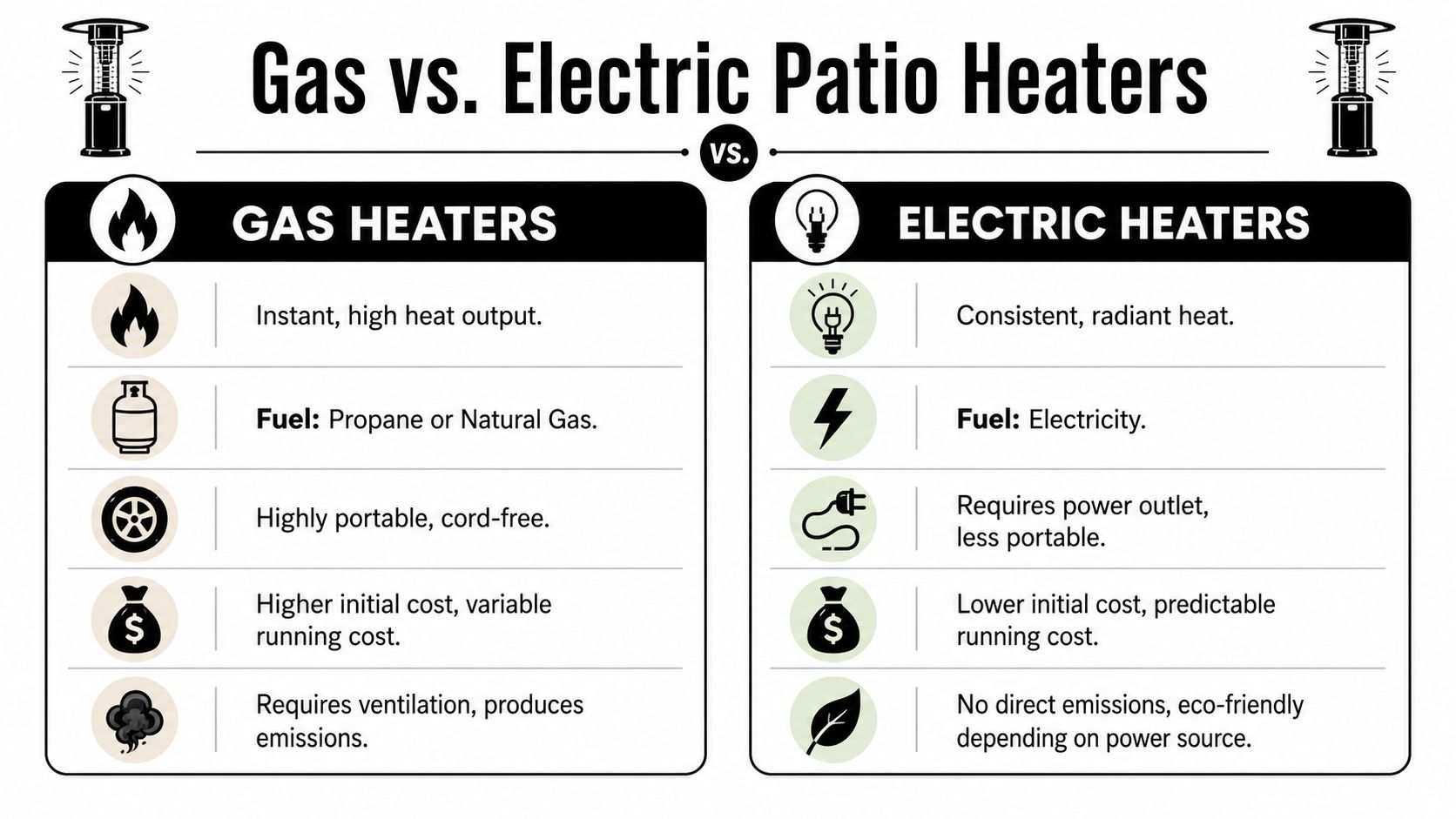
A comparison infographic listing the pros and cons of gas versus electric patio heaters for outdoor spaces.

A planner usually needs to decide between broad, movable heat and targeted, fixed heat. Gas handles the first job well. Electric handles the second. The right answer depends on exposure, power access, ceiling height, and how much the layout might shift during setup.

Gas heaters for open event spaces

For lawns, courtyards, farm venues, and open terraces, gas is usually the safer rental choice. Freestanding propane units are portable, need no trailing extension cords, and can be repositioned if the wind changes or a floor plan gets revised late. Product guidance from Patio Kingdom's gas heater specification notes typical use with 20 lb propane tanks and describes the familiar broad heat pattern these units are known for.

That makes gas practical for:

  • Cocktail areas where guests cluster and move around
  • Perimeter dining tables that cool down faster than central seating
  • Venues with weak power distribution or too few outdoor plug points
  • Load-in setups where planners want fast placement without cable management

Gas also copes better with real event friction. If a supplier adds a bar, if a DJ position shifts, or if a windbreak goes up late, the heating plan can move with it.

Electric heaters for controlled zones

Electric infrared heaters work best where the heating target stays fixed. They warm people and surfaces directly, which suits covered patios, verandas, entrance canopies, and seated zones tucked out of the wind. They are quieter than gas and visually cleaner, which matters at private homes and tighter venues where freestanding units can feel bulky.

The trade-off is practical, not theoretical. Electric only works well if the power supply is reliable and the heater can be mounted or placed where people will feel it. On an exposed terrace in Green Point or along a damp Constantia slope, electric often underperforms unless the area has decent shelter.

Planners using visual layout tools such as ai backyard patio design should still pressure-test the plan against wind direction, cable routes, and actual power access. A neat rendering does not solve a cold corner.

Heater type Best use Main limitation
Freestanding gas Open patios, standing events, flexible layouts Needs safe tank handling and more floor space
Electric infrared Covered seating, entrances, fixed zones Depends on nearby power and shelter
Pyramid-style gas Styled events, arrival areas, visible ambience Often looks better than it heats in windy spots
Mushroom-style gas General event coverage across open areas Less decorative in design-led setups

Mushroom vs pyramid style

This choice matters because the two styles do not behave the same way on site.

Mushroom heaters are the standard event unit for a reason. They throw heat outward in a practical pattern and suit mixed-use spaces where guests stand, chat, then drift between tables. For most winter functions, they are the workhorse.

Pyramid heaters earn their place when the event brief puts more weight on appearance. They look good at entrances, brand activations, and wedding lounges. But in a windy Cape Town venue, visible flame can give a false sense of warmth. They often add atmosphere faster than they add comfort.

What works in Cape Town conditions

Cape Town microclimates change fast over short distances. A courtyard in the City Bowl can be still and mild, while a venue 20 minutes away in Noordhoek can feel damp and exposed. Humidity in the Winelands also changes how cold guests feel once they stop moving.

A simple rental rule works well:

  • Choose gas for exposed venues, shifting layouts, and broad guest movement
  • Choose electric for covered zones with fixed seating and solid power access
  • Use both when the event combines an open mingling area with a sheltered dining or waiting zone

That mixed setup usually gives the best result. Open areas get the stronger, movable heat they need. Sheltered corners get quieter, more precise warmth without cluttering the floor plan.

Calculating Heat Coverage for Your Event Layout

Heating errors often start with guesswork. A planner books a few units, parks them where there is open floor space, and ends up with warm equipment but cold guests. In Cape Town, that gap shows up fast because a courtyard in Green Point, a terrace in Camps Bay, and a lawn in Constantia can all behave differently on the same night.

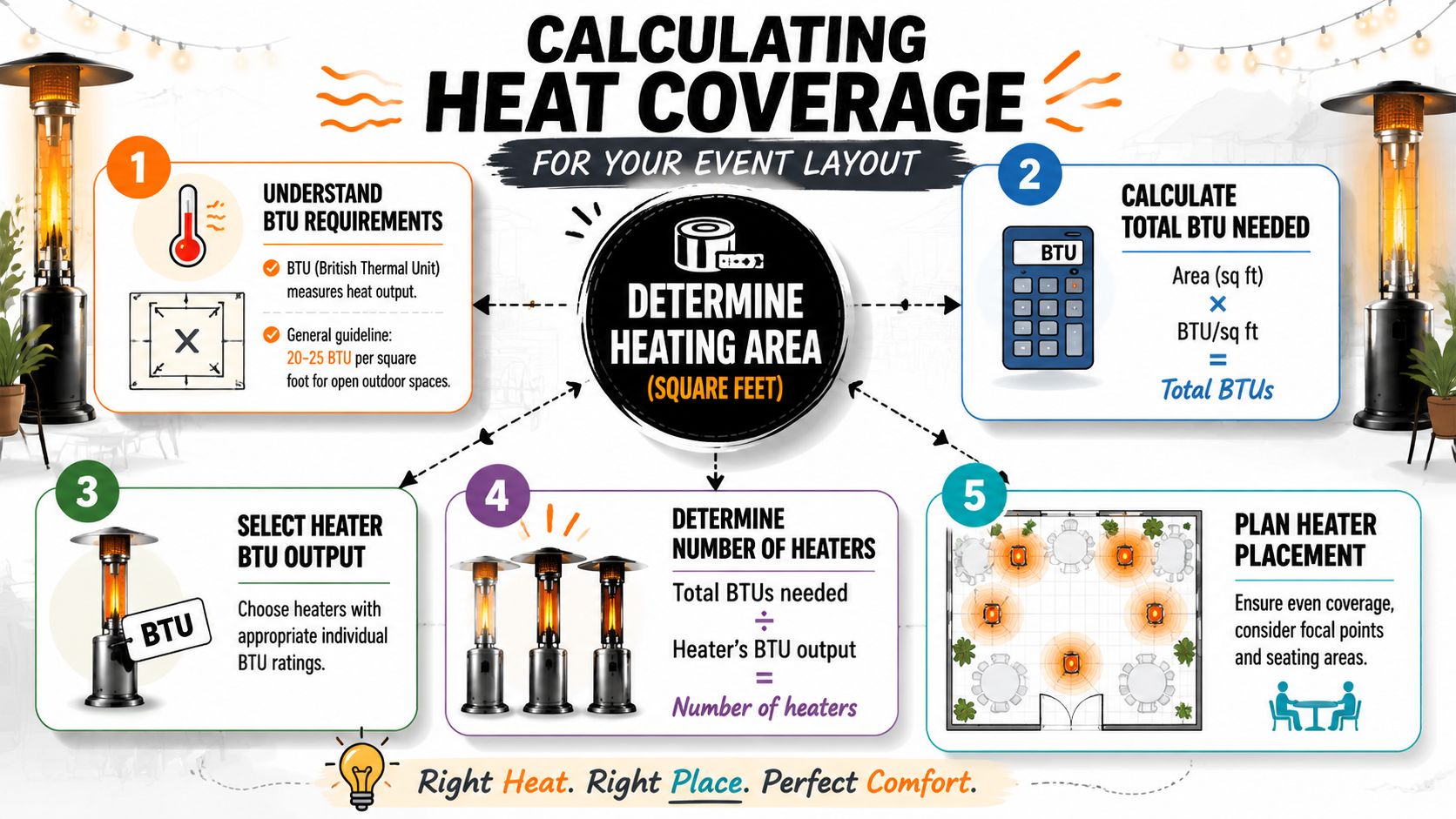
A step-by-step infographic illustrating the process for calculating heat coverage and heater placement for outdoor event spaces.

Start with the area guests actually use

Measure the zones where people will stand, sit, queue, or linger. Skip the decorative lawn, unused corners, and service areas unless guests will spend time there.

Industry guidance from Lowe's patio heater buying guide suggests about 20 BTUs per square foot for a 15 to 20°F temperature rise in patio spaces. The same guide notes that a 1,500 sq ft area needs at least 30,000 BTUs, which can come from one 48,000-BTU propane heater or several smaller units.

Use that as a starting point, not a final answer. Cape Town wind exposure, damp air, and broken-up event layouts often mean the floor plan matters more than the raw BTU total.

A simple working method helps:

  1. Measure the active heating area in square feet.
  2. Multiply by 20 BTUs for a baseline.
  3. Place that output across the layout based on where people stop moving.

Map heat by behaviour, not by venue outline

Treat the site as a set of guest zones, not one large shape. On event plans, I usually break it into arrival, bar, dining, lounge, and any waiting points such as shuttle collection or registration.

That matters because guests feel cold in different ways. Standing groups on a drinks terrace can tolerate brief gaps in warmth. Seated guests in a Winelands courtyard feel the cold faster, especially once the air turns damp after sunset. Transitional spaces also matter more than planners expect, because people often bottleneck there.

If you are sketching options early, a visual planning tool like ai backyard patio design can help you test zones before the final site meeting. For practical unit options, it also helps to review common gas porch heater rental setups so the layout matches what is available for hire.

Layout problems I see repeatedly on Cape Town event sites

Marquee receptions in Franschhoek or Paarl

Planners often assume the marquee interior is the main heating job. The colder problem areas are usually the entrance flap, sidewall edges, bar opening, and any lounge spill-out section where guests drift outside cover. Heat the pause points first.

Waterfront and Atlantic Seaboard terraces

These terraces can look compact on paper and still feel cold in practice. Wind strips heat off rail-side clusters and exposed corners. Two heaters grouped near the bar rarely solve that. A wider spread around the social footprint usually works better.

Garden functions in Constantia

The layout often looks relaxed and open, but loose furniture kills heat efficiency. If seating pockets are too scattered, each heater serves dead space between groups instead of the guests themselves. Tighten the furniture plan, then place heaters around those occupied pockets.

Useful rental rule: Reduce the heated footprint before adding more units. A tighter guest layout often improves comfort more than one extra heater.

Avoid the small-space mistake

Compact patios and side courtyards get underquoted all the time. They look easy to heat, but they often have the worst combination of crosswind, hard surfaces, and guests sitting still close to openings.

Before you confirm the hire count, check four things:

  • Where will guests stay still for more than 10 minutes?
  • Which side of the venue takes the wind first?
  • What built elements block, trap, or redirect warmth?
  • Will the layout change after speeches, dinner, or dancing?

That is the difference between counting heaters and planning heat coverage.

Safe Heater Placement and Clearance Rules

A patio space heater can solve a comfort problem and create a safety problem at the same time if it's placed carelessly. At events, the risks usually come from pressure and speed. Furniture gets shifted at the last minute, florals expand into service space, cables appear where none were planned, and a heater ends up too close to fabric, foliage, or foot traffic.

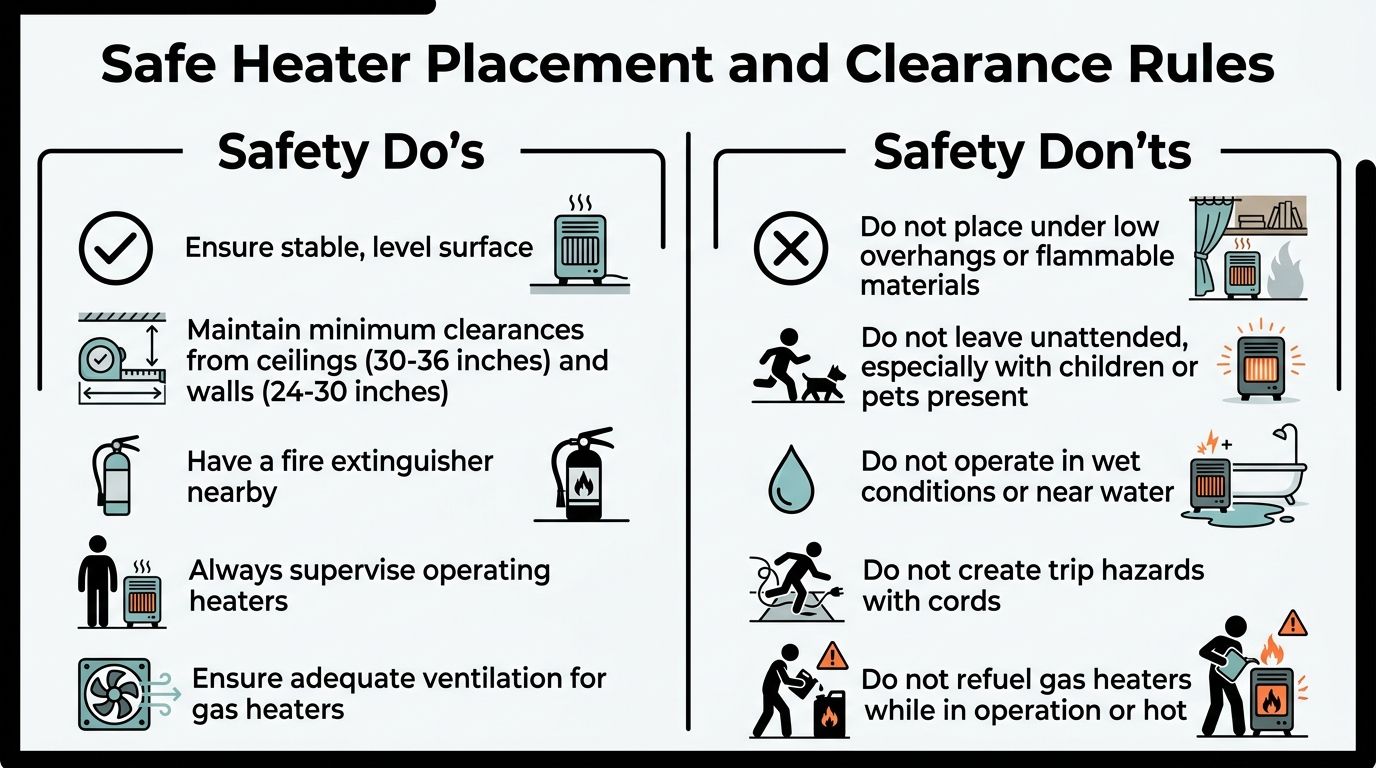
An infographic illustrating essential safety guidelines for the proper placement and operation of space heaters.

The clearance rule that matters

The mandatory standard is 3-foot clearance from flammable materials, as highlighted in the NFPA heating safety guidance. That distance matters around draping, table linen, foliage, umbrellas, timber details, marquees, and decorative installations that get added after the technical plan is signed off.

The same NFPA guidance notes that portable space heaters were involved in only 3% of home heating fires but in 41% of fatal heating fires. For event planners, the lesson is simple. The incident may be unlikely. The consequence can be severe.

Placement rules that work on live event sites

Use a physical walk-through, not a paper plan only. On site, confirm these basics:

  • Stable base: Put each unit on a flat, level surface that won't shift under guest movement or service traffic.
  • Protected edges: Keep heaters away from narrow guest pathways, dancefloor entries, and busy bar queues.
  • Ventilated setup: Gas units need open-air use and proper airflow. Don't squeeze them into improvised enclosed pockets.
  • Clear overheads: Check what sits above the heater after styling is complete, not before.
  • Service access: Staff must be able to turn units off quickly without reaching through guests or furniture.

Common mistakes during setup

Some problems only show up once the room is dressed. A heater that looked safely placed in an empty venue can become a hazard when the florist adds hanging greenery or when a planner pulls lounge seating tighter around it.

This is also where specialist guidance on gas porch heaters is useful, especially for understanding how outdoor gas units behave in partially sheltered entertainment areas.

Never sign off heater placement before the final furniture and styling layout is in position.

A short safety check before guests arrive

Run this check in order:

  1. Stand where guests will stand and look for low fabric, branches, signage, and cords.
  2. Test access around the unit so staff can move safely near it.
  3. Confirm clearances again after styling because that's when many risks are introduced.
  4. Keep a fire extinguisher nearby and make sure the responsible team knows where it is.
  5. Assign ownership so one person is responsible for heater oversight during service.

Warmth helps the event. Safe placement protects everyone in it.

Renting vs Buying Your Patio Space Heater

For most planners, buying a patio space heater sounds sensible until the practical details pile up. You don't just buy a heater. You take on storage, transport, maintenance, cleaning, fuel logistics, and the risk of owning the wrong type for the next venue.

Renting keeps your options open

Events change from job to job. One week you may need freestanding gas units for an exposed courtyard. The next, the venue may only suit electric infrared units in fixed positions. Ownership pushes you toward using what you have, even when it isn't the best fit.

Renting lets you match equipment to the brief instead:

  • A wedding lawn needs broad outdoor coverage.
  • A product launch may need sleek units that don't dominate branding.
  • A birthday dinner may only need focused warmth around seated clusters.

That flexibility matters more than many planners expect.

Ownership costs more than the purchase

A typical mushroom-style propane patio heater uses 45,000 BTUs per hour, while heated furniture can use around 2,500 BTUs per hour, according to this analysis of patio heater inefficiency. That doesn't mean every event should swap heaters for heated furniture. It does show why occasional ownership of high-consumption equipment often makes less sense than accessing the right setup per event.

Storage is another issue. Freestanding heaters are awkward to keep, easy to damage in the off-season, and rarely stored as carefully as technical gear should be. Then there's transport. A heater that looks manageable in a warehouse becomes a nuisance when it has to move through narrow venue access, stairs, gravel, or late-night pack-down.

Renting usually produces a cleaner event operation

The strongest reason to rent isn't convenience alone. It's operational clarity. You can size correctly, scale up when the weather turns, and avoid building your event around whatever equipment is sitting in storage.

If you're weighing the broader pros and cons of fuel-based outdoor heating, this guide to gas patio heater options is a useful reference point.

Buy if you run the same kind of outdoor setup repeatedly and have proper storage, handling discipline, and a maintenance routine. Rent if the venue, guest flow, and exposure change from event to event.

For most weddings, launches, school functions, and private parties, renting is the more practical choice because it keeps the heating plan responsive instead of fixed.

Cape Town and Winelands Climate Considerations

Cape Town doesn't give planners one winter pattern. It gives several. A city terrace can feel sharp because of wind exposure. A Winelands venue can feel colder because damp air settles in after sunset. The same patio space heater layout that works in one suburb can underperform badly in another.

Wind changes everything

The biggest local mistake is treating heater placement as static. It isn't. Wind strips comfort from outdoor zones faster than many planners expect, especially in open courtyards, vineyard-facing lawns, and harbour-side venues.

A 2025 study by the Cape Town University of Technology found that 68% of event planners in the region report guest discomfort due to inadequate heater placement during windy conditions. That local reality explains why generic international guides often fall short here.

When the site is windy:

  • Pull guests into tighter heat zones instead of heating every metre of open space.
  • Use structures already on site such as walls, screens, or built corners to protect the warm area.
  • Avoid placing heaters in direct wind channels like gate openings, corridor gaps, and terrace edges.
  • Rehearse placement at the actual event time when possible, because late afternoon calm can become a very different evening pattern.

For semi-enclosed setups, practical weather barriers such as solar screen porch solutions can also help reduce exposure and improve heater performance when a venue allows them.

Damp cold in the Winelands behaves differently

Franschhoek, Stellenbosch, Paarl, and Constantia often produce a more penetrating chill than the thermometer alone suggests. Guests feel it most when seated. That's why dining layouts need more deliberate thermal planning than standing cocktail events.

The fix usually isn't “more heaters everywhere”. It's a combination of better siting, more compact seating groups, and less exposed lounge placement. Planners who already think carefully about shelter, surfaces, and furniture tend to get better heating outcomes too. This is one reason weather-aware setup choices, like those discussed in weather-resistant outdoor furniture, matter beyond furniture durability alone.

What works best locally

A heater plan for the Western Cape should answer these questions before hire is confirmed:

Local condition Better response
Exposed wind line Create protected guest clusters and heat those, not the whole boundary
Damp evening cold Prioritise seated zones, dining edges, and lounge pockets
Remote power access Favour portable solutions rather than long cable runs
Venue with multiple micro-zones Mix heater types instead of forcing one model across all areas

In Cape Town, heater performance depends as much on where the air moves as on what the heater can produce.

That's the local difference. You're not heating a generic patio. You're heating a temporary event in a shifting microclimate.

Your Pre-Event Heater Checklist for Planners

By the day before the event, the heating plan should already be settled. The final job is execution. A short checklist catches most of the problems that lead to cold guests or unsafe setups.

Final checks worth doing every time

  • Confirm delivery timing: Make sure heaters arrive early enough for placement before florals, furniture, and guest signage start blocking access.
  • Walk the site at the likely event hour: Conditions after sunset matter more than a midday inspection.
  • Check final placement against the live layout: Bars, lounge sets, draping, and umbrellas often shift after the original plan.
  • Verify clearances: Recheck all surrounding fabric, foliage, and overhead elements.
  • Test every unit: Ignition, stability, and access should be confirmed before guests enter the space.
  • Review fuel or power requirements: Gas supply and power access should match the agreed setup.
  • Assign one responsible person: Someone on the planner or venue team should know who monitors heaters during service.
  • Keep troubleshooting contacts ready: If a unit fails, the response should be immediate, not improvised.

One last planner habit

Don't wait for guests to tell you the space feels cold. Stand in the least protected part of the venue and stay there for a few minutes. If that area feels uncomfortable before the event starts, it will feel worse once people stop moving and night settles in.

A good patio space heater plan doesn't draw attention to itself. Guests stay comfortable, and the event keeps flowing.

If you're planning an outdoor wedding, corporate function, matric dance, or private celebration in Cape Town or the Winelands, ABC Hire can help you choose the right event heating setup for your venue, layout, and weather exposure. Their rental range covers practical climate-control solutions that work with real event logistics, not generic showroom assumptions.

Same Day Furniture Delivery: Your Event Rescue Guide

An hour ago, your event plan was stable. Then the guest count changed, a supplier went quiet, or the venue asked for a layout adjustment that suddenly needs more cocktail tables, lounge seating, LED cubes, or climate control on site today.

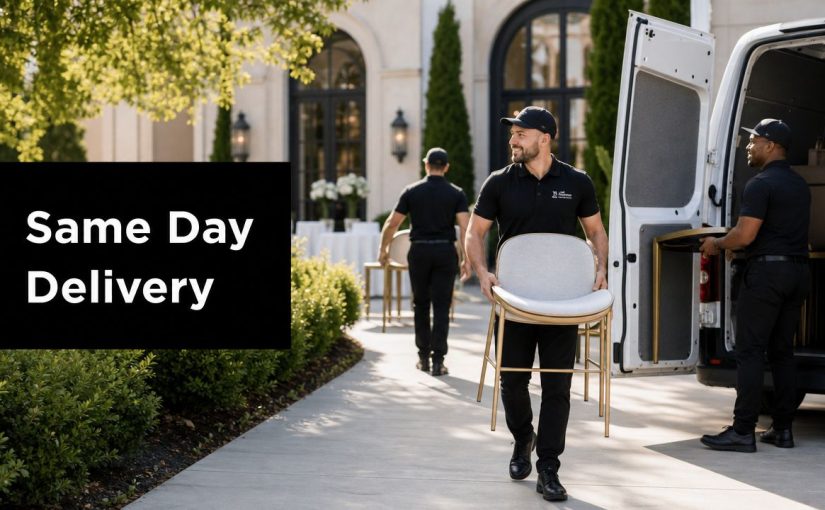
That's where same day furniture delivery stops being a convenience and becomes an event rescue tool.

In Cape Town and the Winelands, late changes are common. Wedding timelines shift. Brand activations expand. A matric dance committee realises the original setup won't carry the room. When that happens, the difference isn't just who has stock. It's who can pick, load, route, communicate, arrive, unload, and place the right items without turning your event day into a second crisis.

The Lifesaver Your Event Didn't Know It Needed

Many believe same day furniture delivery is only for panic moments. In practice, it's also how experienced planners protect an event when real life gets in the way of the perfect timeline.

A florist runs over schedule and your setup window shrinks. A venue opens a second area that now needs soft seating. A corporate client adds a VIP zone at lunchtime for that evening's function. These are normal event problems. They only feel catastrophic when the delivery process is slow, vague, or built for residential drop-offs instead of live events.

Event work has always rewarded fast decisions, but now delivery speed affects buying behaviour much more directly. The global same-day delivery market is projected to reach $56.6 billion by 2031, and 62% of customers make their final purchase decision based mainly on delivery speed, while 75% of younger buyers see same-day delivery as essential according to Capital One Shopping's same-day delivery statistics. For event furniture, that urgency is even sharper because the item isn't a nice-to-have. It may be the seating plan, the bar area, or the visual centre of the room.

Practical rule: If the furniture affects guest flow, service flow, or the event look in a visible way, treat delivery as part of event operations, not as a basic courier job.

That's why experienced coordinators usually care less about flashy promises and more about process. They want realistic cut-offs, access planning, setup coordination, and a team that understands pressure. If you work in events, this broader guide to understanding event professionals explains why logistics partners need to fit the pace and communication style of the industry.

If you're still deciding what to rent in the first place, it also helps to review practical advice on renting furniture for events before the day gets tight.

Your Same Day Delivery Booking Timeline

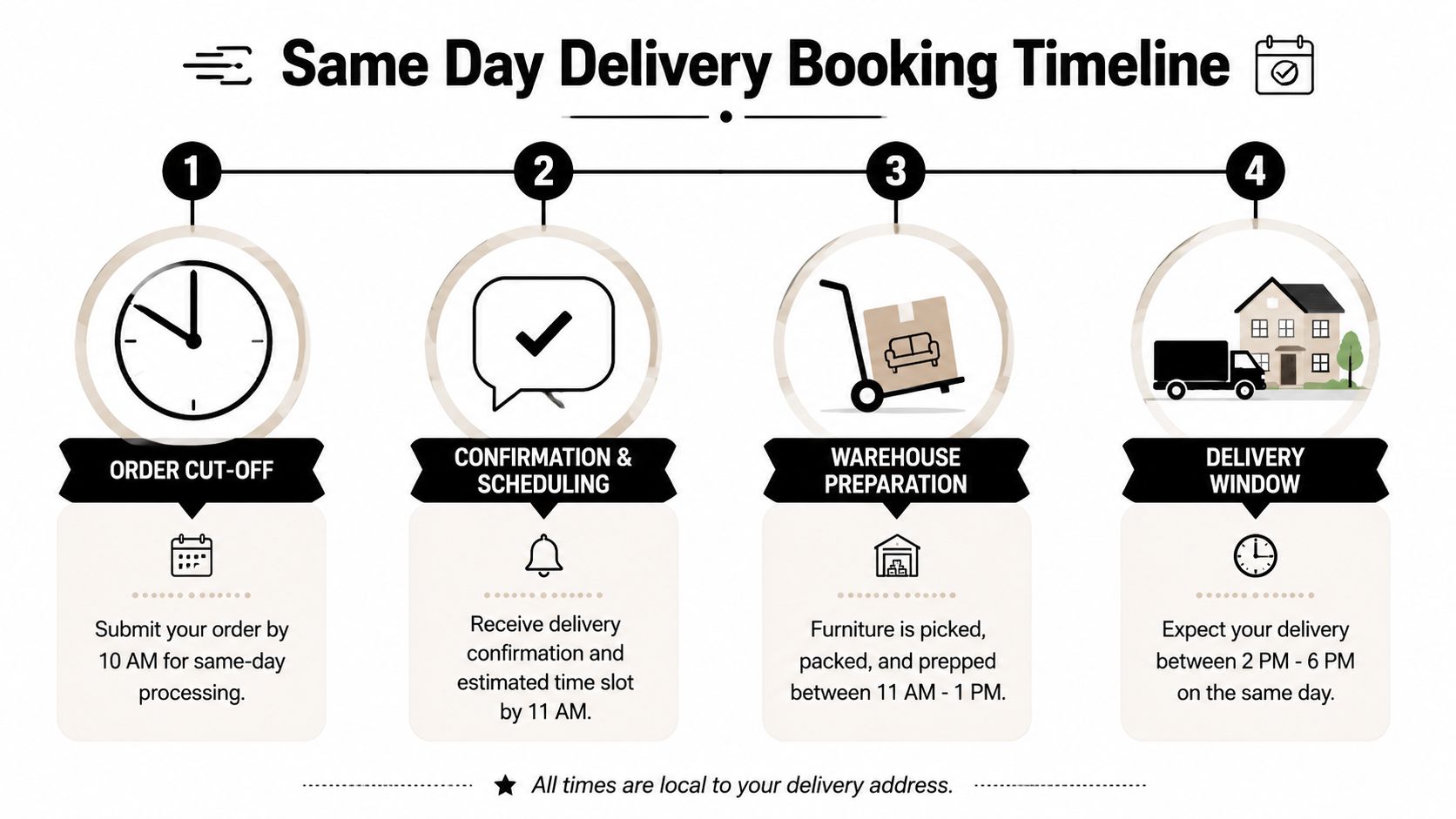
Same day furniture delivery works best when everyone is honest about time. The earlier you book, the more options you keep. The later you leave it, the more the job depends on stock location, crew availability, route congestion, venue access, and whether your order is a straightforward single-drop or a more complex event load.

Here's the ideal booking rhythm for an ordinary same-day request:

A flowchart infographic titled Same Day Delivery Booking Timeline showing four steps for furniture orders.

What a realistic timeline looks like

For central Cape Town venues, a morning booking gives the operations team the best chance to confirm stock, assign the correct vehicle, and brief the crew properly. The useful sequence is simple: confirm the order early, lock the venue details, pick and stage the furniture, then dispatch into a delivery window that still leaves margin for setup issues.

For Stellenbosch, Franschhoek, and Paarl, the booking window needs to be treated more carefully. Travel time is only one part of the equation. The primary risk sits in loading time, access at the venue, and the fact that event furniture often isn't one item. It's tables, chairs, bar units, LED pieces, decor support items, and sometimes powered equipment that must arrive together and in workable order.

City venues versus Winelands venues

A Cape Town city-bowl hotel function is usually easier to rescue on the same day than a multi-stop wedding spread across the Winelands. Dense urban work has its own challenges, but the route is shorter and the fallback options are often better.

By contrast, Winelands jobs punish loose planning. If the order is confirmed late, and the team still needs to clarify service gates, gravel access, stair carry, or timed venue entry, the “same day” part becomes much harder than clients expect.

A useful benchmark is demand itself. The market for rapid delivery keeps growing because clients increasingly buy based on speed, as noted earlier. For event rentals, that means the best providers build their day around disciplined booking windows, not around vague promises. That same urgency is why planners often secure foundational items first, then fill gaps later with practical pieces such as event tables and chairs for fast layout changes.
If you need speciality pieces and installation-sensitive items on the same day, book the non-negotiables first and leave decorative add-ons for a second decision. That preserves the delivery slot for what actually keeps the event functional.

When to be cautious

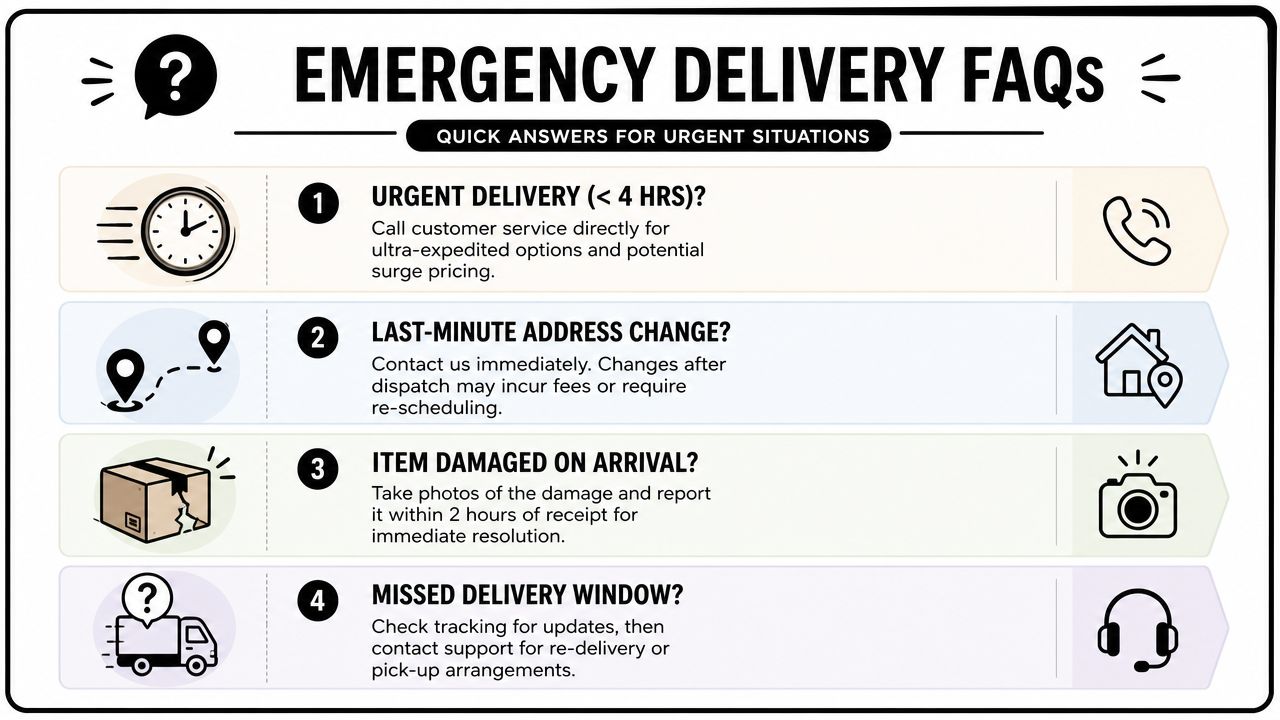
Treat afternoon requests carefully, especially if the venue sits outside Cape Town, needs multiple unloading points, or requires placement in several areas. Same day is still possible in some cases, but the conversation should shift from “Can you deliver today?” to “What can be delivered today reliably?”

That distinction matters. A smaller confirmed order that arrives correctly is always better than an oversized rushed order that creates confusion on site.

The Information You Must Have Ready to Book

The fastest same day furniture delivery calls are never the shortest. They're the clearest.

When a planner has the right details ready, the operations team can move from enquiry to dispatch without wasting the valuable early part of the day on follow-up messages. The missing details are almost always the same: unclear quantities, vague addresses, no on-site contact, or no explanation of access restrictions.

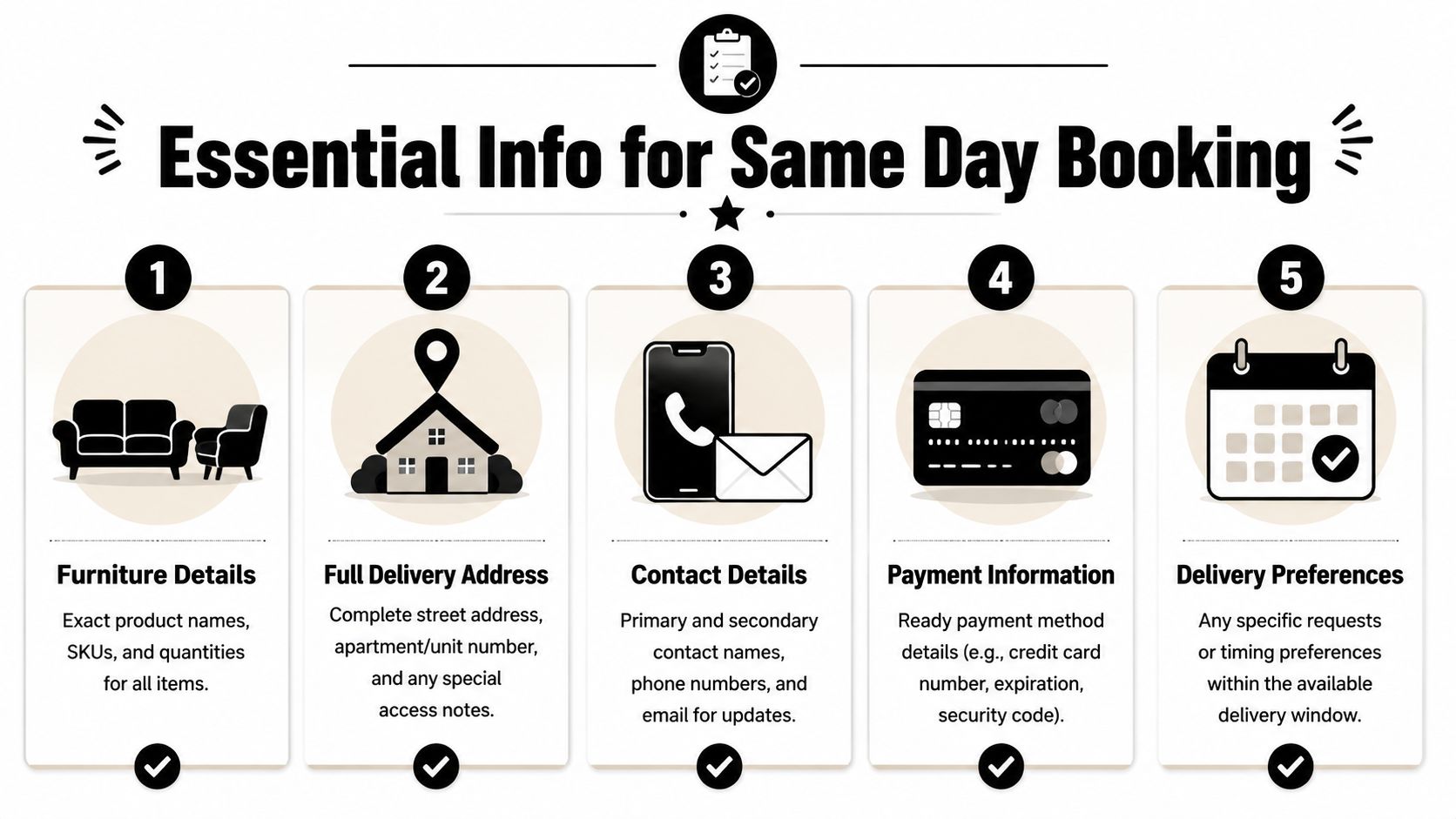
A helpful checklist infographic titled Essential Info for Same Day Booking, outlining five key requirements for furniture delivery.

The booking details that save time

Have these ready before you call or send a WhatsApp:

  • Exact items and quantities. Don't say “some couches and a few tables”. Say “6 cocktail tables, 24 Tiffany chairs, 2 LED cubes, 1 slush machine”.
  • The full delivery address. Include venue name, road, suburb, and the exact entrance the driver must use.
  • Access notes. Service gate, loading bay rules, stairs, lift limits, narrow passages, gravel roads, cellar entrances, or security check-in.
  • Your on-site contact. One person with a working phone who can answer immediately during the delivery window.
  • Required placement. Reception area, dance floor edge, outdoor terrace, VIP lounge, stage left, courtyard bar, or upstairs holding room.
  • Power requirements. Especially important for LED furniture, slush machines, and climate control units.
  • Collection expectations. Same-night collection, next-day pickup, or holdover for a second event day.

Speciality items need better briefing

This matters even more for non-standard event stock. An industry survey found that 78% of Cape Town event planners say same-day options often exclude speciality rental items like LED tables and bean bags, and only 12% of rental companies confirm post-2 PM same-day feasibility for multi-location events in the Winelands. That tells you two things. First, standard delivery systems often struggle with event-specific gear. Second, vague late-afternoon requests for complex multi-venue setups are usually where plans break.

If your event depends on LED furniture or climate control, say so immediately. Those aren't “add-ons” from a logistics perspective. They affect loading, handling, power checks, and placement on arrival.

A same-day booking fails fastest when the client thinks in product names and the logistics team needs operational details. Give both.

The access details people forget

Some of the most expensive delays come from small omissions. A courtyard gate is locked. The service lift is booked by caterers. The venue only accepts supplier vehicles at one side entrance. The delivery team arrives with the right stock and loses time on a preventable site issue.

Use this quick pre-call check:

Booking detail What to confirm Why it matters
Furniture list Names and quantities Prevents stock confusion
Venue access Gate, lift, stairs, parking Avoids unloading delays
Site contact Name and phone Speeds up handover
Placement plan Exact room or zone Reduces double handling
Equipment needs Power and surfaces Protects specialty items

The more specialised the order, the less room there is for assumption.

Understanding Same Day Pricing and Fees

Same day furniture delivery costs more than a standard scheduled run because the team is paying for compression. The stock must be available now, the warehouse must prioritise the order, the vehicle must be assigned around existing jobs, and the route has to absorb less flexibility.

That doesn't make it overpriced. It makes it operationally expensive.

A close-up shot of a hand holding a blue Visa credit card over a payment terminal reader.

What usually shapes the quote

A proper same-day quote usually combines a few moving parts:

  • The rental itself. What you're hiring, in what quantity, and for how long.
  • The fast-turn service component. This covers the urgency and reprioritisation of labour and dispatch.
  • Distance and route complexity. Cape Town CBD, southern suburbs, Stellenbosch, Franschhoek, and Paarl don't place the same demands on the vehicle schedule.
  • Access and handling. White-glove placement, stairs, lift dependency, narrow access, or careful handling for upholstered or powered pieces.
  • Collection timing. Late-night strike, next-morning pickup, or staggered collections can affect the final amount.

Why clients still choose it

Consumer behaviour explains a lot here. 76% of consumers choose same-day delivery when it's free, and 75% choose it when they need the item urgently according to Market.us same-day delivery statistics. Event clients live in that second category. If the event opens in a few hours, the real comparison isn't between premium delivery and cheap delivery. It's between premium delivery and a room that looks unfinished, under-seated, or unworkable.

For planners building budgets, it helps to think in scenarios, not just line items. A useful way to frame distance and handling variables is to review how transport calculators separate labour, access, and route factors, such as the Emmanuel Transport cost calculator. The figures won't match an event rental quote, but the logic does.

What's worth paying for

Pay for certainty where the event is exposed.

If the furniture shapes guest arrival, speeches, catering flow, or branded presentation, the premium usually makes sense. If the item is optional decor and the venue can function without it, then a next-day or scheduled delivery may be the smarter choice.

The best quotes don't just tell you the price. They show you what level of risk and service the price is buying down.

Ask direct questions. Is placement included? Is there a waiting-time risk at the venue? What happens if access changes? Clear answers matter more than a low headline number.

Your On-Site Venue Access and Setup Checklist

The delivery can be perfectly planned and still go wrong in the last ten metres.

That's usually not a transport problem. It's a venue readiness problem. A team arrives on time, then loses minutes to locked gates, unclear room allocations, delayed sign-in, absent contacts, or furniture that has to be moved twice because no one confirmed final placement.

In the Cape Town region, manual routing starts to fail badly once delivery volume gets high, leading to a 30% rise in customer status enquiries and a 25% higher risk of delayed setup for critical event furniture. That's exactly why professional delivery teams rely on disciplined routing and communication. Your side of the job is simpler. Make the venue easy to receive.

The checks that prevent avoidable delays

Use this table before the truck leaves the warehouse, not after it arrives.

Check Point Verification Status Notes
Main contact on site confirmed Name and working mobile number
Access gate or loading bay cleared Include security instructions
Venue accepted delivery window Note any supplier restrictions
Path to setup area clear Remove obstacles and parked vehicles
Lift or stair route checked Flag narrow turns or low clearance
Power points identified Important for LED and climate units
Placement plan signed off Room-by-room or zone-by-zone
Receiving staff available Someone must guide placement

Where setups usually go sideways

These are the problems teams see again and again:

  • No one is waiting at the venue. The truck arrives, calls go unanswered, and unloading stalls.
  • The route inside the venue isn't ready. Decor stock, crates, or catering prep block the path.
  • Placement instructions change during unloading. Every change means more handling and more time.
  • Power hasn't been checked. LED furniture and climate control are delivered correctly, then sit idle while the venue scrambles for extension access.

If you're managing a larger function, pair this with a broader event planning checklist template so delivery, decor, catering, and technical teams aren't all solving the same problem separately.

Safety and handover matter too

A rushed setup can create damage, confusion, and liability. Basic venue-readiness discipline helps with that. For a practical outside perspective on crowd movement, access control, and supplier coordination, these best practices for event safety are useful reading.

Keep one person in charge of receiving furniture. Not three. Not a WhatsApp group. One person.

When that person can answer access questions, sign off placement, and escalate issues immediately, the delivery team can keep moving and your event stays on schedule.

Frequently Asked Questions for Event Emergencies

Late changes don't arrive one at a time. They stack. Traffic, weather, venue calls, supplier timing, and client revisions often hit in the same afternoon. These are the questions that usually come up when the pressure is highest.

An infographic titled Emergency Delivery FAQs detailing instructions for urgent, damaged, or missed furniture deliveries.

Can same day still work during peak wedding season?

Yes, but only if the plan acknowledges seasonal road pressure. A traffic analysis showed that 65% of same-day event furniture deliveries failed during November to January because of 45-minute average delays on the R300 between Cape Town and Stellenbosch. That doesn't mean same day is impossible. It means planners should avoid building their whole event around a best-case road assumption during peak season.

If your venue sits in Stellenbosch or beyond, ask for an earlier dispatch window, simplify the order, and have a fallback layout that can open the event if one non-critical item arrives later than planned.

What about two locations in one day?

It can work for brand activations, content shoots, and split-site corporate events, but only if the order is planned as a multi-drop job from the start. The mistake is adding the second venue after dispatch. That changes load order, route timing, and handover sequencing.

When you know two locations are involved, list which stock must land first and which stock can follow later. “Everything everywhere as soon as possible” isn't a workable instruction.

Can speciality items still be delivered quickly?

Sometimes yes, but they need stronger briefing than standard tables and chairs. LED furniture, bean bags, slush machines, and climate control units all create different handling and placement requirements. If those pieces are essential to the event concept, say so up front and make sure the site is ready to receive and power them.

What should I do if the venue changes access rules on the day?

Call immediately and give one clean update. New gate, changed check-in point, temporary road closure, revised contact person, or delayed supplier entry. Don't send fragments across multiple messages. One complete update helps dispatch make a proper decision fast.

The fastest rescue is usually the clearest message, not the loudest one.

Which areas need the most realistic planning?

Cape Town jobs usually move faster if the venue has proper loading access. Stellenbosch and Franschhoek need more buffer during wedding season. Paarl often needs careful heat and timing planning for powered equipment and outdoor setups. Across all areas, same day works best when the order is tight, the site contact is reliable, and the placement plan is already decided before the truck leaves.


If your event can't wait, ABC Hire is built for exactly these high-pressure moments. From LED furniture and lounge pieces to tables, chairs, slush machines, and climate control equipment, the team supports fast-turn event rentals across Cape Town, Stellenbosch, Franschhoek, and Paarl. Reach out early, send complete venue details, and give your same day furniture delivery the best chance to arrive smoothly and set up right.

Cake Stands for Weddings: A Cape Town & Winelands Guide

You've probably chosen the flavour, approved the design, and saved a dozen reference photos of cakes against vineyards, mountain views, or candlelit reception rooms. Then the baker asks one practical question that suddenly matters more than expected. What stand is the cake going on?

That question changes more than most couples realise. A wedding cake can be beautifully made and still look slightly underwhelming if it's placed on the wrong base, too low for the room, too small for the bottom tier, or too delicate for a breezy lawn reception in the Winelands. The stand is what gives the cake presence. It also protects the cake, supports the weight, and helps the whole display feel intentional instead of improvised.

In Cape Town and the Winelands, this choice needs a bit more thought than the average online checklist suggests. Outdoor venues, gravel paths, timber decks, coastal air, strong afternoon wind, and mixed indoor-outdoor layouts all affect what works. The best cake stands for weddings in this region are the ones that balance style with stability.

The Foundation of Your Wedding Centrepiece

The cake-cutting moment is short, but it carries a lot of visual weight. Guests gather, cameras come out, and suddenly the cake is doing more than dessert duty. It becomes part of the ceremony of the evening.

That's why the stand matters so much. A good stand doesn't compete with the cake. It frames it, lifts it, and gives it the kind of presence a centrepiece deserves. I've seen a simple white buttercream cake look polished and expensive on the right stand, and I've seen an intricate floral design lose impact because it sat on a basic platter that disappeared into the table linen.

Why the stand is never just an accessory

Think of the stand as the cake's stage. The cake may be the artwork, but the stand determines how guests see it from across the room and how it photographs from every angle. Height, shape, finish, and footprint all influence whether the cake table feels elegant, romantic, contemporary, rustic, or slightly off-balance.

In the Western Cape, that's even more noticeable because venues tend to have strong character. A cellar venue with stone walls asks for a different display language from a light-filled city venue or a lawn reception in Franschhoek.

A beautiful cake on the wrong stand often looks smaller, flatter, and less considered than it really is.

What couples usually underestimate

Most couples start by choosing a stand based on looks alone. That's understandable. The photos online are persuasive. But in practice, three questions matter just as much as appearance:

  • Where it will sit: Indoors, under cover, on grass, on decking, or on uneven stone.
  • What it must carry: A light single-tier cake behaves very differently from a heavy celebration cake.
  • How visible it needs to be: A cake in a large reception room needs more visual presence than one in a small dining space.

When you get those basics right, the styling becomes much easier. The stand stops being an afterthought and starts doing the job it's supposed to do.

A Guide to Wedding Cake Stand Types and Materials

Some stands are decorative first. Others are structural first. The best choice depends on your cake design, your venue, and how much visual drama you want from the display.

An infographic detailing various types of wedding cake stands and common materials used to craft them.

Stand types that actually suit wedding use

Pedestal stands are the classic option. They lift the cake without making the setup feel busy. They work especially well for single-tier cakes, modest cutting cakes, and buttercream designs where you want a clean silhouette.

Tiered stands create vertical impact. They're useful when the display itself needs height, or when the cake concept includes separate levels rather than one stacked structure. These can look striking, but they need careful setup and a venue surface that's level.

Plateau stands are lower and broader. They don't have the same dramatic lift, but they're often the safest and smartest choice for heavy cakes or venues where stability matters more than extra height.

Floating stands create that suspended look many modern couples love. They can be stunning in a contemporary venue, especially with minimalist cakes, but they demand proper engineering and should never be chosen purely because they look trendy in a photo.

Materials and the feel they create

Material changes both the style and the practicality of the display.

  • Metal: Reliable, versatile, and available in ornate or minimalist forms. Powder-coated black, brushed gold, and silver finishes tend to pair well with formal weddings.
  • Wood: Warm, relaxed, and ideal for organic styling. A timber base can soften a modern cake and works beautifully in vineyard, garden, and farm settings. If you like that look, this guide to a wooden cake stand gives a useful starting point.
  • Glass: Elegant and light in appearance. Best indoors or in sheltered setups where you want reflection and delicacy.
  • Acrylic: Crisp, modern, and visually subtle. Clear acrylic can create a floating effect, though it shows fingerprints and can feel too lightweight in exposed outdoor settings.
  • Vintage mixed materials: Think pressed glass, aged metal, ceramic, or antique-look pieces. These are wonderful for romantic styling, but they need to be chosen carefully so the stand doesn't look fussy next to an already detailed cake.

Wedding Cake Stand Material Comparison

Material Aesthetic Best For Cape Town Consideration
Metal Classic, polished, formal Ballroom, cellar, elegant indoor receptions Handles movement and setup well, especially on busy event days
Wood Natural, rustic, textured Vineyard, garden, farm, boho styling Works well with local venue styles and hides dust better than glossy finishes
Glass Refined, delicate, luminous Indoor receptions, candlelit spaces Better in protected areas where wind and uneven handling are less of a concern
Acrylic Modern, minimal, clean Contemporary venues, editorial styling Looks sleek but needs extra care outdoors
Vintage mixed materials Romantic, layered, characterful Heritage venues, eclectic styling Beautiful in photos, but check for true stability before committing

Practical rule: Choose the stand material to suit the venue surface first, then the design style second. That order prevents most regrets.

Choosing the Right Size and Structure

A stand can look perfect and still be wrong if the proportions are off. This is where design meets engineering. The right size and structure keep the cake stable, level, and visually balanced.

A hand holds a measuring tape next to a three-tiered white wedding cake on a stand.

Start with the base tier

The bottom tier tells you almost everything you need to know. As a practical rule, the visible top surface of the stand should extend beyond the cake enough to frame it neatly without looking oversized. Many bakers and stylists use the simple plus-two-inch approach, meaning the stand is slightly wider than the bottom tier all the way around.

That extra room helps with presentation, but it also gives you safer edge clearance during transport and setup. A stand that matches the cake exactly can feel cramped and leaves no margin for error.

Weight capacity is not optional

This is the part couples often don't see until something goes wrong. A standard three-tier wedding cake can weigh 15 to 18 kg or more, and venues and caterers in South Africa's event sector increasingly rely on stands rated for at least 20 kg of load, which is why reinforced professional options are common in Western Cape rental stock, as noted in this background on the cake stand.

That means a decorative stand from a homeware shop may not be suitable for a real wedding cake, even if it looks substantial in a product photo.

What to ask before confirming a stand

Use these checks when speaking to your baker, planner, or rental supplier:

  1. What is the diameter of the bottom tier? Don't guess from photos.
  2. What is the approximate finished weight? Fresh flowers, sugar work, and dense fillings all add load.
  3. Is the stand rated for that load? If the answer is vague, ask again.
  4. Does the stand have a broad base and secure top plate? A narrow stem with a heavy cake above it needs extra scrutiny.
  5. Will the venue surface be level? Even a strong stand can become risky on an uneven table.

For couples considering a taller celebration cake, this overview of a three-tier cake stand is a useful reference point.

Signs a stand is too delicate

  • It wobbles when lightly pressed
  • The top plate is thin or loosely attached
  • The stem is narrow relative to the cake size
  • It was designed for home serving, not event use
  • No one can confirm its safe load

A wedding day isn't the moment to test whether a pretty stand is strong enough.

Matching Your Stand to Your Cake and Venue

The best cake setups feel cohesive because the stand connects the cake to the room. It shouldn't look randomly added. It should feel like it belongs with both the design of the cake and the overall environment of the venue.

A three-tier white wedding cake decorated with flowers, sitting on an ornate gold stand on a wooden table.

Pairing style with cake design

A detailed cake usually benefits from a stand that supports rather than competes. If your baker is creating sugar flowers, lace piping, or textured buttercream, a simpler metal or plateau stand often gives the cleanest result.

A minimalist cake can carry more architectural presence below it. That's where a sculptural pedestal, modern acrylic form, or floating structure can add interest without overwhelming the design.

A few pairings tend to work especially well:

  • Naked or semi-naked cakes: timber, matte metal, or softly aged finishes
  • Classic white fondant cakes: polished metal, glass, or a formal pedestal
  • Modern monochrome cakes: black metal, clear acrylic, or sharp-edged contemporary stands
  • Garden floral cakes: lower-profile bases that let the flowers remain the hero

Reading the venue properly

The venue should have real influence over your decision. A stand that looks refined in an indoor city hotel may feel too slight on a long farmhouse table under open sky.

In the Western Cape, wind belongs in this conversation. A 2023 survey of South African wedding venues in the Western Cape found that 62% of outdoor ceremonies and receptions experienced gusty afternoon winds, and many general wedding guides still don't connect that reality to cake stand stability, according to this discussion on whether you need a cake stand for your wedding.

That tracks with what planners see on the ground. Light mirrored tops, narrow glass pedestals, and very tall stands can become awkward choices at exposed vineyard venues or coastal lawns.

If the reception is outdoors and the breeze picks up every afternoon, a lower, heavier stand usually looks better by the end of the day than a dramatic one that feels precarious.

Good choices for local venue types

Wine farms and garden venues
Choose weight and footprint over height. Broader bases, lower centres of gravity, and non-slip contact points matter. Matte finishes also tend to cope better with dust, pollen, and natural light.

City venues and indoor reception spaces
You've got more flexibility here. Taller pedestal stands, reflective finishes, and glass details often perform beautifully because the environment is controlled and the sightlines are cleaner.

Beachside or coastal venues
Salt air, breeze, and soft ground nearby all make stability more important. Metal with a substantial base generally performs better than lightweight acrylic if the cake table is anywhere near an open edge or terrace.

Styling and Placing Your Cake for Maximum Impact

A strong stand still needs the right setting. Placement, table choice, lighting, and guest flow all determine whether the cake becomes a highlight of the reception or fades into the background.

An infographic titled Maximizing Your Cake's Impact with five tips displayed next to a beautiful four-tiered wedding cake.

Place the cake where people will actually see it

A cake hidden in a dark corner won't suddenly become dramatic because the stand is beautiful. Put it somewhere visible but protected from heavy traffic. Near the dance floor can work well. Near the entrance can also be lovely if the table won't obstruct arrivals or staff movement.

The table itself matters too. It should feel proportionate to the cake and stand, with enough surrounding space for styling but not so much that the display looks lost.

Style around the stand, not against it

Good styling supports the base instead of masking it.

  • Use florals selectively: A few blooms or loose greenery at the foot of the stand often look more polished than covering the whole table.
  • Keep linen controlled: If the stand is ornate, a cleaner cloth works better. If the stand is simple, textured linen can add softness.
  • Add candlelight carefully: Candles flatter cakes beautifully, but heat and open flame need enough distance from icing and fresh flowers.
  • Keep the backdrop quiet: The eye should land on the cake first.

For couples planning their photography timeline, it helps to look at examples of professional wedding photography that show how cake placement, background, and lighting affect the final images. The difference between a cluttered backdrop and a considered one is immediate in photos.

Make the display easier for all guests to enjoy

Accessibility is often forgotten with cake tables, especially at outdoor venues. A 2024 report on inclusive event practices in South Africa found that 78% of event planners in Gauteng and the Western Cape felt they lacked clear guidance on accessible food and dessert displays, including wedding cakes, as highlighted in this roundup of wedding cake stand ideas.

That matters in local venues with gravel, lawns, decks, and mixed levels. A tall cake on a high stand can become hard to see for seated guests and awkward for guests using wheelchairs or mobility aids.

Try these practical adjustments:

  • Choose a lower platform if the surrounding terrain is uneven.
  • Avoid tight corners that make approach difficult.
  • Leave space around the table so guests can view the cake from more than one angle.
  • Think about sightlines from seated positions, not just standing ones.

A cake display is more successful when more guests can actually experience it, not just pass by it.

Rent or Buy Your Wedding Cake Stand

For most couples, renting makes more sense than buying. Not because buying is wrong, but because wedding cake stands are specialised items. They need to suit one cake, one venue, one setup style, and then they need to be stored safely afterwards.

Why renting is usually the practical choice

Renting gives you access to a broader range of event-grade pieces without having to commit to ownership. That matters if you need a stand with proper load capacity, a specific finish, or a shape that suits your baker's design.

It also aligns with how the local market works. In the Western Cape, cake-stand hire is one of the most frequently requested small-format accessories, with some Cape Town rental providers listing 80 to 100 or more cake stands and seeing 70 to 85% utilisation during peak season from October to April, according to this post featuring cake stand inventory and demand. That level of use tells you something important. Couples and planners already treat hiring as standard practice.

When buying does make sense

Buying can work well if:

  • You want a keepsake piece for future anniversaries or home use
  • You're hosting multiple events and expect to use it again
  • Your cake is very small and the stand is more decorative than structural
  • You've found a versatile design that suits both the wedding and life afterwards

A glass-covered option can also double as home décor after the day. If that's your style, a glass cake dome may give you a more flexible long-term piece than a formal wedding pedestal.

The hidden work in owning one

When couples buy, they often overlook transport, packing, cleaning, and storage. Large stands scratch. Glass chips. Metal tarnishes if stored badly. Multi-part stands can lose fittings. If you're already coordinating flowers, stationery, seating plans, and final payments, adding one more fragile item to manage isn't always worth it.

Renting tends to remove that admin and lets you choose the right piece for the job instead of the one you can live with afterwards.

Sourcing and Logistics in Cape Town and the Winelands

Good planning saves stress. The stand may be small compared with the rest of the wedding setup, but it touches several suppliers at once. Your baker needs dimensions. Your planner or coordinator needs setup instructions. The venue needs table placement confirmed. The hire company needs collection, return, or delivery details sorted properly.

Questions to ask before you confirm anything

A quick checklist keeps everyone aligned:

  • Ask your baker for the exact base measurement of the finished cake, not an estimate from an early sketch.
  • Confirm whether the cake will arrive assembled or be stacked on site. That affects stand placement and setup timing.
  • Check the venue surface in advance. Timber decking, uneven stone, and outdoor furniture all need closer attention.
  • Find out who is responsible for placing the cake on the stand. Never assume someone else has it covered.
  • Request a photo of the actual stand, not only a sample image from a catalogue.

Local logistics that matter more than people expect

Cape Town and the Winelands often involve travel between suppliers. A baker may be based in one area, the venue in another, and the hire collection point somewhere else again. Keep the stand journey simple where you can.

If the stand is glass, ceramic, or made of multiple parts, let the transport team know in advance. It should be packed separately, labelled clearly, and never tucked in beside décor crates and candle boxes without padding. If the venue is on a farm road or requires a longer setup walk across gravel or lawn, the day-of team should know that too.

The most reliable cake display is usually the one that was measured, packed, and assigned to a specific person before wedding week.

A simple day-of handover plan

The safest handover is straightforward:

  1. The stand arrives clean and checked.
  2. The table is placed and levelled first.
  3. The stand is positioned before the cake arrives.
  4. The baker or designated setup person places the cake.
  5. Final styling is added after the cake is stable.

That order prevents rushed adjustments with a finished cake already on top.

For couples planning weddings in Cape Town, Stellenbosch, Franschhoek, or Paarl, it helps to work with a local hire partner that already understands these venue conditions and the pace of wedding setup days. That local familiarity often matters just as much as the style of the stand itself.


If you're looking for wedding-ready cake stands and reliable event hire support in Cape Town and the Winelands, ABC Hire is a strong local option. Their range suits different venue styles, from elegant indoor receptions to practical outdoor setups, and they understand the logistics that make the day run smoothly. If you already have your cake design and venue in mind, it's worth checking availability early so your stand choice fits the look, weight, and conditions of your celebration.

Wooden Chairs for Sale: Cape Town & Winelands 2026

You're finalising a seating plan while the venue team asks about access times, the florist wants aisle width confirmed, and the forecast hints at wind in the afternoon. That is usually the point when chairs stop being a background detail and become a practical event decision.

A search for wooden chairs for sale often pushes clients toward looks first. For Cape Town and Winelands events, I'd start with handling conditions instead. Chairs get loaded into trucks, moved across brick, gravel, lawn, and cellar floors, then reset between ceremony and reception. If the frame marks easily, loosens at the joints, or struggles with damp coastal air and repeated transport, the problem shows up on site, not in the showroom.

That is why the better question is not only which chair suits the table setting. It is which chair can still present well after high-turnover use, quick crew handling, and a full day of guests sitting, shifting, and standing through speeches and dinner service.

Wooden seating remains a strong part of hospitality and event furnishing, but scale alone does not help you choose well. Product listings can make many chairs look interchangeable. In practice, timber type, finish quality, weight, stackability, and repairability make the difference between a chair that works for one styled shoot and one that performs reliably across a real event season. If you want a useful primer before comparing products, it helps to learn about different hardwood types so you can read listings with a more critical eye.

For most events, rental is the safer decision. You get chairs selected for commercial use, matched quantities, delivery planning, setup support, and one less storage and maintenance problem after the last guest leaves.

Understanding Wooden Chair Materials and Finishes

Not all wood is equal at an event. A chair that looks beautiful in a showroom can fail fast once it's loaded onto a truck, carried across gravel, stacked after midnight, and used again the next morning.

Why hardwood matters

For commercial wooden chairs, hardwood selection is a structural requirement. Fine Woodworking advises using hardwoods in areas exposed to shocks and abrasion, and notes that repeated impact at the leg-to-stretcher and seat-rail joints is where failure usually starts. That's the exact stress pattern event chairs deal with during transport, stacking, and repeated set-up cycles, as explained in Fine Woodworking's guidance on chair timber selection.

In plain terms, dense woods such as beech or oak usually cope better with event use than lighter softwoods. Softwood can work in decorative settings, but when the frame is doing hard commercial work, lighter timber often shows wear faster at the joints and corners.

If you want a useful primer before comparing products, it helps to learn about different hardwood types so you can read listings with a more critical eye.

Practical rule: Judge the chair from the joints outward. If the leg-to-seat connection looks light, exposed, or poorly braced, the style won't save it.

What to inspect before you commit

A wooden event chair should be checked in the same order every time:

  • Frame first: Look at the thickness of the legs, stretchers, and rails.
  • Joint quality: Repeated use exposes weak joinery quickly.
  • Surface resilience: A chair used at events needs a finish that handles hands, glassware, dust, and cleaning cloths.
  • Repairability: Scratches happen. What matters is whether the chair can be touched up without looking patched.

Shortlisted a chair? Ask how it behaves after multiple handling cycles, not just how it looks on day one.

Finishes that work in real venues

Finish changes everything. Stain changes colour. Oil can give a natural look. Varnish or a tougher sealed finish usually offers better day-to-day resistance to spills and surface scuffs. For event stock, appearance alone isn't enough. You need a finish that can be wiped clean and still present well under changing light.

There's also a health and compliance angle that buyers often miss. Many listings for wooden chairs focus on price or appearance but say very little about low-VOC finishes, formaldehyde content, or enclosed-space suitability, even though South Africa's policy framework recognises indoor air pollution as a health issue, as discussed in this overview of wooden chair buying considerations. That matters for schools, indoor functions, childcare venues, and any event where people sit close together for hours.

Choosing Your Wooden Chair Style

Style changes the tone of a room before the flowers, menus, or lighting do. The same table can feel rustic, formal, modern, or relaxed depending on the chair beneath it.

A quick visual comparison helps when you're narrowing down options.

An infographic displaying five different styles of wooden chairs for event planning and interior design purposes.

Five common styles and where they fit

Cross-back chairs suit Winelands weddings, harvest tables, and venues with stone, timber, or vineyard views. They add warmth and texture. They don't try to disappear.

Chiavari chairs are more formal. They work well for ballroom weddings, gala dinners, awards evenings, and polished black-tie layouts. Their strength is visual lightness. You can seat many guests without making the room feel heavy.

Farmhouse chairs create a communal feeling. They're less dressed-up than Chiavari and less stylised than cross-back. If the brief is relaxed but still curated, this style often lands in the sweet spot.

Folding wooden chairs are practical for ceremonies, lawns, and events that need a fast room flip. They're easier to move and store, which matters when the ceremony and reception share one venue.

Bentwood chairs carry a café or heritage feel. They suit intimate receptions, long-table dining, wine estates, and editorial-style events where character matters more than strict symmetry.

Wooden chair styles at a glance

Chair Style Best For (Event Theme) Key Feature
Cross-back Rustic, vineyard, bohemian Warm visual texture
Chiavari Formal weddings, galas, classic receptions Elegant, lightweight profile
Farmhouse Relaxed celebrations, communal dining Simple, sturdy presence
Folding Chair Outdoor ceremonies, flexible layouts Easy transport and quick set-up
Bentwood Vintage, café-inspired, refined dining Curved silhouette and heritage feel

For clients comparing tables and seating together, this guide to wooden tables and chairs for event layouts is useful because the chair style always reads differently once it's paired with the tabletop.

A good event chair doesn't just match the theme. It supports the room's pace. Formal chairs slow the visual rhythm. Rustic chairs soften it. Folding chairs keep it adaptable.

What works and what doesn't

What works is choosing a chair that suits the venue architecture and the service style. Cross-back chairs under exposed beams make sense. Chiavari at a polished corporate awards evening makes sense. Bentwood in a clean convention setting often feels too café-driven unless the concept is intentionally relaxed.

What doesn't work is picking a chair only from a close-up product photo. You need to ask how it looks in rows, around full tables, and from a distance. Guests see the room in wide angle, not in catalogue crop.

Ensuring Guest Comfort and Practical Sizing

The chair can look perfect and still perform badly. Guests notice comfort long before they notice timber species.

Start with seat height

A key benchmark for event seating is the 18-inch seat height, which is about 46 cm, because that standard aligns with common dining table heights and helps keep guest ergonomics predictable at banquets and receptions, according to Dutch Craft Furniture's chair sizing reference. If the seat is too low, guests hunch over the table. Too high, and dining becomes awkward.

That single measurement matters more than many people realise. At weddings, guests sit, stand, and resettle repeatedly. At conferences or speeches, they may stay seated for much longer. In both cases, the wrong seat height creates a low-grade discomfort that affects the whole event.

Bare wood or cushioned seat

There isn't one universal answer. It depends on duration and format.

  • Bare wooden seats: Better for short ceremonies, quick turnover dining, and outdoor layouts where simplicity matters.
  • Fixed cushions: Good when you want a more finished look and a bit more comfort without adding separate accessories.
  • Seat pads: Worth considering for long services, formal dinners, conferences, or venues with older guest demographics.

Comfort also depends on seat width and back shape. A visually delicate chair can still be comfortable if the back supports the sitter properly and the seat doesn't feel cramped. A bulky chair can still be poor if the proportions are wrong.

Common sizing mistakes

The most frequent planning errors are simple:

  1. Mixing chair heights across one room and ending up with inconsistent table fit.
  2. Ignoring guest dwell time and choosing hard seating for an event with long speeches.
  3. Using decorative chairs for dining when they were better suited to ceremony rows.

If guests are seated for the meal, don't treat the chair as décor only. It becomes part of the dining experience.

For practical planning, test one full place setting before final approval. Put the charger, cutlery, glassware, and linen on the table, then seat someone in the chair. That quick trial reveals spacing issues fast.

Renting vs Buying Wooden Chairs for Your Event

A Stellenbosch wedding in summer and a Cape Town corporate dinner in winter can both call for wooden chairs, but the practical demands are different. That is why the main decision is rarely about ticket price alone. It is about who carries the storage, transport, cleaning, repairs, and replacement risk after the event ends.

An infographic comparing the pros and cons of renting versus buying wooden chairs for event planning.

What buying really involves

Owning chairs makes sense on paper until the stock has to survive real event use in the Cape. Timber reacts to humidity changes, sea air, dust, and repeated loading. A chair that looks fine in a showroom can start showing loose joints, finish wear, and scuffed edges after enough trips between storeroom, truck, lawn, and venue floor.

Buying also means taking responsibility for:

  • Storage: Dry, secure space with enough room to stack chairs properly without damaging finishes.
  • Transport: Suitable vehicles, loading crews, tie-downs, and protection between jobs.
  • Maintenance: Cleaning, tightening, touch-up work, and removing damaged units before guests see them.
  • Replacement matching: Finding new stock later that still matches the original batch in colour, finish, and build quality.

That last point catches many buyers out. Timber tones shift between production runs, and imported lines are not always available again when a few chairs need replacing.

Why rental suits most event clients

For one-off events, rental usually gives you a better result with less operational strain. You choose the chair that fits that specific brief, then hand back the storage, upkeep, and damage management to a supplier set up for high-turnover use.

This matters even more in the Winelands and greater Cape Town area. Venues often involve gravel drives, lawns, cellar floors, stair access, or long setup distances from parking to dining space. Folding options are often the practical answer for ceremonies and quick room turns. If you are comparing those formats, this guide to folding wooden chairs for events is a useful starting point.

I usually advise clients to rent unless they are running events often enough to justify the operational side of ownership. A single wedding, awards dinner, product launch, or family celebration rarely needs year-round chair stock sitting in storage.

When buying can make sense

Buying works better for venues, schools, churches, or organisations that use the same chair style repeatedly and already have staff, vehicles, and storage in place. In that setup, the chairs are part of ongoing operations rather than a once-off event purchase.

Even then, durability matters more than appearance alone. Chairs need to stack or transport well, cope with frequent handling, and stay presentable after regular use. Hospitality operators looking at long-term fit and finish standards can Explore our hospitality projects for a broader view of how furniture performs in working environments.

A practical middle ground

Many event businesses keep a core quantity in-house and rent the balance or any specialist style as needed. That approach works well when event profiles shift through the year. A Franschhoek wedding, a CBD conference dinner, and a private garden ceremony do not place the same demands on inventory.

ABC Hire is often part of that flexible model for clients who need event furniture without owning every style themselves. For most event scenarios, rental remains the smarter choice because it protects flexibility and reduces the hidden workload that comes with timber seating.

Styling Wooden Chairs for Memorable Events

A chair can fade into the background or carry part of the design. The difference usually comes down to restraint. The strongest styling choices support the venue and the table setting instead of fighting them.

A wooden cross-back wedding chair decorated with a light fabric drape and fresh green eucalyptus leaves.

A Winelands wedding setting

At a vineyard venue, cross-back or farmhouse-style chairs usually do more work than heavily dressed seating. Natural timber complements the surroundings. Add soft fabric only where it has a purpose, such as aisle-end chairs, the couple's seats, or the outer chairs at a harvest table. Fresh greenery works because it doesn't overpower the wood grain.

What tends not to work is decorating every chair identically with bulky bows or dense florals. It can make a relaxed venue feel overworked. Timber chairs already bring texture, so they often need less dressing than metal or plastic alternatives.

A Cape Town corporate evening

City events often need a tighter finish. Darker timber tones or cleaner silhouettes suit product launches, dinners, and awards functions where branding, stage lighting, and table symmetry matter more than softness. In that setting, styling is usually about precision. Straight rows. Consistent spacing. Minimal accessories.

If you want inspiration from real commercial environments where timber furniture helps define a hospitality setting, it's worth taking a look at Explore our hospitality projects. It's a useful reference for how wood furniture can shape atmosphere without relying on excessive decoration.

Simple styling choices that hold up on the day

  • Aisle chairs: Dress only the outer chairs or alternate rows.
  • Reception chairs: Let the napkin, menu, and glassware carry colour if the chair already has character.
  • Corporate seating: Keep chair dressing minimal so the room looks organised, not busy.
  • Photo zones: Use a distinct chair style in a lounge or signing area to create a focal point.

The more textured the chair is, the less styling it needs. The plainer the chair is, the more carefully you can accessorise it.

Event Logistics in Cape Town and the Winelands

The Western Cape rewards good planning and punishes assumptions. A chair that looks straightforward on paper can become awkward when the truck reaches a steep gravel driveway, a CBD loading bay with time limits, or a lawn softened by recent weather.

Delivery starts with the venue map

Before confirming any chair order, check four things with the venue:

  1. Access route: Can a delivery vehicle reach the drop point directly?
  2. Surface type: Grass, gravel, paving, stairs, or mixed terrain all change handling time.
  3. Storage window: Is there a secure place to hold chairs before guest arrival?
  4. Turnaround plan: Must the team flip the space from ceremony to reception?

Those details affect which wooden chairs are practical, not just which ones are attractive. Folding options can simplify ceremony installations. Stackable dining stock can reduce labour pressure. Heavier framed chairs may look excellent but take longer to move across difficult ground.

Climate changes the maintenance equation

The Western Cape's humidity and coastal air create durability challenges for wooden furniture. Wood movement, swelling, and finish degradation are affected by humidity swings, which makes material selection and ongoing maintenance particularly important for event stock in the region, as noted in this overview of wooden furniture and environmental exposure.

That matters in practical terms. A chair used near the coast doesn't age the same way as one kept in a dry interior venue. Finishes can dull faster. Joints can loosen over time if the stock isn't maintained properly. For outdoor planning, this guide to weather-resistant outdoor furniture choices helps frame which items cope better in exposed settings.

What smooth event logistics look like

A well-run chair install is usually quiet and boring. That's a compliment. Good crews count stock correctly, place rows evenly, avoid scraping surfaces, and remove surplus units before guests arrive.

The best planning questions are practical:

  • How do these chairs stack or fold?
  • How many handling stages are involved from truck to final position?
  • Can the same chair stay in place all day, or must it be moved between spaces?
  • Will the finish still look clean under daylight and evening lighting?

Cape Town and the Winelands often involve movement between indoor and outdoor zones. The less fragile and fussy the chair, the easier the day runs.

Your Wooden Chair Decision Checklist

A wooden chair choice usually becomes clear at the point where the event plan meets real site conditions. In Cape Town and the Winelands, that means looking past appearance and checking how the chair will handle loading, unloading, grass, gravel, cellar floors, salt air, and a full day of guests getting in and out of it.

A checklist for selecting wooden chairs for events, featuring five important planning considerations and a wooden chair.

Quick checks before you confirm

For weddings and private celebrations:

  • Match the setting properly: Timber tone and profile should suit the venue, but also the surface the chairs will stand on. A chair that looks right in a tasting room may be less suitable on uneven lawn.
  • Check comfort against event length: A 20-minute ceremony and a five-hour reception do not ask the same thing of a chair.
  • Keep styling under control: Flowers, ribbons, and signage should add to the table plan, not hide the chair you paid for.

For corporate planners and schools:

  • Prioritise consistency: Matching heights, clean sightlines, and uniform rows make the room feel organised straight away.
  • Choose chairs that are practical to handle: High-volume setups need stock that crews can carry, place, reset, and collect without slowing the schedule.
  • Plan transport early: Multi-stop deliveries, restricted access times, and venue changeovers run better when the team understands the basics of streamlining delivery operations.

For any host searching wooden chairs for sale:

  • Ask what ownership adds after the event: Storage, cleaning, touch-ups, breakage, and transport usually cost more time than people expect.
  • Check how the chair will age in local conditions: Coastal moisture, cellar humidity, and frequent handling all show up quickly on lower-grade timber and softer finishes.
  • Compare buying against renting: If you need chairs for one event, or only a few dates a year, rental is often the more practical option because the stock, maintenance, and logistics stay with the hire company.

The right decision is usually the chair that arrives in good condition, fits the tables properly, stays comfortable through the event, and leaves without creating extra work.

If you need help matching chair style, venue logistics, and guest comfort for a Cape Town or Winelands event, ABC Hire can help you narrow the options and plan the furniture side with less guesswork.

Elevate Events with Glass Water Jugs: Rental Tips 2026

You're probably in that final planning stretch where the big elements are sorted, but the details still decide whether the event feels polished or pieced together. The venue is booked. The florals are discussed. The menu is nearly signed off. Then someone asks a deceptively small question: what are we using for water on the tables?

In Cape Town and the Winelands, that question matters more than people think. At a summer lunch in Stellenbosch, guests reach for water constantly. At a harbour-facing launch, the room might look immaculate, but a table crowded with mismatched plastic bottles can flatten the whole visual effect. Even at a beautifully styled wedding, hydration can feel like an afterthought unless it's handled with the same care as glassware, linen, and lighting.

That's where glass water jugs earn their place. Done well, they make water service feel intentional. They catch the light, suit almost any table design, and help hosts offer something practical without losing elegance. Done badly, they create spills, clutter, and unnecessary staff pressure.

I've seen both versions. The difference usually comes down to choosing the right jug, the right setup, and the right service plan for the venue, weather, and guest flow.

Setting the Scene for Stylish Hydration

A Winelands wedding lunch has a rhythm of its own. Guests arrive from the ceremony slightly warm, the first glasses of bubbly are poured, and by the time they sit down, they want water immediately. Not later, and not after a waiter eventually circles back. If each table already has a clear, chilled glass jug in place, guests settle faster and the whole reception feels more considered.

The same applies in a very different setting. A corporate launch overlooking the Cape Town harbour calls for clean lines, sharp branding, and a room that feels controlled. Water service needs to support that look, not interrupt it. A good glass jug blends into the tablescape while still signalling quality. It says the host thought about comfort, not just presentation.

Why guests notice it

Guests rarely compliment “water logistics” out loud, but they absolutely notice when it's off. They notice warm water. They notice a sticky bottle sweating onto menus. They notice when they have to flag staff for something that should already be there.

With glass water jugs, the service feels calmer. Tables look dressed rather than stocked. Guests pour for themselves naturally, which reduces friction during speeches, plated courses, and long networking stretches.

Water service is one of those details that disappears when it's done properly. That's exactly why it matters.

Why planners care

For planners and hosts, jugs solve two problems at once. They support guest comfort, and they tidy up the visual language of the event. Instead of multiple branded bottles, random labels, or half-open containers, you get one consistent object repeated across the room.

That consistency is especially useful in Cape Town venues where the backdrop is already strong. A vineyard, mountain view, or city skyline doesn't need visual clutter on the table. It needs restraint. A well-shaped glass jug gives you that restraint while still doing a very practical job.

The Enduring Appeal of Glass Water Jugs

Glass water jugs have staying power because they do more than hold water. They change how the table reads. Clear glass reflects candlelight at dinner, picks up natural light at lunch, and gives even a simple table setting a cleaner finish.

There's also a tactile quality to glass that plastic does not offer. Weight matters. Clarity matters. A guest lifting a proper jug feels a sense of substance, and that translates into a more premium hospitality experience.

Why glass suits South African hospitality

In South Africa, glass already carries strong associations with quality service because of the country's long-established wine and soft-drink packaging sectors. That history made glass a familiar choice in hospitality and events, not a niche styling decision. It sits comfortably in local service culture, especially in venues where durable tableware and polished presentation are expected. The wider industry context matters too. Glass packaging is reported as 100% recyclable without loss of quality, and the Glass Recycling Company has stated that millions of tonnes of glass have been recovered for recycling since its launch in 2005, which reinforces glass as part of a broader reuse and recycling culture rather than a purely decorative choice (history of glass and recycling context).

That's one reason glass water jugs feel so natural in the Cape Town and Winelands event space. They don't look imported from some unrelated trend. They fit the region's hospitality language.

What glass does better on the table

A few things happen visually when you use glass instead of disposable or opaque alternatives:

  • It shows the water clearly. Guests can see what's available without lifting lids or asking staff.
  • It showcases garnishes. Lemon wheels, cucumber ribbons, mint, and rosemary look intentional rather than gimmicky.
  • It works across styles. Minimal corporate breakfast, black-tie dinner, harvest table lunch, or contemporary wedding. Glass adapts.

There's also a practical styling advantage. Because glass is visually quiet, it doesn't fight with florals, stationery, or plated food. It complements rather than competes.

The message it sends

A host who uses glass water jugs usually signals three things at once: attention to detail, respect for the guest experience, and confidence in the event design. That matters at weddings, where every object gets photographed, and at brand events, where every object contributes to perception.

Practical rule: If an item sits on the guest table for hours, it isn't just service equipment. It's part of the décor.

That's why glass remains the default for well-styled events. It solves a practical need while improving the room.

A Practical Guide to Jug Sizes and Styles

The wrong jug size creates work. Too small, and staff are constantly topping up. Too large, and guests struggle to lift and pour it neatly, especially across crowded tables. The sweet spot depends on table layout, service style, and whether the event is indoors or exposed to wind and uneven ground.

For most event setups, it helps to think in terms of table behaviour, not just litres. A long shared banquet table behaves differently from a round guest table. A conference break station behaves differently from plated wedding service.

Choosing by capacity

An infographic displaying different glass water jug capacities and popular styles for various occasions and home decor.

A simple sizing framework works well:

  • 1 litre works best for smaller settings, side stations, boardroom use, or tables where space is tight.
  • 1.5 litres is often the most balanced option for event tables. It gives enough volume without becoming awkward to lift.
  • 2 litres suits larger dinner parties, buffet points, or self-service hydration stations where fewer refills matter more than delicate handling.

If you want a useful comparison point when reviewing stock styles, these durable beverage jugs show the kind of practical mid-capacity format that often works well in service. The main lesson isn't the brand. It's the proportion. A jug can look elegant and still be easy to carry, stack, pour, and clear.

Choosing by event style

Not every jug shape behaves the same way in service.

Style Best for Watch out for
Modern narrow-neck jug Corporate functions, contemporary venues Harder to clean quickly if the neck is very tight
Classic curved jug Weddings, formal lunches, mixed-use events Can feel bulky on small tables
Infuser-style jug Wellness events, summer parties, daytime activations Fruit can block the pour if overloaded
Open carafe-style jug Fast table reset and minimalist styling More exposed outdoors

A frequently missed question is whether glass water jugs are practically better than alternatives in Cape Town and the Winelands, because most advice stops at looks and size. In reality, breakage risk, handling, and cleanup logistics matter, especially in winter when wetter surfaces can increase slip and break concerns, and when water costs are under pressure enough that container choice becomes part of cost control rather than just styling (practical jug considerations).

Lid choices that actually help

For Cape conditions, lids deserve more attention than they get.

  • Open top jugs look elegant indoors and work well for quick meal service.
  • Cork or stopper-style closures can look beautiful, but they slow staff down if they're removed and replaced constantly.
  • Flip or fitted lids are often the most useful for outdoor events because they help protect water from windblown dust and reduce accidental contamination.

If the event is on a lawn, gravel path, or damp winter surface, avoid overly delicate shapes with narrow bases. They may photograph well, but they're less forgiving in live service.

Essential Hygiene and Care for Event Water Service

Stylish water service only works if guests trust it. That's where many hosts get nervous, especially with shared table jugs. The concern isn't irrational. People are more aware of safe storage, clean water handling, and repeated-use hygiene than they were a few years ago.

Glass helps, but the material alone doesn't guarantee clean service. The standard depends on how the jug is washed, stored, filled, transported, and presented on the day.

What clean service looks like

A proper event jug should be spotless inside and out, free of chips, cloudiness, and rough edges, and filled as close to service time as practical. Lids and closures matter too. Many people ask whether glass is cleaner than plastic, but the more useful question is how long any jug stays hygienic in repeated rental circulation, what closure reduces contamination, and how sanitation should change when the same stock is used across multiple events. That's particularly relevant in South Africa, where public messaging has emphasised water quality and safe storage practices (food-safety and reusability context).

For hosts, that translates into a few essential requirements:

  • Use food-service-ready jugs only. Decorative vessels aren't automatically suitable for repeated water service.
  • Check every rim and handle. A tiny defect becomes a service problem fast.
  • Fill with fresh, properly handled water. The jug can be flawless and the water still disappoint if the supply setup is neglected.

If your venue relies on filtered water systems, this guide to the importance of water filter maintenance is a useful reminder that clean presentation starts behind the scenes, long before the jugs reach the tables.

Reducing contamination during service

Open jugs can work beautifully, but they need the right context. Indoors, with seated dining and quick turnover, they're usually fine. Outdoors, near pathways, dance floors, or buffet movement, some form of closure is a safer choice.

Service teams should also separate refill areas from used-glass collection areas. It sounds basic, but that's where standards slip. If you're planning a broader drinks setup, the same operational thinking that applies to ice buckets and stands for event service applies here too. Keep cold service organised, contained, and easy for staff to maintain without cross-traffic.

A beautiful jug on the table means nothing if the refill process behind the scenes is chaotic.

Why professional preparation matters

Home-scale cleaning is fine for a dinner party. It's not the same as preparing dozens of matching jugs for a formal event. Repeated-use service items need consistency. One cloudy jug or one stale-smelling lid can undermine the whole table.

That's why experienced planners tend to favour professional event stock rather than pulling together mixed vessels from different sources. Consistency is a hygiene issue as much as a styling one.

How Many Water Jugs Does Your Event Need

A common pitfall in ordering occurs when hosts often think in guest numbers only, then forget duration, weather, table turnover, and whether the water is meant to sit on tables or be fetched from a station. The result is usually one of two problems. Either staff are chasing refills all day, or there are too many jugs taking up space and budget.

A better approach is to work backwards from service style.

Start with the event pattern

Ask these questions first:

  1. Is water pre-set on tables or served from stations?
  2. Will guests remain seated for long periods?
  3. Is the event in warm afternoon sun, shaded garden space, or an indoor venue?
  4. Will alcohol, coffee, or dancing increase demand for water?

Cape Town and Winelands events vary sharply. A midday wedding in Paarl places different demands on service than an evening awards dinner in the city. The room temperature, travel time between bar and tables, and whether guests are outdoors all affect how quickly jugs empty.

A simple planning method

For table service, plan by guest density per table plus refill rhythm. In practice:

  • Smaller tables usually need fewer, more frequently topped-up jugs.
  • Larger shared tables often need more jugs spread evenly so guests don't have to reach.
  • Hot weather events need headroom. Running out is far more visible than having one spare jug in service.

Here's a working planning table you can adapt with your venue manager or caterer.

Event Type (150 Guests) Duration Total Water Needed Number of 1.5L Jugs
Seated wedding lunch Shorter daytime service Moderate to high, with table refills Enough for table placement plus back-of-house refill rotation
Corporate conference Half-day indoor event Steady, spread across sessions Fewer on tables, more useful at stations and break areas
Summer garden party Afternoon outdoor event High and continuous More jugs in active circulation to avoid empty tables
Formal evening dinner Night-time plated service Moderate, with peaks during speeches and meals Table jugs plus reserve stock for swift reset

That table is intentionally qualitative, because exact demand changes too much from one guest list and venue setup to the next. The useful part is the pattern. Outdoor afternoon events almost always need a more aggressive refill plan than indoor evening functions.

Where planners usually under-order

The most common misses are predictable:

  • Arrival period: Guests often want water as soon as they sit.
  • Post-ceremony service: Wedding guests arrive thirsty after standing in sun or wind.
  • Speech blocks: Nobody wants to interrupt a formal moment to ask for a refill.
  • Dance floor transitions: Water demand spikes when guests leave the floor and look for relief quickly.

If your event also includes freestanding hydration points, it helps to compare table service with a broader water dispenser rental option so you're not forcing every glass of water through one format.

For most events, the safest plan isn't “exactly enough”. It's enough on the tables, plus a quiet reserve the guests never have to think about.

A smooth water setup feels effortless. Behind the scenes, it's carefully over-prepared.

Creative Styling and Infusion Ideas

A plain jug of water can still look good, but glass really comes alive when you style it with intention. This is one of the easiest places to add freshness to the table without making the décor feel busy. The key is restraint. One or two ingredients nearly always look better than a crowded mix.

At a Stellenbosch wedding lunch, lemon and rosemary in a clear glass jug can echo the natural setting and look beautiful against white linen. At a city product launch, cucumber slices keep the look clean and modern. At a family milestone celebration, berries and mint can bring colour without needing extra props.

Pair the infusion to the event mood

A glass pitcher and a glass of water infused with fresh orange slices, lemon, and green mint.

Some combinations consistently work well:

  • Lemon and rosemary for classic weddings, vineyard lunches, and elegant rehearsal dinners
  • Cucumber for conferences, wellness events, and minimalist brand activations
  • Orange and mint for daytime birthdays and summer garden gatherings
  • Berry and basil or mint for celebratory tables that need a bit more colour

The goal is visual clarity. Guests should recognise the flavour profile at a glance. If the water looks murky or overloaded, the effect is lost.

Styling details that matter

A few small decisions make a big difference:

  • Cut fruit neatly. Thick, uneven slices can look heavy in the jug.
  • Don't overfill garnishes. Too much fruit interferes with pouring and looks messy by mid-service.
  • Match garnish colour to table palette. Green herbs suit neutral and botanical styling. Citrus works beautifully with crisp white and gold tables.
  • Use chilled ingredients. Warm fruit dropped into cold water dulls the result quickly.

Keep infused water elegant by choosing ingredients that smell fresh, hold their shape, and won't disintegrate during service.

What works in the Cape climate

In hotter conditions, simple combinations hold better than fussy ones. Cucumber keeps its shape. Citrus slices stay attractive for longer. Delicate berries can soften fast if they sit too long before guests arrive.

For windy outdoor events, avoid loose herb sprigs floating near the lip of the jug if you're not using lids. They can end up on the tablecloth instead of in the water. For formal dinners, keep the infusion subtle enough that it complements the meal rather than becoming a talking point for the wrong reason.

Glass water jugs do this job well because they let the colour and shape of the infusion become part of the styling. You're not hiding the contents. You're using them.

Why Renting Glass Jugs in Cape Town Makes Sense

Buying your own event jugs sounds practical until you deal with the full chain of ownership. You have to source matching stock, store it safely, transport it without breakage, wash it properly, sort out replacements, and then find space for it all again after the event. That's manageable for a private dinner. It becomes a burden at event scale.

Cape Town and Winelands events add another layer. Transport routes can include gravel drives, farm roads, stairs, loading constraints, and long setup windows. Fragile stock doesn't just need to look good at arrival. It needs to survive handling, reset, and collection.

The hidden work behind ownership

Most hosts underestimate four things:

  • Storage: Glass takes up space, especially if you want consistent sizes and shapes.
  • Breakage management: One missing or chipped jug can throw off an entire table plan.
  • Cleaning standards: Repeated-use water vessels need more than a quick rinse.
  • Transport logistics: Packing and unpacking glass correctly takes time and labour.

For event use in South Africa, potable-water containers are effectively shaped by the food-contact framework. Glass used for drinking-water jugs should comply with SANS 169 for glass packaging for food and beverages, and repeated-service jugs should be food-contact compliant and visibly defect-free. That's exactly the sort of standard a professional rental operation is equipped to maintain more consistently than an ad hoc collection assembled for one-off use (food-contact compliance guidance).

Why rental is usually the smoother option

Screenshot from https://abchire.co.za

Rental makes sense because it removes the least glamorous parts of the job. You get consistency of style, cleaner presentation across the room, and fewer post-event headaches. That matters whether you're planning a wedding, formal school function, corporate gathering, or private celebration.

It also gives you better design control. If your wider setup includes lounge furniture, tables, bars, or styling pieces, it's easier to keep everything visually aligned when your service items are part of the same rental conversation. That's also why event teams often plan hydration as part of the broader event decoration hire approach rather than as a last-minute catering extra.

When buying still makes sense

Buying can work if you host frequent small events in one fixed location and have reliable cleaning and storage systems. It can also suit venues with a permanent in-house service model and trained staff.

For everyone else, renting is usually the more sensible route. It protects time, simplifies logistics, and helps maintain standards without adding another fragile category to your to-do list.

A good event doesn't feel effortful to the guest. Renting supports that outcome because the practical work has already been handled before the first table is ever set.


If you're planning an event in Cape Town, Stellenbosch, Franschhoek, Paarl, or the surrounding areas, ABC Hire can help you create polished, stress-free water service with stylish event rentals that suit the rest of your setup. Whether you're organising a wedding, corporate function, matric dance, or private celebration, the right glass water jugs and event accessories make the room feel considered from the first pour.

7 Restaurants for Birthday Celebration in Cape Town (2026)

Planning a birthday bash in Cape Town can feel like a high-stakes mission. You want food that justifies the spend, a room that feels right for your crowd, and a setup that won't unravel because the table is too small, the music is too loud, or the wind picks up on the terrace. The pressure climbs fast when it's a milestone dinner, a family celebration, or a group night where half the guests want elegance and the other half want a party.

That's why the best restaurants for birthday celebration plans aren't just about “top restaurants”. They're about fit. Some venues are built for polished tasting menus and a tight guest list. Others work because they absorb a big group without making the night feel chaotic. And a few can carry you from dinner into dancing without a venue change.

Cape Town has the depth to support that range. Statistics South Africa reports 25,271 food and beverage service enterprises and R109.0 billion in turnover in the 2022/23 Census of Commercial Services, which tells you this isn't a niche market. You're booking inside a large, competitive hospitality sector. If you're also looking beyond Cape Town for inspiration, this guide to planning your NYC birthday dinner is a useful contrast in how city dining celebrations are approached. Here's where I'd book in Cape Town, depending on the kind of birthday you're trying to host.

1. For the Milestone Moment

For the Milestone Moment: FYN Restaurant

FYN Restaurant is where I'd send anyone planning a milestone birthday with a small guest list and high expectations. It gives you the kind of dinner people remember in detail. The room, the plating, the city-and-mountain outlook, and the Afro-Japanese tasting format all signal occasion from the first course.

This is not the booking for a casual “let's just go somewhere nice” dinner. FYN works best when the birthday itself is the event. If your group values precision, dietary care, and service that feels fully briefed, it's one of the strongest restaurants for birthday celebration plans in the CBD.

Why it works for a big birthday

The biggest practical advantage is professionalism. FYN publishes its booking and deposit policies, which matters more than people think when you're coordinating guests and holding a reservation that can't drift. That clarity is useful in a market where cost transparency is often missing and restaurant and café pricing has kept rising through 2025, making birthday budgeting more important for hosts comparing formats and venues, as noted in this discussion of budget clarity for birthday dining.

Practical rule: If you're collecting money from guests, choose venues with clear deposit and cancellation terms before you choose the prettiest dining room.

A few trade-offs are obvious. FYN is premium-priced, dinner deposits are serious, and the venue is best for smaller groups. It's also not built for speeches that run long, décor that needs installation time, or a late-night dance-floor pivot.

For the birthday host who wants to add a personal layer after dinner, keep it restrained. A custom cake, elegant florals, or a small after-party elsewhere works better than trying to force a party format into a fine-dining room. For broader inspiration on milestone planning, ABC Hire's ideas for birthday ideas in Cape Town can help you shape the rest of the evening. If gifts are part of the milestone, this milestone gift guide from ROCKS is a good companion.

2. For the Elegant Waterfront Dinner

For the Elegant Waterfront Dinner: PIER

PIER is the dress-up birthday dinner. If the brief is polished, intimate, and slightly cinematic, it delivers. The Waterfront position handles the arrival well, and that matters. Guests don't have to solve a complicated logistics problem before they've even sat down.

The menu leans into a chef-led, seafood-forward tasting experience, and the room stays refined rather than theatrical. That gives PIER a different kind of occasion energy from inner-city fine dining. It's less about urban edge and more about a clean, elegant harbour setting.

Best fit and real limitations

Choose PIER when the guest list is compact and the birthday person wants a composed meal with strong wine-pairing potential. It suits anniversaries, milestone birthdays, and hosted dinners where people are expected to stay seated, engaged, and present for the full experience.

What doesn't work? A noisy, multi-household gathering where people arrive late, swap seats constantly, and want to turn dinner into a standing drinks event. PIER isn't trying to be that venue, and it's better when you let it stay in its lane.

A good way to extend this kind of dinner is to separate the restaurant from the celebration add-ons. Keep the meal at PIER elegant, then move to a private home, suite, or hired space for cake, gifting, and lounge-style drinks. If you want that second setting to feel cohesive, ABC Hire's guide to elegant party rentals is the right starting point.

Book the earliest evening slot you can live with in peak season. Waterfront venues feel smoother when your group isn't fighting end-of-night compression on seating, parking, and service flow.

PIER is central, accessible, and polished. That combination is hard to beat if your idea of celebration means great food, a composed room, and no need to apologise for noise or glitter at the next table.

3. For the Festive Group Experience

For the Festive Group Experience: GOLD Restaurant

GOLD Restaurant solves one of the hardest birthday planning problems. It gives groups a built-in format. That matters when you're organising a mixed crowd with different ages, food confidence levels, and expectations about what “fun” means.

The shared pan-African tasting menu, live entertainment elements, and drumming component create momentum without the host having to manufacture it. Some restaurants for birthday celebration bookings rely on the group to bring the atmosphere. GOLD gives you atmosphere on arrival.

Why groups tend to do well here

Set-format dining is often easier for birthdays than a large à la carte booking. It reduces menu paralysis, keeps service moving, and helps guests feel part of one event instead of several small tables running separate dinners. If you're hosting family, out-of-town visitors, or a celebration where interaction matters, that format is a strength. If you want context on why that shared approach works so well, this explainer on family style dining is useful.

There's also a broader budget lesson here. Independent 2026 research on milestone birthdays reports that the average adult milestone birthday costs US$1,185, with food, drinks, and venue rental accounting for more than 80% of total spending. The precise spending pattern is US-based, but the planning takeaway travels well. Hospitality and space do most of the heavy lifting in a birthday budget.

If the restaurant already provides entertainment, don't overcomplicate the booking with extra programming. Spend your budget on comfort, transport, and a clean post-dinner plan.

The trade-off is noise and structure. Guests looking for quiet conversation or highly customised ordering may find the set menu and show-style rhythm less appealing. But for birthdays that need a reliable group experience, GOLD is one of the easiest recommendations in town.

4. For the See-and-Be-Seen Party

For the See-and-Be-Seen Party: Grand Africa Café & Beach

If the birthday brief includes sunset photos, a fashionable crowd, and the possibility that dinner turns into a party, Grand Africa Café & Beach is the obvious contender. It has range. You can keep it semi-private and stylish, or scale into a bigger social event with bottle service and a more overt party atmosphere.

The oceanfront setting does a lot of work for you. The venue already feels like an event. That saves hosts from trying to create energy from scratch with décor alone.

What to watch before you pay a deposit

Grand Africa works best for birthdays where the guest list is social, not formal. Friends' birthdays, stylish 21sts, and high-energy group dinners suit it far better than intimate family occasions or quiet milestone meals. The biggest operational advantage is choice. With multiple private and semi-private spaces, you can match the room to the group instead of forcing everyone into one format.

But outdoor glamour always comes with a condition. The Western Cape's weather is a serious planning variable, especially for terraces and decks. Recent climate reporting points to pressure from heat, drought, and irregular rainfall in the region, which is why weather-sensitive birthday planning matters so much for Cape Town venues with outdoor components, as discussed in this piece on season-sensitive celebration planning.

That means hosts should ask direct questions before booking:

  • Indoor fallback: Confirm what happens if wind, rain, or a sharp temperature drop changes the event.
  • Minimum spend structure: Ask whether your spend target changes by area, day, or time slot.
  • Furniture flexibility: Check whether the layout can be softened with lounges, low seating, or branded décor moments.

This is exactly the kind of venue that benefits from rentals. If your section feels too open or too generic, soft seating, cocktail tables, LED pieces, and climate-control equipment can change the experience fast. For younger milestone celebrations, ABC Hire's roundup of 21st birthday party ideas is packed with formats that suit this venue style.

5. For the Scenic Winelands Escape

For the Scenic Winelands Escape: Chefs Warehouse at Beau Constantia

Chefs Warehouse at Beau Constantia is the birthday lunch or early dinner booking when scenery is part of the gift. You go here for the vineyard setting, the sense of escape, and a meal that still feels celebratory without demanding nightclub energy later.

This is one of the strongest restaurants for birthday celebration plans when the host wants a short-drive destination rather than a central-city evening. It works especially well for adults who'd rather have views, good wine, and a long table than a loud room and a DJ.

The smart way to use the setting

The private Protea Pod is the headline feature for smaller groups. It gives the event shape without making it feel overproduced. That's useful for birthdays where privacy matters, but formality doesn't need to dominate.

The “tapas for two” style sequence also keeps the meal social. It encourages conversation and sharing while still feeling premium. I'd recommend this venue for daytime celebrations, low-key milestones, and birthdays where guests are travelling in from different parts of Cape Town and want the occasion to feel like a mini escape.

The limitation is simple. This isn't where you go to pivot into a late, dance-heavy night. It's a seated dining occasion. Treat it that way and it performs beautifully.

Ask about transport before you ask about dessert. Scenic venues are easier to enjoy when nobody is negotiating the drive home after a long lunch.

If you want to personalise the experience further, the best move is usually before or after the meal. A welcome-drinks setup at home, a hired villa lounge, or a small cake-and-coffee station after the booking can add personality without fighting the restaurant's service model.

6. For the Social Foodie

The Pot Luck Club is for birthdays where the table wants movement. Not literal movement. Menu movement. More dishes, more tasting, more passing plates, more debate about what to order next.

That small-plates format changes the mood immediately. Guests stay engaged because the meal evolves. You don't get the flat energy that can happen when everyone orders once, eats once, and checks the time.

Why the format helps birthday groups

For social dinners, sharing plates solve two issues at once. First, they create conversation. Second, they help manage spend because the group can pace ordering instead of committing every guest to a fixed personal main course plus add-ons. That flexibility is useful at a time when birthday hosts are paying closer attention to the full cost of venue-led celebrations.

The room's skyline outlook and lively evening energy also help. It feels like a night out, not just a table booking. That's often the sweet spot for birthdays in your late twenties, thirties, and forties when people want atmosphere but don't necessarily want a full-blown party setup.

A few cautions matter. Prime slots go quickly, and this isn't the venue for guests who dislike shared ordering or need a very quiet setting. It's also not a club. If your birthday person wants dancing, treat The Pot Luck Club as dinner only and move elsewhere afterwards.

A practical way to make this kind of booking feel more special is to pre-plan the order and drinks cadence with the restaurant. That avoids the common problem where the first half of the meal flies and the second half drags. For social foodie groups, timing matters almost as much as the menu itself.

7. For Dinner and Dancing

Pigalle Cape Town is one of the easiest answers when someone says, “I want dinner, live music, and a dance floor without changing venues.” That all-in-one format is valuable. Venue changes lose people. Someone goes home, someone misses the Uber, someone can't hear the group plan. Pigalle keeps the celebration intact.

The supper-club style also suits mixed-age groups better than many trend-led venues. Guests who want a proper seated meal can have it. Guests who want music and movement get that too.

Where it beats trendier options

Pigalle's strongest advantage is operational simplicity. Set-menu options help with group planning, and the events capability makes it viable for larger tables and private celebrations. If you're organising for family, colleagues, or a milestone crowd with different tastes, that matters more than having the most fashionable menu in the city.

There's also a useful planning lesson in how people now book celebration spaces. Research cited for the ZA region says 65% of birthday organisers use geo-fenced rental marketplaces to book private dining rooms, with growth from 2024 to 2025. The source is a benchmark rather than a direct Cape Town venue survey, but the takeaway is practical. Hosts increasingly value private-room capability and booking clarity.

Pigalle fits that mindset well because it can function as both restaurant and event venue. That duality is helpful when you need speeches, a birthday cake moment, live entertainment, and a crowd that won't leave at the same time.

Choose Pigalle when the birthday has to work for the whole table, not just the most trend-driven guests in the group.

The downside is volume. Some guests will find the music high, and diners who want a very contemporary, minimalist menu may prefer another room. But if the objective is dinner plus dancing, Pigalle removes a lot of friction.

Top 7 Birthday Celebration Restaurants Comparison

Venue Booking & Complexity 🔄 Resources / Cost ⚡ Expected Outcome / Impact 📊⭐ Ideal Use Cases 💡 Key Advantages ⭐
For the Milestone Moment: FYN Restaurant High, deposits, published policy; reserve well in advance 🔄 Premium pricing & deposits (R500–R1,000 pp); best for small groups ⚡ Exceptional, precision tasting and service; highly memorable ⭐⭐⭐⭐⭐ Milestone birthdays, small groups seeking refined experience 💡 Award-winning cuisine, panoramic city/mountain views, strict dietary handling ⭐
For the Elegant Waterfront Dinner: PIER Moderate–high, chef's menus, early booking recommended 🔄 Tasting-menu pricing with wine pairings; Waterfront access/parking ⚡ Polished seafood-led tasting with “wow” presentation ⭐⭐⭐⭐ 📊 Dress-up milestone dinners, intimate waterfront celebrations 💡 Harbour/mountain views, chef-led pairings, refined dining room ⭐
For the Festive Group Experience: GOLD Restaurant Moderate, set-format simplifies group booking; confirm group rates 🔄 Set-price 14-dish menu; optional entertainment costs; Halaal options ⚡ High-energy, interactive shared experience; very memorable for groups ⭐⭐⭐⭐ 📊 Family gatherings, out-of-town guests, lively group celebrations 💡 Live drumming/storytelling, pan‑African shared menu, group-friendly format ⭐
For the See-and-Be-Seen Party: Grand Africa Café & Beach Moderate, multiple private spaces and event team; minima apply 🔄 Variable (à la carte + bottle service); outdoor/weather considerations ⚡ Energetic, social party atmosphere ideal for photo-ready events ⭐⭐⭐ 📊 Stylish social birthdays, large groups, sunset parties that may continue late 💡 Oceanfront decks, DJs, multiple bars and private venue options ⭐
For the Scenic Winelands Escape: Chefs Warehouse at Beau Constantia Moderate, pod and private dining require advance booking 🔄 Tasting/tapas pricing (seasonal); travel from CBD; limited pod capacity ⚡ Scenic, intimate vineyard dining with strong beverage pairings ⭐⭐⭐⭐ 📊 Intimate lunch/sunset celebrations, small private groups seeking views 💡 Private Protea Pod, vineyard/valley vistas, tailored group options ⭐
For the Social Foodie: The Pot Luck Club Moderate, high demand via DinePlan; prime times book fast 🔄 Sharing plates help manage spend; lively cocktail program ⚡ Lively, social small-plates experience; very convivial but not a dance club ⭐⭐⭐ 📊 Sociable foodie groups who want to sample many dishes and cocktails 💡 Skyline views, vibrant sharing format, strong cocktails ⭐
For Dinner and Dancing: Pigalle Cape Town Moderate, set menus and events team; nightly live music scheduling 🔄 Set-menu pricing simplifies budgeting; live-music venue with capacity ⚡ Supper-club energy combining sit-down dinner with dancing/entertainment ⭐⭐⭐ 📊 Birthdays wanting dinner followed by live music and dancing 💡 Nightly live band, dance-friendly space, private function capability ⭐

From Booking to Balloons Your Birthday Logistics Checklist

Choosing the restaurant is only half the job. The rest is logistics, and that's where birthday celebrations usually go right or wrong. Most problems aren't dramatic. They're small misses that stack up. No clear arrival plan. Not enough seating for pre-drinks. A cold deck after sunset. Nowhere to place the cake. No visual identity once the photos start.

That's why I always separate venue choice from event finish. A restaurant gives you the setting, the kitchen, and the service backbone. It doesn't always give you the exact atmosphere your birthday needs. A private room can feel flat. An outdoor section can lose energy when the weather turns. A stylish restaurant can still leave your group standing awkwardly because the furniture mix isn't designed for celebration flow.

ABC Hire is useful because it closes those gaps quickly and professionally. If the venue allows external enhancement, you can build a far better guest experience with the right pieces. Lounge couches and ottomans create a VIP corner for arrivals or after-dinner drinks. LED furniture helps define a birthday zone without relying on heavy décor. Heaters and climate-control equipment keep outdoor bookings viable when Cape Town conditions shift. For larger celebrations, tables, chairs, bar counters, and service equipment can turn a decent space into a polished one.

That matters in a celebration market where hosts aren't just buying dinner. They're shaping an experience. In Cape Town and the Winelands, bookings often need to function as dining event, photo setting, and social space all at once. The restaurants on this list can do the food and atmosphere side well. Rentals help with the custom layer that makes the event feel specific to the birthday person.

Use a simple filter before you confirm anything:

  • Guest flow: Decide where people will arrive, wait, dine, and linger.
  • Weather backup: Confirm shelter, heating, shade, or an indoor alternative.
  • Visual identity: Add furniture and décor that make the space feel intentional in photos.
  • Budget clarity: Ask about minimum spends, cake fees, corkage, and timing limits upfront.
  • Comfort: Prioritise seating, lighting, and temperature before novelty extras.

Book the table, then design the experience around it. That's usually the difference between a good birthday dinner and one people talk about for months.


If you want your birthday venue to look sharper, feel more comfortable, and work better for guests, ABC Hire can help you build the missing layer. From LED furniture and lounge seating to tables, chairs, heaters, and event accessories, ABC Hire gives you practical tools to turn a restaurant booking into a full celebration setup.

Cake Stand with Dome: Perfect Your Event Display

You're probably looking at a cake order, a venue layout, and a table plan all at once, and the dessert display is starting to feel less like a detail and more like a risk. The cake has to look polished in photos, survive transport, and still be presentable by the time guests see it. In Cape Town and the Winelands, that gets harder fast when the venue is outdoors, the setup window is tight, or the cake table ends up in a breezy tasting room doorway.

That's where a cake stand with dome earns its place. It isn't just decorative serveware. It's a display tool that gives the cake height, protects it during service, and helps the whole dessert station feel finished rather than improvised.

The Essential Role of a Cake Stand with Dome

By the time a cake reaches the venue, several things have already worked against it. It has travelled in traffic, sat through setup delays, and landed on a table that may be indoors, half outdoors, or right in a busy guest path. In Cape Town and the Winelands, that combination is common. The display has to do more than look good for five minutes.

A cake stand with dome gives the cake presence and cover at the same time. The stand raises it above the visual clutter of linen, menus, candles, and florals. The dome keeps the finish cleaner for longer while guests arrive, staff pass by, and the room warms up.

Why height changes the whole table

A cake placed flat on a crowded table disappears fast. I see this often at wine farm weddings where the décor is generous, the tables are long, and the cake itself is fairly modest in size. Once you add bottles, glassware, signage, and flowers, the cake needs some lift or it starts looking like an afterthought.

That extra height also helps in photographs. The cake reads as a focal point instead of another object on the table. For event planners, that matters because the cake table is rarely viewed in isolation. Guests see it from across the room, and photographers shoot it against whatever is happening behind it.

Height is not about formality. It is about visibility.

In local event work, that matters most at:

  • Wine farm weddings where textured décor and long tables can swallow a smaller cake
  • Corporate functions where desserts, branded elements, and gifting displays compete for attention
  • Private celebrations where the cake table needs to carry the styling without looking overdone

Practical rule: If guests are meant to notice the cake before it is cut, give it enough height to stand clear of the table dressing around it.

Why the dome earns its keep

The dome solves a different problem. It buys you time.

At many Winelands venues, the cake is styled well before service starts. The room might still be open to suppliers. Doors open and close. A breeze moves through a courtyard or tasting room. Insects find sugar quickly, especially in warmer months. A dome will not keep a cake cold, but it does protect the surface from dust, curious fingers, and the general traffic that comes with event setup.

That matters even more at venues with transport quirks. If a cake arrives after a drive over gravel roads or up a hill to a reception space, the last thing anyone wants is more handling than necessary. Put it in place, cover it, and leave it alone until service. That reduces fuss and lowers the chance of avoidable damage.

Used properly, a cake stand with dome does two jobs well. It improves how the cake reads in the room, and it protects the finish during the long stretch between delivery and cake cutting. For real event conditions around Cape Town, that is usually the difference between a display that still looks composed at showtime and one that already looks tired.

Anatomy of the Perfect Cake Display

Not every cake stand with dome performs the same way. Some are purely decorative. Others are stable enough for real event work, repeated handling, and transport over farm roads or up venue staircases. The difference usually comes down to fit, proportion, and materials.

A detailed infographic titled Anatomy of the Perfect Cake Display breaking down parts of a cake stand.

The stand does more than lift the cake

The stand has three working parts. The base carries the weight and resists tipping. The pedestal or stem creates height and changes the visual style. The plate or platform supports the cake board itself.

If any one of those is wrong, the whole setup feels off. A narrow base under a tall dome can look elegant in a product photo and become awkward on an uneven venue table. A platform that's barely larger than the cake board can also make slicing messier because there's no working room for service staff.

Here's how the parts behave in practice:

Part What it needs to do What goes wrong when it fails
Base Hold weight and keep the display planted Tipping, wobble, nervous handling
Stem Add height without making the piece top-heavy Visual imbalance and unstable lifting
Plate Support the cake board cleanly Overhang, awkward cutting, icing damage

The dome is a technical piece, not just a cover

The dome should seat properly on the stand. That sounds obvious, but many mixed sets often fail in this regard. Independent product specifications show that domes are normally designed for paired stand sizes such as 6-inch, 9-inch, or 11-inch formats, which is why near-fit combinations are a bad idea in service settings, as shown in these dome sizing examples.

If the rim fit is loose, the dome can shift sideways when guests lift and replace it. If it's too tight, staff end up forcing it into place. Neither works well at a formal event.

A matched set is easier to pack, safer to handle, and far less likely to look improvised on the table.

Material changes both look and handling

Glass remains the classic choice because it shows the cake clearly and suits formal tables. Metal-and-glass combinations can feel more architectural. Wood works when the setting is rustic, but only if the finish is refined enough for the rest of the tableware. Acrylic is practical for some functions because it's lighter, though it doesn't always give the same premium feel in close-up photography.

Proportion matters just as much as material. Example retail specifications show one typical glass dome stand at about 12.4 inches high by 12.9 inches wide, while another larger unit is listed at about 12.2 inches high by 17.7 inches high in the product record, illustrating how dome clearance changes with design and intended cake profile, according to these product dimensions.

For event work, the lesson is straightforward:

  • Higher dome: more room for florals, piping, toppers, and taller decoration
  • Wider heavier base: better stability when the dome is lifted repeatedly
  • Smaller footprint: easier on compact tables, but less forgiving on uneven surfaces

The best displays don't just look elegant. They stay calm under handling.

How to Choose Your Stand by Cake Event and Style

Selection starts with the cake itself. Not the theme board, not the linen sample, not the florist's brief. The cake's width, height, finish, and fragility decide the stand first. Everything else follows.

An infographic guide explaining how to choose a cake stand based on event, size, and aesthetic style.

Start with the cake, not the décor

A heavy buttercream cake needs a stable platform. A tall cake with fresh flowers or sculpted work needs vertical clearance. A neat single-tier cake can sit beautifully on a finer profile stand, but only if the stand still gives enough room around the base for neat service.

Three practical checks help:

  1. Board clearance
    The cake board should sit comfortably inside the display area without crowding the rim.

  2. Decoration height
    Toppers, florals, and piped edges need breathing room under the dome. Tight clearance almost always leads to last-minute decoration damage.

  3. Service access
    If staff need to remove the dome and cut quickly, they need hand space and plate space. A stand that looks delicate but leaves no room to work becomes a problem fast.

For cake makers who also decorate on a turntable, Monopack ltd's professional guide gives useful context on how stand type affects handling and finishing. It's aimed at cake work rather than event styling, but the handling principles carry over.

Match the stand to the event mood

Material and finish should support the room, not fight it. In the Winelands, rustic doesn't mean rough. Modern doesn't mean cold. The best pairings usually feel deliberate but restrained.

A simple guide works well:

  • Wine farm wedding: timber, soft neutral finishes, clear glass, and shapes that suit florals and candlelight
  • City corporate event: cleaner lines, polished metal, glass, or minimalist clear styling
  • Milestone celebration at home or a venue: something more personal, often warmer in tone and less formal than a wedding setup

If you're comparing natural finishes with refined table styling, this closer look at a wooden cake stand for event styling is useful for understanding where timber works best and where it can feel too heavy.

Think about climate and timing

A dome helps most when the cake needs to stand on display before cutting. Its main job in warm conditions is reducing airflow, which slows drying for cakes like sponge or buttercream. It doesn't refrigerate, but that airflow reduction helps preserve presentation quality during long events and can help reduce waste, as explained in this review of cake stand function and freshness.

That matters in Cape Town because many functions run through warm afternoons into evening service. A cake can look perfect at setup and tired by cutting time if it's left open to moving air.

Choose the stand for structure first, the dome for protection second, and the style third. That order prevents most hiring mistakes.

Styling Your Dessert Station for Maximum Impact

Guests notice the dessert table long before they walk up to it. At a wine farm venue, they often see it from across a lawn, through a tasting room, or under shifting afternoon light. If the cake stand with dome is going to carry the table, the rest of the station needs to support it without fighting for attention.

A beautifully decorated cake under a glass dome displayed alongside various pastries on a rustic wooden table.

Wedding tables need layers, not clutter

The strongest wedding setups in the Winelands use height with restraint. The cake should read as the centrepiece first, then the eye should move outward to smaller elements in a clear order. That usually means one dominant stand, two or three lower supporting pieces, and enough open table surface that the display still feels polished in photos.

Outdoor venues make this more practical than decorative. Wind catches loose signage, napkins, and lightweight florals. Uneven timber tables can also make a crowded dessert station feel messy fast. A dome helps the cake hold its presence, but styling needs to stay controlled around it.

A layout that works well is simple:

  • Romantic wedding look
    Clear glass dome, low florals, candles kept beneath cake height, and soft spacing between each item

  • Rustic refined setup
    Natural timber tones, neutral linen, restrained greenery, and pastries plated on low servers so the main stand stays dominant

  • Classic formal table
    Balanced placement, cleaner symmetry, polished finishes, and clear negative space around the cake

Natural textures can work beautifully here, but only if they do not make the table feel heavy. This guide to a wood display stand for event tables is useful if you want that warmer look without losing definition.

Corporate events need cleaner lines

Corporate dessert stations get judged hard in photographs. The cake often sits near branding walls, name cards, product displays, or registration points, so the stand has to fit the brief instead of looking like it came from a wedding store room.

In practice, cleaner styling works better. Fewer items. Tighter spacing. More discipline with finishes.

Event type Styling move that works What to avoid
Product launch One strong central cake with neatly grouped branded treats on lower platters Florals or props that pull attention away from the brand
Awards evening Glass or metallic stand with deliberate lighting and a tidy backdrop Too many finishes on one table
Office celebration Clear central display with easy access for guests and staff Positioning the dome where traffic will knock it

I also recommend checking sightlines before service starts. At Cape Town venues, dessert tables often get placed wherever there is spare room late in setup. That can leave the cake half-hidden behind an ice bucket, coffee station, or floral arrangement. A good-looking stand cannot fix bad placement.

Keep the tallest item central. Step the rest down in a clear visual order. If guests can understand the table in one glance and reach it without bumping the dome, the styling is doing its job.

Renting vs Buying a Cake Stand in Cape Town

For most events, the better question isn't whether a cake stand with dome looks good. It's whether it makes more sense to rent one or buy one. In Cape Town, the answer usually depends on frequency of use, storage space, and how much variety you need across different jobs.

An infographic comparing the pros and cons of renting versus buying a cake stand in Cape Town.

Renting suits most one-off events

If you're planning a wedding, milestone party, matric dance, or a once-off corporate function, renting is usually the practical option. You get the style you need for that specific brief without having to store a fragile dome afterwards or hope the same look works for the next event.

That matters more than people think. Large domes take up awkward shelf space, and glass pieces don't age well when they're packed badly or moved often between cupboards, garages, and venues.

Renting also makes sense because the category isn't disappearing or becoming irrelevant. One industry report valued the global cake stands market at US$1.53 billion in 2025 and projected it to reach US$2.43 billion by 2034, with a 5.2% CAGR, according to this cake stands market outlook. For local event suppliers, that points to presentation ware remaining a live category rather than a short-lived styling fad.

Buying makes sense for repeated use

Buying works better for a bakery showroom, a venue that hosts regular in-house celebrations, or a planner who repeatedly uses the same display language. Ownership gives control. The piece is always available, and you can build your styling kit around it.

But buying has trade-offs:

  • Storage becomes your problem when the dome is bulky or fragile
  • Cleaning standards stay with you after every event
  • Style flexibility drops if your purchased stand only suits one kind of brief

A glass dome can still be worth owning if you use it often enough. This practical look at a glass cake dome for events and display is useful if you're weighing the handling and presentation side of that decision.

The local reality

Cape Town events vary wildly. One weekend can include a polished city launch, a wedding on a Stellenbosch estate, and a family celebration in Paarl. Renting lets you choose to fit the brief each time rather than forcing one stand to work across all of them.

For occasional use, that flexibility usually beats ownership.

Event Day Logistics and Setup Checklist

A cake stand with dome can leave the storeroom looking perfect and still fail on the day if the handling is sloppy. Most problems happen during transport, unpacking, or rushed placement on site. That's especially true at Winelands venues where access roads, gravel parking, and remote setup zones add another layer of risk.

Before the stand leaves for the venue

Pack the stand and dome separately. Never transport them assembled. Even when the fit is excellent, movement in transit puts stress on the rim and increases the chance of chips, hairline cracks, or internal shifting.

Use this pre-departure checklist:

  • Clean the full set properly before packing, especially the inside of the dome where fingerprints and dust show immediately
  • Wrap the dome independently so it can't knock against the base
  • Check the handle or knob grip to make sure the lifting point feels secure and dry
  • Confirm the cake dimensions with the baker or coordinator so the dome clearance matches the final decoration

If the stand arrives before the cake, keep the dome wrapped until final placement. Open glass attracts fingerprints during setup.

What to check on site

Venue tables aren't always level. Farm tables can have a slight bow, linen can hide surface issues, and outdoor stations can shift once the ground settles or wind picks up.

When you place the stand, check these points in order:

  1. Surface stability
    Press lightly on the table edge and centre. If the table rocks, the stand needs to move.

  2. Guest traffic
    Keep the display away from bar queues, service doors, and child-height corners.

  3. Sun and heat
    Don't place the cake where direct afternoon sun will hit the dome and warm the display.

  4. Wind exposure
    Courtyards, verandas, and barn entrances can create steady airflow. A dome helps, but poor placement still causes problems.

Final setup before guests arrive

Once the cake is placed, lower the dome with both hands if it's a larger piece. Don't tilt it in from one side. Tilting increases the chance of catching florals, toppers, or piped borders.

Then do one last visual pass:

  • Check for smudges on the glass
  • Check the dome seat at the rim
  • Check nearby décor height so nothing competes with the cake
  • Check cutting access for the person removing the dome later

The most polished setups usually look calm because someone handled these small details early. That's what keeps the display elegant when the room fills up.

The Final Flourish for Your Memorable Event

A cake stand with dome does two jobs that matter equally. It gives the cake presence, and it gives the cake protection. That combination is what makes it more than a pretty extra on the table.

For Cape Town and Winelands events, the practical side matters as much as the styling. The right stand has to travel well, suit the venue, support the cake safely, and still hold its own in photographs. The dome has to fit properly, lift cleanly, and protect the finish without turning service into a fuss.

The strongest results usually come from simple decisions made well. Match the stand to the cake first. Choose a finish that suits the event rather than overpowering it. Think about setup conditions, not just the Pinterest version of the table. If it's a one-off event, renting often gives you the best balance of flexibility and polish.

When all of that lines up, the cake doesn't just sit on a table. It becomes part of the event atmosphere, which is exactly what a good display piece should do.


If you need reliable event-ready display pieces for weddings, corporate functions, or private celebrations in Cape Town and the Winelands, ABC Hire can help you choose the right option for the brief, the venue, and the practical demands of setup day.

Crystal Champagne Glasses: An Event Host’s Rental Guide

A lot of hosts arrive at the same point. The venue is booked, the menu is sorted, the Cap Classique is chosen, and then someone asks a deceptively simple question: what glasses are we using for the toast?

That choice seems small until the event is real. In Cape Town and the Winelands, glassware has to do more than look elegant on a styled table. It has to survive transport up a gravel drive, suit the service style, work in warm afternoon conditions, and fit the budget once breakage and collection are factored in. Crystal champagne glasses can enhance a celebration beautifully, but they aren't always the smartest option for every guest, every pour, or every venue.

The right answer depends on what matters most at your event. Sometimes that's visual impact for the main toast. Sometimes it's aroma and tasting quality during a food-led service. Sometimes it's reducing risk at a high-volume function where staff are moving fast and guests are standing. The best rental decisions usually come from balancing those priorities early, before the tablescape is locked in.

Setting the Scene for the Perfect Toast

A Stellenbosch wedding often looks effortless from the guest side. The light drops behind the mountains, speeches wrap up, servers move into position, and every place setting suddenly catches the last bit of gold from the sun. Then the toast starts, and all eyes go to the glasses.

A diverse group of friends celebrating with a toast holding crystal champagne glasses outdoors at sunset.

That moment is why many couples and planners ask for crystal champagne glasses rather than basic event stemware. Crystal catches light differently, photographs cleanly, and gives the table a sharper, more finished look. On a long harvest table in Franschhoek or a formal ballroom setting in town, it changes the mood immediately.

But the toast is only one part of the job. The glass has to suit the drink being poured, the way staff are serving, and how the event will move. A refined seated dinner with Cap Classique pairings needs a different approach from a rooftop launch where guests are circulating with canapés.

The best glassware choice is the one that still feels like the right choice once delivery, handling, service pace, and collection are added to the conversation.

Hosts usually start with style. Experienced planners start with use. If you're hiring for a Cape Town wedding, a corporate activation, a matric dance, or a milestone birthday, crystal can absolutely be worth it. You just want to know where it adds value, where it creates avoidable risk, and when standard glass is the more sensible call.

Why Choose Crystal Over Standard Glass

The difference between crystal and standard glass isn't only visual. In service, guests notice it through touch, temperature, aroma, and the overall sense that the drink has been presented with care.

What crystal changes in the drinking experience

For sparkling wine service, crystal can be drawn thinner than standard glass while retaining strength, which reduces rim thickness and improves sensory delivery. It lowers lip contact and helps concentrate aroma, while a narrow bowl profile slows CO₂ loss and preserves effervescence longer, according to this guide to different champagne glass types. That same source notes that the classic flute typically holds about 6 to 10 ounces.

A thinner rim matters more than many hosts expect. A heavy rim makes a drink feel blunt. A fine rim lets the pour feel cleaner and more deliberate. At a wedding toast, guests may not describe that difference out loud, but they register it.

Crystal also tends to look crisper on the table. In event photography, that means less visual heaviness around each place setting and a brighter sparkle when candles or sunset light hit the stems.

A comparison chart outlining the key differences between crystal glasses and standard glass for dining and drinking.

Why this matters in Cape Town conditions

At local events, heat is part of the planning brief. Stemmed champagne glass designs are intended to prevent hand heat from warming the wine, while shaped bowls funnel aromas toward the nose rather than letting them disperse, as outlined in this champagne glass overview. That's especially relevant at summer garden weddings, lawn ceremonies, and outdoor receptions where glasses are often in guests' hands for longer than planned.

Crystal champagne glasses earn their place. They aren't just prettier. They support the actual serving conditions.

A useful way to think about it is this:

  • For appearance: Crystal gives you more brilliance, finer lines, and a more premium table finish.
  • For feel: The finer rim makes the first sip more elegant.
  • For service quality: Stem and bowl design help preserve temperature and direct aroma.
  • For event positioning: Crystal signals intention. It tells guests this isn't a casual pour.

If you're comparing options for a broader wine service setup, this practical look at wine glasses and crystal is useful because it frames the decision as a service choice, not only a décor one.

Practical rule: Choose crystal when the glass is part of the guest experience. Choose standard glass when the glass is mainly there to get the drink from tray to hand with the least risk.

The Three Main Styles of Champagne Glass

Not every crystal champagne glass serves the same purpose. For event work, three styles come up repeatedly. Flute, coupe, and tulip. Each one solves a different problem.

Flute

The flute is the familiar tall, narrow option. It suits formal toasts, neat tray service, and events where you want guests to see a clean stream of bubbles rising through the pour.

Its shape is engineered around bubble retention. The tall, slender form reduces the liquid surface area exposed to air, which helps slow dissipation and keeps carbonation visible for longer. For speeches, arrival drinks, and classic wedding moments, that visual effect still matters.

Flutes work especially well when:

  • The toast is central: A coordinated raise of matching flutes always reads clearly in photographs.
  • Staff are tray-serving: The straight profile is easy to line up and present.
  • The pour is brief: Guests receive, toast, sip, and move on.

The drawback is aroma. If the bowl is too narrow, the wine doesn't open up much.

Coupe

The coupe is theatrical. It brings vintage glamour immediately, which is why themed events, black-tie birthdays, and champagne towers often lean in this direction.

The style has real history behind it. The crystal coupe debuted in Europe in the early 1830s and remained the dominant style for nearly 110 years, according to this history of champagne glasses. By the mid-19th century, Benjamin Disraeli described it as "a saucer of ground glass mounted on a pedestal of cut glass", which captures both the silhouette and the craftsmanship that made it distinctive.

What the coupe gives you:

  • Strong visual identity
  • Excellent fit for Art Deco, Gatsby, or old-Hollywood styling
  • A broad surface that shows cocktails beautifully

What it doesn't give you is control. The wide bowl lets carbonation go more quickly, and it's less practical for moving guests through a standing crowd.

If the event brief is “make it feel cinematic”, the coupe is often the right answer. If the brief is “protect the drink and keep service tidy”, it usually isn't.

Tulip

The tulip sits between the two. It has a fuller bowl than a flute and a narrower opening at the top, so it gives the wine more room to open while still guiding aroma upward.

For better sparkling wine service, that shape often makes the most sense when the drink itself matters. If you're pouring a quality Cap Classique with canapés or alongside a plated menu, the tulip tends to feel more considered than a narrow flute.

This is the glass I'd usually point to for guests who are expected to taste rather than toast.

Champagne Glass Styles at a Glance

Style Best For Ideal Event Theme Notes
Flute Formal toasts and tray service Classic weddings, awards evenings, polished corporate functions Prioritises bubble presentation and a clean, elegant silhouette
Coupe Visual impact and themed styling Gatsby parties, vintage receptions, statement cocktail service Looks striking but sacrifices practical control during busy service
Tulip Sparkling wine with food and slower appreciation Premium brand events, Winelands lunches, chef-led celebrations Better suited to aroma expression while still feeling refined

Matching the Glass to Your Cape Town Event

The right style becomes clearer once you stop asking which glass is best and start asking what the event needs the glass to do.

A diagram illustrating how to match different types of crystal champagne glasses to specific events in Cape Town.

Wedding toast first, tasting second

For a classic wedding in Stellenbosch, Paarl, or Franschhoek, the flute is still the safest fit when the key moment is the toast itself. It looks formal, reads well in photos, and keeps the presentation neat when glasses are preset or passed on trays before speeches.

That works particularly well when:

  • The sparkling pour is brief: welcome drink, speech, toast, done.
  • The room is highly styled: the vertical line of the flute complements structured table settings.
  • The planner wants consistency: one glass shape across all guest tables simplifies setup.

If, however, the couple has chosen a serious Cap Classique and built food pairings around it, the decision can shift. A narrower flute keeps bubbles, but it can also limit aroma release.

Food-led Winelands events need a different lens

For Cape Winelands lunches and dinners, aroma often matters more than spectacle. Independent guidance notes that flutes retain bubbles but can be too narrow to release aromas well, and for food-led events where Cap Classique is paired with cuisine, a glass that enhances aroma, like a tulip, can be more important to the guest experience than one that solely preserves carbonation, as explained in this practical discussion of whether champagne glasses make a difference.

That's why I'd match glasses like this:

  1. Ceremony toast at a formal wedding
    Use flutes. The event needs crisp presentation and smooth service.

  2. Chef-led estate lunch with paired sparkling wine
    Use tulips. Guests are smelling and tasting, not just clinking.

  3. Art Deco birthday or branded soirée with a theatrical bar
    Use coupes. The visual identity does more work than technical retention.

  4. Large mixed-format corporate event
    Split the service. Keep crystal flutes or tulips for VIP tables and standard stemware for high-traffic bar areas.

Matching the glass to the event usually saves money because you stop over-specifying every guest touchpoint.

When standard glass is the smarter move

Not every event benefits from all-crystal service. For a relaxed brunch, a daytime garden party with sparkling cocktails, or a campus formal where movement is constant, standard white wine glasses or standard flutes can be the better operational choice.

That doesn't mean the event looks cheap. It means the hire plan is aligned with reality. High-volume standing service, uneven outdoor surfaces, and quick reset pressure all increase the chance that delicate crystal becomes a liability instead of a feature.

The Rental Logistics Everyone Forgets

Crystal champagne glasses only work well when the logistics are as considered as the styling. This is the part hosts often leave until the final week, and it's where unnecessary costs usually appear.

A checklist infographic titled The Rental Logistics Everyone Forgets displaying six essential event planning rental considerations.

Fragility changes the whole rental equation

The same thin walls that make crystal attractive also make it more fragile. Independent glassware guidance highlights that this delicate construction increases risk compared with heavier glassware, which is why planners need to think about breakage, replacement exposure, and staffing before confirming quantities, as outlined in this champagne glass guide from Waterford.

That matters most at:

  • Outdoor receptions: uneven ground and mobile service trays create handling risk.
  • High-turnover functions: school formals, launches, and networking events move fast.
  • Remote venues: longer transport routes raise the stakes if packing is poor.

When you hire crystal, you're not only hiring the glasses. You're hiring a transport and handling system.

Questions worth asking before you sign

Rental contracts can look straightforward until there's damage after collection. Ask specific questions early, not by email at midnight the week of the event.

A good checklist includes:

  • What condition do the glasses arrive in: polished and rack-packed, or bulk packed?
  • How are they transported: specialised crates, glass racks, or general event tubs?
  • What is the breakage policy: replacement per item, waiver option, or assessed after count-back?
  • What is the cleaning policy: return dirty, rinse-ready, or fully washed?
  • Who is handling them on site: your caterer, venue staff, or hired bar team?

If the event includes ice-heavy drinks, welcome stations, or bottle service points, your cooling plan affects glass logistics too. This guide to choosing a large ice bucket is useful because poor beverage station planning often leads to rushed, messy glass handling later in service.

Rental problems rarely start with the glass itself. They start with unclear handoff points between supplier, venue, caterer, and collection crew.

Mixed-service setups often make the most sense

One of the most practical solutions is not all crystal or all standard. It's a combination.

Use crystal champagne glasses where guests will notice them most:

  • Head table settings
  • VIP lounges
  • The formal toast
  • Styled feature bars or tower displays

Use sturdier alternatives where the pressure is highest:

  • General standing reception zones
  • Outdoor lawn bars
  • Dance-floor adjacent service stations
  • Large guest-count activations

That approach protects the premium feel without pretending every service point has the same risk profile. It's often the difference between a polished event and an expensive clean-up exercise.

Styling Your Tablescape with Crystal Glasses

Glassware changes the table before a single drink is poured. The shape of the bowl, the length of the stem, and the amount of visual space around each setting all affect how formal, relaxed, modern, or romantic the room feels.

Three looks that work

A minimalist city wedding usually suits the flute best. Set alongside a crisp charger, clean folded napkin, and restrained florals, the flute adds height without cluttering the table. Its slim silhouette keeps the place setting sharp and architectural.

A vintage reception tells a different story. Coupes soften the line of the table and bring a little theatre even before service begins. Add candlelight, brass accents, and layered textures, and the glasses become part of the décor rather than an accessory to it.

For a Winelands lunch under trees or on a verandah, tulip glasses pair beautifully with natural linens, seasonal florals, and less rigid place settings. That shape feels polished but not stiff, which suits events that lean into food, conversation, and a slower pace.

Placement matters as much as the glass

Stemmed champagne glasses are designed to reduce hand heat on the bowl and guide aroma toward the nose, which means they need enough space to be lifted easily and used as intended. Crowding them into an over-styled place setting undermines both presentation and function.

A simple working rule is to keep sparkling glassware from fighting with centrepieces, charger edges, and clustered cutlery. If the guest has to reach past décor to pick up a glass, the table is too tight.

For planners shaping the broader look of a reception, this expert guide to event furniture hire is useful because glassware styling only lands well when the chairs, tables, and layout support the same design language. And if candlelight is part of the look, these glass candle holder ideas help tie reflective surfaces together without overloading the table.

Your Cape Town Crystal Rental Checklist

A good crystal hire decision is usually a sequence, not a guess. Start with the event goal, then narrow the glass style, then pressure-test the logistics.

Use this shortlist when speaking to a rental company:

  • Define the role of the glass: Is it mainly for a formal toast, a premium tasting experience, or visual styling?
  • Choose the style accordingly: flute for presentation, tulip for aroma-led service, coupe for theme and atmosphere.
  • Decide where crystal is necessary: every guest place setting, selected tables, or only key service moments.
  • Ask how the stock is packed and transported: crystal quality means very little if delivery handling is careless.
  • Clarify damage terms in writing: don't rely on assumptions about breakage, shortages, or post-event counts.
  • Check the cleaning return standard: this affects staffing, pack-down speed, and venue close-out.
  • Match the glass to the service team: delicate stemware needs competent bar and floor staff.
  • Plan around venue realities: stairs, gravel, wind, lawn service, and long collection windows all matter.

One supplier option in Cape Town is ABC Hire, which offers event rental stock across the region and is relevant if you're coordinating furniture and accessories alongside glassware. The key point is to choose any supplier the same way. Ask precise questions, request clear handling terms, and make sure the glassware plan suits the event you're running, not the one in the mood board.

The smartest hosts don't rent crystal because it sounds premium. They rent it where it adds something visible, tactile, and useful. Everywhere else, they stay practical.


If you're planning a wedding, launch, private celebration, or formal function in Cape Town or the Winelands, ABC Hire can help you coordinate the rental details around your event setup. Use the checklist above when you enquire so you can compare styles, quantities, handling terms, and service needs with confidence.