Battery Operated Lamps: The Cape Town Event Guide

You're halfway through setup, the speeches are queued, the glasses are polished, and then the venue lights dip because the schedule says it's load-shedding time. The music keeps going, but the room suddenly needs practical light, not panic. That's where battery operated lamps earn their keep in Cape Town and the Winelands, because they give you usable light without tying the plan to wall sockets, extension cords, or a last-minute scramble for candles.

For event work, I treat them as operational gear first and décor second. If you're planning a wedding in Stellenbosch, a product launch on the V&A Waterfront, or a milestone dinner in Constantia, cordless lighting lets you place light where the layout needs it, not where the power happens to be. That freedom matters in a region where the power situation can interrupt service, break atmosphere, and force ugly compromises.

Why Battery Operated Lamps Are Essential for Cape Town Events

A Cape Town reception can look perfect at 7 pm, then go flat the moment the lights cut during speeches. I've seen that happen at outdoor dinners, tented weddings, and corporate activations where the whole design depended on low, warm lighting. The teams that recover fastest are the ones that planned with battery operated lamps from the start, not as a backup afterthought.

The real job these lamps do

Battery lamps solve three problems at once. They remove the need for nearby power, they keep the design flexible, and they let you keep guests comfortable when the venue's supply isn't reliable. That is exactly why portable electric lighting became useful in the first place, after the first practical battery in 1800, the first electric arc lamp in 1802, and the first practical flashlight patent in 1899 made self-contained lighting feasible for real work and portable use timeline of lighting history.

For Southern African events, that historical shift matters in a practical way. The move from flame lighting to battery-powered underground safety lamps in the early 20th century shows the same logic I use at events now, safer light, placed exactly where it's needed, with less dependence on a fixed infrastructure Smithsonian underground lighting history.

Practical rule: If a light has to work during service, speeches, and teardown, don't treat it like décor. Treat it like a dependency.

Why Cape Town planners should care

In Cape Town and the Winelands, cordless lamps are not a novelty. They're a control tool. A table lamp can anchor a reception table without a cable running under linen. A floor lamp can define a lounge area on a terrace. A compact uplight can give a dance floor shape without sending someone hunting for a plug behind a hedge.

ABC Hire supplies rechargeable table lamps for hire, which is the right kind of product for this market because it supports placement wherever the design calls for it, not just near a socket. That matters most when the floor plan is beautiful, the venue power is limited, or the event is outdoors and every cable looks like clutter. For a host, the value is simple, the lights are portable, predictable, and easier to build into the rest of the event plan.

Types of Battery Operated Lamps and Key Specifications
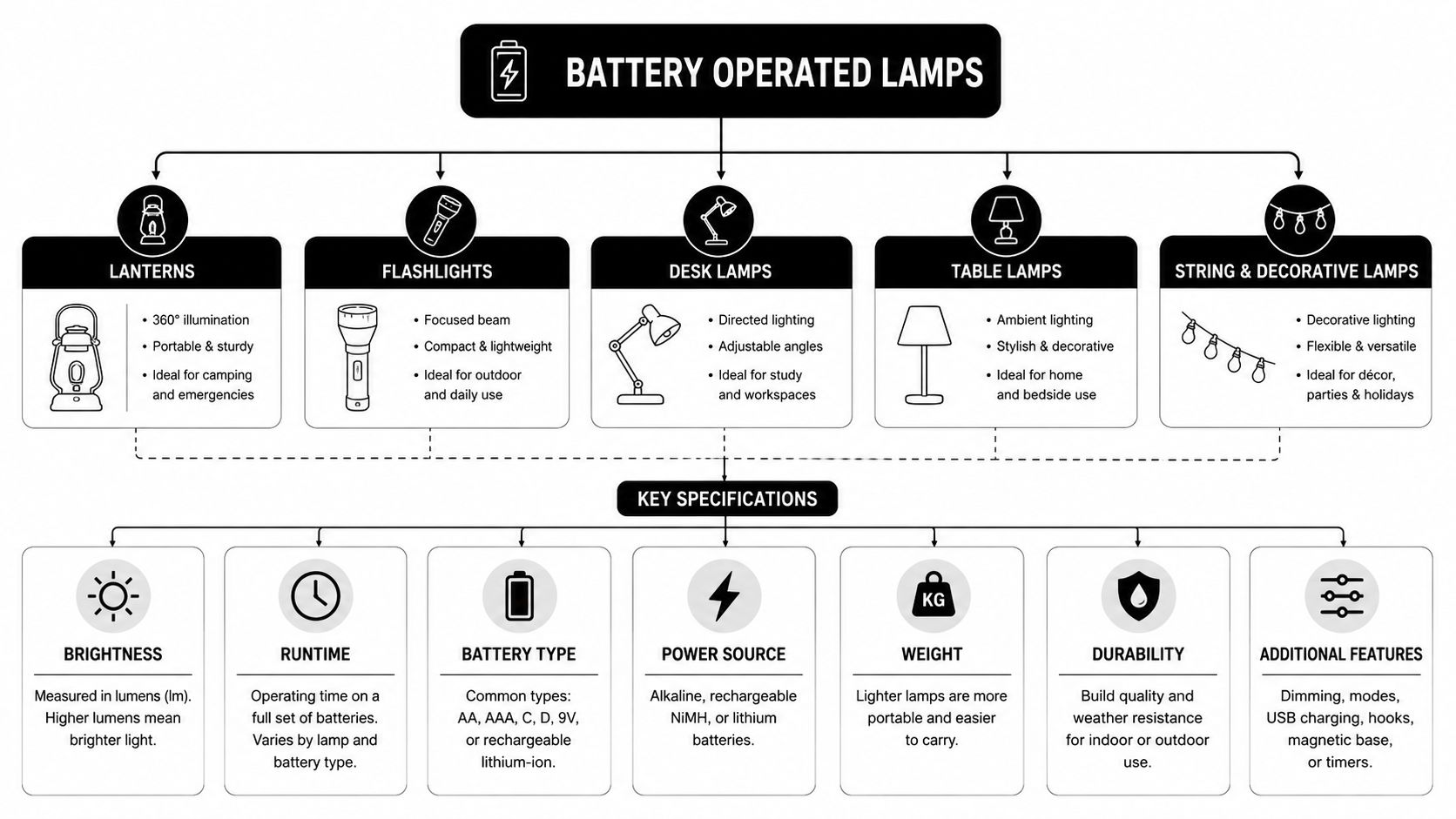
A comprehensive infographic illustrating different types of battery operated lamps and their key product specifications.

Start with the job, not the styling shot. A lamp that looks good online can still be useless on a dining table, beside a lounge chair, or against a wall where the venue needs lift. Match the category to the function first, then worry about finish and colour.

Match the lamp type to the use case

Table lamps fit dining tables, registration desks, and side tables where guests need focused light and the room needs warmth. They create intimacy and keep the layout tidy, which is why they work so well for dinner service and lounge zones.

Floor lamps suit spaces where height and atmosphere matter. I use them for cocktail corners, indoor lounges, and terrace seating because they add layers to a room instead of leaving it flat. They also work well where the light has to be visible from across the venue.

LED cubes and spheres have a stronger visual role. They suit brand activations, photo moments, and contemporary installations where the lamp itself forms part of the design. Fairy light strings are better for softer decorative washes, especially in trees, tents, and around architectural features. Uplighters belong against walls, pillars, and backdrops when the brief is to shape the venue rather than light a table.

Focus on the numbers that matter most

Brightness is measured in lumens, and that is the first spec I check because it tells you how much visible light the lamp can deliver. Colour temperature comes next. A warm white lamp, on the softer end of the spectrum, suits weddings and dinners. A cooler tone makes more sense for corporate launches, clean product displays, and spaces where you want a sharper look.

Runtime per charge is where event planners get caught out. A lamp can look perfect on a product page and still fail a service if it cannot last through the programme. Charging method matters too, whether it is USB, a dock, or another recharge setup, because venue turnaround is easier when charging is simple and repeatable. For outdoor work, an IP rating matters if the lamp may face moisture, wind-driven spray, or a damp terrace.

Use the spec sheet as an event planning tool, not a shopping list. If the product does not tell you brightness, runtime, and charging method clearly, it is not ready for event work.

For a detailed product-focused starting point, the guide to rechargeable table lamps is useful because it keeps the discussion on cordless placement and practical event use rather than home décor trends. That is the lens you need here.

Understanding Runtime and Brightness Trade-Offs
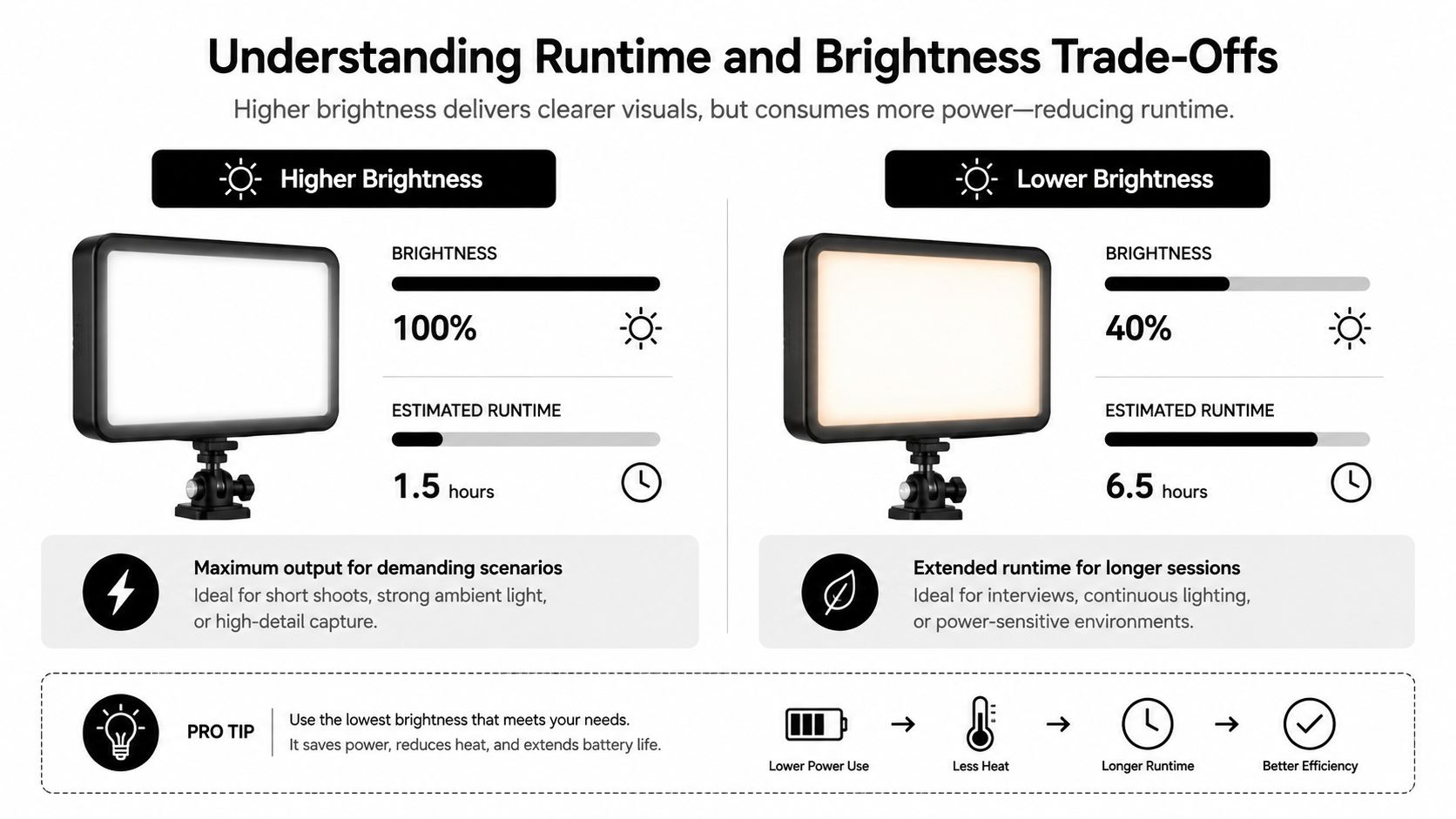
An infographic illustrating the trade-off between brightness levels, power consumption, and battery runtime for portable LED lights.

The biggest mistake I see is simple, people buy for the biggest runtime claim on the box and ignore what the light looks like at the setting they'll likely use. That's the wrong instinct. In events, usable runtime at useful brightness is what counts, because a lamp that runs forever at a dim setting doesn't help a dinner service or a speech.

Bright light drains faster, and that is the trade-off

A useful engineering benchmark is an ANSI-rated battery-operated LED work light with a 2 x 3 V supply and 10 W total output. It produced up to 700 lm, with runtime of about 2 hours on both spotlights or about 4 hours on one spotlight work light runtime benchmark. That example makes the point clearly, higher output pulls more power, so runtime falls as brightness rises.

For Cape Town events, that trade-off maps directly to the evening programme. Welcome drinks need enough light for faces and glasses. Dinner needs softer, flatter light across the table. Speeches need reliable output for the full segment. Teardown just needs enough usable light to keep staff safe. One lamp setting rarely serves all four moments well.

Plan for the whole evening, not the first hour

South African load-shedding changes the buying question. You're not asking whether a lamp can look good for a photo. You're asking whether it can last through service, speeches, and the final stretch of the night. Product guidance in the cordless-lamp market often notes that runtime varies by model and brightness level, and that longer use usually comes from lower settings rather than constant high output battery lamp runtime guidance.

A good habit is to size your lamps against the event's weakest point, not its most optimistic one. If the room needs the lamps to carry a full dinner and a speech block, don't accept a product that only looks strong in bright mode for the first part of the evening. Multi-mode fixtures are the smarter choice because they let you turn the brightness down once the atmosphere is set.

If the specification sheet only talks about “long battery life” without explaining the brightness level behind that claim, I'd pass on it.

South African solar-home specifications show the same logic from another angle. A government tender specified 12 V, 75 Ah tubular lead-acid batteries for systems using 9 W CFL lamps rated around 600 lumens, with at least 75% of rated capacity expected between full charge and load cut-off, and 0.8 A maximum current consumption for the lamp at 12 V solar home system tender. That tells you the same thing event planners already know, lower-current lamps last longer and put less stress on the battery.

Choosing the Right Lamps for Your Event Type

A Cape Town event can fall apart fast if the lighting does the wrong job. A wedding needs warmth. A brand activation needs clean definition. A matric dance needs strong photo output. A private birthday needs lamps that can shift with the evening and still cope if the venue plan changes.

Weddings

For weddings in Stellenbosch, Franschhoek, or Paarl, I prefer warm table lamps on dining tables and soft uplighting around the dance floor or key walls. The light should flatter skin, soften linen, and keep the room from looking clinical. If the venue already has a romantic feel, use the lamps to support that mood rather than fight it.

Corporate events and brand activations

Corporate events need cleaner lines. I'd use LED cubes, spheres, or crisp floor lamps when the goal is brand visibility, product focus, or a polished contemporary look. Cooler light usually works better here because it makes the room feel sharper and more structured. A launch at a convention venue is not a candlelit dinner, so do not force the wrong mood onto it.

School formals and matric dances

These events live or die on how they look in photos and video. Choose lighting that creates shape, highlights entrances, and makes the dance floor obvious. Statement lamps and colour accents work better than tiny decorative pieces that disappear once the room fills up. If students are spending money on dresses, suits, and content, the lighting has to show that off properly.

Private milestone parties

A 50th birthday in a garden or courtyard needs flexibility. Lamps should move easily, survive varied placement, and keep the space usable as the evening shifts from drinks to dinner to dancing. For these events, cordless options make sense because the layout often changes during the night itself. If you are comparing practical table options, the rechargeable table lamps guide is a useful place to start.

Event type Best lamp approach What to avoid
Wedding dinner Warm table lamps, soft uplighting Harsh cool light
Corporate launch LED cubes, spheres, floor lamps Overly decorative mixes
Matric dance Statement lighting, photo-friendly placement Tiny lights that vanish in photos
Milestone party Flexible cordless lamps, mixed heights Heavy pieces that are hard to move

Let the event goal decide the lamp style, not the other way round. If the lamp does not suit the room, it will look like a rental decision instead of part of the design.

Setup, Placement and Styling Tips for Maximum Impact
A comparison chart highlighting the pros and cons of renting versus buying battery operated lamps for events.

Placement does more for atmosphere than fancy product styling ever will. A good lamp in the wrong place still looks awkward. A modest lamp in the right spot can shape a table, a walkway, or a corner into part of the design.

Build light in layers

Start with the lowest practical level of light, then add height. Table lamps anchor guest zones. Floor lamps lift the eye. Uplighters push texture onto walls or foliage. That layering adds depth, and depth is what makes a venue feel finished rather than just lit.

For long banquet tables, space lamps so they support conversation without crowding the centrepiece. On cocktail tables, keep them compact and stable. In gardens, use lamps to mark routes and define edges so guests can move without guessing where to walk. On dance floors, do not scatter them randomly. Place them to frame the space and keep the centre clear.

Battery life matters here as much as appearance. A lamp that looks strong at setup can fade before the last round of speeches if the runtime was overstated or the brightness setting was too high. For a plain explanation of how curtain-style lighting can shape a room without cluttering it, the event fairy light curtain guide is useful.

Style with restraint

Use odd-number groupings when you want a more natural visual rhythm. Pairing every lamp creates a rigid look, while an uneven cluster feels more relaxed. Match lamp colour to the event palette, but do not force exact colour matching if it hurts legibility. The room still needs to function after the photos are taken.

One mistake I see often is over-lighting. Event teams place too many lamps because they worry the room will not be bright enough, then the whole atmosphere flattens out. Another mistake is putting lamps where guests will brush past them. If a lantern or floor lamp is likely to be bumped, move it or anchor it properly.

Good placement beats extra quantity. A few well-placed lamps usually do more for the room than a dense scatter of weak ones.

For one-off Cape Town or Winelands functions, keep the styling simple and the logistics honest. If you are renting, ask how the units will be spaced, charged, and checked before guests arrive. If you are buying for repeated use, the setup has to suit your usual room sizes, not just one polished test run.

Renting Versus Buying Battery Operated Lamps
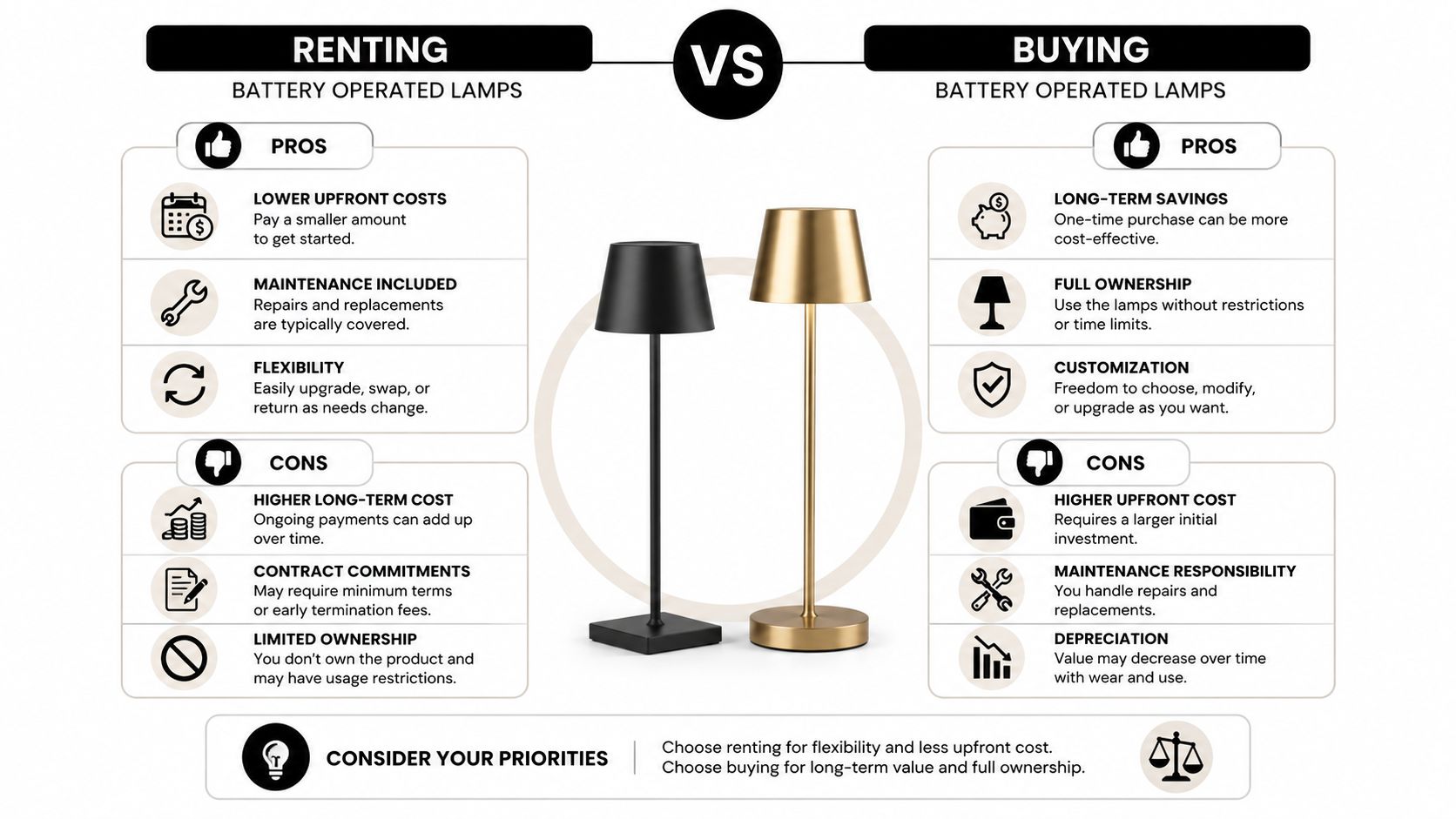
A comparison chart outlining the pros and cons of renting versus buying battery operated lamps.

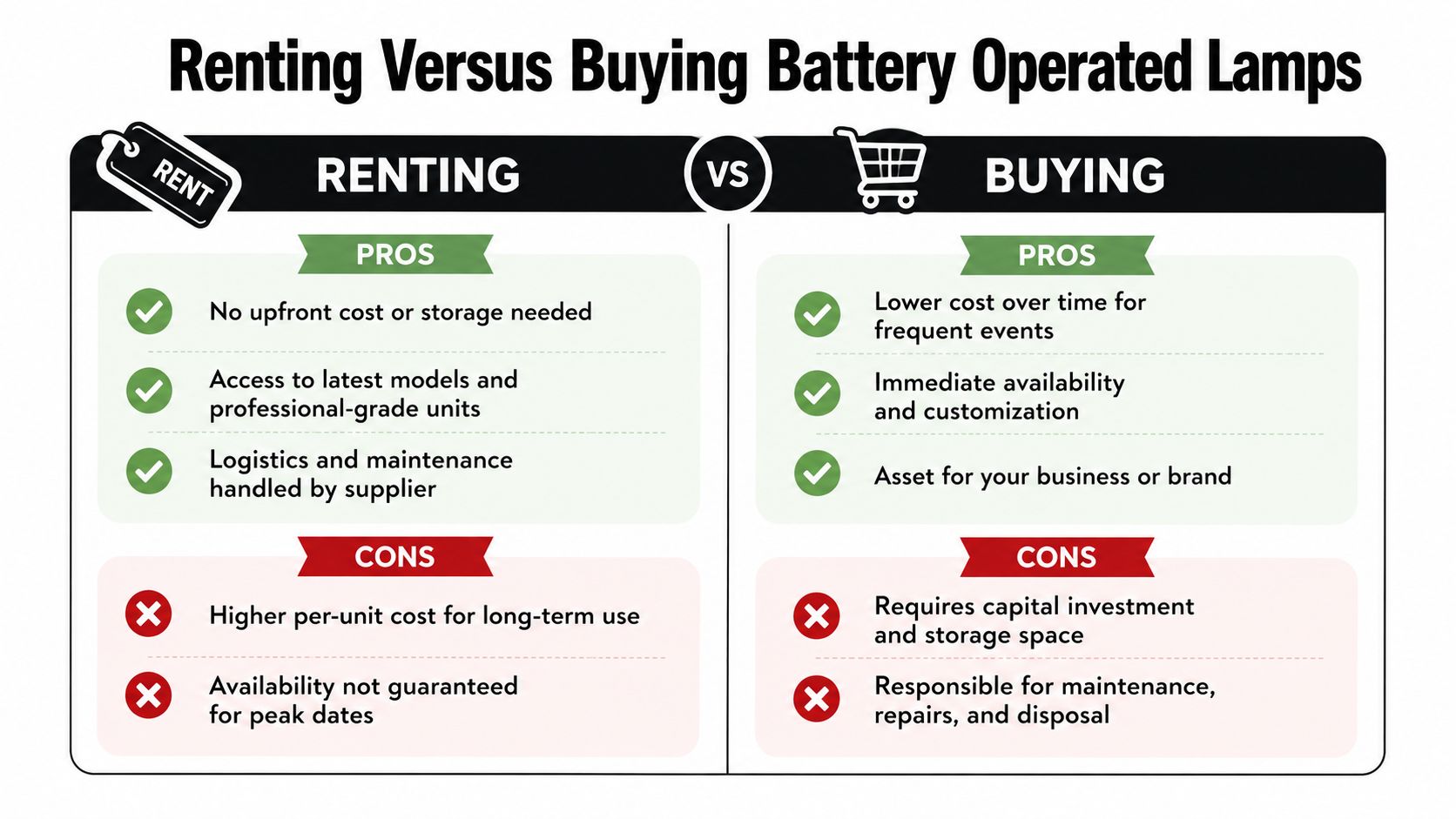
For a one-night wedding, a single corporate activation, or a family celebration, I'd rent almost every time. Buying only makes sense when you'll use the lamps often enough to justify the capital, the storage, the charging routine, and the replacement risk. Most private hosts don't get there.

Why rental wins for most Cape Town events

Rental removes the hidden work. You don't have to buy enough lamps for every table, then figure out where to store them, how to charge them, or what to do when one battery starts fading. You also get a coordinated package that's easier to match across the whole event, which matters when the venue layout is tight or the design is complex.

Buying makes more sense only if the lamps become a regular business asset. If you host events repeatedly, reuse the same style of setup, and have somewhere to store and maintain the units, ownership can start to make sense. But that's a business decision, not a default event-planning decision.

The break-even point isn't useful for one-off hosts unless you already know you'll run multiple events with the same equipment. Once you include charging time, storage space, and upkeep, rental usually beats ownership for occasional use, especially in Cape Town and the Winelands where venues vary and transport logistics matter.

The practical procurement test

Ask three questions before buying:

  • How often will we reuse them? If the answer is only for a single function, rent.
  • Who charges and checks them? If that responsibility falls on you, ownership adds work.
  • Where do they live between events? If storage is a problem, rent again.

ABC Hire is one of the rental options that fits this use case because it provides rechargeable table lamps for event placement without forcing you to manage the equipment afterward. That's the kind of arrangement that makes sense for a single event with a fixed date and a fixed brief.

Battery Care, Safety and Pre-Event Planning Checklist

Battery care starts before guests arrive. Charge lamps in a dry, ventilated area, then test each one on the setting you plan to use. If a lamp is going to work through dinner, don't discover at service time that it only lasts on its lowest brightness.

Keep lamps away from water features unless they're rated for that exposure, and secure floor lamps on terraces where wind can move them. Outdoor venues need extra attention because a lamp that looks stable indoors can become a hazard once the floor shifts, the breeze picks up, or guests start moving between zones.

For battery handling and disposal, use a compliant recycling path rather than treating dead batteries as ordinary waste. If you need a general reference for responsible handling, the EPA universal waste compliance guide from Reworx Recycling is a useful starting point for understanding how battery-related waste streams are commonly managed.

Use this final checklist before load-in:

  • Charge and test every lamp on the exact brightness you'll use.
  • Pack one or two backups for any high-stakes zone like speeches or entrances.
  • Confirm placement so nothing blocks movement or service routes.
  • Check the weather and venue conditions for wind, damp, or exposed edges.
  • Match the lamp plan to the event schedule so lights hold through the full run of show.
  • Print the event checklist and assign one person to sign off each lamp zone. The event planning checklist template is a useful companion if you want a tighter pre-event process.

The best battery lamp setup is the one that disappears into the event because it just works. If you're planning a wedding, corporate function, or private celebration in Cape Town or the Winelands, speak to ABC Hire about rechargeable lamp hire that fits your floor plan, your timing, and your load-shedding reality. Visit ABC Hire to line up the right cordless lighting for your next event.
Brighten Your Event: Choose the Best Rechargeable LED Lamp

A late-afternoon setup in the Winelands can look calm right up until it isn't. The florist is still adjusting the long tables, the band is asking where they can plug in, the wind starts moving through the vines, and everyone's watching the sky because the best part of the event only starts after sunset. That's exactly when lighting decisions stop being decorative and start being operational.

A good rechargeable LED lamp solves two Cape Town event problems at once. It removes cabling from spaces where cables look terrible, and it gives you a layer of resilience when load-shedding or a short-notice outage threatens the mood of the room. For planners working across Stellenbosch, Franschhoek, Paarl, the CBD, and the Atlantic Seaboard, that matters more than any showroom feature list.

What's changed is accessibility. LED pricing dropped hard over time, with the per-lumen price falling by a factor of 10 each decade according to US Department of Energy research on LED price declines. That's a big reason rechargeable event lighting moved from a niche extra to a normal line item for weddings, launches, and private functions.

Setting the Scene with Cordless Brilliance

Sunset is where Cape Town events either come together or start showing their weak points. At a Winelands wedding, daylight carries the setup for most of the afternoon. Then the ambient light drops fast, the venue's fixed lighting feels too harsh or too limited, and every visible extension lead suddenly looks like a planning mistake.

That's where a rechargeable LED lamp earns its keep. On a farm venue lawn, it can mark a pathway without trenching cables across gravel. On a dinner table, it can create warm, controlled light without forcing the stylist to hide plugs and adapters. In a city corporate venue, it lets you light a registration desk, cocktail cluster, or branded product plinth without redesigning the room around wall sockets.

The local advantage is flexibility. Cape Town venues aren't all built for modern event power planning. Some are heritage properties with awkward plug placement. Some have beautiful outdoor sections with almost no practical power access. Some are polished urban spaces where the client wants a clean, contemporary look and won't tolerate cable clutter.

Practical rule: If guests can see the cable, the lamp probably should have been cordless.

Cordless lighting also layers well with other decorative light sources. If the brief calls for softness rather than spectacle, a lamp works better than blasting the whole venue with overhead fill. If you're building atmosphere in stages, pairing lamps with details like battery-operated LED fairy lights for event styling gives you texture without locking the whole event into one lighting look.

What works in practice is using rechargeable lamps as intentional light, not emergency afterthoughts. They're strongest when they support guest flow, table ambience, and key feature areas at the same time. They don't replace every fixture on site. They cover the parts of an event where mobility, appearance, and backup readiness matter most.

Matching the Lamp to Your Cape Town Event

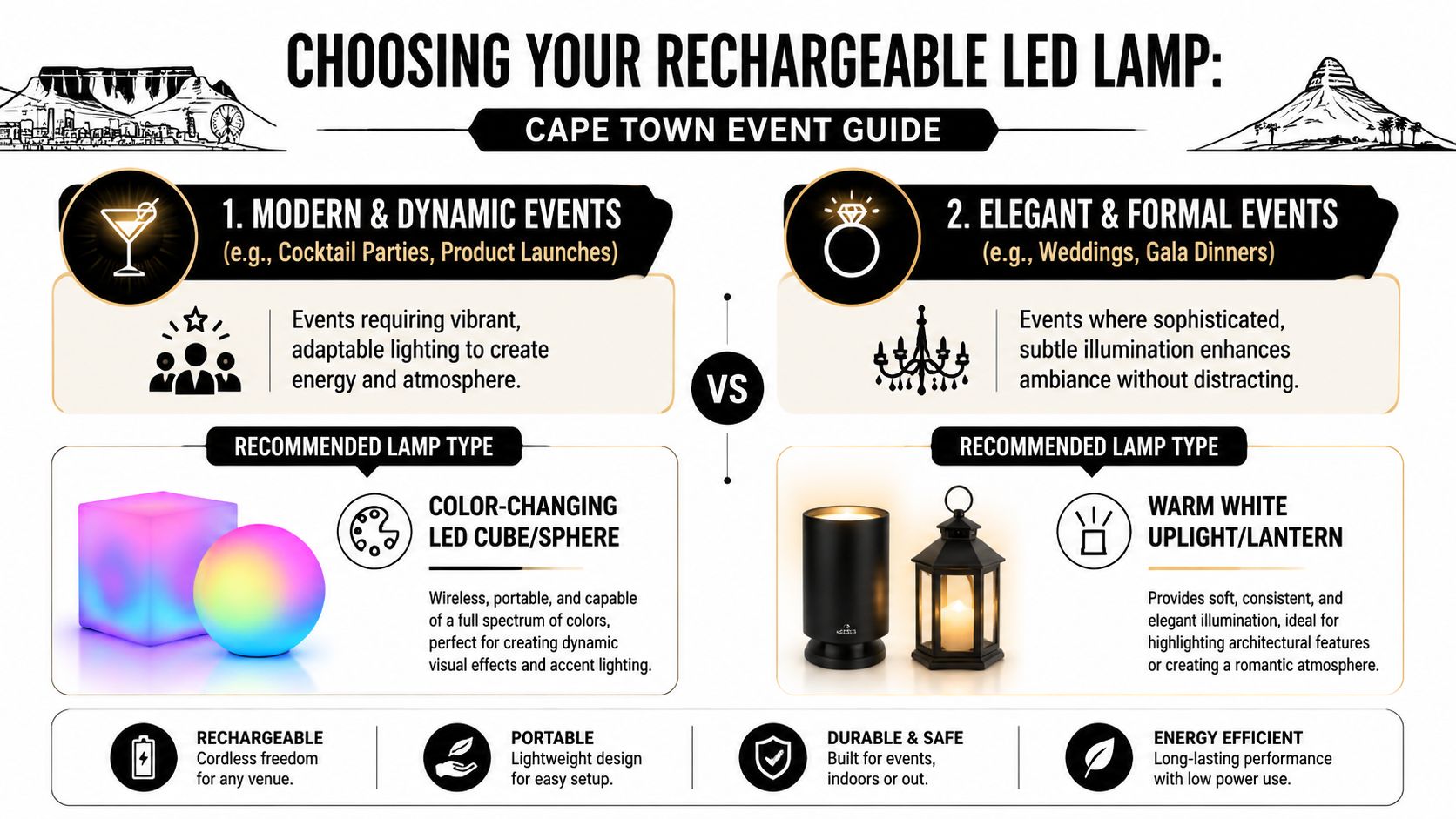
The wrong lamp can make a beautiful event feel off. A glowing cube might be perfect for a brand activation in Woodstock and completely wrong for a formal dinner in Franschhoek. Selection starts with the event style, but in South African conditions the decision should lean heavily on usable brightness during an outage and recharge time between uses, as highlighted in consumer guidance on battery-operated lamps.

A guide comparing rechargeable LED lamps for modern events versus elegant formal occasions in Cape Town.

Winelands weddings

For weddings, the lamp should disappear into the atmosphere rather than call attention to itself. Warm-white table lamps, compact lanterns, and discreet uplight-style units usually do the job better than novelty shapes.

Priorities tend to be:

  • Soft flattering light: Guests need to see faces, menus, and place settings without feeling like they're sitting under a security light.
  • Stable outdoor performance: Grass, stone, uneven surfaces, and wind all punish flimsy units.
  • Quiet design: Brass, black, white, neutral, or frosted finishes usually integrate better than highly saturated housings.

A wedding planner should also think about sequence. Ceremony, canapés, dinner, speeches, and dance floor all ask different things of the same venue. A lamp that can move from welcome drinks to the bar or gift table is more useful than one that only works in a single setup.

Corporate launches and gala events

Corporate events usually need cleaner lines and more control. If branding matters, colour consistency matters. If the venue has multiple zones, the lamp should fit the technical brief rather than just look good in isolation.

For launches and galas, I'd prioritise:

  • Colour control: For branded palettes, basic warm white may not be enough.
  • Fast reset between programme segments: Lamps sometimes need to move from foyer to stage-adjacent networking areas.
  • Professional finish: Corporate clients notice mismatched housings, inconsistent brightness, and scratched diffuser surfaces.

If the event includes scenic lighting, feature lighting, and programmable elements, don't expect decorative rechargeable lamps to do the job of a full production rig. Use them for tables, satellite areas, lounges, and backup elegance around the edges.

Private parties and milestone celebrations

Birthday parties, engagement dinners, and home events can be more forgiving. That opens the door to colour-changing cubes, spheres, decorative lanterns, or compact table lamps that add personality.

These events benefit from portability more than formal precision. Hosts often change layouts mid-event, move furniture, or open a second area outdoors once the weather settles. Rechargeable units make that possible without calling an electrician or rerouting cables through a living room.

Here's a quick selection framework.

Event Type Primary Goal Top Spec Priority Recommended Lamp Style
Winelands wedding Atmosphere and elegance Usable brightness through dinner service Warm white table lamp or lantern
Corporate launch Brand-aligned presentation Control and recharge practicality Sleek table lamp or colour-capable accent unit
Private party Flexible mood creation Portability and visual impact LED cube, sphere, or casual cordless lamp

Don't choose by appearance alone. The lamp that looks best at noon on a supplier sheet can perform worst after sunset on a windy terrace.

Decoding the Technical Specifications

Spec sheets can be misleading if you read them like a retailer reads them. Event people need to read them like operators. The question isn't whether a rechargeable LED lamp sounds impressive. The question is whether it will survive transport, setup, weather, dimming, and a long service window without creating work for the crew.

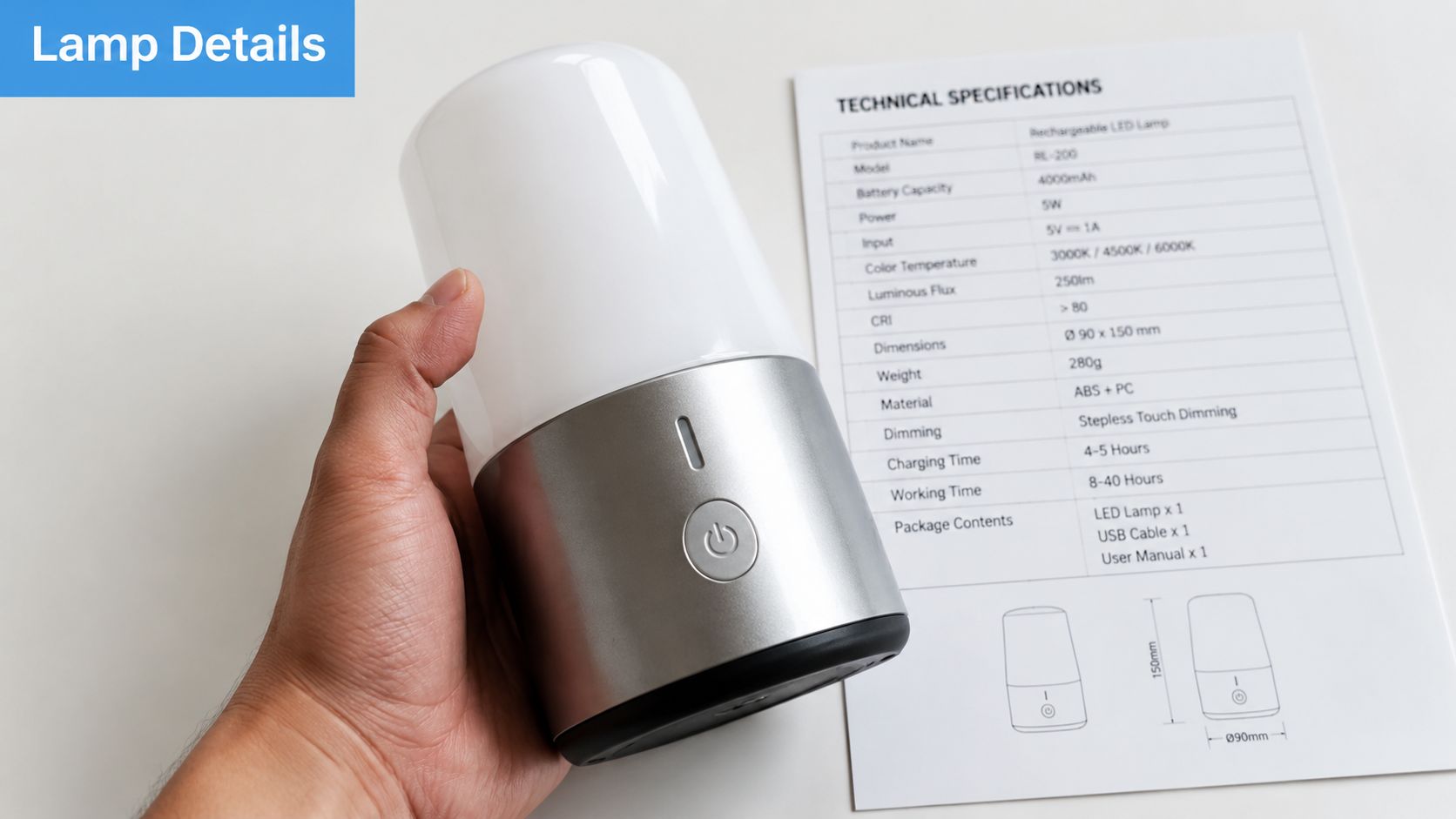
A hand holding a rechargeable LED lamp next to its technical specification sheet on a table.

Brightness and light quality

Start with lumens, not watts. Watts tell you power draw. Lumens tell you light output. That matters because modern LED performance improved steadily, with efficacy improving by about 6 to 8 lumens per watt each year since 2010, and average LED lighting products reaching 102 lm/W in 2018, according to the European Commission Joint Research Centre report on the LED lighting market.

That progress is why compact rechargeable units can now produce useful light without bulky battery packs. But brightness alone isn't enough. For weddings, food service, and brand-sensitive activations, colour rendering matters too. If you want a practical explainer on how light affects the way flowers, skin tones, and fabrics appear, Golden Lighting's guide to CRI is worth reading.

A few practical checks:

  • Warm white for dining: It's usually safer for formal tables and portraits.
  • Neutral or adjustable white for mixed-use spaces: Better where a lamp may shift between service and guest zones.
  • RGB only where it serves the brief: Colour-changing features are useful, but not every event wants nightclub energy.

Battery and runtime reality

A common pitfall for buyers involves runtime. “Runtime” often means very little until you know the brightness setting and the age of the battery pack. A lamp can be technically functional and still too dim to be useful by the point you need it most.

Look for:

  • USB charging: Easier to manage across large batches.
  • Lithium-ion or LiFePO4 battery options: Better suited to repeat event use than vague, unlisted battery specs.
  • Cycle-life information: If the supplier can't explain battery replacement or service planning, that's a warning sign.

Control, casing, and event durability

Remote control sounds handy until remotes go missing on site. DMX sounds complex until the event doesn't have the crew or time to programme it. Match the control method to the actual production level of the event.

For more theatrical or architectural environments, it helps to understand how decorative cordless lighting sits alongside conventional event fixtures such as PAR can lighting used in venue washes and feature illumination. They do different jobs. One gives mobility and intimacy. The other gives broad scenic coverage.

A lamp spec is only useful if it answers a setup question. Can it stay bright enough? Can it be moved quickly? Can it cope with the venue?

Also inspect the body. Metal housings usually wear better than cheap plastic. Weighted bases matter on outdoor tables. Sealed buttons, solid charging ports, and easy-clean surfaces save a lot of trouble after multiple rental cycles.

Creative Setup and Placement for Maximum Impact

Most bad event lighting doesn't fail because the fixtures are poor. It fails because the placement is lazy. A rechargeable LED lamp works best when it shapes movement and mood rather than just filling darkness.

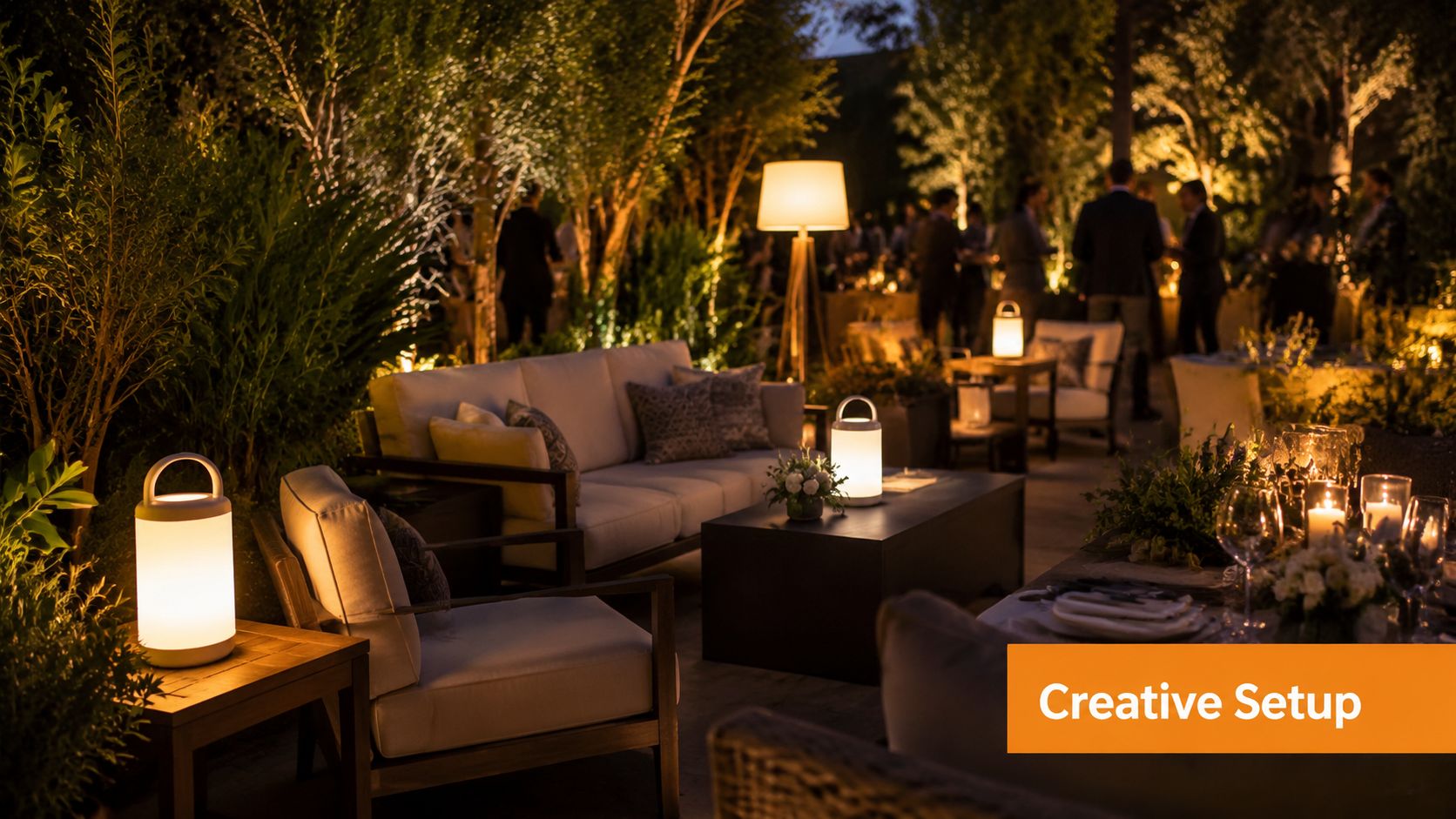
A luxurious outdoor lounge area illuminated by several warm rechargeable LED lamps at a evening garden party.

Use lamps to guide the room

At a lawn reception in Constantia or Stellenbosch, the cleanest move is often to light the route before the destination. Guests remember how a space felt as they entered it. A row of low cordless units along a path, stair edge, or transition from drinks area to dinner space does two jobs at once. It adds atmosphere and reduces uncertainty.

For waterfront and city venues, place lamps where overhead lighting usually leaves dead patches. Think lounge pockets, sideboards, registration points, restroom corridors, and bar fringes. Those transitional areas often make a venue feel unfinished after dark.

Good placement usually follows this sequence:

  1. Arrival line: Gate, pathway, host point.
  2. Social anchor points: Bar, canapé station, lounge seating.
  3. Emotional centre: Head table, cake table, speech zone, branded reveal area.

Keep table lighting disciplined

Table lamps can make a dinner look polished, but they can also ruin sightlines if they're too tall, too bright, or too cold in colour. For round tables, one central cordless lamp often works better than several competing points of light. For long banquet tables, repeated low-profile lamps create rhythm without turning the table into a runway.

A few placement rules help:

  • Keep the glow below eye line: Guests should see each other before they see the fixture.
  • Avoid direct glare into seated faces: Frosted diffusers and shade-style lamps are easier to live with.
  • Balance with candles or florals carefully: Too many decorative light sources can flatten the overall look.

On-site note: If diners start rotating lamps away from themselves, the setup was too bright or badly positioned.

Highlight features, not everything

You don't need to light every object in the venue. In fact, selective darkness usually makes an event look more expensive. Use rechargeable units to pick out trees, signage, product displays, or a DJ front rather than flooding the whole space evenly.

At a private estate, that might mean lighting a single olive tree near the dance floor and leaving the far garden in shadow. At a V&A venue, it might mean creating warm islands of light in lounge areas while the city and harbour provide the background atmosphere.

The best setups feel intentional. Guests should think the event is beautifully lit, not notice how many individual lamps you used.

Charging and Maintenance for Flawless Performance

A rechargeable LED lamp is only as reliable as the charging discipline behind it. Mid-event failures aren't usually bad luck. They're process failures. Somebody trusted the indicator light, skipped runtime testing, mixed charged and uncharged stock, or packed old and new batteries into the same job without tracking them.

The battery is the first thing to plan around. The LED element can last up to 50,000 hours, while a rechargeable LED bulb example is rated at about 20,000 hours and draws 4 watts while matching the brightness of a 50W incandescent, according to LED professional coverage of rechargeable LED bulb design and lifespan. In practice, that means the light source often outlasts the battery pack, so replacement planning matters more than people think.

Build a charging workflow, not a charging corner

The safest approach is to treat charging like inventory control. Every lamp needs a status, a position, and a test record. If your team just plugs everything in the night before and hopes for the best, you're inviting uneven performance.

A workable pre-event system usually includes:

  • Label each lamp: Number the unit and its charger so faults can be traced.
  • Separate tested stock from untested stock: Never pack from the charging area directly.
  • Log weak performers: Any unit with suspect runtime should be removed from premium placements.

If you're dealing with venues that have limited power access, it also helps to understand broader portable power solutions for events and off-grid setups. Not because every lamp needs a power station on site, but because charging strategy becomes part of event power planning when access is tight.

Test for the event, not for the brochure

A lamp that works in the warehouse can still fail at the venue. Brightness settings change battery draw. Cold evenings can expose weak packs. Older stock often looks fine until it's asked to hold output through the critical dinner window.

What works:

  • Run lamps at the intended brightness before the job
  • Test colour-change and remote functions, not just power-on
  • Clean diffusers and bodies before packing
  • Carry a small reserve of matched units for swaps

This is also where buying decisions matter. Replaceable batteries, accessible charging ports, and durable housings save money and stress over time. Sealed disposable units with vague battery specs usually become dead stock faster than expected.

If a supplier can't tell you how battery servicing works, don't assume there is a service plan.

Protect the finish as well as the battery

For weddings and formal corporate work, cosmetic condition matters almost as much as function. Fingerprints on metallic finishes, scratched diffusers, and dented bases are visible under close dining light.

Pack lamps upright where possible. Keep charging cables organised by model. Don't let damp units go back into closed cases after a coastal event. Salt air, mist, and rough load-ins punish neglected stock quickly in Cape Town conditions.

Rental Logistics in Cape Town and the Winelands

Renting usually makes more sense than owning if rechargeable lamps aren't on jobs every week. Cape Town events vary too much. One weekend calls for elegant cordless table lamps at a vineyard. The next needs sturdy portable units for a school function or a corporate rooftop where weather and access are harder on equipment. Rental lets you match the stock to the brief instead of forcing one inventory style onto every event.

Screenshot from https://abchire.co.za

Ask better supplier questions

Local logistics matter. A city hotel with a loading bay is one thing. A remote Winelands venue with gravel access, limited turnaround space, and restricted setup hours is another. Your lighting supplier should understand both.

Ask these questions before confirming:

  • How is runtime tested before dispatch?
  • What happens if a unit fails on site?
  • How are remote venues handled for delivery and collection?
  • Are replacement units packed as part of the job?
  • How are charged and tested units separated from returned stock?

A local South African study and user guidance highlighted why this matters. One rechargeable desk lamp recorded about 3.5 hours of continuous use on a full charge, while a user manual specified up to 8 hours of cordless use. For reliable event planning, test runtime at the intended brightness and add a 20 to 30% buffer for battery ageing and real-world use, as discussed in this design and performance analysis of rechargeable desk lamps.

Plan for the venue, not just the inventory

Winelands venues often stretch crews in ways city planners underestimate. Long distances between prep area and reception space. Limited charging access. Late-night pack-down over uneven ground. Those conditions change what “easy” means.

If lamps are part of the visual plan, they should also be part of the contingency plan. Key areas like entrances, bathrooms routes, bars, and dining tables shouldn't depend entirely on venue power. That's where a local rental partner with experience in event styling and practical operations is useful. For example, ABC Hire's event decoration hire resources sit in the same decision space as rechargeable table lamps, LED furniture, and other portable event elements used across Cape Town and the Winelands.

The strongest rental setups combine aesthetics, transport practicality, and backup thinking. That's the difference between lighting that looks good in a catalogue and lighting that still works when the schedule slips, the weather turns, or the power drops at the wrong moment.


If you're planning a wedding, corporate function, matric dance, or private celebration in Cape Town or the Winelands, ABC Hire can help you match rechargeable lighting to the venue, layout, and load-shedding realities of the job. Ask for a practical setup recommendation based on your event style, not just a product list.