
You've booked a beautiful venue. The mountain view is perfect, the tablescape is nearly there, and sunset is going to do half the styling work for you. Then the practical problem lands. There are hardly any plug points where you need them, the ceremony flows into dinner outdoors, and nobody wants extension cords running through a reception space.
That's where LED fairy lights battery operated stop being a last-minute decorative extra and start becoming one of the most useful tools in event styling. They solve real problems. They bring light to tables, floral moments, signage, backdrops, and lounge corners without tying your design to wall sockets. In South Africa, that flexibility matters even more because venues often mix indoor and outdoor zones, remote setup areas, and the occasional load-shedding concern right when guests arrive.
Used well, battery-operated fairy lights create atmosphere fast. Used badly, they fade too early, look too small for the space, or turn into a tangle of exposed battery packs. The difference is usually planning, not budget.
The Secret to Flawless Event Lighting Anywhere
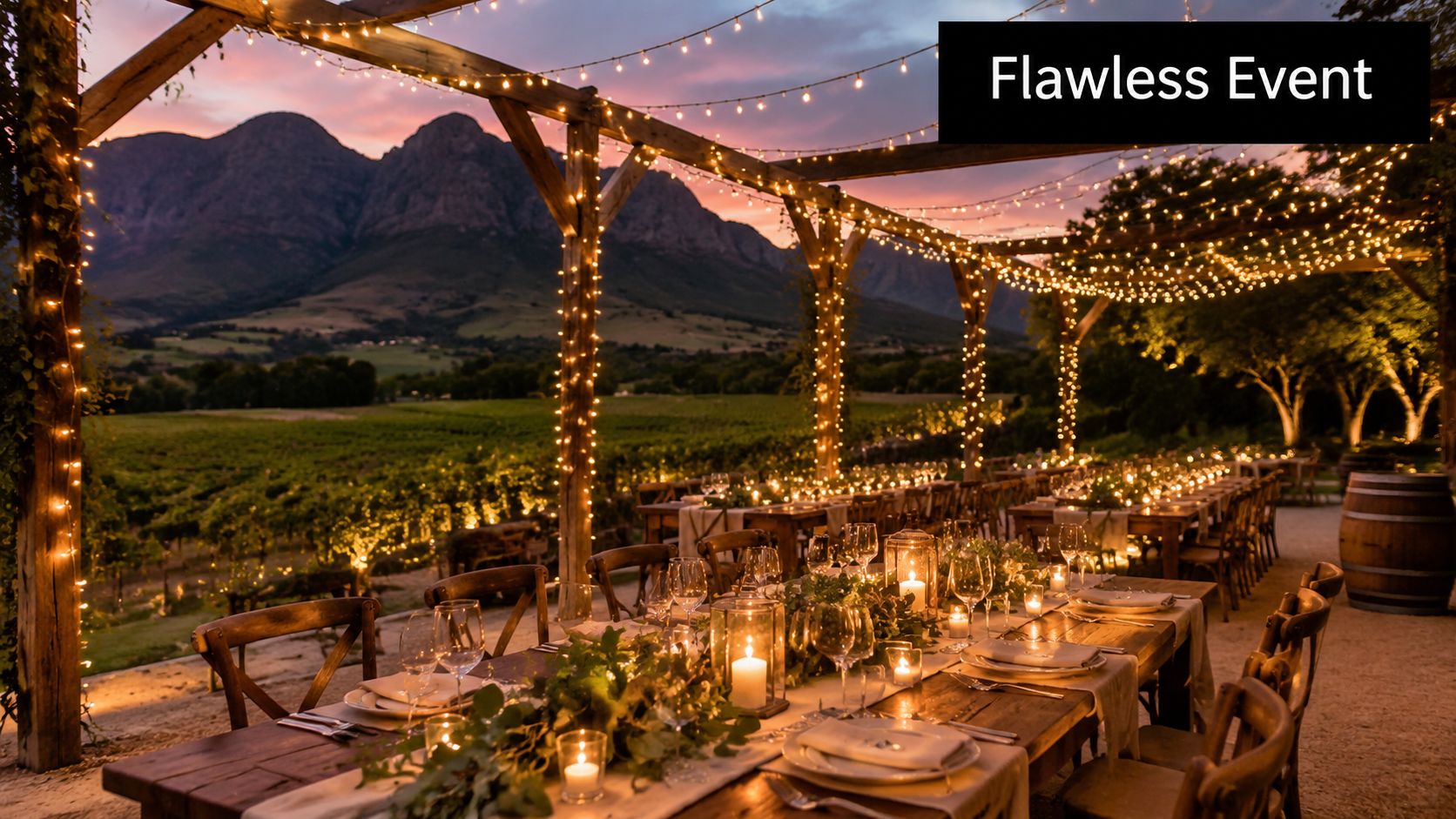
A Cape Winelands reception often looks effortless from the guest side. Long tables under trees, glassware catching the last light, mountain silhouettes behind the dance floor. The setup side is less romantic. Power access can be limited, especially once you move away from the main building. That's why battery-operated LED fairy lights have become a standard styling choice for outdoor weddings, school formals, and temporary brand activations.
They work because they remove the biggest limitation in decorative lighting. Placement no longer depends on a plug point. You can run a strand through a centrepiece, wrap it around a welcome sign, line shelving in a drinks station, or build glow into a photo area without stretching cables across guest pathways.
A big reason stylists favour LED versions is longevity. One industry guide notes that LED fairy lights can last up to 60,000 hours, about 20 times longer than incandescent versions, while battery-powered models can run from 18 to 24 hours and over 100 hours in some micro-drop styles with fresh batteries, which is why they're such a practical fit for long events and venues without easy power access in the ZA market (battery-operated fairy light buying guide).
Why they solve real event problems
Battery fairy lights aren't trying to replace architectural lighting. They do a different job. They add mobility, safety, and speed during setup.
- Portable placement: You can light awkward corners, freestanding décor, and outdoor features without hiring extra power distribution.
- Cleaner styling: No visible extension leads across premium table settings.
- Safer guest areas: Low-voltage decorative strings are easier to integrate than mains-powered décor lights in traffic zones.
Practical rule: If the light needs to travel with the styling item, not stay fixed to the venue, battery power is usually the cleaner choice.
For planners comparing broader lighting budgets across different event contexts, it can also help to compare Colorado Springs lighting costs just to see how location, scale, and fixture type can shift pricing logic in other markets. The local lesson is similar. Decorative lighting and functional event lighting are not the same cost category.
For larger scenes, fairy lights usually work best alongside other layers. If you're balancing ambience with stronger event illumination, it helps to understand where uplighting and wash effects fit in a lighting plan, especially for reception spaces and marquees. This practical guide to PAR can lighting for events is useful for that distinction.
How to Choose the Right Fairy Lights for Your Theme
Not all battery fairy lights behave the same way, even when they look similar online. Buyers often choose by photo first, then discover too late that the string is too short, too cool in colour, too weak for the intended area, or too demanding on batteries for a full event.
The fastest way to choose well is to match the light to the design job. Table styling needs flexibility and a discreet battery pack. A backdrop needs enough length and repetition to avoid looking sparse. Floral installations need wire that bends cleanly and disappears into the arrangement.
Start with runtime, not colour
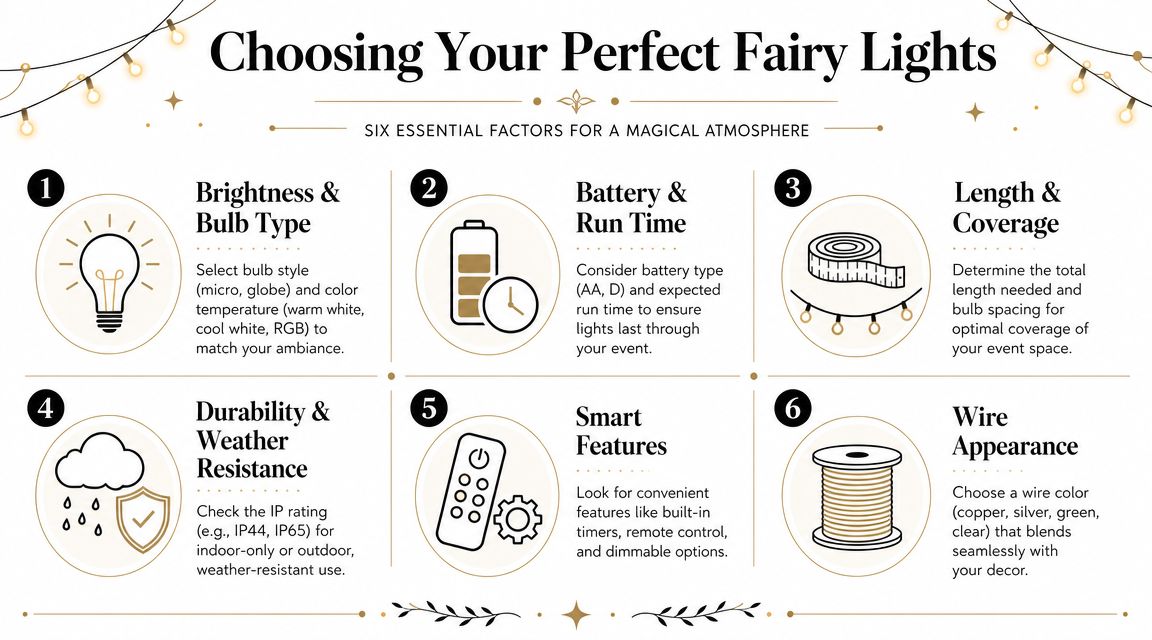
Shoppers often begin with warm white versus cool white. Stylists should begin with battery demand. Product variance in this category is wide. A common format is a 33-foot string with 100 LEDs on 3 AA batteries, but one source also notes that basic strings may last only 4 to 7 hours, while quality LED battery strings can run 18 to 24 hours and some micro-drop designs can go beyond 100 hours, depending on the product and battery setup (battery runtime guide for fairy lights).
That spread changes the buying decision completely. A short private dinner and a long wedding reception don't need the same spec.
A quick selection table
| Design need | What usually works | What usually disappoints |
|---|---|---|
| Centrepieces | Thin wire, warm white, discreet battery pack | Bulky box that can't hide in florals |
| Welcome signs | Medium-length string with even LED spacing | Very short strings that leave patchy areas |
| Backdrop accents | Multiple matching strands layered together | One sparse strand trying to fill a big frame |
| Outdoor table runs | Battery models chosen for longer runtime | Short-life decorative sets bought on appearance only |
Wire, shape, and visual finish
The wire matters more than commonly realized. Silver or copper wire tends to blend well into glass, foliage, timber, and neutral linens. It also bends easily around candle sleeves, plinth edges, arches, and floral foam cages. If the wire fights the shape, setup takes longer and the result looks forced.
Bulb style changes mood too:
- Micro-drop style: Best when you want tiny pinpoints of light and the wire to disappear.
- Classic fairy light look: Better when you want the strand itself to read as part of the décor.
- Globe-style decorative strings: Better for a more visible, playful statement, but less subtle on formal tables.
Match the light to the venue type
A refined indoor dinner can handle a lighter touch. A farm venue with dark pathways and broad outdoor zones can't rely on delicate strings everywhere. Theme should guide the visual language, but venue scale should decide quantity and placement.
If your theme says “soft sparkle” but the venue says “large and open”, trust the venue first. Sparse lighting reads unfinished in a big space.
For planners who work across residential and event environments, it's also useful to see how people think about long-term lighting upgrades in other contexts. This piece on how to improve property value with LED lighting is from a different use case, but it's a good reminder that LED choices are often about efficiency, usability, and appearance together, not colour alone.
A practical checklist before you rent or buy
- Decide the job first. Is the light for a table, a sign, a floral installation, or a backdrop?
- Check the battery format. If the setup needs to run for hours, avoid choosing purely by product photo.
- Look at strand density. More LEDs generally create a richer decorative effect than a long, sparse run.
- Plan where the battery box will hide. If you can't answer that quickly, the product may not fit the design.
- Test the tone against your other lighting. Warm fairy lights next to very cool venue lighting can clash visually.
Forecasting Battery Life for an All-Night Event
The question clients ask most is simple. Will the lights last until the event ends?
The honest answer is that battery life depends on more than the label on the packet. Event use is different from casual home use. Strings may switch on during setup, remain active through pre-drinks, dinner, speeches, and then stay on deep into the evening. In South Africa, there's another layer. Battery décor often pulls double duty during power uncertainty, which means planners need a more realistic expectation of runtime.
A major gap in most buying advice is exactly this. South African planners need real battery-life expectations, especially in load-shedding conditions and in colder Cape weather where battery efficiency can drop in outdoor setups (South African battery-life planning angle).
What changes runtime in practice
Three things usually matter most on event day.
- LED count: More points of light usually mean more battery demand.
- Lighting mode: Static modes and flashing modes won't always drain power the same way.
- Conditions: Cold evening air in the Winelands can make batteries feel weaker sooner than expected.
That's why two strings that look similar in a cart can perform very differently in service.
A planner's working method
For a full-evening event, don't plan around ideal lab-style runtime. Plan around a buffer. Test one complete set before the event, using the exact batteries you intend to use on site. Then check brightness, not just whether the string is technically still on.
Decorative lights often remain visible while already looking tired. A centrepiece that glows softly by design is one thing. A backdrop that has started fading unevenly is another.
Bring spare batteries for any installation that guests will photograph closely. Dim light shows up fast in photos, even when it still looks acceptable from a distance.
The safest way to think about all-night use
Use battery fairy lights where they have a strong decorative return. Don't assign them a bigger job than they can do. For long events, that usually means:
- Prioritise them for table styling and focal décor
- Keep backup cells or AA sets organised by installation area
- Switch on later where possible, especially for décor that doesn't need to glow during setup
- Avoid treating decorative strings as emergency room lighting
If an event has critical zones such as entrances, bathrooms, stairs, or parking transitions, plan separate functional lighting. Battery fairy lights can support atmosphere brilliantly. They shouldn't carry basic guest navigation alone.
Creative Placement and Styling Techniques
Fairy lights succeed when they look intentional. The strongest setups don't scatter them randomly. They use them to shape mood, guide the eye, and pull attention toward detail.
That starts with one decision. Are the lights there for ambience or for function? Retail examples in the broader market include short strings around 6 to 6.6 feet with 20 LEDs, which strongly suggests many products are made for accent use rather than large-scale illumination. That's an important planning point for bigger Cape Town and Winelands venues where scale can swallow small decorative lights (accent-use limitation in short strings).
Good, better, best on guest tables
Good: Coil a fine strand inside clear glass vessels, lantern bases, or around the base of a floral arrangement. This adds glow without visual clutter.
Better: Run lights through layered styling. Think bud vases, textured runners, napkin folds, and low floral groupings so the light reflects off glass and cutlery rather than sitting flat on linen.
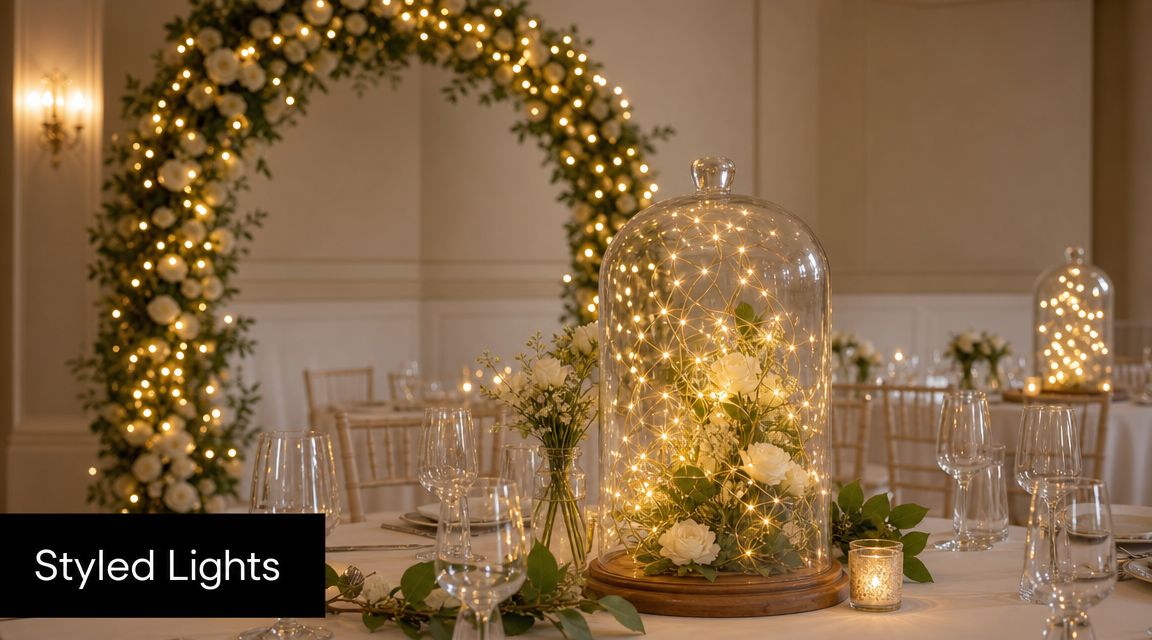
Best: Build the entire centrepiece around concealed sparkle. A cloche, compote, or floral base works well when the battery box is fully hidden and the light appears to come from inside the arrangement itself.
Where they work beautifully
Some placements are reliable almost every time:
- Table centres: They add depth to low-light dinners without blocking conversation.
- Ceremony details: Wrap them through signage, plinth florals, or aisle-side accent pieces.
- Photo backdrops: Layered behind sheer fabric or greenery, they soften the frame.
- Bar and station styling: A little glow under shelving, around menus, or through display baskets can lift a service zone.
Where they often fail
Not every “Pinterest idea” survives real event conditions.
- Large open walls with one or two strands: Too little coverage.
- Outdoor wayfinding across long distances: Decorative strings don't replace practical lighting.
- Windy exposed installations: Thin wire can shift, twist, or look messy if it isn't secured properly.
- Busy buffet zones: Guests and staff can catch wires and battery packs if placement isn't controlled.
Soft decorative light looks magical up close. Across a large lawn or a deep hall, it can disappear almost completely.
Styling by event type
Weddings
Warm white usually suits romantic styling best because it complements candles, timber, foliage, and neutral florals. Use battery fairy lights inside compotes, under gauze runners, around statement signage, or woven into hanging installations where mains cables would ruin the look.
If you want a fuller vertical effect for entrances or photo moments, this guide to using a fairy light curtain for events is worth reviewing alongside battery strings. Curtain lights and battery strings do very different visual jobs.
Corporate events and brand activations
Corporate styling needs more restraint. Fairy lights work best when they edge a branding feature, highlight shelving, or warm up lounge vignettes that would otherwise feel hard. Avoid overusing them around logos or printed graphics. Too much sparkle can reduce clarity.
A neat trick is to place them where they create reflection on acrylic, glass, or metallic finishes rather than trying to make the lights themselves the main feature.
Matric dances and formals
Stylists can lean more theatrical. Photo walls, entry tunnels, dessert tables, and stage-edge detailing all respond well to battery fairy lights. Just avoid trying to light the whole venue with decorative strings. Students want drama in photos, but event teams still need a separate practical lighting plan.
Pairing with other décor without overdoing it
The best fairy-light styling has contrast. Pair fine points of light with fuller textures such as draping, foliage, ribbed glass, or matte linens. If every surface glows, nothing stands out.
Use this quick guide:
| If the décor is… | Then the fairy lights should be… |
|---|---|
| Minimal and modern | Clean, sparse, and tightly placed |
| Rustic or garden-inspired | Woven through foliage and natural texture |
| Glam and reflective | Hidden so the reflections do the work |
| Youthful and high-energy | Grouped in stronger visual moments like backdrops |
Safe Operation and Post-Event Care
Good styling disappears into the guest experience. Poor setup shows itself through visible battery boxes, loose wire, moisture problems, and dead sections at pack-down. Safety and care aren't the dull part of event work. They're what make decorative lighting reliable.
A common battery fairy light design uses a 13 ft silver or copper wire with 3 AA batteries, and while that thin wire is easy to shape, the battery box is usually the least weather-tolerant part, even when the strand itself is suitable for decorative indoor or outdoor use (13 ft battery fairy light design details)).
Protect the weak point
The wire and LEDs are often the initial consideration. Professionals think about the battery box first. That's the part that needs hiding, securing, and shielding.
For outdoor use, keep the battery box off damp ground and away from irrigation, dripping foliage, ice buckets, and condensation-heavy surfaces. In marquees and tented spaces, don't assume “covered” means dry. Wind can push moisture into places you didn't expect.
Safe setup habits that save trouble later
- Secure battery packs firmly: Tape, tuck, or tie them where guests and staff won't brush against them.
- Keep joins out of walkways: Fine wire is easy to miss during service.
- Avoid pressure points: Don't trap thin wire under heavy bases, stacked décor, or furniture legs.
- Label grouped installations: If you're using several identical strings, mark which battery box belongs to which piece before switch-on.
A battery pack hidden well should still be reachable fast. If staff need to dismantle a centrepiece to turn it off, the setup wasn't planned cleanly.
After the event
Post-event care is where many fairy lights lose their usable life. Rushed pack-down creates kinks, snapped wire, and corrosion from old batteries left in storage.
A better routine is simple:
- Switch off before removal
- Remove batteries before storage
- Wipe dry if used outdoors
- Coil loosely, not tightly
- Store each set so the wire doesn't knot with others
If the strand has been shaped tightly around décor all night, don't yank it free in one pull. Reverse the wrapping gently. That small bit of patience saves a lot of replacement pain later.
Renting vs Buying The Smart Choice for Your Event
Buying makes sense when you use the same type of battery fairy lights often, on a small scale, and you're happy to manage testing, storage, replacement batteries, and post-event maintenance yourself. For everyone else, renting usually removes more problems than it creates.
That matters most for one-off hosts, venues that need occasional decorative lighting, and planners who work across very different event styles. The fairy lights for a garden wedding don't necessarily suit a matric photo wall or a clean corporate lounge. Renting gives you flexibility without leaving you with drawers full of mixed stock that only half-matches your next brief.
When buying works
Buying is usually the better fit if:
- You style frequent small events with the same aesthetic each time
- You already have storage systems for delicate décor stock
- You don't mind testing and maintaining each set between uses
- You prefer building your own kit slowly around familiar products
For private use at home or repeat personal entertaining, that can be perfectly sensible.
Why renting is often the smarter event decision
Renting shines when scale, convenience, and variation matter more than ownership.
- No storage burden: You don't need to keep boxes of wire lights, batteries, and spares between events.
- Less maintenance: You're not the one untangling, testing, and retiring tired-looking sets after repeated use.
- Better fit per event: You can choose what suits this specific brief rather than forcing old stock to work.
- Simpler logistics: Large quantities for weddings, activations, and formal functions are easier to source event by event.
A similar decision often comes up with portable table lighting. If you're comparing decorative battery fairy lights with more polished rechargeable alternatives for dining setups, this guide to rechargeable table lamps for events helps clarify when each approach makes sense.
The practical deciding question
Ask one thing before you commit. Do you want to own lighting stock, or do you want the event to look right with the least friction?
If the answer is the second one, rental is often the cleaner path. You get the visual impact without inheriting the testing, battery management, repairs, and storage discipline that good fairy-light stock demands.
For most event work, that's the smarter trade.
If you're planning a wedding, corporate event, matric dance, or private celebration in Cape Town or the Winelands, ABC Hire can help you build a lighting and décor setup that performs in actual events, not just in inspiration photos. Their range covers stylish event essentials for indoor and outdoor functions, making it easier to create a polished atmosphere without the stress of sourcing every item separately.