
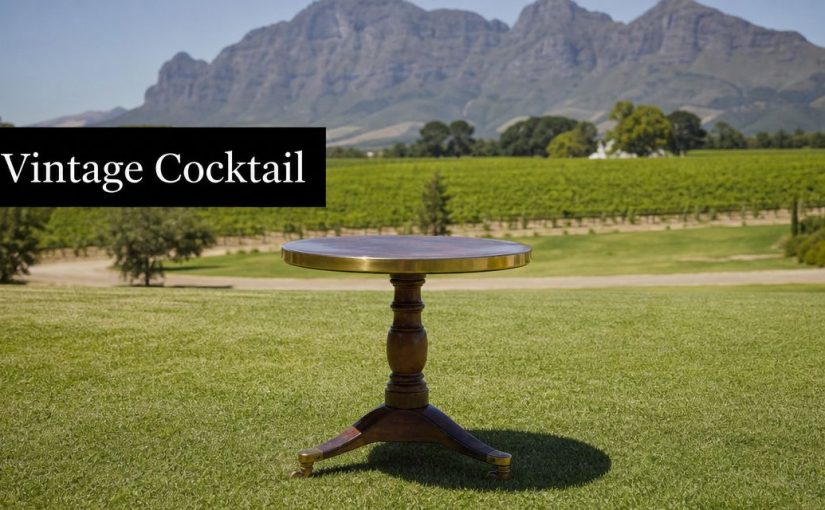
You're probably looking at a floorplan right now and realising the same thing every Cape Town planner realises sooner or later. The room has enough volume, the brief calls for “mingling”, the bar will be busy, and yet the space still won't work unless guests have somewhere elegant to land a drink, a canapé, or a quick conversation.
That's where the vintage cocktail table earns its keep.
In the Cape and the Winelands, these tables do more than fill gaps. They shape movement between the bar, lounge pockets, harvest table, dance floor, and photo moments. Get them right, and the event feels considered. Get them wrong, and guests perch awkwardly on chairs, crowd service points, or abandon beautiful lounge areas because nothing there supports drinks service.
What Defines a Vintage Cocktail Table for Events
A vintage cocktail table earns its place on an event floor by doing two jobs at once. It gives guests a proper surface for a drink and a canapé, and it brings character into the room without demanding a full seating setup.
For events, function comes first. Guests need somewhere to rest a glass while they greet, chat, check a place card, or wait for the next round of service. In practice, that means a cocktail table must be stable, easy to approach from all sides, and sized for standing use or for a lounge grouping where people sit briefly rather than settle in for dinner.
The history matters less than the behaviour it supports. Earlier cocktail tables were tied to more relaxed social entertaining, rather than formal parlour furniture, and that logic still holds on a modern event floor. What planners hire as “vintage” is usually a table with older design cues, not necessarily an antique with collector value.
That distinction matters in Cape Town and the Winelands, where hire stock has to survive gravel drives, lawn installs, cellar doors, and fast turnarounds between venues.
Practical traits that matter on site
A good vintage cocktail table usually has four qualities:
- Useful surface area: enough room for drinks, napkins, and a small styled element without forcing guests to shuffle everything around
- Compact proportions: large enough to serve a group, small enough to keep walkways, bar queues, and service routes clear
- Visual warmth: timber, cane, marble-look tops, brass accents, turned legs, or a softly worn finish that reads collected rather than new
- Flexible placement: suitable beside a lounge cluster, near a bar satellite, on a veranda, or under a stretch tent
I treat durability as part of the brief too. A beautiful marble-top piece may look perfect in a studio photo, but on an uneven wine farm lawn it can be heavy to level, slower to place, and riskier in wind if the base is narrow. A timber or metal-framed option often gives better value for outdoor use.
What “vintage” usually means in the local hire market
In local styling terms, vintage usually describes a mood. It suggests age, patina, detail, and a little soul. It rarely means rare.
That is often the smarter choice. True antiques can be delicate, expensive to replace, and less consistent in height or finish across a larger order. For a 40-person private party, that can be charming. For a 180-guest wedding in Franschhoek with tight install windows, consistency usually wins.
The best rental pieces sit in the middle. They look layered and distinctive, but they are still practical for transport, setup, and repeated hire. That balance matters more than provenance on event day.
For drinks-led events, I also style the tabletop in line with the bar menu. If the brief includes botanicals, citrus garnishes, or refined G&Ts, it helps to review a few polished Craft gin drinks so the glassware, garnish vessels, and tabletop styling feel connected.
Where these tables work hardest
Vintage cocktail tables perform well in spaces built around movement and short stops, not long seated moments. In this region, that usually includes:
- wedding pre-drinks on lawns and courtyards
- corporate mixers in hotel foyers and function rooms
- cellar tastings and brand launches
- veranda spill-out areas at Winelands venues
- reception zones for milestone birthdays and anniversaries
They are less useful in a fully seated dinner where every guest already has generous table space. Add too many, and the room starts to feel crowded, especially in heritage venues with narrow passages or uneven floor levels.
A simple test works every time. If guests need attractive, practical landing points between the bar, lounge areas, and main event spaces, a vintage cocktail table is part of the event infrastructure, not just décor.
Popular Vintage Styles and How to Match Your Theme
Not every vintage cocktail table says the same thing. Some sharpen a room. Some soften it. Some make a corporate event feel less corporate, and some make a wedding feel more grown-up in seconds.
The mistake I see most often is choosing “vintage” as a broad category and stopping there. Style only works when it supports the venue, the florals, the bar finish, the linen palette, and the tone of the guest list.
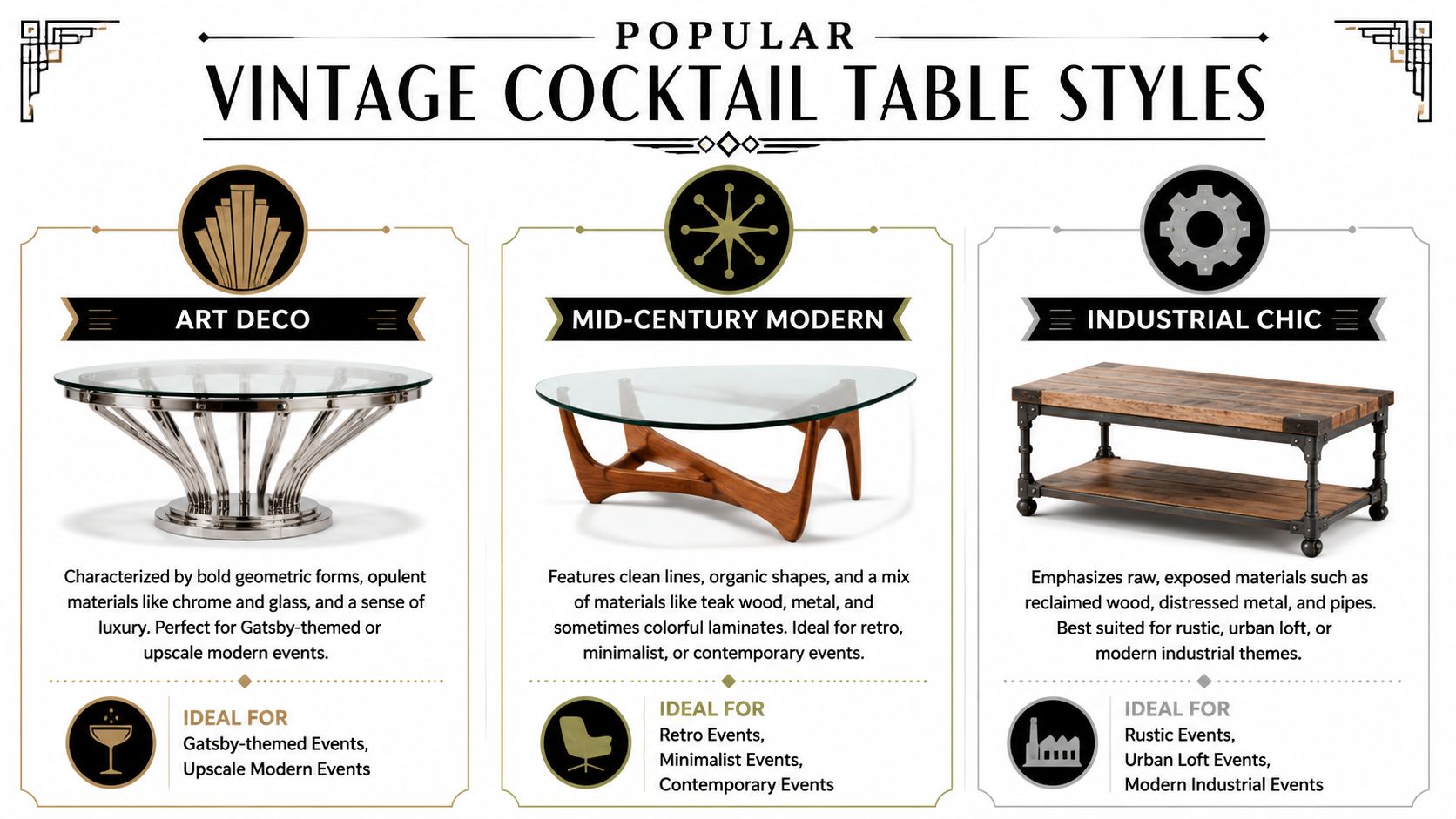
Here's the visual shorthand I use.
Art Deco for glamour and evening polish
Art Deco works when the event wants drama without clutter. Look for geometric lines, mirrored or glass elements, metallic trim, black lacquer tones, smoked finishes, and confident symmetry.
This style suits:
- black-tie weddings
- gala dinners with a lounge extension
- luxury launches
- New Year's events
- formal matric dance after-parties
Art Deco tables do best when the rest of the room is restrained. If the stage set, dance floor vinyl, floral work, and candle styling are all competing, the effect becomes theatrical in the wrong way.
Mid-Century Modern for tailored sophistication
This is often the safest and smartest option for Cape Town planners because it bridges old and new so well. Mid-Century tables usually bring clean lines, timber warmth, tapered legs, and a calm silhouette that doesn't dominate a room.
They're especially effective at:
| Style cue | Best fit |
|---|---|
| Teak or walnut tones | Corporate dinners and media launches |
| Clean rectangular tops | Lounge clusters and hotel foyers |
| Minimal ornament | Modern weddings with soft florals |
| Warm wood finish | Venues that need visual softness |
Mid-Century is excellent when the venue architecture already has personality. Heritage buildings, cellar spaces, and white-walled reception rooms all benefit from furniture that adds character without visual noise.
A good Mid-Century table rarely shouts for attention. It makes everything around it look more resolved.
Rustic and industrial for wine farms and relaxed luxury
Cape planners often confuse rustic with rough. The better version is edited rustic or industrial chic. Think reclaimed wood, dark metal, slightly weathered finishes, and sturdy bases that can sit comfortably against stone, lawn, concrete, or timber decking.
This style works best for:
- Winelands weddings
- harvest-table receptions
- cellar tastings
- outdoor birthdays
- urban warehouse-style launches
What doesn't work is pairing a heavy industrial table with overly delicate seating or a very formal, glossy bar build. The room starts speaking in two different accents.
Ornamental traditional for romantic events
There's also a softer vintage category that leans traditional. Curved legs, carved detail, aged brass tones, marble-look tops, and antique-inspired timber finishes fit beautifully into garden weddings, manor-house venues, or candlelit indoor receptions.
Use this route when you want:
- romance over edge
- softness over geometry
- layered décor over minimalism
The trade-off is practical. Highly ornate pieces can disappear if the styling is too dense, or look fussy if they're dropped into a very sleek venue. They need the right company.
Matching style to event mood
If you're stuck between options, don't ask which table is prettiest. Ask which one helps the room tell the truth about the event.
- For polished corporate: Mid-Century usually wins.
- For glamorous evening events: Art Deco carries the mood.
- For Winelands texture: Rustic or industrial sits naturally.
- For romantic weddings: Traditional ornamental shapes feel effortless.
That decision alone solves half the styling puzzle.
Sizing and Layout Strategy for Cape Town Venues
At this stage, planning either becomes elegant or expensive. A vintage cocktail table might look like a small furniture decision, but layout errors ripple across catering, guest movement, and setup time.
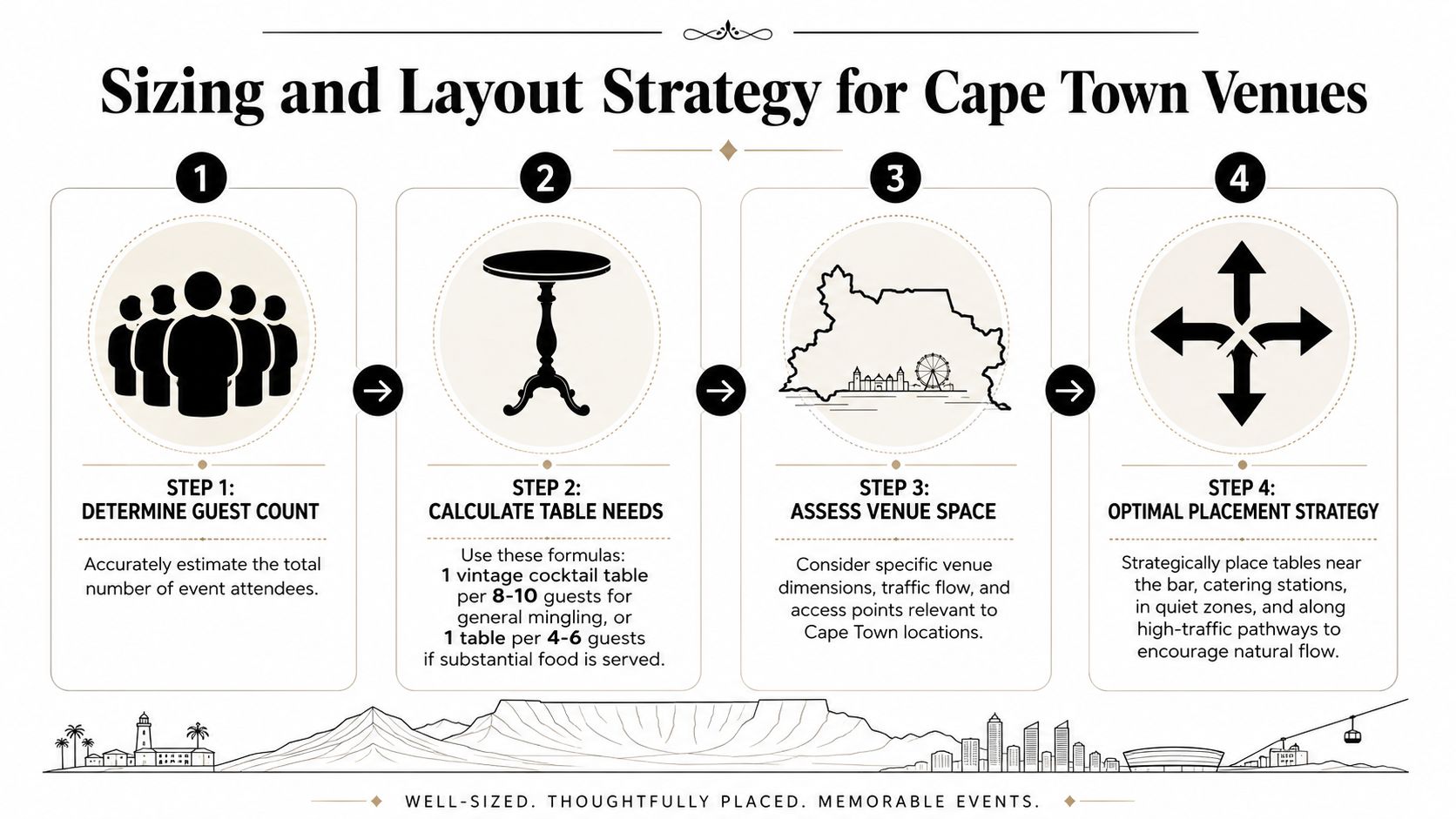
The planning benchmark many teams use is simple: 1 vintage cocktail table per 8 to 10 guests for general mingling, or 1 table per 4 to 6 guests if substantial food is served, as reflected in the event-planning framework shown below. Treat that as a starting point, not a law. Guest behaviour matters just as much as headcount.
Start with guest behaviour, not just numbers
A wedding canapé hour needs a different layout from a conference drinks reception. So does a brand launch where guests are filming content, carrying gift bags, or moving between activation stations.
Use these questions first:
- Will guests stand for long periods?
- Are they balancing food as well as drinks?
- Is there a central bar, or multiple service points?
- Will older guests or family groups want nearby seating?
- Does the event move between indoors and outdoors?
If the answer to several of those is yes, you'll usually need more landing surfaces, not more decorative furniture.
Size affects logistics more than planners expect
These aren't little side tables. Representative vintage-style examples include 46" W × 26" D × 19" H at 71.9 lb and 50" W × 30.25" D × 19.75" H at 85 lb, according to Furniture Pick's product specifications. In metric terms, that means some vintage-style cocktail tables are over 1.2 metres wide and weigh up to 40 kg, which has direct consequences for transport, labour, and placement.
That matters in the Cape for obvious reasons. Historic buildings, upstairs venues, narrow service entries, gravel courtyards, and cellar routes aren't forgiving.
Before sign-off, check:
- Access paths: Can staff move the table from truck to final position without tight turns or stair issues?
- Surface conditions: Lawn, gravel, uneven brick, and timber decks all affect stability.
- Floor sensitivity: Older venues may need more cautious placement and protection.
- Reset practicality: If the room flips after speeches or dinner, heavy pieces slow that process down.
For a different event-floor perspective, this practical note on metal cocktail tables for event layouts is useful when you're comparing visual weight against operational ease.
Placement strategy for common Cape venues
Different local venue types call for different instincts.
Wine farms and lawn receptions
On open lawns, planners often spread tables too widely because there's space available. That creates islands with no atmosphere. Keep tables in intentional clusters near bar access, edge shade, and pathways between the ceremony exit and drinks service.
A better lawn plan usually includes:
- grouped lounge pockets rather than isolated sets
- a few clear sightlines to the view
- breathing room around service staff routes
- no table directly in the main photographer path
Hotel ballrooms and function rooms
Hotels usually reward symmetry, but too much of it can feel stiff. Use cocktail tables to soften the room's geometry. Place them at natural pause points such as near pre-function bars, outside the main seating grid, and along the perimeter where quieter networking happens.
Heritage buildings and city venues
These spaces often have pillars, level changes, and narrower circulation channels. Here the goal is restraint. Fewer, better-placed tables outperform a crowded floor.
If a guest has to twist sideways to pass a table with a drink in hand, the layout is already wrong.
A practical planning method
When I map a room, I work in this order:
| Planning step | What to decide |
|---|---|
| Guest pattern | Standing, mixed seating, or transition event |
| Service style | Drinks only, canapés, or substantial food |
| Traffic lines | Bar queue, catering route, entrance, bathrooms |
| Anchor zones | Lounge pods, dance floor edge, terrace spill-out |
| Final count | Enough tables to support use without blocking flow |
That's the definitive answer to “how many, where, and how”. Count matters. Placement matters more.
Styling Your Vintage Table to Perfection
Once the layout is right, styling becomes much easier because the table already has a job. You're not decorating an object. You're refining a guest experience.
The best-looking vintage cocktail tables at events are usually styled with restraint. Too much décor makes them unusable. Too little makes them feel forgotten.
Start with the tabletop
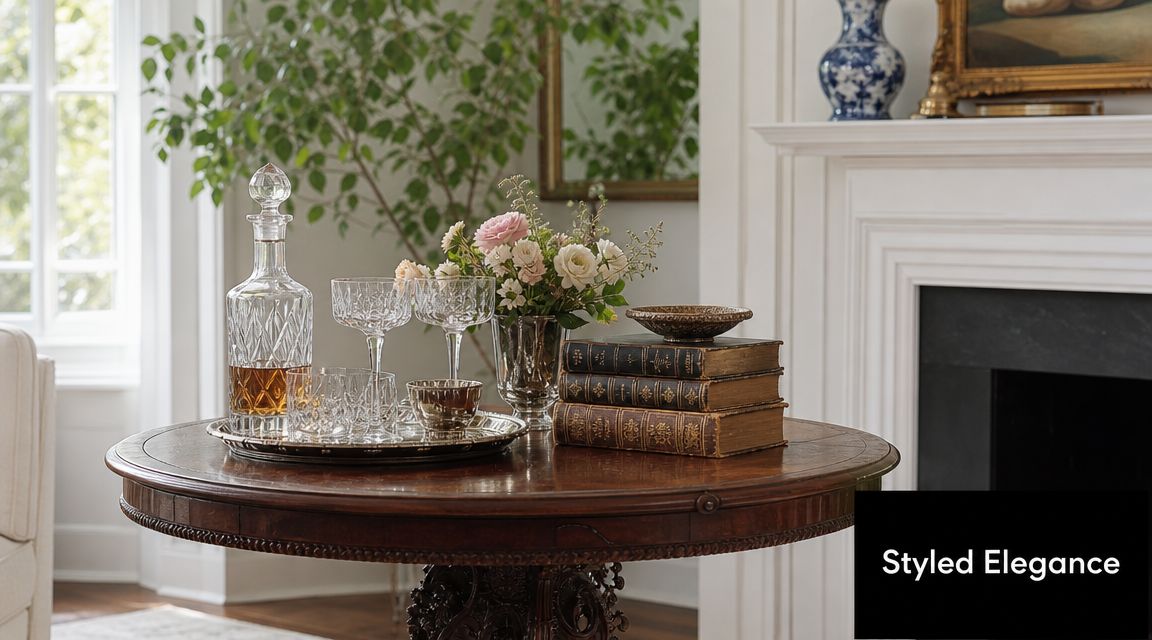
Your tabletop styling should leave enough room for actual hands, glasses, and plates. That sounds obvious, but it's where many beautiful mock-ups fail in real service.
Use a tight edit:
- Low florals: Keep arrangements conversation-friendly and stable in wind-prone outdoor settings.
- Purposeful glassware: If the drinks menu is premium, your table styling should support that tone.
- One hero object: A small lamp, decanter, bud-vase cluster, or candle grouping is often enough.
- Functional trays: They help organise garnish bowls, napkins, or votives without the top looking scattered.
Avoid tall arrangements on mingling tables. Guests don't stand around them. They stand around each other.
Pair the table with the right companions
A vintage cocktail table on its own can feel marooned. It becomes persuasive when paired with furniture that gives context.
Good combinations include:
| Table setting | Best pairing |
|---|---|
| Mid-Century timber table | Leather-look occasional chairs or clean lounge seating |
| Ornamental vintage table | Upholstered armchairs, soft rugs, candlelight |
| Industrial table | Bentwood, tolix-style, or relaxed mixed seating |
| Deco-inspired table | Velvet accents, mirrored details, polished bar styling |
If you're looking at richer metallic finishes, this guide to a gold cocktail table in event styling is a useful comparison point when you want a warmer, more glamorous look than timber alone can provide.
Use décor to direct mood
A cocktail table can shift an event's tone in subtle ways.
For weddings
Lean romantic, but stay practical. Soft floral colour, candle clusters in protected holders, and elegant napkin treatment work well. Guests should still be able to place a clutch, champagne flute, or canapé plate down without hunting for space.
For corporate events
Keep the styling cleaner. Strong materials, minimal florals, a neat tray element, and consistent glassware usually outperform decorative abundance. The room should feel polished and confident, not busy.
For private celebrations
Personality can be introduced. Coloured glass, collected vessels, family photographs in miniature frames, or a thematic object can all work, as long as the table still reads as usable.
Less décor often photographs better because the furniture shape and material can actually be seen.
Don't forget the surrounding light
Vintage finishes respond beautifully to lighting, especially timber, brass-toned detail, and glass. Side lighting, candle glow, and warm ambient spill from a nearby bar can all make the piece feel more expensive than it is.
What doesn't work is harsh overhead white light with ornate table styling. It flattens everything.
For Cape Town outdoor events, remember the shift from late afternoon to evening. A table that looks complete at golden hour can feel visually empty after sunset unless there's some deliberate glow built around it.
The styling balance that usually wins
The most successful cocktail tables do three things at once:
- they look intentional
- they support service
- they encourage people to gather
If one of those falls away, the table stops pulling its weight. Beauty matters, but at events, function is what makes beauty believable.
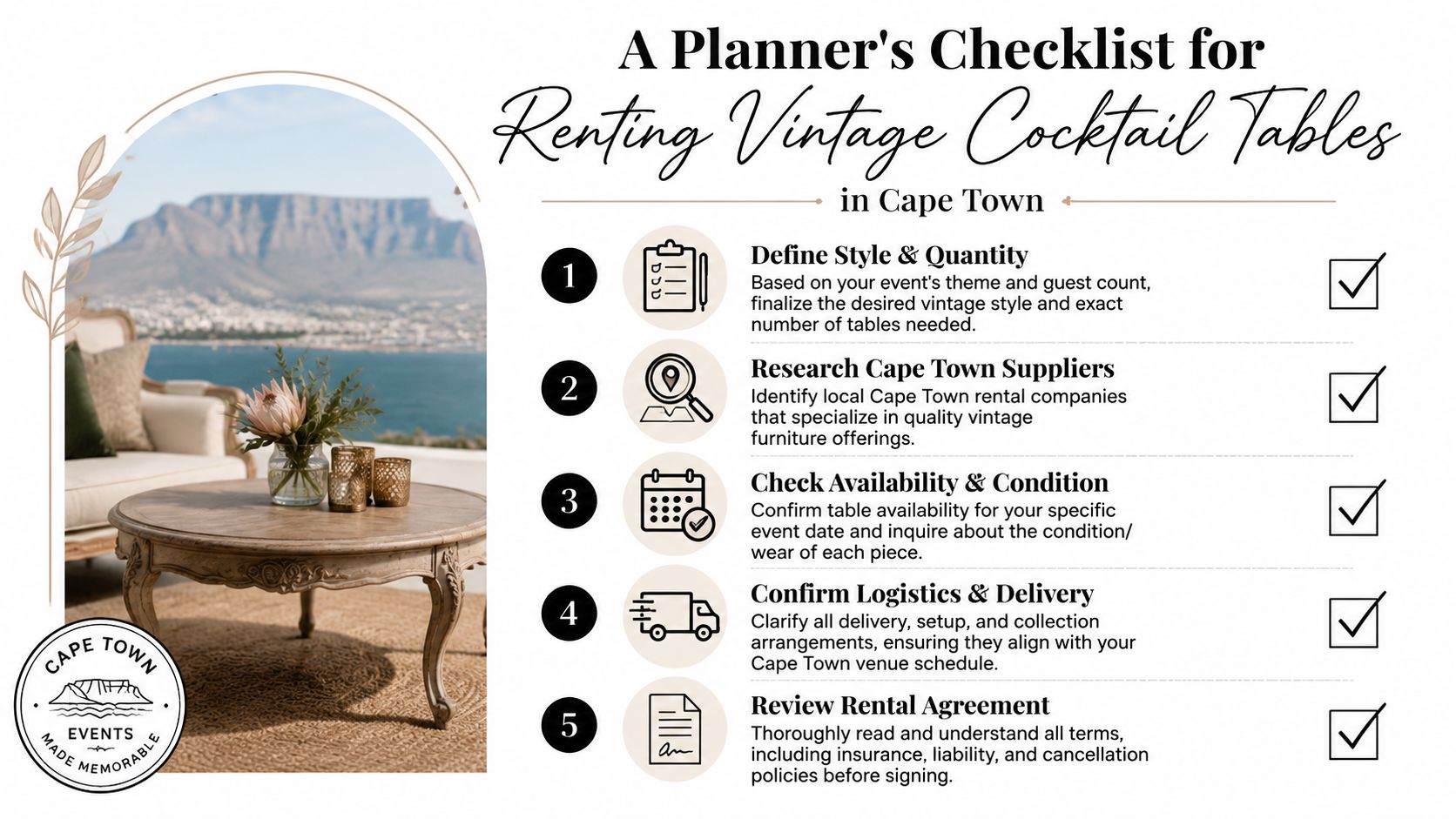
A Planner's Checklist for Renting in Cape Town
A table can look perfect on a mood board and still fail on site. I see it most often at Winelands venues with tight load-in windows, long gravel approaches, or lawns that turn soft after late-afternoon watering. Rental success comes down to matching the furniture to the venue, the timing, and the service plan.
Cape Town hires also need a realistic transport mindset. A truck heading to Franschhoek, Stellenbosch, or Paarl is not doing a casual last-minute detour because two extra tables were added after floral counts were signed off.
The checklist that saves time later
Start with a usable brief
Before asking for pricing, pin down the details that affect stock selection and delivery planning:
- Style direction: Mid-century, Deco, rustic farmhouse, or traditional romance.
- Event function: Welcome drinks, pre-dinner mingling, lounge support, or conference breakout use.
- Table count: Based on guest flow and service points, not a loose sketch.
- Venue access: Stairs, lifts, gravel, lawn, cellar doors, load-in distance, and setup hours.
A vague brief usually leads to two problems. The supplier reserves the wrong mix, or the planner spends the final week approving substitutions that should have been avoided earlier.
Ask logistics questions early
In Cape Town, logistics shape the hire more than people expect. Delivery radius, vehicle access, and placement responsibility need to be confirmed before anyone gets attached to a specific piece.
Ask the supplier:
- Do you deliver to this exact venue and time slot?
- Is placement included, or does the team only offload?
- Can tables be positioned to a floor plan?
- What is the collection procedure if the event finishes late?
- Are outdoor placements approved for the table finish you selected?
Those answers affect staffing, setup timing, and whether you need extra hands on site.
Check consistency, condition, and quantity
Vintage stock should show character. It should not look tired, sticky, wobbly, or mismatched by accident. Ask whether the tables are a matched set, a close family of pieces, or a deliberately mixed collection.
Then ask for current images if the look matters to the design story. A supplier may carry six suitable tables, but only four may be in the same finish after a busy wedding weekend.
If you need a wider view of how local suppliers structure stock, transport, and style categories, this guide to vintage furniture hire in Cape Town is a useful starting point.
Know the commercial terms
The agreement matters as much as the table choice. Good planners read the paperwork with the venue schedule open beside them, because the primary risks sit in timing, liability, and access.
Check these points before paying a deposit:
| Rental point | Why it matters |
|---|---|
| Damage terms | Staff need to know what counts as breakage, staining, or abnormal wear |
| Cancellation terms | Weather shifts and venue changes can trigger costs |
| Hire period | Multi-day setup and next-day strike often change the quote |
| Collection window | Many Cape Town venues enforce strict breakdown times |
| Sign-off responsibility | One person should confirm condition on delivery and collection |
One last local rule. If the venue has restricted access, heritage flooring, narrow doorways, or a strict supplier induction process, send that information to the hire company in writing. It prevents day-of arguments and protects your schedule.
Good rental planning removes friction before the first crate is unloaded.
Frequently Asked Questions About Vintage Table Hire
How far in advance should I book vintage cocktail tables?
In Cape Town and the Winelands, book as soon as the venue and event date are locked in. Vintage stock is usually limited by finish, height, and condition, so the right set can disappear long before linen and florals are signed off.
For spring weddings, December functions, and harvest-season events, I prefer to place an enquiry early and confirm quantities once the floor plan settles. That gives you better odds of getting a consistent set instead of building the room around whatever is left.
Can vintage cocktail tables be used outdoors?
Yes, if the ground is stable and the weather plan is realistic.
Lawns at wine farms can look level in site photos and turn out soft or uneven on setup day. Gravel courtyards, old stone terraces, and sloped garden paths also affect balance. Ask the supplier whether the tables need floor protection, whether they can stand safely on grass, and whether the finish is suitable for uncovered use.
If the forecast looks uncertain, place the outdoor tables where they can be moved under cover fast, without rerouting staff through guest areas.
What happens if a table is damaged during the event?
The hire agreement decides that. Some suppliers treat a water ring as normal event wear. Others will charge for chipped edges, broken joints, deep scratches, or wax and red wine stains that need restoration work.
Assign one person from the planning team to check stock on arrival and again at strike. If something is damaged during service, photograph it and report it straight away. That small step saves arguments later, especially at venues with multiple suppliers loading out at once.
Can I hire vintage cocktail tables for more than one day?
Usually, yes. Multi-day hire is common for weddings with a day-before setup, conferences with branded installations, and private events at venues that only allow collection the next morning.
Confirm three points in writing: the full hire window, where the tables stay overnight, and who carries responsibility after guest departure. On estates outside central Cape Town, collection timing also affects transport fees, so ask for that cost upfront.
Should every cocktail table match exactly?
Matching tables suit formal rooms, corporate launches, and venues with strong architectural symmetry. A mixed set works better for layered lounge areas, garden receptions, and editorial wedding styling.
The key is control. Keep the heights close, repeat one or two finishes, and make sure the tops still make sense together once glassware, candles, and menus are on them. Variety looks intentional only when the scale and colour family are consistent.
Are round or rectangular shapes better?
Choose the shape by use, not by trend.
Rectangular tables usually sit more neatly into lounge groupings and against banquettes or built-in seating. Round tops soften tighter guest areas and reduce sharp corners in busy circulation routes. At Cape Town venues where space can pinch near bars, entrances, or verandas, round tables often make service easier.
Why are these tables still so relevant for events?
They solve a practical event problem. Guests need somewhere to place a drink, rest a small plate, or gather for a quick conversation without committing to a full seated setting.
That matters in local venues where one room often needs to do several jobs in a single service period. A vintage cocktail table can anchor a pre-drinks area, support a lounge cluster, or break up an empty terrace without adding visual bulk. Good pieces earn their floor space.
If you're planning a wedding, corporate function, matric dance, or private celebration and need furniture that looks refined and works hard on the floor, ABC Hire is a strong local partner in Cape Town and the surrounding Winelands. Their range covers stylish event essentials across tables, seating, lounge pieces, and accessories, with practical support for real venue conditions, delivery logistics, and polished event execution.