
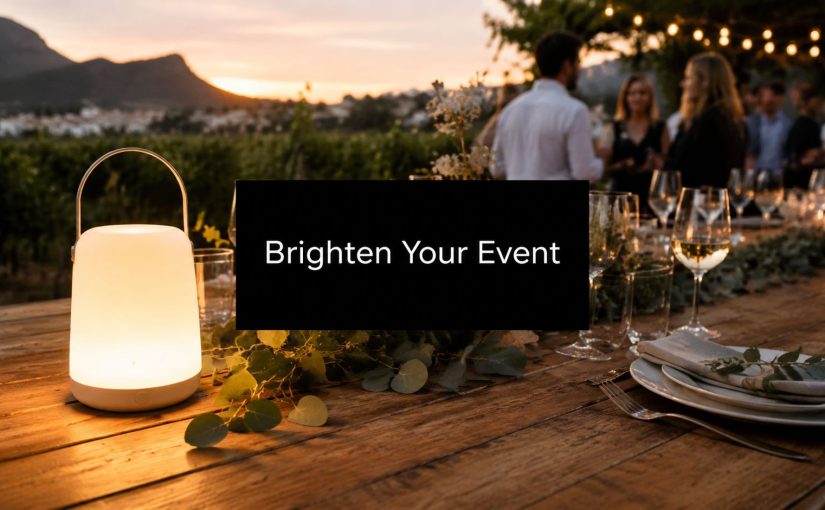
A late-afternoon setup in the Winelands can look calm right up until it isn't. The florist is still adjusting the long tables, the band is asking where they can plug in, the wind starts moving through the vines, and everyone's watching the sky because the best part of the event only starts after sunset. That's exactly when lighting decisions stop being decorative and start being operational.
A good rechargeable LED lamp solves two Cape Town event problems at once. It removes cabling from spaces where cables look terrible, and it gives you a layer of resilience when load-shedding or a short-notice outage threatens the mood of the room. For planners working across Stellenbosch, Franschhoek, Paarl, the CBD, and the Atlantic Seaboard, that matters more than any showroom feature list.
What's changed is accessibility. LED pricing dropped hard over time, with the per-lumen price falling by a factor of 10 each decade according to US Department of Energy research on LED price declines. That's a big reason rechargeable event lighting moved from a niche extra to a normal line item for weddings, launches, and private functions.
Setting the Scene with Cordless Brilliance
Sunset is where Cape Town events either come together or start showing their weak points. At a Winelands wedding, daylight carries the setup for most of the afternoon. Then the ambient light drops fast, the venue's fixed lighting feels too harsh or too limited, and every visible extension lead suddenly looks like a planning mistake.
That's where a rechargeable LED lamp earns its keep. On a farm venue lawn, it can mark a pathway without trenching cables across gravel. On a dinner table, it can create warm, controlled light without forcing the stylist to hide plugs and adapters. In a city corporate venue, it lets you light a registration desk, cocktail cluster, or branded product plinth without redesigning the room around wall sockets.
The local advantage is flexibility. Cape Town venues aren't all built for modern event power planning. Some are heritage properties with awkward plug placement. Some have beautiful outdoor sections with almost no practical power access. Some are polished urban spaces where the client wants a clean, contemporary look and won't tolerate cable clutter.
Practical rule: If guests can see the cable, the lamp probably should have been cordless.
Cordless lighting also layers well with other decorative light sources. If the brief calls for softness rather than spectacle, a lamp works better than blasting the whole venue with overhead fill. If you're building atmosphere in stages, pairing lamps with details like battery-operated LED fairy lights for event styling gives you texture without locking the whole event into one lighting look.
What works in practice is using rechargeable lamps as intentional light, not emergency afterthoughts. They're strongest when they support guest flow, table ambience, and key feature areas at the same time. They don't replace every fixture on site. They cover the parts of an event where mobility, appearance, and backup readiness matter most.
Matching the Lamp to Your Cape Town Event
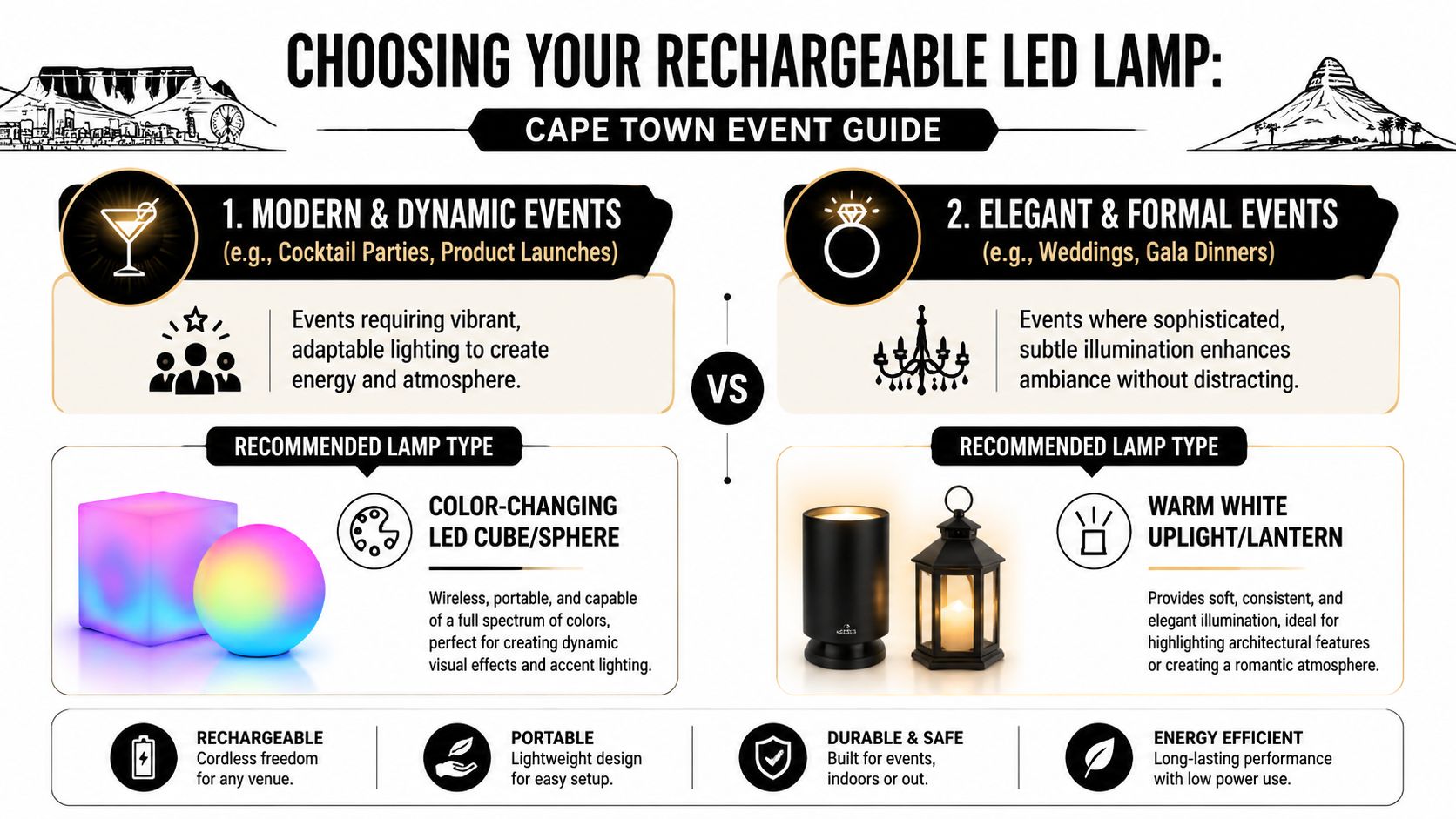
The wrong lamp can make a beautiful event feel off. A glowing cube might be perfect for a brand activation in Woodstock and completely wrong for a formal dinner in Franschhoek. Selection starts with the event style, but in South African conditions the decision should lean heavily on usable brightness during an outage and recharge time between uses, as highlighted in consumer guidance on battery-operated lamps.
Winelands weddings
For weddings, the lamp should disappear into the atmosphere rather than call attention to itself. Warm-white table lamps, compact lanterns, and discreet uplight-style units usually do the job better than novelty shapes.
Priorities tend to be:
- Soft flattering light: Guests need to see faces, menus, and place settings without feeling like they're sitting under a security light.
- Stable outdoor performance: Grass, stone, uneven surfaces, and wind all punish flimsy units.
- Quiet design: Brass, black, white, neutral, or frosted finishes usually integrate better than highly saturated housings.
A wedding planner should also think about sequence. Ceremony, canapés, dinner, speeches, and dance floor all ask different things of the same venue. A lamp that can move from welcome drinks to the bar or gift table is more useful than one that only works in a single setup.
Corporate launches and gala events
Corporate events usually need cleaner lines and more control. If branding matters, colour consistency matters. If the venue has multiple zones, the lamp should fit the technical brief rather than just look good in isolation.
For launches and galas, I'd prioritise:
- Colour control: For branded palettes, basic warm white may not be enough.
- Fast reset between programme segments: Lamps sometimes need to move from foyer to stage-adjacent networking areas.
- Professional finish: Corporate clients notice mismatched housings, inconsistent brightness, and scratched diffuser surfaces.
If the event includes scenic lighting, feature lighting, and programmable elements, don't expect decorative rechargeable lamps to do the job of a full production rig. Use them for tables, satellite areas, lounges, and backup elegance around the edges.
Private parties and milestone celebrations
Birthday parties, engagement dinners, and home events can be more forgiving. That opens the door to colour-changing cubes, spheres, decorative lanterns, or compact table lamps that add personality.
These events benefit from portability more than formal precision. Hosts often change layouts mid-event, move furniture, or open a second area outdoors once the weather settles. Rechargeable units make that possible without calling an electrician or rerouting cables through a living room.
Here's a quick selection framework.
| Event Type | Primary Goal | Top Spec Priority | Recommended Lamp Style |
|---|---|---|---|
| Winelands wedding | Atmosphere and elegance | Usable brightness through dinner service | Warm white table lamp or lantern |
| Corporate launch | Brand-aligned presentation | Control and recharge practicality | Sleek table lamp or colour-capable accent unit |
| Private party | Flexible mood creation | Portability and visual impact | LED cube, sphere, or casual cordless lamp |
Don't choose by appearance alone. The lamp that looks best at noon on a supplier sheet can perform worst after sunset on a windy terrace.
Decoding the Technical Specifications
Spec sheets can be misleading if you read them like a retailer reads them. Event people need to read them like operators. The question isn't whether a rechargeable LED lamp sounds impressive. The question is whether it will survive transport, setup, weather, dimming, and a long service window without creating work for the crew.
Brightness and light quality
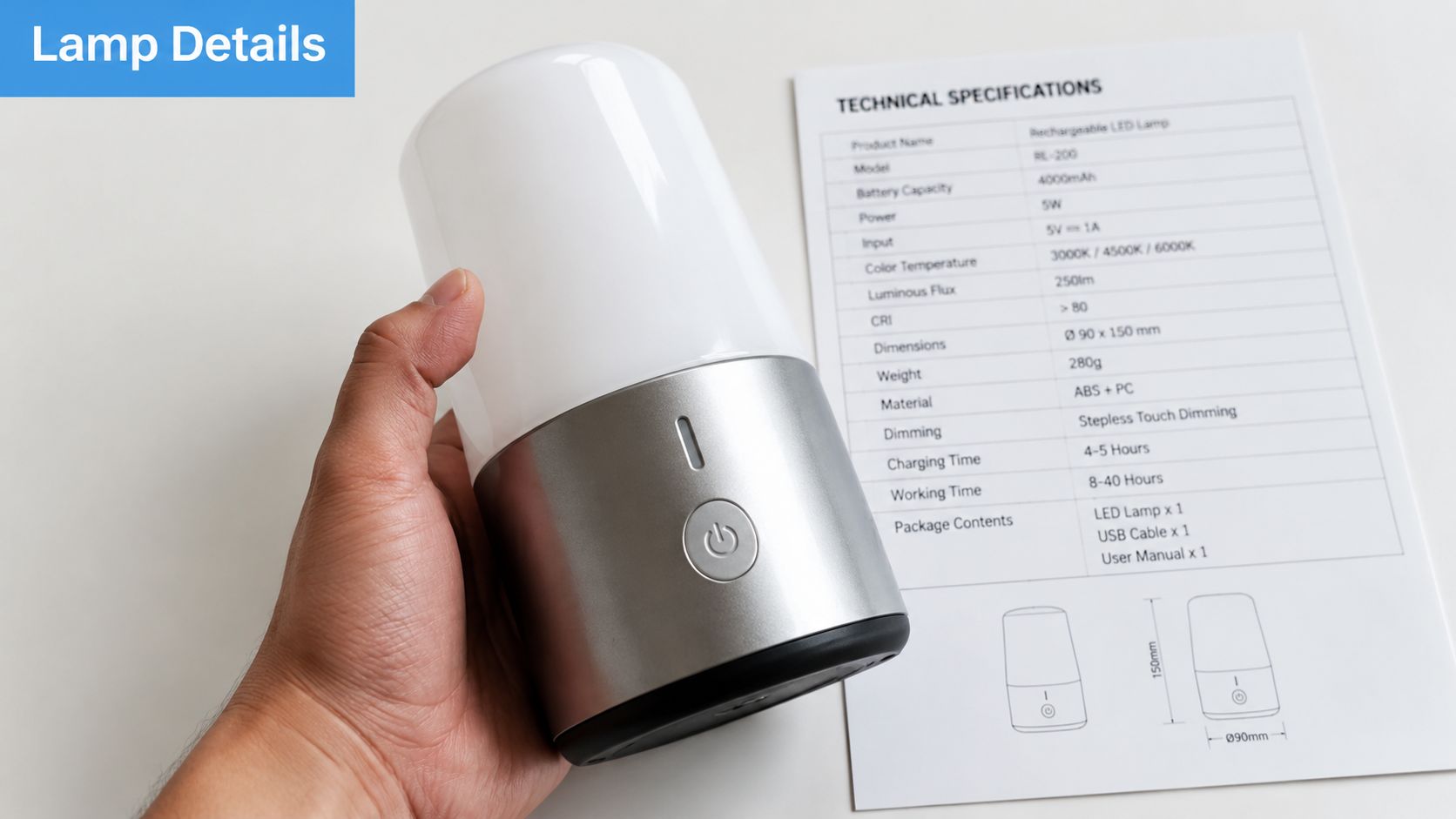
Start with lumens, not watts. Watts tell you power draw. Lumens tell you light output. That matters because modern LED performance improved steadily, with efficacy improving by about 6 to 8 lumens per watt each year since 2010, and average LED lighting products reaching 102 lm/W in 2018, according to the European Commission Joint Research Centre report on the LED lighting market.
That progress is why compact rechargeable units can now produce useful light without bulky battery packs. But brightness alone isn't enough. For weddings, food service, and brand-sensitive activations, colour rendering matters too. If you want a practical explainer on how light affects the way flowers, skin tones, and fabrics appear, Golden Lighting's guide to CRI is worth reading.
A few practical checks:
- Warm white for dining: It's usually safer for formal tables and portraits.
- Neutral or adjustable white for mixed-use spaces: Better where a lamp may shift between service and guest zones.
- RGB only where it serves the brief: Colour-changing features are useful, but not every event wants nightclub energy.
Battery and runtime reality
A common pitfall for buyers involves runtime. “Runtime” often means very little until you know the brightness setting and the age of the battery pack. A lamp can be technically functional and still too dim to be useful by the point you need it most.
Look for:
- USB charging: Easier to manage across large batches.
- Lithium-ion or LiFePO4 battery options: Better suited to repeat event use than vague, unlisted battery specs.
- Cycle-life information: If the supplier can't explain battery replacement or service planning, that's a warning sign.
Control, casing, and event durability
Remote control sounds handy until remotes go missing on site. DMX sounds complex until the event doesn't have the crew or time to programme it. Match the control method to the actual production level of the event.
For more theatrical or architectural environments, it helps to understand how decorative cordless lighting sits alongside conventional event fixtures such as PAR can lighting used in venue washes and feature illumination. They do different jobs. One gives mobility and intimacy. The other gives broad scenic coverage.
A lamp spec is only useful if it answers a setup question. Can it stay bright enough? Can it be moved quickly? Can it cope with the venue?
Also inspect the body. Metal housings usually wear better than cheap plastic. Weighted bases matter on outdoor tables. Sealed buttons, solid charging ports, and easy-clean surfaces save a lot of trouble after multiple rental cycles.
Creative Setup and Placement for Maximum Impact
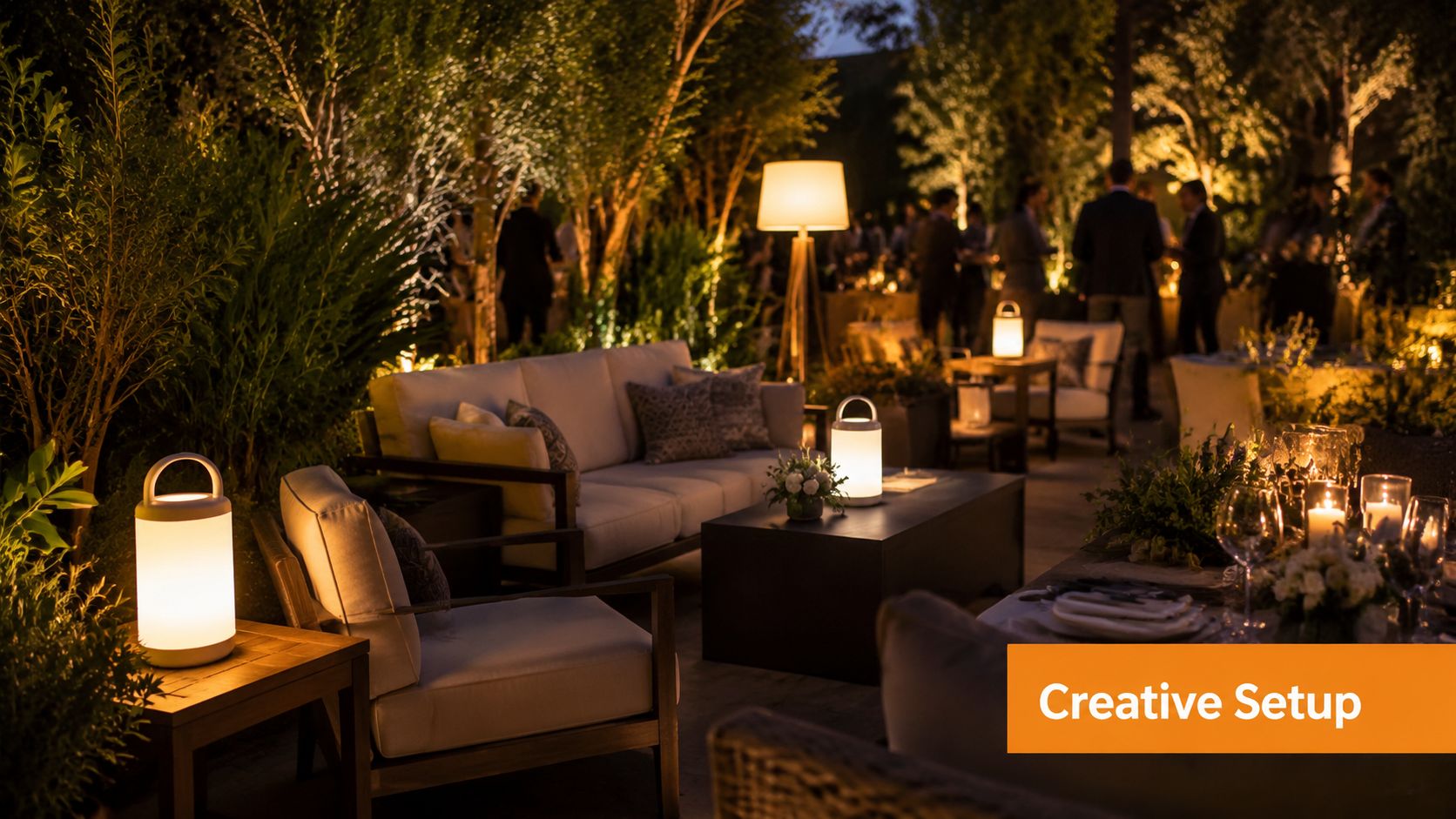
Most bad event lighting doesn't fail because the fixtures are poor. It fails because the placement is lazy. A rechargeable LED lamp works best when it shapes movement and mood rather than just filling darkness.
Use lamps to guide the room
At a lawn reception in Constantia or Stellenbosch, the cleanest move is often to light the route before the destination. Guests remember how a space felt as they entered it. A row of low cordless units along a path, stair edge, or transition from drinks area to dinner space does two jobs at once. It adds atmosphere and reduces uncertainty.
For waterfront and city venues, place lamps where overhead lighting usually leaves dead patches. Think lounge pockets, sideboards, registration points, restroom corridors, and bar fringes. Those transitional areas often make a venue feel unfinished after dark.
Good placement usually follows this sequence:
- Arrival line: Gate, pathway, host point.
- Social anchor points: Bar, canapé station, lounge seating.
- Emotional centre: Head table, cake table, speech zone, branded reveal area.
Keep table lighting disciplined
Table lamps can make a dinner look polished, but they can also ruin sightlines if they're too tall, too bright, or too cold in colour. For round tables, one central cordless lamp often works better than several competing points of light. For long banquet tables, repeated low-profile lamps create rhythm without turning the table into a runway.
A few placement rules help:
- Keep the glow below eye line: Guests should see each other before they see the fixture.
- Avoid direct glare into seated faces: Frosted diffusers and shade-style lamps are easier to live with.
- Balance with candles or florals carefully: Too many decorative light sources can flatten the overall look.
On-site note: If diners start rotating lamps away from themselves, the setup was too bright or badly positioned.
Highlight features, not everything
You don't need to light every object in the venue. In fact, selective darkness usually makes an event look more expensive. Use rechargeable units to pick out trees, signage, product displays, or a DJ front rather than flooding the whole space evenly.
At a private estate, that might mean lighting a single olive tree near the dance floor and leaving the far garden in shadow. At a V&A venue, it might mean creating warm islands of light in lounge areas while the city and harbour provide the background atmosphere.
The best setups feel intentional. Guests should think the event is beautifully lit, not notice how many individual lamps you used.
Charging and Maintenance for Flawless Performance
A rechargeable LED lamp is only as reliable as the charging discipline behind it. Mid-event failures aren't usually bad luck. They're process failures. Somebody trusted the indicator light, skipped runtime testing, mixed charged and uncharged stock, or packed old and new batteries into the same job without tracking them.
The battery is the first thing to plan around. The LED element can last up to 50,000 hours, while a rechargeable LED bulb example is rated at about 20,000 hours and draws 4 watts while matching the brightness of a 50W incandescent, according to LED professional coverage of rechargeable LED bulb design and lifespan. In practice, that means the light source often outlasts the battery pack, so replacement planning matters more than people think.
Build a charging workflow, not a charging corner
The safest approach is to treat charging like inventory control. Every lamp needs a status, a position, and a test record. If your team just plugs everything in the night before and hopes for the best, you're inviting uneven performance.
A workable pre-event system usually includes:
- Label each lamp: Number the unit and its charger so faults can be traced.
- Separate tested stock from untested stock: Never pack from the charging area directly.
- Log weak performers: Any unit with suspect runtime should be removed from premium placements.
If you're dealing with venues that have limited power access, it also helps to understand broader portable power solutions for events and off-grid setups. Not because every lamp needs a power station on site, but because charging strategy becomes part of event power planning when access is tight.
Test for the event, not for the brochure
A lamp that works in the warehouse can still fail at the venue. Brightness settings change battery draw. Cold evenings can expose weak packs. Older stock often looks fine until it's asked to hold output through the critical dinner window.
What works:
- Run lamps at the intended brightness before the job
- Test colour-change and remote functions, not just power-on
- Clean diffusers and bodies before packing
- Carry a small reserve of matched units for swaps
This is also where buying decisions matter. Replaceable batteries, accessible charging ports, and durable housings save money and stress over time. Sealed disposable units with vague battery specs usually become dead stock faster than expected.
If a supplier can't tell you how battery servicing works, don't assume there is a service plan.
Protect the finish as well as the battery
For weddings and formal corporate work, cosmetic condition matters almost as much as function. Fingerprints on metallic finishes, scratched diffusers, and dented bases are visible under close dining light.
Pack lamps upright where possible. Keep charging cables organised by model. Don't let damp units go back into closed cases after a coastal event. Salt air, mist, and rough load-ins punish neglected stock quickly in Cape Town conditions.
Rental Logistics in Cape Town and the Winelands
Renting usually makes more sense than owning if rechargeable lamps aren't on jobs every week. Cape Town events vary too much. One weekend calls for elegant cordless table lamps at a vineyard. The next needs sturdy portable units for a school function or a corporate rooftop where weather and access are harder on equipment. Rental lets you match the stock to the brief instead of forcing one inventory style onto every event.
Ask better supplier questions
Local logistics matter. A city hotel with a loading bay is one thing. A remote Winelands venue with gravel access, limited turnaround space, and restricted setup hours is another. Your lighting supplier should understand both.
Ask these questions before confirming:
- How is runtime tested before dispatch?
- What happens if a unit fails on site?
- How are remote venues handled for delivery and collection?
- Are replacement units packed as part of the job?
- How are charged and tested units separated from returned stock?
A local South African study and user guidance highlighted why this matters. One rechargeable desk lamp recorded about 3.5 hours of continuous use on a full charge, while a user manual specified up to 8 hours of cordless use. For reliable event planning, test runtime at the intended brightness and add a 20 to 30% buffer for battery ageing and real-world use, as discussed in this design and performance analysis of rechargeable desk lamps.
Plan for the venue, not just the inventory
Winelands venues often stretch crews in ways city planners underestimate. Long distances between prep area and reception space. Limited charging access. Late-night pack-down over uneven ground. Those conditions change what “easy” means.
If lamps are part of the visual plan, they should also be part of the contingency plan. Key areas like entrances, bathrooms routes, bars, and dining tables shouldn't depend entirely on venue power. That's where a local rental partner with experience in event styling and practical operations is useful. For example, ABC Hire's event decoration hire resources sit in the same decision space as rechargeable table lamps, LED furniture, and other portable event elements used across Cape Town and the Winelands.
The strongest rental setups combine aesthetics, transport practicality, and backup thinking. That's the difference between lighting that looks good in a catalogue and lighting that still works when the schedule slips, the weather turns, or the power drops at the wrong moment.
If you're planning a wedding, corporate function, matric dance, or private celebration in Cape Town or the Winelands, ABC Hire can help you match rechargeable lighting to the venue, layout, and load-shedding realities of the job. Ask for a practical setup recommendation based on your event style, not just a product list.