
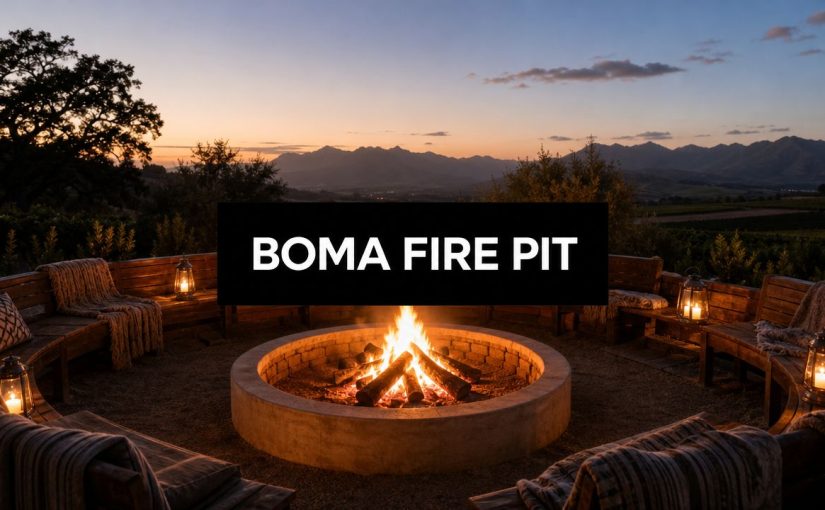
You've probably seen the same brief more than once. The client wants an outdoor event in the Winelands or around Cape Town. They want warmth, atmosphere, and that unmistakable firelit moment when guests stop drifting and start settling in. Then the practical questions arrive all at once. Can we use an open flame at this venue? Who supplies the wood? What happens if the South Easter picks up? Who's responsible if smoke blows into the dining area?
That's where a lot of boma planning goes wrong. Teams spend time on styling boards and almost none on compliance, placement, fuel handling, or guest flow. A boma fire pit in South Africa can be one of the strongest features at a wedding, activation, matric dance, or private celebration, but only if it's treated as event infrastructure rather than just décor.
The Allure of the Boma Fire an Essential Event Centrepiece
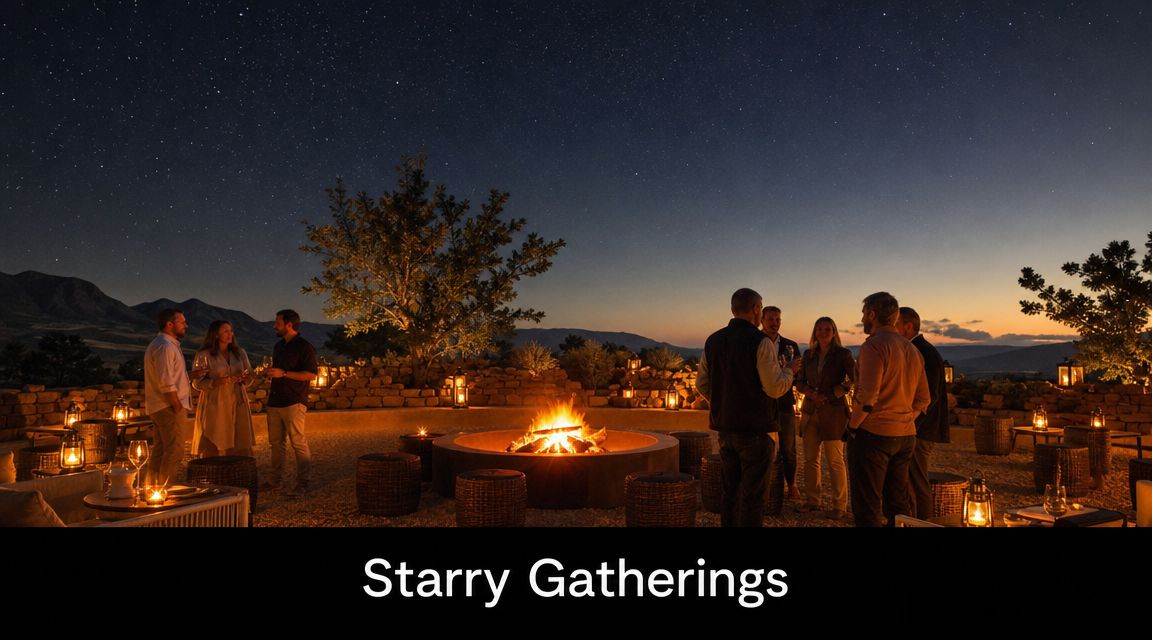
Under Western Cape skies, a fire changes the rhythm of an event. Guests naturally gather around it. Conversations become easier. Photographers get depth and glow without forcing the moment. Caterers can use the area as a pause point between formalities. When the temperature drops after sunset, the fire gives the evening a second life instead of letting people retreat indoors.
That appeal isn't accidental. The word “boma” is used across southern Africa for a fenced enclosure, and in event design it has evolved into a social space centred on a fire pit, often with seating in a half-moon shape to manage smoke and encourage conversation, as noted in Singita's description of the boma tradition.
Why it works so well at events
A proper boma doesn't only warm people. It organises the space.
Instead of guests spreading thinly across a lawn or terrace, the fire creates a centre of gravity. That's useful at weddings where you want a soft transition after dinner. It's just as useful at corporate functions where people need a natural networking pocket that doesn't feel forced.
What works:
- A defined seating curve that lets guests face one another, not just the flame
- Enough breathing room so servers and photographers can move around the group
- A clear relationship to the bar or food station so people don't queue through the heat zone
What doesn't work:
- Putting the boma too close to the dance floor
- Using it as a visual feature with no circulation plan
- Treating smoke direction as something you can “manage later”
A beautiful fire in the wrong place becomes a guest complaint very quickly.
In the Cape, the romance only lasts if the setup is disciplined. Venues differ. Wind differs. Fire rules differ. The strongest boma setups I see are the ones where the planner has already worked through the boring questions before the first log is lit.
How to Choose and Hire the Right Boma Fire Pit
Hiring a boma for an event isn't the same as buying a backyard feature. You're choosing something that has to arrive on time, sit safely on a temporary site, suit the event style, and operate cleanly for several hours without becoming a staffing problem.
A typical hired unit in South Africa is a compact boma fire pit around 70 cm high with a 43 cm tray, and wood is usually supplied separately, according to this local hire specification. That tells you two things immediately. First, many hire units are sized for atmosphere rather than large-scale cooking. Second, fuel logistics often sit with the planner, venue, or caterer, not the hire company.
Start with the event brief, not the fire pit
The wrong way to hire is to ask for “a boma” and stop there.
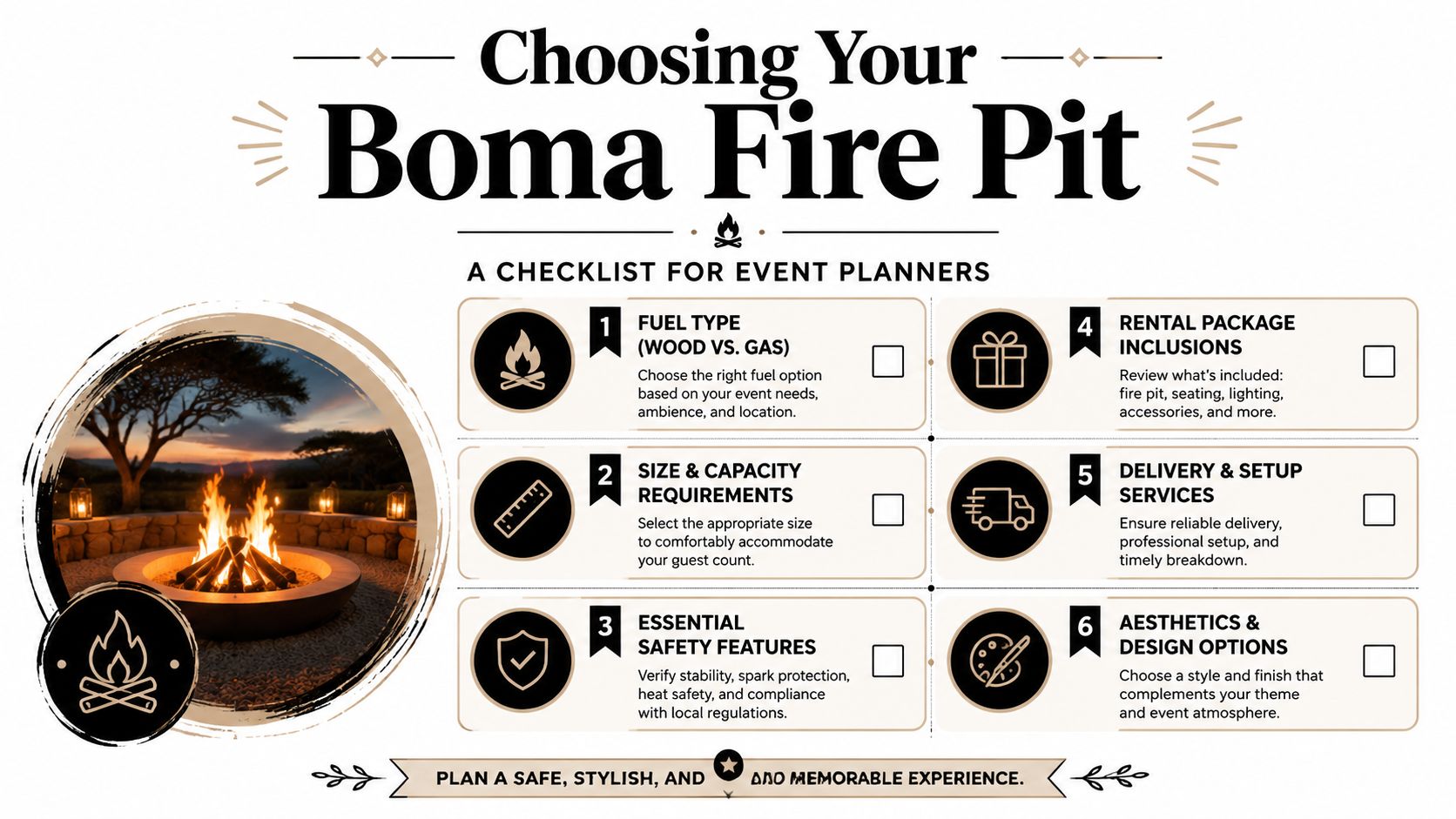
The right way is to define the job the fire pit must do:
- Warmth for a small guest pocket after dinner
- Visual focal point for a branded activation
- Lounge anchor for a wedding cocktail hour
- Ambient feature where real heat matters but smoke sensitivity is high
Those are different use cases. A compact steel unit works well when you need intimacy and a clean footprint. A larger visual style may suit a wide lawn, but it can overpower a smaller venue if the guest count around it is modest.
Questions to ask the rental company
Ask these before you approve the quote.
- What are the exact dimensions? You need the height and tray size, but also the total footprint once safe operating space is added.
- What material is the unit made from? Steel units are common for events because they're sturdy and practical to transport.
- Is ash collection built in? Some hire units include an ash collector. That matters for cleaner operation and pack-down.
- Is wood included? Often it isn't. If it's excluded, confirm who sources, stores, and replenishes it.
- Is there a fire grate, poker, or basic fire tool set? Don't assume.
- Who handles delivery, setup, and collection? A fire pit that arrives kerbside isn't event-ready.
- Will the company place it, or does the venue team need to receive it?
- Is an attendant available or required? Some events can manage with trained venue staff. Others need a dedicated fire minder.
A useful way to think about it is that the hire price rarely tells the full story. The actual event cost includes transport, fuel, labour, fire supervision, and the knock-on effect on furniture layout.
Match the finish to the event
Style still matters. It just shouldn't be the first filter.
A darker steel boma usually disappears better at night and lets the flame do the work. Rustic finishes can be right for farm venues, but they can read cluttered at a polished corporate dinner. If the event has a contemporary furniture package, a cleaner-lined fire pit will usually sit better with the rest of the look.
For planners comparing ideas for lounges and open-air heating zones, this practical guide to fire pits for patios is a useful reference point for how different fire features affect layout and mood.
Procurement rule: If the quote doesn't specify fuel, tools, placement responsibility, and collection timing, it isn't complete.
Safe Site Preparation and Guest Layout
Most fire pit problems start before the match. The site is uneven, the pit is tucked under a low branch, the wind line hasn't been tested, or the chairs have been set by a stylist who's thinking about symmetry rather than heat and smoke. By the time guests sit down, the setup is already working against the event.
For larger semi-permanent installations, professional specifications commonly sit in the 750 mm to 1 100 mm diameter range and rely on a stable base such as compacted gravel, as shown in this fire pit specification reference. Even if you're hiring a temporary unit, the principle holds. The ground must be level, stable, and able to cope with ash, foot traffic, and late-night spills without turning into a hazard.
Assess the site before furniture goes down
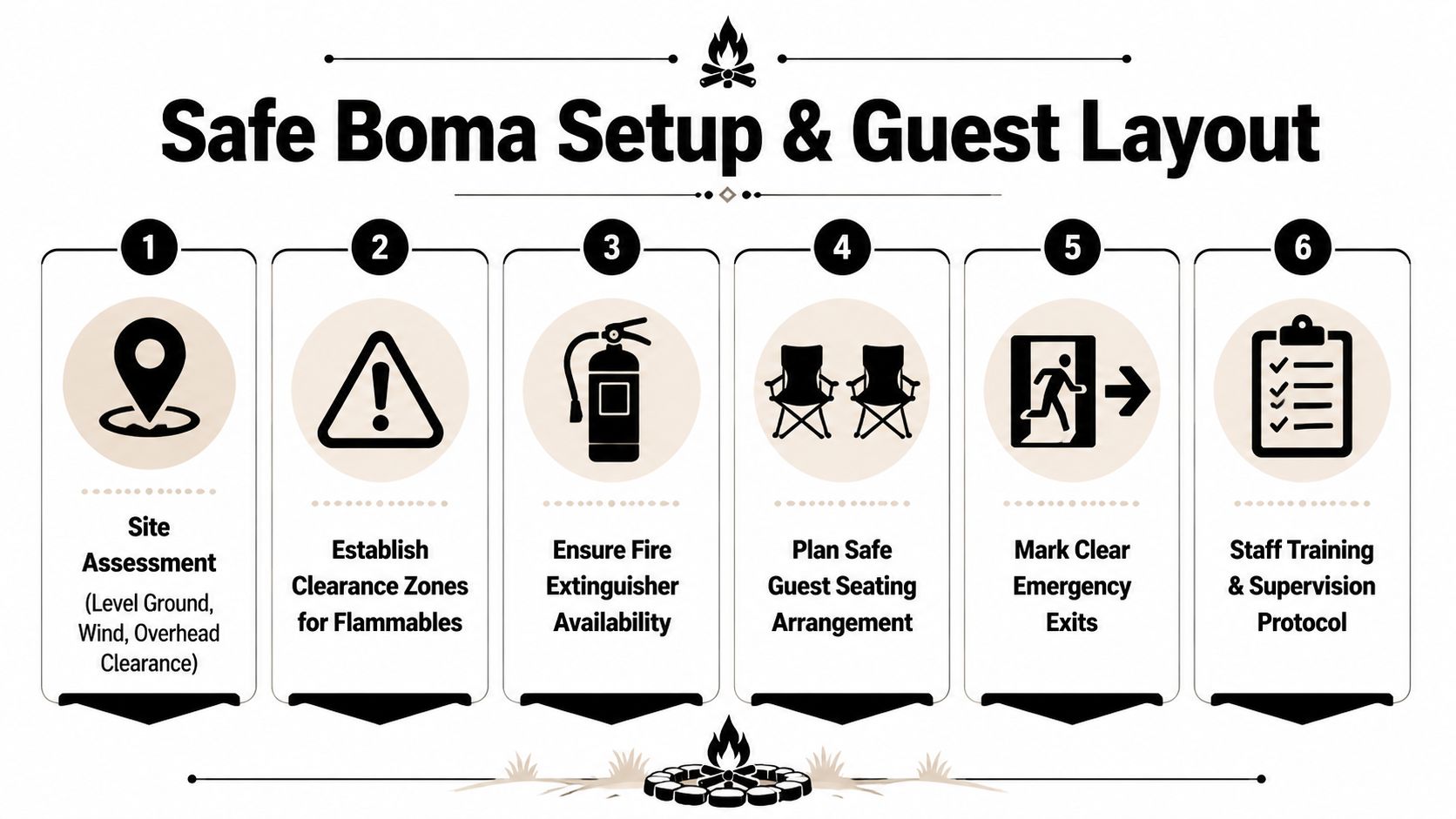
Do the site walk at the same time of day the fire will be used. Afternoon calm can become a very different wind pattern after sunset.
Check these first:
- Ground condition. The pit needs a level, non-slip surface that won't shift under weight or heat.
- Overhead clearance. Trees, fabric draping, festoon cabling, and décor installations all need scrutiny.
- Nearby materials. Soft furnishings, stacked pallets, dried florals, and timber bars can become part of the risk zone if the pit is badly placed.
- Access path. Staff must be able to approach the pit safely to tend the fire or remove ash.
In Cape Town, wind is rarely an afterthought. It's a design input. If the breeze is pushing smoke across your main seating line, half the furniture plan is wrong.
Build the seating around smoke behaviour
The classic boma shape works for a reason. A half-moon or three-quarter curve gives guests visual connection while leaving the smoke path more manageable than a tight full ring.
Here's a simple layout logic that works well on real sites:
| Layout choice | Why it works |
|---|---|
| Half-moon seating | Keeps conversation open and gives smoke a clearer escape side |
| Wider chair spacing | Reduces crowding near the heat edge |
| One clear service gap | Lets staff move safely with drinks, blankets, or fire tools |
| Peripheral standing zone | Gives mingling guests access without blocking seated guests |
What doesn't work is packing ottomans and scatter cushions too close to the pit because the visual looked good on paper. Guests pull seats inward as the night cools. Your original spacing won't hold unless you've planned for that movement.
Practical rule: Set the fire pit where people can enjoy it without needing to edge closer every half hour.
Prepare for fuel, supervision, and fallback weather
The fire itself needs a workflow. Who lights it? Who tops it up? Who shuts it down? If those answers are vague, the setup isn't ready.
Use a short operating checklist:
- Nominate a responsible person for the fire for the full event window.
- Stage fuel discreetly but not within the guest seating area.
- Keep extinguishing equipment accessible, not decorative.
- Maintain a clear exit path from the lounge area.
- Have a rain fallback that doesn't involve panicked furniture moves after guests have settled.
If you need a broad refresher on outdoor fire pit safety, that framework is useful because it reinforces the basics event teams sometimes skip when they're under styling pressure.
For events where an open flame may be unsuitable in one guest zone, planners often pair the boma with softer perimeter heating. A separate guide to gas outdoor heaters is useful when you need to warm standing areas, bars, or entrances without pulling everyone toward one fire source.
If the weather turns or the wind shifts hard, the safest decision is sometimes to scale back the fire feature rather than force it to work.
Navigating Permits and Insurance in the Western Cape
This is the part that separates a professional event plan from a risky one. Many boma setups are technically possible. That doesn't mean they're allowed by the venue, acceptable under current fire conditions, or covered by the right insurance wording.
A key issue in the Western Cape is that what feels reasonable at a private home may be refused at a formal venue during the dry season. Fire-danger ratings and seasonal restrictions matter, especially when vegetation, vineyards, mountain edges, or estate rules come into play, as highlighted in this discussion on Western Cape fire-risk and permissibility.
Get venue approval in writing
A verbal “should be fine” isn't enough.
Ask the venue coordinator specific questions:
- Are open fires allowed on this part of the property?
- Are there seasonal restrictions in force on the event date?
- Does the venue require a designated fire attendant?
- Is there a minimum distance from structures, lawns, or planting beds?
- Can guests carry drinks through the boma zone, or does the venue want that area controlled?
Wine estates, schools, and heritage properties often have stricter internal protocols than private homes. If the venue has a safety file or event operations pack, request the relevant fire conditions early. It saves endless reworking later.
Speak to your insurer like an operator, not a stylist
Insurance conversations go wrong when planners describe the boma as ambience. Underwriters and brokers don't hear ambience. They hear open flame, guest proximity, combustible materials, and third-party liability.
Phrase the risk properly:
- Outdoor fire feature
- Temporary event installation
- Managed or supervised use
- Venue-approved location
- Documented shutdown procedure
That level of detail leads to clearer answers.
For teams that already use permit systems on technical installs, the logic is similar to a safety guide for high-risk worksites. The point isn't to turn an event into an industrial site. The point is to treat controlled hazards with written approval, assigned responsibility, and sign-off.
The administrative checklist that saves events
A boma should trigger a paper trail. Not a huge one. A clear one.
Use this checklist before event week:
- Check current fire conditions for the area and event date window
- Confirm venue permission in writing
- Confirm who supplies and stores fuel
- Record who supervises ignition and shutdown
- Check public liability wording where relevant
- Note emergency access and extinguisher locations
For planners coordinating larger productions, this broader guide to event management in Cape Town is helpful because fire features rarely sit in isolation. They affect staffing, venue operations, floorplans, and supplier coordination.
Styling the Boma for Weddings and Corporate Events
Once the safety, permissions, and operating plan are locked down, the boma becomes a creative asset, providing the atmosphere for many of the best outdoor events in the Cape. Guests want spaces that feel lived-in, social, and slightly immersive. In today's event market, there's strong demand for outdoor, experience-led functions, and a well-styled boma supports that by creating warmth, connection, and a clear focal point, as reflected in this events and hospitality context.
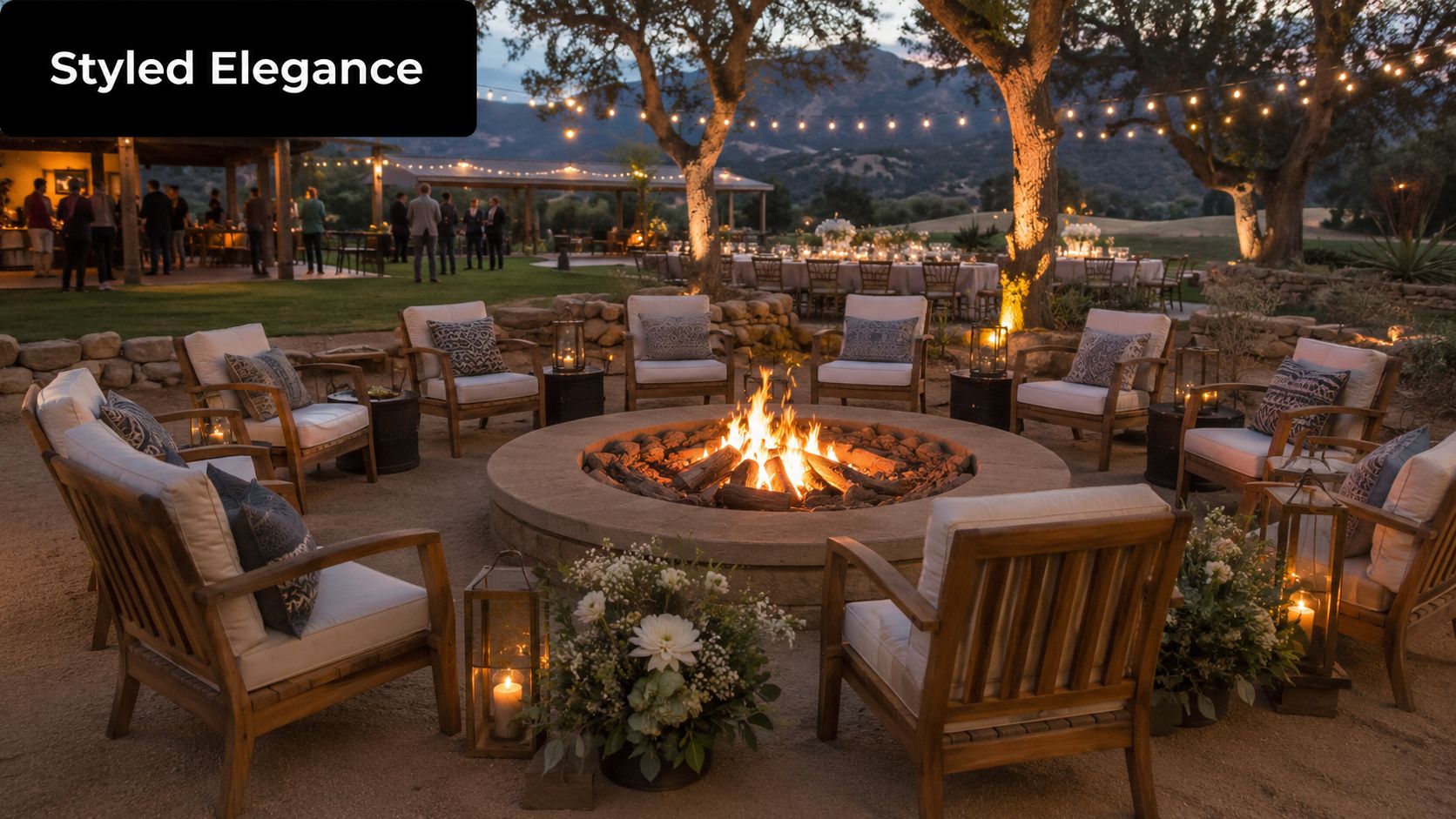
Wedding styling that feels warm, not staged
For weddings, the strongest boma spaces feel like a natural extension of the celebration rather than a themed add-on. Soft seating, layered textures, and a little asymmetry usually work better than a perfectly rigid circle.
Good wedding choices include:
- Timber or upholstered occasional chairs mixed with a few ottomans
- Blanket baskets placed just outside the heat zone
- Low side tables for drinks, but not so many that they interrupt flow
- Lanterns or warm secondary lighting that supports the fire glow rather than competes with it
Avoid overcrowding the area with props. Couples often love rugs, cushions, and candle groupings, but too much styling too close to the pit creates both a safety issue and a visual one. The fire should remain the hero.
A wedding boma also works best when it's tied to a moment in the programme. Post-dinner mingling, a late dessert station nearby, or an after-speech lounge transition all give the area a purpose beyond “nice corner for photos”.
Corporate styling that supports networking
Corporate events need a different discipline. The space should still feel inviting, but the furniture and placement need to encourage short conversations, circulation, and a sense of polish.
A strong corporate boma setup often includes:
- Structured lounge seating rather than deep, sink-in pieces
- Space for standing guests at the edges
- Controlled branding touches such as signage or colour accents nearby, not wrapped around the pit
- A drinks or tasting point close enough to activate the zone, but not so close that service traffic crosses the main seating arc
For evening launches and activations, LED accents or low ambient lighting can work well if they stay secondary to the flame. The mistake is trying to make the boma compete with a stage set. It should anchor the environment, not shout over it.
The most memorable boma areas feel effortless to guests. In reality, they're usually the result of strict furniture editing and very careful spacing.
Frequently Asked Questions for Cape Town Planners
Do I need an attendant for a hired boma fire pit?
If the event is formal, busy, or hosted at a venue with stricter fire controls, a dedicated person is the safer approach. Small private functions sometimes rely on venue staff, but someone should always be clearly responsible for ignition, refuelling, and shutdown. Shared responsibility usually turns into no responsibility.
What if it rains after setup?
Don't improvise after guests arrive. Have a fallback plan before load-in starts. That may mean relocating guests to a covered lounge, delaying ignition until conditions settle, or treating the boma as a visual feature only if the ground and weather no longer support active use.
Can a boma work for a wedding in the Winelands?
Yes, if it fits the venue's fire policy, operating conditions, and guest flow. Winelands weddings often benefit from a boma because evenings cool down quickly, but vineyards and estate landscaping can increase sensitivity around flame use. Confirm the venue's rules early and design around them.
Is a larger fire pit always better?
No. Bigger isn't automatically more useful. A boma that dominates a courtyard can make the whole setup feel cramped and harder to manage. The right size is the one that suits the site, the guest cluster, and the operational plan.
Can I place the boma close to the dance floor?
Usually not a good idea. Guests carrying drinks, moving between music and seating, and late-night crowding all increase risk. Keep the boma in a defined social pocket with enough separation for calm movement.
Are bomas suitable for school or matric events?
They can be, but only with much stricter supervision, venue approval, and a conservative layout. For younger guest groups, planners need tighter control of seating, circulation, and access to the heat zone.
What's the biggest planning mistake?
Treating the fire pit as a styling item instead of a managed event feature. The most common failures are poor placement, weak supervision, and vague approval from the venue.
If you're planning an event that needs a boma setup, lounge furniture, or supporting outdoor heating in Cape Town, the Winelands, or surrounding areas, ABC Hire can help you build a practical rental plan that fits the venue, the guest experience, and the operational realities of the day.