How to Choose a Trestle Table Cloth That Fits

You're standing in a Cape Town venue with the tables delivered, the florals ready, and a stack of cloths that looked “about right” in the catalogue. Then the first cloth goes on. The trestle legs show, the front edge hangs unevenly, and the wedding breakfast suddenly looks like a warehouse setup.

A trestle table cloth is easy to choose once you stop guessing. Start with the standard local footprint, about 180 cm long, 76 cm wide, and 76 cm high, then decide whether you want a practical half-drop or a formal full-drop. From there, fabric, finish, laundering, and hire-day handling become straightforward decisions.

Why the Right Trestle Table Cloth Matters

A standard trestle table gives you a useful starting point. South African event guidance commonly uses a rectangular trestle measuring 180 cm by 76 cm, with a height of 76 cm. That fixed footprint means your main styling decision isn't the table itself. It's the amount of fabric you want falling from the tabletop.

A short cloth can work on a buffet where guests need clear access to the frame, but it can look unfinished on a formal dining table. If the cloth stops high above the floor, guests may see folding legs, braces, or uneven table edges. A longer cloth hides the structure and makes the table read as one deliberate surface.

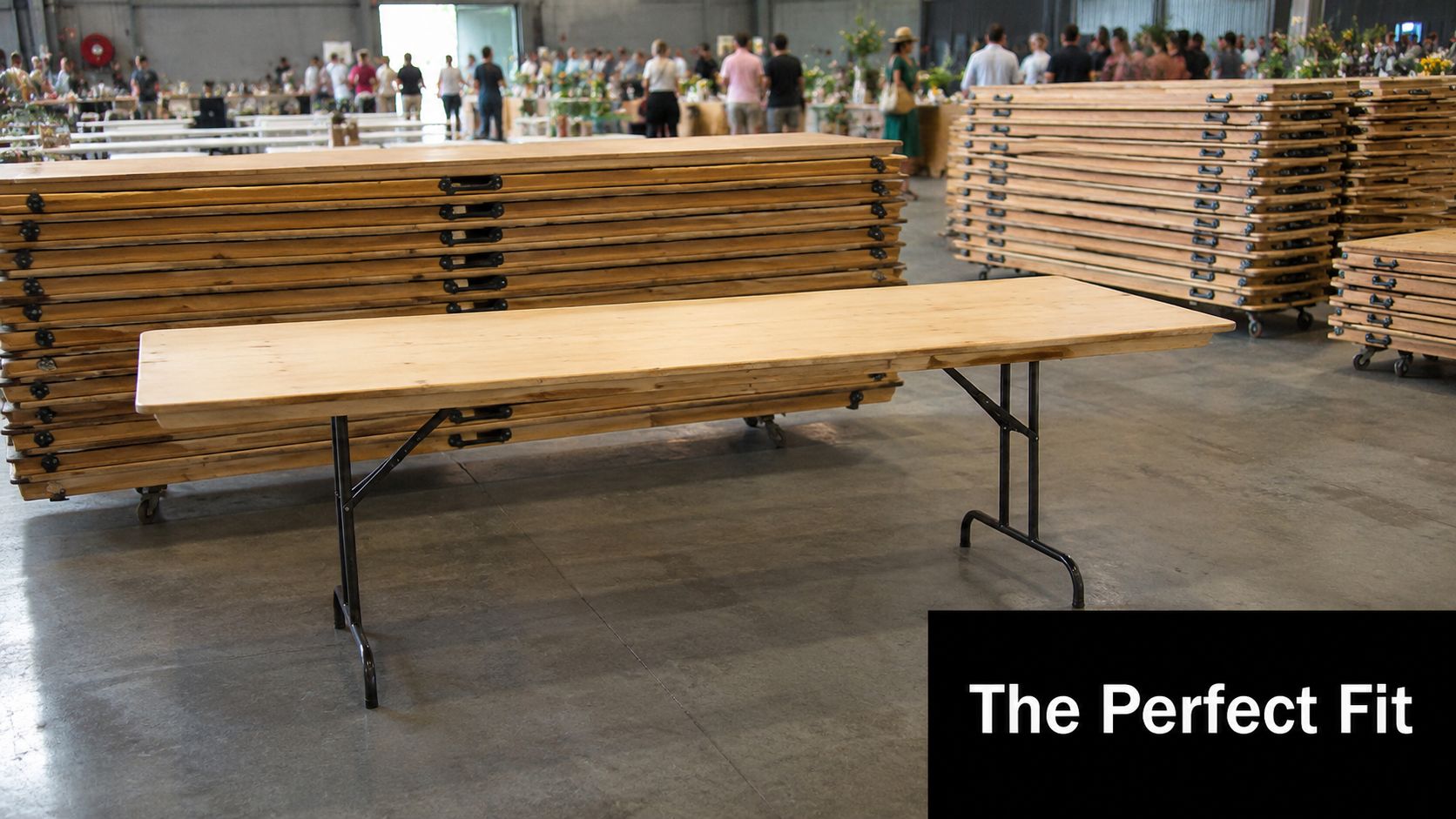
A wooden trestle table set up in a warehouse with stacks of folded tables in the background.

Start with the table, not the catalogue

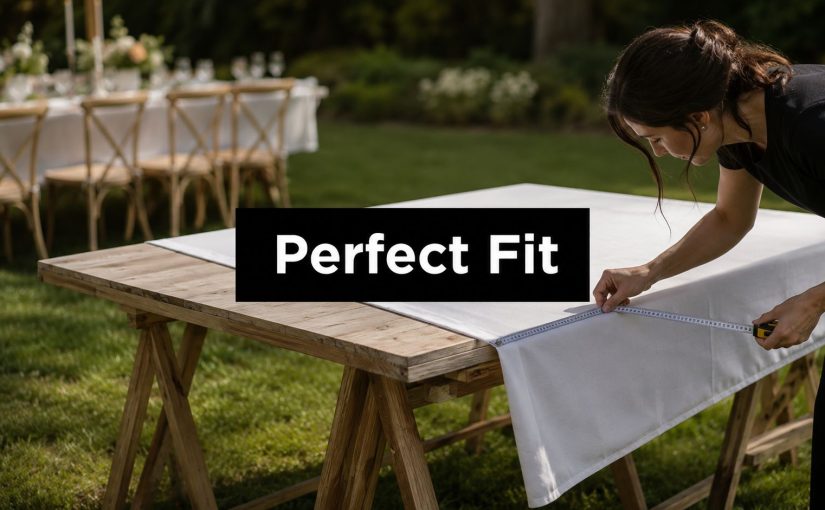
Measure the tabletop, choose the drop, and only then select a cloth. The common mistake is buying a nominal “banquet” cloth without checking how it will sit on your actual trestle. A cloth that looks generous on a round table can expose the folding frame on a rectangular one.

For Cape Town weddings, corporate functions, and school formals, I'd make the drop decision before spending time on colour or overlays. A half-drop keeps the setup practical and gives chairs and guests better clearance. A full-drop creates a cleaner formal line and photographs better from the side.

If you're arranging tables through a local supplier, you can also review ABC Hire's trestle table hire guide to confirm the table type before ordering linen. The cloth must follow the table you're receiving, not the table you assumed was in the booking.

Practical rule: If guests will see the long side of the table in photographs, choose the drop for that view first.

South African sizing guidance gives roughly 40 cm of side drape as a minimum and about 15 cm per side as a tighter modern maximum, with end drape ranging from approximately 50 cm to 30 cm depending on the intended look. Local table-linen sizing guidance reinforces the important point: fit depends on the table footprint and the target drape, not the label on the packaging.

Measuring Your Trestle Table the Right Way

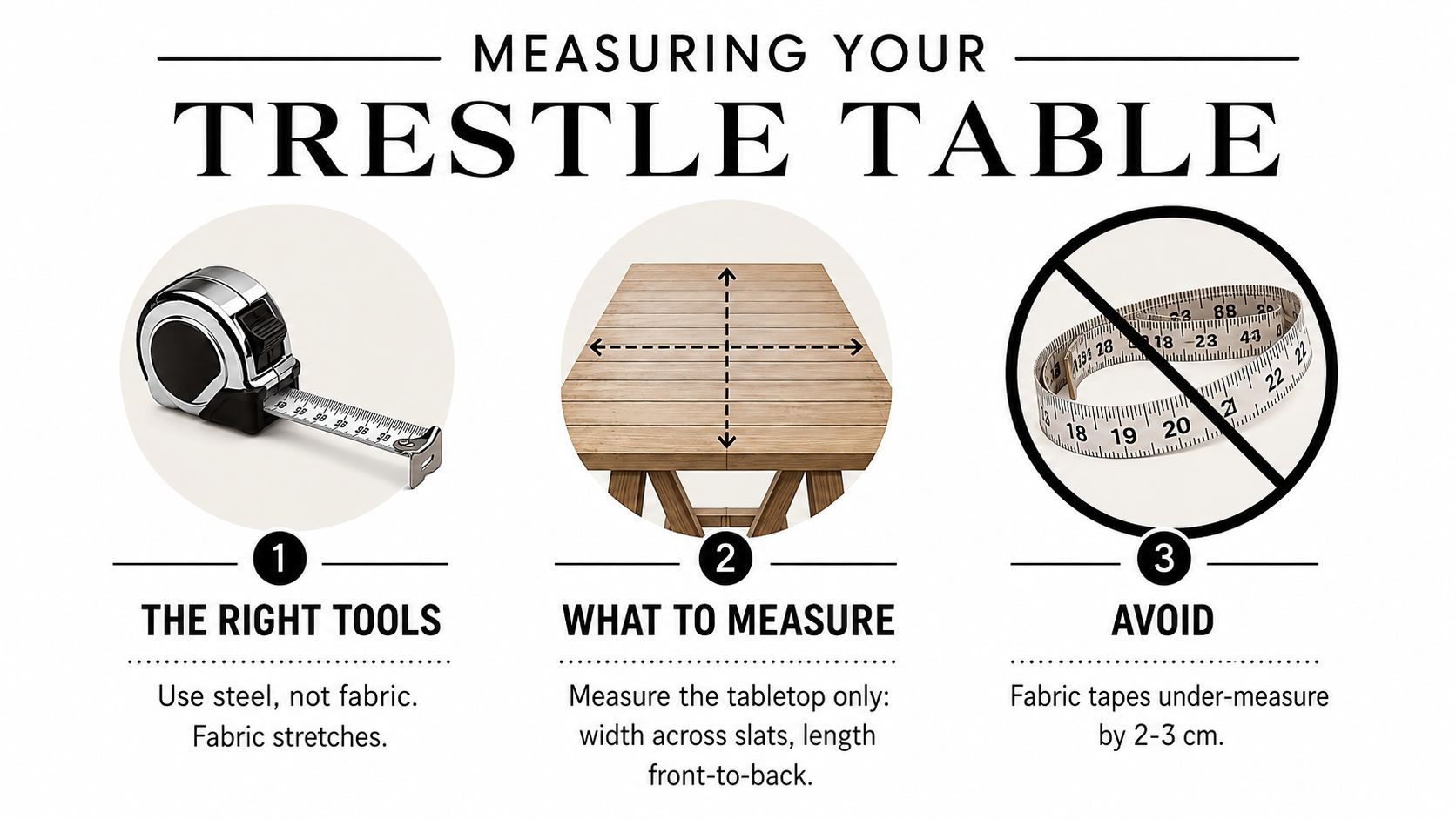
Take a steel tape measure to the venue or warehouse. A fabric tape can stretch and leave you working with an inaccurate measurement, especially across the long edge. Measure the tabletop only. The legs, braces, and folding mechanism don't belong in the cloth calculation.

For the common Cape Town hire trestle, record:

  • Table length: 180 cm
  • Table width: 76 cm
  • Table height: 76 cm

Write those figures down with the event name. Don't rely on memory at load-out, particularly when several table styles are being collected at the same time.

A guide on how to measure a trestle table correctly using a steel tape measure.

Add the drop twice

The basic formula is simple:

Required cloth width = table width + twice the side drop

Required cloth length = table length + twice the end drop

If you want a side drop of about 30 to 35 cm, add that amount to both long sides. For a floor-skimming look, plan for approximately 72 to 75 cm from the tabletop edge to the hem. South African guidance also places a practical minimum side drape around 40 cm, while tighter styling can use a shorter fall. The local size guide is useful when your calculated measurement sits between standard stock sizes.

A cloth around 140 x 250 cm is mapped locally to tables approximately 60 to 110 cm wide and 150 to 190 cm long. A larger 165 x 400 cm cloth suits tables around 85 to 135 cm wide and 300 to 340 cm long. Those ranges are benchmarks, not permission to skip measuring.

Allow for the job the cloth must do

A made-to-order cloth needs seam and hem allowance. A hire cloth needs enough tolerance to survive handling, movement, and repeated laundering. Confirm the finished measurement with the supplier, because the advertised cut size may not equal the usable finished size.

Avoid measuring around the legs. That adds fabric where it won't improve the drape and can create unnecessary bulk. Measure the top, select the fall, calculate both dimensions, then compare your result with the nearest available standard size.

Choosing a Fabric and Finish That Works

The right fabric depends on the event, the laundry process, and the venue lighting. Don't choose linen because the word sounds premium, or polyester because it sounds purely practical. Each fabric creates a different surface, fold, and photograph.

Fabric Typical Hire Cost Crease Recovery Wash Cost On-Camera Look
Polyester satin Usually the most economical hire option Recovers reasonably well with careful steaming Generally economical for routine event laundering Slight sheen, modern, can catch warm uplighting
Cotton Usually a mid-range option Creases readily and needs more pressing Higher handling demand than basic polyester Matte, soft, well suited to rustic and boho styling
Linen Usually the premium option Natural creasing is part of the look Requires careful handling and specialist pressing Textured, relaxed, refined, especially for formal tables

Polyester earns its place

For a large corporate setup or a rental stockroom, polyester satin is the dependable workhorse. It holds colour well and gives planners a consistent finish across multiple bookings. Steam it carefully, and it can look crisp without demanding the same pressing time as a natural fibre.

The trade-off is shine. Under warm venue lighting, satin can reflect bright patches or look more contemporary than intended. Test a sample under the actual lights if the table will sit beneath amber uplighting or strong spotlights.

Cotton and linen need a clear brief

Cotton gives you a flatter, more muted surface. That makes it a strong choice for farm weddings, vineyard dinners, and natural styling where a glossy cloth would feel out of place. It also creases more readily, so allow time for pressing and transport protection.

Linen has the most distinctive fall and texture. Slight wrinkles can look intentional, but deep transport creases don't. For an outdoor section, ask whether the cloth has a soil-release finish, especially where red wine, coffee, or rooibos will be served. Untreated natural fibres can hold stains stubbornly.

For a broader local comparison of sizing and hire considerations, use ABC Hire's table-cloth hire guide. My recommendation is direct: choose polyester for volume and consistency, cotton for a matte styled look, and linen when texture is central to the design and the laundry plan is already in place.

Half-Drop or Full-Drop for Your Event

Choose the drop according to how the table will be used. A half-drop of roughly 30 to 40 cm is practical for buffets, conference lunches, school formals, and setups where chairs need to slide tightly beneath the tabletop. It leaves the lower structure more accessible and reduces loose fabric around feet.

A full-drop falls close to the floor, usually around 70 to 75 cm on a standard-height trestle. It conceals the frame and creates a strong vertical line along the long side. That's the look I'd choose for a wedding head table, cake table, registration desk, black-tie setting, or brand activation where the table acts as part of the visual backdrop.

Event Scenario Recommended Drop Reason
Buffet or serving station Half-drop Keeps access practical and avoids fabric interfering with service
Corporate lunch Half-drop Gives guests and staff clearer leg space
School formal or matric dance Half-drop or full-drop, depending on the table's role Half-drop suits active service tables, while full-drop suits display tables
Wedding head table Full-drop Hides the trestle frame and creates a formal photographed edge
Cake or gift table Full-drop Makes the table a clean visual feature
Registration desk Full-drop Conceals storage and equipment beneath the table

Why I avoid the middle ground

A mid-drop between approximately 45 and 60 cm often looks accidental. It doesn't give you the practical openness of a half-drop, and it doesn't create the anchored floor-length line of a full-drop. The hem can sit awkwardly against chair seats and make the table look underdressed.

For broadside viewing, such as a buffet or presentation row, choose half-drop. For a table that faces the room as a feature, choose full-drop. Check chair clearance before confirming the order, particularly when the venue supplies bulky banquet chairs.

Use table overlays from ABC Hire when you want to add colour or contrast without changing the base cloth's main function. Keep the base cloth disciplined. An overlay should add structure, not distract from an unresolved drop.

Fitting, Caring for, and Storing the Cloth

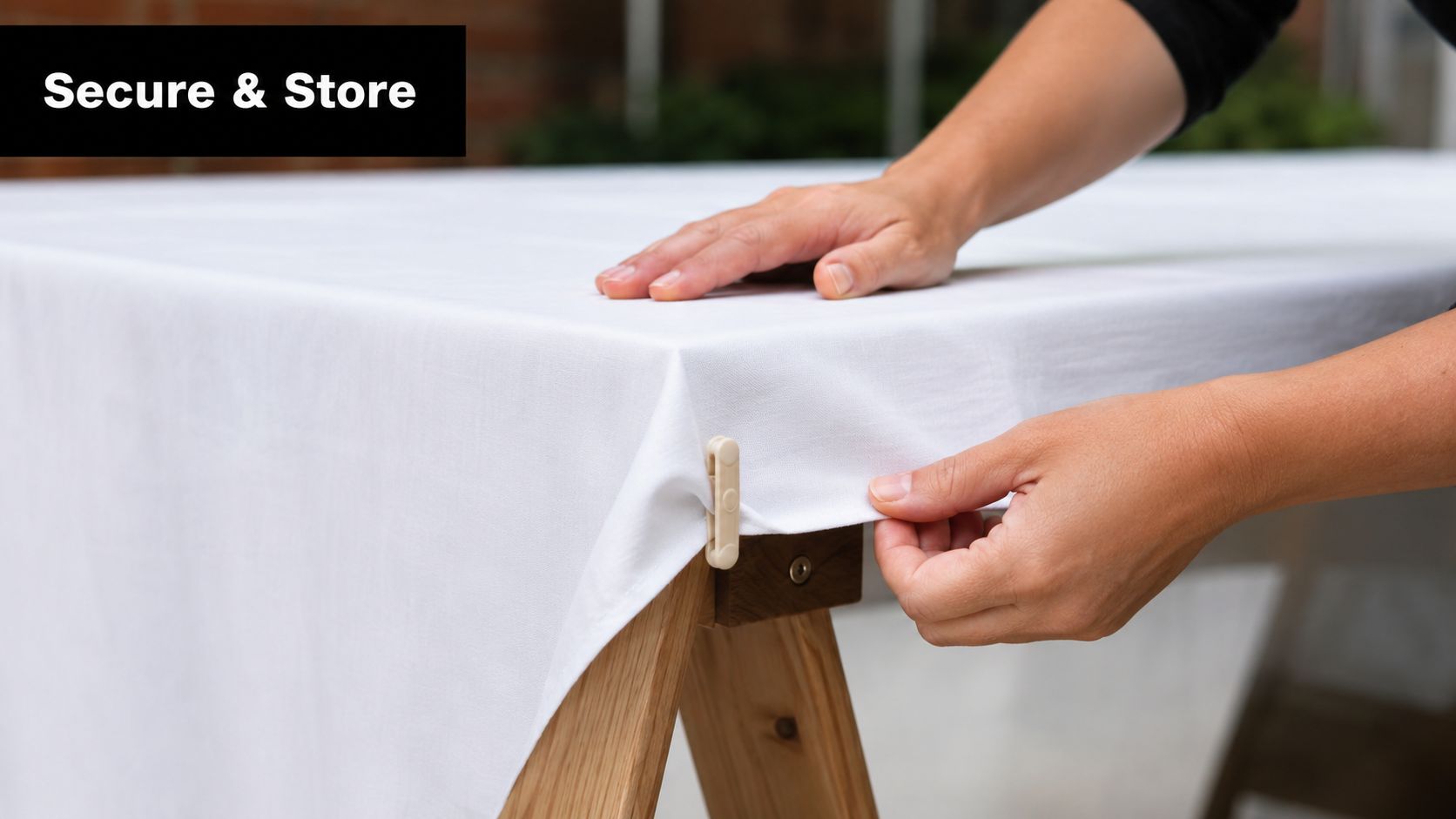
Fit the cloth before the tables leave the warehouse. Place the seam parallel to the table length, then centre the cloth so the overhang matches on both long sides and both ends. If the cloth shifts during transport, clips or discreet pegs can hold the excess without creating visible bunching.

A useful fit check is to stand at the end of the trestle and look down the long edge. The hem should run consistently, the corners should hang at matching heights, and the seam shouldn't cut across the table in an obvious direction.

A person securing a white tablecloth onto a wooden trestle table using a small plastic clip.

Follow the label, not appearance

South African textile procurement documentation expects care-labelling compliance under the Consumer Protection Act and the national care-labelling standard, with permanent wash-care symbols and instructions aligned to SABS 011 and SANS 10011-style requirements. The Mr Price Group quality manual also highlights why fibre classification matters before laundering.

Use this sequence:

  1. Identify the blend. Confirm whether the cloth is polyester-rich, cotton-rich, linen-rich, or a mixed fabric.
  2. Read the permanent label. Match the wash temperature, agitation, bleach, drying, and ironing instructions.
  3. Separate by fibre behaviour. Don't process every cloth together because all the pieces are white.
  4. Test the cycle. Run repeated wash checks before putting a large batch into hire rotation.

Cellulose fibres can weaken under excessive agitation and chlorine bleach. Protein fibres can suffer from alkaline chemistry and heat. Treat the laundering process as part of stock control, not an afterthought.

Store for the next booking

Shake crumbs off outdoors before sorting stained cloths. Fold along established creases, wrap clean stock in breathable cotton sheeting, and store it flat in a dry, ventilated cupboard. Avoid leaving folded linen in a hot vehicle or sealed container, because heat and pressure can deepen creases and encourage stale odours.

Rotate the stock. If the same cloth always sits on the outer edge of a stack, that edge will take more handling damage than the rest. Record stains, pulled threads, and damaged hems before the items return to circulation.

Quick Hire-Day Checklist and Common Questions

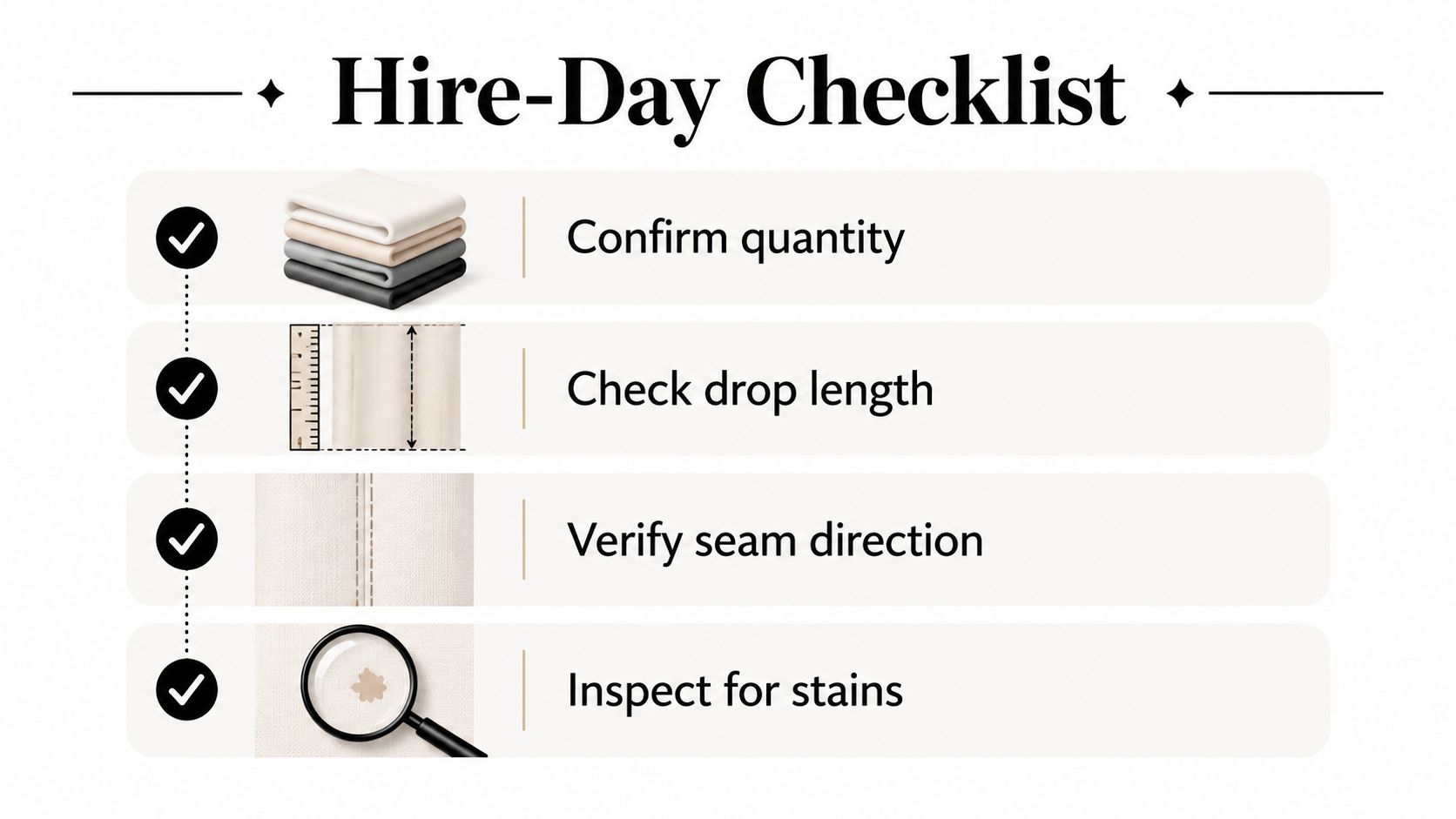
Use the morning of delivery to check the cloths against the brief, not just against the invoice. Confirm the quantity for each table run, verify the selected drop, and inspect the fold lines under good light. Stains often show first where fabric has been folded tightly or stored against another piece.

A Hire-Day Checklist infographic featuring four steps: confirm quantity, check drop length, verify seam direction, and inspect for stains.

The handover check

  • Confirm quantity: Match the cloth count to each table length and identify any pieces allocated to the head table or registration desk.
  • Check drop length: Put one cloth on the actual trestle before loading the rest. A catalogue image can't confirm the finished fall.
  • Verify seam direction: Keep the seam parallel to the long edge so the table looks balanced from the room.
  • Inspect for stains: Look at hems, corners, and fold lines before signing for the hire.
  • Pack clips and spares: Keep the fastening pieces with the linen, and carry replacement cloths for last-minute swaps where the budget allows.
  • Record return condition: Count clips, note damage, and separate food-stained pieces before the stock goes back into rotation.

Questions planners usually ask

Will a 180 x 230 cm cloth fit one standard trestle at full-drop? It can suit a single 76 cm-wide trestle for a full-drop arrangement, but confirm the table length, finished cloth dimensions, and desired hem position with the supplier before ordering.

Can two cloths cover a longer banquet run? Yes, they can overlap at the centre, provided the colour and finish match closely. Ask for pieces from the same dye batch where colour consistency matters.

Can I use chlorine bleach on polyester? Don't. Follow the permanent care label and use a suitable oxygen-based brightener where the fabric instructions allow it. Chlorine can damage fibres and create uneven results.

Why does white linen look blue in photographs? Coloured uplighting changes the appearance of white fabric. Test a swatch at the venue, under the actual lighting, before approving the full order.

What should the hire agreement include? Confirm the replacement cost per cloth and any cleaning surcharge for food stains. That removes an unpleasant argument after the event.


ABC Hire can help you match tables, cloths, and practical event accessories for weddings, corporate functions, school formals, and private celebrations across Cape Town and the Winelands. Visit ABC Hire with your table dimensions and preferred drop, and ask the team to help you plan the correct hire combination before delivery day.

White Card Table Guide for Cape Town Events

You're standing with a quote open, the venue wants the table plan by end of day, and the client has just asked for a white card table. In Cape Town and the Winelands, that phrase can mean very different things depending on who is speaking. If you use it loosely, you can end up pricing the wrong furniture, planning the wrong layout, or paying for a look that doesn't survive a windy outdoor setup.

The problem starts with language. In South Africa, “white card table” is not a standard furniture classification, and the closest authoritative historical use of white card is tied to construction safety training, while the practical event-furniture category is really a folding table with legs that fold against the top for portability and storage, which is why it suits temporary events so well (white card context, folding table definition). That mismatch is exactly why suppliers pause when the term comes up. They need to know whether the brief is about a hire table, a clean white surface, a foldaway format, or a completely different product altogether.

Why the Term White Card Table Causes Confusion

A Stellenbosch planner can hear “white card table” three different ways in one morning. A bride means a clean, white table for the reception. A junior coordinator thinks of a certification term she's seen online. A supplier, meanwhile, is trying to work out whether the order is for a folding event table or some niche product that doesn't exist in the local hire catalogue.

That's the core issue, the phrase sounds familiar, but it doesn't map neatly onto South African event-furniture language. The available regional evidence points the other way, white card is not a common South African event-furniture classification, and there's limited ZA-specific technical literature attached to that wording. The practical furniture type is the folding table, not a formal “white card table” category (ZA context on white card, folding table as furniture type).

What people usually mean

Most clients are really asking for a table that looks clean, photographs well, and can move from truck to venue without drama. That usually means a white finish, a foldable frame, and a hire-friendly surface that can handle service, décor, and quick turnaround.

A supplier can only quote accurately when the wording matches the use case.

If the brief is vague, you lose time on revisions and risk misunderstanding the size, finish, or shape. If the brief is specific, the conversation becomes simple, do you want a rectangular folding table, a round dining table, or a cocktail-height surface for a standing event?

The best habit is to describe the table by function first, then by finish. Say white folding table for indoor reception seating, or white rectangular hire table for outdoor cocktail service. That wording gets you much closer to a usable quote than the phrase “white card table” ever will.

What a White Card Table Actually Is

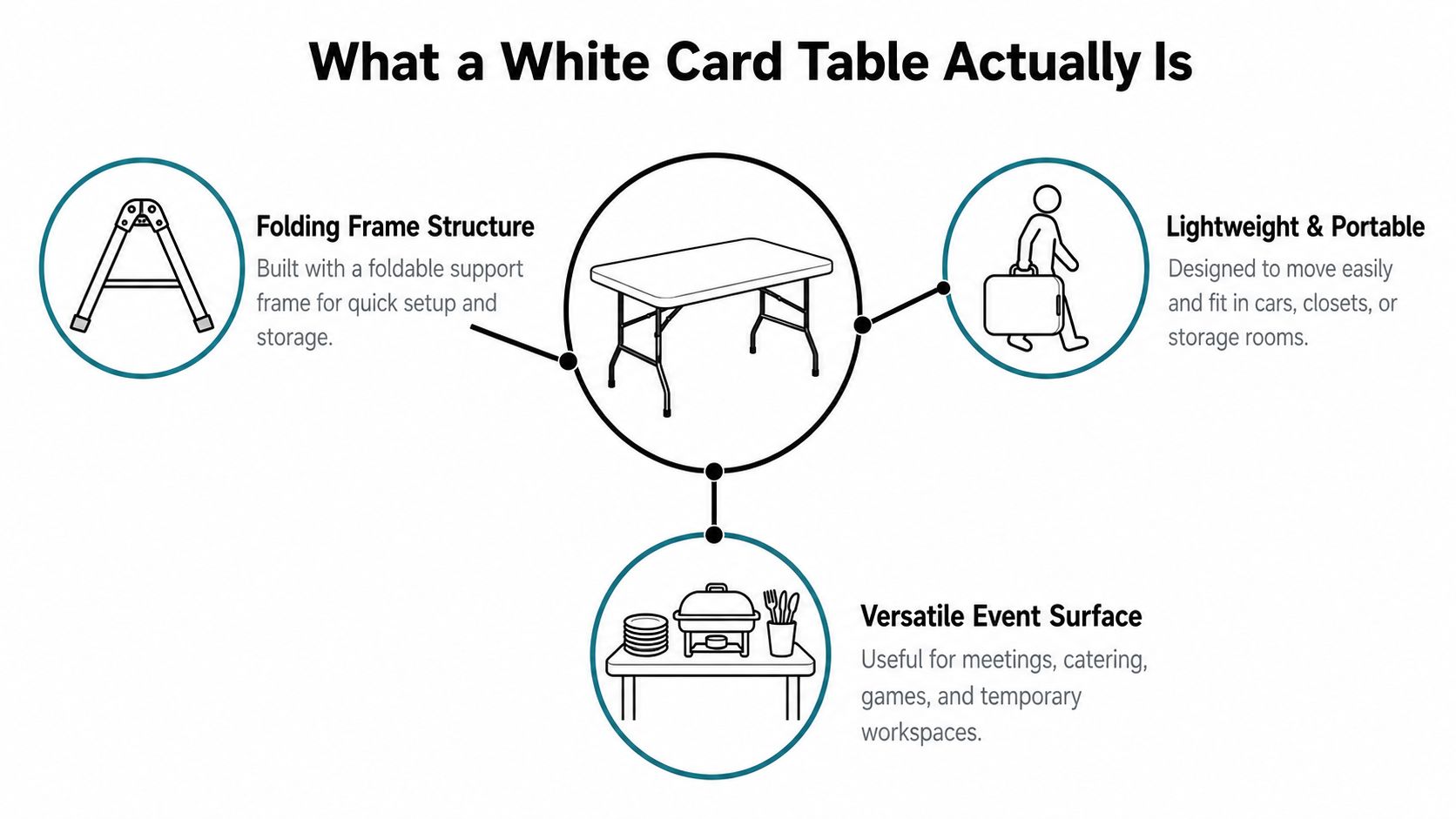
An infographic showing the functional features of a white card table including portability and versatility.

At a Cape Town venue, a client may ask for “white card tables” and mean something very specific, a clean-looking hire table that can be loaded, unfolded, wiped down, and moved again without slowing the run of the event. In practice, a white card table is a white folding table hired for short-term use. It is chosen for presentation, transport, and quick reset, not for permanent installation. The key feature is the foldaway frame, which makes storage, delivery, and turnaround much easier (folding table mechanism).

A working definition you can use with suppliers

If you need to explain it to a venue manager or client, keep it plain. A white card table is a lightweight, hire-ready table with a white finish and folding legs, usually selected for events where the room must be dressed quickly and cleared just as fast.

That definition matters because it separates event furniture from permanent banquet furniture. It also separates a hire table from the old-school plastic trestle look many planners want to avoid. When appearance matters, the white surface helps. When transport matters, the folding frame matters just as much.

A well-chosen table will usually have non-marking feet, a stable locking frame, and a finish that wipes down cleanly after service. Those details do not sound glamorous, but they are the difference between a polished floor that stays spotless and a venue manager phoning you after load-out.

For a simple supplier-facing reference, this folding white table guide keeps the conversation on furniture, not jargon.

What it should do on site

A good hire table should stack neatly in a truck, fit through service entrances, and stand up to repeated handling without looking tired. In other words, the table has to be as practical as it is neat.

Practical rule: if a table is hard to move, hard to clean, or hard to match with the rest of the room, it is the wrong table for event hire.

That is the test. Not whether the phrase sounds fashionable, but whether the table can survive the event day and still be ready for the next one.

If the brief stretches beyond a standard reception layout, a wider rental reference such as find a 10 foot table can help when you are comparing what a venue can physically hold with what a supplier can deliver.

Standard Sizes and Seating Capacity

Most quote mistakes happen because the guest count is fixed before the table plan is. A planner says “120 guests”, then discovers the venue wants wider aisles, the caterer needs service space, and the DJ needs a footprint. The table count changes fast, which is why size matters more than style once the layout starts taking shape.

The sizing conversation that actually helps

For rectangular tables, the common hire conversation usually centres on four-foot, six-foot, and eight-foot tables. For round dining layouts, planners often ask about 1.5 m and 1.8 m rounds. The right answer depends on the event format, plated dinner, buffet, drinks service, or a mixed layout. A longer table gives better line efficiency, while a round table is easier for guest conversation and softer room flow.

If you're checking size options against longer layouts, it can help to look at a broader rental reference such as find a 10 foot table, especially when you're comparing what a venue can physically hold versus what a supplier can deliver.

A guest count is not a table plan. It's only the starting point.

A practical rule is to add one extra table for the things that always appear late, cake, gifts, a signing point, or a DJ stand. That small buffer saves you from cannibalising guest seating on the day.

White Card Table Sizing at a Glance

Table Size Seated Dinner Buffet / Drinks Best For
Four-foot rectangular Small groups, side seating, tighter room plans Service stations, bar support Breakout areas, cake, gifts
Six-foot rectangular Balanced guest seating, standard banquet use Drinks tables, food support Weddings, conferences, school functions
Eight-foot rectangular Larger seated sections, long table runs Efficient buffet lines Banquets, long halls, tight logistics
1.5 m round Conversation-led dining Shared drinks tables Smaller wedding tables, formal dinners
1.8 m round Fuller guest tables, more social spacing Lounge-adjacent drinks setups Larger weddings, gala dining

The table above works as a quote check, not a rigid formula. A seated dinner wants more chair clearance than a buffet. A drinks reception wants table surface and circulation, not deep seating. The shape and service style decide how far one table stretches.

If you're unsure, sketch the room with the venue's doors, pillars, and buffet stations first. Then work backwards from guest movement, not just guest numbers.

Choosing the Right Shape for Your Event

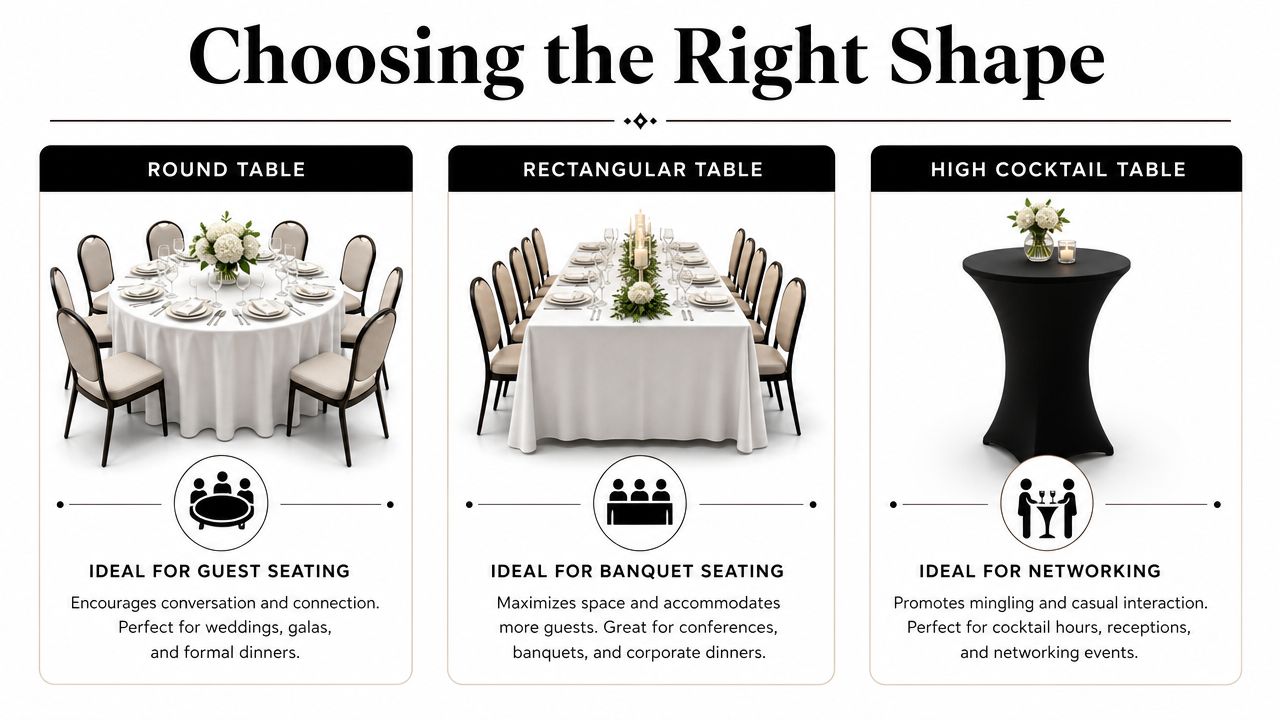
Shape changes the mood of a room long before flowers or lighting do. A round table feels sociable and settled. A rectangular table feels structured and efficient. A cocktail table changes the event entirely, because it turns the room into a standing, moving space rather than a seated one.

A visual guide comparing round tables, rectangular tables, and high cocktail tables for event seating arrangements.

Round, rectangular, and cocktail-height tables

Round tables are still the safest choice for traditional Winelands weddings, especially when the room leans formal and the guest list includes mixed-age family groups. People can talk across the table more easily, and the room often feels softer. That works well for plated service and for venues where the décor is doing a lot of visual heavy lifting.

Rectangular tables suit long banquet halls, conference setups, and tighter spaces where every metre counts. They also work well for school functions and matric dances where you want the room to read clearly from one end to the other. In those spaces, rectangular tables make service simpler because staff can move along straighter runs.

Cocktail tables are different. They're the right choice for corporate activations, launches, networking evenings, and receptions where people are meant to circulate. They reduce seating pressure and keep energy moving near bars, sponsor walls, and product displays.

Shape changes styling and staffing

The shape you choose affects linen, centrepieces, and even how many staff you need on the floor. Round tables need a different drape and a centrepiece that can be seen from every side. Rectangular tables favour runners, repeated décor elements, and cleaner lines. Cocktail tables work best with minimal styling, since clutter defeats the purpose.

White tables are easier to brand visually, but they also show every decision you make. Clean lines look deliberate. Heavy styling looks crowded.

For a more décor-led reference, the ideas in decor on table help when you want to see how shape and styling work together.

The right shape is the one that matches the event's social behaviour. If guests must sit and dine, choose accordingly. If they need to stand, talk, and move, don't force a dining table into a networking format. That's how rooms feel awkward even when the furniture is technically correct.

Setup, Transport, and Cleaning in Cape Town Conditions

A white surface looks elegant in photos, and it also exposes every handling mistake. Dust shows up fast. Wine shows up faster. So does uneven ground, especially at estates where lawns slope slightly or the paving doesn't run perfectly level.

What happens before guests arrive

On grass, the table needs to sit flat enough that glasses don't wander and crockery doesn't wobble. On stone or tile, non-marking feet matter because polished surfaces show scratches and scuffs long after the event ends. On wooden decks, weight distribution matters more than it looks like it should, especially when the table is loaded with glassware, candles, or heavy centrepieces.

If the venue sits in the Winelands, narrow service access can become a significant bottleneck. Older driveways in Franschhoek and similar estates don't always welcome large delivery vehicles. That means the supplier needs a clear off-load plan before the truck arrives, not after.

Cleaning without ruining the finish

The white finish is forgiving only if you act quickly. Blot spills instead of rubbing them, because rubbing pushes colour deeper into the surface or spreads the mark across the table top. Wine, sauce, and dessert spillages need immediate attention, especially in high-turnover formats where the same stock may go back out the next day.

Here's the operational truth:

  • Protect the floor first: use feet that won't mark polished surfaces or decks.
  • Level the table second: use shims where lawns or paving fall away.
  • Clean early: blot spills while they're fresh, before they set.
  • Load carefully: stack and strap tables so the edges don't chip in transit.

The visual upside is real, but the table only stays attractive when handling is disciplined. That matters more in Cape Town weather, where wind, dust, and outdoor service can turn a neat setup into a messy one very quickly.

Styling a White Card Table for Weddings and Corporate Events

A white table is a blank canvas, but it's not a neutral object. The finish changes how linen reads, how candlelight bounces, and how much colour the rest of the room needs. If you style it well, the table disappears into the design. If you overwork it, the room starts to feel busy.

Weddings, galas, and matric dances

For a Winelands wedding, a white surface pairs well with soft linen, simple florals, and candle groups that sit low enough for conversation. Bare white tops can look modern, but they need disciplined styling, because every charger plate and glass becomes more visible against the clean surface. For a more traditional feel, a linen layer gives the table a softer edge.

Corporate events are different. They usually call for sharper branding, cleaner geometry, and less visual clutter. Branded napkins, small sponsor cards, and tidy cable management around AV gear keep the table looking intentional rather than improvised. The white surface helps the branding stand out without fighting the room.

School matric dances sit somewhere in between. Theme colours matter, but they need to be applied with control so the room feels festive, not chaotic. Bold tableware, simple runners, and coordinated chair dressing usually work better than trying to make every surface speak at once.

Styling combinations that hold up

  • Winelands wedding: linen, low florals, candles, and layered glassware.
  • Corporate gala: branded stationery, geometric décor, and restrained colour accents.
  • Matric dance: theme-driven tableware, confident colour blocks, and simpler centrepieces.

A white table also changes how light behaves in the room. That's useful in bright outdoor settings, because the surface doesn't fight the venue's natural light. It's also a reason planners like it for camera-heavy events where the backdrop needs to stay clean and consistent.

For more table-dressing ideas, the notes in table décor guidance sit well alongside the practical styling choices above.

The main decision is whether the table is carrying the styling or supporting it. When the room already has strong décor, keep the table quiet. When the room is plain, let the table work harder through linen and texture.

Renting White Card Tables in Cape Town and the Winelands

Buying is rarely the right answer for event furniture. Tables need storage, transport, maintenance, and repeat cleaning, which is why most planners treat them as a rental decision. The central question is how cleanly the supplier can deliver, collect, and support the event without creating extra work for the coordinator.

What to ask before you book

A standard hire quote should be clear about the table type, finish, quantity, delivery window, and collection terms. It should also tell you what happens if the venue has access constraints or if the table returns with damage. If any of that is vague, ask for the wording in writing before you pay.

Local logistics matter a lot in Cape Town, Stellenbosch, Franschhoek, and Paarl. A Cape Town depot may offer broader stock and easier substitutions, while a Winelands supplier can be better for shorter travel time and venue familiarity. Neither option is automatically better, but each one shifts the balance between convenience and cost.

Reliability signs that matter

  • Stock condition on view: ask to see current furniture condition, not old marketing images.
  • Contract clarity: check delivery, collection, and damage wording carefully.
  • Venue fit: confirm that the supplier has handled similar surfaces and access routes.
  • Communication speed: slow responses before booking usually stay slow after booking.

A dependable rental partner makes the process feel boring, and that's a good thing. The truck arrives on time, the tables match the quote, and the load-out happens without a last-minute argument at the gate.

For a broader rentals reference, tables and chair rentals is useful when you're comparing furniture categories and planning a full event order rather than a single item.

Quick Checklist Before You Confirm Your Quote

Check the table shape, table size, and guest count against the actual room plan, not just the invitation list. Confirm the venue surface, grass, stone, deck, or polished floor, because that changes setup and protection requirements. Ask the supplier how delivery, collection, and any damage rules are handled in writing.

Then verify the styling extras, linen, runners, and centrepieces, so the table matches the rest of the event instead of sitting there unfinished. If the venue has narrow access, limited parking, or an awkward off-load point, say so before the truck leaves the depot. The best quote is the one that still works when the tables reach the site.


ABC Hire supplies event furniture that fits real Cape Town and Winelands conditions, from clean white tables to full seating setups that hold up in weddings, corporate functions, and private celebrations. If you need a rental partner who understands layout, transport, and presentation, visit ABC Hire and plan the table order with a team that does this every week.

Urn Water Boiler Guide for Cape Town Events

You've got the booking in hand, the venue has sent the floor plan, and someone has already asked, “Do we need one urn or two?” That's the Cape Town question. On paper, an urn water boiler looks like a simple hire item. In practice, it decides whether tea service runs cleanly in a Stellenbosch hall, whether the kitchen trips a circuit in the middle of pre-function drinks, and whether guests queue for hot water while the DJ is already loading in.

The smartest planners treat the urn as logistics, not décor. A good choice starts with capacity, then power source, then where the thing will sit without blocking staff or guests. That order matters in the Winelands because the venue rarely gives you perfect power, perfect access, and perfect storage all at once. If you want a broader event-planning lens before you lock the hire list, Creventa event management insights is a useful read on how coordination decisions shape the whole service flow. For a complementary rental option when you want chilled water without tying up your hot drinks setup, see ABC Hire's water dispenser rental guide.

Why Your Cape Town Event Needs the Right Urn Water Boiler

A Friday afternoon wedding in Stellenbosch is the kind of job that exposes weak planning fast. The welcome drinks are done, the first guests are through the gift table, and then the urn empties before the coffee station has even settled into service. Staff start improvising with kettles, the line builds, and the venue manager looks at the same urn as if it personally betrayed them.

That failure usually isn't about the appliance being “bad”. It's about buying or hiring the wrong size, the wrong power source, or placing it where the team can't reach it quickly. The urn water boiler is one of those background decisions that looks minor until hot drinks become the bottleneck everyone notices.

The real job of the urn

An urn is there to keep hot water moving at the pace of your event, not to sit pretty on a buffet. The closest historical cousin is the samovar, a metal urn with a spigot used to boil water for tea. Britannica describes it as a brass urn widely used in Russia, and historical overviews note that by the 18th century it had become a standard domestic appliance in Russian tea culture, helping tea spread beyond elite settings. That history still makes sense today because tea service is about repetition, speed, and reliability, not ceremony alone.

Practical rule: if guests can reach the urn faster than staff can refill it, the setup is already wrong.

Cape Town planners also have to think like logistics people, not appliance shoppers. The event might be in a vineyard, but the service constraints are still basic. You need enough hot water for the wave of guests, a circuit that can cope, and a plan for what happens if the power blinks during service.

Why this matters in our market

South Africa's households, hospitality operators, and event teams still rely on boiled-water appliances for tea, instant beverages, and service stations, so the demand is very real. That makes the urn less of a luxury and more of a working tool in venues where tea and coffee are expected to flow without drama. Modern water-boiling equipment evolved from early domestic heaters into today's electric urns and boilers, and that shift matters because these units are built to hold water hot on demand rather than forcing staff to keep reboiling smaller pots. The old British water-heater history notes that Benjamin Waddy Maughan patented the first domestic water heater in 1868 and later designs moved toward electric and thermostatic models that maintain temperature more efficiently. That's the logic you want on event day.

Sizing an Urn Water Boiler to Your Guest Count

The easiest mistake is sizing for the total guest list instead of the actual tea and coffee moment. Not everyone drinks hot beverages at the same time, and not every event treats the urn as the only hot-water source. In Cape Town, I size for the service window, the beverage mix, and whether the venue is also pulling hot water for prep or dishwashing.

Use the service rhythm, not just the headcount

For an 80-guest wedding, one well-sized urn usually works if tea and coffee are served in a managed station, not a free-for-all. If the ceremony rolls straight into dessert and the buffet is slow-moving, I'd rather see a little buffer than a unit running dry halfway through the first round.

For a 150-guest matric dance, I'd push harder on recovery and queue control. Teen events move fast, staff need to refill quickly, and hot chocolate often becomes part of the mix. Two smaller urns often make more sense than one oversized unit because they split pressure across stations and give you a backup if one is out of action.

For a 250-guest corporate breakfast, I'd look at multiple service points or a larger-capacity hire because the bottleneck is usually the first 20 minutes. That's where people want coffee immediately, and the urn has to cope with repeated draws without turning the catering table into a waiting room.

Practical rule: if the urn will be shared by guests and back-of-house prep, don't size it at the edge. Give yourself buffer or hire a second unit.

Urn capacity by guest count and beverage mix
Guest count Service style Recommended capacity Buffer rule
80 guests Wedding tea and coffee station One medium urn Add buffer if dessert service is delayed
150 guests Matric dance or formal event Two smaller urns Split service points to reduce queues
250 guests Corporate breakfast Larger combined capacity or two units Keep one unit for front-of-house, one for backup
Mixed-use venue Guests plus prep water Step up one size Don't share the same urn across every task

The cleanest decision rule is simple. If the urn is only serving a seated group, size to the guest wave. If it's feeding a moving crowd, size for speed and duplication. If the venue is asking one unit to do everything, hire another one.

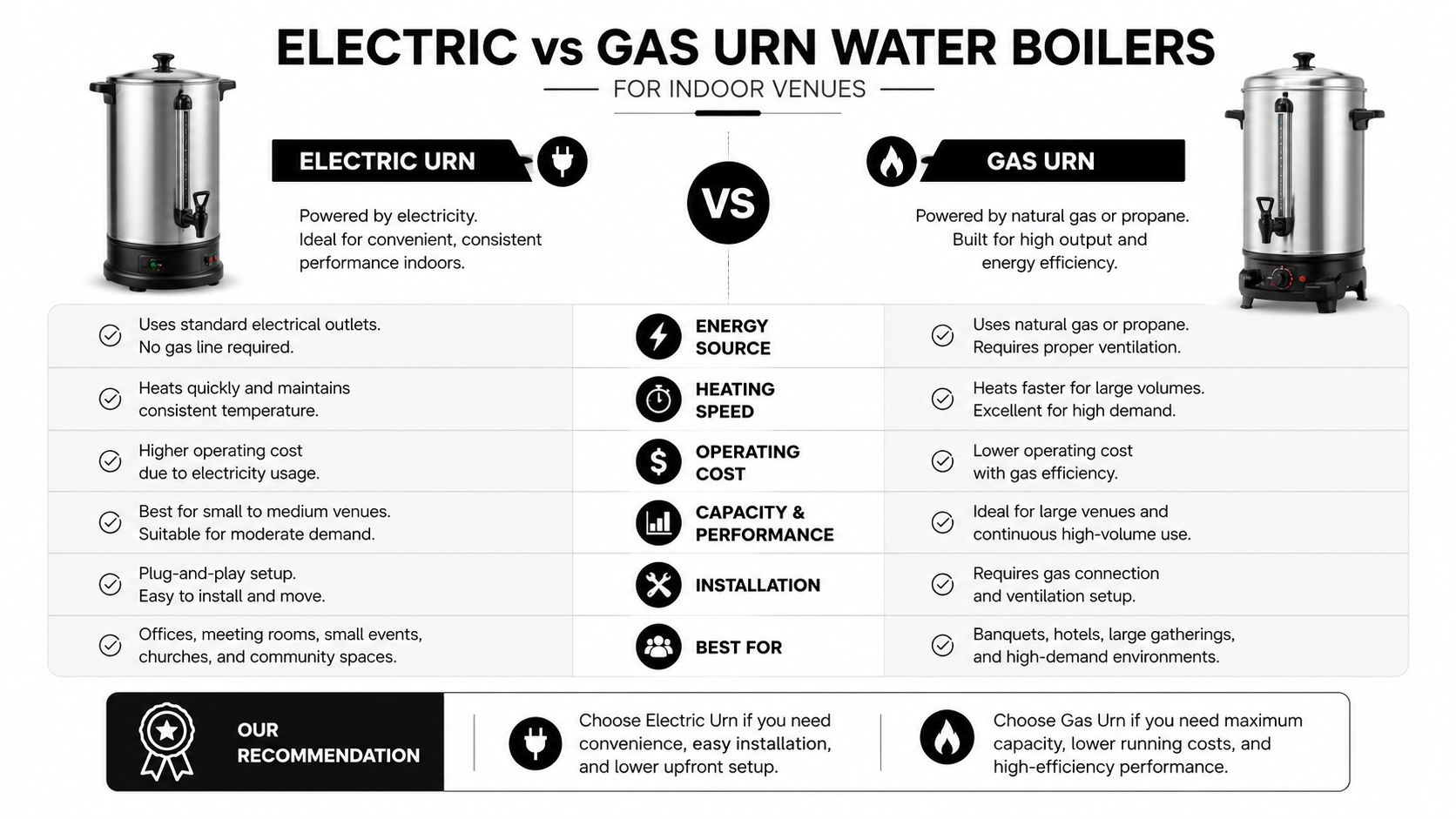
Electric vs Gas Urn Water Boilers for Indoor Venues

A comparison chart showing the benefits and differences between electric and gas urn water boilers for venues.

Electric is the default for most Cape Town venues because it is simple, familiar, and easy to place near a service table. Gas earns its keep when the venue is outdoors, the power is unreliable, or the event runs long enough that you want a different operating cost profile and less dependence on the building's circuit. That's the short version, and for most indoor functions it's the right version.

Where electric wins

Electric urns are the safer request for indoor halls, hotels, and corporate spaces that already run a managed service load. Staff know how to plug them in, venues usually understand them, and they fit better into normal catering layouts. For a planner, that means fewer questions at setup and fewer surprises when the venue supervisor walks the floor.

The weak point is obvious. Electric urns depend on venue power, and that means you have to think about what else is on the same circuit. If the function already has heating, lighting, screens, or kitchen kit pulling power, the urn can become part of a bigger problem instead of a standalone solution.

Where gas makes sense

Gas is the stronger choice for outdoor service, fringe venues, and event plans that can't afford to gamble on a building circuit. It also makes sense where the service window is long and the venue is trying to keep electrical load down. If you're comparing it with other flame-based equipment, ABC Hire's gas stove plates guide gives a useful sense of how planners think about gas as a practical back-up option.

The downside is not subtle. Indoor air quality, venue approval, and safe placement matter more with gas than with electric. You need competent staff, a sensible location, and a venue that is comfortable signing off on it.

The venue decision point

Ask the hire company one direct question. Will this be used indoors with normal guest traffic, or is this an outdoor or power-sensitive setup? If the answer is indoor and stable, request electric. If the answer includes outdoor, off-grid, or uncertain power, put gas on the table early rather than at the eleventh hour.

A small, useful distinction matters here. Electric gives you convenience. Gas gives you flexibility. The better option is the one the venue can safely support without turning tea service into a compliance discussion.

Setting Up, Operating, and Servicing From an Urn

The setup starts before the first plug goes in. I want the venue walk-through done with the urn's final position in mind, because moving a full unit later is the sort of mistake that creates spills, delays, and unnecessary heat exposure for staff. The goal is a straight service path from kettle point to cup point, with no guest traffic cutting across it.

Morning of the event

Put the urn where the catering team can reach it without threading through the guest line. Keep it close enough to the serving station that staff don't waste steps, but far enough from the edge of a buffet that people won't brush against the body or spout. If the venue floor is awkward, use a clear, stable table and check that the cord won't sit in a walkway.

If you want a practical operations framework for event crews, Ticketsmith's event execution and operations guide is worth a look. The best teams always treat the hot-water station as part of the service map, not an isolated appliance.

Staff should never fill an urn and walk away from it without checking the level, the lid, and the spout position.

Filling and first boil

Fill the urn before power-up, never after. That protects the element and keeps the first heat cycle clean. Once it's on, give the team a clear rule on the first pour, because guests always seem to arrive just as someone is still testing the temperature.

When service starts, assign one person to monitor the water level and one person to handle drinks if the station is busy. That split keeps the urn from being overfilled, underfilled, or left with a dry element risk when the table gets busy. If the event is large, a drip tray underneath is not optional in my book. It keeps the floor cleaner and stops small spills from becoming a slip hazard.

During service

Keep the urn away from children, tight corners, and guest congregation points. The steam and metal surface are ordinary workplace hazards if staff ignore them, and they are much more manageable when the unit has breathing room. Cords should be routed cleanly and secured, not left hanging where a waiter can catch a foot.

For cleanup, don't yank the spigot or twist the lid while the unit is still hot. Let the team finish the service run, then cool it properly before draining. That's basic event discipline, and it saves the hire company from avoidable damage and the venue from avoidable mess.

Load-Shedding and Power Planning Around the Urn

At a Cape Town venue, the urn is only as reliable as the power plan behind it. If the lights go out, hot drinks service stops, and nobody cares that the urn looked perfect on the prep table. That is why I treat load-shedding as a logistics problem first and an appliance choice second.

The practical question is simple. Can this urn keep working through the service window, or do we need a fallback that survives a power cut?

Match the urn to the outage window

For a short service window, an electric urn can do the job if the venue has stable backup power or the drinks round is finished before interruptions start. That suits compact corporate functions where tea and coffee go out in one controlled push, then the station closes down.

For longer weddings and dance-floor events, I would not trust electric alone unless the venue has proper backup capacity. A gas urn on standby changes the plan immediately because it gives you a service path that does not depend on the building supply. That matters when speeches run late, guests arrive in waves, or tea service gets pushed back by the program.

For larger or premium events, build inverter or generator support into the quote if the venue's power record is patchy. Tariff pressure matters too, because a long-running electric urn is not background noise on the bill. For context on how much power these units draw, see understanding coffee maker power and electrical requirements. Local planning beats guesswork every time.

The clean rule is this. If the urn only needs to stay hot for a short, controlled window, electric is usually fine. If the service overlaps with uncertain power, use gas or backup power. If the event is large, long, and guest-facing, put redundancy into the plan before the first crate leaves the depot.

What to ask before you sign off

Use this as a one-page venue check.

  • Confirm power stability: Ask whether the venue has had load-shedding interruptions during similar functions.
  • Check backup options: Confirm whether the site can support an inverter, generator, or gas fallback.
  • Measure circuit pressure: Make sure the urn is not sharing a weak line with other heavy-use equipment.
  • Plan the serving window: Decide how long the urn has to stay hot without interruption.
  • Place safely: Keep the unit out of traffic and away from ad hoc extension runs. If you need a reference on cable planning, ABC Hire's 20 m extension cord guide is a practical companion.

The right question is not “Can we plug it in?” It is “Can we keep serving if the power shifts during the busiest 20 minutes?”

Cleaning, Descaling, and Returning the Urn in Hire Condition

The end of the event is where small mistakes become invoice items. Staff are tired, the final sweep is rushed, and someone thinks the urn can be left for “later”. That's how deposits get threatened. Treat the return process like a handover, not a mop-up.

Straight after service

Drain the urn only when it has cooled enough to handle safely. Don't tip it aggressively and don't try to rush the last bit of water out by tilting it onto a fragile table. Wipe the outside once the metal is no longer hot enough to burn a hand, then check the lid, tap, and base for spills or residue.

If the water was hard or the event was long, descale it before the next hire cycle if the hire company expects that from you. Limescale is the quiet enemy of urns because it builds up on heating surfaces and makes the unit work harder than it should. A proper rinse, a descaling pass where permitted, and a final dry wipe are the difference between a returned item and a problem item.

Before the pickup

Inspect the body, spout, cable, and plug for visible wear. Photograph any pre-existing marks before the team starts loading it, especially if the urn arrived with a dent or a scuffed base. That photo habit is not about being difficult. It protects you from arguing about damage that was already there.

Common avoidable charges usually come from three places. The urn is returned still wet, the cable is twisted or left dirty, or the unit is handed back without the accessories it came with. I'd also check the drip tray and lid separately, because those are the bits people misplace when they're clearing an event fast.

Handover checklist

  • Drain fully: Make sure no standing water is left inside.
  • Dry the exterior: Wipe off moisture before loading.
  • Pack all parts together: Keep lid, drip tray, and cable with the unit.
  • Photograph condition: Save a clear image of the urn before pickup.
  • Flag issues immediately: Tell the hire company about any fault before the truck leaves.

A clean return keeps the relationship simple. It also means the next planner gets a serviceable urn instead of one that needs attention before it ever reaches a venue.


If you're planning a wedding, corporate breakfast, matric dance, or brand activation in Cape Town or the Winelands, book your hot-water and event hire early with ABC Hire. They're set up for the practical realities that matter here, from venue constraints to load-shedding-friendly planning, and they'll help you choose equipment that works reliably on the day.

Table Linen for Sale: A Cape Town Event Planner’s Guide

You're four weeks out, the guest count is fixed, and the table plan still isn't settled. That's exactly when table linen for sale stops being a décor decision and becomes a logistics decision. If the cloth misses the drop, fights the venue's table shape, or looks wrong under Winelands light, the whole room feels off.

Cape Town planners get caught here all the time. A linen swatch looks elegant in a showroom, then lands on a trestle at a Stellenbosch estate and suddenly it's too short, too shiny, or too stiff against the room's oak, stone, and glass. The fix is simple, but it has to be practical. Measure the tables properly, choose fabric for the venue, and stop treating sizing as an afterthought.

For context, South Africa's demand for home and event textiles rests on a large, urban consumer base, with a population estimated at about 63.2 million in 2024 and 68.7% of people living in urban areas in 2023, according to World Bank data cited in the market brief on table linen. That matters in Cape Town because urban buying is easier, event turnover is faster, and linen moves through retail and rental channels more often than in low-density markets. Add the country's GDP per capita of about US$6,100 in 2024, also cited in the same brief, and you're not just dressing a basic table. You're specifying presentation, repeat use, and guest-facing polish. For a planner, that's the essential work. World Bank-based South Africa market context

Why Linen Choice Matters More Than You Think

The mistake usually happens at the sample stage. The cloth looks perfect folded over a chair, the colour seems calm, and everyone nods. Then the tables arrive, the venue team starts laying them out, and the linen either stops short of the floor, puddles where guests will kick it, or clashes hard with the estate's timber and stone palette.

A professional event planner adjusting a high-quality white linen tablecloth on a decorated dining table.

The fit problem comes first

A linen can look expensive and still be wrong. Cape Town and Winelands venues are full of table types that don't forgive lazy ordering, round banquets, long trestles, cocktail poseurs, and mixed-size setups all demand different drop lengths. If you only think in terms of “white cloth” or “nice fabric”, you end up solving the wrong problem.

Practical rule: if you don't know the table's exact dimensions, you don't know the linen size. Guessing is how you end up steaming cloths at midnight or borrowing from another supplier.

The other issue is visual weight. A crisp white cloth can read as formal in one room and clinical in another. On a rooftop in the city, that same cloth might feel too bright under hard light, while at a wine estate it can look smart if it's balanced with warmer natural textures.

Style only works after fit

That's why I treat linen as a fit-first purchase. Once the drop is right, the colour and fabric can do their job. Before that, design is just a distraction.

If you need a quick visual reference on dressing the table after the size is locked, use the styling examples in ABC Hire's table décor guide, but don't let styling advice override measurement. The cloth has to behave on the table before it can look good in the room.

Fabric Types That Actually Work for Events

Most planners hear “polyester, cotton, linen” and think they're just different looks. They're not. They behave differently once the cloth meets venue heat, wind, photographers, and guests leaning across the table. The best choice is the one that survives the room you've booked, not the one that sounds nicest in a supplier catalogue.

What each fabric does in practice

Polyester is the safe event workhorse. It tends to crease less, which is useful when a rental team is turning tables quickly, and it usually stays visually calm under pressure. The trade-off is that it can photograph a bit warm and feel less natural in a close-up setting.

Cotton feels familiar and premium, but it shows wrinkles quickly. On a formal dinner where guests are close to the table, that can be fine if the linen is pressed properly and handled well. On a rushed setup, it becomes a maintenance problem.

Pure linen is the one I'd choose when the brief says elegant, natural, and slightly relaxed, but only if the team is prepared for care and pressing. A local product listed at 190 g/m² is described as a medium-weight cloth with better drape stability than lighter decorative linens, and that matters in rental use because heavier cloth sits more cleanly and masks table structure better. 190 g/m² pure linen reference

Satin or taffeta has its place for corporate branding, stage-adjacent tables, and more polished formal setups. Use it sparingly. It can look sharp, but it also makes mistakes obvious, especially if the tables underneath aren't perfectly square.

Pick by event, not by habit

If the event is outdoors in a windy Winelands setting, choose a heavier cloth that doesn't skate across the table. If the event is formal but not fussy, cotton blends are the middle ground that keeps most planners sane. If the brief is premium dining with close guest interaction, pure linen wins on texture, but only if you can handle the maintenance.

For a straightforward breakdown of tactile table layering, the woven mat examples in ABC Hire's table mats guide are useful, but keep the main decision focused on how the fabric behaves, not just how it looks.

Sizing and Drop Length for Cape Town Tables

Most linen orders go wrong here. The method is not complicated, but it has to be followed properly. Measure the tabletop, then add the desired drop twice. That means one allowance for each side of the table, not just one. For a 30-inch-high banquet table, a full-drop linen usually needs 60 inches added in length and width, and for a 36-inch-high table, it needs 72 inches added, because the cloth has to cover both sides evenly. Table sizing method and drop allowance

Use the table shape, not the table vibe

Round tables, rectangular trestles, and cocktail poseurs all need different thinking. A “one-size” cloth is how people end up with knees showing or fabric dragging where glasses and feet catch it. For Cape Town and Winelands venues, I'd rather see a planner overspecify the drop than hope a too-short cloth will pass as intentional.

Here's the simplest way to think about it.

Table format Tabletop size Seats Full drop, floor-length Knee-length drop
Round banquet 60 inch round 8 Add 60 inches to the diameter Mid-length, no floor touch
Round banquet 72 inch round 10 Add 60 inches to the diameter Mid-length, no floor touch
Rectangular trestle 6 ft x 2.5 ft 6 to 8 Add 60 inches to both length and width Drop to below the knee line
Rectangular trestle 8 ft x 2.5 ft 8 to 10 Add 60 inches to both length and width Drop to below the knee line
Cocktail poseur small round top 2 to 4 standing Add 72 inches for the 36-inch height Usually not recommended

Know what each drop says

A full drop gives the room the cleanest formal line, especially for weddings and black-tie dinners. A knee-length drop is safer for mixed-use spaces, buffet edges, and more casual corporate functions. Floor-pooling works only when the venue team wants a dramatic look and the floor is clean, level, and not crowded.

Rule I stick to: if guests are seated close enough to touch the cloth with their knees or shoes, the linen is too short for a formal event.

The biggest practical advantage of exact sizing is that it helps you brief a supplier in one sentence instead of three vague ones. Don't ask for “big rectangles” or “something elegant for trestles”. Give the table format, the tabletop size, and the drop you want.

Colour and Styling for Winelands Venues

Cape Town and the Winelands don't reward random colour choices. A linen that looks soft in daylight can go flat under warm vineyard lighting, while a sharp white can feel cold in a city venue with glass walls and polished floors. The right answer depends on the venue's material palette, the time of day, and whether you want the linen to disappear or carry the styling.

A rustic outdoor dining table set with elegant linen for a wedding overlooking a vineyard landscape.

Match the room, not just the mood board

At historic wine estates in Stellenbosch and Franschhoek, I'd lean towards warm neutrals, soft ivory, sand, or stone, because they sit better beside terracotta, timber, and vineyard greenery. At contemporary city venues, a cleaner white or charcoal-toned linen works better because the architecture usually carries the visual weight already.

For coastal or garden settings, keep the base calm and let texture do the work. A runner or napkin band in olive, dusty green, or muted clay is usually enough. You don't need to force a full-colour tablecloth onto a room that already has enough visual movement.

Keep bold colour in the accents

Most planners overdo colour at table level. If the florals are strong, keep the linen quiet. If the floral budget is restrained, the runner can take more of the visual load. That's how you avoid the room feeling overworked.

A simple rule helps:

  • Warm venue materials: choose ivory, oat, or soft beige.
  • Cool modern interiors: use crisp white, slate, or deep neutral tones.
  • Garden or vineyard settings: pair natural linen shades with a coloured napkin, not a loud base cloth.
  • Black tie or formal dinners: keep the cloth neutral and add contrast through glassware, chairs, or menu cards.

The mistake is trying to make the linen be the centrepiece when the venue already has its own personality. Let the fabric support the space. Don't fight it.

Buying Versus Renting for the Cape Town Market

If you're planning one milestone event, rent. If you're running regular corporate functions, buying can start to make sense. If you're a full-time planner or venue with constant turnover, owning usually wins on long-term convenience. That's the clean answer, and I'd stick to it.

Match the purchase model to the event volume

For a single milestone celebration, buying is the wrong move unless you already have a storage system and you know you'll reuse the cloth. One-off events rarely justify the upkeep, and rental houses in Cape Town already stock the standard sizes and colours most planners need.

For seasonal or recurring functions, buying makes sense if the same look gets reused across multiple dates and storage isn't a problem. Pure linen can be a great choice, but only if someone is willing to press it and keep it in good condition.

For a full-time planner or venue, buy. The convenience of having the right sizes on hand matters more than the initial outlay, and you stop relying on whatever a rental house has left after peak weekends.

A linen cupboard is only useful if someone has time to manage it. If nobody is pressing, sorting, and checking the stock, owning cloth becomes a chore, not an asset.

Keep the cost logic simple

I'm not going to pretend there's a universal breakeven number, because supplier pricing moves and the cloth type changes the maths. What matters is the pattern of use. If a cloth gets used repeatedly and stored properly, ownership can pay off. If it sits in a cupboard between one big event and the next, you're paying for fabric and forgetting about the labour that comes with it.

If you want a local sourcing reference that speaks directly to hiring cloth rather than owning it, ABC Hire's table cloth hire guide is the relevant place to start. Use that route when you need standard sizes fast and don't want laundry sitting on your own team.

Event-Specific Recommendations

For a wedding, I'd keep the base linen quiet and let the florals do the storytelling. At venues like Babylonstoren or MolenVliet, pair an ivory or soft stone cloth with a textured runner and napkins that echo the bouquet rather than compete with it. If the tables are long trestles, layer a runner down the middle and keep the side drop clean, because clutter around the edges kills the look in photographs.

Weddings

Use linen napkins in a shade close to the base cloth, or one step darker if you want contrast without chaos. On round guest tables, a full-drop cloth with a restrained runner often looks more polished than a busy printed option. If the ceremony and dinner are in the same space, keep the linen neutral enough to survive both daylight and evening light.

Corporate functions and brand activations

Corporate work needs cloth that reads calm on stage and still looks clean after repeated handling. Go with a durable base in white, charcoal, or deep neutral tones, then use a branded runner rather than printing the whole table if the budget is tight. That keeps the brand visible without making the whole room feel like a sales floor.

If you need event furniture and accessory support alongside the linen, ABC Hire stocks rental items for Cape Town and surrounding Winelands venues, which helps when the table setup is only one part of the brief. Keep the linen simple and let signage, menus, or a centrepiece carry the identity.

Matric dances and formal school events

Matric dances need cloth that can handle accidents, movement, and a lot of hands. Choose a practical fabric in a colour that works under camera flash, then keep the napkins coordinated rather than dramatic. A school event doesn't need a complicated table language. It needs clean, reliable presentation and easy cleanup.

For these events, I'd avoid fragile-looking finishes that demand constant correction. If the tables are long and the budget is tight, a consistent runner-and-napkin pairing is smarter than trying to make every table a design statement.

Care, Maintenance, and Price Ranges in Rands

If the cloth arrives wrinkled, don't panic. Steam it properly, hang it with space to breathe, and don't cram it into a cupboard the night before the event. For coastal Western Cape storage, dryness matters more than people admit. Damp linen picks up problems fast, and event linen that smells musty is a fail before it reaches the room.

What to do before and after the event

Before setup, inspect every cloth for seam issues, marking, or previous damage. On the day, treat spills immediately with a clean cloth, not panic and rubbing. After the event, separate stained linen from clean linen straight away, because mixing them makes sorting harder and often spreads the problem.

For storage, fold only when the fabric is fully dry. Keep it off the floor, out of direct sun, and away from anything that can trap moisture. That matters even more in the Western Cape than people expect, because humidity and storage shortcuts are a bad combination for formal linen.

What prices should look like

I'm not giving fantasy overseas pricing here. In South African rand, economy options are usually the entry point for basic tablecloths and napkins, mid-range covers the more common event cloths and better finishes, and premium sits where pure linen and heavier decorative cloths usually live. Rental per event usually makes sense for one-off functions, while buying becomes more practical when the cloth gets repeated use and can be maintained properly.

A supplier quote should tell you:

  • Fabric weight, so you know if the cloth will drape properly.
  • Exact dimensions, not a vague size label.
  • Drop length, so you can compare against the table format.
  • Stain and tear policy, because damage happens.
  • Whether laundering is included, because hidden cleaning costs change the total price.

If a quote leaves those details out, push back. That's not being difficult, that's basic procurement.


A CTA for ABC Hire. If you're planning a Cape Town or Winelands event and need table linen that fits the tables on site, send ABC Hire your table sizes, event date, and preferred look now. Ask for cloth that matches the table format first, then the colour, and you'll save yourself the last-minute scramble that ruins so many good events.

Ottoman Cocktail Table: A Cape Town Event Styling Guide

You've got the venue confirmed, the guest list is moving, and now you're staring at a floor plan that still feels flat. That's usually the moment when lounge furniture stops being a styling extra and becomes a planning decision.

In Cape Town, that happens all the time. A Winelands marquee needs warmth without clutter. A city-centre venue needs softer conversation zones inside a clean architectural shell. A corporate launch needs pieces that look polished at the start of the night and still work when people are balancing drinks, canapés, phones, and branded materials later on. That's where the ottoman cocktail table earns its place.

Done well, it solves several problems at once. It can create a central surface, provide overflow seating, soften a hard-edged room, and make a lounge area feel intentional instead of improvised. Done badly, it becomes a wobbly drinks station, a traffic obstacle, or a high-maintenance fabric piece in the wrong setting.

Transforming Spaces with Ottoman Cocktail Tables

A bare event space tells you very quickly what's missing. In an empty marquee, the room often needs anchor points so guests don't drift awkwardly around the perimeter. In a modern venue with polished floors and high ceilings, the challenge is different. The room can look impressive but still feel cold.

An ottoman cocktail table is useful because it changes how people use a space. Instead of treating lounge furniture as decorative filler, planners can use one piece to support seating, footrest use, and low-surface service. That flexibility isn't new. The ottoman began as a seating form that entered Europe from Turkey in the late 18th century, and its later adaptation into a low table reflects a long design shift toward practical, multi-use furniture, as outlined in the history of the ottoman.

That history's importance is often underestimated. At events, every extra furniture category adds complexity. More pieces mean more transport, more placement decisions, and more room for mismatch.

Why it works in Cape Town venues

Cape Town events rarely happen in one fixed environment. A wedding can move from lawn to terrace to hall. A brand activation might start with daylight networking and finish under mood lighting. A birthday at a private home may need a lounge that feels relaxed without swallowing the whole entertainment area.

In those conditions, a soft-but-structured central piece often works better than a conventional coffee table that feels too domestic or too rigid.

Practical rule: The best lounge furniture doesn't just fill space. It helps guests understand how to use the space.

That's why ottoman cocktail tables show up so naturally in Franschhoek weddings, hotel lounges, matric dance pre-function areas, and networking pockets at larger business events. They help create a zone that feels inhabited from the moment guests walk in.

What they solve better than a standard table

A conventional cocktail table is still the right call in some settings. But ottomans shine when you need a room to feel layered and flexible.

They're especially effective when you need to:

  • Soften a formal room with upholstered texture and a more relaxed centre point
  • Build a lounge cluster that can absorb extra guests without feeling over-furnished
  • Reduce piece count by letting one item do the work of seating and surface support
  • Style quickly with trays, florals, candles, or branded props without making the area feel stiff

The key is to stop thinking of the ottoman cocktail table as a trend item. In event work, it's a layout tool.

Choosing the Right Ottoman for Your Event

The wrong ottoman looks good in the quote and causes trouble on site. The right one disappears into the flow of the event because guests use it naturally.

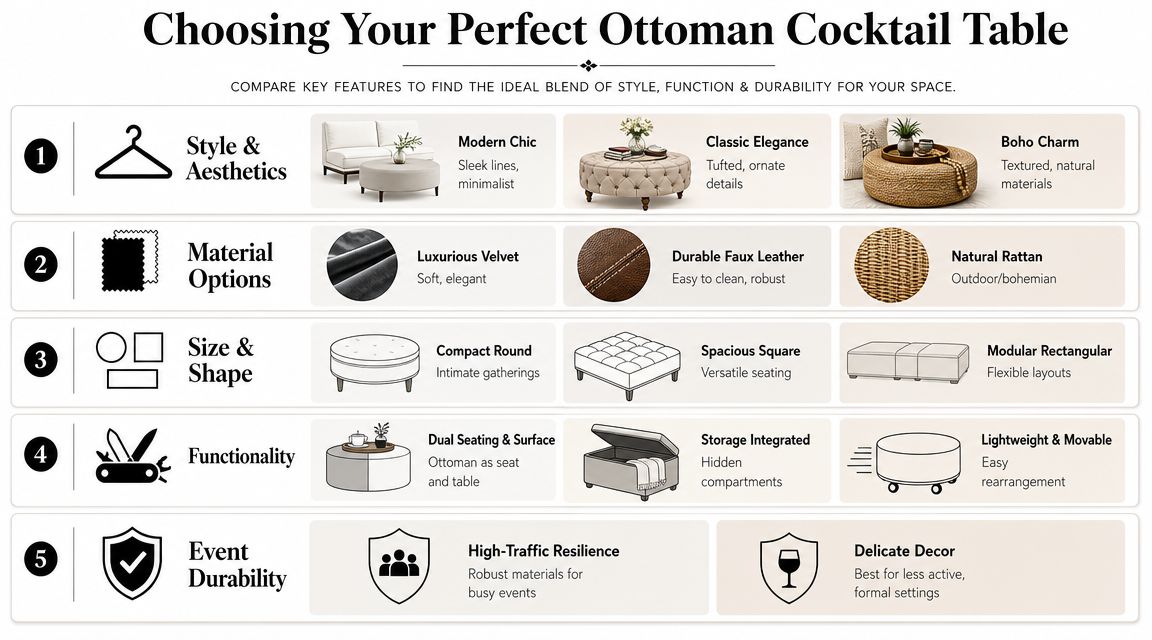
An infographic titled Choosing Your Perfect Ottoman Cocktail Table outlining style, material, shape, functionality, and durability options.

Start with height and proportion

Most rental mistakes start with scale. If the ottoman sits too high, guests end up lifting their shoulders every time they reach for a drink. If it's too low or too long, the lounge starts feeling decorative instead of usable.

A reliable rule is to keep the surface 2 to 5 cm lower than the seat height of the surrounding sofas or chairs, and to size the length at about one-half to two-thirds of the sofa length, based on guidance from Poly & Bark's ottoman sizing guide. That rule works especially well in event lounges because it protects comfort without crowding circulation.

Shape changes how people gather

Shape isn't only visual. It changes movement and conversation.

Round ottomans

Round pieces work well in tighter layouts and in spaces where guests need to move around easily. They soften the room and reduce sharp corners in high-traffic areas. They also suit smaller conversational clusters where the goal is easy mingling rather than structured seating.

If you're comparing options for circular layouts, this guide to a round wood cocktail table is useful for thinking about shape, access, and room balance.

Square ottomans

Square ottomans are often the strongest rental choice for lounge sets. They give you a generous styling surface, work neatly with sectional seating, and usually hold trays better than narrow shapes. For weddings and corporate lounges alike, square forms tend to look deliberate and easy to dress.

Rectangular ottomans

Rectangular pieces suit longer seating runs and can help define a more formal lounge line. The catch is that they need enough surrounding space. In compact venues, they can block flow faster than people expect.

If a layout already feels narrow on paper, a rectangular ottoman usually makes the problem more obvious on site.

Material matters more than colour

Clients often begin with fabric swatches. Planners usually start with cleaning, transport, and wear. That's the better order.

Here's a practical comparison:

Event setting Usually works well Often causes issues
Indoor wedding lounge Structured velvet or quality upholstery with tray use Very soft tops that dip under glasses
Corporate activation Faux leather, wipe-clean finishes, firmer tops Delicate fabrics that mark easily
Indoor-outdoor event Firmer pieces with hard tray-ready surfaces Plush upholstery exposed to weather shifts
Private celebration Comfortable upholstered options with controlled styling Light-coloured fabrics near food-heavy zones

Match finish to event behaviour

A beautiful tufted ottoman may be perfect for a formal wedding lounge where people are chatting and setting down a glass occasionally. It's less ideal for a launch where guests are actively eating, moving, and leaning across the surface.

When choosing, ask the practical questions first:

  • Will guests eat from this area
  • Will drinks sit directly on the surface or on trays
  • Will the ottoman move during the event
  • Is the venue inside only, or does the setup spill onto a terrace or lawn
  • Can the material handle quick cleaning without showing every mark

That's the difference between furniture that photographs well and furniture that performs.

Calculating Quantities and Designing Layouts

Quantity is where many lounge setups go wrong. Some planners over-order and shrink the room. Others under-order and end up with one attractive corner while the rest of the venue feels under-considered.

The better approach is to plan by zones, not by loose furniture count.

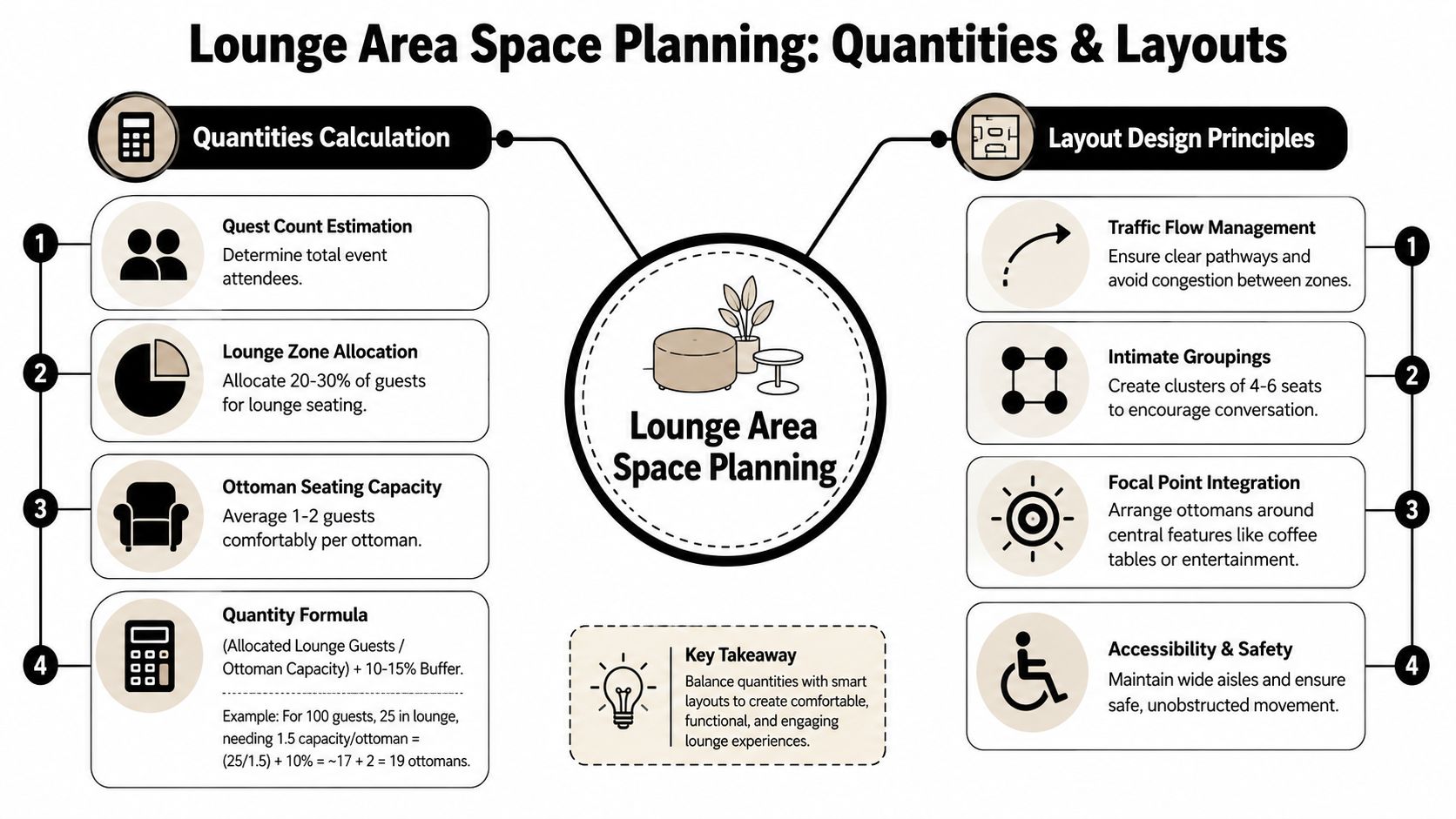
A professional infographic detailing the space planning, quantities, and layout design principles for lounge area furniture.

Build the room in lounge pockets

For most Cape Town events, a lounge works best when it has a clear identity. That might be a welcome-area cluster near the bar, a quieter conversation pod on a terrace, or a central soft-seating island inside a larger reception room.

Instead of asking, “How many ottomans do I need?”, ask:

  1. How many lounge zones does this event need
  2. What is each zone supposed to do
  3. How long will guests spend in each one

A wedding usually benefits from pockets that support short conversations between formal moments. A corporate event may need branded lounge areas where people gather with drinks and promo material. A birthday often needs one central social zone that can flex throughout the night.

Keep module dimensions consistent

Once you decide on multiple ottomans, consistency becomes a quality issue. Public commercial listings show cocktail ottomans commonly around 43 to 48 cm high, and mismatched heights can create an uneven look and potential trip hazards, as noted in this commercial cocktail ottoman reference.

That matters in event styling because guests notice level changes subconsciously. A lounge with mixed heights feels improvised even when the fabrics match.

A good rental setup should look like it was specified as a system, not assembled from leftovers.

Layouts that work in real venues

Different event rooms need different arrangements. These are the formats that tend to work well:

Conversation pods

Use small clusters of seating around one ottoman cocktail table. This is ideal for weddings, hotel venues, and networking events where guests rotate in and out. Round or square ottomans usually suit this layout best.

Long lounge lines

Place ottomans along a continuous sofa run to define a sleek hospitality area. This is useful for corporate launches and formal indoor functions. It looks polished, but only works if service staff still have room to move.

Central feature lounge

Build one large statement seating zone around a key ottoman or a set of matching ottomans. This works well in bigger reception spaces where the lounge should feel like a destination.

If you need a visual planning aid, these tips for furniture placement from Room Sketch 3D are helpful for thinking through circulation before anything arrives on site.

Leave space for people, not just furniture

A lounge can be perfectly styled and still fail if guests have to sidestep around it. Maintain enough room for movement between seating and central surfaces, and watch the approach paths from bars, buffet points, and entrances.

For broader event planning around scale and furniture mix, this guide to tables and chairs rental helps frame the lounge as part of the full floor plan, not a standalone styling moment.

What works best is simple. Furniture should make the room easier to use.

Styling and Pairing Your Ottoman Cocktail Table

Styling is where the ottoman cocktail table either comes alive or starts looking confused. Because it can act as a table, seat, and visual anchor, it needs restraint. Too much on top and guests have nowhere to use it. Too little and it looks unfinished.

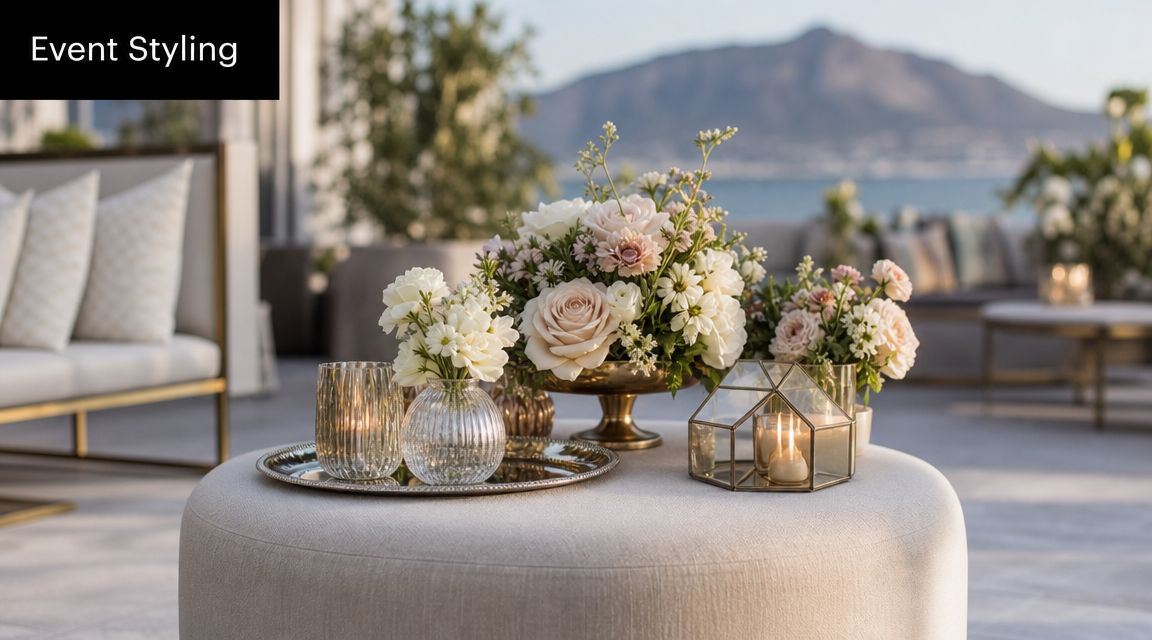
Elegant floral centerpiece on a round ottoman cocktail table at a sunny outdoor terrace lounge area.

Weddings need softness and structure

For Winelands weddings and city receptions, I'd usually treat the ottoman as a layered styling base rather than a full décor table. A tray gives the top visual definition and creates a stable area for candles, bud vases, or a small arrangement. That keeps the setting elegant without sacrificing use.

Round ottomans pair beautifully with curved sofas, occasional chairs, and soft lighting. Square ottomans work better when the lounge needs a stronger centre point and more usable tray space.

A few styling choices usually carry the whole look:

  • A structured tray to create order on an upholstered surface
  • Low florals so guests can still see one another across the lounge
  • Textural contrast such as linen, glass, metal, or timber accessories
  • Controlled candle use where the venue allows it and stability is secure

For more ideas on creating a balanced tabletop moment, this guide on decor on table is a useful reference point.

Corporate events need branding without clutter

Corporate lounges often go wrong when every surface becomes a branding opportunity. A better approach is to let one or two elements carry the identity. That could be a tray in the brand colour, clean acrylic accessories, or a restrained logo placement.

The ottoman should still function as part of the guest experience. If every centimetre is occupied by branded material, people stop using it naturally.

The smartest branded lounges don't shout. They guide attention and still leave room for a drink and a conversation.

Lighting changes everything after sunset

An ottoman can look ordinary at noon and dramatic at night, depending on what surrounds it. This is especially relevant for Cape Town events where outdoor sections transition into evening service.

Pair low lounge furniture with:

  • Warm accent lighting for weddings and private dinners
  • Sharper architectural lighting for launches and modern receptions
  • LED furniture elements when you want a contemporary evening effect without adding bulky décor

The trick is coordination. If the ottoman is soft and textural, let nearby lighting sharpen the scene. If the furniture is already visually bold, keep the tabletop styling quieter.

Good styling always serves the room first. It shouldn't fight the function of the piece.

The Rental Process from Delivery to Collection

Furniture hire runs smoothly when the planner and the rental team are working from the same version of the event. Most problems don't start with the furniture itself. They start with missing venue details, rushed access, or assumptions about where pieces can go.

Before delivery

Start with the practical briefing. Confirm access times, loading points, lift access if relevant, and whether the venue has stairs, gravel, lawn, decking, or narrow passages. In Cape Town and the Winelands, those details matter more than people expect because venues often combine indoor rooms with terraces, courtyards, and weather-sensitive outdoor areas.

Material choice should be settled before dispatch, not after setup. For indoor-outdoor events, a firmer, lower-profile ottoman with a tray-ready top or weather-resistant material is often the more practical choice than plush upholstery, as discussed in Havenly's guide to using an ottoman as a coffee table.

Send a placement plan if you can. Even a simple marked-up floor plan saves time and avoids the on-site “let's just try it there” cycle that delays styling.

During the event

Once the furniture is in place, protect it like part of the event infrastructure. Ottoman cocktail tables are easy to use casually, which is exactly why small issues can build quickly.

A few habits help a lot:

  • Use trays and coasters where drinks will rest for long periods
  • Brief staff early so servers know which lounge pieces are decorative and which are active guest-use surfaces
  • Treat spills immediately instead of waiting until the end of service
  • Watch outdoor shifts if wind picks up or moisture settles later in the evening

Cape Town's weather can turn a terrace setup from calm to challenging within one function. Lightweight accessories on top of soft ottomans can become unstable quickly when the wind changes.

On outdoor jobs, the best-looking setup is the one that still looks composed after guests have actually used it.

At collection time

Collection is easier when the room is handed back in a controlled state. Remove décor items that belong to other suppliers, clear trays and glassware, and make sure the venue team knows what stays and what goes.

If anything was moved during the event, point that out. It helps the collection crew work faster and reduces the risk of pieces being missed in side rooms, bridal suites, or terrace corners.

A good rental process should feel calm. Clear access, sensible material choices, and realistic placement instructions usually make that possible.

Your Essential Ottoman Rental Checklist

The most useful ottoman cocktail table decision isn't “Do I like this piece?” It's “Will this piece still work when the room is full?” That's the filter that separates a strong rental choice from a styling impulse.

A 10-step checklist for renting ottomans for events, featuring icons and detailed planning descriptions.

For weddings

Wedding lounges need cohesion. The ottoman should sit naturally with the floral language, linen palette, and seating profile already in the room.

Run through this before confirming:

  • Check scale against the seating so the lounge feels comfortable, not overbuilt
  • Confirm tray use early if drinks, candles, or florals will sit on top
  • Match tone, not just colour because formal, rustic, modern, and garden venues all read upholstery differently
  • Place lounges where guests pause naturally, such as pre-drinks zones, terrace edges, or reception corners

For corporate activations

Corporate events ask more of the furniture. Guests lean, eat, set down devices, and move in and out fast. The ottoman has to hold up visually and practically.

Focus on these checks:

  • Choose wipe-friendly finishes for high-touch use
  • Keep modules consistent so branded lounges look organised
  • Leave enough free surface for actual guest use, not only branded material
  • Avoid overly soft tops if the lounge will support active catering or working conversations

For private parties and milestone events

Private hosts often want comfort first, and that's exactly right. But comfort still needs structure.

Use this quick decision list:

Question Better choice
Guests mostly chatting with drinks Upholstered ottoman with tray
Mixed indoor-outdoor setup Firmer, lower-profile piece
Heavy food service in the lounge Dedicated hard-top table or firm ottoman
Relaxed home celebration with flexible seating Multi-use ottoman cluster

One question matters more than the rest. When is an ottoman a poor substitute for a traditional cocktail table? For lounge areas that function almost like sit-down dining, a soft surface can become a liability. In those cases, a firm ottoman with a large secure tray, or a dedicated hard-top table, is the safer option, as noted in Bed Bath & Beyond's guidance on ottomans and poufs.

Final pre-booking check

Before you sign off, confirm these practical points:

  • Venue measurements are accurate
  • Access and delivery times are approved
  • Material suits the environment
  • Quantity fits the floor plan
  • Styling items won't compromise use
  • The lounge still works once guests arrive with food, drinks, and bags

That last check is the one many people skip. It's also the one that saves the event.


If you're planning a wedding, corporate function, matric dance, or private celebration in Cape Town or the Winelands, ABC Hire can help you choose event furniture that looks right and works properly on the day. Their range covers lounge furniture, LED pieces, tables, chairs, and other event essentials, with local experience that makes a real difference when access, layout, and venue conditions need careful handling.