You've got a Cape Town venue booked, the guest list is growing, and the furniture quote is filling with chairs, lounges, bars and décor. The easy mistake is to treat cocktail table sets as attractive extras added after the layout is finished. In practice, they determine where guests pause, how quickly they circulate and whether a networking reception feels lively or cramped.
A well-planned set gives guests a surface for drinks, a place to lean and an informal point of contact without locking them into a formal dining arrangement. The wrong number, height or position creates bottlenecks and empty pockets. Here's how to choose cocktail table sets as working parts of the floor plan, not just visual accessories.
Why Cocktail Table Sets Transform Event Spaces
At a corporate reception in a bright Cape Town venue, the first guests usually head towards the bar, the food stations or the people they already know. If the room contains only rows of banquet chairs, those groups settle quickly and the rest of the floor becomes difficult to move through. Guests either stand awkwardly against walls or gather around service areas, creating congestion exactly where staff need to move.
Cocktail table sets change that pattern. Place them between the entrance, bar and main activation area, and they create natural stopping points without closing off the room. Guests can stand, perch briefly on a stool, put down a glass and move on when the conversation ends. That flexibility suits weddings, brand activations, private celebrations and networking functions particularly well.

The furniture influences guest behaviour
People don't use every seat in a traditional layout at the same time. During a drinks reception, they move between conversations, food service and entertainment. A high table supports that rhythm because it offers a temporary base rather than a destination for the entire evening.
Cape Town event furniture guidance identifies cocktail tables as increasingly useful for modern weddings, corporate functions and networking events, particularly as designers move towards mixed-format spaces rather than uniform rows. The practical benefit is clear. Cocktail table sets give guests somewhere to gather while preserving the circulation route around them.
They also help divide a large venue into usable social zones. A table near a sponsor display encourages conversation around the activation. A cluster beside the dance floor supports guests who want to watch without sitting down. A smaller arrangement near a garden pathway gives a wine-farm reception structure without making the setting feel over-furnished.
Planner's rule: Use cocktail tables to support movement between key destinations. Don't place them where they compete with the bar queue, buffet service or dance-floor access.
Why they work at mixed-format events
A wedding may move from welcome drinks to speeches, dinner and dancing. A corporate event may shift from presentations to networking and product demonstrations. Cocktail table sets can remain useful through each phase because they don't dictate one fixed posture or seating arrangement.
For most mingling formats, I'd rather provide purposeful perching points than fill the venue with chairs guests won't use. The layout feels more open, guests make more spontaneous connections and staff retain clearer paths through the room.
Understanding Cocktail Table Set Specifications
A cocktail table set normally combines a tall table with matching stools, although some events use standing-height tables without seats. The set differs from a dining arrangement because it supports short stays, leaning and conversation rather than a complete meal. That distinction should guide every measurement you select.
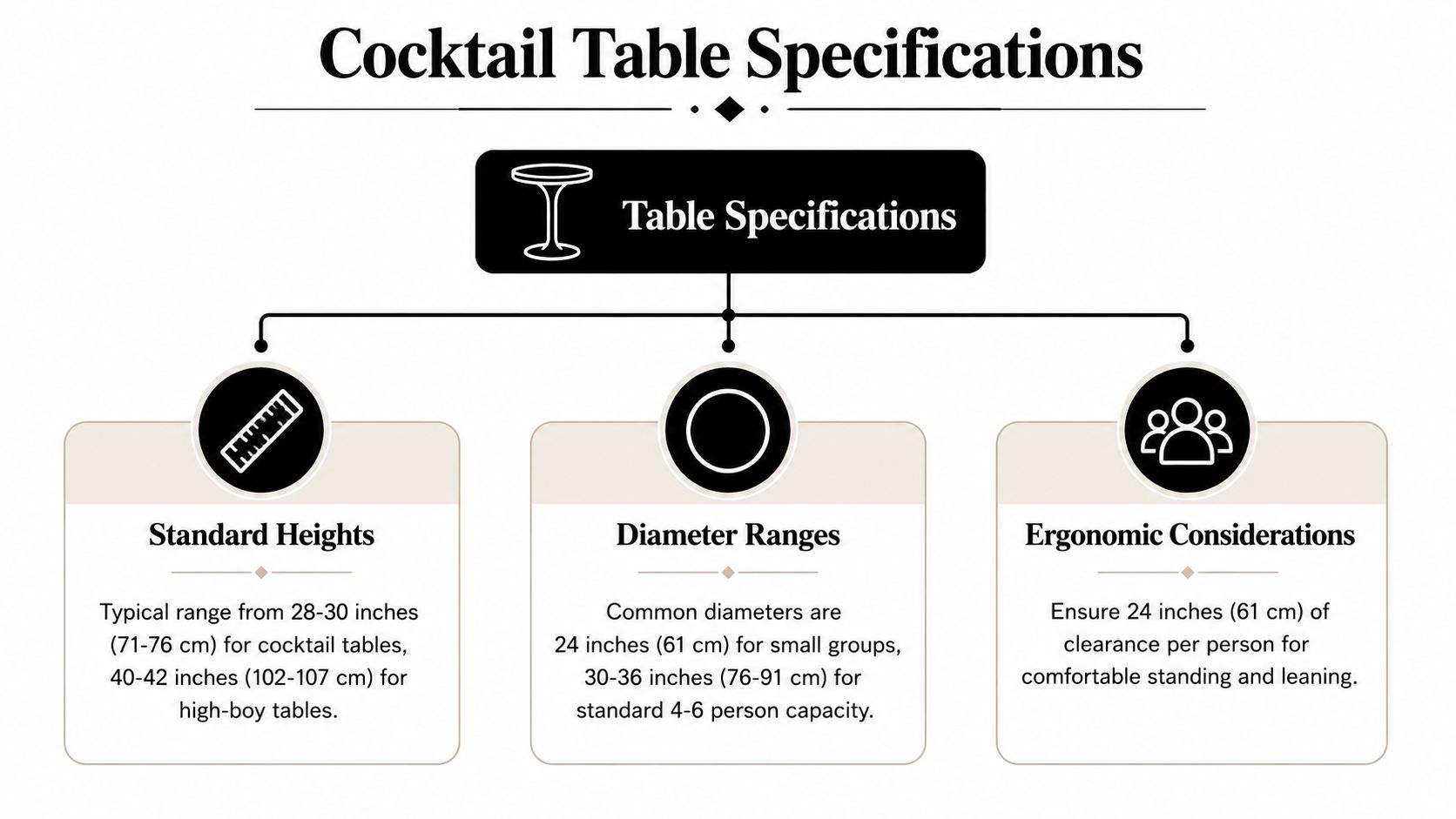
For South African event use, a practical benchmark places cocktail tables at 104–110 cm high, with stools commonly at 75–80 cm seat height, as outlined by South African cocktail table hire guidance. The pairing gives seated guests workable leg clearance while keeping the tabletop at a comfortable standing height.
Start with the height relationship
Measure the tabletop from the floor to its finished surface, then measure the stool seat in the same way. The difference matters more than either measurement in isolation. A stool that's too low forces guests to reach upwards, while a stool that's too high leaves little room for knees and makes getting on and off awkward.
Use these checks before confirming the hire order:
- Table height: Keep the table within the 104–110 cm practical range for a bar-height event format.
- Seat height: Match stools within the 75–80 cm benchmark.
- Leg clearance: Ask the supplier whether the pedestal, foot rail or base obstructs knees.
- Top size: Select a surface large enough for drinks and small plates without encouraging guests to overload the edge.
- Base stability: Prioritise a broad, heavy base over a narrow decorative pedestal.
For a more polished overall setup, clean table tops and pressed linen matter. If your event uses fitted covers or cloth toppers, these laundering table linens tips can help your team understand why fabric care affects presentation and service readiness.
Stability is a venue-safety issue
Tall furniture has a higher tipping risk than low coffee tables, especially when guests lean on a far edge or place a heavy platter away from the pedestal. International testing guidance used in South African furniture procurement specifies that tables above 950 mm are tested with 50% of the normal vertical stability load, applied near the edge furthest from the pedestal to reproduce a difficult tipping moment. See the technical stability specification for the testing context.
That doesn't mean you should calculate a table's exact capacity on site. It means you should ask practical questions. Is the base suitable for outdoor ground? Does the supplier inspect locking mechanisms and foot rails? Can the table cope with normal leaning, or is it intended only for light decorative use?
Treat stability as part of the specification, not a detail to discover during setup.
Materials and Styles for Cape Town Venues
Material choice should follow the venue, weather exposure and event behaviour. A rattan table that looks perfect at a Franschhoek garden wedding may feel out of place at a technology launch in a city gallery. Conversely, polished metal and glass can look sharp indoors but become difficult to manage on uneven grass or in strong coastal conditions.
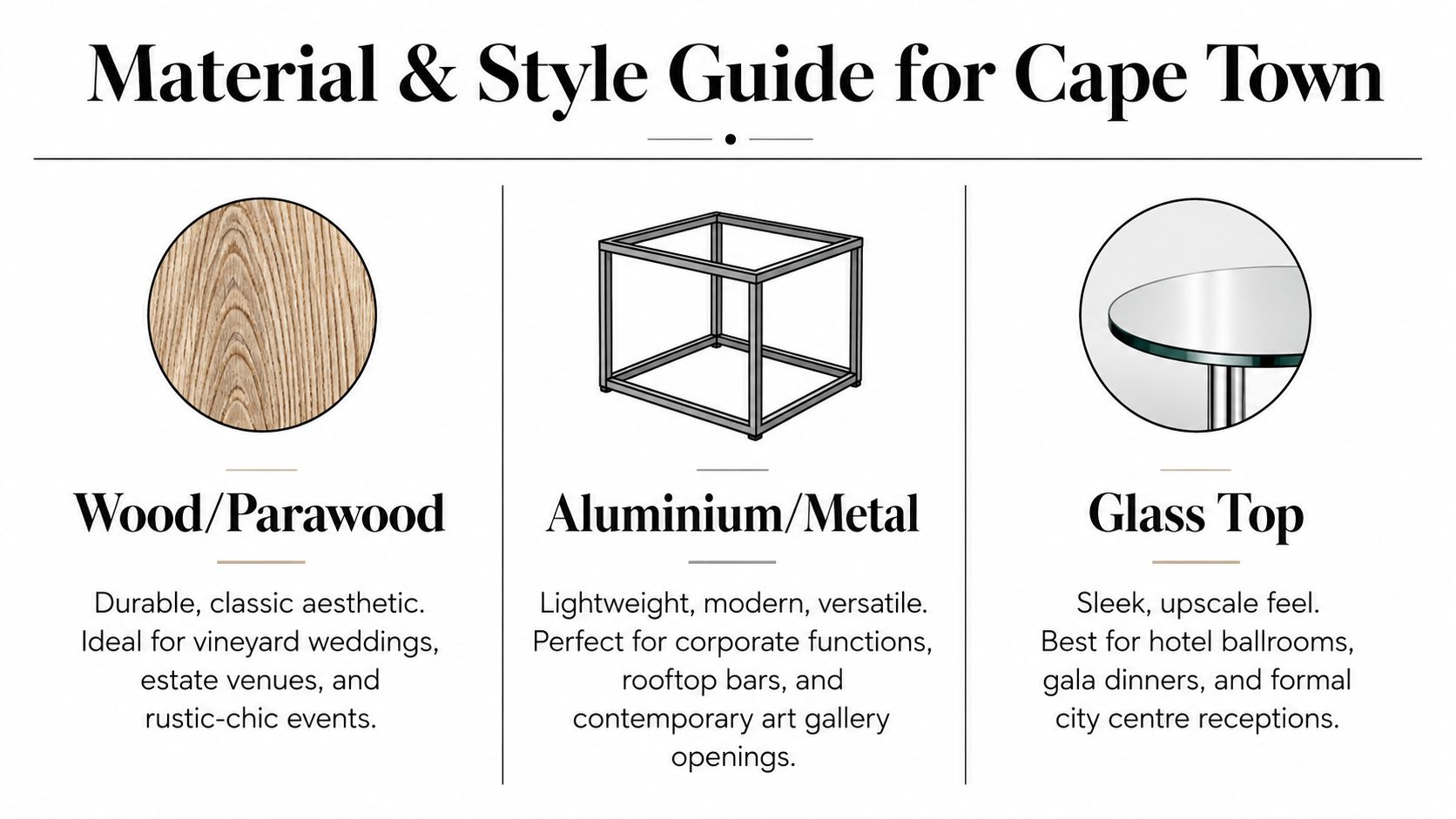
The Cape Town material and style trend guide highlights demand for rattan, woven details and wooden cocktail tables at wine farms and garden weddings. It also describes a shift towards hiring reused pieces instead of relying on disposable décor, alongside stronger demand for eco-conscious materials among corporate clients.
Wood and woven finishes
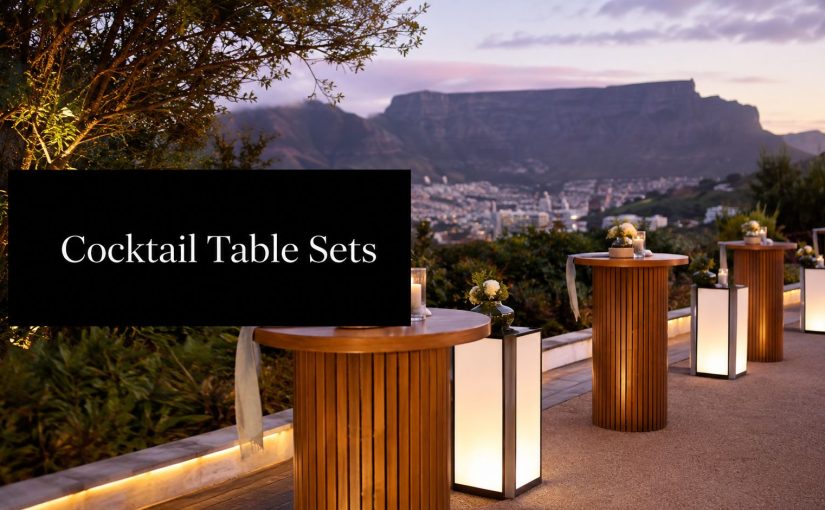
Wood suits vineyard estates, farm venues and outdoor celebrations because it brings warmth into photographs and works naturally with organic surroundings. Parawood and similar timber finishes can support rustic-chic styling, especially when paired with neutral linen, woven stools or simple ceramic details.
Rattan and woven panels add texture, but inspect them carefully before accepting the order. Loose fibres catch clothing, uneven feet wobble on hard surfaces and untreated finishes can deteriorate outdoors. Ask whether the pieces are intended for covered outdoor use and whether the hire company can provide levelers for uneven paving.
Aluminium and other metals
Metal frames are a stronger choice for contemporary corporate functions, rooftop venues and gallery openings. They're visually lighter than chunky timber, easy to combine with brand colours and often simpler for crews to move during a room reset.
A metal cocktail table doesn't have to look industrial. Black powder coating can create a restrained backdrop for a premium brand, while brushed finishes suit modern hospitality spaces. For practical guidance on selecting and positioning metal options, use this guide to metal cocktail tables.
Glass and polished surfaces
Glass tops create a formal, upscale look for hotel ballrooms and city-centre receptions. They reflect lighting well and keep the visual field open, but they require disciplined service. Fingerprints, lipstick marks and condensation show quickly, so the venue needs a cleaning plan during the event.
I'd avoid glass where children, tight crowding or rough outdoor ground create unnecessary risk. For a gala or controlled reception, it can be elegant. For a busy garden party, wood or metal is usually the more sensible choice.
Space Planning and Guest Density Calculations
Most cocktail table mistakes come from counting furniture without counting movement. The table itself is only the centre of the footprint. Guests need room to stand, pull out a stool, turn towards a conversation and pass behind someone holding a drink.
A Cape Town event furniture guide recommends three to four stools per standard round cocktail or poseur table, around 60 cm of space per person, and a 25–30 cm difference between stool seat and tabletop. Use those figures from bar table and chair planning guidance as your starting point, then add venue-specific clearance for service routes and safety.
The simple planning method
Start with the guest count and event format, not the furniture catalogue.
- Standing-only networking: Provide tables as gathering anchors, with stools used sparingly or omitted.
- Mixed mingling: Plan around three to four stools per table, then keep additional guests standing nearby.
- Seated emphasis: Don't force cocktail furniture to do a dining table's job. Add appropriate dining or lounge seating.
A useful working formula is:
Required table sets = guests needing a perch ÷ practical guests supported by each set
For a mixed reception, I'd generally assign each table to its three-to-four-stool configuration, then check whether the remaining standing guests can circulate around the cluster. Don't divide the total guest list by the stool count and assume the result is finished. That produces a room full of furniture and no usable movement.
Requirements by guest count
The table below uses the practical three-to-four-stool configuration. The floor-space figures are planning allowances for the table, stools and immediate guest activity, not a substitute for the venue's measured floor plan.
| Guest Count | Cocktail Tables Needed | Floor Space Required | Stools per Table |
|---|---|---|---|
| 30 guests | 3 tables | Allow space for three active gathering zones | 3–4 |
| 50 guests | 5 tables | Allow space for five active gathering zones | 3–4 |
| 80 guests | 8 tables | Allow space for eight active gathering zones | 3–4 |
| 120 guests | 12 tables | Allow space for twelve active gathering zones | 3–4 |
For a venue with a fixed dance floor, stage or buffet, mark those areas first. Then place cocktail table sets along the edges of movement rather than in the middle of the main route. A set beside a wall can work if guests can still pull out stools. A set beside a service station usually won't.
For broader guidance on finding the right event seating, compare the furniture plan with the event's purpose. The round cocktail table guide is also useful when deciding whether a circular footprint suits your circulation pattern.
Large weddings and corporate functions should reserve tables and chairs two to three months ahead, according to Cape Town hire guidance. That lead time matters most when you need matching finishes, a specific stool style or delivery to Stellenbosch, Franschhoek or Paarl.
Hiring Versus Buying for Cape Town Events
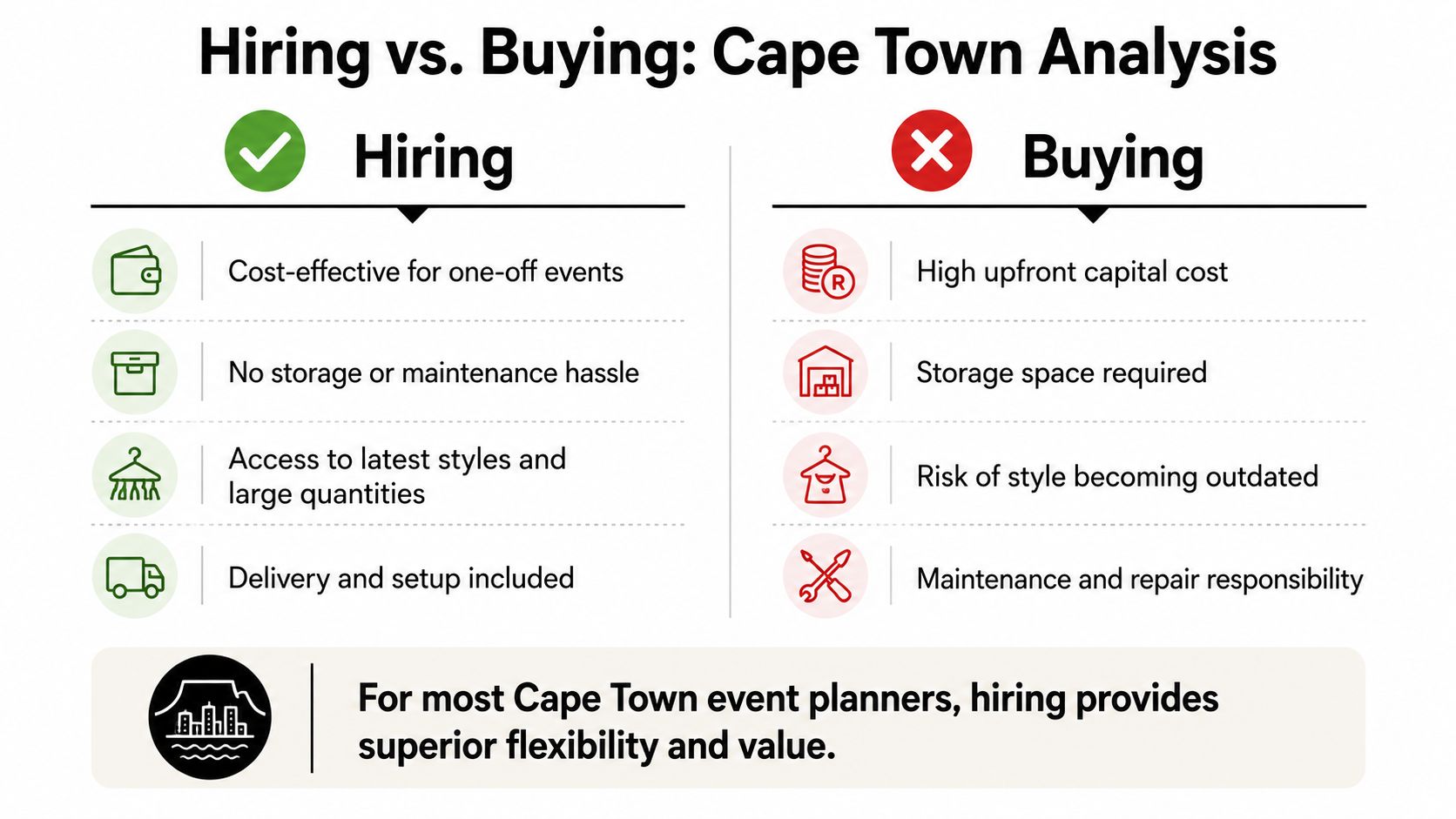
For a one-off wedding, corporate function or private celebration, hiring is the sensible choice. Buying only begins to make operational sense when you have a reliable programme of events, secure storage, transport and staff who can maintain the inventory between bookings.
The local supply base supports that decision. South Africa's furniture industry employed 78,546 people in 2020, contributed about 1.20% to manufacturing GDP and generated estimated turnover of ZAR21.84 billion in the first quarter of 2020, according to Statistics South Africa's furniture industry data. Event furniture sits inside that broader production, import and distribution ecosystem, which helps explain why Cape Town planners can source varied styles through established rental companies.
Buying creates costs beyond the invoice
A purchase price tells you what the furniture costs, not what ownership costs. You also need to account for:
- Storage: Tables, stools, covers and protective packaging occupy dedicated space between events.
- Transport: Tall tables need suitable loading capacity and careful securing to prevent surface damage.
- Maintenance: Wobbly bases, chipped finishes, torn upholstery and stained linen become your responsibility.
- Inventory risk: A style that suits one event may not work for the next client.
- Labour: Your team must load, unload, place, collect and inspect every piece.
Hiring turns those obligations into a defined service arrangement. You can request the quantity and finish needed for a particular floor plan, then return the pieces after breakdown. Confirm whether delivery, collection, setup and removal are included or priced separately.
South Africa's furniture trade is also strongly import-shaped. In 2021, total furniture trade reached US$1.7 billion, with US$1.5 billion in imports and US$163 million in exports, as recorded in the Furniture Industry Masterplan. For event planners, that structure means hire companies can offer imported formats without requiring each client to purchase and store them.
When ownership may be justified
Buying can work for a venue or production company with recurring bookings, controlled storage and a consistent house style. Even then, calculate utilisation carefully. Furniture sitting in a storeroom between occasional events ties up money and requires inspection.
For a practical comparison of the decision, see this guide on whether to rent or own furniture. For most planners, hire provides cleaner logistics and more design flexibility.
Styling Cocktail Table Sets for Different Events
Style should reinforce how guests use the room. A wedding needs warmth and photographs that feel intentional. A corporate function needs brand visibility without turning every table into an advertisement. A private party can take more creative risks, especially after dark.
Weddings in the Winelands
Choose timber, rattan or woven details for vineyard and garden settings. Pair them with natural linen, low floral arrangements and restrained tableware so guests still have room for drinks. Avoid tall centrepieces that obstruct sightlines. People should be able to see across the table and recognise an open place to join a conversation.
Cape Town wedding design is moving towards quiet luxury, organic textures and residential-style lounge elements rather than identical rows of furniture. Use cocktail table sets as part of a mixed composition, with lounge seating near the bar or a shaded rest area instead of repeating the same table everywhere.
Corporate events and brand activations
Start with the brand palette, then choose the finish. Black or brushed metal can support a refined launch, while LED furniture can establish a stronger night-time identity. Keep branded elements focused. A discreet logo on a linen panel or a branded tabletop detail is usually more effective than covering every surface.
Place tables near, but not directly in front of, demonstrations and sponsor displays. Guests need somewhere to talk after engaging with the activation. If refreshments form part of the experience, plan the service point separately. A guide on how to start a hot chocolate stand is useful when a winter function includes a dedicated drinks station.
Private celebrations
Birthdays and milestone parties can use stronger colour, playful lighting and mixed finishes. LED tables work well for evening events, but keep them away from routes where guests carry food or move between outdoor and indoor areas. Use one memorable styled cluster rather than scattering unrelated colours across the venue.
Keep the tabletop functional. A cocktail table covered with oversized décor looks attractive in a photograph but fails once guests arrive. Leave enough clear surface for glasses, small plates and personal items.
Your Complete Cocktail Table Set Decision Framework
Make the furniture decision in this order.
- Map the venue first. Mark entrances, bars, food stations, toilets, stages, dance floors, exits and outdoor transitions. These fixed points determine where tables can safely support circulation.
- Define the event behaviour. Decide whether guests will stand, perch, dine, watch a presentation or move between activities. Don't order stools just because a set includes them.
- Calculate the working quantity. Use the guest count, three-to-four-stool configuration and 60 cm per-person planning allowance as your starting point, then test the arrangement against real routes.
- Match the specification. Check the 104–110 cm table height, 75–80 cm stool height, base stability, surface condition and outdoor suitability.
- Choose the visual language. Timber and woven finishes suit organic Winelands settings. Metal and LED pieces support contemporary corporate work. Glass belongs in controlled, formal interiors.
- Confirm the service. Ask about delivery access, setup, collection, weather exposure, replacement policy, linen condition and damage procedures.
- Reserve early. For larger weddings and corporate functions, secure matching pieces two to three months in advance, following Cape Town booking guidance.
Request a scaled floor plan, not just a product list. A supplier should be able to tell you whether the chosen sets fit around the bar, whether the stools obstruct a route and how the furniture will be loaded into the venue. If they can't answer those questions, you're not ready to sign the hire order.
ABC Hire provides cocktail table hire and cocktail-style seating for weddings, corporate functions and private events across Cape Town and the Winelands. Review the ABC Hire range, share your guest count and venue plan, and ask the team to help place the sets around your real circulation routes.