
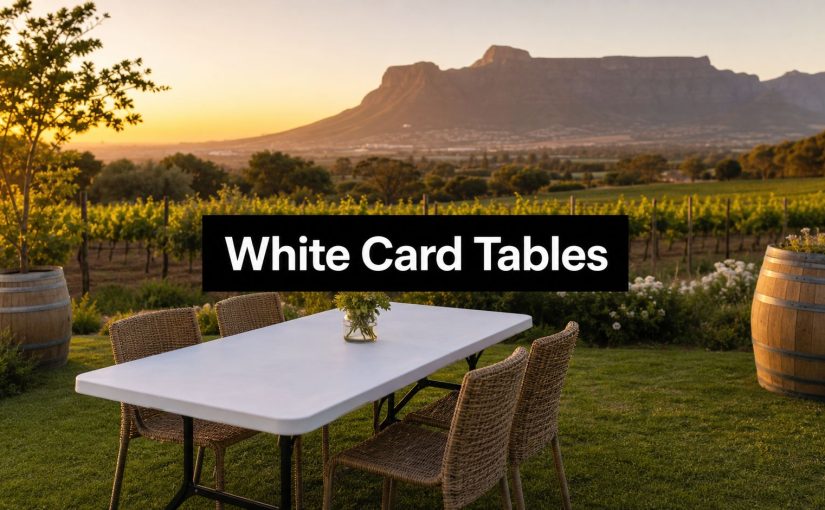
You're standing with a quote open, the venue wants the table plan by end of day, and the client has just asked for a white card table. In Cape Town and the Winelands, that phrase can mean very different things depending on who is speaking. If you use it loosely, you can end up pricing the wrong furniture, planning the wrong layout, or paying for a look that doesn't survive a windy outdoor setup.
The problem starts with language. In South Africa, “white card table” is not a standard furniture classification, and the closest authoritative historical use of white card is tied to construction safety training, while the practical event-furniture category is really a folding table with legs that fold against the top for portability and storage, which is why it suits temporary events so well (white card context, folding table definition). That mismatch is exactly why suppliers pause when the term comes up. They need to know whether the brief is about a hire table, a clean white surface, a foldaway format, or a completely different product altogether.
Why the Term White Card Table Causes Confusion
A Stellenbosch planner can hear “white card table” three different ways in one morning. A bride means a clean, white table for the reception. A junior coordinator thinks of a certification term she's seen online. A supplier, meanwhile, is trying to work out whether the order is for a folding event table or some niche product that doesn't exist in the local hire catalogue.
That's the core issue, the phrase sounds familiar, but it doesn't map neatly onto South African event-furniture language. The available regional evidence points the other way, white card is not a common South African event-furniture classification, and there's limited ZA-specific technical literature attached to that wording. The practical furniture type is the folding table, not a formal “white card table” category (ZA context on white card, folding table as furniture type).
What people usually mean
Most clients are really asking for a table that looks clean, photographs well, and can move from truck to venue without drama. That usually means a white finish, a foldable frame, and a hire-friendly surface that can handle service, décor, and quick turnaround.
A supplier can only quote accurately when the wording matches the use case.
If the brief is vague, you lose time on revisions and risk misunderstanding the size, finish, or shape. If the brief is specific, the conversation becomes simple, do you want a rectangular folding table, a round dining table, or a cocktail-height surface for a standing event?
The best habit is to describe the table by function first, then by finish. Say white folding table for indoor reception seating, or white rectangular hire table for outdoor cocktail service. That wording gets you much closer to a usable quote than the phrase “white card table” ever will.
What a White Card Table Actually Is
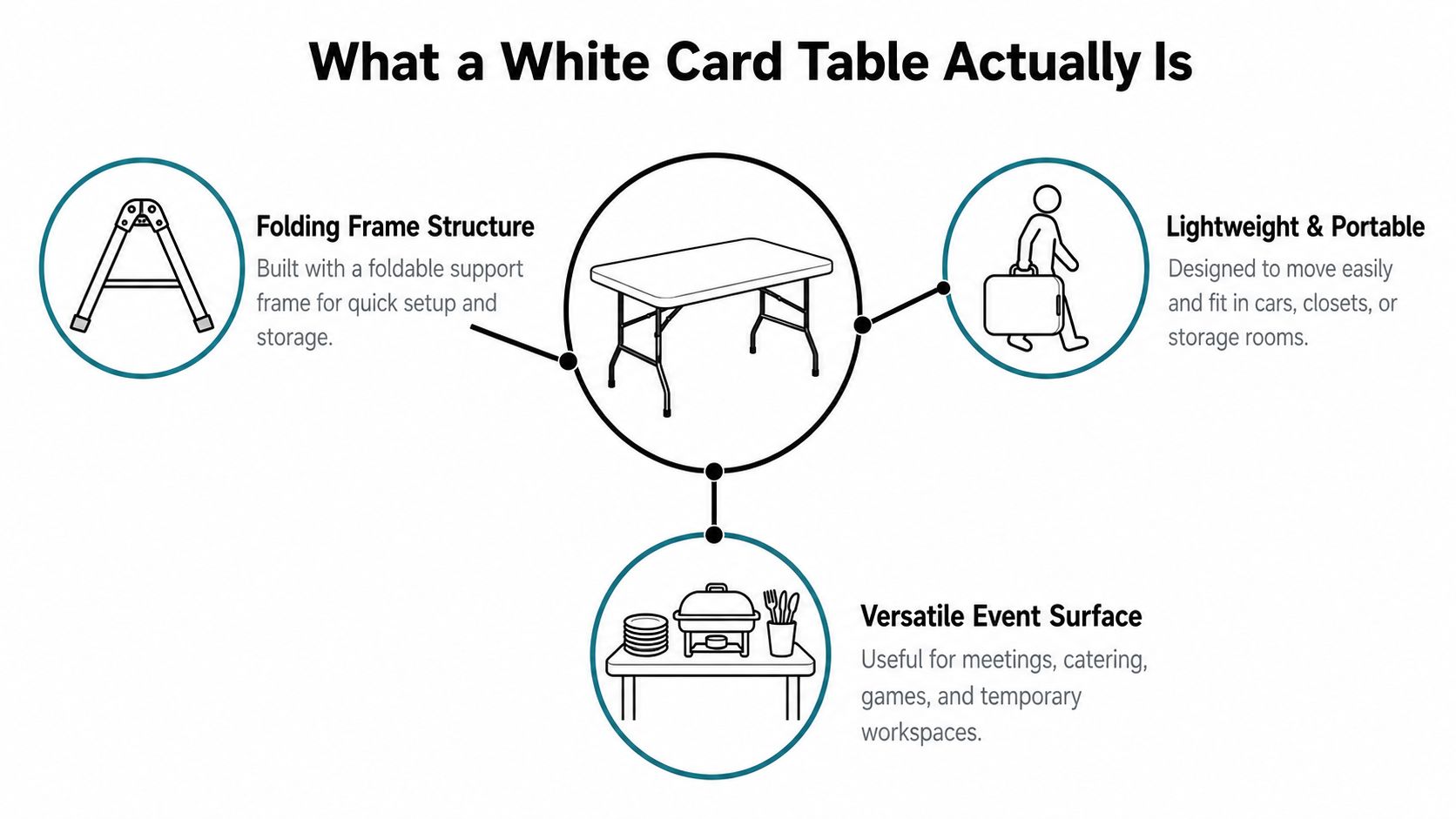
At a Cape Town venue, a client may ask for “white card tables” and mean something very specific, a clean-looking hire table that can be loaded, unfolded, wiped down, and moved again without slowing the run of the event. In practice, a white card table is a white folding table hired for short-term use. It is chosen for presentation, transport, and quick reset, not for permanent installation. The key feature is the foldaway frame, which makes storage, delivery, and turnaround much easier (folding table mechanism).
A working definition you can use with suppliers
If you need to explain it to a venue manager or client, keep it plain. A white card table is a lightweight, hire-ready table with a white finish and folding legs, usually selected for events where the room must be dressed quickly and cleared just as fast.
That definition matters because it separates event furniture from permanent banquet furniture. It also separates a hire table from the old-school plastic trestle look many planners want to avoid. When appearance matters, the white surface helps. When transport matters, the folding frame matters just as much.
A well-chosen table will usually have non-marking feet, a stable locking frame, and a finish that wipes down cleanly after service. Those details do not sound glamorous, but they are the difference between a polished floor that stays spotless and a venue manager phoning you after load-out.
For a simple supplier-facing reference, this folding white table guide keeps the conversation on furniture, not jargon.
What it should do on site
A good hire table should stack neatly in a truck, fit through service entrances, and stand up to repeated handling without looking tired. In other words, the table has to be as practical as it is neat.
Practical rule: if a table is hard to move, hard to clean, or hard to match with the rest of the room, it is the wrong table for event hire.
That is the test. Not whether the phrase sounds fashionable, but whether the table can survive the event day and still be ready for the next one.
If the brief stretches beyond a standard reception layout, a wider rental reference such as find a 10 foot table can help when you are comparing what a venue can physically hold with what a supplier can deliver.
Standard Sizes and Seating Capacity
Most quote mistakes happen because the guest count is fixed before the table plan is. A planner says “120 guests”, then discovers the venue wants wider aisles, the caterer needs service space, and the DJ needs a footprint. The table count changes fast, which is why size matters more than style once the layout starts taking shape.
The sizing conversation that actually helps
For rectangular tables, the common hire conversation usually centres on four-foot, six-foot, and eight-foot tables. For round dining layouts, planners often ask about 1.5 m and 1.8 m rounds. The right answer depends on the event format, plated dinner, buffet, drinks service, or a mixed layout. A longer table gives better line efficiency, while a round table is easier for guest conversation and softer room flow.
If you're checking size options against longer layouts, it can help to look at a broader rental reference such as find a 10 foot table, especially when you're comparing what a venue can physically hold versus what a supplier can deliver.
A guest count is not a table plan. It's only the starting point.
A practical rule is to add one extra table for the things that always appear late, cake, gifts, a signing point, or a DJ stand. That small buffer saves you from cannibalising guest seating on the day.
White Card Table Sizing at a Glance
| Table Size | Seated Dinner | Buffet / Drinks | Best For |
|---|---|---|---|
| Four-foot rectangular | Small groups, side seating, tighter room plans | Service stations, bar support | Breakout areas, cake, gifts |
| Six-foot rectangular | Balanced guest seating, standard banquet use | Drinks tables, food support | Weddings, conferences, school functions |
| Eight-foot rectangular | Larger seated sections, long table runs | Efficient buffet lines | Banquets, long halls, tight logistics |
| 1.5 m round | Conversation-led dining | Shared drinks tables | Smaller wedding tables, formal dinners |
| 1.8 m round | Fuller guest tables, more social spacing | Lounge-adjacent drinks setups | Larger weddings, gala dining |
The table above works as a quote check, not a rigid formula. A seated dinner wants more chair clearance than a buffet. A drinks reception wants table surface and circulation, not deep seating. The shape and service style decide how far one table stretches.
If you're unsure, sketch the room with the venue's doors, pillars, and buffet stations first. Then work backwards from guest movement, not just guest numbers.
Choosing the Right Shape for Your Event
Shape changes the mood of a room long before flowers or lighting do. A round table feels sociable and settled. A rectangular table feels structured and efficient. A cocktail table changes the event entirely, because it turns the room into a standing, moving space rather than a seated one.
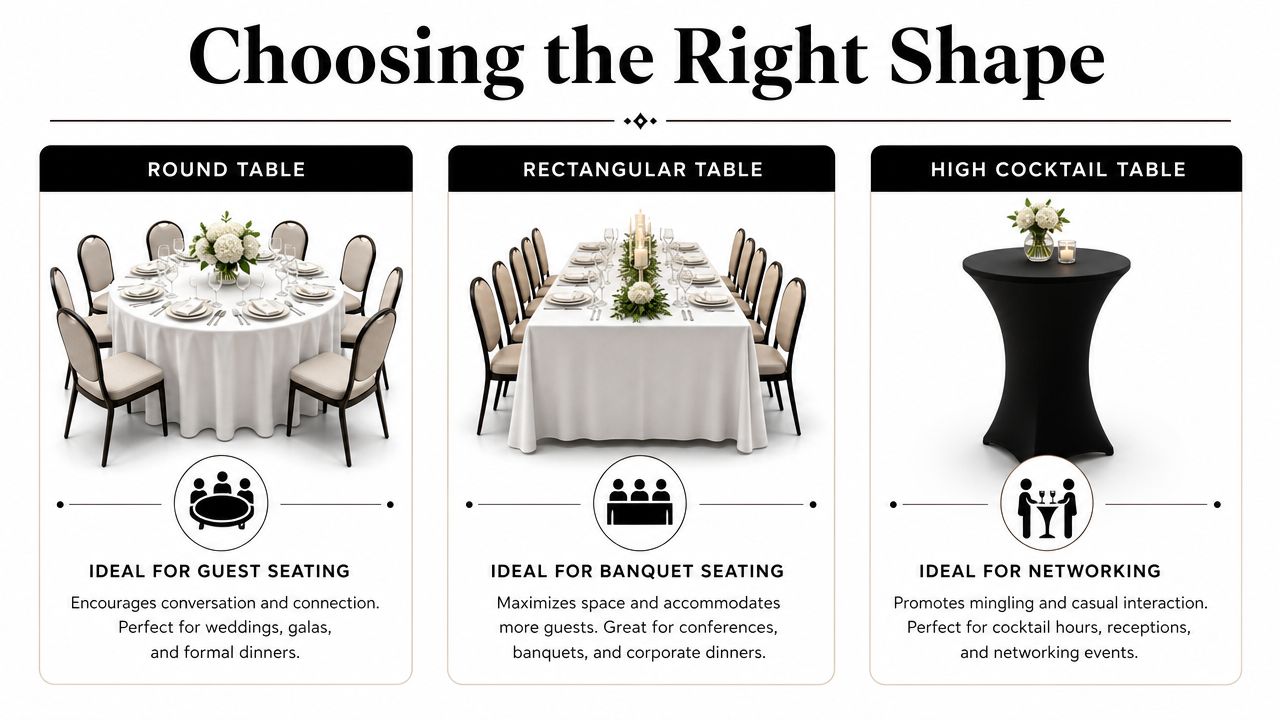
Round, rectangular, and cocktail-height tables
Round tables are still the safest choice for traditional Winelands weddings, especially when the room leans formal and the guest list includes mixed-age family groups. People can talk across the table more easily, and the room often feels softer. That works well for plated service and for venues where the décor is doing a lot of visual heavy lifting.
Rectangular tables suit long banquet halls, conference setups, and tighter spaces where every metre counts. They also work well for school functions and matric dances where you want the room to read clearly from one end to the other. In those spaces, rectangular tables make service simpler because staff can move along straighter runs.
Cocktail tables are different. They're the right choice for corporate activations, launches, networking evenings, and receptions where people are meant to circulate. They reduce seating pressure and keep energy moving near bars, sponsor walls, and product displays.
Shape changes styling and staffing
The shape you choose affects linen, centrepieces, and even how many staff you need on the floor. Round tables need a different drape and a centrepiece that can be seen from every side. Rectangular tables favour runners, repeated décor elements, and cleaner lines. Cocktail tables work best with minimal styling, since clutter defeats the purpose.
White tables are easier to brand visually, but they also show every decision you make. Clean lines look deliberate. Heavy styling looks crowded.
For a more décor-led reference, the ideas in decor on table help when you want to see how shape and styling work together.
The right shape is the one that matches the event's social behaviour. If guests must sit and dine, choose accordingly. If they need to stand, talk, and move, don't force a dining table into a networking format. That's how rooms feel awkward even when the furniture is technically correct.
Setup, Transport, and Cleaning in Cape Town Conditions
A white surface looks elegant in photos, and it also exposes every handling mistake. Dust shows up fast. Wine shows up faster. So does uneven ground, especially at estates where lawns slope slightly or the paving doesn't run perfectly level.
What happens before guests arrive
On grass, the table needs to sit flat enough that glasses don't wander and crockery doesn't wobble. On stone or tile, non-marking feet matter because polished surfaces show scratches and scuffs long after the event ends. On wooden decks, weight distribution matters more than it looks like it should, especially when the table is loaded with glassware, candles, or heavy centrepieces.
If the venue sits in the Winelands, narrow service access can become a significant bottleneck. Older driveways in Franschhoek and similar estates don't always welcome large delivery vehicles. That means the supplier needs a clear off-load plan before the truck arrives, not after.
Cleaning without ruining the finish
The white finish is forgiving only if you act quickly. Blot spills instead of rubbing them, because rubbing pushes colour deeper into the surface or spreads the mark across the table top. Wine, sauce, and dessert spillages need immediate attention, especially in high-turnover formats where the same stock may go back out the next day.
Here's the operational truth:
- Protect the floor first: use feet that won't mark polished surfaces or decks.
- Level the table second: use shims where lawns or paving fall away.
- Clean early: blot spills while they're fresh, before they set.
- Load carefully: stack and strap tables so the edges don't chip in transit.
The visual upside is real, but the table only stays attractive when handling is disciplined. That matters more in Cape Town weather, where wind, dust, and outdoor service can turn a neat setup into a messy one very quickly.
Styling a White Card Table for Weddings and Corporate Events
A white table is a blank canvas, but it's not a neutral object. The finish changes how linen reads, how candlelight bounces, and how much colour the rest of the room needs. If you style it well, the table disappears into the design. If you overwork it, the room starts to feel busy.
Weddings, galas, and matric dances
For a Winelands wedding, a white surface pairs well with soft linen, simple florals, and candle groups that sit low enough for conversation. Bare white tops can look modern, but they need disciplined styling, because every charger plate and glass becomes more visible against the clean surface. For a more traditional feel, a linen layer gives the table a softer edge.
Corporate events are different. They usually call for sharper branding, cleaner geometry, and less visual clutter. Branded napkins, small sponsor cards, and tidy cable management around AV gear keep the table looking intentional rather than improvised. The white surface helps the branding stand out without fighting the room.
School matric dances sit somewhere in between. Theme colours matter, but they need to be applied with control so the room feels festive, not chaotic. Bold tableware, simple runners, and coordinated chair dressing usually work better than trying to make every surface speak at once.
Styling combinations that hold up
- Winelands wedding: linen, low florals, candles, and layered glassware.
- Corporate gala: branded stationery, geometric décor, and restrained colour accents.
- Matric dance: theme-driven tableware, confident colour blocks, and simpler centrepieces.
A white table also changes how light behaves in the room. That's useful in bright outdoor settings, because the surface doesn't fight the venue's natural light. It's also a reason planners like it for camera-heavy events where the backdrop needs to stay clean and consistent.
For more table-dressing ideas, the notes in table décor guidance sit well alongside the practical styling choices above.
The main decision is whether the table is carrying the styling or supporting it. When the room already has strong décor, keep the table quiet. When the room is plain, let the table work harder through linen and texture.
Renting White Card Tables in Cape Town and the Winelands
Buying is rarely the right answer for event furniture. Tables need storage, transport, maintenance, and repeat cleaning, which is why most planners treat them as a rental decision. The central question is how cleanly the supplier can deliver, collect, and support the event without creating extra work for the coordinator.
What to ask before you book
A standard hire quote should be clear about the table type, finish, quantity, delivery window, and collection terms. It should also tell you what happens if the venue has access constraints or if the table returns with damage. If any of that is vague, ask for the wording in writing before you pay.
Local logistics matter a lot in Cape Town, Stellenbosch, Franschhoek, and Paarl. A Cape Town depot may offer broader stock and easier substitutions, while a Winelands supplier can be better for shorter travel time and venue familiarity. Neither option is automatically better, but each one shifts the balance between convenience and cost.
Reliability signs that matter
- Stock condition on view: ask to see current furniture condition, not old marketing images.
- Contract clarity: check delivery, collection, and damage wording carefully.
- Venue fit: confirm that the supplier has handled similar surfaces and access routes.
- Communication speed: slow responses before booking usually stay slow after booking.
A dependable rental partner makes the process feel boring, and that's a good thing. The truck arrives on time, the tables match the quote, and the load-out happens without a last-minute argument at the gate.
For a broader rentals reference, tables and chair rentals is useful when you're comparing furniture categories and planning a full event order rather than a single item.
Quick Checklist Before You Confirm Your Quote
Check the table shape, table size, and guest count against the actual room plan, not just the invitation list. Confirm the venue surface, grass, stone, deck, or polished floor, because that changes setup and protection requirements. Ask the supplier how delivery, collection, and any damage rules are handled in writing.
Then verify the styling extras, linen, runners, and centrepieces, so the table matches the rest of the event instead of sitting there unfinished. If the venue has narrow access, limited parking, or an awkward off-load point, say so before the truck leaves the depot. The best quote is the one that still works when the tables reach the site.
ABC Hire supplies event furniture that fits real Cape Town and Winelands conditions, from clean white tables to full seating setups that hold up in weddings, corporate functions, and private celebrations. If you need a rental partner who understands layout, transport, and presentation, visit ABC Hire and plan the table order with a team that does this every week.