
You've got the booking in hand, the venue has sent the floor plan, and someone has already asked, “Do we need one urn or two?” That's the Cape Town question. On paper, an urn water boiler looks like a simple hire item. In practice, it decides whether tea service runs cleanly in a Stellenbosch hall, whether the kitchen trips a circuit in the middle of pre-function drinks, and whether guests queue for hot water while the DJ is already loading in.
The smartest planners treat the urn as logistics, not décor. A good choice starts with capacity, then power source, then where the thing will sit without blocking staff or guests. That order matters in the Winelands because the venue rarely gives you perfect power, perfect access, and perfect storage all at once. If you want a broader event-planning lens before you lock the hire list, Creventa event management insights is a useful read on how coordination decisions shape the whole service flow. For a complementary rental option when you want chilled water without tying up your hot drinks setup, see ABC Hire's water dispenser rental guide.
Why Your Cape Town Event Needs the Right Urn Water Boiler
A Friday afternoon wedding in Stellenbosch is the kind of job that exposes weak planning fast. The welcome drinks are done, the first guests are through the gift table, and then the urn empties before the coffee station has even settled into service. Staff start improvising with kettles, the line builds, and the venue manager looks at the same urn as if it personally betrayed them.
That failure usually isn't about the appliance being “bad”. It's about buying or hiring the wrong size, the wrong power source, or placing it where the team can't reach it quickly. The urn water boiler is one of those background decisions that looks minor until hot drinks become the bottleneck everyone notices.
The real job of the urn
An urn is there to keep hot water moving at the pace of your event, not to sit pretty on a buffet. The closest historical cousin is the samovar, a metal urn with a spigot used to boil water for tea. Britannica describes it as a brass urn widely used in Russia, and historical overviews note that by the 18th century it had become a standard domestic appliance in Russian tea culture, helping tea spread beyond elite settings. That history still makes sense today because tea service is about repetition, speed, and reliability, not ceremony alone.
Practical rule: if guests can reach the urn faster than staff can refill it, the setup is already wrong.
Cape Town planners also have to think like logistics people, not appliance shoppers. The event might be in a vineyard, but the service constraints are still basic. You need enough hot water for the wave of guests, a circuit that can cope, and a plan for what happens if the power blinks during service.
Why this matters in our market
South Africa's households, hospitality operators, and event teams still rely on boiled-water appliances for tea, instant beverages, and service stations, so the demand is very real. That makes the urn less of a luxury and more of a working tool in venues where tea and coffee are expected to flow without drama. Modern water-boiling equipment evolved from early domestic heaters into today's electric urns and boilers, and that shift matters because these units are built to hold water hot on demand rather than forcing staff to keep reboiling smaller pots. The old British water-heater history notes that Benjamin Waddy Maughan patented the first domestic water heater in 1868 and later designs moved toward electric and thermostatic models that maintain temperature more efficiently. That's the logic you want on event day.
Sizing an Urn Water Boiler to Your Guest Count
The easiest mistake is sizing for the total guest list instead of the actual tea and coffee moment. Not everyone drinks hot beverages at the same time, and not every event treats the urn as the only hot-water source. In Cape Town, I size for the service window, the beverage mix, and whether the venue is also pulling hot water for prep or dishwashing.
Use the service rhythm, not just the headcount
For an 80-guest wedding, one well-sized urn usually works if tea and coffee are served in a managed station, not a free-for-all. If the ceremony rolls straight into dessert and the buffet is slow-moving, I'd rather see a little buffer than a unit running dry halfway through the first round.
For a 150-guest matric dance, I'd push harder on recovery and queue control. Teen events move fast, staff need to refill quickly, and hot chocolate often becomes part of the mix. Two smaller urns often make more sense than one oversized unit because they split pressure across stations and give you a backup if one is out of action.
For a 250-guest corporate breakfast, I'd look at multiple service points or a larger-capacity hire because the bottleneck is usually the first 20 minutes. That's where people want coffee immediately, and the urn has to cope with repeated draws without turning the catering table into a waiting room.
Practical rule: if the urn will be shared by guests and back-of-house prep, don't size it at the edge. Give yourself buffer or hire a second unit.
| Urn capacity by guest count and beverage mix | |||
|---|---|---|---|
| Guest count | Service style | Recommended capacity | Buffer rule |
| 80 guests | Wedding tea and coffee station | One medium urn | Add buffer if dessert service is delayed |
| 150 guests | Matric dance or formal event | Two smaller urns | Split service points to reduce queues |
| 250 guests | Corporate breakfast | Larger combined capacity or two units | Keep one unit for front-of-house, one for backup |
| Mixed-use venue | Guests plus prep water | Step up one size | Don't share the same urn across every task |
The cleanest decision rule is simple. If the urn is only serving a seated group, size to the guest wave. If it's feeding a moving crowd, size for speed and duplication. If the venue is asking one unit to do everything, hire another one.
Electric vs Gas Urn Water Boilers for Indoor Venues
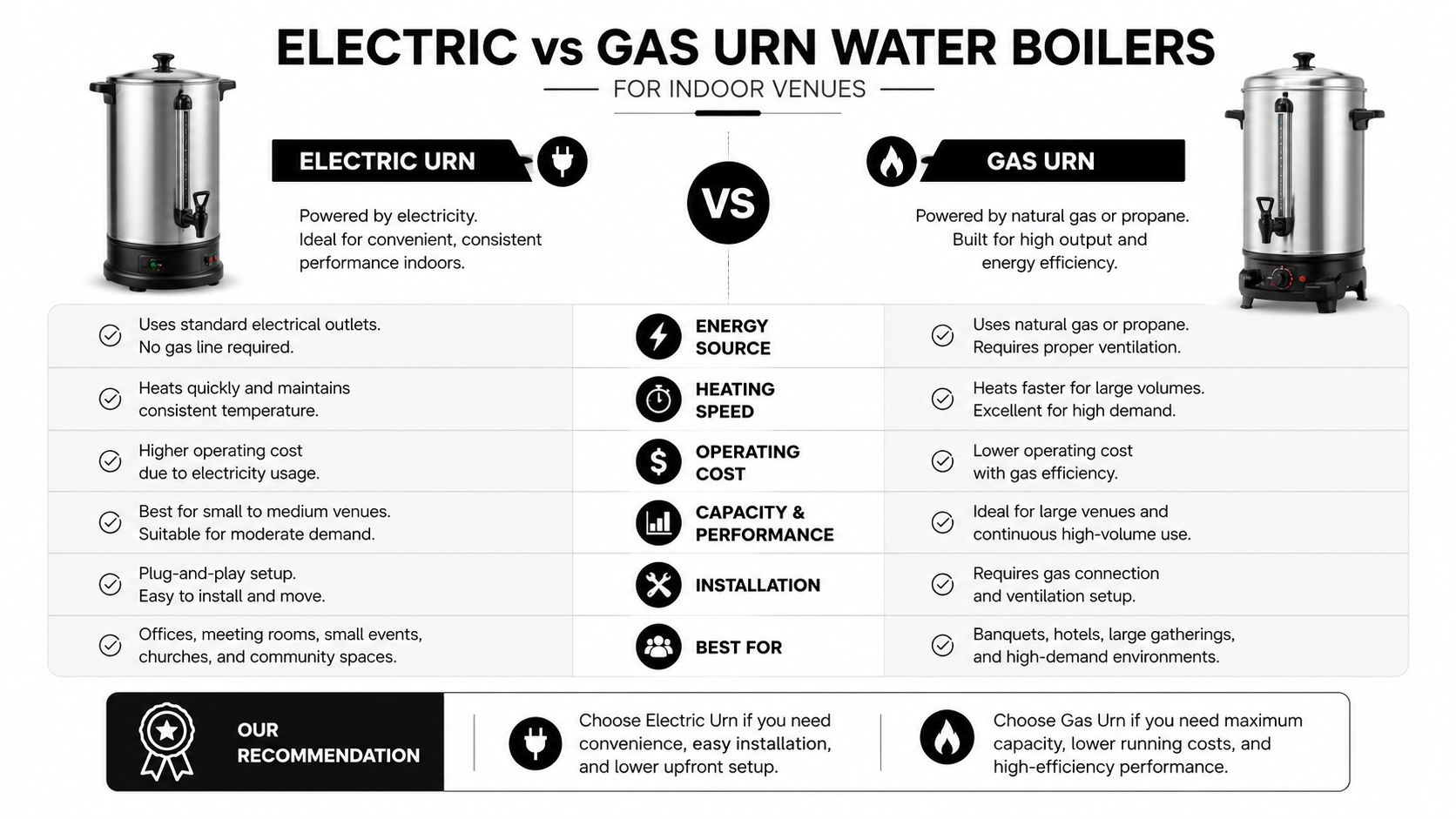
Electric is the default for most Cape Town venues because it is simple, familiar, and easy to place near a service table. Gas earns its keep when the venue is outdoors, the power is unreliable, or the event runs long enough that you want a different operating cost profile and less dependence on the building's circuit. That's the short version, and for most indoor functions it's the right version.
Where electric wins
Electric urns are the safer request for indoor halls, hotels, and corporate spaces that already run a managed service load. Staff know how to plug them in, venues usually understand them, and they fit better into normal catering layouts. For a planner, that means fewer questions at setup and fewer surprises when the venue supervisor walks the floor.
The weak point is obvious. Electric urns depend on venue power, and that means you have to think about what else is on the same circuit. If the function already has heating, lighting, screens, or kitchen kit pulling power, the urn can become part of a bigger problem instead of a standalone solution.
Where gas makes sense
Gas is the stronger choice for outdoor service, fringe venues, and event plans that can't afford to gamble on a building circuit. It also makes sense where the service window is long and the venue is trying to keep electrical load down. If you're comparing it with other flame-based equipment, ABC Hire's gas stove plates guide gives a useful sense of how planners think about gas as a practical back-up option.
The downside is not subtle. Indoor air quality, venue approval, and safe placement matter more with gas than with electric. You need competent staff, a sensible location, and a venue that is comfortable signing off on it.
The venue decision point
Ask the hire company one direct question. Will this be used indoors with normal guest traffic, or is this an outdoor or power-sensitive setup? If the answer is indoor and stable, request electric. If the answer includes outdoor, off-grid, or uncertain power, put gas on the table early rather than at the eleventh hour.
A small, useful distinction matters here. Electric gives you convenience. Gas gives you flexibility. The better option is the one the venue can safely support without turning tea service into a compliance discussion.
Setting Up, Operating, and Servicing From an Urn
The setup starts before the first plug goes in. I want the venue walk-through done with the urn's final position in mind, because moving a full unit later is the sort of mistake that creates spills, delays, and unnecessary heat exposure for staff. The goal is a straight service path from kettle point to cup point, with no guest traffic cutting across it.
Morning of the event
Put the urn where the catering team can reach it without threading through the guest line. Keep it close enough to the serving station that staff don't waste steps, but far enough from the edge of a buffet that people won't brush against the body or spout. If the venue floor is awkward, use a clear, stable table and check that the cord won't sit in a walkway.
If you want a practical operations framework for event crews, Ticketsmith's event execution and operations guide is worth a look. The best teams always treat the hot-water station as part of the service map, not an isolated appliance.
Staff should never fill an urn and walk away from it without checking the level, the lid, and the spout position.
Filling and first boil
Fill the urn before power-up, never after. That protects the element and keeps the first heat cycle clean. Once it's on, give the team a clear rule on the first pour, because guests always seem to arrive just as someone is still testing the temperature.
When service starts, assign one person to monitor the water level and one person to handle drinks if the station is busy. That split keeps the urn from being overfilled, underfilled, or left with a dry element risk when the table gets busy. If the event is large, a drip tray underneath is not optional in my book. It keeps the floor cleaner and stops small spills from becoming a slip hazard.
During service
Keep the urn away from children, tight corners, and guest congregation points. The steam and metal surface are ordinary workplace hazards if staff ignore them, and they are much more manageable when the unit has breathing room. Cords should be routed cleanly and secured, not left hanging where a waiter can catch a foot.
For cleanup, don't yank the spigot or twist the lid while the unit is still hot. Let the team finish the service run, then cool it properly before draining. That's basic event discipline, and it saves the hire company from avoidable damage and the venue from avoidable mess.
Load-Shedding and Power Planning Around the Urn
At a Cape Town venue, the urn is only as reliable as the power plan behind it. If the lights go out, hot drinks service stops, and nobody cares that the urn looked perfect on the prep table. That is why I treat load-shedding as a logistics problem first and an appliance choice second.
The practical question is simple. Can this urn keep working through the service window, or do we need a fallback that survives a power cut?
Match the urn to the outage window
For a short service window, an electric urn can do the job if the venue has stable backup power or the drinks round is finished before interruptions start. That suits compact corporate functions where tea and coffee go out in one controlled push, then the station closes down.
For longer weddings and dance-floor events, I would not trust electric alone unless the venue has proper backup capacity. A gas urn on standby changes the plan immediately because it gives you a service path that does not depend on the building supply. That matters when speeches run late, guests arrive in waves, or tea service gets pushed back by the program.
For larger or premium events, build inverter or generator support into the quote if the venue's power record is patchy. Tariff pressure matters too, because a long-running electric urn is not background noise on the bill. For context on how much power these units draw, see understanding coffee maker power and electrical requirements. Local planning beats guesswork every time.
The clean rule is this. If the urn only needs to stay hot for a short, controlled window, electric is usually fine. If the service overlaps with uncertain power, use gas or backup power. If the event is large, long, and guest-facing, put redundancy into the plan before the first crate leaves the depot.
What to ask before you sign off
Use this as a one-page venue check.
- Confirm power stability: Ask whether the venue has had load-shedding interruptions during similar functions.
- Check backup options: Confirm whether the site can support an inverter, generator, or gas fallback.
- Measure circuit pressure: Make sure the urn is not sharing a weak line with other heavy-use equipment.
- Plan the serving window: Decide how long the urn has to stay hot without interruption.
- Place safely: Keep the unit out of traffic and away from ad hoc extension runs. If you need a reference on cable planning, ABC Hire's 20 m extension cord guide is a practical companion.
The right question is not “Can we plug it in?” It is “Can we keep serving if the power shifts during the busiest 20 minutes?”
Cleaning, Descaling, and Returning the Urn in Hire Condition
The end of the event is where small mistakes become invoice items. Staff are tired, the final sweep is rushed, and someone thinks the urn can be left for “later”. That's how deposits get threatened. Treat the return process like a handover, not a mop-up.
Straight after service
Drain the urn only when it has cooled enough to handle safely. Don't tip it aggressively and don't try to rush the last bit of water out by tilting it onto a fragile table. Wipe the outside once the metal is no longer hot enough to burn a hand, then check the lid, tap, and base for spills or residue.
If the water was hard or the event was long, descale it before the next hire cycle if the hire company expects that from you. Limescale is the quiet enemy of urns because it builds up on heating surfaces and makes the unit work harder than it should. A proper rinse, a descaling pass where permitted, and a final dry wipe are the difference between a returned item and a problem item.
Before the pickup
Inspect the body, spout, cable, and plug for visible wear. Photograph any pre-existing marks before the team starts loading it, especially if the urn arrived with a dent or a scuffed base. That photo habit is not about being difficult. It protects you from arguing about damage that was already there.
Common avoidable charges usually come from three places. The urn is returned still wet, the cable is twisted or left dirty, or the unit is handed back without the accessories it came with. I'd also check the drip tray and lid separately, because those are the bits people misplace when they're clearing an event fast.
Handover checklist
- Drain fully: Make sure no standing water is left inside.
- Dry the exterior: Wipe off moisture before loading.
- Pack all parts together: Keep lid, drip tray, and cable with the unit.
- Photograph condition: Save a clear image of the urn before pickup.
- Flag issues immediately: Tell the hire company about any fault before the truck leaves.
A clean return keeps the relationship simple. It also means the next planner gets a serviceable urn instead of one that needs attention before it ever reaches a venue.
If you're planning a wedding, corporate breakfast, matric dance, or brand activation in Cape Town or the Winelands, book your hot-water and event hire early with ABC Hire. They're set up for the practical realities that matter here, from venue constraints to load-shedding-friendly planning, and they'll help you choose equipment that works reliably on the day.