
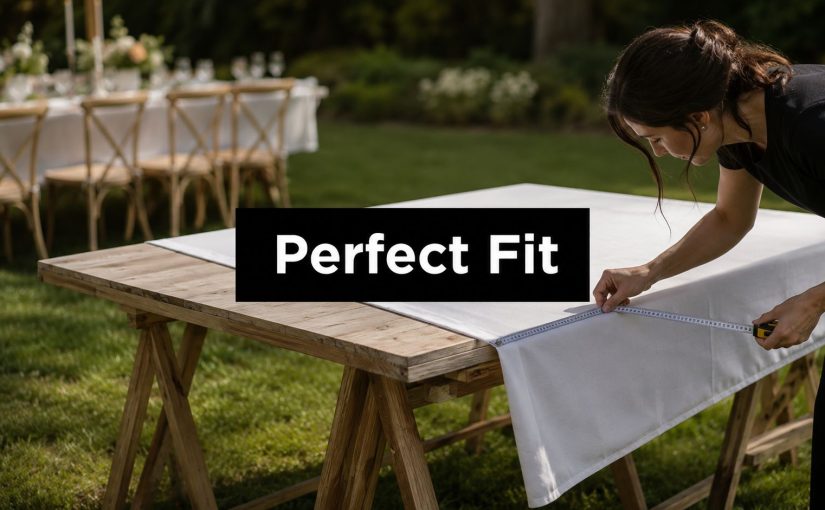
You're standing in a Cape Town venue with the tables delivered, the florals ready, and a stack of cloths that looked “about right” in the catalogue. Then the first cloth goes on. The trestle legs show, the front edge hangs unevenly, and the wedding breakfast suddenly looks like a warehouse setup.
A trestle table cloth is easy to choose once you stop guessing. Start with the standard local footprint, about 180 cm long, 76 cm wide, and 76 cm high, then decide whether you want a practical half-drop or a formal full-drop. From there, fabric, finish, laundering, and hire-day handling become straightforward decisions.
Why the Right Trestle Table Cloth Matters
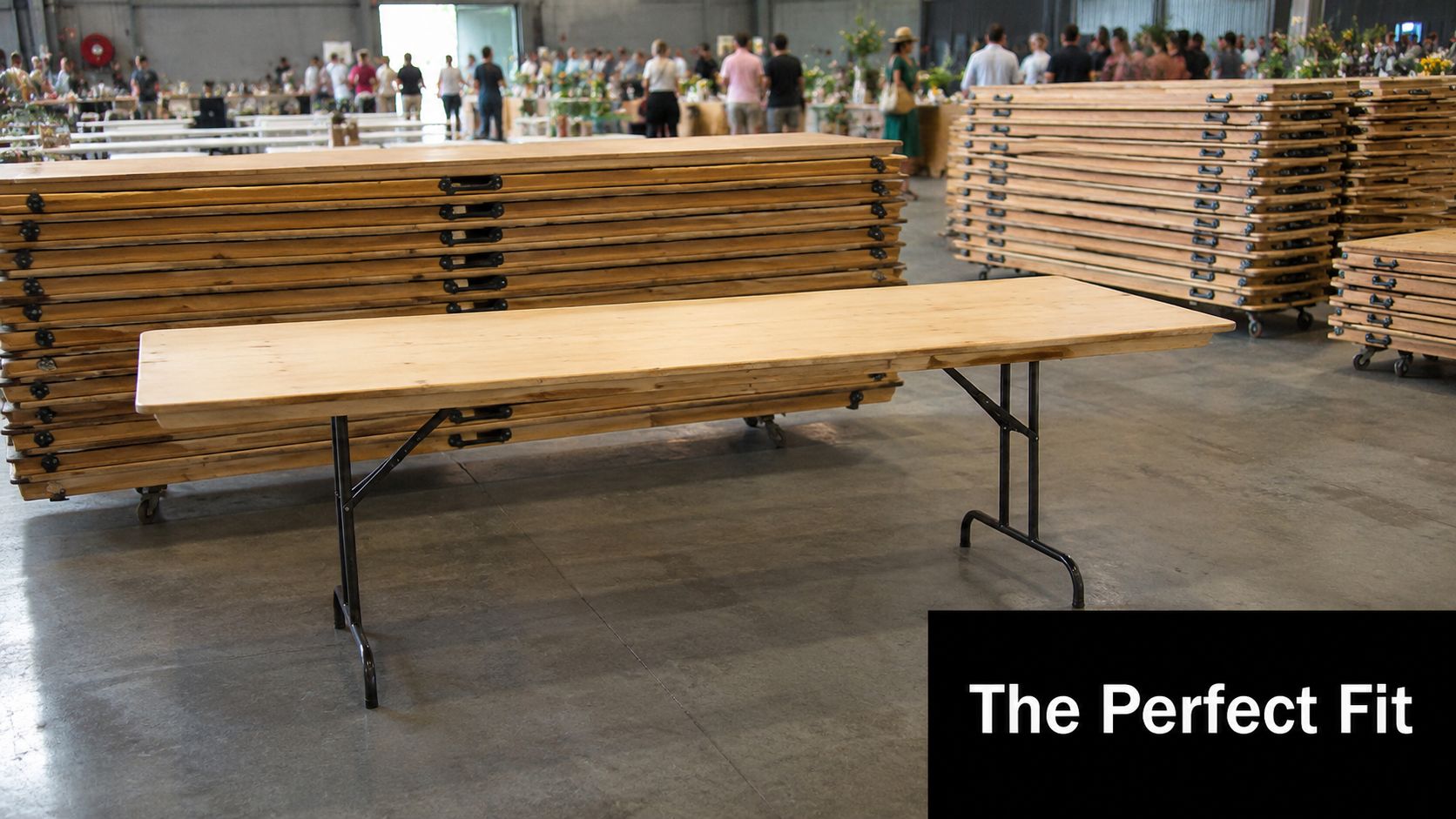
A standard trestle table gives you a useful starting point. South African event guidance commonly uses a rectangular trestle measuring 180 cm by 76 cm, with a height of 76 cm. That fixed footprint means your main styling decision isn't the table itself. It's the amount of fabric you want falling from the tabletop.
A short cloth can work on a buffet where guests need clear access to the frame, but it can look unfinished on a formal dining table. If the cloth stops high above the floor, guests may see folding legs, braces, or uneven table edges. A longer cloth hides the structure and makes the table read as one deliberate surface.
Start with the table, not the catalogue
Measure the tabletop, choose the drop, and only then select a cloth. The common mistake is buying a nominal “banquet” cloth without checking how it will sit on your actual trestle. A cloth that looks generous on a round table can expose the folding frame on a rectangular one.
For Cape Town weddings, corporate functions, and school formals, I'd make the drop decision before spending time on colour or overlays. A half-drop keeps the setup practical and gives chairs and guests better clearance. A full-drop creates a cleaner formal line and photographs better from the side.
If you're arranging tables through a local supplier, you can also review ABC Hire's trestle table hire guide to confirm the table type before ordering linen. The cloth must follow the table you're receiving, not the table you assumed was in the booking.
Practical rule: If guests will see the long side of the table in photographs, choose the drop for that view first.
South African sizing guidance gives roughly 40 cm of side drape as a minimum and about 15 cm per side as a tighter modern maximum, with end drape ranging from approximately 50 cm to 30 cm depending on the intended look. Local table-linen sizing guidance reinforces the important point: fit depends on the table footprint and the target drape, not the label on the packaging.
Measuring Your Trestle Table the Right Way
Take a steel tape measure to the venue or warehouse. A fabric tape can stretch and leave you working with an inaccurate measurement, especially across the long edge. Measure the tabletop only. The legs, braces, and folding mechanism don't belong in the cloth calculation.
For the common Cape Town hire trestle, record:
- Table length: 180 cm
- Table width: 76 cm
- Table height: 76 cm
Write those figures down with the event name. Don't rely on memory at load-out, particularly when several table styles are being collected at the same time.
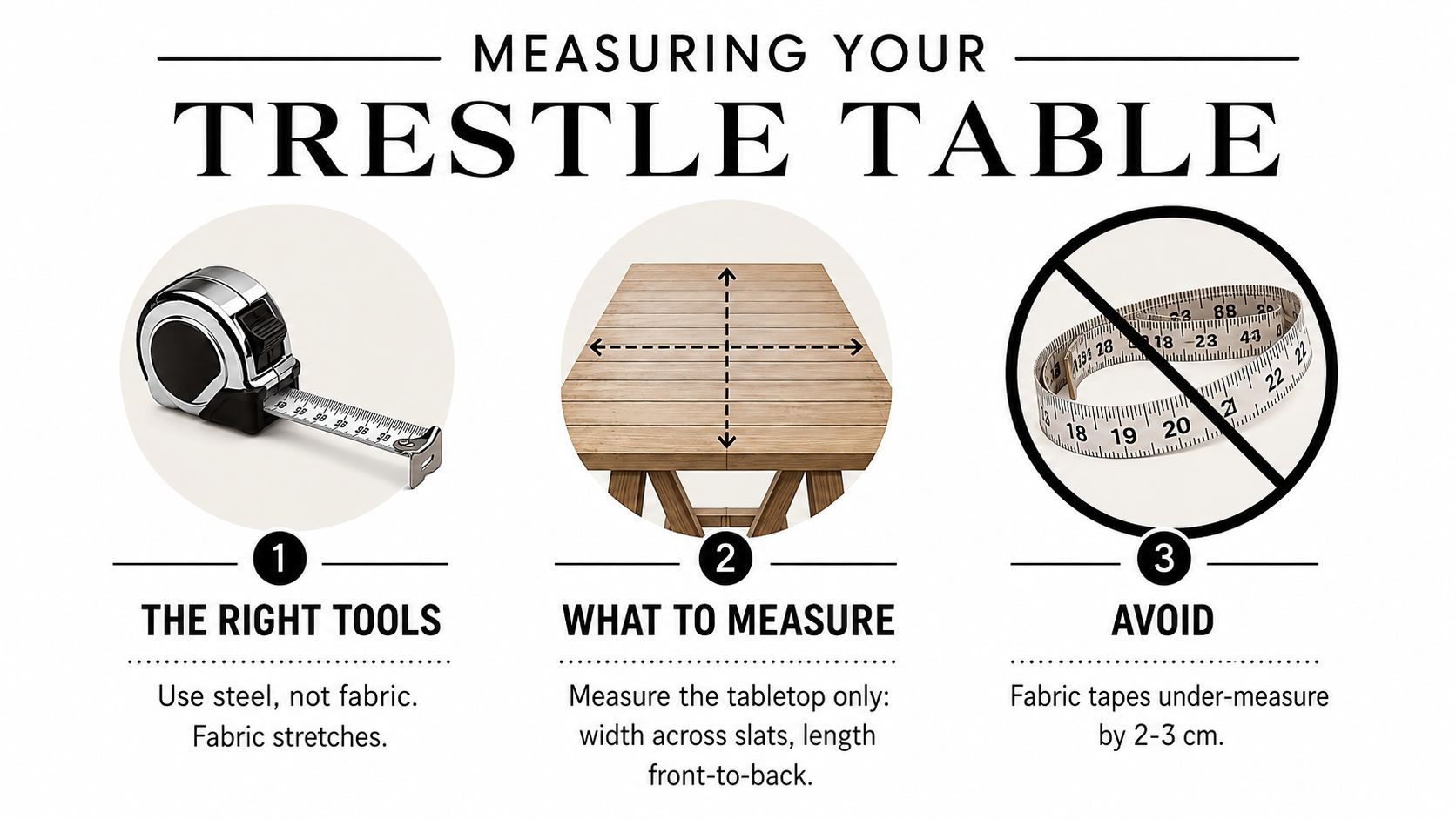
Add the drop twice
The basic formula is simple:
Required cloth width = table width + twice the side drop
Required cloth length = table length + twice the end drop
If you want a side drop of about 30 to 35 cm, add that amount to both long sides. For a floor-skimming look, plan for approximately 72 to 75 cm from the tabletop edge to the hem. South African guidance also places a practical minimum side drape around 40 cm, while tighter styling can use a shorter fall. The local size guide is useful when your calculated measurement sits between standard stock sizes.
A cloth around 140 x 250 cm is mapped locally to tables approximately 60 to 110 cm wide and 150 to 190 cm long. A larger 165 x 400 cm cloth suits tables around 85 to 135 cm wide and 300 to 340 cm long. Those ranges are benchmarks, not permission to skip measuring.
Allow for the job the cloth must do
A made-to-order cloth needs seam and hem allowance. A hire cloth needs enough tolerance to survive handling, movement, and repeated laundering. Confirm the finished measurement with the supplier, because the advertised cut size may not equal the usable finished size.
Avoid measuring around the legs. That adds fabric where it won't improve the drape and can create unnecessary bulk. Measure the top, select the fall, calculate both dimensions, then compare your result with the nearest available standard size.
Choosing a Fabric and Finish That Works
The right fabric depends on the event, the laundry process, and the venue lighting. Don't choose linen because the word sounds premium, or polyester because it sounds purely practical. Each fabric creates a different surface, fold, and photograph.
| Fabric | Typical Hire Cost | Crease Recovery | Wash Cost | On-Camera Look |
|---|---|---|---|---|
| Polyester satin | Usually the most economical hire option | Recovers reasonably well with careful steaming | Generally economical for routine event laundering | Slight sheen, modern, can catch warm uplighting |
| Cotton | Usually a mid-range option | Creases readily and needs more pressing | Higher handling demand than basic polyester | Matte, soft, well suited to rustic and boho styling |
| Linen | Usually the premium option | Natural creasing is part of the look | Requires careful handling and specialist pressing | Textured, relaxed, refined, especially for formal tables |
Polyester earns its place
For a large corporate setup or a rental stockroom, polyester satin is the dependable workhorse. It holds colour well and gives planners a consistent finish across multiple bookings. Steam it carefully, and it can look crisp without demanding the same pressing time as a natural fibre.
The trade-off is shine. Under warm venue lighting, satin can reflect bright patches or look more contemporary than intended. Test a sample under the actual lights if the table will sit beneath amber uplighting or strong spotlights.
Cotton and linen need a clear brief
Cotton gives you a flatter, more muted surface. That makes it a strong choice for farm weddings, vineyard dinners, and natural styling where a glossy cloth would feel out of place. It also creases more readily, so allow time for pressing and transport protection.
Linen has the most distinctive fall and texture. Slight wrinkles can look intentional, but deep transport creases don't. For an outdoor section, ask whether the cloth has a soil-release finish, especially where red wine, coffee, or rooibos will be served. Untreated natural fibres can hold stains stubbornly.
For a broader local comparison of sizing and hire considerations, use ABC Hire's table-cloth hire guide. My recommendation is direct: choose polyester for volume and consistency, cotton for a matte styled look, and linen when texture is central to the design and the laundry plan is already in place.
Half-Drop or Full-Drop for Your Event
Choose the drop according to how the table will be used. A half-drop of roughly 30 to 40 cm is practical for buffets, conference lunches, school formals, and setups where chairs need to slide tightly beneath the tabletop. It leaves the lower structure more accessible and reduces loose fabric around feet.
A full-drop falls close to the floor, usually around 70 to 75 cm on a standard-height trestle. It conceals the frame and creates a strong vertical line along the long side. That's the look I'd choose for a wedding head table, cake table, registration desk, black-tie setting, or brand activation where the table acts as part of the visual backdrop.
| Event Scenario | Recommended Drop | Reason |
|---|---|---|
| Buffet or serving station | Half-drop | Keeps access practical and avoids fabric interfering with service |
| Corporate lunch | Half-drop | Gives guests and staff clearer leg space |
| School formal or matric dance | Half-drop or full-drop, depending on the table's role | Half-drop suits active service tables, while full-drop suits display tables |
| Wedding head table | Full-drop | Hides the trestle frame and creates a formal photographed edge |
| Cake or gift table | Full-drop | Makes the table a clean visual feature |
| Registration desk | Full-drop | Conceals storage and equipment beneath the table |
Why I avoid the middle ground
A mid-drop between approximately 45 and 60 cm often looks accidental. It doesn't give you the practical openness of a half-drop, and it doesn't create the anchored floor-length line of a full-drop. The hem can sit awkwardly against chair seats and make the table look underdressed.
For broadside viewing, such as a buffet or presentation row, choose half-drop. For a table that faces the room as a feature, choose full-drop. Check chair clearance before confirming the order, particularly when the venue supplies bulky banquet chairs.
Use table overlays from ABC Hire when you want to add colour or contrast without changing the base cloth's main function. Keep the base cloth disciplined. An overlay should add structure, not distract from an unresolved drop.
Fitting, Caring for, and Storing the Cloth
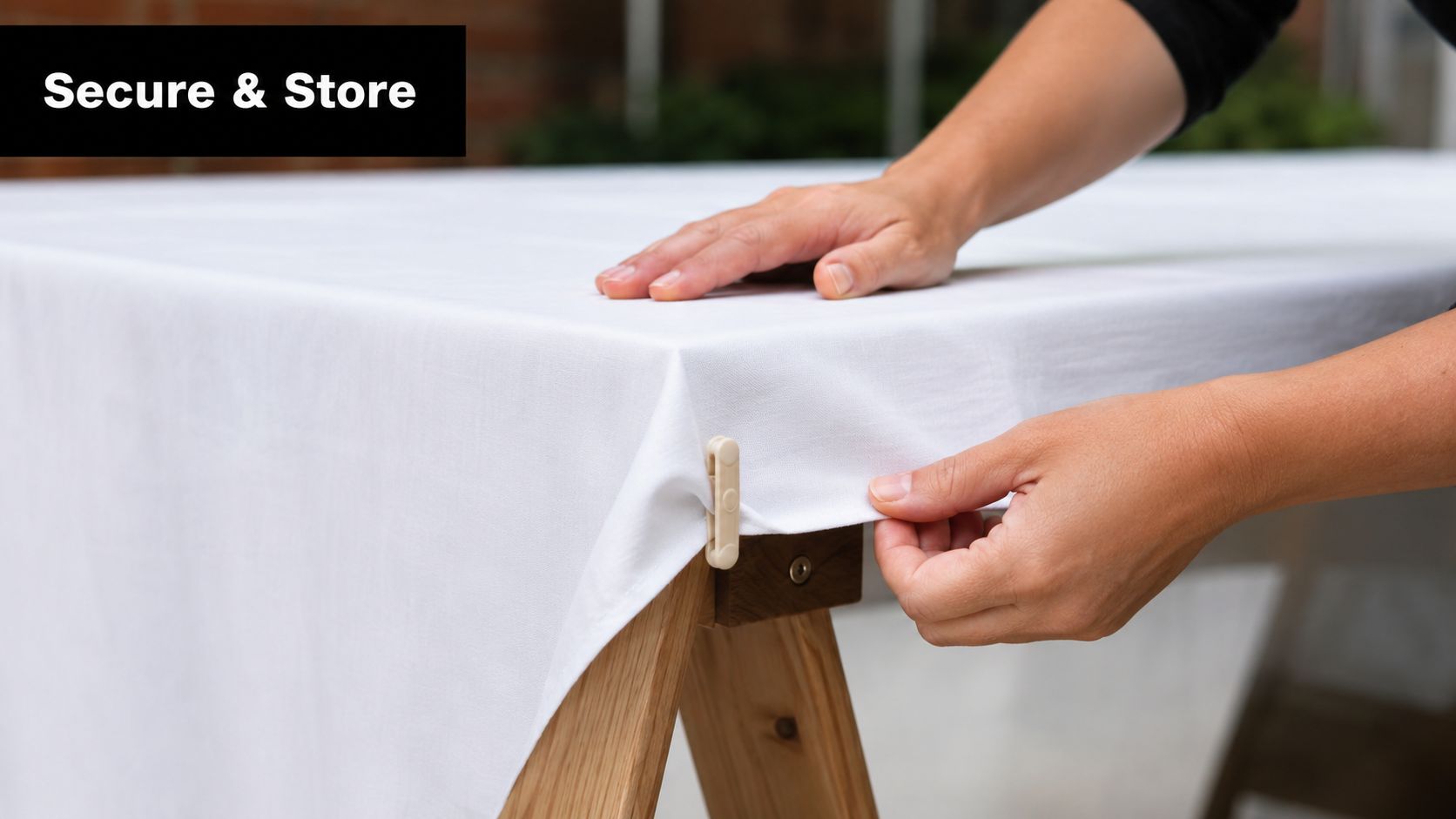
Fit the cloth before the tables leave the warehouse. Place the seam parallel to the table length, then centre the cloth so the overhang matches on both long sides and both ends. If the cloth shifts during transport, clips or discreet pegs can hold the excess without creating visible bunching.
A useful fit check is to stand at the end of the trestle and look down the long edge. The hem should run consistently, the corners should hang at matching heights, and the seam shouldn't cut across the table in an obvious direction.
Follow the label, not appearance
South African textile procurement documentation expects care-labelling compliance under the Consumer Protection Act and the national care-labelling standard, with permanent wash-care symbols and instructions aligned to SABS 011 and SANS 10011-style requirements. The Mr Price Group quality manual also highlights why fibre classification matters before laundering.
Use this sequence:
- Identify the blend. Confirm whether the cloth is polyester-rich, cotton-rich, linen-rich, or a mixed fabric.
- Read the permanent label. Match the wash temperature, agitation, bleach, drying, and ironing instructions.
- Separate by fibre behaviour. Don't process every cloth together because all the pieces are white.
- Test the cycle. Run repeated wash checks before putting a large batch into hire rotation.
Cellulose fibres can weaken under excessive agitation and chlorine bleach. Protein fibres can suffer from alkaline chemistry and heat. Treat the laundering process as part of stock control, not an afterthought.
Store for the next booking
Shake crumbs off outdoors before sorting stained cloths. Fold along established creases, wrap clean stock in breathable cotton sheeting, and store it flat in a dry, ventilated cupboard. Avoid leaving folded linen in a hot vehicle or sealed container, because heat and pressure can deepen creases and encourage stale odours.
Rotate the stock. If the same cloth always sits on the outer edge of a stack, that edge will take more handling damage than the rest. Record stains, pulled threads, and damaged hems before the items return to circulation.
Quick Hire-Day Checklist and Common Questions
Use the morning of delivery to check the cloths against the brief, not just against the invoice. Confirm the quantity for each table run, verify the selected drop, and inspect the fold lines under good light. Stains often show first where fabric has been folded tightly or stored against another piece.
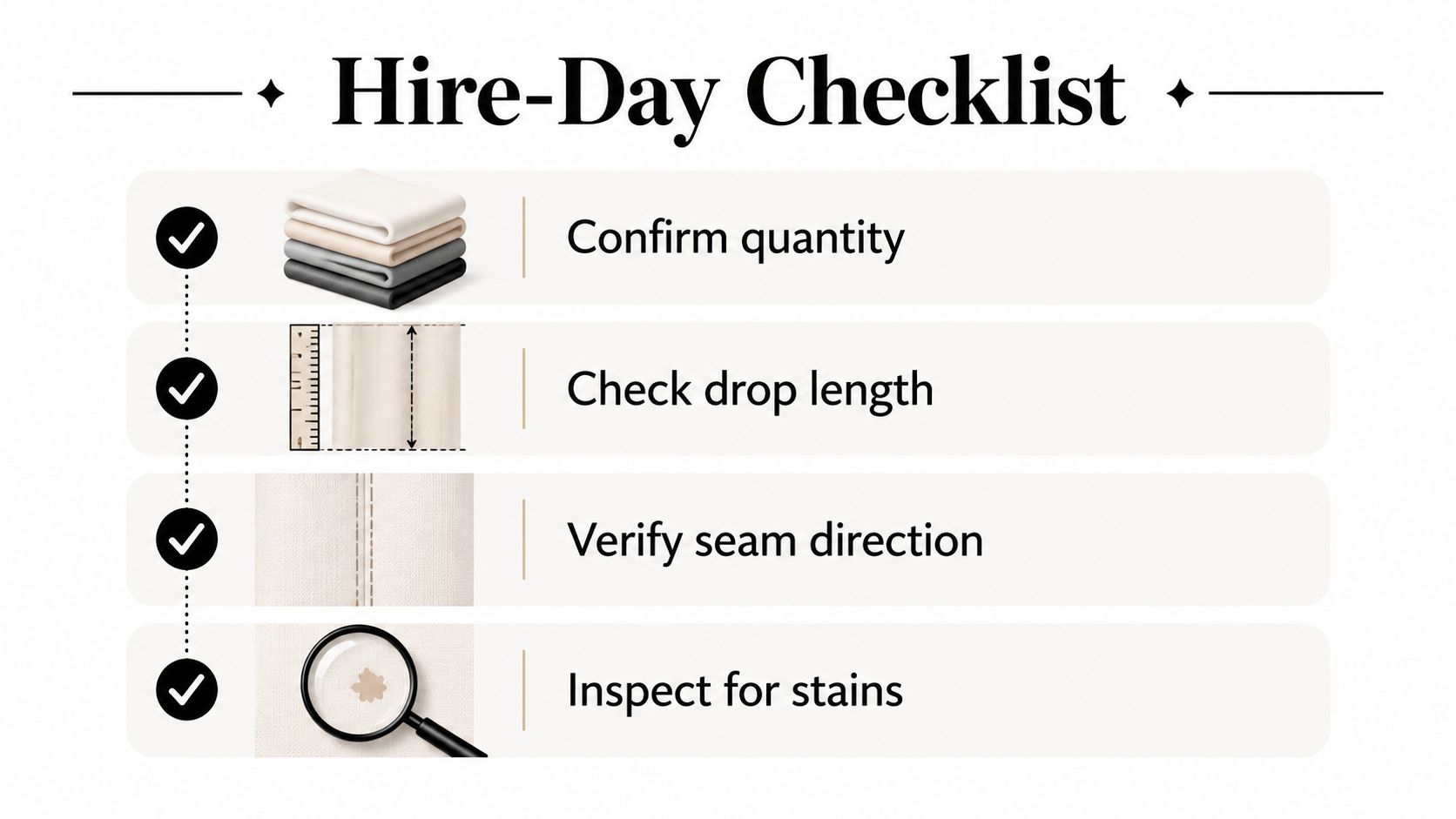
The handover check
- Confirm quantity: Match the cloth count to each table length and identify any pieces allocated to the head table or registration desk.
- Check drop length: Put one cloth on the actual trestle before loading the rest. A catalogue image can't confirm the finished fall.
- Verify seam direction: Keep the seam parallel to the long edge so the table looks balanced from the room.
- Inspect for stains: Look at hems, corners, and fold lines before signing for the hire.
- Pack clips and spares: Keep the fastening pieces with the linen, and carry replacement cloths for last-minute swaps where the budget allows.
- Record return condition: Count clips, note damage, and separate food-stained pieces before the stock goes back into rotation.
Questions planners usually ask
Will a 180 x 230 cm cloth fit one standard trestle at full-drop? It can suit a single 76 cm-wide trestle for a full-drop arrangement, but confirm the table length, finished cloth dimensions, and desired hem position with the supplier before ordering.
Can two cloths cover a longer banquet run? Yes, they can overlap at the centre, provided the colour and finish match closely. Ask for pieces from the same dye batch where colour consistency matters.
Can I use chlorine bleach on polyester? Don't. Follow the permanent care label and use a suitable oxygen-based brightener where the fabric instructions allow it. Chlorine can damage fibres and create uneven results.
Why does white linen look blue in photographs? Coloured uplighting changes the appearance of white fabric. Test a swatch at the venue, under the actual lighting, before approving the full order.
What should the hire agreement include? Confirm the replacement cost per cloth and any cleaning surcharge for food stains. That removes an unpleasant argument after the event.
ABC Hire can help you match tables, cloths, and practical event accessories for weddings, corporate functions, school formals, and private celebrations across Cape Town and the Winelands. Visit ABC Hire with your table dimensions and preferred drop, and ask the team to help you plan the correct hire combination before delivery day.