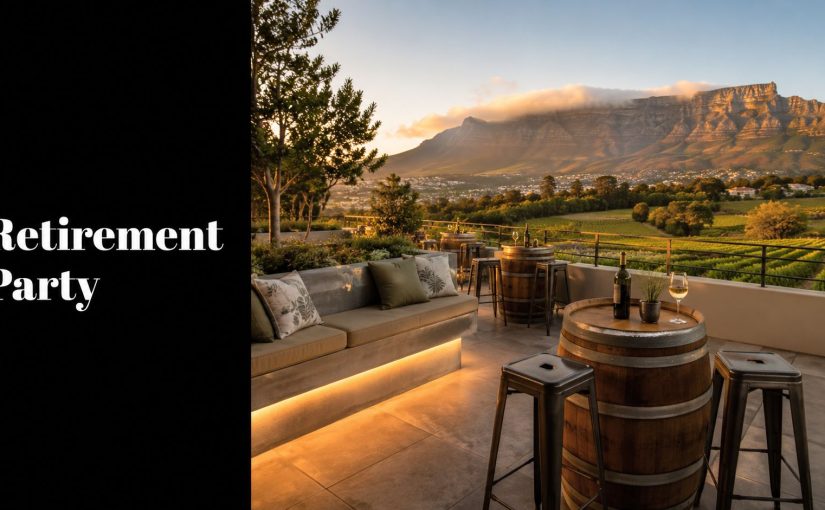
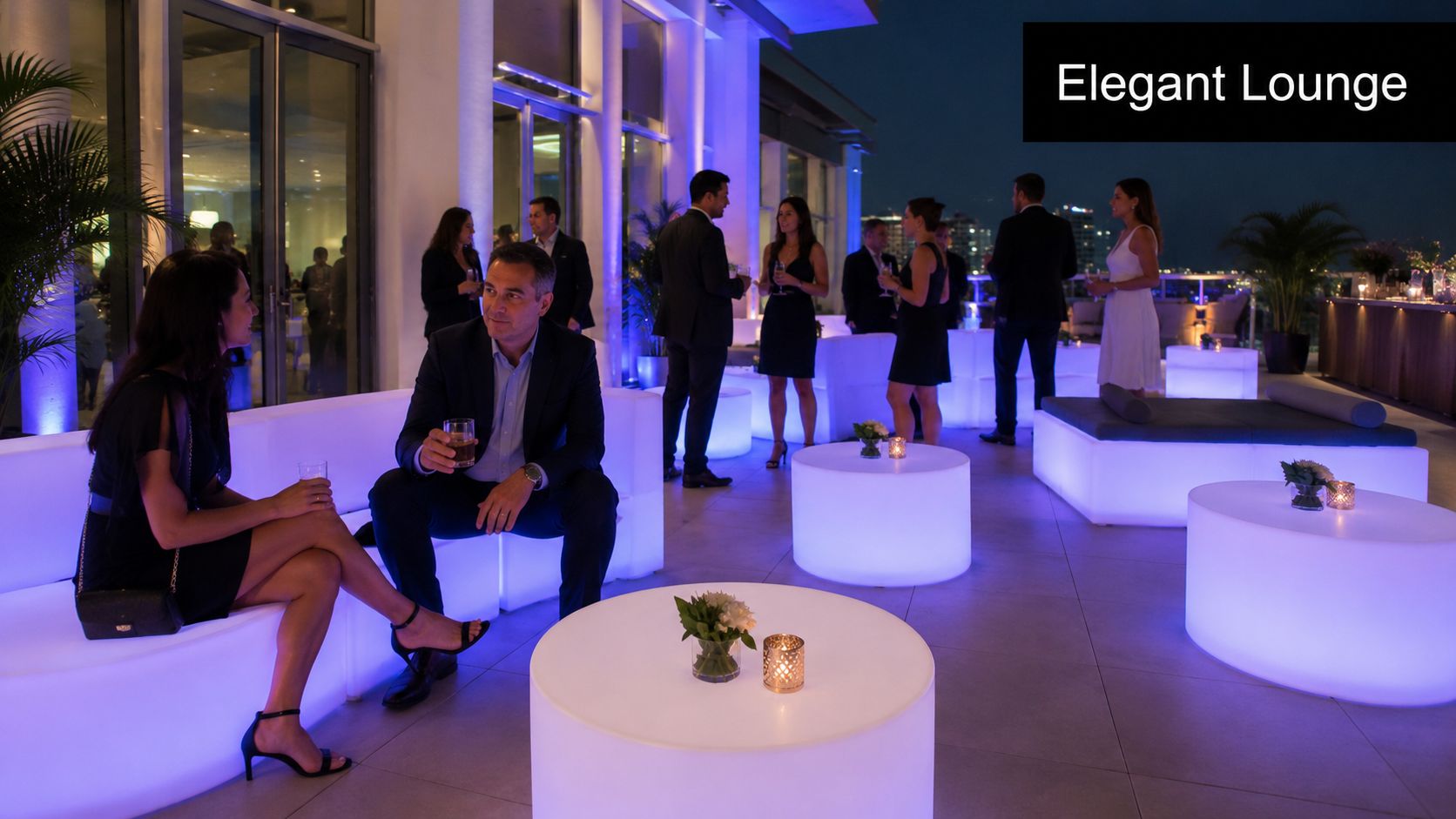
Quality hire of Event Furniture and Event Accessories in Cape Town. Rent Led Furniture, Umbrella's, Stanchions, Airconditioners, Table, Chairs, Heaters, Red Carpets, fairy lights.
You're probably planning an event where guests won't stay in one place for long. A Cape Town wedding on a lawn in Constantia, a cellar-door reception in Stellenbosch, a brand launch in the city, or a matric dance where everyone starts formal and ends up moving between photo spots, the bar, and the dance floor. In all of those setups, round cocktail tables do a lot of quiet work.
Get them right and the room feels easy. Guests have somewhere to rest a drink, conversation forms naturally, and the venue feels full without feeling cramped. Get them wrong and you'll see it fast. People balance glasses on window ledges, crowd around too few tables, or avoid areas that looked good on a floorplan but don't work in real life.
In the Western Cape, the details matter even more. Wind changes outdoor layouts. Uneven terraces punish flimsy furniture. Farm venues often require fast setup over long walking routes. That's why round cocktail tables shouldn't be treated as an afterthought. They're part furniture choice, part crowd management tool, and part styling surface.
Sizing Up Your Options for Guest Comfort
Two dimensions matter most with round cocktail tables. Height affects comfort. Diameter affects how many people can use the table without elbowing each other or parking handbags where drinks should go.
The standard height for cocktail service is 42 inches (106.7 cm), which aligns with the natural elbow position of an average adult and helps reduce upper-body strain during long standing conversations, according to round cocktail table specifications from Forever Redwood. That's why this height works so well for launches, canapés, pre-dinner drinks, and networking functions. Guests don't need to hunch over, and they don't feel like they're eating off a side table.
Height first, then diameter
If your event is built around standing and mingling, start with the standard cocktail height. If people will dine at the tables, that's a different furniture decision entirely.
Diameter is where planners often go wrong. A compact top keeps the room airy, but it also limits what the table can carry. Once you add glasses, a small floral arrangement, perhaps a candle, and the odd phone or clutch bag, space disappears quickly.
Here's a practical guide I use when planning layouts in Cape Town venues:
Table Diameter
Best For (Standing Guests)
Common Use Case
60 cm
2 to 4 guests
Tight terraces, pre-ceremony drinks, matric dance mingling zones
The smaller option is common for compact venues. The Dash 60cm Round model lists a 60 cm diameter and is a useful benchmark for the local market, especially where planners need a compact profile for circulation, as shown on Takealot's 60 cm cocktail table listing.
The slightly larger format is the more generous social table. A standard round cocktail table size of 28.5 inches (72.4 cm) with a 42-inch height is a strong all-purpose choice when guests will be standing around the table for longer periods, especially in premium venues where comfort matters as much as appearance.
Practical rule: If the event includes canapés, welcome drinks, and long conversations, a slightly larger top usually works better than the smallest option that fits the floorplan.
What works in real venues
On a wine farm terrace, smaller tables can look elegant, but only if they're not expected to do too much. They suit short-form mingling well. At a city event where guests hold drinks, name badges, phones, and canapé plates, a larger top often makes the room feel calmer because guests aren't fighting for space.
If you're comparing materials and styles, this guide to metal cocktail tables is useful for understanding how the table's look affects the event feel. Metal can read sleek and contemporary. Covered tables feel softer and more formal. Neither is automatically better. It depends on the room, the dress code, and how long people will use the tables.
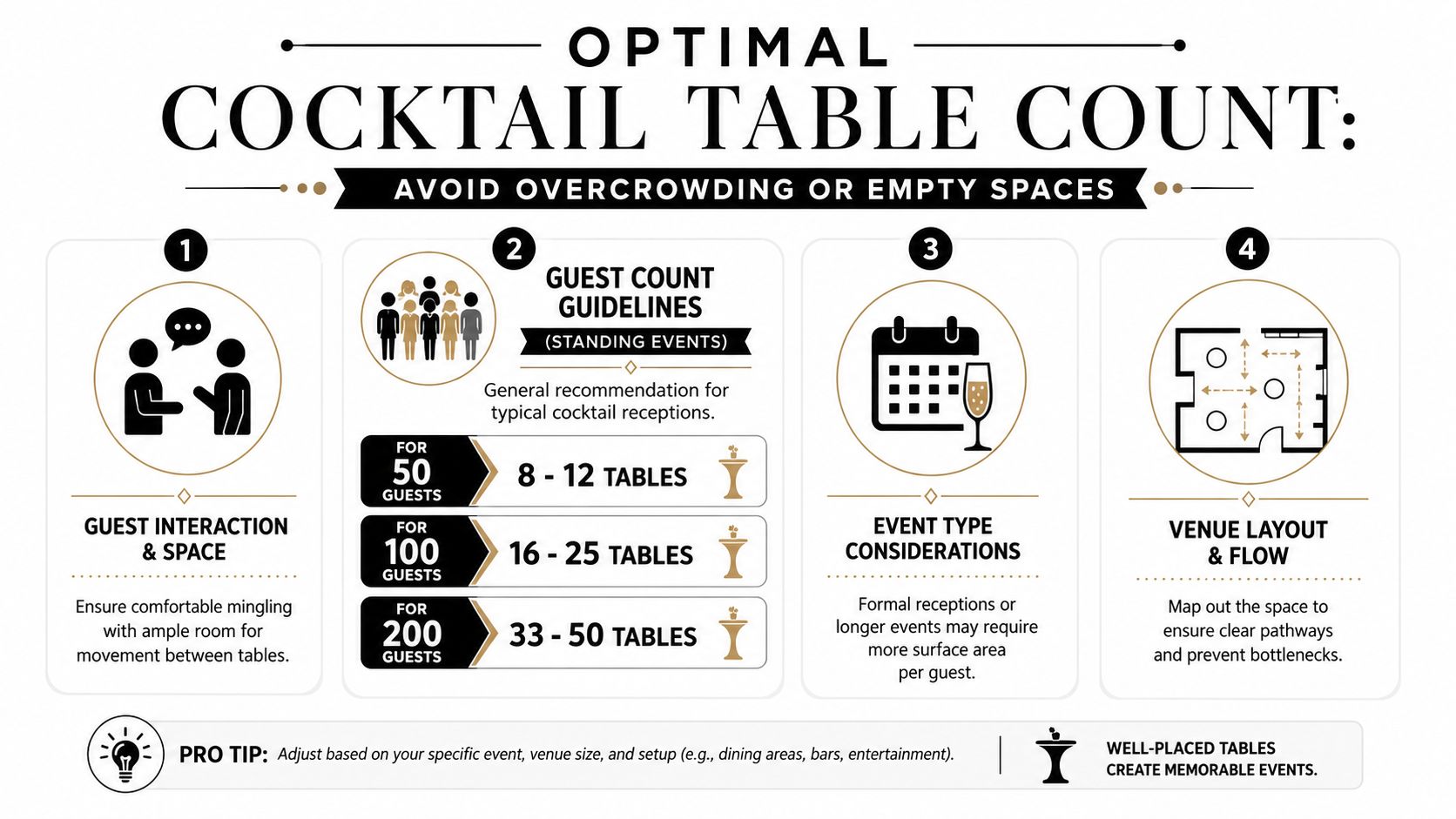
How Many Cocktail Tables Do You Really Need
Many still guess. They look at the guest list, picture a few clusters, and order what feels right. That approach causes problems more often than acknowledged.
A 2025 SEPA study found that 68% of wedding planners in Cape Town incorrectly assume a standard 60 cm round cocktail table accommodates 6 guests comfortably, and the study recommends a maximum of 4 guests for optimal comfort. That's the stat I'd keep in mind before signing off a rental quantity. It's a simple correction with a big effect on how the room feels.
Start with behaviour, not guest count
The right number depends less on the total headcount and more on what guests will be doing. At a corporate mixer, people circulate constantly and need more touchdown points. At a wedding, guests may use cocktail tables mainly before dinner, after the ceremony, and later near the dance floor or bar.
A practical framework is to ask:
Will most guests stand at the same time? If yes, increase your table count.
Will there be plated food or just drinks and canapés? Food needs more usable surface area.
Is there formal seating elsewhere? If yes, cocktail tables can support movement rather than carry the whole event.
Are guests likely to linger outdoors? If the answer is yes, people need enough surfaces to settle into conversation.
A better planning method
Rather than saying “one table can take six”, plan around actual comfort. For standard round cocktail tables, assume up to 4 standing guests per table when you want the event to feel relaxed rather than crowded. That keeps spacing honest.
I also split the room mentally into three categories:
Core mingling zone These tables carry the event. Put enough here that guests don't circle awkwardly.
Support tables near service points Bar queues, coffee stations, and terrace exits all need nearby surfaces.
Overflow pockets Small clusters prevent one busy area from doing all the work.
If a floorplan looks spacious only because every table is over-assigned, it isn't spacious. It's under-furnished.
For weddings in the Winelands, the mistake is often underestimating pre-reception congregation. Everyone comes out of the ceremony at once. They collect drinks at once. They move toward shade or the view at once. If your cocktail tables aren't there waiting for that moment, the event feels disorganised even when everything else is beautiful.
For corporate events, I'd rather see a few extra well-placed round cocktail tables than a polished venue with nowhere practical to put a drink. Guests notice function before they compliment styling.
Strategic Placement for Optimal Event Flow
Placement changes how people move, where they pause, and which parts of the venue come alive. You can have the right quantity of round cocktail tables and still get the room wrong if they're dropped into the space without a plan.
The social hub
This layout suits launches, networking evenings, and high-energy receptions. Group tables in the centre of the room or terrace in loose clusters, not rigid rows. The aim is to create a natural magnet point where people enter, pause, join conversations, and keep moving.
It works especially well in a ballroom or on a broad wine farm deck where there's enough width for circulation around the groupings. The cluster becomes part conversation engine, part visual anchor.
The perimeter flow
Some events need an open middle. A dance floor, speech area, presentation screen, or ceremony turnaround all benefit from keeping the centre clear.
In those cases, place round cocktail tables around the edges and near transition points. Along walls, beside bar stations, just off the dance floor, or under verandas. Guests still have functional standing spots, but the room keeps its breathing space.
For teams mapping movement in larger venues, these effective event planning tactics are helpful for thinking through bottlenecks, entry points, and guest flow in a more deliberate way.
Quiet corners that actually get used
Not everyone wants to stand in the busiest part of the room. A pair of cocktail tables tucked under trees, near a side courtyard, or on the quieter end of a terrace gives guests another social mode. Older relatives, introverted colleagues, and people catching up properly will gravitate there.
Use these quieter pockets carefully:
Near but not inside the busiest route so guests can peel off naturally
Away from service congestion because no one wants deep conversation beside a queue
With enough visual connection that the area feels included, not forgotten
A good layout guides people without making the planning visible. Guests should feel that moving around the event is easy, even if every table has been placed with intent.
Styling Your Tables for a Signature Cape Town Look
Styling changes the role of a cocktail table completely. The same round table can feel formal on a Stellenbosch estate, architectural at a Waterfront launch, or playful at a birthday party after dark. That's why I never style them in isolation. I style them against the venue, the light, and the way guests will use the space.
The classic Winelands wedding
On a wine estate, round cocktail tables often look best when styling feels restrained. Floor-length linen in white, stone, or soft neutrals works because the setting is already doing a lot visually. Add a small fynbos arrangement, keep the top uncluttered, and let the view stay part of the design.
Heavy centrepieces are usually the wrong move here. They block sightlines and fight the relaxed elegance that Winelands venues do so well.
A clean cloth fit matters more than people think. If you're choosing linen for different table sizes and event moods, this guide to tablecloths for round tables helps clarify what creates a polished finish instead of a rushed one.
The city launch
For a corporate event in Cape Town, especially in a modern venue with glass, concrete, or harbour views, I often prefer a more stripped-back look. Bare cocktail tables or sharply fitted covers can work beautifully. Keep florals minimal. Let branding, lighting, and the architecture carry the visual identity.
Discipline matters. If every table has menus, promo cards, oversized florals, candles, gift items, and product literature, the event starts looking busy rather than premium. One strong styling idea is enough.
Styling cue: If guests are standing, leave more open table surface than you think you need. Function is part of the aesthetic.
The birthday or matric dance setup
Evening parties allow more drama, a setting where LED cocktail tables come into their own. They shift the room after sunset and help zones feel intentional without adding bulky decor. A dance floor edge, chill area, or entrance cluster instantly reads as part of the event design rather than random furniture placement.
For more casual finishing touches, I also like looking outside the local event bubble for practical styling ideas. This resource for UK hospitality paper napkins is useful when you're thinking about colour, texture, and disposable service details that still need to feel considered.
The strongest styling choices don't try to force one look onto every event. They use round cocktail tables as flexible surfaces that support the venue's character instead of competing with it.
Local Rental Considerations for the Cape
In the Western Cape, furniture hire isn't just about availability. It's about whether the stock can handle the venue, the weather, and the setup conditions on the day.
That's especially true outdoors. A 2024 University of Cape Town report found that 72% of aluminium round cocktail tables rented for outdoor events in Cape Town's coastal areas showed significant surface degradation within 18 months due to salt spray and UV exposure, which is a strong reminder that climate-appropriate materials matter in this region. Coastal venues look fantastic, but they're hard on furniture.
Material matters more near the sea
A glossy table that looked perfect in a warehouse can age fast after repeated use in Clifton, Camps Bay, or any exposed coastal site. Salt air, direct sun, and wind don't care what looked good in the quote.
Ask rental partners practical questions:
What finish is on the table? Not all metal surfaces hold up the same way.
How is the stock maintained between hires? Maintenance standards show up in the condition on site.
Is the table suitable for outdoor use in exposed areas? Some stock is better kept for indoor or sheltered venues.
Logistics decide whether setup stays calm
A standard 30-inch wood round cocktail table weighs about 25 lbs (11.3 kg) and can be used at 30-inch dining height or 42-inch belly-bar height, according to Event Seating's product specifications. Those details matter when your crew is carrying tables through side gates, up staircases, across lawns, or into venues with tight loading access.
That weight is manageable, but not irrelevant. On a wine farm, where parking may be well away from the reception area, setup time often depends on how many trips crews must make and how easy the tables are to move and assemble.
The smoothest rental jobs in the Cape usually come from planning around the venue's constraints before delivery day, not solving them during setup.
Price isn't the full decision
The cheapest quote can become the expensive choice if stock arrives tired, unsuitable for the weather, or awkward for the venue access. A reliable local supplier should understand city bowl loading windows, farm-road delivery challenges, and the practical difference between a neat indoor launch and a wind-exposed terrace.
If you're comparing furniture packages across event types, this overview of tables and chair rentals is a useful starting point for thinking beyond single-item hire and planning the room as a whole.
Your Final Cocktail Table Rental Checklist
Before confirming your order, run through the event like a guest would. Where will they enter, collect a drink, stop to talk, and put something down? That simple mental walk-through catches most layout mistakes.
Use this final check before you lock in round cocktail tables:
Confirm the height: For standing receptions, standard cocktail height works best for comfort and natural conversation.
Choose the right diameter: Smaller tops suit tighter spaces. Larger tops handle longer mingling and more drinkware.
Check realistic capacity: Don't overload a table because it fits on paper.
Match quantity to behaviour: Order for how people will use the room, not just the size of the guest list.
Map placement properly: Decide which tables belong in hubs, on the perimeter, and in quieter corners.
Style for the venue: Winelands linen, urban minimalism, or LED impact should all support the setting.
Ask about outdoor suitability: Coastal and exposed venues need tougher, well-maintained stock.
Think through access: Stairs, gravel, narrow roads, and long carry distances affect setup more than most clients expect.
Confirm the rental partner understands Cape Town conditions: Local knowledge saves stress on event day.
The best round cocktail tables don't draw attention to themselves. They make the event feel natural, organised, and easy to enjoy.
If you need round cocktail tables, LED furniture, or a full event furniture solution for Cape Town, Stellenbosch, Franschhoek, Paarl, or the surrounding areas, ABC Hire is a strong local partner to speak to. Their range suits weddings, corporate functions, matric dances, and private celebrations, and they understand the practical realities of Western Cape venues that generic suppliers often miss.
You've probably saved a dozen images of glowing tables, taper-lined aisles, and candlelit receptions that look effortless. Then the practical questions start. Which candles work in a Cape Town venue? What survives a Winelands breeze? What belongs on the table, and what only looks good in a styled shoot?
That's where candles for wedding décor either become magical or maddening.
Used well, candlelight makes a room feel warmer, more intimate, and more expensive than it is. Used badly, it creates clutter, blocks conversation, burns too fast, or gives your venue manager a reason to say no. The difference is rarely about taste alone. It's about scale, holders, placement, wind, burn time, and how the whole lighting plan fits your venue.
Setting the Scene with Candlelight
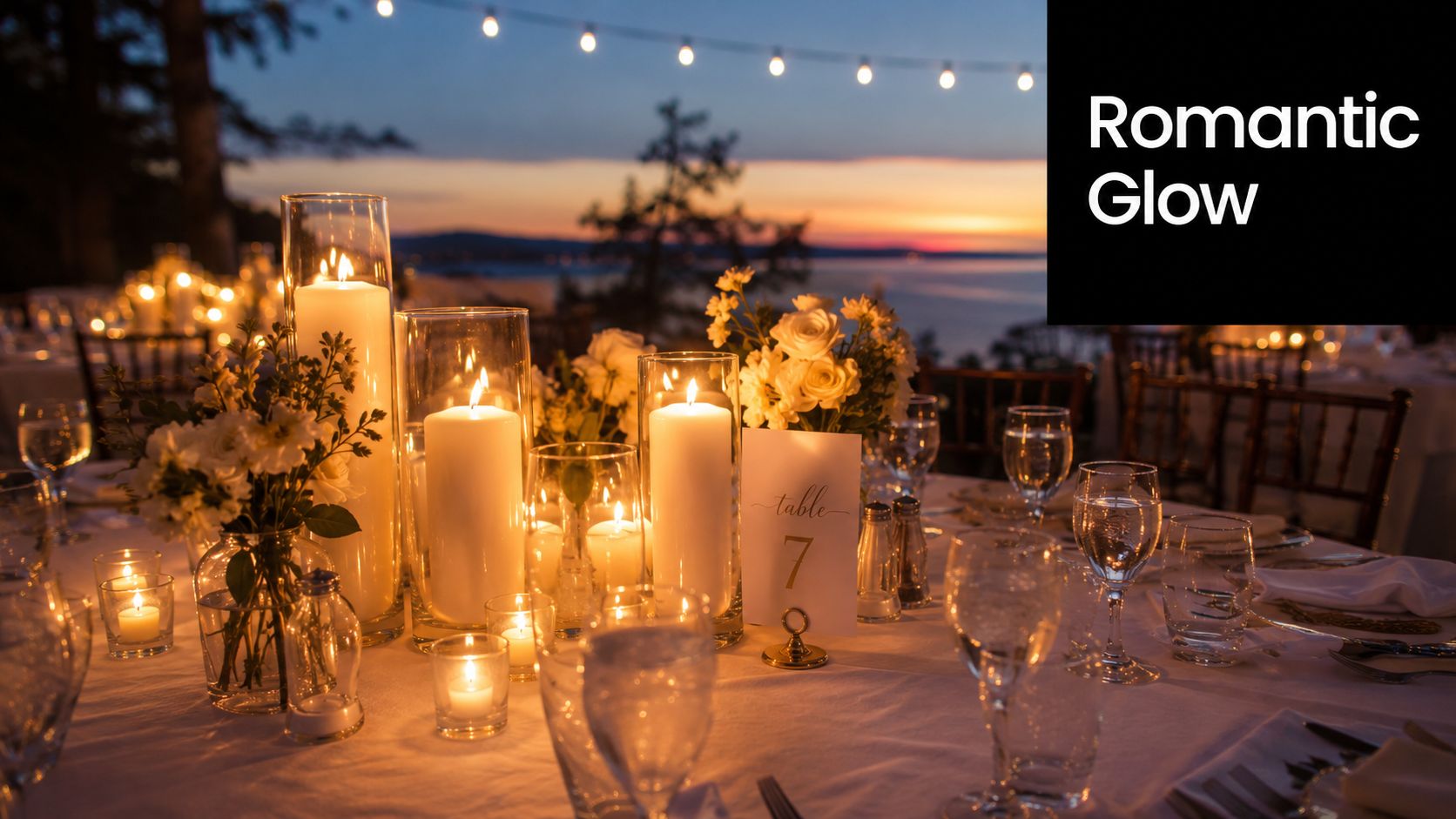
As the sun drops behind the mountains or off the Atlantic, candlelight changes a wedding from pretty to atmospheric within minutes. In Cape Town and the Winelands, that shift is especially noticeable because the natural light is already doing part of the work. Candles then take over gently, warming the room, softening hard venue lines, and giving tables a sense of depth that overhead lighting rarely achieves on its own.
The strongest candle schemes usually begin with one area that carries the mood. That might be the head table, a long harvest table, the ceremony aisle, or the entrance where guests first step into the space. Once that focal point is right, the rest of the candles can support it rather than compete with it. The result feels polished instead of busy.
Couples often ask for "lots of candles" when what they really want is a room that feels intimate and flattering after sunset. Those are not always the same thing. Fifty small flames scattered without structure can read messy. Fewer candles, scaled properly and placed with intent, usually give a better result and are easier to light, protect, and clear with the venue team.
A candle plan needs to answer practical questions early:
Where should candlelight matter most? Ceremony aisle, reception tables, bar, entrance, lounge areas, powder rooms.
What will the venue allow? Some estates permit open flame on tables but not on floors or near draping.
What will the weather do? Cape Town wind changes styling decisions fast, especially for tapers and exposed flames.
Are you renting or buying? For one-night impact, hired hurricanes and holders often make more sense than purchasing mixed pieces you may never use again.
Intentional placement matters more than quantity.
Local context changes everything. A beachfront reception in Camps Bay needs sheltered flames, heavier holders, and less reliance on delicate taper moments. A cellar dinner in Franschhoek can carry richer density and lower, moodier pools of light because the environment is naturally protected. I also treat modern all-candle looks differently from classic floral-and-candle tables. The first demands stricter planning around burn time, replacement stock, and who manages relighting during service.
Good candle styling starts with the venue itself. The room tells you how much glow it can hold, where candlelight will be seen, and whether real flame is the right choice for the conditions. That is what makes the final effect feel romantic rather than forced.
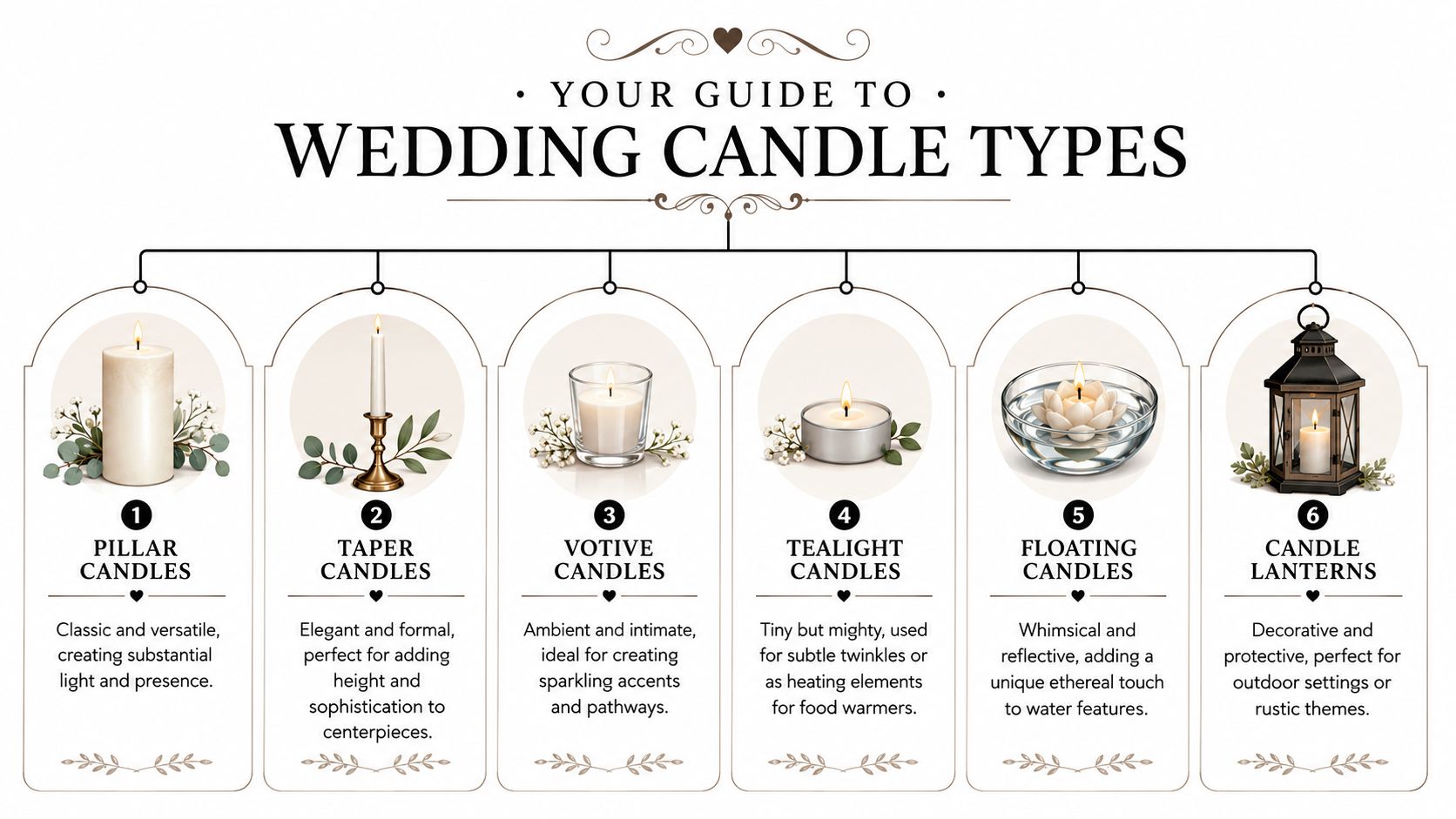
Your Guide to Wedding Candle Types
Each candle type solves a different styling problem. Choose the shape for the job first, then choose the finish and quantity.
Pillars for visual weight
Pillar candles give a table presence. I use them where a design needs body, especially on round guest tables, welcome displays, bars, ceremony plinths, and anywhere florals sit low.
They also photograph well because they read clearly from a distance. The trade-off is bulk. If every pillar is the same height and width, the arrangement can feel static very quickly.
They work well for:
Low centrepieces with garden-style florals
Lantern styling outdoors
Mantel or staircase installations
Aisle clusters in glass sleeves or hurricanes
Tapers for height and line
Taper candles bring height without adding visual heaviness. They suit long tables, formal dining layouts, and cleaner designs where the eye needs a vertical rhythm.
They are less forgiving than pillars. A slightly uneven holder, a soft table surface, or a breeze from an open barn door can make the whole row feel unsettled. In sheltered interiors, though, tapers sharpen a tablescape beautifully and give floral designs a stronger frame.
A practical rule I use often: low, loose flowers usually benefit from a few disciplined taper lines.
Votives and tealights for atmosphere
Votives and tealights do the quiet work. They fill the gaps between larger elements and create that scattered glow guests notice once the room dims.
Votives usually give a richer result because the holder becomes part of the styling and the flame sits high enough to be seen. Tealights are useful for layering, especially in large numbers, but they can disappear on oversized tables or in venues with strong ambient lighting.
If the budget is tight, I would usually keep fewer pillars and protect the spend on votives. The room often feels warmer because of it.
Floating candles for reflection
Floating candles are strongest where water already belongs in the design. They suit bowls at an entrance, troughs on a bar, fountain details, and lounge areas where guests pass close enough to notice the reflection.
Used well, they add movement and softness that standard table candles cannot. Used badly, they look like an afterthought. The vessel matters as much as the candle. Scale, water depth, and the surrounding light all affect whether the effect feels polished or makeshift.
Lanterns and LED alternatives
Lanterns are not a candle type, but they change how candlelight performs. They shield the flame, add structure, and make outdoor styling feel considered, especially at Cape Town venues where wind can shift during the course of one evening.
Then there are LED candles. For some weddings, they are the sensible choice. I recommend them for high-traffic areas, venues with strict flame policies, installations near fabric, and late-night spaces where no one wants to manage relighting. Good LED candles still need editing. Skip the bright blue-toned versions and use warm, realistic options in proper holders so they read as part of the design, not a compromise.
Choosing Candles for Your Venue and Theme
The best candle choice isn't the prettiest one on its own. It's the one that suits the room, the weather exposure, and the tone of the wedding.
Wine estates and heritage venues
Historic Winelands venues tend to suit candlelight naturally. Stone walls, old wood, textured plaster, and long dining tables all respond well to warm, low light. In those settings, pillar candles in glass sleeves or lanterns usually look right at home. They add warmth without fighting the architecture.
For a Stellenbosch or Franschhoek estate wedding, a good approach is to keep the candle shapes slightly organic. Mixed pillar heights, soft ivory tones, and a few metal or ceramic holders often feel more grounded than ultra-polished crystal.
Modern city venues and clean-lined spaces
Contemporary Cape Town venues often need a crisper hand. If the room has steel, concrete, glass, or sharp architectural lines, go cleaner with your candle choices. Tapers in sleek candlesticks and disciplined clusters of votives usually work better than bulky, rustic arrangements.
The mistake here is over-softening the room. Too many mixed holders can make a modern venue lose its edge.
A better fit often looks like this:
Minimalist theme: black, clear, or brushed metal holders with evenly spaced tapers
Modern chic: a restrained mix of tapers and votives, with symmetry doing most of the work
Editorial styling: statement candle groupings that feel sculptural rather than decorative
Beach, garden, and exposed outdoor venues
Outdoor weddings need a tougher candle plan. The prettier the open-air setting, the more disciplined you need to be.
At beachside venues, open tapers are usually the first thing I remove from a design draft unless the ceremony and dinner areas are very sheltered. For gardens and courtyards, lanterns and enclosed cylinders give a much more reliable result. They still feel romantic, but they don't spend the evening fighting the breeze.
If your venue manager starts talking about wind patterns before you've even discussed flowers, take that seriously and adapt the candle plan early.
Matching the candle language to the theme
A few combinations tend to work consistently well:
Theme
Candle approach
Classic romance
Tapers, pillars, and votives in a soft layered mix
Minimalist elegance
Fewer candles, cleaner holders, stronger spacing
Bohemian or garden style
Clusters of pillars and votives with softer variation in height
The common thread is cohesion. Candles for wedding décor should echo the room and the styling language already in place. They shouldn't try to rescue a mismatched concept.
Designing with Light Styling and Centrepiece Ideas
Good candle styling isn't about quantity alone. It's about layering light at different heights so the eye moves across the table and around the room.
A reliable recipe for round guest tables
For 5 ft round intimate wedding tables, a strong benchmark is 2 to 3 large pillar candles or 4 to 5 small pillars, paired with 5 to 7 votive candles and 3 to 4 taper candles to balance glow and safety, according to wedding candle table benchmarks.
That formula works because each type handles a different visual task:
Pillars build the centre of the arrangement
Votives spread light outward and fill the dead space
Tapers lift the eye and stop the design from feeling squat
If you're planning your table décor in detail, it also helps to consider what sits underneath the candles. Reflective bases and warm metallic accents can make a candle grouping feel far richer. A useful reference for that layered look is this guide to Wedding gold charger plates, especially if you want the place setting to carry some of the warmth.
How to keep centrepieces elegant, not crowded
The most common styling mistake is putting every decorative element in the middle of the table at once. Candles, flowers, menus, table numbers, favours, and charger plates all compete for the same visual space. The result looks expensive in pieces and messy as a whole.
A cleaner method is to choose one hero element and let the candles support it. If the florals are lush, reduce the number of large candles. If the candles are the main statement, keep the flowers lower and looser.
For couples who want more table arrangement ideas beyond candles alone, this roundup of a centrepiece for table styling is a helpful planning reference.
Creating candle moments beyond the table
Some of the best candle styling happens away from the guest tables.
Consider using candles in these areas:
Ceremony aisle edges: Keep the spacing consistent and use protected holders if there's any breeze.
Entrance styling: A grouped lantern or pillar installation creates a strong first impression.
Cake or champagne table: Candles frame details beautifully in photographs.
Lounge corners: Small clusters help these areas feel finished rather than forgotten.
A room feels immersive when candlelight appears in repeating pockets, not only at the dining tables.
Height, repetition, and restraint
Professional-looking candle design usually follows three principles.
First, repeat shapes. If every holder is different, the table looks unsettled. Second, vary height deliberately. Too much sameness kills the glow. Third, leave negative space. The eye needs a place to rest.
That's what separates a romantic candle setup from a decorative pile-up.
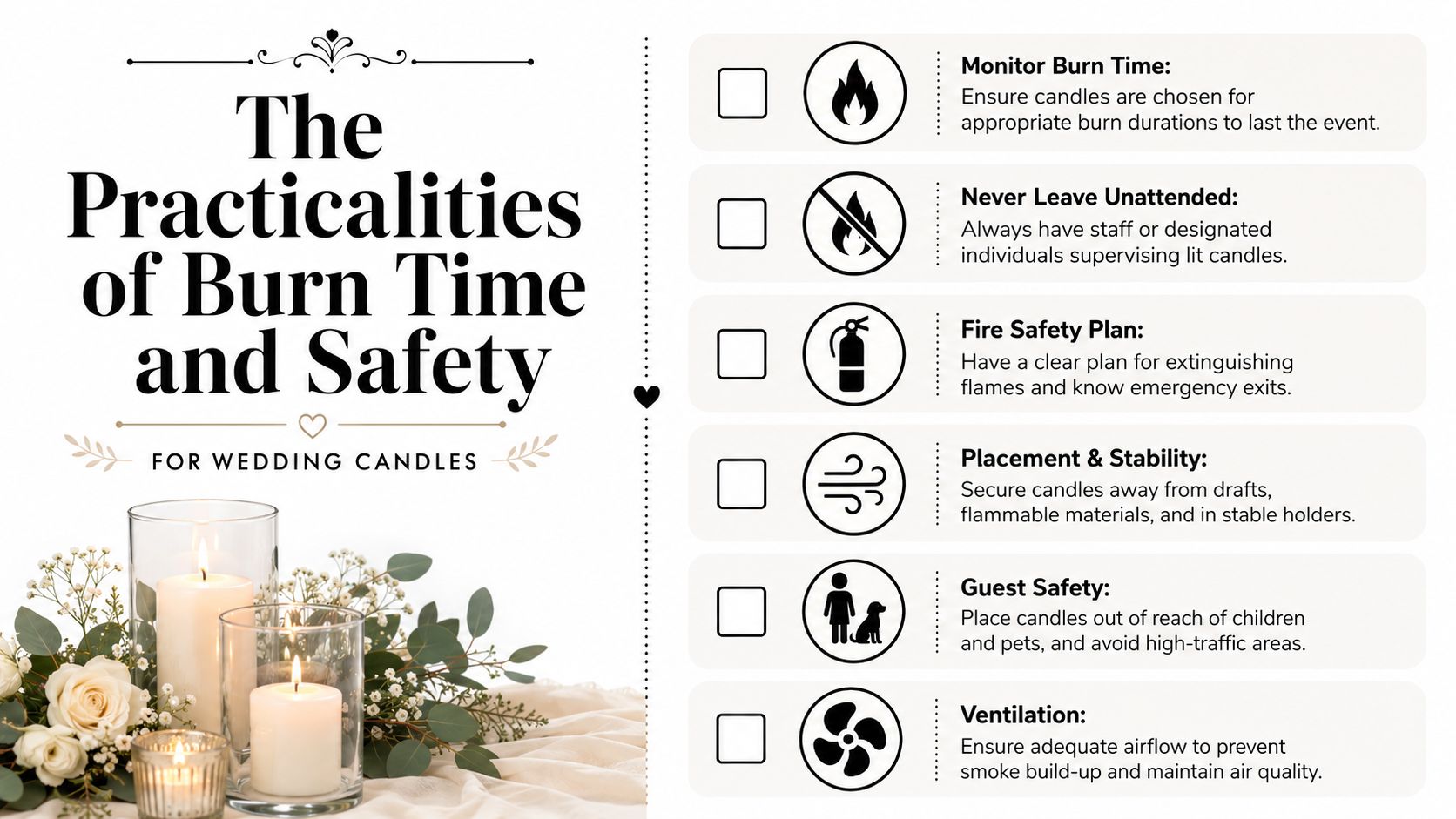
The Practicalities of Burn Time and Safety
The candles looked perfect at sunset. By the time mains were served, half the votives were low, two tapers had gone crooked in the breeze, and wax had marked the linen on the family table. I see versions of this often at Cape Town and Winelands weddings. Candlelight is romantic, but it only works when the practical side has been planned just as carefully as the styling.
Burn time starts with your event schedule
Burn time should be matched to the actual flow of the wedding day. That means setup, guest arrival, any delay to the ceremony, dinner service, speeches, and the point when photographs of the room are still being taken. A candle may technically burn for hours and still be the wrong choice if it tunnels badly, throws off too much heat, or looks tired halfway through service.
Ask suppliers for the expected burn range of the exact candle size you are ordering, not a general promise across the whole range. Wax blend, wick size, draft exposure, and container shape all affect performance. In practice, I would rather use a candle with a consistent, tidy burn than chase an impressive number on paper.
A simple rule helps. If the candle needs to perform for a five-hour guest-facing window, build in a margin rather than buying to the minimum.
Wind changes everything in the Western Cape
Generic wedding advice often ignores the local problem. Cape Town wind can turn an elegant candle plan into a maintenance job within minutes, especially on wine farms, coastal venues, and terraces that feel sheltered until the temperature drops.
Open flames on exposed tables are rarely the best use of budget in those settings. The flame flickers hard, wax burns unevenly, and staff end up relighting candles instead of serving the room. Tall, unprotected tapers are usually the first to struggle.
The safer options are usually the most reliable-looking ones too:
Hurricane vases for tables with any cross-breeze
Heavy lanterns for entrances and pathways
Glass sleeves around pillar candles
Flameless candles in thoroughfares, near draping, or around children
Treat wind as part of the brief from the start. If the venue coordinator says, "It gets breezy after six," believe them and plan accordingly.
Safety rules that matter on the night
Venue rules should be checked before you place a single order. Some venues allow only enclosed flames. Others permit real candles on tables but not along aisles, staircases, or bars. Those restrictions affect the design, staffing, and budget.
Keep flames clear of hanging florals, loose napkins, dried foliage, and guest traffic routes. Use stable holders that cannot tip if a table is bumped. Assign one person or one team to light, monitor, and extinguish candles. Shared responsibility usually means nobody owns the job.
Some weddings absolutely benefit from live candlelight. Others are better served by a mix of real candles and alternatives. If the venue is windy, the tables are tight, or staff access will be limited once dinner starts, portable lighting often gives a calmer result and better consistency in photos.
For couples who want warmth without open flame in problem areas, rechargeable table lamps for events are a practical option for bars, lounge pockets, and outdoor dining tables.
The best candle plan is the one that still looks composed at 9 pm.
Cape Town and Winelands Candle Logistics
The candle plan often looks simple on paper. Then the south-easter picks up at cocktail hour, the venue only allows enclosed flames on the veranda, and someone realises the quote covered wax but not cylinders, lighters, transport crates, or the team to light everything on time.
That is why logistics deserve their own budget line. In Cape Town and the Winelands, candles are rarely just a styling purchase. They are a styling and operations decision.
What candles usually cost locally
Local candle spend varies widely because the final number depends less on the candle alone and more on the full setup around it. A few dinner tables with tealights and hired holders is one budget. A large reception with premium pillars, storm cylinders, aisle lanterns, backup stock, and setup labour is another entirely.
Couples often underestimate four line items:
holders and wind protection
delivery and collection
setup and strike time
breakage or wax damage to hired pieces
That is usually where budgets drift. The wax is visible. The support system is what changes the quote.
Rent or buy depends on the job
Buying works well when the candle itself is part of the design brief. Specific ivory tones, hand-finished tapers, oversized pillars, or a particular wax texture can justify the spend if those details matter in person and in photographs.
Renting usually makes more sense for the infrastructure. Glass hurricanes, lanterns, cylinders, mirror bases, and protective vessels are bulky to transport and annoying to store after one event. For outdoor receptions and estates with long setup routes, hiring those pieces is often the cleaner decision.
Here is the practical trade-off.
Factor
Buying Candles
Renting Candles & Holders
Design control
Best for exact wax colour, size, and finish
Best when the vessels and support pieces shape the look
Budget shape
Higher product spend as quantities grow
Easier to manage for one-day use
Transport
You still need safe packing and delivery
Often simpler if pieces arrive event-ready
Outdoor use
Risky without proper protection
Better suited to wind covers and enclosed options
After the wedding
Leftovers need storing, reselling, or disposal
Nothing to keep afterwards
The hybrid approach works well here
For many Cape Town weddings, the strongest plan is a split one. Buy the candles that carry the visual identity. Rent the technical pieces that make them work safely and neatly in the venue.
I use that approach often for Winelands properties and coastal venues because conditions can change between site visit and wedding day. A calm courtyard at noon can be exposed by sunset. A cellar venue may need candlelight moved quickly from ceremony to reception. Hired holders and lanterns give far more flexibility in those situations than a purchase-only plan.
If you are comparing candles with other rental items, this guide to wedding decor hire in Cape Town helps put the broader styling costs in context.
Local planning choices that save stress
A few decisions make a noticeable difference on the day:
Order by zone, not only by quantity. Ceremony, dining tables, bars, bathrooms, and entrance points each need different holders and burn plans.
Check access times before confirming quantities. Some estates allow long setup windows. Others compress everything into a tight afternoon turnaround.
Ask who is responsible for relighting or replacing candles after sunset. If nobody owns that task, half the room can look uneven by the first course.
Keep backup stock for wind-exposed areas. Outdoor candles rarely burn at the same pace across a full event.
The most polished candle styling in this region is not always the most elaborate. It is the plan that still looks composed once the wind changes, dinner runs late, and the room is full.
Your Wedding Candle Checklist and Timeline
By the time guests walk into dinner, candlelight should feel effortless. It only looks that way when the planning is done early, the quantities are realistic, and someone specific is responsible for lighting, checking, and clearing it.
Six to eight months before
Start with venue rules and access. Ask where open flame is allowed, whether every candle must be enclosed, and which areas are usually affected by wind after sunset. In Cape Town and the Winelands, that last question matters more than couples expect. A courtyard that feels calm at a site visit can become exposed once the temperature drops and the breeze shifts.
Set your styling direction at the same time. Decide whether candles are there to soften the room, frame key moments, or carry the whole atmosphere after dark. That choice affects everything from holder style to setup time.
Three to four months before
Map the candle plan by area, not just by item count.
Use practical zones:
Ceremony: aisle, signing table, altar, entrance
Reception: guest tables, main table, bar, cake table
Then confirm the format. Buy candles if you want full control over colour and finish. Rent holders if you want flexibility, less storage, and fewer breakages to manage. For outdoor sections, a mixed plan often works best, with real flame in protected spots and LED candles where wind or venue rules make live flame unreliable.
The neatest installations are planned with purpose. Every candle should already have a place and a job.
One month before
Review quantities against your floor plan and your schedule. Careful analysis here often reveals over-ordering. A long imperial table needs a different rhythm of candlelight from round tables, and a late winter dinner needs more coverage than a midsummer reception that starts in daylight.
Confirm responsibilities in writing:
Who lights the candles
What time each zone is lit
Who replaces or relights candles outdoors
Who extinguishes everything at the end of the night
If any part of the wedding is outside, test one arrangement in real conditions if possible. I have seen beautiful taper groupings fail on a Stellenbosch lawn because the holders were too light and the flame too exposed.
In the final week
Pack and label by zone. Ceremony candles should be separate from reception candles, and outdoor spares should be easy to grab without opening every box. Include lighters, matches, cloths, drip trays if needed, and a printed lighting list for the setup team.
Edit the plan if timing is tight. A smaller candle scheme, lit properly and placed well, looks far better than an ambitious one rushed in the last twenty minutes.
On the day, place candles according to the floor plan, light them in sequence, and do one final check once guests are seated. That last walk-through catches the details that matter. A table left unlit, a lantern blown out at the entrance, wax drips on a linen runner.
If you're planning a wedding in Cape Town, Stellenbosch, Franschhoek, or Paarl and want the wider décor and lighting pieces around your candle styling to feel just as polished, ABC Hire can help with event furniture, LED options, and practical rental support that makes the whole setting work beautifully.
You've got the venue booked. The flowers, tables, bar service, timing, transport and weather backup are all on your mind. Then one practical question pops up: what will guests do during the in-between moments?
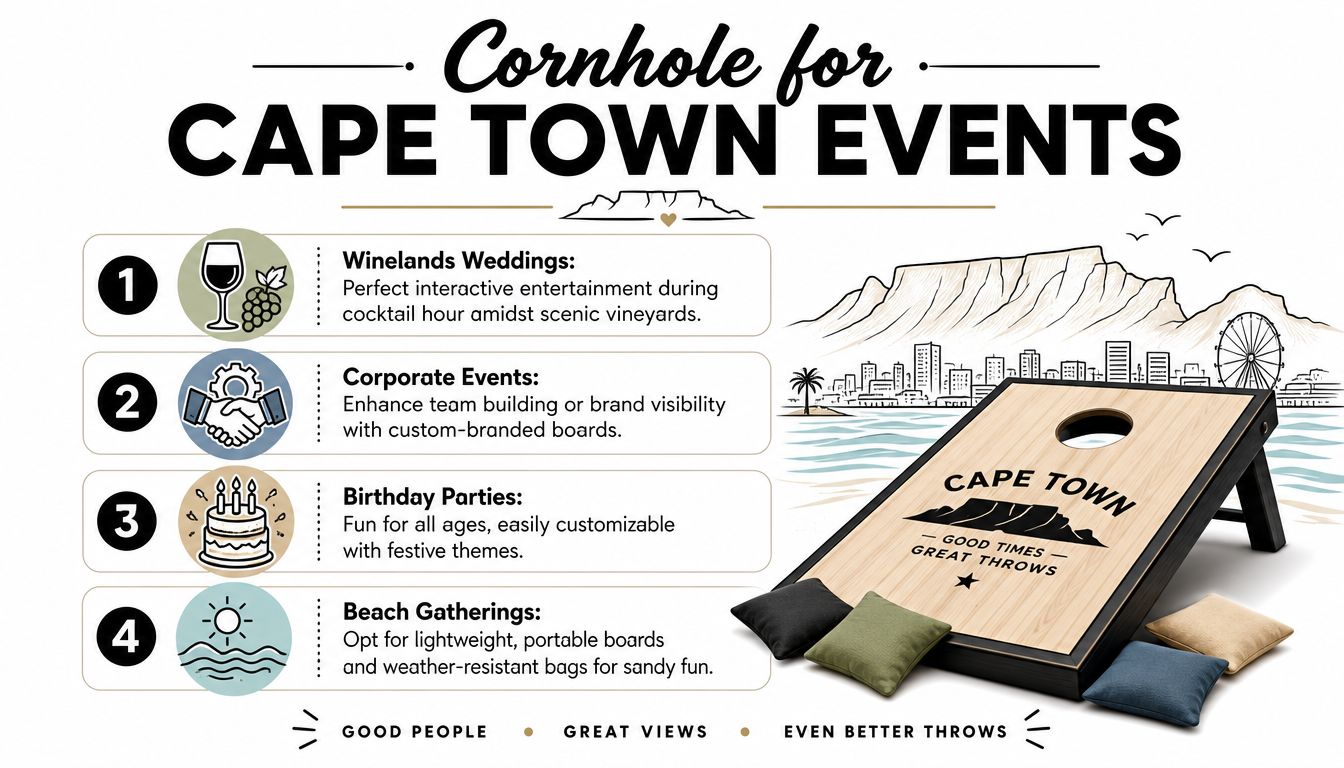
That's where a Corn Hole game earns its place. At a Cape Town wedding, it keeps cocktail hour lively while the couple slips away for photos. At a Winelands function, it gives guests something relaxed to do between speeches and the dance floor opening. At a corporate event, it breaks the awkward “everyone standing with a drink” phase faster than almost anything else.
I've seen hosts worry that lawn games might feel childish, too casual or hard to manage. Cornhole usually proves the opposite. It's simple to grasp, easy to join halfway through, and social without demanding too much from guests. People can play properly, watch from the side, or just cheer on colleagues and cousins. That flexibility is exactly why it works so well at South African events, especially those with outdoor space and a laid-back braai-day atmosphere.
Why a Corn Hole Game Is a Must-Have for Your Next Event
A wedding on a Stellenbosch wine farm often has one beautiful problem. Guests arrive early, the setting is gorgeous, and there's a stretch of time before the next formal part of the day begins. Some head for the bar. Some hover near the canapé trays. Others check their phones because they're not sure where to settle.
A Corn Hole game fixes that.
It doesn't need a master of ceremonies, a strict schedule or any special athletic ability. Two boards, a few bags and a flat patch of lawn are enough to get a crowd interacting. Grandparents can join in. Children can try a throw. Your bridal party can turn it into a mini rivalry. Your corporate guests can loosen up without feeling forced into “team-building”.
It fills the dead space naturally
Some event entertainment asks guests to commit. Cornhole doesn't. People can walk over, throw a bag or two, then drift back into conversation. That's why it works so well during:
Cocktail hour: It gives waiting guests a focal point.
Pre-dinner mingling: It keeps energy up while photos or room changes happen.
Corporate networking: It gives strangers an easy reason to speak to each other.
Family celebrations: It creates a shared activity without splitting guests by age.
Cornhole works best when guests discover it naturally, not when they're pushed towards it.
It suits the Cape Town event style
Cape Town and the Winelands lean beautifully towards outdoor entertaining. Lawns, courtyards, vineyard views and shaded garden spaces all support games that feel polished but relaxed. Cornhole fits that style better than many novelty activities because it looks tidy, sounds familiar once explained, and doesn't dominate the event.
It also matches local social habits. At a braai, birthday or wedding, people like entertainment that sits alongside conversation. They don't want something complicated that needs scorecards, long explanations and strict supervision. Cornhole gives you light competition without turning the whole event into a sports day.
It reduces pressure on the host
Hosts often think they need more programme to keep people happy. Usually, they need better flow. A Corn Hole game helps guests settle themselves, which means fewer awkward lulls and fewer moments where the couple, planner or organiser feels responsible for everyone's mood.
That's why it's become such a reliable choice for weddings, private parties and polished corporate functions across the Cape.
Understanding the Basics of Cornhole
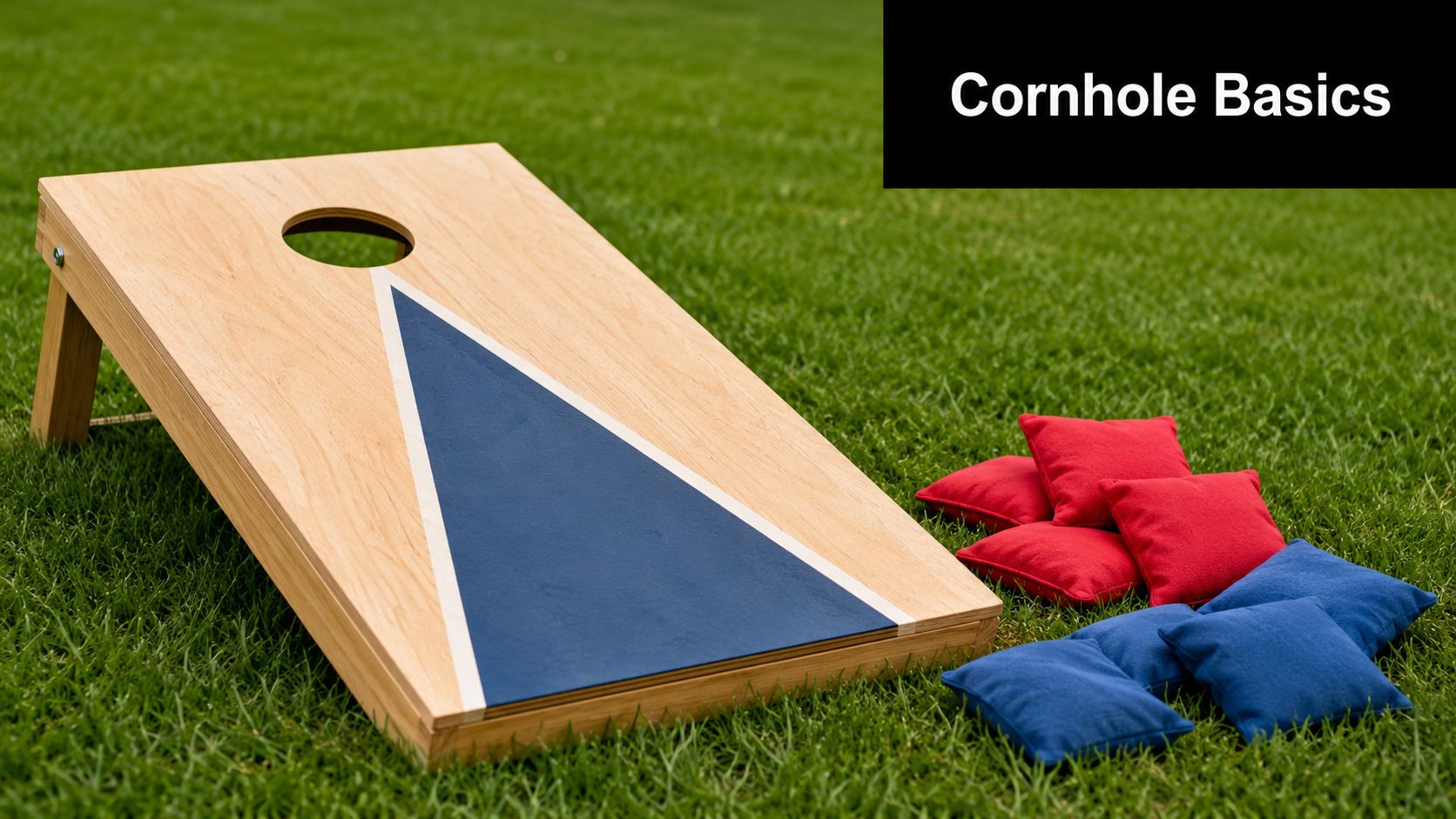
If you've never played before, think of cornhole as a safer, more relaxed cousin of horseshoes or boules. Instead of throwing heavy metal or rolling balls, players toss soft bean bags towards a raised board with a hole near the top.
That's the whole idea.
One board faces another across a short court. Each side takes turns throwing bags. Some land on the board. Some slide off. The best throws drop through the hole. Even complete beginners understand the goal within a minute, which is one of the game's biggest strengths at an event.
What players are trying to do
The objective is simple:
Stand by one board
Toss the bag underhand
Aim for the opposite board
Score better than the other side in that round
That simplicity matters. Guests don't need a practice session or rule briefing before joining in. They can watch one round and immediately know what's happening.
Why people take to it so quickly
A Corn Hole game feels approachable because the equipment is familiar. Bags are soft. The throwing action is gentle. The target is clear. That combination makes it less intimidating than games that require speed, strength or coordination.
For events, that gives you three practical advantages:
It's easy for mixed-age groups: Not everyone at a wedding wants to dance or play something fast-paced.
It looks inviting: Guests can see the setup and understand the point immediately.
It encourages repeat play: People often want “just one more round” because the learning curve is kind.
The best lawn games don't need selling. Guests should be able to walk up and start.
What usually confuses first-time players
Players don't typically struggle with the throwing. They struggle with the scoring language and what counts as “good enough”. For example, they'll ask whether a bag has to go in the hole to matter, or whether bags on the board still count.
The short answer is yes, bags on the board do matter in standard play. The finer detail sits in the scoring rules, and that's where a clear event setup makes all the difference. Once those basics are handled properly, the game runs itself and guests relax into it.
Official Cornhole Game Rules and Scoring
At a wedding on a Stellenbosch wine farm, the first disagreement around cornhole usually starts the same way. One guest says, “Mine landed on the board, so that's one point.” Another says, “Yes, but ours went in the hole, so do we add everything together?” A clear set of rules solves that in seconds and keeps the mood light.
Start with the official format, then soften the delivery for a social crowd. That approach works well at Cape Town corporate functions and Winelands celebrations because guests get a fair game without feeling like they have joined a tournament.
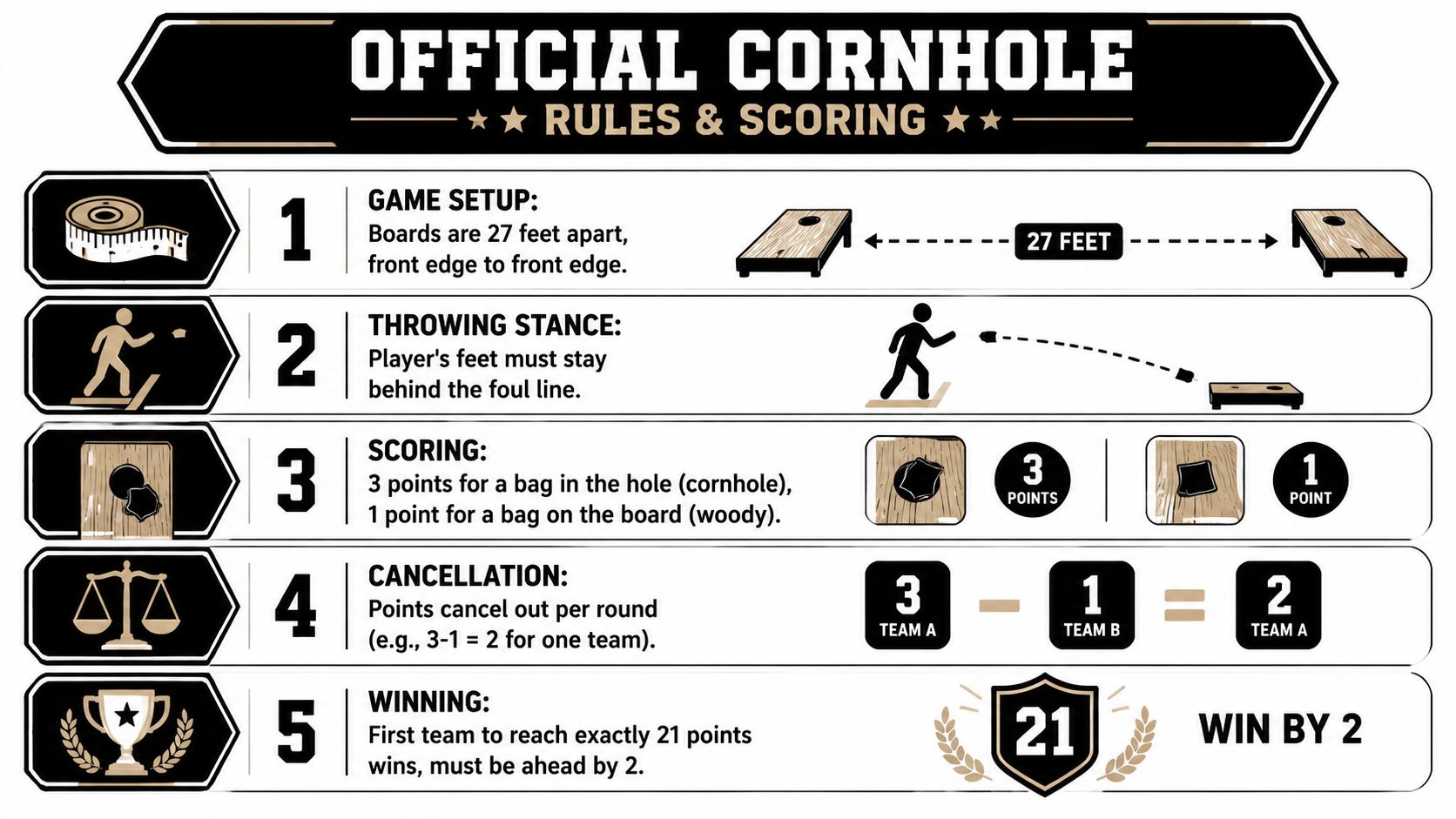
According to the American Cornhole Organization rules, regulation play uses two boards placed 27-foot (8.23 m) front edge to front edge, with boards measuring 2 ft × 4 ft. Each board has a 6-inch (15.24 cm) diameter hole positioned 9 inches from the top edge and 12 inches from each side. A standard game uses 8 total bags, with 4 per team.
If you want a quick explainer to share with guests before play starts, this plain-English guide to a bag toss game is a useful primer.
How a round works
A round is often called an inning. Both sides throw all four of their bags, taking turns until all 8 bags have been played. Players throw underhand and must stay behind the front edge of the board, which acts as the foul line.
For event use, the easiest way to explain it is this: one team throws, the other answers, and nobody counts anything until every bag has stopped moving. That last part matters on lawns, especially after a Cape Town breeze or on slightly uneven ground near a braai area, where a bag can still slide or tip off the board.
A simple round follows this order:
Team A throws one bag
Team B throws one bag
They continue alternating
After all 8 bags have landed, you score the inning
How scoring actually works
Guests usually understand throwing quickly. Scoring is where they hesitate.
The points are simple:
Bag in the hole: 3 points
Bag on the board at the end of the round: 1 point
Bag on the ground or hanging off without resting on top: 0 points
The part that needs a clear explanation is cancellation scoring. It works like balancing two receipts against each other. You do not add both teams' totals to the scoreboard. You compare the two inning scores, cancel the matching points, and only the difference gets added.
So if one team scores 8 and the other scores 6, the higher-scoring team gets 2 points for that inning. That is the official approach, as noted earlier in the ACA rules.
Practical event tip: Put “3 in the hole, 1 on the board, subtract the lower score” on a small sign. It saves a surprising number of debates.
A plain example of cancellation scoring
Here is the version I use when explaining it to wedding guests who want the rules in ten seconds.
Team
Round total
Team Green
8
Team Gold
6
Green scores 2 points, not 8. Gold scores 0 for that inning because their 6 is cancelled out by 6 of Green's 8.
Once guests see one example, they usually get it straight away.
Fouls and what happens to the bag
For social events, you do not need a stern referee. You do need one agreed standard.
These are the fouls that matter most:
Stepping over the foul line while throwing
Throwing overhand instead of underhand
Playing on a surface so uneven that bags roll or bounce in a way that affects fair scoring
If a bag is thrown illegally, it can be removed under ACA rules. At a corporate year-end function or relaxed family wedding, I usually recommend explaining that rule before the first game and then applying it consistently, without making the game feel stiff.
That balance matters in the Winelands. On a formal lawn at a wine estate, guests often appreciate a tidier rule set. At a casual Sunday gathering with braai-day etiquette in full swing, people are happy with one friendly host saying, “Behind the line, underhand only, and we count properly at the end.”
The easiest way to keep the game friendly
Choose one person to act as the rule-setter for the day. They do not need to watch every throw. They only need to settle questions the same way every time.
A short house script works well:
Throw underhand
Stay behind the line
Wait until all bags stop
Score 3 for the hole and 1 for the board
Subtract the lower total from the higher one
If a round gets messy, replay it with good humour
That final point is often the difference between a game guests try once and a game they keep returning to all afternoon. A corn hole game at an event should feel fair, easy to join, and relaxed enough that people want another round.
Cornhole Boards Beanbags and Ideal Setup
The equipment looks simple, but good setup makes the difference between “nice idea” and “everyone's playing”. A Corn Hole game needs the right boards, the right bags and enough surrounding space for people to throw comfortably without colliding with serving staff, décor or other guests.
The official board shape matters because it affects the way bags land and slide. Regulation boards measure 2 ft × 4 ft, and the hole size and position are fixed for standard play. That consistency is one reason experienced players prefer proper boards over improvised DIY versions for formal events.
What to look for in the equipment
You don't need guests to know the technical details, but you do need equipment that feels dependable.
Boards that sit firmly: Wobbling boards lead to complaints, especially on grass.
Bags in matching sets: Distinct colours make scorekeeping easier at a glance.
A surface with some grip: Overly slick finishes can make casual players feel they have no control.
Clean presentation: At weddings and corporate functions, the game should look neat enough to blend into the venue styling.
If you're exploring soft-seating and lawn-game combinations, this guide to Cape Town bean bag hire is useful for creating a relaxed outdoor area around the game.
Where to place the game at a venue
Placement is where many hosts go wrong. They either hide the game too far away, where nobody finds it, or put it in a busy walkway, where it becomes a traffic problem.
A better approach is to place it near activity, but not inside activity.
Good placement
Why it works
Edge of a lawn near the bar
Guests notice it while collecting drinks
Side of a courtyard
Easy to reach without blocking circulation
Open grass near cocktail seating
Players and spectators can gather comfortably
Venue-specific advice for Cape Town and the Winelands
Wine farms often have beautiful lawns, but not every attractive spot is practical. Check the ground first. If it slopes, bags may roll in ways that frustrate players and start scoring debates. The ACA standard specifically expects a flat and level grass surface for accurate play, which is especially relevant for outdoor events.
Also think about the setting around the game:
Keep it clear of fragile décor: Florals, signage and candles don't belong in the throwing zone.
Allow viewing space: People enjoy watching almost as much as playing.
Avoid direct service lanes: Catering staff need clean movement paths.
Consider sun and wind: Late afternoon glare can make one end harder to play from.
On a lawn, test a few bags before guests arrive. If they keep drifting or rolling, move the boards rather than hoping nobody notices.
Cornhole should feel effortless. That only happens when the setup has been thought through in advance.
Perfecting Cornhole for Cape Town Weddings and Functions
The ceremony has ended, the drinks are flowing, and your guests split into familiar groups. A few head straight for the bar. A few know each other well. Others are still finding their feet. In that in-between hour, a corn hole game gives people an easy reason to gather, chat, and join in without putting anyone on the spot.
In Cape Town and the Winelands, that matters more than many hosts expect. A game that suits the setting can help a formal wedding feel warm, a corporate function feel relaxed, and a braai feel organised without losing its easygoing mood.
At a Franschhoek wedding, cornhole often works best as a polished lawn activity during pre-reception drinks. At a Paarl company event, it can run as a light team challenge that people join between conversations. At a suburban birthday or family braai, it usually becomes the background favourite. Guests drift in, play a round, then return later for another go.
One local challenge comes up again and again. Guests often arrive with slightly different ideas about how scoring works. That is normal at weddings, braais, and office functions where people have picked up rules from friends rather than from a formal league. Clear house rules solve this quickly and keep the game social.
Winelands weddings and cocktail hour flow
Cocktail hour can feel long for guests who do not know many people. Cornhole helps because it gives them something simple to do with their hands while conversation starts naturally. It works like a social bridge. Two people can play, four can gather around, and a larger group can watch without needing chairs, microphones, or a formal announcement.
On wine farms, the best results usually come from treating the game as part of the guest experience, not as a side extra. Place it where people naturally pass between drinks, shaded seating, and the reception entrance. That keeps the lawn active without turning one corner of the venue into a bottleneck.
A wedding-friendly setup usually includes:
A small printed rules sign: Short enough to read in a few seconds
One agreed scoring method: Decide it before guests start playing
A gentle invitation from the MC, coordinator, or bar staff: Enough to signal that the game is there to be enjoyed
A clear finish point for each round: Helpful if guests need to move through to dinner
Corporate crowds usually respond well to activities that are easy to join and easy to leave. That is where cornhole earns its place. A guest can play one round while waiting for a colleague, chat during play, and step away without disrupting anything.
That flexibility suits product launches, year-end functions, staff socials, and client events. You can leave the game open for casual use, or set up a short knockout round for teams if the crowd enjoys a little competition. The trick is to keep the tone friendly. A corporate event should feel lively, not tense.
Branded boards can also work well in this setting, especially for activations or internal team events. On a wedding lawn, though, a clean neutral set usually looks better than heavy branding.
Braai-day etiquette and house rules that save the day
Braais have their own rhythm. People snack, talk over each other, disappear to check the fire, and return mid-conversation. Cornhole fits that rhythm beautifully, but only if the rules are settled early.
A good comparison is a shared playlist. If nobody agrees on what is being played, everyone starts making their own choices. Scoring works the same way. One guest counts a bag on the edge as special. Another says only bags through the hole count. A third starts explaining a version they played on holiday. None of this is a problem until the score matters.
Keep it simple:
Put the scoring rules on one visible sign
State how edge bags, doubtful throws, and foot faults will be handled
Choose one person to make the final call if there is disagreement
Favour the decision that keeps the game moving and the mood light
That is good braai-day etiquette. Be clear, be relaxed, and do not let a lawn game become the loudest debate of the afternoon.
What works for private parties and schools
Private parties often need activities that guests can understand without a host giving constant instructions. Cornhole does that well. The target is obvious, rounds are short, and different ages can join without feeling out of place.
Schools, universities, and community events also benefit from that simplicity. Guests do not need sportswear, a warm-up, or a full team. They just need a few beanbags, enough space to throw safely, and a clear idea of the rules.
Across all these events, the principle stays the same. Match the game to the setting, explain the rules before the first throw, and keep the experience easy for guests to join. That is how cornhole feels at home at a Cape Town wedding, a Winelands function, or a laid-back braai.
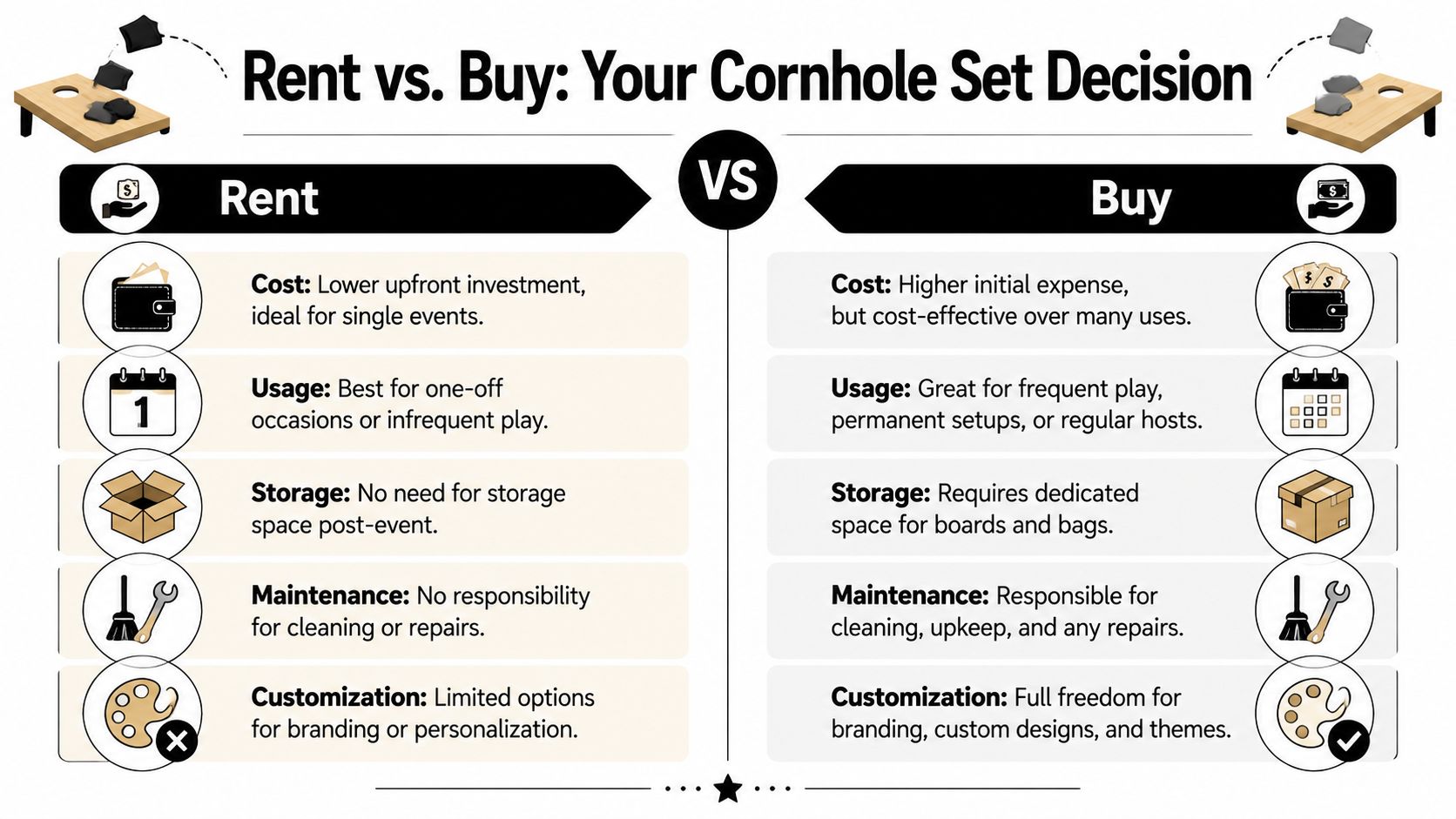
Should You Rent or Buy a Cornhole Game Set
This decision is usually simpler than people expect. The question isn't whether cornhole is worth having. It's how often you'll use it, how much admin you want, and whether you've got the space to store proper boards afterwards.
For most weddings, one-off celebrations and occasional business functions, renting is the more practical option. Buying starts to make more sense if you're a venue, a frequent host, or someone who plans to use the set regularly.
If you're weighing entertainment rentals more broadly, this article on how to rent a party is a helpful starting point.
When renting makes sense
Renting suits hosts who want the fun without the aftercare. You don't need to source boards, compare finishes, store bags in a dry place, or worry whether your DIY set looks polished enough for a wedding lawn.
Renting is usually best when:
The event is once-off: Weddings, milestone birthdays and annual functions fall into this camp.
You want a clean, ready-to-use look: Presentation matters more at formal events.
Storage is limited: Boards aren't tiny, especially once you factor in transport.
You don't want maintenance: After the event, you're done.
When buying may suit you better
Buying can be sensible for venues, estates or households that will use the game often. If the set is going out every weekend, ownership gives you flexibility and immediate access.
Here's a simple comparison:
Option
Better for
Main trade-off
Rent
Single events and occasional use
Less personalisation
Buy
Frequent hosting and regular setups
Storage and upkeep
A practical Cape Town view
For the average engaged couple or event manager, buying often sounds easier than it proves to be. You still need transport, a decent place to keep the boards, and confidence that the set will arrive at the venue looking event-ready.
That's why many local hosts prefer to rent. It keeps the decision focused on guest experience, not equipment ownership. If you're running a venue or planning repeat lawn-game use, buying can absolutely work. If you're planning one excellent day, renting is often the cleaner solution.
Buy if the set will become part of your regular hosting toolkit. Rent if you simply want the event to run smoothly and look good.
Get the Good Times Tossing with ABC Hire
A Corn Hole game solves a very specific event problem. It gives guests something easy, social and low-pressure to do when they aren't eating, dancing or seated for the formal programme. That's why it fits so naturally into Cape Town weddings, Winelands receptions, staff functions and relaxed private celebrations.
The game itself is simple. The success of it isn't accidental. Good placement, clear rules, tidy equipment and a bit of local common sense make all the difference. If you set it up well, guests will treat it as part of the atmosphere rather than a separate entertainment item.
That same thinking applies to other parts of event planning too. Clear systems reduce stress. For small businesses, planners and venue operators who also sell or package services online, this Shopstar guide to selling online is a useful resource for getting your offering presented clearly and professionally.
If you're planning an event in Cape Town, Stellenbosch, Franschhoek, Paarl or nearby areas, adding cornhole doesn't need to become another complicated task on your list. With the right setup, it's one of the easiest ways to add movement, laughter and connection to the day.
Ready to add a Corn Hole game to your wedding, corporate event or private function? ABC Hire can help you create a polished, guest-friendly setup for events across Cape Town and the Winelands. Reach out to book your hire and make sure your guests have something memorable to enjoy between the big moments.
You're probably trying to land a very specific look. Not generic “event furniture”, but a room that feels polished, relaxed, layered, and worth photographing from every angle.
That's usually where Malawian cane furniture enters the conversation. In Cape Town and the Winelands, it solves a styling problem that planners run into all the time. Banquet seating can feel too formal. Contemporary lounge pieces can read cold. Rustic timber can tip too far into farm-style if it isn't handled carefully. Cane sits in the middle and does the hard job well.
It softens a marquee, gives structure to a vineyard terrace, and makes a corporate lounge feel less transactional. It also has to survive real event conditions. Deliveries on tight schedules, movement between ceremony and reception areas, dry inland heat, coastal air, and guests who don't treat furniture like museum pieces. That's where experience matters more than mood boards.
The Timeless Charm of Malawian Cane Furniture
A planner might start with a brief like this. The couple wants elegance, but they don't want the wedding to feel stiff. The venue has stone, oak, lawn, and mountain views. Standard conference chairs are out. Heavy upholstered lounge seating feels wrong. They need something that belongs in the surroundings rather than competing with it.
That's why Malawian cane furniture has become such a dependable choice for refined events in the Western Cape. It brings handwoven texture into a setting without making the space feel over-styled. A single pair of cane lounge chairs can warm up a ceremony signing table area. A full lounge cluster can give shape to a pre-dinner drinks space that would otherwise feel scattered.
Why it works so well in Cape settings
Cape Town and the Winelands reward furniture that looks settled in natural light. Cane does that beautifully. It catches sun without glaring, reads well against linen and timber, and doesn't flatten out in photographs the way some plastic or metal event furniture can.
For planners building layered spaces, it also bridges styles that don't always sit easily together:
Private celebrations: relaxed conversation areas that still feel curated
For anyone shaping a venue with warmth and restraint, this wider conversation around designing authentic rustic interiors is useful because it shows how natural materials keep a room grounded without making it feel themed.
Cane works best when the rest of the room isn't fighting it. Let it be the texture that softens the hard edges.
More than a passing trend
The reason it keeps returning season after season is simple. It doesn't rely on novelty. It has heritage, visual lightness, and enough personality to carry a space without becoming the whole story.
That matters at events. Trend-led pieces date quickly. Good cane doesn't. It feels right at a vineyard wedding, a luxury garden lunch, a panel discussion, or a milestone birthday under a stretch tent. It's one of the few furniture categories that can look relaxed and still read premium.
What Defines Authentic Malawian Cane Furniture
At a site visit, authenticity shows up long before a guest sits down. It shows in how a chair lifts, how the frame holds its shape, and whether the weave still looks calm after loading, stacking, and a bumpy run out to the Winelands. For rental use, that distinction matters more than the label on a product listing.
Authentic Malawian cane furniture is usually identified by two things. The first is a solid timber frame, commonly made with blue gum. The second is handwoven cane that forms part of the chair's working structure, not just a decorative skin. That combination gives the piece its light visual profile and its practical strength.
Start with the frame
I check the frame before I check the pattern of the weave. If the frame is weak, the chair may still photograph well, but it will struggle in a real event cycle.
A good frame earns its keep in three places:
Repeated handling Chairs are loaded, unloaded, carried across gravel, and reset more than once in a busy week. The frame needs to stay square and balanced.
Uneven surfaces Lawns, historic venues, timber decks, and tent flooring all place different pressure on the legs and joints. A stable frame copes better with those shifts.
Seasonal movement Cape Town and the Winelands are hard on natural materials. Dry heat inland and damp coastal air can expose weak construction quickly.
That is why I treat authentic cane and generic woven seating as separate categories. If you want a broader view of what works outdoors, this guide to wicker furniture for outdoor event use is a useful companion.
Then inspect the weave
The weave tells you whether the piece was made for use or made to imitate the look. Authentic Malawian cane rarely has the overly perfect, pressed-flat finish you see on factory copies. The tension feels consistent, but the surface still has the small variations that come with handwork.
Those details matter in rentals because the weave takes real pressure. Guests shift in their seats. Lounge setups run for hours. Furniture is moved by different crew teams, not handled like a showroom sample.
Use this quick check on site or in a warehouse:
Look for slight variation in the weave: hand-finished work has character without looking messy.
Check where cane meets timber: weak replicas often start separating at stress points.
Press the seat and back gently: the response should feel supportive, not brittle or hollow.
Turn the chair over: quality often shows underneath, where poor copies cut corners.
Practical rule: If the underside looks rushed, the chair will usually underperform in rentals.
Why the making process matters
Material preparation affects how the chair behaves after a season of use. Cane that has been handled and woven properly keeps a better balance between flexibility and support. Poorly prepared cane tends to dry out, loosen, or crack sooner, especially once it moves between storage, trucks, and outdoor venues.
That point gets missed in a lot of event buying decisions. Planners often focus on silhouette, colour, and price per unit. Rental teams deal with the after-effects. We see which chairs come back looking sound, and which ones start failing at the joins after a short run of events.
How to spot the difference in practice
A side-by-side comparison usually makes the choice clear.
Feature
Authentic Malawian cane
Lower-grade imitation
Frame feel
Stable and well-balanced
Light, but often less secure
Seat response
Flexible with support
Too rigid or already sagging
Finish
Handmade character
Repetitive, machine-flat appearance
Rental use
Suited to frequent handling
Better kept for light decorative use
For event planners, authenticity is a performance question as much as a design one. The right piece holds up in transport, sits well on mixed venue surfaces, and stays presentable through a Cape season that can shift from hot sun to damp air in the same week.
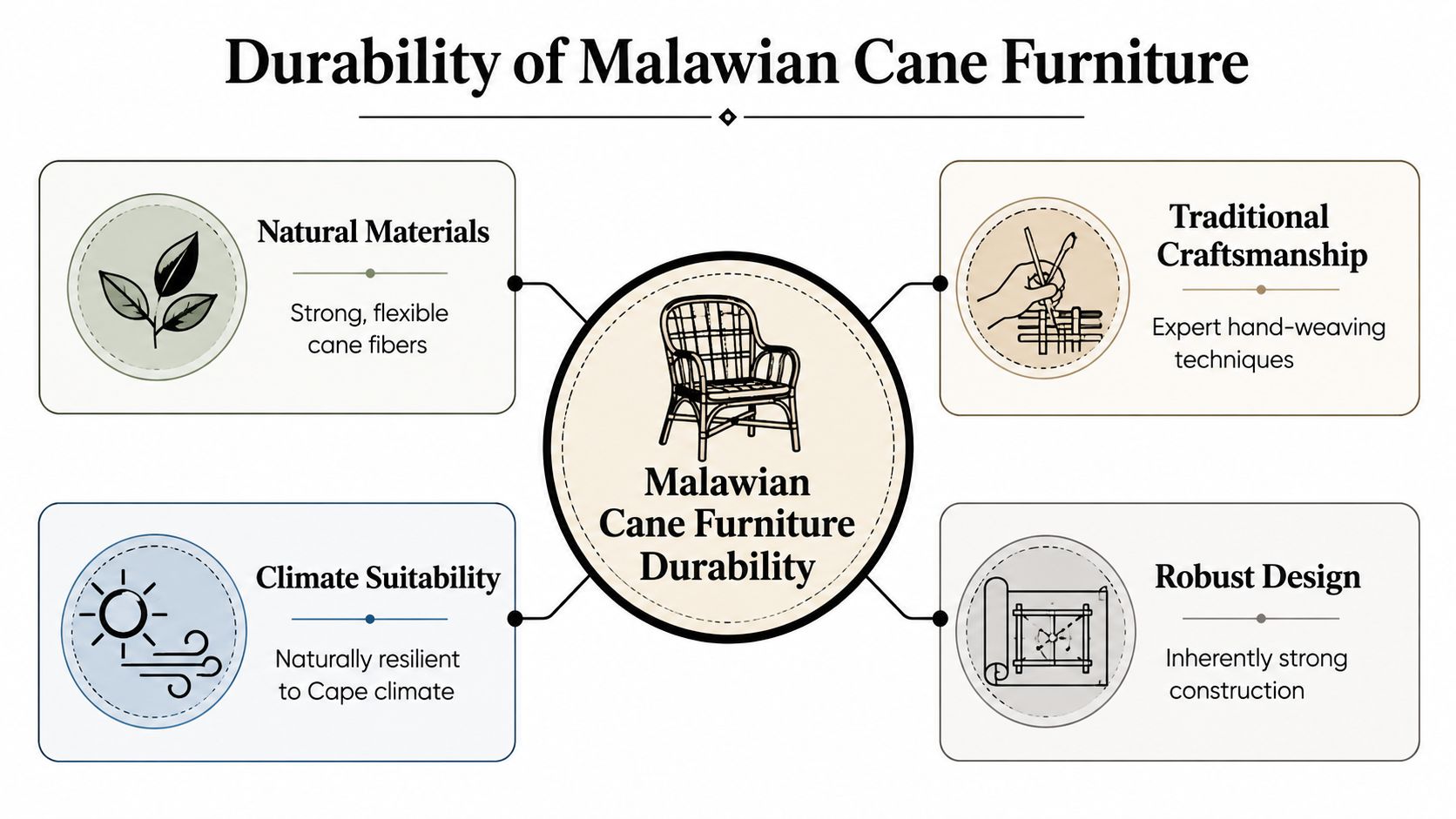
Built for Beauty and Durability in the Cape Climate
One of the most common questions I hear is simple. It looks good, but will it cope outdoors in the Cape?
That's the right question. A lot of imported furniture performs well in a studio or showroom and then struggles once it meets a real South African event calendar. Summer in Stellenbosch is dry and hot. Atlantic-facing venues can turn damp and windy. Garden events move between sun and shade all afternoon. Furniture has to absorb those shifts without becoming unreliable.
Why authentic cane performs better than lookalikes
The local concern isn't whether cane is stylish. It's whether it can stay presentable and functional through changing coastal and inland conditions. That concern is justified. Smith Honig's Malawi cane chair listing highlights that existing content often misses how furniture behaves in South Africa's hot and sometimes humid coastal climates, while noting that authentic Malawian cane is better equipped than other imported rattan because of its material composition.
In practical terms, that means planners should stop grouping all woven furniture into one category. “Rattan-look” is not a performance standard. Construction decides the result.
For a useful companion read on placement and weather considerations, this guide to outdoor wicker furniture use helps frame the broader decisions around exterior event styling.
What works on local venues
Authentic Malawian cane works well in these situations:
Ceremony lounges under partial shade: the furniture keeps visual softness without looking bulky.
Covered terraces near the coast: it suits the environment better than glossy or over-upholstered pieces.
Indoor-outdoor transitions: cane doesn't feel visually jarring when guests move between spaces.
Winelands reception breakaway areas: it complements stone, timber, grass, and vineyard backdrops.
What doesn't work is careless placement. Any natural-fibre furniture will suffer if it's left exposed for extended periods in punishing conditions without thought for timing, cover, or handling. Good planners don't ask furniture to do the impossible. They match the product to the site and the schedule.
Use cane as premium event seating, not as permanent outdoor furniture abandoned to the weather.
The local trade-off
Here's the honest version. Malawian cane furniture is durable, but it isn't indestructible. That's a strength. It performs because of a balanced construction that combines support with flexibility. Furniture that feels rock-hard can crack, split, or age badly. Furniture with some elasticity often handles event use more gracefully.
For Cape events, that balance is exactly what you want. It gives you furniture that looks refined in photographs and behaves sensibly on the ground, which is a better outcome than choosing something purely on trend value.
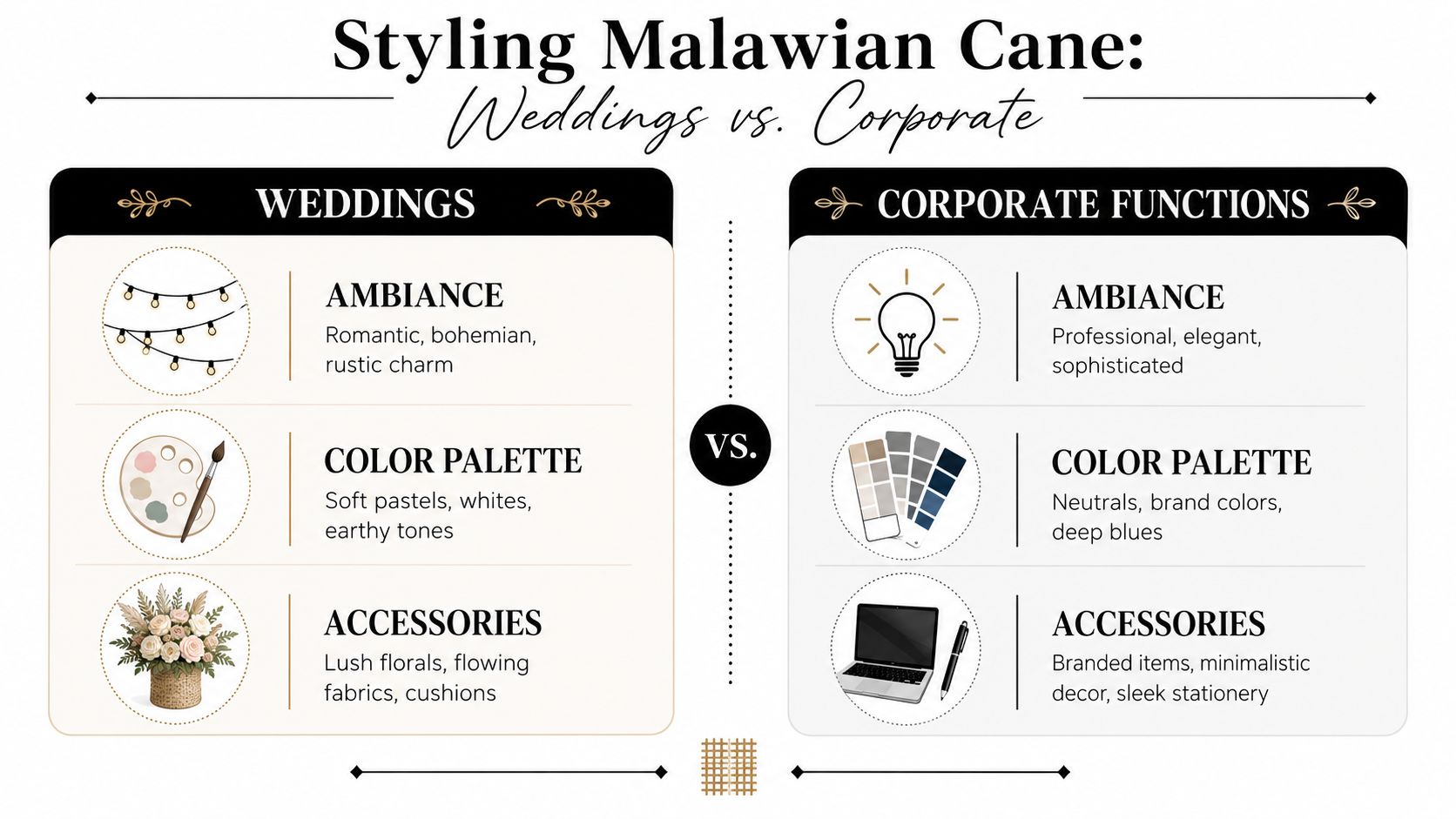
Styling Ideas for Weddings and Corporate Functions
The best results come when cane furniture is styled with intent. It shouldn't be dropped into a venue as a generic “lounge option”. It needs supporting pieces, spacing, and texture around it so the whole zone feels resolved.
A Winelands wedding lounge that feels soft, not sloppy
At a vineyard wedding, cane usually earns its place in one of three areas. The pre-ceremony arrival zone, the drinks lounge after the vows, or a quiet corner near the reception where guests can settle with a glass in hand.
The strongest layouts use a mix of single chairs and occasional tables rather than one oversized cluster. Cane already has visual texture. If you overfill the area, it starts to feel busy.
A wedding combination that works well:
Two or four cane chairs facing inward for conversation
A small side table for candles, menus, or welcome drinks
A natural-fibre rug to anchor the grouping
Loose cushions in ivory, clay, oat, sage, or muted blush
Layered florals that feel garden-grown rather than tightly formal
The key is restraint. Soft linen cushions and one or two throws are enough. Once every chair has a bow, tassel, and oversized floral tie-on, the furniture loses its sophistication.
Wedding styling should feel collected. If every element is shouting “rustic luxury”, the room starts to look staged instead of elegant.
For evening receptions, I like cane paired with warm lamps, candle clusters, and low arrangements rather than high centrepieces nearby. That keeps sightlines open and lets the woven detail show in the lighting.
A corporate setup that doesn't feel like a conference foyer
Corporate teams often want warmth but worry that cane may feel too informal. It doesn't, if the styling is disciplined.
At a product launch or media event, cane works best in deliberate zones. Think registration waiting area, speaker green room, panel seating with personality, or networking lounges that break up a large venue. The furniture softens the atmosphere and encourages guests to stay longer in conversation areas.
A cleaner corporate formula looks like this:
Element
Wedding approach
Corporate approach
Palette
Soft neutrals and pastels
Neutrals with one or two brand colours
Textiles
Linen, soft layering
Minimal cushions, tailored finishes
Tables
Candles, florals, signage
Branded collateral, sleek tabletop styling
Lighting
Romantic and warm
Focused, polished, architectural
One useful reference point for planners shaping guest movement, arrivals, and premium presentation is this broader piece on 2026 corporate event planning. It's not about furniture specifically, but it does reinforce how transport, staging, and comfort all affect the final experience.
If you're leaning into a heritage, editorial, or textured event look, this guide to vintage furniture styling in Cape Town also helps position cane within a fuller event design language.
Pairings that lift the furniture
Some combinations consistently work better than others.
Best with cane: travertine-look tables, timber side tables, linen upholstery, neutral ceramics, woven rugs
Use carefully: mirrored plinths, chrome cocktail tables, ultra-gloss finishes
Usually too much: heavy boho overload, dense macramé, excessive dried grass installations around every cluster
The furniture already brings pattern and depth. Your job is to edit around it so guests notice the room, not just the props.
Your Guide to Renting in Cape Town and the Winelands
A planner signs off a beautiful cane setup for a Franschhoek wedding, then the venue confirms a narrow cellar entrance, a short load-in window, and a lawn that turns soft after morning mist. That is usually where rental decisions get tested. In the Cape, the right cane furniture is not only about style. It has to arrive on time, fit the access route, and still look sharp after setup in wind, dust, or damp coastal air.
That is why I always advise clients to book by venue conditions first, then by look. Cane photographs well, but a successful hire depends on stock consistency, maintenance standards, and a supplier who knows the difference between loading into a CBD hotel and striking from a wine estate after midnight.
What to ask before you book
Start with the questions that affect the event day, not only the quote.
Ask how the furniture is stored between hires, whether the pieces are closely matched, and how the team handles last-minute venue changes. In the Winelands, access can shift quickly because of weather, farm operations, or revised floorplans. A supplier who has worked those venues before will usually spot problems early.
A good rental partner should answer clearly on:
Inventory consistency: are the chairs and loungers close enough in tone and shape for a polished setup?
Condition control: how are frames, weaving, and finishes checked after each hire?
Delivery timing: can the team work within venue access windows and alongside florists, technical crew, and caterers?
Collection planning: what happens if speeches run late or the strike starts after guests have cleared slowly?
Venue familiarity: has the supplier delivered to beaches, estates, private homes, and central city venues with restricted access?
Choose by zone, not by single piece
Clients often begin with one standout chair, then discover the room still feels incomplete. Cane works best when it is planned as part of the guest flow.
That usually means choosing where people will sit, wait, gather, or take photos. A ceremony entrance needs a different quantity and layout from a pre-drinks terrace or a speaker lounge at a conference.
Typical hire approaches include:
Accent seating only Best for a signing table area, entrance moment, or styled photo corner.
Small lounge clusters Useful for cocktail hour, shaded verandas, and relaxed networking spaces.
Repeated seating zones Best for larger weddings and corporate functions where guests spread across several areas.
If you need a wider view of quantities, layouts, and mixed furniture options, this guide to furniture hire in Cape Town is a practical place to start.
What a well-run delivery actually looks like
The strongest setups are planned backwards from the venue. That includes gate access, stairs, gravel drives, lift restrictions, cellar doors, weather cover, and the time other suppliers need on the floor.
Cape Town and the Winelands add their own pressures. South Easter wind can delay outdoor placement. Coastal damp can leave furniture needing a quick wipe before guests arrive. On farms and estates, long carry distances and uneven ground slow crews down if the plan was too optimistic.
The suppliers worth booking usually have the same habits:
A placement plan confirmed before dispatch
A realistic setup window based on the venue
One clear onsite contact
A count and placement check on arrival
A collection time that matches venue strike rules
If a supplier is vague about how delivery will run, expect problems later.
Booking instinct that usually proves right
Beautiful product shots are not enough. The better question is whether the supplier can protect the look once the furniture leaves the warehouse and hits a real Cape Town event site.
Malawian cane is a strong rental choice here because it brings warmth, texture, and a premium finish without feeling heavy or over-styled. But it performs best when the hire company understands local weather, transport routes, venue access, and turnaround pressure. That local knowledge is what keeps the furniture looking refined from first placement to final guest departure.
Event Day Care and Transport Guidance
A cane chair can leave the warehouse in excellent condition and still arrive on the floor looking tired if the crew handles it badly. On Cape Town event days, the pressure points are predictable: quick room turns, damp morning air, lawn setups, and return loading after dark. Good handling protects both the finish and the shape.
What crews should do on site
Authentic pieces are practical to work with because they are light enough to place efficiently and comfortable enough for guest areas, as noted in Malawi Furniture's care guidance. That advantage disappears if teams grab the woven seat, drag the base across stone, or leave pieces exposed while waiting for the rest of the install.
Lift from the frame: hands should be on the solid structure, not the woven seat or back.
Set each piece down on firm, level ground: this matters on lawns, gravel courtyards, and farm venues with uneven surfaces.
Wipe moisture and spills promptly: coastal damp, condensation from drinks, and light rain all need quick attention with a soft damp cloth.
Stage outdoor pieces as late as the schedule allows: less time in direct sun and wind means less cleaning and fewer last-minute touch-ups.
Use covers during holding periods: if furniture is waiting in a loading zone or under partial shelter, keep dust and moisture off it.
One habit saves a lot of damage. Carry cane furniture the way specialist antique movers handle older timber pieces: supported from the strongest points, never by the decorative or woven sections.
Common mistakes during setup and strike
The problems I see most often are not dramatic breakages. They are small handling errors that add up over a busy season.
Don't stack pieces unless that design is meant for stacking.
Don't use arms, woven edges, or backrests as tie-down points in the truck.
Don't place soaked florals, ice buckets, or dripping drink tubs directly on cane surfaces.
Don't leave furniture standing uncovered through a weather change if guests are still hours away.
Cape weather is the ultimate test. A dry, hot setup in the Winelands can leave pieces dusty by guest arrival. A coastal job can bring mist, salt air, and damp cushions before the first person sits down. Teams that work here regularly plan for both.
What proper rental maintenance looks like
Well-kept cane comes from routine conditioning, careful storage, and disciplined loading. It also needs periodic polishing to top and bottom cane surfaces with the right oil-based product, applied sparingly, as noted earlier in the same care guidance.
That is the difference between furniture that photographs well once and furniture that keeps its finish across repeated hires. Guests may never notice the maintenance standard directly. They notice the result immediately.
Your Malawian Cane Furniture Questions Answered
Can it be used outdoors for a Cape Town event?
Yes, if the setup is sensible. Cane works well for outdoor ceremonies, covered terraces, lawn lounges, and transition spaces between indoor and outdoor areas. The important part is placement, timing, and weather awareness. It's event furniture, not something to leave exposed without a plan.
Is it actually comfortable for guests?
Yes. Good cane chairs feel supportive rather than stiff, which is why they work for lounges, waiting areas, and conversation settings. They're also visually lighter than bulky upholstered options, so you don't sacrifice comfort to get the look. If the event runs long, adding cushions improves comfort and helps tie the furniture into the wider palette.
How far in advance should we book?
Book as early as you can once your venue and date are confirmed. Cane is one of those categories that gets requested for weddings, launches, private celebrations, and styled shoots, often by clients chasing a similar aesthetic. Early booking gives you a better chance of getting matching pieces and the exact quantities you need.
What should we ask a rental company before saying yes?
Ask about condition consistency, transport procedures, cleaning standards, and how they handle venue access restrictions. If your event includes premium or fragile décor, it's also worth understanding whether the supplier approaches loading and movement with the same care you'd expect from specialists who handle delicate pieces, similar to the standards described by professional antique movers.
The short version is this. Malawian cane furniture is a strong choice when you want warmth, elegance, and a more thoughtful event environment. The result depends on choosing authentic pieces and working with a team that understands how they should be handled in local conditions.
If you're planning a wedding, launch, private celebration, or formal event in Cape Town or the Winelands, ABC Hire can help you source event furniture that looks right and works hard on the day. Browse the range, confirm availability early, and build a setup that feels as polished in person as it does on your mood board.
You're often down to the final version of the function sheet when this catches you. The menu is signed off. The floorplan works. Glassware counts are sorted. Then someone asks, “Are we putting champagne on tables, at the entrance, or both?” and suddenly champagne ice buckets stop being a small décor decision and become a service problem.
That's usually where events either look polished or start to feel improvised.
In Cape Town and the Winelands, that decision carries more weight than people expect. A bucket affects how quickly bottles come down to serving temperature, how much table space disappears, how many staff touch each bottle during service, and whether your reception reads as premium or patchy. At a summer wedding in Franschhoek, the wrong bucket setup can leave sparkling wine warming too fast between pours. At a corporate launch in the city, too many buckets on small cocktail tables can make the whole room feel cluttered before guests have even settled in.
The point isn't just to have buckets. It's to choose the right type, place them where service needs them, and order enough to support the way the event will run.
The Overlooked Detail That Defines Your Event
You see the pressure point early at a Cape Town summer reception. The sparkling wine is due on arrival, the terrace is already warm, and the venue team asks where the buckets are going. If that answer is vague, service starts slipping before the first proper pour.
Champagne ice buckets affect temperature control, staff movement, table spacing, and the overall read of the room. In the Winelands, where heat, sun and longer outdoor service windows are common, they need to be treated as working equipment with a styling role attached, not the other way around. I plan them the same way I plan glassware drops or back-of-house ice runs, because once guests arrive, there is very little time to correct a weak bucket setup.
A good bucket setup keeps bottles cold, reduces unnecessary handling, and stops staff from improvising with whatever spare vessel is nearest. It also protects the visual balance of the event. One oversized bucket on a small round can crowd candles, florals and bread plates faster than clients expect. If you are weighing options beyond champagne service, this guide to ice buckets and stands for event use is a useful reference point.
What goes wrong when this is treated as an afterthought
The failures are usually practical.
Service backs up when too few buckets are shared between too many tables or stations.
Tables lose usable space when the bucket footprint is larger than the layout allows.
Ice melts too quickly when the vessel is shallow, badly insulated, or placed in direct afternoon sun.
The hire bill creeps up when the fix happens late and the replacement stock does not match the original brief.
Guests may not identify the bucket as the problem, but they notice warm pours, wet tablecloths and staff reaching across them too often.
What good planning looks like
The bucket has to suit the event format first. At a seated wedding, that means leaving enough room for shared plates, décor and comfortable service access. At a product launch, the bucket may need to support the brand look while still being light enough for fast resets. At a matric dance or high-volume private function, durability often saves money because the equipment works harder during setup, service and strike than many clients realise.
When the choice is right, the room feels controlled. Bottles stay at serving temperature for longer, staff work cleanly, and the bucket adds to the table instead of fighting with it.
Choosing Your Buckets Material Style and Size
The wrong way to choose a bucket is by finish alone. The right way is to ask three questions first. Who will handle it, where will it sit, and how long does it need to perform before the next reset?
That narrows the field quickly.
Material decisions that affect the event
Stainless steel works well when service discipline matters. It suits formal dinners, black-tie receptions and premium corporate events because it reads clean and controlled. It also tends to feel more substantial in hand, which helps during tray or table service.
Acrylic is often the practical rental choice for busy events. It's lighter, easier to move in quantity, and less stressful in high-traffic venues where breakage is a real concern. Clear acrylic also disappears visually into many table designs, which can help when you want the bottle on show without adding visual heaviness.
Glass or crystal can look exceptional in the right room, especially under candlelight or in classic ballroom styling. But they demand calm service conditions. In outdoor Winelands settings, where staff may be moving between gravel, lawn, decking and uneven surfaces, the fragility can outweigh the elegance very quickly.
Copper and mixed-metal finishes work best when the styling brief is doing more of the talking. Rustic-luxe weddings, harvest-table aesthetics and branded experiences with warmer palettes can carry them well. The trade-off is maintenance. Fingerprints, water marks and finish wear show faster.
Why size and shape matter more than most people think
A bucket can be beautiful and still fail in service.
A commercially available clear plastic champagne bucket used for beverage service measures about 10.6 in (L) × 8 in (W) × 7.8 in (H) and holds 3.7 quarts, with built-in handles and a stable base designed to reduce spill risk during table service, according to this product specification for a plastic champagne bucket. In practical terms, that size works because it can take a standard 750 ml bottle plus ice without turning into a balancing act.
Practical rule: If the bucket can't comfortably take the bottle and enough ice-water around it, it's not a champagne bucket for event service. It's a prop.
Oval versus round
Oval buckets usually make more sense for table service. They sit neatly, present the bottle well, and often feel easier to carry because the handles fall into a more natural grip. Round buckets can work on bars and stations where symmetry matters more than footprint.
Deep buckets are better for chilling. Shallow buckets may look sleek in product photos, but they often force the bottle to sit too exposed above the ice line. In warm weather, that costs you consistency.
Matching bucket style to event type
A simple way to decide:
Formal wedding reception: stainless steel or refined clear acrylic
Outdoor vineyard wedding: acrylic or other durable break-resistant options
Corporate launch: modern acrylic, branded options, or minimal metal finishes
Matric dance or large private party: durable, easy-to-replace, easy-to-carry buckets
Styled table moment: use a bucket with a stand so the tabletop stays usable
If you're weighing table footprint against presentation, ice buckets and stands for event layouts are often the cleaner solution because they move the bucket off the eating surface without losing the visual cue of premium drinks service.
Calculating Capacity How Many Buckets You Need
A planner can get the glassware, linen and lighting right, then still lose the drinks service by under-ordering buckets. In Cape Town and the Winelands, that mistake shows up fast. Afternoon heat, dry air and long outdoor service windows warm bottles quickly, especially when the bar is under pressure.
Guest count helps, but bucket count comes from service flow.
Start with the bottle journey
Map where each bottle will be chilled, opened and held before you count a single unit. For most events, the pattern falls into three setups:
Arrival service from a station or roaming team
Table service where bottles remain with guests
Self-serve or semi-self-serve points where guests return to a drinks station
Each setup creates a different demand on your stock. A welcome drinks station may show only a few buckets to guests, but staff still need chilled replacements ready behind the scenes. Table service uses more buckets in view because each active table needs its own cold-holding point.
Working ratios that planners can actually use
These ratios are planning tools, not fixed rules. They work well for keeping service tidy without spending money on units that add no value.
Service Style
Recommended Ratio
Notes
Welcome drinks station
One bucket per active serving point
Keep backup buckets off-floor so staff can swap quickly instead of rebuilding in front of guests.
Seated table service
One bucket per table receiving sparkling wine service
If only selected tables get bottles, count those tables only.
Self-serve bar or drinks point
One bucket per bottle position guests can access at once
Too many small buckets can make the area wet and messy. A larger cooling setup may be cleaner.
Bridal table or VIP zone
Dedicated bucket for each featured bottle service point
Presentation matters here, so do not rely on shared buckets.
Toast-only service
Fewer visible buckets, with chilled reserve back-of-house
Plan around timing rather than placing a bucket everywhere.
Local planning considerations
Warm-weather events need a rotation plan, not just a display plan. Bottles should be brought down to serving temperature before they reach the floor, and replacement bottles should already be in chilling buckets before the current round runs out. If you only count the buckets guests can see, service will stall.
I usually split the order into two groups. Visible buckets are placed on tables, bars or stations. Working buckets stay back-of-house for the next wave. That second group is what saves you at a Franschhoek wedding in summer, or at a Stellenbosch venue where the bar run from prep area to lawn is longer than it looked on the site visit.
If the venue has limited cold storage, add that into your numbers early. In many cases, mobile fridge hire for event drink service is cheaper than over-ordering buckets and burning through extra ice to compensate.
How I plan by event type
For a wedding, I separate ceremony, canapés and reception service. The same bucket rarely does all three jobs well unless the timeline is tight and the staff team is strong. Reception tables usually need their own allocation, while arrivals and photo-hour service can run from a smaller pool with quick resets.
For a corporate launch, fewer bucket points often look sharper. Central stations are easier to manage, easier to brand and less likely to clutter high-value guest areas. That also reduces the staff load, because one controlled drinks point is simpler than chasing half-finished bottles across the room.
For a matric dance or large private party, durability and speed matter more than finesse. Count for turnover, not styling. These events often have compressed setup times, and staff need buckets that can be filled, moved and reset without fuss.
Count buckets according to how many bottles must stay cold at the same time, not how many bottles you bought for the full event.
Common counting mistakes
A few planning errors come up again and again:
Counting by guest numbers alone instead of by service points and timing
Ignoring reset time between an empty bottle leaving and the next one arriving cold
Assigning a bucket to every table when only some tables are receiving bottle service
Forgetting back-of-house holding capacity during speeches, meal pacing and toasts
Underestimating weather exposure at outdoor venues where buckets lose chill faster than expected
A clean plan usually looks restrained. Enough buckets to keep bottles cold and service moving. Not so many that the room starts reading like a temporary bar.
The Art of the Chill Ice and Chilling Best Practices
A bucket full of dry ice cubes looks convincing, but it doesn't chill champagne as effectively as people think. The bottle only touches the ice at a few points. That slows the pull-down and creates uneven cooling.
The professional method is an ice-water slurry.
A common service approach is to fill the bucket about halfway with ice and add roughly 1 to 1.5 cups of water, because the water improves thermal contact around the bottle and cools it faster than dry ice alone, as explained in this demonstration of champagne chilling technique. The same reference notes that a well-managed slurry also helps maintain a more constant low temperature over service.
What staff should do before guests arrive
The best chilling plan starts before the first bottle is visible.
Set buckets in place early so you're not styling around wet equipment later.
Pre-chill the bucket briefly if possible, especially on hot days.
Build the slurry close to service time so you don't waste ice before it starts working.
Insert the bottle deep enough for the cold mix to do the job properly.
Assign someone to top up during long service windows.
What works in the Winelands and what doesn't
In Stellenbosch or Franschhoek summer conditions, sunlight and ambient heat punish lazy setup. Buckets placed in direct sun will burn through ice faster and leave staff chasing the problem all afternoon. Even in shaded spaces, warm airflow through marquees and open-sided venues can shorten your holding window.
What works is discipline:
Keep reserve bottles in proper cold storage
Use buckets for active service, not full stockholding
Top up little and often instead of waiting for total melt
Move buckets away from heat sources and sun patches as the light shifts
What doesn't work is filling every bucket too early, then hoping the ice holds.
Buckets versus cold storage
A bucket is not a substitute for refrigerated staging. It's a final-service tool. If the event has a long drinks period or staggered bottle release, pair your buckets with mobile fridge hire for event cold hold so replacement bottles arrive cold before they ever touch the floor.
A cold bottle in a good bucket stays guest-ready. A warm bottle dropped into a struggling bucket puts the whole service team on the back foot.
The small details that protect the guest experience
Wipe condensation from the exterior before service. Don't let labels disintegrate in dirty meltwater. Replace tired ice before speeches and toasts, not during them. And if you're working a premium room, train staff not to overfill the bucket so water sloshes onto linen when the bottle is lifted.
Guests don't talk about the slurry. They notice that their glass is cold, the pour is clean, and the bottle looks cared for.
Staging and Styling Buckets for Your Event
A champagne bucket earns its keep twice. First in temperature control. Then in how it contributes to the room. If you stage it well, it becomes part of the visual rhythm of the event rather than a necessary object someone forgot to hide.
That matters because the bucket carries a long hospitality history. Ice-bucket use goes back to the early 18th century, and champagne service became more standard through the 19th century, with global champagne production rising from 300,000 bottles a year in 1800 to 20 million by 1850, while Adolphe Jaquesson invented the muselet in 1844, according to this history of ice buckets and champagne service. In modern event terms, that's why a bucket still reads as ceremony, welcome and controlled service rather than just cold storage.
Rustic Winelands wedding
At a vineyard wedding, the bucket should feel grounded in the setting. Polished silver can still work, but only if the rest of the table is formal enough to support it. Otherwise, simpler metal or clear buckets often sit more comfortably with textured linens, wooden tables and garden florals.
I prefer to group bucket styling with the table story. If the flowers are loose and seasonal, the bucket shouldn't look too sharp or futuristic. If the room is soft and natural, avoid finishes that reflect too aggressively in afternoon light.
Sleek corporate launch
Corporate events need more restraint. The bucket should support the brand environment, not compete with it.
That usually means cleaner lines, fewer visible units, and more intentional placement near bars, reception points or product reveal areas. Acrylic can work well here because it feels contemporary and keeps the bottle label visible. If the event includes formal pours, pair the setup with champagne coupe glasses for styled drinks service so the cold-holding equipment and the glassware speak the same design language.
Keep the bucket where the camera can justify it. If it lands in every background shot for no reason, it's in the wrong place.
Private parties and milestone celebrations
Birthdays and anniversary events can carry more personality. For such occasions, coloured acrylic, light-up options and bolder placement can work, especially for evening functions. The key is not to let novelty break service logic.
A bright bucket still needs stable placement, enough room for ice-water, and a clear path for guests or staff reaching in. If it glows beautifully but causes puddles on a narrow cocktail table, it hasn't done its job.
Placement choices that improve both look and function
Some setups consistently work better than others:
At the entrance bar: strong for welcome pours and first impressions
On stands beside feature tables: preserves dining space
At a dedicated bubbly station: useful when guests are expected to serve themselves
At the bridal or VIP table: creates a focal point without overloading the whole room
The best styling decisions don't separate beauty from practicality. They use the bucket to make service feel intentional.
Renting Champagne Buckets in Cape Town and the Winelands
A bucket that looked perfect on the styling board can become a nuisance by 4 pm in Franschhoek heat, or arrive at a farm venue with no plan for return packing after midnight. That is why rental usually suits event work in Cape Town and the Winelands better than buying.
The main advantage is operational, not sentimental. Planners need the right quantity, the right finish, and stock that arrives clean, matched, and ready for service. They also need a supplier setup that can cope with city hotels, estates with tight access windows, and venues where staff are striking while guests are still on the dance floor.
Why rental solves the real problems
A lot of advice about champagne buckets stays focused on appearance and basic chilling. However, the critical planning pressure sits elsewhere: quantity, replacement ice, loading space, breakage exposure, and whether the bucket choice still works once the wind picks up or the afternoon turns hot. As noted earlier in this localised look at bucket planning gaps, those are the questions that affect service quality more than the bucket itself.
In the Cape Town and Winelands market, transport matters. Collection timing matters. So does the admin around missing items, wet repacking, and next-day venue clearance. Rental reduces those headaches, especially for one-off weddings, launches, and school or corporate functions where nobody wants to store a stack of bulky buckets afterwards.
What to confirm before you book
Before approving the rental list, check the practical points that tend to cause problems on event day:
Is the bucket right for active service, or only for display
Will delivery and collection fit the venue's access times, especially outside central Cape Town
Are stands, glassware, tubs, or other chilled-service items needed as part of the same order
Who handles cleaning, drying, and repacking after the function
What is the process if guest numbers or the drinks plan changes late
One local option is ABC Hire, which offers event rental stock in Cape Town including ice buckets and related event equipment. That matters when the bucket is one line item inside a larger bar, staffing, and layout plan.
Buying still has a place
Ownership can make sense for venues with a repeat format and a fixed service standard. A permanent bar team with storage, cleaning capacity, and predictable stock counts may save money over time by buying.
For planners, private hosts, and teams running occasional events, rental keeps the decision flexible. You can choose stainless steel for a formal dinner, acrylic for poolside service, or larger formats for a cellar launch without being stuck with one style long after the brief has changed.
If you're planning a wedding, launch, matric dance or private celebration in Cape Town or the Winelands, ABC Hire can help you match champagne ice buckets to the actual service plan, not just the styling board. That means choosing the right quantity, material and supporting equipment so your sparkling wine service looks clean and runs smoothly on the day.
You've chosen the venue. The florist is sorted. The menu is nearly final. Then you look at the tables and realise the room still feels unfinished.
That usually happens when the large items are in place, but the tables don't yet carry the mood of the event. Crisp white cloths can look polished, but on their own they often feel flat. Strong floral work helps, but it can't do all the visual lifting. Faced with this, people often start searching for table runners for sale, hoping for a quick decorative fix.
A runner can do much more than fill empty space. It can introduce colour without overwhelming the room, bring in pattern without changing every linen item, and tie together stationery, candles, florals and furniture. In Cape Town and the Winelands, it also solves a very local styling challenge. Many clients want the elegance of a formal event, but they also want something with identity. Not generic hotel linen. Not a copied Pinterest look. Something refined, but still personal.
More Than Just Fabric An Essential Event Detail
I've seen this most often at weddings and corporate dinners where the brief sounds simple. The client wants a clean, luxurious setting, but also wants the tables to feel memorable. White linen goes down first, the cutlery is beautiful, the chairs are right, and yet the space still doesn't hold attention. A runner often becomes the missing layer.
Used properly, it defines the centre line of the table and gives the eye somewhere to land. It can soften a hard modern setting, sharpen a rustic one, or create a link between a formal reception and local design details that matter to the host. That's why runners aren't just accessories. They're one of the easiest ways to make a room feel considered.
If you're browsing options and want to compare a polished retail style, you can shop our elegant table runners as a reference point for what a refined finish looks like. And if you're still shaping the broader table concept, this guide to decor on table styling ideas helps place the runner in the context of candles, glassware and centrepieces.
Why runners change the room faster than most decor
A table runner works because it affects several things at once:
Colour control: You can introduce a tone or print without committing to full tablecloths.
Visual rhythm: Repeating the same runner across guest tables makes the room feel organised.
Theme clarity: Rustic linen, sleek satin, textured cotton or local print all send different signals.
Budget discipline: One layer can shift the whole mood without replacing every base linen.
Practical rule: If the table setting looks correct but still feels forgettable, the problem is often layering, not furniture.
For Cape events, this matters even more. Light changes quickly, indoor-outdoor spaces are common, and many venues already have strong architectural character. The runner becomes the detail that connects the venue to the client's style instead of fighting it.
Choosing The Right Table Runner Material
Material choice is where good intentions either hold up beautifully or fail on the day. The wrong fabric can crease in transit, slide out of place, look too shiny under daylight, or feel too casual for the room. The right one does the opposite. It settles the table and supports everything placed on top of it.
Linen satin and cotton each create a different mood
Linen is the easiest way to get understated elegance. It works especially well for vineyard weddings, long harvest tables and venues with stone, oak or mountain views. Linen has natural texture, so it doesn't need much help. The trade-off is that it creases easily, which can look charming in relaxed settings and untidy in strict corporate layouts.
Satin suits formal dinners, gala functions and glossy evening receptions. It reflects light well and gives the table a more dressed look. The risk is overuse. If the florals, charger plates and chair treatments are already highly decorative, satin can push the table into visual overload.
Cotton sits in the middle and is more versatile than people expect. It takes colour and print well, folds neatly and is generally easier to handle than more temperamental fabrics. For practical event use, that balance matters.
A useful technical reference comes from regional product analysis of Satinette Cotton. It notes a density of approximately 0.89 g/cm³ and a tensile strength of 42 N, making it suitable for outdoor Winelands use where moisture resistance and wrinkle recovery matter (technical specification analysis for Satinette Cotton). That kind of information sounds niche until you're setting up in damp morning air or light wind and need fabric that still behaves professionally.
For readers comparing textures with other tabletop elements, these notes on woven table mats and table layering can help you avoid mixing materials that compete with each other.
Materials that work well in specific event styles
Some fabrics make the decision easier because they clearly belong to certain settings.
Cheesecloth: Best for soft, romantic styling. It pools well and suits intimate weddings. It's less useful when you want a crisp corporate line.
Velvet: Strong for winter functions, dramatic evening tables and moody colour palettes. It adds depth, but it can feel too heavy for midday events.
Sequinned runners: Effective in celebration spaces where you want sparkle and high contrast. They need restraint elsewhere on the table.
Burlap or jute-style textures: Fine for informal farm-style events, but too rough for most black-tie or luxury briefs.
Printed local cottons: Excellent when you want personality and place. The trick is controlling where the print sits and what surrounds it.
If you're considering a custom route or want to understand fabric combinations before commissioning anything, The Fabric Company's table runner kits are a useful reference for how pattern and material can be assembled intentionally.
Table Runner Material Comparison
Material
Best For (Vibe)
Formality Level
Typical Cost
Durability/Care
Linen
Natural, refined, vineyard elegance
Medium to high
Varies by weave and finish
Creases easily, best steamed on site
Satin
Glamorous, polished, evening formality
High
Varies by quality
Can snag, shows spills quickly
Cotton
Balanced, versatile, adaptable
Low to high depending on print and finish
Varies widely
Easier handling, practical for repeat use
Cheesecloth
Romantic, soft, editorial
Medium
Varies
Delicate drape, less structured
Velvet
Luxe, winter, dramatic
High
Usually premium
Heavier, needs careful storage
Sequinned
Festive, bold, high-impact
High
Usually premium
Decorative only, not subtle
Burlap/jute look
Rustic, casual, farm-style
Low to medium
Often accessible
Textural, but less refined
Choose material for the venue conditions first, then for the look. Beauty that doesn't survive setup isn't useful.
Getting The Size and Measurements Right
The fastest way to make a beautiful runner look cheap is to get the scale wrong. Too narrow and it disappears. Too wide and it starts behaving like a tablecloth. Poor overhang makes even good fabric look accidental.
The cleanest benchmark is straightforward. Expert sizing guidance recommends a 1:3 width-to-table ratio, with 15 to 30 cm overhang on each end. For a typical 90 cm South African event table, a 30 cm wide runner creates professional balance (expert benchmark data for runner sizing).
A simple way to measure properly
For rectangular tables, start with the table width. Divide that width by three to get your target runner width. Then measure the full table length and add the amount of overhang you want on both ends.
For round tables, decide whether the runner will run straight across the diameter or whether you're using crossed runners for layered place settings. For a single straight runner, use the same visual principle. Keep the width proportionate and add enough drop to make it intentional rather than skimpy.
Use this checklist before placing an order:
Measure the actual hired tables: Venue estimates are often wrong.
Confirm whether there's a base cloth: A naked timber table changes the visual weight.
Decide on the mood: Shorter drop feels neat and contemporary. Longer drop feels more formal.
Test with your centrepieces: Low florals and candles allow more visible runner. Dense arrangements hide most of it.
For anyone planning round guest tables, this practical guide to tablecloths for round tables helps you coordinate the runner with the base linen, especially when both fabrics need to share the same visual space.
The drop changes the tone
The end overhang is not a small detail. A shorter finish maintains a refined look and works well for corporate breakfasts, product launches and modern receptions. A longer drop suits weddings, milestone dinners and more dramatic banquet styling.
Sizing note: Don't choose the runner in isolation. The width of the table, the bulk of the centrepiece and the line of the chairs all affect how large or delicate it appears.
One more practical point. If your runner has a bold local print, scale matters even more. A busy pattern on a runner that's too wide can dominate the whole table and drown the floral design.
Styling Table Runners for Maximum Impact
Most styling problems don't come from choosing a bad runner. They come from asking one runner to do too many jobs. A runner can carry colour, pattern, texture or formality. It shouldn't be forced to carry all of them at once.
One of the strongest approaches for formal Cape events is layering. Put a plain base runner down first, usually in white, stone, sand or muted flax. Then place a narrower decorative runner over it. This gives you the personality of colour or print without letting it overpower the place settings.
Ways to style runners without cluttering the table
A few arrangements work repeatedly because they give structure.
The centred layered look: Best for weddings and formal dinners. Use a wide neutral base, then add a slimmer accent runner.
Cross-table placement: Instead of running the fabric down the full length, place short runners across the width of the table for paired place settings or tasting events.
Soft gathered ends: Good for romantic styling, especially with cheesecloth or lighter cottons.
Precise flat finish: Better for executive dining, award functions and brand events where every line should feel precise.
Colour discipline matters just as much as fabric. If the runner carries pattern, reduce visual noise elsewhere. Keep napkins plain. Use cleaner glassware. Let florals echo one or two tones from the print rather than trying to match every colour in it.
Bringing South African prints into formal events
Many beautiful ideas often fall short. Clients love the richness of local design, but the event still needs to read as elegant. That tension is real. Marketplace and social inspiration often celebrate South African table runners for “global flair”, while projected 2026 trend language also points to “personalised and illustrated” runners replacing “traditional white linens”. At the same time, there's very little practical advice on how Cape Town and Winelands planners should balance those vivid fabrics with luxury white linen in high-end settings (projected trend and market styling gap noted here).
The answer is restraint around the print, not restraint in the print itself.
Use a bold DSA African Vibes or TeiBL style runner as the statement, then keep the surrounding pieces disciplined:
White or ivory tablecloths: They act as negative space and make the print look curated.
Controlled florals: Choose flowers that repeat a single colour family from the runner.
Natural chargers or clear glass: They don't compete with pattern.
Black accents sparingly: Useful for evening events, especially if the print already has depth.
A local print looks luxurious when the rest of the table gives it room. It looks busy when every item tries to be noticed.
Candles also help settle a colourful table. If you want ideas on softer centrepiece lighting that won't compete with patterned textiles, this guide to ambient candle decor for home is a helpful visual reference for floating and floral combinations.
Should You Buy or Rent Your Table Runners
It's often assumed that buying table runners for sale is the practical option. Sometimes it is. If you host often, need a consistent house style, or want a custom printed runner for repeated branded use, ownership makes sense. For most one-off events, it usually creates more admin than value.
In Cape Town, Stellenbosch, Franschhoek and Paarl, event setups often involve transport, weather shifts, venue access windows and late-night breakdowns. Owning runners means you're also taking responsibility for storage, steaming, laundering and checking each piece after the event. That burden is easy to underestimate when you're comparing prices online.
When buying makes sense
Buying works best in a few clear cases.
You need a specific print or branded finish: Especially for launches, activations or venue styling that repeats.
You'll use them often: A planner, caterer or venue can justify ownership if the same look recurs.
You want full control over sourcing: This matters when colour matching is strict.
The downside is that you carry the risk. If the shade is wrong, the fabric behaves badly, or the quantity falls short, there's no fallback built into the purchase.
Why renting is often the smarter event decision
For weddings, matric dances, milestone birthdays and company dinners, renting is usually the cleaner option. You choose the look for that event, use it once, then move on without a box of stained linen sitting in storage.
The budget issue is also more complicated than the purchase price suggests. Budget runners are available from R50, but planners still lack reliable information about cost-per-use and durability for hard-use events. That matters because renting a luxury runner for one night can avoid the purchase cost and the risk of a lower-cost item fading or failing when the room needs to look sharp (cost and durability concern for budget runners).
That point is especially relevant for school formals and large receptions. A cheap runner that arrives creased, slides around, or photographs poorly doesn't save money in any meaningful way.
Here's the practical comparison most clients should use:
Decision factor
Buying
Renting
Custom branding or unique print
Strong option
Limited unless arranged specially
Single-use wedding or dinner
Often inefficient
Usually the easier choice
Storage after event
Your responsibility
Not your problem
Cleaning and pressing
Your responsibility
Usually handled by supplier
Large quantity consistency
Harder to manage alone
Easier if stock is available
Decision shortcut: If the event matters more than future reuse, rent. If future reuse matters more than this one event, buy.
Setup Care and Post-Event Cleaning
Even a well-chosen runner can look disappointing if it arrives crushed or gets thrown onto the table five minutes before guests walk in. Setup discipline makes a visible difference.
Before guests arrive
Transport runners rolled or folded with as few hard creases as possible. Keep them clean and dry, especially if you're moving between locations or setting up outdoors. If the fabric creases easily, have a handheld steamer on site and use it before centrepieces go down.
On the table itself, smooth the runner by hand from the centre outward. Check alignment from the room entrance, not only from the side of the table. What looks straight during setup can read skew once chairs, candles and crockery are in place.
A quick setup routine helps:
Lay base linen first: The runner should never be adjusting for a crooked cloth.
Centre from both ends: Don't eyeball only one side.
Secure when needed: Lightweight runners may shift on slick cloths or in breezy venues.
Place decor after final adjustment: Moving heavy vases later often pulls the fabric out of line.
After the event ends
Cleaning is where purchased runners stop feeling romantic. Satin may show marks quickly. Linen often needs proper pressing. Heavier decorative fabrics need careful handling during pack-down so embellishments don't catch or crush.
The safest habit is to sort pieces immediately after collection. Keep damp or stained items separate. Don't leave used runners bunched in plastic bags overnight if you can avoid it. That's how marks set and mildew starts.
If you've bought your own runners, ask your supplier for care instructions before the event, not after it. Some fabrics tolerate normal laundering. Others need more careful treatment. If you skip that step, replacement costs can sneak up on you faster than the original order did.
The part many hosts appreciate only afterwards is this: rental removes almost all of that post-event labour. No washing. No steaming the next day. No finding cupboard space for thirty pieces of fabric you may never use again.
If you'd rather keep your focus on the event than on linen logistics, ABC Hire can help with stylish event rental solutions across Cape Town, Stellenbosch, Franschhoek and Paarl. Their range supports weddings, corporate functions, private celebrations and formal school events, making it easier to create a polished setup without the storage, cleaning and sourcing stress that comes with buying everything yourself.
You've booked the venue, chosen a great caterer, and found an ice cream supplier that suits the mood of the event. Then one practical question starts to matter more than anticipated. What freezer do you need to keep that ice cream perfect from delivery to final service?
At weddings and corporate functions around Cape Town, the problem usually isn't the dessert itself. It's the holding. Ice cream that leaves the supplier in excellent condition can still arrive at service either too soft, too hard, or slightly damaged in texture because the freezer choice, placement, loading, or power setup was wrong.
That's why choosing the right freezer for ice cream matters. It protects texture, flavour, presentation, and service speed. On a wine farm in Paarl, a beachfront setup near Clifton, or a formal dinner in Stellenbosch, the right equipment makes dessert feel polished. The wrong equipment turns it into a recovery exercise.
Serving Flawless Ice Cream at Your Event
By 4 pm on a Cape Town wedding day, the pressure usually shows up in the dessert service first. A freezer has been wheeled across gravel at a wine farm, the staff have opened it too often during setup, and the afternoon heat has started working on every tub before the first scoop is served.
That is why flawless ice cream service starts long before guests reach the dessert station. It depends on temperature control, transport timing, power stability, and where the freezer sits once it arrives on site. Get those practical details right, and the ice cream holds its texture and serves cleanly. Get them wrong, and you end up with soft edges, icy patches, slow scooping, and product waste.
Cape Town and the Winelands add a few complications that generic advice often misses. Beach venues can mean wind, salt air, and longer cable runs to a reliable power point. Wine farms often have beautiful service areas, but not always the easiest vehicle access or the fastest setup path from unloading point to kitchen. On hotter summer days, even a short delay with the lid open can affect the first round of service.
Ice cream also needs different handling from other frozen stock. A unit that is acceptable for bagged ice or frozen snacks may still perform poorly for dessert service because ice cream reacts quickly to temperature fluctuation. For smaller functions or back of house reserve stock, a small chest freezer for event use often gives better holding stability than clients expect, provided it is pre-chilled, packed correctly, and opened with discipline during service.
Good ice cream service starts hours earlier, with the freezer fully cold, correctly loaded, and placed where staff can work quickly without exposing stock to heat.
The best results come from treating freezer planning as part of the event operations plan, not a last-minute equipment add-on. That approach keeps the product consistent from delivery to the final serving, which is what guests remember.
Choosing Your Ice Cream Freezer Type
The right unit depends on how you want to serve, how visible the dessert station will be, and how much stock you need to hold at once.
Chest freezer for back of house reliability
A chest freezer is the workhorse. It's usually the best option when the ice cream is being plated by catering staff behind the scenes or when you need reserve stock close to service.
It isn't glamorous, but it's dependable. The lid opens from the top, cold air stays inside better than with upright formats, and it handles busy service windows well if staff open it briefly and keep the contents organised.
This is also where size matters. In South Africa, 301 to 600 litre units accounted for 42.38% of the 2025 market value, showing a clear preference for medium-to-large freezers that suit practical event needs, according to Mordor Intelligence's commercial ice cream freezers market analysis. That lines up with what works on the ground for weddings, brand activations, and private functions. If you need a useful reference point, this guide to a small chest freezer helps frame where compact units fit and where they don't.
Display freezer for front of house presentation
A display freezer or dipping cabinet is for events where the dessert station should look like part of the experience. Guests see flavours, colours, and presentation immediately. That works well for garden weddings, premium launches, and corporate hospitality where the dessert station needs visual appeal.
The trade-off is operational. Display units need thoughtful placement, cleaner service discipline, and stronger supervision during peak periods. They're excellent when presentation matters. They're less ideal when the venue is cramped or the service team is stretched.
Soft serve machine for interaction
A soft serve machine is different from both. It isn't a storage freezer first. It's an interactive dessert format. Guests enjoy the novelty, and the queue often becomes part of the atmosphere.
That said, soft serve only works when the event is designed around it. It's not the best solution if your brief is artisan scoops, plated desserts, or multiple premium flavours in tubs. It also needs a team that can manage the machine properly during service.
A simple way to choose
Think of the options like this:
Event need
Best fit
Hidden stock, reliable holding, practical service
Chest freezer
Guest-facing dessert station
Display freezer
Interactive novelty and live dispensing
Soft serve machine
Selection rule: Choose the unit that matches the service style first. Capacity and appearance come after that.
Key Freezer Specifications for Perfect Ice Cream
Type matters, but specification matters more. A freezer can look suitable and still perform poorly for ice cream if the holding temperature, cooling method, or power requirement isn't right.
Temperature is the first filter
For proper preservation, ice cream needs a static air temperature of –18°C to –25°C, and that stability matters in South African conditions where ambient temperatures can reach +35°C, as outlined in the ISO 22043 summary from ANSI Blog. This is why a freezer for ice cream can't be judged by “cold enough” alone.
Too warm, and the product softens, refreezes unevenly, and loses its smooth finish. Too cold, and service becomes difficult because the scoop fights the product instead of cutting through it cleanly. The best event setups aim for holding conditions that preserve texture while still allowing efficient service.
ISO 22043 also distinguishes horizontal closed ice-cream freezers that use static air cooling from supermarket-style dynamic air systems. That distinction matters because the cooling pattern affects how well pre-packed ice cream keeps its shape and quality during storage and display.
Capacity isn't just about volume
Most clients start by asking how many litres they need. The better question is how the stock will move during the event.
If you choose a freezer that's too small, staff stack tubs too tightly and service slows down. If you choose one that's too large for the job, you create transport and placement headaches for no benefit. A sensible event freezer should give staff room to organise flavours, reserve stock, and open the lid without disrupting the whole contents.
A practical sizing discussion should include:
Guest pattern: Are all guests likely to collect dessert in one rush, or will service be staggered?
Menu format: Scooped cones, plated desserts, sandwich-style portions, and self-serve stations all place different pressure on the freezer.
Stock rotation: Reserve tubs should be reachable without leaving the lid open for too long.
Power planning saves events
Power is where many outdoor functions come unstuck. Before the freezer arrives, confirm the supply, plug point location, extension routing, and whether other event equipment is sharing the same line.
If your venue team is also thinking through food safety generally, this guide on preventing bacterial growth in food is a useful companion resource. It's not ice-cream-specific, but it helps planners understand why temperature control discipline matters across the whole catering setup.
Ice cream quality drops quietly. Guests usually only notice at serving time, when there's no easy fix left.
Renting vs Buying a Freezer for Your Event
A wedding in Franschhoek and a brand launch in Camps Bay rarely need the same freezer setup. One venue may have a stable prep area and easy truck access. The other may involve stairs, soft ground, salt air, or a long cable run from the nearest plug point. That is why renting usually gives clients a better result than buying.
As noted earlier, the South Africa ice cream market, which was valued at USD 363.1 million for 2025, is projected to grow. For events, that growing demand usually makes specialist hire more practical than owning a unit that may only suit part of your calendar.
Why renting usually works better
Owned equipment only pays off if it is used often enough, stored properly, and moved by people who know how to handle refrigeration equipment. Many venues and planners underestimate that part.
In Cape Town event work, the freezer itself is only one cost. There is also collection or delivery, loading, offloading, storage between bookings, cleaning, maintenance, and the risk that the unit you own is wrong for the next job. A compact chest freezer may suit a 60-guest private lunch, then become a bottleneck at a 200-guest summer wedding. A larger unit solves capacity, but now access through cellar doors or into a beachside marquee becomes harder.
Renting lets you match the unit to the event.
It also gives you support when the cold chain is bigger than just dessert service. If the caterer needs separate chilled holding for toppings, dairy garnishes, or other perishables, it helps to plan the full refrigeration setup together with a mobile fridge for hire for event cold storage, instead of forcing one owned freezer to cover every need.
Frequent in-house use with trained staff and reliable logistics
When buying can make sense
Buying suits a narrow group. A venue with regular in-house dessert service, dedicated storage, steady staff, and a consistent event format can make ownership work. The same applies to a caterer running repeated activations with the same menu and the same operational footprint.
For everyone else, hiring is the safer commercial decision. It reduces mismatch, avoids dead storage, and makes it easier to handle Cape Town and Winelands venue variation from one booking to the next.
Commercial reality: Renting lets you choose the right freezer for the job, the weather, the site access, and the power setup, instead of forcing every event to fit one machine.
The Ultimate Event Freezer Logistics Checklist
A freezer can be technically perfect and still fail on the day because the logistics were handled casually. The venue path is too narrow. The plug is too far away. The freezer arrives late and gets loaded before it's fully cold. Those are the mistakes that cause service issues.
Power and placement basics
Commercial chest freezers suited to South African events are often rated climate class 7, need a 220–240V connection, and a typical 400L unit consumes around 256W, based on the equipment details summarised in this industrial ice cream freezer review. Those details matter when you're planning power on a lawn, in a temporary marquee, or at an older venue with limited infrastructure.
If your event setup includes broader cold-chain needs, a guide to a mobile fridge for hire is useful for thinking through how refrigeration zones should be separated across food and beverage service.
A working checklist for event day
Use this before sign-off with the venue and supplier:
Access route: Confirm gate width, stairs, lifts, gravel, grass, and the exact path from vehicle to setup point.
Final position: Keep the freezer out of direct sun, away from dancefloor traffic, and close enough to service staff to avoid constant walking.
Dedicated power: Don't share the freezer supply with lighting, sound, coffee machines, or catering appliances if you can avoid it.
Arrival timing: Get the unit in early enough to settle and pull down to temperature before stock goes in.
Service reach: Make sure staff can open the lid fully and scoop without bumping into guests, décor, or furniture.
The details people miss
A freezer should never be treated as just another drop item. Someone needs to own the refrigeration plan on the day. That person should know where the plug is, who has authority to move the unit, and what to do if the venue coordinator wants the layout changed at the last minute.
A few final checks help:
Label flavours clearly so staff don't keep lids open while searching.
Keep reserve stock nearby but not piled on top of active tubs.
Plan waste flow for empty containers, napkins, spills, and used serving items.
Maintaining Quality and Hygiene on Event Day
Most ice cream failures happen after setup, not before it. The freezer is cold, the tubs are loaded, and everyone assumes the hard part is done. It isn't.
The fastest way to ruin event ice cream is to overload the freezer. In event settings, 68% of soft ice cream incidents are linked to freezer overload when capacity goes beyond 75%, according to the claim cited in this Instagram reel reference. That makes practical sense. When tubs are packed too tightly, airflow suffers, recovery slows after each lid opening, and the product softens during service.
Non-negotiable handling rules
These are the habits that protect quality:
Stop at sensible loading levels: Leave enough room for air movement and staff access.
Keep the lid closed: Open, retrieve, close. Browsing with the lid open is what weakens holding.
Organise before guests arrive: Put best-selling flavours where staff can reach them first.
Use clean service tools: Scoops, napkins, and portioning tools must be managed properly through the whole service.
Separate allergen-sensitive flavours: Don't let one scoop drift between dairy, vegan, nut, and standard options without proper cleaning.
Hygiene isn't separate from quality
Good hygiene supports texture because it supports disciplined service. Staff who have a proper service plan work faster, keep the unit shut more often, and make fewer messy decisions under pressure.
If your dessert station forms part of a wider catering setup, this overview of catering equipment for hire is useful for thinking about the whole service environment rather than treating the freezer in isolation.
Don't judge the setup by how cold the freezer felt at handover. Judge it by how the last guest's scoop looks.
The myth to avoid
One assumption causes repeated trouble. People think a fuller freezer performs better because it looks “packed cold”. For ice cream service, that's often the opposite of what you want. A well-organised freezer outperforms an overfilled one every time.
Special Considerations for Cape Town and Winelands Events
A freezer that performs perfectly in a city venue can struggle badly at a wine farm in Franschhoek or a beach event in Camps Bay. In the Western Cape, ice cream service is shaped by distance, heat, wind, uneven access routes, and power points that are often far from the serving position clients want.
I see the same pattern across Cape Town and the Winelands. The visual setup gets approved first, then the practical refrigeration questions arrive late. That is where service starts to slip. A terrace with a view may be a long way from stable power. A lawn setup may look simple until the freezer has to cross gravel, steps, or soft ground. At private homes, the issue is often less about access and more about finding a shaded service point that staff can work from without guests crowding the unit.
Venue type changes the plan immediately. Indoor hotel functions usually give you controlled temperatures and easier cable runs. Wine estates often need more thought around delivery timing, loading paths, and where the freezer can sit without spoiling the guest-facing setup. Beach and coastal venues add another layer. Salt air, direct sun, and wind all push the unit harder, and sand around service equipment creates avoidable mess if the station is not protected properly.
Product choice matters more here too. Small-batch and artisan ice cream can be less forgiving during transport and service than a standard retail tub. Vegan ranges are another one to treat carefully. I always advise clients to confirm the supplier's recommended holding range before the event, especially for custom flavours or premium products made with different fat and sugar balances. One freezer does not suit every product.
A few local decisions prevent most problems:
Confirm the exact power point before delivery day: "Nearby" can still mean a long cable run across a courtyard or through a service passage.
Check the delivery route in advance: Cellars, garden venues, and older properties often have tight turns, steps, or uneven surfaces.
Keep the freezer out of direct afternoon sun: Stellenbosch and Paarl heat can soften service faster than clients expect.
Allow for transport timing from supplier to venue: Long summer drives and late setup windows shorten your margin for error.
Brief venue staff and coordinators clearly: The freezer should stay plugged in, level, and in its assigned spot once loaded.
The best Cape Town event setups are rarely the fanciest. They are the ones planned around the venue's real conditions, with the freezer positioned for power, shade, staff access, and quick service.
If you need a freezer setup that fits your venue, power conditions, and dessert service style, ABC Hire can help you plan the practical side properly. From Cape Town functions to Stellenbosch, Franschhoek, and Paarl events, the right rental equipment makes ice cream service cleaner, calmer, and far more reliable on the day.
A retirement party at a Constantia wine estate, a Sea Point hotel terrace, or a family home in Paarl asks for more than speeches and a cake table. The room needs to carry history. It also needs to work for real guest flow, Cape Town weather shifts, parking constraints, and a mix of colleagues, family, and old friends who may not know one another.
That's why the best retirement celebrations feel personal and well-built at the same time. In practice, the strongest events usually combine one clear theme with practical infrastructure: comfortable seating, lighting that flatters people in photos, a drinks setup that keeps queues short, and display pieces that tell the retiree's story without turning the evening into a museum exhibit.
Cape Town and the Winelands give you unusual range. You can host a polished dinner in Stellenbosch, a sunset cocktail farewell in Camps Bay, or a garden lunch in Bishopscourt and still keep the event refined. The trick is choosing ideas that suit the venue instead of fighting it.
Rental choices make that easier. A private home may need extra cocktail tables, lounge seating, glassware, and a proper serving plan. A winery venue often needs softer furniture and structured décor so it feels like a celebration, not a tasting room with name tags. For planners shaping the visual side first, these modern lounge furniture ideas from ABC Hire are a useful starting point because they show how furniture can define zones and set the tone without overfilling the space.
The ten ideas below are built for local conditions and high-touch celebrations. Each one can be adapted for corporate farewells, family-hosted retirement parties, and elegant mixed guest lists across Cape Town and the Winelands.
1. LED Furniture Lounge Setup
The lift doors open onto a Cape Town rooftop at sunset. Table Mountain is doing half the visual work, the wind is picking up, and guests are arriving in mixed groups: former colleagues, adult children, golf friends, and executives from head office. In that setting, an LED furniture lounge can make the event feel polished fast, provided the lighting is controlled and the layout is doing a job.
This setup works best for evening retirements in the city, on hotel terraces, and in Winelands courtyards where you need atmosphere after dark without building a heavy decor scheme. Illuminated cocktail tables, cubes, and bar units give the room shape. They also help guests read the space immediately, which matters at parties where not everyone knows each other.
Restraint is what makes the look work. Warm white, soft amber, muted blue, or a single brand-aligned colour usually carries the room well. Fast colour changes and bright party tones pull the event away from elegant farewell and into nightclub territory, which is rarely the brief for a senior professional retirement.
Set it up in zones that support the evening
LED pieces should define purpose, not just fill gaps. Place taller cocktail tables near the bar for arrival drinks, then create one softer seating cluster where older guests can talk without shouting over the music. Keep the tribute or speech area separate from the main lounge so sightlines stay clear once the formal part starts.
I usually pair glow furniture with conventional sofas or upholstered chairs because an all-LED setup can feel cold after the first half hour. The visual balance matters as much as the furniture count. These modern lounge furniture ideas from ABC Hire are useful if you want to see how mixed seating can define zones without making the venue feel overdesigned.
Practical rule: If the furniture becomes the talking point, the styling has gone too far.
A reliable version of this theme includes:
LED cocktail tables for the first hour, especially if the guest list includes colleagues who will mingle before family speeches start
Low lounge seating for comfort, particularly at longer events or venues with hard surfaces and little built-in furniture
An LED bar or illuminated service point so guests can find drinks quickly without clustering at one dark corner
A clearly framed tribute area for speeches, a slideshow screen, or a memory display
Proper AV support because beautiful lighting does not fix weak sound
There are trade-offs. LED furniture reads beautifully in photos, but it can expose a weak floorplan. Too many glowing pieces in a small venue make the room feel busy. Too few, and the effect looks accidental. In Cape Town, weather also affects the decision. Rooftops and open courtyards often need a backup plan for wind and temperature drops, so confirm where power points sit, whether cables can be hidden safely, and which lounge pieces can shift indoors if the forecast turns.
For the right retiree, though, this format lands well. It suits a modern corporate farewell, a stylish private party in Clifton or Constantia, or a Franschhoek wine estate event that needs a contemporary layer after sunset. The result feels current, social, and easy to use, which is exactly what a mixed guest list needs.
2. Memory Lane Timeline Display
Guests arrive at a retirement party in Newlands or Stellenbosch and head straight for the story first. If the timeline is built properly, it gives them a reason to talk before the formal programme starts, and it connects work colleagues, family, and old friends without forcing conversation.
This idea works because it is personal, not generic. A strong timeline follows the retiree's actual path. Early training years, first big promotion, long-service moments, team photos, awards, community work, then the chapters that point to life after work. For a teacher, that might mean class photos, school magazines, and handwritten notes from former pupils. For a doctor, nurse, or clinic manager, it could be name badges, older uniforms, certificates, and photos from different hospitals or practices across the Cape.
The difference between moving and messy usually comes down to presentation.
Set it up like a small exhibition, with clear sections, readable captions, and enough surface space for guests to stop without blocking the room. In practical terms, that often means trestle tables with fitted linen, framed prints at different heights, and focused lighting so older guests can read the text. If the venue is a wine estate private room or a marquee in the Winelands, lighting matters even more once the sun drops.
ABC Hire stock that helps this concept work in real venues, not just in mood boards. Use trestle tables for the timeline itself, linen to keep the display polished, and easels for oversized photos, welcome signage, or a retirement-year collage near the entrance. If you want the story to carry into the whole room, add a screen and projector setup for a looping slideshow while guests eat or wait for speeches.
Physical displays and digital slideshows do different jobs. The timeline rewards close attention. The slideshow creates atmosphere across the room and helps late arrivals catch up on the retiree's story without needing someone to explain every photo.
A few planning decisions make this easier to pull off:
Add context to every chapter. Dates, job titles, branch names, and one-line captions help guests outside the immediate work circle follow the story.
Edit hard. Twenty to thirty strong images with meaning will hold attention better than a table crowded with every photo the family could find.
Request material early. Printed photos, old certificates, and company memorabilia often sit in drawers, storage boxes, or office archives. Collecting them usually takes longer than hosts expect.
Protect originals. Use copies for public display where possible, especially at larger functions where guests will handle items after a few glasses of wine.
Check the floorplan. A timeline needs browsing space. If it sits in a passage or right beside the bar, guests will rush past it instead of engaging with it.
I also recommend ending the display with a forward-looking panel. Travel plans, grandchildren, hobbies, charity work, or the long-postponed move to the coast give the story a proper finish. Retirement parties should mark achievement, but they should also show momentum.
This format suits Cape Town boardrooms, Constantia restaurants, Winelands venues, and private homes because it scales well. Keep it intimate for 20 guests, or stretch it into a full-length visual feature for 120. Either way, guests leave knowing more about the person, not just the job title.
3. Wine and Wanderlust Celebration
A late afternoon in Stellenbosch or Franschhoek gives this theme most of its atmosphere before you add a single décor piece. Guests arrive to vineyard views, a good Chenin is being poured, and the conversation already feels more relaxed than it would in a hotel function room. For retirees who love travel, food, and long lunches, this format feels natural in the Cape.
The strongest version keeps the travel element personal. Use destination-table names, luggage-tag place cards, a menu built around places the retiree loves, or a guest book that asks for one recommended destination and one reason to go. That is enough. Once the room starts looking like an airport lounge set, the idea loses its grip.
Venue choice does a lot of the work here. Private dining rooms at Winelands estates, boutique wine farms, and smaller restaurants in Constantia or Paarl already bring texture, views, and service. That lets the host spend the budget on better food, better wine, and thoughtful details instead of trying to manufacture atmosphere from scratch.
Layout matters more than hosts expect. I would avoid one long banquet table unless the group is small and knows each other well. Tasting stations, small round tables, or a mix of seated dining with a few standing conversation points usually works better. Guests can move, the retiree can circulate, and the event feels social instead of fixed. If the venue needs extra casual seating or an outdoor tasting area, picnic tables with benches from ABC Hire can help create a more relaxed wine-country setup without making the event feel informal.
A few details consistently improve this theme:
Pair wine with proper non-alcoholic options. Sparkling water and juice are not enough for a polished event. Offer grown-up alternatives that feel considered.
Build the menu around the region. Cape cheeses, seasonal fruit, estate breads, harvest tables, and plated Winelands fare all suit the concept.
Use travel prompts sparingly. One card at each place setting is engaging. Five themed props per guest becomes clutter.
Plan for weather and transport. Sunset is beautiful in the Winelands, but evening chill, wind, and the drive home need handling in advance.
End with a forward-looking toast. Retirement lands better when the message is freedom, curiosity, and time well earned.
This idea works best when the wine service and the storytelling carry equal weight. Too much focus on the venue, and it becomes a pleasant lunch. Too much focus on theme props, and it starts to feel forced. Get the balance right, and you have a Cape Town retirement celebration that feels generous, local, and ready for the next chapter.
4. Outdoor Garden Picnic Party
It is 3pm in Constantia. The sun is still high, the grandparents want proper chairs, the younger cousins are already barefoot on the lawn, and the retiree wants the day to feel relaxed without looking thrown together. That is exactly where a garden picnic works in Cape Town, provided the setup is built for comfort first and photos second.
This idea suits home gardens in the southern suburbs, estate lawns in the Winelands, and boutique venues with mountain views where guests can settle in over a long afternoon. It is one of the easiest formats for mixed age groups because people are free to move, chat, eat, and rejoin the group without the stop-start feeling of a formal programme.
Build the picnic around access and shade
The biggest planning mistake is copying a Pinterest floor picnic and assuming everyone will enjoy it. Many retirement guests will not want to sit low, balance a plate on their knees, or get up from cushions all afternoon. A better layout mixes upright seating with a few softer pockets for younger guests and close family. If you need a practical base for that layout, picnic tables with benches for outdoor gatherings make the space feel grounded and usable from the first drink through dessert.
Shade comes next. In Cape Town, a garden can feel perfect at setup and harsh an hour later. Trees help, but they are rarely enough on their own. Plan umbrella coverage, a wind-aware table layout, and a backup option if the weather turns. In the Winelands especially, late afternoon can shift quickly from warm to chilly.
Food is where this theme earns its place. A picnic retirement party gives you room to serve generous, local menus without the formality of a plated lunch. I usually recommend grazing boards, seasonal fruit, estate breads, good salads, and one or two hot items that can hold well. For family-hosted events, a few dishes tied to the retiree's life or heritage often add more meaning than branded décor ever will.
A few additions improve this format fast:
Proper drinks stations: Put water, soft drinks, and glassware in more than one spot so guests are not queuing at a single table.
Stable side tables: People need somewhere to put a wine glass, coffee cup, or handbag. This small detail changes how comfortable the event feels.
Light lawn games: Boules, croquet, or ring toss work better than anything too physical.
Soft afternoon-to-evening lighting: Lanterns, festoon lights, or cordless lamps help the party keep its shape after sunset.
A clear route for older guests: Avoid forcing anyone across uneven grass in heels or with a walking aid.
Keep the styling restrained. Use linen, baskets, florals, and colour in a way that suits the setting, but do not let décor crowd the function of the party. The best garden picnics in Cape Town feel generous, shaded, and easy to enjoy. Guests remember the comfort, the view, and the conversation.
5. Decades Dance Party Retrospective
The best version of this party starts with a familiar Cape Town scene. Dinner has wrapped, the first track from the retiree's early working years comes on, and guests who swore they would not dance are suddenly at the edge of the floor. That shift only happens when the room is planned around the retiree's timeline, not a generic retro theme.
A decades dance party works well for someone with a long career, strong musical taste, and a guest list that spans family, colleagues, and old friends. In practice, I keep the decade references selective. One or two eras usually carry the strongest emotional weight. Trying to style every decade at once often turns the room into a costume exercise and weakens the story.
Build the room around key chapters
In Cape Town and the Winelands, this format suits hotel venues, converted warehouses, wine estates with indoor reception space, and private halls where lighting and sound can be controlled properly. Start by mapping the retiree's life into two or three chapters. Early career. Peak professional years. The next chapter after retirement. Those chapters give you a cleaner structure for music, visuals, and guest interaction than a strict decade-by-decade layout.
Use each zone with purpose. A 70s or 80s corner might carry bold colour, a lit poseur table cluster, and framed photos from first-job years. A later-career zone can hold speeches, awards, or newspaper clippings. The final area should feel current and social, with a proper lounge setup for guests who want to talk between tracks.
ABC Hire's inventory is useful here because you can shape the floor without overdecorating it. LED cubes or bar units help define a lounge edge. Cocktail tables keep drinks off the dance floor. A black-and-white dance floor gives the room a clear focal point, and practical seating matters more than novelty props once the event is two hours in.
A few choices make this theme work harder:
Keep the dance floor near the bar and main seating: Guests join in sooner when the energy sits in the middle of the room.
Use a playlist with a clear arc: Start with recognisable classics during arrivals, build into fuller dance sets after the first toast, then finish with songs people will sing together.
Give non-dancers a strong vantage point: Banquette seating, lounges, or café-style table clusters let older guests stay part of the action without standing all evening.
Limit each era to one strong visual cue: Lighting colour, signage, or furniture style is enough.
Add one interactive memory piece: “Guess the year” photo cards, old ID badges, career milestones, or handwritten predictions about retirement keep guests engaged between songs.
One caution. Sound can ruin this format faster than weak décor. If the music is too loud from the start, older guests leave the room mentally even if they stay in their seats. I usually ask for a gentler first hour, then raise the energy after the key welcome and tribute are done.
This theme also benefits from local flavour. In the Winelands, pair the dance set with a late-evening coffee station and Cape dessert bites. In the city, a sharper cocktail-led version suits rooftop and hotel venues. The idea is the same in both cases. Give guests a room that feels like the retiree's life in motion, then let the music do the rest.
6. Elegant Sit-Down Dinner Gala
The chairperson has colleagues from Sandton flying in, family driving through from Paarl, and a few close friends who know nothing about the industry. In that mix, a formal dinner works well because it gives the evening shape and gives every guest a clear role in the room.
This format suits senior executives, founders, doctors, academics, and long-serving professionals who deserve proper ceremony. In Cape Town, I usually reserve it for hotel ballrooms, private dining rooms, heritage venues in the City Bowl, or wine estate function spaces in Stellenbosch and Franschhoek where the service standard can carry the tone of the evening.
The success point is pacing.
A strong gala runs on a tight sequence. Guests arrive to drinks and light background music. They move to their tables on time. Entrées land before the first formal tribute. The main speech happens before attention drops. Dessert, coffee, and a final toast close the room cleanly. If any part drifts, the evening starts to feel corporate instead of generous.
Table planning does a lot of the heavy lifting here. Mix family, old colleagues, current leadership, and close friends with care so conversation feels natural. One table of only executives and another of only cousins usually creates two separate events in the same room. The retiree should also have easy access to the people who matter most, without being pinned to one stiff head-table dynamic for three hours.
For a polished setup, keep the design restrained and get the basics right:
Quality dining furniture and linens: Crisp tablecloths, comfortable seating, and proper place settings do more than flashy centrepieces.
Warm, practical lighting: Candles alone are not enough. Guests still need to read menus and see the speaker.
A measured AV plan: One lectern mic, one handheld backup, and speakers set for speech clarity beat an overbuilt sound system every time.
Disciplined run sheets: Every speaker should know their time limit, running order, and who introduces them.
Service equipment that matches the venue style: Glassware, crockery, cutlery, buffet support pieces, and bar units should feel consistent across the room.
Rental choices make the idea easy to execute. For a Cape Town or Winelands gala, I would typically build the room around banquet tables, conference and banqueting chairs, formal crockery, polished cutlery, and clean glassware, then add understated bar counters or coffee service pieces where the venue needs support. ABC Hire's range is useful for this kind of event because you can source the practical backbone of the dinner from one place rather than patching it together across multiple suppliers.
The trade-off is simple. Formality raises expectations. Guests will forgive simple décor if the meal is hot, the speeches are sharp, and the room is comfortable. They will not forgive a beautiful setup with slow service, weak acoustics, or a programme that runs 45 minutes late.
I also keep entertainment light in this format. A short string set, jazz trio, or solo pianist works in most Cape venues. A full production element can pull focus away from the retiree unless public profile is part of the brief. In the Winelands, a wine-paired menu and one well-produced tribute film often gives you enough occasion without overcrowding the night.
The best gala dinners feel calm, generous, and well judged. Good food, polished rentals, disciplined timing, and a few sincere tributes are usually enough to give a retirement the weight it deserves.
7. Interactive Hobby and Passion Station Celebration
Guests arrive at a Constantia wine estate or a family home in Durbanville and immediately see what retirement is opening up next. One corner is set for herb planting. Another holds a travel map covered in pins and handwritten recommendations. A third has sketch paper, paints, or a putting strip, depending on what the retiree loves. The room gives people something to do, talk about, and remember.
This format works because it shifts the focus from farewell speeches to shared experience. It is especially effective for retirees who are known for strong interests outside work, or who have been talking for years about the hobbies they finally plan to spend time on. In Cape Town and the Winelands, where guests are used to beautiful settings and relaxed movement between spaces, these stations feel natural rather than forced.
Keep the curation tight. Three stations are usually enough.
The mistake I see most often is trying to cover every hobby in one event. That spreads the budget too thin and leaves each activity looking half-finished. Pick the interests that guests already associate with the retiree, then build each one properly with clear signage, enough surface area, and someone nearby who can guide participation without turning it into a workshop.
A few formats work particularly well:
Gardening station: small herb potting with message tags or seed packets for guests to take home
Art station: a collaborative canvas, postcard sketch table, or framed illustration board for written notes
Golf station: a compact putting challenge with a simple leaderboard
Travel station: maps, destination cards, and a bucket-list wall guests can add to
Wine or food station: guided tastings, recipe cards, or pairings linked to favourite regions and trips
Rental planning matters here because activity tables can get cluttered fast. I usually anchor the room with trestle tables, then add cocktail tables nearby for guests who want to stand, watch, and chat between activities. If the venue has uneven flow, bar counters or grouped seating help break the room into clear zones without building expensive custom sets. ABC Hire is useful for this style of event because the practical pieces are easy to match across stations, so the party still feels polished even when each corner has its own theme.
There is a trade-off. The more interactive the party becomes, the more carefully structured it needs to be. Guests need instructions that can be understood in seconds. Materials need replenishment. Messy activities need a place that can handle spills, wind, or grass underfoot, especially at outdoor venues in the Winelands.
I also recommend adding seating close to each station. Some guests will participate. Others will enjoy the conversation around it more than the activity itself, particularly older relatives or former colleagues who would rather observe than join in.
The best hobby and passion station celebrations feel personal, generous, and easy to read. Guests should come away feeling they spent time in the retiree's world, not at a themed expo. Done well, this is one of the strongest retirement party ideas for a Cape Town crowd because it combines personality, movement, and atmosphere without losing control of the event.
8. Charitable Giving and Legacy Impact Party
Some retirements are best marked through contribution rather than consumption. If the retiree has spent years mentoring, volunteering, teaching, caring, or leading in the community, a charity-focused celebration can feel more authentic than a purely social party.
This doesn't mean guests arrive to a fundraiser instead of a celebration. It means the event carries a layer of purpose. You might invite guests to support a cause the retiree loves, bring in-kind contributions, or leave pledges linked to a local organisation. The giving element sits alongside the food, speeches, music, and storytelling.
Keep the cause clear and the tone warm
Pick one cause, not five. Explain why it matters to the retiree. Show guests how to contribute in a straightforward way. If you overcomplicate the ask, people disengage. If you make it personal and well organised, they respond generously.
This format also benefits from a clear visual focal point. Use a dedicated legacy table with photos, printed information, and a message from the retiree about the cause. Add a quiet tribute wall where guests can write not only memories, but also the values they associate with the person being honoured.
What works in practice:
A trusted local charity partner: Credibility matters.
A celebration-first atmosphere: Guests should still feel hosted, fed, and welcomed.
Follow-up after the event: Let guests know what was collected or supported, in qualitative terms if exact amounts aren't being shared.
This format is excellent for teachers, healthcare staff, faith leaders, non-profit professionals, and community organisers. It can also soften the tone of highly corporate events by reminding everyone that a career's value isn't measured only in titles and years served.
9. Cocktail Hour and Networking Soirée
A cocktail-style retirement event makes sense when the guest list includes senior colleagues, clients, partners, and friends from different circles who all need space to mingle. It's less rigid than a gala and more polished than a casual braai-style send-off.
The layout matters more than the menu here. Standing events can become tiring and awkward if there aren't enough leaning points, lounge pockets, and surfaces for glasses and plates. Guests won't say “the floor plan was wrong,” but they'll feel it within twenty minutes.
Design for movement and conversation
Start with high-top tables spread evenly through the space, then anchor the perimeter with lounge seating. That gives guests options. Some will move constantly. Others will settle into one area and receive visitors. A room with only bar tables feels transactional. A room with only couches loses momentum.
For styling and spacing, the proportions shown in ABC Hire's gold cocktail table guide are useful because they show how cocktail furniture can look refined rather than corporate bland.
A few details separate a good soirée from a frustrating one:
Multiple service points: One bar creates queues and noise.
A timed toast: Keep formal remarks short and place them before guests disperse too much.
Face-friendly lighting: Guests need to see one another clearly for real conversation.
Substantial canapés or grazing options: Light drinks without enough food can flatten the room early.
This format works especially well for law firms, finance teams, agency leaders, medical practices, and any retirement where the retiree has built a wide professional network. It doesn't need a huge programme. It needs flow, good hospitality, and just enough tribute to keep the event anchored.
10. Photo and Video Story Celebration
A photo and video-led celebration is one of the most effective retirement party ideas when the guest list includes people from different cities, generations, and stages of the retiree's life. The event becomes both a live gathering and a memory-capture exercise.
This isn't the same as hiring a photographer and hoping for the best. You need a plan for what gets captured, where it happens, and how guests participate. A structured visual story gives the retiree something to revisit long after the room is packed down.
Capture reactions, not only portraits
Set up one area for posed photos and another for informal video messages. The best testimonial clips are short and direct. A former colleague recalling one lesson. A grandchild sharing excitement about the retiree having more time. A friend telling one story that everyone else has forgotten.
This format also aligns with the way many local retirement celebrations are already evolving. The SAEC found that interactive elements and personalised storytelling have become standard across a large share of milestone events in Cape Town and the Winelands, while the SAHRI survey also showed strong use of digital slideshows and career-based storytelling in retirement settings. Those patterns support a simple truth. People want retirement parties that preserve memory, not just host a meal.
You can also make guest participation easier with a digital collection method. If friends and family are sharing event images from their phones, tools that help collect wedding guest images can inspire a similar setup for a retirement celebration.
A strong setup usually includes:
A briefing for the photographer and videographer: They should know key relationships and expected moments.
A tribute montage shown once at the right time: During dinner or just before speeches often works best.
Elegant backdrop styling: Keep it timeless so the photos age well.
A follow-up deliverable: A highlight reel, digital gallery, or memory package after the event.
The mistake here is overscripting everything. If every image is staged, the event loses heart. Give professionals a structure, then leave room for real reactions.
Top 10 Retirement Party Ideas Comparison
Choosing between these formats usually comes down to three local realities. Venue fit, weather exposure, and how formal the retiree wants the send-off to feel. In Cape Town and the Winelands, a strong idea on paper can fall flat fast if it needs too much power on a farm venue, too much styling for a tight setup window, or too much formality for a crowd that really wants to mingle with a glass of wine in hand.
I use comparison tables like this to stop clients from chasing a theme that looks great online but fights the venue, budget, or guest mix. If you can match the party style to the room, service model, and rental plan early, the event is easier to cost, easier to build, and far more enjoyable on the day.
Theme
Implementation 🔄 (Complexity)
Resources ⚡ (Requirements)
Expected outcomes 📊 (Impact)
Ideal use cases
Key advantages ⭐
LED Furniture Lounge Setup
Medium. Power planning, cable routing, and colour testing matter
LED furniture rentals, reliable power, lighting control, sound
Polished, photo-ready evening atmosphere with strong visual cohesion
Evening corporate retirements, rooftops, hotel terraces, mixed indoor-outdoor venues
Purpose-driven event with meaningful guest contribution
Community leaders, service-driven retirees, NGO-linked circles
Strong values alignment, positive legacy focus, gives guests a clear role
Cocktail Hour & Networking Soirée
Low to Medium. Success depends on bar speed and room flow
Full bar, high-top tables, canapés service, lounge seating
Mobile, social event with easy mingling and low programme pressure
Professional retirements, after-work functions, large mixed business networks
Flexible timing, easy guest movement, works well in compact venues
Photo & Video Story Celebration
Medium to High. AV checks and editing turnaround affect quality
Photo and video team, backdrops, screens, connectivity, editing
Strong visual record, shareable content, lasting family and team memories
Large retirements, media-friendly families, companies wanting a polished archive
Long-term value after the event, broad guest appeal, captures moments others miss
Practical tips 💡
Check power access, weather backup, delivery times, and venue rules early
Book rentals first, then lock catering and entertainment around the layout
Match the format to the retiree's personality, not just the venue's prestige
Best results come from using the venue's natural strengths
Keep the concept focused. One clear theme with the right rentals lands better than five competing ideas
For Cape Town planners, the rental layer often decides whether a concept stays practical. An LED lounge works best when the venue has stable power and a late finish. A garden picnic needs shade, backup cover, and furniture that can handle uneven ground. A dinner gala needs enough tables, service space, and sound support to keep speeches audible without turning the room into a conference.
That is why the strongest option is rarely the flashiest one. It is the one you can execute cleanly with the venue, the season, and the rentals available from suppliers such as ABC Hire.
Your Partner in Planning the Perfect Farewell
The calls usually come late in the process. The venue is booked, the guest list keeps growing, and somebody suddenly realises the room still needs seating, serving space, cooling, lighting, and a layout that can carry speeches without stalling the atmosphere. That is the point where a retirement party stops being a nice idea and becomes an event plan.
In Cape Town and the Winelands, good planning starts with local realities. Wind affects outdoor setups. Heat changes drink service and guest comfort. Older family members need easier access, proper seating, and clear circulation routes. Corporate guests want a function that feels warm, not stiff. The best farewell events balance all of that without losing the retiree's personality.
That balance usually comes from getting the practical pieces right first. Furniture decides how people gather. Lighting changes whether the room feels flat or inviting. Climate control matters far more in January in Paarl or on a cooler evening in Franschhoek than many hosts expect. A strong bar setup, enough tables, and sensible service flow often do more for the guest experience than another decorative extra.
Cultural fit matters too. Retirement parties in this region often mix work colleagues, family, old friends, and several generations in one room. Food, music, and styling need to feel right for the actual group attending. A Winelands dinner with long banquet tables calls for a different setup from a relaxed Cape Town garden event with cocktail furniture and casual lounge pockets. Good planning respects the retiree's story and the guests in front of you.
ABC Hire fits into that process on the ground. If the concept is a modern LED lounge, hire pieces need to look sharp in photos and still function during service. If the event is outdoors, the furniture must suit the surface and weather conditions. If the party runs into the evening, heating or cooling equipment may be part of basic guest care, not an upgrade. Those are the decisions that keep an event comfortable and easy to run.
Small details matter because they affect how polished the whole room feels. Table naming, place settings, and signage can help tie the setup together. Even something as simple as level up party name labels can support that finishing layer if the core layout is already working.
The strongest retirement celebrations feel considered from the minute guests arrive. People know where to sit, where to get a drink, where speeches will happen, and where conversations can continue afterwards. That kind of event does not happen by luck. It comes from matching the theme to the venue, the season, and the rental list early.
If you're planning a retirement party in Cape Town, Stellenbosch, Franschhoek, Paarl, or the wider Winelands, ABC Hire can help turn the concept into a room that works. From LED furniture and cocktail tables to picnic seating, bean bags, slush machines, and climate control equipment, their hire range gives planners and private hosts practical options for polished, memorable events. Reach out to ABC Hire to map out your venue, guest flow, and rental list before the small details become last-minute problems.
Celebrate a Half-Century in Style: Your Cape Town Guide
If you're planning a 50th right now, you're probably stuck between two bad options. One is the generic restaurant booking that feels like every other birthday. The other is an overcomplicated event idea that looks good on Pinterest but falls apart when guests need parking, heating, glassware, decent seating, and a wet-weather backup.
A 50th needs better judgment than that. It should feel special, but it also has to work on the day. In Cape Town and the Winelands, the setting already does part of the job for you. Vineyards, mountain views, oceanfront venues, heritage estates, and polished city spaces give you a strong starting point. The difference between an average event and a memorable one usually comes down to logistics, flow, and the right hire stock.
That's where most hosts either save money wisely or waste it. I've seen beautiful concepts ruined by poor furniture ratios, underpowered climate control, weak lighting, and timelines that ignore how long setup takes at estates and remote venues. I've also seen simple concepts become exceptional because the host got the practical pieces right.
These 50th birthday celebration ideas are built for real execution in Cape Town, Stellenbosch, Franschhoek, Paarl, and nearby areas. Each one pairs a creative direction with practical rental advice and venue thinking, so you can move from inspiration to a workable plan. If you need a clean, polished event that feels intentional from arrival to last drink, start here.
1. Elegant Garden Soirée with LED Ambient Lighting
Guests arrive while the light is still soft, the mountain is clear, and the first glass of Cap Classique is doing its job. An hour later, the temperature drops, the lawn starts losing definition, and the whole evening depends on whether the lighting, seating, and service layout were planned properly. That is why a garden soirée works so well for a 50th in Cape Town and the Winelands. The setting already feels special, but it still needs event infrastructure to carry the night.
This format suits private homes with established gardens, boutique estates, and vineyard terraces where guests can move easily from welcome drinks to dinner without long walks across uneven ground. In Franschhoek, Stellenbosch, Constantia, and Paarl, the best venues for this style usually have one thing in common. They give you a strong view line at sunset and enough practical access for delivery, power, bar setup, and a wet-weather fallback.
The common mistake is treating LED furniture as the whole theme. It is better used sparingly. A few lit cocktail tables at arrival, soft LED pieces near the bar, and warm ambient lighting around paths or lounge areas create shape after dark without making the event feel like a club night. Keep the dining setup classic with proper chairs, linen, and tables sized for comfortable service.
I plan these events around guest comfort first. Lawn events look relaxed, but they are less forgiving than indoor venues. Heels sink, older guests need proper back support, and Cape Town weather changes quickly after sunset. ABC Hire's role in this kind of setup is practical. Use them for dining tables, chairs, lounge furniture, glassware support, heaters, and flooring where needed. If dancing is part of the evening, review their guidance on outdoor and indoor dance floor options for events before committing to a lawn-only layout.
Practical rule: Let the venue provide the view. Use lighting and hire stock to control mood, comfort, and movement.
A strong garden soirée plan usually includes:
A clear arrival zone: Guests should know where to get a drink, leave gifts, and gather before dinner.
Layered lighting: Combine venue lighting, candles or table lamps, and selective LED pieces so the mood improves as natural light fades.
Weather cover: Have heaters, umbrellas, or a marquee option confirmed before the week of the event.
Lounge pockets: Place small seating clusters near the bar and away from the dining area for guests who want to talk without shouting over music.
Reliable power planning: Outdoor lighting, catering equipment, and sound should not all run off one casual extension setup.
For hosts who want a polished celebration without the formality of a gala, this is one of the safest choices. It photographs well, feels generous rather than rigid, and gives you room to spend money where guests notice it. Good seating, flattering light, and a layout that still works once the sun disappears.
2. Glamorous Indoor Gala Ball with LED Dance Floor
Guests arrive in black tie, the first glass of sparkling wine is already in hand, and the room needs to signal the tone within ten seconds. A gala ball does that well. For a 50th where the brief includes speeches, formal dining, and a full dance set later in the night, an indoor venue gives you tighter control over service, sound, lighting, and weather risk than almost any outdoor format.
Cape Town hotels, private clubs, and polished Winelands function venues are usually the safest fit because they can handle loading times, power demand, staging, and late-night turnover without improvisation. That matters more than theme styling. A beautiful ballroom still fails if guests queue at the bar, servers can't move between tables, or the DJ is tucked into a dead corner with no sightline to the floor.
Where the gala earns its keep
The dance floor is the anchor. Place it where guests can see it from dinner, not in a side pocket that only comes alive after tables are cleared. An LED floor works best when the room lighting supports it. Keep the surrounding wash light low enough for the floor to read properly, but bright enough that older guests can move safely between tables, bar, and bathrooms.
Arrival is the second pressure point. A gala feels expensive when the entry sequence is handled properly. Use a defined welcome point, one photo moment, a staffed drinks handoff, and clear movement into the ballroom. Confetti cannons and red-carpet theatrics can work, but only if the venue ceiling height, cleanup window, and AV timing are confirmed in advance. Otherwise, spend that money on better lighting and sharper table settings.
ABC Hire is useful here because the room often needs more than the venue package covers. If the ballroom glassware is inconsistent, or you want a more polished champagne and wine service for pre-dinner drinks, review their wine glasses and crystal options for events before final numbers are locked. It is a small detail, but gala guests notice mismatched glassware faster than planners expect.
If guests can't immediately read the room, the layout is doing too much work.
Keep lounge seating near the action, not out in the foyer where it drains energy from the event. Use cocktail tables near the bar so guests have somewhere to rest drinks without blocking circulation. Leave proper service lanes between dining tables, and resist the temptation to squeeze in extra seating for marginal RSVPs. In practice, a slightly looser ballroom feels more premium, photographs better, and gives the dance floor a real chance of filling once formalities are over.
3. Intimate Wine Tasting Experience in the Winelands
The best version of this celebration starts before the first pour. Guests leave Cape Town mid-morning, arrive at a Stellenbosch or Franschhoek estate to a quiet welcome drink, settle into a private tasting, then move into a long lunch or early dinner without sharing the occasion with weekend cellar-door traffic. That sequence is what makes it feel considered.
This format suits a host who wants depth rather than noise. At 50, that often means better conversation, a shorter guest list, and a venue with its own sense of place. Estates with private tasting rooms, shaded courtyards, or vineyard-view terraces work well because they already give you atmosphere. The planner's job is to control the flow, protect the privacy, and make sure the experience reads as a hosted birthday rather than a standard public tasting.
Glassware is usually where the event either holds its standard or slips. I have seen excellent wine served in whatever the venue had left from lunch service, and guests notice immediately. If the estate cannot supply consistent stemware across the tasting, toast, and meal, bring in matching stock. ABC Hire's guide to wine glasses and crystal options for events is a useful starting point when you are working out quantities for multiple pours and table service.
The floor plan matters more than many hosts expect. Keep the tasting in one defined area, then move guests to a separate dining setup once that portion is complete. That avoids the awkward middle ground where people are balancing glasses, phones, tasting notes, and handbags while staff try to reset tables around them.
A practical setup usually includes:
A proper arrival point: welcome drinks, a small sign or menu card, and one place for guests to gather before the tasting starts.
A tasting table or station: enough room for bottles, spittoons, water, and any food pairings without clutter.
Side surfaces: cocktail tables or slim service tables so guests can put down notebooks, sunglasses, and phones.
Transport coordination: a shuttle or hired driver changes the mood immediately, especially after a relaxed lunch and several pours.
A weather backup: Winelands wind and afternoon heat can change quickly, so confirm an indoor option before the day.
Personalisation works best in small doses here. Printed tasting menus, place cards, a bottle selected for the celebrant's birth year, or a short welcome from the winemaker all add value. Too much branding makes a private estate feel corporate.
Lead times are tighter than people assume. The most attractive Winelands venues are booked early for weddings, harvest functions, and seasonal lunches, especially in spring and autumn. Secure the venue first, confirm exactly what furniture, glassware, and staffing are included, then build the hire list while there is still stock available.
If the group enjoys learning as much as drinking, use part of the tasting to introduce essential wine tasting skills. Done properly, that turns the birthday from a pleasant lunch into a hosted experience with structure, pace, and a reason for guests to stay engaged from the first glass to coffee.
4. Retro-Themed Party Journey Through Five Decades
This format wins when the celebrant has a strong personality, a good sense of humour, and friends who will participate. A five-decade party is less about random nostalgia and more about curation. Each zone should feel distinct, whether that means music, colour palette, dress code prompts, signature drinks, or memory displays from the 1970s through to now.
The easiest venues for this are warehouse-style spaces, private halls, larger homes with multiple rooms, or heritage venues where separate areas already exist. Don't try to force five decades into one small room. It ends up looking like a prop cupboard.
Make the decades easy to read
Give each era a dominant cue. One decade might be disco lighting and vinyl graphics. Another might be photo walls and lounge furniture styled around the celebrant's university years or early career period. If every cue is subtle, guests won't understand the concept.
A workable layout often looks like this:
Arrival decade: Start with the celebrant's childhood era, using family photos and softer music.
Dinner decade: Place the most elegant or meaningful era where guests will spend the longest time.
Dance decade: End with the strongest music-driven period so the energy rises naturally.
What doesn't work is making costumes compulsory for everyone. Give guests permission to join the fun without making them feel judged at the door. The better approach is “dress from any decade” with visual inspiration in the invitation.
Food can support the timeline too, but keep it selective. One snack or drink cue per era is enough. You're producing an event, not a museum exhibition. If you need a little structure for the tasting side of the evening, especially if wine is part of the experience, essential wine tasting skills can help shape a smarter drinks station.
The strongest retro events also include one emotional anchor. A memory wall, a speech tied to life milestones, or a projected timeline gives the evening heart. Without that, the theme can feel clever but shallow.
5. Luxury Beach Club Celebration with VIP Lounge
Cape Town gives you a beach setting that many destinations would envy, but beachfront events punish sloppy planning. Wind, sand, glare, parking pressure, and shifting temperatures all show up fast. If you want a beach club 50th to feel luxurious, choose a venue with established operations in Camps Bay, Clifton, or Bloubergstrand rather than trying to build a premium event directly on open sand.
The best version is a lounge-led event timed around late afternoon into sunset. That gives you flattering light, a natural rhythm for arrivals, and a cleaner transition into dinner or dancing. Ocean views do most of the visual work, so your furniture needs to look intentional and low-profile rather than bulky.
Where lounge furniture matters most
This is one of the clearest cases for hiring proper modular seating instead of relying on whatever a venue stores in the back. VIP lounge areas need depth, comfort, and enough surfaces for drinks, small plates, and handbags. ABC Hire's guide to modern lounge furniture for contemporary events is useful when you're planning distinct pockets for family, close friends, and general guest seating.
Use weather-ready pieces, weighted umbrellas or covered structures, and side tables that won't disappear visually in strong sunlight. White or neutral furniture usually works best against the sea. Bright colours can compete with the view and date the event quickly.
The beach is already dramatic. Your furniture shouldn't fight it.
A beach club format works especially well for milestone birthdays because it can move between relaxed and polished without feeling confused. Start with oysters, canapés, or spritz-style drinks. Shift into seated dinner, a curated braai interpretation, or a cocktail-heavy sunset celebration depending on the crowd.
What doesn't work is ignoring guest practicality. If the venue has difficult parking, solve it with transfers or valet support. If the wind is known to pick up, don't plan paper signage, floating candles, or unstable florals. The best beach events feel effortless because somebody dealt with all the irritating details in advance.
6. Interactive Virtual Reality and Gaming Experience Party
This idea suits a very specific celebrant. Someone playful, tech-friendly, and not interested in another formal dinner. It can work brilliantly in a private event venue, entertainment space, or converted warehouse setup in Cape Town, but only if you design it for mixed ages and mixed comfort levels.
The biggest mistake is building the whole evening around headsets and assuming everyone will get involved. They won't. Some guests will love the competition. Others will watch for ten minutes and want a proper seat, a drink, and conversation. A good gaming event respects both groups.
Build the room in layers
Keep the active zones separate from the social zones. VR stations need clear floor space, technician oversight, and queue logic. Lounge areas need quieter lighting and enough distance that people can talk without shouting over racing simulators or game commentary.
This is also one of the strongest formats for hybrid attendance. South Africans planning 50th birthdays are still underusing remote participation, even though cross-province family travel for milestone events has risen 40% in the last 12 months, and a 2025 South African Tourism Board study indicates that 65% of adults over 45 have family members living in different provinces, while only 12% of local 50th birthday plans include livestreaming or virtual toast options, according to Peerspace's discussion of 50th birthday planning and hybrid gaps.
That gap is real in practice. Cape Town hosts often have siblings, children, or old friends in Gauteng, KZN, or the Eastern Cape who can't attend. A gaming or tech-forward celebration makes remote inclusion easier than a formal dining room does. Add one well-framed livestream point, a scheduled virtual toast, and a screen that remote guests can be seen on.
Support non-gamers: Add lounge seating, food stations, and one passive entertainment layer.
Use technicians: Don't leave premium equipment in the hands of enthusiastic cousins.
Plan noise control: Place speeches away from gaming audio or pause the active zones.
Done well, this feels current and generous, not gimmicky.
7. Exclusive Fine Dining Chef's Table Experience
A 50th can start with eight guests around a polished table, one excellent bottle already open, and a kitchen that knows the evening matters. That setup often outperforms a bigger party for hosts who care more about conversation, food, and service than spectacle.
In Cape Town and the Winelands, this format works best in private dining rooms, chef-led tasting spaces, boutique hotels, and restaurants prepared to section off part of the venue for a milestone booking. Keep the guest count tight enough that every person can interact with the celebrant during the meal. Once numbers creep up, the chef's table appeal drops and the event starts behaving like a standard restaurant function.
Why the details matter more than the spend
A chef's table feels expensive because it is controlled. Guests notice the timing between courses, the comfort of the chair through a two-hour dinner, whether the glassware matches the menu, and how discreetly the team handles allergies and substitutions. They rarely care about oversized floral installations or too many decorative layers.
Privacy does the heavy lifting here. So does flow.
I usually advise clients to spend first on the table setting and pre-dinner arrival experience. If the venue furniture is tired or inconsistent, bring in better dining chairs, linen, charger plates, glassware, and a small bar setup from ABC Hire so the room reads as one complete experience from the first drink. That approach gives a modest private room the finish of a premium event without paying for a larger venue you do not need.
Guests forgive a shorter guest list. They remember poor pacing, awkward seating, and speeches delivered while plates are being cleared.
Execution is what separates an intimate dinner from an underwhelming one. Confirm dietary requirements early, because tasting menus are difficult to rework on the day. Ask the chef exactly when the kitchen can pause for a toast. Check whether the venue has enough side space for waiters to plate and clear without reaching across guests. If it does not, hired service tables and bar units solve a practical problem, not just a styling one.
The strongest version of this celebration has a clear final note. A custom dessert presentation, printed menus signed by the chef, or a small digestif lounge after dinner keeps the night from ending with the bill folder landing on the table. In my experience, that last 20 minutes is what makes the evening feel curated rather than booked.
8. Adventure-Filled Outdoor Festival with Glamping and Lounges
Guests arrive on a Friday afternoon to mountain air, a welcome drink, and a smartly run base camp instead of a muddled campsite. That is the difference between an outdoor birthday that feels premium and one that feels like hard work.
This format suits a 50th celebrant who wants activity, open space, and an overnight element without sacrificing comfort. In Cape Town and the Winelands, I'd look at private farms, mountain lodges, and adventure properties in areas such as Elgin, Franschhoek, Botrivier, or Hermanus. The venue matters, but operations matter more. If guests are hiking, doing a guided nature walk, paddling, or taking part in low-impact adventure activities, the day needs one clearly marked hub for arrivals, bags, refreshments, and evening reset.
That hub should be built properly. Use a shaded check-in point, a staffed bar, enough loos for the group size, charging access, and lounge seating that can handle a long afternoon. ABC Hire is useful here because the event needs more than attractive furniture. It needs practical pieces that define zones, keep service organised, and make a rural site feel intentional rather than improvised.
Good outdoor parties are planned around recovery time
Adventure sounds exciting on paper. At 50, guest comfort decides whether the format succeeds.
People need a place to sit after activities, a warm layer in the lounge area once the temperature drops, and lighting that makes paths, tent entrances, and bathroom routes easy to follow after dark. I usually recommend putting budget into covered dining space, proper lounge groupings, cocktail tables near the bar, and functional lighting before adding decorative extras. If the weather turns, a marquee or stretch tent is what saves the evening.
The styling should respect the setting. Natural timber, canvas textures, firelight, relaxed dining, and live acoustic music work well in the Western Cape. So does a braai or shared-feast menu if the venue kitchen and fire regulations can support it. What usually dates the event is overdoing the “festival” idea with props that feel imported from another theme instead of tied to the natural surroundings.
An overnight schedule also needs discipline. Build in enough time between the final activity and dinner for showers, room check-in, and a proper change. If guests are split between glamping tents, cottages, or lodge rooms, assign someone to manage transfers, luggage direction, and late-night wayfinding. Those details are easy to miss and expensive to fix on site.
If part of the weekend includes a giving element, Alignmint's fundraising strategies can help shape that portion without turning the birthday into a formal donor event.
The strongest version of this celebration feels relaxed because the logistics are tight. Guests remember the fire, the view, the music, and the comfort. They should not be thinking about where to charge a phone, find a blanket, or sit with a drink after the hike.
9. Charity Gala and Fundraising Celebration
A 50th can do more than celebrate the person. It can reflect what matters to them. If the celebrant is actively involved in a school, NGO, medical cause, church initiative, or community project, a charity-led gala gives the evening substance that guests often respond to very well.
This format works best in a hotel ballroom, private venue, or corporate-style event space where registration, AV, and pledge moments can be managed professionally. A wine estate can also work, but only if the operational side is strong. Fundraising events need more than pretty scenery. They need clear sequencing.
The event must still feel like a birthday
That's where many hosts go wrong. They produce a fundraiser with a cake, instead of a birthday celebration with a meaningful giving component. The celebrant should still be visible in the decor, speeches, and guest experience. Personal storytelling is what connects generosity to the room.
Build the programme around three moments: arrival and welcome, the fundraising action itself, and a relaxed social close. Silent auction tables, pledge cards, or a live appeal all need room to breathe. Don't sandwich them between starters and speeches with no explanation.
If you want to sharpen the fundraising side without making the event feel corporate, Alignmint's fundraising strategies can help with format ideas and donor engagement structure.
A few practical choices make this smoother:
Choose one cause: Multiple beneficiaries confuse guests and weaken the message.
Use an experienced MC: They keep the room warm while moving people toward action.
Separate admin from celebration: Put donor processing away from the main social space.
When this is handled well, guests leave feeling they celebrated a person and contributed to something worthwhile.
10. Multi-Venue Celebration Tour with Lounge Experiences
The best version of a 50th that moves across the city starts with one clear guest experience. Welcome drinks in the CBD, dinner at the Waterfront, then a relaxed lounge finish in Camps Bay or the Winelands can work beautifully. Add too many stops and the evening turns into a transport schedule.
I usually cap this format at three venues. That gives the night progression without fatigue, and each stop can do a specific job. The first sets the tone, the second carries the main meal or signature moment, and the third gives guests space to settle into conversation, music, or a proper late-night close.
Good routing matters more than novelty
Cape Town offers strong combinations, but only if travel time is realistic. CBD to Waterfront is easy. Franschhoek village to a nearby estate can also work well. Stellenbosch plus central Cape Town on the same night usually looks better on paper than it feels in practice, especially for a 50th where comfort and pacing matter.
Each venue needs one named contact, one locked-in timing plan, and one reason for guests to remember that stop. If the handover between venues is vague, people start checking WhatsApp, arriving in fragments, and missing the energy of the event.
The lounge element is what ties the whole tour together. Instead of relying on whatever furniture each venue has on hand, create consistency with hired pieces across the evening. ABC Hire can help standardise that look with lounge seating, cocktail tables, bar units, mobile beverage stations, and climate-control support where a room runs too cold or too warm. That practical layer is what makes multiple venues feel intentionally designed rather than pieced together.
Comfort resets at every stop.
That is the trade-off with a moving celebration. One venue may have great food but hard seating. Another may have atmosphere but weak waiting areas for early arrivals. A final lounge venue can solve both problems if it is set correctly, with soft seating clusters, clear bar access, and enough room for older guests to sit properly without losing the social mood.
Done well, this format feels like a private Cape Town circuit built around the celebrant's personality. Done badly, it feels rushed. Strong transport planning, disciplined timing, and consistent lounge styling are what separate the two.
⭐⭐⭐⭐, Dynamic, varied experiences; showcases several locations
Progressive/curated city or Winelands tours, destination celebrations
Variety and novelty; supports local venues and diverse entertainment
Your Perfect 50th Celebration Starts Here
The best 50th birthday celebration ideas aren't the ones with the most decor, the biggest guest list, or the loudest entertainment. They're the ones that suit the person, fit the venue, and run smoothly from arrival to farewell. That's what people remember. They remember whether the room felt welcoming, whether the evening flowed, whether they were comfortable, and whether the celebration felt like it could only have been for that one person.
Cape Town and the Winelands give you unusual range. You can host an elegant garden dinner in Franschhoek, a polished gala in the city, a private tasting in Stellenbosch, a sunset lounge by the sea, or a chef-led dinner with close family and friends. None of those ideas is automatically better than the others. The right one depends on guest mix, transport realities, season, and how the celebrant enjoys spending time.
That's why logistics should shape the creative choices early. Furniture, lighting, dance floors, bar setups, heating, cooling, glassware, and lounge zones aren't secondary details. They are the event. They determine whether guests queue awkwardly, drift aimlessly, struggle to hear speeches, get cold after sunset, or leave early because there was nowhere comfortable to sit. Strong rental planning solves problems before guests ever see them.
ABC Hire is useful in that exact gap between concept and execution. If you already know your venue, the next step is working out what the venue doesn't provide well enough. If you haven't chosen a venue yet, rental requirements can help narrow the field quickly. A beach club event needs different stock from a ballroom. A chef's table dinner needs different priorities from a glamping weekend. An LED-heavy gala needs technical support in a way a vineyard lunch doesn't.
Good planners also think about the event in phases. Arrival. Drinks. Dining. Toasts. Entertainment. Late-evening comfort. Pack-down. Once you map those moments, the hire list becomes clearer and the budget usually becomes smarter. You stop hiring random nice-to-haves and start hiring the pieces that shape the actual guest experience.
If the birthday includes travel, accommodation, or a destination element, it can also help to look at broader luxury trip inspiration such as Explore Effortlessly luxury travel planning, especially when the celebration stretches beyond a single evening.
A 50th is a major milestone. It deserves more than a rushed booking and a few decorative extras. Choose a concept with character, build it around practical comfort, and partner with suppliers who understand Cape Town venues, Winelands conditions, and real event pressure. That's how you turn a good idea into a celebration people talk about for years.
If you're ready to turn these ideas into a workable event plan, speak to ABC Hire. Their Cape Town team can help you match the right furniture, LED pieces, dance floors, glassware, slush machines, and climate control equipment to your venue, guest count, and event style so your 50th feels polished on paper and even better on the day.
You're standing in an empty venue. The doors are open, the floor is bare, the florist is asking where the main table will sit, and the caterer wants to know buffet lengths before they unload. In that moment, the event doesn't rest on candles, draping, or playlists. It rests on tables.
In Cape Town and the Winelands, that usually means some version of a plastic folding table. New planners often treat it like a background item. Experienced planners know better. The right table makes setup faster, styling easier, transport cleaner, and service safer. The wrong one wobbles on lawn, sags under décor, or arrives looking tired before the guests do.
That matters more here than many generic event guides admit. A wine estate in Franschhoek, a corporate function in the CBD, and a beachfront activation in Camps Bay all ask different things from the same humble table. You need to think about access roads, storage, weather, visual finish, and how the table has been used before it gets to your venue.
The Unsung Hero of Your Cape Town Event
At 7:30 on a Winelands setup morning, the room still looks forgiving. By first guest arrival, every weak decision shows. Tables that looked fine in storage start rocking on uneven floors, bowed tops show through the linen, and tired plastic makes an otherwise polished room feel hired-in.
A plastic folding table usually gets judged as a commodity. In Cape Town event work, it is a piece of working equipment. It affects setup speed, service flow, linen finish, and guest comfort long before anyone notices the flowers or the menu cards.
What new planners often miss
Price matters, but it is not the first filter. Commercial-grade tables and light domestic tables may look similar in photos, yet they behave very differently once you add chafing dishes, glassware, floral installs, or a full coffee station.
The point many generic guides skip is long-term sun exposure. In coastal parts of the Western Cape, high UV levels harden and weaken plastic over time. A table can still fold, stack, and pass a quick visual check, but the top becomes more brittle, the surface loses its finish, and stress points around the legs and hinges become less trustworthy. That is where breakages happen. Not in the showroom. On the third load-in of a windy season.
I see this often with older stock used for outdoor functions near the Atlantic Seaboard or stored badly between summer jobs. The table is not "old" in a rental-catalogue sense. It is sun-cooked.
A table should disappear into the event. If guests notice it, something has already gone wrong.
Why this matters in the Western Cape
Cape Town stock takes punishment. Tables move from warehouse racks to trailers, then onto paving, lawn, cellar floors, and sometimes beach-adjacent sites where salt air and sun do their work. The practical question is not only whether a plastic folding table is convenient. It is whether that specific table has held up structurally after repeated UV exposure and transport.
That is one reason many planners still compare plastic stock against trestle table hire options for Cape Town events, especially for formal functions where top finish and rigidity matter. Plastic still earns its place. It is lighter to handle, quicker to stack, and often the easier choice for fast turnovers. But only if the stock is inspected properly and replaced before the surface and frame start showing fatigue.
If you want a general outdoor-use overview, Lounge Wagon's portable table guide covers the basics well. For Cape Town planners, the extra check is simple. Ask how the tables are stored, how old the stock is, and whether the tops show chalking, hairline cracks, or leg wobble after setup. Those signs matter more here than they do in inland climates.
Selecting the Right Table for Your Guests and Goals
Start with the room, not the catalogue. A planner who picks table type before looking at guest flow often ends up with awkward aisles, cramped service lanes, or a room that feels either crowded or thin.
Begin with the standard banquet workhorse
For weddings, matric dances, and corporate dining, the most common option is the rectangular banquet table. Standard plastic banquet tables typically measure 6 feet (72 inches) in length, 30 to 36 inches in width, and 30 inches in height, with seating for 8 to 10 people per table, based on KaTom's folding table size guide.
That size works because it's familiar to suppliers and easy to plan around. Caterers know the footprint. Linen suppliers know the drop. Venues can usually map it quickly.
Here's the quick reference I use when planning rectangular banquet layouts:
Plastic Folding Table Size and Seating Capacity Guide
Table Type
Dimensions (Typical)
Seats
Best For
Rectangular banquet table
6 ft x 30 in x 30 in high
8 to 10
Weddings, matric dances, corporate dining
Narrow rectangular setup
6 ft x 30 in x 30 in high
8
Tight venues, buffet runs, training rooms
Wider rectangular setup
6 ft x 36 in x 30 in high
8 to 10
Heavier place settings, more generous table styling
Match the table to the event mood
A long rectangular run encourages linear service and efficient room planning. That's useful at formal dinners, conferences, and school functions where you need clarity and speed. It also helps when the venue has fixed architectural constraints such as pillars, cellar walls, or narrow access points.
A wider top gives your stylist more room for layered place settings, candle clusters, and centrepieces. A narrower top is easier for conversation and service reach. If guests have to lean around florals or décor to speak to each other, the styling has started working against the event.
Practical rule: Choose your table width based on what has to sit on it after the plates arrive, not what looks best in an empty venue.
Don't ignore load capacity
Load ratings matter once you move beyond crockery and cutlery. High-quality plastic folding tables from Lifetime are rated at at least 1000 lbs for Light Commercial grade, 1500 lbs for Commercial grade, and 2000 lbs for Professional grade according to Lifetime's guide to folding table weight capacity. The important phrase is distributed weight. That means weight spread across the surface, not all concentrated in one dramatic centrepiece or stacked equipment point.
For planners, that affects:
Buffet stations where multiple chafers, platters, and beverage dispensers sit on one run
Décor-heavy head tables with layered florals, candles, signage, and lighting
Registration desks carrying printers, branded packs, and tech items
Back-of-house prep surfaces where suppliers may place crates or service trays briefly
If you want a broader perspective on portable options for casual or outdoor use, Lounge Wagon's portable table guide is a useful comparison piece. And if you're deciding whether a plastic folding table is the right fit or if a more traditional trestle makes more sense for the look, this trestle tables hire guide helps frame that choice.
Renting vs Buying A Cape Town Cost Analysis
This decision is rarely about the ticket price alone. It's about how often you'll use the tables, how much control you need, and whether you want to own the headaches that come with storage and upkeep.
Plastic folding tables are the most economical option in South Africa, with entry-level purchase prices from R350 to R700, while higher-end plastic tables can exceed R900, according to DataIntelo's market overview. The same source notes that plastic tables dominate because they're lightweight, budget-friendly, and weather-resistant.
When buying makes sense
Buying works for people who run repeated events and already have operational systems around gear. Venue owners, schools, churches, and companies with regular internal functions often benefit most. They know where the tables will live, who will clean them, and how they'll move them.
Buying also makes sense when consistency matters. If you're building your own stock, you can keep the same dimensions, finish, and condition across every event. That simplifies linen, room plans, and staffing.
But ownership adds real tasks:
Storage: Tables need a dry, organised place where they won't warp or get damaged in stacking.
Transport: You'll need the right vehicle access and handling staff every time.
Cleaning: Every spill, scuff, and tape mark becomes your problem.
Replacement planning: A table doesn't stop being a risk just because you already paid for it.
When renting is the smarter move
For once-off weddings, private milestone celebrations, and many corporate events, renting is usually the cleaner choice. You pay for use rather than stockholding, and you don't have to house equipment between events.
This is especially true in Cape Town, where event footprints vary wildly. One month you may need a handful of banquet tables for a board function. The next month you may need a much larger count for a school dinner or wedding. Renting lets the quantity change with the brief.
Renting suits planners who need flexibility. Buying suits operators who need constant availability and already have systems.
A practical way to decide
Use a simple filter:
How often will the tables be used? Frequent repeat use points toward buying.
Who handles transport and storage? If the answer is unclear, renting usually prevents trouble.
How sensitive is the event to appearance? Premium weddings and formal functions need stock in strong condition.
What happens after the event? Cleanup at midnight is one thing. Cleaning, drying, storing, and maintaining tables all year is another.
Mastering Event Logistics Transport and Setup
The event can still fail on the floor even if you chose the right table on paper. Logistics is where many new planners lose time. Not because the work is complicated, but because they don't sequence it properly.
Load in starts before the vehicle moves
Check the route before you load a single table. Cape Town venues can look easy online and turn awkward in real life. CBD sites may have restricted access windows. Heritage buildings often have tighter doorways and stairs. Wine estates can involve gravel, slopes, and long walks from the unloading point.
Plan these in advance:
Access path: Door width, lift access, surface type, and distance from vehicle to setup area
Holding space: A clean zone where tables can sit before placement
Setup order: Buffets and service tables first, guest seating after, then specialty tables
Weather exposure: Wind and sun can complicate outdoor setup even before guests arrive
Stack and move them properly
Dragging tables shortens their life. So does careless stacking. Keep them aligned, move them with enough hands, and avoid dropping corners onto hard surfaces. Most visible damage happens in transport and setup, not during the event itself.
If your event needs urgent turnaround or a same-day room reset, same-day furniture delivery guidance is worth reading because speed only helps if delivery and placement are organised.
If the venue has gravel, lawns, or an incline, assign one person to watch leg placement as tables open. That small role prevents most setup wobble.
On-site setup that actually works
I use a straightforward setup rhythm on outdoor and mixed-surface jobs:
Place all tables closed first. This lets you confirm spacing before committing.
Open from the focal points outward. Start with the head table, stage-facing rows, buffet line, or main guest block.
Check leg locks immediately. Don't assume they've caught cleanly.
Test the floor contact. Press opposite corners lightly. If the table rocks, solve it before linen goes on.
Dress after the room is stable. Linens hide problems. They don't fix them.
Outdoor surfaces need extra attention
Lawns and marquee floors are the usual culprits. A table can look level until glassware hits it. On uneven ground, keep heavier service loads for the firmest positions and leave decorative tables for the softer patches. If one corner is unstable, reposition first. Don't build a whole setup on a bad footing.
That discipline saves time later when catering, styling, and service teams all start using the same room at once.
Styling Ideas to Elevate Your Tables
A plastic folding table doesn't need to look like a plastic folding table. That's the trick. Most guests only see the finished line, height, texture, and proportion. If those are right, the base table has done its job.
Start with the linen drop
The fastest way to cheapen a beautiful room is a poor linen choice. If the cloth is too short, guests clock the plastic legs and frame immediately. If it puddles badly, staff trip, and the room feels untidy.
For formal weddings, I prefer a fuller drop that hides the structure completely. For modern corporate work, a cleaner fitted fall often suits the brief better. Spandex can work for high-tempo activations and casual launches because it stays tight and neat, but it can look too utilitarian for softer Winelands styling.
Use linen to fix the silhouette, then add interest through texture:
Soft layered runners for vineyard receptions
Crisp neutral cloths for conferences and brand events
Textured overlays when the room needs warmth without visual clutter
Napkins and placemats to introduce colour without overloading the centre line
Build décor with stability in mind
Commercial-grade plastic tables can be structurally strong. Some feature a 2-inch tabletop thickness that helps prevent sagging, as noted in the TitanPRO specification sheet. That matters when you're carrying more than flowers and cutlery.
If you're planning heavy styling, think in layers, not in one concentrated mass. Spread decorative weight along the run. Use multiple lower arrangements instead of one oversized statement piece if the setup doesn't need vertical drama.
Tall centrepieces impress in photos, but low and well-spaced arrangements usually serve the room better. Guests can talk, staff can reach, and the table carries the load more evenly.
What works for different event types
For Winelands weddings, softer materials and a restrained centre line usually perform best. Let the view do some of the work. A clean runner, clustered candles, seasonal florals, and proper glassware often beat overbuilt décor.
For corporate functions, symmetry matters more. Use repetition, branded colour cues, and disciplined place settings. Registration and gift tables should feel as considered as dining tables, especially at launches and year-end functions.
For school formals and matric dances, durability is part of styling. Choose covers that won't slip easily and décor that can handle guest movement, photos, and last-minute room changes.
Maintenance and a Critical Cape Town Weather Warning
A table can survive one summer wedding in Franschhoek and still be the wrong table to trust at a windy beachfront corporate function six months later. In Cape Town, sun exposure ages plastic stock faster than many planners expect, and the warning signs are easy to miss until a top starts flexing under load.
Basic care that extends useful life
Good maintenance is simple. It just needs to happen every time.
Wipe spills off early, wash with mild soap and water, dry the table before folding, and store it indoors away from direct sun. Leaving stock stacked in a yard, on an open loading bay, or under a clear roof still exposes it to heat and UV. That shortens service life, even if the tables only come out for events on weekends.
A few checks make a real difference:
Avoid harsh chemicals: Strong cleaners can dry the surface and speed up wear.
Store without twisting the frame: Keep tables flat or upright in a way that does not load one corner or strain the legs.
Check hinges and locks regularly: Folding points loosen first because they carry repeated setup stress.
Inspect tops in daylight: Fine cracks and surface changes often disappear under venue lighting.
The Cape Town problem many buyers miss
High UV exposure is the issue generic table guides rarely explain properly. In coastal conditions, plastic does not just fade. Over time it can dry out, lose some flexibility, and develop fine surface cracking. Once that starts, the table may still look acceptable from a distance while carrying weight less confidently than it did when new.
That matters in the Western Cape. The same stock often rotates between wine farm lunches, school functions, market days, outdoor ceremonies, and sea-facing venues. Constant sun, heat, and salt-heavy air are harder on plastic than occasional indoor use.
Industry practice reflects this. Reputable hire companies inspect older plastic tables for brittleness, micro-cracking, surface chalking, frame looseness, and any change in stiffness before sending them back out. If a top feels dry and rigid, or flexes unevenly, it should not be trusted for buffet service, beverage stations, AV support, or heavy styling.
In Cape Town conditions, colour fade is a cosmetic issue. Fine cracks, a rough or chalky surface, and a top that feels more brittle than it used to are the warning signs that matter.
What to ask before hiring or using stock
If you are renting, ask how the tables are stored between jobs, how old the outdoor stock is, and what takes a unit out of circulation. Those answers tell you more than a quick glance during delivery.
If you own tables, inspect them before any job that puts real weight on the top. Buffet lines, gift stations, coffee service, equipment check-in, and layered décor all expose weakness quickly. I would also press down across different points of the tabletop, not just the centre. Uneven flex usually shows up before obvious failure.
Wind needs its own check. A sound plastic folding table can still shift, creep, or lift in exposed conditions if the setup is poor. Position it on level ground, keep weight low and balanced, and treat outdoor placement as part of the safety plan, not an afterthought.
Your Event Table Foundation Checklist
A planner arrives at a Franschhoek estate for setup and finds that one buffet table looks fine at first glance, then gives a little more flex on one corner than it should. That is how table problems usually show up in Cape Town. Not as dramatic breakages, but as small signs that the stock has spent too many summers in coastal sun and salt-heavy air.
Use this final check before you approve any plastic folding table order, especially for outdoor weddings, corporate functions, and mixed-use event layouts where tables carry real weight for hours.
Final checks before you lock the order
Start with the actual job: Dining, buffet, registration, gifting, display, production support, or back-of-house prep all place different demands on the table
Match size to movement: Confirm that guest circulation, service aisles, waitron access, and venue pinch points still work once chairs, linen, and service equipment are in place
Choose based on use frequency: Renting suits occasional events and variable layouts. Buying only makes sense if you can store, transport, inspect, and retire stock properly
Check the access route, not just the venue: Cape Town city venues, wine estates, and beachfront sites often have stairs, gravel, narrow doors, or long trolley runs that change what is practical
Keep styling load realistic: Heavy centrepieces, layered décor, urns, and beverage dispensers can push a light plastic table past what it should carry safely
Inspect more than the surface: Test leg locks, hinge points, wobble, uneven flex, and any chalky or brittle feel in the top
Treat UV wear as a safety issue: In Cape Town conditions, fading is cosmetic. Brittleness, fine cracking, and loss of stiffness are the warning signs that should stop a table from going onto the floor
Good table decisions rarely get noticed by guests. Poor ones show up fast during service, in wind, or when weight sits on one weak section for too long.
Plastic folding tables still earn their place because they are practical, easy to move, and cost-effective for many event formats. They just need to be chosen with more care than many new planners expect. In this market, sun exposure and age matter almost as much as size.
Reliable planners check what the table will carry, where it will be used, and whether the condition still matches the job. That habit prevents shaky coffee stations, unstable gift tables, and the kind of avoidable setup problems that make an event feel poorly run.
If you need event furniture for a Cape Town, Stellenbosch, Franschhoek, or Paarl function, ABC Hire can help you source practical table and event rental solutions for weddings, corporate functions, school events, and private celebrations.