Black Table Runner Styling Guide for Cape Town Events

You're standing in a Cape Town venue with beautiful views, a table layout that's already approved, and one stubborn decision left on the list. The flowers are set, the crockery is chosen, and the tables still feel a little too open, a little too bright, or too plain for the mood you want. That's usually the moment a black table runner earns its keep.

A well-chosen black runner can pull a whole tablescape into focus without shouting for attention. Used badly, it can make the setup feel severe, flat, or overly formal. In Cape Town and the Winelands, where venues range from sun-washed estates to moody indoor spaces, that difference matters. For practical decor guidance, it's also useful to look at decor store startup advice if you're thinking about how black linens fit into a broader product mix or rental inventory.

Why a Black Table Runner Anchors Your Event Design

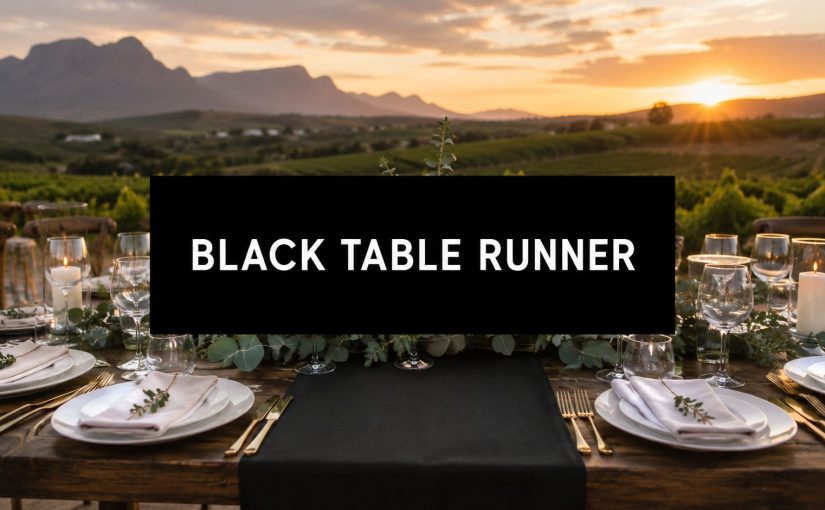
At a recent Winelands wedding reception, the room had everything going for it, vineyard views, warm timber tables, and soft evening light. The first mock-up looked polished, but the table still felt visually loose until the black runner went down the centre of each table. The change was immediate. Crockery stood out more clearly, florals looked richer, and the whole setting felt deliberate instead of scattered.

That is the job of a black runner. It anchors the visual hierarchy of the table, especially when the rest of the palette is light, reflective, or visually busy. In South African events, that can be the difference between a table that reads cleanly in person and one that only works from one angle.

Why black works as a design anchor

Black suppresses visual noise. It gives the eye a resting place, which helps when you are mixing candles, glassware, florals, and branded elements. In a wedding, it can support romance without making everything feel sugary. In a corporate setting, it sharpens the table's edges and helps logos, menus, or display pieces stand out.

The same logic matters if you are thinking about supply and rental stock. South Africa's textiles industry still supports a meaningful local home and event fabric ecosystem, with 143,000 people employed in the clothing and textiles, footwear and leather subsector by late 2022, according to the TIPS manufacturing data study. That matters because black table linen is not just a decorative afterthought, it sits inside a real domestic supply chain.

What often gets overlooked is how black behaves under venue lighting. In a bright conservatory, a matte runner can disappear if the tableware is also dark. In a candlelit room, the same runner can look luxurious, but only if the fabric has enough texture or weight to catch light at the edges. Cape Town venues are especially unforgiving here because daylight shifts quickly, and what looked crisp during setup can read flat by the time guests are seated.

A black runner is strongest when the rest of the table does some of the storytelling.

If you are sourcing or reselling table decor, that logic also fits broader decor store startup advice, because the strongest product mix is not just about colour, it is about how the piece performs in a finished room. For Cape Town and Winelands rentals, that usually means checking whether the runner has enough weight, the edge finish holds its shape, and the fabric suits the lighting you are likely to get at the venue. An item that looks plain on a hanger can be exactly what holds a tablescape together once the linens, glassware, and centrepieces are in place.

If the runner is going into ABC Hire's rental inventory, that same standard applies. Black pieces need to read cleanly from a distance, not just photograph well in a close crop, because they are often the element that stops the table from feeling unfinished.

Choosing the Right Fabric and Dimensions
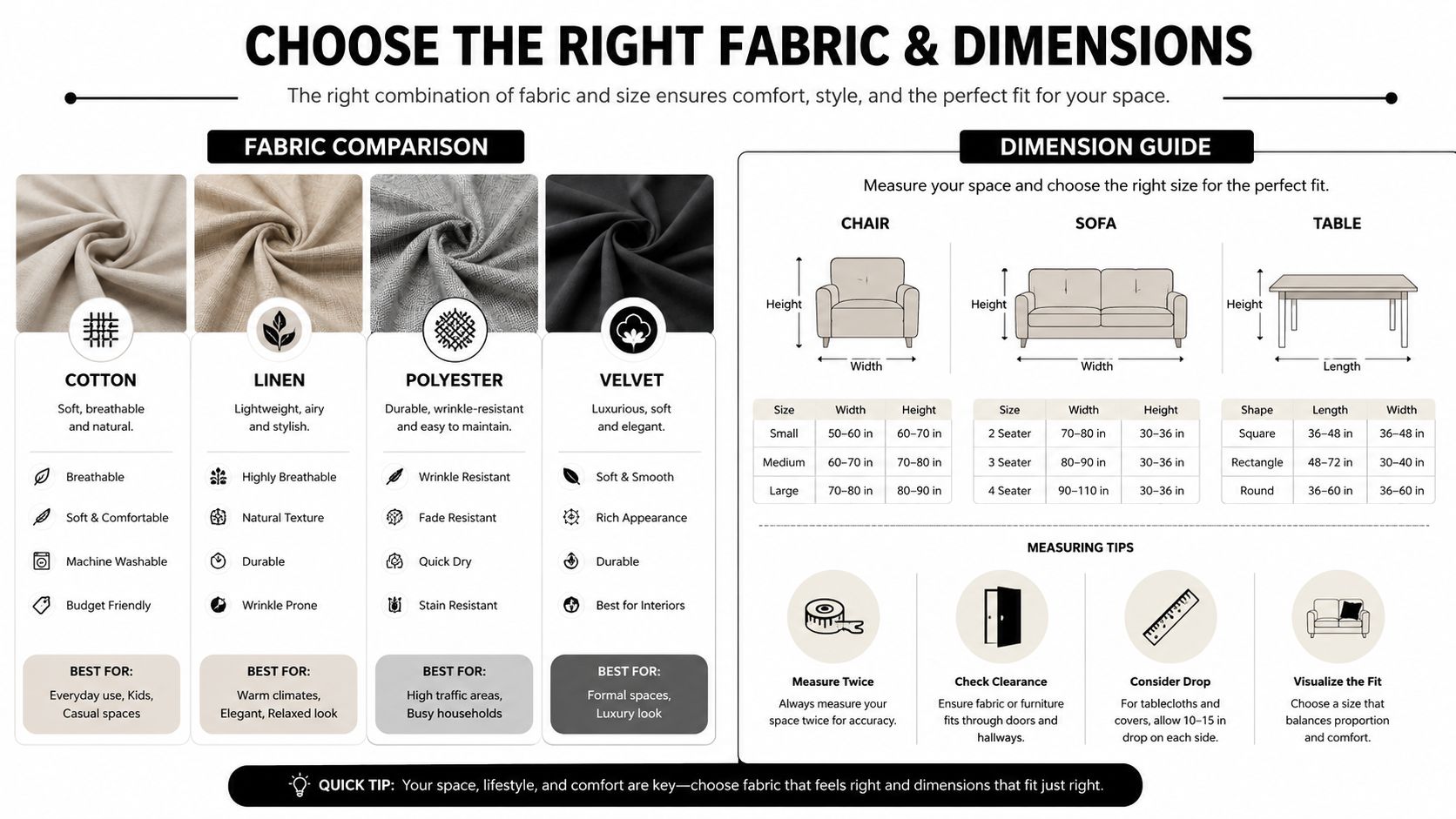
A comprehensive guide illustrating fabric types and furniture dimension measurements for choosing the right home decor.

The first mistake people make with a black runner is choosing by colour alone. The second is picking a length that looks right on a catalogue page but fights the table in real life. Fabric, weight, edge finish, and overhang all affect how the runner behaves once the venue lights switch on.

What the fabric changes

Regionally available black runners come in polyester, chiffon, jute, cotton, or PVC-blend constructions, and each one behaves differently. A denser woven polyester or cotton runner is a better fit for repeated hire use because it is easier to launder and tends to hold its shape more reliably. Sheer chiffon works when you want softness or layering, but it needs more careful handling. Jute reads as textured and rustic, while PVC blends suit more functional or wipe-clean applications.

For high-turnover event stock, the practical commercial benchmark is often 150 to 220 GSM, with serged or hemmed edges to help prevent fraying and improve tear resistance during repeated setup and teardown. That construction matters because black shows damage quickly when the edge starts to go. You can see similar runner specifications in commercial listings such as The Fabric Company batting options, which is useful as a reference point when you're comparing make-up rather than just colour.

How to size it correctly

Standard event runners are often supplied in formats like 33 cm × 150 cm or 70 cm × 300 cm, and width matters as much as length. A useful rule of thumb is that the runner should be about one-third of the table width with 15 to 30 cm of overhang per side. That proportion keeps the drape clean and avoids the awkward look of a runner that's either too narrow to register or so long that it swamps the setting. Commercial product guidance from a local-style rental reference such as table runner sizing guidance points to the same practical balance.

For planners who want a quick cross-check, this simple rule helps:

  • Banquet tables, choose a longer runner with enough overhang to stay elegant when chairs are pulled out.
  • Dining tables, keep the width restrained so plates, chargers, and centrepieces don't feel crowded.
  • Layered tablescapes, go a little wider if the runner is meant to read as a central feature rather than a subtle base.

For related table dressing basics, ABC Hire's own black table cloths guide is a useful companion read when you're matching runners to base linens.

Styling Approaches for Weddings, Corporate Events, and Formals

A black runner can look romantic, disciplined, or bold depending on what sits around it. That's why the same piece works across weddings, board dinners, launches, and school formals, but only if the surrounding materials are chosen with intent.

Weddings call for contrast and softness

On wedding tables, black usually performs best against white or ivory base linens, especially when you want the runner to frame rather than dominate the setting. Gold or brass cutlery, clear glassware, and lush florals stop the table from feeling too hard-edged. The runner becomes the visual spine, while the flowers and candlelight supply warmth.

The trick is to avoid pairing black with too many other matte dark elements unless you have strong ambient lighting. When everything is dark, detail disappears. If the venue is a Winelands estate with timber furniture, black can look exceptionally rich, but only when you offset that darkness with reflective surfaces or pale florals.

Corporate and formal events need cleaner lines

For product launches, gala dinners, and branded functions, black suppresses reflections and makes branded items easier to read under stage light or LED furniture. ABC Hire's range includes lighting and furniture solutions that suit these settings, and a planner looking for book corporate events can use that same logic to build a sharper, more controlled visual field. The runner should frame the message, not compete with it.

Matric dances and school formals usually ask for the most disciplined budget choices. In those settings, the runner works hardest when paired with a strong accent colour, a simple floral line, or a repeated metallic detail. You do not need a lot of decoration if the base linen, runner, and centrepiece are coordinated properly.

Keep the runner quiet when the decor is loud, and make it more textural when the rest of the table is simple.

Layering Linens, Centrepieces, and Lighting for Maximum Impact
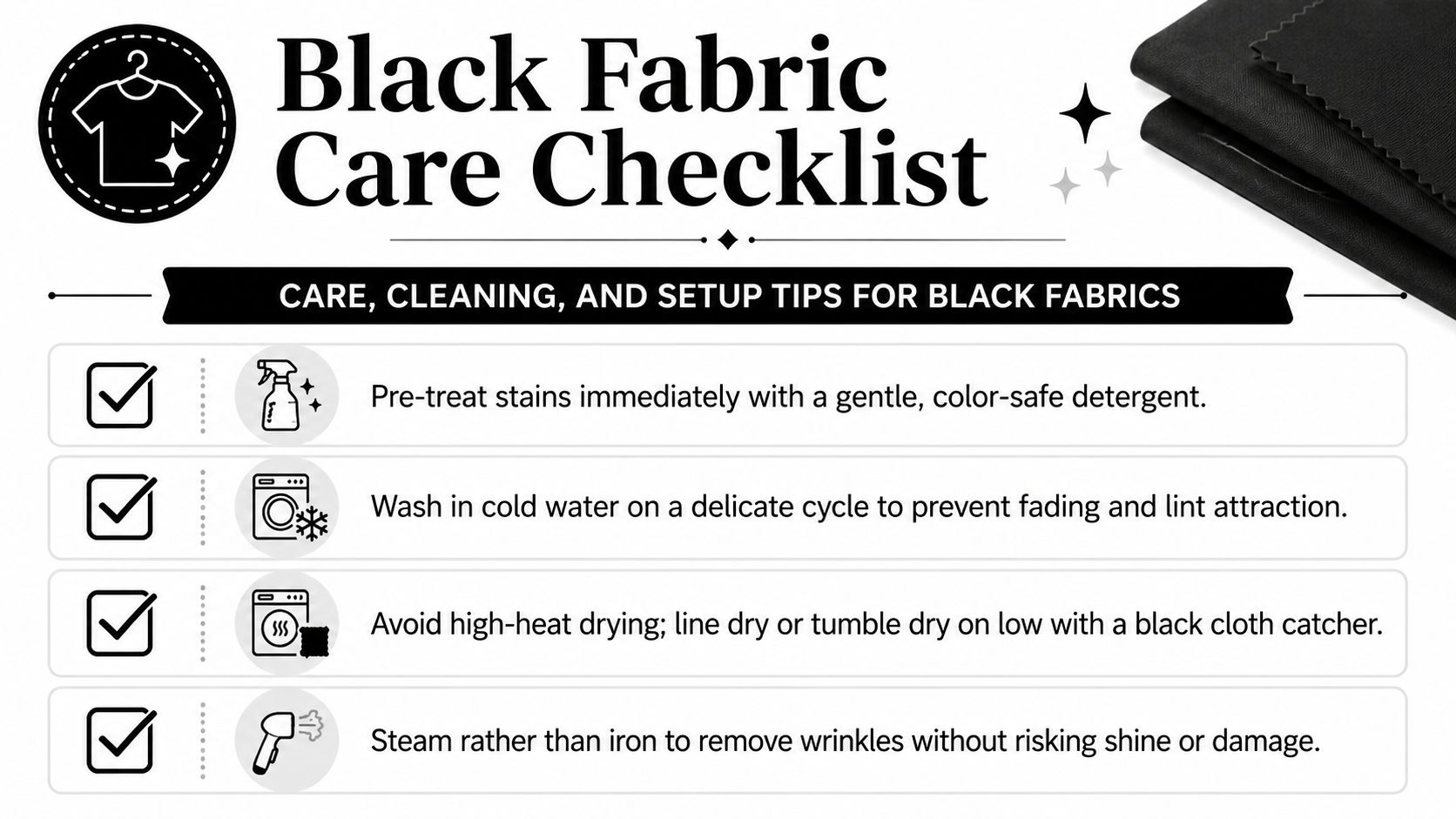
A checklist infographic providing essential care, cleaning, and maintenance tips for black fabric textiles and clothing.

The hardest part of using black linen isn't choosing it, it's keeping it from disappearing into the table. Black absorbs a lot of visual energy, so the surrounding materials have to do more work. The runner needs contrast, texture, or height to register properly in the room and in photographs.

Table surface changes everything

A black runner on wood can look grounded and refined, especially if the timber grain still shows around the edges. On glass, the runner can feel sharper and more contemporary, but it also risks looking like a floating strip if there's nothing layered over it. On white tablecloths, the contrast is strongest, which is useful when you want a bold centre line. On LED-lit tables, black helps suppress glare and lets the light appear cleaner.

Cape Town venues often shift lighting during an event. Daytime receptions can move into sunset, then into ambient night lighting or uplighting. Black is stable across those transitions, but only if you've introduced enough texture, metallic reflection, or floral volume for the table to keep reading clearly as the light changes.

Centrepieces need height and texture

If the runner is black, low and monochrome centrepieces can disappear. Use varied height, organic shape, and at least one reflective or pale element to break the field. A single row of candles can work, but only if the glassware or holders catch enough light. Florals with strong contrast, such as pale blooms against dark linen, are easier to read from across the room.

For more layout ideas, ABC Hire's centrepiece for table reference helps when you're deciding how much verticality the runner needs to support.

Practical rule: if the runner is dark and the venue is dim, the centrepiece has to carry more of the design weight.

Care, Cleaning, and Setup Tips for Black Fabrics

Black fabric can be generous and unforgiving at the same time. It hides some stains better than white linen, but it also exposes lint, fold lines, dust, and powder under bright venue lighting. That means prep matters just as much as styling.

What to do before the event

Steam the runner early enough for it to relax before use, then lint-roll it with care. If the runner has been packed tightly, let it hang so the creases fall out before you dress the table. A table clip can help on slippery surfaces, but use it discreetly so the finish still looks clean.

The best maintenance habit is simple. Deal with marks immediately, don't wait for them to dry into the weave. Candle wax, makeup transfer, and food spills all become harder to handle once they've set into black fibres.

How different fabrics should be handled

Machine-washable polyester and cotton are the easiest for repeat event use, especially when turnover is tight. Chiffon and jute need more care, and they're less forgiving if you're dealing with frequent laundering or rushed pack-downs. Black polyester also benefits from a gentle wash cycle and low-heat drying, because excessive heat can make sheen or wear more noticeable over time.

The care logic is simple. The more formal and delicate the fabric, the more time it takes to keep it photo-ready. That's why many hirers prefer commercial-grade stock for fast-moving weekends and multiple venue changes.

Renting Versus Buying for Cape Town and Winelands Events
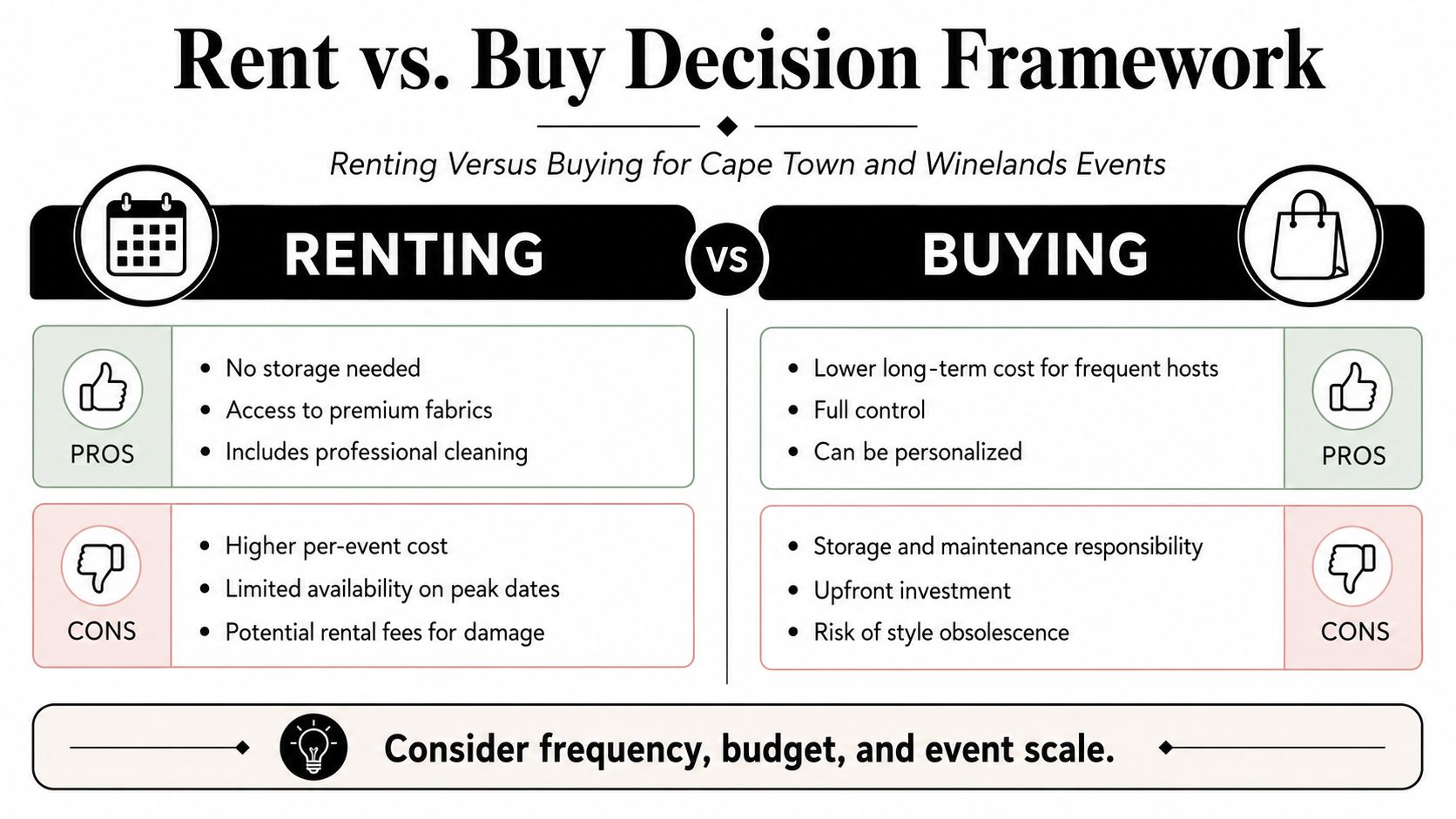
A decision framework chart comparing pros and cons of renting versus buying items for event decor.

The right choice depends on how often you host, how much storage you have, and how much handling you want to take on. A single wedding, a recurring corporate calendar, and a venue's permanent linen stock all call for different answers.

When renting makes more sense

If you only need black runners for one event, rental usually removes the most annoying parts of the job. There's no long-term storage, no laundering after the event, and no need to worry about keeping stock matching across different tables. For planners moving between Cape Town, Stellenbosch, Franschhoek, and Paarl, that also means fewer transport headaches.

ABC Hire fits into that model as one practical option because it provides table and chair hire alongside broader event furniture and accessories, which makes it easier to build a coordinated setup without owning every piece outright. That matters when you're trying to keep the linen plan aligned with the rest of the room, not just with the runner itself.

When buying is the better call

Buying only starts to win when the same runner is used often enough to justify storage, cleaning, and replacement. Even then, ownership means you're responsible for damage, fading, and style drift over time. If your events change tone often, black can stay useful because it's adaptable, but the fabric choice still has to be maintained carefully.

For a useful comparison point, table runners for sale shows how product decisions start to matter once you're not renting on a one-off basis. That's the inflection point where frequency, budget, and scale have to be weighed together.

Consider frequency, budget, and event scale before you decide. The cheapest option on paper is not always the easiest one on event day.

Bringing Your Event Vision to Life

A black runner is never just a strip of fabric. It's a visual tool that can make a table feel grounded, expensive, modern, or romantic, but only if the rest of the design is doing its part. The strongest results come from the right fabric, the right width, and a clear plan for contrast, texture, and light.

Before your event, check five things: fabric choice, runner dimensions, table surface, lighting, and cleaning logistics. If any one of those is ignored, the runner can flatten the whole setting instead of elevating it. In Cape Town and the Winelands, where venues change so much from one booking to the next, that planning step is what keeps the final table from feeling accidental.


If you're planning a wedding, corporate function, or formal event and want your tables to look composed under real venue lighting, talk to ABC Hire about the furniture and event pieces that support a black table runner properly. They can help you match your table setup to the scale of your event, so the final result feels deliberate, practical, and ready for guests.

How to Hire Dress Up Costumes Without the Stress

You're probably here because the event is real, the date is close, and someone has just said, “We still need costumes.” That's the moment when a simple idea turns into a chain of calls, size questions, deposits, transport, and one person worrying about whether the whole thing will still fit the theme on the night.

In Cape Town and the Winelands, hiring dress-up outfits usually makes sense when the event is one-off, the look needs to be specific, and storage after the fact would just be a nuisance. Formal-wear-and-costume rental also fits the rhythm of event-driven demand, which is why short-term access keeps winning when weddings, matric dances, themed launches, and private celebrations all land in the same season, especially when customers want the experience without owning the item long term, as the broader rental economy shows in the U.S. formal wear and costume rental market data.

The practical question isn't whether a costume can be sourced. It's whether it will survive the event, the weather, the fitting, and the return process without creating avoidable stress. A solid party costume inspiration guide can help with theme ideas, but in the Western Cape the decision usually comes down to timing, comfort, and how much risk you're willing to carry on the day.

Why Hire Dress Up Costumes and When It Makes Sense

A bride in Franschhoek wants a vintage look for the welcome party. A school coordinator in Paarl needs a stack of character outfits for a production. A brand manager in the city bowl wants a themed launch that looks sharp for three hours and does not turn into a storage problem afterwards. In each case, hire dress up costumes solve a different problem, but the logic stays the same, you get the look when you need it, then you hand it back.

That short-term access model works because occasion wear is built for events, not for daily rotation. The category performs best when people need a costume for a single event, valuing short-term access over long-term ownership. That is why hiring keeps making sense for weddings, graduations, themed functions, and formal occasions. In South Africa, that matters even more because discretionary spending is selective, and rental turns a high upfront purchase into a manageable event cost, especially when the outfit is only needed once.

The other reason hiring makes sense is control. Buying a costume often means guessing on storage, maintenance, and whether it will still be relevant next season. Hiring removes that burden, but only if the supplier understands the event properly and has stock that suits the venue, the weather, and the expected movement of the wearer.

Practical rule: hire when the outfit is tied to a date, a theme, or a one-night use case. Buy only when repeated wear is likely or when you need a very specific fit that rental stock cannot reliably cover.

For Cape Town planners, that distinction matters more than people think. A beachside function in Blouberg, a winter wedding in the Winelands, and a corporate costume theme in Stellenbosch do not behave the same way. If the outfit needs to photograph well, move well, and come back clean, hiring is often the cleaner operational choice. For event teams coordinating several moving parts, the planning logic also overlaps with broader supplier management, which is why a practical event decoration hire overview can sit naturally beside costume planning. If the brief starts with a theme board rather than a finished outfit, a party costume inspiration guide helps narrow the options before fittings begin.

Where to Source Hire Dress Up Costumes in Cape Town

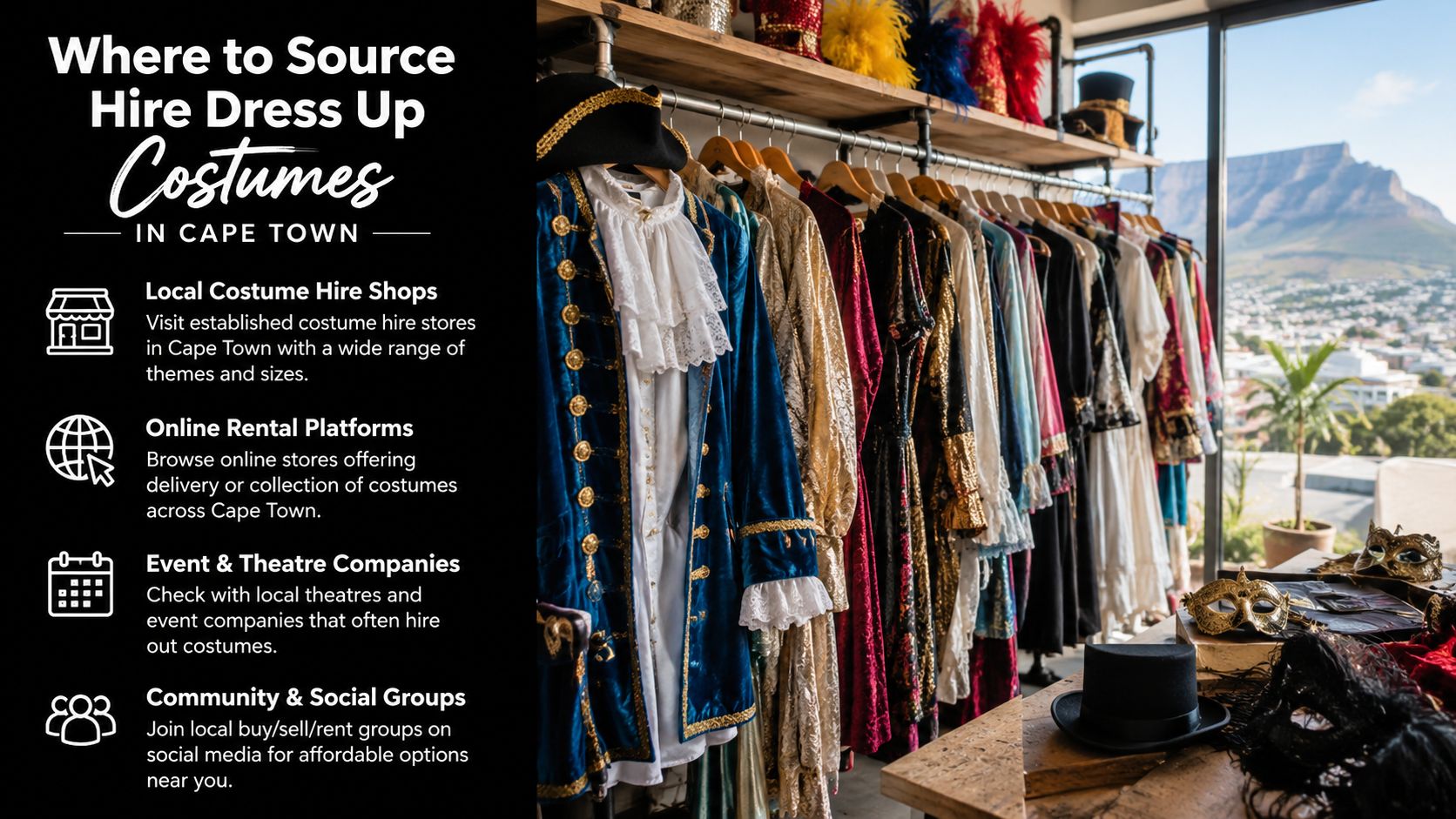
The first path is the specialist costume hire shop. That's the right fit when the brief is unusual, the character reference is specific, or size and styling need proper attention. A Matric dance organiser in the southern suburbs, for example, is usually better off with a supplier that understands formal silhouettes, alteration questions, and what happens when a fitted look meets a long night of dancing.

The second path is a broader event rental partner, especially one that already handles decor, furniture, and themed pieces. ABC Hire, for example, offers event and party furniture rental in Cape Town and the surrounding areas, so it can sit alongside costume planning when a client is coordinating the whole room rather than a single outfit. That's useful for corporate hosts and wedding planners who want one vendor conversation for multiple moving parts, and the company's event decoration hire overview sits naturally beside that kind of planning.

The third path is the party supply or theatrical stockist. This route can work well for a school concert, a quick birthday theme, or a production where the costume needs to read clearly from a distance. The trade-off is that these stockists often focus on availability and theme coverage first, so fit, return rules, and cleaning expectations may need more scrutiny from the buyer.

A rack of elaborate historical costumes in a Cape Town shop with Table Mountain in the background.

A planner in Franschhoek might choose the specialist route for a period theme, while a corporate host in the city bowl may prefer a rental partner who can combine costume planning with chairs, tables, or LED furniture. A coordinator in Paarl may use a theatrical stockist for children's items, then switch to a fitter-led hire house for the adults. The right source depends on how much support the event needs, not just how good the costume looks on the rail.

Booking Timeline and Order Checklist

The cleanest costume bookings start with the brief, not the outfit. UK occupational standards for costume hire begin with interpreting the production brief, confirming budget and timetable, selecting items with the supplier, and then booking out by number and size before delivery, which is exactly the sort of sequence that prevents a lot of avoidable friction in real hire work, as outlined in the UK costume hire standard. A good supplier will ask questions before they promise stock.

For peak season, book earlier than feels necessary. Matric dances, wedding season, and corporate year-end functions all compress demand into the same windows, so the first enquiry should happen as soon as the date and theme are fixed. If the event is large or the sizing is unusual, the fitting or sizing confirmation should follow quickly, because the risk is not just unavailability, it's discovering too late that the chosen item runs small or needs a different cut.

A useful booking conversation should cover deposit, return date, itemised costume components, and the invoice or receipt number linked to the order. The production benchmark from theatre costume hire also stresses that the return appointment should be scheduled at checkout, then the items should be checked back in, cleaned or repaired promptly, and released only once completeness and condition have been verified, which makes the whole process easier to audit, as set out in the costume hire procedures office guide.

Booking timeline for peak-season costume hire First enquiry Fitting or sizing confirmation Final balance and delivery slot
Matric dance As soon as the date is fixed After shortlist is approved Before the event delivery window is locked
Wedding or welcome event When theme and venue are confirmed Once outfit direction is chosen Before collection or delivery is scheduled
Corporate activation As soon as the brief is signed off After wardrobe approvals Before bump-in timing is finalised
School production As early as the cast list settles Before the full order is released Before technical or rehearsal handover

WearView is useful here if you need a place to think through fit presentation and how clothing reads on camera or in a visual brief, especially when a supplier wants more than a loose theme description. Pair that with a simple planning pack, and the event planning checklist template can help keep the ordering conversation grounded.

Measuring, Fitting and Comfort for Long Events

A costume that looks perfect on the hanger can feel wrong the moment someone sits down, dances, or stands under lights for hours. Cape Town events make that worse because the weather can change fast, with warm afternoons turning into cool, windy evenings, and outdoor lawns adding UV exposure, movement, and temperature swings all at once. That's why fit needs to be judged by use, not just by appearance.

Start with the measurements that matter for the garment you're hiring. Waist, chest, hip, shoulder width, and inseam usually matter more than the label on the tag. If the costume has structure, ask whether there's any ease in the seam, whether the lining adds bulk, and whether the fastening allows for minor adjustment after a long dinner or a few hours of dancing.

Practical rule: if the outfit will be worn for more than a couple of hours, comfort beats dramatic effect every time. A slightly simpler look that stays in place will outlast a spectacular costume that pinches, rides up, or overheats.

The most useful question for a Cape Town supplier is whether the costume is breathable, lined, or layered. In a hot inland venue, that matters for comfort. In a breezy coastal or evening setting, it matters for warmth and movement. A lighter accessory-based look can often work better than a full costume when the venue mixes indoor and outdoor spaces, which is common in the Western Cape wedding and events market.

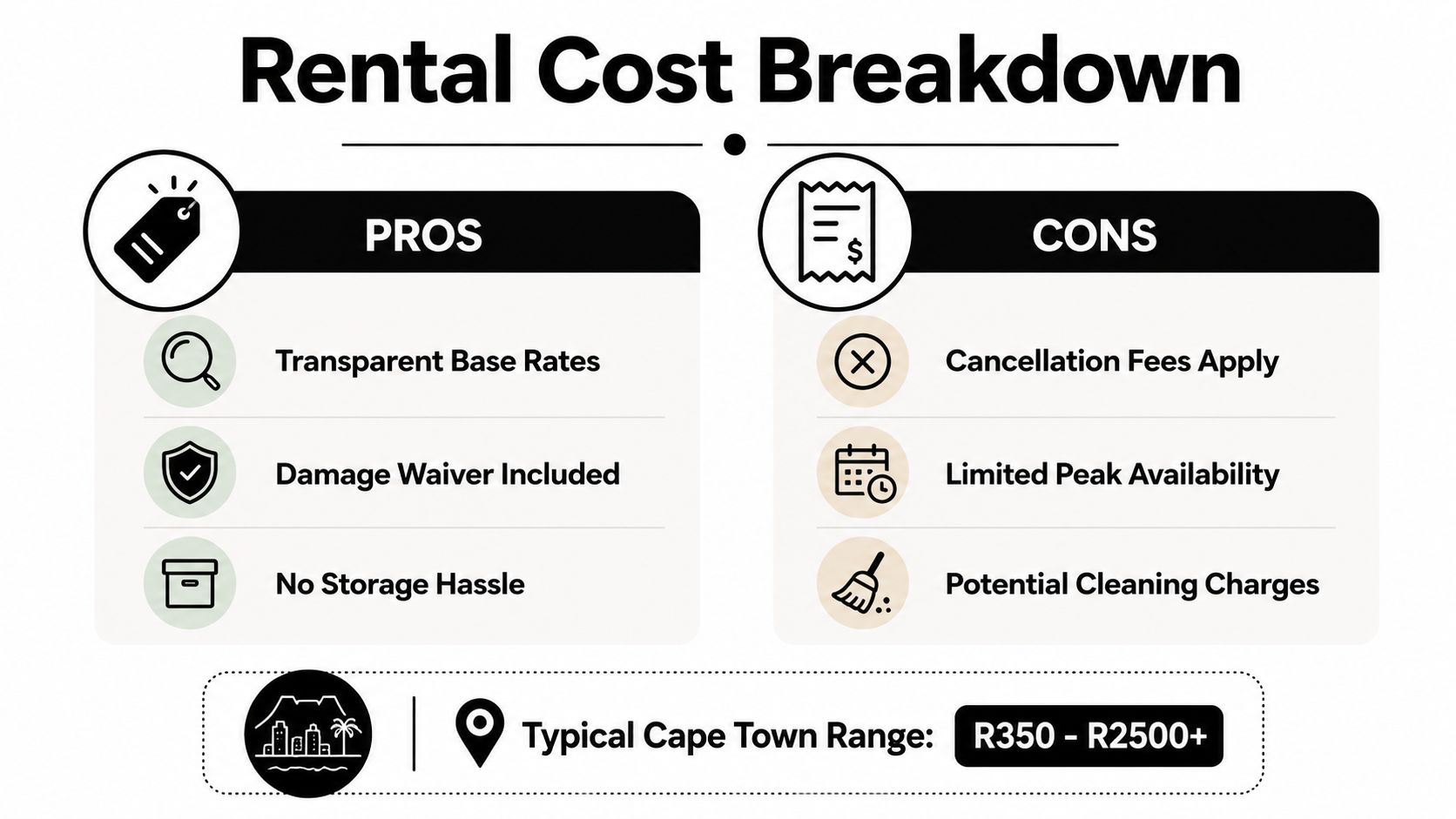
A visual breakdown comparing the pros and cons of rental costs, including typical pricing in Cape Town.

If a size runs small, don't try to force it and hope for the best. Ask immediately whether the supplier can swap sizes, adjust with accessories, or change the look to a safer option that still fits the brief. A costume that works on paper but fails on the body is not a win, especially when there's no spare time before doors open.

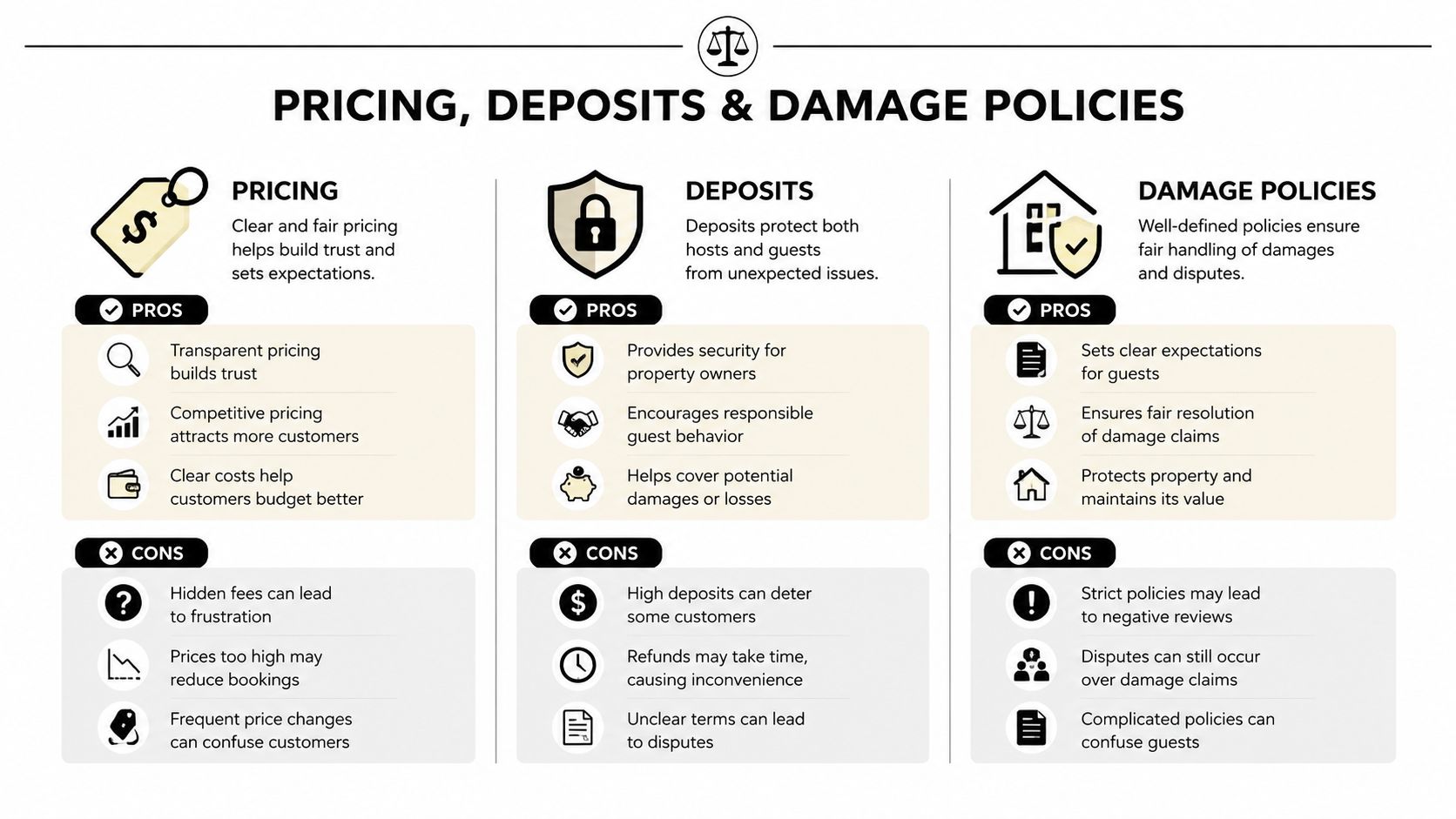
Pricing, Deposits and Damage Policies

The sticker price is only part of the story. A costume quote can look manageable until you add the deposit, cleaning expectations, delivery, late returns, or a damage waiver that wasn't discussed clearly at the start. That's where a lot of event budgets go sideways, not because the price was hidden, but because the buyer didn't ask which parts were refundable and which parts were not.

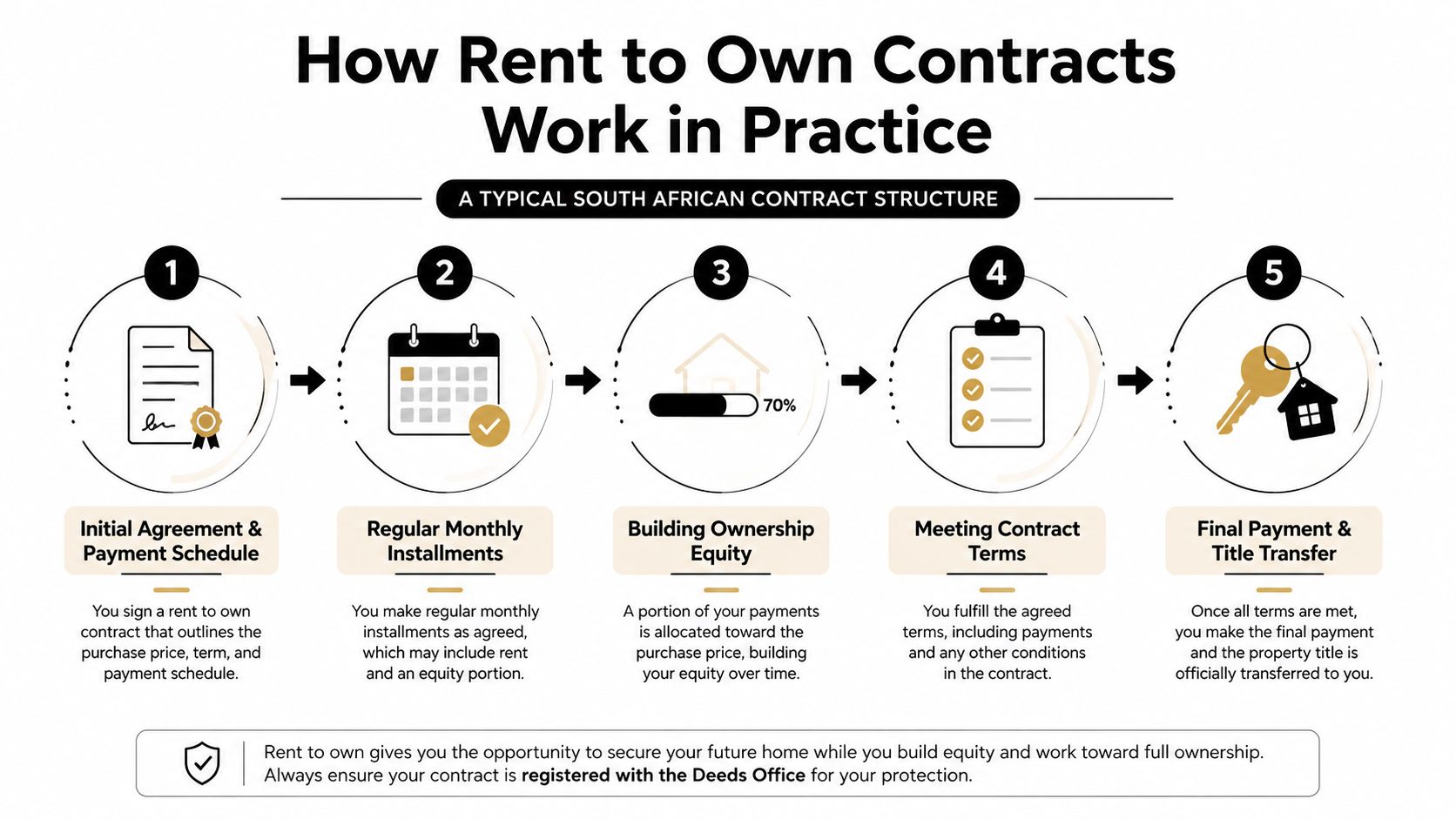
For Cape Town and the Winelands, the budget conversation should cover the full hire order, not just the costume itself. If you're bundling the outfit with chairs, tables, LED furniture, or other event pieces, it's worth asking whether the supplier can package the order. ABC Hire's rent-to-own furniture discussion is relevant here in the sense that event buyers often compare temporary use against ownership decisions, and costume hire sits in the same mindset, short-term access, lower commitment, less storage.

The fairest damage policies are the ones that spell out what counts as normal wear, what counts as avoidable damage, and when the deposit is released. A refundable deposit should not be treated like a mystery charge. It should be linked to the item's return condition, with any cleaning or repair costs explained in advance, not after the fact.

A professional infographic comparing the pros and cons of pricing, security deposits, and damage policies for rentals.

A fair quote usually reads like a contract, not a guess. It tells you what's included, what triggers an extra charge, and who is responsible if the outfit comes back dirty or incomplete. If the supplier can't explain that clearly, the order is too risky for a formal event, especially when the calendar is already tight and the client expects the hire to stay neat.

Cleaning, Returns and Contingency Planning

Most costume problems don't start on the night, they start the day after. Someone spills on a sleeve, someone forgets an accessory, or the event runs late and the return window becomes a problem. That's why return-day discipline matters just as much as the fitting, and why the best hires are the ones with a clean chain of responsibility from handover to return.

Before anything leaves the shop, inspect it with the supplier. Check the condition, confirm all pieces are present, and make sure the return expectations are written down. The WearView approach to presentation and fit reminds buyers that clothing needs to work in real settings, and that same logic applies when the outfit has to survive heat, movement, and post-event handling. If you need a broader reference point for planning spend around visual production, the photoshoot pricing insights from Picjam are useful for thinking about how people budget for one-off visual outcomes, even when the setting is an event rather than a shoot.

The strongest position, in practice, is simple. Hire when the costume is part of a one-time event, buy when the item will be used often enough to justify storage and maintenance, and DIY only when the look is forgiving enough to tolerate improvisation. A child's themed birthday can often handle DIY accessories. A corporate activation usually needs hire because the presentation has to stay consistent. A budget-conscious wedding is better served by hiring a few statement pieces than trying to own a full theme wardrobe no one will use again.

If the event runs later than planned, tell the supplier early. If a piece goes missing, report it immediately. If the sizing was wrong, don't leave the problem until collection day. The more transparent the handover, the fewer surprises there are when the deposit is checked and the return is logged.

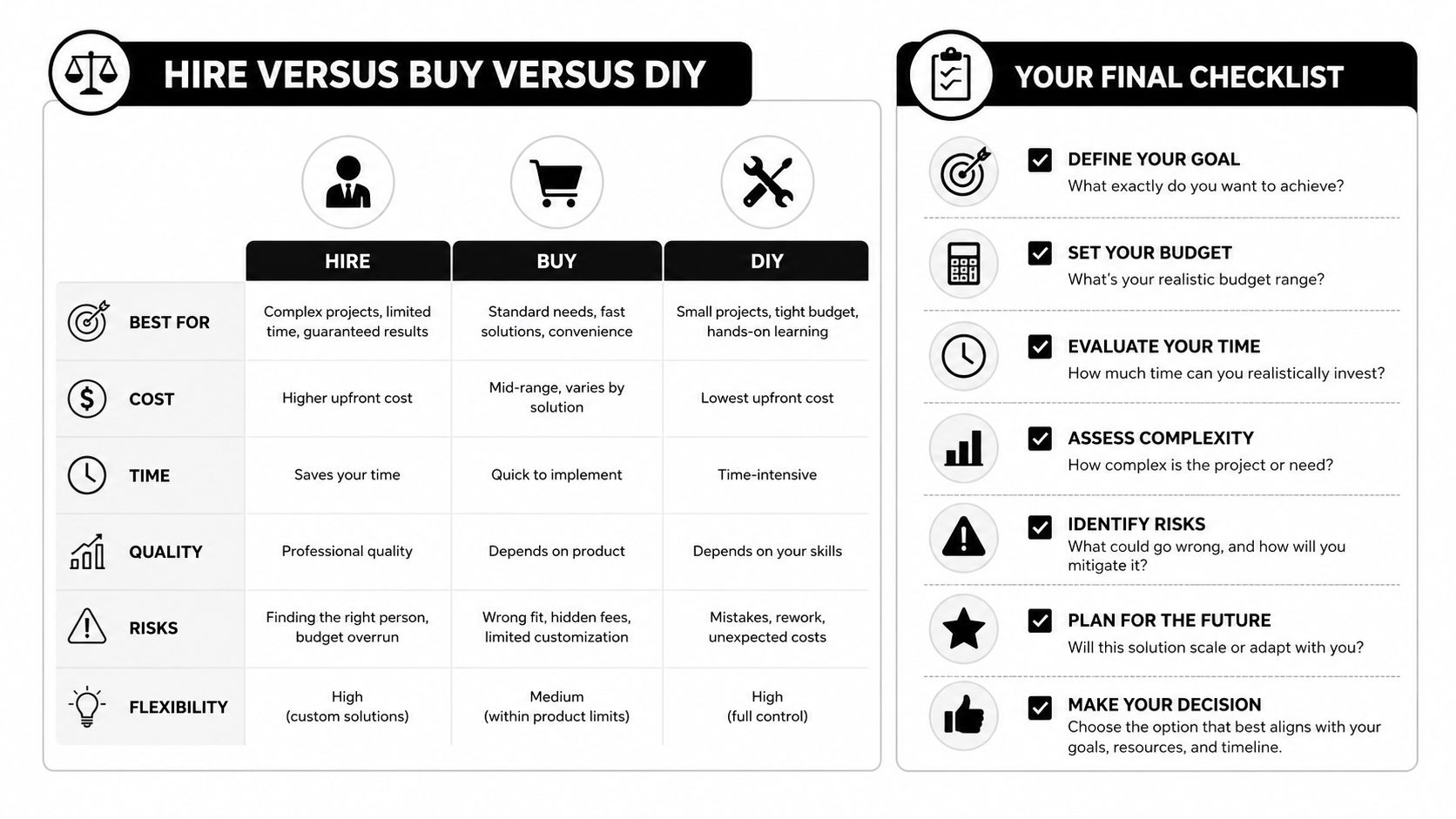
Hire Versus Buy Versus DIY and Your Final Checklist

A comparison chart outlining the pros and cons of hiring, buying, or doing it yourself for projects.

For a matric dance, hire wins because the look is single-use and fit matters. For a corporate brand activation, hire or a hybrid rental setup wins because consistency and turnaround matter. For a child's themed birthday, DIY can work if the look is flexible. For a budget-conscious wedding, hire is usually the safest way to keep the theme polished without buying storage problems.

Take this checklist to the supplier this week. Confirm the date, theme, and venue. Shortlist three suppliers. Book a fitting or sizing confirmation. Lock the deposit. Schedule the return. Ask who handles cleaning, what counts as damage, and what backup exists if a size runs small.


If you want a practical Cape Town rental partner that understands event logistics as well as presentation, ABC Hire can help with the furniture and event-side pieces that often sit alongside costume planning. Reach out before the peak-season dates fill up, then build the hire around the event instead of trying to patch it together at the last minute.

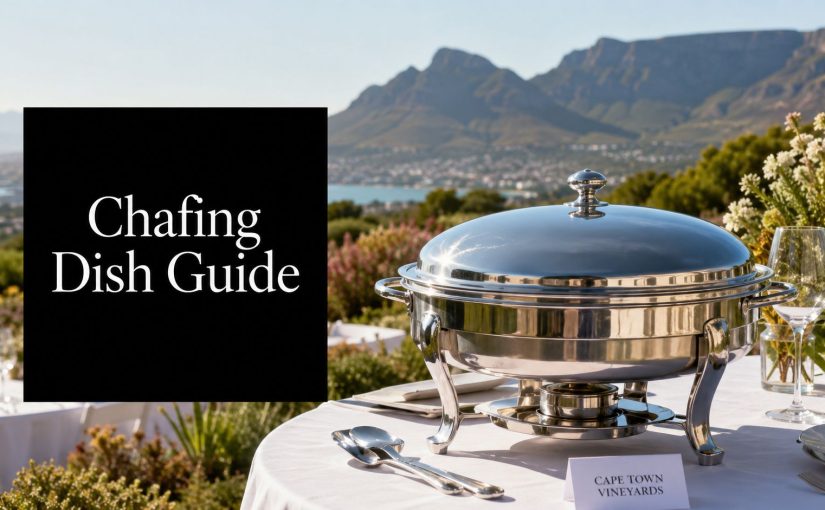
Round Chafing Dish Guide for Cape Town Events

You're standing at the buffet table in the Winelands, the food is ready, the photographer is waiting, and the only thing between a smooth service and a messy one is the equipment under those gleaming domes. A round chafing dish looks simple, but in event rental terms it's a very specific tool, and the wrong choice shows up fast in cold sauces, awkward table gaps, and guests queuing too slowly.

If you're planning a wedding, corporate function, matric dance, or formal school event in Cape Town or the Winelands, treat the round chafer as a service decision, not a décor decision. It's there to hold soups, sauces, sides, and desserts at buffet temperature with indirect heat, while still looking polished enough for a formal setting. For a useful broader hosting reference alongside buffet planning, the holiday gathering hosting tips from SouthShore Fine Linens are worth a look, because the same discipline around flow, timing, and presentation applies here.

What a Round Chafing Dish Does at Your Event

A round chafing dish is a portable food warmer built around four parts, a stand, a water pan, a food pan, and a lid. The water bath creates indirect heat, so the food sits above the flame or heat source instead of cooking directly on it. That matters because round chafers are usually hired for dishes that need steady warmth without scorching, especially soups, sauces, vegetable sides, desserts, and smaller buffet portions.

What you are really hiring

In plain English, you're hiring a compact hot-holding unit that's designed to look good on a buffet line and behave properly in service. In South African event-rental use, round models are typically specified at 4 to 7 quarts, which is why they suit medium-volume stations rather than bulk mains. A 7-quart unit holds about 6.6 litres, which is enough to keep a plated buffet station moving without taking up the footprint of a large rectangular pan, according to the historical and practical reference in the chafing dish overview on Wikipedia.

That compact form is why planners keep choosing round units for Cape Town weddings and school functions. They feel formal, they read well on the table, and guests can serve from them easily from either side. If you're building a buffet with mixed dishes, round chafers usually belong on the items that need elegance more than sheer volume.

Practical rule: use round chafers for the dishes guests take in smaller portions, not for the main item that disappears fastest.

Menu fit and service flow

Round chafers work best when you want presentation and access rather than maximum tray length. They suit soup stations, dessert buffets, sauce points, and side-dish clusters at intimate or medium-sized events. A good caterer uses them where the buffet needs visual softness, not where the line needs to absorb heavy traffic.

That's why they show up so often in Cape Town and Winelands settings. They make sense when the event has style, but they still have to earn their place through function. If you're unsure what to choose, keep reading for fuel choice, sizing, setup, and styling, because those decisions change how well the chafer performs on the day.

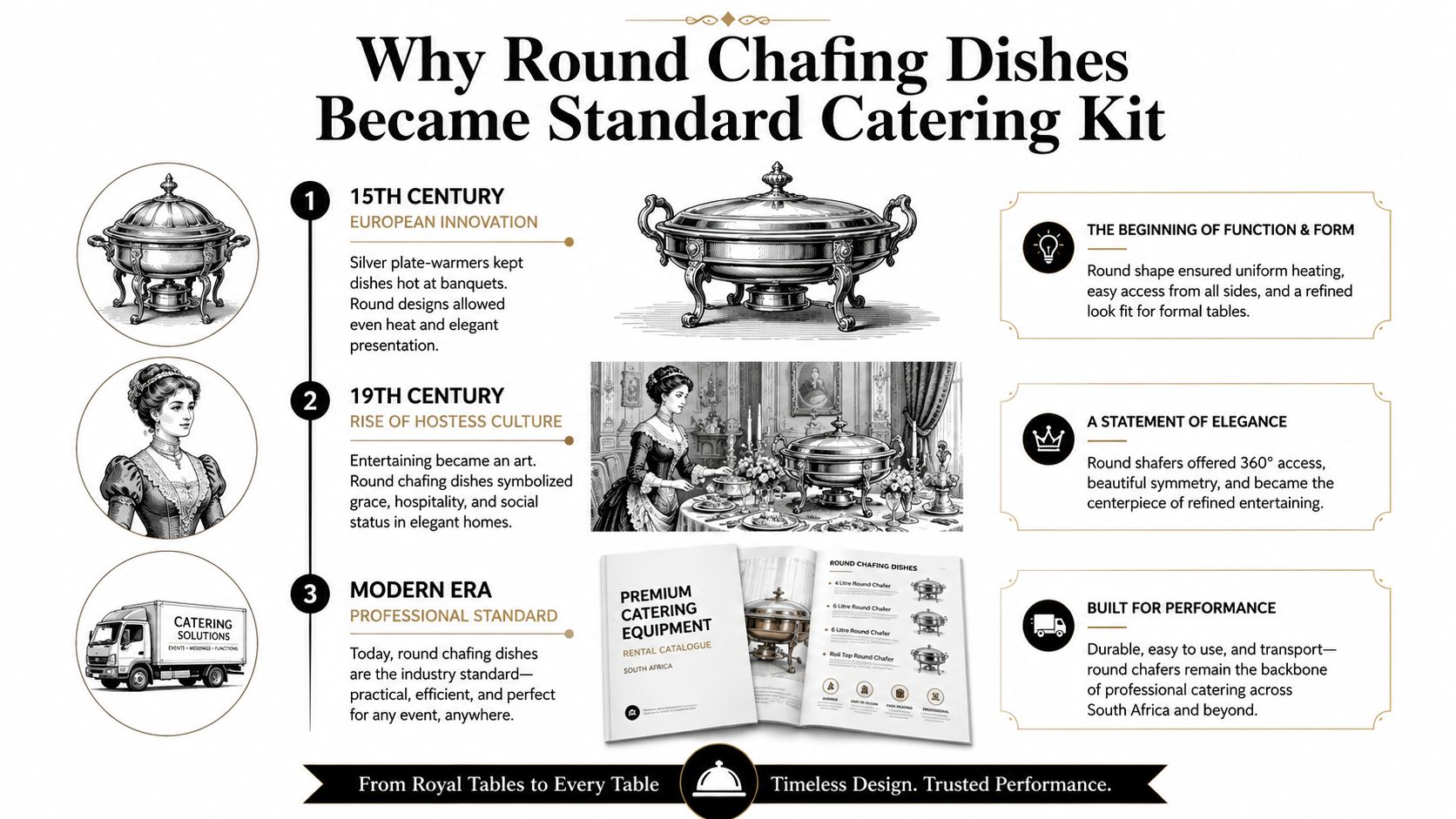
Why Round Chafing Dishes Became Standard Catering Kit

An infographic detailing the historical evolution and modern professional use of round chafing dishes in catering.

The round chafing dish did not appear because somebody wanted a prettier buffet. It grew out of a long catering tradition built around portability, hot holding, and controlled service. The form was already established in Europe by the 15th century, and by 1666 Samuel Pepys was ordering a silver chafing-dish for warming plates, according to the historical record in the FoodServiceNews archive article on the dish's history (FoodServiceNews).

From utility to presentation

By the late 19th and early 20th centuries, chafing dishes were described as being at a “near fever pitch” in popularity, and by the 1890s they had become indispensable to hostesses for luncheons, tea, and supper service, again in the historical account above. That matters because the round format kept its practical job while picking up a presentation role. It stopped being just a heating device and became service ware that also had to look right on the table.

That shift is exactly why the format still fits Cape Town weddings and formal hospitality. You're not just keeping food warm. You're trying to make the buffet look considered, coordinated, and expensive without making service awkward. The round dome does that well when the menu is compact and the visual standard is high.

The same historical source also notes modern experimental work on Byzantine-style chafing dishes, where a tested maximum water temperature of 380°C was recorded, with candles producing the highest average temperatures. That doesn't mean you need that level of heat in event service, but it does show why the basic engineering of a chafer has lasted so long, it's built around reliable warming, not novelty.

Why the round format still wins

For South African event work, the round chafer is now a refined, food-service-grade tool. It works because it gives you enough capacity for medium-volume service while staying compact enough for buffet styling and transport. It also signals a formal service standard, which is why it remains a staple in rental catalogues for weddings, corporate events, and school formals.

The point is simple. Round chafers stayed because they solve a real buffet problem, and they do it with a better visual finish than most bare service pans. That's why they still matter in today's hospitality market, especially where appearance and timing have to work together.

Choosing the Right Fuel and Heat Source

A round chafer only works properly when the heat source fits the venue. In Cape Town and the Winelands, that usually means choosing between gel fuel, wick or spirit lamps, electric warming plates, and induction. Get this wrong and service turns messy fast. Food cools, lids stay open too long, and staff spend the whole event fighting the setup instead of serving guests.
Match the fuel to the venue, not the other way round

Outdoor receptions are the toughest test. Wind will beat open flame every time if the setup is exposed, so gel, wick, and spirit options need shelter, a steady surface, and sensible placement, as general food-service guidance notes in the chafing dish buying guide. For an indoor reception with controlled ventilation, gel fuel is clean and simple. For a sheltered patio or a tented space, wick or spirit lamps can work if the service team keeps them stable and watched. Electric warming plates suit venues with reliable power and fully indoor service. Induction is the neatest option, but only if the chafer is induction-ready.

For Cape Town planners, the key decision is footprint and control. Flame-based setups are portable and do not depend on plugs, which helps at heritage venues, farms, and locations where load-shedding still shapes the day. Electric and induction units give steadier heat, but they also tie you to power and cable management, which matters on a crowded buffet line. If the wind is high or the site is exposed, choose a heat source that can survive the conditions, not one that only looks elegant on a catalogue page.

Fuel type Best venue Wind tolerance Power needed Notes
Gel fuel Indoor receptions Low None Simple and portable, but not for exposed outdoor service
Wick or spirit lamp Sheltered patios, tents Moderate None Needs careful supervision and stable placement
Electric warming plate Indoor buffets High indoors, low outdoors Yes Good when venue power is reliable
Induction Premium indoor buffet builds High indoors, low outdoors Yes Only works with induction-compatible equipment

What matters most on the day

Fuel choice does nothing for a bad setup. If the water bath runs dry, the food suffers no matter what is burning underneath. If the lid stays open, heat escapes faster than the fuel can recover it. That is why I tell clients to choose the venue first, then the heat source, then the serving layout.

Direct advice: if you are planning an outdoor Winelands function, stop focusing on the finish and ask how the flame behaves in wind.

The same logic applies to table layout in Cape Town and the Winelands. A round chafer takes less linear buffet space than a long rectangular pan, but it still needs breathing room for guests to serve themselves without crowding the table. If the buffet is tight, a compact heat source is the safer choice because it keeps cables, fuel canisters, and staff movement under control. If you want a practical rundown of warmer types before you book, ABC Hire's catering food warmers guide is a useful reference for comparing flame-based, electric, and induction options.

Use that comparison to decide whether your event needs portable heat, steady electrical control, or a system that can handle wind and uneven site conditions. The right answer depends on power, weather, and how much control you want your team to keep during service.

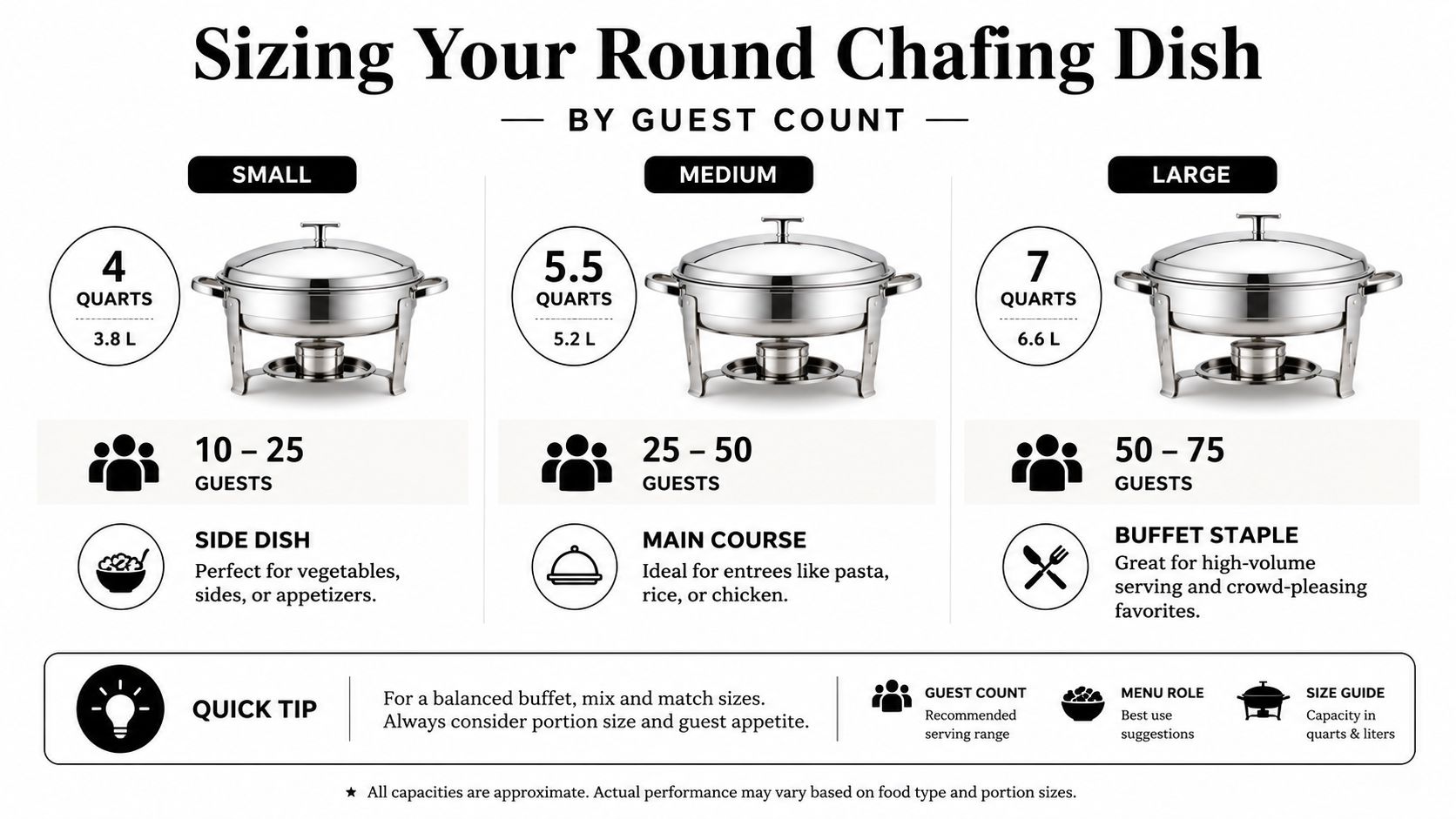
Sizing Your Round Chafing Dish by Guest Count

An infographic showing sizing guidelines for round chafing dishes based on guest counts and menu types.

Round chafers are usually specified by usable volume, not outer diameter. That's the number that matters for planning, because the shape might look neat on paper while the internal capacity still limits what you can serve. In South African event rental, the common working band is around 6.0 to 6.9 quarts, or about 5.6 to 6.5 litres, which is the workhorse range for buffet service.

Read capacity before you read appearance

Commercial listings show compact footprints in the rough range of 420 to 496 mm wide and about 320 mm high, based on product sheet examples in the technical reference data. That footprint is useful on a crowded table, but it also tells you something else. A 6-litre round chafer is built for medium-volume items, not for the highest-turnover main dish on the line.

Here's the cleanest way to think about it.

  • 4-quart units: use them for smaller side stations, sauces, and desserts where presentation matters more than bulk.
  • 6.0 to 6.9-quart units: use them as the practical default for most Cape Town wedding buffets, because they carry enough food to stay worthwhile without crowding the table.
  • 7-quart units: choose them when you want a little more service time from one pan, and the buffet station still has room for the round footprint.

Round versus rectangular on a real buffet table

Planners get caught. Round chafers look elegant and let guests serve from any angle, but they can leave dead space on a straight buffet line. Rectangular units use the table edge better, especially when you need tight packing and a clean run of trays. That trade-off is why round chafers work best on circular stations, clustered dessert points, and mixed-format buffets, while rectangular pans win on long, straight lines.

Rule of thumb: if your table is long and narrow, round is a style choice. If your table is tight and linear, rectangular is a space choice.

Use both formats if the menu needs it. Put round chafers on sauces, soups, and desserts, then let rectangular pans handle the mains and starches. That's the layout that usually behaves best in Cape Town venues where space is precious and service still has to feel polished.

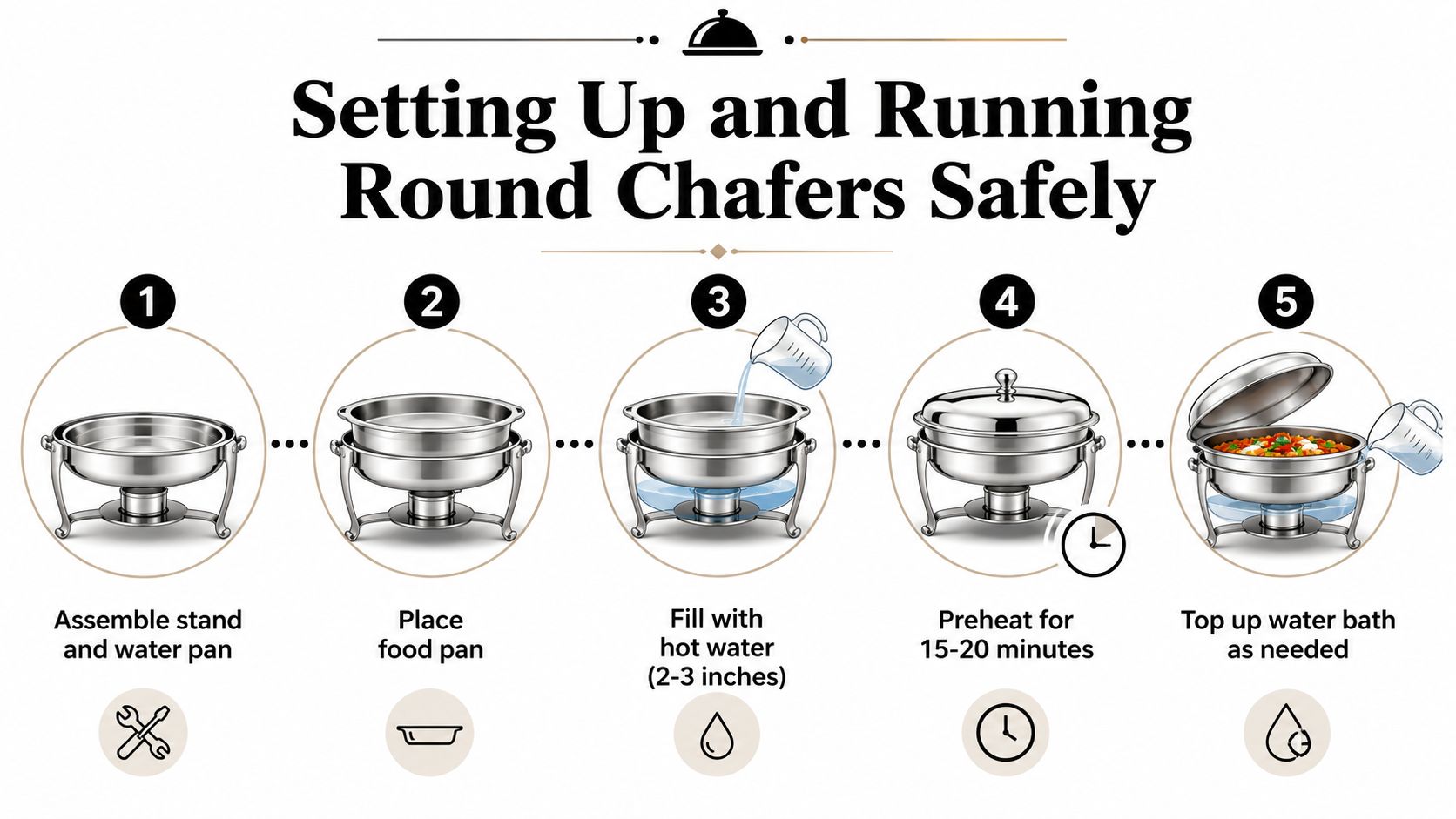
Setting Up and Running Round Chafers Safely

A five-step instructional guide on how to safely assemble and operate a round chafing dish for catering.

A round chafer should be easy to run. If the team is stopping to improvise during service, the setup was weak from the start. Keep hot food above 135°F or 57°C while it is holding, and build every part of the station around that target. In Cape Town and the Winelands, that also means respecting wind, table placement, and the power situation at the venue, because a pretty buffet that loses heat is bad service.

The setup that works

Start with the stand on a stable, heat-resistant surface. Add the water pan, then fit the food pan, then light or activate the heat source. Use hot water in the bath, not cold water, so the unit reaches service temperature faster and does not burn fuel warming up from scratch.

A clean workflow looks like this.

  1. Assemble the stand and water pan. Check that the base sits level and does not wobble.
  2. Place the food pan. Make sure it seats properly and does not tilt.
  3. Fill with hot water. Keep the bath deep enough to transfer heat evenly, but do not flood the unit.
  4. Preheat before service. Give the water time to stabilise before the first plate goes out.
  5. Top up the water bath as needed. If the level drops, heat transfer drops with it.

If you are running a buffet in a windy venue, use a sheltered table position and keep the chafer out of direct draughts. That small detail matters more than people want to admit. A round unit loses less heat than an open dish, but it still performs badly if the fuel is exposed and the lid is left standing open between servings. For a visual example of a polished rental finish, see ABC Hire's gold chafing dish guide.

Lid discipline matters more than people think

Keep the lid closed between servings. Use roll-top or soft-close lids where possible, especially models that open at 90° or 180°, because they cut heat loss during repeated use. That matters on a self-service buffet where guests come in short bursts. Every minute with the dome open lets heat escape and forces the water bath to work harder.

Practical rule: if the lid stays open, the chafer stops holding heat properly and starts wasting fuel.

Safety is blunt. Open flames need ventilation and supervision. Drip trays should stay in place, and tablecloths must not hang too close to burners. If a fuel can runs dry during service, replace it calmly and at once, then check that the water bath is still hot enough before you reopen the station. Use the right styling around the unit as well, because tidy presentation and safe spacing should work together, not fight each other. For planners who want to coordinate the buffet look with colour and candlelight, The Candledust color palette is a useful reference for keeping the table deliberate rather than cluttered.

Styling Round Chafers for Weddings and Functions

A round chafing dish can look sharp on its own, but styling is what makes it belong in the room. In Cape Town and the Winelands, the best-looking buffets don't try to hide the equipment. They coordinate it. That's the difference between a catered table and a considered station.

Build around the dome, not against it

Round chafers work well when you repeat the shape in the rest of the setup. Cluster them on a circular table for a hero dessert or sauce station, or line them along a rectangular buffet when the menu needs order. The round profile softens the line of the table, which is helpful in vineyard venues where the décor already leans organic and elegant.

Use simple trims instead of clutter. Greenery runners, ribbon wraps, and mirrored risers all work if they support the table rather than crowd it. For colour planning, the The Candledust color palette is a useful visual reference for planners working with soft candlelight and layered tones, because the overall mood around the buffet should feel deliberate, not improvised.

Lighting and local venue style

Uplighting the dome gives you a cleaner look than blasting it with bare bulbs. Polished lids reflect everything, including bad lighting, so keep the source controlled and warm. Candles at the base can look good in a formal setting, but only if the heat source and floral elements are kept apart.

The Winelands aesthetic is especially forgiving when you use round chafers with long vineyard tables, fynbos arrangements, and late-afternoon natural light. Stellenbosch and Franschhoek receptions often look strongest when the buffet feels understated rather than over-designed. The equipment should support the room, not compete with it.

If you're building a matching finish across the buffet, ABC Hire's gold chafing dish guide is a useful companion read because it shows how finish choice changes the visual weight of the station. Use that thinking to decide whether the round units should fade into the décor or act as part of the statement.

Rental Checklist for Cape Town and the Winelands

Hiring a round chafer is easy. Hiring the right one, on the right terms, for the right venue is where planners either look organised or end up firefighting. If your event is in Cape Town, Stellenbosch, Franschhoek, or Paarl, the rental brief needs to cover delivery access, quantity, finish, and what happens if something arrives damaged.

What to confirm before you sign

Start with logistics. Wine estates often have tighter loading access than city venues, and that affects delivery timing and drop-off points. If your event also depends on connectivity for RSVP management, supplier coordination, or digital guest lists, the wi fi events planning guide is a useful planning reference, because service staff and event managers need stable communication just as much as the buffet needs heat.

Use this checklist before booking.

  • Rental partner selection: confirm the supplier stocks round chafing dishes, not just generic buffet ware.
  • Delivery logistics: ask where the vehicle can unload at the venue and whether extra handling time is needed.
  • Quantity planning: count stations, not just guests, because one buffet line can need multiple formats.
  • Rental period: check collection and return times in writing.
  • Condition on delivery: inspect lid fit, dome polish, and stand stability before setup.

Questions planners forget to ask

Ask whether fuel is included or charged separately. Ask what happens if a dome is cracked or a hinge fails mid-event. Ask if lids are replaced between hires and whether the supplier expects a clean return or handles post-event washing themselves. Those details sound small until you're standing beside a half-set buffet with guests arriving.

Best practice: treat the rental quote like an operations document, not a shopping list.

If you want one place to start comparing catering equipment categories, ABC Hire's catering equipment for hire guide is a sensible internal reference before you finalise the order. Use it to align the chafer hire with the rest of the buffet setup, especially if you're mixing serving gear, tables, and décor across multiple stations.

Common Mistakes and Quick Answers

The three mistakes that ruin round chafer service are predictable. A dry water pan kills indirect heat. The wrong fuel for the venue creates wind, smoke, or power problems. A lid left propped open drains temperature faster than realized.

For guest planning, don't order by headcount alone. Order by station count and menu role, then mix round and rectangular units where the buffet layout demands it. If the venue loses power during service, switch to your backup heat plan immediately, then keep the water bath topped up and the lids closed until the station stabilises.

A round chafer is a service tool, not a decorative extra. Treat it that way and it behaves.

If you're planning a Cape Town, Stellenbosch, Franschhoek, or Paarl event and want the buffet equipment sorted properly, speak to ABC Hire about catering gear that fits your layout and service style. Visit ABC Hire to check what's available, then lock in the round chafing dishes, tables, and supporting equipment before your event date gets tight.

Pine Dining Table and Chairs: A Practical Cape Town Guide

A guest count just changed, the venue has a tighter floor than expected, and the couple still wants that warm timber look in a Stellenbosch setting. That's usually where pine dining table and chairs come onto the shortlist fast, not because they're the flashy option, but because they're the set that can be moved, dressed, and fitted into real event space without turning setup into a wrestle.

Why Pine Works So Well for Cape Town Events

A Paarl farm wedding and a corporate lunch in the CBD ask very different things from furniture, but pine handles both surprisingly well. The reason is simple. Pine is lighter and easier to work than hardwoods, and modern wood-density references put it at about 450 to 500 kg/m³, while oak sits around 700 to 800 kg/m³, so oak can weigh about 1.5 times more for the same volume, which matters every time a team carries tables across gravel, lifts them into a marquee, or resets them between room changes. That lower weight helps rental crews move faster and with less strain, while still giving clients the solid timber look they want for weddings, corporate functions, and private events, as described in the historical overview of pine furniture use in accessible, functional settings source.

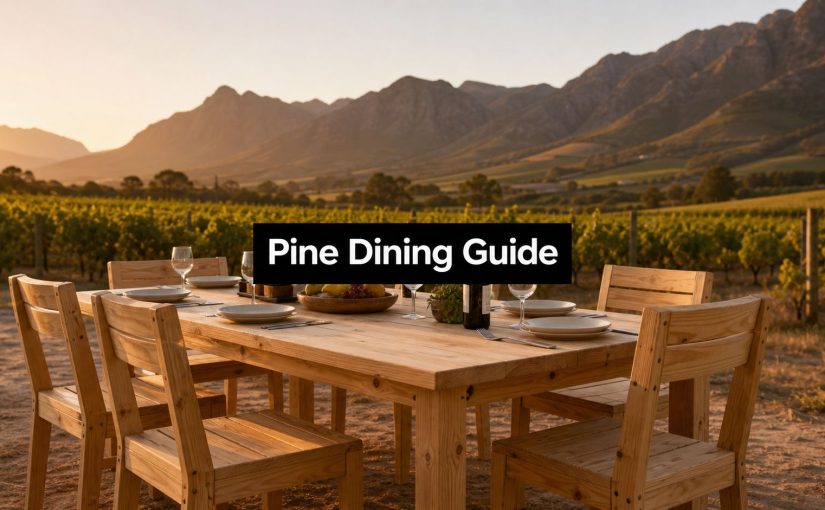
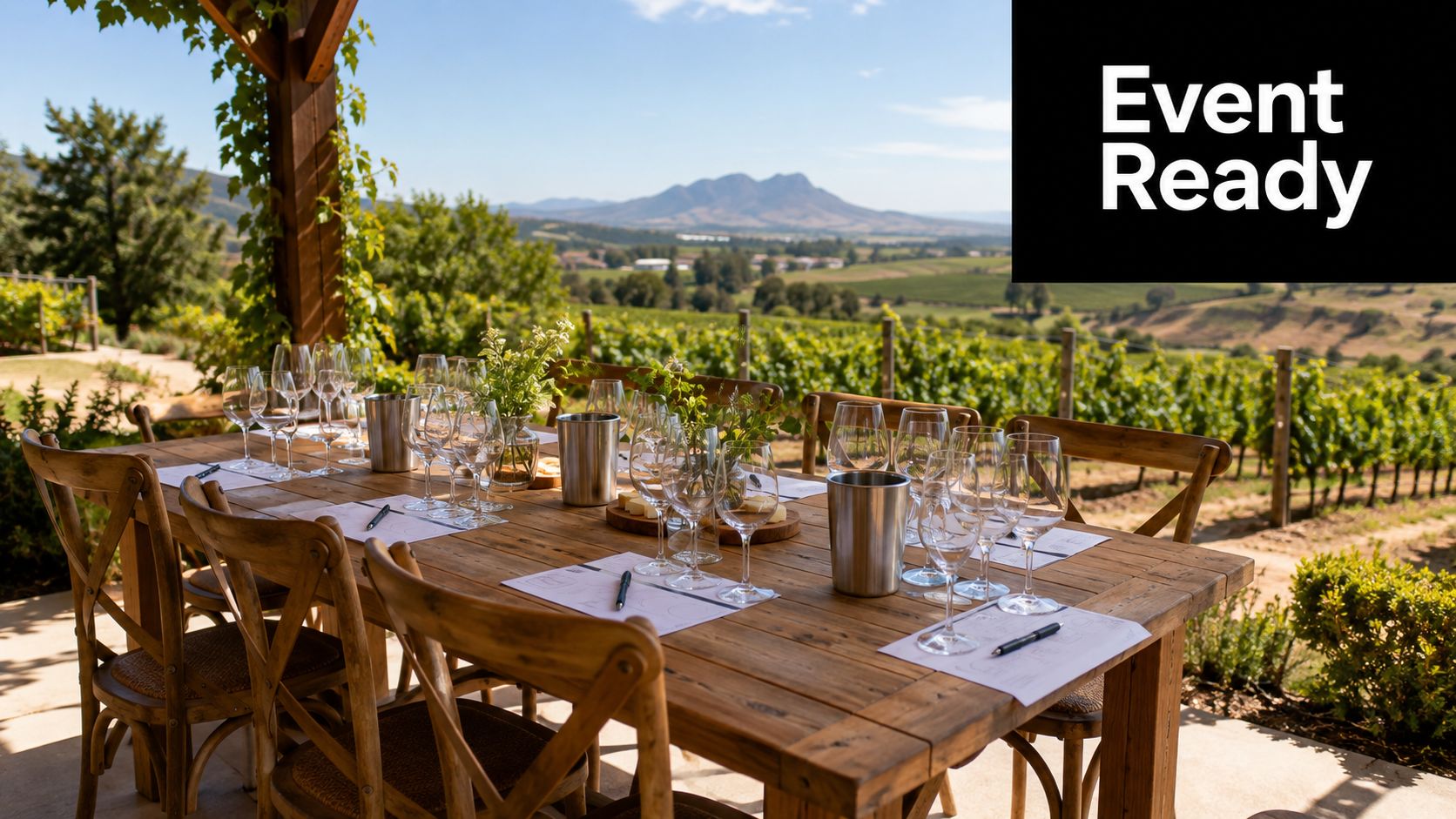
A rustic pine dining table and chairs set up for a wine tasting with vineyard views.

The practical reason planners keep returning to pine

Pine also fits the look most clients are asking for when they say “simple but polished”. It reads as warm and familiar, which works in a farm venue in the Winelands, a tasting room, or a formal dining tent where the rest of the styling is doing the heavy lifting. The historical furniture record notes that dining furniture became a distinct household fixture later than many assume, and that early sets were often straightforward combinations of table and chairs in woods such as oak, pine, and cherry source.

That matters in Cape Town event hire because pine doesn't fight the room. It supports the room.

Practical rule: if the room changes often, the venue is spread across multiple surfaces, or the same stock needs to be reconfigured between ceremony and reception, pine usually makes the operation easier than a heavier hardwood set.

There's a trade-off, though. Pine is softer, so it shows wear faster than harder woods under repeated commercial use. For a one-night event or a seasonal venue refresh, that's often acceptable. For a busy hire cycle with lots of turnover, you need to plan for surface care and refinishing between jobs, not pretend the material is indestructible.

Sizing a Pine Dining Table and Chairs Set to Your Guest Count

On site, the first wrong turn is usually the same. Someone picks the table style before checking the footprint, then tries to make the guest count fit around it. Start with the size of the set, then check whether it can seat people without pushing knees, elbows, or serving paths into the same narrow space. South African furniture specifications commonly separate 4-seater, 6-seater, and 10-seater formats, and that helps planners stop treating one shape as a universal answer source.

For Cape Town and Winelands setups, that distinction is practical, not theoretical. A pine set that works in a small tasting room can feel crowded once you add charger plates, glassware, flowers, and a service route. Pine also shifts easier than many hardwood pieces, which helps with load-in and layout changes, but the material's softness means the finish needs a little more care if the set is going to move between ceremony, dinner, and late-night resets.

Use the table height and seat height together

For a standard 4-seater, a common footprint is 900 x 900 x 450 mm source. Everyday dining-table heights usually sit around 750 to 760 mm, and chair seat heights cluster around 420 to 450 mm, which is the range that usually gives workable thigh clearance and a comfortable dining posture source. The order matters. Measure the table height first, then confirm the chair seat height matches it.

A low lounge chair under a dining-height table is the quickest way to ruin a tidy layout. It looks fine on a product page and feels wrong the minute guests sit down.

For guest-count planning, work in layouts, not loose numbers. A 50-guest wedding may sit neatly across smaller tables, while a 60-guest dinner can be easier to service with longer runs if the room shape allows it. The room decides a lot here. A narrow farm venue, a marquee with a central aisle, and a corporate dinner in a hotel function space all ask for different spacing, even if the guest count is similar. If you are still weighing whether the event should feel more intimate or more compact, practical tools like wedding size decision exercises help couples settle the scale before décor gets booked.

Set size Table footprint (mm) Seats Best venue use
4-seater 900 x 900 x 450 4 Small dining rooms, tasting areas, breakout meals
6-seater Use supplier format 6 Family-style dinners, mid-size receptions
10-seater Use supplier format 10 Long-table banquets, corporate dining, larger wedding meals

The practical test is simple. Put the chosen table in the room, place the chairs, then walk the route a waiter would take with plates in hand. If the chair backs, table ends, or décor start narrowing the path, the set is too big for the floor plan, even if the guest count looks correct on paper. Pine makes this easier to adjust than heavier furniture, but only if the table size matches the way the room will be used.

Choosing the Right Pine Finish for the Event Style

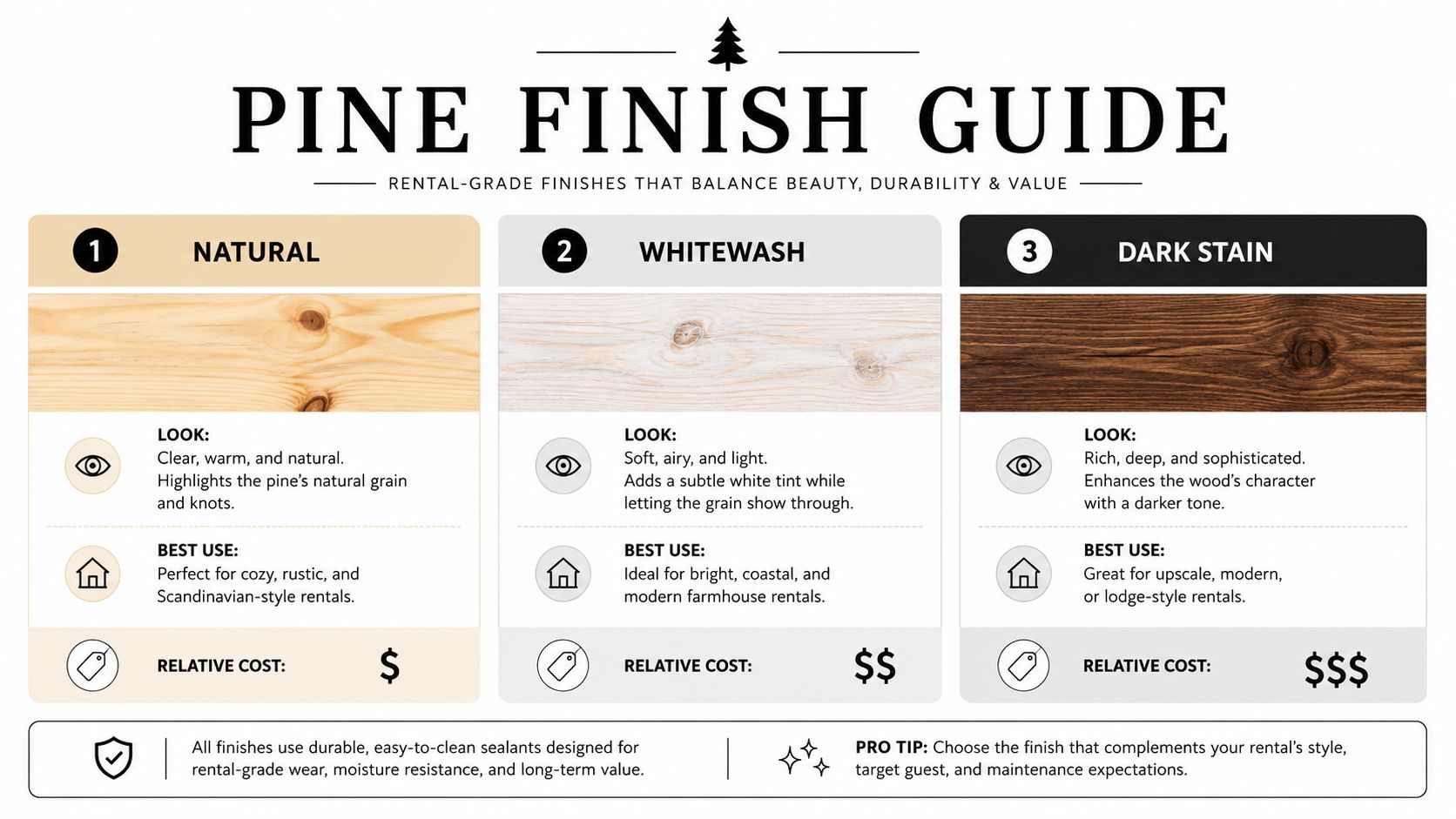
Finish changes how pine reads in the room. A natural pine set feels relaxed and honest, a whitewashed set looks lighter and softer, and a dark stain pushes the furniture toward a more dramatic, formal feel. The wood itself stays the same basic material, but the visual effect changes enough that a Strand beach wedding and a Century City gala won't want the same treatment.

Match the finish to light, not just theme

Natural pine works best when the venue already has warmth in it. It suits farm lunches, informal receptions, and spaces with sandstone, linen, and ambient evening light. Whitewash pine is the cleaner choice for bright interiors and contemporary rooms, because it keeps the furniture from reading too heavy in daylight. Dark stain is the most controlled-looking option, but it also makes the grain feel more deliberate and can absorb light in a way that suits evening functions more than airy daytime spaces.

Pine's softer grain matters here. It can take stain unevenly compared with harder woods, so if a client wants a perfectly uniform, premium sheen, that expectation needs to be managed before hire confirmation. The finish can still look good, but it shouldn't be sold as if it behaves like a dense hardwood.

Care changes with the finish

The wrong cleaner can do more damage than a long event. Harsh products strip sealants, dull the surface, and leave patched-looking areas that show up under venue lighting. Coasters are worth using even at events, because condensation rings and hot cups punish pine finishes faster than most clients expect.

The market still shows steady interest in unfinished and natural pine dining pieces, including farmhouse-style options, which tells you the look remains useful for buyers who want flexibility rather than a locked-in formal style source. That same versatility is why finish choice should be made by venue, not by habit.

A visual guide comparing three wood finish options for pine furniture: natural, whitewash, and dark stain.

Layout Planning That Actually Works On Site

A room plan fails when it looks tidy on paper but leaves no room for people to move. Start with clearance, then build the tables around the circulation route, not the other way around. Independent design guidance recommends allowing about 24 inches per person and at least 36 inches between the table edge and walls or other furniture, with 48 inches preferred in larger rooms source. That spacing matters in Cape Town and the Winelands because venues often mix dining, dancing, service access, and décor storage in one continuous area.

Build the floor plan from the service path inward

For a marquee on a wine farm, the route from kitchen to tables is usually the pressure point, so the aisle needs to stay clean from start to finish. In a Cape Town CBD banquet, the issue is often side access and how the tables relate to the room perimeter. For a corporate board dinner, the challenge is less about headcount and more about how the layout supports conversation without blocking visibility or staff movement.

The fastest way to avoid a bad plan is to work in this order:

  1. Measure the usable room, not the whole venue.
  2. Mark the service aisle before placing any tables.
  3. Place the chosen set sizes with guest movement in mind.
  4. Check access points for doors, DJ kits, bars, and staff routes.

That same logic applies whether you're booking a set of dining tables or coordinating with a hire house that also stocks chairs and other room basics, like the layout guidance discussed in ABC Hire's tables and chairs rental overview.

A dining layout is only successful when service can move without asking guests to stand up.

Common site mistakes to avoid

Don't force a head table into a depth that only works on a brochure. Don't forget the footprint of the DJ, band, or gift table. Don't leave breakout bar space as an afterthought if the room is meant to carry a reception and a meal in one flow. If the layout starts to feel tight before décor is even added, it's already too tight.

A four-step infographic illustrating the professional on-site layout planning process for event space configuration and design.

Load Ratings and Durability Without the Guesswork

A pine dining table can look ready for anything on a wedding or corporate floor, until someone starts using it like a buffet station, a display stand, or a place to park heavy décor. That is where problems begin. In practice, the safe habit is simple, check the chair rating first, then the table's allowable load, then leave margin for guests leaning in, staff setting down service items, and people shifting in their seats.

Read the rating as a hard ceiling

Manufacturer ratings are not decorative copy. They are the limit you work to, and on site I treat them that way every time. IKEA notes that one pine chair model in its table-and-4-chairs set was tested for domestic use and meets EN 12520 and EN 1022 for safety, durability, and stability source. A solid-pine dining set from a major retailer lists a 265 lb table capacity and 220 lb per chair, while a comparable pine set lists a 110 lb table limit and 220 lb per chair. The point is not to memorise those figures. It is to follow the order of checks. Start with the chair load, confirm the table rating, and keep headroom for real event movement.

Pine also benefits from a quick reality check against how other furniture systems are handled. The Safety Space pallet rack guide makes the same basic point in a different setting, weight limits only work when the people using the equipment respect them. That mindset matters on a floor where tables are moved, reset, and dressed under time pressure.

Where pine is fine, and where it isn't

Pine handles normal dining use well, and it does a good job in many rental layouts across Cape Town and the Winelands when the load is spread evenly across the top. What it does not like is repeated overloading, rough transport, or being asked to do the work of a production table for a full buffet line. Soft timber marks more easily than harder species, so a heavy vase, stacked décor, or a bad drag across the floor can leave a visible trace.

That trade-off is part of the rental decision. A pine table is usually a good fit for seated meals, welcome drinks, and lighter decorative setups. If the job involves heavy service gear, constant repositioning, or a table that will carry more than dining, a metal-framed rental option is often the safer call. The right choice is the one that matches the load, the handling, and the amount of wear the piece will take before it gets back into the truck.

For mixed orders, it helps to compare pine tables with a more workmanlike format such as the one discussed in ABC Hire's wooden trestle table guide. The frame matters as much as the finish. If a table has to hold more than place settings and a centrepiece, choose the build that is meant to carry that job.

Styling Linen, Centrepieces and Lighting for Pine Tables

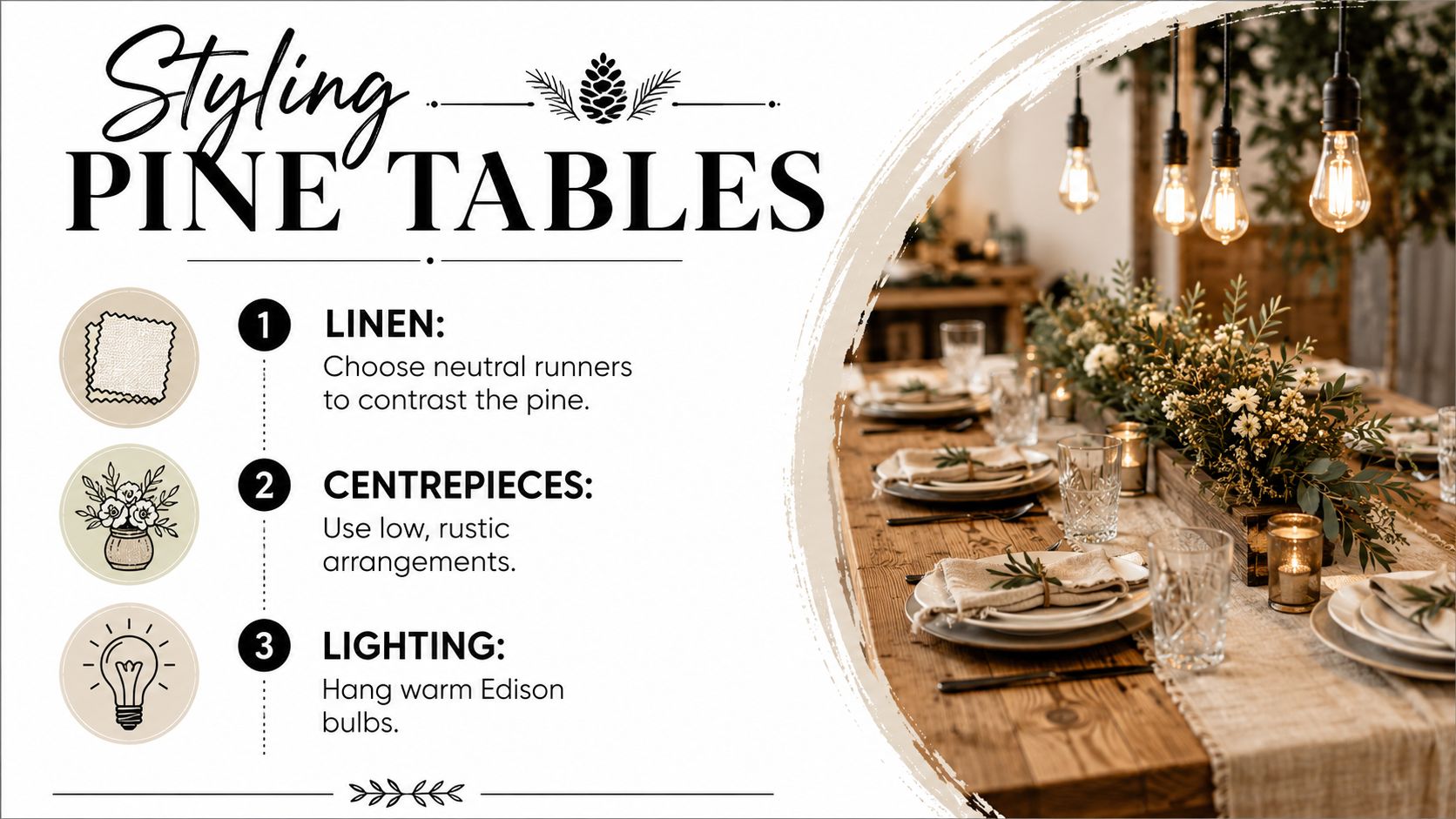
Pine looks best when the styling respects its warmth instead of trying to cover it up. The furniture should still read as timber, so the décor needs to frame the finish rather than fight it. Natural pine takes warm linen and amber light well, whitewash pine works neatly with cool greys and cleaner candlelight, and dark-stained pine can take more dramatic uplighting without losing its shape in the room.

Keep the table surface open

Low-profile centrepieces are the safest option for most events. Tall arrangements can look impressive in isolation, but they block sightlines and make the table feel crowded once chargers, glasses, menus, and service pieces are added. A linen runner usually does more for the table than a full cover, because it lets the wood remain visible while still adding softness.

A simple styling approach often works better than a heavily layered one:

  • Natural pine: Use neutral runners, soft beige napkins, and warm, textured florals.
  • Whitewash pine: Pair with pale linen, cool-toned accents, and restrained décor.
  • Dark stain: Use contrast. Think lighter textiles, candle clusters, and fewer pieces on the tabletop.

Let lighting do part of the work

Warm bulb tones flatter pine grain and keep the timber from going orange under venue lights. That matters in the evening, especially in larger rooms where the furniture needs to hold its own visually without becoming heavy. Edison-style bulbs suit the look if the venue allows them, but the bigger principle is consistency. Don't mix too many light temperatures over the same table.

The design instinct here is similar to the broader advice in ABC Hire's decor on table guide. The best tables don't look crowded. They look finished.

If the décor steals the space from the furniture, the setup stops feeling coordinated and starts feeling squeezed.

A rustic pine dining table styled with neutral linen runners, floral centerpieces, and warm hanging Edison bulbs.

Rental Logistics and On-Site Setup That Save the Day

The last hour before delivery is where good planning shows up. Confirm the stock count, recheck the table and chair measurements, and make sure the venue knows where the furniture is going before the truck arrives. If the event is outside in the Winelands, ask about humidity, uneven ground, and flooring protection before anyone starts unloading.

Use a setup sequence, not a scramble

The simplest delivery check is still the most useful one. Count chairs on arrival. Verify seat height against the table. Run a quick wobble test. Then brief the venue on floor protection so nobody drags timber across stone, tile, or polished concrete.

A few things save time every single time:

  • Check the handoff early: confirm delivery windows, access points, and contact names before the truck leaves.
  • Inspect damage immediately: note chips, cracks, loose legs, or finish wear before setup starts.
  • Keep replacements realistic: if stock is missing, swap with a compatible size and finish, not a visually clashing alternative.
  • Plan for outdoor movement: have a wet-weather or wind backup if the furniture is going onto grass, decks, or gravel.

If you're organising a mixed storage-and-delivery workflow, especially across multiple venues or off-site holds, furniture storage delivery options are worth understanding because the handoff between transport and setup is where a lot of avoidable damage happens.

What to ask before the truck arrives

Ask whether the tables were already sealed and whether the chairs were checked for loose joints. Ask who covers late-return issues if the schedule shifts. Ask what happens if the guest count changes at the last minute, because it often does. And if load shedding is part of the event environment, make sure the room plan doesn't depend on perfect lighting just to make the timber work.

ABC Hire supplies event furniture, including tables and chairs, for weddings, corporate functions, and private events across Cape Town and the surrounding Winelands. If you need pine dining table and chairs for a reception, tasting, or formal dinner layout, visit ABC Hire and plan the hire around the room, the guest count, and the setup you need.

Coloured Wine Glasses for Events: A Practical Guide

You're standing in front of a hire quote, and the numbers look sensible until you realise the glassware line is doing two jobs at once. It has to suit the tablescape, survive transport to Stellenbosch or the Cape Town CBD, and still look tidy after a long sit-down, a few slammed toasts, and the last round coming back to the rack. That's where coloured wine glasses stop being a styling whim and start being a rental decision.

In Cape Town and the Winelands, planners often get pulled in two directions. The moodboard wants amber stems, green bowls, or a dramatic table moment for golden hour. The venue manager wants a setup that washes cleanly, matches replacement stock, and doesn't leave you with a pile of chipped oddments after the event.

Planning an Event Around Coloured Wine Glasses

A wedding coordinator in Stellenbosch gets the same call every week. The couple has a Pinterest board full of blush napkins, candlelight, and tinted stemware, then the hire quote lands and the pretty part collides with the practical part. The same thing happens with brand teams in the Cape Town CBD, only the brief is tighter, the launch palette is stricter, and nobody wants glassware that looks like a retail display instead of part of a live event.

Start with the room, not the glass

The right choice depends on what the guest sees first. A long table in the Winelands can carry soft amber or green accents because daylight, linen, foliage, and wine all work together. A dark evening function with LEDs needs stronger contrast, otherwise delicate tinting disappears and the table just reads as “plain glass”.

Practical rule: choose coloured glassware only if it earns its place in the room. If the colour won't show from a seated guest's eye line, it's not doing enough work.

The historical logic is useful here. The old shift from opaque coloured vessels to transparent wine service is why clear glasses became the default for wine evaluation, and the current expectation is still that the bowl should let you see the wine's colour. That's the standard the styling has to push against, not ignore, and the Oxford archaeology guidance captures that transition clearly in the history of glass as a display medium for wine itself Oxford archaeology guidance on glass.

For event planning, the decision is simple. Use coloured wine glasses when the palette needs a deliberate accent, when the table is large enough to justify a visual statement, or when the venue lighting supports it. Skip them when the wine list is central, the room is already busy, or the styling budget is tight enough that a cleaner glass choice would free money for candles, florals, or better linen.

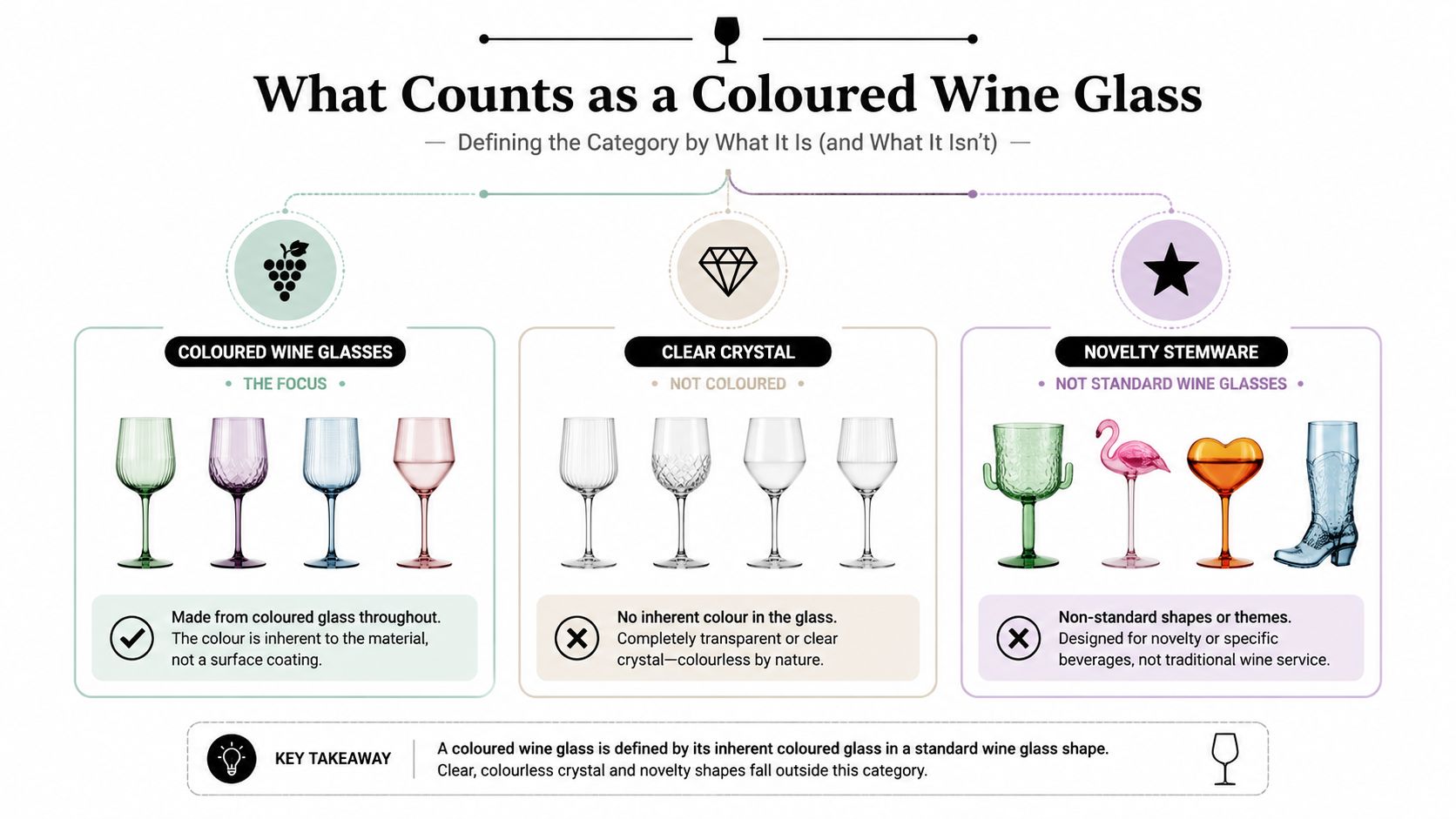
What Counts as a Coloured Wine Glass

A visual guide explaining the classification of coloured wine glasses versus clear crystal and novelty stemware.

People use the term loosely, and that causes bad hire decisions. A coloured wine glass is not the same thing as a novelty goblet, a tinted tumbler, or a random mix of cut crystal left over from another function. For rental purposes, the category should stay narrow, because narrow categories are easier to source, wash, replace, and match on the day.

The three useful families

The first family is glass, which gives the most authentic feel and usually the cleanest look for a premium table. The second is acrylic, which is lighter and safer for some casual or high-traffic settings, but can look less refined under close inspection. The third is polycarbonate, which sits closer to event durability than to classic glass elegance and usually makes sense when breakage is the bigger problem than appearance.

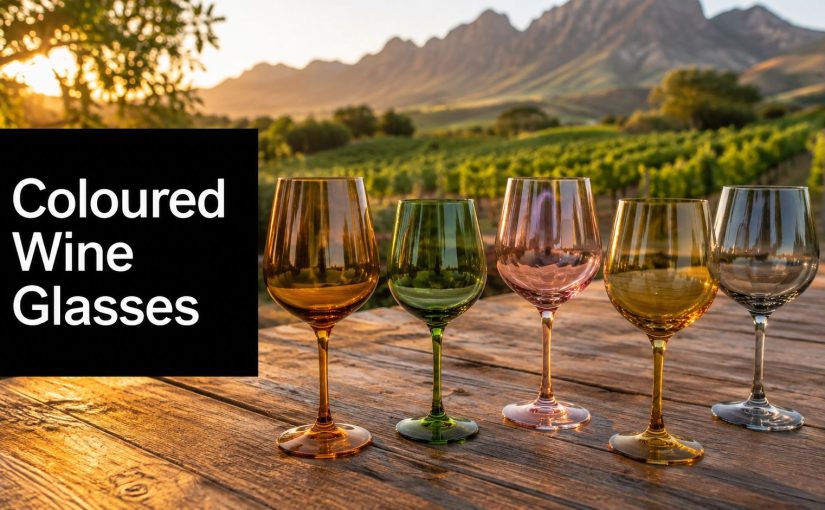
Within those families, the colour treatment changes the brief. A fully tinted bowl gives the strongest visual statement. A rim-tinted glass reads subtle and modern. A stem-tinted option is easier to live with if you want colour without hiding the wine itself. Amber and green tones are the most practical because they still read as glassware rather than prop styling.

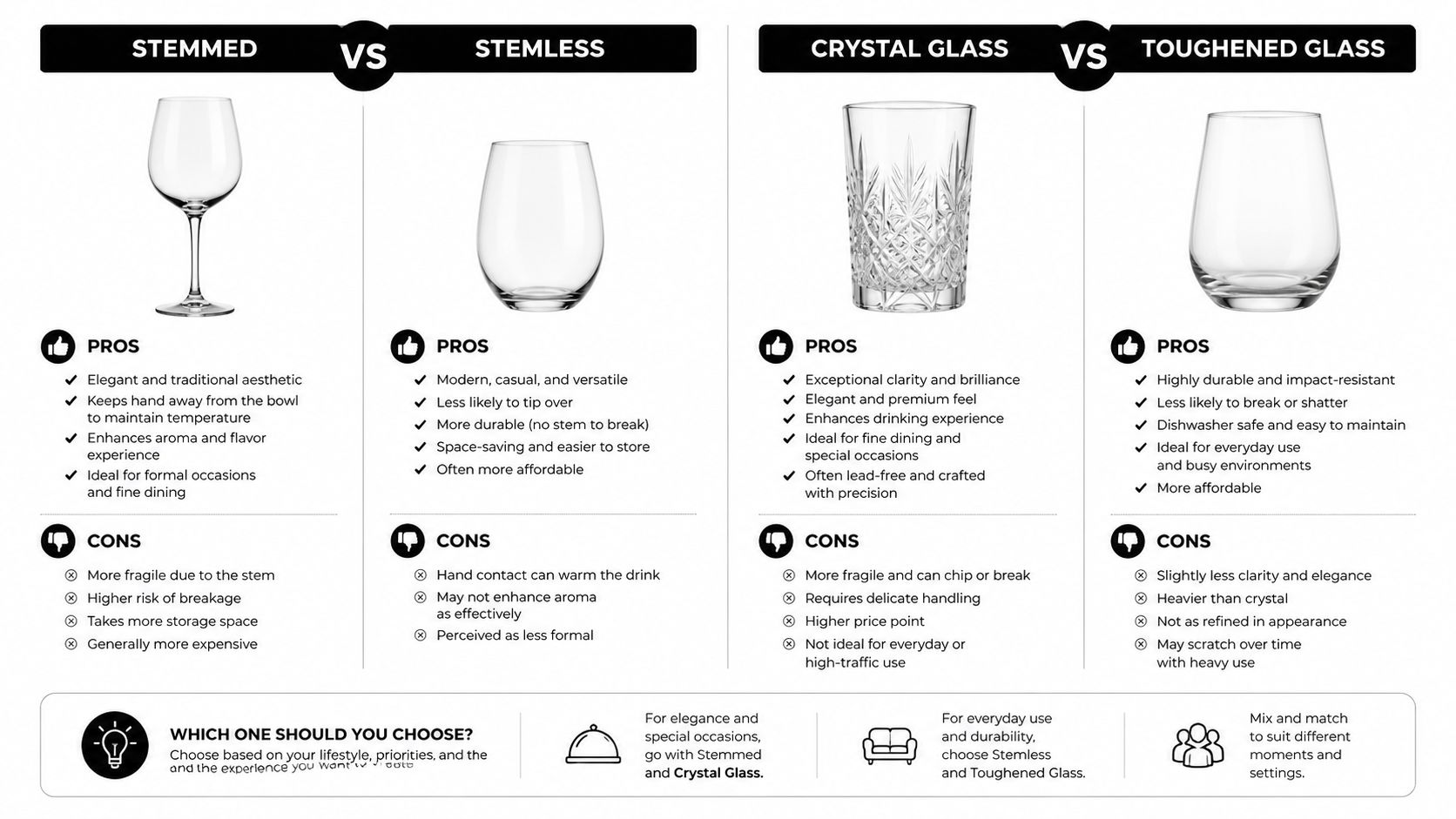
That distinction matters if you're comparing a wedding line with a corporate line. Premium weddings usually want coloured glass that still feels like proper stemware in the hand. High-volume activations can tolerate lighter materials if the event risk profile is high and the styling brief is more about impact than wine ritual. If you already know you want clear crystal for comparison, keep this crystal glassware guide open while you compare the options.

Glass vs Acrylic vs Polycarbonate Compared

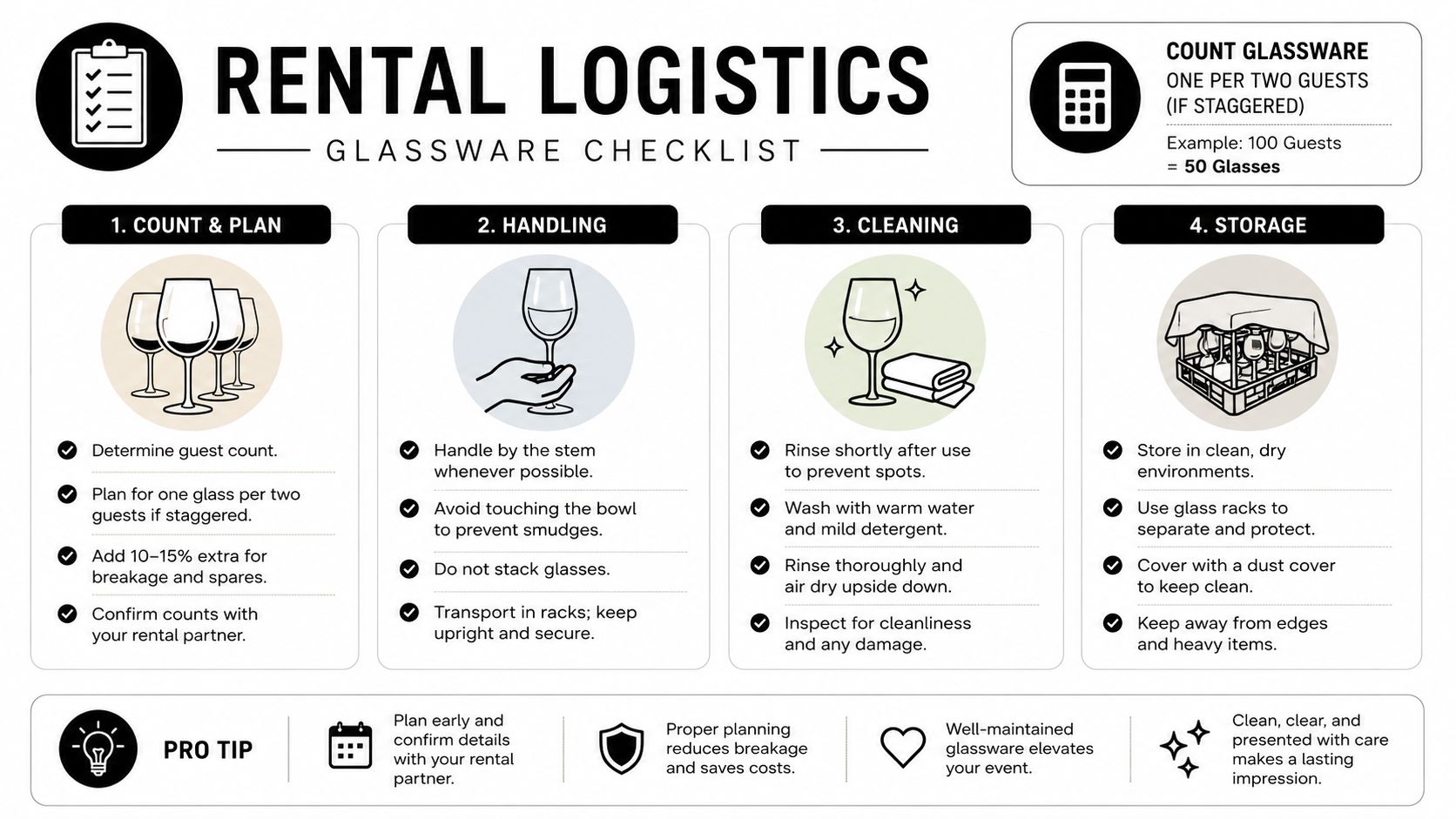
A Cape Town planner does not choose coloured wine glasses by look alone. If the service has to survive packing, delivery, unloading, guest handling, collection, and wash-and-return, the material choice decides whether the line still looks sharp by the end of the night.

Material Feel and optics Breakage risk Best for
Glass Best clarity, best sound, most convincing on a dressed table Highest if handled badly Premium weddings, tastings, formal dinners
Acrylic Lighter in hand, less crisp visually, practical for casual service Lower than glass, but still needs care Home events, poolside setups, relaxed functions
Polycarbonate Tough, consistent, more functional than luxurious Lowest of the three High-traffic corporate events, school dances, outdoor bars

Glass still wins on presentation. It gives the cleanest optics, the most convincing hand-feel, and the right sound on a toast. For a formal wedding table or a seated dinner, that matters more than saving a few breakages. If you want clear stemware as the reference point for a premium line, keep this crystal glassware guide open while you compare options.

Acrylic is the practical middle ground. It is lighter, easier to move, and less punishing if staff are working fast, but it does not carry the same refined look under close inspection. Use it for casual functions, poolside service, and events where the glassware needs to survive a lot of handling without becoming the focus of the table.

Polycarbonate is a workhorse. It makes sense when breakage is the bigger problem than elegance, especially at high-traffic corporate events, school functions, and outdoor bars. It will hold up better than the other two materials, but it reads as utility first, style second. That trade-off is fine when the brief is controlled service and lower risk.

A wedding planner with 150 guests should normally start with glass if the table is formal and service is seated. A corporate planner running 500 guests should look harder at acrylic or polycarbonate, because the operational risk rises with volume and the bar gets more traffic. The table setting can still feel polished, but the material has to match the pace of the room.

A mixed approach works only if it is deliberate. Use glass where guests are seated and photographed, then move to a tougher material where staff need speed and breakage control. For a private braai, I would only use coloured glass if the table itself is the statement. For a matric dance, I would prioritise stock consistency and breakage control over fragile glamour, because the rental line has to survive the full service cycle without surprises.

Choose the material for the event you are running. If guests will lift the glass repeatedly and the table needs polish, use glass. If the event will be fast-moving, heavily serviced, or exposed to knocks, use acrylic or polycarbonate and budget for fewer headaches at collection time.

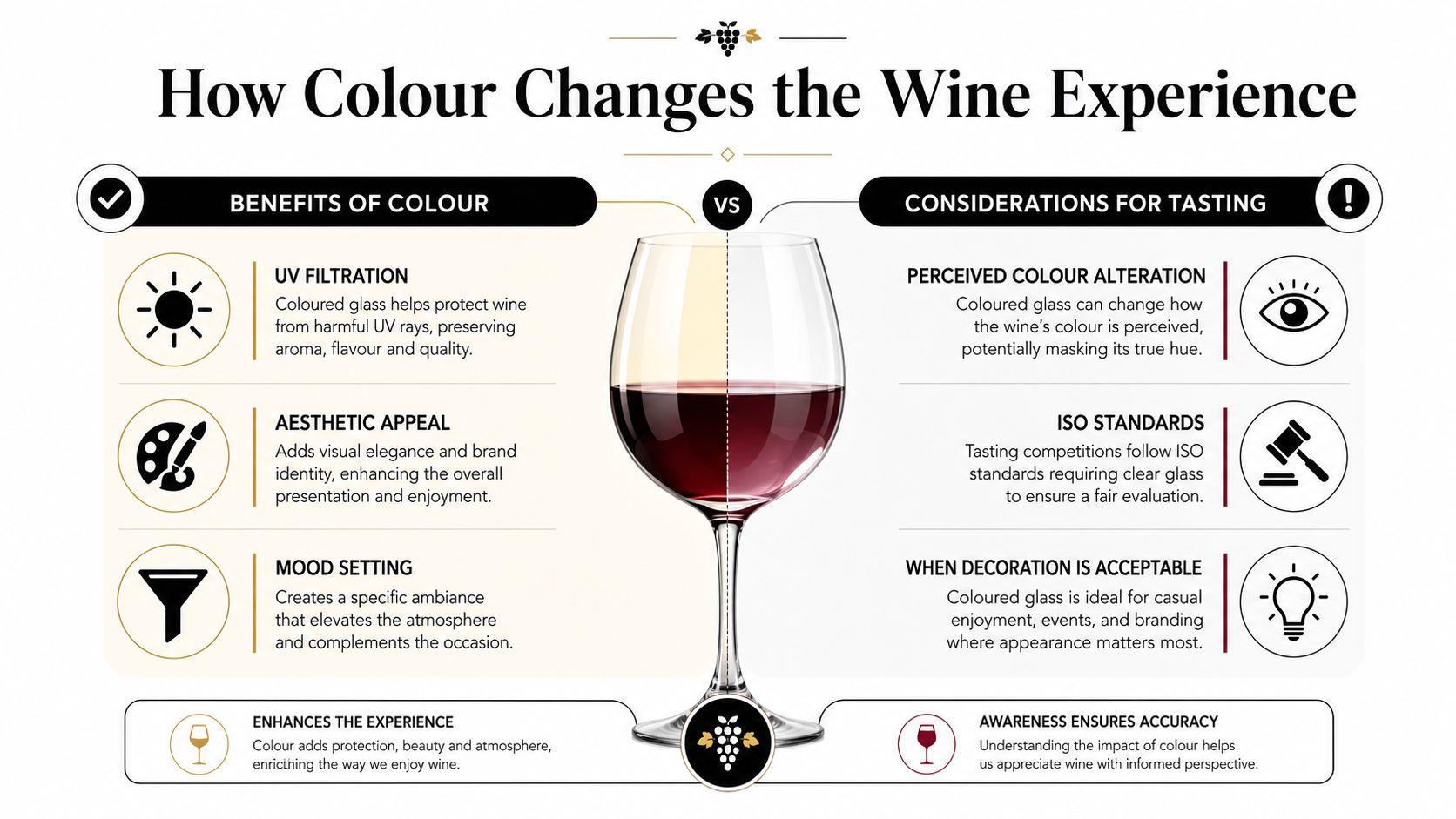
How Colour Changes the Wine Experience

An infographic comparing the benefits and tasting considerations of using coloured glass for wine drinking.

Colour changes how wine reads on the table, and it changes what guests can judge before they even sip. The ISO 3591 tasting standard requires a colourless transparent glass so the wine's appearance isn't masked, although it also allows a highly coloured glass for special tests when the visual factor is being removed on purpose ISO 3591 preview. That tells you everything you need to know about the divide between tasting and styling.

Where colour helps

There's a practical side to coloured glass too. Technical notes on wine-bottle glass show that clear glass gives the weakest UV protection, while green and amber glass block more of the damaging wavelengths, with one note reporting clear glass transmitting about 90% of 350 nm light, green about 70% at 370 nm, and amber giving the strongest protection across the UV spectrum glass and UV note. For venues with bright hospitality lighting, that's relevant to presentation and storage around the bar, even if it's not a tasting argument.

The event translation is straightforward. A coloured rim gives a light accent and still leaves the bowl open. A coloured stem is easier to live with on a lunch table because the wine stays visible. A coloured bowl is the boldest choice, but it also hides the wine the most, so it belongs in themed functions, not in wine-led tastings.

A Stellenbosch long-table lunch can carry colour because the setting is generous and the daylight is softer. A Cape Town evening activation is different. LED light can flatten weak tints, so the glass either needs enough colour to register or it should stay clear and let the branding, lighting, and florals do the visual work.

The blunt rule is this. If the guest is meant to evaluate the wine, stay clear. If the guest is meant to enjoy the table as part of the brand or event story, colour is fair game.

Styling and Colour Pairing for Real Events

An elegant outdoor table setting featuring vibrant colored wine glasses and floral centerpieces against a vineyard backdrop.

A styling brief only works when it's specific enough for the florist, linen supplier, and rental team to follow without improvising. If you want the glassware to pull its weight, it needs to echo something already on the table, not arrive as a random accent. The easiest way to brief it is by palette, contrast level, and lighting condition.

Three pairings that work in Cape Town and the Winelands

For a soft Winelands wedding, use sage, blush, and amber. Choose amber or lightly tinted stems, keep the linen warm and matte, and let the flowers stay loose rather than tightly arranged. The glassware should show up most strongly at sunset and during the first toast, when the light catches the bowl and the table stops looking flat.

For a high-contrast Cape Town brand launch, go deep green and gold. Use stronger coloured stems or bowls, pair them with black or deep neutral linen, and keep floral work architectural rather than romantic. This is the kind of event where the glassware needs to read from across the room, especially around the bar and media wall.

For a school formal, lean into jewel tones under LED lighting. Use coloured glass only if the lighting plan is strong, because weak tinting gets lost fast. Keep the rest of the table controlled, or the room will look messy rather than intentional.

If you're looking for general decor direction beyond glassware, a bridal shower décor guide can help you think about palette, table focus, and how small colour decisions read in photos. And if your event leans more towards flutes and celebration service than wine service, compare the look with champagne coupe glasses before you lock the table plan.

My advice is plain. Pick one hero colour, one support colour, and one neutral base. If all three fight for attention, the glassware will look accidental, and the table will feel over-styled instead of polished.

Renting Coloured Wine Glasses in Cape Town and the Winelands

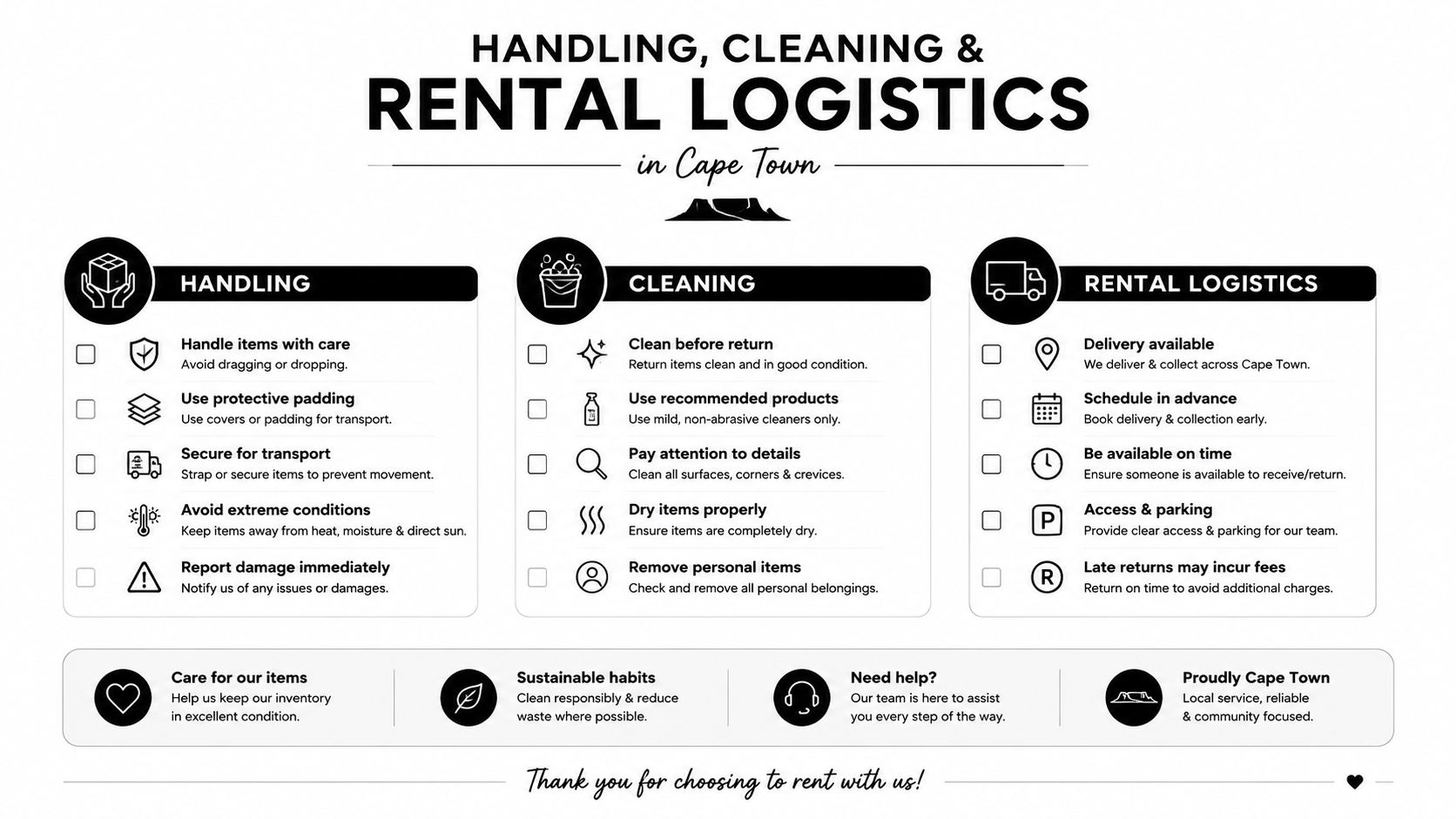
The rental side is where planners get caught out. You can love the styling and still lose the day if the stock count is thin, the replacement colour doesn't match, or the venue timing is vague. A serious rental brief should cover quantities, breakage, cleaning, and the delivery window before anyone confirms.

What to ask before you book

Start with the guest count, then work backwards from service style. For a seated course, plan one wine glass per guest per course plus a buffer, because the buffer is what saves you when a glass disappears or gets chipped before mains. If the supplier won't discuss a sensible breakage allowance in writing, keep shopping.

Ask for the exact delivery and collection windows, not just the date. That matters in Cape Town, Stellenbosch, Franschhoek, and Paarl because venue access can be tighter than the event plan suggests.

Cleaning and return handling matter just as much. A proper wash-and-return cycle should be clear about who rinses, who packs, and who takes the blame if stock comes back mismatched. If you're mixing coloured and clear pieces on one table, ask how they're being packed so the replacement stock on the day doesn't look like a different line.

If you want a practical planning reference for the broader glassware mix, keep Wedding Studio in mind as a venue and planning resource, then compare your glassware ask with ABC Hire's cutlery and crockery hire guide so the whole table is aligned. ABC Hire also carries event glassware, so it's one of the suppliers you can include when you're checking whether coloured lines can be coordinated with the rest of the hire order.

Budgeting and Pricing for Coloured Wine Glasses

Be honest with the budget before you fall in love with the look. Glass is usually the premium choice, acrylic sits in the middle, and polycarbonate is the functional option when breakage control matters more than the feel of the glass in hand. If you're planning a 150-guest wedding, the full hire quote should reflect the material, delivery, cleaning, and the buffer stock, not just the per-glass figure.

A useful budget should also include the bits planners forget. Collection fees, weekend handling, replacement costs for broken stock, and minimum-order rules on coloured lines all push the total up quickly. If a quote looks suspiciously cheap, it usually means one of those items has been left out.

For a real-world planning stance, I'd keep the budget conversation simple. Glass costs more because it looks better. Acrylic and polycarbonate save money and reduce risk, but they're not the same visual category, so don't pretend the cheaper option delivers the same table finish. Choose the material that matches the event, then spend the saved money on linen, florals, or lighting if the table still needs more impact.

Booking Coloured Wine Glasses from ABC Hire

Send four details with your quote request. Give the guest count, the event type, the venue location in Cape Town, Stellenbosch, Franschhoek, or Paarl, and your colour or material preference. Then ask for delivery time, collection time, breakage terms, and whether matching extras like coloured water glasses or champagne flutes are available in the same line.

If you're choosing quickly, use this rule. Glass suits formal weddings and tastings, acrylic suits relaxed private events, and polycarbonate suits high-traffic functions where durability comes first. Lock that in writing, or the hire order will drift.


If you're planning a wedding, corporate function, or private celebration and you want the glassware to look right without creating a headache, start with a proper hire quote from ABC Hire. They supply event glassware for Cape Town and the Winelands, so you can compare coloured options against the rest of your table hire in one place.

Candle Wall Holders for Events: Styling, Safety, Sourcing

You're standing in a venue in the Winelands with linen on the tables, candles already approved, and a blank stretch of wall that still looks flat and unfinished. That's the moment candle wall holders earn their keep. They lift the room visually, pull the eye upward, and give you a lighting layer that feels intentional instead of added at the last minute.

For weddings, corporate dinners, and milestone celebrations, candle wall holders sit in a sweet spot between décor and function. They belong to the wider family of wall-mounted light fixtures, or sconces, and that heritage matters because wall-mounted candle lighting has never just been about prettiness. It comes from a long decorative tradition of bracket lights fixed to walls and other vertical surfaces, and the basic idea of safely elevating flame goes back thousands of years, including candle-holder artifacts from ancient Egypt's Fourth Dynasty, around 2575 to 2130 BCE, as noted in the historical record on sconce and candle-holder history).

Why Candle Wall Holders Transform Event Spaces

A Cape Town reception can look polished on paper and still feel visually underpowered once guests sit down. Put candlelight on the wall, and the whole room changes. The tables stay clear, the sightlines open up, and the venue starts to feel taller, warmer, and more layered.

Elegant wedding dinner party with candle wall holders creating an intimate ambiance under a sunset mountain view.

Why wall-mounted flame reads better than tabletop clutter

Table centrepieces compete with plates, menus, glassware, and florals. Wall-mounted candlelight does the opposite, it frees the table and uses the venue itself as part of the design. In rooms with high ceilings, long corridors, or exposed stone, that vertical glow gives you the drama a low centrepiece never will.

This is why I recommend candle wall holders for venues that already have architectural character. They frame arches, entrance walls, stair landings, and dining zones without eating into guest space. If you've ever wanted a room to feel finished without overloading the tables, this is the cleaner move.

For a useful lighting parallel, the way interior wall sconces can upgrade rooms with wall sconces translates directly into events, especially when the goal is atmosphere rather than brightness. The same logic applies in a marquee, wine cellar, or manor house reception. Wall light adds visual rhythm, and rhythm is what makes a space feel designed rather than decorated.

The strongest event lighting choices solve two problems at once, they improve the look of the room and they keep service areas uncluttered.

Why the format fits South African event spaces

South African venues often balance heritage, hospitality, and practical turnover. That means a lighting solution has to work on a wall, photograph well, and leave the tables free for food and conversation. Candle wall holders do all three when they're chosen with the venue's scale in mind.

They also suit the kind of event styling people book here, including intimate weddings, formal dinners, and brand evenings where a soft glow feels more expensive than a full table setup. In my view, that's the value. You're not buying a candle accessory. You're buying a way to make a venue feel deliberate.

Types and Materials for Every Event Style

A wedding reception in the Winelands can look polished on paper and still fall flat on the wall if the holder is wrong for the room. Choose the wrong finish, the wrong depth, or the wrong mounting method, and venue staff will spot the problem before guests do. Candle wall holders need to suit the surface, the service flow, and the fire rules of the venue.

The main styles and where they fit

Taper holders are the sharpest choice for formal dining. They keep the profile slim, work well in pairs, and suit banquet rooms where you want the eye to move cleanly along a wall. A technical listing for taper wall candle holders shows a 21 mm to 22 mm fit to reduce wobble, wall projection options from 5 cm to 25 cm, and a load capacity of up to 2.5 kg per holder at this product specification. That tight fit matters because any wobble shows up fast once guests start moving past the wall.

Pillar candle sconces give you a fuller, heavier look. They suit rustic farms, wine estates, and reception spaces that need more visual weight on the wall. If the room has stone, timber, or exposed plaster, this style usually feels right from the first glance.

Glass-enclosed lantern styles are the safest visual choice where flame protection matters. They shield the candle better, reduce draft issues, and work well in rooms with drapery, hanging florals, or narrow walkways. Prioritize glass-enclosed lanterns for venues with heavy drapery or floral arrangements. For a closer look at the format, see glass candle holders for event use.

LED-compatible alternatives are not a second-best option in South Africa. They make sense when load-shedding, venue fire rules, or late service rules out open flame. A good LED candle inside a wall holder still gives you the vertical glow clients want, without adding the risk that comes with a live flame.

For a rustic finish, you can find cozy candle holders, but rental teams still need to check the finish, weight, and mounting style against the actual venue wall before signing off on the look.

Materials should follow the venue, not the mood board

Wrought iron is the best rental material for repeated use. It is sturdy, visually timeless, and handles event turnover well. A common technical example uses solid wrought iron construction, one-screw mounting, a footprint of 16.5 in high x 5 in wide x 3 in deep, and a 1.5 lb unit mass. That structure matters because the holder sits off the wall and creates torque at the fastener, especially on temporary installs with mixed wall surfaces as shown in this product example.

Brass works well in classic interiors and polished heritage rooms. It reads warmer on camera than chrome and pairs neatly with cream, deep green, and glass.

Wood only works when the venue is dry, the finish is fire-conscious, and the styling is deliberately rustic. It is softer visually, but I would not use it as the first choice for busy event walls where guests, staff, and décor all compete for space.

Acrylic has a place in modern décor, but I would keep it selective for event rentals. It can look sleek, yet it rarely carries the same visual authority as metal in a formal room.

An instructional infographic detailing the optimal sizing and placement guidelines for installing candle wall sconces.

Sizing and Placement for Maximum Impact

The wrong size holder makes a good venue look awkward. Too small, and the wall looks empty. Too deep, and guests brush past it all night. The safest, neatest installs are the ones where the holder fits the candle properly and respects the traffic flow.

Start with fit, projection, and load

A good candle-diameter tolerance keeps the candle upright and reduces wobble. That matters more than people think, because wobble drives uneven wax runoff and unstable flame behaviour. The taper holder spec above uses a 21 mm to 22 mm fit, and that narrow range is exactly the kind of detail you want in a rental checklist.

Projection from the wall changes both appearance and risk. Shorter projection reduces stress on the anchor point, which is useful in busy event spaces. The product data cited earlier gives a range from 5 cm to 25 cm, which tells you how much these holders can vary in visual presence.

Practical rule: if guests will pass close to the wall, choose the slimmer projection. Style should never outrank circulation.

Place holders where they frame, not fight, the room

Mount holders where they support the architecture. A corridor wall wants rhythm. A dining room wall wants balance. A staircase wants repetition that guides the eye upward. In each case, avoid random spacing and keep the pattern consistent.

The one measurement that event teams should treat seriously is mounting height. A common design guideline for visual comfort is to keep wall accents in the eye-line zone, not too high to disappear and not so low that they compete with guests. For events, that translates into careful alignment with mirrors, doorways, and seating zones rather than a one-size-fits-all number.
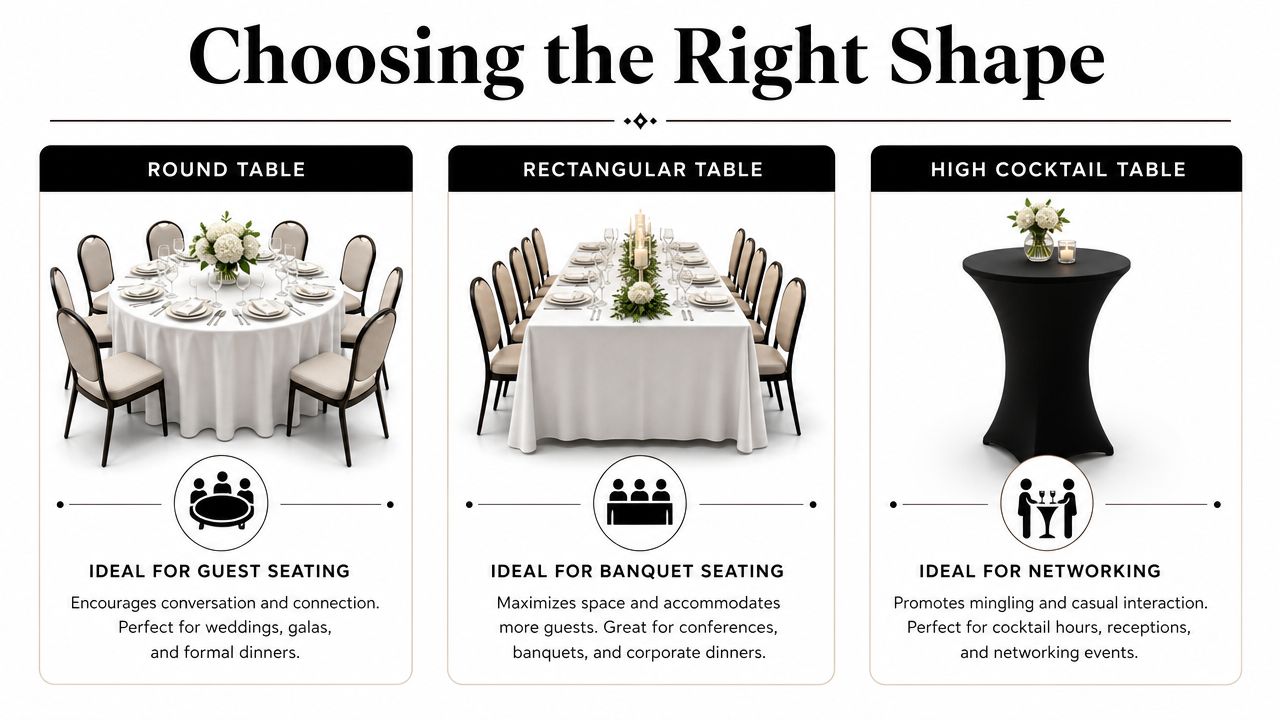
If the room has mirrors, use them. Reflected candlelight multiplies the glow without adding more flame or more hardware. That's a better design choice than increasing the number of holders.

Safety and Installation Essentials for Venues

Open flame at an event is never a styling-only decision. It's a venue decision, a liability decision, and often a fire officer decision. The venue team will care less about your mood board than about wall substrate, evacuation routes, and what happens if a guest brushes past the installation.

A safety checklist infographic for venue installations featuring tips for candles, extinguishers, and fire prevention regulations.

Fire risk is not theoretical

Candles have a real fire history. In the U.S. during 2020 to 2024, candles caused an estimated annual average of 5,894 home structure fires, with 63 civilian deaths, 532 injuries, and $286 million in property damage, and over half of candle fires started when flammable décor was too close to the flame according to the fire-safety data in this collection. You don't need those exact numbers to know the conclusion. You need distance, supervision, and the discipline to keep flame away from drapery, paper, and dried florals.

South African event guidance points in the same direction, keep open flame away from combustible materials and use stable, non-combustible supports. That's why I prefer holders with enclosed glass or secure brackets for venues with heavy décor, and LED alternatives when the site is tight on safety margin. If you need to think through extinguisher placement alongside the rest of your risk planning, a practical resource is cabinet fire extinguisher for businesses, because the conversation around flame is never just about the candle.

Temporary mounting has to respect the wall

Plasterboard, masonry, and heritage surfaces are not the same thing. A holder that feels solid on brick can fail or damage a fragile wall finish. That's why the anchor and bracket matter as much as the candle itself.

For temporary installs, use the lightest hardware that still gives you real stability, and test the bracket before guests arrive. The one-screw mounting example above shows how compact metal frames are typically stabilised, but the venue substrate still decides what is safe. On heritage walls, I would rather use fewer holders and a safer fix than force a decorative pattern that leaves marks.

You should also work with the venue manager on removal. Wax residue, screw holes, and adhesive damage can wipe out any goodwill you built during setup. If the venue is strict, switch to LED candles and keep the wall décor purely structural.

For broader rental planning around candles in wedding settings, this internal guide on candles for wedding is useful because the same safety logic carries through to table and wall styling. The rules are simple. Secure mounting, non-combustible materials, visible access to extinguishers, and no open flame near soft finishes.

What a responsible install looks like

A clean install has three traits. The holder is stable. The flame is supervised. The venue can say yes without hesitation. If any one of those is missing, change the plan.

Styling Ideas for Weddings and Milestone Events

The best wall candle styling doesn't shout. It creates a corridor of glow, a softened entrance, or a dining wall that feels finished before the first course lands. In Cape Town and the Winelands, that usually means working with the venue's own materials instead of trying to fight them.

Weddings and formal dinners

At a wine estate reception, I'd run candle wall holders along a feature wall behind the couple's table or beside the bar, then keep the table centrepieces lower and looser. That avoids visual clutter and gives photographers a clear, layered backdrop. If the room already has stone, timber, or aged plaster, let the wall texture do half the work.

For a ceremony-to-dinner transition, wall-mounted candlelight is especially useful in entrance passages and pre-dinner lounges. Guests feel the shift from daylight to evening immediately, and the room doesn't need heavy florals to make the point.

Corporate functions and brand activations

Corporate hosts should be more restrained. Use matching holders, repeat them evenly, and keep the finish consistent with the brand palette. A black metal frame reads sharper and more modern than a heavily ornate brass piece, which is why sleek event walls often work better with simple sconces than with statement candelabras.

For launches or awards evenings, a narrow band of wall candlelight can define a networking zone without blocking signage or sponsor walls. That's the sort of detail senior clients notice because it feels controlled, not busy.

Milestone events and school formals

For birthdays, anniversaries, and matric dances, the job is mood, not extravagance. Add wall candle holders where you want people to pause, then combine them with flowers or draping only if the venue can handle the extra visual load. If the venue is already ornate, keep the holders simple and let the room speak.

Keep the wall styling quieter than the table styling. If both compete, the room starts to feel overworked.

If you want the whole event to feel cohesive, repeat one finish in the holders, glassware, and any LED furniture nearby. That gives you continuity without forcing every design choice to match.

Renting vs Purchasing Candle Wall Holders

For most one-off events, renting is the better decision. Buying makes sense only if you use the same style repeatedly, have storage space, and can inspect, clean, and transport the pieces properly. Most hosts don't.

Renting wins on flexibility and logistics

Rental stock gives you more room to match the venue. One wedding might need slim wrought iron holders for a cellar wall, while the next needs enclosed glass pieces for a marquee. Purchasing locks you into a single style and shifts storage, maintenance, and replacement risk onto your side.

Rentals also reduce pressure on the day. You're not solving finish quality, missing brackets, or candle fit yourself. A good supplier should deliver condition-checked holders that are ready for the venue team to approve.

Purchase only if you'll reuse them properly

If you buy, you need somewhere to store them, protect the finish, and keep the mounting hardware together. That sounds simple until you're moving between events and the brackets are missing or bent. For most couples and corporate hosts, that's just unnecessary friction.

A rental conversation should cover delivery, collection, damage deposits, and whether the holder is suitable for the specific wall. Don't leave that to the night before. Ask early, because venue rules can change the whole plan.

The simple decision rule

If the event is one night, rent.
If the style needs to change by venue, rent.
If the holder will live in storage for months, don't buy it just because it looks beautiful.

The only real case for buying is repeated use in a controlled setting. For everyone else, renting is cleaner, cheaper in practice, and easier to align with venue requirements.

Sourcing and Renting Locally in Cape Town and the Winelands

Local sourcing matters because candle wall holders are not generic décor items. They have to travel well, fit the venue, and arrive with the right mounting hardware. In Cape Town, Stellenbosch, Franschhoek, Paarl, and nearby areas, the rental partner you choose should understand walls, fire rules, and event timing, not just product availability.

What to ask before you book

Start with the basics. Ask whether the holders are suitable for temporary installation, what wall types they can be fixed to, and whether the supplier provides hardware that won't damage the venue. If they can't answer clearly, keep looking.

Then ask about flame management. A supplier should be able to discuss open flame, glass-enclosed options, and LED alternatives without hesitating. If your venue is strict or your schedule is tight, that flexibility matters more than an ornate finish.

Why local partners are easier to work with

A Cape Town or Winelands supplier can respond faster to venue changes, load-shedding concerns, and last-minute layout shifts. That's not a luxury, it's operational sanity. The closer the partner is to the event zone, the easier it is to solve collection, replacement, and on-site coordination.

If you're still comparing providers, this guide on event decor hire near me is worth reading because location, transport, and service radius all affect whether the rental works on the day. That's especially true for wall-mounted lighting, where a missing bracket or wrong fit can derail the whole look.

How to brief the rental partner

Send the venue name, wall surface type, event date, and whether the holders need to work with real flame or LED candles. Include a reference photo if you have one. The better the brief, the fewer surprises on install day.

Load-shedding also deserves a plan. If the event may lose power, choose holders that still look good with LED candles or enclosed glass. That gives you a design that survives the outage instead of collapsing into a half-finished setup.

For couples and hosts who want the room to feel polished without guesswork, the right local rental partner saves time, protects the venue, and keeps the candle styling under control.


If you're planning a wedding, corporate function, or milestone celebration in Cape Town or the Winelands, speak to ABC Hire about event rentals that work with your venue, your safety rules, and your design brief. They can help you choose practical candle wall holder options that suit the day, especially when you need reliable local support and a setup that looks polished on arrival.

Port Drinking Glasses: A Practical Cape Town Guide

Most advice makes port drinking glasses sound like a specialist purchase for sommeliers and collectors. That's overkill for a Cape Town wedding, a Winelands tasting, or a corporate dinner. If you're hiring glassware for service on the floor, the question isn't whether the glass has a proper pedigree, it's whether it looks right, pours cleanly, stacks sensibly, and survives a busy night.

My blunt recommendation is simple. For most South African events, a small dessert-wine stem does the job better than a dedicated port glass, unless the brief is highly formal or the photo aesthetic is very specific. The old rule about tiny, tulip-shaped service still matters, but planners don't need to buy into tasting-room theory to make a good rental call. A practical port guide from McLaren Vale Cellars port guide makes the same basic point in another context, port is a serving style first, and a glass choice second.

Why Port Glasses Are Simpler Than the Internet Makes Them

Port glass advice gets inflated because people talk about it like a connoisseur problem. On a venue floor, it's a logistics problem. If your inventory already includes a small dessert-wine stem or a modest white-wine stem, you're probably closer to the right answer than you think.

The rental decision is about fit, not ceremony

Port has always been a compact pour. Antique references describe traditional service in very small vessels, often around 2–3 fluid ounces, roughly 60–90 mL, in 18th-century London records (Scottish Antiques). That's the old logic behind the shape, a small bowl, a controlled pour, and enough room for aroma without turning the glass into a splash zone.

For planners, that history matters less as nostalgia and more as a sizing clue. You do not need a giant red-wine goblet for port. You need something that reads as refined, sits neatly on a formal table, and doesn't look absurd once half-filled.

Practical rule: if the glass looks right beside dessert cutlery and espresso cups, it will usually work for port service too.

The other thing people forget is that most guests aren't there to analyse stem geometry. They're there to finish a meal well. If the drink arrives clean, measured, and elegant, the glass has done its job.

Use the smallest sensible stem you already hire

If I were building a rental brief from scratch, I'd start with a small dessert-wine stem before I'd special-order dedicated port glassware. It's easier to source, it photographs well, and it blends into mixed service without calling attention to itself. That matters on a table where the champagne flute, water goblet, and coffee service are all competing for visual space.

Dedicated port glassware is still useful for a heritage-heavy tasting or a formal dessert service, but it's not mandatory. In practice, the choice often comes down to whether the event needs a specialist look or a reliable serving solution. Most Cape Town clients need the second one.

Where Port Glasses Came From and Why the Size Matters

Port drinking glasses did not start as decorative overkill. They came out of the late 17th and 18th centuries, when British trade with the Douro Valley expanded and port settled into the after-dinner routine of elite homes. Once the wine was fortified with brandy to survive shipping, the service style followed the same logic, smaller pours, smaller vessels, less fuss.

The old service style still tells you what works

Those older London references are useful because they show the original brief. Port was served in very small measures, about 60–90 mL, which matched both its fortified strength and its dessert-wine role (Scottish Antiques). That is why a modern port glass still reads as restrained beside a standard wine goblet.

For rental work, the useful benchmark is the vessel, not the mythology. The practical capacity sits at 14–18 cL, with a usual pour of 5–6 cL and about one-third of the glass filled so the aroma stays concentrated (Limonadier). A glass in that range keeps the wine focused without forcing service staff to top up constantly.

An infographic detailing the history and design benefits of port wine glasses through a timeline and illustrations.

Bigger wine glasses are the wrong instinct for port

The wider wine-glass trend in England is the warning sign. A Cambridge/BMJ study measured average wine-glass volume rising from 66 mL in 1700 to 449 mL in 2017, nearly 7 times larger. That shift suits still wine service. It works against port.

Port is fortified, sweeter, and usually poured with more control. A large bowl exposes too much surface area and makes the drink look lost on the table. For event work in South Africa, the better choice is a neat tulip shape in the 120–150 mL range, especially when the brief includes dessert, tasting notes, or a formal dinner finish. In practical terms, the best-looking option is often a small dessert-wine stem rather than a dedicated port glass, because it stacks better, survives service better, and fits mixed table settings without drawing the wrong kind of attention.

The supplier benchmark backs that up. Olympia's examples sit at 120 mL and 150 mL, with the taller version reaching 151 mm (Olympia crystal port glass). That is the size family I would trust for formal South African service, not because it is fussy, but because it lands well on a dressed table and holds up in rental stock.

The Four Glasses You Can Hire for Port Service

Not every event needs a dedicated port glass, and not every glass that can hold port should be used for it. The right choice depends on how formal the room is, how much stock you need to move, and whether the table setting has to carry a premium look. For rental work, I think in four practical options.

Dedicated tulip port glasses

This is the cleanest solution when the event is formal. A 120–150 mL tulip bowl gives you the right visual proportion, and the narrow top helps hold aroma while the pour stays controlled (Olympia crystal port glass). Fill it to about one-third, which keeps the wine concentrated and avoids the heavy, overexposed look of a larger stem.

Sherry glasses

Copita-style glasses and other small sherry forms sit in the 90–120 mL zone and work well when you want a compact, traditional pour. They're not identical to a classic port tulip, but they're close enough for many tastings, especially when the service is seated and the guest count is manageable. If the venue already keeps sherry or aperitif glassware in rotation, that stock can solve the port problem without another line item.

Small white-wine stems

A small white-wine stem around 180–220 mL is the flexible compromise. It's larger than ideal, but still acceptable when you need consistency with the rest of the tableware or you're serving mixed after-dinner drinks. If the port pour is only one element in a broader beverage plan, this is often the easiest hire decision.

Small dessert-wine glasses

This is the option I reach for most often in real event work. A small dessert-wine stem feels polished, rents easily, and fits with bread-and-butter service, petit fours, or cheese plates without reading as specialist kit. It's also the most forgiving choice when you're matching existing glassware instead of building a dedicated port set.

Glass type Capacity Typical fill Best event fit
Dedicated tulip port glass 120–150 mL About one-third, 5–7 cL Formal tastings, cellar dinners, plated dessert service
Sherry glass 90–120 mL Small controlled pour Aperitif-style service, intimate tastings
Small white-wine stem 180–220 mL Modest pour, not full Mixed table service, flexible hire inventories
Small dessert-wine glass Varies by supplier Light pour, usually one-third or less Weddings, corporate dinners, general rental use

The best port glass in theory is not always the best one in a hire shed. The right answer is the one that matches the rest of the room and doesn't create a mismatch at service.

Stemmed vs Stemless and Crystal vs Toughened Glass

Rental reality takes over fast. Guests notice the drink, but the floor team notices breakage, packing, and whether the glassware survives the run from warehouse to venue and back again.

A comparison chart showing the pros and cons of stemmed vs stemless and crystal vs toughened drinking glasses.

Stemmed glassware looks cleaner, stemless glassware handles pressure better

A stemmed glass photographs better. It keeps hand heat off the wine and gives a formal table a more deliberate finish. The trade-off shows up at setup and pack-down, because stems stack awkwardly, need more care in transit, and chip more easily when staff are moving quickly between prep, service, and breakdown.

Stemless glassware is tougher and packs more tightly, so it often wins for large guest counts, informal receptions, and venues with tight storage. It warms the pour faster and reads more casual, which works for a relaxed after-dinner setup and falls short at a polished estate dinner.

Crystal brings finesse, toughened glass brings practical value

Crystal gives you clarity, sparkle, and the kind of finish people associate with premium service. It is more fragile and more expensive to replace when the inevitable knock happens, so it suits a formal tasting or a small VIP dinner where the room can justify the extra care.

For most Cape Town weddings, matric dances, and corporate functions, toughened soda-lime glass is the sensible answer. You want stock that can handle transport, stacking, and repeated washing without fuss. If you want a useful reference point for the visual difference and overall glassware positioning, the ABC Hire article on wine glasses crystal gives a clear sense of why crystal gets chosen for style, even when tougher stock makes more operational sense.

The glass that breaks least is usually the glass the floor team trusts most.

Use the setting to decide, not personal preference alone

A whiskey tasting brief makes the same point from another angle. For layered aroma and controlled nosing, the vessel shape matters, but rental choice still comes down to service style and durability as well as the drink itself. A useful comparison appears in the discussion of glasses for scotch whiskey tasting, where shape and practicality are treated as a working pair rather than separate goals.

If you are running a high-contact event, choose the glass your staff can handle with confidence. If the room is formal and the guest count is contained, choose the one that flatters the table. The best-looking glass in a catalogue is useless if it creates headaches on the floor.

Matching Port Glasses to Cape Town and Winelands Events

The same pour lands differently depending on the room. A glass that looks perfect in a cellar can look fussy on a rooftop, and a casual stem can undercut the whole mood at a plated wine estate dinner. That's why I don't recommend one universal port glass for every South African event.

Stellenbosch tasting, go formal and narrow

A Stellenbosch tasting in a working cellar or estate venue calls for a proper tulip shape. The room already does part of the storytelling, so the glass should support that language instead of fighting it. Crystal or a very clean small stem works here because the setting rewards precision and the pours are usually slower and more deliberate.

Cape Town corporate dinner, keep it efficient

A Cape Town corporate year-end dinner needs neatness more than theatre. Small dessert-wine stems are the sweet spot because they fit into mixed tableware, align with broader beverage service, and don't look overdesigned beside plated dessert or coffee service. The room might be a rooftop, a hotel ballroom, or a gallery space, so the glass has to hold up across styles.

Franschhoek wedding, match the mood of the evening

A Franschhoek wedding often sits between formal and relaxed. If port is being served after dessert or near a fireplace, stemless can work if the rest of the styling is soft and the couple wants something less precious. If the brief leans elegant and the photographs matter, I'd still push for a small stemmed option.

Rule of thumb: the more the venue already feels like a wine experience, the more a dedicated tulip glass makes sense.

I also think guest count should shape the decision as much as the menu. The bigger the event, the more you should bias towards glassware that packs well, washes easily, and blends into the rest of the service line. In the Winelands, that usually means hiring for operational confidence first and romance second.

Serving, Pouring and Pairing Port the Right Way

Port service falls apart when staff treat it like ordinary wine. It needs a smaller pour, a cleaner hand, and a glass that suits the pace of the end of the meal. For most South African events, that usually points to a small dessert-wine stem rather than a dedicated port glass, because the ultimate test is whether it works on the floor, not whether it wins a tasting-room argument.

An infographic titled Rental Logistics showing a four-step checklist for managing event glassware rentals.

Pour small and keep the glass under control

The safest approach is still the one-third fill. A small stem gives enough bowl space for aroma without turning the pour into a heavy, sloshing serve. Keep the measure controlled and leave air above the wine so the service feels deliberate, not casual.

Keep the wine slightly cool, not icy

Port should sit below room temperature, but it should never be treated like a chilled white or a cocktail build. Ruby and tawny styles usually do well in a moderate temperature band, while vintage styles can sit a little warmer, so the bar team should resist the urge to over-ice the bottle or chill the glass aggressively. The point is balance, not brute cold.

Pair with the right plate

Dark chocolate, blue cheese, cured meats, nut tarts and dried fruit all hold their own beside port. Those flavours match the wine's sweetness and intensity without being flattened by it. If dessert already includes one of those elements, the port service feels like part of the course instead of a separate extra.

For event planners who want the service to feel tied to a real wine destination, a curated Porto itinerary gives useful context, even if the event is happening in Cape Town. If you are also building out the rest of the service setup, the practical notes on ice buckets and stands are worth keeping close, because port service usually sits inside a wider drinks station, not in isolation.

If the pairings are too sweet, the port feels heavy. If they are too sharp, the wine feels flat.

If your bar team needs one simple instruction sheet, keep it blunt. Open the bottle properly, measure the pour, and serve it in a glass with enough airspace for the bouquet to open.

Handling, Cleaning and Rental Logistics in Cape Town

Even the right glass goes wrong if the logistics are sloppy. Port service depends on clean, chip-free stems, sensible counts, and a rental plan that doesn't leave the venue manager chasing missing stock after midnight.

A professional infographic outlining handling, cleaning, and rental logistics guidelines for equipment rentals in Cape Town.

Count for staggered service, not worst-case panic

If port is being served after dessert rather than all at once, a practical count is one glass per two guests. That keeps stock sensible while still giving the service team enough headroom to replace a damaged or missing piece during the evening. For mixed events, that approach is easier to manage than over-ordering a full second set.
Inspect, polish and pack like the venue matters

Check every glass for chips and stress cracks before it leaves the warehouse. Polish with a lint-free cloth, not a rough towel, or you'll end up with water marks that show under warm lighting. Pack by size and style so the same glasses come back together, especially if the venue has a narrow service lift or a tight load-in window.

Work with a rental partner that understands event flow

A good supplier should be able to handle delivery across Cape Town, Stellenbosch, Franschhoek and Paarl, then collect on the schedule the venue needs. For multi-day hires, turnaround on washing and repacking needs to be clear from the start. If you're comparing broader hire categories, the ABC Hire guide to cutlery and crockery hire is a useful reminder that glassware should be briefed as part of the whole table service, not as an afterthought.

ABC Hire also carries glassware as part of its event hire range, which matters if you're trying to keep the drink service consistent across water, wine, and after-dinner pours. That's the kind of practical overlap that saves time on a floor plan.

Putting Together Your Rental-Ready Glassware Brief

A good port brief is short. It should tell the supplier what glass style you want, how many guests you're serving, where the venue is, and whether the pour is formal, casual, or tied to a dessert course. If you can fit the service logic on one page, the hire order is usually clear enough for everyone involved.

Start with the glass choice. For most Cape Town and Winelands events, I'd write small dessert-wine stem or small tulip port glass, then add the style and capacity if the venue is being precise about presentation. After that, note the delivery suburb, access limits, and whether the glassware needs to match existing table settings.

Then add the service instructions. Say whether port will be poured seated, after dessert, or as a standing reception pour, and whether the bar team should expect staggered serving or a single round. Finish with a clean breakage expectation and any wash-back requirements if the event runs over more than one day.

If you keep it that tight, the rental company can do the rest without guesswork. That's the primary job here, not arguing over the perfect shape on paper. The best setup is the one that lands cleanly on the table and disappears into the service.


ABC Hire supplies glassware as part of its Cape Town event hire range, so if you need port service that matches the rest of your tables, they can help you build the order around the full floor plan. For weddings, tastings, and corporate dinners in Cape Town, Stellenbosch, Franschhoek, or Paarl, visit ABC Hire and ask for a glassware brief that fits your guest count, venue access, and service style.

How to Build a Cheese Platter Board for Cape Town Events

You can have a beautiful board lined up, the vineyard lawn ready, and a guest list that looks manageable on paper, then the afternoon heat starts working against you. Soft cheese loosens, cut fruit dulls, and the platter that looked sharp during load-in can look tired before the first round of speeches. That's the challenge with a cheese platter board in Cape Town, not just making it look generous, but keeping it elegant, safe, and easy to serve through a long event window.

A cheese platter board works because it sits at the point where hospitality, speed, and visual impact meet. Cheese has a long culinary history, with cheesemaking dating back more than 4,000 years in ancient records, and some evidence placing it over 7,000 years ago in early European and Mediterranean finds, while the formal cheese course became established in Europe during the 17th and 18th centuries according to the International Dairy Foods Association's history of cheese. That lineage matters in South African event catering, because this isn't a novelty garnish, it's a proven serving format built for sharing.

Why a Cheese Platter Board Works for Cape Town Events

A planner standing on a Winelands lawn knows the pressure points immediately. The guest list is final, the venue has a narrow load-in window, and the food has to look as good at service time as it did in the proposal deck. A cheese platter board fits that brief better than most centrepiece formats because it doesn't need on-site cooking, it transitions easily from intimate gatherings to larger receptions, and it feels at home beside local wines.

The format also carries visual credibility. Cheese boards grew from a structured course into a shared platter for social entertaining, and that shift from formal dining to easy hospitality is exactly why they work so well at weddings, tastings, matric dances, and corporate functions. The long history behind the format, documented by the International Dairy Foods Association, gives planners a useful answer when clients ask why this style feels polished without being stiff.

The practical reason it wins on event day

The biggest advantage is operational, not decorative. A board can be staged early, replenished cleanly, and photographed from several angles without a chef standing over it. It also pairs naturally with tasting-style service, which is why it suits pre-drinks, cellar-door events, and brand activations where guests circulate rather than sit.

Practical rule: if the food has to look premium, travel well, and require minimal last-minute work, a cheese board is often the safest centrepiece choice.

There's still a decision to make, though. The right guest quantity, cheese mix, board style, and temperature control plan all change how well the final display survives. That's where most catering advice goes thin, and where event planners need a working method instead of pretty inspiration.

Calculating Quantities for Any Guest Count

A six-step infographic on calculating food quantities for event planning for any number of guests.
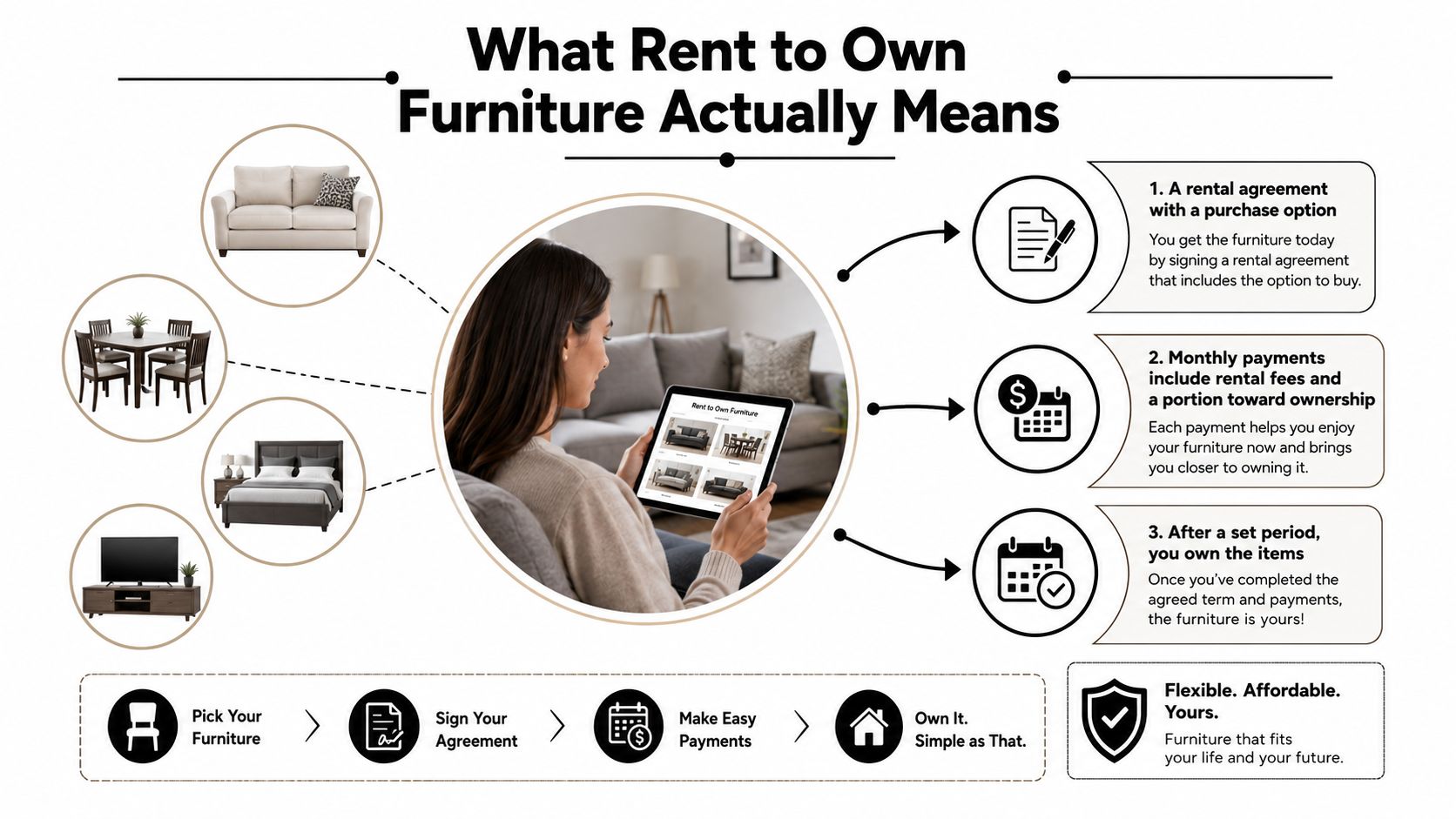
Start with the cheese itself, then build the rest of the board around that number. For a cheese-centric platter, the record-based guidance in the brief points to 1.75 oz (50 g) of each cheese per person, while a board that sits alongside other food can drop to ¾ oz (25 g) per person. Another catering benchmark for an appetizer board is 1 to 1.5 oz of cheese per guest per cheese, with 3 to 4 cheeses usually giving enough flavour contrast without overcrowding the display, as noted in Shelburne Farms' cheese board guidance.

A simple working formula

Use this order of planning:

  1. Decide the board's role. If it's the main grazing station, lean heavier on cheese. If it shares space with canapés or charcuterie, go lighter.
  2. Pick 3 to 4 cheeses first. That gives contrast without turning the board into a shop shelf.
  3. Size cheese before accompaniments. Once the cheese mass is fixed, fill the board with bread, crackers, fruit, nuts, and spreads around it.
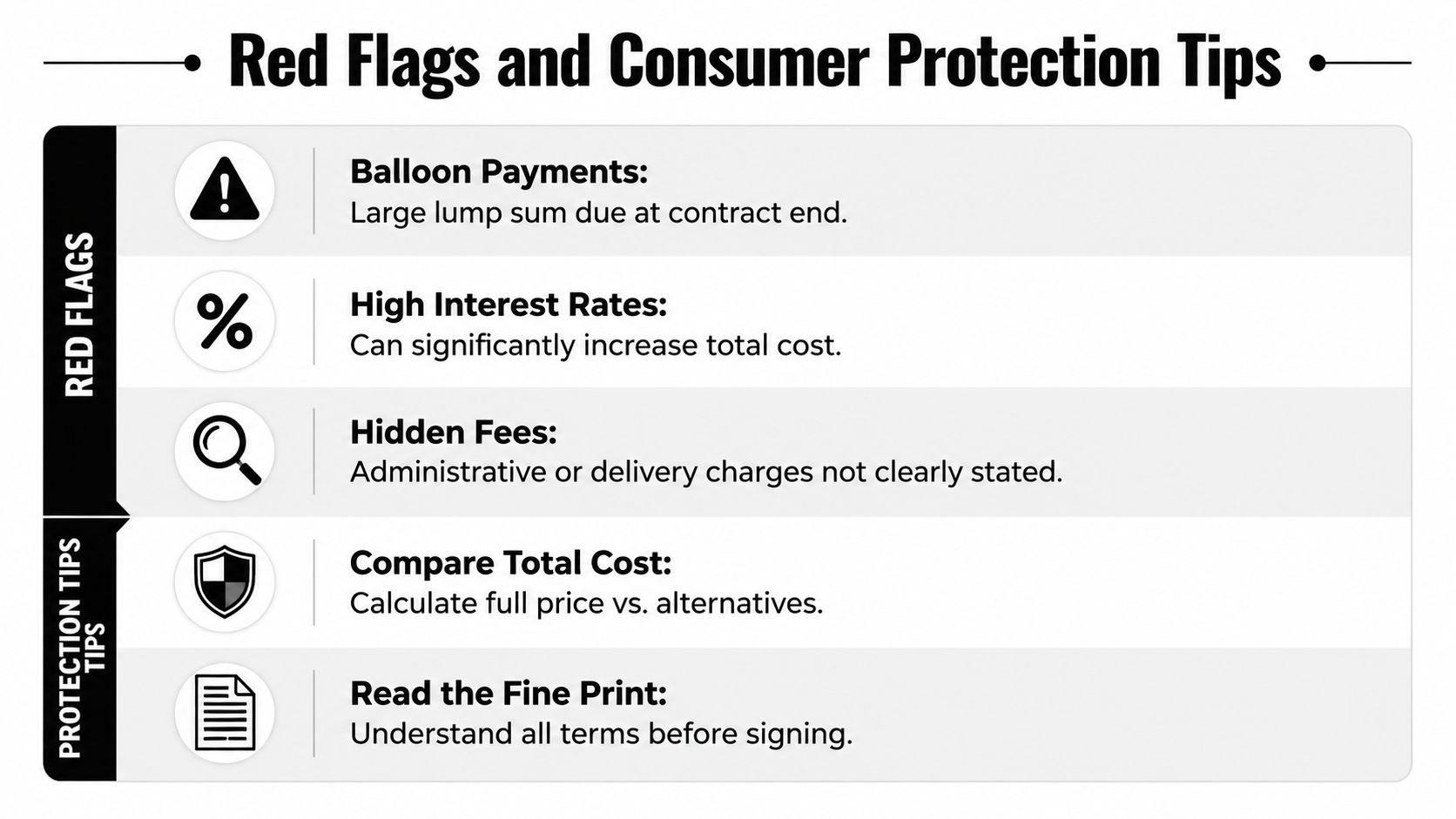
  4. Leave space for topping up. A board that looks too full from the start usually looks messy by the midpoint of service.
  5. Match quantity to format. A small dinner board needs density. A corporate station needs easier access and a faster refill pattern.

For an 80-guest Winelands wedding where the board is a pre-dinner feature and not the only food on site, the lighter benchmark is usually the smarter one. That means sizing for the lower per-guest range, then using accompaniments to create visual abundance rather than forcing too much cheese onto the board. The Guinness World Records listing for the largest cheese platter, at 2,012.85 kg (4,437 lb 9.92 oz) with around 145 varieties from Wisconsin producers, shows the format can scale dramatically, but event service still works best when the board stays readable and easy to approach, not overstuffed, according to Guinness World Records.

Use the cheese count to set the shape of the board, not the other way around. If the board is too small for the mix, guests end up fighting for space around the same wedges.

That logic holds whether you're feeding 20 people at a private dinner or 300 guests at a corporate launch. The method is the same, only the refill rhythm changes.

Choosing Cheeses That Earn Their Place on the Board

The easiest mistake is shopping by instinct instead of function. A board needs cheese roles, not just cheese names, because guests read the display as a composition, not a list. Hard cheeses anchor, semi-soft cheeses bridge, soft cheeses spread, and blue cheeses give the board a strong finish.

Category Role on Board Texture Pairing Direction
Hard Anchor Firm, sliceable, grating-friendly Works with crackers, crusty bread, and structured wine
Semi-soft Bridge Supple, balanced Fits most guests and softens the jump between stronger styles
Soft Spread Creamy, yielding Needs bread, fruit, or plain crackers for easy service
Blue Accent Bold, pungent Best used in smaller amounts as the flavour highlight

A balanced shortlist usually starts with one familiar crowd-pleaser, one local Winelands option, one hard cheese with structure, one creamy cheese, and one blue for contrast. That mix gives you comfort and interest without making the board feel random. It also helps when you brief a supplier, because you're asking for a texture profile and service role, not just a shopping list.

What to avoid when you're selecting

Avoid building the whole board from soft cheeses. They look lovely for a moment, then lose edge and become difficult to slice or spread neatly once service starts. Avoid buying only crowd-pleasers too, because the board becomes flat and forgettable.

The best boards usually have one cheese that most guests already know, one that feels a little local or seasonal, and one that makes people pause. That pause matters in a tasting setting, because it encourages conversation without turning the station into a lecture.

If a cheese doesn't change the board's texture, colour, or flavour range, it probably doesn't deserve space.

Building and Styling the Board Itself

A pair of hands arranging artisan cheese slices on a rustic wooden board for a platter.

Start with the hardest cheeses, because they do the visual heavy lifting. They act as anchors, they hold clean edges, and they give the board structure before anything softer goes in. Once those are placed, add the creamy cheeses and spreads, then fill the negative space with fruit, nuts, olives, preserves, and bread.

The order that keeps the board tidy

First place the boards or trays, then the main cheeses, then the supporting elements. Use bowls and small ramekins for olives, honey, chutney, or mustard so the liquids don't spread into the cheese area. That keeps the surface clean and lets you add height without clutter.

Colour matters more than people think. Pale cheeses need contrast from dark grapes, figs, berries, or dried fruit, while a few herbs or leafy garnishes can break up the visual weight. Odd numbers usually look more natural than pairs or perfect symmetry, but don't force that rule if the serving flow needs clearer access.

The board should still have breathing space around each cheese. Guests need room to cut, scoop, and move without damaging the arrangement, and the display looks more premium when nothing is jammed edge to edge. The wooden serving board guide from ABC Hire is useful here because the surface itself affects how polished the final layout feels, especially on rustic, vineyard-style tables.

A well-styled board should look abundant, but never crowded. The moment guests can't tell where one item ends and the next begins, the composition has gone too far.

Heat, Timing and Food Safety on Long Event Days

A cheese platter board can look perfect at set-down and still fall apart by mid-service if the temperature is wrong. Cape Town summer heat is hard on soft cheeses, cut fruit, and anything with a glossy finish, and the board starts to look tired long before guests are finished. On long winery lunches and outdoor corporate functions, the display has to survive the afternoon as well as the first reveal.

The fix is to treat timing as part of styling. Put the board out closer to guest arrival, not during early venue setup, and build a plan for refreshes if service will run for hours. Use shade wherever you can, because direct sun on a vineyard lawn or terrace will push the board downhill fast. Chilled staging bowls under selected items can keep the display steady without changing the look, and the Wayfair cheeseboard guide still gives a solid baseline for room-temperature presentation, even if it does not deal with long hot-service days in a practical way.

What holds up best

Hard cheeses handle service better than soft cheeses. They keep their shape, slice cleanly, and stay presentable for longer, which matters when the board is meant to sit in front of guests rather than disappear into the kitchen after five minutes. Soft cheeses need quicker replenishment and tighter checks because once they warm, they lose their edges and the board starts to look messy.

Cold storage behind the scenes matters just as much. The display can be styled perfectly, but if the back-up stock is sitting warm, the next refill only resets the problem for a short while. That is why a mobile fridge for hire guide from ABC Hire fits this part of planning so well, because the board depends on what is stored off-site or off-board as much as what guests can see.

Food safety and presentation rise or fall together on long event days. If the back-up stock is warm, the next refill only repeats the same issue.

Cross-contact control matters too, especially when prep teams are handling dairy, fruit, crackers, and garnish in the same prep flow. The guide on prevent cutting board cross contamination is a useful reminder that clean surfaces, separate tools, and clear prep zones are part of keeping the board safe, not just tidy.

Transport, Setup and Hygiene on Site

The journey from prep kitchen to venue is where many boards lose quality. Pack the cold items last, keep the load order logical, and avoid stacking anything that can crush fruit, crack cheese edges, or smear garnish. A board that arrives intact usually got packed in the reverse order of how it's served, with the most delicate items protected and the board surface kept clean and dry.

On site, the board should go down on a stable base before anything is styled on top. Serving knives, spoons, tongs, and cheese markers need to be placed where staff can reach them without crossing over the food. Allergen labels help guests self-serve confidently, especially at corporate functions and formal weddings where mixed dietary needs are the norm.

The board itself also matters for hygiene. A procurement-grade specification that allows for surface roughness not exceeding 3.2 µm Ra, thickness variation within ±2 mm, and edge radii of 2 to 3 mm, with groove channels about 4 to 5 mm deep and 6 to 7 mm wide, is not just technical jargon, it reduces moisture ingress, warping, and sanitation problems between events, according to the professional cheese board procurement guide. In rental work, those finish tolerances directly affect whether a board cleans properly after repeated wash-and-dry cycles.

Leftovers need a plan before service begins. If the board is meant to be reset later, keep the reserve stock separated, chilled, and clearly marked so staff don't mix fresh product with display items that have already sat in the room. That habit protects both the presentation and the venue's reputation.

Wine Pairings That Work in the Winelands

A good cheese board in the Cape lands best when the wine feels intentional, not improvised. Strong blues usually want contrast, aged hard cheeses need structure, creamy soft cheeses prefer brightness, and semi-soft cheeses sit comfortably in the middle. That gives you a useful pairing logic for weddings, cellar tastings, and corporate launches where guests expect the board to reflect the wine list rather than compete with it.

For a straightforward Winelands pairing map, bold blue cheese works well with a tawny port or sweet dessert-style wine, aged hard cheese suits a structured red such as Cabernet Sauvignon or a Bordeaux-style blend, creamy soft cheeses pair naturally with Sauvignon Blanc or Cap Classique, and semi-soft or washed-rind cheeses can sit comfortably with Pinot Noir or a lighter Chardonnay. For hosts who want a wider flavour reference beyond wine, the whiskey food pairing guide shows the same basic principle at work, pairing intensity with structure instead of throwing random flavours together.

How to label pairings so guests use them

Keep the signage short. Guests don't need a tasting essay, they need confidence. A simple note such as “Best with Cap Classique” or “Try this with the red blend” is enough to guide self-service without slowing the line.

Waiting staff should know which cheese sits where and which pour matches it. That helps at formal receptions where guests ask the same question repeatedly, and it keeps the board from becoming a bottleneck. If the bar team knows the pairing story, they can steer guests naturally instead of improvising answers.

For the physical setup, matching the serving style to the room makes a difference. The wine glasses and crystal guide from ABC Hire is relevant because stemware, board height, and table placement should feel like one design choice, not separate rentals dropped into the room.

How ABC Hire helps the board work on site

The right rental pieces remove friction where it shows up. Cheese boards, crates, and display props help with height and layout. LED cubes and furniture suit evening functions where the board needs to read as a feature station. Tables and climate control equipment solve the service window and heat problem. Slush machines can support the beverage side of a summer activation, which keeps guests moving while the board remains accessible.

For smaller private dinners, a single well-built board with simple props is usually enough. For larger weddings and corporate activations, the board often needs support from tables, chilled staging, and a cleaner traffic flow around the station. That's where good rental choices matter, because they let the food stay elegant without asking the venue team to improvise on the day.

Quick checklist for the quote

  • Board size and finish to suit the guest count and service style
  • Chilled support for backup stock and long outdoor service
  • Display props for height, visibility, and table styling
  • Stemware and furniture to match the wine experience
  • Climate control if the board has to survive a warm afternoon

If you're planning a wedding, tasting, matric dance, or corporate function in Cape Town, Stellenbosch, Franschhoek, or Paarl, build the rental quote around the board first, then add the pieces that keep it attractive and safe for the full event window. Visit ABC Hire to source the boards, props, furniture, and climate-control support that make a cheese platter board work properly on the day.

White Card Table Guide for Cape Town Events

You're standing with a quote open, the venue wants the table plan by end of day, and the client has just asked for a white card table. In Cape Town and the Winelands, that phrase can mean very different things depending on who is speaking. If you use it loosely, you can end up pricing the wrong furniture, planning the wrong layout, or paying for a look that doesn't survive a windy outdoor setup.

The problem starts with language. In South Africa, “white card table” is not a standard furniture classification, and the closest authoritative historical use of white card is tied to construction safety training, while the practical event-furniture category is really a folding table with legs that fold against the top for portability and storage, which is why it suits temporary events so well (white card context, folding table definition). That mismatch is exactly why suppliers pause when the term comes up. They need to know whether the brief is about a hire table, a clean white surface, a foldaway format, or a completely different product altogether.

Why the Term White Card Table Causes Confusion

A Stellenbosch planner can hear “white card table” three different ways in one morning. A bride means a clean, white table for the reception. A junior coordinator thinks of a certification term she's seen online. A supplier, meanwhile, is trying to work out whether the order is for a folding event table or some niche product that doesn't exist in the local hire catalogue.

That's the core issue, the phrase sounds familiar, but it doesn't map neatly onto South African event-furniture language. The available regional evidence points the other way, white card is not a common South African event-furniture classification, and there's limited ZA-specific technical literature attached to that wording. The practical furniture type is the folding table, not a formal “white card table” category (ZA context on white card, folding table as furniture type).

What people usually mean

Most clients are really asking for a table that looks clean, photographs well, and can move from truck to venue without drama. That usually means a white finish, a foldable frame, and a hire-friendly surface that can handle service, décor, and quick turnaround.

A supplier can only quote accurately when the wording matches the use case.

If the brief is vague, you lose time on revisions and risk misunderstanding the size, finish, or shape. If the brief is specific, the conversation becomes simple, do you want a rectangular folding table, a round dining table, or a cocktail-height surface for a standing event?

The best habit is to describe the table by function first, then by finish. Say white folding table for indoor reception seating, or white rectangular hire table for outdoor cocktail service. That wording gets you much closer to a usable quote than the phrase “white card table” ever will.

What a White Card Table Actually Is

An infographic showing the functional features of a white card table including portability and versatility.

At a Cape Town venue, a client may ask for “white card tables” and mean something very specific, a clean-looking hire table that can be loaded, unfolded, wiped down, and moved again without slowing the run of the event. In practice, a white card table is a white folding table hired for short-term use. It is chosen for presentation, transport, and quick reset, not for permanent installation. The key feature is the foldaway frame, which makes storage, delivery, and turnaround much easier (folding table mechanism).

A working definition you can use with suppliers

If you need to explain it to a venue manager or client, keep it plain. A white card table is a lightweight, hire-ready table with a white finish and folding legs, usually selected for events where the room must be dressed quickly and cleared just as fast.

That definition matters because it separates event furniture from permanent banquet furniture. It also separates a hire table from the old-school plastic trestle look many planners want to avoid. When appearance matters, the white surface helps. When transport matters, the folding frame matters just as much.

A well-chosen table will usually have non-marking feet, a stable locking frame, and a finish that wipes down cleanly after service. Those details do not sound glamorous, but they are the difference between a polished floor that stays spotless and a venue manager phoning you after load-out.

For a simple supplier-facing reference, this folding white table guide keeps the conversation on furniture, not jargon.

What it should do on site

A good hire table should stack neatly in a truck, fit through service entrances, and stand up to repeated handling without looking tired. In other words, the table has to be as practical as it is neat.

Practical rule: if a table is hard to move, hard to clean, or hard to match with the rest of the room, it is the wrong table for event hire.

That is the test. Not whether the phrase sounds fashionable, but whether the table can survive the event day and still be ready for the next one.

If the brief stretches beyond a standard reception layout, a wider rental reference such as find a 10 foot table can help when you are comparing what a venue can physically hold with what a supplier can deliver.

Standard Sizes and Seating Capacity

Most quote mistakes happen because the guest count is fixed before the table plan is. A planner says “120 guests”, then discovers the venue wants wider aisles, the caterer needs service space, and the DJ needs a footprint. The table count changes fast, which is why size matters more than style once the layout starts taking shape.

The sizing conversation that actually helps

For rectangular tables, the common hire conversation usually centres on four-foot, six-foot, and eight-foot tables. For round dining layouts, planners often ask about 1.5 m and 1.8 m rounds. The right answer depends on the event format, plated dinner, buffet, drinks service, or a mixed layout. A longer table gives better line efficiency, while a round table is easier for guest conversation and softer room flow.

If you're checking size options against longer layouts, it can help to look at a broader rental reference such as find a 10 foot table, especially when you're comparing what a venue can physically hold versus what a supplier can deliver.

A guest count is not a table plan. It's only the starting point.

A practical rule is to add one extra table for the things that always appear late, cake, gifts, a signing point, or a DJ stand. That small buffer saves you from cannibalising guest seating on the day.

White Card Table Sizing at a Glance

Table Size Seated Dinner Buffet / Drinks Best For
Four-foot rectangular Small groups, side seating, tighter room plans Service stations, bar support Breakout areas, cake, gifts
Six-foot rectangular Balanced guest seating, standard banquet use Drinks tables, food support Weddings, conferences, school functions
Eight-foot rectangular Larger seated sections, long table runs Efficient buffet lines Banquets, long halls, tight logistics
1.5 m round Conversation-led dining Shared drinks tables Smaller wedding tables, formal dinners
1.8 m round Fuller guest tables, more social spacing Lounge-adjacent drinks setups Larger weddings, gala dining

The table above works as a quote check, not a rigid formula. A seated dinner wants more chair clearance than a buffet. A drinks reception wants table surface and circulation, not deep seating. The shape and service style decide how far one table stretches.

If you're unsure, sketch the room with the venue's doors, pillars, and buffet stations first. Then work backwards from guest movement, not just guest numbers.

Choosing the Right Shape for Your Event

Shape changes the mood of a room long before flowers or lighting do. A round table feels sociable and settled. A rectangular table feels structured and efficient. A cocktail table changes the event entirely, because it turns the room into a standing, moving space rather than a seated one.

A visual guide comparing round tables, rectangular tables, and high cocktail tables for event seating arrangements.

Round, rectangular, and cocktail-height tables

Round tables are still the safest choice for traditional Winelands weddings, especially when the room leans formal and the guest list includes mixed-age family groups. People can talk across the table more easily, and the room often feels softer. That works well for plated service and for venues where the décor is doing a lot of visual heavy lifting.

Rectangular tables suit long banquet halls, conference setups, and tighter spaces where every metre counts. They also work well for school functions and matric dances where you want the room to read clearly from one end to the other. In those spaces, rectangular tables make service simpler because staff can move along straighter runs.

Cocktail tables are different. They're the right choice for corporate activations, launches, networking evenings, and receptions where people are meant to circulate. They reduce seating pressure and keep energy moving near bars, sponsor walls, and product displays.

Shape changes styling and staffing

The shape you choose affects linen, centrepieces, and even how many staff you need on the floor. Round tables need a different drape and a centrepiece that can be seen from every side. Rectangular tables favour runners, repeated décor elements, and cleaner lines. Cocktail tables work best with minimal styling, since clutter defeats the purpose.

White tables are easier to brand visually, but they also show every decision you make. Clean lines look deliberate. Heavy styling looks crowded.

For a more décor-led reference, the ideas in decor on table help when you want to see how shape and styling work together.

The right shape is the one that matches the event's social behaviour. If guests must sit and dine, choose accordingly. If they need to stand, talk, and move, don't force a dining table into a networking format. That's how rooms feel awkward even when the furniture is technically correct.

Setup, Transport, and Cleaning in Cape Town Conditions

A white surface looks elegant in photos, and it also exposes every handling mistake. Dust shows up fast. Wine shows up faster. So does uneven ground, especially at estates where lawns slope slightly or the paving doesn't run perfectly level.

What happens before guests arrive

On grass, the table needs to sit flat enough that glasses don't wander and crockery doesn't wobble. On stone or tile, non-marking feet matter because polished surfaces show scratches and scuffs long after the event ends. On wooden decks, weight distribution matters more than it looks like it should, especially when the table is loaded with glassware, candles, or heavy centrepieces.

If the venue sits in the Winelands, narrow service access can become a significant bottleneck. Older driveways in Franschhoek and similar estates don't always welcome large delivery vehicles. That means the supplier needs a clear off-load plan before the truck arrives, not after.

Cleaning without ruining the finish

The white finish is forgiving only if you act quickly. Blot spills instead of rubbing them, because rubbing pushes colour deeper into the surface or spreads the mark across the table top. Wine, sauce, and dessert spillages need immediate attention, especially in high-turnover formats where the same stock may go back out the next day.

Here's the operational truth:

  • Protect the floor first: use feet that won't mark polished surfaces or decks.
  • Level the table second: use shims where lawns or paving fall away.
  • Clean early: blot spills while they're fresh, before they set.
  • Load carefully: stack and strap tables so the edges don't chip in transit.

The visual upside is real, but the table only stays attractive when handling is disciplined. That matters more in Cape Town weather, where wind, dust, and outdoor service can turn a neat setup into a messy one very quickly.

Styling a White Card Table for Weddings and Corporate Events

A white table is a blank canvas, but it's not a neutral object. The finish changes how linen reads, how candlelight bounces, and how much colour the rest of the room needs. If you style it well, the table disappears into the design. If you overwork it, the room starts to feel busy.

Weddings, galas, and matric dances

For a Winelands wedding, a white surface pairs well with soft linen, simple florals, and candle groups that sit low enough for conversation. Bare white tops can look modern, but they need disciplined styling, because every charger plate and glass becomes more visible against the clean surface. For a more traditional feel, a linen layer gives the table a softer edge.

Corporate events are different. They usually call for sharper branding, cleaner geometry, and less visual clutter. Branded napkins, small sponsor cards, and tidy cable management around AV gear keep the table looking intentional rather than improvised. The white surface helps the branding stand out without fighting the room.

School matric dances sit somewhere in between. Theme colours matter, but they need to be applied with control so the room feels festive, not chaotic. Bold tableware, simple runners, and coordinated chair dressing usually work better than trying to make every surface speak at once.

Styling combinations that hold up

  • Winelands wedding: linen, low florals, candles, and layered glassware.
  • Corporate gala: branded stationery, geometric décor, and restrained colour accents.
  • Matric dance: theme-driven tableware, confident colour blocks, and simpler centrepieces.

A white table also changes how light behaves in the room. That's useful in bright outdoor settings, because the surface doesn't fight the venue's natural light. It's also a reason planners like it for camera-heavy events where the backdrop needs to stay clean and consistent.

For more table-dressing ideas, the notes in table décor guidance sit well alongside the practical styling choices above.

The main decision is whether the table is carrying the styling or supporting it. When the room already has strong décor, keep the table quiet. When the room is plain, let the table work harder through linen and texture.

Renting White Card Tables in Cape Town and the Winelands

Buying is rarely the right answer for event furniture. Tables need storage, transport, maintenance, and repeat cleaning, which is why most planners treat them as a rental decision. The central question is how cleanly the supplier can deliver, collect, and support the event without creating extra work for the coordinator.

What to ask before you book

A standard hire quote should be clear about the table type, finish, quantity, delivery window, and collection terms. It should also tell you what happens if the venue has access constraints or if the table returns with damage. If any of that is vague, ask for the wording in writing before you pay.

Local logistics matter a lot in Cape Town, Stellenbosch, Franschhoek, and Paarl. A Cape Town depot may offer broader stock and easier substitutions, while a Winelands supplier can be better for shorter travel time and venue familiarity. Neither option is automatically better, but each one shifts the balance between convenience and cost.

Reliability signs that matter

  • Stock condition on view: ask to see current furniture condition, not old marketing images.
  • Contract clarity: check delivery, collection, and damage wording carefully.
  • Venue fit: confirm that the supplier has handled similar surfaces and access routes.
  • Communication speed: slow responses before booking usually stay slow after booking.

A dependable rental partner makes the process feel boring, and that's a good thing. The truck arrives on time, the tables match the quote, and the load-out happens without a last-minute argument at the gate.

For a broader rentals reference, tables and chair rentals is useful when you're comparing furniture categories and planning a full event order rather than a single item.

Quick Checklist Before You Confirm Your Quote

Check the table shape, table size, and guest count against the actual room plan, not just the invitation list. Confirm the venue surface, grass, stone, deck, or polished floor, because that changes setup and protection requirements. Ask the supplier how delivery, collection, and any damage rules are handled in writing.

Then verify the styling extras, linen, runners, and centrepieces, so the table matches the rest of the event instead of sitting there unfinished. If the venue has narrow access, limited parking, or an awkward off-load point, say so before the truck leaves the depot. The best quote is the one that still works when the tables reach the site.


ABC Hire supplies event furniture that fits real Cape Town and Winelands conditions, from clean white tables to full seating setups that hold up in weddings, corporate functions, and private celebrations. If you need a rental partner who understands layout, transport, and presentation, visit ABC Hire and plan the table order with a team that does this every week.

Rent to Own Furniture: Costs, Contracts, and Smarter

You're standing in a showroom or scrolling a website, trying to furnish a room or stage an event without wrecking your cash flow. The price tag looks manageable until you realise the offer is really about access today and a lot of fine print later. That's the trap with rent to own furniture. It can solve an immediate problem, but only if you understand the true cost, the contract terms, and whether you need ownership at all.

What Rent to Own Furniture Actually Means

A couple in Cape Town needs a lounge suite before guests arrive for the weekend. A school organiser needs chairs and tables for a formal event. A family moving into a new place wants furniture now, but the bank balance says later. That's the kind of pressure that pushes people towards rent to own furniture.

An infographic explaining the rent to own furniture process with steps including selecting items and making payments.

The basic idea

Rent to own sits between rental and credit. You get the furniture, you make regular payments, and the contract gives you a path to ownership if you keep paying and meet the terms. If you stop, you usually hand the item back, and you may lose what you've already paid.

That's why the model appeals to households under budget pressure and to buyers who want flexibility more than ownership. South Africa's retail environment still tracks furniture, household appliances, and equipment as a distinct spending category, which matters because rent-to-own operators are competing for the same household budget. The broader consumer-credit environment also affects durable-goods buying decisions, so these access models stay relevant when households don't want a large upfront commitment. Stats SA's retail trade release makes that spending category visible, and the South African Reserve Bank has repeatedly flagged household credit conditions and cost-of-living pressure as important context for durable-goods purchases.

Why people choose it

People do not choose this model because it's cheap. They choose it because it lowers the cash barrier. That's a meaningful difference.

Practical rule: If the main problem is upfront cash, rent-to-own can help. If the main problem is total affordability, it usually isn't the best deal.

South Africa's population was estimated at roughly 63 million in 2024 as noted in the industry reference, so the addressable market is large enough for furniture access models to stay active across households, student housing, events, and temporary accommodation. But size doesn't make the contract good. It just means the product is easy to find.

How Rent to Own Contracts Work in Practice

A rent-to-own contract gives you possession now and ownership later, if you keep up the payments and follow the terms. In practice, it sits between rental and credit, which is why South African buyers should read it like a finance agreement, not a casual furniture hire form.

A five-step infographic showing the process of a South African rent-to-own property contract structure.

What to look for before you sign

A clean contract makes the trade-offs obvious. A poor one hides the cost in language that only becomes clear after a missed payment or a dispute.

  • Agreement term: These contracts often run 12 to 24 months, so check whether the term matches how long you need the furniture. VRTO's guide
  • Payment frequency: Some plans use weekly payments, others monthly. Choose the schedule that fits your income cycle, not the one that only looks smaller on paper.
  • Early purchase window: Many agreements include a same-as-cash window of about 90 days. That only helps if the discount and buyout terms are written clearly.
  • Return rules: If you stop paying, the provider can usually take the item back, and previous payments may not come back to you.
  • Ownership transfer: Do not assume you own the furniture until the contract says so in plain language.

The National Credit Act 34 of 2005, which came into force on 1 June 2006, changed how regulated credit is handled in South Africa. That matters here because rent-to-own often behaves like credit even when it is sold as rental. Disclosure, affordability checks, and the wording of the contract are not side issues. They are what decide whether the deal is fair.

Read the contract like a finance document, not like a sales brochure.

If you are comparing a home furniture package with a venue setup, look at ABC Hire's guide to tables and chairs rental. Short-term hire is priced and structured differently, and for event planners that difference usually matters more than the promise of ownership later.

Calculating the Full Price Tag Over Time

Many customers only notice the extra cost after they have already signed. The payment looks manageable, the furniture is available right away, and the contract hides the true bill until later. Rent-to-own usually works more like a high-cost consumer lease than a normal instalment sale, because you pay for use now and the chance to own later.

Why the sticker logic fails

The listed weekly or monthly amount is only one piece of the cost. Delivery, installation, financing margin, and the length of the contract all push the final price higher. Consumer guidance notes that rent-to-own plans commonly cost 2 to 5 times regular retail pricing, and missed payments can lead to repossession or forfeiture instead of equity building. Financial Consumer Agency of Canada

That is why the cheapest-looking payment is often the most expensive way to furnish a room.

Access Model Monthly Outlay Total Paid Over 24 Months Ownership Outcome
Rent to Own Lower upfront monthly payment structure Can rise sharply once fees and contract length are added Ownership only if contract terms are completed
Cash Purchase Highest upfront payment Lowest total cost if you can pay once Immediate ownership
Lay-by Spread before collection Usually closer to cash pricing than rent-to-own Ownership after final payment and collection
Short-Term Rental Ongoing access fee Best for temporary use, not ownership No ownership

A fair comparison starts with one question, what will the item cost you in total by the end of the contract? If you cannot answer that clearly, do not sign yet.

The costs that catch people out

South African buyers and event planners get burned when they focus on the instalment and ignore the exit cost. A lounge suite for a long-term flat, a temporary wedding setup, and a corporate activation all have different cost logic. If the furniture is only needed for a short period, the payment trail matters less than storage, transport, and what happens after the event.

For temporary use, short-term hire usually wins because it removes the long tail of ownership. For a closer look at value in lounge suites, ABC Hire's fair price furniture lounge suites guide is useful because it keeps the focus on what the piece is worth, not just what the monthly amount seems to promise.

A good comparison also includes the cost of holding furniture you no longer need. If you are trying to work out whether to rent, buy, or keep items between uses, it is worth a look to find Sydney furniture storage options because storage quickly becomes a hidden cost whenever ownership outlives the occasion.

Rule of thumb: If you would not buy the item at full retail today, do not sign a contract that could push the total far above retail over time.

Comparing Rent to Own Against Buying and Short-Term Rental

The key question is not which option sounds cheapest. It is what the furniture will cost you over its full life, and whether you will still want it after the event, the lease, or the season ends.

A long-term home setup and a short-term event setup follow different rules. If you are furnishing a flat you plan to keep, ownership can make sense. If you are staging a wedding, a corporate activation, or a weekend function, ownership is a drag on cash flow and storage.

Decision matrix by use case

Situation Best-fit option Why
Permanent home furnishing with limited cash flow Rent to own or lay-by Spreads the cost, but only if the total price still works
Can pay now without strain Cash purchase Lowest overall cost and immediate ownership
One-off event or short-term use Short-term rental No long contract, no storage problem, no ownership burden
Need flexibility and want to avoid credit stress Short-term rental or lay-by Keeps obligations lighter

For South African event planners in Cape Town, Stellenbosch, Franschhoek, and Paarl, the answer is usually clear. A weekend wedding does not justify a long payment contract for tables, chairs, or lounge pieces. A corporate activation does not need furniture sitting in storage after the brand walls come down.

That storage bill is where ownership starts to look expensive. If you are trying to work out whether to rent, buy, or keep items between uses, it is worth looking at find Sydney furniture storage options as a reminder that storage becomes a hidden cost whenever ownership outlives the occasion.

Why event hire usually wins for temporary needs

Event hire solves the actual problem, which is access on a fixed date. You choose the pieces, they arrive when needed, and they leave when the event is over. There is no multi-month obligation, no guesswork about resale, and no cash tied up in furniture you will barely use.

The same logic applies to specialist event suppliers that build around a single occasion. If you need a broader event experience, create immersive event experiences shows how temporary hire is designed around the event itself, not around ownership.

For a South African perspective on the furniture side, ABC Hire's guide to renting furniture for events is a useful reference point. The lesson is straightforward, if the need is temporary, a long-term finance product is the wrong tool.

Red Flags and Consumer Protection Tips

The first red flag is a deal that sounds simple but hides the actual price. The second is a contract that makes it easy to lose money and hard to walk away. You don't need to be a lawyer to spot trouble, you just need to slow down and read like someone who expects the provider to protect its own interests, because it will.

A graphic showing a list of red flags and consumer protection tips for rental contracts.

The clauses that should make you pause

Watch for a balloon payment at the end of the term. That can turn a manageable payment plan into a nasty surprise. Also watch for vague condition assessments when the item is returned, because “damage” can become a convenient excuse to keep your money and the goods.

Other pressure points are obvious once you know where to look:

  • Late fees that stack quickly: Ask for the exact cost of a missed payment in writing.
  • Automatic renewal language: Make sure the contract does not automatically roll forward on terms you didn't expect.
  • Hidden delivery or administrative charges: If they're not written clearly, treat them as a warning sign.
  • Repossession clauses: Confirm what happens to previous payments if the item is taken back.

Consumer-protection guidance from the Federal Trade Commission survey on rent-to-own customers highlights a simple reality, these agreements can be expensive and the payment history may not translate into ownership if the contract breaks down. FTC survey on rent-to-own customers

What to ask before you sign

Ask for the total cost, not just the payment amount. Ask for the early-purchase discount schedule in writing. Ask whether there's a payment holiday clause for emergencies. If the provider won't answer clearly, walk away.

The National Credit Regulator is the place to go if a provider ignores disclosure or treats you unfairly under regulated credit rules. Under the National Credit Act, affordability and clarity are not optional decorations. They're part of the consumer protection framework that makes these contracts defensible in the first place.

When Event Furniture Hire Makes More Sense

If the furniture is for one event, rent-to-own is the wrong conversation. You don't need a payment plan that runs across months when you need chairs for a Saturday, LED furniture for a night function, or a lounge set for a corporate launch. You need the right items on the right date, then you need the floor space back.

Temporary need, temporary solution

That's why event hire wins for weddings, brand activations, matric dances, private parties, and venue setups. It matches the purchase to the actual use pattern. A long contract for a one-off event just adds cost, paperwork, and storage headaches.

The practical advantage is simple. You don't own the burden after the event. You also avoid the ugly middle ground where you've paid for furniture, but now you need to store, transport, clean, and protect it.

For planners who want the broader playbook, ABC Hire's event furniture rental guide is a useful reference because it focuses on temporary access rather than ownership. That's the right mindset for one-off occasions.

What event hire can cover

A good hire partner can handle tables, chairs, bean bags, LED furniture, slush machines, and climate control equipment. That matters in the Cape because outdoor functions and evening events often need more than just seating. You're solving atmosphere, comfort, and logistics at once.

If your event also needs themed entertainment and layout ideas, PSW Events' casino tables page shows how a hire model supports a complete event experience. That's the point, hire should build the function, not lock you into a long ownership cycle.

Straight answer: If you need the item for a weekend, hire it. If you need it for years, buy carefully. If you can't answer which one it is, don't sign yet.

Making the Right Furniture Decision for Your Situation

Start with the question, not the marketing question. How long do you need the furniture? Do you need ownership, or just access? Is this a home purchase or an event requirement? If the need is temporary, choose hire. If the need is permanent and you can afford it, buy. If you need flexibility and can handle the full cost, rent-to-own can work, but only with clear terms.

The trap is judging the offer by the smallest payment. That tells you very little about the true cost. The better approach is to compare total outlay, contract length, and what happens if life changes before the final payment is made.

For anyone still balancing furniture choices against budget and style, insights from Lott's Furniture are a useful reminder that good furniture shopping starts with fit, quality, and timing, not just price tags.

Choose the model that matches your timeline, not the one that looks easiest in the moment. That one decision saves more money than any slick payment plan ever will.


If you're planning an event in Cape Town or the Winelands, or you need furniture access without taking on a long contract, ABC Hire has the hire options to match the job. Use the right solution for the right timeline, and keep your budget working for you instead of against you.