

A lot of elegant events run into the same practical problem. The adults are sorted. The styling is polished, the catering is timed, the seating plan is locked in. Then someone asks, “What are the children going to do?”
At a wedding in Stellenbosch or a corporate family day in Cape Town, children need more than a token colouring table. Parents want to relax for a while, but they also want to see that the children’s area is safe, tidy, and well managed. That’s where a childrens plastic slide starts making sense, not as random party equipment, but as a deliberate part of the event plan.
A well-chosen slide gives children a clear play point, helps keep movement contained to one zone, and fits surprisingly well into premium events when the scale, colour, and placement are right. It doesn’t need to look like a municipal playground. It needs to look intentional.
Adding Joy to Your Event with a Childrens Plastic Slide
A childrens plastic slide works best when it solves two problems at once. It gives children something active to do, and it gives adults confidence that the children’s entertainment hasn’t been left to chance.
At formal events, the mistake I see most often is treating kids’ entertainment as an afterthought. A planner spends weeks choosing linens, lighting, and lounge furniture, then adds a few scattered toys the day before. The result is predictable. Children lose interest quickly, parents hover nearby, and the children’s area spills into walkways and dining spaces.
A slide changes that dynamic because it creates a natural centre for play. Children queue, climb, slide, repeat. That rhythm matters at an event where you want energy in one designated area rather than all over the venue.
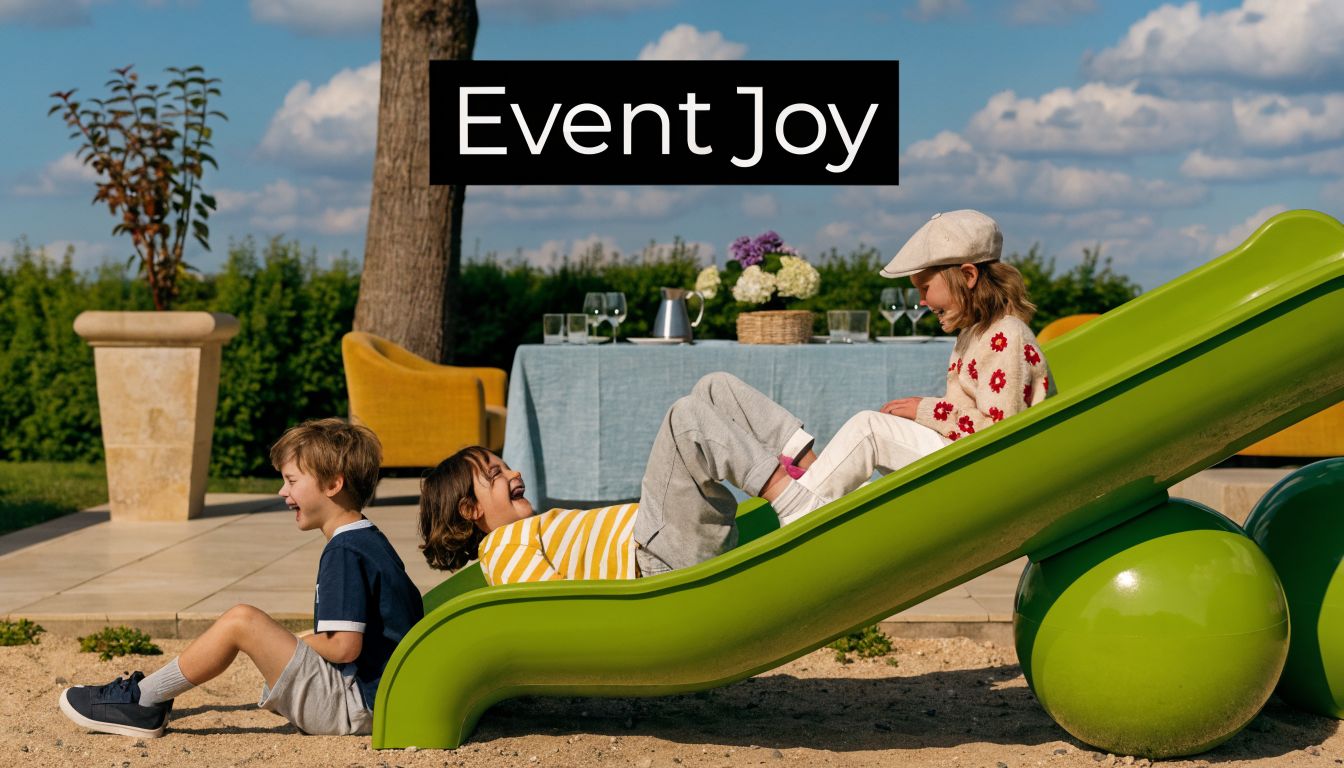
Why it suits adult-focused events
A wedding reception in Franschhoek isn’t a kiddies party, and it shouldn’t feel like one. The answer isn’t loud, oversized equipment that fights the styling. The answer is a compact, clean-lined slide placed in a supervised corner with soft flooring, shade, and a few age-appropriate add-ons.
That setup works because it respects the event. The children get movement and play. The adults keep the tone of the day.
A good children’s area should lower stress for parents, not add visual clutter for the planner.
For hosts who want to build out that zone properly, ideas from kiddies party decor inspiration can help with colour matching, layout, and how to make the play corner feel intentional rather than improvised.
More than just “something to do”
Slides also fit into a broader movement play setup. If you’re planning for younger guests who need active play rather than screen time, this list of 10 gross motor activities for kids is useful for thinking beyond one item and creating a simple, balanced children’s zone around it.
The strongest event setups usually keep the play offering focused. One slide, one soft activity, one shaded rest point. That’s often more effective than filling the area with too many disconnected items.
Choosing the Right Slide for Your Event and Guests
The right slide depends on who’s attending, where it’s going, and what kind of event you’re running. Get one of those wrong and the slide either won’t be used properly or won’t sit comfortably in the space.
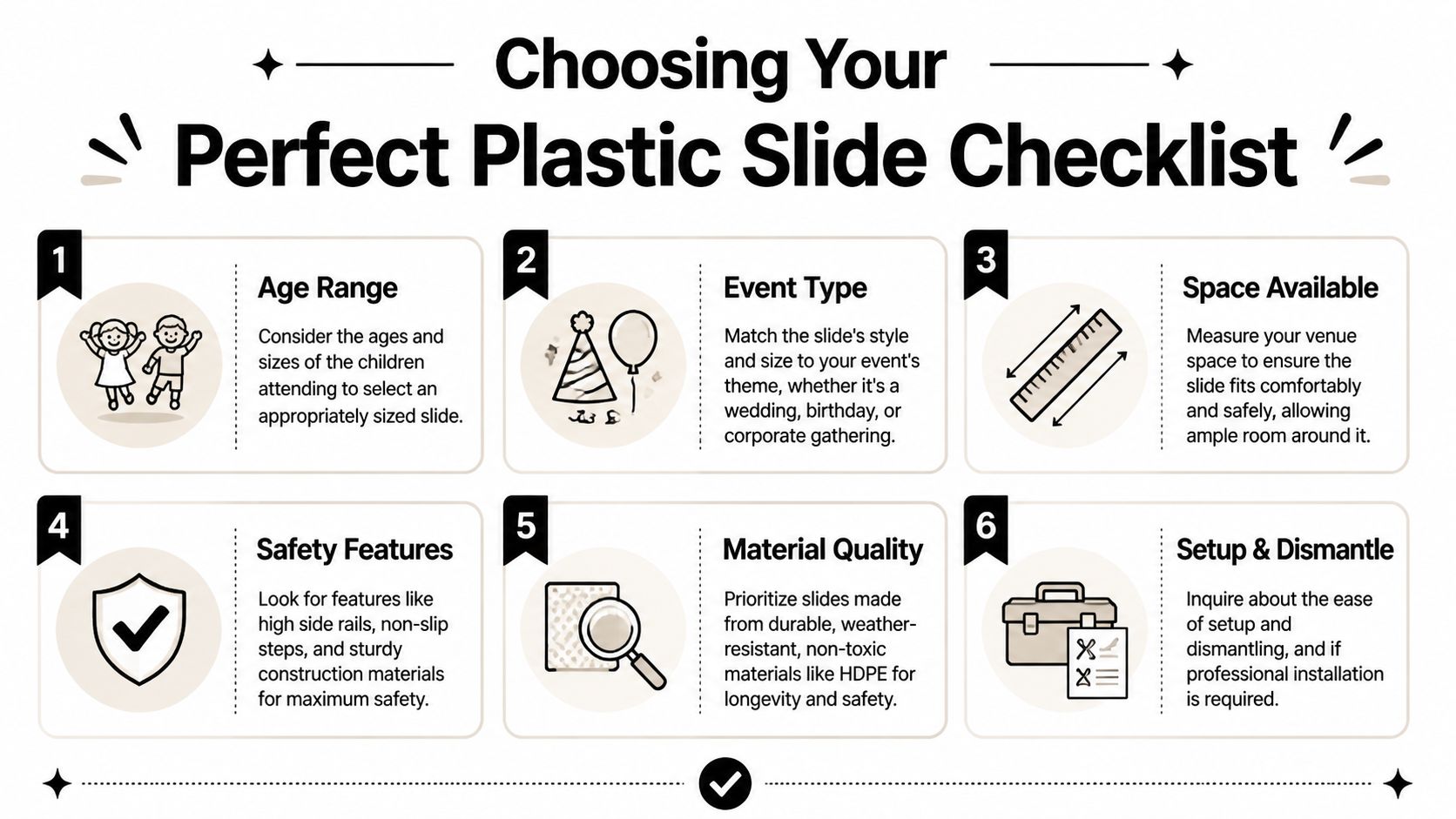
Match the slide to the age group
Age comes first. Not theme, not colour, not what looked nice in a photo.
For younger children, gentler slides are the safer choice. For optimal safety, platforms should be no higher than 81cm for toddlers and preschoolers, while school-aged children’s platforms should generally not exceed 1.8 metres, and toddler slides should have a recommended incline of 24 degrees or less according to playground slide guidance.
That matters in real event planning because mixed-age groups can tempt organisers to choose one “middle ground” option. In practice, that often disappoints older children and overwhelms younger ones. If most guests are under school age, choose for them. Don’t scale up just because a few older cousins may attend.
A quick rule of thumb:
- Mostly toddlers and preschoolers. Choose a low platform, easy steps, and a short run-out at the bottom.
- Mostly primary school children. You can consider a larger unit, but keep supervision and landing space in mind.
- Broad age mix. Separate activity zones usually work better than expecting one slide to suit everyone.
Measure the venue properly
Planners often measure only the equipment footprint. That’s not enough.
You need room for the climb side, the slide exit, adult supervision, and a buffer so children aren’t stepping straight into service routes or guest seating. At outdoor venues in the Winelands, lawns can look generous until florists, mobile bars, and lounge clusters go in. In city venues, paved courtyards can become tight very quickly.
Practical rule: If the children can exit the slide straight into a waiter’s path, the slide is in the wrong place.
Check these before confirming any hire:
- Surface condition. Level ground matters more than appearances. Grass can hide dips. Paving can become slippery.
- Shade position. Morning shade and afternoon shade aren’t the same thing at an all-day event.
- Access route. A slide that fits the lawn but can’t move through a narrow gate creates avoidable delays.
If you’re comparing broader active play options as well, this Ocodile climbing sets guide is a helpful reference for how children’s equipment choices change depending on age, footprint, and supervision needs.
Choose for the event style
A formal wedding needs a different slide setup from a casual birthday.
At a black-tie reception, the best option is usually a neat, compact slide in a discreet family area with soft neutral styling around it. At a corporate family day, visibility often matters more. Parents want to spot their children from seating or networking areas without walking across the venue.
If your event leans more playful overall, combining a slide with larger activity rentals can make sense. For example, planners looking at broader children’s entertainment formats often compare slides with options discussed in bouncy castle hire in Cape Town. The key difference is footprint, visual impact, and how easily each option fits a refined event setting.
Understanding Plastic Slide Materials and Safety Features
The material matters more than most clients expect. A childrens plastic slide can look similar in photos across suppliers, but the actual performance on event day depends heavily on what it’s made from and how it’s built.
Why HDPE is the standard
High-density polyethylene, or HDPE, is the industry standard for commercial slides because it is weatherproof, UV-stabilized, and maintains a significantly lower surface temperature than metal, a critical safety feature for events in sunny climates like Cape Town and the Winelands, as explained in this slide material guide.
That lower heat retention is not a minor detail in the Western Cape. A slide may be perfectly fine at setup time and far less comfortable later in the afternoon if it sits in direct sun. Metal is the obvious risk, but not all plastics perform equally well either. Better-quality HDPE is more dependable outdoors, especially for summer functions.

What to look for beyond the material
Good material doesn’t fix poor design. The slide still needs sensible safety features and a layout that works for event use.
Look for these details:
- High side walls. These help keep children centred during descent, especially when they twist or lean.
- Rounded edges and smooth joins. Event equipment gets repeated use, so sharp mould lines or rough seams are a red flag.
- Stable hand support. Children need secure grip points on the way up, not just a slippery ladder.
- A clear exit area. The base should allow children to finish the slide and move away cleanly.
One of the strongest indicators of quality is how the slide behaves after repeated transport and setup. Cheap units often loosen, flex too much, or develop stress points around the climb section. That’s where commercial-grade equipment earns its keep.
Heat, hygiene, and repeated use
For high-end events, I’d treat a slide the same way I’d treat lounge furniture or catering equipment. It must still look clean and presentable after transport, setup, and a full service period.
HDPE helps here because it’s easier to clean and more resilient outdoors than many alternatives. That matters when an event starts with a polished morning setup and ends after hours of dust, grass, juice spills, and sunscreen-covered hands.
A simple children’s area also pairs well with softer accessories. If you’re building a toddler-friendly zone around a slide, products similar to the Playz ball pit collection show the kind of soft-play add-ons parents often expect in younger age-group setups.
If the surface gets hot, the steps feel flimsy, or the landing area crowds too easily, the slide isn’t event-ready no matter how attractive it looked online.
Renting vs Buying a Slide for Event Use
Many consumers compare hire and purchase too narrowly. They think about the visible item only. They don’t think about storage, transport, cleaning, inspection, event-by-event suitability, and what happens when the unit no longer matches the venue or guest age mix.
That’s why the total cost question matters. As noted in this overview of playground slide considerations, many discussions overlook total cost of ownership, even though rental flexibility is especially important in seasonal event markets like the Winelands.
The real difference in practice
Buying can make sense if you operate a permanent children’s facility or host frequent events in the same controlled venue. In that scenario, one consistent setup may justify ownership.
For most event planners, venues, schools, and private hosts, hiring is usually the cleaner option. Event needs change too much. A compact slide may be ideal for a wedding welcome area, but too small for a school function. A larger unit might suit a family day, but look out of place at a formal lunch.
That flexibility is the core advantage. You choose for the event in front of you, not for every possible future event.
Rent vs Buy comparison for event planners
| Consideration | Renting from ABC Hire | Buying Your Own |
|---|---|---|
| Upfront commitment | Lower commitment for one-off or occasional events | Higher commitment because the asset stays with you |
| Storage | No long-term storage burden after the event | You need secure, clean storage between uses |
| Transport logistics | Delivery and collection can be coordinated as part of the event plan | You must arrange suitable transport each time |
| Maintenance | Ongoing upkeep is handled as part of the rental model | Cleaning, checks, repairs, and replacement become your responsibility |
| Event fit | You can choose a unit that suits each venue and guest mix | You work around the one model you own |
| Aesthetic flexibility | Easier to match different event styles over time | One purchase may not suit every event tone |
| Risk management | Professionally managed inventory reduces admin for the organiser | The owner carries the burden of condition monitoring |
| Seasonal demand | Practical when your need is occasional or uneven through the year | Harder to justify if the unit sits unused for long periods |
What buying tends to hide
Ownership sounds simple until the slide has to live somewhere. It needs to stay clean, dry, and protected between bookings. Someone must check fittings, watch for wear, and make sure it still presents well enough for a client-facing event.
Then there’s transport. A slide isn’t useful if it can’t move efficiently from storage to venue, through access points, and back again without damage.
Hiring makes the most sense when the slide is part of an event operation, not a permanent play installation.
When hiring is the stronger choice
Hiring is usually the better fit when:
- The event profile changes. Weddings, school functions, and brand activations don’t need the same equipment.
- You value a polished look. Rental stock is chosen for presentation as well as function.
- You don’t want operational drag. Your team already has enough to manage on event day.
- You need adaptability. Different lawns, courtyards, and indoor-outdoor spaces call for different choices.
Buying can still work for repeat-use environments. But for event-specific use, especially in premium venues where layout and presentation matter, hiring is often the more efficient and less troublesome route.
Easy Setup and Maintenance for Your Hired Slide
A childrens plastic slide only performs well if it’s placed correctly. The safest unit can still become awkward if the ground is uneven, the run-out is blocked, or the play area is mixed into guest traffic.
Start with the ground, not the slide
Check the installation surface before anything else. At Winelands venues, grass is common and usually forgiving, but it can slope more than it appears. In urban courtyards, paving may look neat while creating a harder, less forgiving landing environment.
The landing area matters most. While specific South African injury statistics are not readily available, global recall data shows how serious falls can be, and CPSC recall information underlines the importance of proper impact-absorbing surfacing extending out from the base.
That should shape placement decisions immediately. Don’t install a slide where children finish onto bare paving, gravel, or a decorative edge.
Event-day setup checklist
Use a short, disciplined check rather than relying on visual judgement alone.
- Confirm the surface is level. Small tilts change how stable the slide feels to a child.
- Keep the base clear. No décor stands, no side tables, no gift boxes near the exit path.
- Create a soft landing zone. Use suitable impact-absorbing surfacing where needed.
- Protect the queue area. Children need enough room to wait without bunching onto the steps.
- Check sun exposure during event hours. Conditions at setup may change by mid-afternoon.
The best place for a slide is rarely the most photogenic corner. It’s the place with the safest approach, clearest supervision line, and best landing conditions.
Keep it usable through the day
Maintenance on event day doesn’t need to be complicated, but it does need to be consistent. Wipe away sticky spills, grass clippings, and dirt before they build up. If the event runs for many hours, assign someone to recheck the area periodically, especially after meal service when children often return to play all at once.
Three simple habits help:
- Recheck after setup traffic. Other suppliers sometimes shift nearby items without realising they’re narrowing the play zone.
- Keep shoes, bags, and cups out of the exit area. That’s where clutter appears first.
- Pause use briefly if the surface becomes unsafe. A short reset is better than pushing through with a compromised setup.
A tidy slide reads as safer to parents as well. That perception matters at premium events, where guests notice whether children’s entertainment has been managed with the same care as the rest of the function.
Local Compliance and Partnering with ABC Hire
In the Cape Town and Winelands event market, “safe enough” isn’t a professional standard. If children are using equipment at a wedding, corporate function, school event, or private celebration, the organiser should think in terms of commercial suitability, sensible placement, inspection, and accepted playground safety principles.
Why local compliance needs attention
South Africa doesn’t offer a handy set of local event-specific slide statistics for planners to work from, and that gap often leads people to underestimate the issue. In practice, the lack of local numbers doesn’t lower the duty of care. It raises the need for caution.
For public-facing or larger guest events, planners should favour equipment and setup methods aligned with recognised playground safety thinking, including principles associated with SANS 1176 for playground equipment. That doesn’t mean every wedding needs to feel like a municipal audit. It means the basics must be right. Stable equipment, sensible age fit, proper surfacing, and clear supervision all matter.
Where professional rental support matters
A specialist rental partner removes a lot of avoidable risk because they already think about the questions many clients miss:
- Is the unit suitable for repeated event use?
- Has it been checked between hires?
- Will it fit through the access route at this venue?
- Does the setup area allow for safe use and easy supervision?
- Is the look of the item appropriate for the event standard?
That’s the difference between acquiring a slide and integrating one properly into an event plan.
When children’s equipment arrives as part of a managed rental operation, the organiser doesn’t have to solve every technical detail alone.
For planners coordinating broader logistics, event management insights for Cape Town are helpful because children’s entertainment should sit inside the wider operational picture, not outside it.
The practical takeaway for Western Cape events
For weddings in Stellenbosch, family days in Cape Town, school functions in Paarl, or private celebrations in Franschhoek, a childrens plastic slide can work exceptionally well. But it only works when the equipment suits the guest age, the venue layout supports safe use, and the supplier understands event realities rather than just product delivery.
That combination is what gives hosts peace of mind. Children stay engaged. Parents can breathe. The event keeps its polished feel.
If you’re planning an event and need reliable, well-presented children’s entertainment that fits a premium setting, ABC Hire can help you choose the right setup for your venue, guest mix, and event style across Cape Town and the Winelands.