Quality hire of Event Furniture and Event Accessories in Cape Town. Rent Led Furniture, Umbrella's, Stanchions, Airconditioners, Table, Chairs, Heaters, Red Carpets, fairy lights.
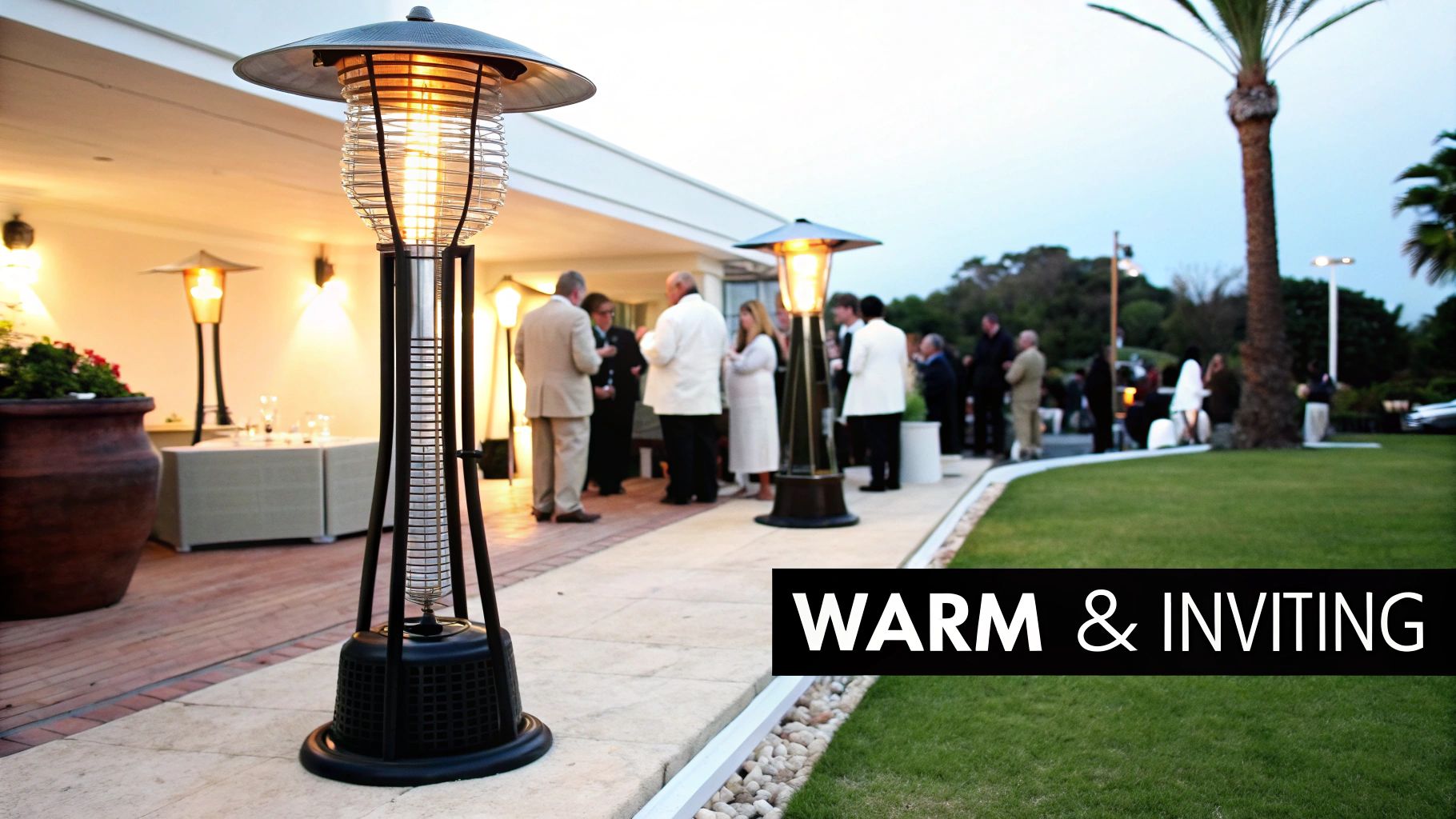
When you're looking for outside heaters for sale, what you're really searching for is peace of mind. It’s about creating that warm, inviting atmosphere that keeps guests happy and ensures your event is a success, no matter what Cape Town’s famously unpredictable weather decides to do.
Keeping Your Cape Town Event Warm
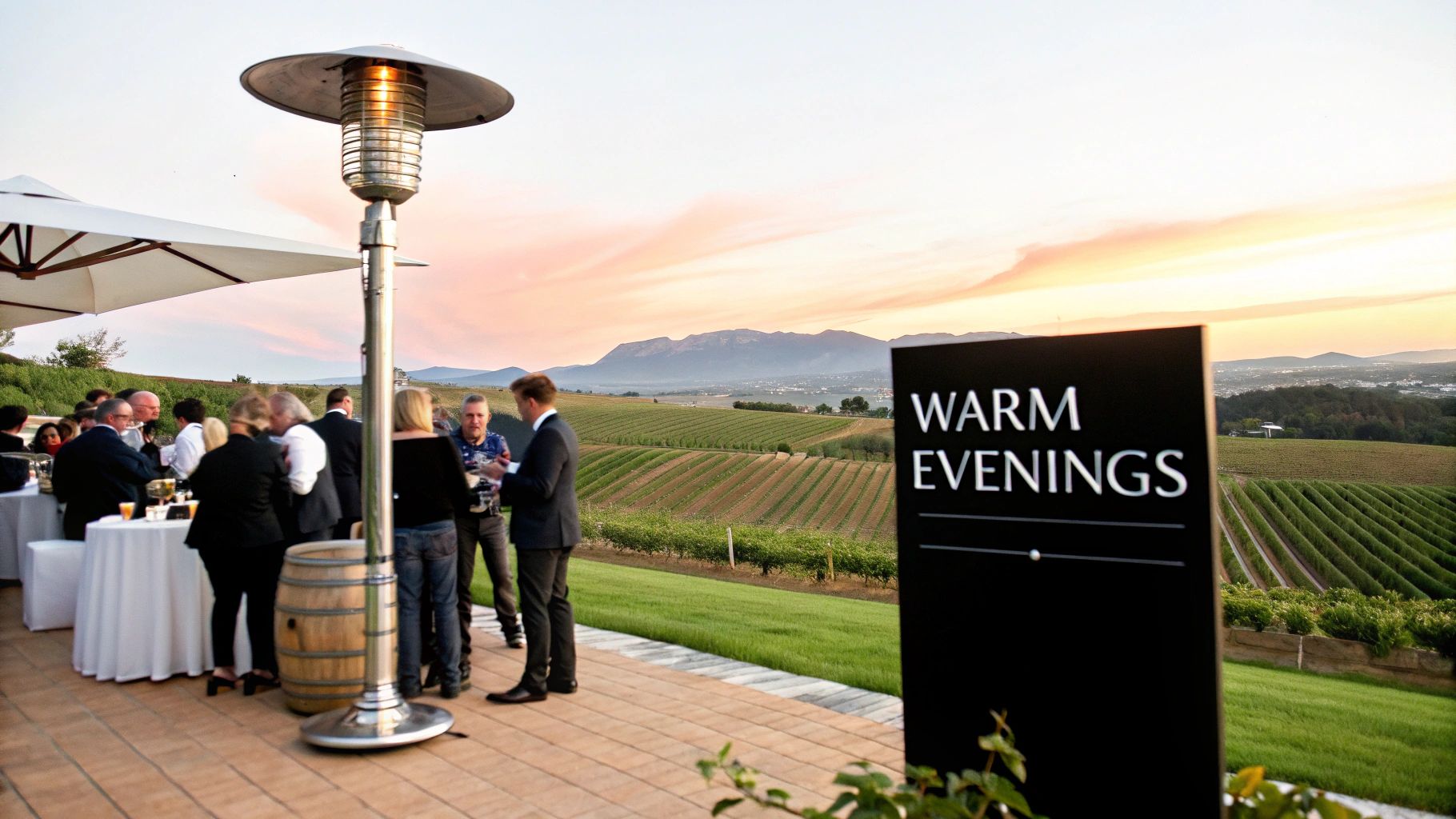
Picture a beautiful, chilly evening at a Winelands wedding. The difference between guests huddled in a corner and guests mingling happily often comes down to one thing: effective heating. Choosing the right outdoor heaters isn't just about comfort; it's about creating ambience and making sure the event flows perfectly.
This isn't just a hunch; the demand is growing. South Africa's market for commercial outdoor heaters is set to grow by a strong 5.89% each year. This reflects what we see on the ground—a rising need from event planners in places like Stellenbosch and Franschhoek who need reliable climate control. You can dive deeper into these trends with this commercial outdoor heaters market report.
This guide will walk you through everything you need to know. We’ll cover the different types of heaters, safety essentials, and the practical pros and cons of buying versus hiring from a trusted partner like ABC Hire. Think of this as your complete roadmap to getting event heating right, every single time.
Choosing the Right Heater for Your Venue
Picking the right heater can feel a bit technical, but it’s actually quite straightforward when you think about what you need for your venue. It’s all about matching the heater to your space.
A gas mushroom heater, for example, is like a modern campfire. It creates a fantastic, warm focal point and kicks out a lot of heat, but just like a fire, it needs plenty of open space and good ventilation. They’re a classic for a reason.
Then you have electric heaters. Think of these as a spotlight of warmth. They are quick, directional, and perfect for targeting a specific seating area, though you’ll always need to be near a power source.
Infrared heaters are a clever option. They work a bit like the sun, warming people and objects directly instead of just the air around them. This makes them surprisingly effective, even when there's a classic Cape Town breeze.
Beyond traditional outside heaters for sale, a fire pit can also create an amazing atmosphere. If you're looking for a permanent feature, learning how to choose a great fire pit for your patio can add another layer of warmth and style to your venue. Next, we’ll look at the best options for your Cape Town event needs.
Calculating Your Event's Heating Needs
Working out how many heaters you need for your event doesn't have to be complicated. The key is to look at the heater's BTU (British Thermal Unit) or kilowatt (kW) rating. Think of this number as its heating power – the higher it is, the more warmth it provides.
Of course, the needs of a breezy, open-air cocktail party on a farm in Stellenbosch are very different from a cosy, enclosed marquee in Constantia. A good starting point is knowing the basics of calculating heating needs using BTUs to make sure every corner of your venue is comfortable for your guests.
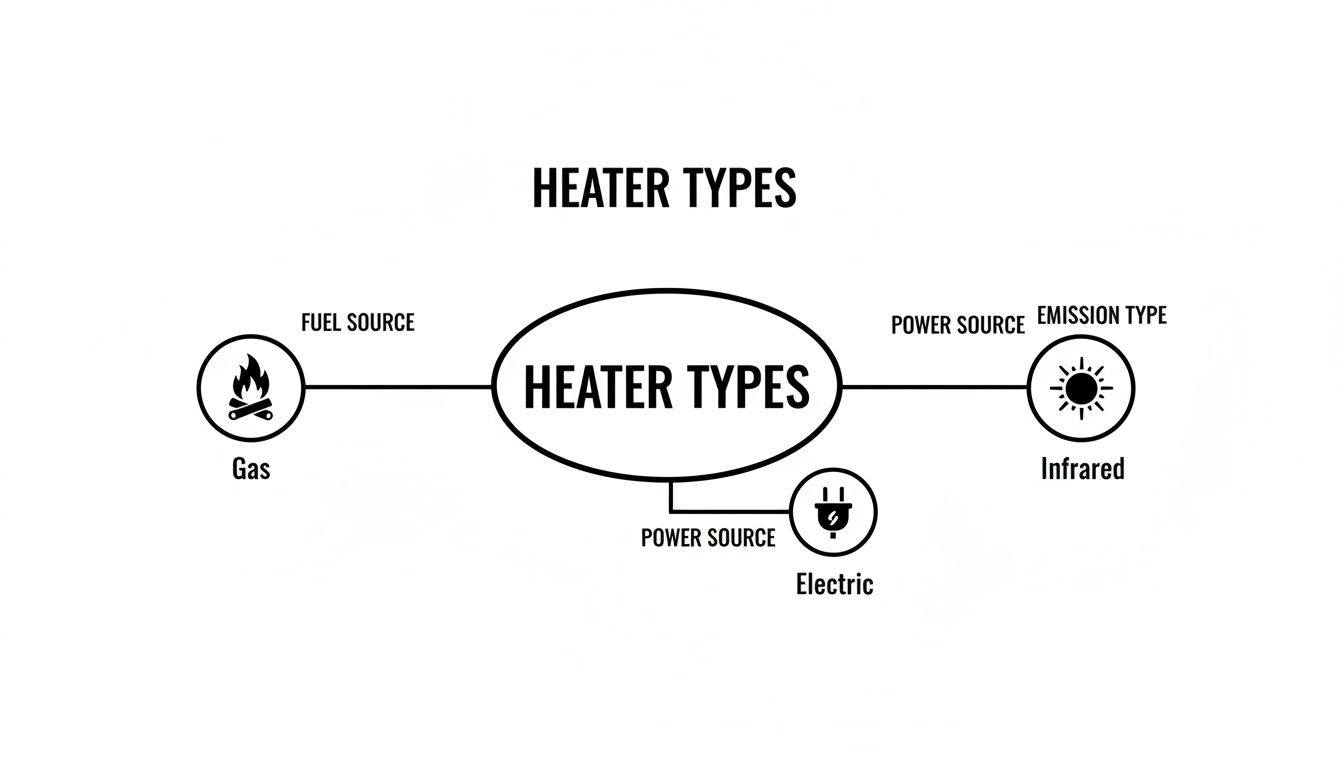
As you can see below, the main types of outdoor heaters are defined by their fuel, power source, and how they project heat.
Your final decision will come down to a mix of these factors, plus practical things like the height of your tent and how exposed your venue is to that famous Cape Town wind.
Heater Coverage Guide For Cape Town Events
To give you a practical starting point, we've put together this quick guide. It helps you estimate the number and type of heaters you might need for common event setups around the Cape.
Event Area Type
Typical Size (m²)
Recommended Heater Type
Estimated Number of Heaters
Small Covered Patio / Balcony
20 – 40 m²
Electric Infrared or Gas Patio
1 – 2
Medium Marquee (Seated Dinner)
100 – 150 m²
Gas Patio or Electric Infrared
4 – 6
Large Open-Air Cocktail Area
200+ m²
Gas Patio Heaters
8 – 10+
Intimate Garden Ceremony
50 m²
Electric Infrared Heaters
2 – 3
Remember, this table is just an estimate. Always consider factors like wind, ambient temperature, and your specific layout when making your final decision. When in doubt, it's always better to have a little extra warmth on hand.
Safe Heater Placement and Weather Proofing
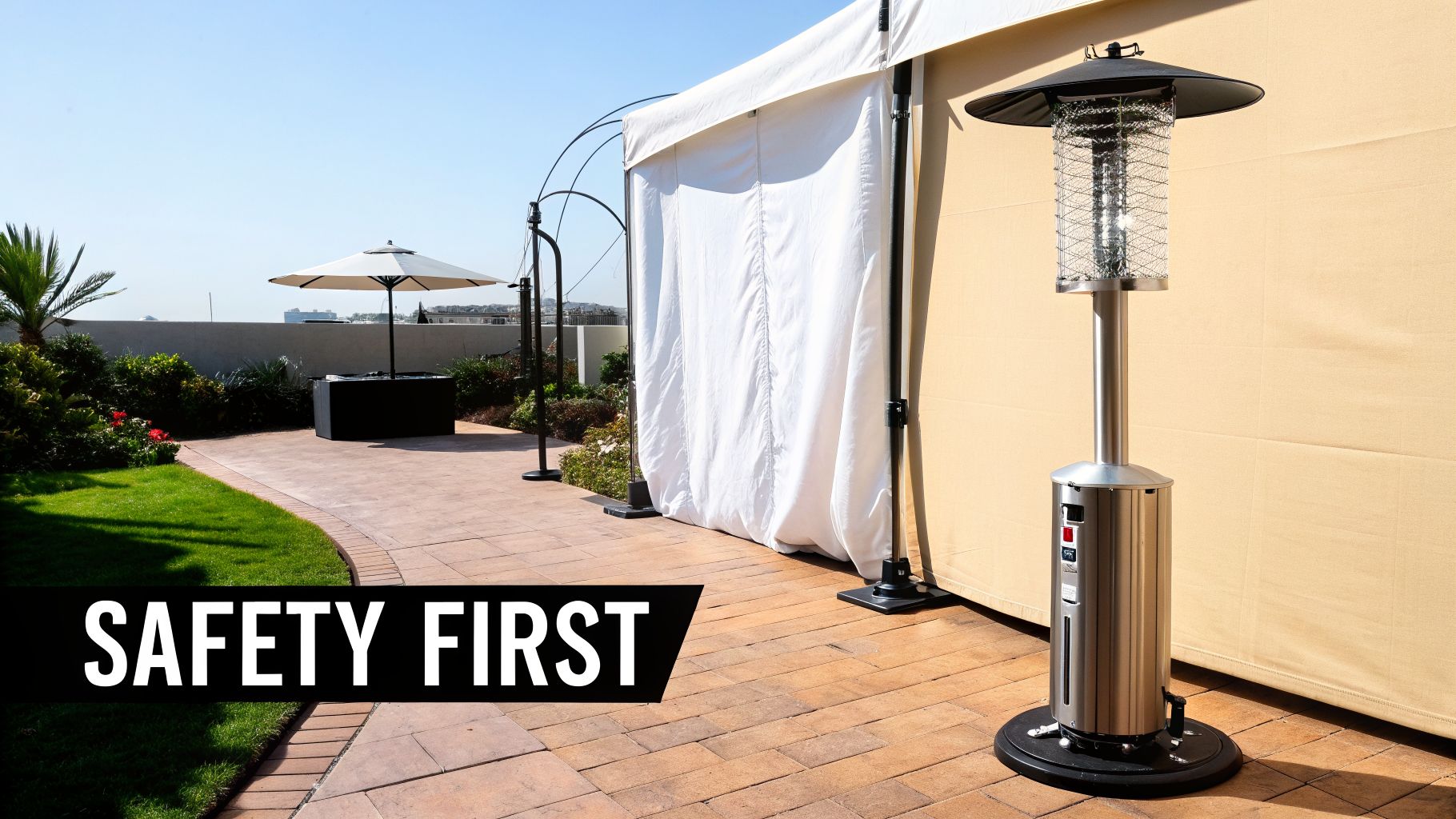
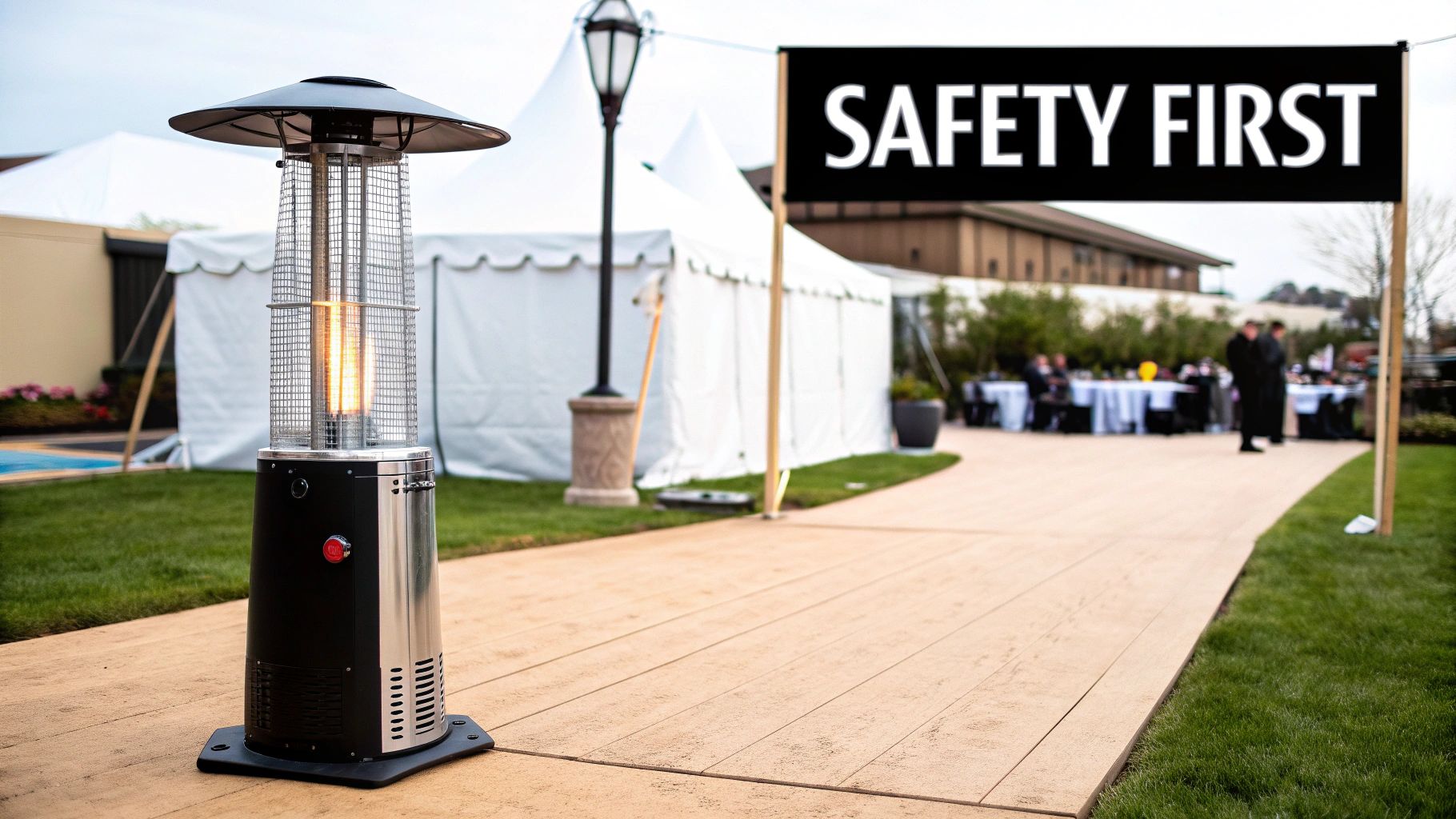
When you're setting up any outside heaters for sale or hire, safety has to be your number one concern. Think of every heater as having its own "safety bubble"—a non-negotiable clearance distance that must be kept from anything flammable. This includes marquee walls, delicate table linens, and all your beautiful décor.
Of course, here in Cape Town, we also have to plan for the "Cape Doctor." When the wind picks up, infrared heaters are often the better choice. They heat people and objects directly instead of trying to warm up the air that’s just blowing away. If you're using classic mushroom-style gas heaters, make sure they are properly anchored so they can’t be tipped over by a sudden gust.
For a detailed look at the safe operation and setup of gas heaters, explore our complete guide to gas outdoor heaters. Always check with your venue and rental partner about any specific local regulations.
Buying vs. Hiring: The Smart Financial Choice
It's a question we hear all the time from event planners: should I invest in buying my own heaters, or is it better to hire? On the surface, searching for outside heaters for sale and owning your equipment seems like a good long-term plan.
But let's be honest, the initial price tag is just the tip of the iceberg. Owning heaters means dealing with the total cost of ownership. You've got to think about secure storage (they take up a lot of space!), maintenance and repairs, transport to and from every single event, and the ever-present cost of refilling gas bottles. It adds up quickly.
Hiring, on the other hand, flips this on its head. You trade a large, unpredictable capital expense for a simple, fixed operational cost. For one clear fee, you get the heaters delivered, professionally set up exactly where you need them, and collected after your event. All the logistical headaches simply disappear. We cover the practical side of these popular units in our guide to choosing a gas patio heater.
For most event-based needs, hiring isn't just easier—it's the smarter and more cost-effective choice.
Cost Comparison: Buying vs. Hiring 10 Patio Heaters For A Year
To put this into perspective, let's break down the estimated costs for using 10 heaters for an average of 5 events over a single year. The numbers often speak for themselves.
Cost Factor
Buying Heaters (Estimated Cost)
Hiring from ABC Hire (Estimated Cost)
Initial Purchase
R30,000 (R3,000 per unit)
R0
Storage (Annual)
R3,600 (R300/month)
R0
Gas Refills (5 Events)
R11,000 (R220 per refill x 10 units x 5 events)
Included in Hire Fee
Maintenance/Repairs
R2,500 (Estimated)
R0
Transport (5 Events)
R5,000 (R1,000 per event)
Included in Hire Fee
Hire Fee (5 Events)
N/A
R15,000 (R300 per unit x 10 units x 5 events)
Total Annual Cost
R52,100
R15,000
As the table shows, the total cost of ownership in just the first year can be more than 3 times the cost of hiring. By partnering with ABC Hire, you save significant capital, eliminate logistical stress, and get access to professionally maintained equipment every single time.
Your Pre-Event Heating Checklist
Let's run through a quick checklist. Getting the heating right means one less thing to worry about on the day, so your guests can simply enjoy the atmosphere you’ve created.
There’s no substitute for a proper site visit with your hire company. This is where you’ll pinpoint the perfect spots for heaters, confirm exactly how many you need, and check where your power points are for any electric units. Getting the power sorted is a big one – you can find out more about the right power supply for your event equipment here.
A simple placement map, drawn up with your hire partner, takes all the guesswork out of the setup on the day. We also make sure to test every heater before the event starts. When you hire from a team like ABC Hire, we handle these details for you, making the whole process straightforward.
Still Have Questions? Let’s Get Them Answered
We get it. Planning an event in Cape Town means being ready for anything, especially our unpredictable weather. You've got the big picture sorted, but those small details about keeping guests warm can be tricky.
Over the years, we’ve heard just about every question there is when it comes to hiring outdoor heaters. So, we’ve put together the most common ones right here to give you clear, straightforward answers and help you make the final call with confidence.
Picture this: a perfect Cape Town evening. Maybe it’s a chic wedding in the Winelands or a corporate do with twinkling city views. The sun dips, a cool breeze rolls in, and suddenly your perfect atmosphere isn't so perfect anymore. This is where a gas patio heater becomes the unsung hero of your event, keeping guests comfortable and the good times rolling. In the Western Cape's beautifully unpredictable climate, reliable outdoor heating isn't a luxury—it's a must-have.
Creating an Unforgettable Vibe
Honestly, the difference between a good event and a truly great one often comes down to how your guests feel. When people are warm and comfortable, they stick around longer, chat more, and walk away with fantastic memories. This is especially true for any outdoor gathering in Cape Town or the Winelands, where a stunning day can easily turn into a chilly night without warning.
Why Atmosphere Is Everything
A gas patio heater does more than just pump out heat. It creates a natural, inviting hub where people can gather. Think of it as a clean, modern campfire—all the cosy glow and warmth, none of the smoke or mess. It’s that little touch of sophistication that elevates the entire experience, turning a simple space into a warm, welcoming lounge.
Getting event planning right means thinking about what your guests need before they even have to ask. For a complete rundown on covering all your bases, a good practical guide to event planning can be a lifesaver, ensuring every detail, including guest comfort, is spot on.
When you plan for warmth, you're doing more than just ticking a box. You're thoughtfully designing an environment that feels welcoming and luxurious, showing your guests that their comfort is your top priority.
This guide is your A-to-Z resource for hiring gas patio heaters for your next event. We’ll walk you through everything you need to know to make the right choice, ensuring your celebration is remembered for all the right reasons. From picking the right style and number of heaters to getting your head around safety and logistics, you'll have all the confidence you need to create a perfectly warm, utterly memorable occasion.
Why Gas Patio Heaters Are the Top Choice for Events
When you're planning an outdoor event, the atmosphere is everything. You need solutions that are powerful, elegant, and above all, flexible. This is where a good gas patio heater comes in—it ticks all those boxes, offering a blend of performance and style that other heating methods just can't touch.
Think of it as your own portable, controllable bonfire. You get all the inviting warmth and that mesmerising glow that naturally draws people together, but without any of the smoke, ash, or logistical nightmares that come with a real fire. This self-contained convenience is exactly why they’re the go-to for professional event planners.
Power and Portability Combined
The real magic of a gas patio heater lies in its freedom. Unlike electric heaters, they aren't tied down by clumsy extension cords that create tripping hazards and limit your layout options. They can be placed exactly where you need that pocket of warmth, whether it’s on a sprawling lawn in the Winelands or a chic city rooftop terrace.
This incredible portability means you can design your event layout without compromise. You can create intimate, warm conversation zones or spread the heat evenly across a large cocktail reception. With a powerful output, typically around 38,000 BTUs, a single unit can comfortably warm a radius of several metres, making them seriously efficient.
The core benefit of a propane gas patio heater is its ability to deliver serious warmth to any location, regardless of the venue's infrastructure. This flexibility is priceless for event planners who work across diverse and sometimes remote locations.
Their dominance in the local market isn't a fluke. Gas patio heaters are a huge part of South Africa's outdoor heating scene, capturing over 44% market share in 2023 across the Middle East & Africa region. In event-heavy areas like Cape Town and the Winelands, portable propane models are the overwhelming favourite, making up an estimated 70% of all rentals.
A Clear Winner Over the Alternatives
When you start weighing up the options, the practical benefits of renting a gas patio heater for your event become even clearer. Let’s take a quick look at how they stack up against the usual suspects.
Comparing Heating Options for Your Cape Town Event
Here’s a quick look at the pros and cons of common outdoor heating methods to help you decide what’s best for your event.
Heating Type
Best For
Heat Radius
Portability
Aesthetic Impact
Gas Patio Heaters
Versatile events needing flexible placement and ambient warmth.
Wide (3-5 metres)
High (fully portable)
Professional & sleek
Electric Heaters
Covered patios or marquees with easy access to power outlets.
Focused (2-3 metres)
Low (tethered)
Can be discreet
Wood Fire Pits
Rustic, casual gatherings where smoke isn't a concern.
Variable
Low (heavy, fixed)
High (rustic charm)
Infrared Heaters
Targeted, directional heat for specific zones like seating areas.
Focused (direct line)
Low (often electric)
Minimal, industrial
As you can see, each option has its place, but for the sheer flexibility and reliability needed for most events, gas heaters consistently come out on top.
The Smart Choice for Cape Town Events
Ultimately, the goal is to keep your guests comfortable without sacrificing style or safety. A gas patio heater shines in all these areas, delivering reliable, powerful heat with a polished, professional look. This makes them an indispensable tool for any successful outdoor gathering.
For a deeper dive into different models, you can check out our guide on finding the perfect gas outdoor heater for your specific needs. The combination of easy setup, powerful heat distribution, and complete portability makes them the most logical and effective choice for keeping your guests happy from sunset until the last dance.
How to Choose the Right Gas Patio Heater
Picking the right gas patio heater for your event is about more than just chasing away the chill. It's a design choice. You're trying to match the heater's style and function to the specific vibe and layout you’ve planned. Get this right, and your guests won't just be comfortable—they'll be impressed by the cohesive atmosphere you've created.
When it comes to rentals, your choice usually boils down to two fantastic, but very different, options. Each one serves a unique purpose, blending performance with a certain visual flair. Knowing how they differ is the first step to making a smart decision that really works for your event.
Mushroom Heaters: The Classic Choice for Wide Coverage
The mushroom heater is what most people picture when they think of a patio heater. That distinctive, umbrella-like reflector at the top isn't just for looks; it’s cleverly designed to push heat downwards and outwards, creating a wide, circular pocket of warmth. Think of it less as a direct blast of heat and more like a gentle, warm shower covering a broad area.
This design makes it incredibly practical and efficient for any event where guests are mingling.
Wide Heat Distribution: A single mushroom heater can comfortably warm an area of up to 20 square metres.
Ideal for Open Spaces: They're perfect for cocktail hours, networking events, or any setup where people are standing and moving around.
Subtle Presence: Their classic look tends to blend into the background, providing functional warmth without stealing the show.
Because they spread heat so well over a large radius, mushroom heaters are the real workhorses of the event rental world. They deliver reliable, widespread comfort, making them a safe and popular bet for almost any outdoor gathering.
Pyramid Heaters: A Statement in Style and Ambiance
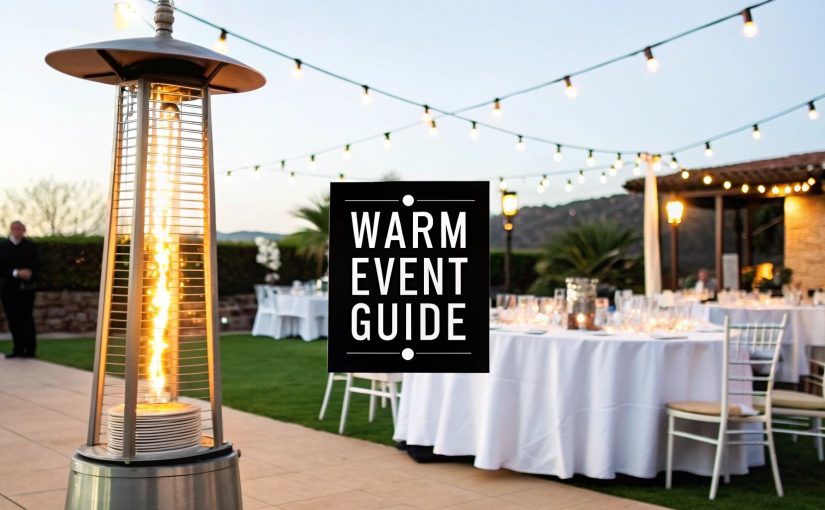
Where the mushroom heater is all about function, the pyramid heater is pure theatre. Often called a flame tower, this striking, modern heater features a tall, tempered glass tube that encases a mesmerising, dancing flame. It's as much a piece of decor as it is a source of heat.
The pyramid heater is all about creating an atmosphere. The warmth it gives off is more radiant and localised, warming those who gather near it. It’s less about heating a wide zone and more about creating an inviting, warm focal point. These are perfect for adding a bit of drama to an entrance, a VIP lounge, or any modern, chic event. While they do provide heat, their main job is to look incredible.
You can see how different heating elements create a specific mood by exploring the design of fire pits for patios, which share that same focus on visual appeal.
A pyramid heater turns warmth into a feature. It draws people in with its dynamic flame, making it a natural gathering spot and a fantastic conversation starter at any sophisticated event.
Calculating How Many Heaters You Need
Booking the right number of heaters is critical. Too few, and your guests will be shivering. Too many, and your space feels cluttered and stuffy. Luckily, a simple formula can give you a pretty accurate estimate.
As a general rule of thumb, one standard mushroom-style gas heater effectively warms about 15-20 square metres of event space.
Here’s a simple, two-step process to figure it out:
Determine Your Active Event Area: First, work out the square meterage of the specific outdoor area you need to keep warm. Don’t bother including the dance floor or service areas where constant heating isn't a priority.
Divide by the Heater's Coverage: Take your total square meterage and divide it by 20 (the average coverage per heater). This gives you the number of mushroom heaters you’ll likely need. Always round up to the next whole number to be safe.
Let’s run through a quick example. Say you're hosting a cocktail party for 150 guests on a 250 square metre terrace.
Calculation: 250 sqm / 20 sqm per heater = 12.5
Recommendation: You’ll want to rent 13 mushroom heaters to ensure the entire terrace feels cosy and comfortable for everyone.
This simple bit of maths helps you book with confidence, ensuring every corner of your event is wrapped in a welcoming layer of warmth.
Mastering Heater Placement and Safety Protocols
Choosing the right number of heaters is one thing, but placing them for maximum warmth and total safety is a completely different ball game. A well-placed gas patio heater creates a genuinely cosy, inviting zone. Get it wrong, and it can be ineffective or, even worse, a serious hazard. Getting the placement right is how you unlock the real value of your rental heaters.
Think of it like setting up lights for a photograph. You need to position each source strategically to get rid of any cold spots and create a balanced, comfortable environment. The goal is to create overlapping circles of warmth, so your guests can wander around freely without walking into a sudden chill.
The Golden Rules of Heater Placement
Let's be clear: safety is absolutely non-negotiable. While any professional hire company ensures their gear is in top shape, it's your responsibility to place it correctly on-site. Always start with these fundamentals to protect your guests, your décor, and the venue itself.
A gas patio heater needs room to breathe, which means keeping a safe distance from anything that could catch fire.
Vertical Clearance: Make sure there's at least 1 metre of open space above the heater's reflector. You should never, ever place one directly under a low marquee ceiling, hanging tree branches, or any decorative draping.
Horizontal Clearance: Keep the heater at least 1 metre away from marquee walls, curtains, plants, and any other flammable materials on all sides.
Stable Footing: The heater must stand on a firm, completely level surface. Compacted, even grass can work in a pinch, but a paved or decked area is always the safer bet. Never place a heater on a slope or uneven ground.
For a deeper dive into the specifics of different models and their safety features, our article on various types of gas porch heaters has some extra insights.
Designing Your Warmth Zones
The perfect layout depends entirely on the flow of your event. A sit-down dinner has very different heating needs compared to a standing cocktail party.
For a seated dinner, try placing heaters between the tables to create pockets of shared warmth. Just avoid putting a heater too close to any single table—it can make those guests uncomfortably hot while leaving others out in the cold. You're aiming for lovely ambient heat, not a direct blast.
For a standing reception or networking event, it’s better to create deliberate "warming stations." Cluster a few heaters in key social areas, like near the bar or around lounge spots, to encourage guests to gather and mingle comfortably.
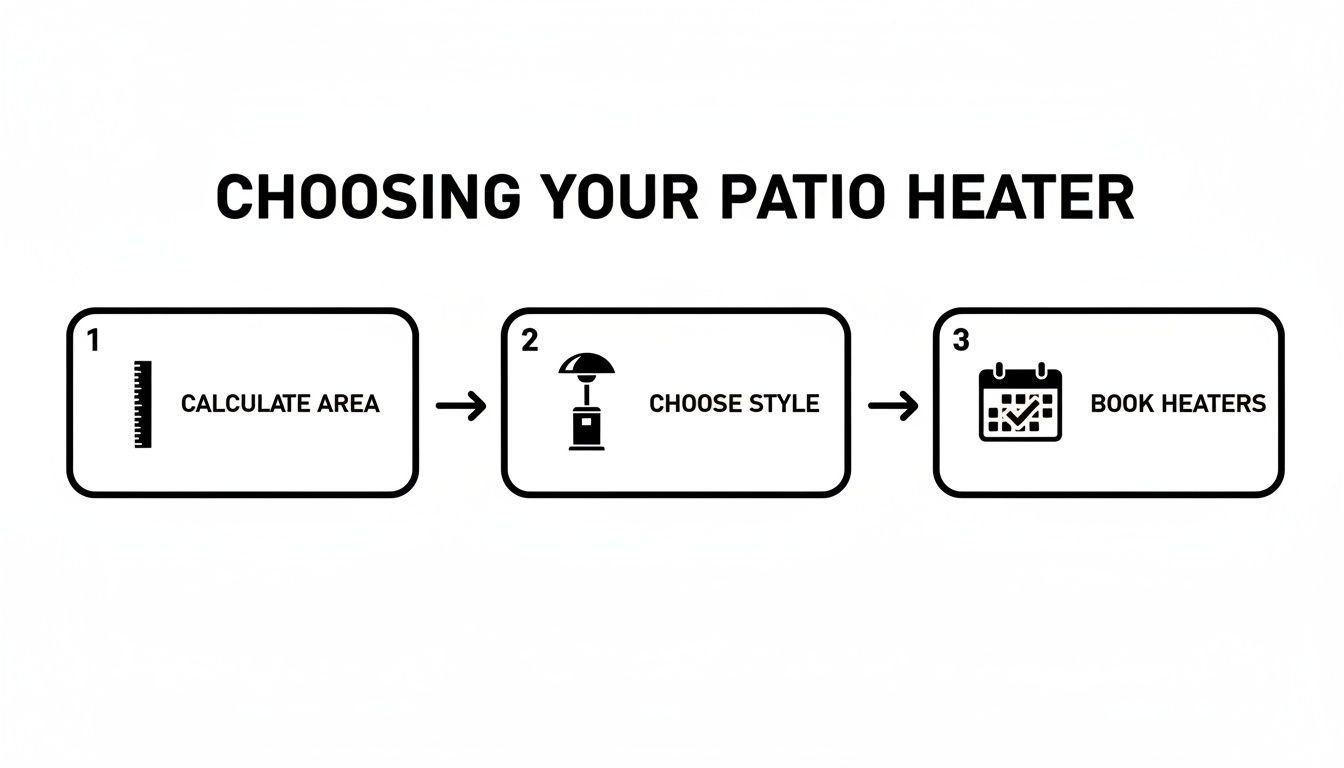
This simple guide breaks down the process of choosing the right heaters for your event.
This visual flow makes the decision-making process much easier, taking you from figuring out your space requirements to choosing a style that matches your event’s vibe.
Taming the Cape Doctor
Anyone who has planned an event in Cape Town knows the "Cape Doctor" can be a real party crasher. This southeasterly wind can slash the effectiveness of any outdoor heater and introduces a whole new level of safety checks.
This is where modern safety features are absolutely essential.
Always, always confirm that your rental gas patio heater has a tip-over safety switch. This brilliant little device automatically cuts the gas supply if the heater gets knocked or tilted too far, preventing a potential fire. For any outdoor event in the Western Cape, it’s a non-negotiable.
When placing heaters in windy spots, try to tuck them into sheltered areas, like against a solid wall or in the lee of a building. This helps stop the pilot light from blowing out and ensures more of that lovely radiant heat actually reaches your guests. Just be sure not to build a barricade around the heater, as it still needs proper airflow to work safely.
To give you peace of mind, it’s worth understanding what a regular gas heater service involves. While the hire company handles the big maintenance jobs, knowing about the professional checks highlights just how important those safety systems are.
Here’s a quick checklist to run through before your event kicks off.
Gas Heater Placement and Safety Checklist
This pre-event checklist will help ensure your heaters are set up for optimal safety and performance.
Checklist Item
Why It Matters
Professional Standard
Level Ground Check
An unstable heater is a tipping hazard.
The base must be 100% flat and on solid ground. No wobbling.
Clearance Measured
Prevents fire risk from radiant heat.
Use a tape measure: 1m above and 1m on all sides from flammable materials.
Tip-Over Switch Test
Confirms the primary safety feature is working.
Gently tilt the unit (when off). You should hear the switch click and engage.
Hose & Connection Check
Prevents dangerous gas leaks.
Visually inspect the hose for cracks; connections should be snug.
Away from Foot Traffic
Reduces the chance of accidental bumps or knock-overs.
Place heaters out of main walkways, behind seating, or in designated corners.
Wind Assessment
Strong gusts can extinguish the pilot or make the heater unstable.
Position heaters in sheltered spots; postpone use in extreme winds.
By following these placement rules, you can make sure every guest enjoys the warmth safely, leaving you free to focus on hosting a flawless and memorable event.
Understanding Rental Logistics and Fuel Management
Let's get into the practical side of things. Working out the logistics of hiring a gas patio heater is actually much easier than you’d imagine, especially when you team up with a pro rental company. It’s our job to make the process smooth so you can focus on the hundred other things on your event to-do list.
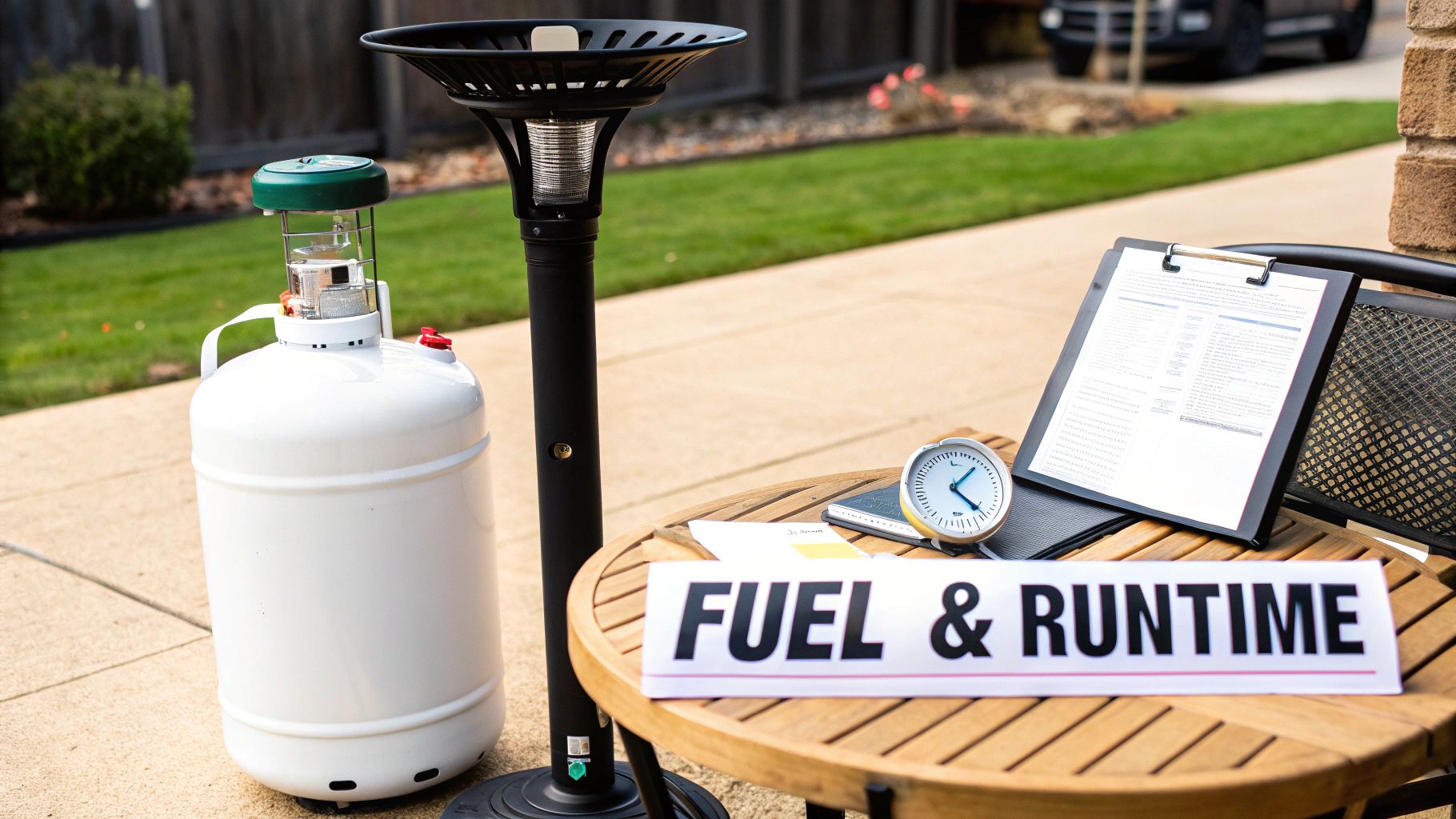
The most important part is getting a handle on the fuel. A standard gas patio heater runs on a 9kg propane gas cylinder, which fits neatly inside the base. One of these tanks provides a good amount of heat, keeping everyone toasty for hours.
This whole setup is designed for the event world—it’s reliable, straightforward, and gets the job done without any fuss.
Calculating Your Fuel Needs
The first question every event planner asks is, "How long will the gas actually last?" It's a fair question—the last thing you want is for the heat to die down halfway through the evening speeches.
On a medium setting, a single 9kg propane tank will keep a heater going for about 10 to 12 hours. That’s more than enough runtime for most events, easily covering the entire evening from the first welcome drink to the last dance.
To work out what you’ll need, just think about how long your outdoor area will be active.
Standard Evening Event (5-6 hours): One full 9kg tank for each heater is perfect.
All-Day Festival or Multi-Day Event: This is where you'll want at least one spare tank per heater. It's always better to have a backup on standby.
The best thing to do is chat with us about your event schedule. We'll make sure you have the right number of spare gas cylinders delivered along with the heaters, so you don't have to give it a second thought.
The Clear Advantage of Hiring Over Buying
For anyone in the event industry, the decision to rent or buy gas heaters is a no-brainer. Hiring just makes more sense, both financially and logistically. Think about it: buying a whole fleet of heaters means a massive upfront cost, not to mention the ongoing headaches of storage, maintenance, and safety checks.
Renting turns a major capital expense into a simple, manageable operational cost. You get access to professionally maintained, top-of-the-line equipment for a fraction of the price of ownership, with all logistics handled for you.
Here in South Africa, especially in the Western Cape where the event scene in Cape Town and the Winelands is always buzzing, renting is the standard. It's cost-effective, with prices ranging from R500-R1500 per unit weekly, compared to the steep price of buying. This is exactly where ABC Hire comes in, helping create stylish, warm patios for unforgettable weddings and parties. You can read more about the propane patio heater market on datainsightsmarket.com.
When you hire from a company like ABC Hire, you're not just getting a heater. You're getting a full service that typically includes:
Delivery and Collection: We bring the heaters right to your venue and pick them up when the party's over.
Setup and Placement: Our team can help you position the units for the best heat coverage and safety.
Fuel Supply: Each heater comes with a full tank of gas, ready to fire up immediately.
This all-in-one service takes the hassle of transport, storage, and maintenance completely off your plate. It's simply the smartest and most efficient way to heat any event.
Getting to Grips with Setup and Troubleshooting
Even when you have pros like us at ABC Hire delivering your heaters, knowing a few basics gives you great peace of mind. A quick check or a simple fix is all it takes to keep the warm, festive atmosphere going without a single interruption.
Our team will handle the heavy lifting, of course, but it never hurts to know the essentials. Before your guests arrive, it’s always a good idea to cast a quick eye over the heaters. Make sure each one is standing firm on level ground and has plenty of breathing room from things like marquee walls, overhanging branches, or flowing decorations.
Firing Them Up: A Quick-Start Guide
Modern gas patio heaters are designed to be incredibly straightforward and safe to light, usually with just the push of a button.
Open the Gas: Start by slowly turning the valve on top of the 9kg propane cylinder anti-clockwise. This gets the gas flowing.
Turn the Knob: Next, push the main control knob on the heater in and turn it to the 'PILOT' setting. You’ll probably need to keep it held down for about 30-60 seconds to let the gas travel up to the burner.
Press to Ignite: While still holding the control knob in, press the red or black igniter button (that’s the piezo ignition) a few times. You should see a small pilot flame flicker to life.
Set Your Heat: Once that pilot is lit, keep holding the knob for another 30 seconds or so to make sure it stays on, then let go. Now you're free to turn the knob to your perfect heat setting, from a gentle low to a toasty high.
Don’t panic if it takes a few clicks of the igniter to get going, especially on a classic windy Cape Town evening. That’s completely normal. The real trick is holding that pilot knob down long enough for the gas to reach the right spot.
Common Hiccups and Easy Fixes
Every now and then, a heater might decide to be a bit stubborn. Before you reach for the phone, these simple checks can solve the most common issues right there on the spot.
Heater Won't Light?
Is the Gas On? Take a peek at the propane tank. Is the valve turned all the way open? It's a surprisingly common oversight!
Check the Connection: Make sure the regulator hose is screwed tightly onto the tank. A loose connection means no gas flow.
Flame Looks Weak or Low?
Running on Empty? The propane tank might just be getting low on fuel. An easy way to tell is by feel – a full 9kg tank has some serious heft to it.
Is the Valve Fully Open? Sometimes the valve isn't opened all the way, which restricts the flow. Give it another gentle turn to be sure.
Of course, there are always a few questions that pop up. Here are the quick, straight answers to the most common things we get asked by event planners, helping you get your booking sorted with confidence.
How Far in Advance Should I Book Heaters?
If your event is in Cape Town or the Winelands, especially during the busy wedding season from September to May, you’ll want to book your gas patio heaters at least four to six weeks in advance.
Popular dates and long weekends can get booked out months ahead of time, so getting in early saves a lot of last-minute stress and makes sure you get the gear you need. For smaller weekday functions or during the off-season, a two-week lead time is usually fine. But the golden rule is always: the sooner, the better.
Can I Use a Gas Heater Inside a Marquee?
This one is all about safety, and the short answer is no, you should not use a standard gas patio heater inside a fully enclosed marquee or tent. They are designed for outdoor or very well-ventilated areas because they use oxygen and give off carbon monoxide.
That said, you can safely use them in structures that are semi-enclosed, like a marquee with one or more sides rolled up or completely open.
Good ventilation is absolutely essential. For a space to be considered "well-ventilated," at least 25% of the total wall area must be permanently open to the fresh air outside. This keeps the air circulating and stops any dangerous fumes from building up.
If you're planning an event in a completely enclosed marquee, you’ll need to look at other heating options made specifically for indoor use. Your guests' safety should always be the top priority.
What’s Included in the Rental Price?
Knowing exactly what you're paying for helps with your budget and means no surprises on the day. When you hire from a professional company like us, the price usually covers a full service to make your life easier.
Here's what you can generally expect:
The Heater Itself: A clean, professionally maintained and safety-checked gas patio heater.
A Full Gas Cylinder: Every heater comes with one full 9kg propane gas cylinder, which will give you about 10-12 hours of heat.
Delivery and Collection: Our team will bring the heaters to your venue before the event kicks off and pick them up afterwards. No logistical headaches for you.
If you need extras, like having our team set them up for you or getting more gas cylinders for a longer event, we can usually arrange that for a small extra fee. It’s always a good idea to chat about these details when you book to make sure everything runs smoothly from start to finish.
Ready to create that warm, welcoming vibe for your next event? The team at ABC Hire is here to help with great advice and top-quality gas patio heater rentals.
If you're planning an outdoor event in Cape Town, you already know you have to be ready for its famously unpredictable weather. A gas outdoor heater is your secret weapon for making sure guests are comfortable, turning what could be a chilly evening into a warm, memorable atmosphere. This guide is built specifically for event planners, walking you through everything from picking the right heater to mastering placement and safety.
Keeping Your Cape Town Event Warm And Inviting
Part of Cape Town’s charm is its incredible outdoor venues, but we all know the weather can turn on a dime. As an event planner, guest comfort is everything. A sudden drop in temperature can kill the mood faster than anything else.
That's where a strategically placed gas outdoor heater comes in. It’s more than just an appliance; it's a tool for creating a consistently welcoming vibe. It allows you to stretch the usable hours of a venue, making sure your event continues seamlessly long after the sun goes down.
The real goal here is to turn a potential problem—a cold evening—into a feature of comfort and luxury. By creating pockets of warmth, you encourage guests to mingle, relax, and actually enjoy the experience you’ve worked so hard to create. Think of these heaters as functional decor that radiates pure hospitality.
Why Gas Heaters Are an Event Staple
Their popularity isn't just a local trend. It reflects a global preference for reliable outdoor comfort. In fact, the worldwide market for outdoor heating, where gas heaters are a massive component, was valued at around $6.0 billion and is expected to hit $8.86 billion by 2032. That kind of growth shows a real, sustained confidence in this technology's ability to deliver.
This guide is your complete playbook, focusing on the practical knowledge you actually need as an event planner. We'll cover:
How They Work: Get a simple breakdown of how a gas outdoor heater creates instant, targeted warmth.
Choosing the Right Model: Figure out which heater styles will best suit your event's look and layout.
Calculating Coverage: Master the art of knowing exactly how many units you need for perfect comfort.
Safety and Placement: Learn the essential protocols to ensure a secure and smooth experience for everyone.
By mastering the use of a gas outdoor heater, you're not just fighting the cold; you're actively designing a more inviting and enjoyable guest experience from start to finish.
Whether you're planning a wedding under a clear marquee or a corporate function on an open-air terrace, this is crucial info. Often, these setups are paired with other hired structures, and knowing how to integrate heating is key. For more tips on creating covered spaces, have a look at our guide on gazebo hire in Cape Town to see how all the pieces can work together.
From selecting the perfect heater to ensuring it runs flawlessly on the day, we’re here to help you succeed.
How a Gas Outdoor Heater Actually Works
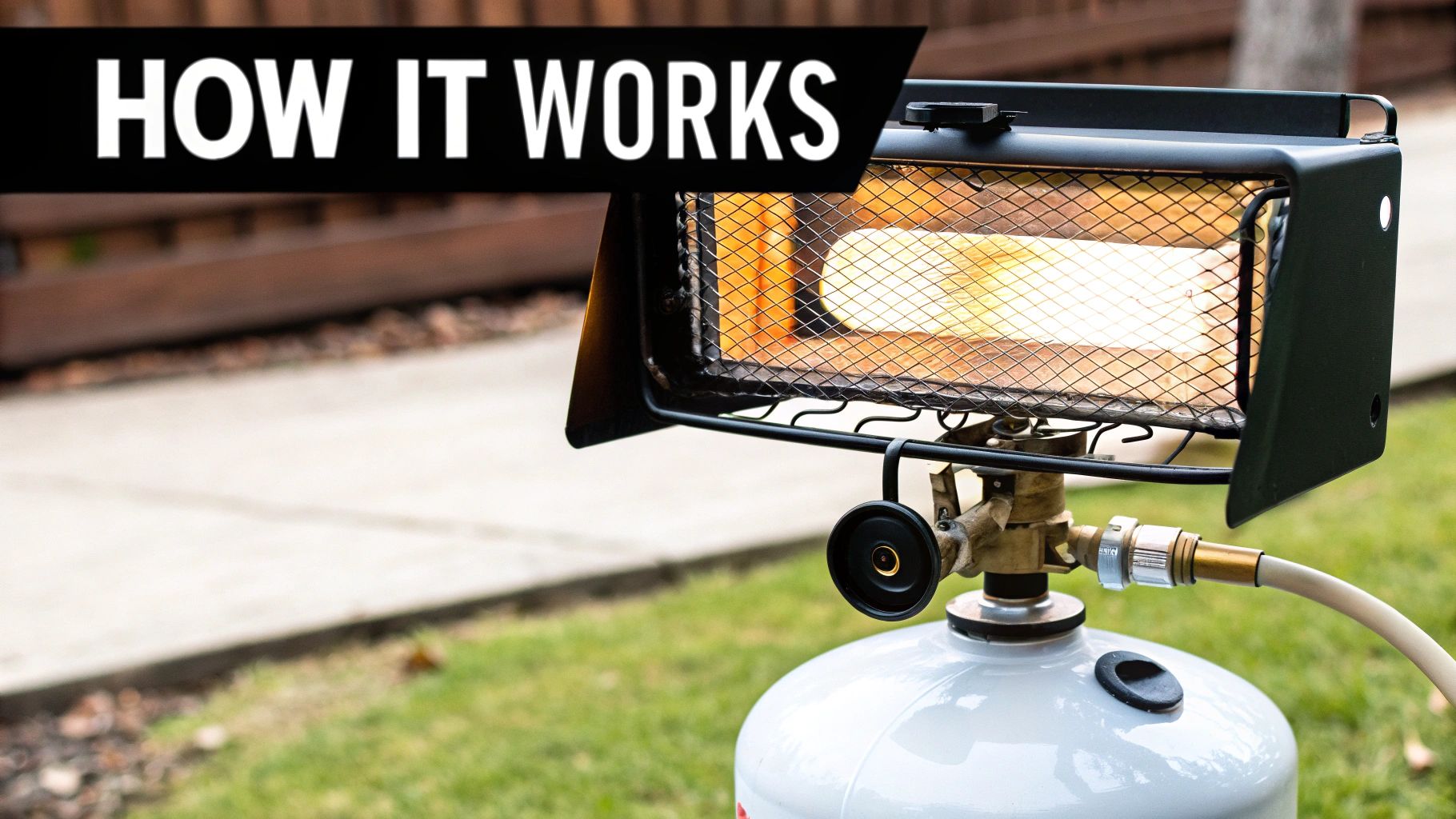
Ever wondered what's going on inside one of those patio heaters? Think of it as a cleverly designed, controlled campfire, channelling warmth exactly where your guests need it most. Instead of wood, it runs on Liquefied Petroleum Gas (LPG)—the same gas you’d use for a braai—to create powerful, comforting radiant heat. The whole setup is a simple but brilliant bit of engineering that delivers instant cosiness.
When you fire it up, a valve releases a steady flow of LPG from the cylinder. The gas travels up a hose to the heart of the unit: the burner assembly. A simple push-button igniter creates a spark, igniting the gas, and that's when the magic really starts.
But the flame doesn't just burn openly. It heats up a crucial component called the emitter screen, which is a tough metal grid sitting right above the burner. As the screen gets hot, it glows a familiar, bright orange, just like the embers in a fire.
From Glowing Emitter to Radiant Warmth
That glowing screen is the real source of the warmth you feel. It sends out infrared radiation, a type of energy that travels through the air until it hits a person or an object. It’s the very same kind of heat you feel from the sun on a clear day.
This is what sets an outdoor heater apart from your typical indoor one. Most indoor heaters use convection, which means they warm up the air, and that warm air circulates around the room. An outdoor gas heater uses radiation to heat people and objects directly, not the air itself.
Why This Matters for Your Event: Radiant heat is a game-changer for outdoor events because it cuts straight through cool air and isn't easily carried off by a breeze. It delivers that instant feeling of warmth directly to your guests, keeping everyone comfortable even on a chilly Cape Town evening.
This direct approach is way more efficient for open spaces. You’re not wasting energy trying to heat an entire garden or patio; you’re focusing all that lovely warmth right where your guests are mingling.
The Key Components Directing the Heat
Three main parts work together to make this happen safely and effectively. Knowing what they do will give you the confidence to operate any rental heater like a pro.
The Gas Regulator: This is the small but vital bit that connects the gas cylinder to the heater's hose. It’s the gatekeeper, making sure gas is delivered to the burner at a constant, safe pressure. Without it, the flame would be all over the place.
The Burner and Emitter: As we mentioned, this is the engine room. The burner creates the flame, and the emitter turns that flame's energy into widespread infrared heat. A well-maintained burner gives you a clean, steady flame for maximum warmth.
The Reflector Shield: You can't miss this part—it’s the large, umbrella-like metal disc at the very top of the heater. Its job is simple: to catch all the heat rising from the emitter and bounce it downwards in a wide cone. Without this shield, most of that valuable warmth would just float off into the sky.
Together, these parts create a reliable system that turns a simple cylinder of LPG into a comforting circle of warmth. It’s the science behind that cosy feeling that keeps a great outdoor party going long after the sun has set.
Choosing The Right Heater For Your Event's Style
Picking a gas outdoor heater isn't just about keeping guests warm – it's a design choice that adds to the whole vibe of your event. The right heater should blend in with your decor and layout, enhancing the look you've worked so hard to create. It’s all about striking that perfect balance between function and style.
The two most popular heaters you can hire each bring something different to the table. Your decision really comes down to whether you need quiet, widespread warmth or a dramatic, eye-catching centrepiece. Let's look at what makes each one unique.
The Workhorse Mushroom Heater
The classic freestanding mushroom heater is a crowd favourite for a good reason. Its famous umbrella-shaped reflector is built to push heat out efficiently, making it a reliable workhorse for pretty much any outdoor space. Think of it as the most dependable player on your event heating team.
This design is brilliant at radiating heat downwards and outwards in a big, even circle. It’s perfect for creating warm zones in open areas like gardens, patios, or around cocktail tables where people are standing and chatting. Because it has an understated look, it provides comfort without stealing the show from your main decor.
Thanks to its wide heat coverage, the mushroom heater is often the most budget-friendly choice for warming up larger areas, as you'll likely need fewer of them to keep everyone comfortable.
The Showstopping Pyramid Heater
When your event calls for a bit of drama and a high-end feel, the pyramid heater is a knockout. Its standout feature is a tall, quartz glass tube with a live flame dancing up the middle. It provides both heat and an incredible visual.
This type of heater is like a piece of functional art. It’s perfect for framing an entrance, marking out a VIP lounge, or just adding a touch of class to a chic cocktail party. While its heat is a bit more focused than a mushroom heater's, the beautiful glow and striking design create an atmosphere that people won't forget.
A pyramid heater takes something essential—warmth—and turns it into a design feature. Guests are naturally drawn to the light and movement, making it an elegant and natural spot for people to gather.
A Side-by-Side Comparison
To help you see the difference clearly, here’s a quick comparison of these two popular styles. This table lays out their strengths and where they shine, helping you match the right heater to your event’s specific needs.
Gas Outdoor Heater Comparison for Event Planners
Heater Type
Best For
Heat Coverage (Approx.)
Aesthetic Appeal
Key Consideration
Mushroom Heater
Widespread, practical heating for open spaces, gardens, and marquees.
15-20 sq meters
Functional and classic, designed to blend in rather than stand out.
Maximum heat efficiency and coverage for your budget.
Pyramid Heater
Creating a visual focal point, accentuating entrances, or high-end events.
10-15 sq meters
Modern and dramatic, with a visible flame for high visual impact.
Atmosphere and style are as important as the heat itself.
At the end of the day, your choice comes down to your main goal. Need to heat a large, open area for a seated dinner efficiently? The mushroom heater is your best bet. Trying to create a stylish, exclusive lounge for a product launch? The pyramid heater will deliver that "wow" factor.
Often, the best solution involves a mix of both. You can find out more about creating comfortable, stylish outdoor zones in our guide to Cape Town umbrella hire, which covers another key part of guest comfort.
How Many Heaters Do You Actually Need?
Getting the right number of heaters for your event is a bit of a balancing act. Too few, and your guests will be shivering and huddling together for warmth. Too many, and you'll end up with uncomfortable hot spots while burning through your rental budget. The real goal is to create a consistent, gentle warmth that feels completely natural and inviting.
A good starting point is the general rule of thumb. A standard mushroom-style gas outdoor heater will typically warm up a radius of about 20 square metres. But, and this is a big but, that’s just an estimate. Real-world conditions like a sudden gust of wind, the night's actual temperature, and whether your space has any partial shelter will massively affect how they perform.
This is especially true for events in Cape Town, where a sea breeze can roll in without any warning. A steady wind can easily shrink a heater's effective coverage by 25-30%, which means you might need to place them a bit closer together than you first thought.
Start by Mapping Your Event Zones
Before you can land on a final number, you need to get a clear picture of your venue's layout and, more importantly, how your guests will actually use the space. Don't just think in total square metres; break the area down into its different zones.
Put yourself in your guests' shoes. Where will people naturally gather? Pinpointing these social hubs is the secret to placing your heaters strategically.
Seated Dining Areas: These are your top priority. Guests aren't moving around, so they'll feel the cold much more. You need consistent, overlapping warmth here.
Cocktail and Standing Zones: Think high-top tables or areas near the bar—these are natural mingling spots. Heaters here can be spaced a little further apart.
Lounge Pockets: Those cosy seating areas with couches or beanbags need their own dedicated heat source to feel truly comfortable and inviting.
Entrances and Exits: Placing a heater near the main entrance creates an instant feeling of warmth and welcome the moment guests arrive.
This approach means you're not just wasting heat on empty space. You're focusing the warmth exactly where it will make the biggest difference to your guests' experience.
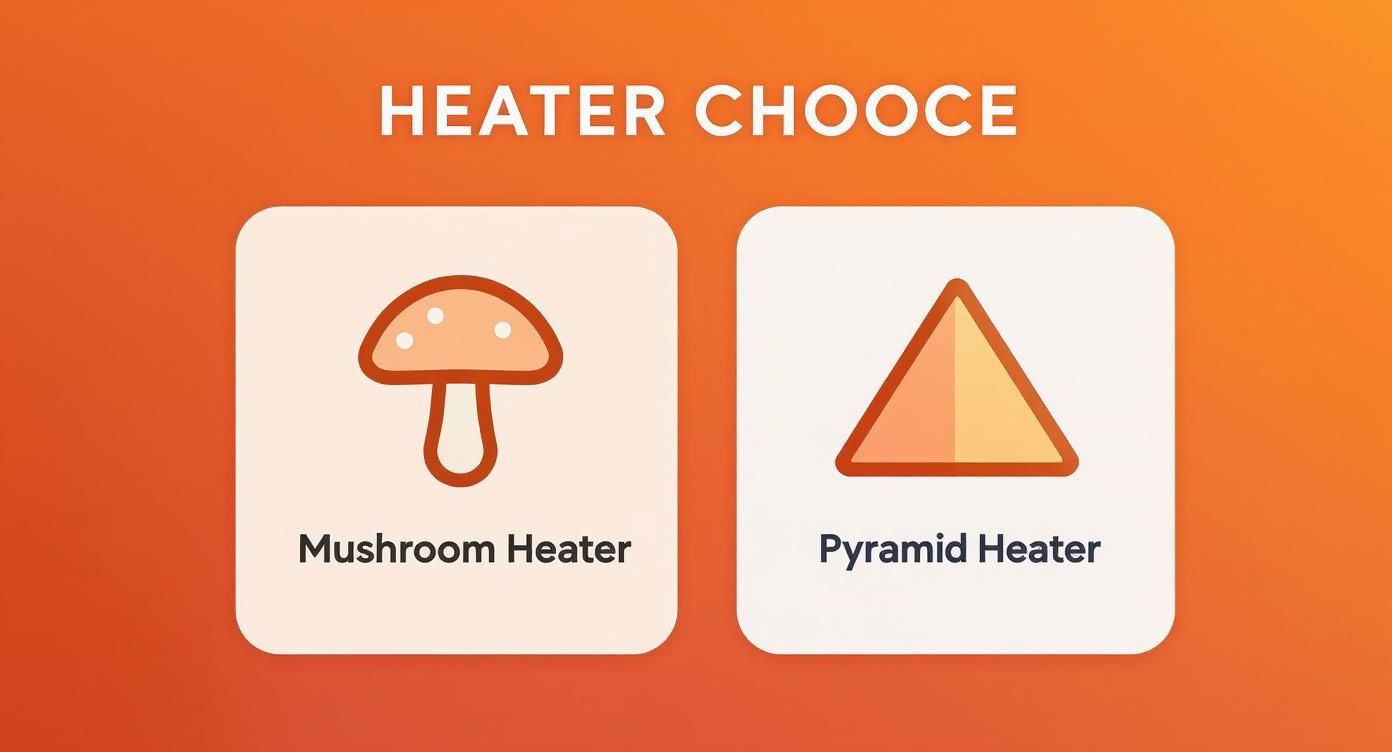
The infographic below gives you a quick visual guide to help you see the difference between heater types and where they work best as you map out your event.
As you can see, mushroom heaters are brilliant for wide coverage, while the pyramid-style ones add a real atmospheric touch to specific zones.
Putting it Into Practice: Scenarios and Calculations
Let’s run through a couple of common event setups. This should help you visualise how to calculate what you'll need.
Pro Tip: Always sketch out a simple floor plan of your venue. Use circles to represent the rough 20-square-metre coverage of each heater, then move them around on paper to cover your key zones without leaving any big cold spots.
Scenario 1: The Standing Cocktail Party For an open-air cocktail do with 80 guests, the aim is to create pockets of warmth rather than heating the entire garden. People will be moving and mingling.
Calculation: Guests will naturally cluster in groups, so you can strategically place 4 to 5 heaters around high-traffic areas like the bar, food stations, and a few cocktail tables. This encourages flow while making sure no one is ever too far from a bit of warmth.
Scenario 2: The Seated Wedding Reception Here we have a seated reception with 10 round tables, each seating 10 guests. The priority is consistent warmth for every single table, as people will be sitting down for a long time.
Calculation: A great setup is to place one heater in the gap between every two tables. This arrangement would call for 5 heaters to cover all ten tables perfectly. You might want to add a sixth one near the entrance or by the dance floor for good measure.
By mapping your zones and thinking about the flow of your specific event, you move from guesswork to a solid, actionable heating plan. It’s the best way to ensure every guest stays comfortable and your budget is used as efficiently as possible.
Mastering Heater Safety And Local Regulations
When you hire a gas outdoor heater, you're not just renting equipment; you're taking on the responsibility for your guests' safety. And while our heaters are designed to be incredibly safe and reliable, their sheer power demands a healthy dose of respect and careful handling. It's like being the captain of a ship—you need to know the rules of the sea to ensure a smooth, worry-free journey for everyone on board.
Getting safety right is the absolute cornerstone of a successful event. It’s non-negotiable, and it all boils down to understanding the core principles of placement, ventilation, and the heater's own safety mechanisms. These aren't just polite suggestions; they are essential steps to protect your guests, your venue, and your hard-earned reputation.
Core Safety Protocols For Every Event
Your first job is to pick the right spot. A gas heater must always be placed on a completely flat, stable, and non-combustible surface. Grass can be uneven and poses a potential fire risk, making a paved patio, solid deck, or firm flooring the ideal foundation.
Next up is clearance. That radiant heat feels wonderful, but it’s intense. Keeping a safe distance from anything flammable is critical. This includes tent walls, hanging decorations, flowy tablecloths, and even dense bushes or trees.
As a golden rule, always maintain a minimum clearance of 1 metre on all sides of the heater and even more space overhead, especially if it’s under a marquee or a large umbrella. And a quick pro-tip: never, ever let guests use a heater as a coat rack or a place to hang their bags.
Understanding Built-In Safety Features
Professional hire companies like ABC Hire only stock units equipped with modern safety technology. One of the most important features to know about is the anti-tilt switch.
This clever little device is a real lifesaver. If a heater gets accidentally knocked or tilted beyond a safe angle, the switch automatically cuts the gas supply, instantly putting out the flame. It's an essential safeguard against fire hazards, particularly at lively events where guests are mingling and moving around.
Ventilation: The Silent Protector
Proper ventilation is arguably the most crucial safety aspect of all, especially if you’re using heaters in a semi-enclosed space like a marquee with one or two sides open. Gas outdoor heaters consume oxygen and release carbon monoxide (CO) as a byproduct. Out in the open air, this is no problem at all as the gas just dissipates harmlessly.
But in a poorly ventilated area, CO can build up to dangerous levels. That’s precisely why these heaters must never be used in fully enclosed tents, garages, or any indoor space. For any semi-enclosed setup, you have to ensure there is plenty of cross-flow ventilation to keep the air fresh and, most importantly, safe. The safety rules for heaters are closely linked to your venue choice, a topic we dive into in our guide on tent hire for parties.
Navigating Local Regulations And Environmental Impact
For most private events in Cape Town held on private property, you won’t need a specific permit just for using gas heaters. However, your event's overall safety plan must still comply with the City of Cape Town’s event by-laws, not to mention any specific rules set by your venue. The simplest way to tick this box is by using certified, professional equipment from a reputable hire company.
It’s also worth touching on the environmental conversation. While traditional gas patio heaters are effective, there is a growing awareness of their carbon footprint. A gas-powered patio heater can emit around 3 kilograms of CO2 within just a couple of hours. As environmental concerns rightly become more prominent, the industry is shifting towards solutions with better emission controls. By choosing well-maintained, efficient models for your event, you can do your part to minimise its impact.
Your Gas Heater Questions Answered
When you're in the thick of event planning, a few questions are bound to pop up, especially when dealing with equipment. For gas outdoor heaters, getting those answers sorted is key to a safe, warm, and brilliant event. We've pulled together the most common questions we get from event planners right here in Cape Town, with simple, no-nonsense answers.
Think of this as your personal cheat sheet for heater hire. From how long the gas lasts to safety and local rules, we'll cover what you need to know to handle things like a seasoned pro.
How Long Does a 9kg Gas Bottle Last In a Patio Heater?
This is the big one, and for good reason—it hits your budget and your logistics. That 9kg LPG cylinder is the fuel tank for your heater, and how long it lasts comes down to one thing: the heat setting.
Crank it up to the highest setting, and you can expect a single 9kg bottle to give you about 8 to 10 hours of solid warmth. If you're just looking for a bit of ambient heat on a lower setting, you can easily stretch that to around 12 hours.
Event Planning Takeaway: For most standard evening events running 5-6 hours, one 9kg gas cylinder for each heater is usually plenty. But if you're planning a longer celebration or expecting a proper Cape Town cold snap that needs high heat from the get-go, it’s a smart move to have a spare cylinder on standby for each unit.
Can I Use a Gas Outdoor Heater Inside a Marquee?
This is a critical safety question. The short answer is no, you absolutely cannot use a gas outdoor heater inside a fully enclosed marquee. It's incredibly dangerous. With no way for fumes to escape, you run a serious risk of fire and a hazardous build-up of carbon monoxide.
But, you can use them safely in a semi-enclosed setup. If your marquee has at least one side completely open, you’ll have the airflow needed to let heat and fumes dissipate safely.
Even then, placement is everything:
Give It Space: Keep the heater a minimum of 1 metre away from the marquee walls, ceiling, and any draping or décor.
Keep It Stable: The heater must be on a completely flat, solid surface to make sure there’s no chance of it tipping over.
If your event is in a fully sealed marquee, your only safe options are electric heaters or a ducted heating system where the unit stays outside.
What Happens If a Heater Is Knocked Over?
A great question, especially for lively events with guests moving around. Luckily, any professional rental heater worth its salt comes with a non-negotiable safety feature: an anti-tilt switch.
It’s a clever little mechanism. If the heater gets bumped and tilts too far, or gets knocked over completely, the switch instantly cuts the gas supply to the burner. The flame goes out immediately, stopping a potential fire before it can even start.
While the anti-tilt switch is a great backup, your best strategy is always smart placement. Position heaters away from busy walkways, the dance floor, or kids' play areas to minimise the risk from the start.
Do I Need a Special Permit For Gas Heaters At a Cape Town Event?
Navigating council regulations can feel like a headache, but for gas heaters, it’s usually quite straightforward. For most private events on private property in and around Cape Town, you won’t need a specific "heater permit."
That doesn't mean it's a free-for-all, though. Your event's overall safety plan still needs to line up with the City of Cape Town’s by-laws and any rules your venue might have.
The easiest way to tick all the boxes is to hire from a professional company.
Certified Gear: A reputable supplier makes sure their heaters are certified and maintained to meet national safety standards (like those from the LPGSA).
Compliance Made Easy: When you hire compliant equipment, you're showing you've done your due diligence, which makes getting your event plan signed off by a venue a whole lot smoother.
Working with a trusted partner like ABC Hire means you get equipment that’s not just effective, but also fully compliant—taking one more thing off your very full plate.
Ready to create a warm and inviting atmosphere for your next outdoor event? At ABC Hire, we provide top-quality, safe, and stylish gas outdoor heaters that are perfect for any occasion. Explore our heating solutions and get a quote today at https://abchire.co.za.