Corporate Event Decor in Cape Town: A Practical Guide

At 17h30, the light is dropping over Table Mountain and 180 guests are still arriving at a V&A Waterfront venue. The planner is watching three things at once: the bar queue is backing into the photo area, the stage looks flat under the venue's tungsten house lights, and the networking lounge has become a decorative island rather than a place where people want to sit.

That's the point at which corporate event decor stops being a styling exercise. Furniture, lighting, backdrops and branded installations either help people move, meet and remember the event, or they get in the way. In Cape Town, the result also depends on wind, venue power, load-in restrictions and the practical realities of working in a city where a warehouse in Salt River, a convention centre and a Winelands estate all demand different production decisions.

What Corporate Event Decor Really Does in Cape Town

A well-designed room gives guests obvious answers without asking them a question. They should know where registration ends, where the drinks are, which lounge belongs to networking, where the sponsor activation starts and how to find the stage. If those cues aren't clear, people bunch up at entrances, avoid underlit corners and walk past branded spaces.

I treat corporate event decor as an experience tool with three practical measures: flow, dwell time and brand recall. A lounge with comfortable, correctly scaled furniture can keep conversations going. A lit bar or poseur-table cluster can pull people away from a congested arrival route. A stage backdrop with controlled contrast can make the programme legible from the back of the room, while a photo wall positioned beside a queue can turn a brand moment into an obstruction.

Cape Town's business-events market gives these decisions real commercial weight. South Africa's business-events sector recorded estimated direct spend of R38.5 billion in 2014 and R42.4 billion in 2015, alongside 267,660 direct and indirect annual jobs in 2014 and 280,555 in 2015, according to the South African event management industry overview. The same source records 140 international meetings and conferences in 2015, attracting about 80,000 delegates and generating just over R1 billion in economic impact. That scale creates demanding expectations for presentation, staging, furniture and guest movement.

The Cape Town conditions that change the brief

A rooftop terrace can look perfect on a calm site visit and become unusable when the south-easter arrives. A Winelands estate may have beautiful lawns but uneven ground, a narrow access road and a strict load-out window. A venue's house lighting may be warm enough for dinner but completely wrong for a navy-and-white brand palette.

Power planning deserves its own conversation. Stage rotations, technical changeovers and venue power interruptions can leave a room suddenly dependent on emergency systems, so the decorative plan mustn't rely on one fragile lighting circuit. Outdoor functions also need a weather decision, not just a wet-weather sentence in the proposal.

For branded focal points, planners can use practical references such as branded backdrop ideas for conferences when deciding whether a step-and-repeat, dimensional logo wall or content-led screen will work harder. The backdrop should support photography and orientation without narrowing a circulation route.

Practical rule: If a decor item doesn't improve movement, comfort, visibility or recognition, question whether it deserves floor space.

A useful starting point for the wider event plan is ABC Hire's guide to how to host a corporate event. The decor brief should be written alongside the programme and guest journey, not added after the venue layout has already been approved.

Choosing a Theme That Carries Your Brand

A corporate theme works when guests feel the brand before they read the logo. It fails when every surface carries a message and the room starts to look like a temporary trade-show stand.

Begin with three inputs. First, ask marketing for the approved brand colours, typography, logo clear space and any materials that can't be used. Second, study the venue's existing character. A converted Salt River warehouse can carry stronger contrast, raw textures and a more industrial build than a Stellenbosch wine estate with timber, stone and established garden views. Third, choose one emotional outcome, such as confidence, curiosity, celebration or connection.

Build the visual system in layers

A deep navy and brushed-gold palette can give a CTICC year-end function a formal, financial-services feel. Use navy in the lounge upholstery or stage treatment, brushed gold in selected trims and warm neutral lighting on tables. Don't cover every chair or wall in metallic finishes. One repeated accent is usually more convincing than many unrelated props.

For a Winelands product launch, a restrained fynbos-inspired palette of greens, terracotta and natural stone can connect the event to its setting without turning the room into a botanical display. At a De Waterkant rooftop, black surfaces and controlled neon can suit a technology reveal, but the lighting needs a neutral layer for faces, food and presentations.

Carry the theme through a small number of deliberate touchpoints:

  • Arrival: Use one strong welcome sign or dimensional logo moment rather than multiple competing messages.
  • Networking: Repeat the palette through branded cushions, lounge trims or a discreet side table detail.
  • Stage and screens: Keep the stage background quiet enough for speakers and content to remain readable.
  • Dining: Use napkin prints, menu cards or place settings only where they add a useful brand cue.
  • Photography: Position a step-and-repeat or branded scenic wall where it supports, rather than interrupts, guest flow.

A theme reference such as Ticketsmith's conference themes can help generate directions, but the final concept still has to answer the venue, audience and programme requirements.

The best brand-to-decor ratio is qualitative rather than fixed. The room should feel unmistakably yours, yet guests should still experience a function, not walk through a catalogue of marketing assets. Put the logo at the moments of arrival, interaction and photography, then let colour, texture and light carry the rest.

Furniture, LED Pieces, and Lighting as the Experience Engine

Furniture changes behaviour before guests consciously notice it. A four-seater banquette encourages a small group to settle into one conversation, while scattered cubes create flexible perches and poseur tables keep people standing. Neither is automatically better. The choice depends on whether the function needs sustained networking, rapid circulation, casual viewing or a clear transition into dinner.

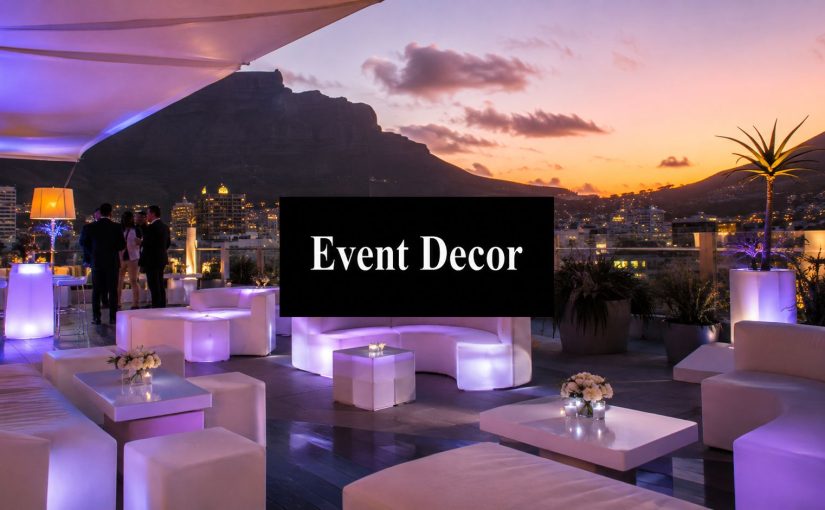
LED furniture earns its place when it performs several jobs at once. A glowing cube can act as a seat, a visual marker and a low-level light source. An LED poseur table can identify a networking zone without adding separate linen and uplighters. A curved illuminated bar can become the room's anchor, but it still needs enough surrounding space for service and queue movement.

ABC Hire's information on corporate event furniture rentals is a useful starting point for comparing furniture types before the floor plan is finalised.

Use a layered lighting plan

Most corporate rooms need four lighting layers:

  1. Ambient lighting establishes the overall level and keeps routes readable.
  2. Task lighting supports registration, bars, dining and any area where guests must see clearly.
  3. Accent lighting draws attention to a logo wall, product plinth, floral installation or architectural feature.
  4. Feature lighting creates the recognisable visual signature, such as a colour-changing bar, a stage wash or a controlled LED furniture cluster.

A single warm wash often flattens the room. A cold blue wash can make food and skin tones look harsh. Full house lighting fights nearly every carefully selected colour palette. The solution is to agree on a neutral working level for faces and food, then add colour in controlled zones.

Safety remains part of the lighting brief. South African event guidance specifies average lighting of 20 lux and a minimum of 5 lux for stairways, corridors, exit doorways and gates, with emergency lighting required where normal lighting fails, as set out in the South African event safety standard. Decorative effects can't compromise safe movement.

Function type Recommended LED pieces Primary lighting layer Key note
Conference arrival LED cubes, illuminated reception counter Task plus ambient Keep registration readable and avoid narrowing the entrance
Networking cocktail LED poseur tables, curved LED bar Ambient plus accent Use furniture to separate conversation zones from service queues
Product launch Illuminated plinths, linear LED bars Accent plus feature Control reflections so product details and screens remain visible
Formal dinner Selective LED side tables, subtle bar lighting Ambient plus task Keep table lighting flattering and avoid colour on food
Brand activation LED counters, modular cubes, lit display frames Accent plus feature Place the brightest element where it can be seen without blocking approach routes
Stage programme LED scenic elements, controlled backdrop lighting Ambient plus feature Prioritise speaker visibility, screen contrast and emergency access

Planning the Layout for Flow and Compliance

Start with a venue-readiness audit before choosing the furniture package. At a Cape Town venue, confirm the truck route, unloading point, lift or doorway dimensions, available power distribution and approved rigging points. At a Winelands estate, add lawn condition, road access, marquee anchoring, generator position and the venue's noise and access restrictions.
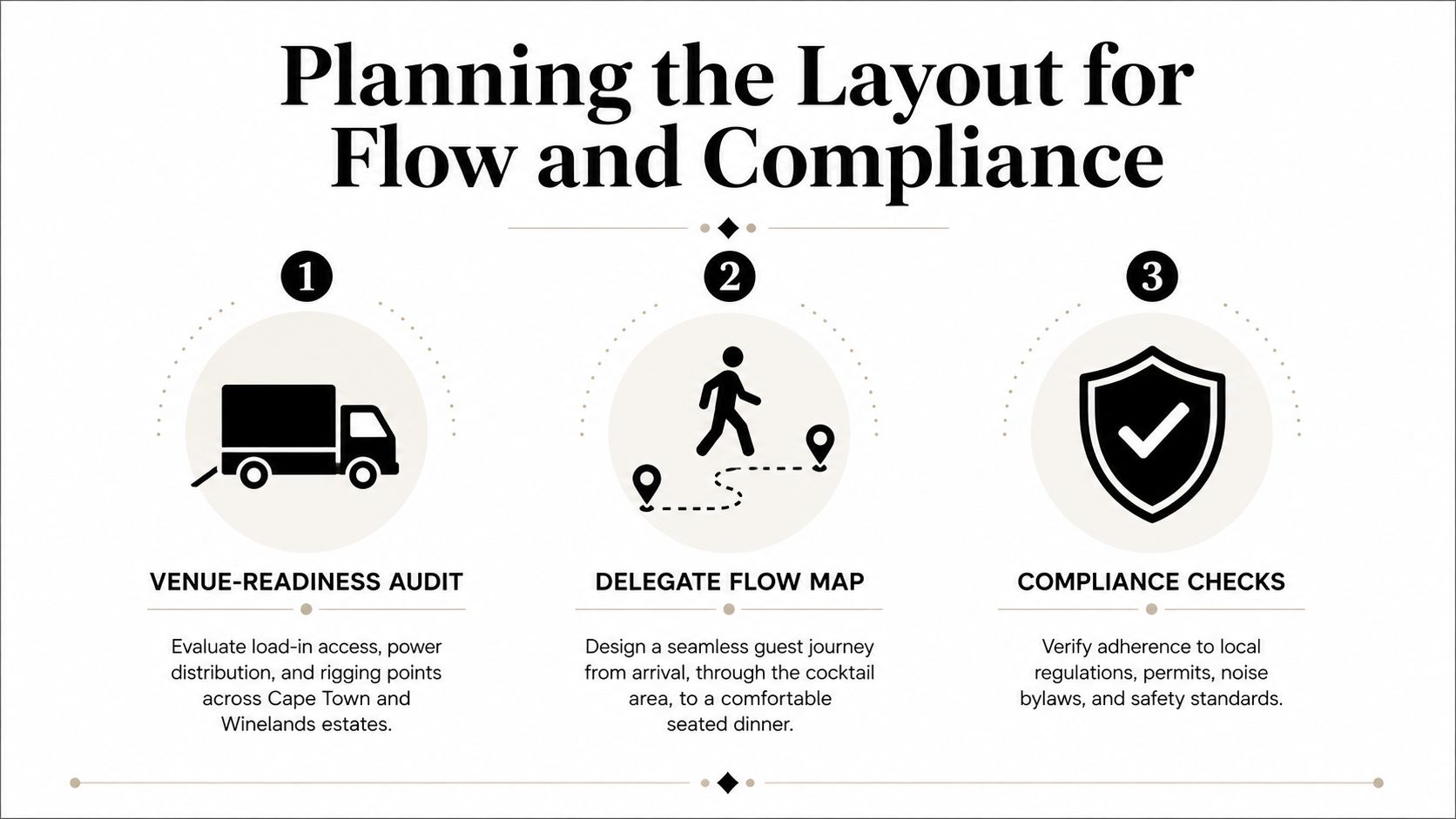
A three-step guide to planning event layout for flow and compliance, including venue audits and delegate mapping.

Map the guest journey

Draw the route from arrival to registration, welcome drink, networking, seating, programme and after-hours areas. Mark the places where people stop naturally, then keep furniture from turning those points into bottlenecks. A photo wall beside a bar queue needs more clearance than the same wall placed along a quiet perimeter.

Compliance must be checked against the venue's permit conditions and applicable building and event requirements. Don't guess capacity or aisle arrangements from a mood board. Ask the venue or appointed safety professional to confirm the approved layout, especially where temporary structures, staging, marquees or substantial scenic builds are involved.

Complete the site checklist

  • Access: Confirm vehicle approach, unloading times, door widths and storage for empty packaging.
  • Ground conditions: Check uneven lawns, slopes and surface protection before placing bars, lounges or stages.
  • Weather: Review marquee anchoring, wind exposure and a covered route between outdoor and indoor zones.
  • Power: Confirm generator backup, cable paths, distribution boards and approved electrical equipment.
  • Exits: Photograph emergency routes and keep décor, furniture, draping and cables outside them.
  • Materials: Request flame-retardant certificates and verify that electrical fittings are SABS approved.

Never place LED bars where guests can trip over bases or cables. The exact clearance depends on the venue's approved plan, furniture dimensions and traffic load, so the production team should draw the footprint rather than rely on a generic distance. Temporary structures may also require plan submission or local authority approval. The venue's technical and compliance teams should confirm this before fabrication begins.

Building a Realistic Decor Budget

A useful Cape Town decor budget has five separate lines: theming and signage, furniture, lighting, florals and table styling, then installation and strike labour. Keep transport, power requirements, venue charges, damage deposits and VAT visible rather than hiding them inside a single decor total.

The brief doesn't provide verified market price bands, so any supplier quotation should be treated as an event-specific commercial figure, not a universal Cape Town rate. A coastal rooftop, a CTICC hall and a Constantia estate can carry very different labour, access and equipment costs.

Spend where guests notice performance

Put money into the elements that shape the event journey. A strong stage treatment, a readable arrival installation, comfortable lounge furniture and reliable lighting usually do more than a large quantity of small table props. Reusable modular pieces can also support sustainability goals and reduce waste-heavy set builds, a direction reflected in recent South African industry reporting on reusable furniture, local sourcing and lighter use of single-use decor in this South Africa event-management report.

A 200-guest Constantia year-end function should be costed as a scenario, not presented with invented totals. Ask each supplier to separate:

  • Theming and signage: Backdrop, welcome sign, menus, directional signs and branded scenic elements.
  • Furniture: Dining seating, lounges, bars, poseur tables and modular LED pieces.
  • Lighting: Distribution, fixtures, control, focus and technical operator requirements.
  • Floral and table styling: Florals, vessels, candles or flameless alternatives, linen and table details.
  • Labour: Delivery, setup, styling pass, technical checks, strike and return logistics.
Decor line Indicative range in ZAR Splurge versus save Notes
Theming and signage Supplier quotation required Splurge on the hero backdrop, save on minor signs Confirm artwork, print finish and installation method early
Furniture and modular LED pieces Supplier quotation required Splurge on high-visibility networking and photo zones Reuse standard banquet furniture where it won't affect the guest experience
Lighting rig Supplier quotation required Splurge on stage, arrival and food-friendly lighting Don't pay for effects that overpower presentations
Florals and table styling Supplier quotation required Splurge where guests sit, save on distant areas Consider reusable plants or modular arrangements
Install and strike labour Supplier quotation required Don't cut blindly Access restrictions and late load-out can change labour needs

For a broader production framework, planners can consult this 2026 event planning playbook, then request a written contingency line and clear VAT treatment from every vendor. Never approve a “complete decor package” until you know what happens if weather, access or power changes the installation plan.

Coordinating Vendors and the Installation Run-Order

A smooth decor build is choreography, not a collection of suppliers arriving whenever they're ready. The decor lead should coordinate the venue, technical team, furniture supplier, florist, branding printer and client through one agreed production timeline.

The sequence below prevents the common mistake of placing furniture before the lighting team can focus, or styling tables before the venue signs off the final floor plan.

Five production phases

  1. Initial brief and site survey: Confirm the programme, guest journey, venue restrictions, access, power, rigging and weather exposure.
  2. Technical draw and decor render: Combine stage, lighting, furniture, signage, cable routes and emergency paths in one drawing.
  3. Vendor schedule: Allocate load-in windows, arrival contacts, equipment storage, focus time, styling access and strike responsibilities.
  4. On-site choreography: Install infrastructure first, then lighting, large scenic elements, bars, furniture and styling. Keep one person responsible for the live floor.
  5. Final walkthrough and strike: Check the approved layout, brand finish, lighting scenes, exits, bathrooms, bar routes and supplier collection plan.
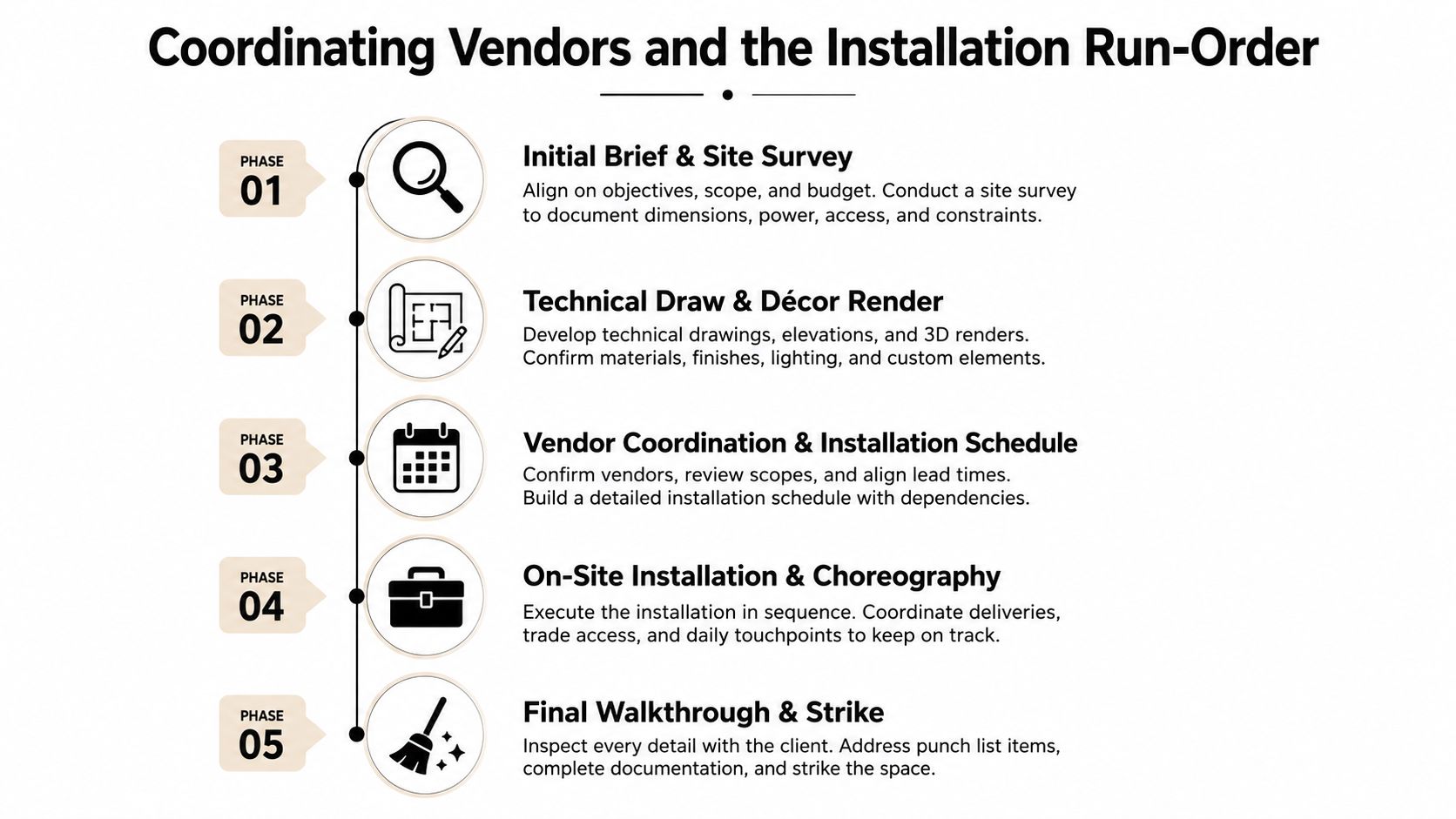
A five-phase infographic outlining the process for coordinating event vendors and managing installation schedules.

Cape Town timing can punish vague schedules. N2 traffic affects Winelands arrivals, residential estates may restrict after-hours loading, and some venues impose firm load-out curfews. Put those constraints in the call sheet, then confirm them with each driver and supplier rather than assuming the booking email has been read.

Give decisions a clear owner

The decor lead should set hold points for artwork approval, technical sign-off, material certificates, furniture quantities and the final guest layout. Any change after a hold point needs an identified cost, time and safety effect before someone approves it.

Use one WhatsApp group or radio channel for live site decisions, with the client, venue representative and production leads included. Keep design debate out of the load-in channel. For specialist planning around illuminated pieces, LED furniture hire in Cape Town can help planners define where modular lighting supports the run-of-show rather than complicates it.

Common Pitfalls and Questions From Real Cape Town Events

Last-minute decor changes rarely stay small. A florist may need to substitute arrangements after a summer cold-chain failure. A venue power problem may force a switch to battery-powered LED cubes. A linen measurement missed by a metre can delay dressing every table. Each change affects the run-order, photographs, brand consistency and labour.

DIY also looks cheaper until the organiser has to move heavy furniture across an uneven lawn, protect equipment from wind, coordinate a generator and clear packaging before guests arrive. Saving on rigging can create a compliance problem. Saving on florals can create colour drift when warm tungsten light turns carefully selected tones muddy.
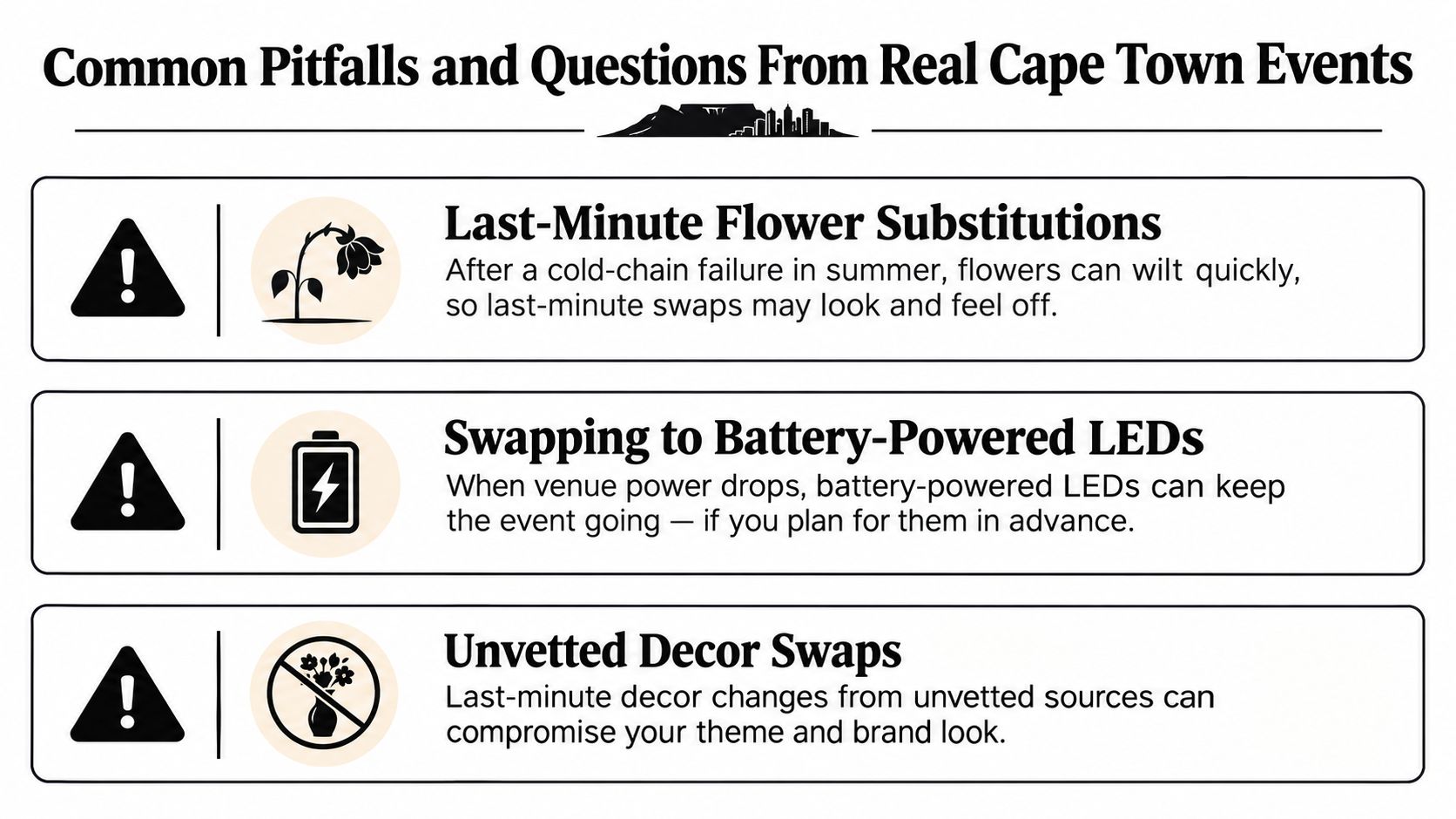
A graphic highlighting common challenges for Cape Town event planning, including flower wilting, power failures, and decor quality.

Questions planners ask after the site visit

How should we handle a Winelands load-in window?
Treat it as a booked production slot. Send vehicle details, crew names, equipment dimensions and the installation order to the venue in advance. Arriving early doesn't guarantee access if the estate has another function, residents nearby or limited storage.

What's a sensible weather plan for a December function?
Choose the decision deadline before the event day, identify which furniture and decor can move indoors, and confirm the covered route. A wet-weather plan that only protects guests but leaves power distribution and scenic elements exposed isn't complete.

Why do brand colours look different under LED and tungsten?
They use different colour qualities and intensities, so a printed navy, floral terracotta or branded green may shift on camera and in person. Test the actual fixtures, backdrop material and screen content in the venue, then photograph the result before sign-off.

Can we skip the final walkthrough if the mood board is approved?
No. A mood board can't show a blocked exit, a cable crossing a guest route, a bar queue colliding with registration or a stage hidden by a column. The walkthrough is where the design meets the building.

Are last-minute substitutions acceptable?
Only when the replacement is checked against the approved colour, size, safety documentation, power requirement and installation time. An attractive substitute that arrives late or needs a different base can cost more than the original choice.

The cheapest decor decision is often the one that doesn't create a second installation.


ABC Hire supplies corporate event furniture, LED furniture, tables, chairs, decor accessories and related hire equipment for functions across Cape Town, Stellenbosch, Franschhoek and Paarl. Visit ABC Hire to discuss a layout-led rental plan that supports guest flow, branded focal points and practical on-site installation.
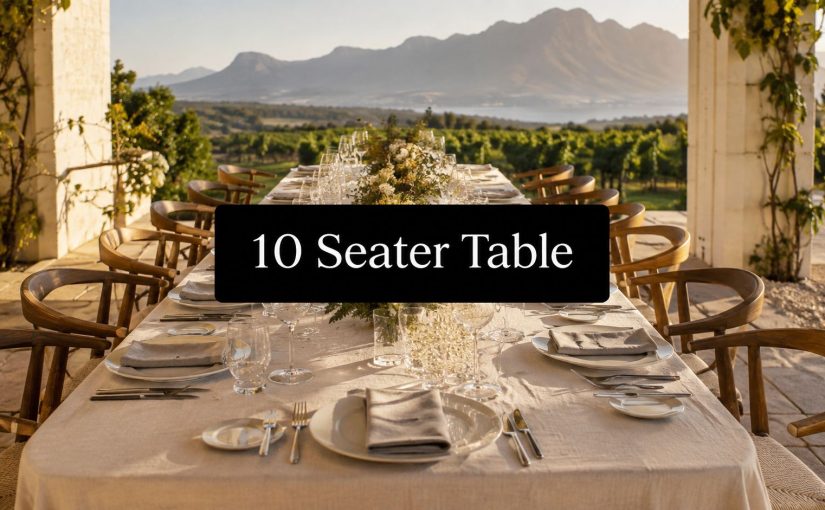
10 Seater Table Guide for Cape Town Events

You're standing in a venue with a tape measure in one hand and a seating chart in the other, trying to work out whether the 10 seater table you love will fit, or whether it'll choke the room the minute chairs go down. In Cape Town and the Winelands, that question gets asked in marquees, wine-estate lawns, compact homes, and long banquet halls, and the wrong answer costs time, money, and floor space you can't get back.

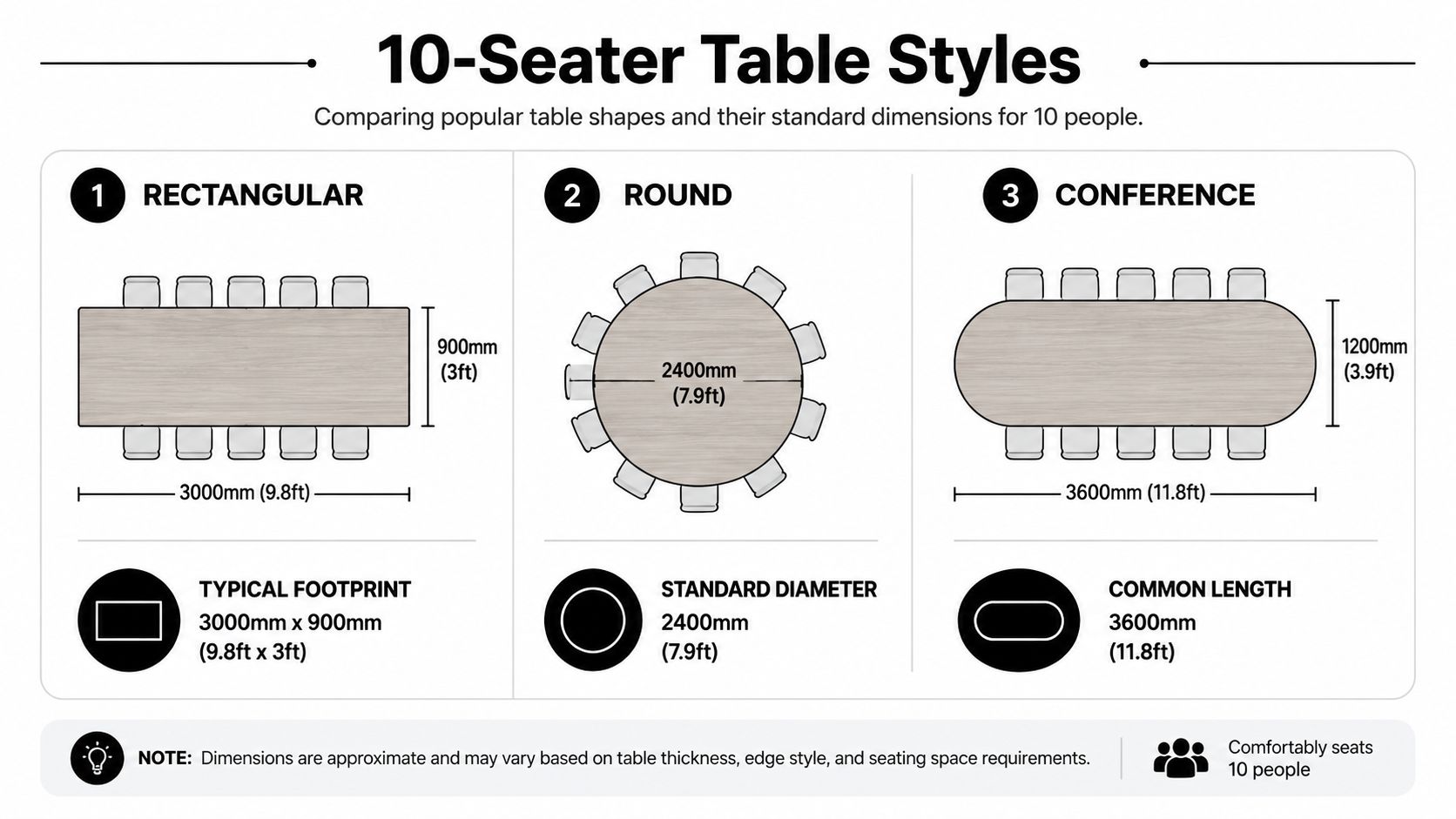
The practical truth is simple. A 10 seater table is not a casual dining-room piece, it's an event-format unit that needs proper planning around footprint, place setting, and clearance. For South African events, the useful numbers are the ones that tell you whether guests can sit comfortably, servers can move, and the room still has breathing space. In a typical setup, 10 guests are planned around a rectangular table of 96 to 120 inches (244 to 305 cm) long or a round table of 72 to 84 inches (183 to 213 cm) diameter, with about 24 to 28 inches per person for comfortable spacing (HerNest dining table size guide).

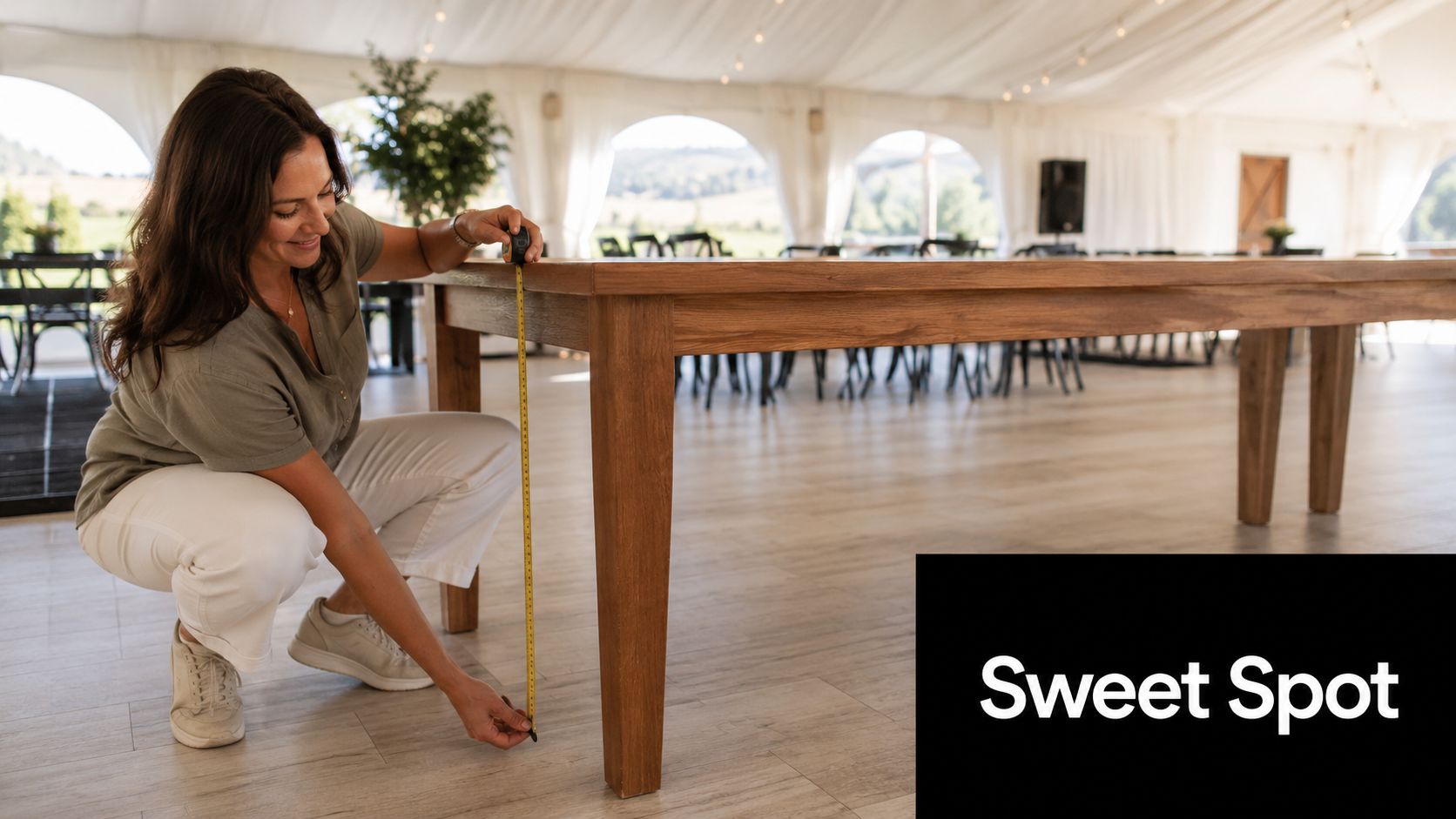
A woman crouches to measure the height of a wooden dining table in a rustic event space.

Why the 10 Seater Table Is a Cape Town Planner's Favourite

A planner crouched on a venue floor isn't thinking about style first, they're thinking about survival. Will the table fit between a bar, a dance floor, and a service lane. Will chairs scrape the wall. Will guests have to stand up every time a waiter passes. That's why the 10 seater table keeps showing up in Cape Town weddings, corporate banquets, matric dances, and school formals, it lands in the sweet spot between intimate dining and full banquet scale.

The sizing language that matters

Use the same words suppliers use. A place setting is one guest's allocated space at the table, footprint is the total space the table takes on the floor, and clearance is the movement room around it. Once you know those three things, the layout stops being guesswork.

A 10-seater also works because it gives planners a clean counting unit. If you're building a seating plan for a Winelands wedding, you can estimate tables, chairs, and aisle widths without overcomplicating the room. That makes it easier to compare rental quotes and talk sensibly to the venue coordinator.

Practical rule: if the table is the right size on paper but the room can't absorb chair movement, it's the wrong table.

The other reason this format wins is predictability. A 10-person setup sits at the upper end of residential dining and the lower end of banquet planning, so it translates well across event types. That matters in Cape Town, where one client wants a polished estate lunch and another needs a formal school dinner in a hall that wasn't built for lavish furniture.

If you're comparing domestic-style inspiration against event reality, a useful reference point is the broader sizing logic used for smaller tables in the dining table dimensions for 8 guide from Gorins Furniture & Mattress, but for local events the core issue is always floor plan fit, not just seat count.

A diagram comparing the dimensions and footprints of rectangular, round, and conference style 10-seater tables.

Standard Dimensions for Rectangular, Round and Conference Styles

Stop asking only, “Can it seat ten?” Ask, “What shape fits the room, the service route, and the mood?” That's how event people think, and it's the right way to think about a 10 seater table. The geometry changes everything.

Rectangular tables for dining and banquets

For a rectangular 10-seater, the common planning range is 96 to 120 inches long, which is roughly 8 to 10 feet, and about 24 to 28 inches per person is the comfort benchmark (HerNest dining table size guide). In practical event terms, that's the shape you reach for when the room is long, when rows need to stay tidy, or when you want a strong visual line down the middle of a reception space.

Rectangular tables are the easiest shape to pair with trestle-style rentals, and they photograph well in rows. If you're using runners, charger plates, or a narrow floral line, the rectangle gives you a clean canvas. For shape reference on trestle layouts, see trestle tables hire, because that's the style many Cape Town planners use when they need practical length without clutter.

Round tables for conversation-heavy events

A round table for ten is usually planned at 72 to 84 inches diameter, which is the geometry that works when you want conversation to feel open and equal (Reventals table sizes and seating). A 72-inch round is commonly used for 10, and that's the useful number to remember when you're booking a wedding or gala.

Rounds are friendlier for guest interaction, but they eat floor space quickly. They suit lawns, open marquees, and rooms where circulation is already generous. They're also the shape most likely to need careful linen choices, especially when you want a neat drop. For round linen fit and styling, the local guide on tablecloths for round tables is worth using alongside your floor plan.

Conference tables for meetings and training

Conference-style 10-seater tables are a different animal. The technical baseline is typically around 3000 mm × 1200 mm × 750 mm, with a 25 mm top and 1.2 mm powder-coated metal sections, while a welded stainless-steel canteen format is commonly 2400 mm × 800 mm × 750 mm with 202/304-grade stainless steel (Godrej Singapore 10-seater page).

That difference matters because conference tables prioritise cable management and individual workspace, while canteen tables prioritise hard-wearing sanitation. If you're booking a boardroom, training session, or staff briefing, don't order a dining-style shape and hope it will behave like meeting furniture.

Choosing Round, Rectangular or Oval for Your Venue

Cape Town venues don't behave like showroom catalogues. A glamorous shape that looks perfect online can become awkward the minute it meets a narrow marquee aisle, a sloping wine-estate lawn, or a compact heritage room with tight walls. That's why generic table-size charts fall short locally, they tell you the capacity, but not the reality of the space.

Tight marquees need discipline

In a tight marquee, rectangular usually wins. It gives you cleaner edges, easier stacking in rows, and less wasted perimeter space than a round. If service lanes are narrow and the bar is already fixed into one side of the tent, a round table just creates dead zones that nobody can use properly. Oval can help if you want a softer look than a rectangle, but it still behaves more like a long table than a social circle.

Long halls reward rectangles

For long banquet halls, I'd pick rectangular without apology. It fills the room properly, keeps sightlines ordered, and lets you build a clear central aisle or side service route. This is the shape that works for school dinners, awards evenings, and formal business functions where the room needs structure more than intimacy.

Wine-estate lawns favour rounds, but only when space is generous

On a lawn, a round can look beautiful because it feels relaxed and open. Use it when the layout has room to breathe, not because it's fashionable. If the lawn is broken up by trees, edging, or uneven service access, a round becomes fiddly fast. In that case, I'd go rectangular and keep the layout deliberate.

A shape is only “better” if staff can move around it without turning the event into an obstacle course.

For a local planner or couple, the short answer is this. Tight marquee, choose rectangular. Long hall, choose rectangular. Open estate lawn, choose round only if circulation is easy. If you want one style that gives you a balance of comfort and formal control, oval is a solid compromise, but it still needs proper length. That logic is why many teams cross-check with the practical guidance in the ABC Hire trestle table hire article before locking the final floor plan.

Fit-Checking the Table in Your Room or Marquee

Most layout mistakes happen before a single chair is unloaded. The team sends a quote, the bride approves the look, and then someone realises the dance floor has nowhere to live. Don't let that happen. Measure first, then place the 10 seater table on paper.

Use a paper-scale test

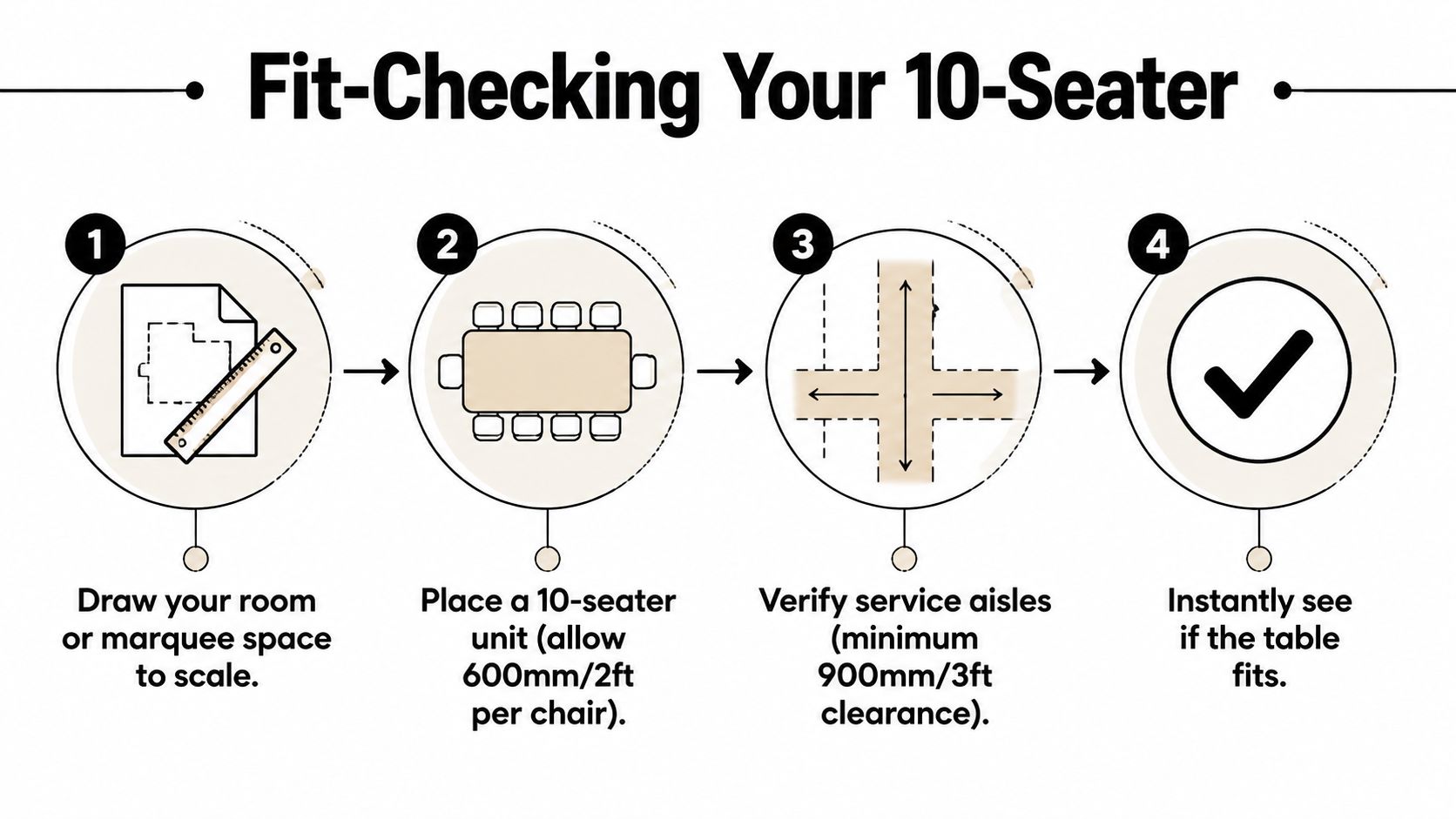
Draw the room or marquee to scale. Mark doors, poles, bars, buffet areas, and any fixed objects. Then place one table footprint into the drawing and add chair space around it. For planning, the useful comfort figure is about 24 to 28 inches per person at the table, and the practical event version means leaving enough room for a chair to move without clipping another guest (HerNest dining table size guide).

Check the circulation first

The test is not just whether the table fits, but whether people can get around it. Use the aisle line as your essential guide. A service lane that is too narrow turns setup and clearing into a daily headache for the catering team.

Working rule: if the table fits only when nobody is serving, dancing, or carrying trays, it doesn't fit.

A practical fit-check looks like this:

  • Mark the footprint: trace the actual table shape, not an estimate.
  • Place the chairs: allow around 600 mm, roughly 2 feet, per chair position when you sketch the seating ring.
  • Verify service access: keep the aisle clear enough for people and trays to pass.
  • Add the extras: remember the cake table, gift table, DJ, and bar before you finalise the layout.

If you're moving furniture through tight access points before setup, the logic in Boston mover door fitting tips from TLC Moving & Storage is surprisingly relevant, because the same practical thinking applies to venue doors, passageways, and loading paths.

For event spaces, the missing question is always, “What else needs to fit around the table?” Answer that and you'll avoid the classic Cape Town problem of a beautiful setup that blocks the flow of the whole room.

A four-step infographic explaining how to measure and verify if a 10-seater dining table fits your room.

Seating Layouts and Styling Ideas That Actually Work

A 10 seater table can look formal, relaxed, modern, or dramatic. The trick is not buying more decor, it's matching the shape, chairs, and lighting to the event's actual energy. Cape Town couples often over-style the table and then run out of room for serving dishes, while brand teams do the opposite and leave the setting looking unfinished.

Wedding reception with a long-table feel

For a Cape Town wedding reception, I'd use a rectangular table with coordinated chairs and a narrow centrepiece line. Keep the floral height low enough for conversation, and use linen that falls cleanly instead of pooling around chair legs. The table should feel elegant, not crowded.

Matric dance dinner with structure

For a matric dance, the safest choice is still a rectangular or conference-style layout. Students need clear access, the catering team needs fast service, and the room often doubles as a photo area. Stackable chairs work well here, and you can sharpen the look with charger plates or a simple runner instead of heavy decor.

Corporate awards or brand activation

For corporate events, the table should support branding without turning into a billboard. Clean lines, black or white chairs, and a restrained centrepiece work better than an overloaded display. If you want a night-time edge, add LED cubes, curved benches, or stackable LED chairs around the perimeter so the room gains atmosphere without blocking chair movement.

Winery lunch with softer styling

A Winelands lunch suits a lighter hand. Use natural textures, a modest floral set, and enough space between settings that guests don't feel packed in. The best tables in this setting look effortless because the styling respects the view and the room.

If the decor starts to steal chair space, cut the decor.

The best finish is always one that serves the event type. Keep the centrepiece scale modest, choose chairs that match the table shape, and let the lighting do some of the work. That's especially true at night, where glowing furniture and simple linen can do more for mood than another round of flowers ever will.

Rental Logistics With a Cape Town Hire Company

Booking a 10 seater table is easy only if you ask the right questions early. The rental process should be about fit, access, and condition, not just a quick yes on stock. Cape Town, Stellenbosch, Franschhoek, and Paarl each bring different logistics, and the supplier needs to know the venue realities before the truck rolls.

What to confirm before you sign

Ask whether the table is delivered flat-packed or assembled, what the collection window is, and whether the venue has loading access close to the setup point. That matters more than people think, because a table that's easy to unload into a hall is not the same as one that has to cross a steep garden path, a gravel drive, or a narrow doorway.

Check what arrives with the table as well. Some suppliers bundle chairs, while others charge separately for linen, accessories, or setup support. ABC Hire offers a tables for hire service in Cape Town and lists event tables in its online selection, which makes it a useful option when you need to match one table family across a larger event.

Lead times matter in peak season

Don't assume stock will still be there when you circle back later. Friday to Sunday weddings, matric dances, and year-end functions all squeeze the same pool of tables, chairs, and LED pieces. If the event depends on a specific table shape, lock it early.

For rental planning, the linked overview on tables and chair rentals is the sensible starting point when you're comparing what gets booked together and what should be quoted separately.

A few details clients often forget to ask:

  • Delivery zone: confirm the exact route, especially outside central Cape Town.
  • Surface conditions: lawns, sand, gravel, and stepped access all affect labour.
  • Returns: check whether collection timing affects venue access or penalties.
  • Condition on arrival: inspect for wobble, marks, or mismatched finishes before setup starts.

The point is simple. A table that looks cheap on paper can become expensive in labour if the venue is awkward. A supplier who understands local access problems is worth more than one who only talks about the furniture itself.

Cost Drivers and Smart Booking Tips

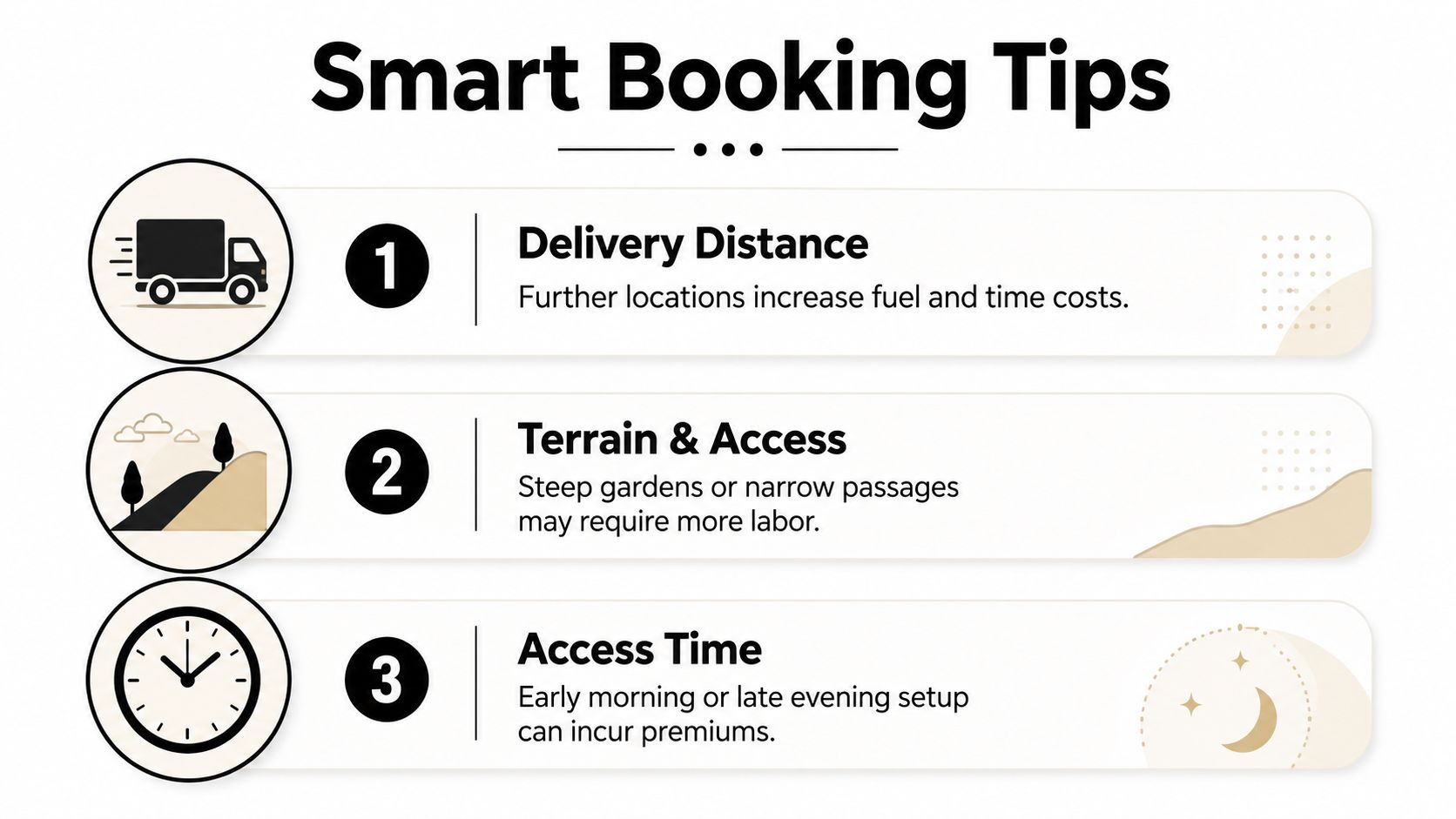
The headline rate on a quote is not the full story. In Cape Town event hire, the final cost is shaped by delivery distance, terrain, access time, and how much handling the table needs before it's ready for guests. That's why two tables with the same rental line can end up feeling very different on the invoice.

What really moves the price

A venue with easy driveway access is simpler than a wine estate lawn with a long walk from the loading area. Early morning setup and late evening collection can also change labour demands, especially when the event site has limited access windows. If you're renting more than one furniture category, bundling them into one delivery is usually smarter than splitting the job across separate drops.

For layout pre-planning, a simple garden sketch in the spirit of the best free garden design software from OutdoorBrite can help you visualise spacing before you ask for a quote, especially if the event sits on a lawn or in a marquee.

Three booking moves that save trouble

  • Book early for Friday to Sunday dates: those are the slots that disappear first.
  • Bundle compatible items: tables, chairs, and LED furniture often make more sense on one truck.
  • Be honest about access: if the setup involves slopes, narrow paths, or long carries, say so before the quote is final.

Don't underquote the venue

Marquee events and estate functions are where people get caught out. A room can look simple in a photo and still be awkward on the day because of steps, soft ground, or obstructed access. If the supplier doesn't know that, the quote is only half the job.

If you want to read a quote properly, look past the table line and ask which line items are tied to transport, labour, and timing. That's where the difference sits.

An infographic titled Smart Booking Tips, listing factors like delivery distance, terrain, and access time for services.

FAQs on Hiring a 10 Seater Table in Cape Town

How long does setup take

It depends on access, not just the table itself. A straightforward hall setup is quick, but once you add a marquee, a lawn, or a venue with narrow loading access, the job slows down because labour has to carry and place everything carefully. Ask the supplier whether the quote includes placement or just delivery.

Will a 10 seater table work under a stretch marquee

Yes, if the marquee footprint is planned properly. A round table can feel generous in an open tent, while a rectangular one usually behaves better where side space is tight. If the stretch tent has poles, curves, or uneven edges, rectangular is normally the safer choice because it gives you more control over the remaining floor.

How should I light it for a night event

Use lighting to support the table, not drown it. Soft overhead ambience, warm accent lights, and a clear centrepiece work better than harsh direct light that flattens the decor. If you're adding LED furniture, keep the glow around the room's perimeter so the table remains the visual anchor.

What does a 10 seater rental cost in Cape Town

I'm not going to invent a number for you. Rental cost depends on table style, delivery distance, venue access, and whether you need extras like chairs, linen, or LED pieces. The right way to price it is to compare like-for-like quotes and confirm whether transport and handling are already included.

If you only ask for the table rate, you're missing the part that usually changes the total.

Use the fit-check, choose the shape that suits the venue, and ask the supplier to explain any access-related charges before you book. That's the fastest way to stop a simple table from becoming a setup problem.


If you need a 10 seater table for a Cape Town wedding, Winelands lunch, matric dance, or corporate function, ABC Hire can supply event tables, chairs, and matching furniture for a proper floor plan, not a guess. Visit ABC Hire to check what's available and book the right table shape before the date you want is gone.

Bubble House for Sale: Your 2026 Cape Town Buyer’s Guide

You've searched bubble house for sale because you want something memorable. Maybe it's a wedding feature in Franschhoek, a brand activation in Cape Town, or a private celebration that needs more than another standard marquee. The gap is that individuals searching this phrase often look for two very different things, and South Africa treats them very differently.

One is the dream: an iconic round architectural home, the kind you see on international design feeds. The other is the product you can realistically use here: an inflatable clear bubble tent for events. If you don't separate those two ideas early, you waste time chasing a product that isn't showing up in the local property market, or you buy the wrong event structure for Cape wind, venue rules, and practical use.

Dreaming of a Bubble House in Cape Town

Cape Town is exactly the sort of place that makes the bubble-house idea irresistible. Ocean views. Mountain backdrops. Vineyards. Glassy sunsets. If you're planning a luxury wedding, a proposal setup, or a photo-driven event, a bubble structure sounds like the perfect fit.

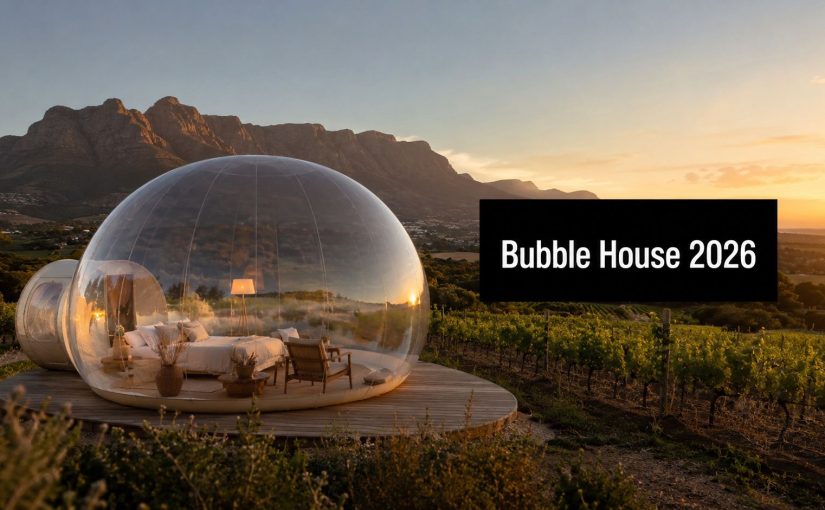
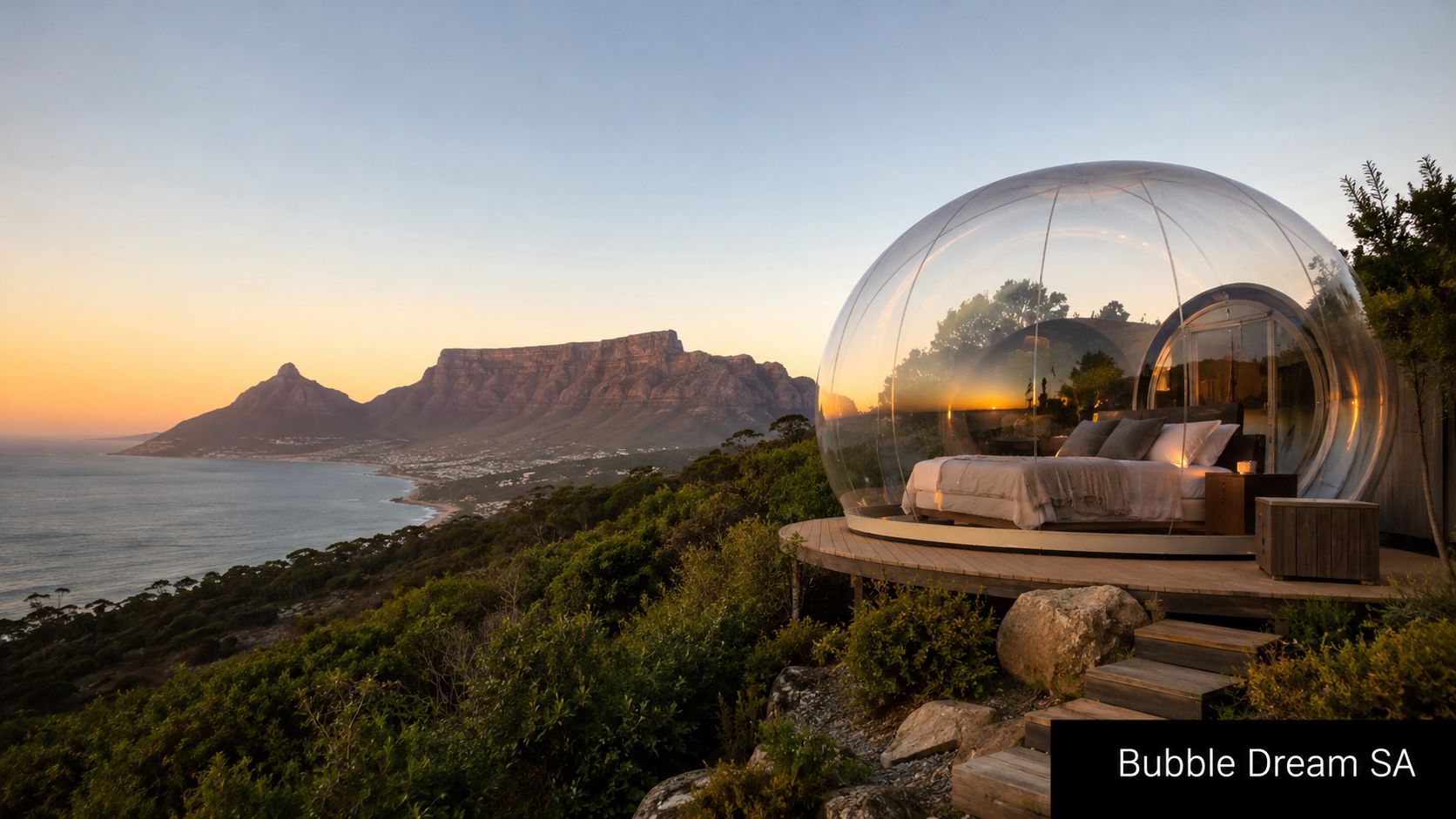
A luxurious transparent bubble dome bedroom overlooking the ocean and Table Mountain in Cape Town at sunset.

What most buyers mean when they search

In practice, people usually mean one of these:

  • A permanent statement home with rounded architecture and a futuristic look
  • A venue feature for weddings, birthdays, or proposals
  • A branded event space for launches and activations
  • A rentable visual experience that looks premium in photos

That confusion isn't theoretical. In the South African market, most content around bubble houses blends event rentals with permanent structures, which leaves couples and planners unclear about whether they can buy one for a venue or only rent one. Local listings such as Home in 1's inflatable clear bubble house offering are marketed as rentals for events like weddings and showers, not as architectural homes for sale.

A Stellenbosch planner might ask for a bubble house thinking of a romantic overnight structure. A Paarl venue owner might mean a semi-permanent feature for ceremonies. A brand team in the CBD might need a transparent dome for one weekend. Those are three different procurement decisions.

Practical rule: If your main goal is atmosphere, photos, or a temporary guest experience, you're not shopping for a house. You're shopping for an event structure.

Why this distinction matters in the Winelands

In the Winelands, the wrong assumption creates expensive problems. A permanent dwelling involves planning, engineering, foundations, compliance, and long-term maintenance. An inflatable event bubble involves transport, blower setup, anchoring, weather judgement, and venue permission.

The visual overlap fools people. Both can look rounded, clear, and dramatic. But one is a property purchase category. The other sits much closer to tenting, event hire, and temporary installation.

If you're trying to solve a real event need in Cape Town, Stellenbosch, Franschhoek, or Paarl, the smart move is to stop searching for the fantasy object and define the use case first. Overnight accommodation, ceremony cover, lounge zone, branded activation, kids' play feature, or photo booth. Once that's clear, the market gets much easier to manage.

Permanent Dream vs Inflatable Reality

The cleanest way to approach a bubble house for sale search in South Africa is to split the category in two.

The first category is the permanent architectural bubble home. The second is the inflatable event bubble tent. They share a visual language, but that's where the similarity mostly ends.

What exists in the market

There are no recorded sales of a “Bubble House” in the South African real estate market, based on the absence of such listings in national property databases and major portals, as noted in this South African property market reference. If you're searching local residential listings hoping to find an iconic circular bubble home in Cape Town or the Winelands, you're not missing a hidden niche. It isn't appearing as a recognised tradable residential product.

Internationally, the best-known example in the current conversation is the Michigan Bubble House, but that's useful mainly as a reminder that the architectural version is an overseas curiosity, not a local buying category.

Permanent Bubble Home vs Inflatable Bubble Tent

Attribute Permanent Architectural Bubble Home Inflatable Event Bubble Tent
Purpose Residential or long-term architectural use Temporary events, styled setups, activations
Availability in South Africa No recorded sales in local property databases Available through event suppliers and rental channels
Mobility Fixed structure Portable and relocatable
Installation Construction project with approvals and engineering Event setup with blower, anchoring, and site prep
Use case Living, hospitality, landmark property Weddings, parties, launches, photo moments
Weather strategy Built into structural design Depends heavily on anchoring, placement, and event-day conditions
Ownership model Property purchase Usually better suited to hire or occasional purchase
Buyer profile Property developer, specialist owner-builder Planner, venue, host, activation team

Where buyers go wrong

The biggest mistake is comparing these options as if they sit on the same decision tree. They don't.

A permanent bubble home is closer to commissioning a niche build than buying a tent. You'd be dealing with land use, structural design, compliance, contractors, and a build methodology that's unusual in the South African residential market. That's why search demand doesn't translate neatly into property listings.

An inflatable bubble tent is much more straightforward. You can source one, transport it, inflate it on site, style it, and remove it after the event. That doesn't make it simple, but it does make it real.

If your event is in the Winelands and your date is already locked, the inflatable route is the only route that behaves like a normal event procurement decision.

The useful decision filter

Ask one question first: Do you need a place to live, or a place to host an experience?

If it's the second, stop evaluating bubble homes and start evaluating event tents. That one shift saves weeks of false research and pushes you toward the details that matter, such as material quality, blower reliability, anchoring method, storage, and venue permission.

Choosing Your Inflatable Bubble Tent

What does the right bubble tent look like for a Cape Town event once you stop searching for a fantasy “bubble house” and start buying a working event structure?

It starts with the job the unit must do on site. A proposal dome at a Clifton villa, a tasting lounge in Stellenbosch, and a branded activation at a city venue may all use clear inflatable structures, but they do not need the same entrance design, blower setup, or wear tolerance. Buyers who choose on appearance first usually pay for it later in setup time, guest flow problems, or material damage after only a few uses.

Use case should drive the shortlist.

A photo-led installation benefits from a cleaner profile and minimal visible hardware. A guest lounge needs easier access, better ventilation planning, and enough usable floor area for furniture without making the dome feel cramped. Brand activations need repeatable setup, practical power routing, and surfaces that still look good after heavy foot traffic. If you are comparing options across the wider event market, this guide to different types of event tents helps place a bubble tent in the right category rather than treating it as the answer to every brief.

Material quality shows up fast in Cape conditions

Transparent PVC always looks impressive in product photos. The real test is how it performs after transport, inflation, sun exposure, cleaning, and pack-down.

In Cape Town and the Winelands, clear material takes strain from UV, dust, grass stains, damp morning setups, and frequent handling. If the PVC is too thin or poorly finished, it marks easily, loses clarity, and starts looking tired long before the unit has paid for itself. Buying guidance from Inflatable-Zone's bubble tent overview notes that thicker commercial-grade PVC is generally preferred for repeat event use because it holds shape better and handles wear more reliably than lighter novelty-grade material.

Ask direct questions before you buy. What is the PVC thickness? Is it intended for commercial hire stock or occasional private use? How are the seams finished? Can you get matching repair patches locally, or will every minor repair turn into a parts chase?

The specification sheet matters more than the promo photos

Good buyers spend time on the boring details because those details affect every setup.

  • Blower pairing: The blower must match the unit properly for stable inflation and presentable shape.
  • Entrance style: Tunnel entry, zipped opening, or airlock-style access changes guest movement and styling options.
  • Anchoring layout: Anchor points should be clearly positioned and suited to the surfaces you use.
  • Power requirements: You need realistic cable planning, especially at vineyards and private homes where power points are not always close.
  • Pack-down logic: Clear domes that are difficult to dry and fold become expensive to own.
  • Repair support: After-sales guidance, patch kits, and spare components matter more than a low headline price.

One practical point often gets missed. A bubble tent that works well on a level lawn can be awkward on gravel, paving joints, or mixed surfaces. That comes up often at Cape venues where the pretty setup area is not always the easiest technical setup area.

Shape should match the event format

Different layouts solve different operational problems.

Format Best fit Main caution
Single clear dome Proposals, styled shoots, intimate lounge setups Heat build-up and condensation need active management
Tunnel-entry dome Guest arrivals, premium experiences, controlled access Takes more discipline to position and inflate cleanly
Multi-zone inflatable layout Brand activations, kids' experiences, interactive spaces More components mean more setup complexity and more points of failure

For venue owners and planners, the safest choice is usually the model that covers your repeat work, not your most aspirational booking. If the dome will spend most of its life doing styled photo moments, small luxury installs, or occasional cellar-door activations, buy for that pattern. Transparent inflatables are high-maintenance stock. They reward careful handling and punish casual ownership very quickly.

Budgeting the True Cost of Ownership

How much does a bubble house for sale really cost once it lands in Cape Town?

This is the point where the local confusion starts. Buyers searching for a permanent bubble home in South Africa usually end up looking at event-grade inflatable domes instead. Those are two completely different purchases. In the Cape Town and Winelands market, the money question is rarely just the unit price. It is transport, labour, storage, maintenance, power planning, and how often the tent earns its keep.

The listed price is only the starting point

A clear inflatable dome can look affordable on a supplier page and still become expensive stock to own. The cost sits around the tent, not only inside the invoice.

Expect to budget for:

  • Freight and offloading to Cape Town or the Winelands, especially for imported units
  • Clean, dry storage with enough room to prevent careless folding and pressure damage
  • Cleaning time and materials to keep the PVC clear enough for photographs and guest-facing use
  • Consumables and repairs such as patching materials, replacement fittings, and seam work
  • Blower contingency if the primary unit fails before or during an event
  • Setup labour from people who know how to anchor, tension, and present the dome properly

Professional installation is often treated as optional. In practice, it is often the difference between a dome that photographs well and one that looks creased, cloudy, or unstable. For buyers comparing ownership with event-by-event hiring, it helps to benchmark against broader tents for hire pricing and use cases rather than focusing only on the purchase figure.

Labour and downtime catch owners off guard

The biggest ownership mistake is assuming the dome will look after itself between bookings.

It will not.

Someone needs to inspect it after every use, test the blower before loading, check anchoring points, manage extension cables safely, supervise pack-down, and make sure the material is fully dry before storage. If that work falls to an untrained in-house team, the savings disappear quickly. If it falls to a contractor each time, ownership starts to look a lot like repeated hire costs.

I see this often with Cape venues that buy for one high-impact season, then discover the dome is only suitable for a narrow set of bookings. A proposal setup on a lawn is one thing. A public-facing activation in wind, dust, or mixed surfaces is another. The prettier the dome needs to look, the stricter the operating discipline needs to be.

Budget for the boring costs

The boring costs are the ones that damage margin.

Power backup matters. Call-out labour matters. Vehicle space matters. So does the lost booking if the dome comes out of storage marked, damp, or missing a working component. Imported inflatable stock can also mean slower turnaround on spares, which matters if your calendar is tight over wedding season.

For businesses marketing these structures online, clear wording also matters. Sellers who blur the line between fantasy housing searches and temporary event products create the wrong leads. The same principle shows up in digital visibility work such as optimizing local search for estate agents. Precise intent brings better enquiries. In this niche, that means saying clearly whether you are selling an event dome, not implying a permanent bubble home that the local market does not really offer.

A practical ownership test

Before buying, answer four questions carefully:

  1. Will the dome be used often enough to recover storage, maintenance, and labour costs?
  2. Do you have a trained team and a backup blower plan?
  3. Can you store it properly through damp weather and quieter months?
  4. Does your booking mix suit an inflatable event structure, rather than the idea of a permanent bubble house?

If the answers are weak, renting is usually the cleaner decision. If the dome will be used repeatedly by a disciplined venue, planner, or activation company, ownership can make sense. In this category, profit usually comes from operational discipline, not from getting the lowest purchase price.

Site Prep Permits and Local Regulations

Can your site take a bubble structure, and will the venue, insurer, and municipality allow it on the day?

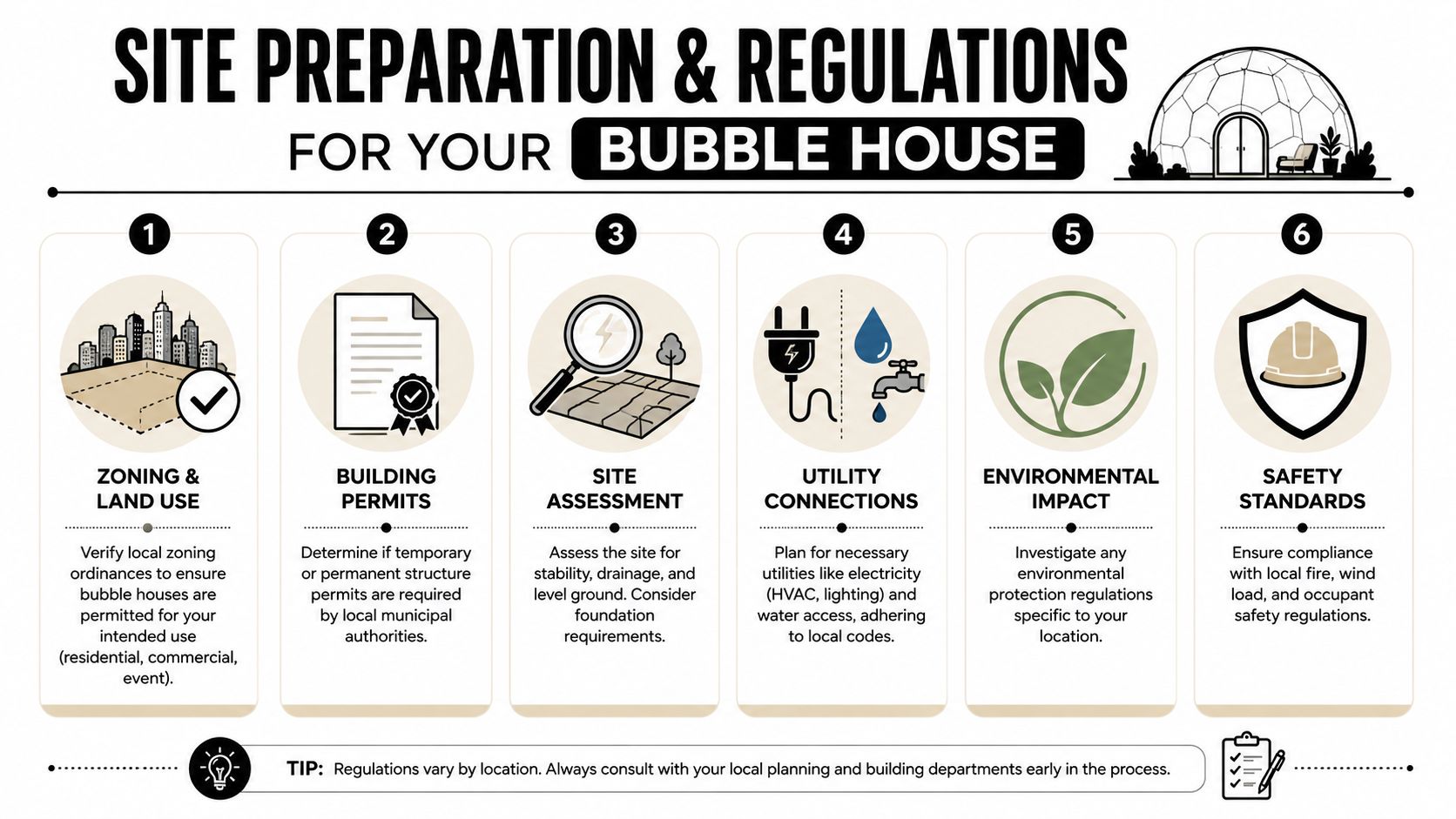
A six-step infographic guide detailing site preparation and regulatory requirements for setting up a bubble house.

In Cape Town and the Winelands, many buyers realise they are not dealing with a quirky “house” purchase at all. They are dealing with a temporary event structure that needs flat ground, safe power, secure anchoring, venue approval, and a realistic weather plan. The search term causes confusion. The site rules remove it quickly.

Start with the ground, not the product

A bubble tent only performs well on a clean, level area with enough working room around it for anchoring, access, and safe guest movement. Manufacturer setup guidance from Bubbling Bubbles makes the same practical point event crews already know. You need extra perimeter space beyond the visible dome itself, and you cannot treat the quoted dome size as the full site requirement.

That catches people out at wine estates and private homes. A lawn may look generous until you account for irrigation heads, sharp gravel edges, planting beds, low branches, cable runs, and the route guests will use. I always assess the full operating area, not just the patch where the dome will sit.

Power needs the same level of attention. The blower must run from a reliable supply, and extension leads cannot become a trip hazard or sit where rainwater collects.

Permanent bubble home rules are a different category

In South Africa, the phrase “bubble house for sale” encompasses two very different things. A permanent dwelling falls into building compliance. An inflatable event dome falls into temporary structure and event operations.

South Africa's residential norms and standards set baseline requirements for formal housing, including minimum floor area and prescribed foundation standards for stand-alone dwellings, according to the National Norms and Standards for residential construction. That alone explains why there is no meaningful local market for ready-made architectural bubble homes for sale. Even before design and engineering costs, you are in full building-regulation territory.

For Cape Town sites, wind exposure also changes the conversation fast. Coastal venues, valley funnels, and exposed farm lawns can be calm at site visit stage and difficult on event day. Temporary domes are far less forgiving than many clients expect.

On a Stellenbosch lawn or Atlantic Seaboard site, wind is not a minor detail. It is often the decision-maker.

What to check with venues and municipalities

Public guidance is patchy, so the organiser has to ask direct questions early. Do not assume an inflatable dome is treated the same way as a standard marquee. Some venues will allow it only in specific positions. Some insurers will ask for extra detail. Some municipalities may want clarity on event setup, public safety, or temporary structure conditions depending on the site and the scale of the function.

The practical route is simple:

  • Get written venue approval: Confirm the exact position, access times, and any restrictions on pegging, ballast, or power use.
  • Ask the local authority the right question: Describe it as a temporary inflatable event structure, not a “bubble house.”
  • Check insurer acceptance: Confirm public liability and whether the structure changes your event cover conditions.
  • Inspect the actual surface: Grass, compacted earth, paving, and gravel all affect anchoring and guest safety differently.
  • Set a weather stop point: Agree in advance who makes the call if wind or rain makes use unsafe.

For venue-side comparisons, this guide to tents for hire in Cape Town gives a more realistic frame for temporary structure planning than dream-home style bubble content. If your marketing or listing language targets unusual property-style searches, optimizing local search for estate agents is a useful example of how precise local wording filters out the wrong enquiries. That matters here because the Cape market rarely offers true bubble homes for sale, while event clients are usually looking for a temporary dome solution.

Buying vs Renting for Your Event The Smart Choice

Should you buy a bubble house for sale in Cape Town, or are you better off renting an inflatable bubble tent for the event you have in mind?

In this market, that distinction matters. A true architectural bubble home is not what event clients in Cape Town, Stellenbosch, Franschhoek, or Paarl are usually buying. They are almost always choosing between renting a temporary inflatable structure for a specific date, or purchasing one and taking on the operational burden themselves.

For most private functions, brand activations, and wedding installations, renting is the safer commercial decision. Ownership only starts to make sense when the structure will be used often enough to justify storage, transport, repairs, and trained setup crew.

Why renting suits most events

The pressure point is not inflation time. It is control on the day. These structures are lightweight, weather-sensitive, and only perform properly when they are anchored, monitored, and used within the supplier's operating limits. The South African Weather Service issues public warnings and forecasts that event teams should treat seriously, especially in the Cape where wind can shift quickly between morning setup and guest arrival.

That is why experienced rental suppliers earn their fee. They are not just sending out a tent. They are managing setup method, ballast, blower requirements, positioning, and the call on whether conditions are still acceptable for use.

What buying really commits you to

A purchased unit can look economical on a spreadsheet, especially if you expect repeat use. In practice, buyers usually underestimate the admin around it.

Ownership means handling:

  • transport to and from each site
  • crew training for setup and pack-down
  • weather monitoring before and during the event
  • drying, cleaning, and mould prevention after use
  • safe storage between bookings
  • repair planning for seams, punctures, and worn fittings

Miss one of those, and the savings disappear quickly.

Rent if the structure supports one event or a short campaign. Buy if it forms part of your operating model and you already have the team, vehicle space, and storage discipline to support it.

Where renting stays flexible

Rental also gives planners better options when the brief changes. A launch in the Winelands may need a different footprint from a beachfront event in Camps Bay. A wedding venue may approve one temporary structure and reject another based on access, lawn protection, or visual impact. If you own one bubble tent, there is a temptation to force it into every brief, even when a different tent form would work better.

That same logic applies to other event equipment. This article on a podium for sale for event use is a useful comparison. Some items are practical to own because they are easy to store and repeatedly usable. Larger, weather-exposed structures often cost more to keep than buyers expect.

Presentation still matters, especially if the event supports a venue brand, development launch, or property-facing campaign. Broader branding thinking can help here. Resources that level up real estate marketing are useful because they focus on how people experience the finished environment, not just the asset list behind it.

The practical answer is simple. If you want the bubble look for a wedding weekend, a matric dance, a product reveal, or a seasonal activation, rent it. If you run events regularly and can support the logistics properly, then buying can work.

Screenshot from https://abchire.co.za

If you're planning an event in Cape Town, Stellenbosch, Franschhoek, or Paarl and want the bubble-house look without the buying mistakes, ABC Hire can help you choose the right event setup for your venue, guest flow, and weather realities. Their range of event furniture, tenting support, and styling-ready hire stock makes it easier to build the experience you want, with practical guidance that fits local conditions.

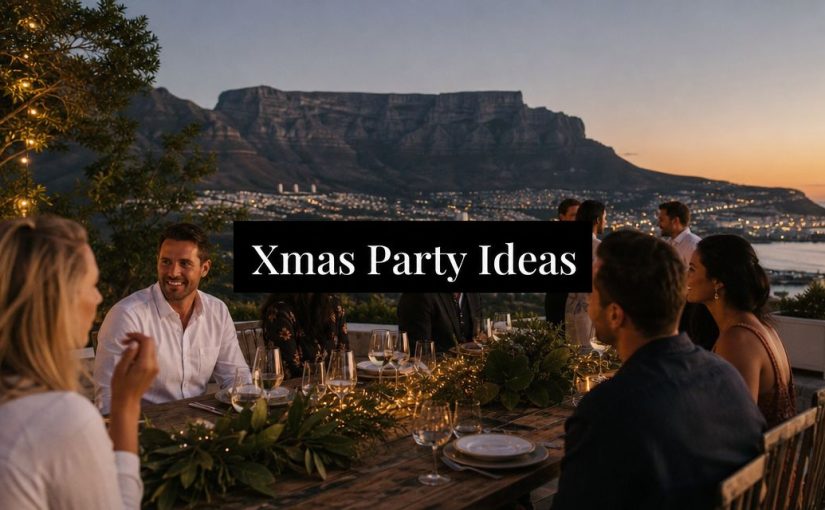
10 Unforgettable Xmas Party Ideas for Cape Town 2026

Planning the perfect Cape Town Christmas party starts here. The year is drawing to a close, and the task has probably landed on your desk at the same time as budgets, guest lists, venue emails, and a dozen “quick questions” from stakeholders. Whether you're pulling together a corporate year-end function, a family celebration in the Winelands, or a polished client event, the pressure is the same. It has to feel festive, look considered, and run smoothly on the night.

Generic tinsel and a Bluetooth speaker won't carry a December event in the Western Cape. Cape Town and the Winelands have their own rhythm. December bookings bunch tightly into the final weeks of the year, and that's when venues, caterers, and rental suppliers feel the most pressure. Holiday planning also sits inside a broader year-end spending cycle, with demand concentrated in the final 6 to 8 weeks of the year, which is exactly why late decisions tend to hurt availability and flexibility (Drive Research on Christmas spending seasonality).

The good news is that strong Xmas party ideas don't need to be complicated. They need to be right for the venue, realistic for the weather, and supported by the right rental equipment.

Below are 10 practical ideas that work in Cape Town, Stellenbosch, Franschhoek, Paarl, and the surrounding Winelands. Each one is designed to be executable, stylish, and flexible enough to handle real event conditions.

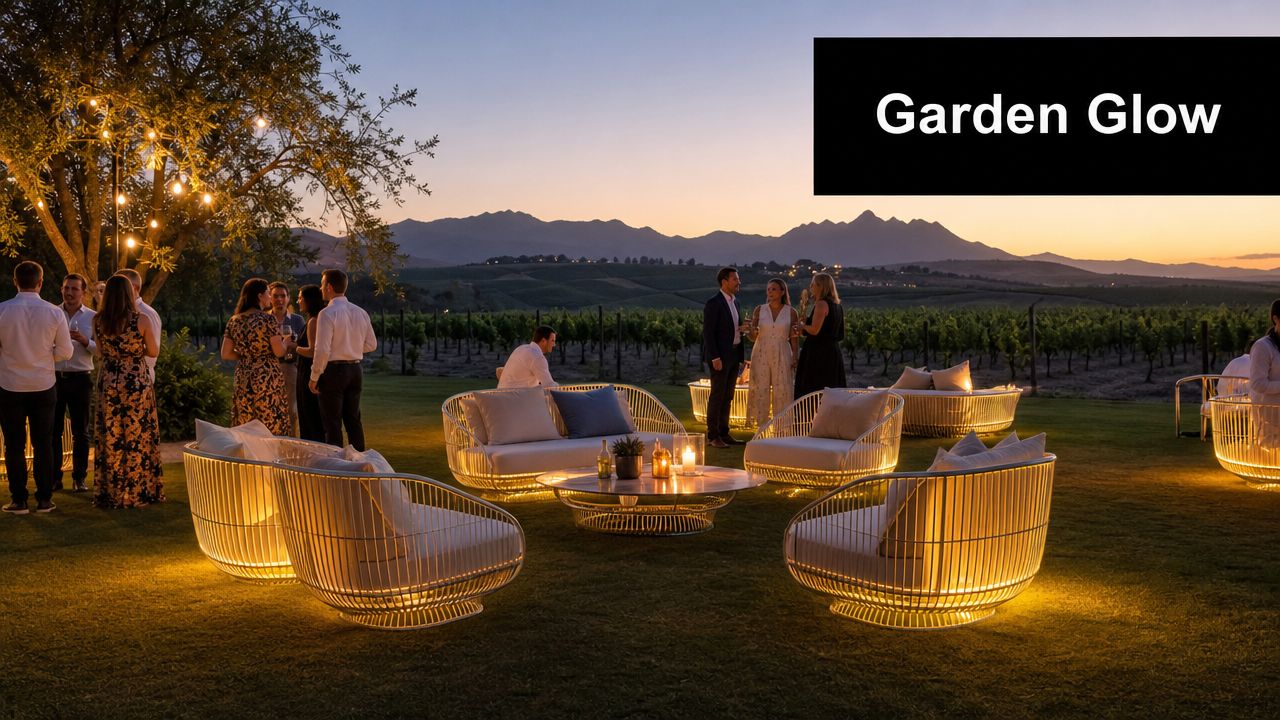
1. Festive Garden Party with LED Furniture

A garden party is still one of the strongest Xmas party ideas in the Western Cape, but only when it's designed for the way guests use outdoor space. People don't stand in one neat cluster under a tree. They break into smaller groups, drift toward the bar, and settle where the lighting feels flattering and the seating feels easy.

That's where LED furniture earns its keep. Instead of adding separate decorative pieces and then solving lighting afterwards, use illuminated cocktail tables, LED cubes, loungers, and bar units as part of the functional layout. You get seating, atmosphere, and visual impact in the same footprint.

A group of people enjoying an elegant evening garden party with modern glowing furniture at sunset.

How to make it work

For a Winelands estate gala, place LED loungers in conversation pockets rather than in one large line. At a corporate year-end event in Cape Town, use glowing high tables near the drinks area and softer lounge seating on the perimeter. At a private Franschhoek villa, fewer pieces placed with intention usually look better than trying to fill every corner.

Warm white usually lands better than colour-changing effects for Christmas. If the brief is more modern, use colour in one area only, such as the bar or entrance moment, and keep the rest clean.

Practical rule: Let the LED furniture do part of the decorating job. If you overload the garden with extra décor, the space starts to feel busy instead of premium.

A curtain of fairy lights behind the bar or photo area adds depth without making the whole setup feel gimmicky. This is one of those details that works especially well when paired with glowing furniture, and fairy light curtain styling ideas can help you keep it elegant.

What doesn't work is treating LED pieces as random novelties. If they're scattered without a seating plan, guests admire them for five minutes and then ignore them.

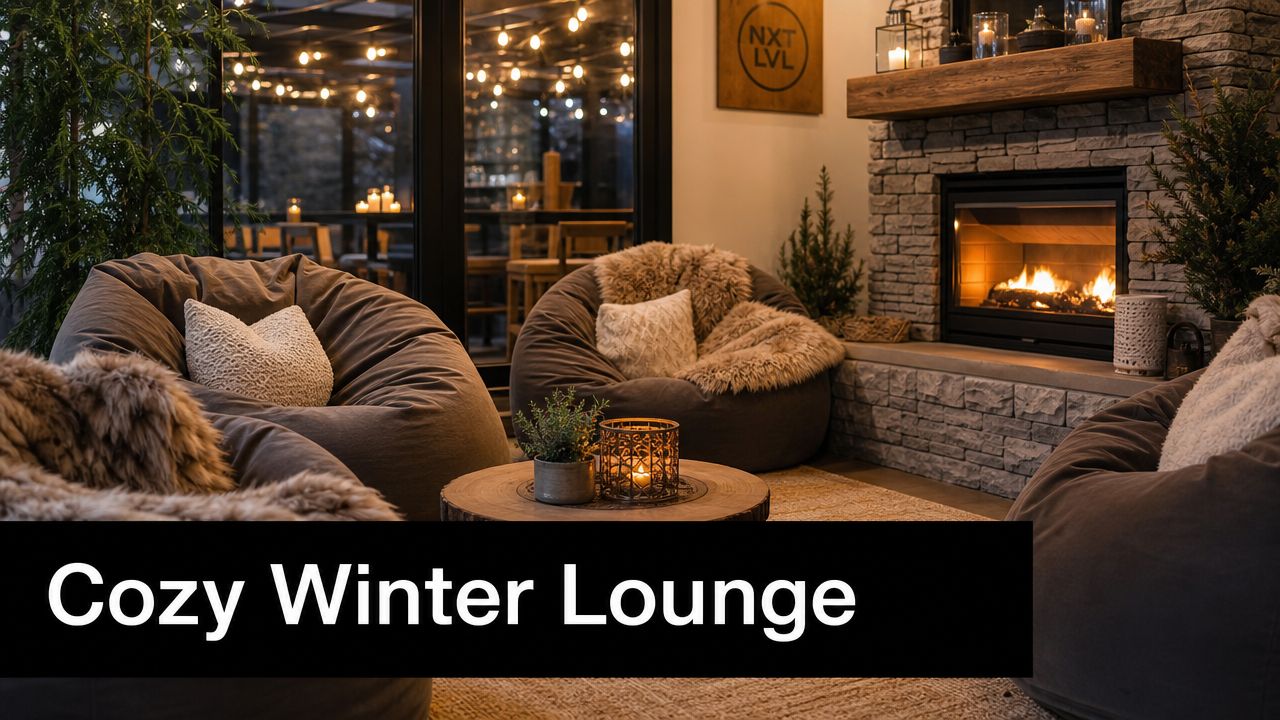
2. Winter Wonderland Lounge Setup

The phrase “winter wonderland” sounds imported, but the format works beautifully in Cape Town when you interpret it as a cool, layered lounge rather than fake snow and theatrical props. Think texture, intimate seating, soft pools of light, and a layout that invites conversation.

This is ideal for hotel terraces, covered courtyards, cellar venues, and semi-indoor spaces in the Winelands. It's also one of the safest Xmas party ideas for teams who want atmosphere without going full theme party.

A cozy lounge area featuring comfortable bean bag chairs arranged around a fireplace for holiday atmosphere.

The layout matters more than the theme

For larger guest counts, create multiple lounge zones instead of one oversized seating island. A single dense setup looks good in a photo and fails on the night because guests on the outer edge disengage from the room. Smaller clusters with low tables hold drinks, canapés, and gift items better.

Use bean bags selectively. They're brilliant in relaxed corners, youth-focused events, and informal staff functions, but they shouldn't dominate a corporate room where guests are dressed formally. Mix them with standard lounge chairs, ottomans, and coffee tables so the setup still feels polished.

A few details make the difference:

  • Layered seating: Combine soft seating with upright chairs so guests can choose comfort or posture depending on the moment.
  • Warm light: Lamps, LED accents, and candle-style lighting create a better mood than harsh overhead venue lighting.
  • Useful tables: Every lounge cluster needs somewhere to put a drink. If you skip that, people stand instead of settling.

What doesn't work is over-styling the space with too many winter clichés. In South Africa, guests respond better to comfort than to forced seasonal references.

3. Outdoor Festive Market-Style Event

If your guest list includes mixed age groups, multiple departments, or clients who don't all know each other, a market-style event usually outperforms a formal dinner. Guests can move, browse, snack, and socialise without the pressure of assigned seating.

This format suits courtyards, estate lawns, urban rooftops, and venue forecourts. It also works well for brand activations because people naturally circulate between food points, beverage stations, and product moments.

Why movement improves the atmosphere

Static events go flat quickly. A market-style setup keeps the room alive because there's always somewhere else to move next. High tables near food stations, shared standing tables in the centre, and a few relaxed seating pockets around the edges create a natural rhythm.

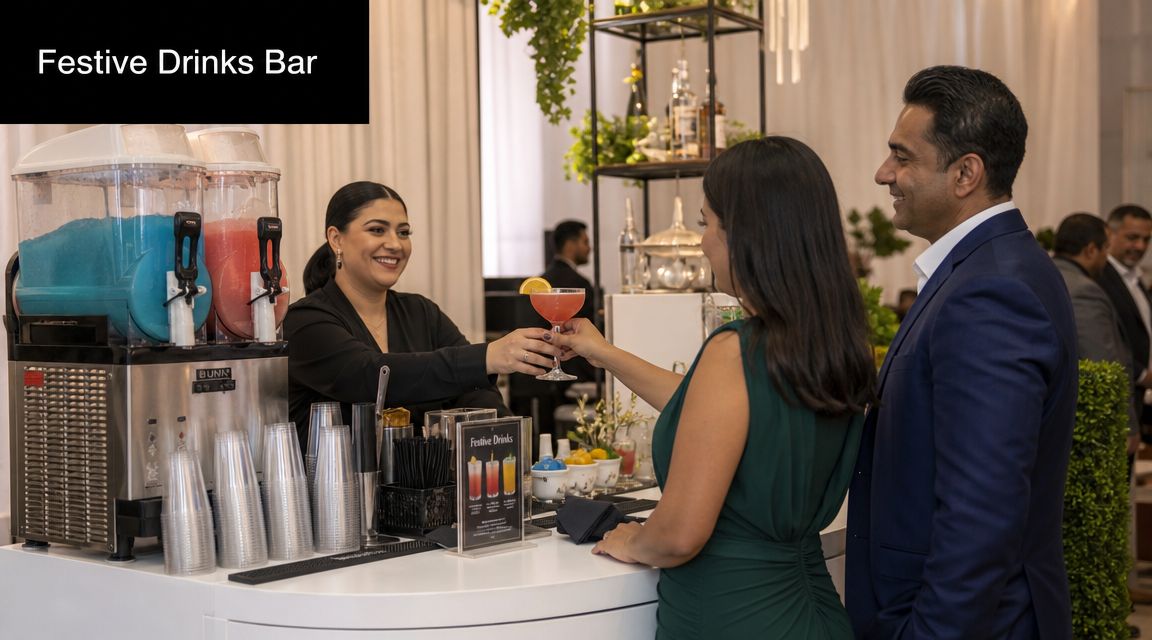
If you're planning one of these for a Cape Town corporate crowd, give the event a clear anchor. That might be a festive food lane, a dessert station, or a signature drink point with slush machines in seasonal colours. The event feels curated when there's one memorable focal point instead of many equal ones competing for attention.

Use a mix of:

  • Bar-height tables: Best near drinks and quick networking areas.
  • Lower seating pockets: Useful for older guests, family groups, and anyone staying longer.
  • Clear pathways: Leave enough room for catering staff and guests carrying plates.

Guests stay longer when they can choose their own pace. That's the real strength of this format.

What doesn't work is going all-standing with nowhere to sit. Even energetic events need relief points. If guests can't perch, pause, or set something down, they leave earlier than planned.

4. Climate-Controlled Marquee Christmas Celebration

Some of the best Cape Town Xmas party ideas happen outdoors. Some of the worst mistakes happen when organisers assume outdoor means simple. December in the Western Cape can be glorious, windy, hot, or unexpectedly cool after sunset, sometimes all in the same event window.

A marquee solves the exposure issue, but only if you treat it as a real venue with power, airflow, access, and zoning. A bare tent with fairy lights is not a plan. A properly dressed marquee with cooling, lighting, flooring, furniture, and backup thinking is.

Build for comfort first

Start with thermal comfort, not décor. Guests notice heat immediately, and they remember it long after they've forgotten the centrepieces. South African festive planning is increasingly shaped by climate and electricity resilience, so shade, airflow, backup power awareness, and timing all matter more than many imported Christmas guides admit (Event Solutions on alternatives and planning realities).

Inside the marquee, combine lounge areas with standing zones so the room doesn't feel like a wedding reception unless that's the brief. Clear-sided structures work especially well on estates because you keep the vineyard views and evening glow.

Portable climate equipment and LED pieces are a smart pairing. Low-draw LED furniture helps maintain atmosphere without loading the power plan with unnecessary decorative strain.

If you're using a tented setup for a gala or a large private celebration, marquee and tent hire guidance for parties is worth reviewing early, before you confirm entertainment and catering positions.

What doesn't work is adding cooling as an afterthought. By then, table plans, cables, bars, and service routes are already fixed, and every solution becomes messy.

5. Interactive Beverage Station Party

A beverage station can carry an entire event if it's handled properly. It gives guests something to do, somewhere to gather, and a visual moment that photographs well without forcing a theme.

For Cape Town corporates, this is one of the easiest Xmas party ideas to tailor to the audience. You can keep it polished with premium glassware and restrained styling, or make it playful with frozen drinks, colour-led garnishes, and festive naming.

A friendly bartender serves a festive pink cocktail to a woman in a green dress at a bar.

Keep the menu focused

Too many choices slow service and dilute the idea. A better approach is a small menu done well. One frozen option, one signature non-alcoholic option, and one or two fast bar classics usually beat an overbuilt list.

This is also where inclusive planning matters. South African festive events increasingly need alcohol-free options, dietary awareness, and formats that don't exclude guests who don't drink. That's one of the most overlooked practical gaps in holiday party planning content, and planners who solve it well immediately create a stronger event experience (PowerToFly on more inclusive holiday parties).

A good beverage station setup should include:

  • A clear front counter: Guests must understand where to order and where to collect.
  • A non-alcoholic hero drink: Not an afterthought. It should feel as considered as the cocktail option.
  • Separate garnish space: This keeps the bar from clogging during peak arrivals.

Don't hide the alcohol-free station at the back. If it looks second-rate, guests read that message immediately.

What doesn't work is turning the drinks area into a bottleneck. Position the bar away from venue pinch points and keep surrounding furniture loose enough for queue spillover.

6. Elegant Seated Dinner with Statement Furniture

Some events still need the discipline and ceremony of a seated dinner. Executive teams, milestone family celebrations, and premium client evenings often land better when guests are hosted properly at the table.

The mistake is assuming “formal” has to mean stiff. The strongest seated Christmas dinners in the Winelands feel structured but relaxed, with statement chairs, generous spacing, and lighting that flatters both the tablescape and the room.

Where to spend your effort

Start with the chair selection. Guests sit on it for most of the evening, and it's one of the largest visual elements in the room. If the chairs look cheap or don't suit the venue architecture, no floral arrangement will rescue the overall feel.

Then focus on proportion. At estate venues in Stellenbosch or Franschhoek, long tables can look spectacular, but only when service access has been considered. Round tables are often easier for conversation, but they need enough space between them to avoid the room feeling cramped.

The wider Christmas décor market remained substantial, at over USD 7 billion in 2023, which tells you appetite for festive spectacle is still very much alive (Statista on the global Christmas decorations market). In local execution, though, spectacle works best when translated into efficient lighting and furniture choices rather than high-draw decorative clutter.

Use:

  • Uniform premium chairs: They instantly sharpen the room.
  • Intentional lighting: Uplighting, table lighting, and soft ambient wash beat a bright general flood.
  • A restrained centre line: Let guests see one another across the table.

What doesn't work is squeezing in extra tables to increase numbers. That decision nearly always damages service, comfort, and the premium feel.

7. Festive Kids' Zone with Activity Seating

When children are part of the guest mix, they need their own environment. Not a token craft table in the corner. A properly planned zone with age-appropriate seating, activity surfaces, shade, and supervision changes the entire mood of a family event.

Corporate family days, school celebrations, and Winelands lunches all benefit from this. Adults relax more when children are engaged, and the event stops feeling like a compromise between two audiences.

Design it for use, not just for looks

Bean bags, low tables, and washable seating work well because children move constantly between sitting, kneeling, colouring, snacking, and chatting. The area should feel festive, but practicality matters more than perfection. If it's precious, it won't survive the first half hour.

Set it slightly apart from the main adult area but still within sightlines. Parents don't want the kids' zone on another side of the property, and entertainers don't want it directly inside the bar traffic.

Useful add-ons include:

  • Craft tables: Best for colouring, card-making, and quieter activities.
  • Soft seating corners: Ideal for younger children who need downtime.
  • Snack points: Keep simple food and water nearby so children aren't constantly moving back into the main event.

If you want to round out the food offering visually, even a simple display inspired by Italian party food from IFM can spark ideas for a brighter, family-friendly station.

What doesn't work is borrowing adult furniture and hoping children will adapt. They won't. Their zone needs to be built for their size and energy.

8. Networking Christmas Cocktail Reception

Not every Christmas function should feel like a party first. Some need to support introductions, client hospitality, and internal relationship-building without losing the festive layer. That's where a cocktail reception format wins.

This is especially strong for agencies, property groups, professional services firms, and business associations in Cape Town. Done right, it feels social without drifting into chaos.

Use furniture to guide behaviour

Networking doesn't happen because you tell people to mingle. It happens because the room gives them easy places to pause, join a conversation, and leave it gracefully. Bar tables are one of the best tools for that because they create low-commitment gathering points.

Scatter them evenly, but don't make the room too symmetrical. A perfect grid feels rigid. A more natural spread, anchored by the bar and a few food touchpoints, gives the space a better social flow. If you need inspiration for styles and practical placement, Cape Town bar tables and chairs for events offers a useful starting point.

A few small additions can soften the corporate edge. One interactive station, one festive photo corner, or a family-friendly side activity can help if the audience mix is broader. Even browsing creative holiday activities for children can spark ideas for a lighter breakout area at more inclusive receptions.

A networking event fails when everyone ends up standing in one dense knot near the bar.

What doesn't work is over-seating the room. Too much lounge furniture encourages guests to settle into closed groups and stay there.

9. Bohemian Garden Christmas Celebration

For creative teams, younger hosts, and clients who hate anything that feels corporate, a bohemian garden format can be the right answer. It keeps the celebration festive without relying on obvious Christmas tropes.

This style works well in gardens, courtyards, olive groves, and laid-back Winelands spaces. Mixed seating, rugs, textured cushions, low tables, lanterns, and layered lighting all help create depth. The effect should feel assembled, not manufactured.

Controlled looseness is the trick

The room must look relaxed, but the planning behind it can't be. If you mix too many furniture styles without a unifying palette, the setup reads as random. Use one colour family across cushions, florals, and table details so the space still feels curated.

This is also where rentals are smarter than buying. The broader party supplies category was valued at USD 15.80 billion in 2024 and is projected to reach USD 33.04 billion by 2033 at an 8.54% CAGR, a sign that experiential spend continues to grow and that modular, reusable event assets fit the direction of the market (Straits Research on the party supplies market). For Cape Town planners, that supports using rental lounge sets, lighting, and climate gear rather than buying one-off décor that won't scale or store well.

A strong boho Christmas setup usually includes:

  • Mixed-height seating: Low lounges with a few upright chairs for comfort balance.
  • Layered lighting: Lanterns, festoon, LED accents, and candles at different levels.
  • Natural materials: Timber, woven textures, and greenery stop the room from feeling synthetic.

What doesn't work is leaning so hard into “boho” that guests have nowhere practical to eat, drink, or sit properly.

10. Alfresco Winelands Estate Christmas Dinner

If the brief is premium, and the venue has the views to match, an alfresco estate dinner is hard to beat. Long tables on a terrace, vineyard rows catching late light, a calm service style, and a layout that lets the natural setting contribute to the ambiance. It's one of the most memorable Xmas party ideas available in the Western Cape.

It's also one of the easiest to get wrong. Outdoor dinners look effortless only when logistics have been handled thoroughly.

Respect the venue and the sunset

At a Stellenbosch or Franschhoek estate, furniture should complement the architecture rather than compete with it. Clean lines, good linens, and elegant dining chairs usually outperform fussy décor. Let the wine, setting, and food carry the mood.

Time matters here. Guests should arrive while there's still enough daylight to appreciate the property, then move naturally into dinner as the light softens. Once darkness lands, layered table lighting and discreet ambient lighting keep the atmosphere intact without flattening the environment.

Think carefully about backup planning. Even when the weather looks stable, an estate dinner still needs a contingency path for wind, temperature shifts, and power-sensitive equipment. Cooling earlier, warmth later, and a service route that still works after dark are part of the complete plan.

A premium alfresco dinner works best when:

  • The table plan respects the view: Don't turn guests away from the scenery if that's the venue's main asset.
  • Service access is protected: Staff need clean movement paths from kitchen to table.
  • Rental quality matches the venue: Budget furniture inside a luxury setting is immediately visible.

What doesn't work is trying to “out-decorate” the Winelands. If the estate is beautiful, support it. Don't fight it.

Comparison of 10 Christmas Party Ideas

Concept Implementation Complexity 🔄 Resource Requirements ⚡ Expected Outcomes 📊⭐ Ideal Use Cases 💡 Key Advantages ⭐
Festive Garden Party with LED Furniture Medium, power planning and weather checks required 🔄 LED furniture inventory, power access, booking lead time ⚡ High visual impact; strong evening ambiance and photo appeal 📊⭐ Evening outdoor gatherings at Winelands estates and twilight events 💡 Dual-purpose furniture + lighting; energy-efficient; Instagrammable ⭐
Winter Wonderland Lounge Low–Medium, modular setup, fabric care needed 🔄 Large quantity of soft seating, lighting layers, climate control if semi-outdoor ⚡ Warm, comfortable atmosphere that encourages long conversations 📊⭐ Indoor or covered corporate/private lounges; intimate gatherings 💡 Highly comfortable and flexible layout; cozy guest experience ⭐
Outdoor Festive Market-Style Event Medium, layout and flow planning; weather contingency 🔄 Many high-top tables and bar stations, staff for stations, possible covers ⚡ Energetic, high-mingling attendance with efficient guest throughput 📊⭐ Large open-air corporate parties, brand activations, markets 💡 Maximizes mingling and capacity; scalable for large crowds ⭐
Climate-Controlled Marquee Christmas Celebration High, marquee installation, HVAC and power coordination 🔄 Tent/marquee, climate systems, power infrastructure, specialist installers ⚡ Weather-independent comfort; consistent guest experience and protected assets 📊⭐ Large corporate galas and premium estate events needing reliability 💡 Ensures comfort in Cape Town summer; protects high-value setups ⭐
Interactive Beverage Station Party Medium, station placement and staffing logistics 🔄 Slush machines, bar setups, trained staff, power and spill mitigation ⚡ High engagement and social media shareability; interactive guest experiences 📊⭐ Corporate receptions, brand activations, experiential private events 💡 Creates memorable focal points; reduces full-service catering need ⭐
Elegant Seated Dinner with Statement Furniture High, precise coordination with catering and seating plans 🔄 Premium dining furniture, tableware, lighting and staffing ⚡ Formal, impressive atmosphere that promotes focused conversation 📊⭐ Executive dinners, premium Winelands celebrations, milestone events 💡 Timeless elegance; supports premium pricing and guest experience ⭐
Festive Kids' Zone with Activity Seating Low–Medium, supervision and safety planning 🔄 Child-height furniture, washable fabrics, activity materials and staff ⚡ Increased family satisfaction; safer, engaged children during events 📊⭐ Family-friendly corporate or private events, estate family days 💡 Keeps families relaxed; inclusive and engaging for children ⭐
Networking Christmas Cocktail Reception Medium, strategic furniture layout for circulation 🔄 High-top tables, bar stations, minimal seating, efficient catering ⚡ Optimizes networking; flexible capacity with cost efficiency 📊⭐ Professional networking events and industry receptions 💡 Maximizes connections; more affordable than seated dinners ⭐
Bohemian Garden Christmas Celebration Medium, curated styling to avoid clutter 🔄 Mixed vintage/contemporary pieces, layered textiles, varied lighting ⚡ Trendy, Instagram-worthy vibe appealing to creative audiences 📊⭐ Creative-industry events, young-professional gatherings, styled estate parties 💡 Highly distinctive aesthetic; encourages creative styling and photos ⭐
Alfresco Winelands Estate Christmas Dinner High, logistics, weather planning, venue coordination 🔄 Estate-appropriate premium furniture, contingency plans, coordination teams ⚡ Luxury, memorable experiences leveraging scenic backdrops 📊⭐ Premium client entertaining, milestone celebrations at Winelands estates 💡 Unforgettable setting; justifies premium pricing and bespoke service ⭐

Your Christmas Party Checklist Bringing It All Together

Choosing the theme is the easy part. Success for a Christmas event in Cape Town or the Winelands comes down to timing, layout, comfort, and supplier coordination. If you leave those decisions too late, even the best Xmas party ideas start collapsing under practical pressure.

The biggest planning mistake I see is treating furniture and equipment as the final decorative layer. In reality, they shape the event from the start. LED furniture affects power planning. Bar tables affect guest movement. Lounge seating affects how long people stay. Climate-control equipment affects whether an outdoor venue feels premium or punishing.

Book early if your event falls in December. That's when year-end functions stack up, and the best venues, caterers, and rental stock are under the most pressure. Once your date is fixed, lock in the essentials first. Venue, rental partner, catering direction, and core event format should come before menu flourishes and decorative extras.

Keep your planning anchored around a few practical questions:

  • What does the venue need to do well? Networking, dining, family hosting, or celebration all require different furniture plans.
  • How will guests move through the space? Arrival, drinks, food service, seating, and departure should feel natural.
  • What happens if the weather turns? Shade, cooling, cover, and backup positioning must be thought through in advance.
  • Is the event inclusive in practice? That means seating variety, alcohol-free options, comfortable access, and formats that don't exclude quieter guests.
  • Can the power plan support the concept? Shared venue power across catering, sound, and lighting is a real issue, especially for summer events. Good execution in South Africa depends on load awareness, thermal comfort, and flexible layouts rather than adding more decorative elements.

One good rule is to build the event around guest comfort first and visual impact second. The two aren't in conflict. In fact, the best-looking events usually feel easy because the practical decisions were handled properly. When seating is comfortable, the lighting is flattering, the drinks flow well, and the room has breathing space, guests experience the party as polished even if the décor is relatively restrained.

Cape Town and the Winelands offer some of the best festive event settings anywhere. Gardens, terraces, barns, courtyards, hotel decks, wine estates, and private homes can all become exceptional Christmas venues with the right rental strategy behind them. Even ideas from outside the local market, such as Modern Yard Landscapes' Austin light services, can be a useful reminder that lighting works best when it supports architecture and atmosphere rather than overwhelming the space.

The short version is simple. Pick a format that suits your audience. Plan for weather and power. Use rental equipment as part of the event strategy, not as a last-minute add-on. Do that well, and your 2026 Christmas party won't just look festive. It will be effective.


If you're planning a Christmas function in Cape Town, Stellenbosch, Franschhoek, Paarl, or the surrounding Winelands, ABC Hire can help you turn the concept into a smooth, stylish event. From LED furniture and lounge setups to bar tables, slush machines, seating, and climate-control equipment, their team understands what local events need to run well in the busiest part of the year.

Your Guide to Renting Bistro Table Chairs in Cape Town

Picture a sunset wedding in the Stellenbosch Winelands or a chic corporate launch party looking out over the Cape Town city bowl. What's the secret ingredient? Intimate, stylish seating that draws people together. Bistro table chairs are often the unsung heroes of these events, doing far more than just providing a place to sit—they shape the atmosphere and spark connection.

The Essential Role of Bistro Chairs in Cape Town Events

When it comes to planning an event, furniture isn't just about filling a space; it's about setting the stage for memories. Bistro table chairs, with their classic look and small footprint, are masters at creating those perfect little pockets for conversation. It's best to think of them not just as seats, but as complete "conversation nooks" for two or three guests to relax and connect. For anyone hosting an event in the Western Cape, that makes them an incredibly valuable tool.

A scenic patio with a wicker bistro table and two chairs overlooking a beautiful mountainous landscape.

This guide is your go-to resource for hiring these iconic pieces from ABC Hire. We’ll walk you through everything, from picking the right style for your venue to getting your layout just right. Our goal is to show you exactly how these simple sets can turn any spot—from a huge wine estate to a sleek city terrace—into an unforgettable setting.

Why Bistro Sets Are a Top Choice

So, what makes bistro sets such a popular choice for events in our area? It all comes down to a perfect mix of practicality and good looks. Their small size means you can place them almost anywhere, letting you make the most of your space without it feeling cluttered. You can easily line them up along a balcony, group them in a garden, or create a relaxed, café-style zone.

The real magic of a bistro set is its ability to create intimacy. Unlike big, formal dining tables, they naturally bring people closer, making them ideal for networking at corporate events or for offering a quiet moment at a busy wedding.

Transforming Spaces with Style and Function

At the end of the day, your seating is a cornerstone of great event design. It directly impacts how your guests move, how comfortable they are, and the overall vibe of the day. For a bigger picture on making your event a hit, check out guides on how to plan a successful event that cover all the moving parts.

As we dive in, you’ll see how choosing the right bistro table chairs is a huge part of that puzzle. For even more seating inspiration, you can explore our comprehensive guide to hiring chairs for any occasion.

Matching Chair Styles to Your Cape Town Venue

Choosing the right bistro table chairs is about so much more than just giving guests a place to sit. It's the detail that pulls your entire event's look together, setting the mood and defining the space. The right chair sends a message, creating an atmosphere that feels effortless and intentional.

For anyone planning an event in Cape Town, this is a crucial step. A romantic wedding tucked away in the Franschhoek vineyards demands a completely different feel than a slick corporate party at a modern V&A Waterfront venue. Your chairs are the bridge between your theme and the location itself.

Classic Elegance for Winelands Romance

When your backdrop is the rolling hills and historic Cape Dutch estates of the Winelands, you need chairs that whisper timeless sophistication.

  • Wrought Iron Chairs: These are the quintessential choice for a garden party or vineyard wedding. Their elegant scrollwork and solid frame bring to mind a classic European bistro, feeling right at home among the oaks and vines of Stellenbosch or Paarl.
  • Bentwood Chairs: With their graceful, steam-bent curves, these chairs offer a look that is both rustic and incredibly refined. They're perfect for bringing a vintage or bohemian vibe to life, especially when set alongside natural wood tables.

What's great about these styles is that their open designs don't feel heavy or block the view. They complement the stunning scenery, rather than competing with it, letting the natural beauty of the Winelands remain the star.

One thing every Cape Town planner knows is that you have to be ready for the weather. Your furniture needs to stand up to our brilliant sun and the sudden arrival of a coastal breeze, so durable materials are a must.

Modern Lines for Urban Chic Events

Hosting your event in a contemporary city space—a sleek art gallery, a rooftop bar, or a minimalist conference centre? Your chairs need to match that sharp, modern energy. This is where clean lines and industrial-inspired materials really shine.

For these settings, aluminium or powder-coated steel bistro table chairs are a fantastic choice. Their minimalist design feels crisp and professional, making them perfect for corporate functions, product launches, or sophisticated cocktail parties. They come in a range of colours, from classic black and white to bolder shades, so you can easily match them to your brand or event palette.

These materials are also incredibly practical. Aluminium is surprisingly lightweight, which makes setup and last-minute layout changes a breeze. Powder-coated steel, on the other hand, is exceptionally tough, resisting scratches and chips to keep looking flawless all night long. If you're looking for more ideas on creating a unified look, see how we approach pairing wooden tables and chairs.

Weathering the Cape Climate with Smart Material Choices

The Western Cape's unique climate means your furniture has to be as tough as it is beautiful. From the salty sea air on the Atlantic Seaboard to the intense UV rays beating down in the Winelands, choosing weather-resistant materials for an outdoor event isn't just a good idea—it's essential.

Always look for bistro table chairs that are built to handle the outdoors.

  1. Powder-Coated Finishes: This process seals metal chairs with a tough protective layer, guarding them against rust and corrosion from that salty sea spray.
  2. Weather-Treated Wood: If you love the look of wood, make sure the chairs are properly sealed to resist moisture and prevent fading or cracking in the sun.
  3. Durable Synthetics: High-quality resin or plastic chairs can be a brilliant, low-maintenance solution that delivers on style without the weather worries.

By thinking through both the style and the substance of your chairs, you can be confident they won't just look incredible, but will also perform perfectly. It's that peace of mind that lets you focus on your guests and enjoy the day.

Designing Your Event Layout with Bistro Sets

Great event design is all about flow. It’s not just about filling a space with furniture; it's about choreographing how your guests move, connect, and experience the day. Think of your floor plan as a map for a great time, and bistro table chairs are one of your best tools for creating memorable spaces.

Getting the layout right is what separates a good event from a truly fantastic one. It’s about creating an atmosphere that feels effortless and inviting. Here’s our guide to planning your space with bistro sets, turning that blank venue floor into a vibrant, functional setting your guests will love.

Creating Flow and Function with Your Floor Plan

First things first: what is each area for? Are you picturing a buzzing cocktail zone, quiet nooks for conversation, or a scenic spot for guests to simply catch their breath? Bistro sets are incredibly adaptable and can work wonders in all these scenarios.

For a big wedding reception, you could use bistro sets to create small, intimate clusters away from the main dining area. This gives guests a comfortable place to chat without having to shout over the DJ. Or, on a narrow hotel balcony, a few sets lined up can create a VIP feel, making the most of a space that might otherwise be overlooked.

The real secret is to avoid bottlenecks and create clear, intuitive pathways. A good layout guides guests naturally through your event, encouraging them to explore different areas and mingle. As a rule of thumb, always make sure your main walkways are at least 1.2 to 1.5 metres wide.

This visual guide shows how different chair styles can complement various Cape Town event settings, helping you picture the perfect fit.

An infographic showing three styles of chairs suitable for outdoor venues in Cape Town, South Africa.

As the infographic shows, your venue and theme really point the way. Romantic wrought iron feels right at home in the Winelands, while sleek, modern aluminium is perfect for a chic city function, highlighting how important material choice is for handling the Cape’s unique weather.

Calculating Guest Capacity and Spacing

Once you have your zones mapped out, it's time to think about the numbers. Nothing kills the vibe faster than an overcrowded room where guests feel trapped.

A simple way to plan is to think about 'guest density'. For a standing cocktail-style event with some seating, you should aim for about 1 to 1.5 square metres of floor space per person.

When placing your bistro sets, spacing is everything—for both comfort and looks.

  • Between Sets: Leave at least 1.5 metres between the edges of your tables. This gives guests enough room to pull out their chairs and allows people to walk between tables without bumping into anyone.
  • For Pathways: In main traffic areas, like the path to the bar or restrooms, open that gap up to 2 metres. This creates a clear, wide lane and prevents frustrating logjams.
  • Against Walls: Always leave a minimum of 1 metre between a pulled-out chair and any wall or barrier. This gives people plenty of room to get in and out of their seats comfortably.

To make planning even easier, here’s a quick calculator to help you figure out how many sets you might need and how to arrange them.

Bistro Set Spacing and Capacity Calculator

This table gives you some handy estimates for planning different types of events. Use it as a starting point to make sure your layout feels spacious and works for your specific needs.

Event Type Recommended Space Per Set (sq. metres) Guests Per Set Layout Tip
Cocktail Reception ~4 sq. m 2 Scatter sets to create mingling zones and prevent crowding near the bar.
Casual Dining ~5 sq. m 2 Arrange in neat rows or small clusters for a relaxed café feel.
Lounge/Breakout Area ~6 sq. m 2 Space sets out generously to create private, comfortable conversation nooks.

Remember, these are just guidelines. The key is to visualise your guests moving through the space and adjust accordingly for maximum comfort. For a broader look at all your options, check out our complete guide to table and chair rentals.

Layout Ideas for Cape Town Venues

Let’s bring this to life with a few classic Cape Town scenarios. These examples show how a little strategic placement of bistro table chairs can totally transform a venue.

1. The Winelands Wedding Reception
Picture a gorgeous Stellenbosch wine farm. You could scatter bistro sets under the old oak trees or along a veranda overlooking the vineyards. This creates perfect little informal spots for guests to relax with a drink during cocktail hour, away from the more formal dining setup. The spacing can be generous here, adding to the feeling of serene, open luxury.

2. The Corporate Rooftop Party
For a swanky networking event on a city rooftop with those killer Table Mountain views, use bistro sets to break up the open space. Arranging them in small groups encourages conversation. We love placing them along the edge so guests can take in the view, just making sure the paths to the bar and food stations stay wide and clear.

3. The Intimate Courtyard Celebration
In a sheltered courtyard in the City Bowl, a handful of bistro sets can create an incredibly charming, European café vibe. It’s a layout that’s perfect for a milestone birthday or an engagement party. Here, you can group the sets a little closer to build a cosy, intimate atmosphere while still leaving enough room for everyone to move around comfortably.

Styling Bistro Chairs: From Sunny Daytime Charm to Evening Glamour

One of the best things about bistro table chairs is just how versatile they are. Think of them as the perfect starting point, a foundation you can dress up or down to suit any theme, whether it’s a relaxed daytime affair or a chic evening soiree. With a few creative touches, you can transform these simple seats from purely functional items into statement pieces that your guests will definitely notice.

A row of outdoor bistro chairs adorned with blue and white fabric draped over green cushions.

Good styling is about more than just making things look pretty; it's about creating a whole vibe. It’s those little details—a soft cushion, a sprig of fynbos, the glow of a lantern—that all work together to tell your event's story. Let’s walk through how you can take your bistro sets from a fresh, daytime look to a truly glamorous evening setting.

Mastering Daytime Décor with Linens and Florals

For daytime events, the aim is usually to create a fresh, inviting atmosphere where guests feel comfortable. This is where fabrics and a few natural touches can really work their magic, adding colour and personality to your bistro tables.

It’s just like how a great accessory can completely change an outfit; the same idea applies here.

  • Cushions and Seat Pads: A non-negotiable for both looks and comfort. Pick colours that match your event's palette—think crisp white for a classic wedding or bright floral patterns for a garden party. They instantly make metal or wooden chairs much more comfortable for those long, lazy chats.
  • Fabric Draping: For a bit of soft romance, try draping light, flowing fabric over the backs of the chairs. A sheer organza or natural linen will catch the Cape breeze beautifully, adding a touch of gentle movement.
  • Table Linens: While bistro tables look great left bare, a simple table runner or a small circular cloth can add another layer of sophistication and colour.
  • Minimalist Floral Touches: You don’t need much. A single protea stem in a bud vase or a small posy of fynbos on each table is often all it takes to connect your space to the gorgeous natural scenery of the Cape.

All these small elements pull together to create a welcoming daytime vibe that feels thoughtful and personal, encouraging your guests to sit back, relax, and soak it all in.

The Magic of Lighting for Evening Ambiance

As the sun dips below the horizon, lighting becomes your secret weapon. It has the power to completely shift the mood, turning your functional seating areas into something truly enchanting. The right lighting doesn’t just help people see; it creates an atmosphere.

For instance, stringing fairy lights above a cluster of bistro sets creates a magical canopy that’s perfect for a romantic evening. The soft, warm glow is incredibly flattering and makes the space feel intimate. Placing lanterns on or around the tables adds another layer of warmth, with gentle, flickering light that invites guests to linger longer.

That moment when day turns to night is a key part of any event. By cleverly using lighting, you basically give your space a ‘second reveal,’ wowing your guests all over again as the evening's personality comes to life.

Creating a 'Wow' Factor with LED Furniture

If you really want to make a statement, try mixing classic bistro chairs with modern tech. This blend of old and new is where you can create that unforgettable 'wow' factor. Here at ABC Hire, we’re seeing more and more planners combine our traditional furniture with our innovative LED pieces.

The trend is clear right here in Cape Town. In 2026, bistro table chairs made up 32% of all furniture hires, thanks to a 55% jump in demand for private parties. And for evening events, ABC Hire's LED-enhanced options are now used to light up 70% of night-time receptions, adding a modern twist to a timeless look. You can get more insights on why this classic café style is so enduring from Metropolis Magazine.

Just imagine pairing rustic, industrial-style metal bistro chairs with our glowing LED cocktail tables. The contrast is fantastic. The raw charm of the chairs gets a boost from the futuristic glow of the tables, creating a look that’s both edgy and sophisticated. It’s a brilliant move for brand launches, 21st birthdays, or modern weddings that want to break the mould.

You can set the LED furniture to a single colour that matches your theme or let it cycle through different hues, adding a dynamic, interactive feel to your party. This combination makes sure your event space looks incredible and stays exciting long after the sun goes down.

The ABC Hire Process: What to Expect When You Rent with Us

Planning an event means you have a million things to worry about. Your furniture rental shouldn't be one of them. Think of us as an extension of your team—the people who handle the tables and chairs so you can focus on creating an unforgettable experience for your guests.

This is our straightforward guide to hiring bistro table chairs from us for your event in Cape Town or the Winelands. From your first call to the final pickup, we make sure the entire process is simple, clear, and reliable.

Your Step-by-Step Rental Journey

We’ve refined our process to be as efficient as possible. It’s all about getting you the right gear for your event, without any fuss.

Here’s how it works when you partner with ABC Hire:

  1. Getting Your Quote: It all starts with a chat. Tell us your event date, your venue, and how many guests you're expecting. We'll help you pin down the perfect style and number of bistro chairs, then send over a clear, itemised quote.

  2. Clear Pricing: No surprises here. Your quote will break everything down: the hire fee for each item, delivery costs based on your location (whether you're in the city bowl or a remote wine farm), and the details of our damage waiver.

  3. Locking It In: Once you give us the green light, your order is confirmed. Our logistics crew then gets in touch with you or your venue manager to lock in the best times for delivery and setup, working around your event schedule.

Delivery, Setup, and Collection Made Easy

This is where a great rental partner proves their worth. Our team knows the Western Cape like the back of their hand, from navigating the narrow streets of Bo-Kaap to accessing the grandest wine estates in Franschhoek. We do the heavy lifting so you don’t have to.

Our crew will deliver and place your bistro table chairs exactly where you want them, following your floor plan. After the party's over, we'll be back at the agreed-upon time for a quick, quiet collection, leaving your venue just as we found it. It’s a complete service designed to give you total peace of mind.

And it's a popular choice for a reason. Bistro table chairs made up 41% of all furniture we rented for weddings in Franschhoek and Paarl between 2025 and 2026. With a 98% on-time delivery record to venues in these key areas, you can trust them to be there when you need them. You can learn more about the history of these classic sets from Lazy Susan Furniture.

Pro Tip: Always send us your floor plan or layout diagram beforehand. It helps our delivery team get everything set up quickly and accurately, saving you precious time on the day of your event.

Key Questions to Ask Your Rental Company

To make sure you're working with the right people, it helps to have a few questions ready. This checklist covers the important details and shows you the kind of transparency you should expect from any professional supplier.

  • Do you have a minimum order for delivery?
  • How are your delivery and collection fees calculated?
  • What does your damage waiver cover if something gets broken?
  • Do you offer a full setup service, or is it just a drop-off?
  • What is your cancellation policy?

At ABC Hire, we're always ready with clear, honest answers to these questions. We're here to build a partnership you can rely on, ensuring your event in Cape Town or the Winelands is a huge success.

Common Questions About Renting Bistro Chairs

When you're in the thick of planning an event, the questions can start piling up. From finalising guest numbers to figuring out a plan B for Cape Town's fickle weather, it's natural to want clear answers. We get it. We're not just a supplier; think of us as part of your event team, ready to share our experience.

We've pulled together the most common questions we hear from clients about hiring bistro table chairs. Our aim is to tackle these head-on, so you can feel confident in your decisions and get back to the more exciting parts of planning.

How Many Bistro Sets Do I Need for a Standing Cocktail Event?

This is easily the most important question we get asked. For a cocktail-style event where you want guests to mingle, you definitely don't need a chair for every person. In fact, too much seating can kill the social buzz you're going for. The trick is to find that perfect sweet spot between encouraging people to move around and offering them a comfy place to land.

As a rule of thumb, we suggest providing seating for about 30% to 40% of your guest count.

For a cocktail party with 100 guests, that means having enough seats for 30 to 40 people. Since our classic bistro sets seat two, you'd be looking at hiring around 15 to 20 bistro table and chair sets. This ensures there are always a few inviting spots for guests to take a break, set down their drinks, and have a proper chat.

This approach keeps the energy of the party up while making sure everyone stays comfortable. It's the ideal recipe for a successful, social event that feels lively but never disorganised.

What Is the Plan if It Rains During My Outdoor Event?

Ah, the classic Cape Town question! Our weather loves to keep us on our toes, and planning for "four seasons in one day" is just smart thinking around here. While many of our bistro chairs are built from tough, weather-resistant materials like powder-coated steel, your guests' comfort always comes first.

We always, always recommend having a solid backup plan. This could be:

  • A marquee or stretch tent ready to go.
  • An indoor area at your venue that can be set up quickly.
  • Plenty of large, sturdy umbrellas to cover the bistro sets.

Our crew has plenty of experience with last-minute changes. If the weather turns, we can work with you or your venue manager to get everything moved and rearranged in your backup spot. Sorting out this Plan B from the beginning takes a huge amount of stress off your shoulders on the day.

Can I Mix and Match Different Chair Styles?

Absolutely! We actually love it when clients do this. Mixing and matching different chair styles is one of the best ways to create a space that feels unique, interesting, and full of personality. It’s a great trick to avoid that uniform, "rented" look.

The secret to pulling it off is to have one thing that ties it all together. For example, you could pair our rustic bentwood chairs with some of our more industrial metal ones, but use the same style of table throughout. Another idea is to stick to a strict colour scheme—like black, white, and natural wood—while playing with chairs of different materials and shapes.

Our team is always happy to help you brainstorm. We can act as your styling consultants to help you pick a combination that looks deliberate, chic, and fits the vibe of your event perfectly.

Are There Budget-Friendly Options That Still Look Chic?

Definitely. You don't need a massive budget to create a stylish, memorable event. We have some fantastic options that give you a high-end look for a really accessible price. Our powder-coated steel bistro table chairs, for instance, are hugely popular because they have such clean, modern lines.

Think of them as a blank canvas. They look sleek and sophisticated all on their own, but you can also dress them up easily. A simple colourful cushion, a bit of fabric draped over the back, or a single flower on the table can completely change the look.

In Cape Town's buzzing event scene, this mix of style and smarts has become a major trend. We've seen rental demand for bistro table chairs jump by 45% since 2022 alone. In fact, 68% of local wedding planners now favour bistro sets for intimate setups, and their stackable design can save up to 30% more space during transport and on-site. You can read more about the rise of classic bistro furniture from BistroPatio.com. By picking a versatile, wallet-friendly chair, you free up more of your budget for the other details that make a huge impact.


Ready to create an unforgettable atmosphere for your next event? The team at ABC Hire is here to provide the perfect seating solutions tailored to your vision. Explore our extensive range of bistro table chairs and other event essentials on our website. Visit abchire.co.za to get your free quote today!