10 Seater Table Guide for Cape Town Events

You're standing in a venue with a tape measure in one hand and a seating chart in the other, trying to work out whether the 10 seater table you love will fit, or whether it'll choke the room the minute chairs go down. In Cape Town and the Winelands, that question gets asked in marquees, wine-estate lawns, compact homes, and long banquet halls, and the wrong answer costs time, money, and floor space you can't get back.

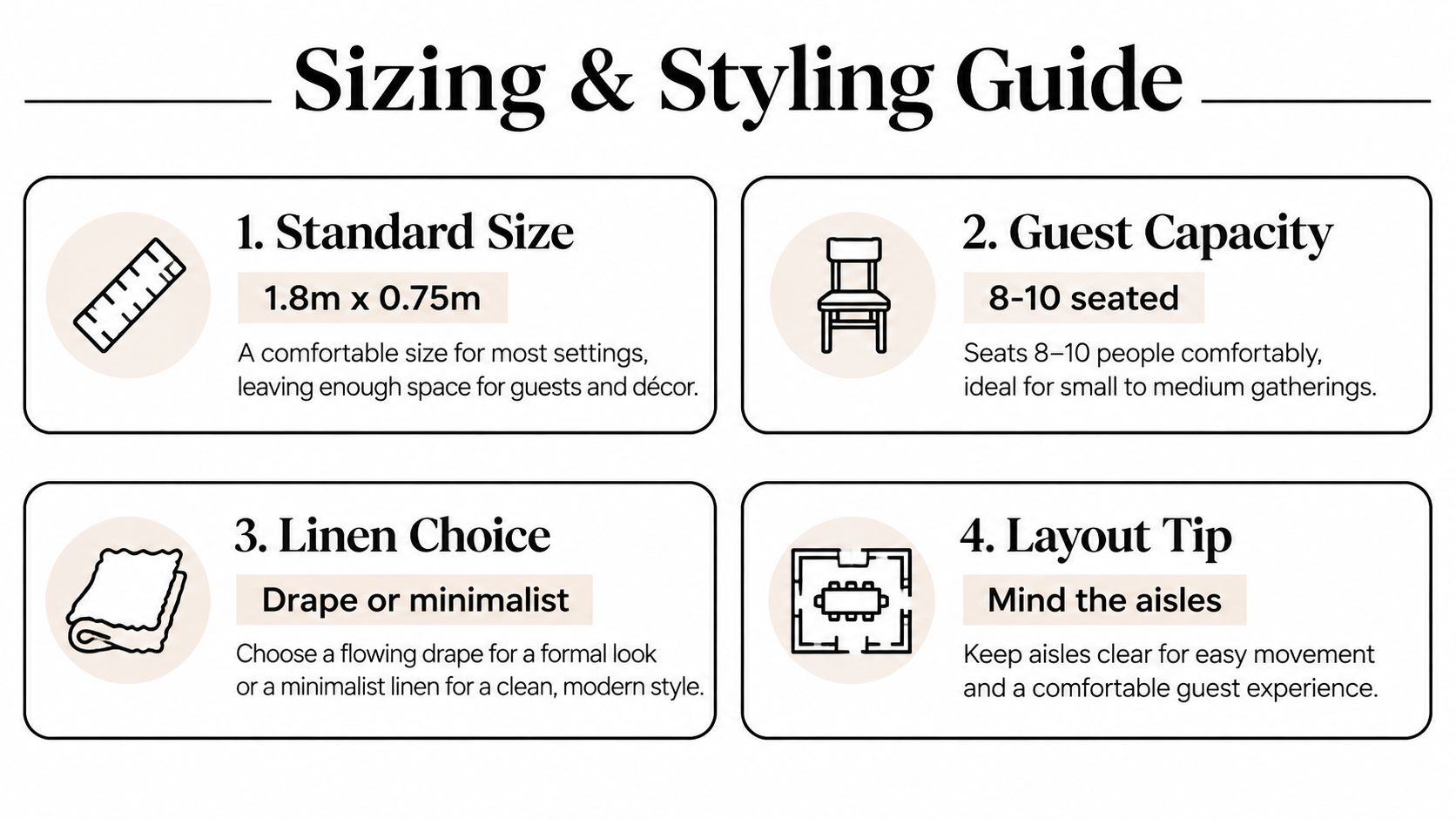
The practical truth is simple. A 10 seater table is not a casual dining-room piece, it's an event-format unit that needs proper planning around footprint, place setting, and clearance. For South African events, the useful numbers are the ones that tell you whether guests can sit comfortably, servers can move, and the room still has breathing space. In a typical setup, 10 guests are planned around a rectangular table of 96 to 120 inches (244 to 305 cm) long or a round table of 72 to 84 inches (183 to 213 cm) diameter, with about 24 to 28 inches per person for comfortable spacing (HerNest dining table size guide).

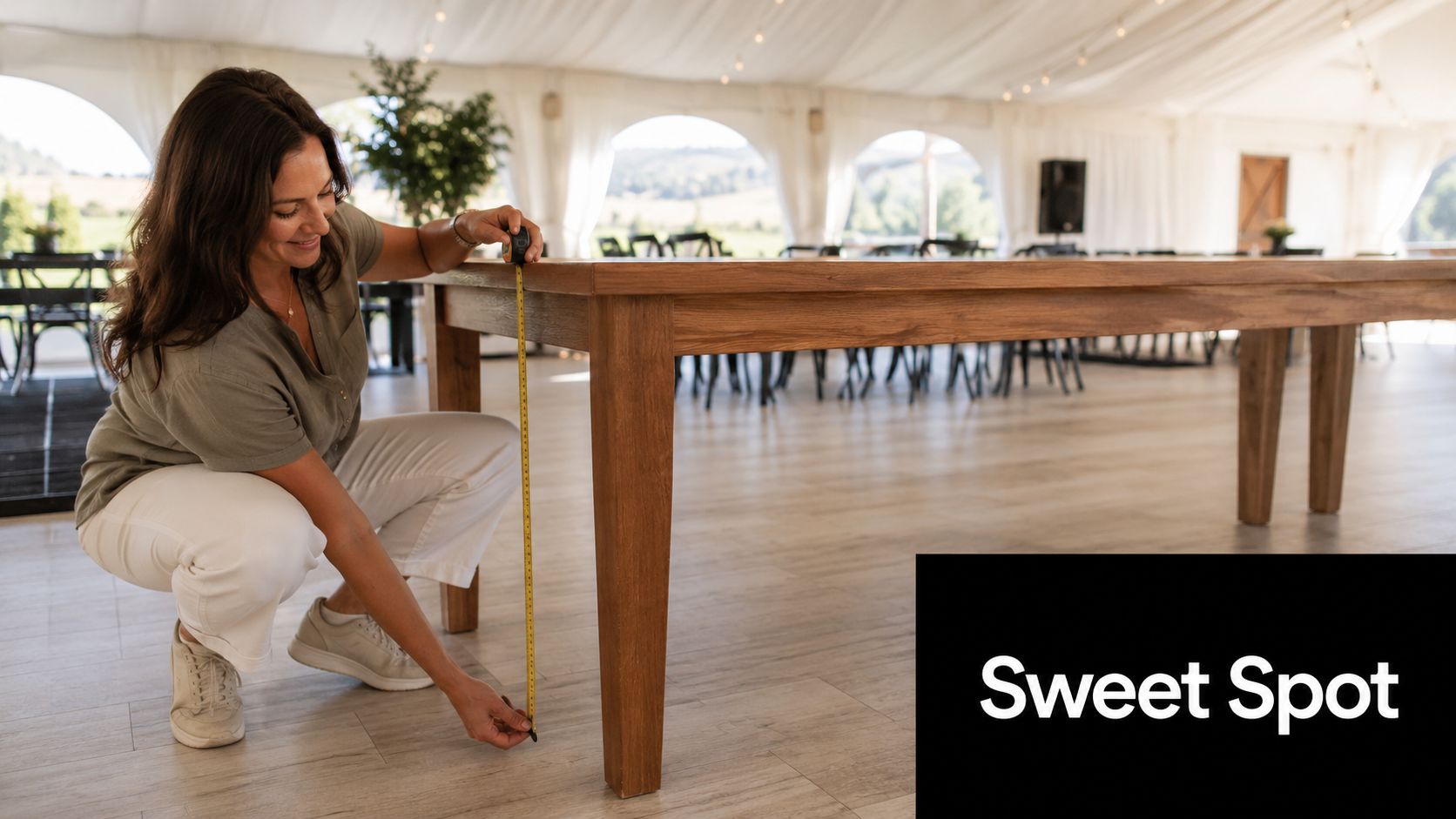
A woman crouches to measure the height of a wooden dining table in a rustic event space.

Why the 10 Seater Table Is a Cape Town Planner's Favourite

A planner crouched on a venue floor isn't thinking about style first, they're thinking about survival. Will the table fit between a bar, a dance floor, and a service lane. Will chairs scrape the wall. Will guests have to stand up every time a waiter passes. That's why the 10 seater table keeps showing up in Cape Town weddings, corporate banquets, matric dances, and school formals, it lands in the sweet spot between intimate dining and full banquet scale.

The sizing language that matters

Use the same words suppliers use. A place setting is one guest's allocated space at the table, footprint is the total space the table takes on the floor, and clearance is the movement room around it. Once you know those three things, the layout stops being guesswork.

A 10-seater also works because it gives planners a clean counting unit. If you're building a seating plan for a Winelands wedding, you can estimate tables, chairs, and aisle widths without overcomplicating the room. That makes it easier to compare rental quotes and talk sensibly to the venue coordinator.

Practical rule: if the table is the right size on paper but the room can't absorb chair movement, it's the wrong table.

The other reason this format wins is predictability. A 10-person setup sits at the upper end of residential dining and the lower end of banquet planning, so it translates well across event types. That matters in Cape Town, where one client wants a polished estate lunch and another needs a formal school dinner in a hall that wasn't built for lavish furniture.

If you're comparing domestic-style inspiration against event reality, a useful reference point is the broader sizing logic used for smaller tables in the dining table dimensions for 8 guide from Gorins Furniture & Mattress, but for local events the core issue is always floor plan fit, not just seat count.

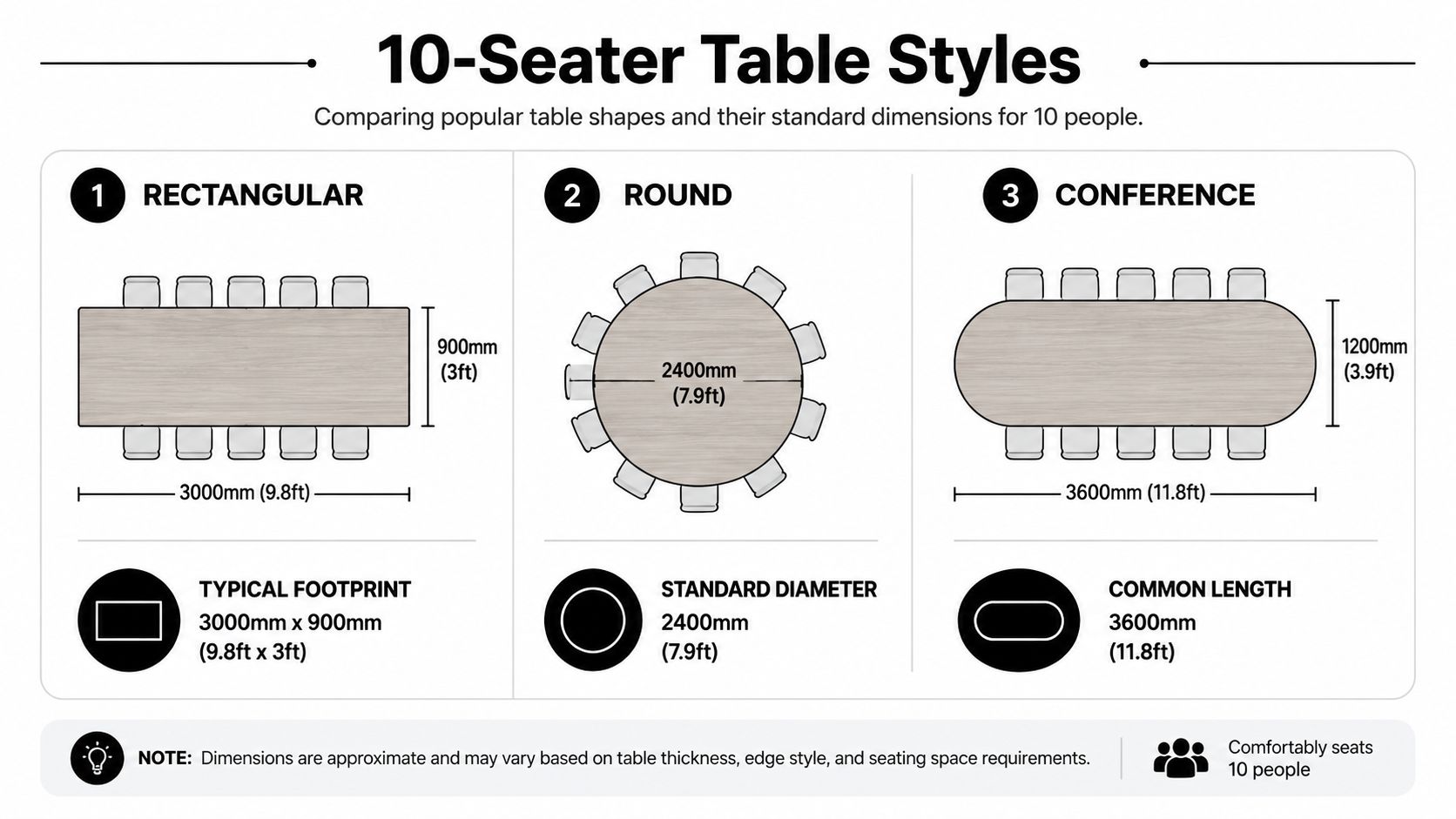
A diagram comparing the dimensions and footprints of rectangular, round, and conference style 10-seater tables.

Standard Dimensions for Rectangular, Round and Conference Styles

Stop asking only, “Can it seat ten?” Ask, “What shape fits the room, the service route, and the mood?” That's how event people think, and it's the right way to think about a 10 seater table. The geometry changes everything.

Rectangular tables for dining and banquets

For a rectangular 10-seater, the common planning range is 96 to 120 inches long, which is roughly 8 to 10 feet, and about 24 to 28 inches per person is the comfort benchmark (HerNest dining table size guide). In practical event terms, that's the shape you reach for when the room is long, when rows need to stay tidy, or when you want a strong visual line down the middle of a reception space.

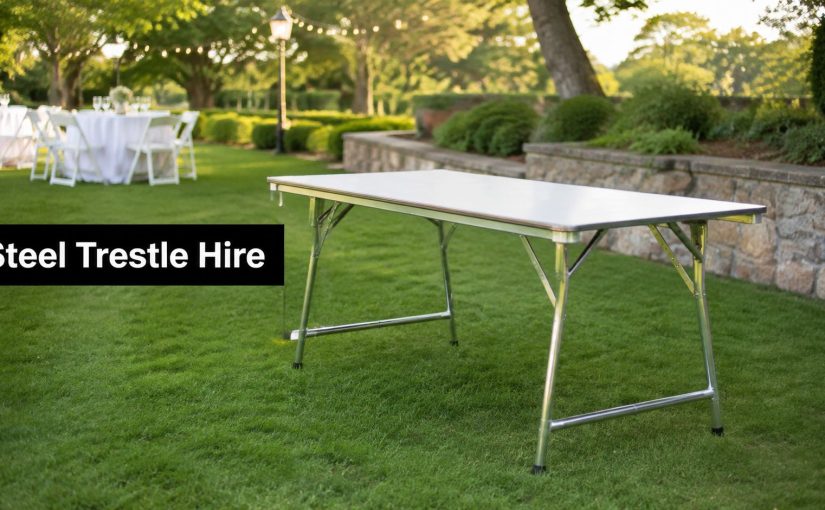
Rectangular tables are the easiest shape to pair with trestle-style rentals, and they photograph well in rows. If you're using runners, charger plates, or a narrow floral line, the rectangle gives you a clean canvas. For shape reference on trestle layouts, see trestle tables hire, because that's the style many Cape Town planners use when they need practical length without clutter.

Round tables for conversation-heavy events

A round table for ten is usually planned at 72 to 84 inches diameter, which is the geometry that works when you want conversation to feel open and equal (Reventals table sizes and seating). A 72-inch round is commonly used for 10, and that's the useful number to remember when you're booking a wedding or gala.

Rounds are friendlier for guest interaction, but they eat floor space quickly. They suit lawns, open marquees, and rooms where circulation is already generous. They're also the shape most likely to need careful linen choices, especially when you want a neat drop. For round linen fit and styling, the local guide on tablecloths for round tables is worth using alongside your floor plan.

Conference tables for meetings and training

Conference-style 10-seater tables are a different animal. The technical baseline is typically around 3000 mm × 1200 mm × 750 mm, with a 25 mm top and 1.2 mm powder-coated metal sections, while a welded stainless-steel canteen format is commonly 2400 mm × 800 mm × 750 mm with 202/304-grade stainless steel (Godrej Singapore 10-seater page).

That difference matters because conference tables prioritise cable management and individual workspace, while canteen tables prioritise hard-wearing sanitation. If you're booking a boardroom, training session, or staff briefing, don't order a dining-style shape and hope it will behave like meeting furniture.

Choosing Round, Rectangular or Oval for Your Venue

Cape Town venues don't behave like showroom catalogues. A glamorous shape that looks perfect online can become awkward the minute it meets a narrow marquee aisle, a sloping wine-estate lawn, or a compact heritage room with tight walls. That's why generic table-size charts fall short locally, they tell you the capacity, but not the reality of the space.

Tight marquees need discipline

In a tight marquee, rectangular usually wins. It gives you cleaner edges, easier stacking in rows, and less wasted perimeter space than a round. If service lanes are narrow and the bar is already fixed into one side of the tent, a round table just creates dead zones that nobody can use properly. Oval can help if you want a softer look than a rectangle, but it still behaves more like a long table than a social circle.

Long halls reward rectangles

For long banquet halls, I'd pick rectangular without apology. It fills the room properly, keeps sightlines ordered, and lets you build a clear central aisle or side service route. This is the shape that works for school dinners, awards evenings, and formal business functions where the room needs structure more than intimacy.

Wine-estate lawns favour rounds, but only when space is generous

On a lawn, a round can look beautiful because it feels relaxed and open. Use it when the layout has room to breathe, not because it's fashionable. If the lawn is broken up by trees, edging, or uneven service access, a round becomes fiddly fast. In that case, I'd go rectangular and keep the layout deliberate.

A shape is only “better” if staff can move around it without turning the event into an obstacle course.

For a local planner or couple, the short answer is this. Tight marquee, choose rectangular. Long hall, choose rectangular. Open estate lawn, choose round only if circulation is easy. If you want one style that gives you a balance of comfort and formal control, oval is a solid compromise, but it still needs proper length. That logic is why many teams cross-check with the practical guidance in the ABC Hire trestle table hire article before locking the final floor plan.

Fit-Checking the Table in Your Room or Marquee

Most layout mistakes happen before a single chair is unloaded. The team sends a quote, the bride approves the look, and then someone realises the dance floor has nowhere to live. Don't let that happen. Measure first, then place the 10 seater table on paper.

Use a paper-scale test

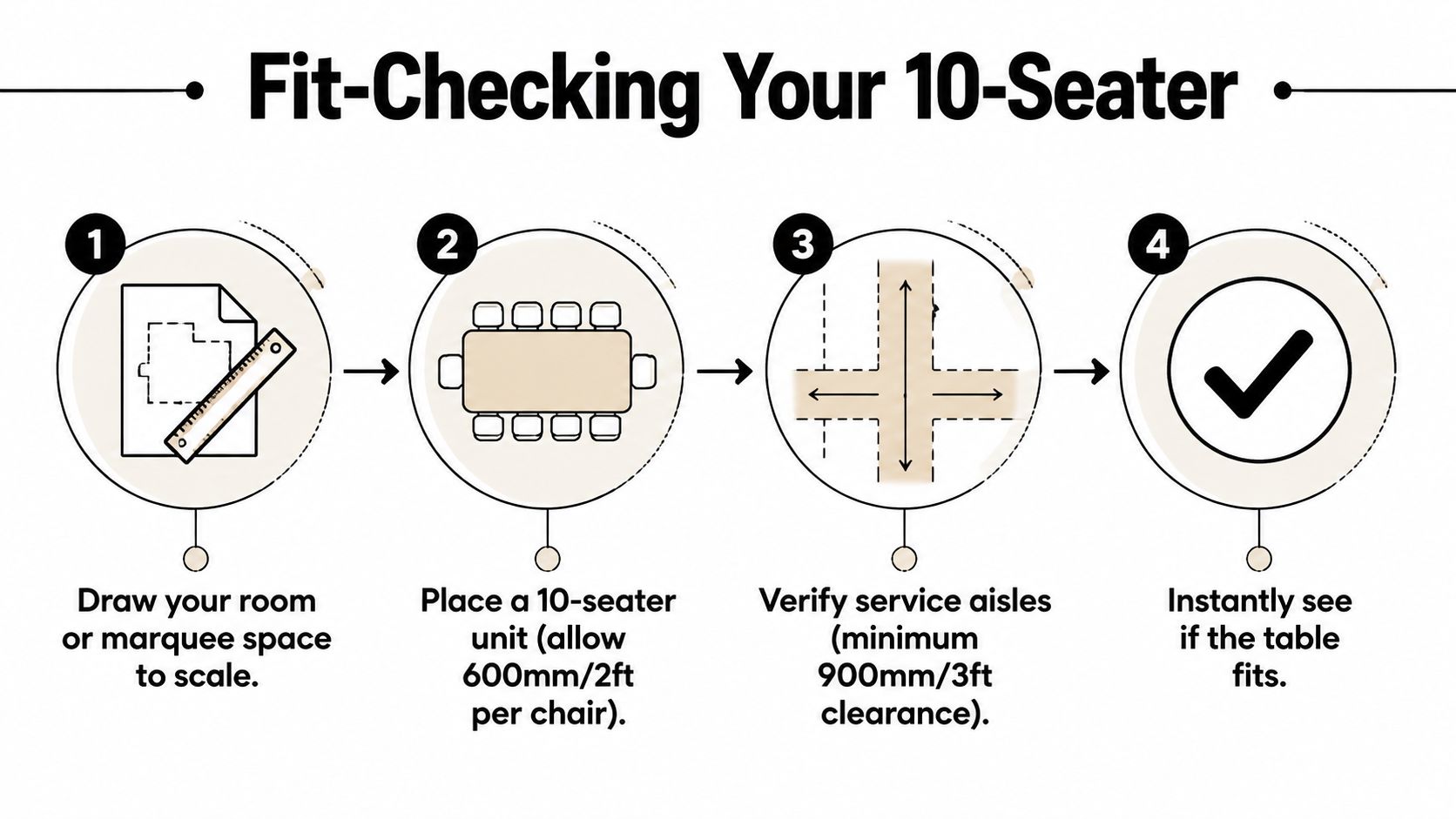
Draw the room or marquee to scale. Mark doors, poles, bars, buffet areas, and any fixed objects. Then place one table footprint into the drawing and add chair space around it. For planning, the useful comfort figure is about 24 to 28 inches per person at the table, and the practical event version means leaving enough room for a chair to move without clipping another guest (HerNest dining table size guide).

Check the circulation first

The test is not just whether the table fits, but whether people can get around it. Use the aisle line as your essential guide. A service lane that is too narrow turns setup and clearing into a daily headache for the catering team.

Working rule: if the table fits only when nobody is serving, dancing, or carrying trays, it doesn't fit.

A practical fit-check looks like this:

  • Mark the footprint: trace the actual table shape, not an estimate.
  • Place the chairs: allow around 600 mm, roughly 2 feet, per chair position when you sketch the seating ring.
  • Verify service access: keep the aisle clear enough for people and trays to pass.
  • Add the extras: remember the cake table, gift table, DJ, and bar before you finalise the layout.

If you're moving furniture through tight access points before setup, the logic in Boston mover door fitting tips from TLC Moving & Storage is surprisingly relevant, because the same practical thinking applies to venue doors, passageways, and loading paths.

For event spaces, the missing question is always, “What else needs to fit around the table?” Answer that and you'll avoid the classic Cape Town problem of a beautiful setup that blocks the flow of the whole room.

A four-step infographic explaining how to measure and verify if a 10-seater dining table fits your room.

Seating Layouts and Styling Ideas That Actually Work

A 10 seater table can look formal, relaxed, modern, or dramatic. The trick is not buying more decor, it's matching the shape, chairs, and lighting to the event's actual energy. Cape Town couples often over-style the table and then run out of room for serving dishes, while brand teams do the opposite and leave the setting looking unfinished.

Wedding reception with a long-table feel

For a Cape Town wedding reception, I'd use a rectangular table with coordinated chairs and a narrow centrepiece line. Keep the floral height low enough for conversation, and use linen that falls cleanly instead of pooling around chair legs. The table should feel elegant, not crowded.

Matric dance dinner with structure

For a matric dance, the safest choice is still a rectangular or conference-style layout. Students need clear access, the catering team needs fast service, and the room often doubles as a photo area. Stackable chairs work well here, and you can sharpen the look with charger plates or a simple runner instead of heavy decor.

Corporate awards or brand activation

For corporate events, the table should support branding without turning into a billboard. Clean lines, black or white chairs, and a restrained centrepiece work better than an overloaded display. If you want a night-time edge, add LED cubes, curved benches, or stackable LED chairs around the perimeter so the room gains atmosphere without blocking chair movement.

Winery lunch with softer styling

A Winelands lunch suits a lighter hand. Use natural textures, a modest floral set, and enough space between settings that guests don't feel packed in. The best tables in this setting look effortless because the styling respects the view and the room.

If the decor starts to steal chair space, cut the decor.

The best finish is always one that serves the event type. Keep the centrepiece scale modest, choose chairs that match the table shape, and let the lighting do some of the work. That's especially true at night, where glowing furniture and simple linen can do more for mood than another round of flowers ever will.

Rental Logistics With a Cape Town Hire Company

Booking a 10 seater table is easy only if you ask the right questions early. The rental process should be about fit, access, and condition, not just a quick yes on stock. Cape Town, Stellenbosch, Franschhoek, and Paarl each bring different logistics, and the supplier needs to know the venue realities before the truck rolls.

What to confirm before you sign

Ask whether the table is delivered flat-packed or assembled, what the collection window is, and whether the venue has loading access close to the setup point. That matters more than people think, because a table that's easy to unload into a hall is not the same as one that has to cross a steep garden path, a gravel drive, or a narrow doorway.

Check what arrives with the table as well. Some suppliers bundle chairs, while others charge separately for linen, accessories, or setup support. ABC Hire offers a tables for hire service in Cape Town and lists event tables in its online selection, which makes it a useful option when you need to match one table family across a larger event.

Lead times matter in peak season

Don't assume stock will still be there when you circle back later. Friday to Sunday weddings, matric dances, and year-end functions all squeeze the same pool of tables, chairs, and LED pieces. If the event depends on a specific table shape, lock it early.

For rental planning, the linked overview on tables and chair rentals is the sensible starting point when you're comparing what gets booked together and what should be quoted separately.

A few details clients often forget to ask:

  • Delivery zone: confirm the exact route, especially outside central Cape Town.
  • Surface conditions: lawns, sand, gravel, and stepped access all affect labour.
  • Returns: check whether collection timing affects venue access or penalties.
  • Condition on arrival: inspect for wobble, marks, or mismatched finishes before setup starts.

The point is simple. A table that looks cheap on paper can become expensive in labour if the venue is awkward. A supplier who understands local access problems is worth more than one who only talks about the furniture itself.

Cost Drivers and Smart Booking Tips

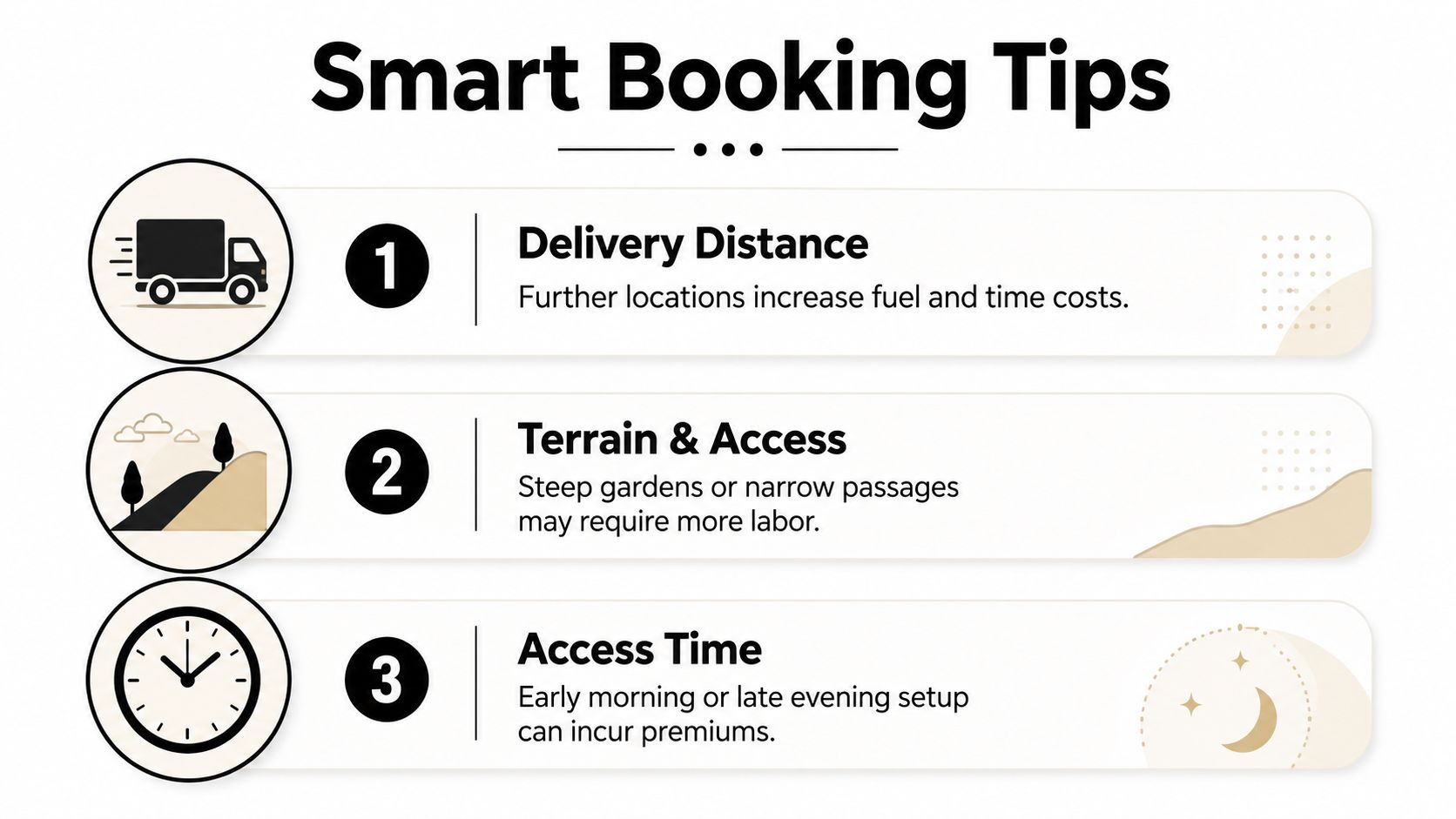
The headline rate on a quote is not the full story. In Cape Town event hire, the final cost is shaped by delivery distance, terrain, access time, and how much handling the table needs before it's ready for guests. That's why two tables with the same rental line can end up feeling very different on the invoice.

What really moves the price

A venue with easy driveway access is simpler than a wine estate lawn with a long walk from the loading area. Early morning setup and late evening collection can also change labour demands, especially when the event site has limited access windows. If you're renting more than one furniture category, bundling them into one delivery is usually smarter than splitting the job across separate drops.

For layout pre-planning, a simple garden sketch in the spirit of the best free garden design software from OutdoorBrite can help you visualise spacing before you ask for a quote, especially if the event sits on a lawn or in a marquee.

Three booking moves that save trouble

  • Book early for Friday to Sunday dates: those are the slots that disappear first.
  • Bundle compatible items: tables, chairs, and LED furniture often make more sense on one truck.
  • Be honest about access: if the setup involves slopes, narrow paths, or long carries, say so before the quote is final.

Don't underquote the venue

Marquee events and estate functions are where people get caught out. A room can look simple in a photo and still be awkward on the day because of steps, soft ground, or obstructed access. If the supplier doesn't know that, the quote is only half the job.

If you want to read a quote properly, look past the table line and ask which line items are tied to transport, labour, and timing. That's where the difference sits.

An infographic titled Smart Booking Tips, listing factors like delivery distance, terrain, and access time for services.

FAQs on Hiring a 10 Seater Table in Cape Town

How long does setup take

It depends on access, not just the table itself. A straightforward hall setup is quick, but once you add a marquee, a lawn, or a venue with narrow loading access, the job slows down because labour has to carry and place everything carefully. Ask the supplier whether the quote includes placement or just delivery.

Will a 10 seater table work under a stretch marquee

Yes, if the marquee footprint is planned properly. A round table can feel generous in an open tent, while a rectangular one usually behaves better where side space is tight. If the stretch tent has poles, curves, or uneven edges, rectangular is normally the safer choice because it gives you more control over the remaining floor.

How should I light it for a night event

Use lighting to support the table, not drown it. Soft overhead ambience, warm accent lights, and a clear centrepiece work better than harsh direct light that flattens the decor. If you're adding LED furniture, keep the glow around the room's perimeter so the table remains the visual anchor.

What does a 10 seater rental cost in Cape Town

I'm not going to invent a number for you. Rental cost depends on table style, delivery distance, venue access, and whether you need extras like chairs, linen, or LED pieces. The right way to price it is to compare like-for-like quotes and confirm whether transport and handling are already included.

If you only ask for the table rate, you're missing the part that usually changes the total.

Use the fit-check, choose the shape that suits the venue, and ask the supplier to explain any access-related charges before you book. That's the fastest way to stop a simple table from becoming a setup problem.


If you need a 10 seater table for a Cape Town wedding, Winelands lunch, matric dance, or corporate function, ABC Hire can supply event tables, chairs, and matching furniture for a proper floor plan, not a guess. Visit ABC Hire to check what's available and book the right table shape before the date you want is gone.

Plastic Folding Table Guide for Cape Town Events

You're standing in an empty venue. The doors are open, the floor is bare, the florist is asking where the main table will sit, and the caterer wants to know buffet lengths before they unload. In that moment, the event doesn't rest on candles, draping, or playlists. It rests on tables.

In Cape Town and the Winelands, that usually means some version of a plastic folding table. New planners often treat it like a background item. Experienced planners know better. The right table makes setup faster, styling easier, transport cleaner, and service safer. The wrong one wobbles on lawn, sags under décor, or arrives looking tired before the guests do.

That matters more here than many generic event guides admit. A wine estate in Franschhoek, a corporate function in the CBD, and a beachfront activation in Camps Bay all ask different things from the same humble table. You need to think about access roads, storage, weather, visual finish, and how the table has been used before it gets to your venue.

The Unsung Hero of Your Cape Town Event

At 7:30 on a Winelands setup morning, the room still looks forgiving. By first guest arrival, every weak decision shows. Tables that looked fine in storage start rocking on uneven floors, bowed tops show through the linen, and tired plastic makes an otherwise polished room feel hired-in.

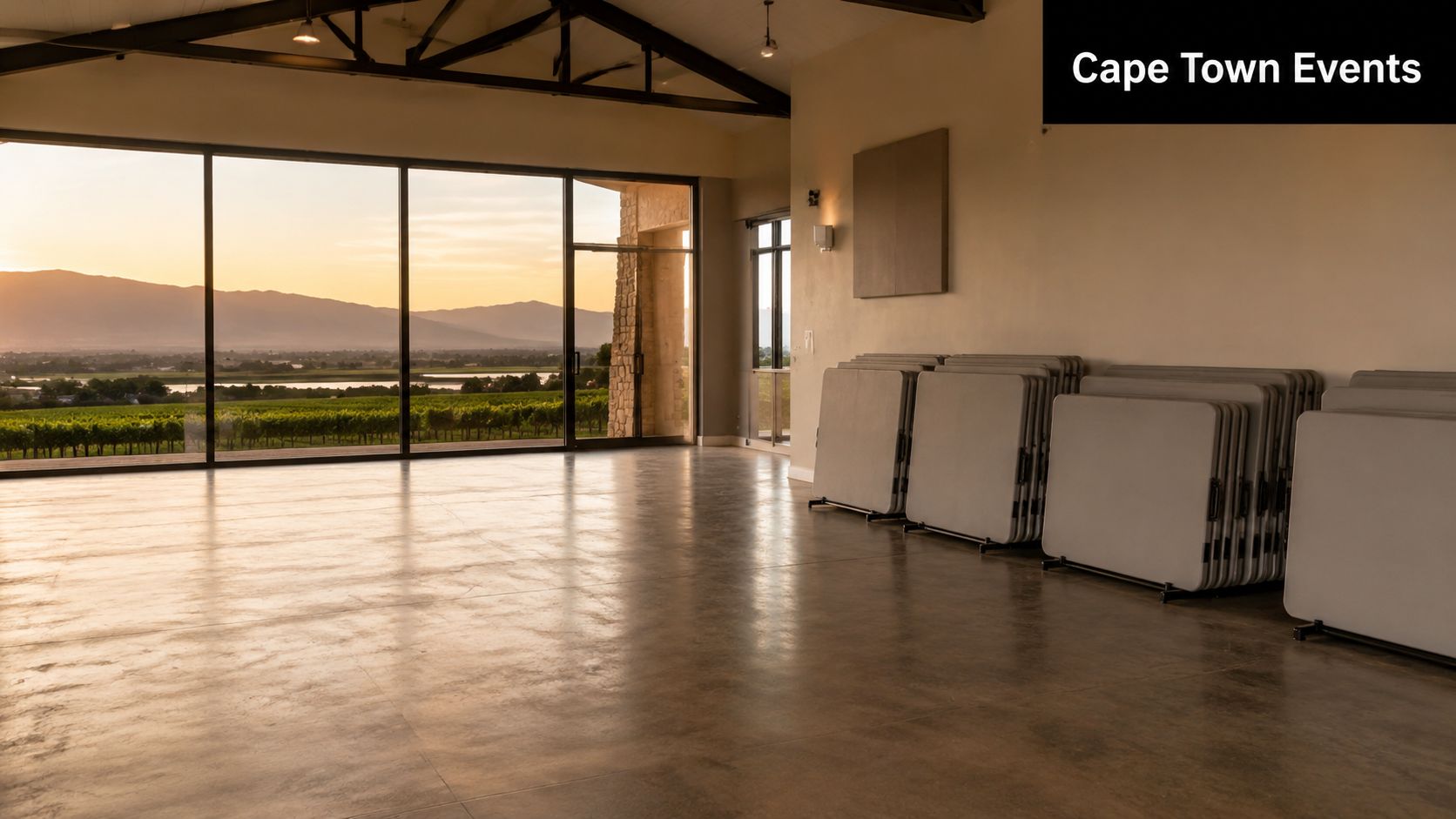
A modern event venue with a sunset view overlooking vineyards, featuring stacked plastic folding tables inside.

A plastic folding table usually gets judged as a commodity. In Cape Town event work, it is a piece of working equipment. It affects setup speed, service flow, linen finish, and guest comfort long before anyone notices the flowers or the menu cards.

What new planners often miss

Price matters, but it is not the first filter. Commercial-grade tables and light domestic tables may look similar in photos, yet they behave very differently once you add chafing dishes, glassware, floral installs, or a full coffee station.

The point many generic guides skip is long-term sun exposure. In coastal parts of the Western Cape, high UV levels harden and weaken plastic over time. A table can still fold, stack, and pass a quick visual check, but the top becomes more brittle, the surface loses its finish, and stress points around the legs and hinges become less trustworthy. That is where breakages happen. Not in the showroom. On the third load-in of a windy season.

I see this often with older stock used for outdoor functions near the Atlantic Seaboard or stored badly between summer jobs. The table is not "old" in a rental-catalogue sense. It is sun-cooked.

A table should disappear into the event. If guests notice it, something has already gone wrong.

Why this matters in the Western Cape

Cape Town stock takes punishment. Tables move from warehouse racks to trailers, then onto paving, lawn, cellar floors, and sometimes beach-adjacent sites where salt air and sun do their work. The practical question is not only whether a plastic folding table is convenient. It is whether that specific table has held up structurally after repeated UV exposure and transport.

That is one reason many planners still compare plastic stock against trestle table hire options for Cape Town events, especially for formal functions where top finish and rigidity matter. Plastic still earns its place. It is lighter to handle, quicker to stack, and often the easier choice for fast turnovers. But only if the stock is inspected properly and replaced before the surface and frame start showing fatigue.

If you want a general outdoor-use overview, Lounge Wagon's portable table guide covers the basics well. For Cape Town planners, the extra check is simple. Ask how the tables are stored, how old the stock is, and whether the tops show chalking, hairline cracks, or leg wobble after setup. Those signs matter more here than they do in inland climates.

Selecting the Right Table for Your Guests and Goals

Start with the room, not the catalogue. A planner who picks table type before looking at guest flow often ends up with awkward aisles, cramped service lanes, or a room that feels either crowded or thin.

Begin with the standard banquet workhorse

For weddings, matric dances, and corporate dining, the most common option is the rectangular banquet table. Standard plastic banquet tables typically measure 6 feet (72 inches) in length, 30 to 36 inches in width, and 30 inches in height, with seating for 8 to 10 people per table, based on KaTom's folding table size guide.

That size works because it's familiar to suppliers and easy to plan around. Caterers know the footprint. Linen suppliers know the drop. Venues can usually map it quickly.

Here's the quick reference I use when planning rectangular banquet layouts:

Plastic Folding Table Size and Seating Capacity Guide

Table Type Dimensions (Typical) Seats Best For
Rectangular banquet table 6 ft x 30 in x 30 in high 8 to 10 Weddings, matric dances, corporate dining
Narrow rectangular setup 6 ft x 30 in x 30 in high 8 Tight venues, buffet runs, training rooms
Wider rectangular setup 6 ft x 36 in x 30 in high 8 to 10 Heavier place settings, more generous table styling

Match the table to the event mood

A long rectangular run encourages linear service and efficient room planning. That's useful at formal dinners, conferences, and school functions where you need clarity and speed. It also helps when the venue has fixed architectural constraints such as pillars, cellar walls, or narrow access points.

A wider top gives your stylist more room for layered place settings, candle clusters, and centrepieces. A narrower top is easier for conversation and service reach. If guests have to lean around florals or décor to speak to each other, the styling has started working against the event.

Practical rule: Choose your table width based on what has to sit on it after the plates arrive, not what looks best in an empty venue.

Don't ignore load capacity

Load ratings matter once you move beyond crockery and cutlery. High-quality plastic folding tables from Lifetime are rated at at least 1000 lbs for Light Commercial grade, 1500 lbs for Commercial grade, and 2000 lbs for Professional grade according to Lifetime's guide to folding table weight capacity. The important phrase is distributed weight. That means weight spread across the surface, not all concentrated in one dramatic centrepiece or stacked equipment point.

For planners, that affects:

  • Buffet stations where multiple chafers, platters, and beverage dispensers sit on one run
  • Décor-heavy head tables with layered florals, candles, signage, and lighting
  • Registration desks carrying printers, branded packs, and tech items
  • Back-of-house prep surfaces where suppliers may place crates or service trays briefly

If you want a broader perspective on portable options for casual or outdoor use, Lounge Wagon's portable table guide is a useful comparison piece. And if you're deciding whether a plastic folding table is the right fit or if a more traditional trestle makes more sense for the look, this trestle tables hire guide helps frame that choice.

Renting vs Buying A Cape Town Cost Analysis

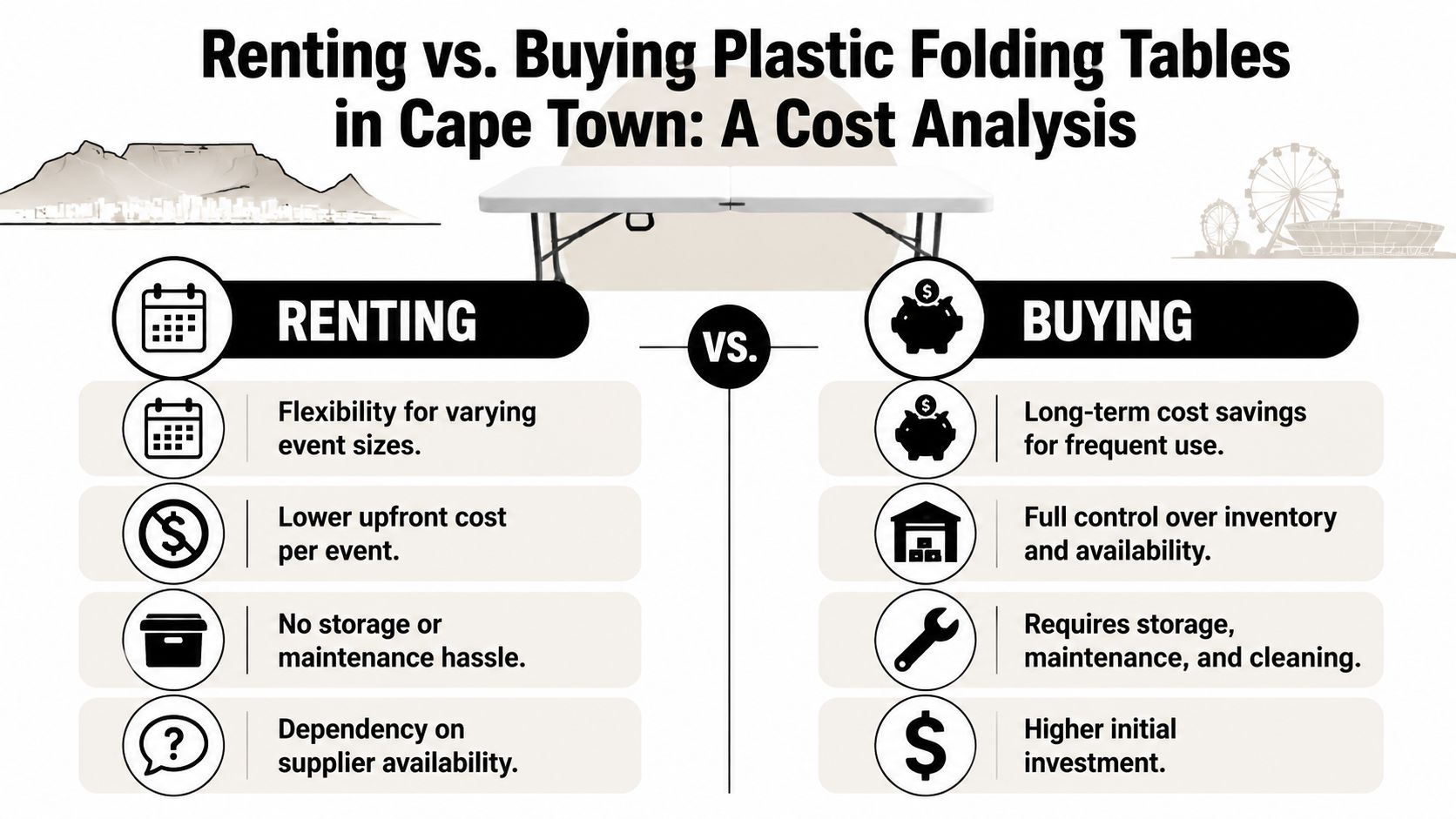
This decision is rarely about the ticket price alone. It's about how often you'll use the tables, how much control you need, and whether you want to own the headaches that come with storage and upkeep.

An infographic comparing the pros and cons of renting versus buying plastic folding tables in Cape Town.

Plastic folding tables are the most economical option in South Africa, with entry-level purchase prices from R350 to R700, while higher-end plastic tables can exceed R900, according to DataIntelo's market overview. The same source notes that plastic tables dominate because they're lightweight, budget-friendly, and weather-resistant.

When buying makes sense

Buying works for people who run repeated events and already have operational systems around gear. Venue owners, schools, churches, and companies with regular internal functions often benefit most. They know where the tables will live, who will clean them, and how they'll move them.

Buying also makes sense when consistency matters. If you're building your own stock, you can keep the same dimensions, finish, and condition across every event. That simplifies linen, room plans, and staffing.

But ownership adds real tasks:

  • Storage: Tables need a dry, organised place where they won't warp or get damaged in stacking.
  • Transport: You'll need the right vehicle access and handling staff every time.
  • Cleaning: Every spill, scuff, and tape mark becomes your problem.
  • Replacement planning: A table doesn't stop being a risk just because you already paid for it.

When renting is the smarter move

For once-off weddings, private milestone celebrations, and many corporate events, renting is usually the cleaner choice. You pay for use rather than stockholding, and you don't have to house equipment between events.

This is especially true in Cape Town, where event footprints vary wildly. One month you may need a handful of banquet tables for a board function. The next month you may need a much larger count for a school dinner or wedding. Renting lets the quantity change with the brief.

A rental option such as ABC Hire's tables and chair rentals guide is useful when you want the broader furniture picture rather than solving tables in isolation.

Renting suits planners who need flexibility. Buying suits operators who need constant availability and already have systems.

A practical way to decide

Use a simple filter:

  1. How often will the tables be used?
    Frequent repeat use points toward buying.

  2. Who handles transport and storage?
    If the answer is unclear, renting usually prevents trouble.

  3. How sensitive is the event to appearance?
    Premium weddings and formal functions need stock in strong condition.

  4. What happens after the event?
    Cleanup at midnight is one thing. Cleaning, drying, storing, and maintaining tables all year is another.

Mastering Event Logistics Transport and Setup

The event can still fail on the floor even if you chose the right table on paper. Logistics is where many new planners lose time. Not because the work is complicated, but because they don't sequence it properly.

Load in starts before the vehicle moves

Check the route before you load a single table. Cape Town venues can look easy online and turn awkward in real life. CBD sites may have restricted access windows. Heritage buildings often have tighter doorways and stairs. Wine estates can involve gravel, slopes, and long walks from the unloading point.

Plan these in advance:

  • Access path: Door width, lift access, surface type, and distance from vehicle to setup area
  • Holding space: A clean zone where tables can sit before placement
  • Setup order: Buffets and service tables first, guest seating after, then specialty tables
  • Weather exposure: Wind and sun can complicate outdoor setup even before guests arrive

Stack and move them properly

Dragging tables shortens their life. So does careless stacking. Keep them aligned, move them with enough hands, and avoid dropping corners onto hard surfaces. Most visible damage happens in transport and setup, not during the event itself.

If your event needs urgent turnaround or a same-day room reset, same-day furniture delivery guidance is worth reading because speed only helps if delivery and placement are organised.

If the venue has gravel, lawns, or an incline, assign one person to watch leg placement as tables open. That small role prevents most setup wobble.

On-site setup that actually works

I use a straightforward setup rhythm on outdoor and mixed-surface jobs:

  1. Place all tables closed first.
    This lets you confirm spacing before committing.

  2. Open from the focal points outward.
    Start with the head table, stage-facing rows, buffet line, or main guest block.

  3. Check leg locks immediately.
    Don't assume they've caught cleanly.

  4. Test the floor contact.
    Press opposite corners lightly. If the table rocks, solve it before linen goes on.

  5. Dress after the room is stable.
    Linens hide problems. They don't fix them.

Outdoor surfaces need extra attention

Lawns and marquee floors are the usual culprits. A table can look level until glassware hits it. On uneven ground, keep heavier service loads for the firmest positions and leave decorative tables for the softer patches. If one corner is unstable, reposition first. Don't build a whole setup on a bad footing.

That discipline saves time later when catering, styling, and service teams all start using the same room at once.

Styling Ideas to Elevate Your Tables

A plastic folding table doesn't need to look like a plastic folding table. That's the trick. Most guests only see the finished line, height, texture, and proportion. If those are right, the base table has done its job.

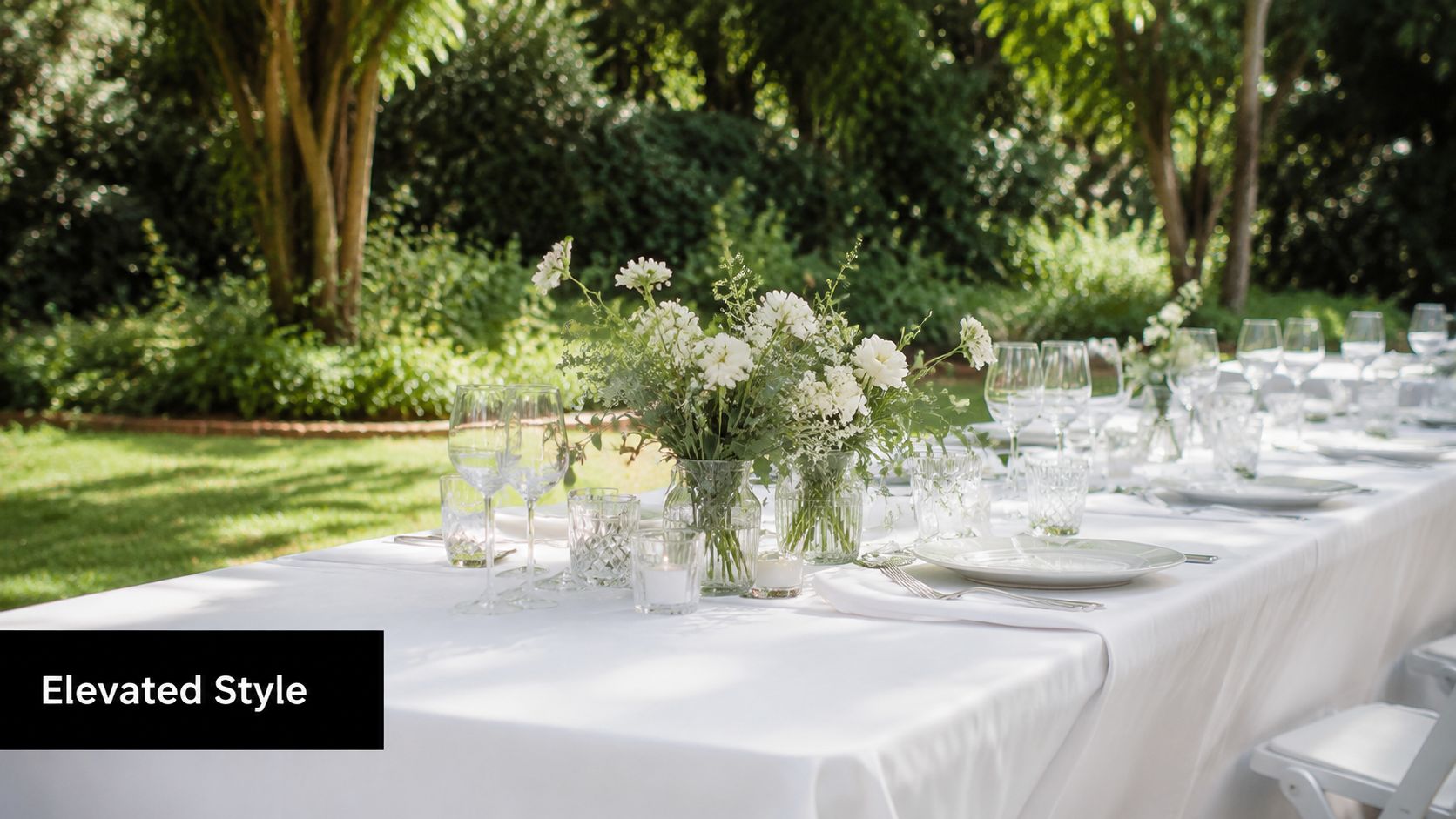
A long plastic folding table set up for an outdoor garden wedding reception with white flowers.

Start with the linen drop

The fastest way to cheapen a beautiful room is a poor linen choice. If the cloth is too short, guests clock the plastic legs and frame immediately. If it puddles badly, staff trip, and the room feels untidy.

For formal weddings, I prefer a fuller drop that hides the structure completely. For modern corporate work, a cleaner fitted fall often suits the brief better. Spandex can work for high-tempo activations and casual launches because it stays tight and neat, but it can look too utilitarian for softer Winelands styling.

Use linen to fix the silhouette, then add interest through texture:

  • Soft layered runners for vineyard receptions
  • Crisp neutral cloths for conferences and brand events
  • Textured overlays when the room needs warmth without visual clutter
  • Napkins and placemats to introduce colour without overloading the centre line

Build décor with stability in mind

Commercial-grade plastic tables can be structurally strong. Some feature a 2-inch tabletop thickness that helps prevent sagging, as noted in the TitanPRO specification sheet. That matters when you're carrying more than flowers and cutlery.

If you're planning heavy styling, think in layers, not in one concentrated mass. Spread decorative weight along the run. Use multiple lower arrangements instead of one oversized statement piece if the setup doesn't need vertical drama.

Tall centrepieces impress in photos, but low and well-spaced arrangements usually serve the room better. Guests can talk, staff can reach, and the table carries the load more evenly.

What works for different event types

For Winelands weddings, softer materials and a restrained centre line usually perform best. Let the view do some of the work. A clean runner, clustered candles, seasonal florals, and proper glassware often beat overbuilt décor.

For corporate functions, symmetry matters more. Use repetition, branded colour cues, and disciplined place settings. Registration and gift tables should feel as considered as dining tables, especially at launches and year-end functions.

For school formals and matric dances, durability is part of styling. Choose covers that won't slip easily and décor that can handle guest movement, photos, and last-minute room changes.

Maintenance and a Critical Cape Town Weather Warning

A table can survive one summer wedding in Franschhoek and still be the wrong table to trust at a windy beachfront corporate function six months later. In Cape Town, sun exposure ages plastic stock faster than many planners expect, and the warning signs are easy to miss until a top starts flexing under load.

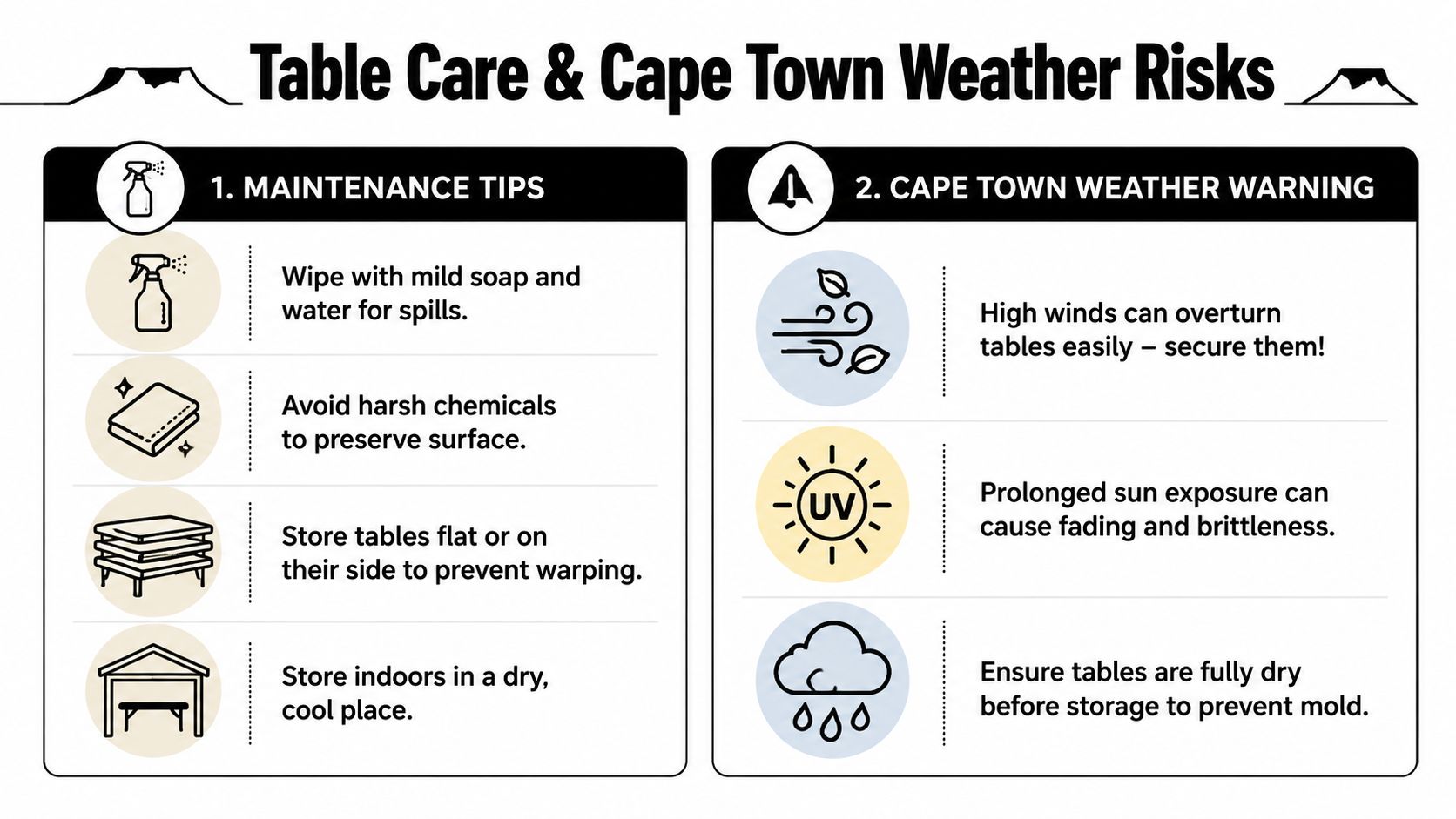
An infographic titled Table Care and Cape Town Weather Risks detailing maintenance tips and weather-related precautions.

Basic care that extends useful life

Good maintenance is simple. It just needs to happen every time.

Wipe spills off early, wash with mild soap and water, dry the table before folding, and store it indoors away from direct sun. Leaving stock stacked in a yard, on an open loading bay, or under a clear roof still exposes it to heat and UV. That shortens service life, even if the tables only come out for events on weekends.

A few checks make a real difference:

  • Avoid harsh chemicals: Strong cleaners can dry the surface and speed up wear.
  • Store without twisting the frame: Keep tables flat or upright in a way that does not load one corner or strain the legs.
  • Check hinges and locks regularly: Folding points loosen first because they carry repeated setup stress.
  • Inspect tops in daylight: Fine cracks and surface changes often disappear under venue lighting.

The Cape Town problem many buyers miss

High UV exposure is the issue generic table guides rarely explain properly. In coastal conditions, plastic does not just fade. Over time it can dry out, lose some flexibility, and develop fine surface cracking. Once that starts, the table may still look acceptable from a distance while carrying weight less confidently than it did when new.

That matters in the Western Cape. The same stock often rotates between wine farm lunches, school functions, market days, outdoor ceremonies, and sea-facing venues. Constant sun, heat, and salt-heavy air are harder on plastic than occasional indoor use.

Industry practice reflects this. Reputable hire companies inspect older plastic tables for brittleness, micro-cracking, surface chalking, frame looseness, and any change in stiffness before sending them back out. If a top feels dry and rigid, or flexes unevenly, it should not be trusted for buffet service, beverage stations, AV support, or heavy styling.

In Cape Town conditions, colour fade is a cosmetic issue. Fine cracks, a rough or chalky surface, and a top that feels more brittle than it used to are the warning signs that matter.

What to ask before hiring or using stock

If you are renting, ask how the tables are stored between jobs, how old the outdoor stock is, and what takes a unit out of circulation. Those answers tell you more than a quick glance during delivery.

If you own tables, inspect them before any job that puts real weight on the top. Buffet lines, gift stations, coffee service, equipment check-in, and layered décor all expose weakness quickly. I would also press down across different points of the tabletop, not just the centre. Uneven flex usually shows up before obvious failure.

Wind needs its own check. A sound plastic folding table can still shift, creep, or lift in exposed conditions if the setup is poor. Position it on level ground, keep weight low and balanced, and treat outdoor placement as part of the safety plan, not an afterthought.

Your Event Table Foundation Checklist

A planner arrives at a Franschhoek estate for setup and finds that one buffet table looks fine at first glance, then gives a little more flex on one corner than it should. That is how table problems usually show up in Cape Town. Not as dramatic breakages, but as small signs that the stock has spent too many summers in coastal sun and salt-heavy air.

Use this final check before you approve any plastic folding table order, especially for outdoor weddings, corporate functions, and mixed-use event layouts where tables carry real weight for hours.

Final checks before you lock the order

  • Start with the actual job: Dining, buffet, registration, gifting, display, production support, or back-of-house prep all place different demands on the table
  • Match size to movement: Confirm that guest circulation, service aisles, waitron access, and venue pinch points still work once chairs, linen, and service equipment are in place
  • Choose based on use frequency: Renting suits occasional events and variable layouts. Buying only makes sense if you can store, transport, inspect, and retire stock properly
  • Check the access route, not just the venue: Cape Town city venues, wine estates, and beachfront sites often have stairs, gravel, narrow doors, or long trolley runs that change what is practical
  • Keep styling load realistic: Heavy centrepieces, layered décor, urns, and beverage dispensers can push a light plastic table past what it should carry safely
  • Inspect more than the surface: Test leg locks, hinge points, wobble, uneven flex, and any chalky or brittle feel in the top
  • Treat UV wear as a safety issue: In Cape Town conditions, fading is cosmetic. Brittleness, fine cracking, and loss of stiffness are the warning signs that should stop a table from going onto the floor

Good table decisions rarely get noticed by guests. Poor ones show up fast during service, in wind, or when weight sits on one weak section for too long.

Plastic folding tables still earn their place because they are practical, easy to move, and cost-effective for many event formats. They just need to be chosen with more care than many new planners expect. In this market, sun exposure and age matter almost as much as size.

Reliable planners check what the table will carry, where it will be used, and whether the condition still matches the job. That habit prevents shaky coffee stations, unstable gift tables, and the kind of avoidable setup problems that make an event feel poorly run.

If you need event furniture for a Cape Town, Stellenbosch, Franschhoek, or Paarl function, ABC Hire can help you source practical table and event rental solutions for weddings, corporate functions, school events, and private celebrations.