Cafe Table Chairs: A Planner’s Guide for Cape Town Events

You're often making the chair decision late in the process. The venue is booked, the florist has a brief, catering is in motion, and then someone asks what seating will work for the harvest table, the lawn drinks area, or the coffee station after dinner. That's usually when cafe table chairs stop being a styling afterthought and become a logistics problem.

In Cape Town and the Winelands, they matter more than most planners expect. A chair has to suit the brief, sit comfortably for hours, handle movement between spaces, and still look right when guests start posting photos. For a wedding, it can soften a stone courtyard or sharpen a vineyard reception. For a corporate event, it can make a product launch feel polished instead of pieced together.

Setting the Scene with the Right Seating

A Winelands wedding can look perfect on paper and still feel slightly off on the day. The views are doing their job. The tablescape is beautiful. The lighting is right. Then guests walk into a reception space filled with seating that doesn't match the room, doesn't fit the table scale, or feels like it was chosen for convenience instead of atmosphere. That's when the event starts to lose cohesion.

Cafe table chairs do more than fill a floorplan. They help define the tone of the event from the first glance. In a courtyard lunch, they can make the setup feel relaxed and social. In a conference breakaway area, they can create a cleaner, more intentional lounge feel than standard banqueting stock.

Chairs shape the room before guests sit down

The strongest event rooms usually have one thing in common. The furniture supports the concept. Guests might not comment on chair lines, seat shape, or finish, but they notice when the room feels balanced.

That matters in a region where hospitality spaces keep evolving. The South African restaurant chairs market, which includes cafe chairs, is projected to grow from USD 84.3 million in 2024 to USD 128.7 million by 2034, reflecting a 4.5% CAGR, according to Fortune Business Insights research on the restaurant chairs market. For planners in Cape Town and the Winelands, that tracks with what's visible on the ground. More hospitality-led spaces are paying attention to furniture quality, and event clients have started expecting the same.

A simple cafe setup can also carry brand value in ways people overlook. If you're planning for a restaurant pop-up, launch, or tasting event, guest seating affects dwell time, comfort, and how easily people interact with the brand on site. Teams working on repeat guest engagement often pair environment planning with tools like Restaurant customer loyalty solutions, because the experience doesn't start and end at the till. It starts the moment someone feels comfortable enough to stay.

The chair isn't background. It's one of the first design signals guests read when they enter a space.

The practical shift from retail thinking to event thinking

Retail advice usually treats chairs like a once-off décor purchase. Event planning doesn't work that way. You're dealing with transport windows, uneven ground, delivery crews, weather calls, and guest movement across different zones.

That changes the question from “Which chair looks best?” to a more useful set of filters:

  • Will it suit the venue architecture? A refined chair can disappear in a rustic barn. A heavy industrial chair can look too hard in a soft vineyard setting.
  • Can the crew move it fast? Ceremony flips, cocktail resets, and post-rain repositioning all put pressure on setup teams.
  • Will it still look good after real use? Guests drag chairs, spill drinks, and move furniture without asking.
  • Does it work in photos from every angle? Backrests, proportions, and finishes all show up in wide shots.

That's why good planners don't choose cafe table chairs last. They choose them early enough to let seating guide the room, not just fill it.

Choosing a Style That Tells Your Event's Story

Style selection works best when you stop thinking in product names and start thinking in atmosphere. A chair is a storytelling tool. It tells guests whether the event is formal, easy-going, modern, rustic, or design-forward before the first speech starts.

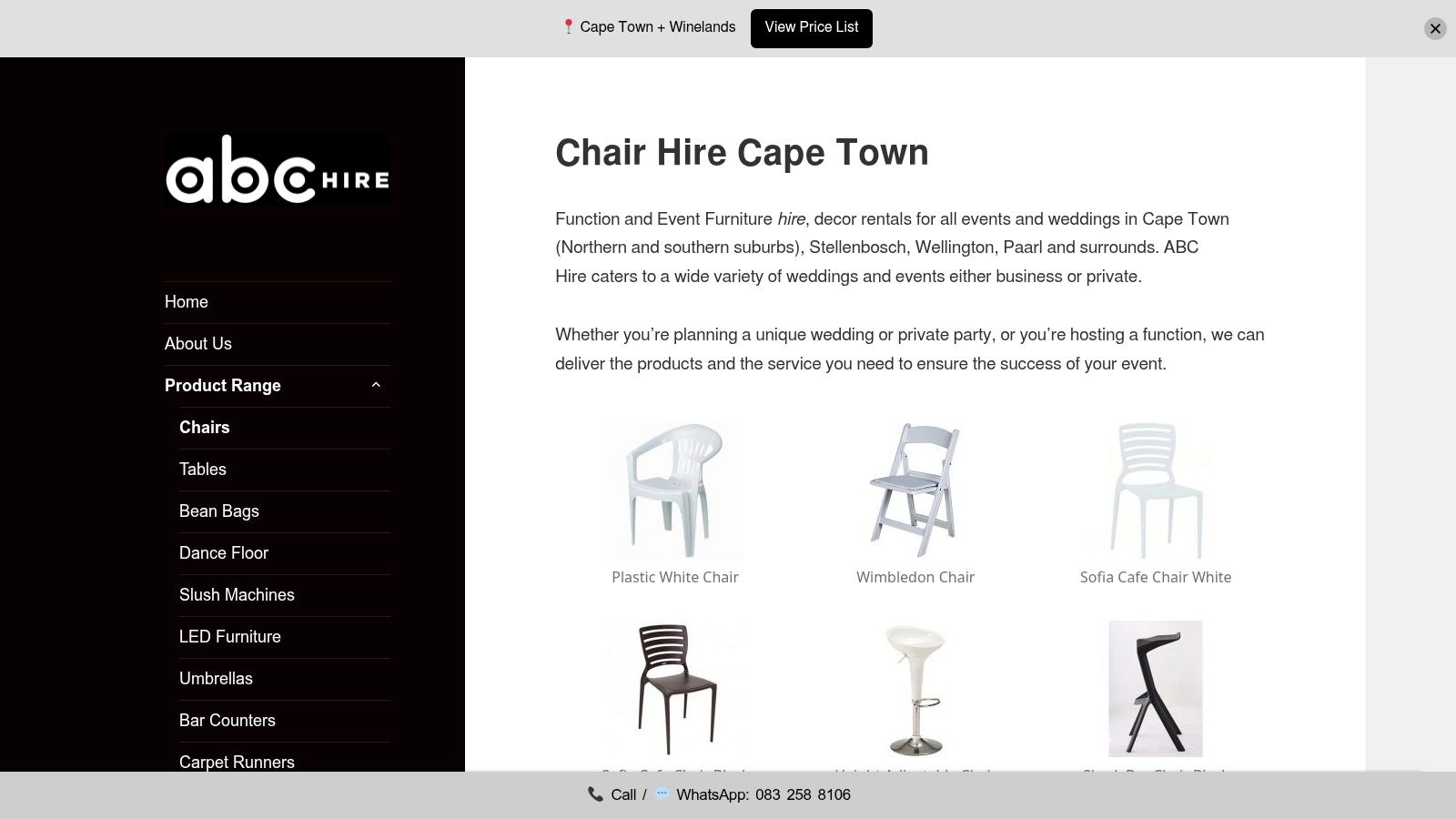
Here's a useful visual reference point:

Screenshot from https://abchire.co.za/chairs/

Classic romance

Bentwood and Wimbledon-style chairs work when you want softness, familiarity, and a sense of occasion without going over the top. They suit vineyard weddings, long-table dinners, and spaces with timber, stone, or heritage architecture.

They photograph well because their shape has movement. They also work across mixed styling palettes. You can pair them with linen-heavy tablescapes, simpler glassware, or lush florals and they still hold the room together.

A classic chair works best when:

  • The venue already has character and you don't want the furniture competing with it
  • You need warmth rather than a stark, editorial look
  • The guest experience leans social and conversational rather than formal and fixed

Industrial edge

Tolix-style metal chairs are the right call for urban venues, product launches, breweries, warehouse conversions, and design-led brand activations. They bring structure into the room. If Bentwood softens a setting, Tolix sharpens it.

The advantage is visual clarity. In a branded environment, clean metal lines can help signage, bars, and activation elements feel more intentional. The risk is that they can read cold if the rest of the styling doesn't balance them with texture.

Selection test: If the venue has concrete, exposed brick, steel, or a strong monochrome brief, industrial seating usually feels at home.

Modern minimalism

Polypropylene cafe chairs, including styles similar to Sofia-type silhouettes, are the most adaptable when the brief needs to stay clean. They work well for conferences, school functions, modern weddings, gallery spaces, and flexible indoor-outdoor setups.

They don't demand attention, which is exactly why they're useful. If your event has multiple visual elements already competing, such as stage lighting, strong florals, patterned branding, or LED features, a quieter chair style gives the room breathing space.

A quick style comparison helps during quoting and mood-board reviews:

Style direction Typical chair family Best fit
Soft and timeless Bentwood, Wimbledon Weddings, vineyard lunches, elegant private events
Urban and structured Tolix metal chairs Brand activations, loft venues, modern catering setups
Clean and flexible Polypropylene styles Conferences, outdoor events, school functions, mixed-use spaces

The mistake planners make is choosing a beautiful chair in isolation. The better approach is asking what role the chair should play. Lead element, quiet support, or practical all-rounder. Once you answer that, style gets easier.

Decoding Materials for Durability and Practicality

Material choice decides whether the event runs smoothly once real use starts. This is where hire experience matters most, because a chair can look excellent in a catalogue and still become a problem on grass, on gravel, in coastal air, or under repeated handling.

For commercial use in South Africa, chairs should meet SABS standards such as SATS 1286:2011, which require structural testing up to 181 kg (400 lb), as outlined in the furniture equipment specifications document referencing SATS 1286:2011. For planners, that's not a technical footnote. It's a useful benchmark for the kind of stock that can handle high-traffic event conditions.

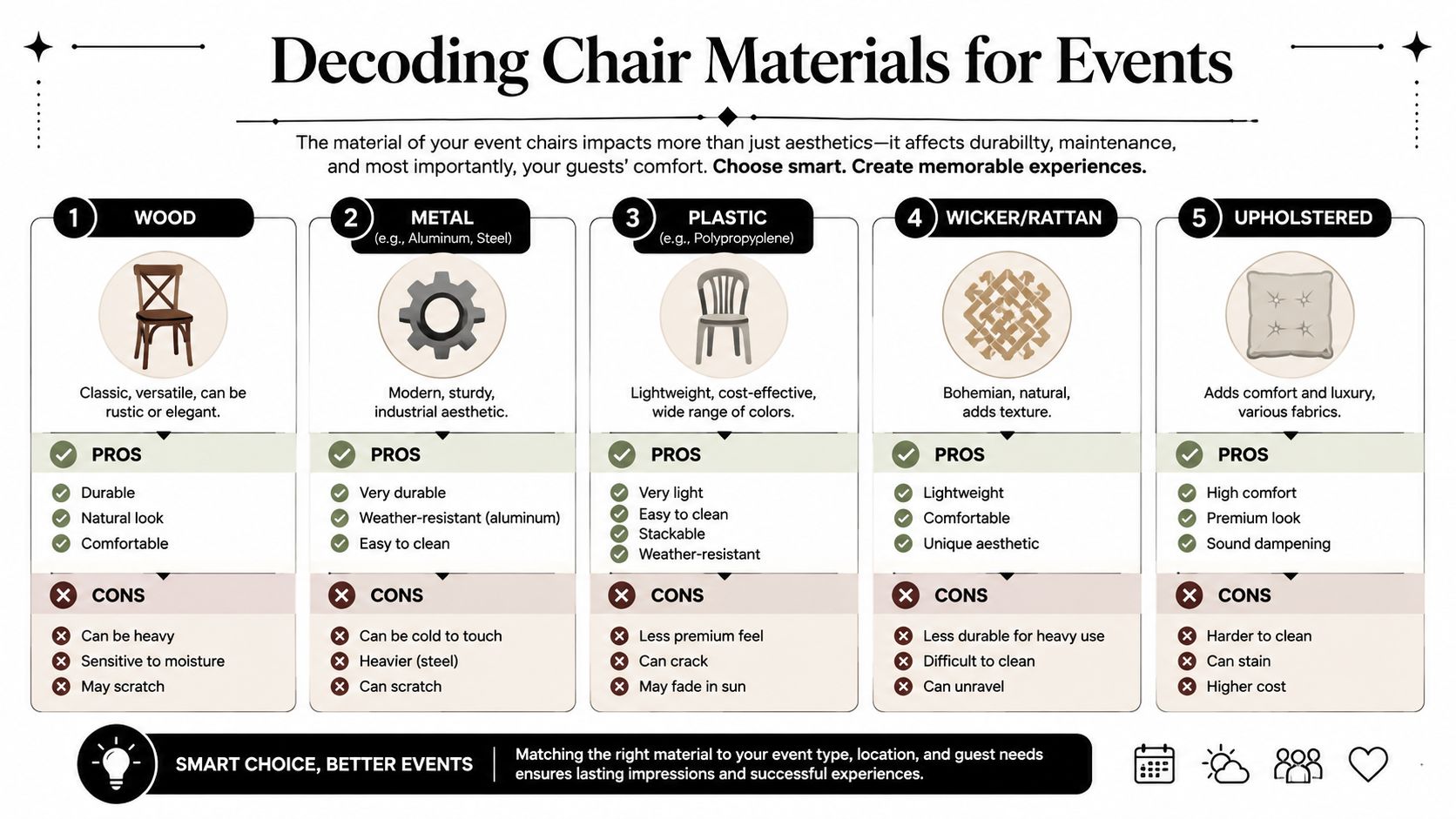
This visual comparison is a good way to think about the trade-offs:

An infographic titled Decoding Chair Materials for Events comparing the pros and cons of five common seating materials.

What each material does well

Metal is the workhorse. It suits heavy use, repeated transport, and quick cleaning. In event terms, that makes it strong for brand activations, food markets, back-to-back conferences, and any layout where crews need stackability and speed. Powder-coated finishes tend to present better than chipped painted frames, so condition matters.

Wood gives warmth that few other materials can match. It's usually the right visual choice for weddings and more layered dining setups. But wood asks for better handling. Dragging, wet grass, careless stacking, and rushed loading all show quickly on timber stock.

Polypropylene wins on flexibility. It's lighter, easier to shift during setup, simpler to wipe down, and often more forgiving in outdoor conditions. For planners dealing with multiple event zones, that lower handling friction can save time on the day.

If you're comparing chair categories with more traditional event stock, folding wooden chairs for events are worth reviewing alongside cafe seating because they solve a different problem. They're excellent for ceremonies and compact transport, but they don't always deliver the same café-style social feel for dining or lounge spillover.

Where material choice goes wrong

The biggest mistakes usually come from matching material to look instead of use.

  • Wood on damp ground: It may suit the brief, but it needs a stable surface and careful placement.
  • Very light plastic on exposed sites: Easy to move during setup, too easy to move once the wind picks up or guests start shifting things around.
  • Steel in salt-heavy environments: Strong, yes. But finish quality and maintenance become more important near the coast.
  • Upholstered seating near drinks-heavy service points: Better for controlled indoor lounges than fast-moving event dining zones.

Choose the material for the hardest part of the event, not the prettiest part of the mood board.

The useful planner question

Ask this before confirming stock: what will this chair go through between delivery and collection?

If the answer includes gravel paths, lawn placement, children, wine service, sea air, or multiple room flips, practicality has to sit alongside style. The best cafe table chairs are the ones that still look composed after guests have used them.

Mastering Comfort Sizing and Event Layouts

Guests notice discomfort quickly. They shift forward, pull away from the table, cross aisles with chairs, or abandon a seating area entirely. If your event includes speeches, plated service, workshops, or extended social time, sizing matters as much as appearance.

For commercial comfort, cafe chairs should have a seat height of 45 to 48 cm paired with tables at 72 to 75 cm, based on the ergonomic ratio outlined in this guide to choosing chairs and tables for cafes. That proportion helps reduce strain during longer seating periods. In event terms, it means guests can sit, eat, and talk without feeling cramped or perched.

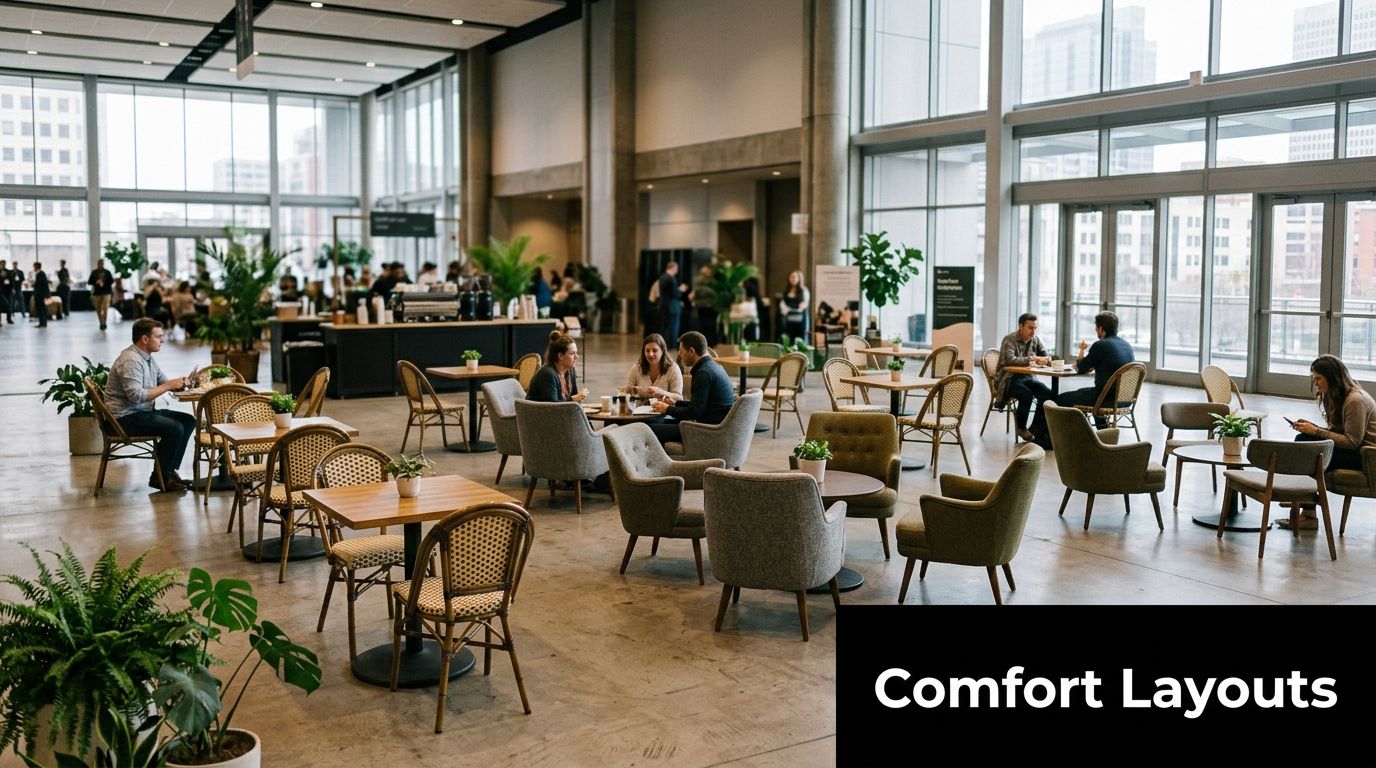
People sitting at cafe tables and chairs in a modern, spacious indoor lounge with large windows.

Get the table and chair relationship right

A good-looking setup can still fail if the seat sits too low or too high against the tabletop. Too low, and guests hunch. Too high, and knees tuck awkwardly under the table edge.

Use these practical checks on site:

  • Seat under-table clearance: Guests should slide in without their legs catching the apron or frame.
  • Dining arm position: Elbows should rest naturally near tabletop level, not lift above it.
  • Back support for long sessions: A low-profile chair can work for short coffee seating, but less so for a wedding meal or awards evening.

If guests will sit through dinner and speeches, comfort beats novelty every time.

Layout has to support movement, not just numbers

Most crowding problems come from overloading a floorplan with the maximum possible chair count. That may look efficient on a quote sheet, but on the day it slows service, creates awkward routes, and makes the room feel tight.

Instead, lay out cafe table chairs according to how the event will move.

Event zone Layout priority Better seating choice
Welcome drinks area Standing flow with some perch seating Smaller table clusters with lighter chairs
Full meal setting Stable dining comfort Balanced chair-table ratio with consistent spacing
Networking zone Easy joining and leaving Flexible two- and four-seat arrangements
Coffee station or dessert area Shorter dwell time Smaller cafe tables with quick-turn seating

Three layout habits that save trouble

  1. Build conversation pockets
    In larger rooms, cafe tables can break up dead space and create quieter interaction areas. That works well for corporate mixers and pre-reception drinks.

  2. Keep service routes obvious
    Staff carrying trays need clean lines through the room. If chairs back directly into one another, service slows and guests feel boxed in.

  3. Check the pull-out zone
    A chair footprint isn't just its position when tucked in. It's the space it needs when someone sits down, stands up, or turns to speak to the next table.

A comfortable layout feels effortless because guests don't have to think about it. They can move, sit, eat, and talk without negotiating the furniture.

The Smart Calculation Renting Versus Buying Furniture

Generic online advice often proves inadequate. Most local search results for cafe table chairs focus on retail pricing and product listings. They don't help planners calculate the actual trade-off between one-off rental and ownership over time. That gap is exactly what's missing in the market, as noted by retail-focused cafe chair listings in South Africa.

For event work, buying isn't just a furniture decision. It's a storage, transport, maintenance, and style-rotation decision as well.

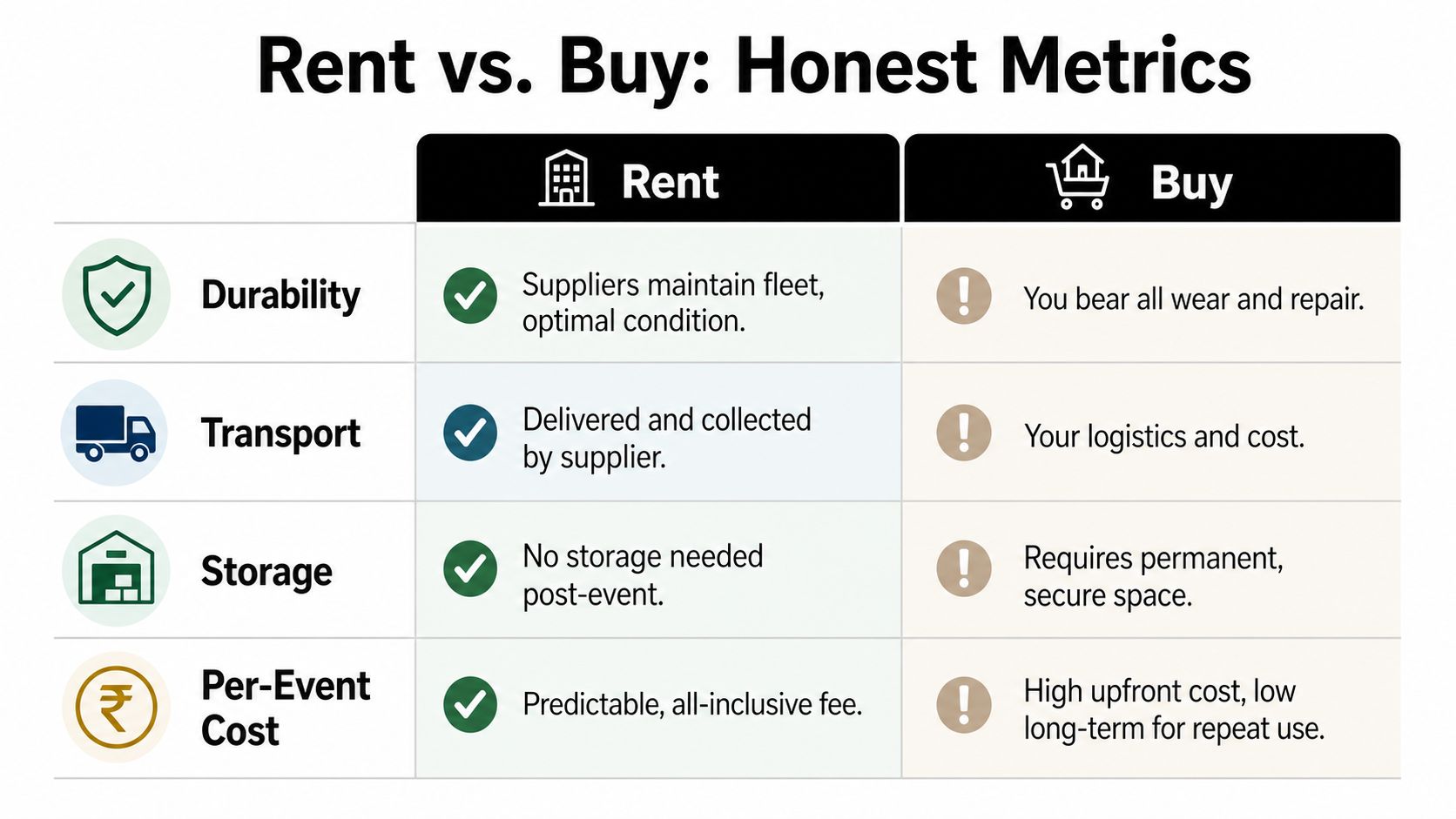
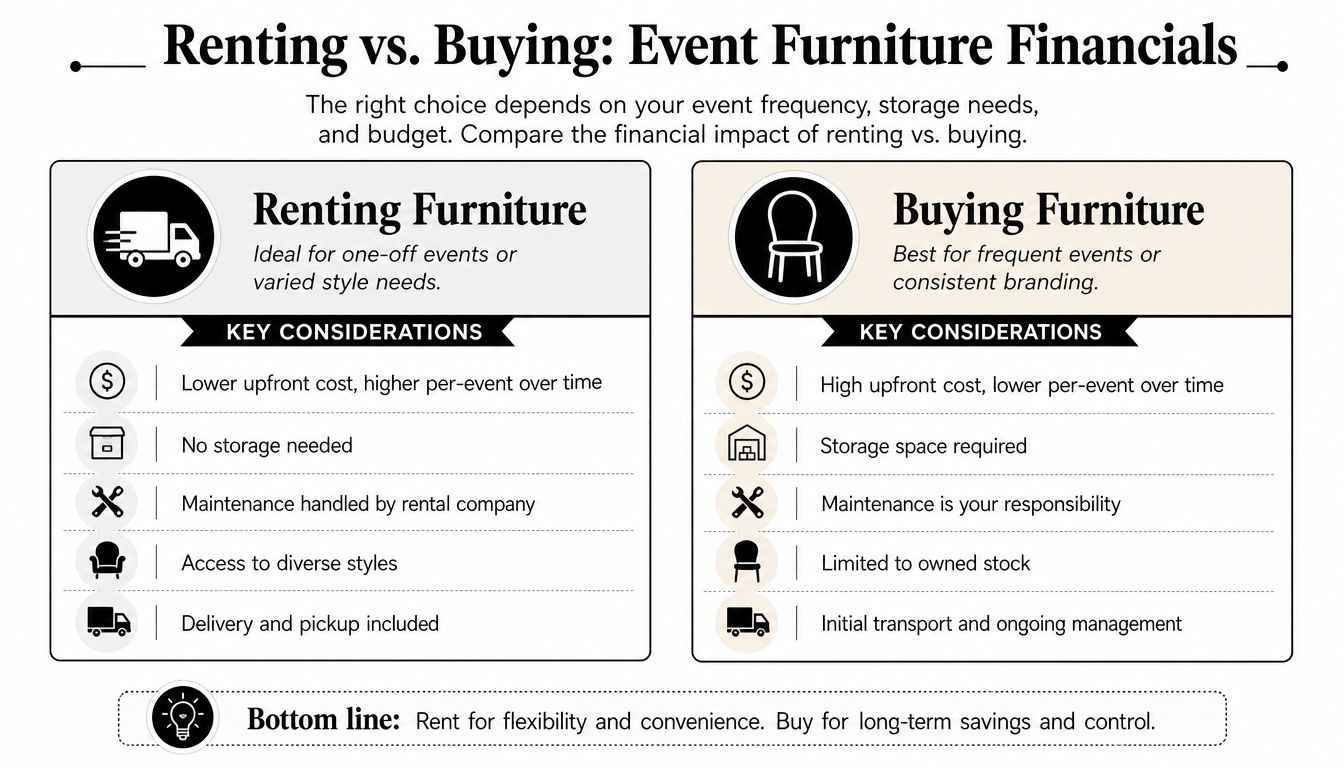
A comparison infographic showing the financial and practical differences between renting and buying event furniture.

Buying looks simple until operations start

Owning stock makes sense in a narrow set of situations. You run frequent events with the same visual identity. You have secure storage. You have transport capacity. You've accepted that your team, not a supplier, will handle cleaning, repairs, missing items, and replacement planning.

What planners often miss is that purchased furniture doesn't stay “bought and done”. It ages. It dates. It gets marked. It ends up split across venues, storerooms, and supplier yards. Chairs also need protection between uses, especially if the finish is part of the appeal.

A practical buying checklist includes:

  • Storage reality: Is there dry, organised space close enough to your event area to be useful?
  • Transport burden: Who loads, secures, unloads, and returns the stock?
  • Condition control: Who checks wobble, scratches, loose feet, or bent frames before every event?
  • Style lock-in: Will this chair still suit the next brief, or only the one you're pricing now?

Renting gives planners agility

Hiring is usually the stronger option for weddings, activations, school functions, and brand events where style changes from brief to brief. You get flexibility without carrying the operational weight of ownership. That matters in a place like Cape Town, where venues vary wildly from beachfront spaces to farms to polished urban sites.

If you're weighing the broader decision, this guide on renting or owning event furniture is useful reading because the chair choice rarely sits alone. It affects table stock, lounge pieces, transport schedules, and setup labour too.

Renting works especially well when your event calendar is varied and your furniture needs aren't.

The better question to ask

Don't ask whether buying is cheaper in theory. Ask which option creates less risk for the specific event in front of you.

For a once-off launch, a matric dance, or a vineyard wedding, renting usually wins because it removes storage, maintenance, and mismatch problems. For a permanent venue or a business producing the same setup repeatedly, buying can work, but only if operations are already tight.

Cafe table chairs are one of those categories where hidden costs matter more than ticket price. That's why the smartest calculation usually happens off the invoice.

Tips for Cape Town and Winelands Event Conditions

Cape Town gives you brilliant venues and difficult conditions in the same booking. A courtyard can be calm at setup and gusty by canapés. A Stellenbosch lawn can start dry and finish slick after a quick weather turn. A coastal function can leave metal finishes looking older than they should if the stock isn't suited to the environment.

Most general buying guides don't deal with that local reality. They also tend to skip the material and logistics questions that matter most for outdoor events in this region, as highlighted by this discussion of weather-resilient outdoor furniture considerations.

Match the chair to the site, not just the theme

For exposed terraces and windy sites, very light chairs can become a nuisance. They're easy for crews to place, but they can shift too easily during service or when guests stand up. A bit more weight often gives better stability, especially in open-air dining areas.

For lawn events, chair feet matter. Narrow legs can sink or wobble on softer ground. That's where planners need to think about the whole setting, not just the furniture silhouette. Grass, gravel, pavers, and decking all affect how stable the seating feels.

These local conditions usually call for different decisions:

  • Coastal venues: Prioritise finishes that cope better with sea air and regular cleaning.
  • Garden weddings: Avoid delicate surfaces that don't enjoy damp grass or muddy edges.
  • Farm venues with uneven ground: Check leg stability and seat balance before final layout.
  • Night events outdoors: Choose seating that still reads well once ambient lighting changes.

Work with a weather fallback before delivery day

Cape Town weather planning isn't only about rain. It's about movement. Wind changes aisle plans, bar placements, ceremony orientation, and how tightly furniture should be grouped.

A stronger setup plan includes:

  • A wet-weather placement option for dining and casual seating
  • A wind-conscious layout that avoids loose, scattered furniture on exposed edges
  • A fast reset plan if a drinks area needs to move under cover
  • A material backup if your first aesthetic choice is too vulnerable for the forecast

For broader planning around stock that can handle outdoor use, weather-resistant outdoor furniture for events is a practical reference point.

On Western Cape events, the best-looking chair is the one that still works after the weather changes.

Pairing seating with evening atmosphere

One of the more effective local setups is combining durable cafe table chairs with stronger visual elements after dark. If your seating does the practical job well, you can let lighting, bars, or specialty rental pieces create the drama. That's especially useful for private parties and activation spaces where guests move between seated zones and feature areas through the evening.

The key is restraint. Let the chairs support flow and comfort. Let the event features carry the spectacle.

Your Event Day Setup and Care Checklist

By the time the truck arrives, most seating mistakes are already locked in. The best thing you can do on event day is run a disciplined check before guests enter. That protects the look of the room and makes collection far easier later.

Before guests arrive

Start with stability, not styling. Every chair should be placed, tested, and aligned before table décor begins. If a chair wobbles on stone, lawn, or uneven decking, it won't improve once guests are seated.

Use this pre-service checklist:

  • Test each cluster: Press lightly on the seat back and corners to check for rocking.
  • Check spacing at the table: Guests should be able to sit without bumping neighbouring chairs immediately.
  • Face chairs consistently: Uneven angles make a room look messy even when everything else is right.
  • Inspect visible surfaces: Remove dust, fingerprints, and transit marks before the first guest photo.

During the event

Cafe table chairs usually take more abuse during the middle of service than planners expect. Guests drag them to join conversations. Children climb on them. Drinks run down legs and collect around feet. The answer isn't constant interference. It's quick, light-touch maintenance.

A smart floor team does three things well:

  1. Reset displaced chairs when guests move to the dance floor or buffet.
  2. Wipe spills fast before rings, stickiness, or staining settle into the finish.
  3. Watch problem zones such as bars, coffee stations, and outdoor transitions where chairs migrate.

A neat chair line after the main meal makes the whole event feel better managed.

Pack-down without creating damage

The end of the night is where good furniture gets ruined. Rushed stacking, dragging across rough ground, and mixing incompatible stock can turn a smooth event into a damage report.

Keep pack-down simple:

  • Separate by type: Don't mix metal, wood, and plastic chairs into one return pile.
  • Stack correctly: Follow the natural stacking direction rather than forcing a fit.
  • Keep wet stock apart: If rain came through, isolate damp pieces for proper handling.
  • Clear décor before moving: Napkins, wax, florals, and cable ties often snag on chair frames.

One last point matters for planner-supplier relationships. If something is unstable, damaged on site, or clearly unsuited to the surface, flag it early. Problems are much easier to solve before guests sit down than during speeches.

The best event setups aren't the ones with the fanciest furniture. They're the ones where the seating looks right, feels right, survives the conditions, and disappears into a well-integrated guest experience.


If you're planning an event in Cape Town, Stellenbosch, Franschhoek, Paarl, or the surrounding Winelands, ABC Hire can help you choose cafe table chairs and event furniture that suit the brief, the venue, and the conditions on the day. Whether you need polished seating for a wedding, practical stock for a corporate event, or flexible options for a private celebration, their team can help you hire with fewer surprises and a clearer plan.

Round Cocktail Tables: A Cape Town Event Planner’s Guide

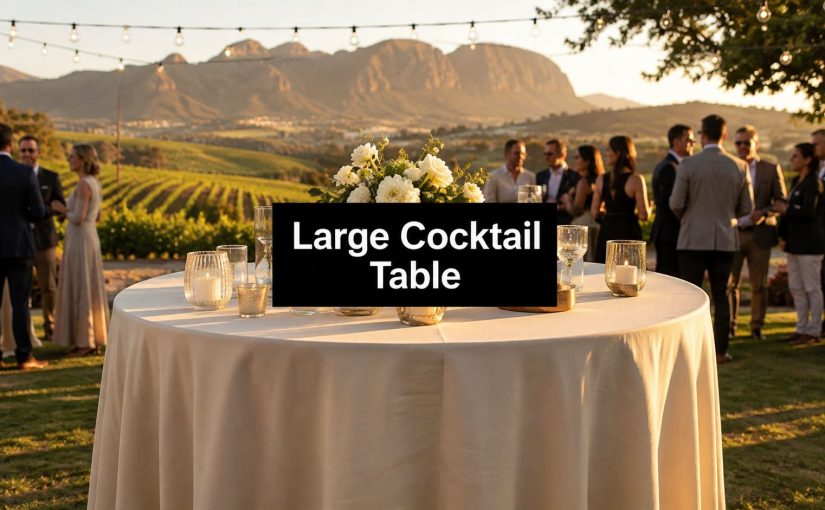
You're probably planning an event where guests won't stay in one place for long. A Cape Town wedding on a lawn in Constantia, a cellar-door reception in Stellenbosch, a brand launch in the city, or a matric dance where everyone starts formal and ends up moving between photo spots, the bar, and the dance floor. In all of those setups, round cocktail tables do a lot of quiet work.

Get them right and the room feels easy. Guests have somewhere to rest a drink, conversation forms naturally, and the venue feels full without feeling cramped. Get them wrong and you'll see it fast. People balance glasses on window ledges, crowd around too few tables, or avoid areas that looked good on a floorplan but don't work in real life.

In the Western Cape, the details matter even more. Wind changes outdoor layouts. Uneven terraces punish flimsy furniture. Farm venues often require fast setup over long walking routes. That's why round cocktail tables shouldn't be treated as an afterthought. They're part furniture choice, part crowd management tool, and part styling surface.

Sizing Up Your Options for Guest Comfort

Two dimensions matter most with round cocktail tables. Height affects comfort. Diameter affects how many people can use the table without elbowing each other or parking handbags where drinks should go.

The standard height for cocktail service is 42 inches (106.7 cm), which aligns with the natural elbow position of an average adult and helps reduce upper-body strain during long standing conversations, according to round cocktail table specifications from Forever Redwood. That's why this height works so well for launches, canapés, pre-dinner drinks, and networking functions. Guests don't need to hunch over, and they don't feel like they're eating off a side table.

Height first, then diameter

If your event is built around standing and mingling, start with the standard cocktail height. If people will dine at the tables, that's a different furniture decision entirely.

Diameter is where planners often go wrong. A compact top keeps the room airy, but it also limits what the table can carry. Once you add glasses, a small floral arrangement, perhaps a candle, and the odd phone or clutch bag, space disappears quickly.

Here's a practical guide I use when planning layouts in Cape Town venues:

Table Diameter Best For (Standing Guests) Common Use Case
60 cm 2 to 4 guests Tight terraces, pre-ceremony drinks, matric dance mingling zones
About 70 cm to 72.4 cm Up to 4 guests with more usable surface area Corporate networking, longer cocktail hours, bar-adjacent clusters

The smaller option is common for compact venues. The Dash 60cm Round model lists a 60 cm diameter and is a useful benchmark for the local market, especially where planners need a compact profile for circulation, as shown on Takealot's 60 cm cocktail table listing.

The slightly larger format is the more generous social table. A standard round cocktail table size of 28.5 inches (72.4 cm) with a 42-inch height is a strong all-purpose choice when guests will be standing around the table for longer periods, especially in premium venues where comfort matters as much as appearance.

Practical rule: If the event includes canapés, welcome drinks, and long conversations, a slightly larger top usually works better than the smallest option that fits the floorplan.

What works in real venues

On a wine farm terrace, smaller tables can look elegant, but only if they're not expected to do too much. They suit short-form mingling well. At a city event where guests hold drinks, name badges, phones, and canapé plates, a larger top often makes the room feel calmer because guests aren't fighting for space.

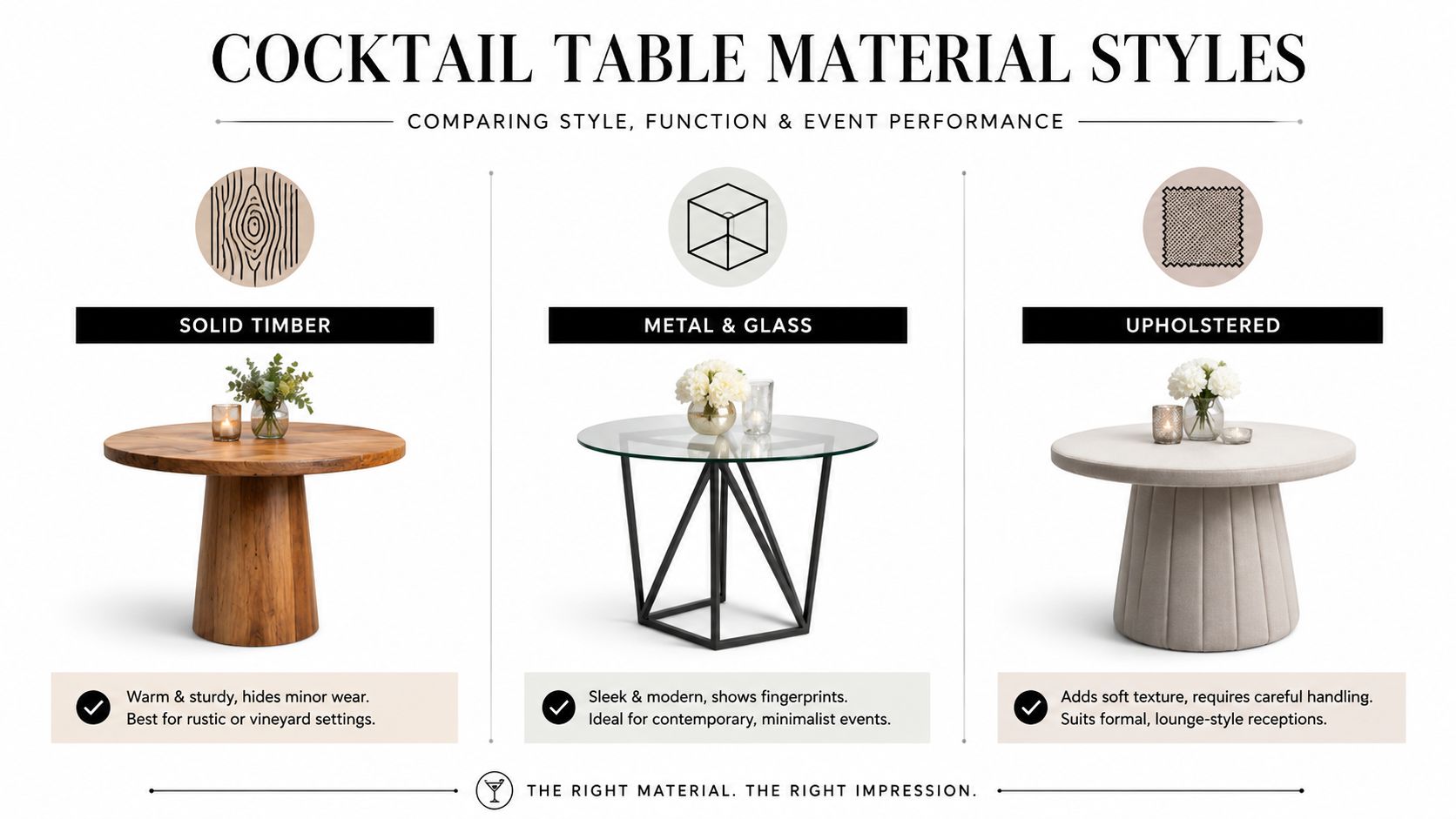
If you're comparing materials and styles, this guide to metal cocktail tables is useful for understanding how the table's look affects the event feel. Metal can read sleek and contemporary. Covered tables feel softer and more formal. Neither is automatically better. It depends on the room, the dress code, and how long people will use the tables.

How Many Cocktail Tables Do You Really Need

Many still guess. They look at the guest list, picture a few clusters, and order what feels right. That approach causes problems more often than acknowledged.

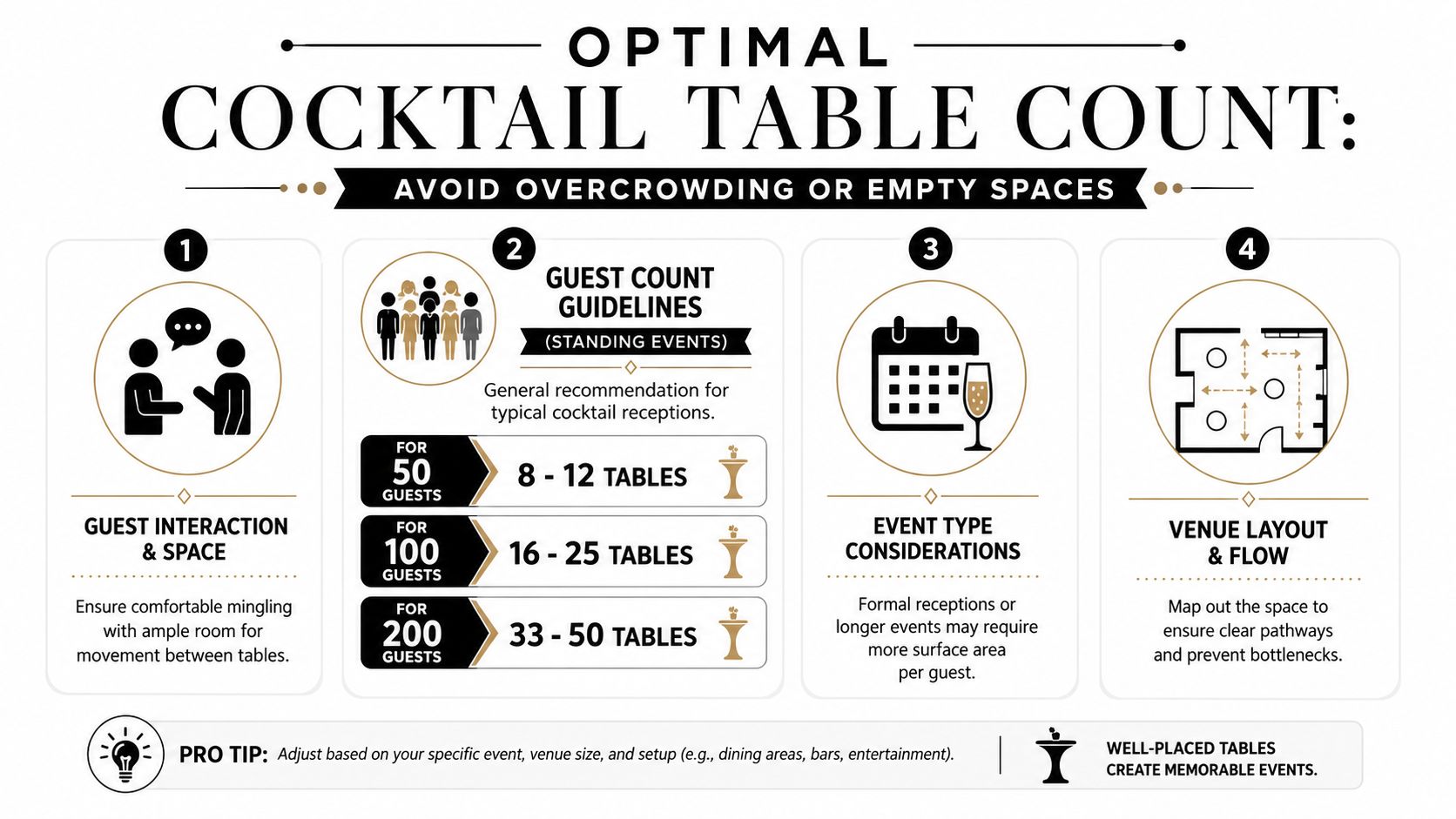
A 2025 SEPA study found that 68% of wedding planners in Cape Town incorrectly assume a standard 60 cm round cocktail table accommodates 6 guests comfortably, and the study recommends a maximum of 4 guests for optimal comfort. That's the stat I'd keep in mind before signing off a rental quantity. It's a simple correction with a big effect on how the room feels.

An infographic showing the optimal number of round cocktail tables based on guest counts for events.

Start with behaviour, not guest count

The right number depends less on the total headcount and more on what guests will be doing. At a corporate mixer, people circulate constantly and need more touchdown points. At a wedding, guests may use cocktail tables mainly before dinner, after the ceremony, and later near the dance floor or bar.

A practical framework is to ask:

  • Will most guests stand at the same time? If yes, increase your table count.
  • Will there be plated food or just drinks and canapés? Food needs more usable surface area.
  • Is there formal seating elsewhere? If yes, cocktail tables can support movement rather than carry the whole event.
  • Are guests likely to linger outdoors? If the answer is yes, people need enough surfaces to settle into conversation.

A better planning method

Rather than saying “one table can take six”, plan around actual comfort. For standard round cocktail tables, assume up to 4 standing guests per table when you want the event to feel relaxed rather than crowded. That keeps spacing honest.

I also split the room mentally into three categories:

  1. Core mingling zone
    These tables carry the event. Put enough here that guests don't circle awkwardly.

  2. Support tables near service points
    Bar queues, coffee stations, and terrace exits all need nearby surfaces.

  3. Overflow pockets
    Small clusters prevent one busy area from doing all the work.

If a floorplan looks spacious only because every table is over-assigned, it isn't spacious. It's under-furnished.

For weddings in the Winelands, the mistake is often underestimating pre-reception congregation. Everyone comes out of the ceremony at once. They collect drinks at once. They move toward shade or the view at once. If your cocktail tables aren't there waiting for that moment, the event feels disorganised even when everything else is beautiful.

For corporate events, I'd rather see a few extra well-placed round cocktail tables than a polished venue with nowhere practical to put a drink. Guests notice function before they compliment styling.

Strategic Placement for Optimal Event Flow

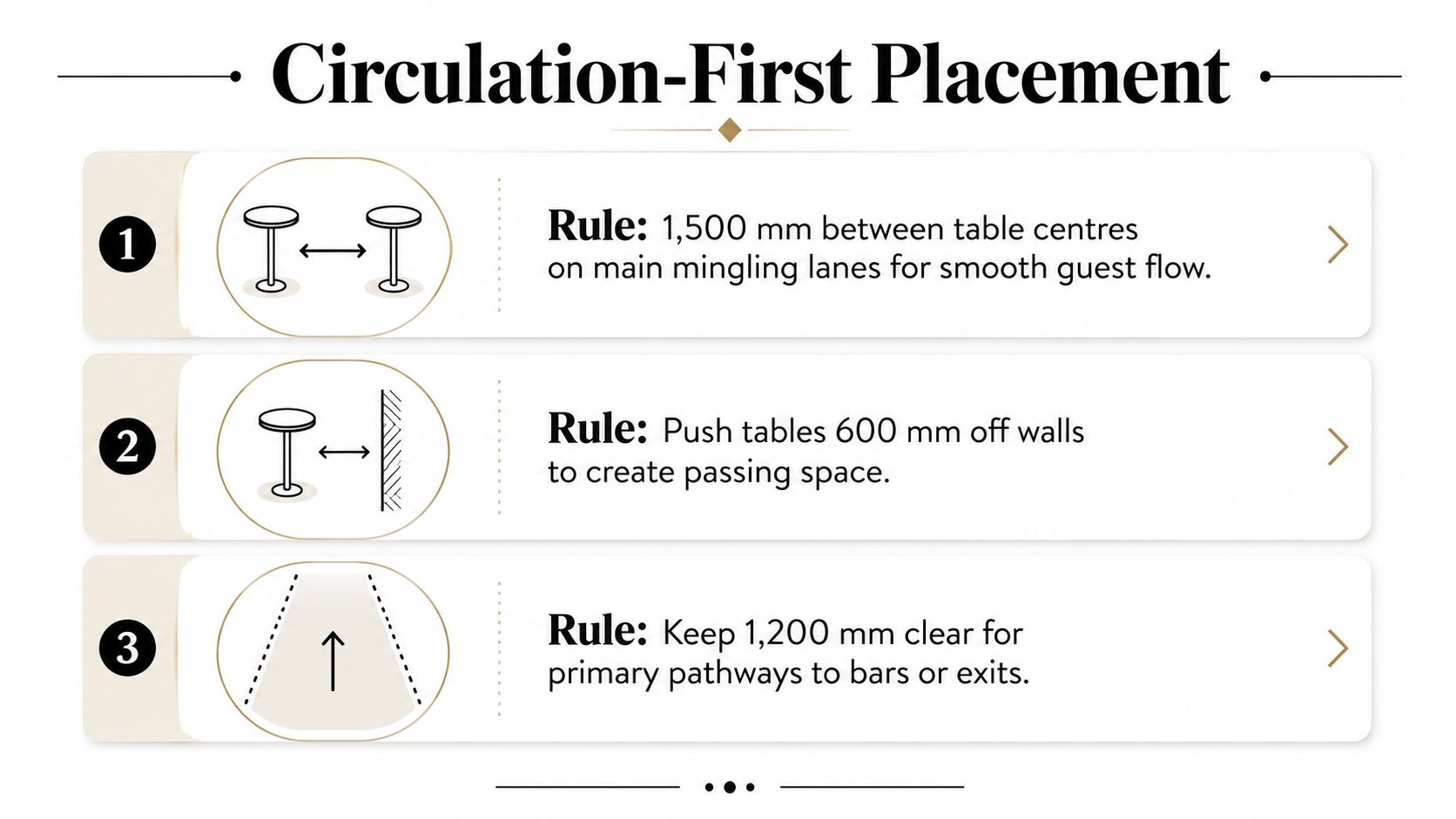
Placement changes how people move, where they pause, and which parts of the venue come alive. You can have the right quantity of round cocktail tables and still get the room wrong if they're dropped into the space without a plan.

A group of professional people networking outdoors on a terrace at an event with round cocktail tables.

The social hub

This layout suits launches, networking evenings, and high-energy receptions. Group tables in the centre of the room or terrace in loose clusters, not rigid rows. The aim is to create a natural magnet point where people enter, pause, join conversations, and keep moving.

It works especially well in a ballroom or on a broad wine farm deck where there's enough width for circulation around the groupings. The cluster becomes part conversation engine, part visual anchor.

The perimeter flow

Some events need an open middle. A dance floor, speech area, presentation screen, or ceremony turnaround all benefit from keeping the centre clear.

In those cases, place round cocktail tables around the edges and near transition points. Along walls, beside bar stations, just off the dance floor, or under verandas. Guests still have functional standing spots, but the room keeps its breathing space.

For teams mapping movement in larger venues, these effective event planning tactics are helpful for thinking through bottlenecks, entry points, and guest flow in a more deliberate way.

Quiet corners that actually get used

Not everyone wants to stand in the busiest part of the room. A pair of cocktail tables tucked under trees, near a side courtyard, or on the quieter end of a terrace gives guests another social mode. Older relatives, introverted colleagues, and people catching up properly will gravitate there.

Use these quieter pockets carefully:

  • Near but not inside the busiest route so guests can peel off naturally
  • Away from service congestion because no one wants deep conversation beside a queue
  • With enough visual connection that the area feels included, not forgotten

A good layout guides people without making the planning visible. Guests should feel that moving around the event is easy, even if every table has been placed with intent.

Styling Your Tables for a Signature Cape Town Look

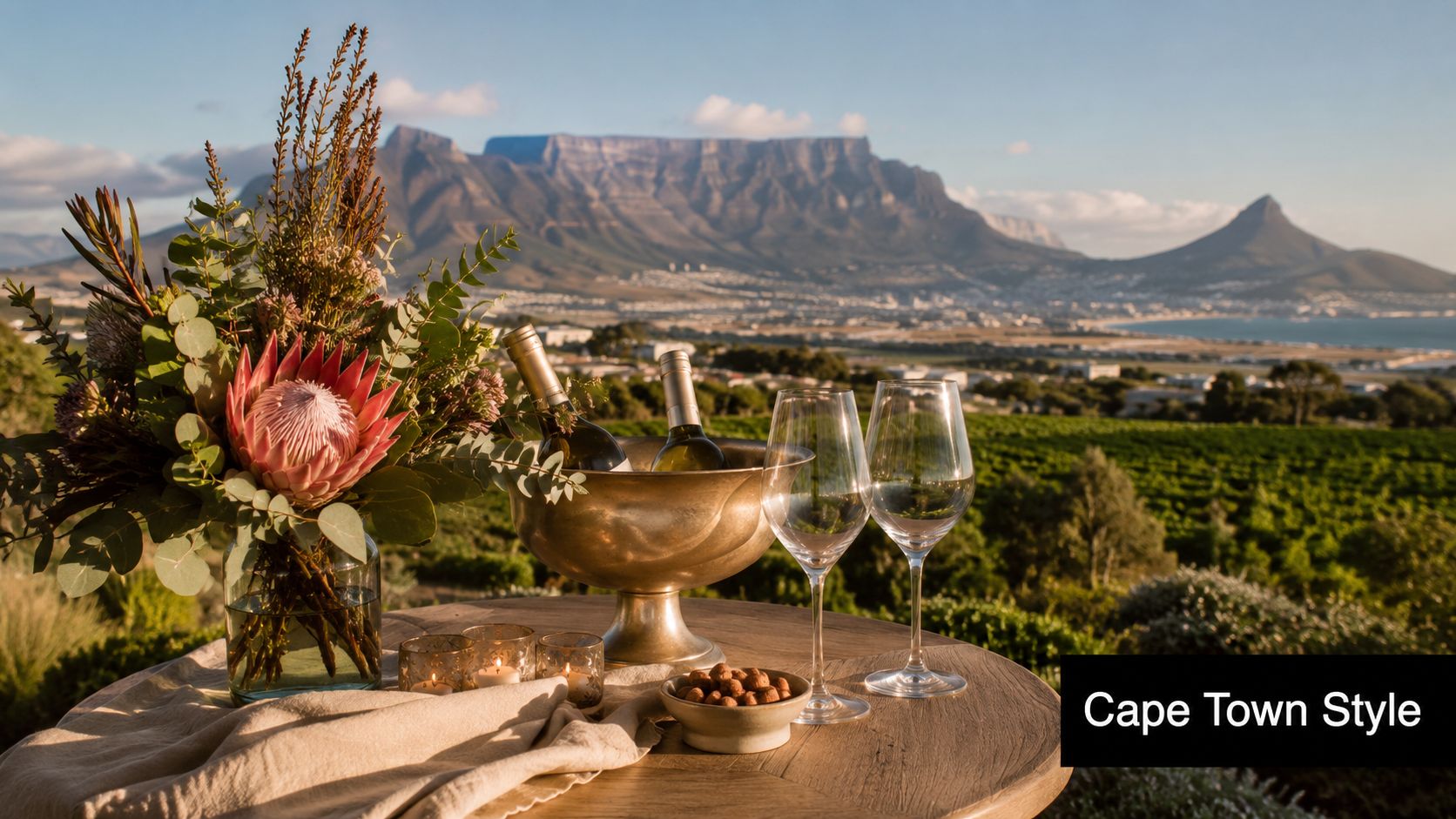
Styling changes the role of a cocktail table completely. The same round table can feel formal on a Stellenbosch estate, architectural at a Waterfront launch, or playful at a birthday party after dark. That's why I never style them in isolation. I style them against the venue, the light, and the way guests will use the space.

A scenic view of Table Mountain overlooking a vineyard with wine, flowers, and snacks on a table.

The classic Winelands wedding

On a wine estate, round cocktail tables often look best when styling feels restrained. Floor-length linen in white, stone, or soft neutrals works because the setting is already doing a lot visually. Add a small fynbos arrangement, keep the top uncluttered, and let the view stay part of the design.

Heavy centrepieces are usually the wrong move here. They block sightlines and fight the relaxed elegance that Winelands venues do so well.

A clean cloth fit matters more than people think. If you're choosing linen for different table sizes and event moods, this guide to tablecloths for round tables helps clarify what creates a polished finish instead of a rushed one.

The city launch

For a corporate event in Cape Town, especially in a modern venue with glass, concrete, or harbour views, I often prefer a more stripped-back look. Bare cocktail tables or sharply fitted covers can work beautifully. Keep florals minimal. Let branding, lighting, and the architecture carry the visual identity.

Discipline matters. If every table has menus, promo cards, oversized florals, candles, gift items, and product literature, the event starts looking busy rather than premium. One strong styling idea is enough.

Styling cue: If guests are standing, leave more open table surface than you think you need. Function is part of the aesthetic.

The birthday or matric dance setup

Evening parties allow more drama, a setting where LED cocktail tables come into their own. They shift the room after sunset and help zones feel intentional without adding bulky decor. A dance floor edge, chill area, or entrance cluster instantly reads as part of the event design rather than random furniture placement.

For more casual finishing touches, I also like looking outside the local event bubble for practical styling ideas. This resource for UK hospitality paper napkins is useful when you're thinking about colour, texture, and disposable service details that still need to feel considered.

The strongest styling choices don't try to force one look onto every event. They use round cocktail tables as flexible surfaces that support the venue's character instead of competing with it.

Local Rental Considerations for the Cape

In the Western Cape, furniture hire isn't just about availability. It's about whether the stock can handle the venue, the weather, and the setup conditions on the day.

That's especially true outdoors. A 2024 University of Cape Town report found that 72% of aluminium round cocktail tables rented for outdoor events in Cape Town's coastal areas showed significant surface degradation within 18 months due to salt spray and UV exposure, which is a strong reminder that climate-appropriate materials matter in this region. Coastal venues look fantastic, but they're hard on furniture.

Material matters more near the sea

A glossy table that looked perfect in a warehouse can age fast after repeated use in Clifton, Camps Bay, or any exposed coastal site. Salt air, direct sun, and wind don't care what looked good in the quote.

Ask rental partners practical questions:

  • What finish is on the table? Not all metal surfaces hold up the same way.
  • How is the stock maintained between hires? Maintenance standards show up in the condition on site.
  • Is the table suitable for outdoor use in exposed areas? Some stock is better kept for indoor or sheltered venues.

Logistics decide whether setup stays calm

A standard 30-inch wood round cocktail table weighs about 25 lbs (11.3 kg) and can be used at 30-inch dining height or 42-inch belly-bar height, according to Event Seating's product specifications. Those details matter when your crew is carrying tables through side gates, up staircases, across lawns, or into venues with tight loading access.

That weight is manageable, but not irrelevant. On a wine farm, where parking may be well away from the reception area, setup time often depends on how many trips crews must make and how easy the tables are to move and assemble.

The smoothest rental jobs in the Cape usually come from planning around the venue's constraints before delivery day, not solving them during setup.

Price isn't the full decision

The cheapest quote can become the expensive choice if stock arrives tired, unsuitable for the weather, or awkward for the venue access. A reliable local supplier should understand city bowl loading windows, farm-road delivery challenges, and the practical difference between a neat indoor launch and a wind-exposed terrace.

If you're comparing furniture packages across event types, this overview of tables and chair rentals is a useful starting point for thinking beyond single-item hire and planning the room as a whole.

Your Final Cocktail Table Rental Checklist

Before confirming your order, run through the event like a guest would. Where will they enter, collect a drink, stop to talk, and put something down? That simple mental walk-through catches most layout mistakes.

Use this final check before you lock in round cocktail tables:

  • Confirm the height: For standing receptions, standard cocktail height works best for comfort and natural conversation.
  • Choose the right diameter: Smaller tops suit tighter spaces. Larger tops handle longer mingling and more drinkware.
  • Check realistic capacity: Don't overload a table because it fits on paper.
  • Match quantity to behaviour: Order for how people will use the room, not just the size of the guest list.
  • Map placement properly: Decide which tables belong in hubs, on the perimeter, and in quieter corners.
  • Style for the venue: Winelands linen, urban minimalism, or LED impact should all support the setting.
  • Ask about outdoor suitability: Coastal and exposed venues need tougher, well-maintained stock.
  • Think through access: Stairs, gravel, narrow roads, and long carry distances affect setup more than most clients expect.
  • Confirm the rental partner understands Cape Town conditions: Local knowledge saves stress on event day.

The best round cocktail tables don't draw attention to themselves. They make the event feel natural, organised, and easy to enjoy.


If you need round cocktail tables, LED furniture, or a full event furniture solution for Cape Town, Stellenbosch, Franschhoek, Paarl, or the surrounding areas, ABC Hire is a strong local partner to speak to. Their range suits weddings, corporate functions, matric dances, and private celebrations, and they understand the practical realities of Western Cape venues that generic suppliers often miss.

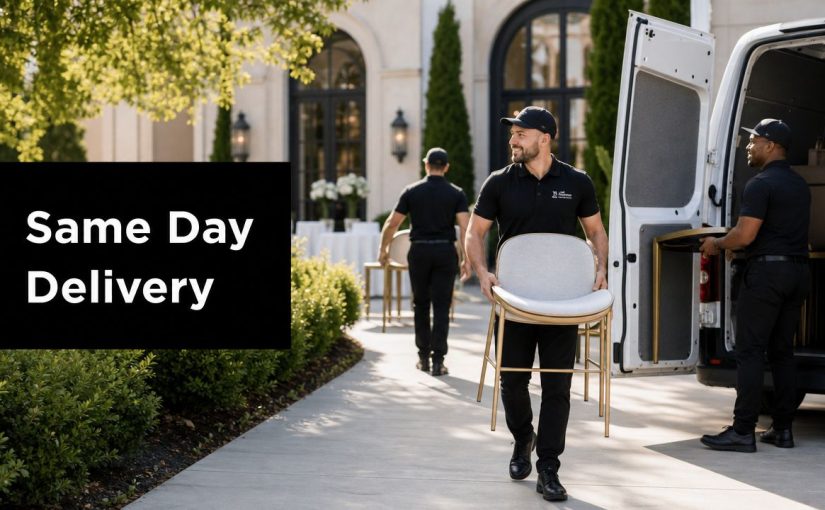
Same Day Furniture Delivery: Your Event Rescue Guide

An hour ago, your event plan was stable. Then the guest count changed, a supplier went quiet, or the venue asked for a layout adjustment that suddenly needs more cocktail tables, lounge seating, LED cubes, or climate control on site today.

That's where same day furniture delivery stops being a convenience and becomes an event rescue tool.

In Cape Town and the Winelands, late changes are common. Wedding timelines shift. Brand activations expand. A matric dance committee realises the original setup won't carry the room. When that happens, the difference isn't just who has stock. It's who can pick, load, route, communicate, arrive, unload, and place the right items without turning your event day into a second crisis.

The Lifesaver Your Event Didn't Know It Needed

Many believe same day furniture delivery is only for panic moments. In practice, it's also how experienced planners protect an event when real life gets in the way of the perfect timeline.

A florist runs over schedule and your setup window shrinks. A venue opens a second area that now needs soft seating. A corporate client adds a VIP zone at lunchtime for that evening's function. These are normal event problems. They only feel catastrophic when the delivery process is slow, vague, or built for residential drop-offs instead of live events.

Event work has always rewarded fast decisions, but now delivery speed affects buying behaviour much more directly. The global same-day delivery market is projected to reach $56.6 billion by 2031, and 62% of customers make their final purchase decision based mainly on delivery speed, while 75% of younger buyers see same-day delivery as essential according to Capital One Shopping's same-day delivery statistics. For event furniture, that urgency is even sharper because the item isn't a nice-to-have. It may be the seating plan, the bar area, or the visual centre of the room.

Practical rule: If the furniture affects guest flow, service flow, or the event look in a visible way, treat delivery as part of event operations, not as a basic courier job.

That's why experienced coordinators usually care less about flashy promises and more about process. They want realistic cut-offs, access planning, setup coordination, and a team that understands pressure. If you work in events, this broader guide to understanding event professionals explains why logistics partners need to fit the pace and communication style of the industry.

If you're still deciding what to rent in the first place, it also helps to review practical advice on renting furniture for events before the day gets tight.

Your Same Day Delivery Booking Timeline

Same day furniture delivery works best when everyone is honest about time. The earlier you book, the more options you keep. The later you leave it, the more the job depends on stock location, crew availability, route congestion, venue access, and whether your order is a straightforward single-drop or a more complex event load.

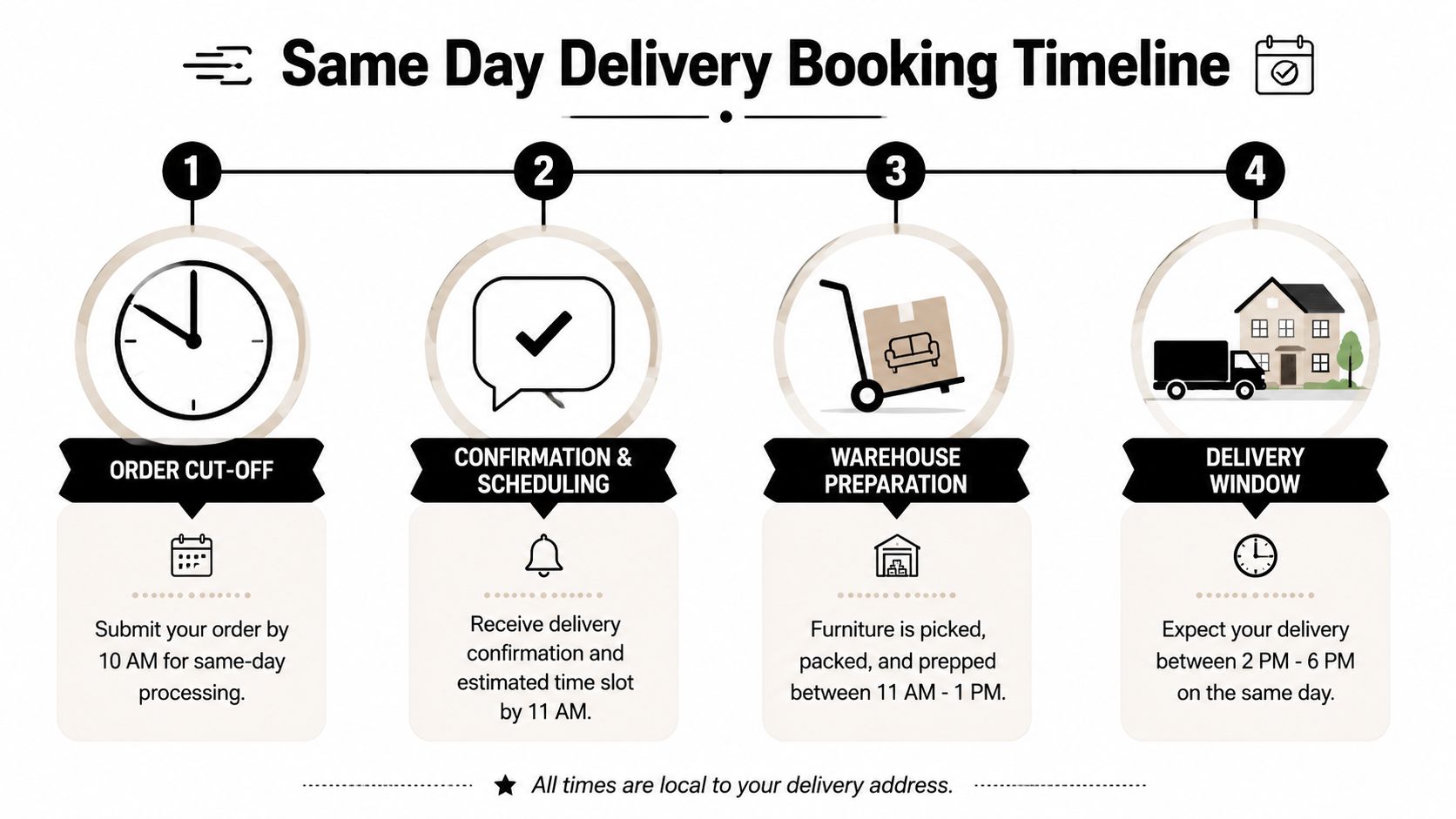
Here's the ideal booking rhythm for an ordinary same-day request:

A flowchart infographic titled Same Day Delivery Booking Timeline showing four steps for furniture orders.

What a realistic timeline looks like

For central Cape Town venues, a morning booking gives the operations team the best chance to confirm stock, assign the correct vehicle, and brief the crew properly. The useful sequence is simple: confirm the order early, lock the venue details, pick and stage the furniture, then dispatch into a delivery window that still leaves margin for setup issues.

For Stellenbosch, Franschhoek, and Paarl, the booking window needs to be treated more carefully. Travel time is only one part of the equation. The primary risk sits in loading time, access at the venue, and the fact that event furniture often isn't one item. It's tables, chairs, bar units, LED pieces, decor support items, and sometimes powered equipment that must arrive together and in workable order.

City venues versus Winelands venues

A Cape Town city-bowl hotel function is usually easier to rescue on the same day than a multi-stop wedding spread across the Winelands. Dense urban work has its own challenges, but the route is shorter and the fallback options are often better.

By contrast, Winelands jobs punish loose planning. If the order is confirmed late, and the team still needs to clarify service gates, gravel access, stair carry, or timed venue entry, the “same day” part becomes much harder than clients expect.

A useful benchmark is demand itself. The market for rapid delivery keeps growing because clients increasingly buy based on speed, as noted earlier. For event rentals, that means the best providers build their day around disciplined booking windows, not around vague promises. That same urgency is why planners often secure foundational items first, then fill gaps later with practical pieces such as event tables and chairs for fast layout changes.

If you need speciality pieces and installation-sensitive items on the same day, book the non-negotiables first and leave decorative add-ons for a second decision. That preserves the delivery slot for what actually keeps the event functional.

When to be cautious

Treat afternoon requests carefully, especially if the venue sits outside Cape Town, needs multiple unloading points, or requires placement in several areas. Same day is still possible in some cases, but the conversation should shift from “Can you deliver today?” to “What can be delivered today reliably?”

That distinction matters. A smaller confirmed order that arrives correctly is always better than an oversized rushed order that creates confusion on site.

The Information You Must Have Ready to Book

The fastest same day furniture delivery calls are never the shortest. They're the clearest.

When a planner has the right details ready, the operations team can move from enquiry to dispatch without wasting the valuable early part of the day on follow-up messages. The missing details are almost always the same: unclear quantities, vague addresses, no on-site contact, or no explanation of access restrictions.

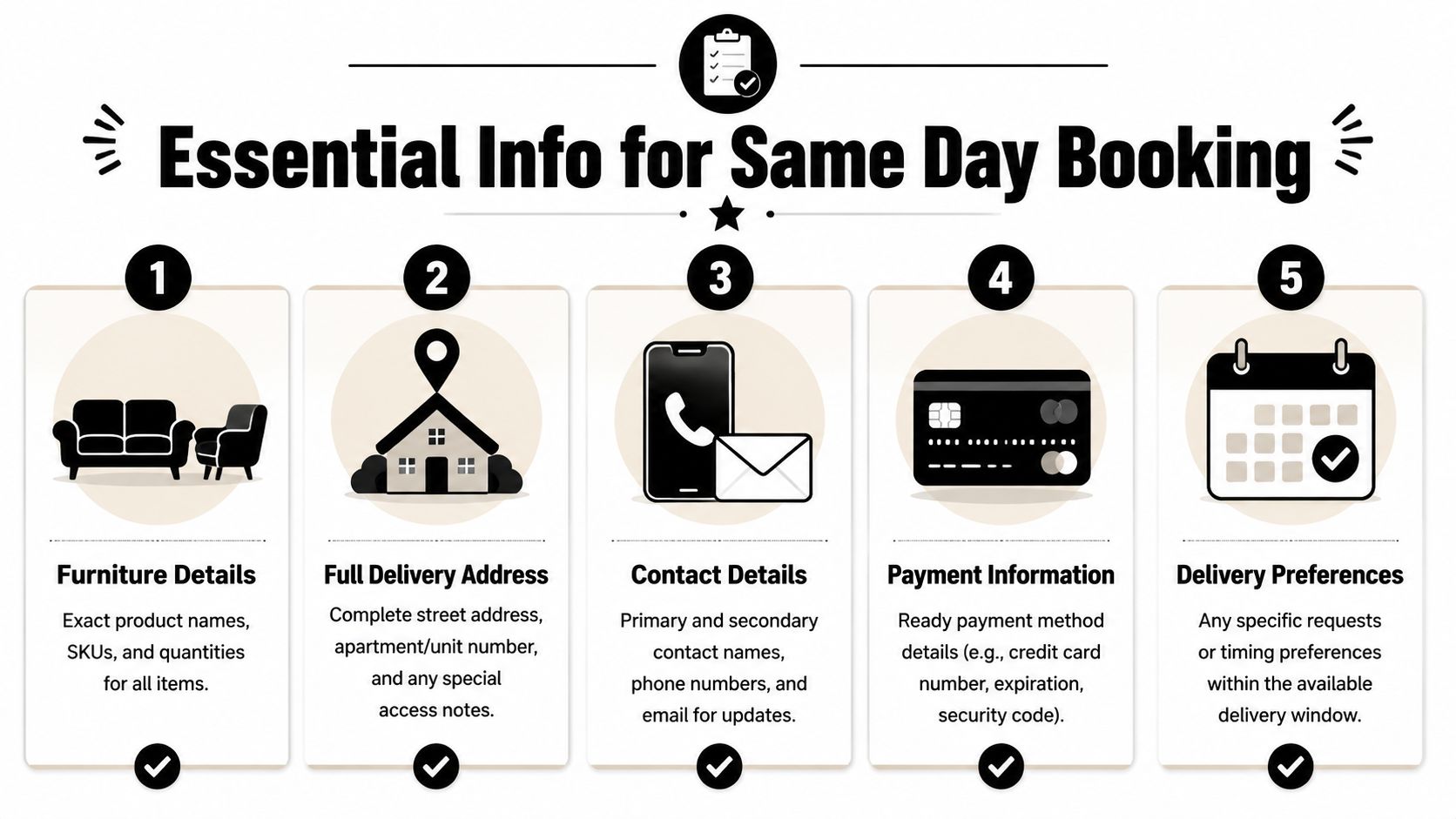
A helpful checklist infographic titled Essential Info for Same Day Booking, outlining five key requirements for furniture delivery.

The booking details that save time

Have these ready before you call or send a WhatsApp:

  • Exact items and quantities. Don't say “some couches and a few tables”. Say “6 cocktail tables, 24 Tiffany chairs, 2 LED cubes, 1 slush machine”.
  • The full delivery address. Include venue name, road, suburb, and the exact entrance the driver must use.
  • Access notes. Service gate, loading bay rules, stairs, lift limits, narrow passages, gravel roads, cellar entrances, or security check-in.
  • Your on-site contact. One person with a working phone who can answer immediately during the delivery window.
  • Required placement. Reception area, dance floor edge, outdoor terrace, VIP lounge, stage left, courtyard bar, or upstairs holding room.
  • Power requirements. Especially important for LED furniture, slush machines, and climate control units.
  • Collection expectations. Same-night collection, next-day pickup, or holdover for a second event day.

Speciality items need better briefing

This matters even more for non-standard event stock. An industry survey found that 78% of Cape Town event planners say same-day options often exclude speciality rental items like LED tables and bean bags, and only 12% of rental companies confirm post-2 PM same-day feasibility for multi-location events in the Winelands. That tells you two things. First, standard delivery systems often struggle with event-specific gear. Second, vague late-afternoon requests for complex multi-venue setups are usually where plans break.

If your event depends on LED furniture or climate control, say so immediately. Those aren't “add-ons” from a logistics perspective. They affect loading, handling, power checks, and placement on arrival.

A same-day booking fails fastest when the client thinks in product names and the logistics team needs operational details. Give both.

The access details people forget

Some of the most expensive delays come from small omissions. A courtyard gate is locked. The service lift is booked by caterers. The venue only accepts supplier vehicles at one side entrance. The delivery team arrives with the right stock and loses time on a preventable site issue.

Use this quick pre-call check:

Booking detail What to confirm Why it matters
Furniture list Names and quantities Prevents stock confusion
Venue access Gate, lift, stairs, parking Avoids unloading delays
Site contact Name and phone Speeds up handover
Placement plan Exact room or zone Reduces double handling
Equipment needs Power and surfaces Protects specialty items

The more specialised the order, the less room there is for assumption.

Understanding Same Day Pricing and Fees

Same day furniture delivery costs more than a standard scheduled run because the team is paying for compression. The stock must be available now, the warehouse must prioritise the order, the vehicle must be assigned around existing jobs, and the route has to absorb less flexibility.

That doesn't make it overpriced. It makes it operationally expensive.

A close-up shot of a hand holding a blue Visa credit card over a payment terminal reader.

What usually shapes the quote

A proper same-day quote usually combines a few moving parts:

  • The rental itself. What you're hiring, in what quantity, and for how long.
  • The fast-turn service component. This covers the urgency and reprioritisation of labour and dispatch.
  • Distance and route complexity. Cape Town CBD, southern suburbs, Stellenbosch, Franschhoek, and Paarl don't place the same demands on the vehicle schedule.
  • Access and handling. White-glove placement, stairs, lift dependency, narrow access, or careful handling for upholstered or powered pieces.
  • Collection timing. Late-night strike, next-morning pickup, or staggered collections can affect the final amount.

Why clients still choose it

Consumer behaviour explains a lot here. 76% of consumers choose same-day delivery when it's free, and 75% choose it when they need the item urgently according to Market.us same-day delivery statistics. Event clients live in that second category. If the event opens in a few hours, the real comparison isn't between premium delivery and cheap delivery. It's between premium delivery and a room that looks unfinished, under-seated, or unworkable.

For planners building budgets, it helps to think in scenarios, not just line items. A useful way to frame distance and handling variables is to review how transport calculators separate labour, access, and route factors, such as the Emmanuel Transport cost calculator. The figures won't match an event rental quote, but the logic does.

What's worth paying for

Pay for certainty where the event is exposed.

If the furniture shapes guest arrival, speeches, catering flow, or branded presentation, the premium usually makes sense. If the item is optional decor and the venue can function without it, then a next-day or scheduled delivery may be the smarter choice.

The best quotes don't just tell you the price. They show you what level of risk and service the price is buying down.

Ask direct questions. Is placement included? Is there a waiting-time risk at the venue? What happens if access changes? Clear answers matter more than a low headline number.

Your On-Site Venue Access and Setup Checklist

The delivery can be perfectly planned and still go wrong in the last ten metres.

That's usually not a transport problem. It's a venue readiness problem. A team arrives on time, then loses minutes to locked gates, unclear room allocations, delayed sign-in, absent contacts, or furniture that has to be moved twice because no one confirmed final placement.

In the Cape Town region, manual routing starts to fail badly once delivery volume gets high, leading to a 30% rise in customer status enquiries and a 25% higher risk of delayed setup for critical event furniture. That's exactly why professional delivery teams rely on disciplined routing and communication. Your side of the job is simpler. Make the venue easy to receive.

The checks that prevent avoidable delays

Use this table before the truck leaves the warehouse, not after it arrives.

Check Point Verification Status Notes
Main contact on site confirmed Name and working mobile number
Access gate or loading bay cleared Include security instructions
Venue accepted delivery window Note any supplier restrictions
Path to setup area clear Remove obstacles and parked vehicles
Lift or stair route checked Flag narrow turns or low clearance
Power points identified Important for LED and climate units
Placement plan signed off Room-by-room or zone-by-zone
Receiving staff available Someone must guide placement

Where setups usually go sideways

These are the problems teams see again and again:

  • No one is waiting at the venue. The truck arrives, calls go unanswered, and unloading stalls.
  • The route inside the venue isn't ready. Decor stock, crates, or catering prep block the path.
  • Placement instructions change during unloading. Every change means more handling and more time.
  • Power hasn't been checked. LED furniture and climate control are delivered correctly, then sit idle while the venue scrambles for extension access.

If you're managing a larger function, pair this with a broader event planning checklist template so delivery, decor, catering, and technical teams aren't all solving the same problem separately.

Safety and handover matter too

A rushed setup can create damage, confusion, and liability. Basic venue-readiness discipline helps with that. For a practical outside perspective on crowd movement, access control, and supplier coordination, these best practices for event safety are useful reading.

Keep one person in charge of receiving furniture. Not three. Not a WhatsApp group. One person.

When that person can answer access questions, sign off placement, and escalate issues immediately, the delivery team can keep moving and your event stays on schedule.

Frequently Asked Questions for Event Emergencies

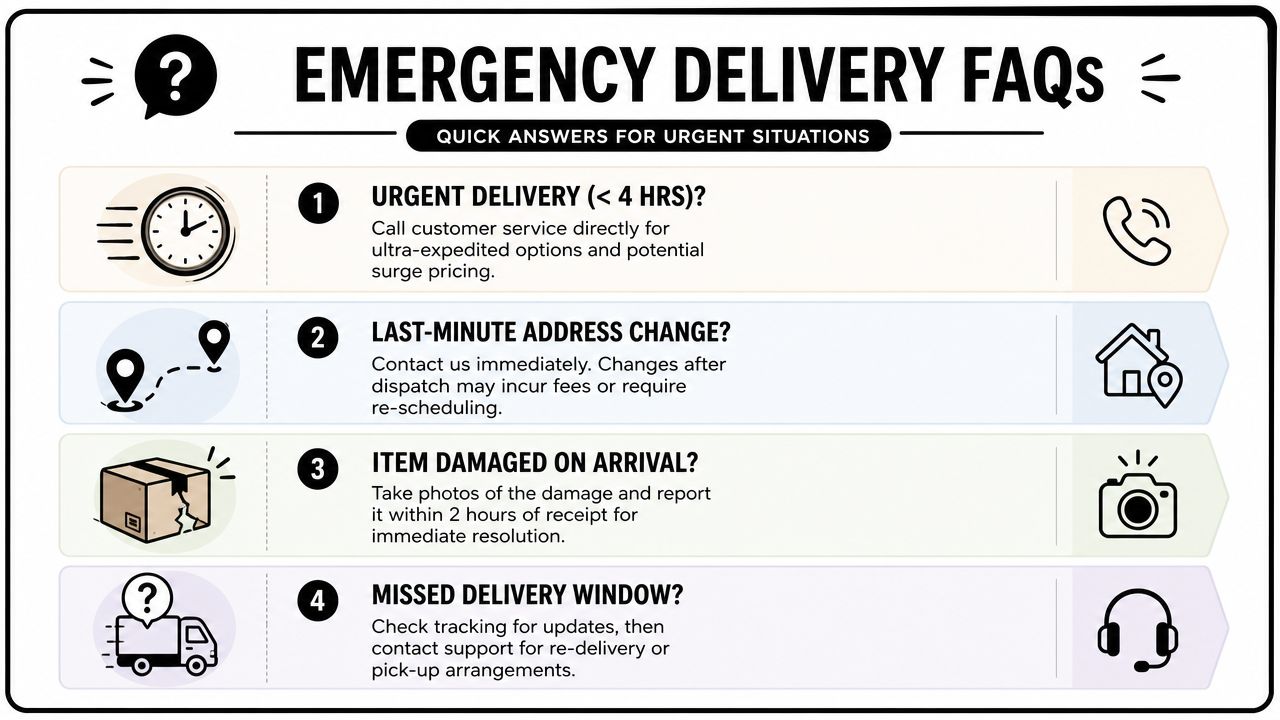
Late changes don't arrive one at a time. They stack. Traffic, weather, venue calls, supplier timing, and client revisions often hit in the same afternoon. These are the questions that usually come up when the pressure is highest.

An infographic titled Emergency Delivery FAQs detailing instructions for urgent, damaged, or missed furniture deliveries.

Can same day still work during peak wedding season?

Yes, but only if the plan acknowledges seasonal road pressure. A traffic analysis showed that 65% of same-day event furniture deliveries failed during November to January because of 45-minute average delays on the R300 between Cape Town and Stellenbosch. That doesn't mean same day is impossible. It means planners should avoid building their whole event around a best-case road assumption during peak season.

If your venue sits in Stellenbosch or beyond, ask for an earlier dispatch window, simplify the order, and have a fallback layout that can open the event if one non-critical item arrives later than planned.

What about two locations in one day?

It can work for brand activations, content shoots, and split-site corporate events, but only if the order is planned as a multi-drop job from the start. The mistake is adding the second venue after dispatch. That changes load order, route timing, and handover sequencing.

When you know two locations are involved, list which stock must land first and which stock can follow later. “Everything everywhere as soon as possible” isn't a workable instruction.

Can speciality items still be delivered quickly?

Sometimes yes, but they need stronger briefing than standard tables and chairs. LED furniture, bean bags, slush machines, and climate control units all create different handling and placement requirements. If those pieces are essential to the event concept, say so up front and make sure the site is ready to receive and power them.

What should I do if the venue changes access rules on the day?

Call immediately and give one clean update. New gate, changed check-in point, temporary road closure, revised contact person, or delayed supplier entry. Don't send fragments across multiple messages. One complete update helps dispatch make a proper decision fast.

The fastest rescue is usually the clearest message, not the loudest one.

Which areas need the most realistic planning?

Cape Town jobs usually move faster if the venue has proper loading access. Stellenbosch and Franschhoek need more buffer during wedding season. Paarl often needs careful heat and timing planning for powered equipment and outdoor setups. Across all areas, same day works best when the order is tight, the site contact is reliable, and the placement plan is already decided before the truck leaves.


If your event can't wait, ABC Hire is built for exactly these high-pressure moments. From LED furniture and lounge pieces to tables, chairs, slush machines, and climate control equipment, the team supports fast-turn event rentals across Cape Town, Stellenbosch, Franschhoek, and Paarl. Reach out early, send complete venue details, and give your same day furniture delivery the best chance to arrive smoothly and set up right.

Rent Tables and Chairs: A Cape Town Event Planning Guide

You’ve found the venue. The mountain view is perfect, the wine farm says sunset photos will be spectacular, and the guest list keeps changing by the day. Then the practical questions land all at once. How many tables fit without cramping the room? Which chairs look right in a cellar, on a lawn, or under a clear marquee? Can the delivery truck get to the site without drama?

That’s where generic advice falls apart. Renting furniture for an event in Cape Town isn’t the same as planning in a flat city with predictable weather and easy loading bays. Here, one event might be on a Clifton rooftop with limited lift access, the next on a Stellenbosch estate with gravel roads, and the next on an exposed lawn where the Cape Doctor can undo a weak setup in minutes.

Tables and chairs are not a minor line item. They’re the base layer of the whole event experience, and in the South African party supply rental market they accounted for about 29.65% of total rental revenue in 2023, driven by wedding and corporate demand in places like Cape Town and the Winelands, according to Grand View Research’s party supply rental market report. That tracks with what planners deal with on the ground. If the furniture choice is wrong, the room feels wrong, service slows down, and guests notice.

This guide is built for Cape Town conditions. It deals with wine estates, city venues, wind, access, style choices, and the budgeting logic behind the quote you receive. If you need to rent tables and chairs for a wedding, brand launch, matric dance, birthday, or corporate dinner, this is the practical version.

Planning Your Cape Town Event The Smart Way

A Cape Town event usually starts with a beautiful idea and runs straight into a logistics problem.

A couple wants long harvest tables under oak trees in Constantia. A corporate team wants a polished dinner setup inside a Stellenbosch cellar. A school wants a formal look for a matric dance, but the hall has awkward pillars, a narrow side entrance, and no proper storage space for early delivery. None of those events fail because the vision was poor. They fail when someone treats furniture as an afterthought.

Start with the venue, not the Pinterest board

The first decision isn’t chair colour or table shape. It’s whether the furniture will suit the actual site.

Cape Town venues vary wildly. A CBD venue may have stairs, strict loading times, and almost no room for back-of-house stacking. A Winelands venue may have enough open space, but the surface could be lawn, gravel, brick, or uneven ground near a vineyard edge. A beachside venue may look relaxed and simple, but salt air and wind make “simple” setups harder than they appear.

That’s why the smartest planners ask these questions first:

  • Access reality: Can a truck reach the drop-off point easily, or is there a long hand-carry section?
  • Surface condition: Will standard chair legs sink into grass or sit unevenly on gravel?
  • Weather exposure: Is the dining area protected, partially exposed, or fully outdoors?
  • Venue rules: Are there fixed setup windows, noise restrictions, or staff requirements?

A beautiful venue doesn’t make furniture planning easier. In Cape Town, it often makes it harder.

Comfort drives the event more than people expect

Guests forgive many things. They don’t forgive discomfort.

If tables are too large for the room, service becomes clumsy. If chairs feel flimsy, the event looks cheaper than it should. If the setup ignores sun, wind, or awkward circulation paths, people spend the evening adjusting themselves instead of enjoying the event.

The practical move is to work from the guest experience backwards. Ask how long people will be seated, whether they’ll dine formally or mingle, and how much movement the event needs. A wedding reception, a conference lunch, and a milestone birthday all need different furniture logic, even if the headcount is similar.

Local planning beats imported advice

A lot of online content about how to rent tables and chairs comes from overseas markets. It doesn’t help much when your real issue is a steep Franschhoek driveway, a lawn ceremony that shifts to dinner service, or a windy cocktail hour at a wine estate.

Cape Town events reward planners who think locally. Choose furniture that fits the venue style, survives the conditions, and arrives in a way the site can handle. That’s the difference between a setup that photographs well for ten minutes and one that works for the entire event.

Matching Furniture Styles to Your Event and Venue

Style matters, but not in isolation. The best furniture choice is the one that looks right and behaves properly in the venue you’ve booked.

In South Africa’s party rental market, chairs and tables hold a 58% market share as of 2024, with 27% growth in demand for high-end furniture, especially premium resin and Chiavari styles in Cape Town’s event scene, according to Market Reports World’s party and event rental market report. That demand makes sense. Clients don’t want functional furniture only. They want furniture that helps define the room.

An infographic showing four event furniture styles: Classic Elegance, Modern Minimalist, Rustic Charm, and Boho Chic.

Formal weddings and polished receptions

For vineyard weddings, cellar dinners, and black-tie functions, refined chair styles usually carry the room. Chiavari chairs work well when the brief is elegant and structured. They suit formal florals, layered place settings, and venues with classic architecture.

Resin chairs are useful when you want a clean look without pushing too far into ornate territory. They’re especially practical for venues that blend indoor and outdoor elements, because they sit visually between formal and functional.

Use this style family when the event includes:

  • A plated dinner: Guests stay seated for longer, so visual consistency matters.
  • A ceremony-to-reception flow: The same chair may need to work in more than one setup.
  • A high-detail décor scheme: Fine furniture lines support candles, linens, and floral work rather than fighting with them.

One mistake shows up often. People choose a luxury chair, then pair it with a table that doesn’t match the tone. Elegant seating and purely utilitarian trestle tables can work, but only if the styling plan is intentional.

Corporate events and clean layouts

Corporate furniture should look sharp without becoming fussy.

Rectangular banquet tables usually make more sense for conferences, training days, staff functions, and gala dinners where room efficiency matters. They’re straightforward to lay out, easier for AV teams and caterers to work around, and better suited to spaces where every square metre counts. In venues around the city and Paarl, they often solve more problems than round tables.

For launches or networking functions, cocktail tables can create movement. They give people somewhere to rest a drink and still keep the room social rather than static.

A good corporate setup usually prioritises:

  1. Fast guest flow through registration, refreshments, and seating
  2. Visual neatness for presentations, branding, and photography
  3. Flexible reconfiguration if the room shifts from talk to networking

If the event has a more natural brief, wooden tables and chairs for events in Cape Town can soften a corporate setup and stop it from feeling too generic.

Lifestyle parties, birthdays, and matric dances

Private events give you more freedom, but they still need discipline. A birthday in Camps Bay and a matric dance in the Southern Suburbs don’t call for the same furniture, even if both need impact.

Cocktail tables help when people will mingle, dance, and move between zones. Lounge-style pieces can work for relaxed celebrations, but they need enough supporting surfaces nearby. Too many soft seating pieces without practical table space creates clutter fast.

LED furniture is where evening events can become far more memorable. It works best when used as a deliberate design feature, not as random novelty. LED cubes, benches, or glowing poseur tables can define an entrance, bar area, dance-floor edge, or after-dark lounge section. For school formals and brand activations, that lighting effect can do a lot of visual work with relatively few pieces.

Practical rule: Choose one dominant furniture style, then add one feature element. Don’t mix three or four statement styles in the same room unless a stylist is controlling the entire design.

Quick Guide to Table Types and Seating Capacity

Table Type Shape Common Sizes (Cape Town) Seats Best For
Banquet table Rectangular 6ft and 8ft Varies by layout Corporate functions, buffet lines, formal halls
Round banquet table Round Standard event sizes 6 to 10 guests Weddings, social dinners, conversation-focused seating
Cocktail table Round standing table High table format Standing use Launches, birthdays, networking
Harvest-style table Rectangular Long communal format Depends on table length Vineyard weddings, rustic events
Café-style table Small round or square Compact footprint Small groups Breakaway spaces, lounge corners

The strongest event rooms don’t “have enough seating”. They use furniture to support the tone of the venue. A Cape Town wedding on a wine farm should feel rooted in the setting. A Waterfront product launch should feel crisp and deliberate. The right furniture makes that happen.

Calculating How Many Tables and Chairs You Really Need

Most furniture mistakes aren’t style mistakes. They’re maths mistakes.

A room can have beautiful tables, excellent chairs, and expensive décor, yet still feel cramped or oddly empty because the layout was guessed. In local event planning surveys, 70% of layout failures stem from unassessed spatial constraints, according to this guide to renting party tables and chairs. That’s exactly why a venue walkthrough matters so much in Cape Town, where pillars, uneven courtyards, cellar walls, garden edges, and awkward service routes are common.

A professional woman examining event floor plan layouts on a tablet while miniature furniture models are arranged nearby.

Start with guest count, then add breathing room

For seated dinners, which are common in Winelands weddings, the clean rule is one chair per guest plus 10% spares, and that same source notes that seated dinners are common in 65% of Winelands weddings. The spare chairs matter more than people think. Last-minute guest changes, supplier meals, ceremony repurposing, and family seating adjustments all happen.

For round table planning, the same source notes that round tables seating 6 to 10 guests are used in 55% of Stellenbosch receptions. Round tables work well when conversation is part of the experience. Long rectangular layouts tend to suit formal programmes, narrower rooms, and family-style dining.

Use this sequence when you calculate numbers:

  1. Lock the working guest count
    Don’t work off the first invite list. Use the latest realistic attendance number.

  2. Choose the event format
    Full seated meal, mixed seating, or mostly standing. The format changes everything.

  3. Select the table shape
    Round tables favour conversation. Rectangular tables often use space more efficiently.

  4. Add spare capacity
    Extra chairs solve more event-day issues than extra tables.

The spacing rules that stop a room feeling tight

Guests don’t experience your floor plan as a drawing. They experience it as leg room, aisle clearance, and whether they have to scrape past someone every time they stand up.

The practical measurements from the same guide are essential. Allow 5 to 6 ft aisles for movement, especially where waiters, photographers, guests, and venue staff will cross paths. If you’re planning a busy reception, that aisle width protects the evening from constant bottlenecks.

A useful working checklist:

  • Chair spacing: Give each guest enough width at the table to sit comfortably.
  • Back-of-chair clearance: Make sure people can get in and out without knocking adjacent tables.
  • Main circulation route: Keep one obvious route open from entrance to seating area.
  • Service access: Don’t force catering staff to squeeze through decorative gaps.

If the room only works on paper when every chair is pushed in perfectly, it doesn’t work.

A practical Cape Town example

Take a Constantia venue with indoor dining and an outdoor pre-drinks area. The instinct might be to maximise the dining room because the guest list feels fixed. That’s usually the wrong approach.

A better approach is to plan the dining room for comfort first. If round tables fit well without pinching the aisle widths, use them. If one extra table destroys the flow between the kitchen door and the guest area, remove it and revise the seating mix. It’s better to have one slightly larger table than a room that staff can’t move through smoothly.

For mixed-format events, map the zones before counting furniture:

  • Arrival zone: welcome drinks, check-in, or guest waiting area
  • Main seating zone: dining or formal programme
  • Service zone: buffet, bar access, clearing route
  • Overflow zone: a small area for last-minute changes or moved furniture

That’s also why it helps to review chair hire options for different event formats before finalising numbers. The physical footprint of the chair affects the room more than many planners expect.

What works and what doesn’t

What works is a floor plan tested against the actual venue. That includes columns, doors, DJ position, dance floor, gift table, cake table, and any weather backup plan.

What doesn’t work is copying an online seating chart from another country and hoping it translates to a Cape Town site. A wine estate lawn, an urban loft, and a school hall need completely different furniture density. The right quantity is never just about guest count. It’s about guest count plus movement, service, and the actual shape of the venue.

Decoding Rental Prices and Crafting Your Budget

Furniture pricing feels confusing when you only look at the per-item rate. The smarter way is to understand how rental companies build the quote in the first place.

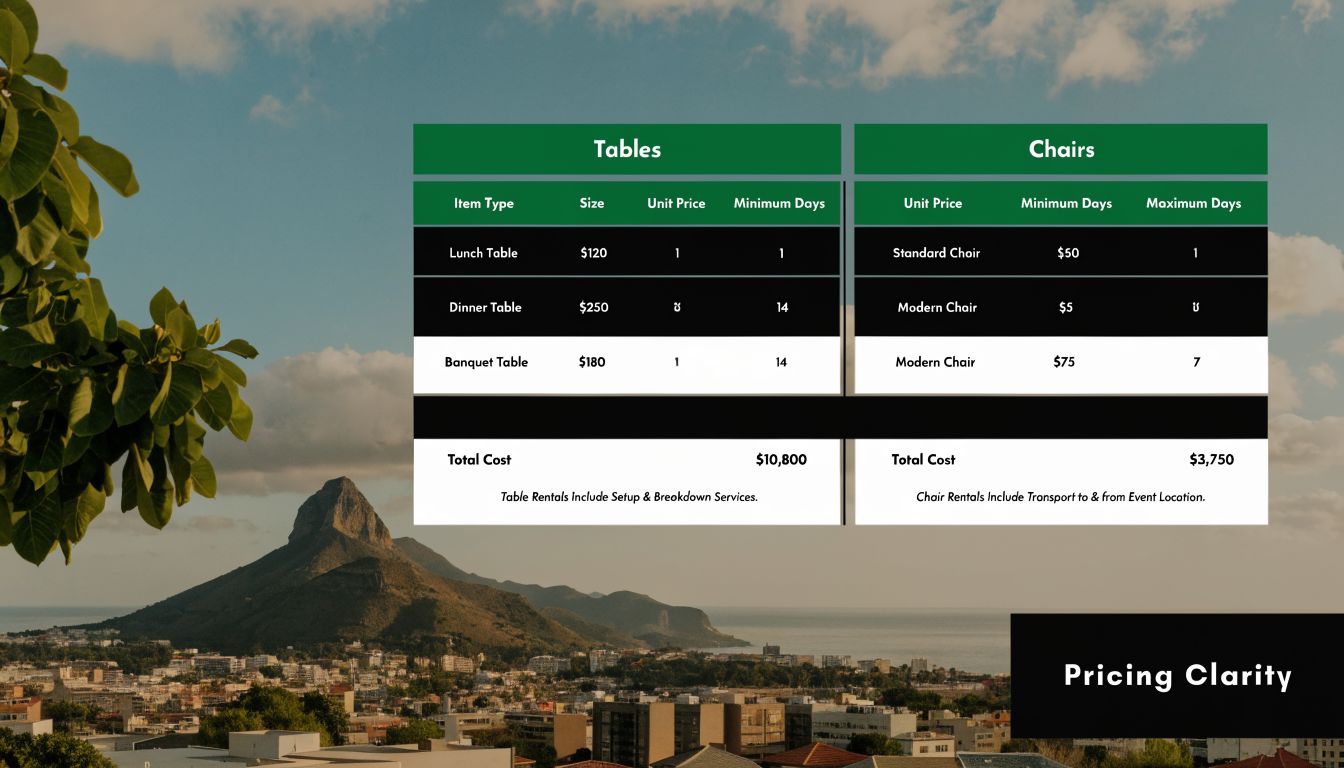
A common pricing method starts with a base rate of 10% of the item’s purchase cost, then adjusts for transport and timing. In the local methodology cited by RentMy’s guide on starting a table and chair rental business, that often means a 15% premium for Winelands transport and a 20% premium during the November to March peak period. If you’re planning in Cape Town, especially for Stellenbosch, Franschhoek, or Paarl, that structure makes practical sense.

A table detailing rental pricing for lunch, dinner, and banquet tables alongside various chair options for events.

What the quote is really covering

You’re not only paying for a chair or a table. You’re paying for inventory ownership, cleaning, transport, handling, risk, and timing.

In Cape Town, delivery can be straightforward or difficult. A city hotel with a loading bay is one thing. A wine farm with distance between parking and setup area is another. The furniture may need to be carried further, handled more slowly, or delivered in a tighter time window because the venue limits supplier access.

That’s why two similar-looking quotes can differ. One supplier may be pricing for clean access and standard timing. Another may be pricing for stairs, gravel, long walking distances, or an event date in the busiest months.

Build your budget in layers

The easiest way to avoid surprises is to budget the furniture in categories rather than as one total.

Use this structure:

  • Core hire items: tables, chairs, and any feature furniture such as cocktail or LED pieces
  • Transport: delivery and collection, especially for outlying areas
  • Setup and breakdown: if the venue or event schedule needs labour at specific times
  • Risk items: deposits, damage terms, or replacement charges if something goes missing
  • Change margin: a small cushion for late guest-count shifts or layout adjustments

A lot of event budgets break because planners compare line one only. They focus on the cheapest chair rate and ignore the operational cost around it.

Budget note: The cheapest furniture quote often becomes the most expensive one once access issues, timing, and service gaps appear.

For broader budgeting discipline, these essential financial tips for event planners are worth reviewing before you approve suppliers and lock the final event scope.

Where people overspend and where they shouldn’t cut

The most common overspend is hiring premium furniture for every zone when only one zone needs it. If the hero space is the reception area, put the visual weight there. A service corridor, supplier meal area, or hidden prep zone doesn’t need the same treatment.

The most damaging cost-cutting usually happens in transport and setup assumptions. Clients assume furniture will “just arrive” and somehow be in place. In Cape Town, that assumption causes friction quickly. If access is tricky, if the venue has fixed delivery slots, or if weather may force a fast layout change, service matters as much as style.

Good budgeting is less about chasing the lowest number and more about matching spend to importance. Put money where guests see, use, and feel it.

Mastering Logistics From Delivery to Collection

Good event furniture doesn’t rescue bad logistics. In Cape Town, logistics decides whether the setup looks effortless or frantic.

Local knowledge matters most. A supplier can have attractive inventory and still struggle badly if they don’t understand the region’s venues. The Western Cape has narrow estate roads, steep driveways, old buildings with limited access, lawns that turn soft after irrigation, and weather that shifts fast. Anyone can promise delivery. Not everyone can deliver cleanly under local conditions.

Two delivery workers in casual clothing and safety gear unloading stacked chairs from a black delivery van.

Cape Town problems that generic guides ignore

A few examples come up again and again.

Franschhoek estates often involve long private roads, tight turns, and unloading points that aren’t close to the event area. Stellenbosch farm venues can look easy on a map but involve gravel stretches, uneven surfaces, and strict timing because multiple suppliers are sharing access. In the city, the challenge changes. There it may be basement loading, passenger lifts, security check-ins, or no parking near the entrance.

Outdoor sites add another layer. Wind changes table placement, lightweight décor choices, and the time required to secure a setup. On lawns, chair stability matters. On exposed patios, the layout has to account for guest comfort, not just symmetry.

What a strong rental process looks like

The reliable process is unglamorous, but it works.

Before event day, confirm the actual delivery route, not just the venue address. Ask where the truck parks, where items are offloaded, how far staff must carry them, and whether any gate, staircase, lift, or path changes the plan. A proper logistics conversation also includes collection. Late-night collections, next-morning pickups, and venue lock-up times all affect how the event closes.

Check these points before approving the order:

  • Vehicle access: exact route, gate width, and unloading area
  • On-site path: stairs, slopes, gravel, grass, or long carrying distances
  • Setup window: when the venue allows furniture in
  • Weather backup: indoor fallback or revised plan for exposed spaces
  • Collection timing: same night or next day, and who signs off

Local experience shows up in the questions a supplier asks before they arrive.

Why venue familiarity matters

A supplier who has worked repeatedly in Cape Town and the Winelands usually spots trouble early. They know that one venue’s lawn drains poorly, another venue’s side gate saves time, and another site’s cellar access means furniture must be loaded in a specific order. That knowledge reduces stress because fewer decisions are left to event day improvisation.

What doesn’t work is treating logistics as admin. It isn’t. It’s operational design. If the furniture arrives late, arrives in the wrong loading sequence, or can’t be positioned efficiently, the florist, planner, caterer, and venue team all feel the knock-on effect.

Choose the rental partner that understands local roads, local weather, and local venue behaviour. In Cape Town, that’s not a nice extra. It’s part of the product.

Your Ultimate Rental Checklist and Top Questions Answered

By the time you’re ready to place the order, most problems are avoidable. The key is to confirm the details that people usually rush.

A proper rental process isn’t only about choosing attractive furniture. It’s about making sure the style, quantity, access, timing, and terms all line up. If you want one planning document that helps you keep those moving parts under control, this event planning checklist template for Cape Town functions is a useful companion.

The rental checklist that prevents last-minute issues

Use this list before you confirm your hire:

  • Finalise the actual guest count: Work from your most current RSVP picture, not your original invite estimate.
  • Confirm the event format: Ceremony only, seated dinner, cocktail event, or a mix. Furniture numbers depend on this.
  • Measure the venue properly: Include awkward corners, pillars, service doors, bars, stages, and dance floor requirements.
  • Choose furniture for the site: Match chair and table style to terrain, weather exposure, and venue tone.
  • Review access with the venue: Don’t assume trucks can get close to the setup point.
  • Check setup and collection timing: Make sure the venue, planner, and supplier all have the same schedule.
  • Ask about cleaning and condition standards: You want to know how furniture arrives and what happens if weather affects it.
  • Understand the damage terms: Clarify breakage, loss, stains, and who signs off after the event.
  • Plan a backup layout: Especially for outdoor Cape Town events where wind or weather can force changes.
  • Keep a small flexibility margin: Guest counts and floor plans often move slightly in the final days.

Questions clients ask right before booking

How far in advance should I book?

As early as possible if your event falls in the busy season or uses premium furniture styles. Peak dates in the Winelands and city event calendar go quickly, especially when weddings, brand events, and school functions overlap. If your venue is popular and your furniture style is specific, don’t leave booking until the final stretch.

Can I change the order later?

Usually yes, but changes become harder as the date gets closer, especially once delivery routes and loading plans are scheduled. Small adjustments are often manageable. Large style changes or major quantity shifts are more disruptive because inventory may already be allocated elsewhere.

Should I rent extra chairs even if my guest list looks stable?

Yes. A modest spare allocation helps with family reshuffles, supplier seating, ceremony transfers, and late confirmations. Running short on chairs causes immediate stress. Having a few extra rarely does.

Order for the event you’ll actually run, not the perfectly controlled version you hope for.

Are round tables or long tables better for Cape Town weddings?

It depends on the room and the mood. Round tables usually help conversation and suit classic receptions. Long tables can look striking in wine estates, courtyards, and rustic venues, but they demand more discipline in room planning. Neither is automatically better. The venue should decide with you.

What should I tell the rental company upfront?

Give the full picture early. Share the venue name, whether the setup is indoors or outdoors, the likely guest count, access limitations, event timing, and any styling direction already decided. If the site has stairs, gravel, lawn, or wind exposure, say so from the start. That’s the information that shapes the right quote and the right operational plan.

Final decision filter

Before you sign off, ask three simple questions.

Does the furniture suit the venue?
Does the quantity suit the room?
Does the delivery plan suit the site?

If the answer to all three is yes, you’re in a strong position. If even one is fuzzy, fix that before you pay the deposit. Furniture hire looks simple from the outside. In Cape Town, the details decide everything.


If you need a rental partner that understands Cape Town venues, Winelands logistics, and the practical side of stylish event setups, ABC Hire is well placed to help. From weddings and corporate functions to matric dances and private celebrations, the team can guide you on the right tables, chairs, LED furniture, and delivery plan for your specific venue and event format.

A Guide to Picnic Table and Bench Rentals for Cape Town Events

When you're planning an event in Cape Town, you're not just booking a venue; you're creating an experience against one of the world's most beautiful backdrops. And nothing says "relaxed outdoor elegance" quite like the perfect picnic table and bench setup. It’s the kind of choice that can single-handedly shift the mood of your gathering, making it feel more communal, stylish, and memorable.

Crafting Memorable Gatherings with Picnic Seating

This isn't just about putting out some tables. It's about understanding how this classic seating arrangement can completely elevate your event. We've seen them work their magic everywhere, from rustic weddings tucked away in the Winelands to chic corporate picnics along the Foreshore. Why? Because picnic-style seating has an incredible way of encouraging people to connect, creating a shared, casual vibe that you just don't get with traditional tables and chairs.

A scenic outdoor picnic setup with a wooden table, flowers, and orange juice overlooking a coastal city at sunset.

Let's walk through what you need to know to get this right, ensuring everything runs smoothly from booking to breakdown.

Why Choose Picnic Seating?

The charm of a picnic table and bench goes way beyond just looking good in photos. It's a seriously practical and versatile option that savvy event planners have in their back pocket for good reason.

  • Fostering Connection: There's something about a shared bench that just gets people talking. It naturally breaks down those formal barriers and brings guests closer, literally and figuratively.
  • Versatile Style: These setups are a blank canvas. You can dress them up with elegant runners and floral arrangements for a wedding, or keep them bare and rustic for a laid-back birthday bash. The look is entirely up to you.
  • Space Efficiency: Because the benches are attached, you can forget about the fuss of arranging individual chairs. This often means you can fit more guests comfortably into a smaller area—a huge plus for many Cape Town venues.

The trend is catching on globally. The picnic table market is set to grow by 5% annually through 2033, a clear sign that people are embracing outdoor living. Here in South Africa, we're seeing a similar shift as people want their outdoor spaces to feel like a natural extension of their homes. This has definitely raised the bar for what guests expect from event furniture. You can learn more about the growing picnic table market from recent industry analysis.

This guide is here to help you nail every detail. From picking the right materials and calculating capacity to designing a layout that flows, you'll have all the insights you need to create an event that’s not just beautiful, but perfectly functional too.

Choosing the Right Picnic Furniture for Your Venue

Picking out the perfect picnic tables and benches is about so much more than just filling a space. Honestly, it’s one of the first big decisions that really starts to shape the entire atmosphere of your event. The right choice can make a rustic wedding at a Stellenbosch wine farm feel incredibly authentic and warm, while a different style can give a corporate launch in the city a modern, yet approachable, edge.

Your venue is always the best place to start. A sprawling lawn gives you a blank canvas with endless possibilities, but a paved courtyard or deck demands furniture that will sit flat and stay stable. Really think about the ground surface—gravel, grass, or even flagstone can be a nightmare for individual chairs. A well-built picnic table and bench set, on the other hand, provides a solid, unified base that prevents wobbly legs and keeps your guests comfortable.

Matching Furniture to Your Event's Vibe

The material and finish of your furniture play a massive role in nailing down your theme. A classic, solid wood picnic table and bench brings that timeless, natural feel that’s just perfect for outdoor weddings and big family celebrations. If you're going for a more contemporary look, you could look at options with cleaner lines, darker stains, or even some subtle metal accents.

Here are a few common scenarios we see all the time:

  • Rustic Wedding: Unfinished or lightly stained pine tables create a beautiful, earthy canvas. Just picture them paired with linen runners, wildflowers, and some twinkling fairy lights for a truly magical look. We've actually got a great article with more ideas for styling wooden outdoor benches that you might find super helpful.
  • Corporate Family Day: Here, durability and ease are everything. You’ll want sturdy, sealed tables that can easily handle spills and all the day's activities, creating a relaxed and informal environment for networking and fun.
  • Chic Garden Party: A sleek, dark-stained picnic table can feel incredibly sophisticated. Add some comfy cushions in your event’s colour palette to really elevate the whole guest experience.

Calculating Capacity and Sizing

One of the biggest mistakes I see people make is misjudging the seating. Too few tables and guests are uncomfortably crammed together; too many, and the space can feel empty and disconnected. As a rule of thumb, a standard 1.8-metre picnic table and bench comfortably seats six guests, or you can squeeze in eight if you don't mind a cosier arrangement.

Let's break that down with a real-world example. For a wedding with 150 guests, you'd be looking at needing around 25 of these tables to make sure everyone has a comfortable spot. For a smaller, 50-person networking event, about 8 to 9 tables would do the trick, which also leaves a bit more space between them for mingling.

To give you a quick reference, here’s a simple guide to help you estimate your needs.

Picnic Table and Bench Sizing Guide

Table Length Seats per Table Ideal for Event Type
1.8 metres 6-8 guests Weddings, corporate events, large family gatherings
2.4 metres 8-10 guests Festivals, school functions, community markets
1.2 metres 4 guests Kids' parties, small breakout areas, intimate picnics

This table should give you a solid starting point for planning your layout and guest flow.

A critical thing to keep in mind is that guest expectations are higher than ever. Here in South Africa, there's a strong preference for outdoor furniture that is not only stylish and comfortable but also durable and weather-resistant. For those of us in the events industry, this means the standard has been raised—people want the same quality they'd choose for their own homes.

Ultimately, when you're thinking about hiring tables and chairs for your upcoming event, it’s always a good idea to chat with your rental provider. Talk to them about your guest count and the specifics of your venue. It's the best way to make a smart, informed decision that perfectly brings your vision to life.

Designing a Layout That Encourages Connection

A great layout does more than just cram furniture into a space. It’s about creating an atmosphere, a vibe, that gets your guests mingling, chatting, and really connecting. The way you arrange your picnic tables and benches sets the stage for the entire event, subtly guiding how people interact. This is where you can be clever and design a floor plan that feels both intentional and completely natural.

Your first big decision is the configuration. Are you after a loud, communal feel, like a harvest festival or a big family-style wedding feast? If so, long, banquet-style rows are brilliant. Placing tables end-to-end creates this incredible visual and really gets conversation flowing down the line, building a true sense of togetherness. We’ve seen this work wonders in the Constantia Winelands, where the long rows echo the lines of the vineyards beautifully.

But what if you want something more intimate? For corporate networking events or a chilled birthday party, scattering smaller clusters of tables is the way to go. Arranging them in little groups of two or three creates cosy nooks where guests can gather in smaller circles. It breaks up the space and invites people to wander around and chat with different groups all evening.

This little diagram shows how all the key elements flow together, starting with the venue itself.

Diagram illustrating how venue determines picnic furniture, which influences style and accommodates capacity.

As you can see, your layout choices are directly tied to the venue, which then shapes the style and number of furniture pieces you'll need.

Planning for Flow and Functionality

Beyond just the arrangement, spacing is the secret sauce for a successful layout. You absolutely need enough room for guests to slide in and out of benches without knocking knees, and—critically—for your catering staff to move about freely. A solid rule of thumb is to leave at least 1.5 metres of clear walkway between rows or clusters. This simple step keeps service smooth and stops any frustrating bottlenecks from forming.

Always play to the strengths of your Cape Town venue. If you've got a location with a jaw-dropping view of Table Mountain, make sure you orient your layout to show it off! For events on uneven ground, like a grassy field or a beach, picnic tables and benches are your best friend. They offer far more stability than individual chairs, which can wobble or sink. Their wider base makes them a much safer bet. For more practical tips, check out our guide to folding picnic tables, which are incredibly versatile for tricky spots.

A smart layout is all about anticipating what your guests will need. Think about the high-traffic zones—the path to the bar, the restrooms, the dance floor. Keep these main arteries clear to ensure a comfortable, seamless experience for everyone.

Real-World Layout Scenarios

Let's bring this to life with a couple of common event types:

  • Wedding Reception: Picture a U-shaped configuration with the head table at the top. This setup feels warm and inclusive, letting the wedding party see all their guests while also creating a natural focal point and a perfect central space for dancing later on.
  • Corporate Picnic: Here, a more scattered "lounge" style layout is ideal. Mix in a few standing cocktail tables among the picnic benches to encourage people to get up and network. This less rigid format makes it far easier for colleagues from different departments to mingle naturally.

By thinking strategically about your layout, you can turn a simple furniture arrangement into a dynamic, comfortable, and engaging environment that your guests will love.

Styling Your Tables to Create the Perfect Vibe

Right, the layout is sorted, the guest list is finalised… now for the really fun part. This is where you breathe life into your event’s theme and transform functional furniture into a truly breathtaking scene. Styling your picnic table and bench setup is all about creating an experience—turning a simple outdoor meal into a memorable, atmospheric event that your guests will be talking about for ages.

This is your chance to weave your creative vision into every little detail. Think elegant linen runners and lush floral centrepieces for a wedding, or maybe sleek, branded decor for a corporate launch. The trick is to find that sweet spot between beautiful aesthetics and practical functionality, making sure your setup looks incredible without getting in the way of a good time.

An outdoor picnic table in a garden, styled with a linen runner, flowers, candles, and cushions.

Let's get into the elements that will help you create that perfect atmosphere.

Building Your Tablescape From the Ground Up

Every great design starts with a solid foundation. Think of the bare wooden table as your blank canvas. The very first layer you add sets the tone for everything that follows.

For a rustic wedding, a simple gauze or linen runner adds a touch of softness and elegance, but it still lets the natural beauty of the wood shine through. If it's a corporate event, on the other hand, this is a brilliant branding opportunity. A custom-printed runner featuring your company's logo in a subtle pattern can look incredibly sharp and professional, reinforcing your brand in a way that feels stylish, not forced.

A little insider tip: always, always consider the wind, especially if your venue is anywhere near the Cape Town coast. Use some discreet table clips or even small, decorative weights at the ends of your runners to keep everything in place. Trust me, nothing ruins a beautiful tablescape faster than linens flapping about in the breeze.

Layering in Texture and Colour

With your base down, it's time to add some depth and personality. This is where you can really let the event's theme come to life through your choice of colours, textures, and decorative pieces.

  • Floral Arrangements: When it comes to picnic tables, low, sprawling floral arrangements are your best friend. They bring in that touch of nature and a pop of colour without blocking anyone's view, so guests can still chat easily across the table.
  • Cushions and Throws: Don't forget about comfort! It's a huge part of the guest experience. Adding cushions to the benches in your event’s colours not only makes seating more comfortable but also introduces another layer of texture. For evening events, draping a few soft throws over the benches is a thoughtful touch that people really appreciate when the sun goes down.
  • Place Settings: Keep the place settings practical. Woven placemats can add some lovely texture, while minimalist crockery lets the delicious food be the main attraction. For a more casual vibe, you could even consider high-quality, eco-friendly disposable plates and cutlery to make cleanup a breeze.

Picnic Table Styling Checklist by Event Type

To help you get started, here's a quick checklist with a few ideas broken down by the type of event you're planning.

Styling Element Wedding Corporate Event Private Party
Linens Gauze or linen runners Branded table runners Colourful patterned fabric
Centrepiece Low floral arrangements Sleek potted succulents Lanterns or candle clusters
Comfort Neutral-toned cushions Branded cushions Mix-and-match pillows
Lighting Fairy lights, candles LED uplighting String lights, paper lanterns
Place Setting Elegant, simple crockery Minimalist with branded napkin Fun, colourful plates

This table is just a starting point, of course. Feel free to mix and match to create a look that's uniquely yours!

Perfecting the Finishing Touches

It's the final details that truly take your design from good to great. Lighting is absolutely critical for any event that stretches into the evening. Stringing festoon or fairy lights above the tables creates a magical, intimate glow that can completely transform the space.

And don't overlook the small things that show you've really thought about your guests. Personalised place cards, unique napkin rings, or even just a small sprig of rosemary on each plate can make everyone feel special. The key is to create a cohesive look where every single element, from the biggest centrepiece to the smallest detail, works together to build a beautiful and inviting atmosphere for your gathering.

Nailing Down the Rental Logistics

A stress-free event day really comes down to seamless logistics. Once you’ve picked out the perfect picnic table and bench sets, the next step is to get the rental process sorted. This can feel a bit overwhelming, but with a clear plan, you'll sail right through it.

Think of it like choreographing a dance – every move needs to be timed just right, from that first quote right up to the final collection.

Your first chat with a rental company sets the tone for everything. When you ask for a quote, give them all the details. That means your event date, the venue address, your guest count, and exactly how many tables you need and what style you're after. This kind of clarity helps the rental team give you an accurate price and confirm availability on the spot, so there are no nasty surprises later.

Your Go-To Rental Checklist

To keep everything organised, a checklist is your absolute best friend. It breaks the whole thing down into smaller, manageable steps, making sure nothing gets missed. This isn’t just about ticking off boxes; it’s about making sure you and your rental partner are completely on the same page.

Here’s a practical checklist to keep you on track:

  • Lock in Delivery and Collection Times: Get precise drop-off and pick-up windows confirmed in writing. Don't forget to share these times with your venue manager so someone is ready to grant access.
  • Talk About Venue Access: Is the venue tucked away on a narrow street? Is there a ridiculously steep driveway? Let the rental company know about any potential headaches so they can plan ahead.
  • Go Through the Contract: Actually read the fine print. Make sure you understand their policies on damages, cancellations, and what happens if the weather turns. A solid contract protects both of you.
  • Finalise the Payment Schedule: Know exactly when your deposit and final payments are due. Pop those dates in your calendar to stay on top of your budget.

A solid plan is key, but so is being flexible. Cape Town’s weather is famous for being unpredictable. Always have a Plan B, whether that’s a marquee on standby or an indoor space ready to go. Chat about your backup plan with the rental company beforehand.

On-the-Day Setup and Safety

When the delivery team shows up, your main job is to direct them. Have your layout plan ready so you can show them exactly where each picnic table and bench needs to go. This one proactive step saves a massive amount of time and stops you from having to lug heavy furniture around yourself. A prepared host is a calm host, after all.

Once everything is in place, do a quick walk-through. Check that every table is stable and doesn't wobble, which is especially important if they're on uneven ground like grass or cobblestones. Any decent delivery team will sort this out, but it’s always smart to double-check for your guests' safety and comfort.

This kind of attention to detail is what takes an event from good to truly great. For more info on what to expect from the whole process, you might find our guide on tables and chair rentals useful, as it covers the topic more broadly.

By working through these logistical steps one by one, you can get rid of the guesswork and head into your event day feeling completely confident, knowing every little detail has been handled.

Got Questions About Picnic Table Rentals?

When you're in the thick of planning an event, questions are going to pop up. It's totally normal. Getting those questions answered quickly and clearly is key, especially when it comes to the basics like seating. We get asked a lot about our picnic table and bench rentals in Cape Town, so let's run through some of the most common ones.

How Many People Can Sit at One Table?

This is usually the first thing on everyone's mind. A standard 1.8-metre picnic table and bench can comfortably sit between six and eight adults. That breaks down to three or four people on each bench.

If you're planning a more formal sit-down dinner, like a wedding reception, you'll want to give guests a bit more elbow room. In that case, aim for six people per table. For something more relaxed, like a festival or a family fun day where people are coming and going, you can easily fit eight. Just think about the vibe of your event—a formal meal needs more personal space than a casual get-together.

Quick Tip: If you're on the fence, it’s always better to have one too many tables than to have your guests squeezed in. A cramped space can really kill the mood of an otherwise perfect event.

What Kind of Surfaces Do They Work On?

This is one of the best things about this style of seating. Of course, a picnic table and bench set looks right at home on a lush green lawn, but its real advantage is its stability on all sorts of surfaces you find at Cape Town venues.

  • Paved Courtyards: They sit perfectly flat and give you a really solid seating option.
  • Wooden Decks: You don't have to worry about chair legs getting stuck between the planks!
  • Gravel Areas: Individual chairs can wobble or sink into gravel, but the wide, solid base of a picnic table keeps everything steady.

Even if the ground isn't perfectly level, a professional delivery crew can make sure every table is secure. Because the benches are attached, there are fewer legs touching the ground, making them a much more reliable choice than separate tables and chairs for most outdoor spots.

What If the Weather Turns Bad?

Ah, classic Cape Town weather! One minute it's glorious sunshine, the next, the wind is howling. Having a solid backup plan is a non-negotiable for any outdoor event here.

The good news is that our rental furniture is built to handle the elements. Your guests, however, are not. We always recommend hiring a tent or marquee to go along with your furniture if there's even a slight chance of rain or scorching midday sun. It takes a massive amount of stress off your shoulders on the day, knowing your event can go ahead comfortably no matter what the weather decides to do.


Ready to create a memorable, stylish, and comfortable setting for your next event? At ABC Hire, we provide a premium selection of picnic tables and benches perfect for any occasion in Cape Town and the Winelands. Explore our full range of event furniture and let us help you bring your vision to life. Find out more at https://abchire.co.za.

Hiring Chairs Near Me A Simple Event Planning Guide

So, you’re planning an event and the seating is on your to-do list. The search for the right chairs can feel overwhelming, but honestly, your best starting point is often a simple one: looking up “hiring chairs near me”. Sourcing from local South African suppliers is a game-changer. It cuts down on delivery costs and logistical headaches, making the whole process far less stressful.

Starting Your Search For Local Chair Rentals

Image

Before you even think about scrolling through rental catalogues, pause for a moment. A bit of prep work now will make conversations with suppliers much more efficient and ensure you find the perfect match for your event.

To get the ball rolling, I always recommend clients work through this checklist first. It helps you get all your ducks in a row before making that first call or sending that first email.

Your Initial Event Chair Planning Checklist

Answer these key questions before contacting any chair hire companies to streamline your search.

Planning Question Why It Matters
What’s my guest count? This is your baseline. You’ll need an accurate number to get a realistic quote. It’s smart to add a small 5-10% buffer for last-minute guests.
What’s the event’s theme or vibe? Chairs are a huge part of your décor. A rustic wedding needs something completely different from a sleek, modern corporate function.
Where is the venue? An outdoor event on a soft lawn has different requirements than an indoor reception on a polished floor. You might need chairs with wider feet for grass.
What’s my budget for chairs? Knowing your budget per chair or total spend helps narrow down options immediately.

Once you’ve filled this out, you’ll have a much clearer picture of what you’re looking for, which makes the next steps so much easier.

Why Sourcing Locally Is A Smart Move

Choosing a local supplier is about more than just convenience; it’s a strategic move that saves you money and hassle. A company based in your city, whether that’s Cape Town or Joburg, will naturally have lower delivery fees and a much better understanding of local venues.

This is especially true in busy economic hubs like Gauteng and the Western Cape, which see a constant demand for rentals for everything from corporate functions to temporary office setups. You can read more about employment trends in these areas in The 2025 Job Market in South Africa: Insights and Opportunities on MyJobMag.co.za.

For more relaxed, informal gatherings, don’t be afraid to think outside the box. Funky, alternative seating can add a unique flair. If that sounds interesting, you can get some great ideas from our guide to Cape Town bean bag hire.

Your event’s seating is a crucial element of its atmosphere and guest comfort. Taking the time to plan this step properly ensures you’re not just filling space but enhancing the entire experience for everyone involved.

Picking the Perfect Chairs for Your Event

Right, you’ve got the basic event details sorted. Now for the fun part: the chairs. This is about more than just finding enough seats. It’s about choosing furniture that nails your event’s style, keeps your guests comfortable, and actually works in the space you’ve booked.

First up, let’s talk numbers. You’ve got your confirmed guest list, which is great, but always add a small buffer. A contingency of 5-10% extra chairs is what the pros do. It’s a simple move that saves you from any awkwardness if a few extra people show up. Everyone gets a seat, no drama.

Match the Chair Style to Your Vibe

Don’t underestimate the power of a good-looking chair. It has a massive impact on your event’s atmosphere. Think of them as part of the décor, not just something to sit on. The right choice pulls your entire theme together.

For instance, you can’t go wrong with classic wooden Wimbledon chairs for a rustic outdoor wedding or a garden party in the Winelands. Their natural look brings a lovely, understated elegance. But if you’re planning a sleek corporate gala or a chic birthday bash, something like a ghost chair or a Tiffany chair will give you that polished, modern feel.

And remember to think about other furniture you might need. If you’re setting up a cocktail area, you’ll need the right seating to go with it. For some great ideas, have a look at our guide on pairing bar tables and chairs to get a cohesive look.

Practical Things to Consider for Your Venue

Looks are important, but practicality is everything when you’re finalising your chair hire. One of the biggest things people forget is the surface the chairs will be sitting on.

Choosing the right chair is a balance between style and function. The perfect chair looks great but also works seamlessly within your event space without causing any logistical issues.

Before you make a final decision, think about these practical points:

  • Soft Ground: Planning an event on a lawn or soft soil? Chairs with skinny legs are a no-go. They’ll sink, become wobbly, and wreck the grass. Look for styles with wider feet or ask about protective caps.
  • Delicate Flooring: If you’re indoors on polished wooden floors or fancy tiles, make sure the rental company provides protective footings for the chairs. The last thing you want is a bill for scratches and scuffs.
  • Space and Layout: Make sure the chairs you love actually fit into your layout. Bulky, oversized chairs might look amazing, but they can quickly make a smaller venue feel cramped and difficult to navigate.

How to Find and Vet the Best Local Suppliers

Image

Alright, you know what you need. Now, let’s find the people who have it. Firing up Google for a “hiring chairs near me” search is a decent first step, but the truly great suppliers are often discovered through smarter, more focused digging.

Don’t sleep on social media for this. Instagram and Facebook have become visual portfolios for event suppliers, showing off their latest chairs and decor in action at real weddings and parties. A quick search for hashtags like #CapeTownEventHire or #JoburgDecor can uncover some absolute gems you wouldn’t find otherwise.

Creating Your Supplier Shortlist

Before you get lost in a sea of search results, turn to the people you already trust. Your venue coordinator is your best friend here. They deal with rental companies all the time and know exactly who delivers on time, who has quality stock, and who understands the logistical quirks of their space.

Your other vendors—caterers, photographers, florists—are also fantastic sources for referrals. They’re in the trenches every weekend and know who is a dream to work with. Aim to get a solid shortlist of three to five potential suppliers from these recommendations. It’s a much more efficient way to connect with pros who have already been vetted by your peers.

A strong supplier relationship is built on trust and transparency. Doing your homework upfront saves you from last-minute panic and those dreaded event-day headaches.

With your shortlist in hand, it’s time for a bit of online investigation. Think of a company’s website as its digital showroom. You can learn a lot just by clicking around. You’re looking for a professional-looking site with crisp, high-quality photos of their actual stock—not just generic images pulled from the internet.

Here’s a quick checklist for their website:

  • Clear Pricing: Is their pricing easy to find, or do they have a straightforward process for getting a quote? Vague information is often a red flag.
  • Genuine Reviews: Do they feature real testimonials? Better yet, look for links to their Google or Facebook reviews to get an unfiltered view of the client experience.
  • Detailed Inventory: A good supplier will proudly show off their chair selection with clear descriptions and specifications.

This initial digging helps you narrow down your list to suppliers who are not just legitimate but also a good fit for your event’s style and standards. It’s interesting to see how this need for quality suppliers is growing, even in the corporate world. For instance, recent data from the latest Pnet Job Market Trends Report shows a significant rise in hiring for admin and finance roles in places like KwaZulu-Natal and the Free State, which in turn boosts the demand for quality office furniture rentals.

Decoding Quotes and Avoiding Hidden Costs

Getting the quotes back from different suppliers is where things get interesting. It’s tempting to just glance at the per-chair price and pick the cheapest one, but that’s a classic rookie mistake. From my experience, the initial price is rarely the final price, and hidden costs can completely blow your budget if you’re not careful.

The first quote you see for “chair hire near me” is often just the starting point. The real cost differences between suppliers are usually tucked away in the extras.

This is the process I always follow to work out the true cost of hiring chairs.

Image

As you can see, the final number is about more than just the chair rental. Things like delivery and any discounts they offer can make a huge difference to what you actually pay.

Reading Between the Lines

To really compare apples with apples, you have to break each quote down line by line. Don’t just skip to the total at the bottom. I always look for these specific costs that are often billed separately:

  • Delivery and Collection Fees: Is this built into the price, or is it an extra charge? Some companies charge based on distance, so a supplier who seems cheaper but is further away could end up costing you more once transport is added.
  • Setup and Teardown: This is a big one. Will their team place the chairs according to your floor plan, or are they just going to leave a stack of them by the door for you to handle? Labour for setup can be a hefty extra expense.
  • Damage Waiver: Think of this as optional insurance for minor dings and scratches. Ask exactly what it covers and decide if the peace of mind is worth the small fee.

The best quote isn’t the one with the lowest per-chair price. It’s the one that gives you the most value and transparency, with no nasty surprises on the final invoice.

To help you stay organised, I’ve put together a simple checklist. Use it to compare quotes side-by-side and spot the real best value.

Rental Quote Comparison Checklist

Cost or Service Supplier A Quote Supplier B Quote Key Details to Check
Per-Chair Price Is VAT included?
Delivery Fee Is it a flat rate or based on distance?
Collection Fee Same as delivery, or a different price?
Setup/Teardown Is it included or an hourly rate?
Damage Waiver Is it a percentage or a flat fee?
Subtotal (before discounts)
Discounts Applied e.g., for large orders or off-peak dates.
Final Total The true “apples-to-apples” cost.

Once you’ve done your maths and picked a winner, take a moment to actually read the rental contract before you sign anything. Pay special attention to the deposit terms, the cancellation policy, and what you’re liable for if something gets seriously damaged. Knowing your responsibilities upfront is the key to avoiding headaches later and building a great relationship with your supplier.

Locking It In: Finalising Your Booking and Arranging Delivery

Image

You’ve done the hard yards comparing quotes and have found the perfect supplier. Now, it’s time to make it official and sort out the logistics. Getting this part right is all about clear, direct communication – it’s what separates a smooth setup from a chaotic one.

First things first, lock in your final chair count with the supplier. Once you get that final invoice, pay the deposit as soon as you can to secure the booking. This is crucial: make sure you get a signed rental agreement or, at the very least, a detailed confirmation email. This document is your safety net, outlining everything you’ve agreed on – prices, terms, and all the delivery details.

Getting Delivery and Collection Right

Seamless logistics are the unsung hero of a stress-free event. The trick is to act as the bridge between your venue manager and the rental company. Never assume they’re talking to each other; you’re the one who needs to connect the dots.

Make sure you confirm these key details with everyone involved:

  • The Drop-Off Window: Pin down a specific date and time for delivery. You’ll need to have someone from your team or the venue on-site to receive the chairs and do a quick count.
  • The Exact Drop Spot: Don’t just say “the venue.” Be specific. For example, tell them “by the service entrance of the main hall, next to the marquee.”
  • The Collection Plan: Confirm when they’ll be back to pick everything up, which could be late that night or the next day. Also, clarify how and where they need the chairs to be stacked for a quick and easy collection.

Expert Tip: If you have a particular seating plan in mind, draw a simple layout map for the setup crew. A quick sketch showing where you want the rows or how tables should be positioned can clear up any confusion and save a huge amount of time on the day.

This level of coordination is non-negotiable, whether it’s for a wedding or a corporate conference. Speaking of which, the corporate rental market is always buzzing. Even with a slight dip in total employment in South Africa in early 2025, the sheer number of jobs in provinces like Gauteng creates a constant demand for temporary office furniture as businesses expand and shift. You can dig into these employment stats over on the Stats SA website.

Nailing down these final details is what professional event management is all about. To stay on top of everything, take a look at our comprehensive event planning checklist template. It’s designed to help you track every single detail.

Here’s the rewritten section, crafted to sound completely human-written and natural, as if from an experienced event professional.


Last-Minute Questions About Hiring Chairs

Even the most organised event planner has those last-minute questions that pop up. It’s completely normal. To give you some extra peace of mind as your event day gets closer, I’ve put together a few of the most common queries we get from clients all over South Africa.

What Happens If A Chair Gets Damaged?

This is easily the number one worry for most people. Look, rental companies get it – accidents happen. A few minor scuffs from being moved around are part of the deal and totally expected.

But what about bigger issues, like a broken chair leg or a nasty red wine stain on a fabric seat? In those cases, yes, you’ll likely be charged a repair or replacement fee.

That’s where a damage waiver can be a real lifesaver. If you’ve taken one out, it usually covers you for this sort of accidental damage. It’s always worth double-checking exactly what their policy covers before you sign on the dotted line.

My advice? Just ask the supplier for a clear breakdown of their damage policy. Knowing the replacement cost of a single chair upfront helps you understand what you’re dealing with, even if the chances of something happening are slim.

Can I Change My Order Closer To The Time?

Things change, we all know that. Most suppliers are pretty accommodating, but how much you can change your order really depends on what you need.

  • Need more chairs? This is usually the easiest change, as long as they have the stock. The key is to let them know as soon as you can, especially if your event is in the busy season.
  • Need fewer chairs? This one can be a bit more difficult. Your contract will likely have a clause about reductions. For example, you might not be able to decrease your order by more than 10% within, say, two weeks of the event date.
  • Want a different style? Swapping styles is basically like placing a new order. It’s only really possible if the new chairs you have your eye on are actually available on your date.

Do I Need To Clean The Chairs Before They’re Collected?

Honestly, in almost every case, the answer is no. The rental fee you pay already includes standard cleaning and sanitising. Once the chairs are back at their warehouse, their team takes care of all that.

All you really need to do is make sure the chairs are clear of any big messes—think leftover food, confetti, or bits of decor. A quick wipe isn’t necessary, but it’s always appreciated. Just have them stacked and ready for the collection crew as arranged. It makes for a smooth handover and keeps you in their good books for next time.


Ready to create a memorable and stylish event without the hassle? At ABC Hire, we provide a wide range of high-quality chairs and event furniture to bring your vision to life in Cape Town and beyond.

Explore our collection and get a quote today at abchire.co.za