Gold Cake Stands: A Cape Town Event Planner’s Guide

You're probably looking at cake photos, venue mood boards, florist samples, and a growing list of rental decisions, all while trying to make one display feel polished instead of pieced together. The cake stand often gets left until late. Then someone realises the cake table matters far more than expected, because once the room is styled and guests start taking photos, that stand sits right at eye level.

In Cape Town and the Winelands, that choice matters even more. A gold cake stand can feel romantic at a Stellenbosch estate, clean and architectural in a city venue, or warm and glamorous against evening lighting and LED furniture at a branded launch. But not every gold finish works in every setting, and not every stand that looks good online is stable enough for a real event day.

After handling event rentals across different venue types, one thing stays true. The best gold cake stands don't just match the cake. They match the room, the light, the table plan, and the way the event runs.

Choosing Your Perfect Gold Cake Stand

A gold cake stand isn't one item. It's a category, and the differences between finishes and materials show up quickly once the stand is in the venue. Under daylight, one stand can look soft and elegant. Under warm uplighting, the same finish can suddenly read too yellow, too shiny, or too heavy for the rest of the styling.

Start with the venue, not the cake

In Cape Town, venues vary wildly. A beachfront setting often has strong natural light, pale surfaces, and wind to think about. A wine estate may bring textured stone, timber, greenery, and softer ambient light. A city venue might have black-framed windows, polished floors, and more dramatic evening styling.

That's why the first question isn't “Do I want gold?” It's what kind of gold makes sense in this space?

Here's the quickest way to think about it:

Finish Type Aesthetic Best For
Polished gold Reflective, formal, glamorous Ballroom receptions, black-tie dinners, evening weddings
Matte gold Soft, understated, modern Minimalist weddings, contemporary venues, refined dessert tables
Brushed gold Warm, textured, versatile Wine farms, garden marquees, mixed-metal styling
Antique gold Aged, romantic, decorative Vineyard celebrations, heritage venues, vintage-inspired events
Gold acrylic finish Clean, lightweight, modern Corporate events, styled shoots, lighter cakes, quick installations

A polished metal stand works when you want a stronger focal point. It catches candlelight beautifully and gives a cake display more presence. The trade-off is that fingerprints, smudges, and scratches show more easily. In venues with harsh downlighting, it can also reflect too much and compete with the cake rather than support it.

Matte and brushed finishes are more forgiving. They photograph well, they sit comfortably with linen and florals, and they don't shout for attention. If a client says they want elegant but not flashy, that's usually where I'd start.

Practical rule: If your cake has delicate piping, sugar flowers, or soft neutral tones, choose a finish that supports detail instead of reflecting over it.

Choose material for function as much as style

Many clients focus only on colour, but material affects stability, weight, and handling.

Metal stands tend to be the safest all-rounder for real events. They usually feel secure on the table, hold their line visually, and cope better with transport and setup than more fragile options. For heavier tiered cakes, metal is often the most comfortable choice.

Gold-finished acrylic can work well for modern styling, especially where the stand is part of a larger dessert feature rather than a traditional cake-table moment. It's lighter to carry and can suit corporate functions or contemporary private events. The downside is that it may feel less substantial if the cake is tall or dense.

Glass with gold detailing can look beautiful, but it needs more careful handling and usually suits controlled indoor setups better than busy, high-traffic event environments.

Match finish to the rest of the table

The stand should sit in conversation with the rest of the styling. If your chargers, candle holders, cutlery accents, or signage frames lean warm and brushed, a cool bright gold can look disconnected. If your event includes raw timber tables, olive foliage, and soft draping, antique or brushed gold usually feels more natural than mirror-shine metallics.

For Cape Town and Winelands events, these combinations tend to work well:

  • Beachfront reception: Matte gold with ivory florals, glassware, and light linen
  • Wine estate wedding: Brushed or antique gold with layered greenery and stone or wood textures
  • Modern city event: Clean gold pedestal with monochrome florals or minimalist stationery
  • Evening celebration with lighting features: Polished gold used sparingly so it catches the glow without overwhelming the table

A gold cake stand should never look like a last-minute add-on. When the finish, material, and setting line up, the stand feels intentional before the cake is even placed on it.

Selecting the Right Size and Structure

The most attractive stand in the room is useless if the cake overhangs, tilts, or feels risky when the venue team moves around it. In such situations, practical planning matters more than aesthetics. A cake display must look balanced, but it also has to stay stable through setup, photography, cutting, and service.

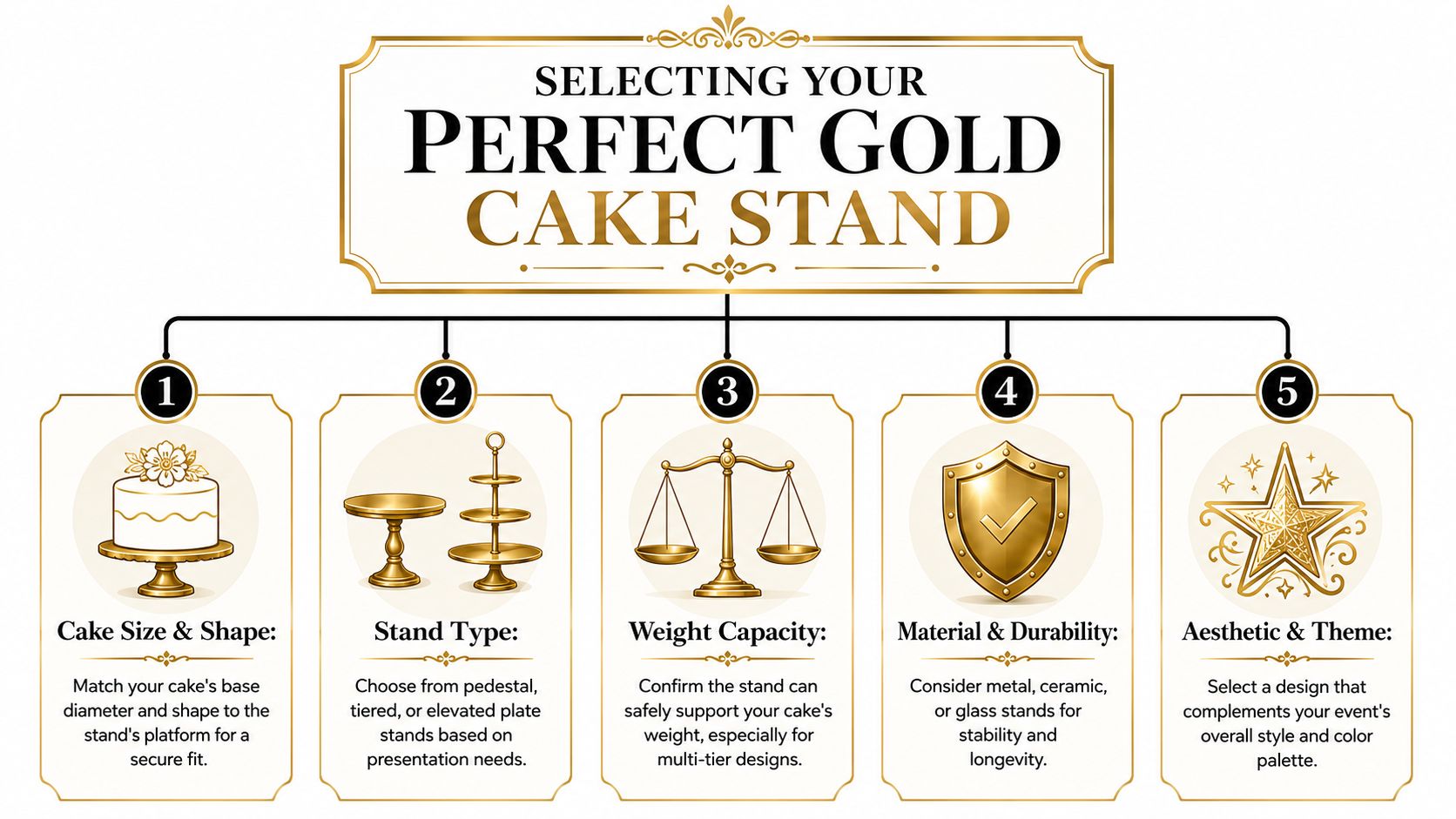
An infographic titled Selecting Your Perfect Gold Cake Stand outlining five essential factors for choosing a stand.

Get the cake measurements from the baker early

Don't guess based on the design sketch. Ask the baker for the base diameter, overall height, and estimated final weight once the design is confirmed. Fresh florals, dense sponge, ganache finishes, separator tiers, and internal supports all affect the final load.

A simple working rule is to choose a stand that gives the cake base a visible border rather than letting the icing sit right at the edge. That border makes the display look finished and gives staff a little more confidence when positioning the cake.

For a three-tier wedding cake, the stand size should be based on the bottom tier, not the top profile shown in the sketch. If the cake has a broad base and a tall silhouette, a stand that looks generous in the showroom can suddenly look undersized once everything is assembled at the venue.

Think about weight before shape

Many people make a mistake here. They choose a stand because the diameter looks right, then only ask about strength later. That order should be reversed.

If the cake is especially tall, heavily decorated, or built with dense layers, confirm that the rental team knows the approximate weight and structure. A low, sturdy pedestal usually handles this better than a delicate raised plate with a narrow neck.

If you're also planning to place the cake under a display cover, it helps to check the stand height and top clearance against options like a glass cake dome guide before locking in the final setup.

A stand doesn't fail only when it collapses. It fails when everyone around the table feels nervous touching it.

Single pedestal or multi-level display

These are different tools, and the best one depends on what the cake is doing in the room.

A single pedestal stand is the safe classic. It gives one hero cake a clear stage and works well for weddings, milestone birthdays, and formal functions. It also makes cutting easier because the cake sits on one stable platform.

A tiered stand works better for smaller cakes, cupcakes, mini desserts, or a mixed sweet table. It creates height variation, but it's not always ideal for a heavy statement cake. Some clients love the look of levels, then realise the event already has enough visual complexity from candles, florals, menus, and signage.

A separated display can be the most elegant compromise. The main cake sits on one gold stand, while matching or complementary pieces around it hold cupcakes, favours, or petite sweets.

A quick event-day check

Before the cake arrives, make sure someone confirms these points on site:

  • Table level: The surface must be steady. Uneven ground under a trestle or dressed table can cause a slight lean.
  • Stand placement: Keep it away from table edges and guest traffic lines.
  • Heat and sun exposure: Buttercream and ganache react quickly near windows, heaters, or direct afternoon sun.
  • Cutting access: Leave enough space for the couple, caterer, or event team to stand comfortably behind or beside the table.

The stand is part of the engineering, not just the styling. Once size and structure are right, the whole display feels calm, and that calm shows in the photos.

Styling Your Gold Cake Stand Like a Pro

The stand is chosen. The cake is sorted. Now the display has to earn its place in the room.

Styling can lead people to either create a strong focal point or accidentally bury the cake in decor. A gold stand already brings shine, warmth, and form, so the styling around it needs restraint in one event and drama in another. The difference comes down to context.

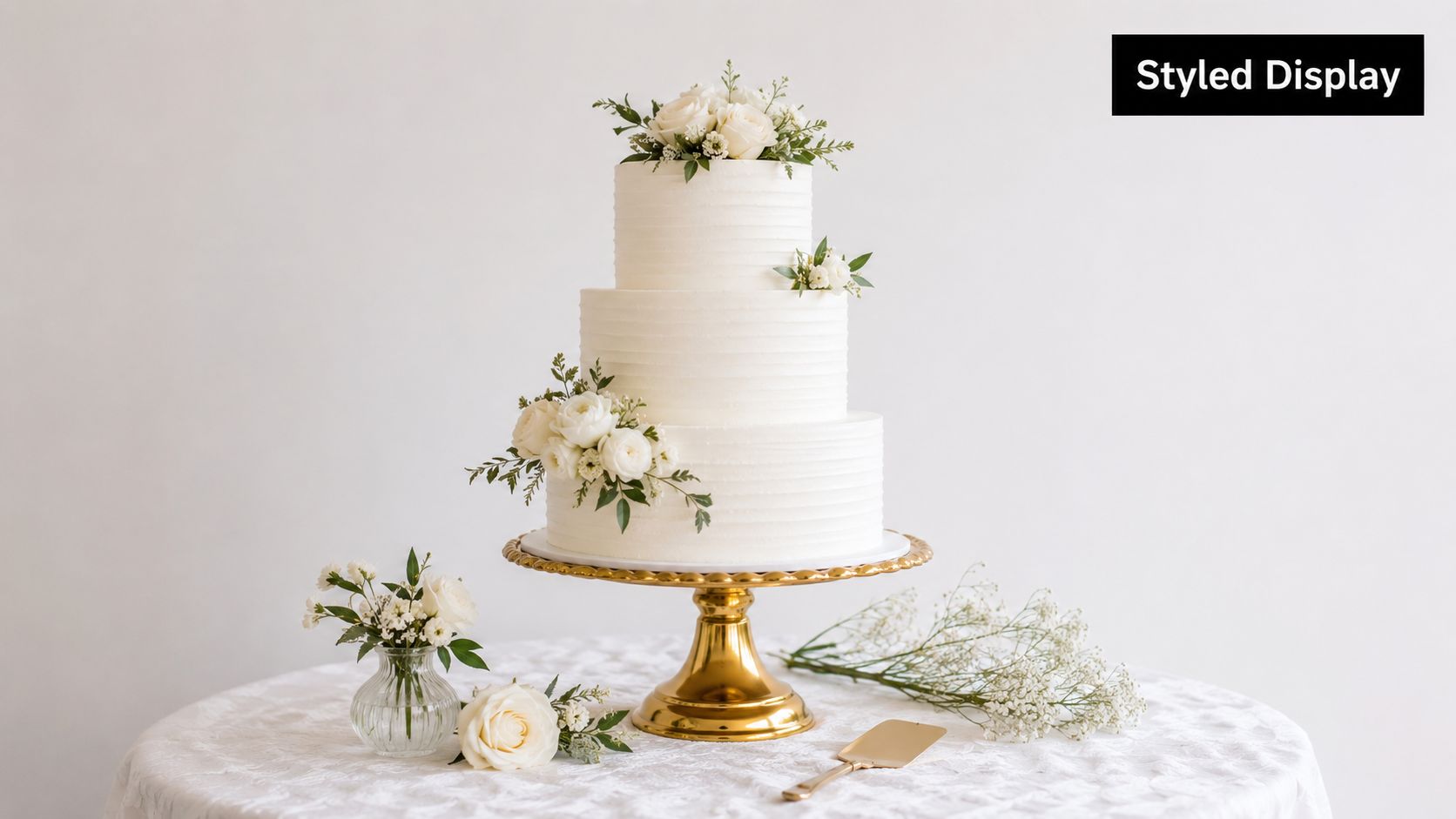
A three-tier white wedding cake decorated with fresh flowers displayed on an elegant gold cake stand.

Minimalist modern wedding

In a clean contemporary venue, the strongest move is often to give the cake breathing room. I've seen simple white cakes on brushed gold pedestals look far more expensive than highly decorated tables because nothing competes with them.

The styling formula is straightforward:

  • Keep linen plain: Crisp white, stone, or soft taupe lets the gold read as intentional.
  • Limit florals: One low arrangement or two small clusters are usually enough.
  • Use negative space: Don't fill every corner of the table.
  • Choose one accent finish: Clear glass or black details can sharpen the look.

This approach works especially well for city weddings where the architecture already provides texture. The cake stand becomes the warm note in a controlled palette.

Lavish vineyard celebration

On a wine estate, the display can handle more abundance, but it still needs hierarchy. A common mistake is placing a gold cake stand into a sea of florals, candles, fruits, and dessert pieces until the cake disappears.

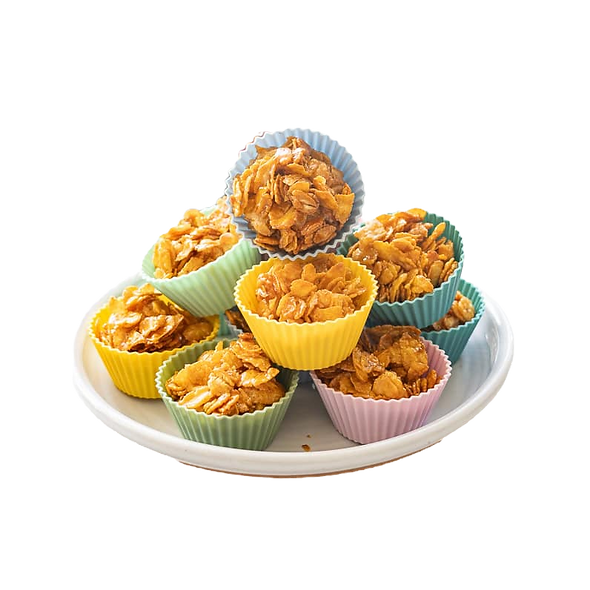
A better approach is to build outward from the stand. Start with the cake on the highest or most central point. Then add soft draping, garden-style florals, candlelight, and supporting desserts at lower levels. If the dessert spread includes handcrafted extras, something textured and nostalgic like artisanal honey cornflake treats can add variety without looking mass-produced.

Let the cake stand hold the brightest metallic note on the table. Everything else should support that, not repeat it at the same intensity.

To make this look polished, vary height carefully. Tall arrangements belong behind or slightly to the side, not directly beside the cake where they block photos and guest sightlines.

Chic corporate launch

Corporate events ask for a different kind of discipline. The cake often has branding on it, and the stand needs to showcase that without pushing the display into wedding territory.

For a product launch or evening activation, a sleek gold stand can work beautifully with:

  • Structured florals or foliage: Think grouped stems rather than loose romantic bouquets
  • Branded desserts: Neat, symmetrical placement matters more than abundance
  • Modern candle styling or LED accents: Subtle glow helps the cake hold attention in a dimmer room
  • Coordinated metallic details: If you're adding more gold, use it selectively

If the wider event includes warm metallic decor, it helps to align the cake table with related pieces like gold candle holders for event styling so the display feels connected rather than isolated.

Placement matters as much as decor

The best-styled stand can still vanish if the table sits in the wrong place. Give the cake enough backdrop to feel framed, but not so much traffic that guests brush past it all evening. Near an entrance can work for impact. Near the dance floor can work for evening reveal. Right beside a service door almost never works.

A gold cake stand looks professional when the table around it feels edited. Not empty. Edited.

Creating a Cohesive Event Theme

A gold cake stand becomes powerful when it ties into the room's wider visual language. On its own, it's a decorative object. In a well-designed event, it acts like a bridge between materials, lighting, furniture, florals, and mood.

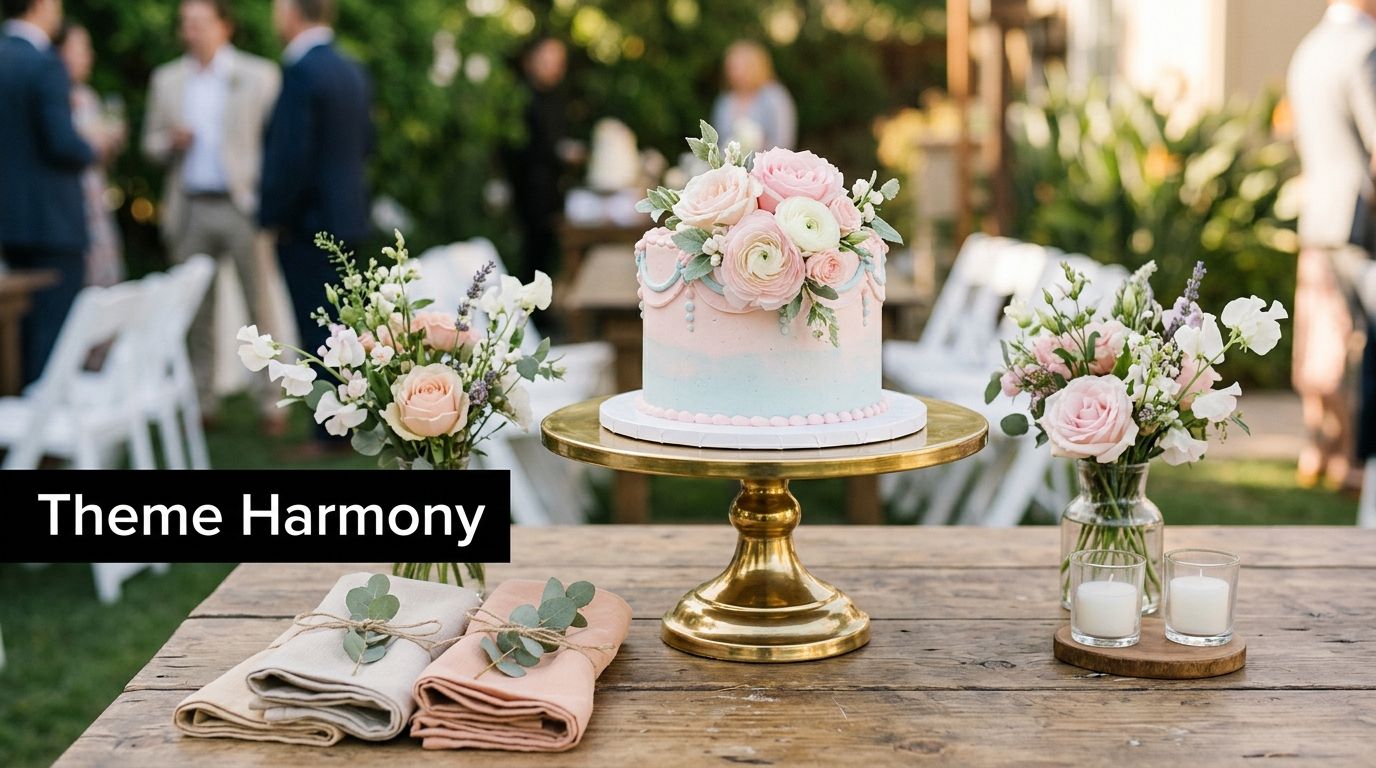
A wedding cake on a gold pedestal stand, surrounded by flower bouquets, candles, and linen napkins.

Use gold as either harmony or contrast

At a Franschhoek or Stellenbosch wedding, gold usually works best as harmony. It echoes candlelight, soft flatware tones, champagne hues, and floral palettes built around cream, blush, green, or muted terracotta. In that setting, the stand feels romantic and settled. It doesn't need to shout because the rest of the styling already speaks the same language.

At a modern city event, gold can do something different. It can create contrast. Put a gold pedestal against black linen, white florals, clear acrylic signage, or industrial architecture, and the stand starts reading as a deliberate point of warmth. That tension often looks sharper than trying to match everything too closely.

Pairing gold with LED furniture at evening events

This is one of the more interesting Cape Town combinations because it mixes classic and contemporary elements without making the event feel confused. LED furniture has a clean, futuristic edge. Gold cake stands carry warmth and ceremony. Together, they work when each has a clear role.

The LED furniture should shape the atmosphere of the room. The gold stand should anchor the cake display as the formal focal point. If both are fighting for equal attention, the result feels busy. If the room lighting is handled carefully, the contrast can be excellent.

A few combinations that tend to land well:

  • White LED cocktail furniture with a matte gold cake stand: Clean and upscale for rooftop launches or private evening parties
  • Soft colour-changing lounge pieces with brushed gold accents: Better for celebrations where the room shifts from dining into dancing
  • Gold cake display near, not inside, the brightest LED cluster: This keeps the cake visible and avoids strange colour casts on icing

Design note: Gold reads best when there's a little separation from strong coloured light. Let the furniture glow nearby, and keep the cake table in cleaner light.

Repeat the finish selectively

A cohesive event doesn't mean putting gold on every surface. It means repeating it enough that the cake stand feels intentional. Chairs, candle holders, charger plates, menu frames, or bar details can all help, but only if the finish is close enough in tone to feel related.

That's especially relevant when seating forms part of the visual story. Pairing the cake display with complementary pieces like gold Tiffany chairs in event layouts can make the whole reception feel more resolved, particularly in classic wedding settings.

A stand works hardest when it doesn't feel like a separate decision. When the room, furniture, and cake table all point in the same direction, guests may not notice the design logic consciously, but they'll feel that the event is organised, polished, and complete.

The Ultimate Gold Cake Stand Rental Checklist

A smooth rental usually depends less on the item itself and more on the questions asked before booking. Clients often assume a cake stand is simple. Then the event week arrives, and someone discovers the stand's finish isn't what they expected, delivery timing clashes with the baker, or the return process is more hands-on than planned.

The easiest way to avoid that stress is to treat the booking like a professional checklist, not a casual add-on.

Ask these questions before you confirm

  • What are the exact dimensions? Don't settle for “medium” or “large”. You need the platform width, overall height, and a clear description of the stand shape.
  • What material is the stand made from? Metal, acrylic, and mixed-material stands behave differently in transport and on-site setup.
  • What finish does it have in real light? Ask whether it's polished, brushed, matte, or antique. “Gold” on a website can cover several looks.
  • Who handles delivery and collection? This matters if the baker is arriving separately or if venue access is tightly scheduled.
  • Is setup included or is the stand drop-off only? Those are very different services.
  • What is the cleaning expectation after use? You shouldn't be left scraping icing, sugar work, or wax residue after a long event day.
  • What happens if the item is damaged during service or transport? Ask about responsibility clearly, before the paperwork is signed.

Condition matters more than clients think

A stand can be technically available and still not be event-ready. The finish should be clean, the base should sit evenly, and the top plate should feel secure. Rental photos don't always show minor wear, especially on reflective metallics.

For delicate transport planning, it can help to understand how protective materials work. A supplier using proper handling methods similar to protective packaging bubble wrap standards is already thinking in the right direction about care and presentation.

Cape Town and Winelands timing needs attention

Local event logistics can get tight quickly. Weekend weddings, wine farm access windows, and back-to-back city events all put pressure on delivery timing. If your venue has restricted setup hours or a narrow handover with the florist and baker, those details need to be confirmed early.

Quality rental companies distinguish themselves. They don't answer vaguely. They know the stand dimensions, they can provide a clear explanation of the finish, and they're clear about who does what on the day.

Good rental service feels boring in the best way. Everything is confirmed, the item arrives as described, and no one has to improvise around it.

The insider's shortlist

Before you pay a deposit, make sure you can answer all of these with confidence:

  1. Will this stand suit the venue style and lighting?
  2. Has the baker confirmed the cake's size and likely weight?
  3. Will the delivery window align with venue access?
  4. Do you know who places the stand and who collects it?
  5. Are the cleaning and damage terms clear?
  6. Have you seen or been told the actual finish type, not just “gold”?

That's the difference between hiring a pretty object and securing a reliable event element. The second option always makes event week easier.

Your Gold Cake Stand Rental Questions Answered

Can I reserve a stand before the cake design is final?

Yes, but do it carefully. Reserve the style and likely size range, then confirm the final dimensions once the baker signs off the design. If you lock in too early without updating the rental team, you can end up with the right look but the wrong platform.

Should the stand be delivered to me, the venue, or the baker?

The cleanest option depends on who is placing the cake. If the baker is setting the cake directly on site, venue delivery usually makes the most sense. If a planner or stylist is building the display first, they may want the stand earlier. What matters is that one person owns the handover and placement plan.

Can a gold cake stand be used outdoors?

Sometimes, yes, but outdoor use needs judgement. Wind, uneven ground, direct sun, and dust all affect the display. Covered outdoor spaces are usually easier than fully exposed setups, especially for taller cakes or more delicate finishes.

What if my event style mixes gold with other metals?

That can work well if one finish leads and the others support it. Keep the cake stand as the hero metallic, then bring in secondary finishes sparingly through candle holders, cutlery, frames, or furniture accents. Mixed-metal styling fails when every finish gets equal weight.

Do I need a separate stand for cupcakes or sweets?

Not always. If the cake is the main visual moment, one strong pedestal stand often does the job better than several competing pieces. Add separate dessert stands only when the broader table design calls for them and there's enough space to style them properly.

Who is responsible if the stand is knocked during the event?

That depends on the rental agreement and who had control of the item at the time. Ask the question directly before booking. Clear terms prevent awkward conversations later, especially at busy functions where multiple suppliers are working around one table.

Can the stand be customised with flowers, ribbon, or signage?

Usually, yes, but keep additions controlled. Florals should look integrated rather than taped on as an afterthought. Ribbon can work for softer romantic styling. Signage should never hide the shape or balance of the stand itself.

How far in advance should I book?

Earlier is always better for popular dates in Cape Town and the Winelands, especially if your event falls in a busy wedding period or around year-end functions. Leaving a cake stand to the final week limits finish options and can force compromises elsewhere in the styling.


If you want a gold cake stand that looks right in the room and works properly on the day, ABC Hire is worth contacting early. Their Cape Town team handles event furniture and accessories across the city and Winelands, which makes it easier to coordinate your cake display with seating, tables, LED furniture, and the rest of your rental setup in one place.

Rent a Freezer for Ice Cream in Cape Town: Event Guide 2026

You've booked the venue, chosen a great caterer, and found an ice cream supplier that suits the mood of the event. Then one practical question starts to matter more than anticipated. What freezer do you need to keep that ice cream perfect from delivery to final service?

At weddings and corporate functions around Cape Town, the problem usually isn't the dessert itself. It's the holding. Ice cream that leaves the supplier in excellent condition can still arrive at service either too soft, too hard, or slightly damaged in texture because the freezer choice, placement, loading, or power setup was wrong.

That's why choosing the right freezer for ice cream matters. It protects texture, flavour, presentation, and service speed. On a wine farm in Paarl, a beachfront setup near Clifton, or a formal dinner in Stellenbosch, the right equipment makes dessert feel polished. The wrong equipment turns it into a recovery exercise.

Serving Flawless Ice Cream at Your Event

By 4 pm on a Cape Town wedding day, the pressure usually shows up in the dessert service first. A freezer has been wheeled across gravel at a wine farm, the staff have opened it too often during setup, and the afternoon heat has started working on every tub before the first scoop is served.

That is why flawless ice cream service starts long before guests reach the dessert station. It depends on temperature control, transport timing, power stability, and where the freezer sits once it arrives on site. Get those practical details right, and the ice cream holds its texture and serves cleanly. Get them wrong, and you end up with soft edges, icy patches, slow scooping, and product waste.

Cape Town and the Winelands add a few complications that generic advice often misses. Beach venues can mean wind, salt air, and longer cable runs to a reliable power point. Wine farms often have beautiful service areas, but not always the easiest vehicle access or the fastest setup path from unloading point to kitchen. On hotter summer days, even a short delay with the lid open can affect the first round of service.

Ice cream also needs different handling from other frozen stock. A unit that is acceptable for bagged ice or frozen snacks may still perform poorly for dessert service because ice cream reacts quickly to temperature fluctuation. For smaller functions or back of house reserve stock, a small chest freezer for event use often gives better holding stability than clients expect, provided it is pre-chilled, packed correctly, and opened with discipline during service.

Good ice cream service starts hours earlier, with the freezer fully cold, correctly loaded, and placed where staff can work quickly without exposing stock to heat.

The best results come from treating freezer planning as part of the event operations plan, not a last-minute equipment add-on. That approach keeps the product consistent from delivery to the final serving, which is what guests remember.

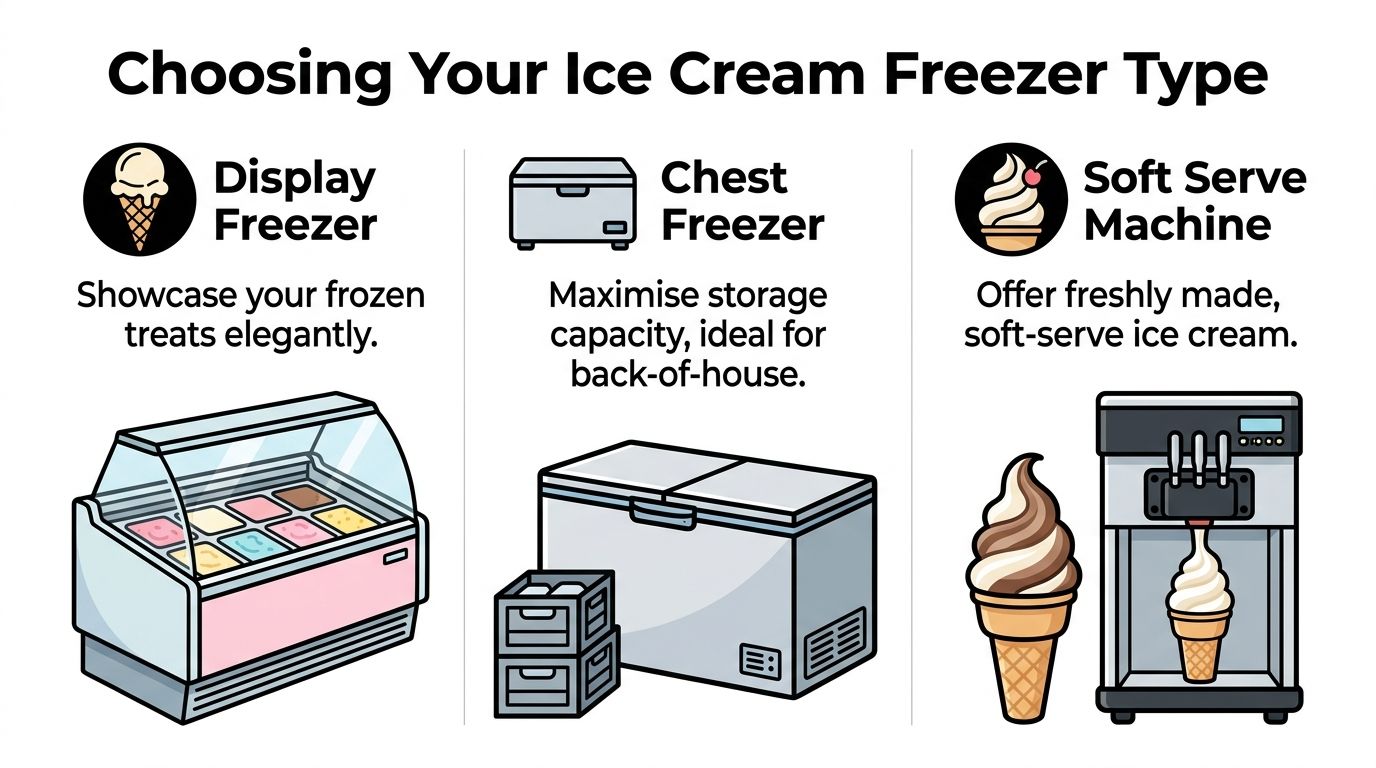
Choosing Your Ice Cream Freezer Type

The right unit depends on how you want to serve, how visible the dessert station will be, and how much stock you need to hold at once.

An infographic showing three types of ice cream equipment: display freezer, chest freezer, and soft serve machine.

Chest freezer for back of house reliability

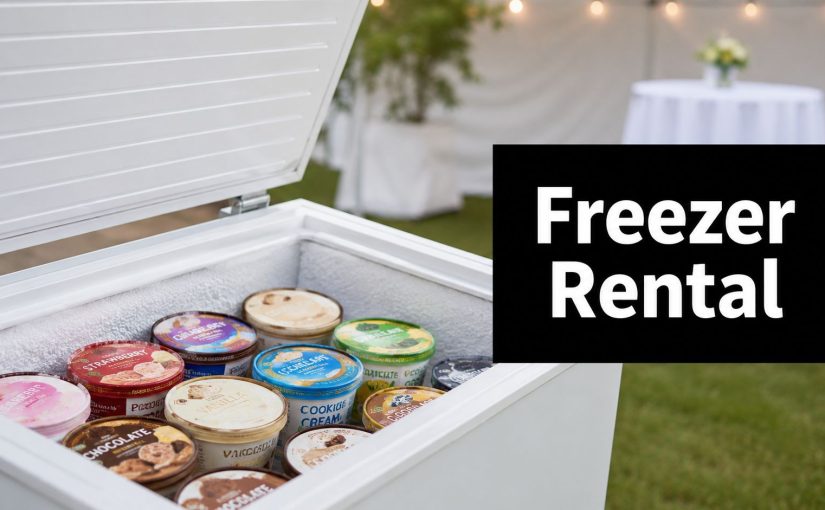
A chest freezer is the workhorse. It's usually the best option when the ice cream is being plated by catering staff behind the scenes or when you need reserve stock close to service.

It isn't glamorous, but it's dependable. The lid opens from the top, cold air stays inside better than with upright formats, and it handles busy service windows well if staff open it briefly and keep the contents organised.

This is also where size matters. In South Africa, 301 to 600 litre units accounted for 42.38% of the 2025 market value, showing a clear preference for medium-to-large freezers that suit practical event needs, according to Mordor Intelligence's commercial ice cream freezers market analysis. That lines up with what works on the ground for weddings, brand activations, and private functions. If you need a useful reference point, this guide to a small chest freezer helps frame where compact units fit and where they don't.

Display freezer for front of house presentation

A display freezer or dipping cabinet is for events where the dessert station should look like part of the experience. Guests see flavours, colours, and presentation immediately. That works well for garden weddings, premium launches, and corporate hospitality where the dessert station needs visual appeal.

The trade-off is operational. Display units need thoughtful placement, cleaner service discipline, and stronger supervision during peak periods. They're excellent when presentation matters. They're less ideal when the venue is cramped or the service team is stretched.

Soft serve machine for interaction

A soft serve machine is different from both. It isn't a storage freezer first. It's an interactive dessert format. Guests enjoy the novelty, and the queue often becomes part of the atmosphere.

That said, soft serve only works when the event is designed around it. It's not the best solution if your brief is artisan scoops, plated desserts, or multiple premium flavours in tubs. It also needs a team that can manage the machine properly during service.

A simple way to choose

Think of the options like this:

Event need Best fit
Hidden stock, reliable holding, practical service Chest freezer
Guest-facing dessert station Display freezer
Interactive novelty and live dispensing Soft serve machine

Selection rule: Choose the unit that matches the service style first. Capacity and appearance come after that.

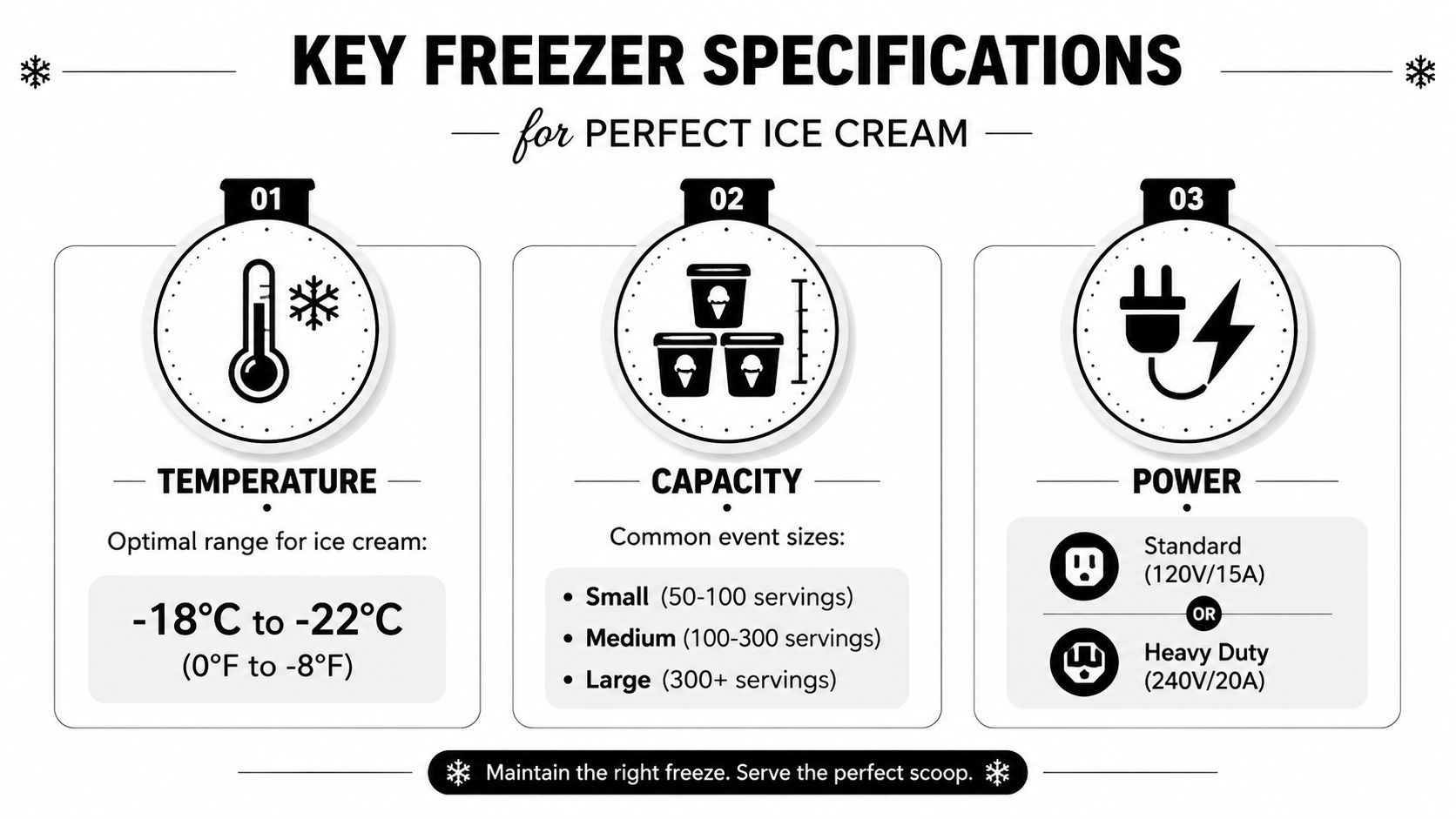
Key Freezer Specifications for Perfect Ice Cream

Type matters, but specification matters more. A freezer can look suitable and still perform poorly for ice cream if the holding temperature, cooling method, or power requirement isn't right.

An infographic detailing essential freezer specifications for storing and serving ice cream, including temperature, capacity, and power.

Temperature is the first filter

For proper preservation, ice cream needs a static air temperature of –18°C to –25°C, and that stability matters in South African conditions where ambient temperatures can reach +35°C, as outlined in the ISO 22043 summary from ANSI Blog. This is why a freezer for ice cream can't be judged by “cold enough” alone.

Too warm, and the product softens, refreezes unevenly, and loses its smooth finish. Too cold, and service becomes difficult because the scoop fights the product instead of cutting through it cleanly. The best event setups aim for holding conditions that preserve texture while still allowing efficient service.

ISO 22043 also distinguishes horizontal closed ice-cream freezers that use static air cooling from supermarket-style dynamic air systems. That distinction matters because the cooling pattern affects how well pre-packed ice cream keeps its shape and quality during storage and display.

Capacity isn't just about volume

Most clients start by asking how many litres they need. The better question is how the stock will move during the event.

If you choose a freezer that's too small, staff stack tubs too tightly and service slows down. If you choose one that's too large for the job, you create transport and placement headaches for no benefit. A sensible event freezer should give staff room to organise flavours, reserve stock, and open the lid without disrupting the whole contents.

A practical sizing discussion should include:

  • Guest pattern: Are all guests likely to collect dessert in one rush, or will service be staggered?
  • Menu format: Scooped cones, plated desserts, sandwich-style portions, and self-serve stations all place different pressure on the freezer.
  • Stock rotation: Reserve tubs should be reachable without leaving the lid open for too long.

Power planning saves events

Power is where many outdoor functions come unstuck. Before the freezer arrives, confirm the supply, plug point location, extension routing, and whether other event equipment is sharing the same line.

If your venue team is also thinking through food safety generally, this guide on preventing bacterial growth in food is a useful companion resource. It's not ice-cream-specific, but it helps planners understand why temperature control discipline matters across the whole catering setup.

Ice cream quality drops quietly. Guests usually only notice at serving time, when there's no easy fix left.

Renting vs Buying a Freezer for Your Event

A wedding in Franschhoek and a brand launch in Camps Bay rarely need the same freezer setup. One venue may have a stable prep area and easy truck access. The other may involve stairs, soft ground, salt air, or a long cable run from the nearest plug point. That is why renting usually gives clients a better result than buying.

As noted earlier, the South Africa ice cream market, which was valued at USD 363.1 million for 2025, is projected to grow. For events, that growing demand usually makes specialist hire more practical than owning a unit that may only suit part of your calendar.

Why renting usually works better

Owned equipment only pays off if it is used often enough, stored properly, and moved by people who know how to handle refrigeration equipment. Many venues and planners underestimate that part.

In Cape Town event work, the freezer itself is only one cost. There is also collection or delivery, loading, offloading, storage between bookings, cleaning, maintenance, and the risk that the unit you own is wrong for the next job. A compact chest freezer may suit a 60-guest private lunch, then become a bottleneck at a 200-guest summer wedding. A larger unit solves capacity, but now access through cellar doors or into a beachside marquee becomes harder.

Renting lets you match the unit to the event.

It also gives you support when the cold chain is bigger than just dessert service. If the caterer needs separate chilled holding for toppings, dairy garnishes, or other perishables, it helps to plan the full refrigeration setup together with a mobile fridge for hire for event cold storage, instead of forcing one owned freezer to cover every need.

Renting versus buying at a glance

Factor Renting Buying
Upfront commitment Lower cost for occasional events Large capital purchase
Flexibility Choose size and format per booking Limited to the unit you own
Maintenance Usually handled by the hire company Owner handles servicing and repairs
Storage No long-term storage required Needs secure, suitable storage space
Transport Commonly arranged as part of the hire Owner must organise vehicle and handling
Best fit Weddings, launches, corporate functions, seasonal demand Frequent in-house use with trained staff and reliable logistics

When buying can make sense

Buying suits a narrow group. A venue with regular in-house dessert service, dedicated storage, steady staff, and a consistent event format can make ownership work. The same applies to a caterer running repeated activations with the same menu and the same operational footprint.

For everyone else, hiring is the safer commercial decision. It reduces mismatch, avoids dead storage, and makes it easier to handle Cape Town and Winelands venue variation from one booking to the next.

Commercial reality: Renting lets you choose the right freezer for the job, the weather, the site access, and the power setup, instead of forcing every event to fit one machine.

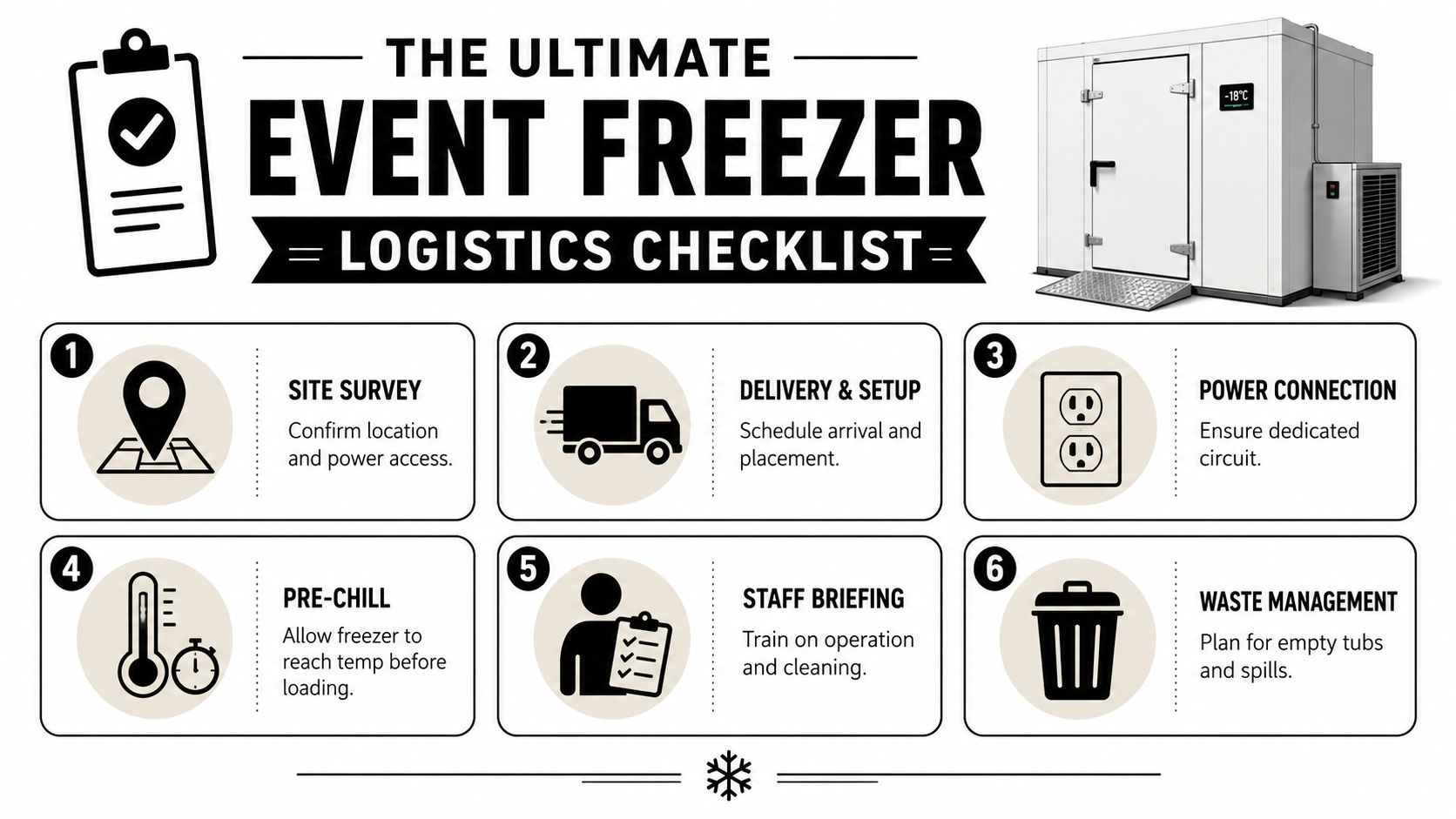
The Ultimate Event Freezer Logistics Checklist

A freezer can be technically perfect and still fail on the day because the logistics were handled casually. The venue path is too narrow. The plug is too far away. The freezer arrives late and gets loaded before it's fully cold. Those are the mistakes that cause service issues.

A six-step checklist infographic for event freezer logistics, including site survey, delivery, power, and staff training.

Power and placement basics

Commercial chest freezers suited to South African events are often rated climate class 7, need a 220–240V connection, and a typical 400L unit consumes around 256W, based on the equipment details summarised in this industrial ice cream freezer review. Those details matter when you're planning power on a lawn, in a temporary marquee, or at an older venue with limited infrastructure.

If your event setup includes broader cold-chain needs, a guide to a mobile fridge for hire is useful for thinking through how refrigeration zones should be separated across food and beverage service.

A working checklist for event day

Use this before sign-off with the venue and supplier:

  • Access route: Confirm gate width, stairs, lifts, gravel, grass, and the exact path from vehicle to setup point.
  • Final position: Keep the freezer out of direct sun, away from dancefloor traffic, and close enough to service staff to avoid constant walking.
  • Dedicated power: Don't share the freezer supply with lighting, sound, coffee machines, or catering appliances if you can avoid it.
  • Arrival timing: Get the unit in early enough to settle and pull down to temperature before stock goes in.
  • Service reach: Make sure staff can open the lid fully and scoop without bumping into guests, décor, or furniture.

The details people miss

A freezer should never be treated as just another drop item. Someone needs to own the refrigeration plan on the day. That person should know where the plug is, who has authority to move the unit, and what to do if the venue coordinator wants the layout changed at the last minute.

A few final checks help:

  1. Label flavours clearly so staff don't keep lids open while searching.
  2. Keep reserve stock nearby but not piled on top of active tubs.
  3. Plan waste flow for empty containers, napkins, spills, and used serving items.

Maintaining Quality and Hygiene on Event Day

Most ice cream failures happen after setup, not before it. The freezer is cold, the tubs are loaded, and everyone assumes the hard part is done. It isn't.

The fastest way to ruin event ice cream is to overload the freezer. In event settings, 68% of soft ice cream incidents are linked to freezer overload when capacity goes beyond 75%, according to the claim cited in this Instagram reel reference. That makes practical sense. When tubs are packed too tightly, airflow suffers, recovery slows after each lid opening, and the product softens during service.

Non-negotiable handling rules

These are the habits that protect quality:

  • Stop at sensible loading levels: Leave enough room for air movement and staff access.
  • Keep the lid closed: Open, retrieve, close. Browsing with the lid open is what weakens holding.
  • Organise before guests arrive: Put best-selling flavours where staff can reach them first.
  • Use clean service tools: Scoops, napkins, and portioning tools must be managed properly through the whole service.
  • Separate allergen-sensitive flavours: Don't let one scoop drift between dairy, vegan, nut, and standard options without proper cleaning.

Hygiene isn't separate from quality

Good hygiene supports texture because it supports disciplined service. Staff who have a proper service plan work faster, keep the unit shut more often, and make fewer messy decisions under pressure.

If your dessert station forms part of a wider catering setup, this overview of catering equipment for hire is useful for thinking about the whole service environment rather than treating the freezer in isolation.

Don't judge the setup by how cold the freezer felt at handover. Judge it by how the last guest's scoop looks.

The myth to avoid

One assumption causes repeated trouble. People think a fuller freezer performs better because it looks “packed cold”. For ice cream service, that's often the opposite of what you want. A well-organised freezer outperforms an overfilled one every time.

Special Considerations for Cape Town and Winelands Events

A freezer that performs perfectly in a city venue can struggle badly at a wine farm in Franschhoek or a beach event in Camps Bay. In the Western Cape, ice cream service is shaped by distance, heat, wind, uneven access routes, and power points that are often far from the serving position clients want.

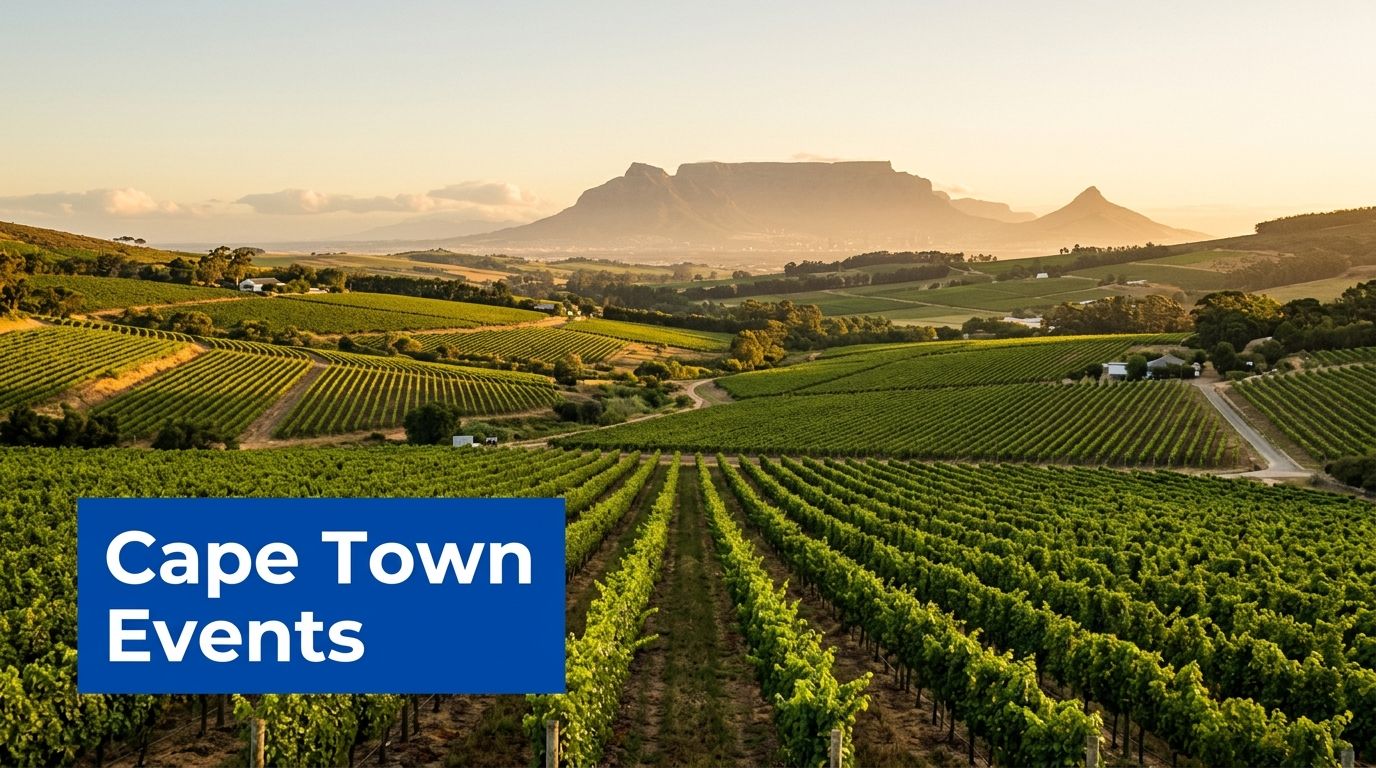
Lush green vineyards in Cape Town with Table Mountain in the background at sunset.

I see the same pattern across Cape Town and the Winelands. The visual setup gets approved first, then the practical refrigeration questions arrive late. That is where service starts to slip. A terrace with a view may be a long way from stable power. A lawn setup may look simple until the freezer has to cross gravel, steps, or soft ground. At private homes, the issue is often less about access and more about finding a shaded service point that staff can work from without guests crowding the unit.

Venue type changes the plan immediately. Indoor hotel functions usually give you controlled temperatures and easier cable runs. Wine estates often need more thought around delivery timing, loading paths, and where the freezer can sit without spoiling the guest-facing setup. Beach and coastal venues add another layer. Salt air, direct sun, and wind all push the unit harder, and sand around service equipment creates avoidable mess if the station is not protected properly.

Product choice matters more here too. Small-batch and artisan ice cream can be less forgiving during transport and service than a standard retail tub. Vegan ranges are another one to treat carefully. I always advise clients to confirm the supplier's recommended holding range before the event, especially for custom flavours or premium products made with different fat and sugar balances. One freezer does not suit every product.

A few local decisions prevent most problems:

  • Confirm the exact power point before delivery day: "Nearby" can still mean a long cable run across a courtyard or through a service passage.
  • Check the delivery route in advance: Cellars, garden venues, and older properties often have tight turns, steps, or uneven surfaces.
  • Keep the freezer out of direct afternoon sun: Stellenbosch and Paarl heat can soften service faster than clients expect.
  • Allow for transport timing from supplier to venue: Long summer drives and late setup windows shorten your margin for error.
  • Brief venue staff and coordinators clearly: The freezer should stay plugged in, level, and in its assigned spot once loaded.

The best Cape Town event setups are rarely the fanciest. They are the ones planned around the venue's real conditions, with the freezer positioned for power, shade, staff access, and quick service.

If you need a freezer setup that fits your venue, power conditions, and dessert service style, ABC Hire can help you plan the practical side properly. From Cape Town functions to Stellenbosch, Franschhoek, and Paarl events, the right rental equipment makes ice cream service cleaner, calmer, and far more reliable on the day.

A Complete Guide to Renting a Gas Patio Heater in Cape Town

Picture this: a perfect Cape Town evening. Maybe it’s a chic wedding in the Winelands or a corporate do with twinkling city views. The sun dips, a cool breeze rolls in, and suddenly your perfect atmosphere isn't so perfect anymore. This is where a gas patio heater becomes the unsung hero of your event, keeping guests comfortable and the good times rolling. In the Western Cape's beautifully unpredictable climate, reliable outdoor heating isn't a luxury—it's a must-have.

Creating an Unforgettable Vibe

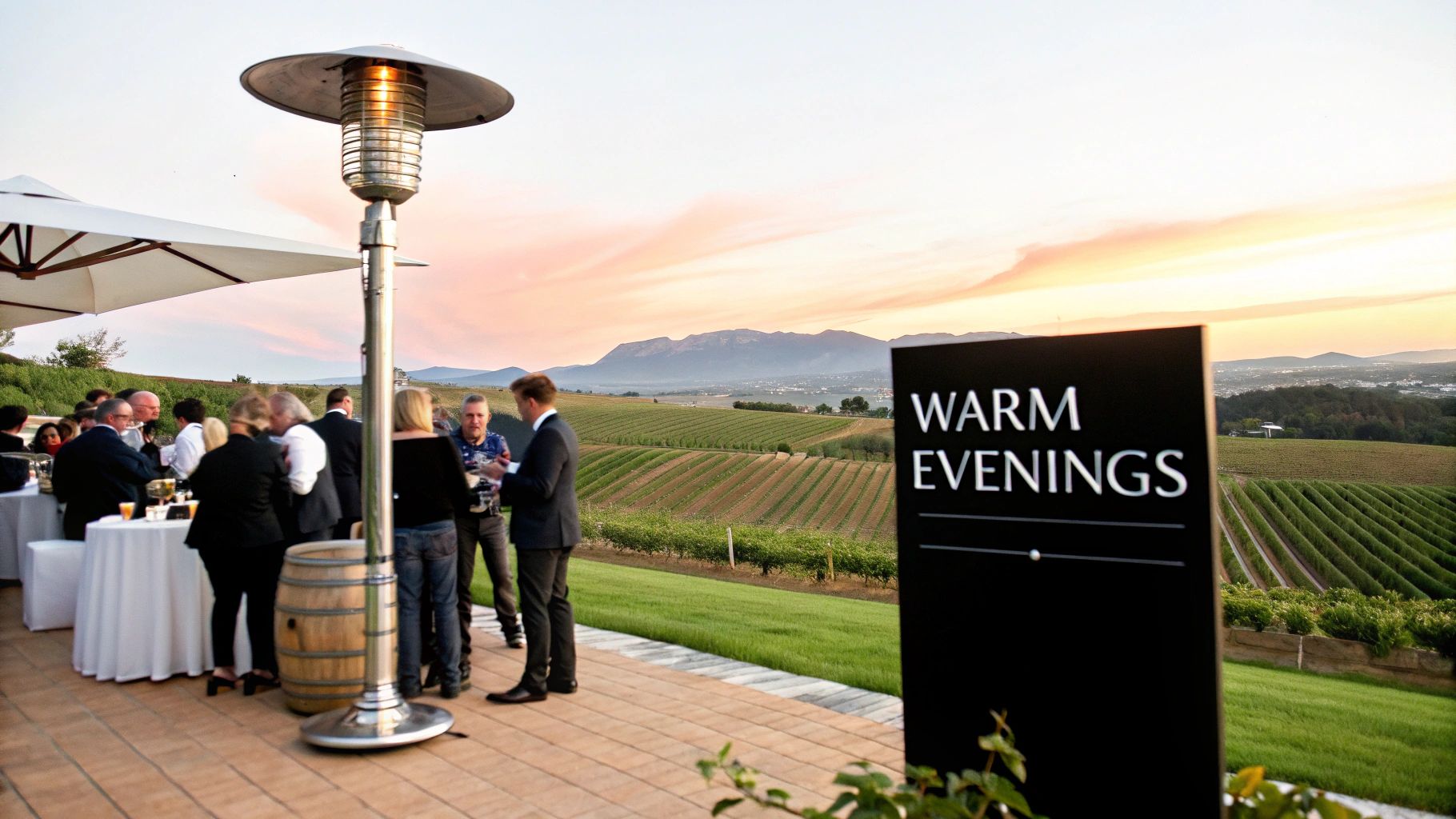
An outdoor evening event with people socializing next to a gas patio heater, overlooking a vineyard at sunset.

Honestly, the difference between a good event and a truly great one often comes down to how your guests feel. When people are warm and comfortable, they stick around longer, chat more, and walk away with fantastic memories. This is especially true for any outdoor gathering in Cape Town or the Winelands, where a stunning day can easily turn into a chilly night without warning.

Why Atmosphere Is Everything

A gas patio heater does more than just pump out heat. It creates a natural, inviting hub where people can gather. Think of it as a clean, modern campfire—all the cosy glow and warmth, none of the smoke or mess. It’s that little touch of sophistication that elevates the entire experience, turning a simple space into a warm, welcoming lounge.

Getting event planning right means thinking about what your guests need before they even have to ask. For a complete rundown on covering all your bases, a good practical guide to event planning can be a lifesaver, ensuring every detail, including guest comfort, is spot on.

When you plan for warmth, you're doing more than just ticking a box. You're thoughtfully designing an environment that feels welcoming and luxurious, showing your guests that their comfort is your top priority.

This guide is your A-to-Z resource for hiring gas patio heaters for your next event. We’ll walk you through everything you need to know to make the right choice, ensuring your celebration is remembered for all the right reasons. From picking the right style and number of heaters to getting your head around safety and logistics, you'll have all the confidence you need to create a perfectly warm, utterly memorable occasion.

Why Gas Patio Heaters Are the Top Choice for Events

When you're planning an outdoor event, the atmosphere is everything. You need solutions that are powerful, elegant, and above all, flexible. This is where a good gas patio heater comes in—it ticks all those boxes, offering a blend of performance and style that other heating methods just can't touch.

Think of it as your own portable, controllable bonfire. You get all the inviting warmth and that mesmerising glow that naturally draws people together, but without any of the smoke, ash, or logistical nightmares that come with a real fire. This self-contained convenience is exactly why they’re the go-to for professional event planners.

Power and Portability Combined

The real magic of a gas patio heater lies in its freedom. Unlike electric heaters, they aren't tied down by clumsy extension cords that create tripping hazards and limit your layout options. They can be placed exactly where you need that pocket of warmth, whether it’s on a sprawling lawn in the Winelands or a chic city rooftop terrace.

This incredible portability means you can design your event layout without compromise. You can create intimate, warm conversation zones or spread the heat evenly across a large cocktail reception. With a powerful output, typically around 38,000 BTUs, a single unit can comfortably warm a radius of several metres, making them seriously efficient.

The core benefit of a propane gas patio heater is its ability to deliver serious warmth to any location, regardless of the venue's infrastructure. This flexibility is priceless for event planners who work across diverse and sometimes remote locations.

Their dominance in the local market isn't a fluke. Gas patio heaters are a huge part of South Africa's outdoor heating scene, capturing over 44% market share in 2023 across the Middle East & Africa region. In event-heavy areas like Cape Town and the Winelands, portable propane models are the overwhelming favourite, making up an estimated 70% of all rentals.

A Clear Winner Over the Alternatives

When you start weighing up the options, the practical benefits of renting a gas patio heater for your event become even clearer. Let’s take a quick look at how they stack up against the usual suspects.

Comparing Heating Options for Your Cape Town Event

Here’s a quick look at the pros and cons of common outdoor heating methods to help you decide what’s best for your event.

Heating Type Best For Heat Radius Portability Aesthetic Impact
Gas Patio Heaters Versatile events needing flexible placement and ambient warmth. Wide (3-5 metres) High (fully portable) Professional & sleek
Electric Heaters Covered patios or marquees with easy access to power outlets. Focused (2-3 metres) Low (tethered) Can be discreet
Wood Fire Pits Rustic, casual gatherings where smoke isn't a concern. Variable Low (heavy, fixed) High (rustic charm)
Infrared Heaters Targeted, directional heat for specific zones like seating areas. Focused (direct line) Low (often electric) Minimal, industrial

As you can see, each option has its place, but for the sheer flexibility and reliability needed for most events, gas heaters consistently come out on top.

The Smart Choice for Cape Town Events

Ultimately, the goal is to keep your guests comfortable without sacrificing style or safety. A gas patio heater shines in all these areas, delivering reliable, powerful heat with a polished, professional look. This makes them an indispensable tool for any successful outdoor gathering.

For a deeper dive into different models, you can check out our guide on finding the perfect gas outdoor heater for your specific needs. The combination of easy setup, powerful heat distribution, and complete portability makes them the most logical and effective choice for keeping your guests happy from sunset until the last dance.

How to Choose the Right Gas Patio Heater

Picking the right gas patio heater for your event is about more than just chasing away the chill. It's a design choice. You're trying to match the heater's style and function to the specific vibe and layout you’ve planned. Get this right, and your guests won't just be comfortable—they'll be impressed by the cohesive atmosphere you've created.

When it comes to rentals, your choice usually boils down to two fantastic, but very different, options. Each one serves a unique purpose, blending performance with a certain visual flair. Knowing how they differ is the first step to making a smart decision that really works for your event.

Mushroom Heaters: The Classic Choice for Wide Coverage

The mushroom heater is what most people picture when they think of a patio heater. That distinctive, umbrella-like reflector at the top isn't just for looks; it’s cleverly designed to push heat downwards and outwards, creating a wide, circular pocket of warmth. Think of it less as a direct blast of heat and more like a gentle, warm shower covering a broad area.

This design makes it incredibly practical and efficient for any event where guests are mingling.

  • Wide Heat Distribution: A single mushroom heater can comfortably warm an area of up to 20 square metres.
  • Ideal for Open Spaces: They're perfect for cocktail hours, networking events, or any setup where people are standing and moving around.
  • Subtle Presence: Their classic look tends to blend into the background, providing functional warmth without stealing the show.

Because they spread heat so well over a large radius, mushroom heaters are the real workhorses of the event rental world. They deliver reliable, widespread comfort, making them a safe and popular bet for almost any outdoor gathering.

Pyramid Heaters: A Statement in Style and Ambiance

Where the mushroom heater is all about function, the pyramid heater is pure theatre. Often called a flame tower, this striking, modern heater features a tall, tempered glass tube that encases a mesmerising, dancing flame. It's as much a piece of decor as it is a source of heat.

The pyramid heater is all about creating an atmosphere. The warmth it gives off is more radiant and localised, warming those who gather near it. It’s less about heating a wide zone and more about creating an inviting, warm focal point. These are perfect for adding a bit of drama to an entrance, a VIP lounge, or any modern, chic event. While they do provide heat, their main job is to look incredible.

You can see how different heating elements create a specific mood by exploring the design of fire pits for patios, which share that same focus on visual appeal.

A pyramid heater turns warmth into a feature. It draws people in with its dynamic flame, making it a natural gathering spot and a fantastic conversation starter at any sophisticated event.

Calculating How Many Heaters You Need

Booking the right number of heaters is critical. Too few, and your guests will be shivering. Too many, and your space feels cluttered and stuffy. Luckily, a simple formula can give you a pretty accurate estimate.

As a general rule of thumb, one standard mushroom-style gas heater effectively warms about 15-20 square metres of event space.

Here’s a simple, two-step process to figure it out:

  1. Determine Your Active Event Area: First, work out the square meterage of the specific outdoor area you need to keep warm. Don’t bother including the dance floor or service areas where constant heating isn't a priority.
  2. Divide by the Heater's Coverage: Take your total square meterage and divide it by 20 (the average coverage per heater). This gives you the number of mushroom heaters you’ll likely need. Always round up to the next whole number to be safe.

Let’s run through a quick example. Say you're hosting a cocktail party for 150 guests on a 250 square metre terrace.

  • Calculation: 250 sqm / 20 sqm per heater = 12.5
  • Recommendation: You’ll want to rent 13 mushroom heaters to ensure the entire terrace feels cosy and comfortable for everyone.

This simple bit of maths helps you book with confidence, ensuring every corner of your event is wrapped in a welcoming layer of warmth.

Mastering Heater Placement and Safety Protocols

Choosing the right number of heaters is one thing, but placing them for maximum warmth and total safety is a completely different ball game. A well-placed gas patio heater creates a genuinely cosy, inviting zone. Get it wrong, and it can be ineffective or, even worse, a serious hazard. Getting the placement right is how you unlock the real value of your rental heaters.

Think of it like setting up lights for a photograph. You need to position each source strategically to get rid of any cold spots and create a balanced, comfortable environment. The goal is to create overlapping circles of warmth, so your guests can wander around freely without walking into a sudden chill.

The Golden Rules of Heater Placement

Let's be clear: safety is absolutely non-negotiable. While any professional hire company ensures their gear is in top shape, it's your responsibility to place it correctly on-site. Always start with these fundamentals to protect your guests, your décor, and the venue itself.

A gas patio heater needs room to breathe, which means keeping a safe distance from anything that could catch fire.

  • Vertical Clearance: Make sure there's at least 1 metre of open space above the heater's reflector. You should never, ever place one directly under a low marquee ceiling, hanging tree branches, or any decorative draping.
  • Horizontal Clearance: Keep the heater at least 1 metre away from marquee walls, curtains, plants, and any other flammable materials on all sides.
  • Stable Footing: The heater must stand on a firm, completely level surface. Compacted, even grass can work in a pinch, but a paved or decked area is always the safer bet. Never place a heater on a slope or uneven ground.

For a deeper dive into the specifics of different models and their safety features, our article on various types of gas porch heaters has some extra insights.

Designing Your Warmth Zones

The perfect layout depends entirely on the flow of your event. A sit-down dinner has very different heating needs compared to a standing cocktail party.

For a seated dinner, try placing heaters between the tables to create pockets of shared warmth. Just avoid putting a heater too close to any single table—it can make those guests uncomfortably hot while leaving others out in the cold. You're aiming for lovely ambient heat, not a direct blast.

For a standing reception or networking event, it’s better to create deliberate "warming stations." Cluster a few heaters in key social areas, like near the bar or around lounge spots, to encourage guests to gather and mingle comfortably.

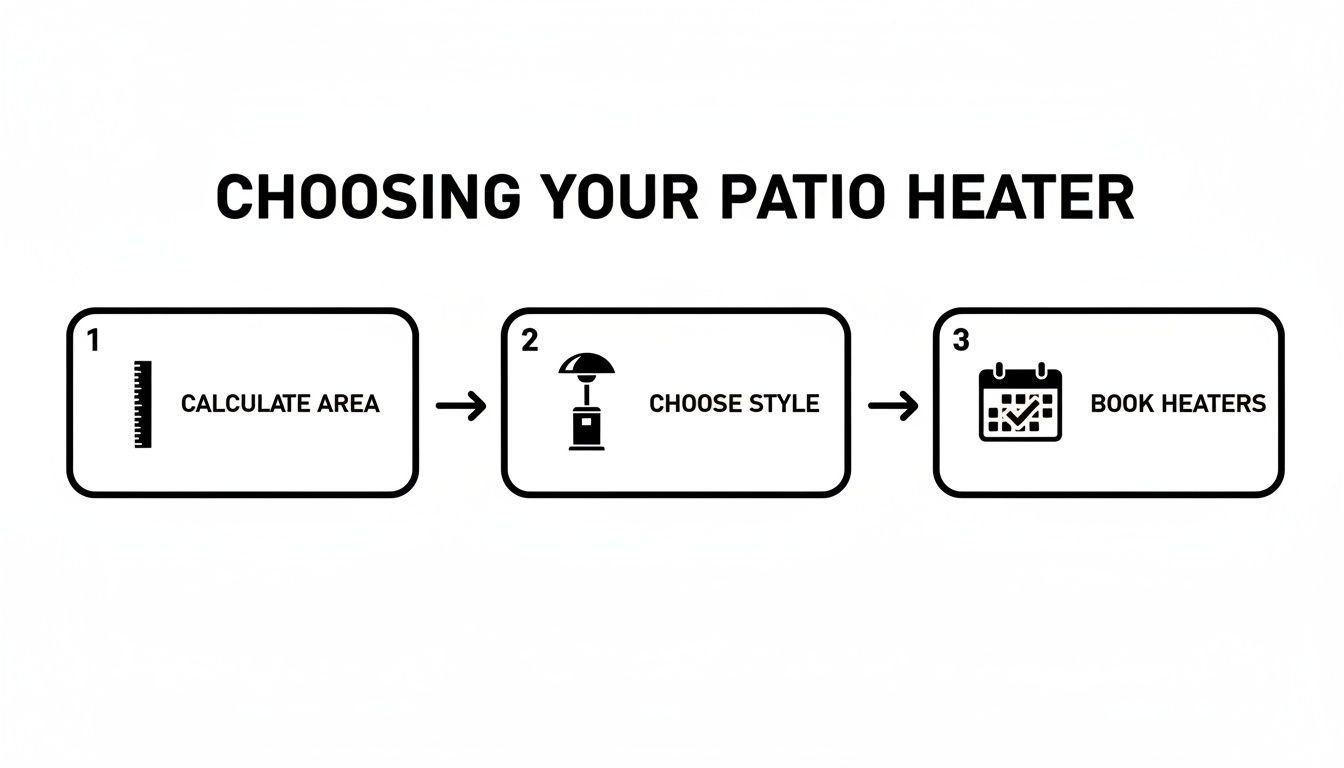
This simple guide breaks down the process of choosing the right heaters for your event.

A three-step guide illustrating how to choose your patio heater, including calculating area, choosing style, and booking.

This visual flow makes the decision-making process much easier, taking you from figuring out your space requirements to choosing a style that matches your event’s vibe.

Taming the Cape Doctor

Anyone who has planned an event in Cape Town knows the "Cape Doctor" can be a real party crasher. This southeasterly wind can slash the effectiveness of any outdoor heater and introduces a whole new level of safety checks.

This is where modern safety features are absolutely essential.

Always, always confirm that your rental gas patio heater has a tip-over safety switch. This brilliant little device automatically cuts the gas supply if the heater gets knocked or tilted too far, preventing a potential fire. For any outdoor event in the Western Cape, it’s a non-negotiable.

When placing heaters in windy spots, try to tuck them into sheltered areas, like against a solid wall or in the lee of a building. This helps stop the pilot light from blowing out and ensures more of that lovely radiant heat actually reaches your guests. Just be sure not to build a barricade around the heater, as it still needs proper airflow to work safely.

To give you peace of mind, it’s worth understanding what a regular gas heater service involves. While the hire company handles the big maintenance jobs, knowing about the professional checks highlights just how important those safety systems are.

Here’s a quick checklist to run through before your event kicks off.

Gas Heater Placement and Safety Checklist

This pre-event checklist will help ensure your heaters are set up for optimal safety and performance.

Checklist Item Why It Matters Professional Standard
Level Ground Check An unstable heater is a tipping hazard. The base must be 100% flat and on solid ground. No wobbling.
Clearance Measured Prevents fire risk from radiant heat. Use a tape measure: 1m above and 1m on all sides from flammable materials.
Tip-Over Switch Test Confirms the primary safety feature is working. Gently tilt the unit (when off). You should hear the switch click and engage.
Hose & Connection Check Prevents dangerous gas leaks. Visually inspect the hose for cracks; connections should be snug.
Away from Foot Traffic Reduces the chance of accidental bumps or knock-overs. Place heaters out of main walkways, behind seating, or in designated corners.
Wind Assessment Strong gusts can extinguish the pilot or make the heater unstable. Position heaters in sheltered spots; postpone use in extreme winds.

By following these placement rules, you can make sure every guest enjoys the warmth safely, leaving you free to focus on hosting a flawless and memorable event.

Understanding Rental Logistics and Fuel Management

Let's get into the practical side of things. Working out the logistics of hiring a gas patio heater is actually much easier than you’d imagine, especially when you team up with a pro rental company. It’s our job to make the process smooth so you can focus on the hundred other things on your event to-do list.

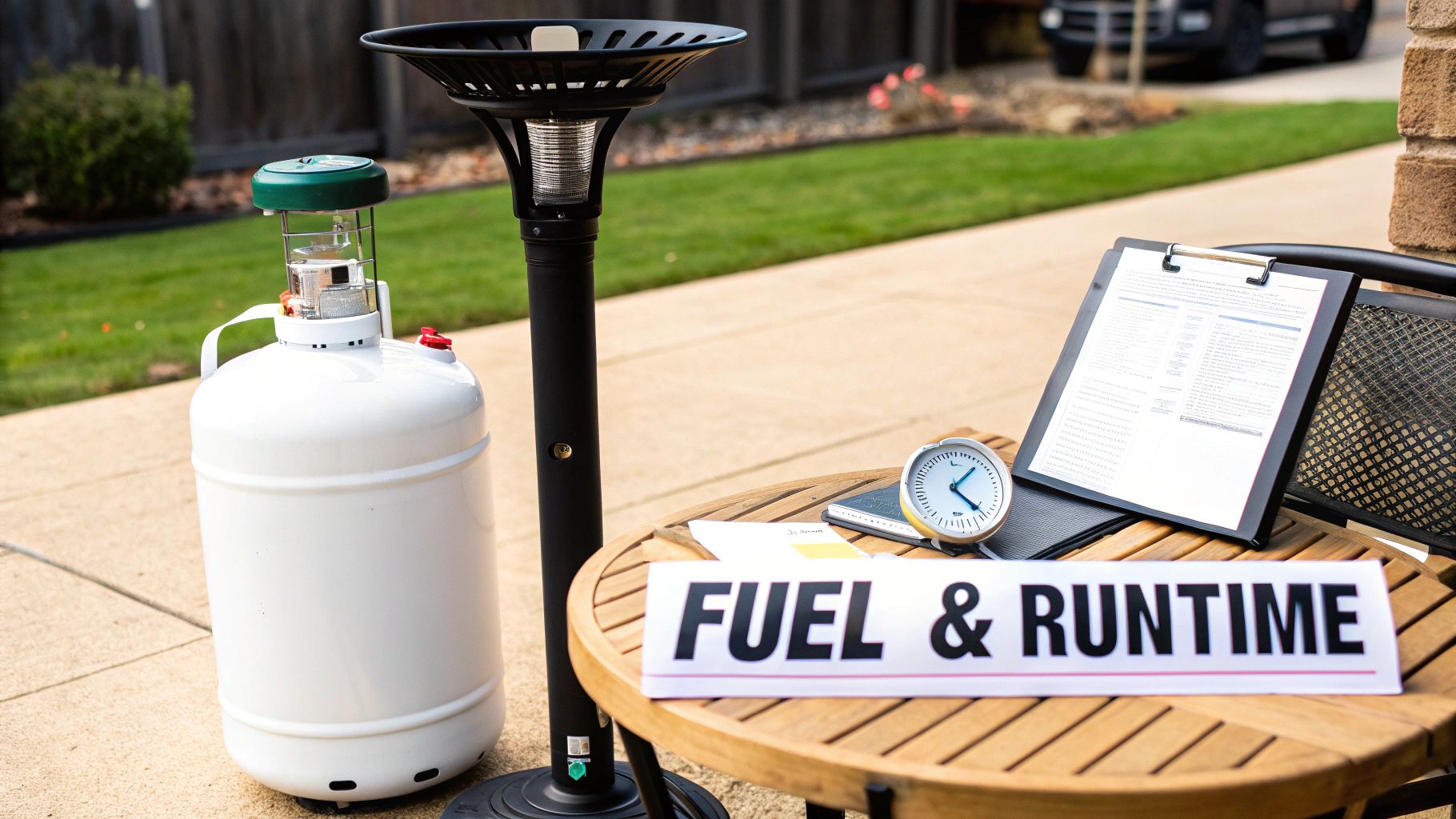
The most important part is getting a handle on the fuel. A standard gas patio heater runs on a 9kg propane gas cylinder, which fits neatly inside the base. One of these tanks provides a good amount of heat, keeping everyone toasty for hours.

Outdoor patio scene with a gas heater, propane tank, and a sign reading 'FUEL & RUNTIME' on a wooden table.

This whole setup is designed for the event world—it’s reliable, straightforward, and gets the job done without any fuss.

Calculating Your Fuel Needs

The first question every event planner asks is, "How long will the gas actually last?" It's a fair question—the last thing you want is for the heat to die down halfway through the evening speeches.

On a medium setting, a single 9kg propane tank will keep a heater going for about 10 to 12 hours. That’s more than enough runtime for most events, easily covering the entire evening from the first welcome drink to the last dance.

To work out what you’ll need, just think about how long your outdoor area will be active.

  • Standard Evening Event (5-6 hours): One full 9kg tank for each heater is perfect.
  • All-Day Festival or Multi-Day Event: This is where you'll want at least one spare tank per heater. It's always better to have a backup on standby.

The best thing to do is chat with us about your event schedule. We'll make sure you have the right number of spare gas cylinders delivered along with the heaters, so you don't have to give it a second thought.

The Clear Advantage of Hiring Over Buying

For anyone in the event industry, the decision to rent or buy gas heaters is a no-brainer. Hiring just makes more sense, both financially and logistically. Think about it: buying a whole fleet of heaters means a massive upfront cost, not to mention the ongoing headaches of storage, maintenance, and safety checks.

Renting turns a major capital expense into a simple, manageable operational cost. You get access to professionally maintained, top-of-the-line equipment for a fraction of the price of ownership, with all logistics handled for you.

Here in South Africa, especially in the Western Cape where the event scene in Cape Town and the Winelands is always buzzing, renting is the standard. It's cost-effective, with prices ranging from R500-R1500 per unit weekly, compared to the steep price of buying. This is exactly where ABC Hire comes in, helping create stylish, warm patios for unforgettable weddings and parties. You can read more about the propane patio heater market on datainsightsmarket.com.

When you hire from a company like ABC Hire, you're not just getting a heater. You're getting a full service that typically includes:

  • Delivery and Collection: We bring the heaters right to your venue and pick them up when the party's over.
  • Setup and Placement: Our team can help you position the units for the best heat coverage and safety.
  • Fuel Supply: Each heater comes with a full tank of gas, ready to fire up immediately.

This all-in-one service takes the hassle of transport, storage, and maintenance completely off your plate. It's simply the smartest and most efficient way to heat any event.

Getting to Grips with Setup and Troubleshooting

Even when you have pros like us at ABC Hire delivering your heaters, knowing a few basics gives you great peace of mind. A quick check or a simple fix is all it takes to keep the warm, festive atmosphere going without a single interruption.

Our team will handle the heavy lifting, of course, but it never hurts to know the essentials. Before your guests arrive, it’s always a good idea to cast a quick eye over the heaters. Make sure each one is standing firm on level ground and has plenty of breathing room from things like marquee walls, overhanging branches, or flowing decorations.

Firing Them Up: A Quick-Start Guide

Modern gas patio heaters are designed to be incredibly straightforward and safe to light, usually with just the push of a button.

  1. Open the Gas: Start by slowly turning the valve on top of the 9kg propane cylinder anti-clockwise. This gets the gas flowing.
  2. Turn the Knob: Next, push the main control knob on the heater in and turn it to the 'PILOT' setting. You’ll probably need to keep it held down for about 30-60 seconds to let the gas travel up to the burner.
  3. Press to Ignite: While still holding the control knob in, press the red or black igniter button (that’s the piezo ignition) a few times. You should see a small pilot flame flicker to life.
  4. Set Your Heat: Once that pilot is lit, keep holding the knob for another 30 seconds or so to make sure it stays on, then let go. Now you're free to turn the knob to your perfect heat setting, from a gentle low to a toasty high.

Don’t panic if it takes a few clicks of the igniter to get going, especially on a classic windy Cape Town evening. That’s completely normal. The real trick is holding that pilot knob down long enough for the gas to reach the right spot.

Common Hiccups and Easy Fixes

Every now and then, a heater might decide to be a bit stubborn. Before you reach for the phone, these simple checks can solve the most common issues right there on the spot.

Heater Won't Light?

  • Is the Gas On? Take a peek at the propane tank. Is the valve turned all the way open? It's a surprisingly common oversight!
  • Check the Connection: Make sure the regulator hose is screwed tightly onto the tank. A loose connection means no gas flow.

Flame Looks Weak or Low?

  • Running on Empty? The propane tank might just be getting low on fuel. An easy way to tell is by feel – a full 9kg tank has some serious heft to it.
  • Is the Valve Fully Open? Sometimes the valve isn't opened all the way, which restricts the flow. Give it another gentle turn to be sure.

Of course, there are always a few questions that pop up. Here are the quick, straight answers to the most common things we get asked by event planners, helping you get your booking sorted with confidence.

How Far in Advance Should I Book Heaters?

If your event is in Cape Town or the Winelands, especially during the busy wedding season from September to May, you’ll want to book your gas patio heaters at least four to six weeks in advance.

Popular dates and long weekends can get booked out months ahead of time, so getting in early saves a lot of last-minute stress and makes sure you get the gear you need. For smaller weekday functions or during the off-season, a two-week lead time is usually fine. But the golden rule is always: the sooner, the better.

Can I Use a Gas Heater Inside a Marquee?

This one is all about safety, and the short answer is no, you should not use a standard gas patio heater inside a fully enclosed marquee or tent. They are designed for outdoor or very well-ventilated areas because they use oxygen and give off carbon monoxide.

That said, you can safely use them in structures that are semi-enclosed, like a marquee with one or more sides rolled up or completely open.

Good ventilation is absolutely essential. For a space to be considered "well-ventilated," at least 25% of the total wall area must be permanently open to the fresh air outside. This keeps the air circulating and stops any dangerous fumes from building up.

If you're planning an event in a completely enclosed marquee, you’ll need to look at other heating options made specifically for indoor use. Your guests' safety should always be the top priority.

What’s Included in the Rental Price?

Knowing exactly what you're paying for helps with your budget and means no surprises on the day. When you hire from a professional company like us, the price usually covers a full service to make your life easier.

Here's what you can generally expect:

  • The Heater Itself: A clean, professionally maintained and safety-checked gas patio heater.
  • A Full Gas Cylinder: Every heater comes with one full 9kg propane gas cylinder, which will give you about 10-12 hours of heat.
  • Delivery and Collection: Our team will bring the heaters to your venue before the event kicks off and pick them up afterwards. No logistical headaches for you.

If you need extras, like having our team set them up for you or getting more gas cylinders for a longer event, we can usually arrange that for a small extra fee. It’s always a good idea to chat about these details when you book to make sure everything runs smoothly from start to finish.


Ready to create that warm, welcoming vibe for your next event? The team at ABC Hire is here to help with great advice and top-quality gas patio heater rentals.

Explore our event hire options and get a quote today at abchire.co.za

Your Ultimate Guide to Backdrop for Hire in Cape Town

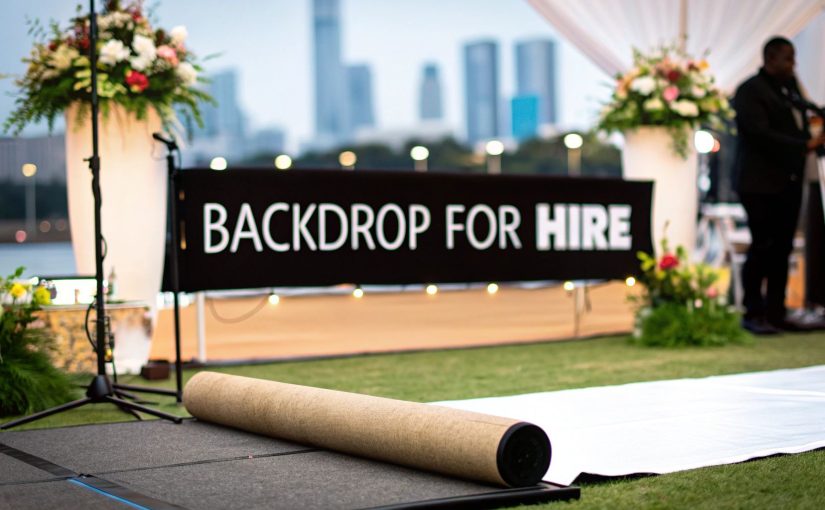
A backdrop is so much more than just a pretty background; it's the visual heart of your event. It’s what frames the most important moments, turning any space—from a rustic wine farm in the Winelands to a sleek corporate venue in the CBD—into a polished, professional setting.

Finding the Perfect Backdrop for Your Cape Town Event

Let’s be honest, the right backdrop sets the whole mood. It’s the first thing your guests will see, it’s going to be in almost every photo, and it’s the one thing that can really tie your entire theme together.

Whether you're planning a dreamy wedding, a sharp corporate launch, or a fun birthday bash, choosing the right backdrop is a game-changer. Think of this guide as your starting point for navigating backdrop hire in Cape Town. We'll get into how to match your choice with your event's theme and venue, and explore the different materials and styles that make a real statement.

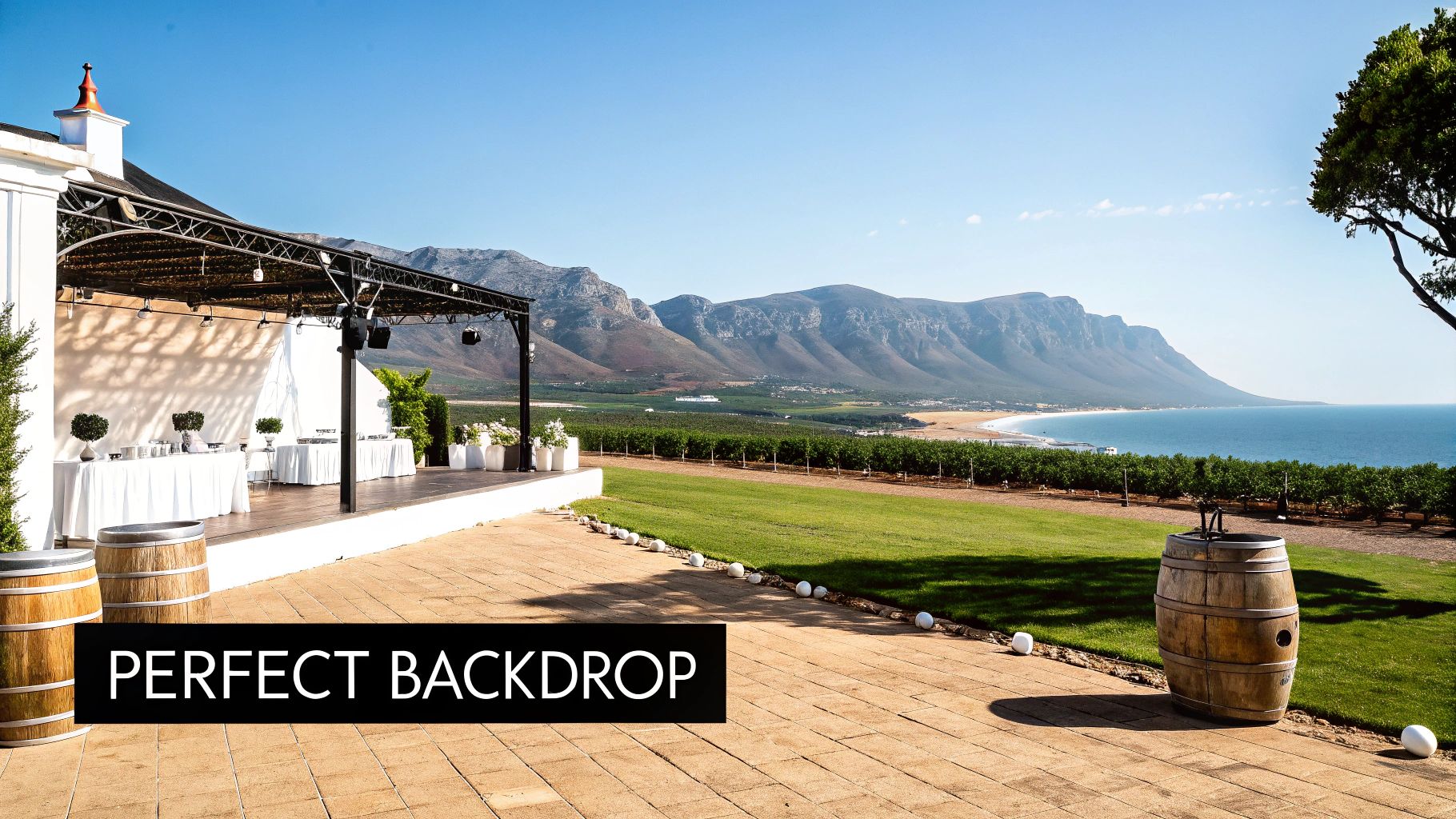
Elegant outdoor event space with white tables, a stage, wine barrels, and picturesque mountain and ocean views.

Why Hiring a Backdrop Is a Smart Move

Opting to hire a backdrop is one of the smartest ways to get a high-end look without the huge expense and hassle of buying one yourself. It gives you access to a massive variety of professional options that would probably be out of reach otherwise. It’s the ultimate event accessory—it just instantly elevates your space.

Hiring also takes the logistical headache away. A professional company will handle the delivery, the setup, and the breakdown. That’s one less thing for you to stress about on the day, which is a lifesaver for big events where time is tight.

Visuals are a bigger deal than ever in event planning. We're seeing a huge shift in budgets—in fact, 65% of event budgets in the Western Cape now set aside 15-20% for visual elements like backdrops. That's a massive jump from just 10% back in 2020. This is partly because people are leaning towards more sustainable, reusable hires over single-use items.

For a company like ABC Hire, this makes our backdrops a must-have for anyone planning a Franschhoek wedding or a matric dance. A single, stunning backdrop can slash setup costs by 30% while seriously boosting the "wow" factor. You can read more about these industry trends over on BusinessWire.

A backdrop isn't just a background; it's a statement. It tells your event's story, reinforces your brand, and creates an inviting space that gets guests snapping photos and making memories.

Matching the Backdrop to Your Vision

Before you start scrolling through options, take a second to get clear on your vision. The best backdrops feel like they were made for the event.

Ask yourself a few key questions:

  • What's the theme? Is it rustic, modern, glamorous, or corporate? Your backdrop needs to match that vibe. A wooden arch draped in florals is perfect for a vineyard wedding, while a clean, branded wall works for a product launch.
  • What's the venue like? Look at the existing decor, colours, and architecture. Your backdrop should complement the space, not fight with it. If the venue already has breathtaking views, sometimes a more minimalist backdrop is all you need.
  • What's the mood you're after? What do you want guests to feel? Soft fabrics and warm lighting create a romantic atmosphere. Bold graphics and bright colours bring the energy and excitement.

Thinking through these points will help you narrow down the search and find a backdrop for hire that takes your Cape Town event from ordinary to absolutely unforgettable.

Matching Your Backdrop to Your Event and Venue

Picking the right backdrop is about so much more than just filling a space. It’s got to feel like it belongs there, perfectly in sync with your event's vibe and the character of your venue. Get it right, and it becomes a seamless part of the experience.

Think about it: a slick, custom-branded wall is a total power move for a corporate launch at the Cape Town International Convention Centre (CTICC). It screams professionalism. But imagine that same backdrop at a rustic wedding on a Franschhoek wine farm—it would stick out like a sore thumb. The trick is to enhance the atmosphere, not fight against it.

Tailoring Your Choice to the Occasion

First things first, what's the backdrop's job? Is it the centrepiece for a ceremony, a fun photo booth background, or a professional stage setting? Each role demands something different.

  • Weddings: For I-do's in a lush vineyard, a blooming floral wall or a beautifully draped arch amps up the romance. These softer textures create a dreamy focal point for both the ceremony and the photos that will last a lifetime. We've got plenty of ideas over in our guide to wedding arch hire.
  • Corporate Events: Professionalism and branding are everything here. A crisp, clean backdrop with a company logo or event slogan adds instant credibility. It’s the perfect setting for keynote speakers, panel discussions, and those all-important professional headshots.
  • Private Parties and Matric Dances: Now this is where the fun really begins! Go bold with vibrant, themed backdrops. Shimmer walls, custom neon signs, or imaginative printed scenes become the life of the party, getting guests snapping and sharing.

It's no secret that event-specific backdrops are hugely popular, especially for weddings. Here in South Africa, the coastal beauty of Cape Town and the elegance of the Winelands make a stunning backdrop almost non-negotiable for couples. We've seen a 40% increase in backdrop hires since 2022 alone. With over 150,000 weddings happening across the country in 2024 and the Western Cape hosting 28% of them, that's around 42,000 ceremonies where a scenic backdrop is key to framing those gorgeous vineyard or ocean views.

Pro Tip: Always look at what your venue already offers. If you’re at a beachfront spot in Camps Bay with an incredible ocean view, choose something that frames the scenery instead of blocking it. A simple, elegant arch often works far better than a solid wall.

Working With Your Venue, Not Against It

Before you lock in that backdrop hire, take a good, hard look at the physical space. What’s the venue's colour scheme? What’s the lighting like? Are there any standout architectural details? A backdrop with glittering gold accents might look phenomenal in a grand ballroom, but it could easily clash with the rustic wooden beams of a barn venue in Stellenbosch.

To help you narrow down the options, here’s a quick guide based on some of the most common events we see in and around Cape Town.

Backdrop Selection Guide by Event Type

Event Type Recommended Backdrop Style Ideal Material Pro Tip for Cape Town Venues
Winelands Wedding Floral Wall or Rustic Arch Wood, fresh/silk flowers, draped fabric Choose florals that complement the vineyard's natural foliage. A wooden arch won't obstruct the mountain views.
Corporate Conference Branded Step-and-Repeat Tension fabric, rigid board Ensure the material is non-reflective to avoid camera flash glare. Clean, bold logos work best in large convention halls.
Beachside Birthday Party Shimmer Wall or Neon Sign Sequin panels, LED tubing A shimmer wall captures the sparkling water beautifully. Make sure any electricals are properly secured from wind and moisture.
Matric Dance Custom Themed Print Vinyl, fabric Go for high-impact graphics that tie into the dance's theme. It becomes the main photo spot for the night.

This table should give you a solid starting point for finding a backdrop that feels like it was made for your event.

And while you're busy creating the perfect aesthetic, don't forget the practical side of things. Great event planning means thinking about everything, including the security and management of your space. Getting to know the best practices for securing your venue during events will help ensure everything runs smoothly. Ultimately, the right backdrop hire is one that feels completely intentional—enhancing your venue’s best features and making your Cape Town event one to remember.

Getting the Size and Customization Right

When you’re hiring a backdrop, it’s about more than just finding a nice design – getting the scale right is a game-changer. A backdrop that’s too small for the room just gets lost and looks a bit amateur. On the other hand, one that’s massive can completely swallow your venue, making everything feel tight and cluttered.

First things first, get out the tape measure. You need to know your ceiling height and the width of the space where the backdrop will live. Don’t forget to look out for obstacles like light fittings, doorways, or pillars that could get in the way.

A standard 2.4m x 2.4m backdrop is usually a great fit for a photo booth or for framing a couple of speakers on a small stage. But if you’re dressing a large stage or a wedding top table, you’ll need to go much wider to really make a statement.

Standard Sizes Versus Custom Builds

So, should you go for a standard rental or a custom build? It really boils down to your budget and how important branding is. Standard sizes are brilliant because they’re affordable and we’ve always got them on hand. This makes them perfect for most weddings and private parties where the main goal is simply a beautiful background.

But for corporate events, brand activations, or really specific themed parties, a custom build is an investment that truly delivers. It’s your chance to splash your logos, brand colours, or unique graphics all over it – something a standard hire just can’t do. That’s how a simple piece of decor becomes a powerful part of your brand’s story.

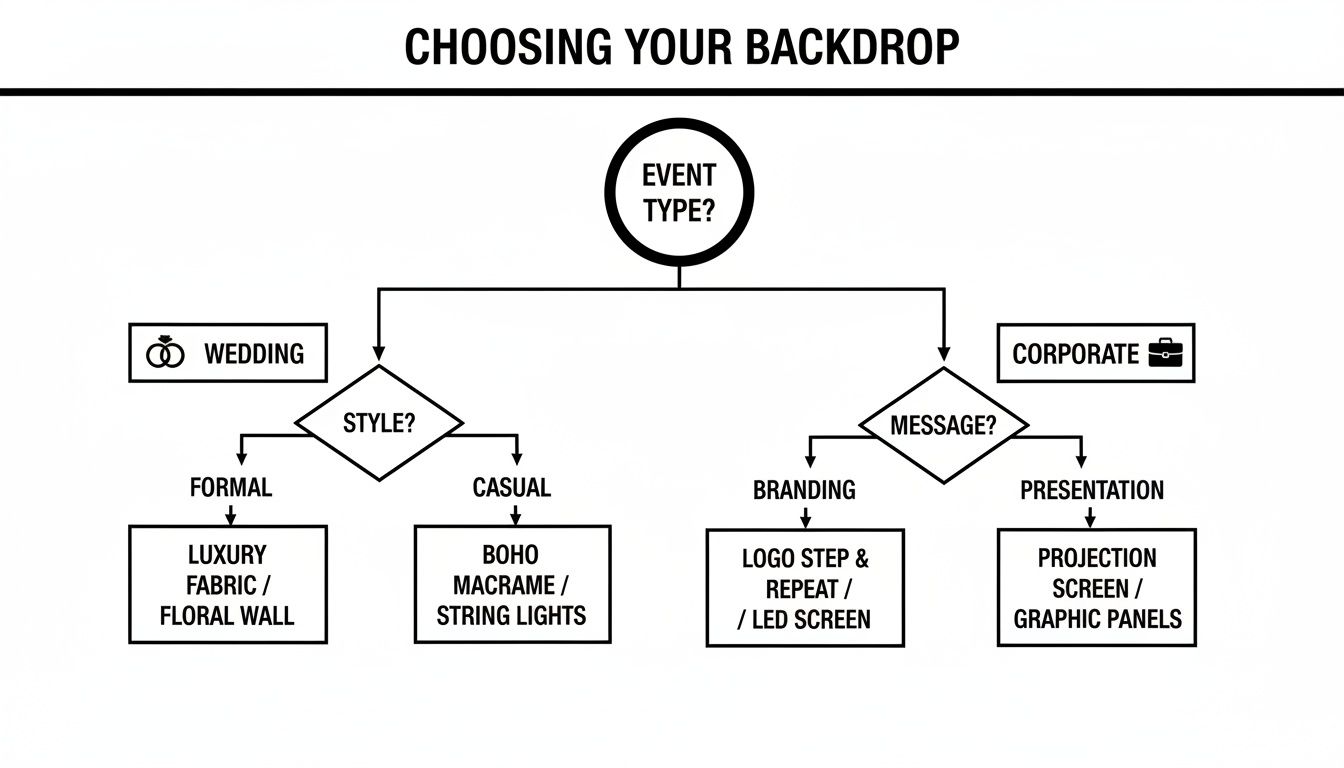
This little guide can help you figure out what’s best for your event.

A flowchart guiding event backdrop selection based on event type, style, and message.

As you can see, weddings are often all about the look and feel, while corporate events need to make a strong, branded impact.

Making Your Custom Backdrop Shine

If you do decide to go custom, you can get incredibly creative. Think of a sleek step-and-repeat backdrop covered in sponsor logos, or a dreamy wedding backdrop with the couple’s monogram. Customization is what makes your event feel like yours.

To get the ball rolling, you’ll need to send us your design files. Here are a few things to keep in mind to make sure it comes out perfectly:

  • File Format: We always prefer vector files (like .AI, .EPS, or .SVG) for logos and graphics. They can be scaled to any size without getting blurry.
  • Resolution: If you’re using photos, they need to be at least 300 DPI at the final print size. Anything less and you risk it looking pixelated.
  • Lead Time: Custom printing and building isn’t an overnight job. You’ll want to have your design finalised at least 4-6 weeks before your event. This helps avoid any last-minute rush fees and gives us the time to get it just right.

Here's a pro tip: lighting is your secret weapon. Even the most incredible custom design can look a bit dull if the lighting is bad. Chat with us about uplighting or backlighting options – it’ll make your graphics pop and give the whole setup a professional, dramatic feel.

We know that rising costs are on every event planner’s mind. Data shows event expenses shot up by 22% between 2019-2025, which has pushed 72% of couples to look at rentals as a way to save. Just choosing to hire a backdrop can cut your decor budget by up to 18%.

For our corporate clients here in Cape Town, the real value is in brand activation. We're seeing 55% of them choosing tech-infused backdrops that link directly to their marketing goals. You can dig deeper into these event industry trends in this detailed report from Research and Markets.

Right, so you’ve picked out the perfect backdrop. Fantastic! Now comes the part that can make or break your event day: the logistics. Getting that beautiful piece from our warehouse to your venue without a hitch is where the real magic happens, especially when you’re dealing with the unique quirks of venues across Cape Town and the Winelands.

Let’s be honest, the key to a stress-free setup is crystal-clear communication. You’ll want to loop in both your backdrop provider (that’s us!) and your venue manager well ahead of time. This little bit of coordination is what stops any last-minute panic and makes sure everyone is on the same page.

A professional hire company will handle the heavy lifting, of course. But we rely on you for the crucial details. Giving us the full picture upfront means our team can show up ready for anything – whether it’s navigating a winding farm road in Stellenbosch or bracing for the infamous Cape Doctor at a windy coastal venue.

Delivery Windows and Venue Access

Timing is everything on the day of an event. We’ll work closely with you to set a specific delivery and setup window that slots perfectly into your schedule. This isn't just about dropping off a backdrop; it’s a coordinated effort to get it in and up without disrupting anyone else.

To get this right, we just need a few bits of info:

  • Venue Contact Person: Who is our point person on-site? A name and mobile number are essential.
  • Access Details: Is there a security gate we need a code for? A specific loading bay? A tricky service elevator? Let us know.
  • Placement Confirmation: A simple floor plan with an 'X' or even a quick photo of the spot where you want the backdrop is a massive help.

Getting these details sorted beforehand lets our team work quickly and efficiently. We can respect the venue's rules and stay completely out of the way of your other suppliers. It’s this kind of professional teamwork that turns a potentially chaotic setup into a smooth, seamless process.

The success of an event often hangs on the logistical details that nobody sees. A well-planned delivery and setup schedule is the foundation for a flawless execution, leaving you free to focus on what matters: your guests.

With everyone feeling the economic pinch, many of our clients are looking for smarter ways to spend. Renting from a local expert like ABC Hire in Cape Town is a great way to do that. The average backdrop hire fee is expected to be around R2,500 per event in 2025, which is a significant saving compared to the R4,000 price tag for a custom-built piece. Plus, with unpredictable roads and infrastructure, having a reliable local team is non-negotiable. As South Africa gets ready for the 2027 Cricket World Cup, we’re already seeing a surge in demand and expect it to climb another 25% in the Winelands by 2026.

Breakdown and Collection

The job isn’t done when the last guest heads home. Having a clear plan for breakdown and collection is just as important as the setup. We’ll pre-arrange a collection time with you, which is usually either late that night once the party has wrapped up, or first thing the next morning.

When you're juggling multiple suppliers, it’s vital to understand the agreements you have with each one. For a deeper dive into the contractual side of things, checking out resources on wedding vendor contract templates can be incredibly useful. And for more decor-specific tips, don’t miss our complete guide on wedding decor hiring in Cape Town. By staying on top of every detail, we make sure your backdrop hire experience is expertly handled from start to finish.

Styling Your Backdrop With Creative Flair

A great backdrop is a fantastic starting point, but the real magic happens when you start styling it. Once you’ve picked out the perfect backdrop for your event, the fun really begins. This is your chance to accessorise, get creative, and weave it into your overall design to create a focal point that genuinely stops people in their tracks.

A studio event setup with a 'CREATIVE STYLING' black backdrop, floral arch, and colorful balloons.

Think of it as an opportunity to layer different textures, play with lighting, and add those personal touches that perfectly capture your theme. Looking beyond the backdrop itself to the elements surrounding it is the secret to a polished, high-impact look that will have every guest pulling out their phone for a photo.

Lighting and Atmosphere

Never underestimate the power of lighting. It's your most effective tool for setting the mood and can instantly transform a simple backdrop from flat to dynamic, creating a sense of depth and drama that’s impossible to ignore.

A strategically placed uplighter or a soft, ambient glow can make all the difference. We’ve seen it time and time again. Consider some of these options:

  • Uplighting: Pop a few lights at the base of the backdrop and angle them upwards. This creates a really elegant, dramatic wash of colour that’s brilliant for highlighting textures.
  • Fairy Lights: For that touch of romance or whimsy, you just can't beat the sparkle of tiny lights. You can get more ideas from our guide on creating the perfect fairy light curtain.
  • LED Furniture: Placing colourful LED cubes or tables nearby casts a modern, cool glow that helps tie your entire decor scheme together.

These lighting choices have become especially crucial here in Cape Town. With challenges like load-shedding, we’ve seen a huge shift; in fact, 60% of planners now prioritise plug-and-play backdrops that won’t be affected by power cuts. Looking ahead to 2025, with major events on the horizon, we're expecting backdrop demand for formal functions to jump by as much as 35%, making a well-stocked and reliable inventory essential for any coordinator.

A beautifully styled backdrop does more than just look good—it becomes an interactive experience. It’s the designated photo spot, the stage for important announcements, and the visual anchor for your entire event.

Accessorising With Purpose

Accessories are the final, character-filled touches that really bring your theme to life. The trick is to be intentional with your choices and avoid creating clutter. Every single element should add to the story you’re trying to tell.

Think about layering different textures and shapes to create visual interest. For a wedding in the Winelands, you could pair a rustic wooden arch with beautiful cascading florals and soft, draped fabrics. Or for a modern 21st birthday bash, a shimmer wall backdrop pops to life with a custom neon sign and a cascade of metallic balloons.

The goal is to create a scene that feels complete and cohesive. A well-styled backdrop doesn’t just sit in the corner; it commands attention and guarantees your event looks spectacular, both in person and in every single photo.

Your Backdrop Hire Questions, Answered

Planning an event means you've got a lot on your plate. When it comes to backdrop hire, you've probably got questions, and we've got the answers. We’ve put together the most common things people ask us, so you can get the info you need and tick another thing off your list.

How Far in Advance Should I Book?

Honestly, the sooner, the better. This is especially true if your event falls within Cape Town’s peak season, which really gets going from October through to April. Our most popular pieces get booked out months in advance during this time.

If you’ve got your heart set on a custom-designed backdrop, you’ll want to give us a bit more of a heads-up. We recommend locking it in at least 4-6 weeks beforehand. This gives us plenty of breathing room for the design process, printing, and building it all without any last-minute panic.

Grabbing something from our existing collection? You can often get away with booking 2-3 weeks out. But, if you want to guarantee your first choice, booking early is always the safest bet.

What’s Included in the Hire Price?

We like to keep things simple and clear. The price you see for a backdrop hire covers the rental of the backdrop itself and its support frame for your event day. No hidden surprises there.

Because every event is different, we quote for the logistics separately. This includes delivery, professional setup, and collection after the party’s over. We calculate this based on your venue’s location and the specific timings. It’s the fairest way to do it, ensuring you get an accurate price whether you’re in the city bowl or celebrating out in the Winelands.

The Bottom Line: The hire fee covers the backdrop and its frame. We'll give you a separate, tailored quote for delivery, setup, and collection based on your venue's details.

Can I Use a Hired Backdrop Outside?

You absolutely can! A lot of our backdrops look incredible in outdoor settings—think garden parties, beach weddings, or elegant functions on a wine farm. The key to getting it right is just a little bit of planning.

It’s really important you chat to us about your outdoor venue beforehand. There are a few things we need to factor in:

  • The Cape Doctor: That famous Cape Town wind is no joke, especially near the coast.
  • The Ground: Is it grass, sand, or paving? We need to know so we can bring the right gear to keep it steady.
  • The Elements: We'll come prepared for whatever the weather might throw at us.

For all our outdoor setups, we use heavy-duty support structures and weights that are cleverly hidden away. This keeps your backdrop secure and looking perfect, come rain or shine.


Ready to find the perfect backdrop that makes your event pop? The ABC Hire team is here to help. Check out our collection and get a quote that’s tailored just for you at https://abchire.co.za.