You’ve got the venue booked, the timeline is tight, and the brief sounds familiar. The event needs one feature that feels festive, photographs well, and gives guests something to do the moment they arrive. In Cape Town and the Winelands, a chocolate fountain machine often fills that role better than a static dessert table.
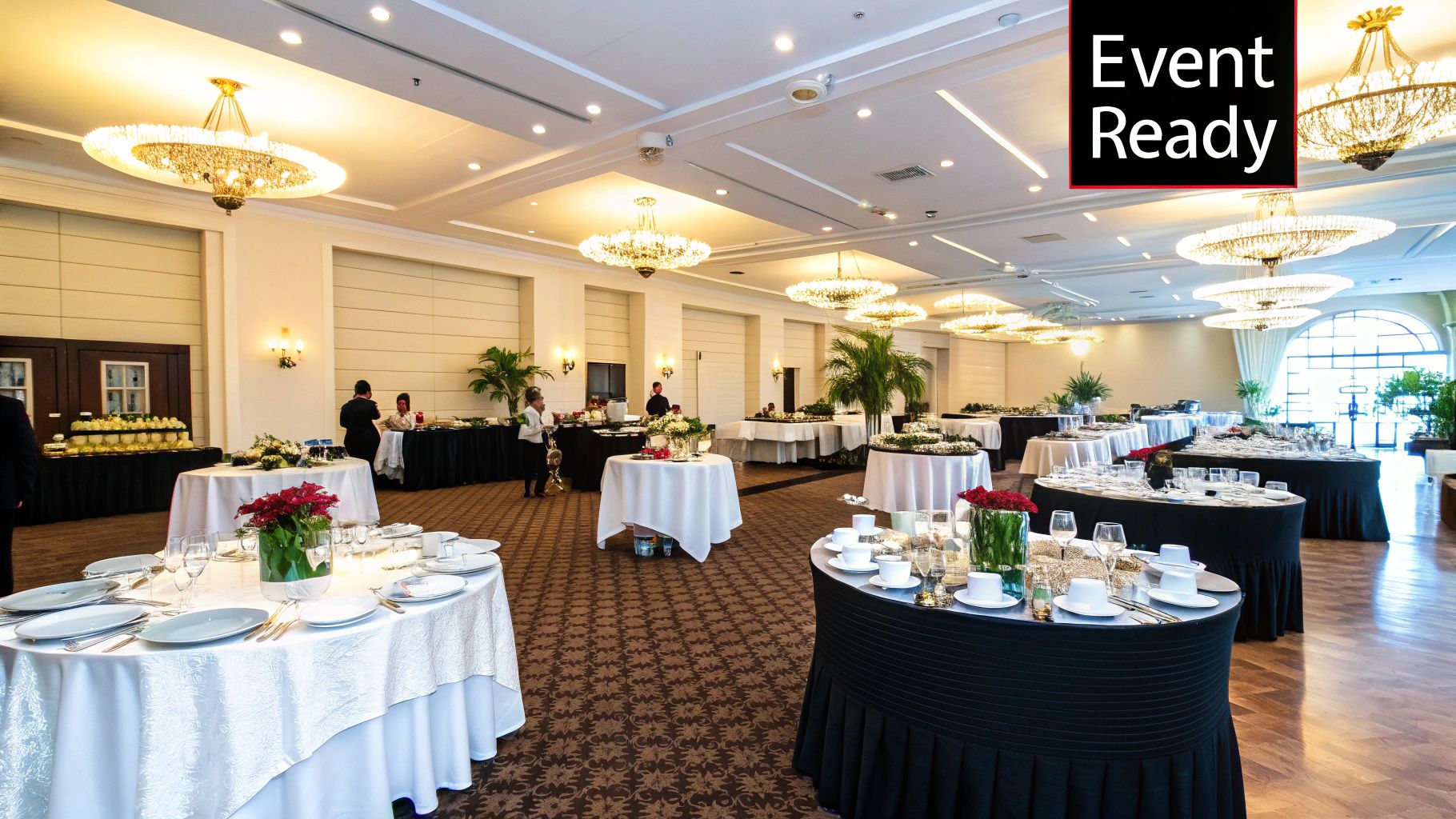
It works across very different events. A wedding in Franschhoek needs elegance. A matric dance needs movement and theatre. A corporate launch in the CBD needs a station that draws people in without slowing service. A good fountain does all three when it’s chosen and run properly.
Why a Chocolate Fountain is Your Event's Secret Weapon
A fountain earns its place because it does more than serve dessert. It creates a point of activity. Guests gather around it, compare dipping choices, take photos, and keep returning through the evening.
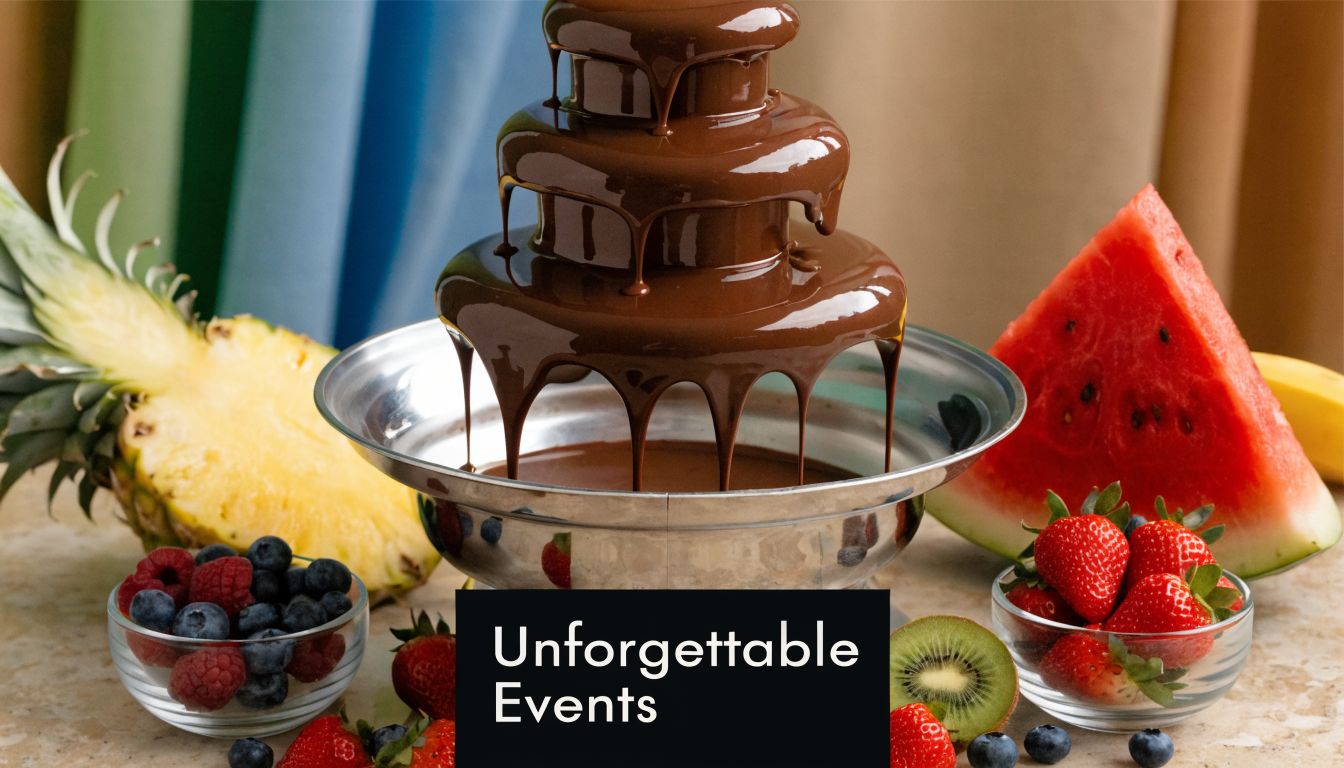
In the Western Cape, that appeal isn’t new. Chocolate fountain machines became a cornerstone of Cape Town’s event scene in the mid-2000s, with adoption rising alongside a 150% surge in luxury event catering demand, and by 2015, 72% of high-end weddings in Stellenbosch and Franschhoek featured interactive chocolate stations according to local catering surveys cited at candy-buffets.co.uk.
It gives guests something to do
Some event features look good but don’t change the atmosphere. A fountain does. People interact with it.
That matters at:
- Weddings where guests need a soft ice-breaker between formal moments
- Corporate functions where people mingle in waves rather than sit for a full plated dessert
- Private celebrations where a host wants a centrepiece without building an entire dessert room
It pairs well with other interactive details
The strongest events usually combine one edible talking point with one personal keepsake or participation element. If you’re already planning a guest experience beyond food, a thoughtful Guest book alternative can complement the same kind of interactive flow without feeling gimmicky.
For more playful dessert-station inspiration, this look at https://www.abchire.co.za/blog/candy-floss-machine-hire/ is useful when you’re deciding whether to build one hero station or combine two.
A fountain works best when it’s treated as part dessert, part entertainment, and part visual anchor.
Why planners still come back to it
The reason planners keep booking fountains is simple. They solve a common event problem. You need one feature that feels generous without overcomplicating service.
A well-run fountain station looks abundant, suits formal and informal events, and gives you flexibility with fruit, baked items, and sweets. That mix is hard to beat.
How a Chocolate Fountain Machine Actually Works
One might look at the falling chocolate and assume the machine is complicated. It isn’t. The core system is straightforward once you break it into parts.
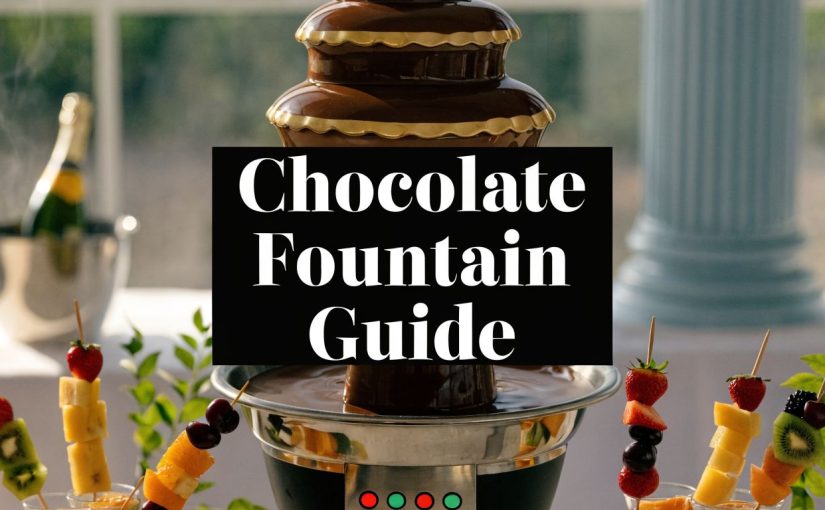
Think of it as a warm chocolate loop. The basin holds melted chocolate, the motor drives an internal auger upward, and the chocolate spills over the top before returning to the base to repeat the cycle.
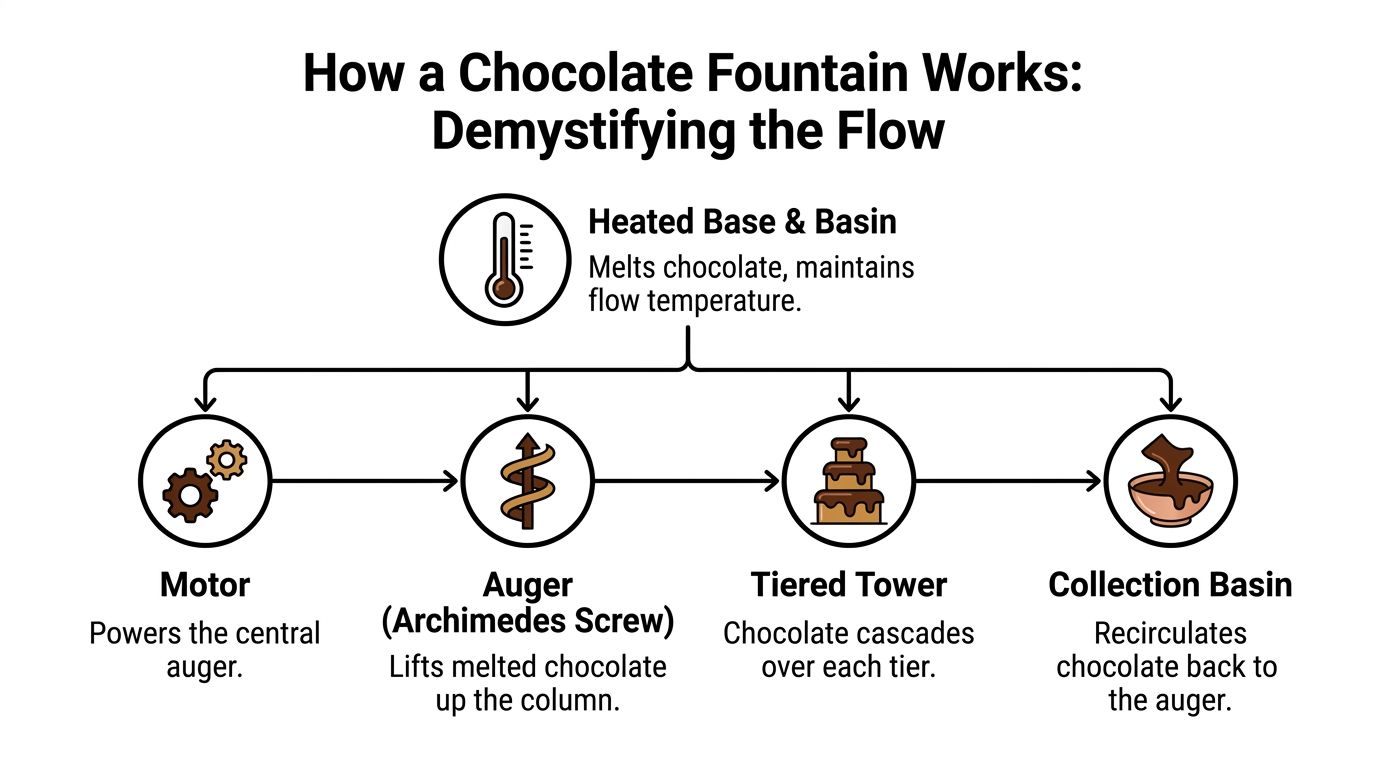
The four parts that matter
Heated base and basin
The chocolate sits and stays fluid. Without steady heat, the whole system fails because the chocolate thickens before it can circulate properly.
Motor
The motor turns the internal lifting mechanism. If the machine is underpowered for the amount of chocolate inside, flow becomes patchy and the unit strains.
Auger
The auger is the key mechanical piece. It’s a spiral shaft, based on the Archimedes screw concept, that carries melted chocolate from the base to the top of the tower.
Tiered tower
Once the chocolate reaches the top, gravity does the rest. It cascades over each tier and returns to the collection basin below.
The fountain doesn’t “pour” chocolate down. It lifts it first, then lets gravity create the curtain effect.
Why chocolate consistency matters
A chocolate fountain machine needs chocolate that stays fluid under heat. If it’s too thick, the auger still pushes it upward, but the curtain won’t form cleanly across the tiers.
That’s why operators pay attention to:
- Heat stability
- Chocolate viscosity
- How quickly the machine was preheated
- Whether the machine is level
Common machine sizes in event use
Different events need different machines. In practical hire use, you’ll usually see:
| Machine style | Best suited to | Practical note |
|---|---|---|
| Small 3-tier units | Intimate private parties | Easier to place on compact buffet tables |
| 4-tier professional units | Weddings, matric dances, corporate events | Better for steady service and stronger visual impact |
| 5-tier commercial units | Larger guest counts and formal setups | More dramatic presence, but need careful placement and setup |
Capacity and service style
Commercial units used in event hire often sit in the middle ground between dramatic enough to draw attention and practical enough to clean and transport. Some models are built for long service windows, while others are better for shorter dessert bursts.
The machine itself is only half the equation. The operator still needs to match the right amount of chocolate, the right temperature, and the right dippables. Get those aligned and the fountain looks effortless. Miss one of them and the machine gets blamed for a chocolate problem.
Renting vs Buying a Fountain for Your Event
This is one of the most common planning decisions, especially for venues, caterers, and private clients who host more than once. A chocolate fountain machine can be rented for a single event or bought outright, but those two choices suit very different needs.
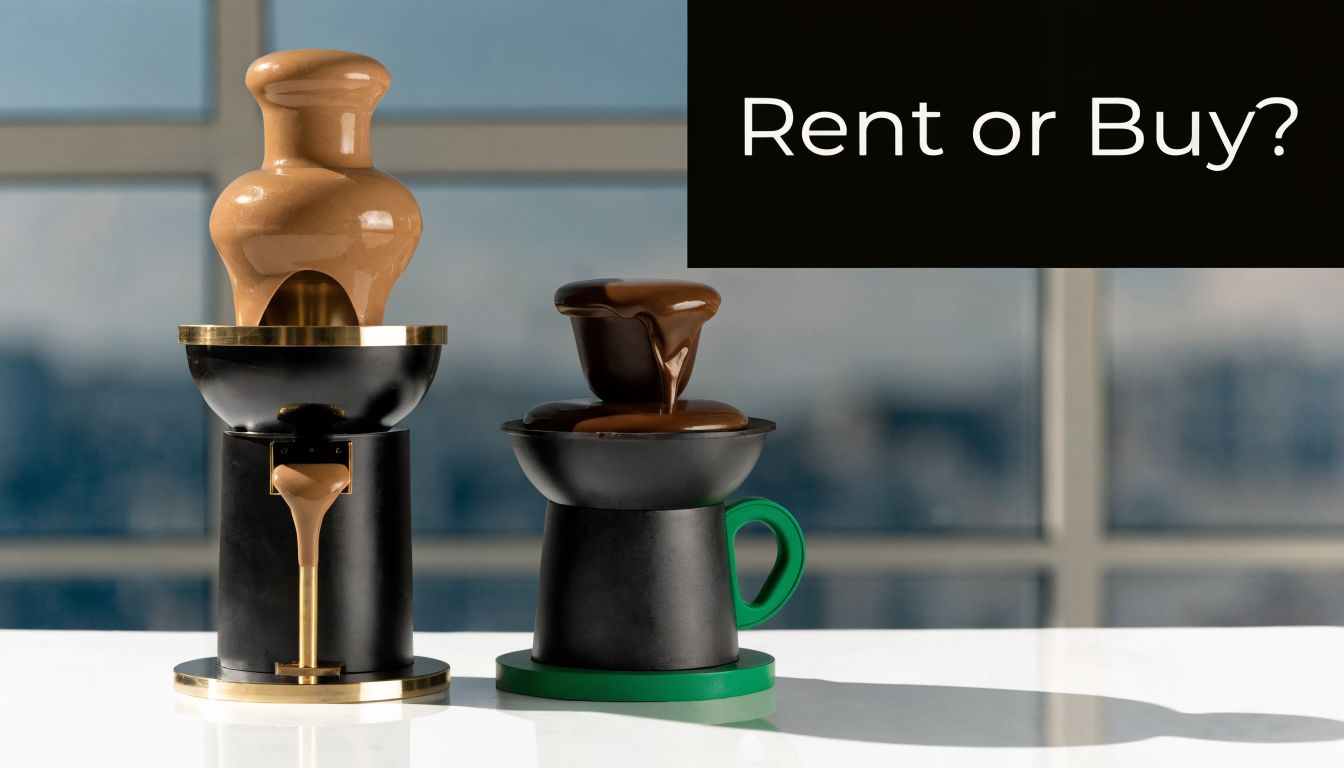
Renting makes sense for most one-off events
For weddings, birthday parties, product launches, and matric functions, renting is usually the cleaner decision. You get a machine that suits the event, you don’t have to store it afterwards, and you avoid the less glamorous side of ownership.
That less glamorous side includes:
- Transporting a food machine safely
- Cleaning chocolate out of all removable parts straight after service
- Storing the unit somewhere dust-free
- Testing it before each use
- Replacing worn parts over time
Buying only works when usage is regular
Ownership becomes reasonable when the same person or business uses the machine often enough to justify maintenance, storage, and staff training. That tends to be a better fit for permanent hospitality operations than occasional hosts.
Here’s the practical comparison:
| Consideration | Renting | Buying |
|---|---|---|
| Upfront cost | Lower immediate commitment | Higher initial spend |
| Storage | No storage after event | You need secure, clean storage |
| Maintenance | Usually handled by hire company | You handle cleaning and upkeep |
| Flexibility | Choose a different size for each event | You’re locked into what you own |
| Risk on event day | Lower if supplier tests equipment well | Entire performance depends on your prep |
If you’re hosting occasionally, buying often feels cheaper only until you factor in transport, setup errors, and cleaning time.
The hidden burden is cleanup
Chocolate fountains look polished during service and messy immediately after. That’s normal. The issue isn’t just wiping the outside. Proper cleanup means dismantling the tiers, auger, and other removable parts while the chocolate is still workable.
If someone waits too long, cleanup becomes a project instead of a quick reset.
Renting also gives you event-fit choice
Rentals offer planners a clear advantage over ownership. A small engagement party and a large corporate activation don’t need the same fountain. Renting lets you scale the machine to the room, the table layout, and the guest flow.
When renting is the practical move
- You’re hosting once or only a few times a year
- You don’t want staff worrying about operation
- You need setup and collection handled professionally
- You want flexibility on machine size
When buying can be justified
- You run recurring events
- You have staff who know food equipment
- You can clean and store the unit properly
- You accept responsibility for event-day troubleshooting
For most Cape Town event clients, renting removes more problems than buying solves.
Selecting the Right Machine for Your Guest List and Venue
A Paarl wedding with 120 guests needs a very different fountain setup from a 30-person birthday in Sea Point. The machine has to suit the pace of service, the table space available, and the venue’s power setup. In Cape Town, heat, wind, and load-shedding can turn a good-looking booking into a messy service point if the machine is chosen on appearance alone.
Start with guest flow, not just headcount.
Two events can have the same number of guests and need different machines. A plated wedding dessert service puts less pressure on the fountain than a corporate launch where people arrive in waves and queue at once. For heavier service, a taller commercial unit with a larger chocolate capacity holds temperature and flow more reliably over several hours. Smaller fountains work well for private homes, baby showers, and compact venues where the fountain is one dessert feature, not the main attraction.
Match size to service style
Ask these questions before confirming the unit:
- Will guests serve themselves throughout the event, or during one short dessert window
- Is the fountain a visual centrepiece or a secondary station
- How long does the service need to run
- Will children, large groups, or high table traffic increase dipping frequency
Those details matter more than a simple “small, medium, or large” choice.
Venue constraints decide more than people expect
I usually look at the table first. If the venue can only offer a narrow or slightly uneven surface, that limits the machine options immediately. A chocolate fountain needs a level, stable base or the curtain runs unevenly and the presentation suffers.
Cape Town and Winelands venues also bring local quirks. Outdoor setups in Stellenbosch or Franschhoek can be beautiful, but wind carries dust and cool evening air affects flow. Indoor venues near the coast often deal with humidity, which can affect surrounding dippables and the general neatness of the station. In tighter city venues, the issue is often access. If staff must carry equipment up stairs, through a service passage, or across a busy function room, a large fountain may be more trouble than value.
Power planning is part of machine selection
A fountain may fit the guest list and still be the wrong choice if the power supply is unstable. That is a real concern in Cape Town. Before confirming a machine, check whether the venue has a reliable plug point near the dessert station, whether extension leads are allowed, and whether the inverter or generator can handle catering equipment without tripping.
For Winelands venues and outer-route properties, I treat backup power as a planning item, not an afterthought. If the venue already runs key service areas on inverter support, choose a fountain that can work comfortably within that setup.
Ask the venue manager one direct question: “What happens at this table if mains power drops during service?”
A practical selection guide
Choose a smaller fountain when
You have a modest guest count, limited table space, or a mixed dessert table where the fountain is only one element.
Choose a larger commercial fountain when
You expect steady traffic, want stronger visual impact, or need the station to run for a long service window without struggling to maintain flow.
Prioritise easy transport and setup when
The venue has stairs, narrow access points, strict setup times, or uneven event flooring.
Prioritise backup power compatibility when
The venue is in a load-shedding-prone area or depends on inverter or generator support during functions.
One more practical point. The fountain should also suit the chocolate style you plan to serve. Visual planning helps here, especially if the station needs to match the rest of the dessert table or event palette. A quick comparison of dark and milk chocolate options can help when deciding how prominent the fountain should be in the room.
The best machine is the one that fits the venue, holds a steady curtain during peak service, and does not create extra work for staff halfway through the event. That is usually what separates a fountain people photograph from one people avoid.
Choosing the Best Chocolate and Dipping Items
The machine gets attention first. The chocolate decides whether guests come back for a second dip. Frequently, event setups misstep, focusing on the fountain hardware and treating the chocolate as a simple grocery item.
It isn’t.
Start with the right chocolate
For event use, couverture chocolate is usually the strongest choice because it’s made for better melt and flow characteristics. It gives you a smoother curtain and a cleaner mouthfeel.
Compound chocolate can work in some settings, but it often doesn’t deliver the same finish. If the event is premium, the difference shows.
A useful visual reference for comparing dark and milk chocolate options can help when you’re building a flavour profile for the station.
Dark, milk, or white
Each creates a different event feel.
| Chocolate type | Best for | Watch out for |
|---|---|---|
| Milk chocolate | Broad guest appeal, family events, corporate functions | Can feel too sweet if all dippables are sugary |
| Dark chocolate | Elegant weddings, adult audiences, richer fruit pairings | Not every guest prefers the intensity |
| White chocolate | Visually striking dessert tables | Usually fussier in flow and heat handling |
Dippables that work consistently
The best dipping items have structure. They should hold on a skewer, survive sitting out, and pair naturally with warm chocolate.
Classic crowd-pleasers
- Strawberries for colour and instant recognition
- Pineapple chunks because the acidity cuts sweetness
- Marshmallows for easy dipping and broad appeal
- Pretzels when you want a sweet-salty contrast
Strong buffet-table performers
- Brownie bites if they’re cut small and kept firm
- Mini doughnuts for a more indulgent station
- Pound cake cubes because they’re neat and hold shape well
Items to use carefully
- Very soft fruit can slip or break apart
- Crumbly pastries make the basin messy quickly
- Wet ingredients can interfere with the chocolate and the station hygiene
A fountain station improves when the dipping menu gets shorter and better, not longer and random.
Build around the event mood
For weddings in the Winelands, fruit-heavy selections usually look cleaner and more refined. For school formals and milestone birthdays, guests often expect marshmallows, brownies, and sweeter bakery items.
A practical mix usually includes:
- something fresh
- something soft
- something crunchy
- one indulgent baked option
Presentation matters more than variety overload
Too many bowls crowd the table and slow guest movement. A tighter, well-styled arrangement looks more generous than an oversized spread with poor organisation.
Keep skewers visible, napkins close, and the most popular items within easy reach. If guests can understand the station at a glance, they use it more confidently and the fountain feels more polished.
Expert Setup and Troubleshooting for a Flawless Flow
A chocolate fountain can look perfect in the prep area and start misbehaving 20 minutes into service. I see it most often at Cape Town weddings and Winelands functions where the setup looked fine, but the table was slightly uneven, the venue had a warm draft from an open door, or the power point was nowhere near the dessert station.
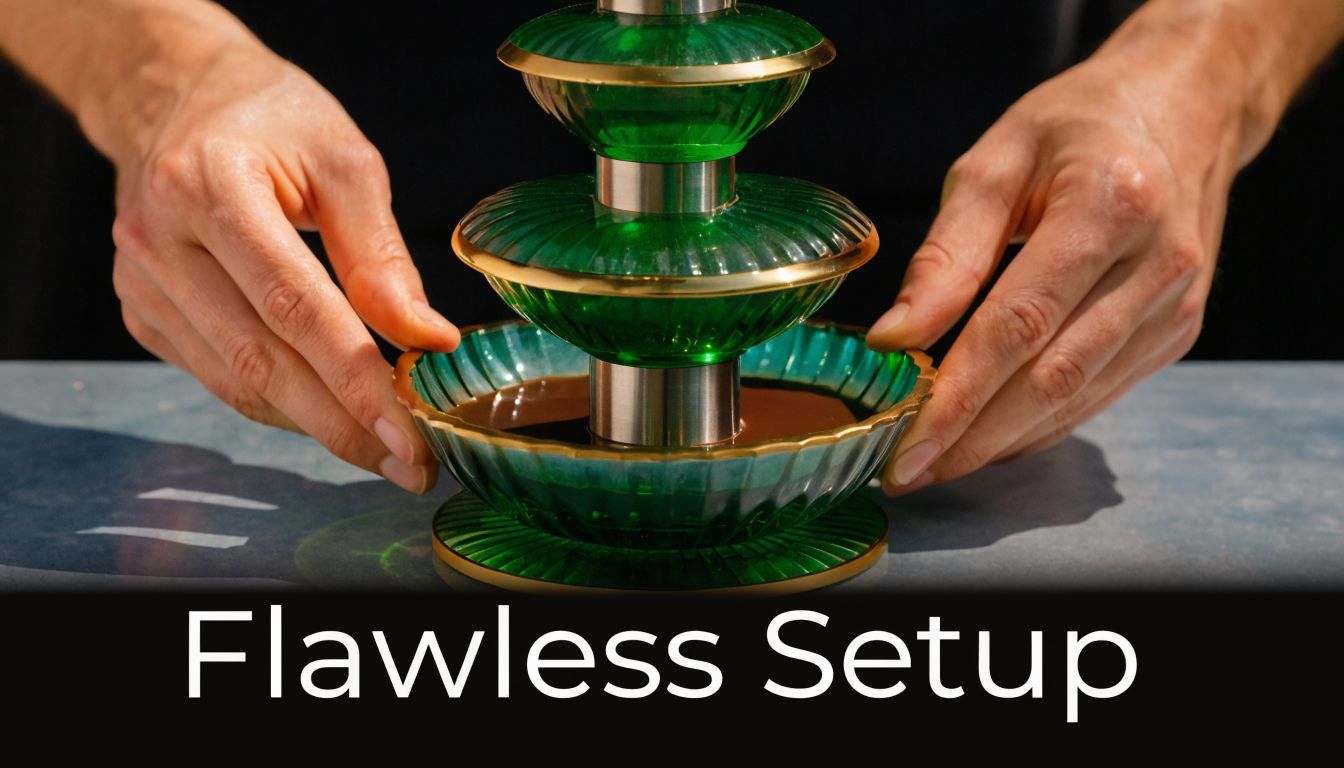
Good flow starts before any chocolate goes into the basin.
Start with the table, power, and room conditions
Put the fountain on a firm, level table with enough space for platters, skewers, napkins, and guest movement. Avoid the edge of the dance floor, the main path to the bar, and any spot near an open window or venue entrance. Even a light breeze can cool the chocolate and disturb the curtain.
Power planning matters more than clients expect. If the venue layout forces a longer cable run, use a safe setup and plan it before decor goes in. This guide to a 20 m extension cord for event equipment is useful when the power point is not close to the dessert station.
Outdoor-adjacent venues in Stellenbosch, Paarl, and Franschhoek need extra care. Dust, afternoon heat, and damp coastal air can all affect performance.
Follow a proper setup order
Commercial fountains generally perform best when they are assembled fully, preheated, and only then filled with prepared chocolate. The heating element needs time to bring the basin up to working temperature. Starting the motor too early with thick chocolate puts unnecessary strain on the auger.
A reliable setup sequence looks like this:
- Assemble the fountain completely and make sure every tier is seated properly.
- Check level from more than one side. A table can look straight and still be slightly off.
- Preheat the machine first before adding chocolate.
- Add melted, ready-to-flow chocolate rather than solid pieces.
- Start the motor only after the basin is warm enough.
- Watch the first cycle closely and correct small issues before guests arrive.
That short testing window saves a lot of stress later.
Level affects everything
An uneven fountain rarely fixes itself once service starts. One side will run thin, the curtain will break, and the return to the base will become inconsistent. Staff often blame the chocolate first, but in practice the table level is one of the main causes.
This shows up often at heritage venues and wine estates where floors are not perfectly flat. A folding table on lawn, paving, or old timber can shift once the machine is filled. Check it again after loading the basin, not only during assembly.
In Cape Town and the Winelands, “bad chocolate” is often a setup problem in disguise.
Handle humidity, heat, and load-shedding properly
Local conditions change how a fountain behaves. Warm, humid weather can thicken the flow or make the finish look dull. At farm venues, dust can get into the basin during long setup periods. At private homes and smaller halls, load-shedding planning is part of the job.
Use a practical approach:
- Keep the fountain away from doors and breezeways
- Store chocolate out of direct sun before setup
- Cover the unit if the room is being reset or cleaned around it
- Run a short test shortly before guest arrival
- Confirm the venue’s power plan in advance, especially if a generator will be used
If the event is scheduled during a risky power window, ask the venue exactly which circuits stay live and whether the dessert area is covered. A fountain is not the item to leave on an uncertain plug point.
Quick fixes for common problems
The chocolate curtain has gaps
Check the level first. Then check heat. If both are correct, the chocolate is probably too thick for the machine.
The flow is slow
The usual causes are underheating, chocolate that is too thick, or starting the motor before the unit was properly warmed. If thinning is necessary, do it cautiously and in small amounts. Too much added oil can hurt the taste and texture.
The machine sounds strained
Stop and inspect the load on the auger. Thick chocolate, poor preheating, or an uneven base are the common reasons. Continuing to run it usually makes the problem worse.
Chocolate is pooling badly in the base
Look for a tilt in the table or a blockage from partially set chocolate. This can happen fast in an air-conditioned room if the fountain sits in direct airflow.
Cleanup needs to happen quickly
Break the unit down while the chocolate is still warm. Stainless steel parts are much easier to clean immediately after service than once the residue has set hard. This is one reason professional crews stay close to the end of service instead of leaving the fountain standing until venue strike.
A fountain that runs well for three hours usually comes down to boring, disciplined prep. Position it properly, level it carefully, test it before doors open, and respect Cape Town conditions instead of treating it like an indoor mall display.
Understanding Rental Costs in Cape Town and the Winelands
Rental pricing confuses people because they compare one number without checking what’s included. A chocolate fountain package is rarely just the machine standing on its own.
What a professional rental usually includes
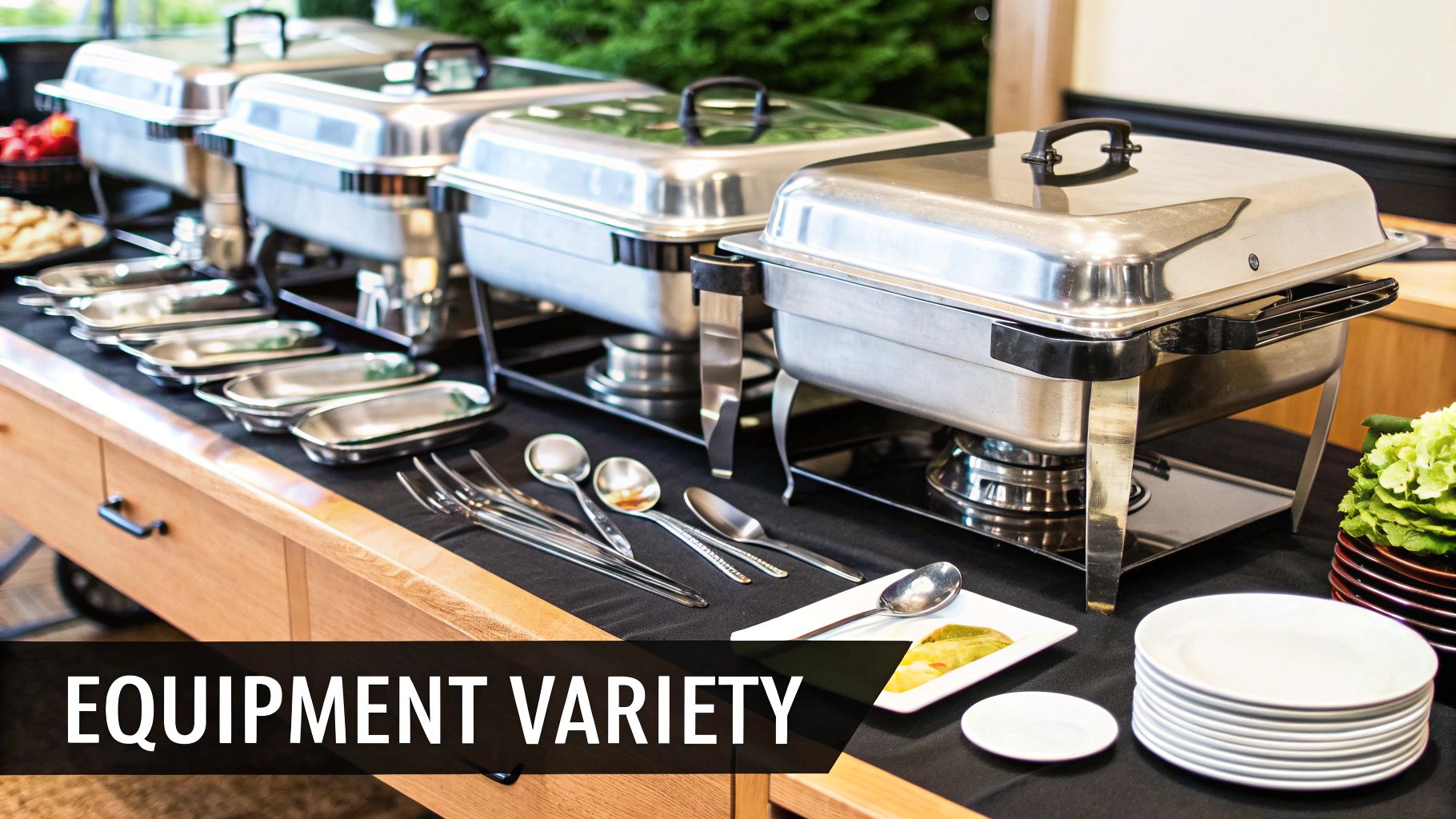
In practice, a proper package often bundles several elements together:
- The fountain machine itself in a size suited to the event
- Chocolate supply based on expected service needs
- Basic service accessories such as skewers and napkins
- Delivery and collection, depending on the location
- Sometimes an attendant, especially for larger or more formal functions
That’s why two quotes can look far apart while offering completely different levels of support.
What pushes the price up or down
A CBD corporate function and a wedding in Franschhoek don’t carry the same logistics. Even if the machine is similar, the event context changes the cost structure.
The main variables are usually:
- Guest count, because it affects chocolate volume and station pressure
- Hire duration, especially for long-running functions
- Travel distance, particularly for Paarl, Franschhoek, and outlying estates
- Staffing requirements, if the station needs active management
- Machine type, because larger or more heavy-duty units involve different handling
What clients should ask before approving a quote
Is chocolate included
Some providers include it. Others price the machine and chocolate separately.
Is setup part of the package
This matters more than many clients realise. A fountain that arrives without proper setup support can cost you time and stress on event day.
Who handles breakdown and cleaning
That changes the real value of the hire.
Is backup power compatibility available
For some venues, that question matters just as much as the dessert selection.
For a wider view of what tends to sit inside a professional food-service rental brief, this guide to https://www.abchire.co.za/blog/catering-equipment-for-hire/ helps frame the broader catering equipment side of event planning.
The cheapest fountain quote often leaves out the labour, delivery detail, or service support that actually makes the station run well.
Budgeting properly
The best way to budget is to treat the fountain as a managed feature, not a standalone object. If you only compare machine price, you miss the primary cost drivers. If you compare setup, staffing, travel, chocolate, and risk reduction, the quote becomes much easier to judge.
That’s how experienced planners assess value.
Frequently Asked Questions from Event Planners
Can I supply my own chocolate
Sometimes, yes. In practice, it’s often a bad idea unless the supplier confirms the chocolate is suitable for fountain use.
The issue isn’t taste alone. Flow, consistency, and heat behaviour matter just as much. A chocolate that tastes great in a slab can perform poorly in a fountain.
How early should I book for wedding season
Book as early as you can once the venue and date are confirmed. Peak Western Cape wedding periods compress supplier availability quickly, especially for feature items tied to catering and dessert service.
If your venue is in the Winelands, don’t leave it until the final weeks. Travel logistics and high-demand dates narrow your options.
What if my guest count changes late
Tell the rental partner immediately. A small increase might only affect chocolate quantity and service layout. A bigger increase can change the recommended machine and the amount of table space needed.
Late guest-count changes are manageable when they’re communicated early enough.
Does the fountain need an attendant
Not always, but larger events usually benefit from one. An attendant keeps the station tidy, monitors flow, tops up dippables, and catches small issues before guests notice them.
For formal events, that extra oversight often improves the whole presentation.
Can the fountain be used outdoors
Only with caution. Outdoor use adds wind, dust, uneven surfaces, and temperature swings. In the Cape Town area, even venues that feel semi-sheltered can expose the machine to air movement that affects flow and hygiene.
Indoor placement is usually the safer choice.
What’s the biggest mistake clients make
They focus on the visual and ignore the operating conditions. A fountain needs the right table, the right power access, the right chocolate, and enough room around it.
When those basics are sorted, the station feels easy. When they aren’t, even a good machine struggles.
If you’re planning a wedding, corporate function, matric dance, or private celebration in Cape Town or the Winelands, ABC Hire can help you choose the right chocolate fountain setup for your venue, guest flow, and power realities. The right machine, properly matched and properly run, turns a dessert station into one of the most memorable parts of the event.