
You don't typically shop for a 3 burner gas braai in isolation. You’re trying to solve an event problem.
A couple is hosting a wedding on a Stellenbosch estate. A corporate team is planning a launch on a rooftop in Cape Town. A school is organising a matric dance with food service outdoors. In each case, the brief sounds simple until the catering details land on your desk. You need steady heat, fast service, less mess, and a setup the venue will allow.
That’s where a 3 burner gas braai earns its place. It gives you proper cooking control without the sprawl of a larger commercial unit. It’s fast enough for live service, clean enough for premium venues, and practical enough for teams that don’t want to manage ash, sparks, or inconsistent heat during guest service.
For planners working across Cape Town and the Winelands, that balance matters. Wind, venue rules, delivery access, and turnaround times all affect whether food service feels polished or chaotic. If you’re hiring across multiple categories, it also helps to look at your broader catering equipment for hire so the braai fits the rest of the service plan instead of becoming an isolated decision.
The Event Planner’s Secret Weapon for Outdoor Catering
A 3 burner gas braai works best when the event needs to feel relaxed, but the execution can’t be left to chance.
At weddings, guests love the theatre of food being cooked fresh outdoors. They don’t love waiting while someone battles with charcoal that won’t settle, smoke that drifts into the seating area, or a temperature swing that ruins the first batch of steaks. Gas fixes that. You open, ignite, preheat, and start working.
Why planners lean on it
Its main value isn’t only the cooking. It’s the predictability.
With a good 3 burner setup, the catering team can run different heat zones at the same time. One side handles searing. Another keeps a gentler grilling temperature. The third can hold cooked items briefly while the next batch goes on. That matters when your menu includes boerewors, burgers, chicken, and vegetarian items that can’t all be treated the same way.
Practical rule: At events, control beats romance. Guests remember hot food served on time more than they remember the fuel source.
Where it fits best
A 3 burner gas braai is particularly useful for:
- Wedding receptions: Outdoor service without the ash and smoke issues that premium venues often dislike.
- Corporate events: Faster setup and easier shutdown when access windows are tight.
- Private celebrations: Enough cooking flexibility for mixed menus without hiring oversized equipment.
- School and campus functions: Simpler supervision and less mess after service.
It isn’t the answer for every event. If you’re feeding a large crowd in a short service window, one unit may not be enough. But for many Cape Town and Winelands functions, it sits in the sweet spot between too small and unnecessarily bulky.
What Makes a 3 Burner Gas Braai Ideal for Events
A good event braai needs three things. Useful capacity, controllable heat, and a layout that supports service instead of slowing it down.
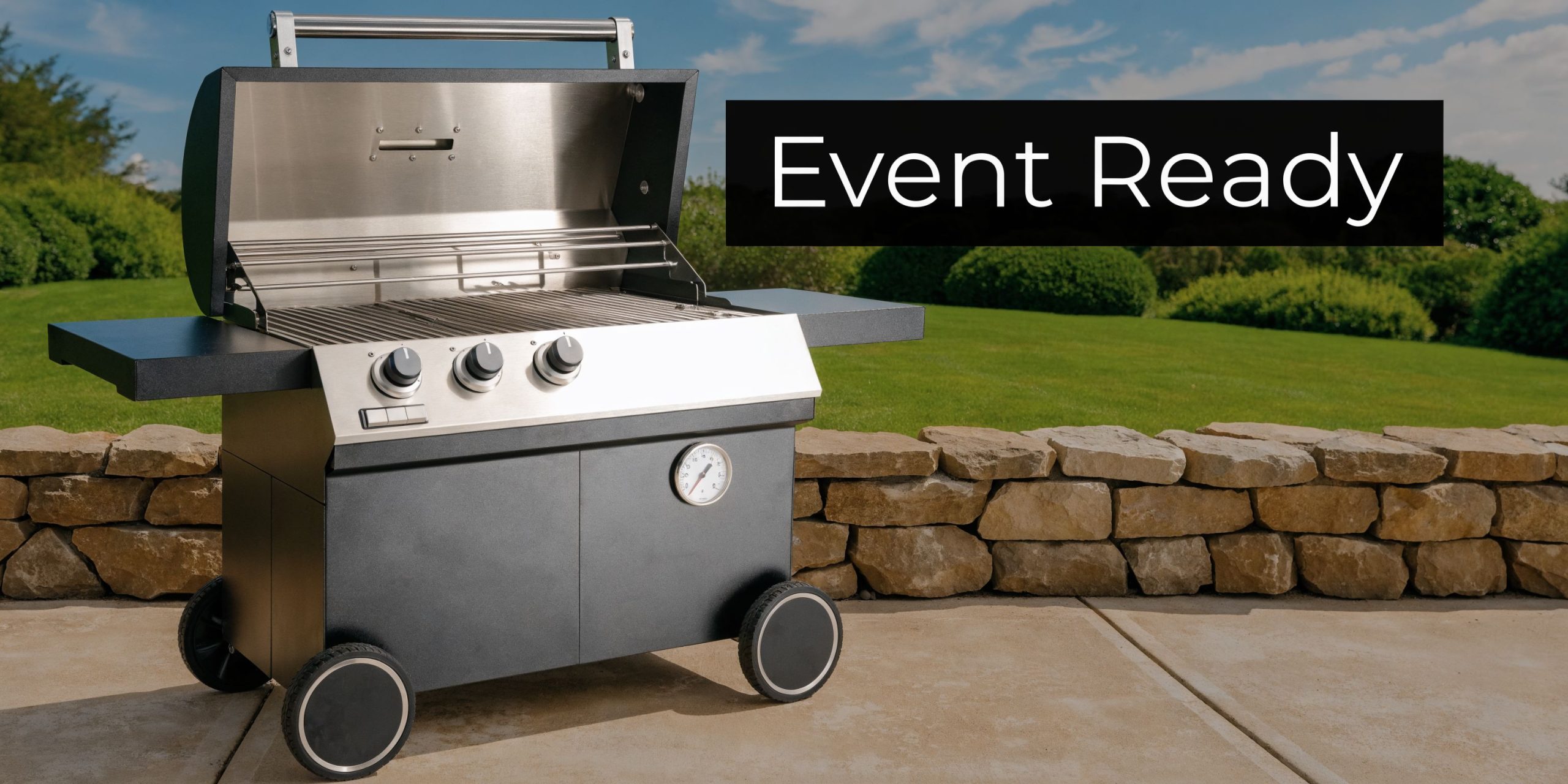
The reason the 3 burner format works so well is simple. It behaves more like a chef’s stovetop than a basic backyard grill. Each burner gives you a separate zone, so you’re not forced to cook everything over one blanket of heat.
The spec range that matters
One useful benchmark in the local market is the Megamaster Crusade Series 3 Burner Patio Gas Braai, which offers 2,763 cm² of primary braaiing space and 40,500 BTUs of total heat output across three stainless steel burners. It’s priced at R5,999.00 including 15% VAT, and that 40,500 BTU level has become a recognised benchmark for 3-burner units in South Africa (The Installer SA product listing).
Those numbers matter because they tell you what a mid-range event-friendly braai can realistically do. It’s enough surface area for proper batch cooking, and enough heat to avoid the sluggish recovery you get when a weak unit loses temperature every time the lid opens.
How the three burners help in service
Use the burners like this:
- High-heat zone: For steaks, burger patties, or anything that needs colour fast.
- Medium zone: For chicken, sosaties, or boerewors that need more controlled cooking.
- Holding zone: For resting cooked food briefly or finishing delicate items.
That setup prevents one of the most common event mistakes. Overcrowding a single hot surface and hoping for the best.
What works and what doesn’t
What works
- Separate heat zones for mixed menus
- Faster response when the guest count rises suddenly
- Cleaner operation on patios, lawns, and estate venues
What doesn’t
- Treating all three burners as permanently full blast
- Loading the grill edge to edge
- Using the braai without assigning one person to manage flow
A 3 burner gas braai performs well when someone is actively running it. It performs badly when it’s left as a self-serve afterthought.
For most event planners, that’s a key appeal. It offers enough capability to cook professionally, without moving into oversized equipment that costs more to transport, place, and supervise.
Gauging Capacity How Many Guests Can You Feed
You feel the pressure on this decision when a wedding planner asks a simple question. Will one braai carry canapes, mains, or late-night food without creating a queue that irritates guests and stretches staff.
The honest answer is that a 3 burner gas braai is a service tool, not a guest-count promise. Output depends on the menu, the serving window, and who is running the grill. A focused menu can move fast on one unit. A mixed menu with steaks, chicken, vegetarian items, and last-minute requests can overwhelm it quickly.
A useful benchmark comes from Weber’s gas grill capacity guidance, which explains cooking space in terms of how many steaks or burgers fit on the grill at once rather than treating grill dimensions as enough on their own (Weber grill size guide). That is the right way to plan an event braai as well. Batch output matters more than the brochure dimensions.
Plan by service window, not by total headcount
For Cape Town and Winelands events, I size a single 3 burner unit around the busiest 30 to 45 minutes of service.
If 60 wedding guests all expect hot food in one short main-course window, one braai can be tight even if the total event is only moderately sized. If 80 corporate guests are eating over a longer lunch period, one braai may be enough because the demand is spread out.
That is the trade-off planners often miss. The problem is rarely the final guest count on the seating plan. The problem is how many plates need to leave the grill at the same time.
A practical way to judge one unit
| Event scenario | One 3 burner gas braai usually works | Add a second unit or another cooking point |
|---|---|---|
| Boerewors rolls or burgers | Yes, if service is staggered and buns, condiments, and sides are handled off the braai | Yes, if the whole group will queue at once |
| Steak or chicken mains | Yes, for smaller groups or plated service with a controlled pass | Yes, for larger tables served in a short window |
| Mixed menu with vegetarian items | Sometimes, if the menu is tightly managed | Usually, to avoid cross-traffic and delays |
| Late-night wedding food | Often a good fit | Add capacity if guests are released from the dance floor all at once |
When one braai is enough
One unit is usually the economical choice when:
- the menu is narrow
- the venue has a separate prep or plating table
- one staff member is dedicated to the braai for the full service period
- guests are served in waves, not in a single rush
This is often the sweet spot for casual wedding meals, staff lunches, and smaller corporate functions.
When one braai starts costing you money
Hiring only one unit can look cheaper on paper, then fail during service.
If the braai becomes the bottleneck, staff overtime rises, guests wait, and the host notices the delay before they notice the rental saving. For premium events, I would rather add controlled capacity than gamble on a single grill running flat out for the whole peak. That is also why planners comparing fuel options often end up reviewing guides like Charcoal vs Gas Grill before deciding how much speed and control they need from the cooking station.
For larger outdoor layouts, some planners also compare a gas unit with more traditional setups such as drum braai stands for event service, especially when they want a dedicated second station for volume rather than theatre.
The simplest rule
Use one 3 burner gas braai for controlled service. Use two when the menu is broad, the service window is short, or the client will judge the event by how fast guests get fed.
Gas vs Charcoal vs Electric Braais for Events
At private homes, fuel choice is often personal. At events, it’s operational.
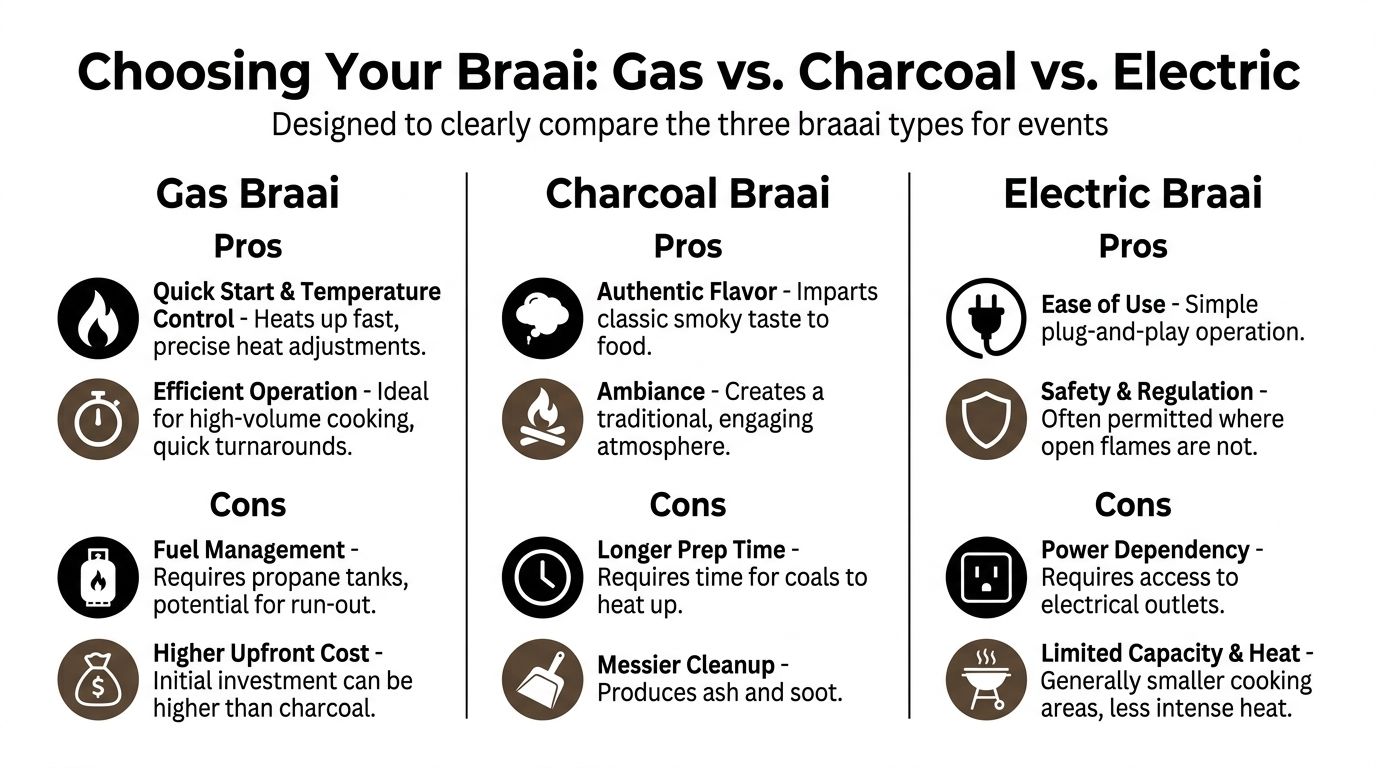
The best option is the one that gives the team dependable service, keeps the venue comfortable, and doesn’t create avoidable risk. For most outdoor event work in Cape Town and the Winelands, a 3 burner gas braai wins because it gives you speed and control without tying you to power or the mess of ash.
The practical differences
South African 3-burner gas braais are commonly built around 9kg LP gas cylinders and consume about 0.85 kg/hour on high, which gives about 10-12 hours of cooking from a full cylinder. The same source notes that stainless steel flame tamers can reduce grease flare-ups by 40% compared to charcoal, while gas remains usable during load-shedding because it doesn’t depend on electrical supply (Origin Series 3-Burner Patio Gas Braai PDF).
That’s why gas is the working choice for event teams. It keeps service moving and removes two common points of failure. Unstable fire management and power dependency.
Event Braai Comparison Gas vs Charcoal vs Electric
| Factor | Gas Braai | Charcoal Braai | Electric Braai |
|---|---|---|---|
| Setup speed | Fast ignition and faster service start | Slower to get cooking-ready | Quick if power access is close and stable |
| Heat control | Strong control through separate burners | More manual adjustment | Generally simple but less efficient for event throughput |
| Venue mess | Cleaner, with less ash and soot | Ash, smoke, and more cleanup pressure | Cleanest surface impact |
| Flavour profile | Good braai flavour with practical consistency | Strong traditional smoky flavour | Mildest flavour profile |
| Event resilience | Works during load-shedding | Works without power, but slower and messier | Fully dependent on electricity |
Where each option still makes sense
Choose gas when the event needs reliable flow, a polished setup, and quick recovery between batches.
Choose charcoal when the venue allows it, the service pace is slower, and the flavour theatre is central to the experience.
Choose electric when open flame isn’t allowed and the menu is modest enough that lower-output cooking won’t become a bottleneck.
If you want a consumer-friendly outside perspective on the broader trade-offs, this breakdown of Charcoal vs Gas Grill is useful. For event planners specifically, the decision usually becomes less emotional once timelines and venue rules enter the room.
For some venue styles, planners also compare alternative braai formats before locking in the final setup. That’s where looking at options such as drum braai stands can help clarify whether you need atmosphere, throughput, or cleaner operational control.
Safe Setup and Placement at Your Venue
At a Cape Town wedding, the braai station often looks fine at 10 a.m. Its true challenge arises at 6 p.m. when the wind picks up, servers start crossing the area, and a guest drags a lounge chair too close to the heat.
That is why placement needs to be planned with service in mind, not decided after the tables are in.
Placement rules that prevent avoidable problems
Start with clearance. Keep the braai well away from draping, floral installations, umbrellas, dry planting, timber screening, and stacked rental stock. Manufacturer guidance for gas grills commonly calls for roughly 91 cm clearance from combustible materials, and practical site work supports that margin because decor shifts during an event and staff need room to work safely (Weber gas grill safety tips).
The ground matters just as much. A 3 burner gas braai should stand on paving, concrete, or another firm level surface. Lawns are risky at wine farms and private estates, especially after irrigation or late-afternoon setup. Wheels sink, the frame tilts, and hot cooking surfaces stop being predictable.
Wind is the other factor planners in the Western Cape cannot ignore. Place the braai so the operator is not taking direct heat and flare-up risk into the body, and so smoke is not pushed into guest seating or the drinks station. If the only available spot is exposed, adjust the layout early instead of forcing the caterer to work in a bad position.
Check the gas connection before anyone tries to light it
I insist on the same routine every time:
- Confirm the cylinder is upright and stable.
- Check that the hose runs cleanly with no kinks, stretching, or rubbing points.
- Open the cylinder slowly.
- Test the connection with soapy water.
- If bubbles appear, close the gas and fix the connection before ignition.
That leak test takes a minute and prevents the sort of last-minute panic that delays service.
Light only after the connection has been checked properly.
Build the braai station into the venue plan
The braai should sit inside a controlled working zone, not in a spare corner. Leave enough room for the cook, prep trays, plated output, and one clear service path in and out. Keep guests out of that lane. Children, photographers, and roaming waiters all drift toward the action if the boundary is vague.
Also check what else is being installed nearby. If the evening setup includes heating, apply the same spacing discipline used for outdoor gas patio heater hire at events. Open-flame equipment needs separation, stable footing, and a layout that still works once the venue fills up.
A safe setup is usually the simplest one on site. Clear access, firm ground, sensible spacing, and no combustible decor close enough to become a problem halfway through service.
Renting a 3 Burner Gas Braai in Cape Town and the Winelands
For many events, renting makes more sense than owning. Not because a 3 burner gas braai is hard to buy, but because event work includes transport, storage, timing, and responsibility after the last guest leaves.
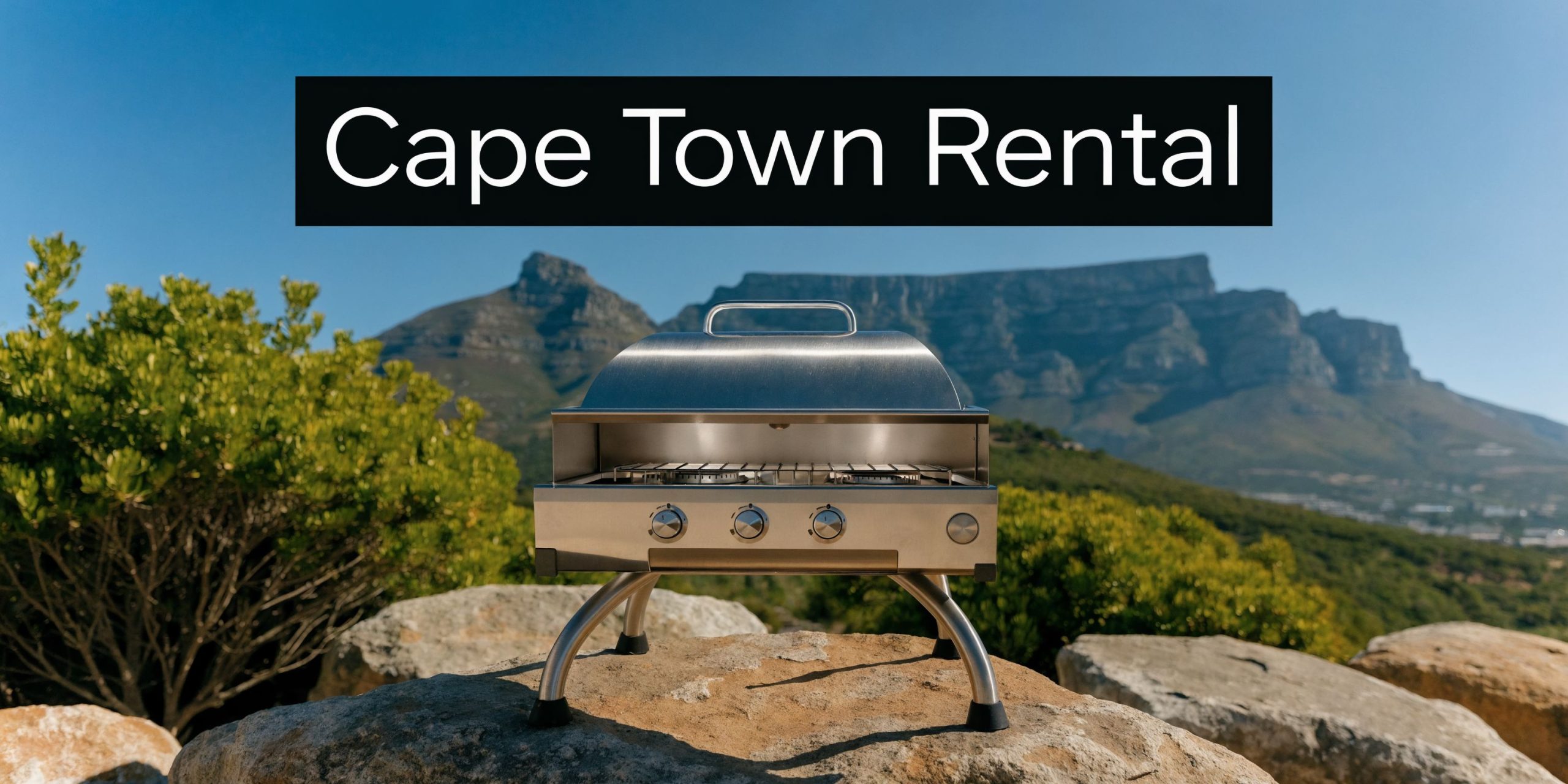
The rental market gives planners flexibility, and that matters in the Western Cape where one week might involve a Franschhoek wedding and the next a short-format corporate activation in the city.
What the numbers say
A useful market snapshot is that the South African event rental market is projected to grow significantly, while 3-burner gas braai rental in Cape Town typically ranges from R500-R800 per day. The same source places purchase cost at about R5,000-R10,000, which makes renting a cost-effective option for one-off weddings and corporate functions, especially once transport and storage for venues in Stellenbosch and Franschhoek are considered (Onlyfire guide to 3-burner gas grills).
That’s the first filter. If you’re not going to use the unit often, ownership usually creates more admin than value.
What to confirm before you book
Ask these questions before paying a deposit:
- What’s included in the day rate? Confirm whether the braai arrives with the regulator, hose, and a gas cylinder or whether gas is billed separately.
- Who handles delivery and collection? Winelands venues can be simple or awkward depending on access hours, stairs, gravel paths, and estate rules.
- What condition must the unit be returned in? Some suppliers expect a scraped grill and shut-down unit. Others handle deeper cleaning themselves.
- What happens if service runs late? Weddings often drift. Make sure pickup timing won’t clash with breakdown.
- Is setup support available? This matters for teams without an experienced braai operator on site.
Rental works best when logistics are the primary issue
Owning sounds economical until you factor in where the braai lives between events, who cleans it properly, and who moves it safely. Rental removes those headaches.
It also lets planners match the equipment to the event. One function might need a compact gas braai for a courtyard. Another might need multiple cooking stations across a larger outdoor footprint.
For occasional event use, the smart question isn’t “Can we buy one?” It’s “Who’s going to transport, store, clean, and check it every time?”
That’s usually where the rental decision gets easy.
Post-Event Essentials for a Smooth Rental Return
The event may be finished, but sloppy shutdown creates the last problem of the day.
A rental braai should go back in a condition that shows the team handled it properly. That doesn’t mean performing a full workshop-level clean on site. It means doing the basics correctly and not handing over a greasy, half-cooled unit with the cylinder still open.
Shut down in the right order
Use a consistent sequence:
- Turn the burners off.
- Close the gas supply.
- Allow the braai to cool properly before moving it.
- Check that no utensils, foil, or food trays are left on warming racks or side shelves.
That sequence reduces confusion during breakdown, especially when multiple suppliers are packing out at the same time.
Do the cleaning that matters
On-site cleaning should be simple and useful.
- Scrape the grids: Remove food residue while the surfaces are still manageable.
- Empty loose debris: Don’t leave scraps and burnt bits inside the firebox area.
- Wipe external surfaces: Grease smears on lids and shelves make a unit look worse than it is.
- Check the drip area: If runoff has collected, don’t send it back untouched.
If your team needs a general refresher on the basics, this guide on how to clean a BBQ grill is a practical reference.
Prepare it for collection
Before pickup, make sure the braai is accessible. Don’t box it in behind stacked tables, décor crates, or furniture waiting for collection.
A smooth return usually comes down to three things:
- Clear shutdown
- Basic cleaning
- Easy access for the driver
Rental suppliers notice the difference. So do planners who want fast repeat bookings and fewer disputes after the event.
Frequently Asked Questions for Event Planners
Can I use a 3 burner gas braai during load-shedding
Yes, gas is often the practical choice when you can’t rely on power. It keeps outdoor catering moving without depending on the venue’s electrical supply, which is one reason many planners prefer it for event service.
How long will a standard gas cylinder last
Most 3-burner gas braais in South Africa are built around a 9kg gas cylinder, which is the common local benchmark. In the local market, that standard is widely used across 3-burner models, including units associated with LPGSA-approved positioning such as the Sizzler 3-burner reference noted on the Pinnacle page (Megamaster Pinnacle Series 3 Burner Patio Gas Braai).
For planning purposes, use the supplier’s fuel guidance for the actual unit hired and build in a margin if the event includes extended service.
What surface should the braai stand on
A level, stable, non-fragile surface is best. Paving and solid patios are easiest. Firm ground can work if the unit won’t shift. Avoid unstable placement near décor, draping, or guest circulation.
Is one 3 burner gas braai enough for a wedding
Sometimes yes, sometimes no. It depends on menu complexity, service timing, and whether food is plated in waves or served all at once. Focus on service flow, not just the presence of a single braai.
Should I rent or buy for a once-off function
For one-off weddings, private events, and occasional corporate functions, renting is usually simpler. It removes storage, transport, and maintenance from your job list.
What should I check when the unit arrives
Look at the hose, regulator, grill condition, wheel stability, and general cleanliness. Confirm what’s included, where it will stand, and who is responsible for operation during service.
If you’re planning an outdoor event in Cape Town, Stellenbosch, Franschhoek, Paarl, or the surrounding areas, ABC Hire can help you pull the full setup together. From event furniture and LED pieces to practical hire items that support smooth service, they’re a reliable local partner for weddings, corporate functions, and private celebrations.