Rent water cooler: rent water cooler for events

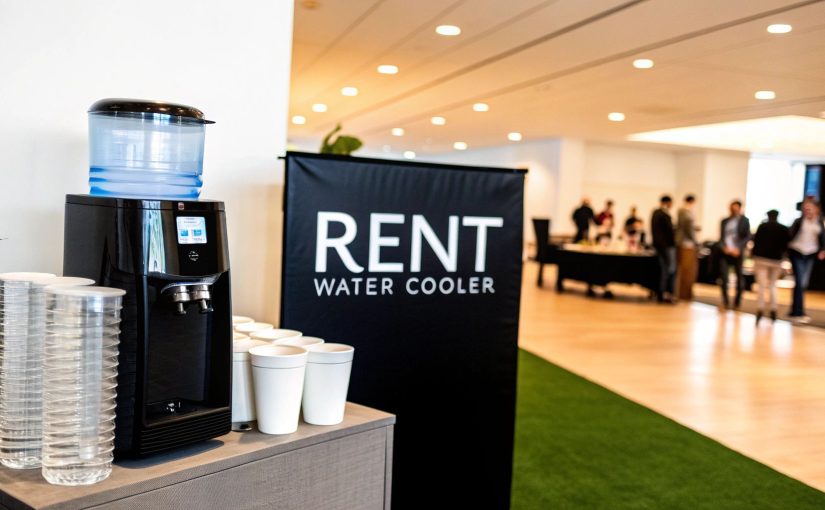
Renting a water cooler for your event isn't just a small detail; it's a savvy move that makes a huge difference to your guests' comfort and cuts down on your own event-day stress. It's the smart, green, and budget-friendly alternative to stacks of single-use plastic bottles, offering convenient, high-quality hydration whether you're planning a wedding, a corporate day, or a festival.

Why Smart Event Planners Rent Water Coolers

Keeping your guests happy and hydrated is fundamental to a great event, from a sun-drenched wedding in Stellenbosch to a slick corporate launch in the heart of Cape Town. Choosing to rent a water cooler is more than just a practical decision—it’s a strategic one. It instantly shows you care about your attendees, giving them easy access to fresh, cool water whenever they need it.

This simple touch stops people from getting thirsty and uncomfortable, which has a direct impact on how much they enjoy the day you've planned.

Taking Care of Your Guests

A well-placed water station is more than just a tap; it becomes a welcome spot for a quick refresh. It helps avoid long queues at the bar just for a glass of water and promotes a healthier, more inclusive vibe. For you, the planner, this means happier guests who are more likely to stick around longer and really get into the spirit of the event.

Deciding to rent isn't just about providing water. It's about showing you've thought through every detail to create a professional, considerate experience. You've anticipated your guests' needs before they even had to ask.

A Sustainable and Wallet-Friendly Choice

Beyond keeping everyone comfortable, renting is a fantastic choice for the environment. It dramatically reduces the plastic waste from hundreds of individual water bottles, helping your event meet modern sustainability standards.

Financially, it’s a no-brainer. In South Africa's vibrant event industry, this has become a go-to, cost-effective solution. The numbers back it up: the local water dispenser market was valued at USD 19.8 million in 2023 and is expected to climb to USD 32.1 million by 2030. This clearly shows a growing preference for professional hydration setups.

You get to skip the hassle of buying, transporting, and storing bulky equipment. To get a full picture of the different options and services available, it's worth exploring dedicated water dispenser cooler rentals.

Right, let's get you sorted. Choosing the right water cooler isn't just a tick-box exercise; it's about making sure your guests are comfortable and the event runs smoothly. The venue itself will usually point you in the right direction, but it really comes down to a simple choice: do you need flexibility or an endless supply?

Your first option is the classic bottled water cooler. We’ve all seen them, and for good reason – they are the champions of versatility.

These are completely self-contained units. All you need is a standard plug point, and you're good to go. This makes them the perfect solution for venues where hooking up to a water pipe just isn't an option. Think of a beautiful marquee wedding in a Franschhoek vineyard, a corporate family day on a remote field, or a beach party on the West Coast. Their biggest advantage is that you can put them exactly where you need them most, no strings (or pipes) attached.
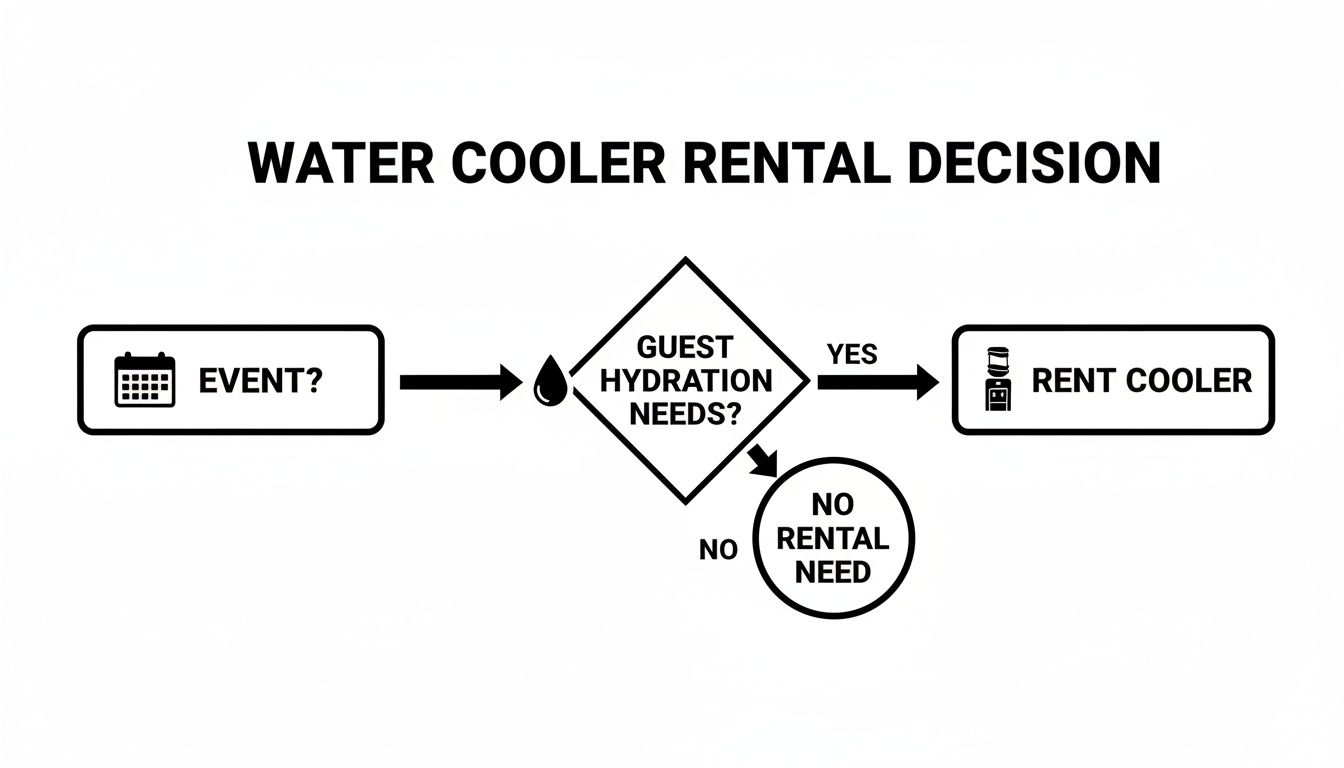
Flowchart illustrating the water cooler rental decision process for an event based on guest hydration needs.

This flowchart breaks it down nicely. It shows that once you've decided your guests need easy access to water, the next steps are pretty straightforward. The main goal is always to keep everyone hydrated without a fuss.

Plumbed-In Coolers for Fixed Venues

On the other hand, you've got plumbed-in units, sometimes called bottleless coolers. These are fantastic because they offer an endless supply of filtered water on tap.

These systems connect straight into the venue's main water line. That makes them a brilliant choice for established locations with the right infrastructure, like conference centres, hotels, and corporate offices in and around Cape Town.

The main benefit here is peace of mind. You never have to worry about the water running out or having someone swap a heavy bottle in the middle of a presentation. It’s a set-and-forget solution, which is ideal for multi-day conferences or large exhibitions where you need a constant, reliable supply.

The bottom line is simple: bottled coolers bring the water to you, wherever you are. Plumbed-in coolers give you a non-stop flow, but only if the plumbing is there to support it. Your venue really makes the decision for you.

When you're thinking it over, don't forget the little details. For example, looking into water coolers with filter systems is a great touch. It guarantees top-quality water with a great taste, something your guests will definitely notice and appreciate.

Bottled vs Plumbed-In Water Coolers for Your Event

To make things even clearer, here's a quick comparison to help you decide which water cooler is the best fit for your event's specific needs.

Feature Bottled Water Cooler Plumbed-In (Bottleless) Cooler
Best For Outdoor events, marquees, remote locations, venues with no water access. Conference centres, corporate offices, hotels, indoor venues with plumbing.
Setup Needs Standard electrical plug socket. Nearby water line and a standard electrical plug socket.
Water Supply Limited to bottle capacity (typically 20 litres per bottle). Continuous, uninterrupted flow of filtered water.
Flexibility High. Can be placed anywhere with access to power. Low. Placement is restricted by proximity to water pipes.

As you can see, for temporary setups where you're also juggling other rentals, like finding the right mobile fridge hire for your event, the sheer flexibility of bottled coolers is hard to beat. They just work perfectly with the pop-up, dynamic nature of most events we see across the Western Cape.

How to Accurately Estimate Your Water Needs

Running out of water halfway through an event? That's a nightmare scenario every planner dreads. Fortunately, you don't have to rely on pure guesswork. By looking at a few key details about your event, you can get a solid estimate and make sure no one goes thirsty.

A great place to start is the 500ml per guest, per hour rule. Think of this as your baseline. From here, you'll need to tweak the numbers based on what’s actually happening on the day. An indoor, air-conditioned workshop has completely different hydration needs than a summer wedding in the Winelands.
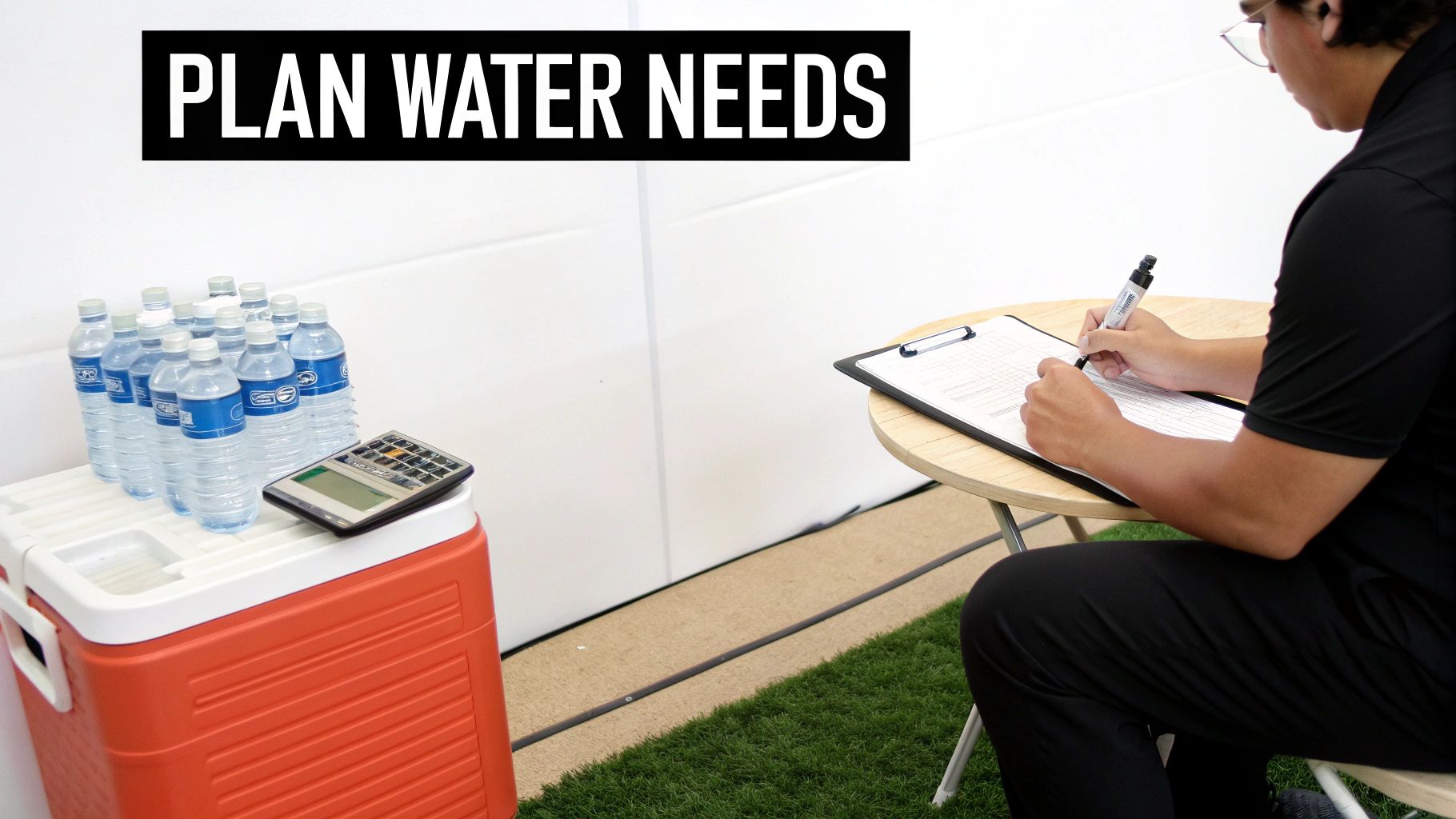
A person plans water needs by writing on a clipboard next to a cooler with bottles.

Factors That Increase Water Consumption

There are a few things that will have your guests reaching for a cup of water more often. Always factor these in before you finalise your order.

  • Time of Year: A hot summer event in Stellenbosch or Paarl will require way more water than a cool winter gathering. High temperatures and direct sun mean people will naturally drink more.
  • Event Type: A high-energy festival or a wedding with a packed dance floor will see guests hydrating constantly. Compare that to a seated conference, where consumption will be much lower.
  • Menu Choices: Serving salty canapés, spicy snacks, or a big braai? You can bet people will be thirsty. The same goes for events with alcohol—it's always a good idea to have plenty of water on hand to help guests stay hydrated.

Let's put this into practice. Imagine you're planning a four-hour wedding for 150 guests on a warm day.

Using the baseline formula, you'd calculate: 150 guests x 0.5 litres x 4 hours = 300 litres.
Since our standard large water bottles hold 20 litres, you'd need at least 15 bottles. Simple as that.

Why You Should Always Order a Buffer

Even with the best calculations, it's always smart to have a little extra. Life happens. A sudden heatwave could roll in, or the party might run a bit longer than planned, and your supply can vanish faster than you expected.

As a rule of thumb, add an extra 15-20% to your final number. For our 15-bottle wedding example, that means ordering another two or three bottles, bringing your total to 17 or 18.

This small extra cost buys you incredible peace of mind. It guarantees that the last guest to leave can still grab a cool, refreshing drink. Having a solid plan is what separates good events from great ones; check out our event planning checklist template for more tips on staying organised. This little bit of over-ordering is a detail that makes a huge difference to your guests' experience, showing you’ve thought of everything.

Strategic Placement for Seamless Guest Access

A water cooler is only as good as its location. Let's be honest, if your guests can't find it easily, it might as well not be there. Thoughtful placement is what transforms a simple rental into a seamless part of your event, making sure hydration is effortless and intuitive for everyone.

Before you start dreaming up the perfect spot, have a chat with your venue. You need to know exactly where the plug sockets are and how much floor space you actually have to work with. This quick check saves you from those last-minute setup day surprises, like finding the ideal spot is miles away from a power source.
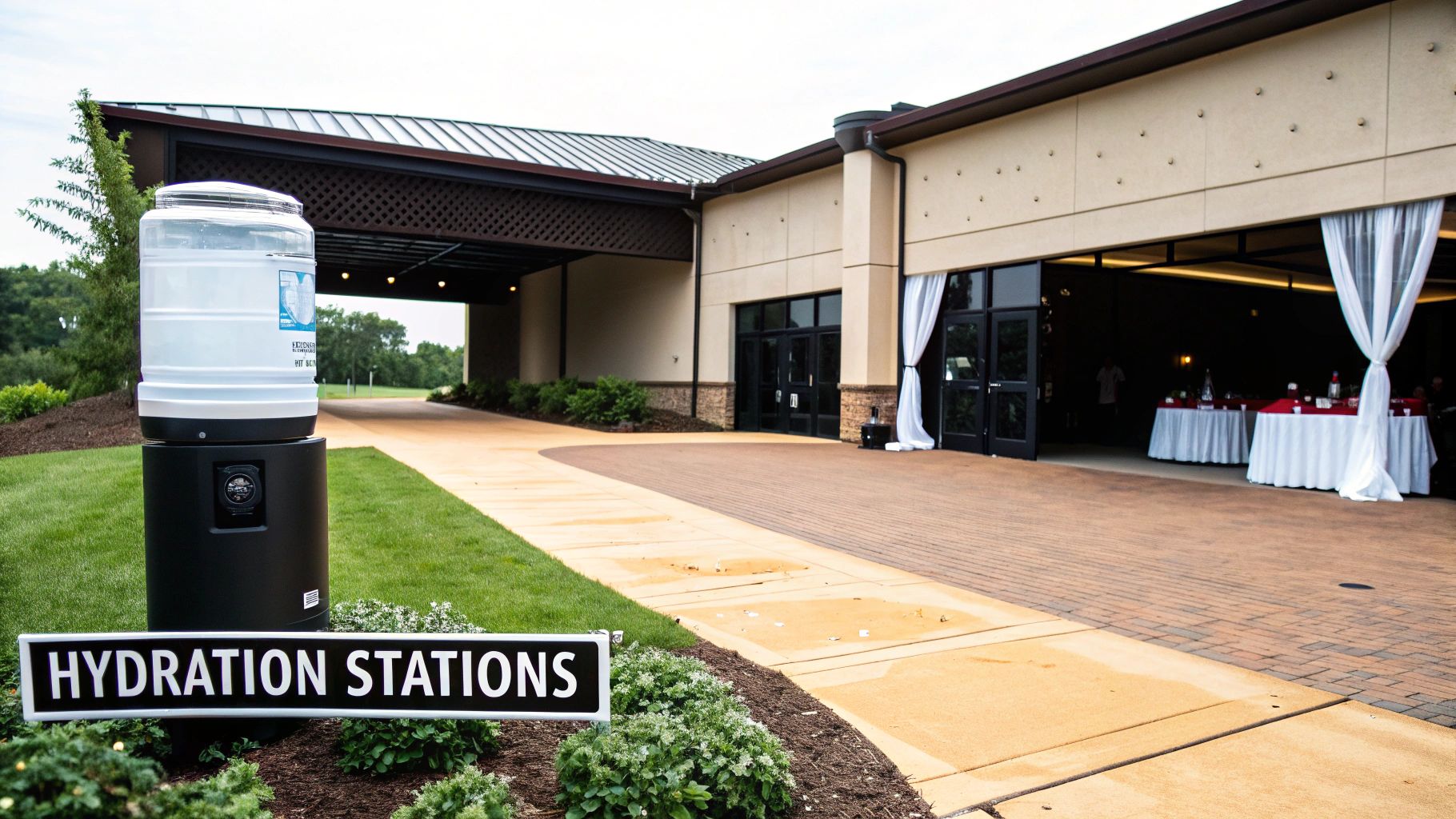
A hydration station water cooler on grass next to a path leading to an outdoor event venue.

Identifying High-Traffic Hotspots

Once you've got the practical details sorted, think about how your guests will move around the space. The goal is to place coolers in natural gathering points and along busy routes without creating a bottleneck.

Think about where people will naturally end up or pass by frequently.

  • Near Entrances and Exits: A cooler here is perfect for offering a refreshing welcome drink as guests arrive and a final sip of water before they head home.
  • Adjacent to the Dance Floor: This is an absolute must for weddings and parties. A station nearby means guests can rehydrate quickly without missing out on the fun.
  • Close to Buffet or Food Stations: Putting a cooler near the food is always a smart move, especially if you’re serving salty or spicy dishes that will have people looking for a drink.

Pro Tip: Whatever you do, avoid shoving a water cooler into a tight corner or a narrow hallway. You're aiming to create an open, inviting hydration station, not a frustrating queue that blocks a walkway.

Logistics and Professional Coordination

This is where coordinating with your rental company really pays off. Think about large-scale operations, like the multi-unit setups detailed by the CSIR for their Western Cape offices; they require a precise delivery schedule to ensure everything runs smoothly. While your event might not be an entire office block, the principle is the same. For more on this, you can read about the logistical demands of multi-unit water dispenser setups.

When you partner with a hire company, they handle the heavy lifting—installation, maintenance, the lot—so you can focus on your event.

Make sure you confirm your delivery and setup times well in advance. Ideally, you want the coolers installed and tested before the first guest even thinks about arriving. This also gives your team a chance to get comfortable with how to change a bottle if it runs out.

Finally, think about accessibility for everyone. Make sure at least one station is positioned in an area that’s easy to reach for guests with mobility challenges. When you rent a water cooler, it’s these small details in placement and planning that make a huge difference. It turns a simple utility into a thoughtful touch that really elevates the whole guest experience.

Getting to Grips with Rental Costs and Bookings

Every successful event starts with a clear budget. When it comes to hiring a water cooler, understanding the costs upfront means no nasty surprises, letting you manage your money with confidence. The whole process is pretty straightforward, but knowing what you’re looking at on a quote makes all the difference.

Most quotes are built from a few key parts. First up is the unit rental fee—that’s the base cost for the cooler itself. Then, you'll have the cost of the water, which is usually priced per 20-litre bottle. These two are the heart of your rental cost.

But there are a couple of other things you'll likely see on the bill.

What to Expect on Your Quote

Your final invoice will usually include a few standard charges that cover the logistics of getting the gear to your venue and back again. It's best to see these not as hidden extras, but as part of the service that makes it all happen.

  • Delivery and Collection Fees: This covers the transport to and from your venue, whether you're in Cape Town, Stellenbosch, or Paarl. The price is typically based on how far our team has to travel.
  • Optional Extras: This is where you can add handy things like disposable cups, cup dispensers, or even branded sleeves if you want to tie everything into your event's theme.

Let's paint a picture with a couple of real-world scenarios. Say you're running a small, one-day corporate workshop for 50 guests. You'd likely need one cooler and about three water bottles. Your quote will be simple, mostly covering the unit, water, and delivery.

Now, imagine a weekend-long wedding for 200 guests. That’s a different story. You'll need several coolers and a much larger water order—maybe 20 bottles or more. This is where getting a detailed quote is absolutely essential for keeping your budget on track. For more tips on kitting out your event, checking out options for catering equipment for hire can give you a bigger picture of what’s needed.

A good, transparent quote should list every single item clearly. Never be shy to ask your rental company to talk you through it line by line. You should know exactly what you’re paying for.

Smart Booking Timelines for a Stress-Free Event

In event planning, timing is everything, and hiring your water coolers is no different. Nailing the timing means you're guaranteed to get what you need, avoiding that last-minute scramble, especially during the crazy summer season here in the Western Cape.

For any event happening during peak season—think November to March—it's smart to book your water coolers at least 3 to 4 months in advance. This is especially true for popular wedding spots in the Winelands, where demand for all rental equipment goes through the roof.

If you’re planning something in the off-season or a smaller corporate function, you can usually get away with a shorter lead time of 4 to 6 weeks. But honestly, the best move is always to book as soon as your date and venue are locked in. It secures your equipment and is one less thing to worry about as the big day gets closer. It’s a simple step that makes a world of difference.

Common Questions About Renting Water Coolers

Even when you've got a solid plan, a few questions always pop up as you finalise the details. You want to be completely sure about the little things when you decide to rent a water cooler. Here, we tackle some of the most common queries we get from event planners, giving you clear, straightforward answers to help you lock in your hydration strategy with total confidence.

This is about making sure every part of your event runs smoothly, from the first guest arriving to the last one leaving.

How Far Ahead Should I Book for Peak Season?

This is probably the number one question we get, especially for anyone planning a wedding in the beautiful Cape Winelands. The short answer? As early as you possibly can.

For events during the peak summer season—that’s typically November to March—we strongly suggest booking your water coolers 3-4 months in advance. This time of year sees a huge demand for all event rentals in Stellenbosch, Franschhoek, and Paarl. Booking early doesn't just guarantee you get the units you need; it also secures your delivery slot and gets a big item off your to-do list.

For corporate events or private parties in the cooler, off-season months, a lead time of 4-6 weeks is generally fine. But the golden rule is always this: book as soon as your venue and date are confirmed. It’s a simple step that saves you from any last-minute stress.

What Happens If We Run Out of Water?

The thought of running out of water mid-celebration is a common worry, but it’s one we can easily avoid with a bit of smart planning. Our whole estimation process is designed to prevent this exact scenario.

We always advise clients to have an extra one or two 20-litre bottles on top of what you think you'll need. This is your buffer. It’s especially crucial for outdoor events, summer weddings, or any function with lots of activity. Think of it as your on-site insurance policy.

Having those extra bottles stored discreetly on-site provides complete peace of mind. It ensures your hydration station stays fully stocked, no matter what, as same-day emergency deliveries are not always possible.

Are the Coolers Properly Sanitised?

Absolutely. Hygiene is non-negotiable for us. Every single water cooler undergoes a rigorous cleaning and sanitisation process after it returns from an event. We stick to strict health and safety protocols to make sure each machine is in pristine, ready-to-use condition for you.

And the water itself is completely protected. Each 20-litre bottle is sealed right at the source, guaranteeing the water inside is pure, fresh, and untouched until you need it. You can be certain that both the equipment and the water you serve are perfectly safe for every one of your guests.

Do You Deliver Outside Central Cape Town?

Yes, we certainly do. Our service area is designed to cover the key event hubs across the Western Cape. We regularly deliver to clients throughout the Cape Town metro, including the Northern and Southern Suburbs.

Our delivery network also extends deep into the Winelands. We cater to popular event destinations including:

  • Stellenbosch
  • Franschhoek
  • Paarl
  • Somerset West

Delivery and collection fees are simply based on the distance from our depot to your venue. When you ask for a quote, just give us the full address, and we'll include a clear, itemised transport fee so you see the full cost upfront. No surprises on your final invoice.


Ready to make sure your guests stay happy and hydrated? At ABC Hire, we provide reliable and convenient water cooler rental solutions for events across Cape Town and the Winelands. Get in touch with us today for a personalised quote!
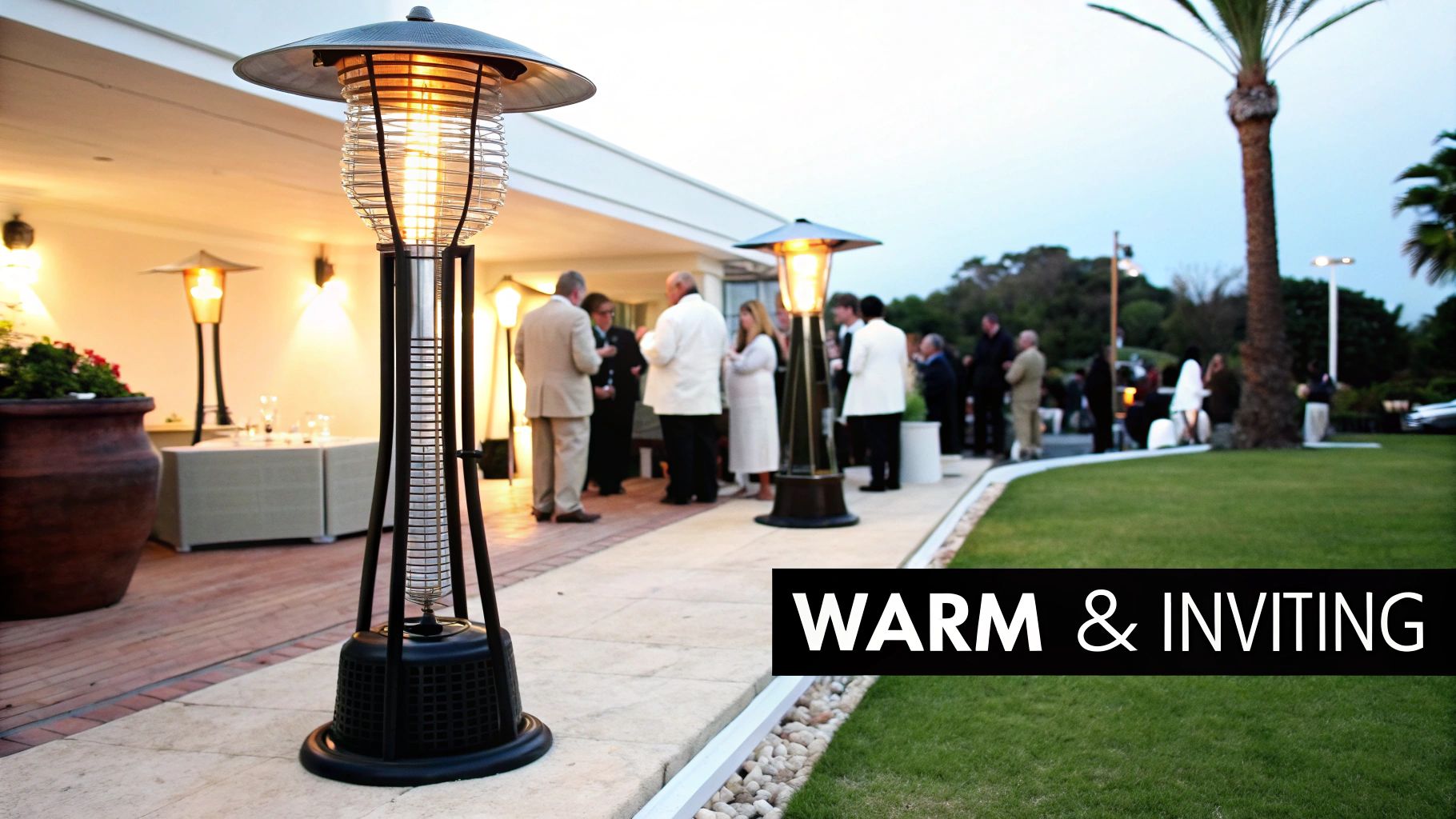
Gas Outdoor Heater Event Planning Guide

If you're planning an outdoor event in Cape Town, you already know you have to be ready for its famously unpredictable weather. A gas outdoor heater is your secret weapon for making sure guests are comfortable, turning what could be a chilly evening into a warm, memorable atmosphere. This guide is built specifically for event planners, walking you through everything from picking the right heater to mastering placement and safety.

Keeping Your Cape Town Event Warm And Inviting

Part of Cape Town’s charm is its incredible outdoor venues, but we all know the weather can turn on a dime. As an event planner, guest comfort is everything. A sudden drop in temperature can kill the mood faster than anything else.

That's where a strategically placed gas outdoor heater comes in. It’s more than just an appliance; it's a tool for creating a consistently welcoming vibe. It allows you to stretch the usable hours of a venue, making sure your event continues seamlessly long after the sun goes down.

A gas outdoor heater warming up an elegant outdoor event space at night

The real goal here is to turn a potential problem—a cold evening—into a feature of comfort and luxury. By creating pockets of warmth, you encourage guests to mingle, relax, and actually enjoy the experience you’ve worked so hard to create. Think of these heaters as functional decor that radiates pure hospitality.

Why Gas Heaters Are an Event Staple

Their popularity isn't just a local trend. It reflects a global preference for reliable outdoor comfort. In fact, the worldwide market for outdoor heating, where gas heaters are a massive component, was valued at around $6.0 billion and is expected to hit $8.86 billion by 2032. That kind of growth shows a real, sustained confidence in this technology's ability to deliver.

This guide is your complete playbook, focusing on the practical knowledge you actually need as an event planner. We'll cover:

  • How They Work: Get a simple breakdown of how a gas outdoor heater creates instant, targeted warmth.
  • Choosing the Right Model: Figure out which heater styles will best suit your event's look and layout.
  • Calculating Coverage: Master the art of knowing exactly how many units you need for perfect comfort.
  • Safety and Placement: Learn the essential protocols to ensure a secure and smooth experience for everyone.

By mastering the use of a gas outdoor heater, you're not just fighting the cold; you're actively designing a more inviting and enjoyable guest experience from start to finish.

Whether you're planning a wedding under a clear marquee or a corporate function on an open-air terrace, this is crucial info. Often, these setups are paired with other hired structures, and knowing how to integrate heating is key. For more tips on creating covered spaces, have a look at our guide on gazebo hire in Cape Town to see how all the pieces can work together.

From selecting the perfect heater to ensuring it runs flawlessly on the day, we’re here to help you succeed.

How a Gas Outdoor Heater Actually Works

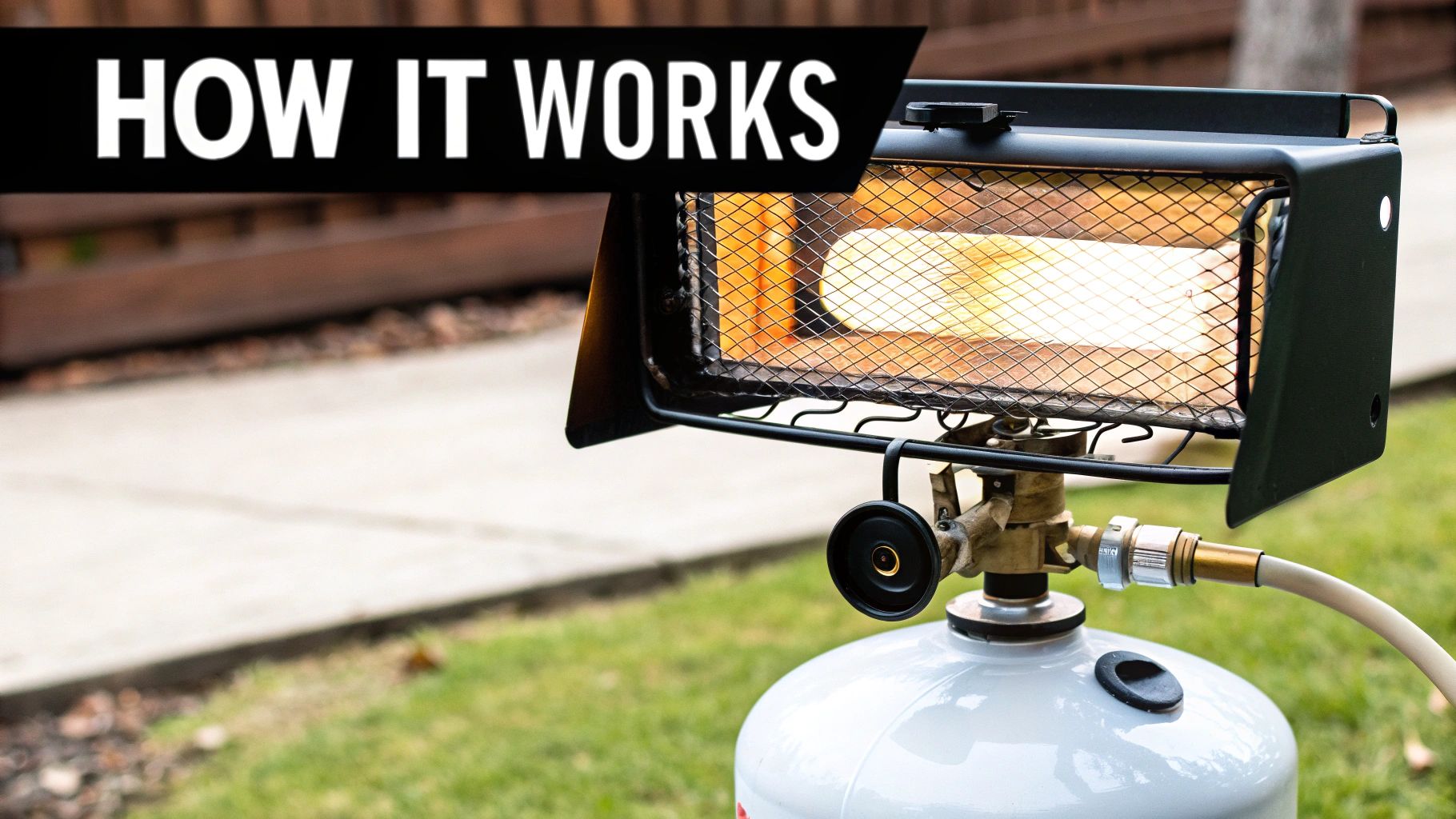
Ever wondered what's going on inside one of those patio heaters? Think of it as a cleverly designed, controlled campfire, channelling warmth exactly where your guests need it most. Instead of wood, it runs on Liquefied Petroleum Gas (LPG)—the same gas you’d use for a braai—to create powerful, comforting radiant heat. The whole setup is a simple but brilliant bit of engineering that delivers instant cosiness.

When you fire it up, a valve releases a steady flow of LPG from the cylinder. The gas travels up a hose to the heart of the unit: the burner assembly. A simple push-button igniter creates a spark, igniting the gas, and that's when the magic really starts.

Close-up of a gas outdoor heater's glowing emitter screen

But the flame doesn't just burn openly. It heats up a crucial component called the emitter screen, which is a tough metal grid sitting right above the burner. As the screen gets hot, it glows a familiar, bright orange, just like the embers in a fire.

From Glowing Emitter to Radiant Warmth

That glowing screen is the real source of the warmth you feel. It sends out infrared radiation, a type of energy that travels through the air until it hits a person or an object. It’s the very same kind of heat you feel from the sun on a clear day.

This is what sets an outdoor heater apart from your typical indoor one. Most indoor heaters use convection, which means they warm up the air, and that warm air circulates around the room. An outdoor gas heater uses radiation to heat people and objects directly, not the air itself.

Why This Matters for Your Event: Radiant heat is a game-changer for outdoor events because it cuts straight through cool air and isn't easily carried off by a breeze. It delivers that instant feeling of warmth directly to your guests, keeping everyone comfortable even on a chilly Cape Town evening.

This direct approach is way more efficient for open spaces. You’re not wasting energy trying to heat an entire garden or patio; you’re focusing all that lovely warmth right where your guests are mingling.

The Key Components Directing the Heat

Three main parts work together to make this happen safely and effectively. Knowing what they do will give you the confidence to operate any rental heater like a pro.

  1. The Gas Regulator: This is the small but vital bit that connects the gas cylinder to the heater's hose. It’s the gatekeeper, making sure gas is delivered to the burner at a constant, safe pressure. Without it, the flame would be all over the place.
  2. The Burner and Emitter: As we mentioned, this is the engine room. The burner creates the flame, and the emitter turns that flame's energy into widespread infrared heat. A well-maintained burner gives you a clean, steady flame for maximum warmth.
  3. The Reflector Shield: You can't miss this part—it’s the large, umbrella-like metal disc at the very top of the heater. Its job is simple: to catch all the heat rising from the emitter and bounce it downwards in a wide cone. Without this shield, most of that valuable warmth would just float off into the sky.

Together, these parts create a reliable system that turns a simple cylinder of LPG into a comforting circle of warmth. It’s the science behind that cosy feeling that keeps a great outdoor party going long after the sun has set.

Choosing The Right Heater For Your Event's Style

Picking a gas outdoor heater isn't just about keeping guests warm – it's a design choice that adds to the whole vibe of your event. The right heater should blend in with your decor and layout, enhancing the look you've worked so hard to create. It’s all about striking that perfect balance between function and style.

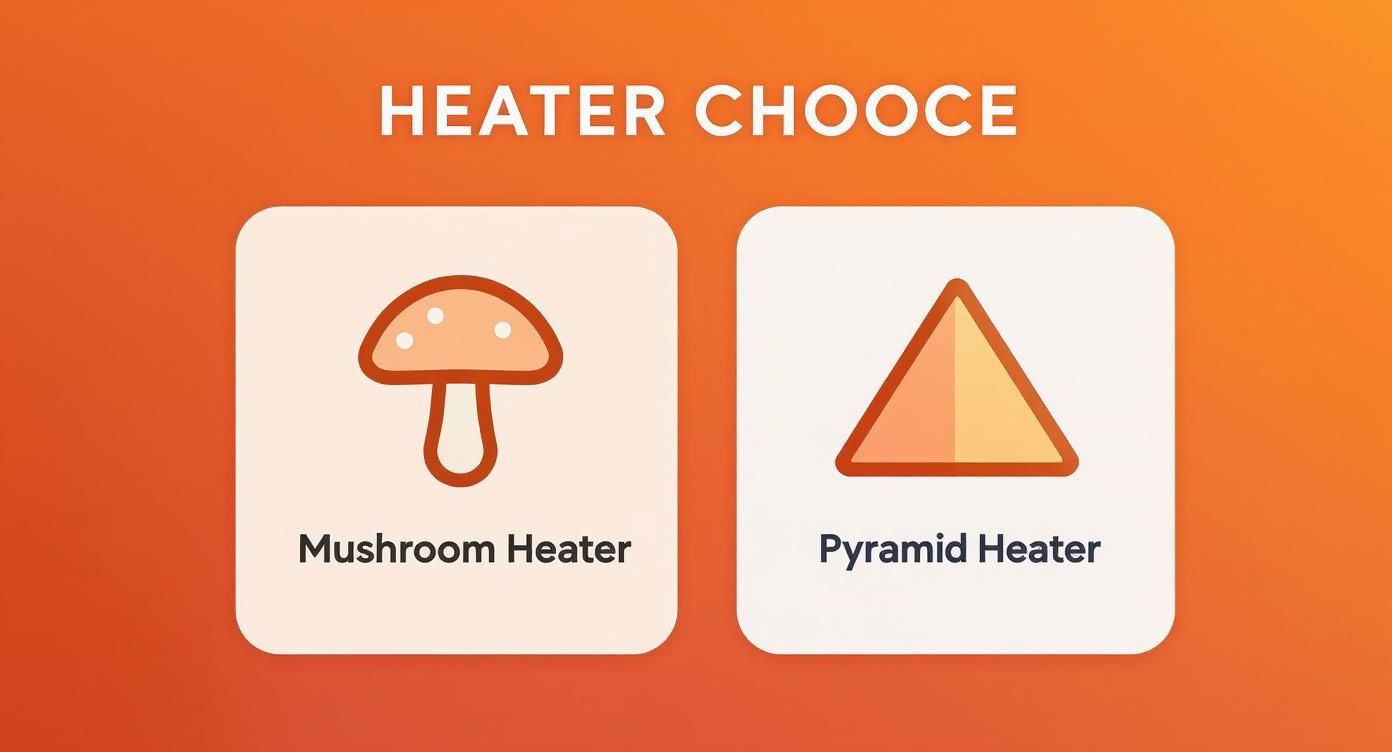
The two most popular heaters you can hire each bring something different to the table. Your decision really comes down to whether you need quiet, widespread warmth or a dramatic, eye-catching centrepiece. Let's look at what makes each one unique.

The Workhorse Mushroom Heater

The classic freestanding mushroom heater is a crowd favourite for a good reason. Its famous umbrella-shaped reflector is built to push heat out efficiently, making it a reliable workhorse for pretty much any outdoor space. Think of it as the most dependable player on your event heating team.

This design is brilliant at radiating heat downwards and outwards in a big, even circle. It’s perfect for creating warm zones in open areas like gardens, patios, or around cocktail tables where people are standing and chatting. Because it has an understated look, it provides comfort without stealing the show from your main decor.

Thanks to its wide heat coverage, the mushroom heater is often the most budget-friendly choice for warming up larger areas, as you'll likely need fewer of them to keep everyone comfortable.

The Showstopping Pyramid Heater

When your event calls for a bit of drama and a high-end feel, the pyramid heater is a knockout. Its standout feature is a tall, quartz glass tube with a live flame dancing up the middle. It provides both heat and an incredible visual.

This type of heater is like a piece of functional art. It’s perfect for framing an entrance, marking out a VIP lounge, or just adding a touch of class to a chic cocktail party. While its heat is a bit more focused than a mushroom heater's, the beautiful glow and striking design create an atmosphere that people won't forget.

A pyramid heater takes something essential—warmth—and turns it into a design feature. Guests are naturally drawn to the light and movement, making it an elegant and natural spot for people to gather.

A Side-by-Side Comparison

To help you see the difference clearly, here’s a quick comparison of these two popular styles. This table lays out their strengths and where they shine, helping you match the right heater to your event’s specific needs.

Gas Outdoor Heater Comparison for Event Planners

Heater Type Best For Heat Coverage (Approx.) Aesthetic Appeal Key Consideration
Mushroom Heater Widespread, practical heating for open spaces, gardens, and marquees. 15-20 sq meters Functional and classic, designed to blend in rather than stand out. Maximum heat efficiency and coverage for your budget.
Pyramid Heater Creating a visual focal point, accentuating entrances, or high-end events. 10-15 sq meters Modern and dramatic, with a visible flame for high visual impact. Atmosphere and style are as important as the heat itself.

At the end of the day, your choice comes down to your main goal. Need to heat a large, open area for a seated dinner efficiently? The mushroom heater is your best bet. Trying to create a stylish, exclusive lounge for a product launch? The pyramid heater will deliver that "wow" factor.

Often, the best solution involves a mix of both. You can find out more about creating comfortable, stylish outdoor zones in our guide to Cape Town umbrella hire, which covers another key part of guest comfort.

How Many Heaters Do You Actually Need?

Getting the right number of heaters for your event is a bit of a balancing act. Too few, and your guests will be shivering and huddling together for warmth. Too many, and you'll end up with uncomfortable hot spots while burning through your rental budget. The real goal is to create a consistent, gentle warmth that feels completely natural and inviting.

A good starting point is the general rule of thumb. A standard mushroom-style gas outdoor heater will typically warm up a radius of about 20 square metres. But, and this is a big but, that’s just an estimate. Real-world conditions like a sudden gust of wind, the night's actual temperature, and whether your space has any partial shelter will massively affect how they perform.

This is especially true for events in Cape Town, where a sea breeze can roll in without any warning. A steady wind can easily shrink a heater's effective coverage by 25-30%, which means you might need to place them a bit closer together than you first thought.

Start by Mapping Your Event Zones

Before you can land on a final number, you need to get a clear picture of your venue's layout and, more importantly, how your guests will actually use the space. Don't just think in total square metres; break the area down into its different zones.

Put yourself in your guests' shoes. Where will people naturally gather? Pinpointing these social hubs is the secret to placing your heaters strategically.

  • Seated Dining Areas: These are your top priority. Guests aren't moving around, so they'll feel the cold much more. You need consistent, overlapping warmth here.
  • Cocktail and Standing Zones: Think high-top tables or areas near the bar—these are natural mingling spots. Heaters here can be spaced a little further apart.
  • Lounge Pockets: Those cosy seating areas with couches or beanbags need their own dedicated heat source to feel truly comfortable and inviting.
  • Entrances and Exits: Placing a heater near the main entrance creates an instant feeling of warmth and welcome the moment guests arrive.

This approach means you're not just wasting heat on empty space. You're focusing the warmth exactly where it will make the biggest difference to your guests' experience.

The infographic below gives you a quick visual guide to help you see the difference between heater types and where they work best as you map out your event.

Infographic about gas outdoor heater

As you can see, mushroom heaters are brilliant for wide coverage, while the pyramid-style ones add a real atmospheric touch to specific zones.

Putting it Into Practice: Scenarios and Calculations

Let’s run through a couple of common event setups. This should help you visualise how to calculate what you'll need.

Pro Tip: Always sketch out a simple floor plan of your venue. Use circles to represent the rough 20-square-metre coverage of each heater, then move them around on paper to cover your key zones without leaving any big cold spots.

Scenario 1: The Standing Cocktail Party
For an open-air cocktail do with 80 guests, the aim is to create pockets of warmth rather than heating the entire garden. People will be moving and mingling.

  • Calculation: Guests will naturally cluster in groups, so you can strategically place 4 to 5 heaters around high-traffic areas like the bar, food stations, and a few cocktail tables. This encourages flow while making sure no one is ever too far from a bit of warmth.

Scenario 2: The Seated Wedding Reception
Here we have a seated reception with 10 round tables, each seating 10 guests. The priority is consistent warmth for every single table, as people will be sitting down for a long time.

  • Calculation: A great setup is to place one heater in the gap between every two tables. This arrangement would call for 5 heaters to cover all ten tables perfectly. You might want to add a sixth one near the entrance or by the dance floor for good measure.

By mapping your zones and thinking about the flow of your specific event, you move from guesswork to a solid, actionable heating plan. It’s the best way to ensure every guest stays comfortable and your budget is used as efficiently as possible.

Mastering Heater Safety And Local Regulations

When you hire a gas outdoor heater, you're not just renting equipment; you're taking on the responsibility for your guests' safety. And while our heaters are designed to be incredibly safe and reliable, their sheer power demands a healthy dose of respect and careful handling. It's like being the captain of a ship—you need to know the rules of the sea to ensure a smooth, worry-free journey for everyone on board.

Getting safety right is the absolute cornerstone of a successful event. It’s non-negotiable, and it all boils down to understanding the core principles of placement, ventilation, and the heater's own safety mechanisms. These aren't just polite suggestions; they are essential steps to protect your guests, your venue, and your hard-earned reputation.

A gas heater placed safely on a stable patio surface away from flammable materials

Core Safety Protocols For Every Event

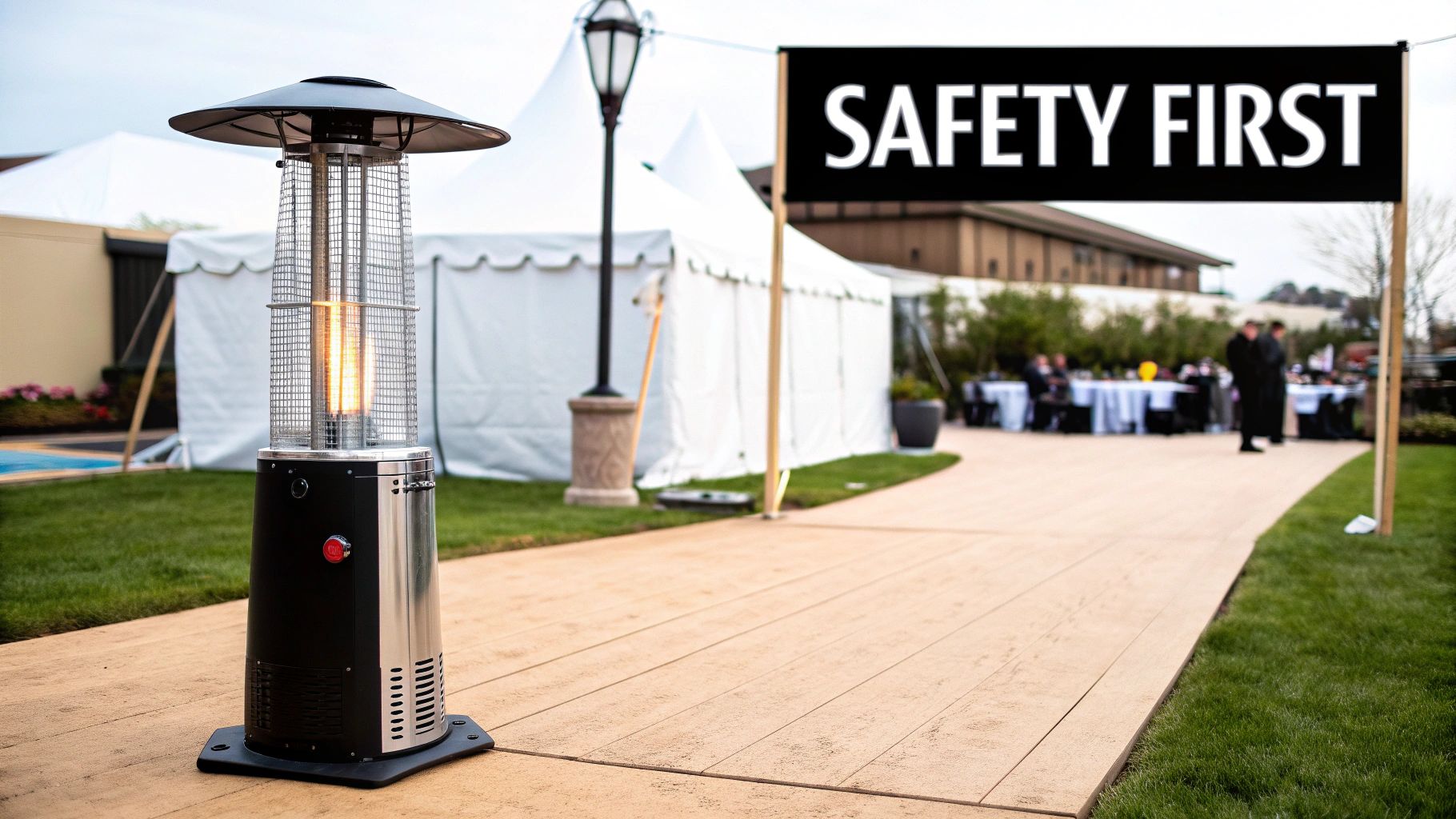
Your first job is to pick the right spot. A gas heater must always be placed on a completely flat, stable, and non-combustible surface. Grass can be uneven and poses a potential fire risk, making a paved patio, solid deck, or firm flooring the ideal foundation.

Next up is clearance. That radiant heat feels wonderful, but it’s intense. Keeping a safe distance from anything flammable is critical. This includes tent walls, hanging decorations, flowy tablecloths, and even dense bushes or trees.

As a golden rule, always maintain a minimum clearance of 1 metre on all sides of the heater and even more space overhead, especially if it’s under a marquee or a large umbrella. And a quick pro-tip: never, ever let guests use a heater as a coat rack or a place to hang their bags.

Understanding Built-In Safety Features

Professional hire companies like ABC Hire only stock units equipped with modern safety technology. One of the most important features to know about is the anti-tilt switch.

This clever little device is a real lifesaver. If a heater gets accidentally knocked or tilted beyond a safe angle, the switch automatically cuts the gas supply, instantly putting out the flame. It's an essential safeguard against fire hazards, particularly at lively events where guests are mingling and moving around.

Ventilation: The Silent Protector

Proper ventilation is arguably the most crucial safety aspect of all, especially if you’re using heaters in a semi-enclosed space like a marquee with one or two sides open. Gas outdoor heaters consume oxygen and release carbon monoxide (CO) as a byproduct. Out in the open air, this is no problem at all as the gas just dissipates harmlessly.

But in a poorly ventilated area, CO can build up to dangerous levels. That’s precisely why these heaters must never be used in fully enclosed tents, garages, or any indoor space. For any semi-enclosed setup, you have to ensure there is plenty of cross-flow ventilation to keep the air fresh and, most importantly, safe. The safety rules for heaters are closely linked to your venue choice, a topic we dive into in our guide on tent hire for parties.

Navigating Local Regulations And Environmental Impact

For most private events in Cape Town held on private property, you won’t need a specific permit just for using gas heaters. However, your event's overall safety plan must still comply with the City of Cape Town’s event by-laws, not to mention any specific rules set by your venue. The simplest way to tick this box is by using certified, professional equipment from a reputable hire company.

It’s also worth touching on the environmental conversation. While traditional gas patio heaters are effective, there is a growing awareness of their carbon footprint. A gas-powered patio heater can emit around 3 kilograms of CO2 within just a couple of hours. As environmental concerns rightly become more prominent, the industry is shifting towards solutions with better emission controls. By choosing well-maintained, efficient models for your event, you can do your part to minimise its impact.

Your Gas Heater Questions Answered

When you're in the thick of event planning, a few questions are bound to pop up, especially when dealing with equipment. For gas outdoor heaters, getting those answers sorted is key to a safe, warm, and brilliant event. We've pulled together the most common questions we get from event planners right here in Cape Town, with simple, no-nonsense answers.

Think of this as your personal cheat sheet for heater hire. From how long the gas lasts to safety and local rules, we'll cover what you need to know to handle things like a seasoned pro.

How Long Does a 9kg Gas Bottle Last In a Patio Heater?

This is the big one, and for good reason—it hits your budget and your logistics. That 9kg LPG cylinder is the fuel tank for your heater, and how long it lasts comes down to one thing: the heat setting.

Crank it up to the highest setting, and you can expect a single 9kg bottle to give you about 8 to 10 hours of solid warmth. If you're just looking for a bit of ambient heat on a lower setting, you can easily stretch that to around 12 hours.

Event Planning Takeaway: For most standard evening events running 5-6 hours, one 9kg gas cylinder for each heater is usually plenty. But if you're planning a longer celebration or expecting a proper Cape Town cold snap that needs high heat from the get-go, it’s a smart move to have a spare cylinder on standby for each unit.

Can I Use a Gas Outdoor Heater Inside a Marquee?

This is a critical safety question. The short answer is no, you absolutely cannot use a gas outdoor heater inside a fully enclosed marquee. It's incredibly dangerous. With no way for fumes to escape, you run a serious risk of fire and a hazardous build-up of carbon monoxide.

But, you can use them safely in a semi-enclosed setup. If your marquee has at least one side completely open, you’ll have the airflow needed to let heat and fumes dissipate safely.

Even then, placement is everything:

  • Give It Space: Keep the heater a minimum of 1 metre away from the marquee walls, ceiling, and any draping or décor.
  • Keep It Stable: The heater must be on a completely flat, solid surface to make sure there’s no chance of it tipping over.

If your event is in a fully sealed marquee, your only safe options are electric heaters or a ducted heating system where the unit stays outside.

What Happens If a Heater Is Knocked Over?

A great question, especially for lively events with guests moving around. Luckily, any professional rental heater worth its salt comes with a non-negotiable safety feature: an anti-tilt switch.

It’s a clever little mechanism. If the heater gets bumped and tilts too far, or gets knocked over completely, the switch instantly cuts the gas supply to the burner. The flame goes out immediately, stopping a potential fire before it can even start.

While the anti-tilt switch is a great backup, your best strategy is always smart placement. Position heaters away from busy walkways, the dance floor, or kids' play areas to minimise the risk from the start.

Do I Need a Special Permit For Gas Heaters At a Cape Town Event?

Navigating council regulations can feel like a headache, but for gas heaters, it’s usually quite straightforward. For most private events on private property in and around Cape Town, you won’t need a specific "heater permit."

That doesn't mean it's a free-for-all, though. Your event's overall safety plan still needs to line up with the City of Cape Town’s by-laws and any rules your venue might have.

The easiest way to tick all the boxes is to hire from a professional company.

  • Certified Gear: A reputable supplier makes sure their heaters are certified and maintained to meet national safety standards (like those from the LPGSA).
  • Compliance Made Easy: When you hire compliant equipment, you're showing you've done your due diligence, which makes getting your event plan signed off by a venue a whole lot smoother.

Working with a trusted partner like ABC Hire means you get equipment that’s not just effective, but also fully compliant—taking one more thing off your very full plate.


Ready to create a warm and inviting atmosphere for your next outdoor event? At ABC Hire, we provide top-quality, safe, and stylish gas outdoor heaters that are perfect for any occasion. Explore our heating solutions and get a quote today at https://abchire.co.za.

📍 Cape Town + Winelands