
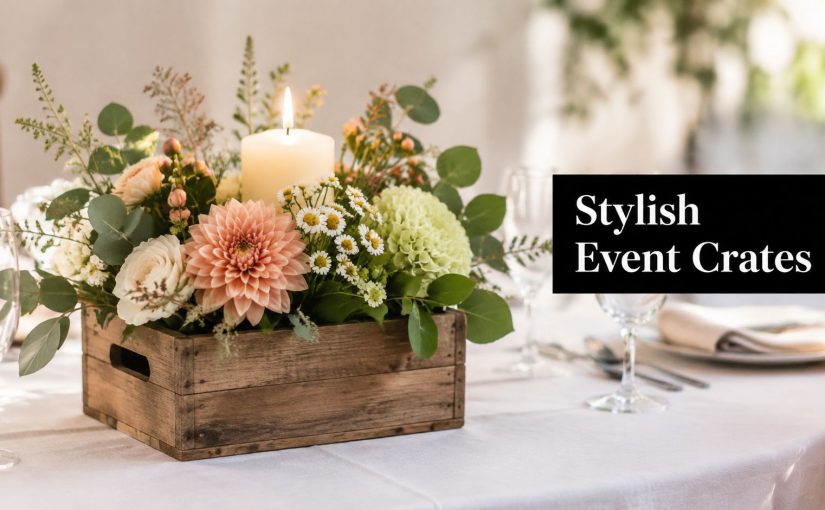
The venue is open, the tables are dressed, and one long banquet table still looks flat. A few vases disappear behind the glassware, the welcome sign needs height, and the dessert display has nowhere to build upwards. A small wooden crate often solves all three problems before the first guest arrives.
In Cape Town and the Winelands, crates work because they're more than rustic props. They're reusable styling units that can lift, frame, separate and organise event details. Turn one on its side for a floral arrangement, stack several for a welcome point, or use a single crate as a compact sign holder. Unlike fragile one-purpose décor, a well-made crate can move from a wedding to a corporate activation, then return to storage ready for another setup.
Why Small Wooden Crates Work So Well for Event Styling
At a Stellenbosch wedding, the styling problem is often practical rather than creative. The table plan looks beautiful on paper, but once the menus, wine glasses and candles are in place, the centrepiece needs more height. A stack of crates creates a level change without adding a bulky plinth, and the natural timber softens formal tableware without making the setting feel overly themed.
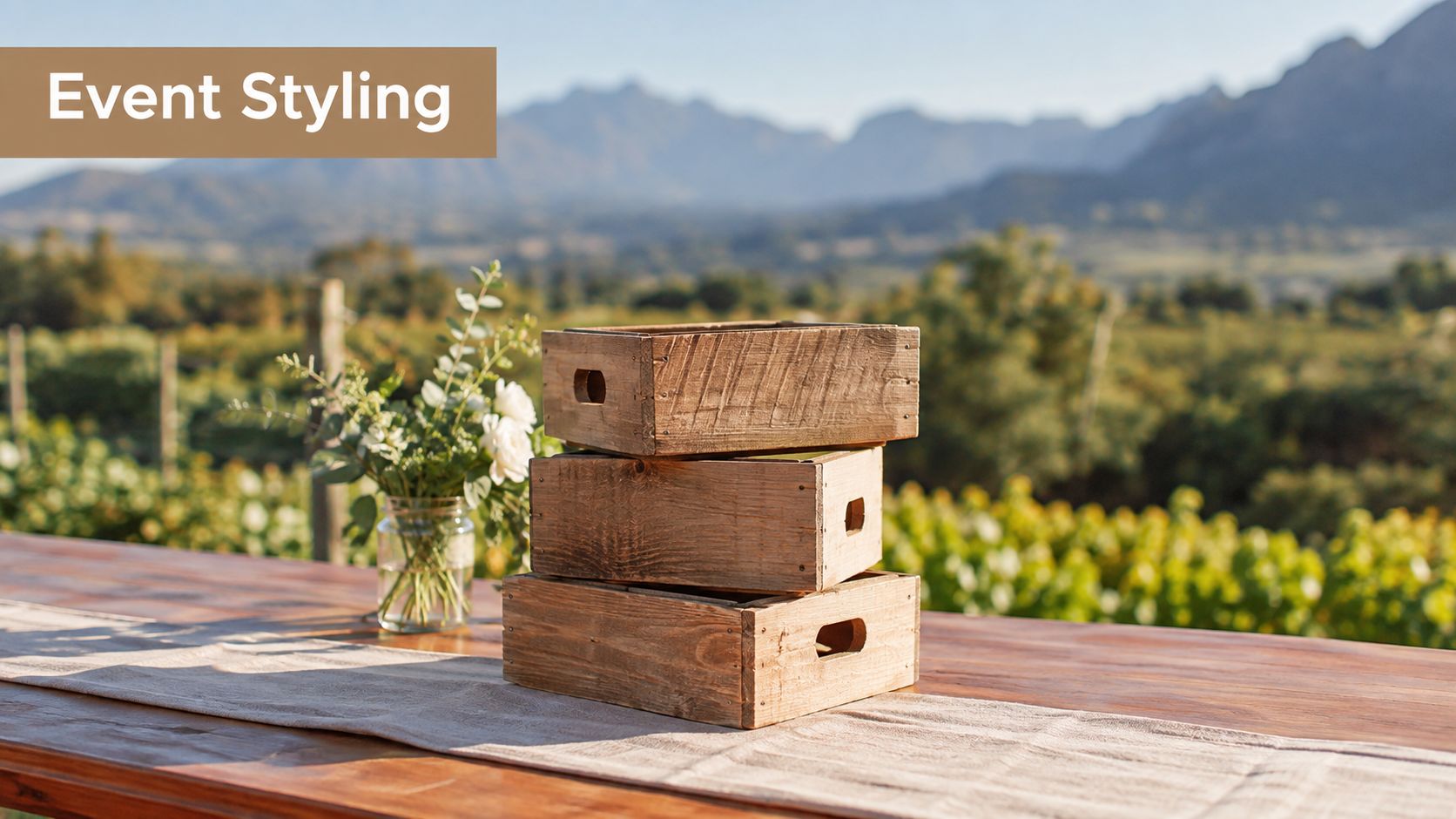
The same unit can work differently at a birthday celebration. Place it beneath a cake sign, fill it with wrapped favours, or use it beside the bar for menus and garnishes. At a brand activation, crates can introduce a farm-market feel while giving products a clean, tiered presentation. Their open slats keep displays visually light, which matters when guests need to see products, signage or florals from several angles.
A styling building block, not a one-day prop
Crates also make pack-down more organised. Rather than dismantling a collection of separate risers, baskets and stands, a styling team can gather the crates, wipe them down and stack them for transport. That reuse makes the hire model particularly attractive for planners who work across venues and need pieces that perform more than one job.
The material has practical limits. A rough crate can catch linen, a weak corner can wobble under a heavy arrangement, and inconsistent sizes can make a deliberately casual display look accidental. Good results depend on selecting a consistent set, checking each piece before loading, and matching the crate to the job.
Practical rule: If a crate will sit near guests, treat stability, smooth edges and clear sightlines as styling requirements, not afterthoughts.
Event setups also carry responsibility beyond appearance. If décor is placed near walkways, candles, electrical equipment or guest seating, it's sensible to review how event insurance can protect you alongside your normal venue safety planning.
How to Choose the Right Small Wooden Crate for Your Event
Choose the crate for its job before choosing its colour. A centrepiece crate needs enough internal space for a jar, liner or floral mechanic, while a sign crate needs a stable base and an opening that frames the board rather than hiding it. A display crate for bottles or favours must also tolerate repeated handling.
Start with the footprint
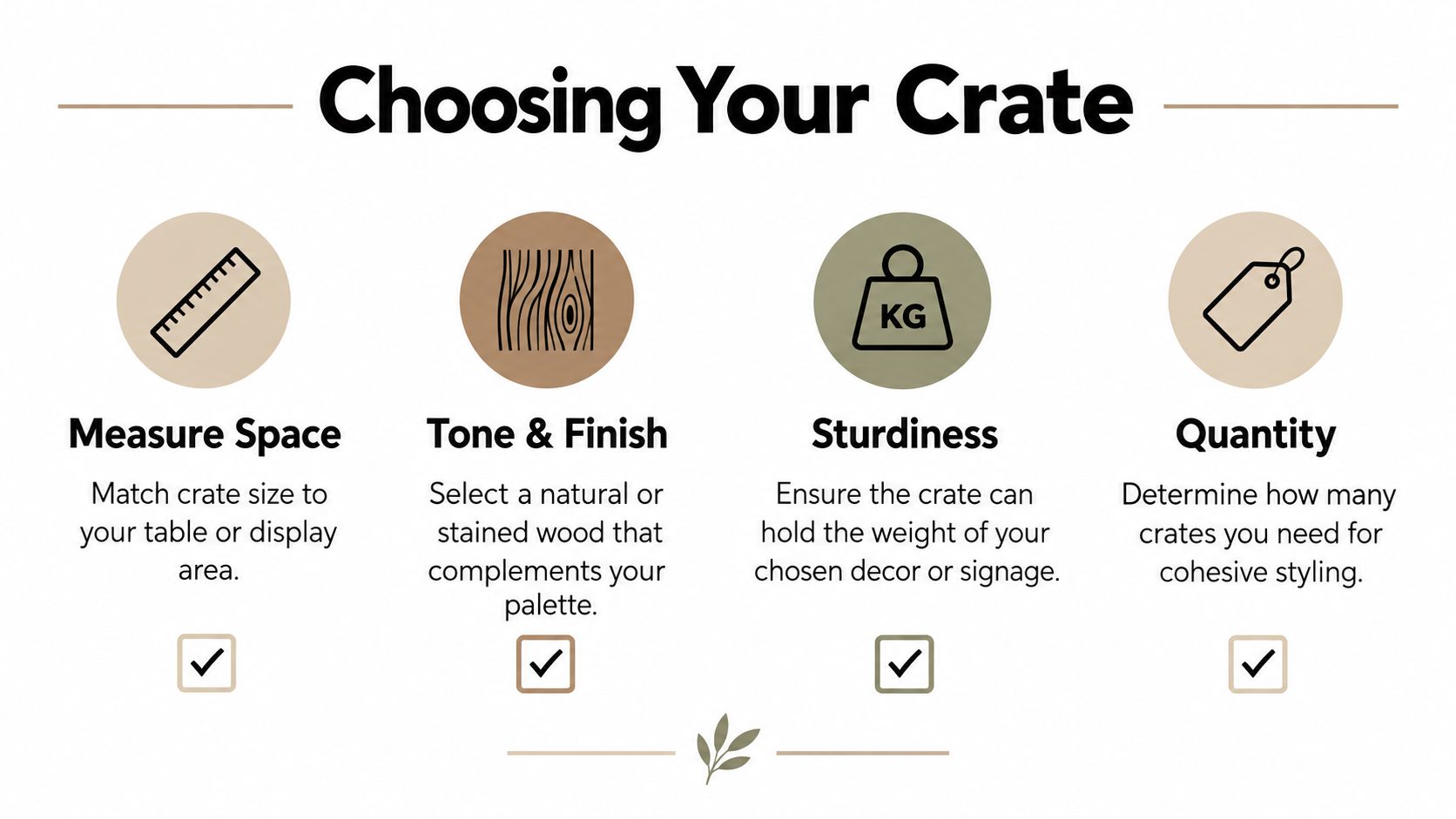
Measure the table, shelf or display zone, then allow room for hands to pass around the arrangement. On a round guest table, a crate that occupies too much surface area competes with place settings. On a long banquet table, several smaller units usually create a more relaxed rhythm than one oversized block.
Check both external and internal dimensions. Thick slats and corner framing reduce the usable space, so a jar that fits the outside measurement may not fit inside the crate. If you're sending small products or gifts, compare the crate's interior with the packed item, not the product description alone. For compact mailed goods, 4x4x4 inch shipping boxes can help you think through the relationship between packaging dimensions and the display space available.
Inspect the finish by hand
Run a cloth over the timber. If it snags, guests' clothing and table linen may do the same. Look for exposed nails, split corners, loose slats and sharp staples. A natural finish suits vineyard weddings and market-style activations, while a painted or stained set can support a corporate palette more precisely.
Mixed timber can look charming when the event deliberately uses an eclectic style. It looks untidy when the rest of the décor is symmetrical. Hire a matching set when the crates form a repeated feature, such as table numbers or a tiered favour station. Choose varied pieces only when you're controlling the composition through placement, colour and repeated florals.
Test the structure before loading
Place the crate on a level surface and press gently on each corner. It shouldn't rock. Add the intended contents, then lift it from underneath rather than by a slat. For heavier signage or décor, choose reinforced corners and a solid base.
A useful selection checklist is:
- Measure twice: Confirm the table footprint and internal capacity before ordering.
- Match the finish: Keep timber tones consistent unless an intentionally collected look is part of the brief.
- Check the joinery: Reject pieces with movement, cracked boards or protruding fixings.
- Order for repetition: Count every table, display point and spare required for replacements.
Styling Centrepieces and Florals With Small Wooden Crates
A crate gives a florist a useful frame, but it shouldn't become a hidden water container. Build the arrangement inside a watertight vessel, then place that vessel into the crate. A glass jar, ceramic pot or florist's bucket can work, provided the base is stable and the crate stays dry.
Three reliable orientations
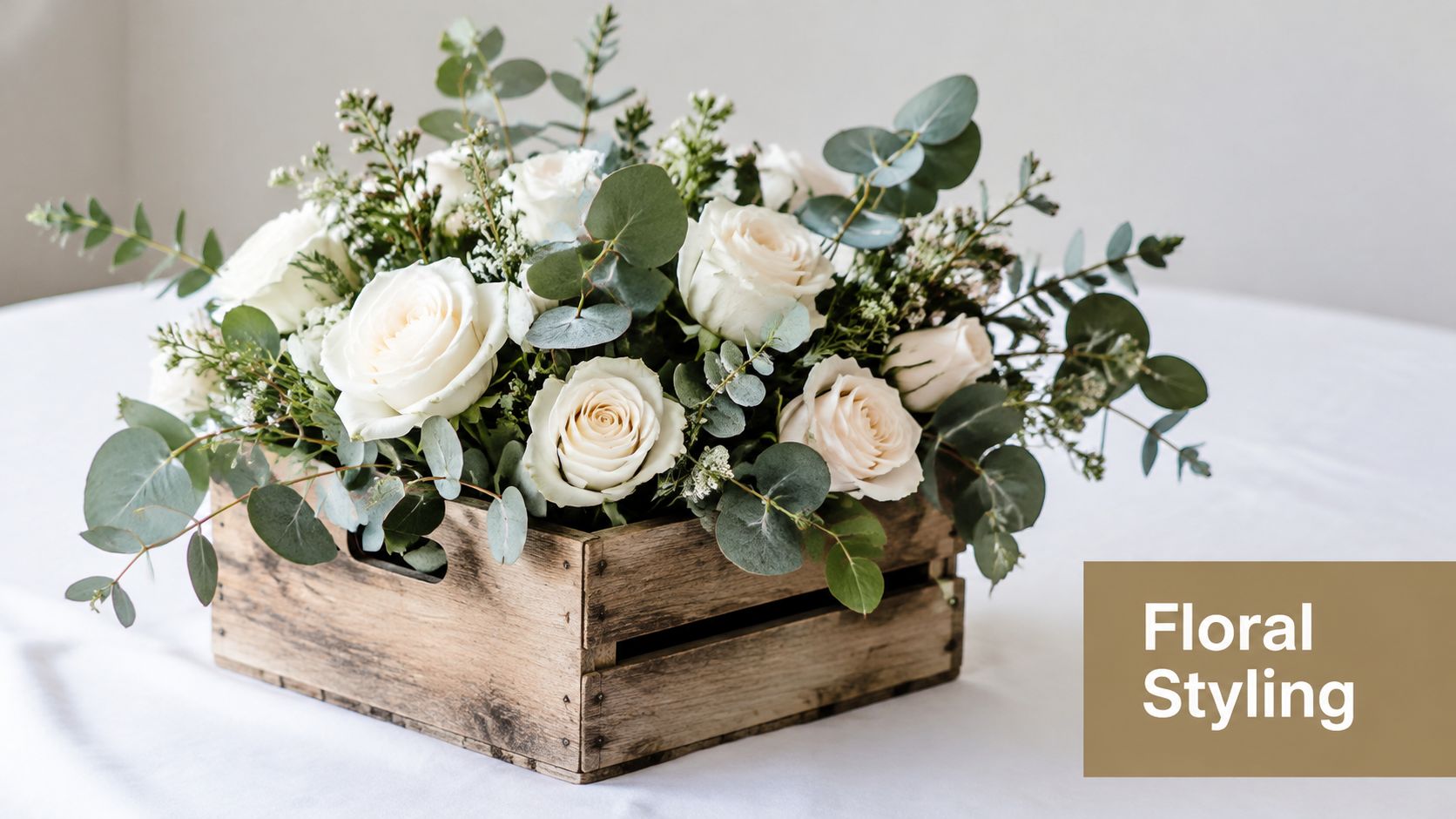
Upright for height. Stand the crate normally and place a jar inside. Keep the flowers loose and airy, with foliage extending slightly above the rim. This works well on long tables because the crate creates height without requiring a tall, narrow vase.
On its side for a low arrangement. Turn the crate so the open face points towards guests. Arrange jars, bud vases or small potted herbs inside the opening. This is a strong choice for round tables where guests need to see across the centre.
Inverted as a riser. Turn the crate upside down and place a tray, bowl or floral vessel on top. Add a discreet non-slip layer between the crate and the item. The riser should look intentional, so repeat the same height or orientation elsewhere rather than using one isolated upside-down unit.
For a detailed companion approach to serving and display surfaces, see this guide to a wooden tray with handles. A handled tray can also make a crate arrangement easier to carry from the prep area to the table.
Keep the mechanics transport-ready
Prepare the floral vessel before delivery, but add delicate stems on site if the arrangement is likely to catch during loading. Use a liner beneath damp containers, and lift the complete unit from its base. Don't drag a wet crate across linen or polished timber.
For a Winelands look, combine one strong flower with foliage and a restrained filler. White roses with eucalyptus create a clean contrast against timber, while seasonal branches or herbs can make a farm-style table feel less formal. Corporate arrangements usually benefit from fewer flower types and stronger repetition, especially when the crate is supporting branded signage.
Candles need their own safety check. Use enclosed glass holders, keep flame away from dry foliage and never place a candle directly against the timber. If the venue has restrictions, replace open flames with battery-operated lights placed inside jars.
Match the build to the table
Long banquet tables can carry a sequence of crates with alternating florals, menus and candles. Leave clear breaks so guests can talk across the table. Round tables need a tighter centre, with one crate, a compact cluster of jars or a low arrangement that won't block faces.
A crate is most successful when it supports the flowers rather than competing with them. Let the wood provide structure, then keep the contents visually lighter than the container.
Stacking Signage and Creative Display Ideas That Guests Notice
Vertical displays attract attention, but they also introduce movement and load. Build from the widest, most stable base, keep heavier items low, and test the structure by gently pressing the top before guests arrive. A beautiful stack that shifts when someone brushes past it isn't ready for service.
Build for the guest journey
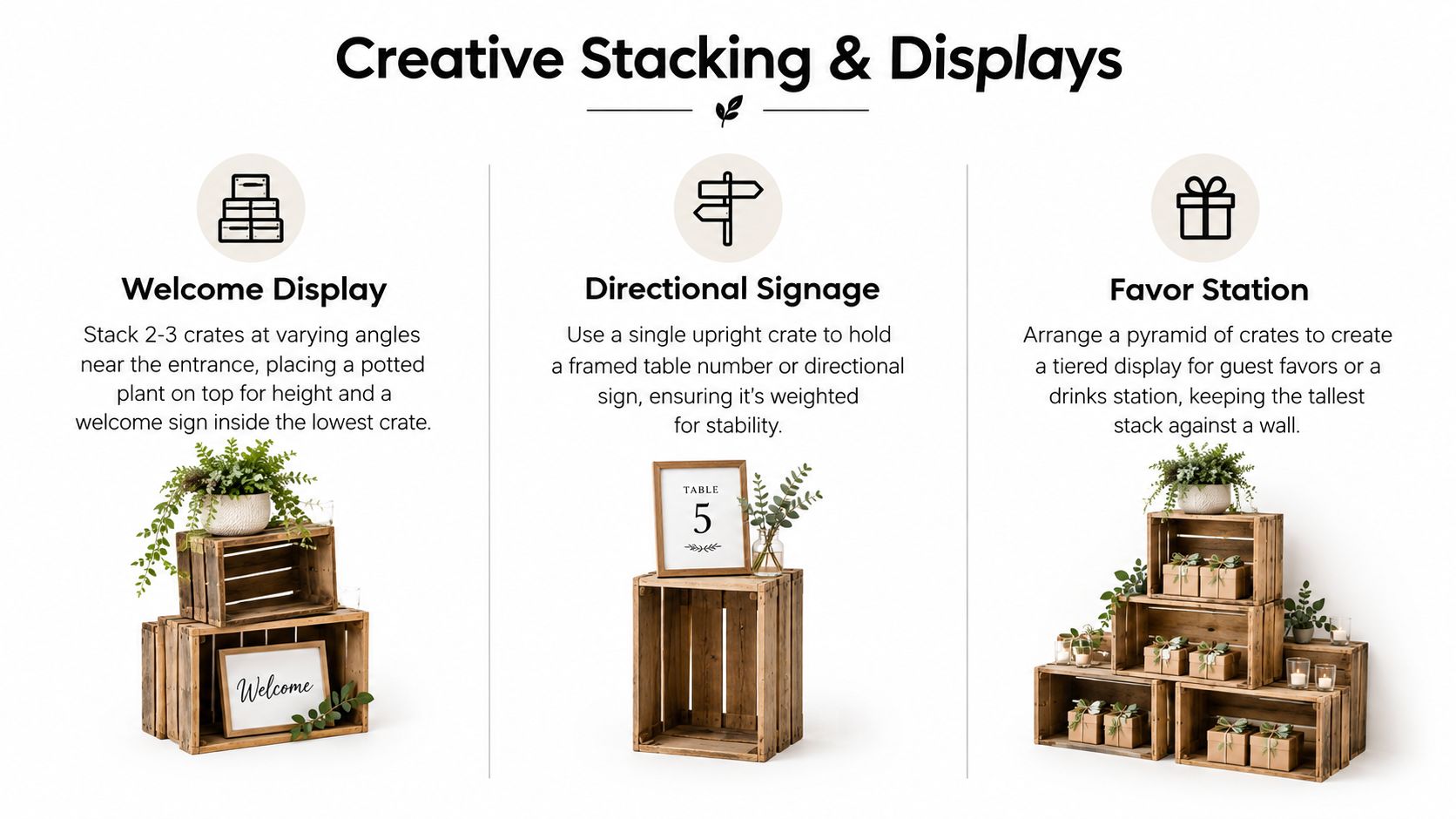
At an entrance, stack crates at varied angles only if each contact point is secure. Put a welcome board inside the lowest opening, add a plant or floral vessel to the upper level, and keep the arrangement beside the flow of guests rather than in the doorway. The display should guide people without creating a bottleneck.
For directional signage, one upright crate is often enough. Slide a framed table number or printed board into the opening, then add weight at the base if the venue is exposed to wind. Hand-lettered panels suit informal celebrations, while a clean printed board usually performs better at a corporate event where guests must read information quickly.
A dessert bar benefits from staggered levels. Use lower crates for plates and napkins, medium levels for packaged treats, and a clear central space for the main dessert. Keep the tallest section against a wall or behind the service line, so guests can reach the front without knocking into the display.
Give every stack a job
Crate cubbies work well for programmes, blankets or wrapped favours because guests can see the contents immediately. A cake plinth can create useful height, but the cake should sit on a rigid board or tray, not directly on slats. A photo backdrop can use crates as side shelving, provided the overall arrangement can't be pulled forward by a guest.
Use concealed cable ties, museum putty or non-slip material where suitable for the venue surface. Don't rely on a decorative object to hold a stack in place. If the display is tall, freestanding or positioned where children may reach it, ask the venue or technical team whether it needs anchoring.
For a clean product-led arrangement, a wood display stand may be more appropriate than forcing crates to carry a job they weren't designed for. The best event styling uses the right support, not the most fashionable object.
Protect sightlines
Walk past the display from the guest's direction. Check that signage can be read without bending, that products are visible, and that staff can replenish stock without dismantling the arrangement. Photograph the setup from eye level, not only from above. A display can look balanced in a styling image while blocking the person standing in front of it.
Sourcing Reuse and Export Ready Considerations in South Africa
A small wooden crate beats cardboard when the event involves repeated handling, damp conditions, short-cycle rental movement or a need for a consistent visual system. Cardboard remains useful for clean, lightweight packaging and one-way transport, particularly when the box will be recycled after delivery.
| Use Case | Choose Small Wooden Crate When | Choose Cardboard When |
|---|---|---|
| Local rental rotation | You need a reusable unit that can be wiped, stacked and used again | The item is travelling once and presentation is secondary |
| Farm-gate or market display | Products need open visibility and a sturdy tiered presentation | Stock needs enclosed, lightweight transit packaging |
| Event signage | The sign needs a stable base or a natural display frame | The message is temporary and will be discarded or recycled |
| Damp or rough handling | Timber offers more resistance to crushing and repeated movement | The route is controlled and the package will stay dry |
| Export shipment | The crate can meet regulated wood-packaging requirements | A compliant alternative packaging format is available |
South Africa's wood trade provides the commercial backdrop for these decisions. The Observatory of Economic Complexity reported US$41.3 million in South African wood carpentry exports in 2023, with the United Kingdom, Botswana, Lesotho, Namibia and the United States among the main destinations. In December 2024, exports reached ZAR67.9 million, while imports were ZAR35.8 million, producing a positive balance of ZAR32.1 million. These figures describe wood carpentry rather than small event crates specifically, but they show that wooden products move through established regional and international trade channels. OEC trade data
For local sourcing, inspect timber provenance and construction quality rather than chasing a distressed finish. Reclaimed timber can add character, but it still needs to be clean, sound and free from protruding fixings. Guidance on reclaimed lumber from TimberSol Ltd offers useful context for evaluating reused wood visually and structurally.
Export compliance is separate from styling
For South African export use, solid wood packaging thicker than 6 mm must comply with ISPM 15. The approved treatment threshold is a core temperature of at least 56 °C for 30 minutes, and the finished crate must carry the IPPC mark with the ZA country code and HT treatment code. The practical sequence is simple: confirm that the material is regulated wood packaging, source treated timber, check the mark, and retain treatment records. South African ISPM 15 guidance
Missing or incorrect marks can lead to refusal or destruction at the destination. For event hire within South Africa, that export requirement may not apply, but a supplier should still be able to explain how the crate was made and maintained. For broader hire-versus-buy guidance, compare the expected handling pattern with the available wooden boxes and crates before committing to a large collection.
Bringing Your Crate Styled Event Together With Confidence
A successful crate setup starts with selection, not decoration. Choose pieces that fit the surface, suit the palette and stand level. Then assign each crate a clear role, whether that's holding flowers, raising a sign, organising favours or creating a visual break along a banquet table.
Before guests arrive, run a short inspection:
- Check stability: Press each stack lightly and remove anything that rocks.
- Protect surfaces: Use liners beneath wet vessels and non-slip material under risers.
- Read the signs: Stand where guests will stand and confirm that every message is legible.
- Test the flow: Walk from the entrance to the bar, tables and toilets without brushing against displays.
- Plan pack-down: Keep crates dry, label grouped décor and load them so corners won't be crushed.
The reusable styling system holds significant value. One consistent collection can move between weddings, matric dances, brand activations and milestone birthdays, changing character through flowers, fabric, printed boards and tableware. Hire makes sense when you need a coordinated set for one event or want delivery and collection handled. Buying can suit a farm-gate brand, venue or stylist with regular storage and repeat use.
Brief your team with a simple layout photograph, a crate count, the intended orientation of each piece and the destination table or display. That small amount of organisation prevents the common event-day scramble where crates arrive but nobody knows which ones carry flowers, signage or stock.
For Cape Town, Stellenbosch, Franschhoek and Paarl events, ABC Hire offers event furniture and décor rentals that can help you build a coordinated setup without buying every piece. Visit ABC Hire to discuss the crates, display supports and wider event equipment that will make your styling practical on arrival and straightforward to collect after the celebration.