
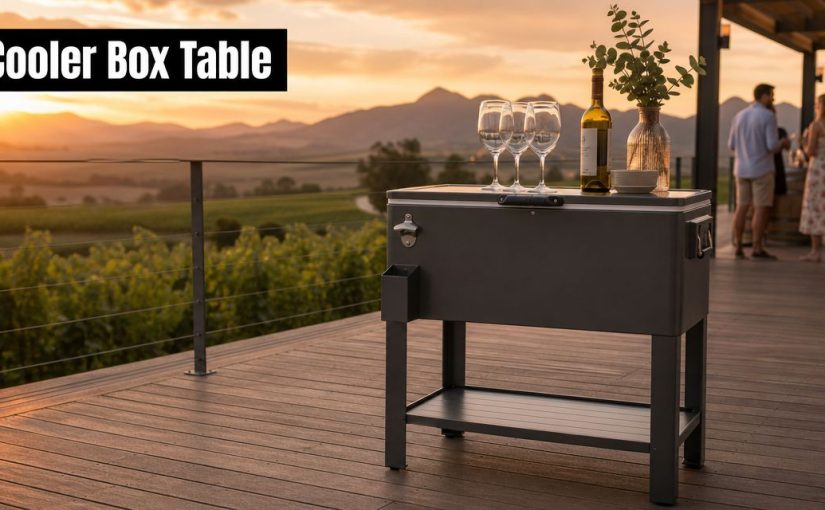
You're often closest to a cooler box table when an event starts going slightly wrong.
Guests drift toward the one staffed bar. A terrace drinks station runs dry because nobody wants to carry refills across gravel. The ice chest tucked behind a hedge does its job, but it looks like equipment rather than part of the event. In Cape Town and the Winelands, that problem shows up fast because venues are beautiful, spread out, and often designed for movement rather than centralised service.
A cooler box table fixes more than temperature. Used properly, it changes how people circulate, where they pause, and how much pressure lands on your main bar team. That's why event pros keep coming back to it for weddings, school functions, brand activations, birthdays, and informal corporate gatherings.
The Secret to Effortless Event Refreshments
A Paarl vineyard wedding usually looks effortless from the guest side. Sunset, soft lighting, a lawn full of conversation, and glasses constantly in hand. From the planning side, it's a different story. Drinks service has to keep moving across a site that was never built like a hotel bar.
That's where a cooler box table earns its place. Instead of one hard-working bar and a few unattractive ice chests hidden out of sight, you create smaller refreshment points that feel intentional. Guests don't need to abandon a conversation to fetch water, tonic, beer, or soft drinks. They reach for it where they're already standing.

Why this object works so well outdoors
The strength of the category is portability. The modern version traces back to 1951, when Richard Laramy created a recorded “portable ice chest”, a milestone in the shift away from heavy metal coolers and toward insulated consumer products, as noted in this history of the portable ice chest and cooler box evolution.
That background matters because Cape venues still present the same core challenge. You need cold drinks away from fixed refrigeration. On a lawn, by a ceremony site, next to a dance floor, or on a terrace with limited power, a portable insulated unit still beats a solution that depends on a plug point.
Practical rule: If guests must walk away from the social moment to find refreshments, your service layout is working against the event.
Why it feels smarter than a loose cooler
A standard cooler solves storage. A cooler box table solves service design.
It gives guests a surface to rest a glass, place a small plate, or gather around. That changes behaviour. People cluster naturally around a point that offers both refreshment and a place to stand. For planners, that means fewer dead corners and better use of in-between spaces such as terrace edges, lawn pockets, pre-reception zones, and informal lounge areas.
What doesn't work is using it like a hidden backup container. Once it disappears behind furniture, it loses half its value. The best results come when the unit is visible, styled, and positioned as part of the guest journey rather than an afterthought.
What Is a Cooler Box Table
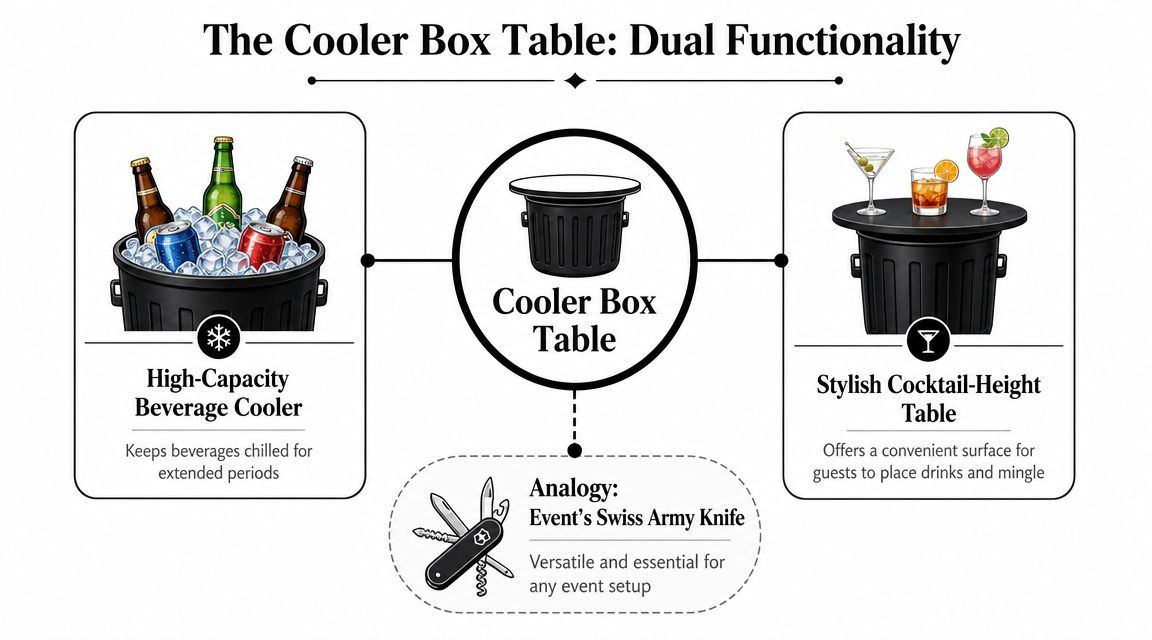
At its simplest, a cooler box table is the Swiss Army knife of party furniture. It stores ice and drinks like a cooler, then converts into a usable table surface for guests. That dual role is what makes it so useful on event day.
A normal cooler chest asks you to choose function over appearance. A normal cocktail table asks you to solve drinks storage somewhere else. A cooler box table combines both, which is why it works so well in elegant but practical event setups.
How the mechanism usually works
Most units follow the same basic logic:
- Insulated base that holds ice and beverages.
- Lift-up or telescoping lid that rises and locks into position.
- Stable top surface that acts like a side table or cocktail table.
- Easy access so guests can help themselves without unpacking the whole setup.
That matters because it removes clutter. You don't need a separate side table for glasses and a separate tub for cold drinks if one item can cover both jobs.
What problem it solves on real events
The value isn't just that it's clever. It's that it reduces friction.
A few examples make this clear:
- At a wedding welcome area, it becomes a self-serve water and tonic station while still reading as furniture.
- At a braai or private party, it works as a drinks point without adding another table to an already tight patio.
- At a corporate activation, it creates a compact branded touchpoint that doesn't look like back-of-house equipment.
Guests treat a cooler box table differently from a loose cooler. They approach it, gather around it, and use it as part of the room.
What it is not
It's not a replacement for every bar format. If you're serving full cocktails, wine service, or high-volume spirits, you still need staffed bar infrastructure. It's also not ideal when the planner expects one unit to carry an entire event's beverage load from start to finish.
Where it struggles:
- Formal plated service: It helps with support drinks, not table-by-table service.
- Huge single-point demand: It's better distributed across a venue than overloaded in one location.
- Poor styling choices: If it's overfilled, dripping, or ringed with empty bottles, it starts looking utilitarian.
The winning approach is to treat the cooler box table as a guest-facing service point. Not a substitute for planning, but a compact tool that makes planning look effortless.
Sizing and Technical Specifications for Planners
On site, the wrong size shows up fast. A unit that looks compact on a product page can block a path on a terrace, sit awkwardly on uneven lawn, or leave guests stooping for every refill. Good planning starts with how people will move around it, not with litres alone.
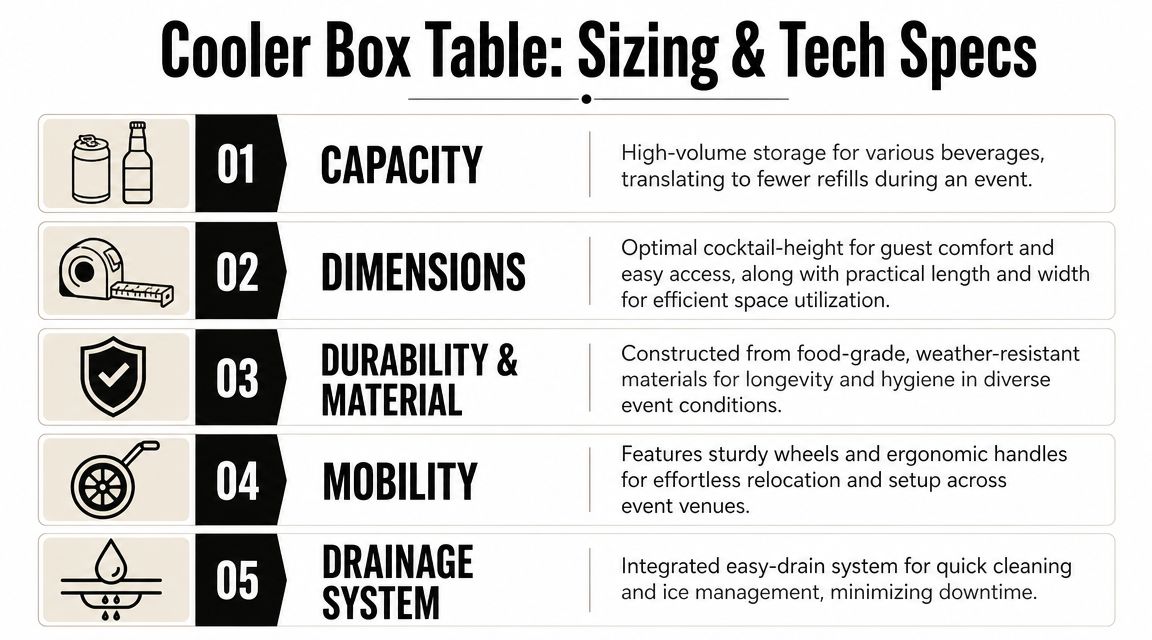
A useful benchmark is the Keter Cool Bar, which has a 49.5 × 49.5 cm footprint and a lid that extends 27 cm, according to the Keter Cool Bar product specification. For Cape Town and Winelands events, that compact base matters because it gives you another guest-facing refreshment point without asking the venue for a full bar footprint.
Footprint and layout reality
A 49.5 × 49.5 cm base fits into the kind of spaces planners often need to activate. Patio edges, pool decks, ceremony exit routes, tasting room courtyards, and lounge pockets all benefit from a drinks point that does not dominate the floor plan.
That small footprint solves a service design problem. Guests get refreshments closer to where they are already standing, which reduces unnecessary trips back to a central bar and helps keep mingling zones alive. At dispersed venues, that matters more than raw storage volume.
For planners working through spacing and guest flow, the principles used in mastering wedding table design apply here as well. A cooler box table becomes part of the room plan, so you still need enough clearance for approach, opening height, and people gathering around it without pinching circulation.
Height and guest comfort
The 27 cm lid extension changes how the unit performs in use. Closed, it reads as a compact table. Opened, it becomes a practical standing-height service point for drinks, water, or mixers.
That is a strong fit for cocktail hours, outdoor ceremonies, and pre-reception lawns where guests are moving in short bursts and need somewhere convenient to set down a glass. It is a weaker fit beside low lounge seating or in narrow passages where the raised lid starts competing with people's shoulders and sightlines.
Ground conditions matter too. I treat lawn, gravel, cobbles, and timber decks differently because a cooler table only feels polished when the top surface stays stable once loaded with ice and bottles.
Capacity in service terms
Capacity should be read as service reach, not just storage. One patio-style cooler table in this category holds enough drinks for a small guest cluster, which makes it useful as a local support station rather than the main event bar.
That distinction saves planners from a common mistake. If one unit is expected to carry a whole function, guests queue, lids stay open too long, ice burns off faster, and the station starts looking picked over. If the same unit is assigned to a defined zone, such as a lawn game area, shuttle drop-off point, or welcome court, it works hard and still looks tidy.
A simple planning read looks like this:
| Spec | What it means on event day |
|---|---|
| Compact square footprint | Easier to place near guest clusters without crowding the venue |
| Rising lid | Better standing access and a more usable surface for quick drink service |
| Mid-size cooler cavity | Best for satellite refreshments, water, mixers, or canned beverages |
If you're weighing portable cooling against powered equipment, this guide to bar refrigerator sizes for event setups is useful for deciding when to use chilled back-up stock and when a cooler box table can handle guest-facing service on its own.
The sizing mistake planners make most often
Planners sometimes size the unit for how much stock they want on hand, instead of how the station will behave once guests arrive.
A cooler box table works best as a distributed service tool. Use it to shorten walking distance, support informal mingling, and relieve pressure on the main bar. For Cape Town events with terraces, lawns, and split-level venue areas, several well-placed units usually serve guests better than one oversized drinks point at the centre.
Styling a Cooler Box Table for Weddings and Corporate Events
Guests step off the shuttle in Franschhoek or drift out onto a Constantia lawn, and the first five minutes decide the mood. If the refreshment point feels awkward, people hover, wait, or head straight for the main bar. If it feels considered, they settle quickly, pick up a drink without friction, and start talking.
Function gets a cooler box table onto the floor plan. Styling makes it feel intentional, and that matters because this piece often sits in the exact zones where guest experience can either loosen up or stall.
For a Stellenbosch or Franschhoek wedding
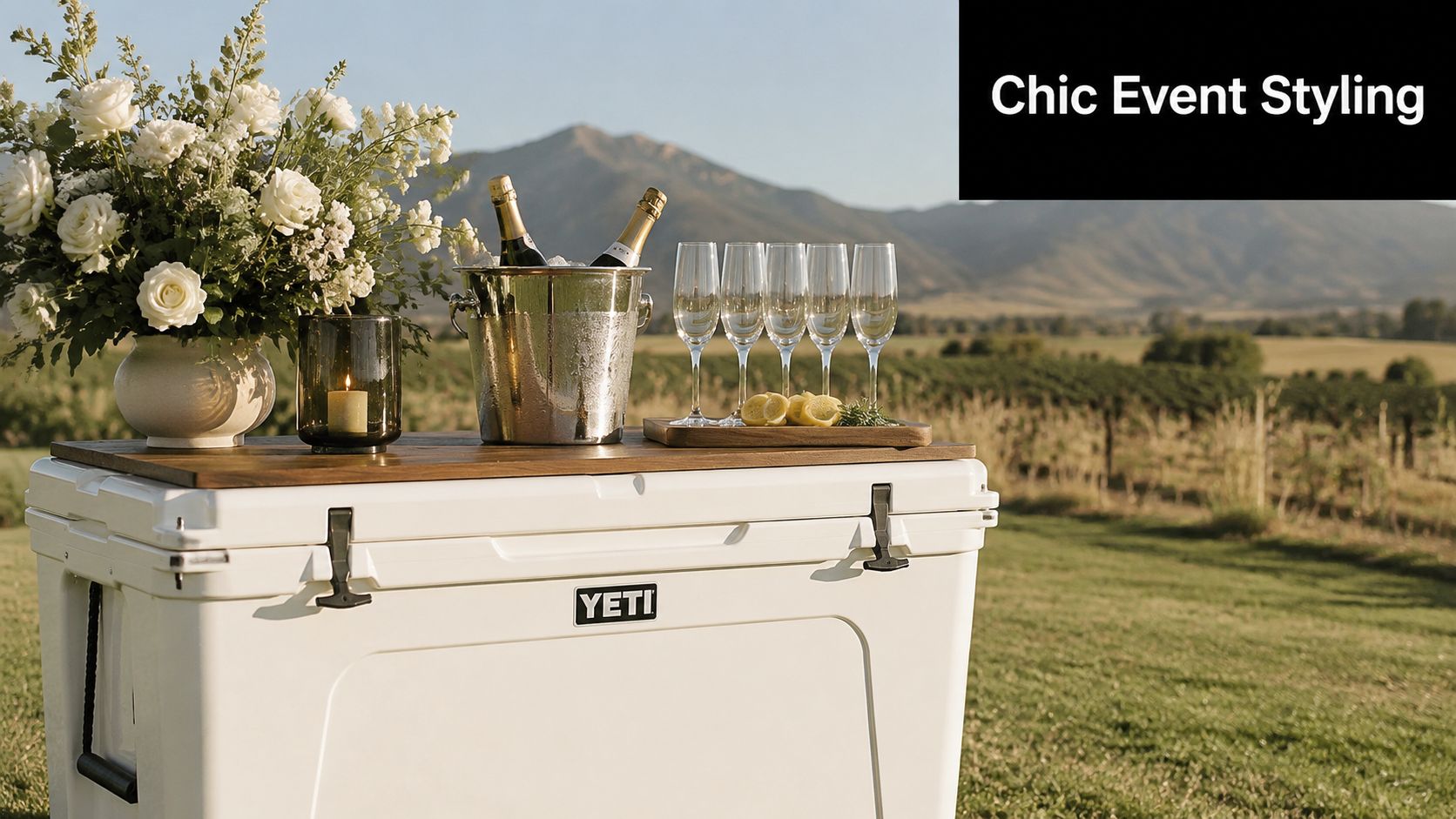
At a wedding, the cooler box table works best as a small hospitality moment. Guests should read it in seconds. Water here. Spritz there. Garnish within reach. No hunting, no clutter, no uncertainty about whether they're allowed to use it.
The strongest setups keep the top surface disciplined. One low floral detail that matches the palette, one drinks direction, and glassware that belongs together is usually enough. Once couples start loading the surface with signage, mixed bottles, scattered fruit, and extra décor, the table stops helping service and starts looking like overflow.
A wedding-ready version often suits welcome drinks, post-ceremony mingling, or a late-night soft drink pocket away from the dance floor. In Cape Town and the Winelands, that distributed approach helps because guests rarely stay in one neat cluster for long. They spread across lawns, terraces, courtyards, and firepit areas.
Good choices for wedding styling include:
- A single drink story: G and T, spritz, canned cocktails, still and sparkling water, or soft drinks
- Restrained garnish: Citrus, rosemary, cucumber, or edible florals in small, tidy quantities
- Matching glassware: One style reads better than a mix of leftovers
- Clear social support: If the station needs a stronger mingling zone, pair it with nearby bar tables and chairs for events
I usually advise couples to style for guest behaviour, not for a photo alone. If 40 people are likely to pass through that area in 20 minutes, every decorative choice has to leave enough working room for lids, ice, bottles, and hands.
For a Cape Town corporate function
Corporate events need a cleaner read. The cooler box table should support movement and conversation, especially at launches, terrace networking sessions, and split-room functions where the main bar cannot carry every interaction.
Branding works best when it is controlled. Use one brand colour, one concise message, and products that make sense together. Branded water, premium soft drinks, or canned mixers usually perform better than a mixed assortment that feels like leftover stock from three suppliers.
What works well:
- Brand colour blocking
- Neat, repeated product facings
- Minimal top styling
- A station purpose guests understand immediately
What tends to fail:
- Too much branding, which makes the setup feel promotional instead of hospitable
- Stock that does not match the tone of the event
- Styling that ignores service flow and leaves no room for guests to serve themselves comfortably
There is also a planning benefit here. A well-styled cooler box table creates an informal refreshment node without the cost and footprint of a full secondary bar. For teams solving event planning challenges, that is often the difference between a room that bottlenecks and one that keeps moving.
A cooler box table should sharpen the service idea of the space. If guests can tell what it is for, reach it easily, and feel comfortable lingering nearby, the styling is doing its job.
Smart Placement and Logistics for Cape Town Venues
Placement decides whether a cooler box table feels well-integrated or pointless.
On Cape Town events, the best use is rarely “put it somewhere with drinks.” The better question is where guests naturally slow down, gather, or break away from the main crowd. That's where the unit starts working for you. It should intercept movement, not compete with the main bar.
Use it as a hydration station, not a backup bin
In event supply discussions, the cooler box table is increasingly framed as a hydration station that can “relieve the need for additional staff” at self-serve functions, a practical angle noted in this roofed cooler-box station reference. That's especially useful for Cape Town and Winelands events where labour budgets, long walking distances, and queue management all matter.
That doesn't mean replacing your bar team. It means protecting them from low-value interruptions such as repeated water requests, canned soft drinks, or basic self-serve refreshments.
The placements that work best
A cooler box table performs well in these zones:
- Ceremony-to-cocktail transition areas: Guests arrive thirsty and don't want to join a queue immediately.
- Dance floor edges: A quick grab point keeps people in the energy of the room.
- Outdoor lounges and terraces: These spaces often feel detached from the main service point.
- School function foyers or courtyards: Students and parents move constantly, so decentralised drinks access helps.
- Brand activation pockets: One central bar often creates a dead queue rather than conversation.
For planners wrestling with broader movement, timing, and setup issues, this article on solving event planning challenges through logistics thinking is a useful companion because it looks at flow as a systems problem, not just a checklist.
Local venue realities that change the setup
Cape venues are rarely neutral boxes. Wine farms have gravel, lawns, and uneven transitions. Heritage buildings have tight doorways and awkward corners. Coastal properties bring wind and salt into every practical decision.
That means the cooler box table should be placed with a few essential considerations in mind:
| Placement check | Why it matters |
|---|---|
| Level surface | A raised lid needs a stable base |
| Clear access around the unit | Guests shouldn't crowd a narrow passage |
| Shade where possible | Better for guest comfort and easier service management |
| Visible but not central | It should support the room, not hijack it |
A common mistake is placing one right beside the main bar. That usually adds clutter without reducing pressure. Move it to the outer ring of activity and it starts doing real work.
Your Cooler Box Table Rental Checklist and FAQs
Hiring a cooler box table is straightforward when you ask the right questions. Most problems don't come from the concept. They come from poor fit, tired units, or vague delivery planning.
For outdoor Cape events, material durability matters more than many clients realise. Finishes, fasteners, trim, and cladding need to cope with sun, transport, and coastal air. The material discussion around a practical build using stainless steel fittings and an aluminium top in this outdoor cooler box build example points to the core issue. Longevity depends on what the unit is made from, not just how it looks on day one.
Cooler Box Table Rental Checklist
| Checklist Item | Why It Matters |
|---|---|
| Ask how the units are cleaned between hires | Guest-facing drink stations need to arrive hygienic and presentation-ready. |
| Confirm whether the lid locks securely in table mode | A table surface that feels loose creates risk in busy mingling areas. |
| Check the material finish for outdoor use | Sun, transport, and moisture expose weak finishes quickly. |
| Ask about metal fittings and fasteners | Coastal air is hard on poor-quality hardware. |
| Confirm delivery access at the venue | Farms, stairs, gravel paths, and narrow passages can complicate setup. |
| Ask whether drainage and emptying are simple | Breakdown should be fast, especially on short turnaround events. |
| Clarify whether it's best used for self-serve or staffed support | The answer affects placement, stock, and guest flow. |
| Plan backup cooling if the event has long service hours | Portable cooling supports service well, but it still needs refill logic. |
If your event includes multiple beverage zones, it also helps to understand how portable cooling fits alongside larger cold-storage options such as mobile fridge hire for events.
FAQs planners actually ask
How long does the ice last
That depends on weather, stock rotation, lid use, and how often guests open the unit. There isn't one fixed answer that suits every event. In practice, planners should treat a cooler box table as a service point that needs replenishment planning, especially on warm outdoor functions.
Can it be used for food
It's best thought of as a beverage and hydration solution unless the hire company specifically confirms suitable food-safe use for your application. On most events, drinks are the cleaner and more reliable role.
Is it formal enough for a wedding
Yes, if it's styled properly and placed with intent. It looks elegant when it forms part of a drinks experience. It looks temporary when it's treated like hidden storage.
Is it worth using if there's already a main bar
Usually, yes. Its value is in reducing unnecessary trips and queues, especially for water, canned drinks, mixers, and informal grab-and-go service.
The smartest hires are the ones guests barely notice as equipment. They just experience the event as smoother.
A cooler box table does exactly that when the planner uses it to shape movement, reduce bar congestion, and create natural social pockets.
If you're planning an outdoor wedding, corporate function, school event, or private celebration in the Cape, ABC Hire can help you choose the right furniture and service pieces for a cleaner, smoother setup. Ask for a quote based on your venue layout, guest flow, and beverage plan, not just a product list.