

You’ve found the venue. The mountain view is perfect, the wine farm says sunset photos will be spectacular, and the guest list keeps changing by the day. Then the practical questions land all at once. How many tables fit without cramping the room? Which chairs look right in a cellar, on a lawn, or under a clear marquee? Can the delivery truck get to the site without drama?
That’s where generic advice falls apart. Renting furniture for an event in Cape Town isn’t the same as planning in a flat city with predictable weather and easy loading bays. Here, one event might be on a Clifton rooftop with limited lift access, the next on a Stellenbosch estate with gravel roads, and the next on an exposed lawn where the Cape Doctor can undo a weak setup in minutes.
Tables and chairs are not a minor line item. They’re the base layer of the whole event experience, and in the South African party supply rental market they accounted for about 29.65% of total rental revenue in 2023, driven by wedding and corporate demand in places like Cape Town and the Winelands, according to Grand View Research’s party supply rental market report. That tracks with what planners deal with on the ground. If the furniture choice is wrong, the room feels wrong, service slows down, and guests notice.
This guide is built for Cape Town conditions. It deals with wine estates, city venues, wind, access, style choices, and the budgeting logic behind the quote you receive. If you need to rent tables and chairs for a wedding, brand launch, matric dance, birthday, or corporate dinner, this is the practical version.
Planning Your Cape Town Event The Smart Way
A Cape Town event usually starts with a beautiful idea and runs straight into a logistics problem.
A couple wants long harvest tables under oak trees in Constantia. A corporate team wants a polished dinner setup inside a Stellenbosch cellar. A school wants a formal look for a matric dance, but the hall has awkward pillars, a narrow side entrance, and no proper storage space for early delivery. None of those events fail because the vision was poor. They fail when someone treats furniture as an afterthought.
Start with the venue, not the Pinterest board
The first decision isn’t chair colour or table shape. It’s whether the furniture will suit the actual site.
Cape Town venues vary wildly. A CBD venue may have stairs, strict loading times, and almost no room for back-of-house stacking. A Winelands venue may have enough open space, but the surface could be lawn, gravel, brick, or uneven ground near a vineyard edge. A beachside venue may look relaxed and simple, but salt air and wind make “simple” setups harder than they appear.
That’s why the smartest planners ask these questions first:
- Access reality: Can a truck reach the drop-off point easily, or is there a long hand-carry section?
- Surface condition: Will standard chair legs sink into grass or sit unevenly on gravel?
- Weather exposure: Is the dining area protected, partially exposed, or fully outdoors?
- Venue rules: Are there fixed setup windows, noise restrictions, or staff requirements?
A beautiful venue doesn’t make furniture planning easier. In Cape Town, it often makes it harder.
Comfort drives the event more than people expect
Guests forgive many things. They don’t forgive discomfort.
If tables are too large for the room, service becomes clumsy. If chairs feel flimsy, the event looks cheaper than it should. If the setup ignores sun, wind, or awkward circulation paths, people spend the evening adjusting themselves instead of enjoying the event.
The practical move is to work from the guest experience backwards. Ask how long people will be seated, whether they’ll dine formally or mingle, and how much movement the event needs. A wedding reception, a conference lunch, and a milestone birthday all need different furniture logic, even if the headcount is similar.
Local planning beats imported advice
A lot of online content about how to rent tables and chairs comes from overseas markets. It doesn’t help much when your real issue is a steep Franschhoek driveway, a lawn ceremony that shifts to dinner service, or a windy cocktail hour at a wine estate.
Cape Town events reward planners who think locally. Choose furniture that fits the venue style, survives the conditions, and arrives in a way the site can handle. That’s the difference between a setup that photographs well for ten minutes and one that works for the entire event.
Matching Furniture Styles to Your Event and Venue
Style matters, but not in isolation. The best furniture choice is the one that looks right and behaves properly in the venue you’ve booked.
In South Africa’s party rental market, chairs and tables hold a 58% market share as of 2024, with 27% growth in demand for high-end furniture, especially premium resin and Chiavari styles in Cape Town’s event scene, according to Market Reports World’s party and event rental market report. That demand makes sense. Clients don’t want functional furniture only. They want furniture that helps define the room.

Formal weddings and polished receptions
For vineyard weddings, cellar dinners, and black-tie functions, refined chair styles usually carry the room. Chiavari chairs work well when the brief is elegant and structured. They suit formal florals, layered place settings, and venues with classic architecture.
Resin chairs are useful when you want a clean look without pushing too far into ornate territory. They’re especially practical for venues that blend indoor and outdoor elements, because they sit visually between formal and functional.
Use this style family when the event includes:
- A plated dinner: Guests stay seated for longer, so visual consistency matters.
- A ceremony-to-reception flow: The same chair may need to work in more than one setup.
- A high-detail décor scheme: Fine furniture lines support candles, linens, and floral work rather than fighting with them.
One mistake shows up often. People choose a luxury chair, then pair it with a table that doesn’t match the tone. Elegant seating and purely utilitarian trestle tables can work, but only if the styling plan is intentional.
Corporate events and clean layouts
Corporate furniture should look sharp without becoming fussy.
Rectangular banquet tables usually make more sense for conferences, training days, staff functions, and gala dinners where room efficiency matters. They’re straightforward to lay out, easier for AV teams and caterers to work around, and better suited to spaces where every square metre counts. In venues around the city and Paarl, they often solve more problems than round tables.
For launches or networking functions, cocktail tables can create movement. They give people somewhere to rest a drink and still keep the room social rather than static.
A good corporate setup usually prioritises:
- Fast guest flow through registration, refreshments, and seating
- Visual neatness for presentations, branding, and photography
- Flexible reconfiguration if the room shifts from talk to networking
If the event has a more natural brief, wooden tables and chairs for events in Cape Town can soften a corporate setup and stop it from feeling too generic.
Lifestyle parties, birthdays, and matric dances
Private events give you more freedom, but they still need discipline. A birthday in Camps Bay and a matric dance in the Southern Suburbs don’t call for the same furniture, even if both need impact.
Cocktail tables help when people will mingle, dance, and move between zones. Lounge-style pieces can work for relaxed celebrations, but they need enough supporting surfaces nearby. Too many soft seating pieces without practical table space creates clutter fast.
LED furniture is where evening events can become far more memorable. It works best when used as a deliberate design feature, not as random novelty. LED cubes, benches, or glowing poseur tables can define an entrance, bar area, dance-floor edge, or after-dark lounge section. For school formals and brand activations, that lighting effect can do a lot of visual work with relatively few pieces.
Practical rule: Choose one dominant furniture style, then add one feature element. Don’t mix three or four statement styles in the same room unless a stylist is controlling the entire design.
Quick Guide to Table Types and Seating Capacity
| Table Type | Shape | Common Sizes (Cape Town) | Seats | Best For |
|---|---|---|---|---|
| Banquet table | Rectangular | 6ft and 8ft | Varies by layout | Corporate functions, buffet lines, formal halls |
| Round banquet table | Round | Standard event sizes | 6 to 10 guests | Weddings, social dinners, conversation-focused seating |
| Cocktail table | Round standing table | High table format | Standing use | Launches, birthdays, networking |
| Harvest-style table | Rectangular | Long communal format | Depends on table length | Vineyard weddings, rustic events |
| Café-style table | Small round or square | Compact footprint | Small groups | Breakaway spaces, lounge corners |
The strongest event rooms don’t “have enough seating”. They use furniture to support the tone of the venue. A Cape Town wedding on a wine farm should feel rooted in the setting. A Waterfront product launch should feel crisp and deliberate. The right furniture makes that happen.
Calculating How Many Tables and Chairs You Really Need
Most furniture mistakes aren’t style mistakes. They’re maths mistakes.
A room can have beautiful tables, excellent chairs, and expensive décor, yet still feel cramped or oddly empty because the layout was guessed. In local event planning surveys, 70% of layout failures stem from unassessed spatial constraints, according to this guide to renting party tables and chairs. That’s exactly why a venue walkthrough matters so much in Cape Town, where pillars, uneven courtyards, cellar walls, garden edges, and awkward service routes are common.

Start with guest count, then add breathing room
For seated dinners, which are common in Winelands weddings, the clean rule is one chair per guest plus 10% spares, and that same source notes that seated dinners are common in 65% of Winelands weddings. The spare chairs matter more than people think. Last-minute guest changes, supplier meals, ceremony repurposing, and family seating adjustments all happen.
For round table planning, the same source notes that round tables seating 6 to 10 guests are used in 55% of Stellenbosch receptions. Round tables work well when conversation is part of the experience. Long rectangular layouts tend to suit formal programmes, narrower rooms, and family-style dining.
Use this sequence when you calculate numbers:
Lock the working guest count
Don’t work off the first invite list. Use the latest realistic attendance number.Choose the event format
Full seated meal, mixed seating, or mostly standing. The format changes everything.Select the table shape
Round tables favour conversation. Rectangular tables often use space more efficiently.Add spare capacity
Extra chairs solve more event-day issues than extra tables.
The spacing rules that stop a room feeling tight
Guests don’t experience your floor plan as a drawing. They experience it as leg room, aisle clearance, and whether they have to scrape past someone every time they stand up.
The practical measurements from the same guide are essential. Allow 5 to 6 ft aisles for movement, especially where waiters, photographers, guests, and venue staff will cross paths. If you’re planning a busy reception, that aisle width protects the evening from constant bottlenecks.
A useful working checklist:
- Chair spacing: Give each guest enough width at the table to sit comfortably.
- Back-of-chair clearance: Make sure people can get in and out without knocking adjacent tables.
- Main circulation route: Keep one obvious route open from entrance to seating area.
- Service access: Don’t force catering staff to squeeze through decorative gaps.
If the room only works on paper when every chair is pushed in perfectly, it doesn’t work.
A practical Cape Town example
Take a Constantia venue with indoor dining and an outdoor pre-drinks area. The instinct might be to maximise the dining room because the guest list feels fixed. That’s usually the wrong approach.
A better approach is to plan the dining room for comfort first. If round tables fit well without pinching the aisle widths, use them. If one extra table destroys the flow between the kitchen door and the guest area, remove it and revise the seating mix. It’s better to have one slightly larger table than a room that staff can’t move through smoothly.
For mixed-format events, map the zones before counting furniture:
- Arrival zone: welcome drinks, check-in, or guest waiting area
- Main seating zone: dining or formal programme
- Service zone: buffet, bar access, clearing route
- Overflow zone: a small area for last-minute changes or moved furniture
That’s also why it helps to review chair hire options for different event formats before finalising numbers. The physical footprint of the chair affects the room more than many planners expect.
What works and what doesn’t
What works is a floor plan tested against the actual venue. That includes columns, doors, DJ position, dance floor, gift table, cake table, and any weather backup plan.
What doesn’t work is copying an online seating chart from another country and hoping it translates to a Cape Town site. A wine estate lawn, an urban loft, and a school hall need completely different furniture density. The right quantity is never just about guest count. It’s about guest count plus movement, service, and the actual shape of the venue.
Decoding Rental Prices and Crafting Your Budget
Furniture pricing feels confusing when you only look at the per-item rate. The smarter way is to understand how rental companies build the quote in the first place.
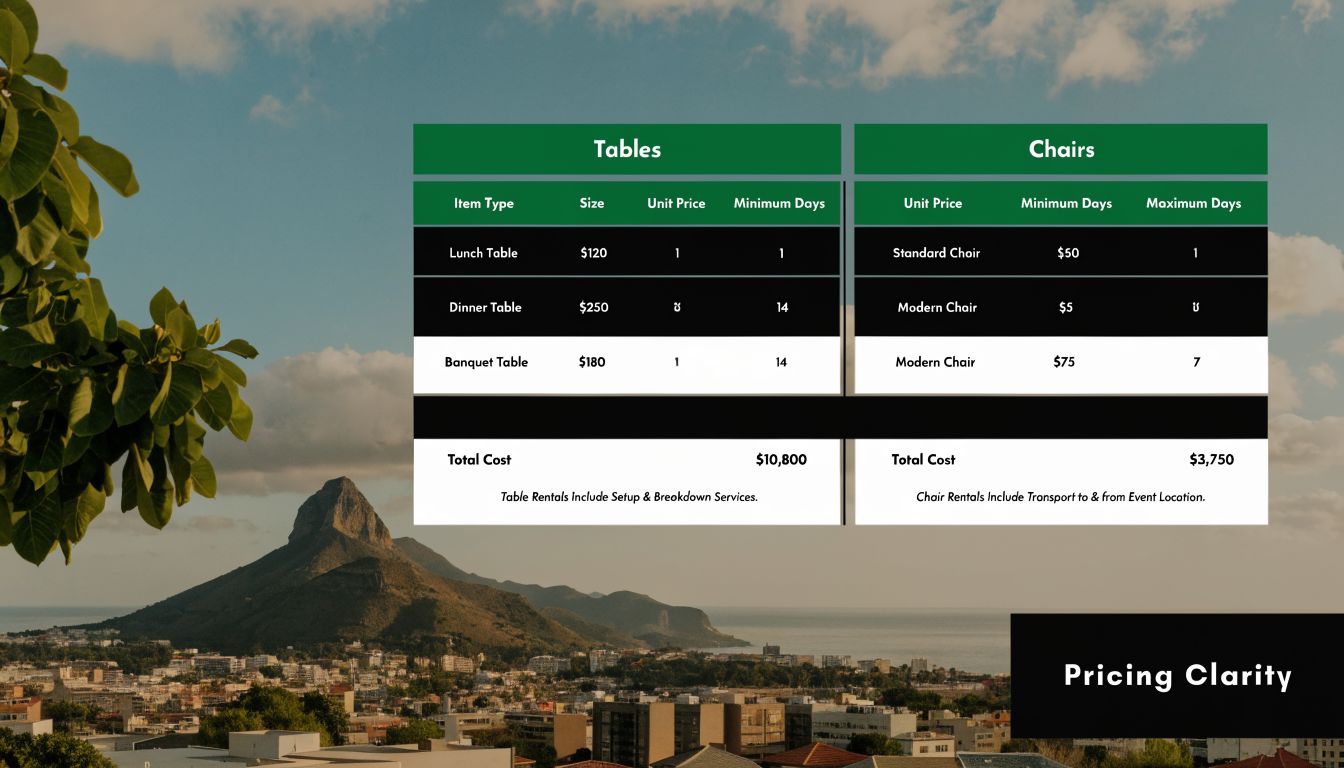
A common pricing method starts with a base rate of 10% of the item’s purchase cost, then adjusts for transport and timing. In the local methodology cited by RentMy’s guide on starting a table and chair rental business, that often means a 15% premium for Winelands transport and a 20% premium during the November to March peak period. If you’re planning in Cape Town, especially for Stellenbosch, Franschhoek, or Paarl, that structure makes practical sense.
What the quote is really covering
You’re not only paying for a chair or a table. You’re paying for inventory ownership, cleaning, transport, handling, risk, and timing.
In Cape Town, delivery can be straightforward or difficult. A city hotel with a loading bay is one thing. A wine farm with distance between parking and setup area is another. The furniture may need to be carried further, handled more slowly, or delivered in a tighter time window because the venue limits supplier access.
That’s why two similar-looking quotes can differ. One supplier may be pricing for clean access and standard timing. Another may be pricing for stairs, gravel, long walking distances, or an event date in the busiest months.
Build your budget in layers
The easiest way to avoid surprises is to budget the furniture in categories rather than as one total.
Use this structure:
- Core hire items: tables, chairs, and any feature furniture such as cocktail or LED pieces
- Transport: delivery and collection, especially for outlying areas
- Setup and breakdown: if the venue or event schedule needs labour at specific times
- Risk items: deposits, damage terms, or replacement charges if something goes missing
- Change margin: a small cushion for late guest-count shifts or layout adjustments
A lot of event budgets break because planners compare line one only. They focus on the cheapest chair rate and ignore the operational cost around it.
Budget note: The cheapest furniture quote often becomes the most expensive one once access issues, timing, and service gaps appear.
For broader budgeting discipline, these essential financial tips for event planners are worth reviewing before you approve suppliers and lock the final event scope.
Where people overspend and where they shouldn’t cut
The most common overspend is hiring premium furniture for every zone when only one zone needs it. If the hero space is the reception area, put the visual weight there. A service corridor, supplier meal area, or hidden prep zone doesn’t need the same treatment.
The most damaging cost-cutting usually happens in transport and setup assumptions. Clients assume furniture will “just arrive” and somehow be in place. In Cape Town, that assumption causes friction quickly. If access is tricky, if the venue has fixed delivery slots, or if weather may force a fast layout change, service matters as much as style.
Good budgeting is less about chasing the lowest number and more about matching spend to importance. Put money where guests see, use, and feel it.
Mastering Logistics From Delivery to Collection
Good event furniture doesn’t rescue bad logistics. In Cape Town, logistics decides whether the setup looks effortless or frantic.
Local knowledge matters most. A supplier can have attractive inventory and still struggle badly if they don’t understand the region’s venues. The Western Cape has narrow estate roads, steep driveways, old buildings with limited access, lawns that turn soft after irrigation, and weather that shifts fast. Anyone can promise delivery. Not everyone can deliver cleanly under local conditions.

Cape Town problems that generic guides ignore
A few examples come up again and again.
Franschhoek estates often involve long private roads, tight turns, and unloading points that aren’t close to the event area. Stellenbosch farm venues can look easy on a map but involve gravel stretches, uneven surfaces, and strict timing because multiple suppliers are sharing access. In the city, the challenge changes. There it may be basement loading, passenger lifts, security check-ins, or no parking near the entrance.
Outdoor sites add another layer. Wind changes table placement, lightweight décor choices, and the time required to secure a setup. On lawns, chair stability matters. On exposed patios, the layout has to account for guest comfort, not just symmetry.
What a strong rental process looks like
The reliable process is unglamorous, but it works.
Before event day, confirm the actual delivery route, not just the venue address. Ask where the truck parks, where items are offloaded, how far staff must carry them, and whether any gate, staircase, lift, or path changes the plan. A proper logistics conversation also includes collection. Late-night collections, next-morning pickups, and venue lock-up times all affect how the event closes.
Check these points before approving the order:
- Vehicle access: exact route, gate width, and unloading area
- On-site path: stairs, slopes, gravel, grass, or long carrying distances
- Setup window: when the venue allows furniture in
- Weather backup: indoor fallback or revised plan for exposed spaces
- Collection timing: same night or next day, and who signs off
Local experience shows up in the questions a supplier asks before they arrive.
Why venue familiarity matters
A supplier who has worked repeatedly in Cape Town and the Winelands usually spots trouble early. They know that one venue’s lawn drains poorly, another venue’s side gate saves time, and another site’s cellar access means furniture must be loaded in a specific order. That knowledge reduces stress because fewer decisions are left to event day improvisation.
What doesn’t work is treating logistics as admin. It isn’t. It’s operational design. If the furniture arrives late, arrives in the wrong loading sequence, or can’t be positioned efficiently, the florist, planner, caterer, and venue team all feel the knock-on effect.
Choose the rental partner that understands local roads, local weather, and local venue behaviour. In Cape Town, that’s not a nice extra. It’s part of the product.
Your Ultimate Rental Checklist and Top Questions Answered
By the time you’re ready to place the order, most problems are avoidable. The key is to confirm the details that people usually rush.
A proper rental process isn’t only about choosing attractive furniture. It’s about making sure the style, quantity, access, timing, and terms all line up. If you want one planning document that helps you keep those moving parts under control, this event planning checklist template for Cape Town functions is a useful companion.
The rental checklist that prevents last-minute issues
Use this list before you confirm your hire:
- Finalise the actual guest count: Work from your most current RSVP picture, not your original invite estimate.
- Confirm the event format: Ceremony only, seated dinner, cocktail event, or a mix. Furniture numbers depend on this.
- Measure the venue properly: Include awkward corners, pillars, service doors, bars, stages, and dance floor requirements.
- Choose furniture for the site: Match chair and table style to terrain, weather exposure, and venue tone.
- Review access with the venue: Don’t assume trucks can get close to the setup point.
- Check setup and collection timing: Make sure the venue, planner, and supplier all have the same schedule.
- Ask about cleaning and condition standards: You want to know how furniture arrives and what happens if weather affects it.
- Understand the damage terms: Clarify breakage, loss, stains, and who signs off after the event.
- Plan a backup layout: Especially for outdoor Cape Town events where wind or weather can force changes.
- Keep a small flexibility margin: Guest counts and floor plans often move slightly in the final days.
Questions clients ask right before booking
How far in advance should I book?
As early as possible if your event falls in the busy season or uses premium furniture styles. Peak dates in the Winelands and city event calendar go quickly, especially when weddings, brand events, and school functions overlap. If your venue is popular and your furniture style is specific, don’t leave booking until the final stretch.
Can I change the order later?
Usually yes, but changes become harder as the date gets closer, especially once delivery routes and loading plans are scheduled. Small adjustments are often manageable. Large style changes or major quantity shifts are more disruptive because inventory may already be allocated elsewhere.
Should I rent extra chairs even if my guest list looks stable?
Yes. A modest spare allocation helps with family reshuffles, supplier seating, ceremony transfers, and late confirmations. Running short on chairs causes immediate stress. Having a few extra rarely does.
Order for the event you’ll actually run, not the perfectly controlled version you hope for.
Are round tables or long tables better for Cape Town weddings?
It depends on the room and the mood. Round tables usually help conversation and suit classic receptions. Long tables can look striking in wine estates, courtyards, and rustic venues, but they demand more discipline in room planning. Neither is automatically better. The venue should decide with you.
What should I tell the rental company upfront?
Give the full picture early. Share the venue name, whether the setup is indoors or outdoors, the likely guest count, access limitations, event timing, and any styling direction already decided. If the site has stairs, gravel, lawn, or wind exposure, say so from the start. That’s the information that shapes the right quote and the right operational plan.
Final decision filter
Before you sign off, ask three simple questions.
Does the furniture suit the venue?
Does the quantity suit the room?
Does the delivery plan suit the site?
If the answer to all three is yes, you’re in a strong position. If even one is fuzzy, fix that before you pay the deposit. Furniture hire looks simple from the outside. In Cape Town, the details decide everything.
If you need a rental partner that understands Cape Town venues, Winelands logistics, and the practical side of stylish event setups, ABC Hire is well placed to help. From weddings and corporate functions to matric dances and private celebrations, the team can guide you on the right tables, chairs, LED furniture, and delivery plan for your specific venue and event format.