
The problem usually starts at the best moment of the event.
The sun drops behind the Stellenbosch mountains, the speeches are done, the band starts to sound better, and guests drift outside with a glass in hand. Then the temperature turns. Not dramatically. Just enough that shoulders tighten, older guests head indoors, and the outdoor area you paid to style so carefully suddenly empties.
That’s why outside patio heaters matter so much in Cape Town and the Winelands. Our weather doesn’t usually ruin an event in one obvious blow. It chips away at guest comfort through evening chill, moving air, exposed courtyards, and venues that feel sheltered in daylight but very different after dark.
Generic heating advice misses that local reality. A planner in Franschhoek doesn’t need broad lifestyle content about “creating cosy ambience”. They need to know which heaters still perform when the breeze picks up, how to place them around lounge pockets, what to do when power reliability is a concern, and when renting is smarter than owning.
Keeping Guests Warm The Ultimate Guide to Outside Patio Heaters
A polished outdoor event can still fall short. The food is right, the lighting is right, the florals are right, but guests still migrate away from the space you wanted them to use. In practice, temperature is often the reason.
Cape Town planners know this pattern well. Rooftops in the city bowl, wine estate courtyards, garden ceremonies that turn into evening receptions, and school functions on open lawns all have one thing in common. They look better outdoors than indoors, but they need active heating if you want guests to stay comfortable.

The wider market tells the same story. The global outdoor heating market reached USD 4.44 billion in 2026 and is projected to grow to USD 5.59 billion by 2030, which shows how outdoor heaters have shifted from a luxury item to a practical requirement for hospitality and events, according to outdoor heating market projections from Research and Markets.
What actually changes when heating is planned properly
Well-heated outdoor spaces behave differently during an event. Guests settle instead of circulate nervously. People stay through dessert, speeches, and the dance floor transition. Venue flow improves because you’re not forcing everyone into one indoor fallback space.
That matters for more than comfort alone:
- Wedding timing works better: Sunset photos and first dance moments don’t compete with guests looking for blankets or indoor corners.
- Corporate networking lasts longer: People keep using the terrace instead of abandoning it after the formal programme.
- Venue styling pays off: Lounge furniture, bars, and outdoor dining layouts stay occupied as intended.
Practical rule: If your event relies on an outdoor area after sunset, heating shouldn’t be an add-on. It should be part of the floor plan.
Why local conditions change the decision
In the Cape, warmth on paper and warmth on site aren’t the same thing. A heater that looks powerful in a catalogue can underperform badly if it’s fighting moving air, poor placement, or the wrong layout.
A useful heating plan has to answer real event questions:
- Where will guests stand, sit, queue, and talk?
- Which areas are exposed to wind?
- Is the heat meant to cover dining, a ceremony transition, or a cocktail lounge?
- Are you better served by portable gas units or directional electric infrared models?
Outside patio heaters work best when they’re treated as event infrastructure, not decorative extras. Once you approach them that way, the decisions become far easier and the event feels controlled from the moment the temperature drops.
Choosing Your Heat Source Gas vs Electric Patio Heaters
The first decision isn’t style. It’s how the heat behaves.
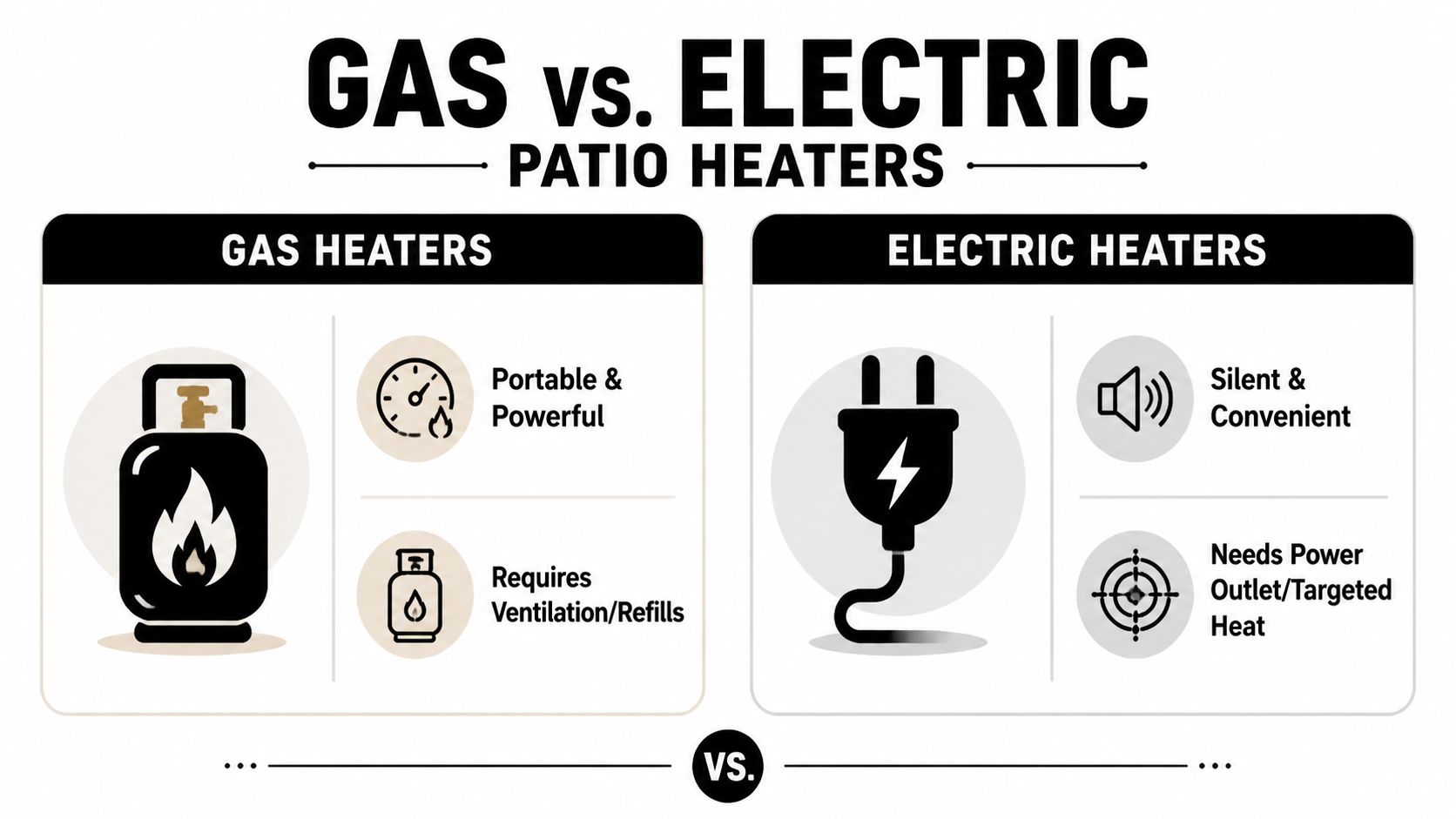
Gas and electric patio heaters warm people in different ways, and that difference becomes obvious at an outdoor event. Gas feels more like a bonfire. It creates a surrounding pocket of warmth. Electric infrared feels more like sunshine. It sends heat toward people and surfaces directly.
When gas heaters make sense
Gas units are the classic event choice for a reason. They’re portable, visually familiar, and easy to place where no power point is available. For open lawns, courtyard edges, and temporary layouts, that flexibility matters.
They also suit events where the heater needs to move with the plan. If the venue team is building a bar extension on one side and a cigar or lounge area on the other, gas gives you more freedom to adapt on site.
Gas is often the practical option when you need:
- Portability: No dependence on nearby electrical supply.
- Fast layout changes: Easier to reposition during setup.
- Traditional event styling: Many clients still like the tall, visible heater format at entrances, patios, and standing areas.
That said, gas isn’t the automatic winner for Cape Town conditions. In exposed spaces, some of that warmth can feel less effective because the air movement strips away comfort faster than expected.
Where electric infrared pulls ahead
Electric infrared is the smarter option in more scenarios than many planners realise. According to electric patio heater performance guidance from Woodland Direct, electric patio heaters convert up to 98% of their energy into radiant heat, warming people and objects directly rather than trying to warm the surrounding air.
That matters in the Western Cape. When the air is moving, radiant heat usually feels more dependable because it’s directed where guests are. It’s also quieter, cleaner in presentation, and often easier to integrate into a polished venue design.
A few practical strengths stand out:
| Heater type | Best use case | Main trade-off |
|---|---|---|
| Gas | Open layouts with limited power access | Needs fuel management and more ventilation awareness |
| Electric infrared | Seated zones, covered areas, windy sites | Needs suitable power access and deliberate placement |
A heater that warms the air can feel impressive beside the unit. A heater that warms the guest usually performs better at the table.
The trade-offs planners should look at first
Don’t choose by product category alone. Choose by event behaviour.
If the event is mostly seated, electric infrared often wins because it can target dining rows, lounge clusters, or specific conversation zones. If guests are moving constantly across a broad area, gas can be useful because it creates more general warmth around circulation spaces.
Also look at operations:
- Setup complexity: Gas needs bottle handling and replacement planning.
- Venue restrictions: Some venues are more comfortable with one heat source than the other.
- Visual impact: Tall gas heaters are visible design elements. Electric bars and mounted units are usually more discreet.
- Power planning: Electric depends on a stable supply, so event managers need to think ahead when power reliability is a concern.
If you’re comparing fuel systems more broadly for outdoor entertaining, this outdoor living fire table fuel comparison is a useful read because it frames fuel choices in plain operational terms.
For planners who want a closer look at portable gas options used for events, ABC Hire’s guide to gas patio heaters is relevant for understanding where that format fits.
What works in real event conditions
For exposed rooftops, breezy terraces, and long seated dinners, electric infrared usually gives more reliable guest comfort. For entrance points, roaming cocktail spaces, and venues without convenient electrical access, gas still has a strong place.
The mistake is expecting one heater type to solve every problem. The better approach is matching the heater to the way the space will be used. That’s what separates a warm venue from a venue that merely contains heaters.
How to Calculate Your Event’s Heating Needs
Most heating problems aren’t caused by buying the wrong unit. They’re caused by underestimating coverage.
Planners often start with the guest count and stop there. That’s understandable, but heaters warm spaces, seating zones, and activity areas. The cleaner starting point is the physical footprint you need to cover.
Start with the BTU rule
A reliable rule of thumb is to multiply the square footage by 20 BTUs. Based on patio heater sizing guidance from BBQGuys, a 1,000 square-foot garden venue would require 20,000 BTUs of heating power.
That gives you a planning baseline. It doesn’t mean one heater is always enough. It means your combined heating output should be built around that requirement.
A simple way to size an event
Use this sequence before you request a quote or sign off on a layout:
Measure the usable event area
Don’t count the whole property. Count the spaces guests will occupy after dark, such as the dining section, bar terrace, lounge area, and walkway between marquee and main building.Apply the BTU formula
Multiply the square footage by 20 BTUs to get your total heating target.Break the space into heat zones
A dinner table section needs different coverage from a standing cocktail cluster. Heating works better when divided into zones than when treated as one big outdoor void.Match output to guest behaviour
If people will sit for long periods, use more deliberate, targeted coverage. If they’ll move around, spread heat across circulation points.
A practical event example
Take a Winelands reception with a dining tent opening onto an outdoor lounge and bar. On paper, the outside footprint may seem manageable. In reality, guests don’t distribute evenly. They gather where the music is lower, where the drinks are, where smokers step out, or where family groups can sit and talk.
That’s why planners should think in layers:
- Dining edge: Keep heat near seated guests, not only at perimeter corners.
- Lounge pocket: Create a self-contained warm zone that invites people to stay.
- Transition routes: Short paths between spaces can feel colder than the main area if left untreated.
Guests remember cold gaps more than warm corners. One neglected transition area can make the whole venue feel underheated.
Range and radius are not the same
This catches people often. A heater’s range is the broader area it can contribute to. Its radius is the distance from the unit where warmth is meaningfully felt.
That distinction changes your layout decisions. A heater may technically cover an area, but if the warm radius doesn’t reach the outer seats or the queue line at the bar, those guests still feel cold.
A useful planning check is to map heaters against these questions:
- Where are people seated longest?
- Where do people stand still instead of moving through?
- Which side of the layout is most exposed?
- Will one unit leave obvious cold pockets between tables or couches?
What works better than one oversized heater
For many events, several properly placed heaters outperform one high-output focal unit. Multiple units let you overlap coverage, protect vulnerable seating groups, and respond to the shape of the venue rather than forcing the venue to respond to the heater.
That’s especially true in L-shaped patios, split-level gardens, and venues with partial walls or planting that interrupts heat flow. Outside patio heaters should follow the event layout, not the other way around.
If you’re unsure, map the venue the same way you’d plan lighting. Start with where guests need to feel comfortable, then build the heat around those exact moments and positions.
Strategic Heater Placement for Safety and Warmth
A good heater in the wrong place is still the wrong heater setup.
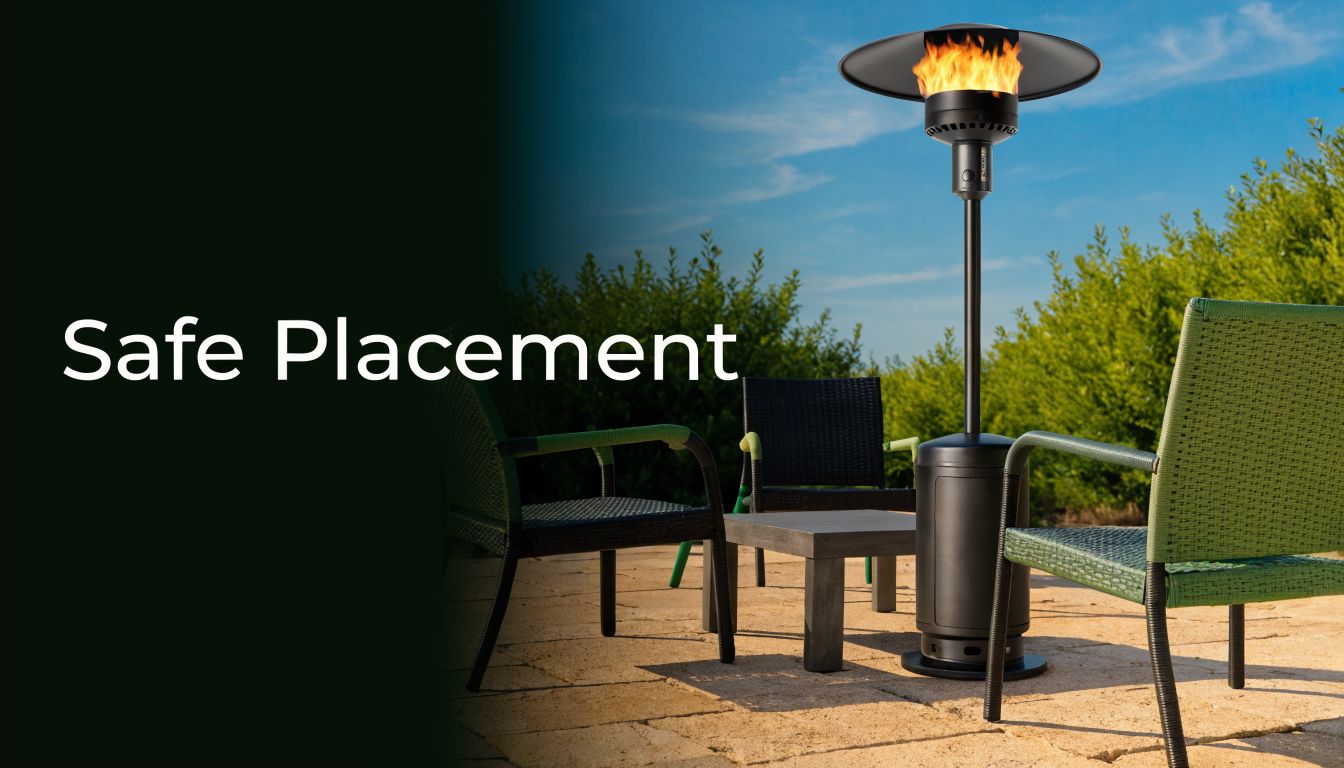
At events in Cape Town, placement decides whether heat reaches guests or disappears into open air. It also decides whether the setup feels polished or becomes an obstacle around service routes, decor installations, and tightly packed furniture.
Start with the non-negotiables
Before you think about warmth, think about clearance and movement. Heaters should never compete with draping, florals, tent lines, low branches, signage, or busy service lanes. A beautiful layout can become awkward fast if waiters are weaving around heater bases or guests are brushing past hot equipment on the way to the bar.
In practical event terms, avoid placing heaters:
- In pinch points: Entrances, buffet approaches, and tight walkway turns
- Near soft styling elements: Drapes, linen-heavy lounges, and hanging decor
- Where guests back into them: Especially around cocktail clusters with no defined seating
- Beside children’s activity zones: Even at family-friendly events, heaters need controlled space around them
Cape Town wind changes everything
Placement in the Western Cape is not just about distance. It’s about direction. According to guidance discussing Cape Town winter wind impact on patio heater performance, average winter wind speeds of 15-25 km/h can reduce the effective heating radius of standard mushroom-style propane heaters by up to 40%.
That’s why a textbook layout often disappoints on site. A heater placed symmetrically for visual balance can still underperform if it’s exposed to the prevailing breeze.
What works better is deliberate positioning:
- Use structures as shields: Walls, planters, pergola edges, and tent sides can help protect heat zones.
- Angle for exposure: Don’t line up every heater in a perfect visual grid if one side of the venue takes the wind.
- Reserve the most protected positions for seated guests: Standing guests can tolerate cooler conditions for shorter periods than diners or older family members.
For planners weighing portable options for patios and entertaining spaces, this guide to gas porch heaters is a useful reference point.
Wind doesn’t remove heat evenly. It finds the weakest edge of the layout first.
Build warm microclimates
The most effective event layouts create small warm zones rather than trying to heat every open square metre equally. Think in terms of lounge pods, dining banks, and sheltered pause points.
Three placements tend to work well:
| Event area | Better placement approach | Common mistake |
|---|---|---|
| Outdoor lounge | Heat the seating cluster directly | Putting one heater too far behind the furniture |
| Dining terrace | Spread units to overlap along seated rows | Heating only the perimeter |
| Walkway or entrance | Warm the arrival or waiting point, not the full path | Trying to heat long open routes end to end |
What doesn’t work
Some setups look logical during daylight and fail completely once the air cools.
Avoid these habits:
- One heater for visual effect only: If it’s acting as decor, it probably isn’t doing enough heating.
- Perimeter-only planning: Guests usually feel the cold in the middle gaps and exposed corners.
- Ignoring the late-night shift: After dinner, people move. Your warm dining area may become a cold dance-adjacent lounge unless the layout anticipates that flow.
The best heater placement always follows guest behaviour, wind exposure, and safety discipline at the same time. If one of those three is ignored, comfort drops quickly.
The Smart Choice Renting Patio Heaters from ABC Hire
Buying heaters makes sense for a fixed, repeat-use environment with stable storage, in-house maintenance, and a predictable event format. That’s not how most event work in the Cape runs.
A wedding planner may handle an exposed wine estate this month, a private home in Constantia next month, and a corporate courtyard after that. Those aren’t the same heating jobs. The equipment, quantity, transport plan, and setup logic change every time.
Why rental suits event operations better
Commercial demand is the strongest part of this category. According to Technavio’s patio heater market analysis, commercial users account for the largest revenue share, which fits what event planners already know. Professional operators need flexibility more than ownership.
Renting usually solves significant problems:
- No storage burden: Heaters are bulky, and off-season storage is rarely free space.
- No maintenance admin: You don’t need to test, clean, repair, or manage wear between events.
- No locked-in inventory mistake: If your next venue needs a different format, you’re not stuck with the wrong units.
- Simpler budgeting: You cost the equipment into the event instead of carrying ownership overhead across the year.
Ownership sounds cheaper until operations get involved
On paper, buying can feel like control. In practice, it often means transport, bottle coordination, condition checks, storage scuffs, and last-minute failures becoming your responsibility. Event teams already manage too many moving parts to add equipment lifecycle management unless necessary.
Rental keeps the decision focused on suitability. You choose what fits the venue and the guest experience, rather than trying to force the same owned stock into every event.
The more varied your event calendar is, the less useful a one-size-fits-all heater inventory becomes.
Where a rental partner adds value
The practical gain isn’t just access to equipment. It’s reducing the number of heating decisions you need to carry alone. For event work around Cape Town, Stellenbosch, Franschhoek, and Paarl, ABC Hire offers climate control equipment within a broader event rental operation, which helps when heating needs must align with furniture layouts, lounges, and evening flow.
That matters because heating isn’t isolated from the rest of the setup. A good plan considers where guests will sit, where the bar goes, where LED furniture draws attention, and how people move after speeches or dinner.
Rental is usually the smarter route when your priority is execution, not ownership. For most planners and venues, that’s the primary job.
Budgeting for Warmth Costs and Local Cape Town Rules
Heating decisions are rarely only about comfort. They’re usually tied to power access, venue rules, and what the client is willing to spend for the hours that matter most.
In Cape Town, budget planning gets more complicated because the most obvious heater choice is not always the most practical one once you factor in energy costs and power reliability.
What the running cost conversation really looks like
The cleanest comparison is this. According to South Africa-focused outdoor heater cost and carbon guidance, propane heaters run at R15-25 per hour for a 46,000 BTU equivalent, while electric infrared runs at R8-12 per hour on off-peak tariffs. The same source states that South Africa’s 2026 carbon tax is R159 per tonne CO2e, and that gas heaters become 20-30% more expensive to operate post-tax compared to electric models.
For planners, that doesn’t mean gas is wrong. It means gas needs a stronger reason to be the chosen format.
A practical budgeting view looks like this:
| Budget factor | Gas heaters | Electric infrared |
|---|---|---|
| Hourly operating view | Higher running cost band | Lower running cost band on off-peak tariffs |
| Power independence | Strong advantage | Depends on available supply |
| Carbon-sensitive planning | Less favourable post-tax | Usually the easier fit |
Load shedding changes the answer
Electric often looks better until the power plan is weak. If the venue has unreliable supply, no backup, or a heavily loaded event setup already drawing from the same system, electric needs scrutiny.
The same South Africa-focused outdoor heater cost and carbon guidance notes Stage 2 load shedding averaging 4 hours per day in Cape Town winters, which is exactly why planners can’t assess heater type in isolation.
A sensible local approach is to ask:
- What power supply is confirmed for the event window?
- What else is drawing from the same source?
- Does the venue have a tested backup plan?
- Would a mixed heater strategy reduce risk?
For planners comparing purchase versus hire options while weighing those trade-offs, this overview of patio heaters on sale helps frame the broader decision.
Local rules matter more than many hosts expect
Venue and municipal compliance usually comes down to practical controls rather than one universal checklist for every site. Gas appliances may trigger stricter venue oversight around placement, handling, and operating conditions. Covered structures may also impose tighter rules than open patios.
The safest approach is to confirm these points early with the venue or event manager:
- Whether gas appliances are allowed in the intended area
- Whether covered or semi-enclosed spaces have special restrictions
- Who is responsible for setup approval on site
- What access routes are required for emergency movement and staff circulation
Don’t leave heater compliance to event day. By then, your layout is built, the furniture is in, and the alternatives are worse.
Budget for the right kind of certainty
The cheapest heater on paper can become the expensive choice if it underheats the event, conflicts with the venue rules, or depends on a power plan nobody verified. Good budgeting includes operating cost, but it also includes reliability, compliance, and the cost of solving mistakes late.
For Cape Town events, warmth is a logistics decision as much as a design decision. The best planners price it that way from the start.
The Ultimate Event Heating Checklist
A strong heating plan is easier to execute when it’s reduced to a simple working checklist. Save this for your next site visit.
Planning phase
- Map the live event footprint: Mark the areas guests will use after sunset, not the full property.
- Note wind exposure: Identify open corners, rooftop edges, courtyard funnels, and doorways that pull cold air through the layout.
- Choose the right heat style: Match the heater type to the venue conditions, guest flow, and power access.
- Calculate heating output: Use the venue size to work out the required coverage before you decide on quantities.
Booking and pre-event phase
- Confirm the final floor plan: Heating only works when it matches where guests will sit, stand, queue, and circulate.
- Check venue permissions: Verify any restrictions around gas use, covered areas, and placement zones.
- Confirm power readiness: For electric units, make sure the intended supply is available and suitable.
- Plan for changes: If the weather turns or the wind shifts, know which areas can be prioritised.
Event day phase
- Walk the layout again: Check clearances around draping, florals, furniture, and service paths.
- Switch on before guests need it: Outdoor areas should feel warm on arrival, not warm half an hour later.
- Brief the crew: Staff should know who is responsible for monitoring heaters during the event.
- Watch guest behaviour: If a lounge area empties while another stays full, the heating pattern may need adjustment.
The best time to fix a cold area is before the first guest decides to leave it.
Patio Heater Rental FAQs
Can outside patio heaters be used under a marquee or covered area
Sometimes, yes. It depends on the heater type, the structure, airflow, and the venue’s operating rules. Covered spaces need extra care with placement and clearance, and gas units generally need more caution than open-air setups. Always confirm the venue’s requirements before finalising the plan.
How many heaters do most events need
There isn’t one standard answer because it depends on the size of the area, the layout, and how exposed the venue is. A seated dinner, for example, needs a different approach from a cocktail event spread across a terrace and garden edge. Start with the event footprint, then build the heater count around that rather than around guest numbers alone.
Are gas or electric heaters better for Cape Town events
Neither is universally better. Gas is useful when portability matters or power access is limited. Electric infrared is often the stronger performer for targeted comfort, especially in spaces where air movement makes ambient warmth less reliable.
Do heaters work well with styled lounge setups
Yes, if they’re integrated properly. A heater can anchor a lounge pod, support outdoor bar seating, or keep a transition space active after dark. The strongest results usually come when heating is planned alongside furniture and guest flow rather than added after the styling is done.
If you’re planning an outdoor wedding, corporate function, private party, or venue setup in Cape Town or the Winelands, ABC Hire can help you match the right heating equipment to the space, layout, and practical constraints of the event.