
Cape Town event days rarely fail because of the obvious things. The flowers arrive. The sound check gets done. The seating plan is final. Then the temperature climbs, the venue's kitchen turns out to be smaller than promised, and someone asks where the extra ice, frozen desserts, or backup canapés are meant to go.
That's usually where a small chest freezer stops being an appliance and starts becoming event insurance.
In the Winelands especially, I've seen cold storage become the quiet pressure point behind otherwise beautiful events. A wine estate in Stellenbosch can look effortless from the guest side while the operations team is juggling heat, distance between prep areas, and the fact that one power interruption can wreck timing. A compact freezer in the right place solves more than people expect. It protects product, buys breathing room for catering teams, and keeps service standards intact when the venue setup isn't ideal.
The Unsung Hero of Flawless Events
A summer wedding can unravel from the dessert station backwards.
At a farm venue, the ceremony runs late because transport between the parking area and the lawn takes longer than planned. The kitchen fridge is already full with plated starters and garnish trays. The couple has ordered artisan ice cream for dessert, plus welcome drinks that need a final hard chill before service. By the time speeches start, the team is opening and closing every cold unit on site, trying to create space that isn't there.
Guests never see the panic. They only notice soft ice cream, under-chilled bubbly, and service that suddenly feels rushed.
That's why I treat a small chest freezer as a working piece of event infrastructure, not a nice-to-have. It sits in the background, doesn't ask for attention, and handles the stock that matters most when timing slips. For weddings, that might be desserts, ice, frozen components, or backup proteins. For brand events, it might be bottled water, ice pops, or promotional product that has to arrive in perfect condition. For a private party, it often becomes the difference between a smooth bar and a constant scramble.
A freezer is most valuable when nobody talks about it. That means it did its job.
The reason it works so well in events is simple. A chest design gives you useful depth and a wide opening, so you can stage bulky items without trying to wedge them between shelves. In practice, that matters far more than showroom features. Event teams don't need showroom elegance. They need reliable cold storage that handles pressure, awkward packaging, and a service environment that changes by the hour.
Where it earns its keep
A small chest freezer is especially useful when the venue has one of these weak spots:
- Limited kitchen space: Many beautiful venues have excellent front-of-house flow and cramped back-of-house storage.
- Remote service areas: Outdoor bars, lawn receptions, and tented functions often sit far from the main cold room.
- Heat-sensitive items: Ice cream cakes, frozen desserts, and large quantities of ice don't cope well with constant fridge-door traffic.
- Uncertain power conditions: In the Western Cape, resilience matters as much as raw capacity.
The best events feel calm. Behind that calm is usually one very practical decision made early.
Choosing the Right Freezer Size and Capacity
The biggest mistake people make is choosing by guesswork. They pick the smallest unit available because it sounds easier to place, or they overbook a large unit “just in case” and then battle floor space all day.
A more useful approach is to think like you're packing a car boot for a long weekend. It's not just about total volume. It's about shape, access, and whether the items you need first end up buried underneath the rest.
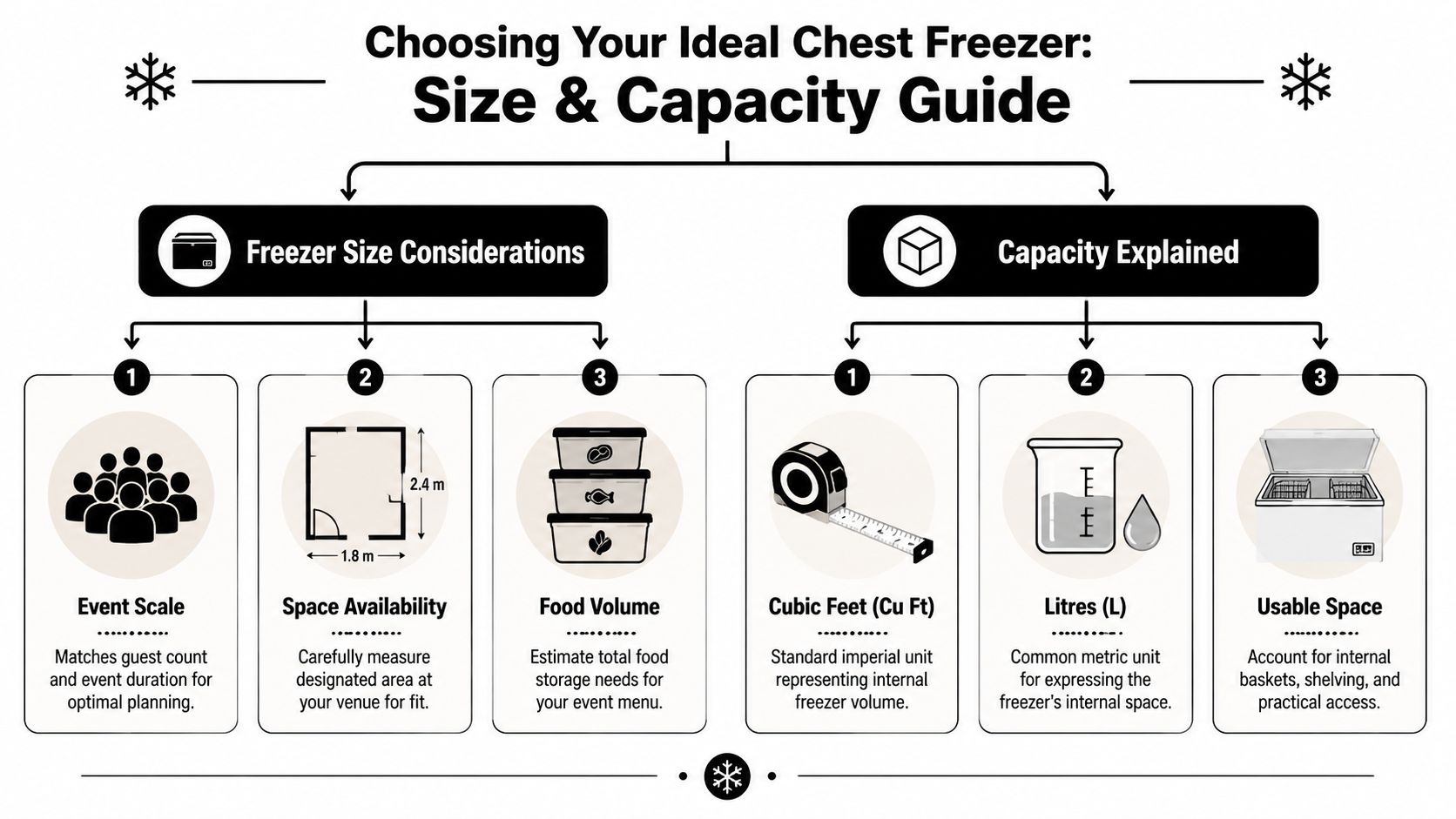
A small chest freezer generally falls in the 5 to 9 cubic feet range, roughly 140 to 255 litres, and can hold about 175 to 225 lbs of food using the rule that 1 cubic foot holds roughly 25 lbs of frozen goods, according to Whirlpool's freezer size guide. That same guide notes typical dimensions of 29 to 38 inches wide, 32 to 34 inches high, and 22 to 27 inches deep, which is useful when you're checking whether a freezer will fit through a service passage or into a prep room.
Translate capacity into event reality
Litres sound technical. Event stock is physical. You're dealing with ice bags, tubs, trays, bottles, and cartons.
Use these practical checks instead:
- If the freezer is for ice only: Prioritise easy access over theoretical maximum fill. Staff will open it often.
- If it's for desserts or frozen canapés: Leave room for airflow and organised stacking. Crushed packaging and overloading create service delays.
- If it's backup storage for catering: Separate what must stay untouched until service from stock that the team will pull throughout the day.
Practical rule: If your team has to unpack half the freezer to reach one item, the size may be right but the plan is wrong.
Match the freezer to the event type
Different events put pressure on cold storage in different ways.
A wedding usually needs freezer space for a few high-risk items. Think frozen desserts, emergency ice, or items that must stay pristine until a precise service window. A corporate launch often needs repeated access because staff are handing out chilled product all evening. A birthday party may need less variety, but constant bar support.
When I help planners think this through, I ask three questions first:
- What must remain frozen until the last possible moment?
- Who needs access during service? The chef, the bar team, or both.
- Where will the freezer sit in relation to guest flow and prep flow?
Those answers matter more than brand brochures.
For a broader look at cold storage options across event setups, this guide to bar fridge and freezer hire is useful because it helps frame when compact freezer capacity is enough and when you need a mixed setup.
Don't confuse internal volume with usable volume
A chest freezer's open cavity is one of its strengths. In event work, bulky stock often fits better in that format than in an upright model with fixed dividers. But usable space still drops quickly when you add baskets, awkward packaging, or poor loading discipline.
The smartest move is to assign the freezer one job. If it becomes half ice, half desserts, half backup catering, nobody will find anything fast when service starts.
Rent or Buy Your Event Freezer
The rent versus buy call usually gets made in the week after an event, not before it. That is when the freezer has to be cleaned, dried, stored, moved out of the way, and tested for the next booking. If your team cannot handle that without strain, ownership starts costing more than the purchase price.
For Cape Town planners, the primary question is frequency with control. A venue in Durbanville with weddings most weekends can justify owning a unit because it stays on site and gets used often. An independent planner working across Constantia, Stellenbosch, Franschhoek, and private homes in the city usually benefits more from hiring. Every site has different access, different kitchen support, and different cold storage gaps.
Buying does make sense in the right setup. Retail pricing in South Africa shows that compact chest freezers sit within reach for established operators, especially if the unit will work most weeks and live in a proper prep or storage area. Makro's chest freezer listings are a useful reference point for current local buying options and price bands. For a venue or caterer with predictable demand, that spend can be easier to defend than repeated short-term hires.
The operational trade-off
Ownership works best when the freezer has a home, a handler, and a schedule.
Those three things matter more than brand promises.
A bought unit gives you control. You know its condition, you can pre-chill it before event week, and you are not relying on supplier availability in peak season. That matters in November and December, when event calendars tighten and last-minute equipment requests get harder to fill across Cape Town and the Winelands.
Renting gives you flexibility instead. You match the freezer to the event, avoid storing dead stock between jobs, and keep capital free for staffing, transport, power backup, or glassware. For planners managing mixed event types, that flexibility is often the better business decision.
| Consideration | Renting (e.g., from ABC Hire) | Buying |
|---|---|---|
| Upfront commitment | Lower commitment for one-off or occasional events | Higher upfront outlay |
| Flexibility by event | Easier to match freezer size to each function | You work with the unit you own |
| Storage between events | No ongoing storage burden | Requires secure storage space |
| Maintenance | Usually handled by the rental provider | Your responsibility |
| Transport logistics | Often simpler if delivery and collection are available | You must arrange handling and movement |
| Best fit | Planners, private hosts, seasonal demand | Venues or operators with frequent, predictable use |
Who should usually rent
Rental usually suits teams dealing with changing venues, changing guest counts, or short bursts of demand:
- Wedding planners: Estate kitchens differ wildly, and some beautiful Winelands venues still have limited freezer space once the caterer arrives.
- Corporate teams: Product launches and brand activations often need cold storage only for a single service window.
- Private hosts: A once-off celebration rarely justifies buying, storing, and maintaining an appliance afterward.
- Schools and universities: Formals, prizegivings, and seasonal functions create sharp demand, then long gaps with no use.
Who may benefit from buying
Buying tends to suit operators with repeatable systems:
- Busy venues with recurring functions
- Caterers with dedicated prep premises
- Operators who already have appliance storage and transport systems
I would add one more filter. Buy only if the freezer can stay plugged in, be checked regularly, and be moved by staff who know how to handle it properly. If it is going to sit in a storeroom behind decor stock and only come out before major events, rental is usually the safer call.
If you are still comparing a chest freezer with a mixed cold-storage setup, this guide to deep freezer and refrigerator combinations for event use helps clarify when frozen holding alone is enough and when you also need chilled service stock nearby.
The expensive mistake is buying for “future use” without a clear pattern of bookings. I see that most often with smaller operators who want backup equipment on hand, then discover that transport, storage space, cleaning discipline, and pre-event testing are the actual burden.
Power and Placement for Cape Town Venues
In Cape Town event work, power planning isn't separate from freezer planning. It is freezer planning.
That matters most at venues where the beautiful parts are far from the practical parts. Historic buildings in town can have awkward plug access. Marquee setups in Paarl can involve long cable routes and uneven ground. Wine estates often have excellent catering spaces for normal service, then stretch beyond those spaces when the event grows.
South Africa's energy reality has pushed buyers and operators towards efficiency and resilience. Defy's guide to chest freezers in South Africa notes the strong focus on eco-friendly, reliable brands and highlights solar-powered chest freezers as a practical solution to load-shedding, operating independently of the national grid. That's especially relevant for remote service areas and outdoor functions where backup planning has to be built in from the start.
Place it where staff can use it fast
The best freezer placement is rarely the most hidden corner.
You want the unit close enough to the team that they'll use it properly, but not so close to guest traffic that the lid opening becomes visible clutter or a safety issue. For a wedding, that usually means near the catering or bar support zone, not in the decorative footprint of the event itself. For a corporate activation, the ideal spot is often a back-of-house pocket directly behind the branded service point.
Check these details before the event day:
- Level surface: A stable, flat base matters, especially at outdoor venues and temporary structures.
- Shade and ambient heat: Keep the unit out of direct sun and away from cooking equipment.
- Plug access: Don't assume the nearest socket is suitable or conveniently placed.
- Lid clearance: Staff need room to open the freezer fully without hitting walls, counters, or drape lines.
Match the venue type to the risk
Cape Town venues each bring their own friction points.
A heritage building may limit placement because of narrow service entries and older electrical layouts. A Franschhoek farm venue may have excellent space but longer distances between prep, storage, and service. A tented event on an estate often creates the most moving parts because nothing is naturally fixed in place.
If the freezer is hard to reach, staff will compensate with poor habits. They'll leave it open too long, overfill nearby fridges, or create messy temporary storage.
Think beyond mains power
Solar chest freezers are getting more attention for good reason. They reduce dependence on the grid and suit venues or event formats where power stability is uncertain. They won't be the answer for every event, but they are worth considering where venue infrastructure is inconsistent or where sustainability is part of the brief.
What doesn't work is treating the freezer like a plug-and-forget item. Every event plan should include power allocation, cable path, setup timing, and a named person responsible for checking that the unit is running correctly before stock goes inside.
Essential Food Safety and Maintenance Tips
Cold storage only helps if the freezer is organised, monitored, and used with discipline. A badly run freezer creates the same kind of event risk as no freezer at all. Food quality drops. Service slows. Liability goes up.
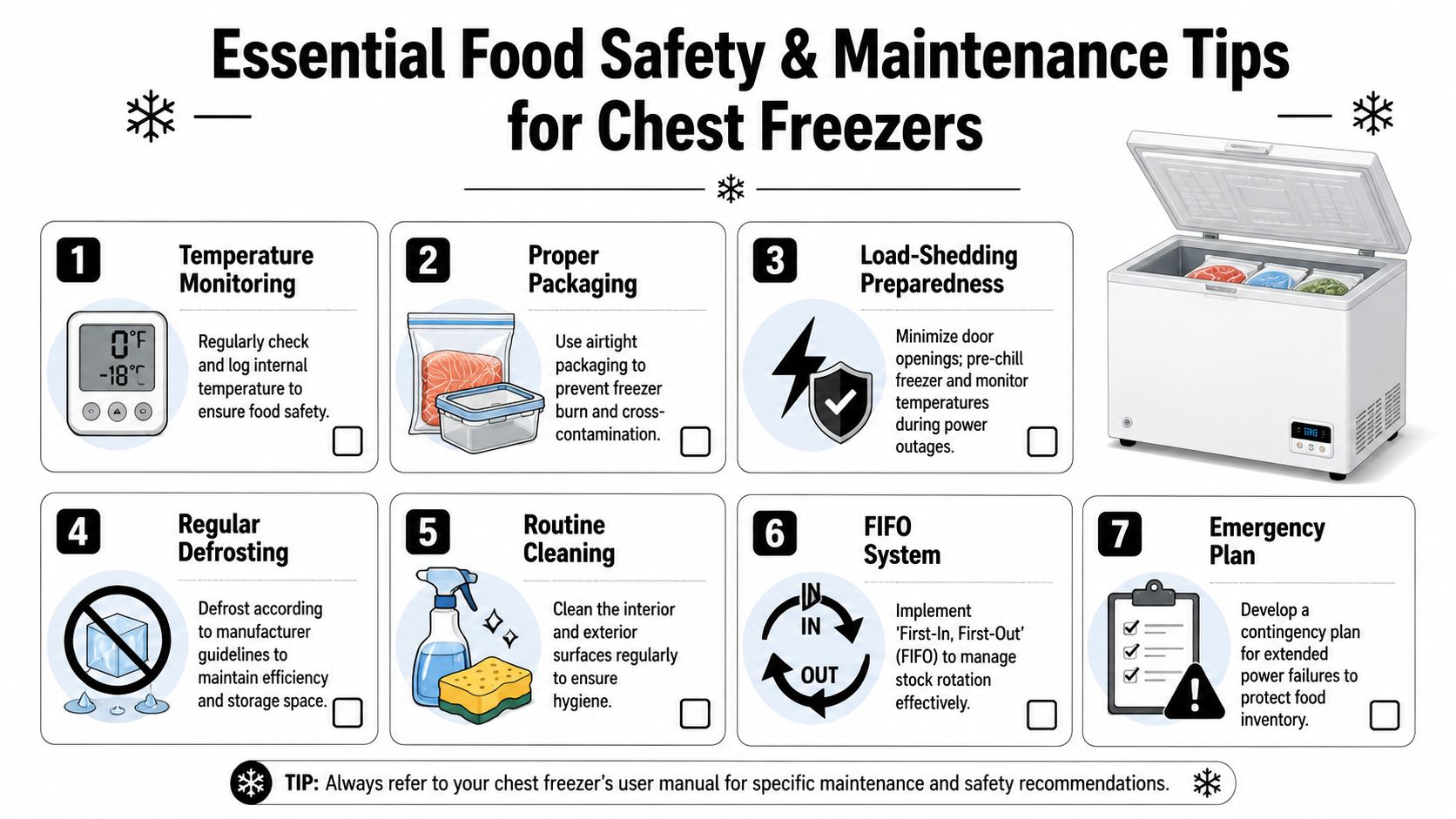
The baseline matters. Small chest freezers maintain a temperature range of −23°C to −29°C, and some models preserve food for over 135 hours in super-freezer modes during power outages, according to the referenced Hisense H125CF market example and temperature benchmark. For event teams, the takeaway isn't to rely on the outage window as a strategy. It's to understand that good freezer performance gives you a safety margin when conditions go sideways.
Before the event
A freezer should never arrive on site and immediately get packed to the brim.
Do the setup properly first:
- Pre-chill the unit: Let it reach operating temperature before loading stock.
- Group items by service timing: Put late-service stock below or behind early-access items.
- Use sealed packaging: This protects product quality and reduces contamination risk.
- Label clearly: Especially important if multiple teams share one unit.
If your event includes mixed cold-chain items, kitchen discipline matters just as much as freezer performance. MODERN LYFE's food safety advice is a helpful refresher on why foods shouldn't linger in unsafe temperature ranges during prep and service.
During service
The biggest mistakes happen when the event gets busy.
Staff start “quickly checking” inside the freezer every few minutes. Someone drops warm stock into the same space as frozen desserts. The lid gets left open while people decide what they need.
Use these habits instead:
- Assign access: One person or one team should control the freezer during peak service.
- Open with purpose: Know what you're taking before the lid goes up.
- Separate high-value stock: Keep premium desserts, special dietary items, or backup proteins protected from constant rummaging.
- Monitor condition, not just temperature: Packaging collapse, frost build-up, and condensation can tell you a lot.
Cold storage works best when access is limited and intentional.
After the event
Rental or owned, the close-down routine matters.
- Remove all stock promptly: Don't leave forgotten product behind after breakdown.
- Wipe interior surfaces: Sticky spills and food debris turn into odour problems fast.
- Check for damage: Hinges, baskets, and lid seals should be inspected before sign-off.
- Leave the unit in good order: If it's a rental, this avoids disputes. If it's yours, it makes the next event easier.
Lockable lids and anti-thaw features are useful where stock security and product consistency matter, especially at larger venues with multiple crews moving through back-of-house. What doesn't work is using a freezer as a dumping zone. If nobody owns the system, the system breaks.
Small Chest Freezer Use Cases and Costs
On a Cape Town event floor, a small chest freezer usually earns its keep in the gaps the main venue fridge cannot cover. I use them for the stock that cannot be left to chance. Frozen desserts for a plated finish, backup ice for a bar that is running harder than forecast, or late-arriving product that needs holding before service all fit this job well. At Winelands venues with compact prep areas, a smaller chest unit also solves a basic space problem without forcing the kitchen team to rework their whole layout.
A small freezer makes sense in different ways depending on the event.
- Wedding reception: Hold sorbet, ice cream cakes, frozen petit fours, or backup canapés that need to stay stable until a precise service window.
- Corporate launch: Keep branded treats, product samples, or activation stock in controlled condition until handout.
- Private celebration: Support the bar with bagged ice, frozen garnishes, and overflow items that would otherwise crowd the house fridge.
Some activations need more than back-of-house cold holding. If guest-facing frozen distribution is part of the concept, Mpz frozen food vending machines may suit the brief better.
Cost depends less on the sticker price and more on how often you run events with the same cold-storage pressure. For a planner handling occasional weddings or one-off brand activations, rental is usually easier to justify because delivery, pickup, and short-term use are built into the decision. For venues, caterers, and event businesses that need repeat freezer capacity through season, buying can make sense if the unit will not sit idle for long stretches.
The other cost sits in the failure points. Melted dessert stock, emergency ice runs, damaged presentation, and staff time spent fixing preventable cold-chain problems are usually more expensive than the freezer itself.
If you are weighing a fixed freezer against a more flexible cold setup, mobile fridge hire for events is a useful comparison point. In practice, chest freezers are best when you need deep cold retention in a small footprint. Fridges are often the better call when stock needs frequent access during service.
Frequently Asked Questions for Event Planners
How far in advance should I book a freezer for a Cape Town event
Book as early as you can once the venue and service plan are confirmed. Peak wedding months, year-end functions, and matric season put pressure on event equipment availability. The more specific your site needs are, the less you should leave to the last week.
Should the freezer arrive on the event day
Usually, earlier is better if access allows. That gives the unit time to settle, cool properly, and be loaded in an organised way. Same-day delivery can work, but it leaves less margin for setup delays, venue access issues, or power checks.
Do I need to transport it myself
In most professional event setups, it's better to arrange delivery and collection rather than moving the unit in a private vehicle. Small chest freezers are compact compared with commercial cold rooms, but they still need careful handling, stable transport, and sensible positioning on site.
Can a rental freezer be used at outdoor venues
Yes, provided the placement is managed properly. Keep it on a level surface, out of direct sun, and close enough to the operating team that service stays efficient. Outdoor use fails when the unit is treated like scenery instead of working equipment.
Can I use one freezer for both bar stock and catering stock
You can, but it's rarely ideal unless the contents are clearly separated and access is controlled. Mixed-use freezers tend to become disorganised quickly during service. If the event has a serious bar and a serious catering brief, split the jobs.
Can I brand a freezer for a corporate event
Sometimes, but only if branding methods won't damage the surface or interfere with operation. Always clear this with the provider first. Temporary wraps or magnets may be possible depending on the unit and the event brief.
What should I confirm before signing off on a booking
Ask about the exact unit size, delivery timing, collection timing, power requirements, and whether the freezer will arrive clean and ready for use. Also confirm who is responsible for setup position and who signs off on condition at collection.
If you're planning a wedding, corporate event, matric function, or private celebration in Cape Town or the Winelands, ABC Hire can help you secure practical event equipment that keeps service smooth and guests happy. It's a smart option when you need reliable cold storage without the hassle of buying, storing, and moving a freezer yourself.