
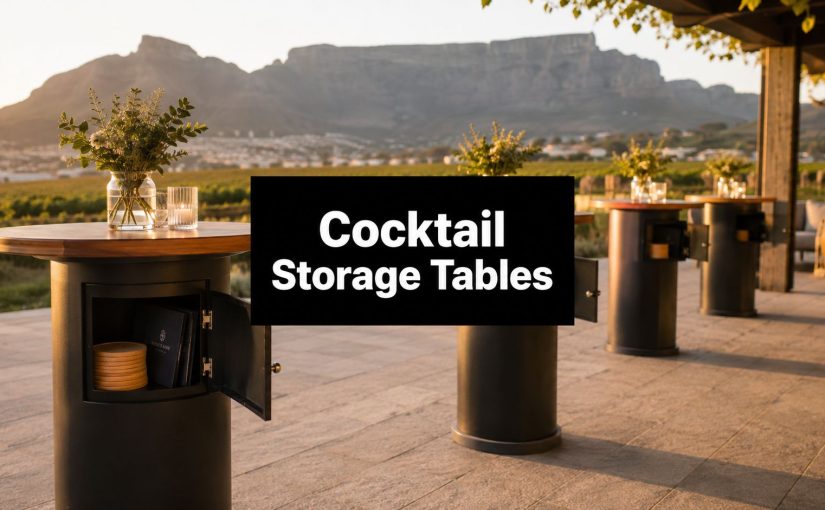
An hour before a Winelands wedding, the cocktail area can look deceptively calm. Behind the marquee, staff are carrying programmes, sparklers, menus, favour boxes and battery uplighters from a back-of-house tent, while the load-in route narrows around catering equipment and floral deliveries.
Then the tables arrive. A row of cocktail tables with storage is placed around the reception area, and each unit carries part of its own payload. Coasters stay close to the drinks station, signage is kept out of sight until needed, and small emergency items no longer occupy a separate crate on the guest route.
That's the working appeal of this furniture format. It isn't a decorative upgrade. The storage compartment can reduce handling, protect sightlines and make a reset less dependent on a distant storeroom. For practical advice on keeping guest-facing areas organised and clean, planners can also review planning event hygiene with WipesBlog.com.
Why Event Planners Are Choosing Cocktail Tables With Storage
In Constantia, a tight estate driveway or garden path can turn every extra crate into a timing problem. A table that arrives with its own menus, matchbooks or charger cables reduces the number of trips between the service area and the guest zone. The benefit is small on paper, but useful when several suppliers are working through the same access point.
At a Cape Town corporate activation, the pressure is different. The team may need to clear branded collateral quickly after a product demonstration, then prepare the space for another audience. A concealed compartment gives staff somewhere to put brochures, extension leads and small display components without making the table look like a packing station.
Operational rule: Storage inside the table should protect the run sheet, not create another item for staff to manage.
The same principle applies to a matric dance. Decor can double as takeaway, but only if the table's compartment is easy to open, easy to check and sized for the items being distributed. A beautiful door that needs two people to hold it open slows service. A drawer that catches on the carpet becomes a liability during a fast reset.
Some planners already use specialised furniture to combine functions, such as a cooler box table near a bar or lounge zone. Cocktail tables with storage extend that approach to smaller event supplies. They're useful when the floor plan needs clean edges and the venue doesn't offer convenient holding space.
South Africa's furniture master plan places cupboards, tables, pedestals, display units and storage units within the broader case goods category, so a storage-equipped cocktail table sits within an established furniture family rather than being a novelty product. The same document records nominal furniture sales peaking at R18.1 billion in 2017, followed by declines in 2018 and 2019, with imports estimated at about R3 billion per year, roughly 40% of goods sold. Those figures come from the South Africa hotel furniture, fixtures and equipment market reference.
The practical conclusion is straightforward. If storage helps staff carry, conceal and reset event stock without compromising stability or access, it earns its floor space. If it merely hides clutter while making the table heavier, wider or slower to service, a standard cocktail table may work better.
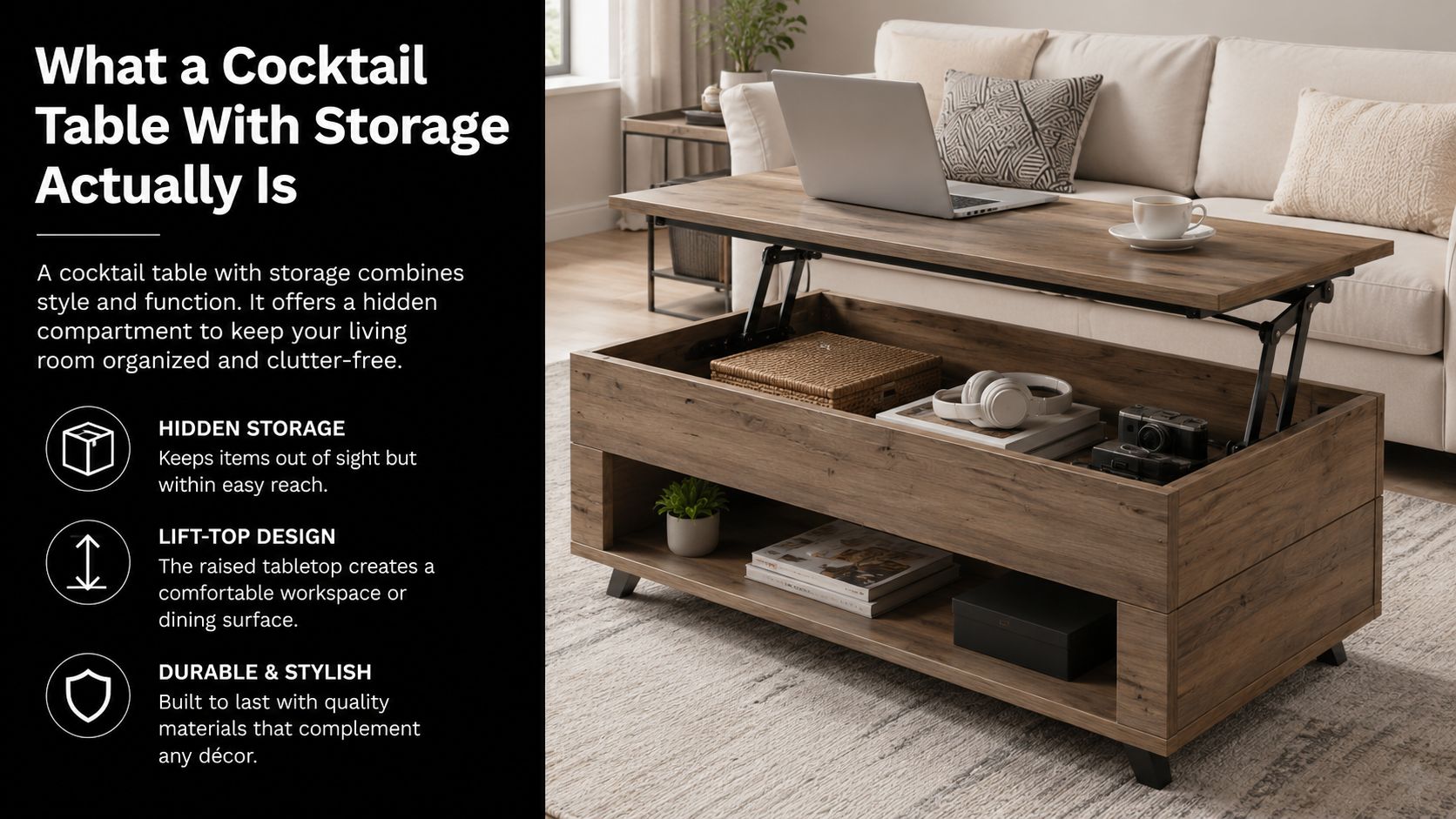
What a Cocktail Table With Storage Actually Is
In rental terms, a cocktail table with storage is a tall event table with an integrated compartment or concealed service area. The usual silhouette is narrow and upright, often with a round top and poseur height. The storage mechanism changes how staff load, move and reset the piece.
A lift-up top creates a cavity beneath the surface. It's neat for menus, napkins, battery packs or small favour items, but the hinge must stay secure and the lid must close without trapping fabric or cables. A removable tray is faster for staff because the whole payload can be lifted out, although the tray needs a positive locating point so it doesn't slide when the table is moved.
Other designs use a lower shelf ring, a hollow pedestal with a side access door, or a weighted base that conceals a battery housing. Open shelves suit visible staging and decorative displays. Closed compartments suit planners who want a clear tabletop and no exposed stock.
Common formats in Cape Town hire stock
The pieces most relevant to local events tend to fall into a few practical groups:
- Poseur-height lift-top tables: A clean option for weddings and formal functions, especially when the contents need to disappear between service periods.
- LED cocktail cubes: Their internal space usually protects a battery housing and control equipment rather than general event stock.
- Barrel-style tables: These suit rustic Winelands settings, with rope-handled drawers or doors that make the storage part of the visual language.
- Open-base tables: Useful when the planner wants baskets, blankets or display objects to remain visible.
The distinction matters during quoting. A table with a small battery compartment isn't equivalent to a table that can hold gift bags. A lower shelf isn't concealed storage. A lift-up top may look generous but still be unsuitable for glassware or heavy stock.
These tables also aren't interchangeable with other furniture categories. They aren't bar tables, which are designed around service and often need clearance for stools or staff. They aren't cake tables, which need a stable presentation surface and a different loading pattern. They aren't coffee tables, which sit low and serve seated guests. Specifying the wrong category can leave you with attractive furniture that doesn't support the actual event task.
Materials, Finishes, Sizing, and Load Capacity
A hire manager needs more than a colour swatch. The useful specification covers the frame, surface, base, access mechanism and realistic contents of the storage compartment.
Powder-coated steel bases are common where weight and resistance to movement matter. They can be a sensible choice for guest-facing areas because the mass sits low, but the finish can show chips if units are stacked carelessly. Aluminium columns reduce carrying weight and can help on difficult load-ins, although the base and joints still need enough rigidity for repeated handling.
Hardwood and quality plywood tops offer a warmer finish for estate weddings. Raw timber photographs well at venues such as Spier or Vergelegen, but it needs proper wiping between functions because fingerprints, wine rings and dust show quickly. High-gloss white laminate gives a crisp corporate look, yet scuffing becomes visible after repeated handling. Matte black powder coating is generally more forgiving for activations where the furniture is moved frequently.
The dimensions that affect the floor plan
A standing guest needs enough tabletop area for a drink and small personal items without the table becoming a traffic obstruction. The following ranges are useful as a quoting starting point, not a substitute for the supplier's actual product sheet.
| Spec | Typical range | Planner note |
|---|---|---|
| Top diameter | 600 to 700 mm | Suitable for standing guests, styling and light service items |
| Overall height | 1100 to 1200 mm | Around 1100 mm suits standard poseur use, while 1200 mm belongs in raised bar or high-service zones |
| Base diameter | At least 400 mm | A wider base generally supports better tip resistance on a tall silhouette |
| Storage type | Lift-top, tray, shelf, drawer or pedestal cavity | Ask how staff access it during service |
| Storage cavity | Product-specific | Measure the actual opening, not only the external table dimensions |
| Frame | Powder-coated steel or aluminium | Balance transport weight against rigidity |
| Top | Hardwood, plywood, laminate or composite | Match the surface to cleaning and damage expectations |
The table's capacity is where many otherwise good designs fail. A compartment intended for a clutch, menus or a small stack of programmes shouldn't be treated as a crate for bottled drinks or a gift hamper. Ask for the manufacturer's permitted storage load in kilograms, then ask whether that limit applies while the lid, drawer or door is open.
Load the mechanism, not just the cavity
The stored items affect the table in two ways. Their mass increases the load on hinges, catches and drawer runners, while an uneven pile shifts the centre of gravity. A cavity that holds several light items may be suitable, but the same space filled with dense stock can make the top awkward to lift and the table less stable.
A useful warehouse test is simple. Load the compartment with the exact items planned for the event, open the access panel, and check whether the table remains level and easy to operate. If the supplier can't provide a load limit, treat the compartment as light-duty storage and keep heavy service stock elsewhere. For a broader look at sturdy table construction, compare the considerations discussed in this granite top table guide, particularly around surface weight and handling.
South Africa's wider furniture market provides a substantial base for multifunctional formats. One market estimate places revenue at USD 5,072.2 million in 2022 and projects USD 8,464.8 million by 2030, at a 6.6% CAGR over 2023 to 2030, as reported in this South Africa furniture market outlook. The figures describe the broad furniture market, not cocktail tables specifically, but they help explain why tables and storage products continue to appear in practical commercial specifications.
Renting vs Buying Cocktail Tables With Storage in Cape Town
The right choice depends less on the furniture's purchase price than on how often your team can use it without creating a storage and maintenance problem.
Take a Winelands wedding with 120 guests at a Stellenbosch estate. The planner needs 18 tables for one weekend, then has no confirmed requirement for the same format. Hiring keeps the units, transport, cleaning and damage exposure with the rental company. Buying may look attractive when comparing a unit price with a hire line, but the calculation changes once delivery, collection, secure storage and future repairs are included.
A Cape Town corporate activation has a different pattern. If the brand team runs product launches at the CTICC on a recurring basis, owning a consistent set can make sense when the tables are used often enough and the company has a secure storage area. The team also controls its finish, branding and compartment contents, but it accepts responsibility for battery charging, hinge checks, transport protection and replacement parts.
A school hosting an annual matric dance usually has the weakest case for ownership. Storage space is limited, budgets must serve a single formal event, and a table that sits unused for most of the year still needs to be kept dry, covered and secure. Hiring allows the school to choose a different finish or configuration as the event theme changes.
Rental vs Purchase at a Glance
| Factor | Renting | Buying |
|---|---|---|
| One-off event | Flexible, with no long-term storage burden | Usually leaves unused stock after the function |
| Repeated corporate use | Useful for testing styles and quantities | Can suit consistent recurring activations |
| Transport | Often arranged as part of the hire service | Must be managed by the owner |
| Breakage liability | Confirm the supplier's damage and replacement terms | Owner carries repair and replacement risk |
| Finish selection | Depends on available stock and date | Greater control over finish and branding |
| Storage | No warehouse space required after collection | Requires secure, dry and accessible storage |
| Restocking | Supplier may handle cleaning and preparation | Internal team must inspect and reset |
| Quantity changes | Easier to scale for each event | Fixed inventory can be excessive or insufficient |
For many Cape Town events, hiring fewer than 50 units is operationally simpler because the planner avoids committing to a permanent stockholding. That isn't a universal financial rule. It's a useful starting point for comparing a single function with a genuine recurring requirement.
Ask the rental house three practical questions before accepting a quote. Can they provide finish swatches or an actual warehouse viewing? What happens if the required quantity is damaged or unavailable during preparation? What delivery window applies to Stellenbosch, Franschhoek or Paarl, and does the quote include collection after the venue's strike period?
A supplier that answers those questions clearly is easier to work with than one that only confirms a per-unit rate.
Styling and Placement for Weddings, Corporate Events, and Parties
The storage feature should support the visual plan, not dictate it. Start by deciding what guests need to reach, what staff need to retrieve and what must remain invisible.
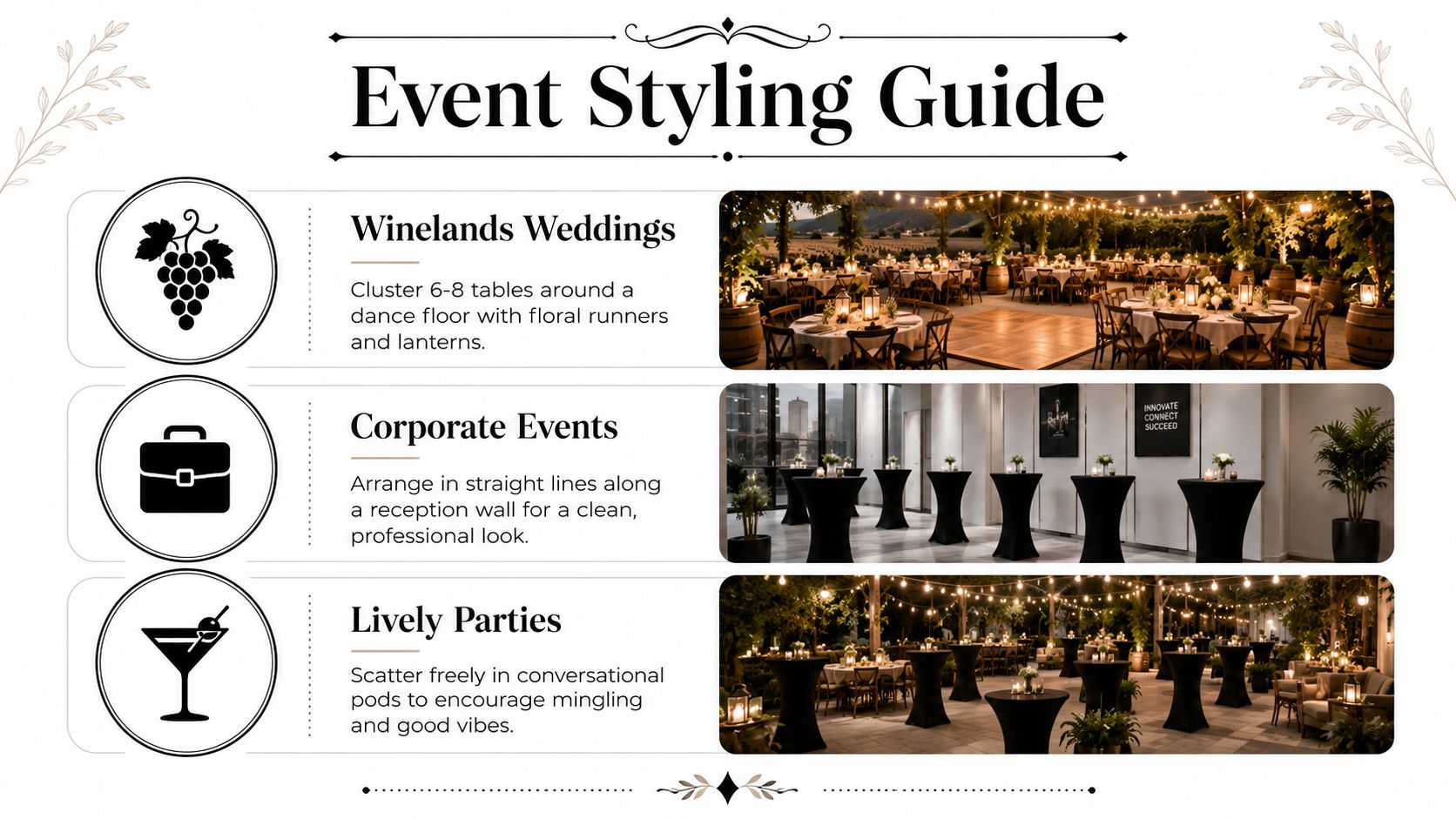
At a Winelands wedding, a loose conversational cluster works well around the dance floor. Use floral runners, lanterns or low arrangements that leave enough usable tabletop for glasses. The concealed area can hold matchbooks, sparkler buckets and cake-cutting kits, but keep ignition items separate from battery equipment and anything that could be damaged by moisture.
For a corporate activation, create a cleaner rhythm. Place tables along a product demonstration route or reception wall, leaving a clear passage between the furniture and the guest flow. Compartments can hold branded collateral, spare lanyards and charger cables, while the tops remain deliberately restrained so the product display stays dominant.
A matric dance or milestone party often needs a denser arrangement. A grid of tables in the school hall can hide masks, wristbands and emergency supplies, but staff should load the units before guests enter. Once the room is live, a locked or difficult-to-open compartment becomes a distraction.
Placement rules that survive real venues
- On uneven lawns: Keep the table base fully supported on firm ground. Don't bridge a hollow with a loose wedge that can shift when a guest leans on the top.
- On decking: Check that the support points sit across the deck structure rather than over a flexible or damaged board.
- In coastal wind: Use a heavier base or approved ballast, and keep lightweight styling elements low and secured.
- Near bars: Leave enough service clearance for staff and avoid placing a storage door where it opens into a queue.
- Around dance floors: Use curved clusters rather than a rigid barrier, so guests can circulate without cutting across the dancing area.
The styling can borrow from other bar-area furniture without turning the table into a bar. For ideas on making a service zone feel intentional, these unique bar cart centerpiece ideas offer useful direction on layering accessories, glassware and focal details.
The top should still have a job. A small arrangement, menu stand or branded object is enough. If every surface carries a large vase, candle cluster or product sample, guests lose the practical place to put a drink, and staff lose access to the compartment below.
For a broader selection of shapes and configurations, planners can also review round cocktail tables before deciding whether storage is essential on every unit or only on selected tables in the layout.
Stability, Safety, and Maintenance on a Busy Event Floor
A tall table with an empty cavity can feel stable in a warehouse and behave differently on Winelands cobbles or a Cape Town pier deck. The risk increases when guests lean on the edge, when stored items sit high, or when an open door shifts the load outside the support area.
South African conformity assessment principles for furniture focus on structural integrity, stability against tipping, material safety and the absence of sharp edges or hazardous points, as outlined in the furniture conformity assessment guidance. Added hinges, panels and stock increase the overturning moment, so the base, joints and load path need to be considered as one system.
Testing concepts for non-domestic tables also treat taller configurations more conservatively. In the EN 15372 and ISO-style benchmark described in this technical table stability document, tables above 950 mm are subject to a reduced test load of 50% of the standard vertical load because taller tables are more prone to overturning. That makes low, central storage and a rigid base especially important for cocktail-table designs.
A practical inspection routine
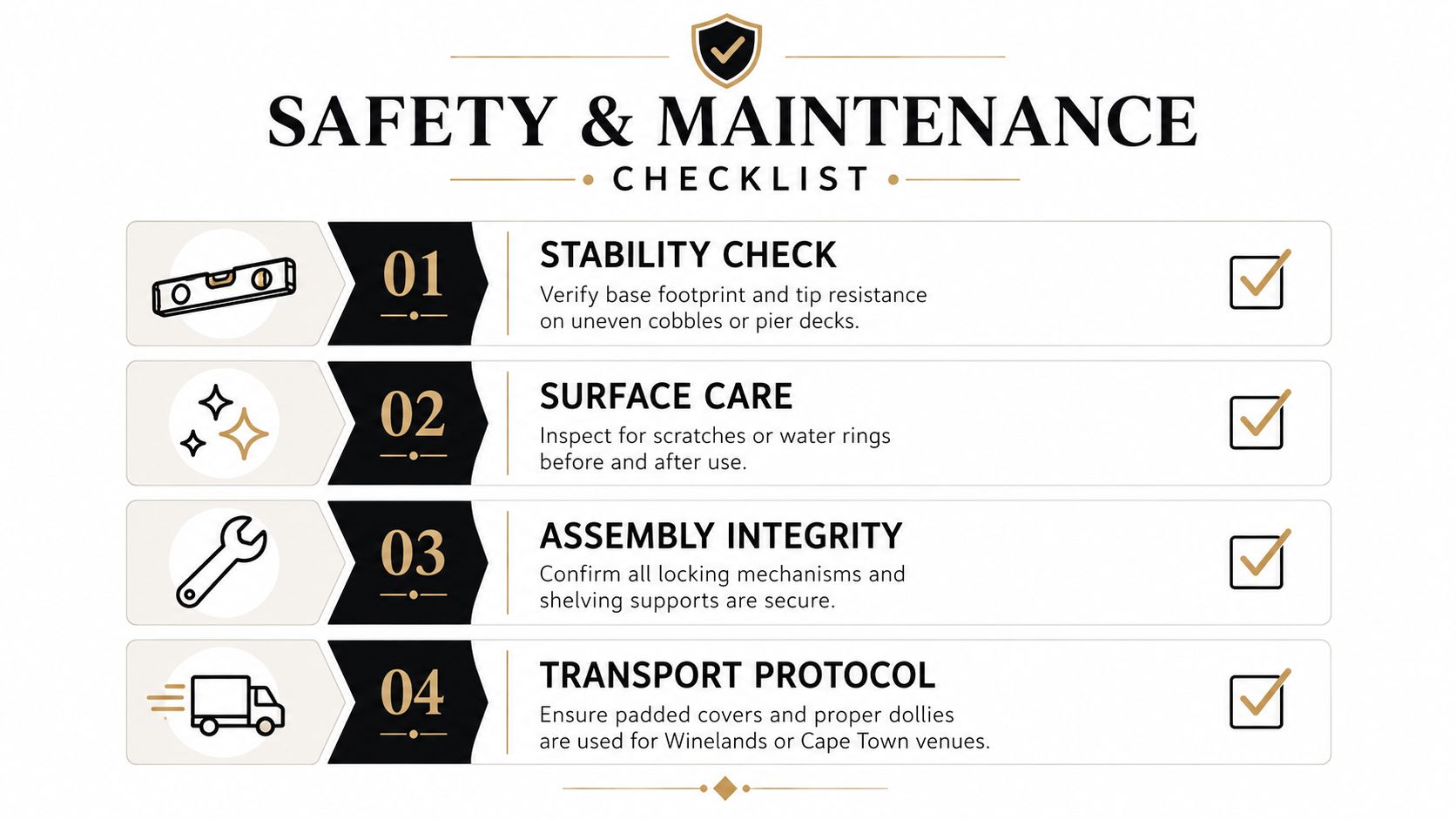
- Before loading: Check hinges, catches, drawer runners, locking mechanisms and shelf supports.
- On arrival: Inspect the surface for chips, water rings and loose joints before staff dress the table.
- Outdoors: Use approved ballast or sandbags where the supplier and venue permit it, keeping the ballast low and concealed.
- During service: Don't exceed the stated compartment load, and don't leave a door extended into a walkway.
- At reset: Remove stock, close all panels and check that the unit is still level before moving it.
Maintenance should match the finish. Powder-coated steel may need careful scuff repair rather than aggressive sanding. Upholstered tops require fabric-safe cleaning and protection from wet glasses. Rental houses handling back-to-back weekend events need enough time to inspect, wipe, repair and re-cover each unit before it leaves the warehouse again.
Making the Right Choice for Your Next Event
Start with the event profile. A one-off wedding usually benefits from hiring, while a venue or corporate team running frequent functions may gain more from owning or taking a long lease on a consistent range. The deciding factor is repeated use, not the appearance of a lower unit price.
Then decide what storage means for your event. A hidden compartment suits menus, small supplies and clean sightlines. An open shelf suits visible baskets or display objects. An LED base may only need to house batteries, so it shouldn't be quoted as general-purpose storage.
Before confirming the order, check these points:
- Stock depth: Confirm the exact quantity available for your date, including replacement units.
- Opening dimensions: Measure the gap for ice buckets, gift baskets, menus or charger cases.
- Venue conditions: Ask whether the base is suitable for cellar floors, marquee decking, cobbles or coastal surfaces.
- Reset timing: Confirm when staff can access the compartments and when the hire company will collect.
- Warehouse condition: Request a viewing of the actual table where possible, not only a catalogue image.
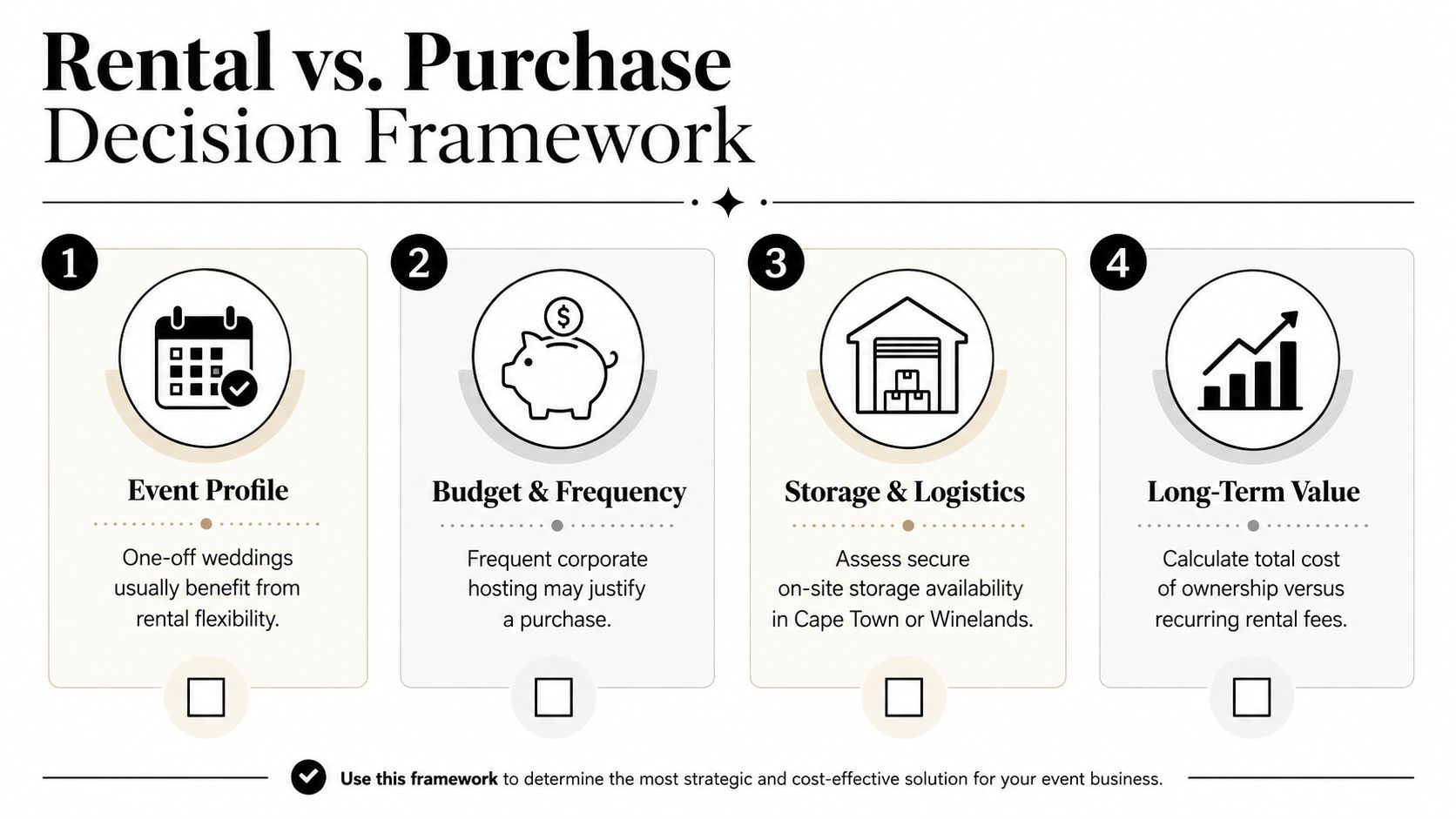
Write your must-haves before requesting quotes, then ring two suppliers so you can compare stock, access mechanisms and delivery terms rather than price alone. For Cape Town and Winelands events, ABC Hire offers cocktail tables and wider event furniture hire, including tables, LED furniture and related event equipment, so visit ABC Hire to discuss a storage-focused setup for your next function.