

You're planning a 120-guest wedding at a farm venue outside Stellenbosch. The Pinterest board is polished, the couple has chosen the colour palette, and the venue has given you a narrow load-in window. Then the practical questions arrive. Who delivers the tables and lounges? Who installs the draping? Does the venue have enough usable floor area once the bar, dance floor, ceremony arch and guest seating are in place? Will fabric backdrops meet the venue's fire-safety requirements? Can the truck reach the estate before traffic and weather disrupt the schedule?
That's why decor for hire in Cape Town should be treated as a logistics and risk-management decision before it becomes a styling decision. The right supplier protects the event plan from late deliveries, unsuitable stock, unsafe layouts and unclear responsibilities. The right look still matters, but it has to survive the conditions of Cape Town, Stellenbosch, Franschhoek, Paarl and the surrounding Winelands.
Why Decor for Hire Matters in Cape Town
The Western Cape has a substantial wedding and events economy. Statistics South Africa recorded 102,373 marriages and unions nationally in 2024, with the Western Cape accounting for 22,382, or 23.0%, of that total. The province also recorded the country's highest share of marriages solemnised by religious marriage officers, at 52.3%, or 11,707 marriages. Those figures point to sustained demand for styled ceremonies, reception furniture, table presentation, floral decor and formal event infrastructure in the province. Partytrends provides the regional context for this decor-hire demand.
A wedding-heavy market creates repeat requirements for the same practical inventory. Tables, chairs, lounge seating, bars, lighting, arches and decorative accessories move from one ceremony or reception to the next. Cape Town's marriage profile also has historical depth. Statistics South Africa recorded the Western Cape's crude marriage rate at 335 marriages per 1,000 population in Census 2022, up from 304 in Census 2011, while the City of Cape Town rose from 308 to 341 over the same period. The provincial marriage profile from Statistics South Africa supports the view that this is an established event market, not a short-lived styling trend.
The Pinterest board isn't the floor plan
A beautiful arrangement can still fail if the venue's usable area can't accommodate it. A round table, dining chairs, service aisles, lounge clusters, a dance floor and a backdrop all compete for space. Add temporary structures, bars or climate-control equipment, and the decorated layout may affect both guest movement and venue capacity.
Cape Town venues also impose their own delivery and breakdown rules. A farm estate may allow setup only during a specific morning window, while a coastal venue may require a wind plan for open-air structures. Traffic on routes such as the N1, N2 and R44 can compress the supplier's working day, so a quote without a confirmed load-in plan is incomplete.
Practical rule: Choose the layout that can be delivered, installed, inspected and removed on time. Style comes after that.
What Decor for Hire Actually Covers
Decor for hire is a service category, not a single product. A supplier may provide soft decor, furniture, lighting, props, table accessories, setup labour or only selected items. Ask for an itemised scope before assuming that a photograph represents a complete package.
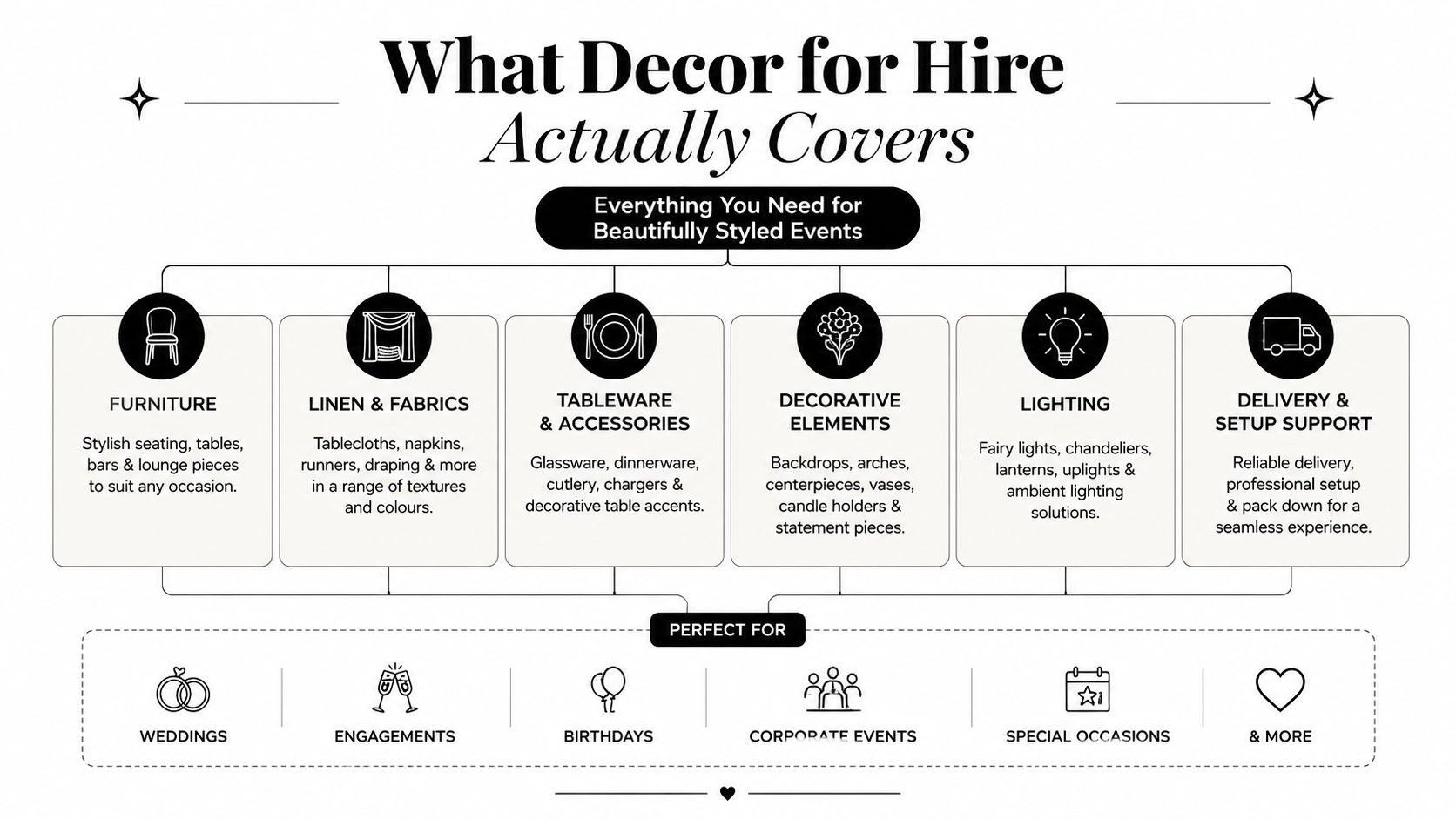
Separate the inventory into four groups
- Soft decor: Tablecloths, napkins, chair covers, sashes, fabric backdrops and draping. These items define colour and texture, but they also require careful laundering, installation and fire-safety documentation.
- Furniture: Dining tables, chairs, lounge suites, bars, ceremony arches and occasional tables. Furniture determines the event footprint and usually creates the greatest effect on guest circulation.
- Lighting: Fairy lights, festoons, uplighters, chandeliers, candles and battery-powered fittings. Lighting can change the mood dramatically, but the supplier must confirm power access and safe cable routing.
- Themed props: Signage, centrepieces, dance-floor decals, display plinths and photo-booth backdrops. These items add personality, but they should never block exits or narrow required walkways.
A supplier may include delivery, installation and collection, while styling, on-the-day coordination, candles, florals, tableware or custom signage may be billed separately. The venue may provide tables or chairs, but that doesn't mean its team will move them into your preferred layout. Confirm who receives the stock, who sets it up, who removes it and who remains responsible for breakages.
The distinction between a fully serviced hire and a venue-only arrangement is useful here. A clear dry hire event definition can help planners understand when they're hiring space or equipment without the wider operational service. If you need a fabric feature or ceremony focal point, review practical options such as this guide to a backdrop for hire.
Match the stock to the venue
Winelands venues often have uneven surfaces, long distances between the truck and reception area, and strict restrictions on vehicle access. Coastal venues add wind exposure and salt air. Battery lighting may be more practical where generators are restricted, while freestanding, properly weighted structures are safer than light temporary frames in exposed areas.
How Pricing Really Works for Decor Hire
A decor-hire quote reflects far more than the visual value of the items. Two suppliers can interpret the same Pinterest reference differently because one quote includes delivery, setup, collection and styling while the other prices only the stock. The apparent difference may also come from quantities, hire duration, venue access or risk allocation.
The line items that change the quote
Item type and quantity come first. A few statement pieces may cost less than dressing every guest table, but they can require specialist transport or installation. Furniture also has a larger handling footprint than napkins, candles or signage.
Distance and access affect delivery planning. Stellenbosch, Franschhoek and Paarl venues may require extra travel time, careful loading, or a second crew member for long carries. A supplier should know whether the truck can reach the setup area and whether the venue permits unloading at the required time.
Labour is often the hidden difference. Setup, styling, moving furniture, striking the installation and loading the return stock all require people. After-hours work, Sunday collection and late breakdowns can attract separate charges, especially where the venue imposes its own access rules.
Damage protection needs plain language. Ask whether the quote includes a refundable deposit, a damage waiver, or both. Check which losses are excluded, how stained linen is treated, and when the deposit is returned.
| Cost Driver | Why It Changes the Quote |
|---|---|
| Stock type | Specialist furniture, structures and lighting need more handling than small tabletop pieces |
| Quantity | More guest seating and table dressing increase packing, transport and setup requirements |
| Hire duration | Longer holding periods may affect availability and the supplier's scheduling |
| Delivery distance | Winelands travel, access roads and carrying distance change transport effort |
| Setup and breakdown | Crew time, venue access windows and late collection rules affect labour |
| Damage terms | A waiver, deposit or replacement responsibility changes the client's financial exposure |
| Styling service | A styled installation requires planning and labour beyond simple equipment drop-off |
Compare quotes by scope, not by total alone. Ask for the exact item list, quantities, delivery window, setup responsibility, collection time and damage terms. A supplier who can explain every line is easier to manage than one who offers a low headline price with the operational detail missing.
Popular Packages and Theme Ideas
The strongest package is the one that suits the venue, guest movement and install conditions. A romantic look that depends on delicate outdoor draping may be a poor choice for an exposed estate, while a compact lounge package can work well in a city warehouse or rooftop launch.
| Package | Typical Inclusions | Best-Fit Venues | Style Notes |
|---|---|---|---|
| Winelands romantic garden | Ceremony arch, dining tables and chairs, soft linen, lounge seating, candle holders and warm lighting | Gardens, vineyard lawns and estate courtyards in Stellenbosch, Franschhoek and Constantia | Layered, intimate and softened with natural surroundings |
| Winelands modern minimal | Clean-lined furniture, neutral table settings, restrained centrepieces, sculptural backdrop and focused lighting | Contemporary tasting rooms, modern estates and covered reception spaces | Fewer elements, stronger shapes and less visual clutter |
| Rustic wine-cellar | Timber or mixed-material tables, practical seating, candlelight, signage and compact lounge pieces | Cellars, barns and covered farm venues | Textured and warm, but still needs clear service routes |
| Corporate launch | Branded backdrop, step-and-repeat, sleek lounges, cocktail tables, plinths and event lighting | Rooftops, galleries, warehouses and hotel venues in Cape Town | Brand visibility first, with furniture arranged for movement and networking |
| Matric formal | Themed table decor, bold colour accents, neon signage, photo-booth corner and dance-floor features | School halls, campus venues and civic event spaces | High-impact details scaled to a controlled indoor footprint |
Build each package around the room
For a Winelands wedding, the ceremony arch, guest seating and reception tables should share a visual language. Don't hire an oversized lounge collection just because it looks impressive in a catalogue. It may reduce dining capacity, obstruct service staff or force guests into narrow routes.
Corporate events need a different priority. A step-and-repeat must be visible without creating a queue that interferes with catering or registration. Lounge furniture should support conversation, while lighting should make branding and speaker areas readable in photographs.
Matric dances reward boldness, but school halls punish clutter. Use one strong photo moment, a clear dance area and lighting that can be controlled safely. Items that travel easily, such as signage, linens and smaller props, can be moved to out-of-town venues more efficiently. Bulky furniture and structures are often better sourced near the venue when transport and collection would complicate the schedule.
For practical inspiration that keeps spend and scope under control, review these wedding decor ideas on a budget. The useful principle is simple. Spend on the elements guests see and use, then remove anything that adds handling without improving the experience.
The Rental Process from Enquiry to Collection
A reliable hire runs on information exchanged early. Send the supplier the venue address, date, guest count, event type, preferred style, floor plan, setup access, power availability and weather backup. A supplier can't sensibly confirm a lounge layout or lighting plan from a colour palette alone.
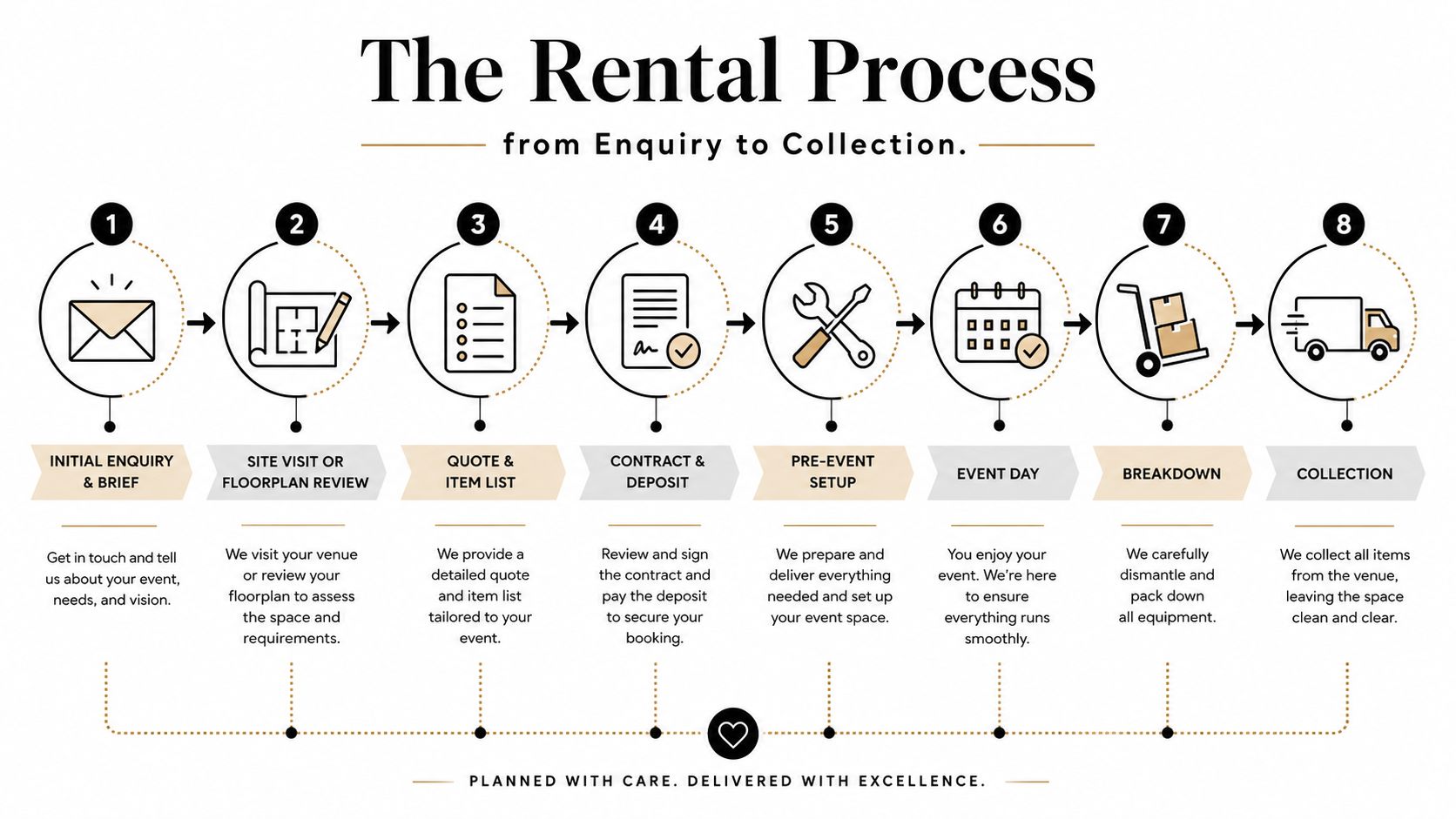
Eight stages to control
- Initial enquiry and brief: State what the event is, where it is, how many guests are expected and what the venue allows.
- Site visit or floorplan review: Confirm entrances, lift access, unloading points, power, floor surfaces, exits and weather exposure.
- Quote and item list: Require quantities, hire dates, delivery windows, setup, collection, labour and damage terms in writing.
- Contract and deposit: Check cancellation, substitution, breakage, weather and access clauses before paying.
- Pre-event setup: Confirm the crew arrival time with both the supplier and venue. Don't assume the venue's booking time equals the supplier's access time.
- Event day: Keep a contact person available for access questions, last-minute furniture movement and venue instructions.
- Breakdown: Establish what can be struck immediately and what must remain until guests leave or the venue signs off.
- Collection: Photograph returned stock if the supplier requires condition evidence, and confirm the process for deposit release.
Protect the final fortnight
Peak-season weekends need earlier action than quiet dates. South African guidance varies, with one local decor FAQ recommending four to twelve weeks for larger events and a furniture-rental guide recommending three to six months for the best selection. Sandton Decor Hire and Urban Tonic's South African event-decor guide illustrate why generic lead-time advice isn't enough. Demand, specialist stock and venue access should determine your deadline.
Two weeks before the event, confirm the final guest count, floor plan, delivery contact, venue access window, power points, weather backup, setup sequence, collection time and supplier contact numbers. Ask whether the supplier carries contingency stock for breakage and whether the venue has approved the proposed layout.
How to Choose a Reliable Cape Town Supplier
A polished portfolio proves styling ability, not operational reliability. On an event day, the supplier also needs the right vehicle, confirmed access, compliant fabric documentation and a collection plan that suits the venue. Treat decor hire as a logistics and risk-management decision before judging the Pinterest board.
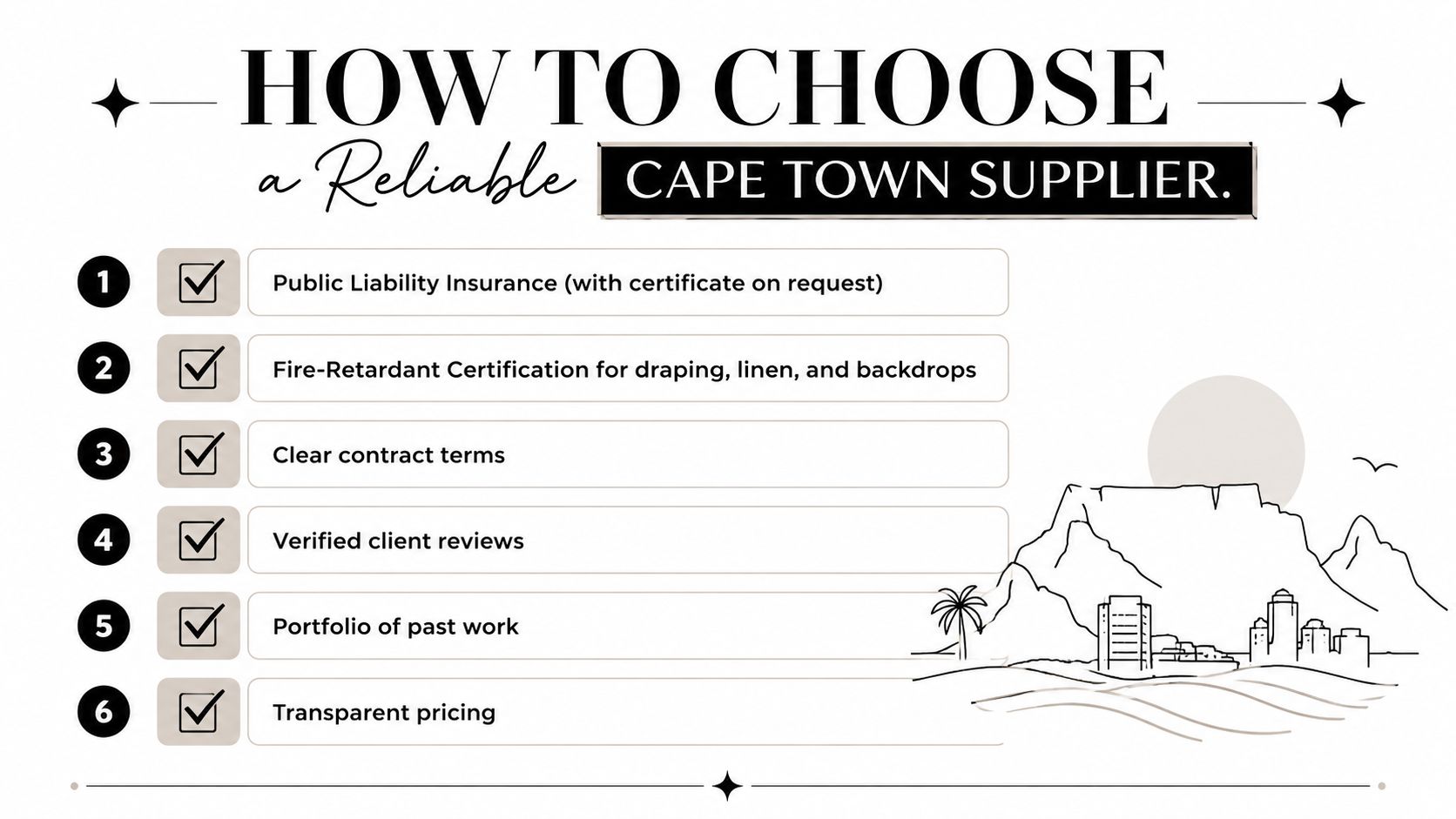
Ask for evidence, not reassurance
- Public liability insurance: Request the certificate and confirm that the cover suits event work at the venue.
- Fire-retardant documentation: Ask for records covering draping, curtains, chair covers, tablecloths and fabric backdrops.
- Electrical safety: Confirm that lighting and powered equipment use compliant fittings, with safe cable routes and suitable protection.
- Recent references: Speak to clients or coordinators who used the supplier at comparable venues.
- Physical portfolio: View real setup photographs, not only catalogue images. Ask how each installation was secured, powered and packed down.
- Transparent pricing: Require an itemised quote separating delivery, labour, damage terms and collection.
Western Cape venues may apply strict permit, capacity and fire-safety conditions. Those rules affect the furniture footprint, access route and setup window. Ask the supplier to confirm how drapes, floor coverings, centrepieces and other combustible decor will be documented and installed. Fire-retardancy records should be part of procurement, not an afterthought.
Read the contract like an organiser
Check substitution rights, weather cancellations, late-access charges, cleaning fees, breakage responsibility and deposit-release timing. Confirm whether the supplier owns the stock or brokers it from another company. Brokered stock can mean extra mark-ups, uncertain availability and substitutions when another booking takes priority.
The contract should state the delivery vehicle, arrival window, loading route, setup responsibility and collection conditions. A large lounge suite may fit the floor plan but fail at a narrow estate entrance. A supplier who has not checked access can turn a simple delivery into a delay, labour charge or layout change.
Local experience matters. A supplier familiar with estate rules in Stellenbosch, Franschhoek, Paarl and Hermanus will ask about truck access, uneven surfaces, wind exposure and collection. For nearby options, use event decor hire near me, then compare each supplier against the same checklist rather than choosing on proximity alone.
Your Next Steps and Quick Answers
A supplier cannot price accurately from a mood board alone. Confirm the guest count, venue and date, shortlist two suitable suppliers, request itemised quotes, check insurance and fire-retardant records, then book a walkthrough before signing. In Cape Town and the Winelands, the furniture footprint, delivery route and setup window can affect permits, capacity and fire-safety compliance.
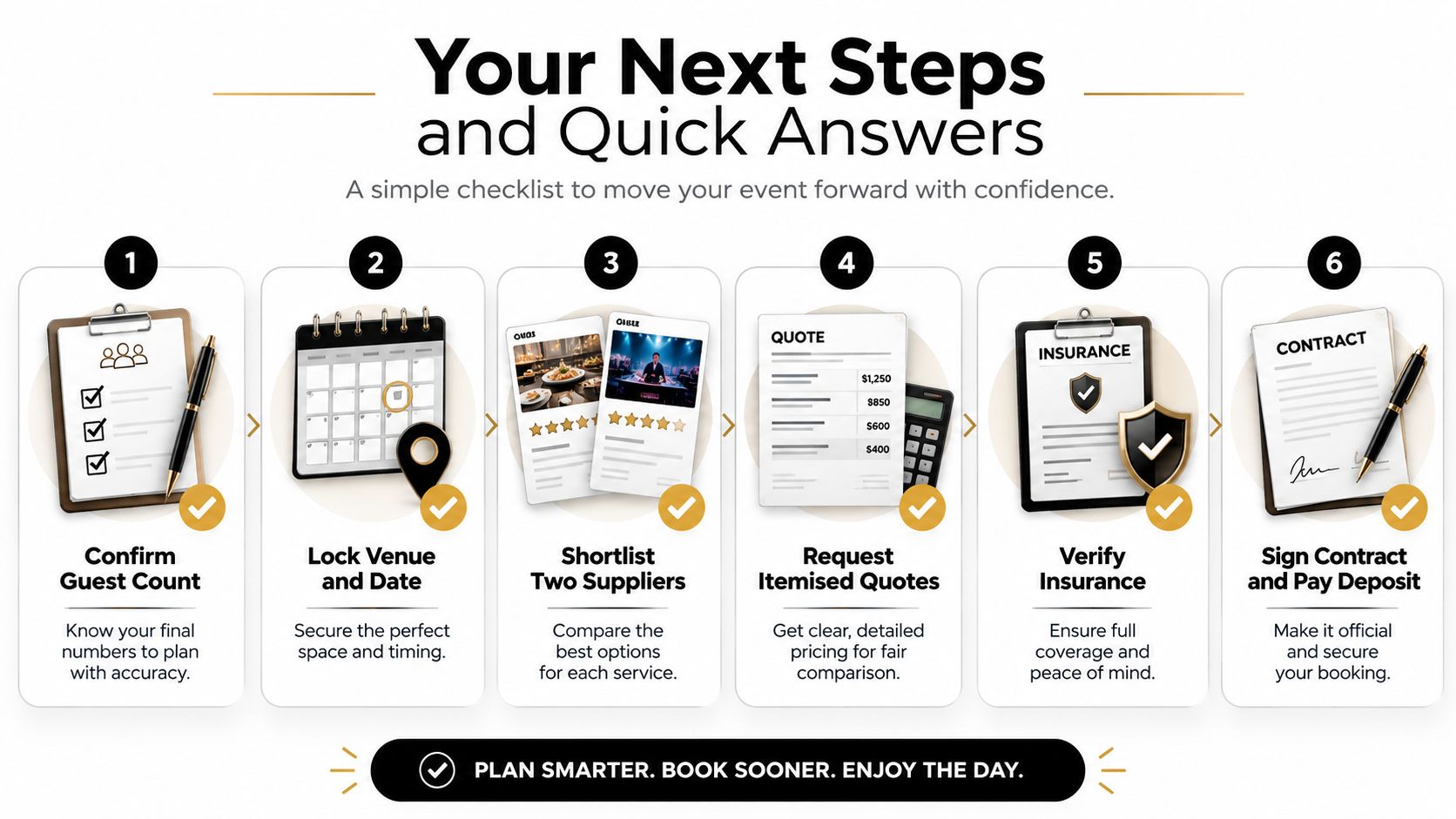
Questions planners ask before booking
How early should I book? For larger events, South African guidance ranges from four to twelve weeks for decor and three to six months for the widest furniture selection. Treat those ranges as a starting point. Peak weddings, matric dances, corporate launches and year-end functions can exhaust specialist stock earlier, so book once the venue and broad layout are confirmed.
Can I add furniture after confirming the guest list? Only if usable floor area remains and the layout stays within the venue's certified capacity. Planning benchmarks include 0.5 m² per person for cocktail standing functions, 1.0 m² for cinema seating, 1.3 m² for school-room seating and 1.75 m² for banquet seating with 1.8 m round tables. The standard's planning guidance shows why lounges, bars and backdrops belong on the floor plan, not as late additions.
When do permits become relevant? The City of Cape Town Events By-law excludes events under 200 people only where there is no amplified sound and no temporary structure. Events expected to exceed 2,000 people require SAPS approval and police risk categorisation before an event permit may be issued. Check The City of Cape Town Events By-law with venue requirements, especially for marquees, staging and open flames.
What should I expect around damage? A refundable deposit, damage waiver or replacement clause may apply. Confirm treatment of stains, missing pieces, candle wax, weather damage and late returns.
What about outdoor weather? Require a backup location. Confirm whether each structure, linen and lighting item can be moved safely, who makes the weather call and who pays for the change.
Settle the furniture plan, safety documents and delivery schedule before refining styling details. Ask suppliers to price the actual operation, including access and handling, rather than only the look.
ABC Hire supplies event furniture and accessories, including tables, chairs, lounge pieces, LED furniture, glass candle holders and climate-control equipment for weddings, corporate events and private functions in Cape Town and surrounding Winelands areas. Visit ABC Hire to review hire options and request a setup based on your venue, date and guest plan.