
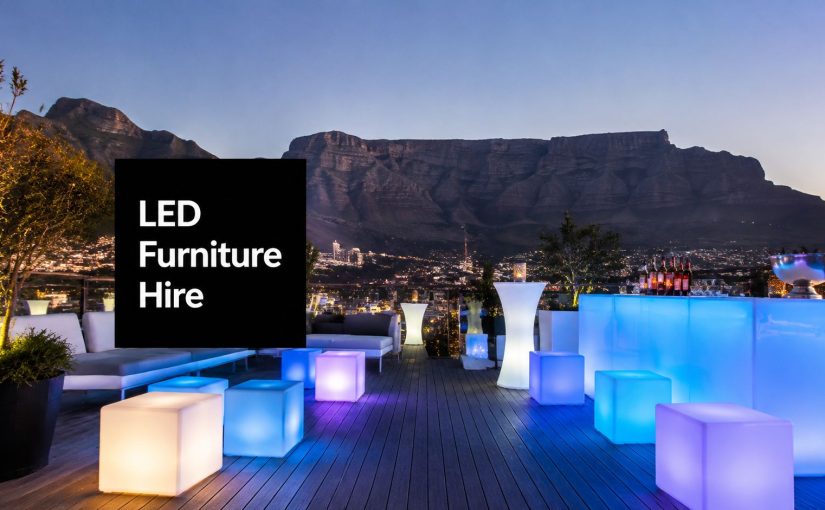
Six days before a marquee wedding reception, the planner discovers that the venue's practical lighting is fine for catering, but hopeless for the dance floor and lounge areas. She needs furniture that looks deliberate after sunset, won't create a maze of extension leads, and can reach a Winelands estate without turning setup into a second production. That's where LED furniture hire in Cape Town earns its place.
Illuminated cubes, bars, cocktail tables, benches and ottomans can define a dark venue without hiring a separate lighting crew. But the hire only works when the pieces match the event schedule, venue rules, weather exposure and delivery route. Cape Town's city bowl, Atlantic Seaboard, Stellenbosch estates and Helderberg venues don't present the same operating conditions.
What LED Furniture Hire Actually Means in Cape Town
LED furniture hire is a short-term rental service for illuminated seating, tables, bars and decorative pieces. A rental house supplies the furniture, arranges delivery or collection, and may handle placement, setup and removal. The units are usually rechargeable and battery-powered, although some ranges use low-voltage cabling connected to a central transformer.
That changes the floor plan in a useful way. Standard linen-and-Chiavari hire gives guests somewhere to sit and creates a formal dining structure. LED furniture adds light, zoning and visual direction. A glowing bar can anchor the drinks area, cubes can create informal seating around a dance floor, and illuminated cocktail tables can keep guests circulating instead of clustering beside the main dining tables.
Planner's rule: Use LED furniture to define guest behaviour, not just to add colour.
Cape Town has the demand to support this kind of specialist hire. The City of Cape Town reported that its Events Permit Office processed 1,540 event permit applications in the 2025/26 financial year and approved 983 events, attracting about 4.1 million spectators and participants. The city also reported that its top 30 events generated more than R5 billion in local economic activity, with six flagship events contributing roughly R4.5 billion. Those figures include major public events, but they also illustrate the depth of the city's wider event ecosystem, which supports weddings, corporate activations and formal celebrations. The City of Cape Town event-economy assessment provides the local context.
The brief looks different by location. A city-bowl rooftop may need compact pieces that can move through a lift and avoid visible cabling. A wine-estate reception may need weather-rated furniture that arrives over gravel roads before a strict gate closes. A Helderberg matric dance may prioritise saturated colour, photo-friendly seating and fast collection after the last guest leaves.
LED furniture also belongs in the same supplier conversation as exhibition and activation infrastructure. If a brand team is coordinating a broader visual installation, guidance on an exhibition stand can help align furniture, branding and guest-flow decisions. For weddings, planners can also compare illuminated pieces with the wider range of furniture for hire in Cape Town before finalising the layout.
How LED Furniture Works and What the Specs Really Deliver
Start by identifying the power family. Battery-powered pieces contain rechargeable packs inside each unit, while wired or transformer pieces receive low-voltage power from a central source. Battery units are easier to position and safer for layouts that change during the evening. Wired systems can suit fixed installations, but they require cable planning, protected routes and a venue willing to accommodate the load.
Local commercial LED furniture is commonly specified with six to eight hours of recharge time, approximately eight to ten hours of working time, IP64 to IP68 protection, and 16 colour modes, including fading, strobing and flashing. These specifications come from a South African supplier listing summarised in the available local reference material, ABC Hire's LED furniture range. Treat those figures as a planning benchmark, not a promise that every model performs identically.
Battery runtime is a scheduling question
A supplier may quote a working time of eight to ten hours, but the actual result depends on brightness, colour mode and control behaviour. A static single colour is generally less demanding than full-saturation colour changes, rapid flashing or continuous fading. If the reception begins before sunset and ends late, charge every unit fully and ask whether the stated runtime applies to the mode you've selected.
Charging time matters during a busy event week. If pieces are returned from one function and immediately needed for another, the supplier's charging capacity becomes part of your risk assessment. Ask how many units can charge simultaneously and whether backup pieces are already charged.
IP ratings need a real venue scenario
The IP rating indicates resistance to solids and water, but it doesn't make furniture invincible. A weather-rated unit may be suitable for a covered terrace or lawn lounge, yet still need protection from standing water, direct rain and careless placement.
A practical comparison looks like this:
| Spec | Battery-Powered Pieces | Wired or Transformer Pieces |
|---|---|---|
| Placement | Flexible, with no cable run to each unit | Best for planned, fixed layouts |
| Venue power | Minimal reliance on mains during the event | Requires transformer access and cable management |
| Setup | Faster repositioning | More time needed for routing and protection |
| Runtime risk | Depends on charge, brightness and colour mode | Depends on stable supply and protected connections |
| Best use | Weddings, lounges, rooftop events and mobile activations | Structured installations with controlled access |
Control systems deserve equal attention. An IR remote is simple, but it needs a clear line of sight and a charged battery. DMX can give venue technicians coordinated control across furniture and lighting, while a Bluetooth app offers flexibility but depends on a phone, pairing and someone willing to operate it. If you're leaving before the first dance, choose a mode that can be set once and left alone. For party lighting that needs to work with the overall atmosphere, compare furniture with LED lights for parties before selecting the control method.
Power, Venues and the Cape Town Night-Event Reality
Battery-powered furniture is usually the sensible choice when a venue has strict power-loading rules. Cape Town venues commonly operate on reticulated mains of 240 V and 380 V, and the Cape Town International Convention Centre requires advance notice when demand exceeds 60 Amps on a three-phase supply. Its safety guidance also favours low-wattage or LED displays and discourages halogen because of fire risk. The CTICC safety and security manual sets out those venue considerations.
The important distinction is between furniture power and venue power. A battery cube can be charged before delivery and then operate without adding a new load to the venue during the reception. That reduces the need for extension leads across walkways and lowers the chance that decorative lighting competes with catering equipment, sound, refrigeration or stage systems.
Don't use an unsupported runtime promise in your event plan. The verified local benchmark is about eight to ten hours of working time, with six to eight hours for recharging, so match the unit specification to the schedule and chosen brightness rather than assuming every piece will last indefinitely. If your furniture will be operating throughout the ceremony, cocktail hour and reception, ask the supplier to confirm the expected runtime for that exact programme.
City-bowl rooftops bring access and noise issues. Generators may be restricted, lifts may limit the size of each delivery batch, and cables can create trip hazards in compact spaces. Stellenbosch and Franschhoek farms often present a different problem, limited backup power and longer distances between the loading area and reception site. Battery pieces won't solve every production requirement, but they remove one avoidable dependency.
Load-shedding still needs a proper contingency plan. Charged furniture can remain illuminated if the venue's mains supply fails, but the DJ, caterer, sound system, bar refrigeration and general safety lighting may not. Treat LED furniture as one resilient layer, not as an emergency-lighting system. For smaller guest areas, rechargeable table lights can complement the plan, as outlined in this guide to rechargeable table lamps.
Booking Logistics Across Cape Town and the Winelands
The city and the Winelands should not be booked as if they're one delivery zone. Cape Town's event infrastructure is unusually dense. A 2026 industry inventory report listed 476 conference venues in the Western Cape, representing 26% of South Africa's listed conference inventory, while Cape Town ranked first among cities with 101 venues, or 5.5% of the national listing. The broader Cape Metro, including Stellenbosch, Paarl, Franschhoek and Somerset West, contained 183 venues. The regional venue inventory report explains that spread.
That density creates choice, but it also creates a dispersed logistics problem. City-bowl and Atlantic Seaboard deliveries may be straightforward, while wine-estate jobs can involve gravel roads, narrow gates, loading restrictions and long walks from the truck to the marquee.
Put the brief in writing
Send the supplier a single written schedule covering:
- Quantity and product mix: List cubes, benches, bars, tables and ottomans separately.
- Colour and control: Specify static warm white, colour-changing, a branded palette or a preset sequence.
- Delivery window: Include the venue's approved arrival slot, not merely the guest arrival time.
- Access information: Share gate instructions, road conditions, loading areas, stairs, lifts and distance to the setup point.
- Setup responsibility: Confirm whether the team places and tests the furniture or only drops it at the venue.
- Collection: Ask whether collection is scheduled after the event, the next morning or at another agreed time.
For Stellenbosch, Franschhoek, Paarl and Helderberg estates, book earlier than you would for a city venue. The exact lead time depends on the date, inventory and route, but rural access makes late changes harder to absorb. After-midnight collection can also carry an extra charge, so confirm it before approving the quote.
Check the small contractual details
Ask who supplies the controller, charging equipment, spare batteries and any protective materials. Clarify the damage waiver, especially where wind, uneven lawns, gravel and outdoor bar areas could increase scuffing. A signed delivery note should record the number and condition of the pieces on arrival, with the on-site contact named clearly.
Operational rule: A verbal promise about delivery timing is not a schedule. Put every access and collection detail in the quote or contract.
The local market still has a practical information gap. Product pages often state working times, but planners need answers about charging logistics, venue power limits, load-shedding, delivery windows and outdoor setup. A supplier that answers those questions directly is more useful than one that only sends attractive catalogue images.
Styling Ideas for Weddings, Matric Dances and Brand Activations
LED furniture works when it supports the room's social rhythm. It fails when every item flashes in a different colour and the venue starts looking like a showroom. Choose one dominant mood, then use furniture to create zones that guests understand instinctively.
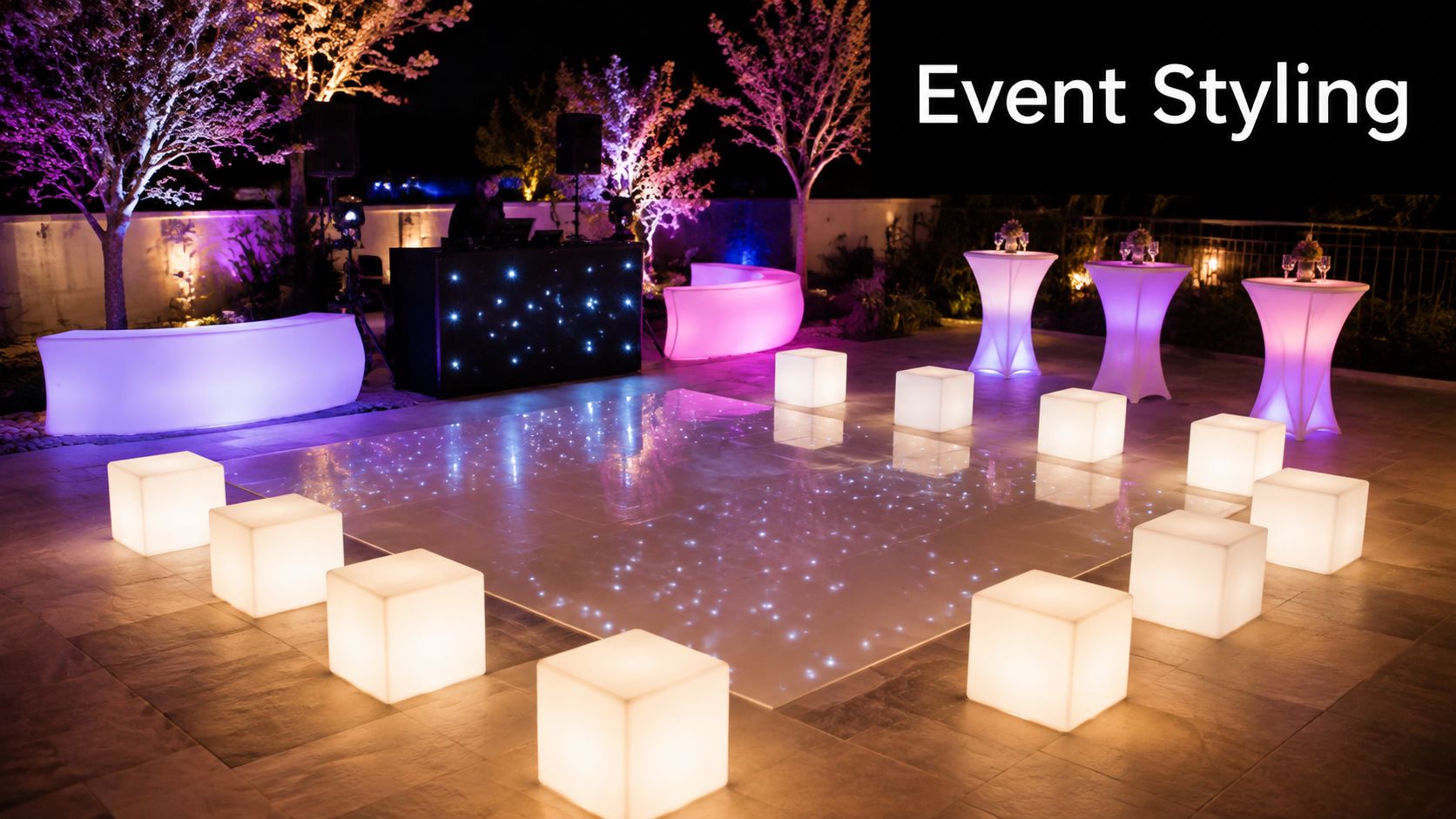
For a wedding reception, warm white usually gives the most controlled result. Place illuminated cubes around the dance floor as informal perches, add curved benches near the DJ area, and use glowing cocktail tables to define a separate lounge or cigar area. Keep the dining tables calmer. The dance floor and bar should carry the visual energy.
Match the furniture to the event
Matric dances can take stronger colour. Magenta, cyan or a programmed colour sequence works well with LED cubes, posing benches and one statement chair that gives students a clear photo anchor. Don't scatter pieces randomly. Create one deliberate photography zone and one separate seating area so the furniture doesn't block the entrance or buffet.
Brand activations need consistency more than spectacle. Ask whether the units accept DMX, IR control or a Bluetooth app, then confirm who will change the colour during the evening. A campaign palette should appear across the bar, cocktail tables and seating rather than shifting unpredictably between unrelated hues.
Winelands ceremonies need restraint. Low-glow rectangular tables under oak trees can create intimacy without flooding the area with light. Use the venue's architecture and planting as part of the design, and avoid bright furniture near the ceremony sightline.
Test colour against the actual venue
Soft pastel modes can disappear in daylight, while saturated colours can dominate a compact rooftop. Request a sample image or colour render that reflects the venue's walls, flooring and nearby lighting. Choose with sunset in mind. A colour that looks refined at the start of the invitation time may look flat once the sky darkens, so plan the transition from natural light to artificial light as part of the styling brief.
Why a Single Cape Town Hire Partner Beats Mixing Suppliers
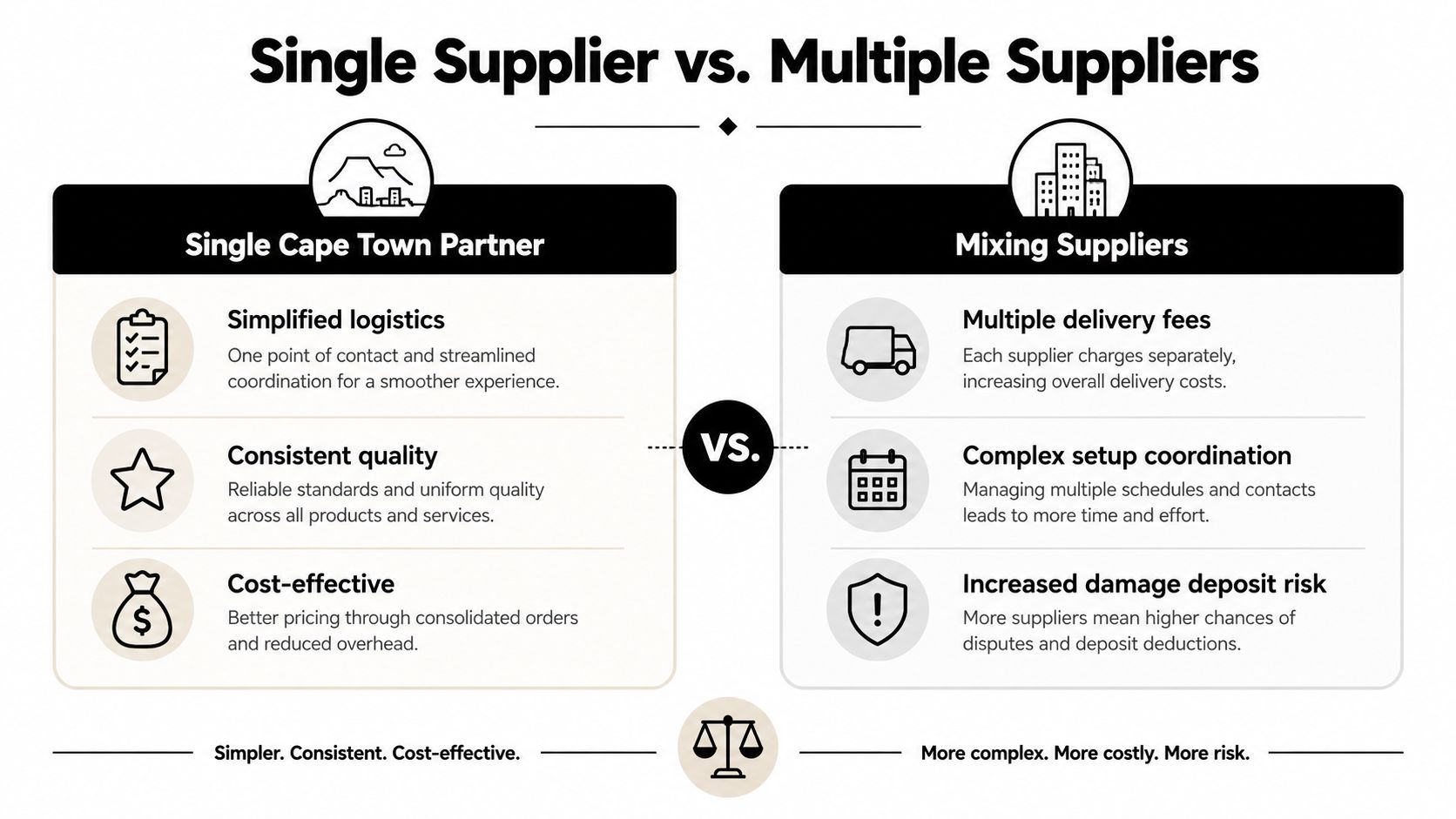
Splitting the order across several companies sounds flexible, but it creates separate delivery fees, setup windows, contracts and collection arrangements. At a wine estate, each additional vehicle can complicate gate access and unloading. One consolidated delivery is easier for the venue, the planner and the supplier team.
A single partner also creates one chain of responsibility. If a cube arrives scratched, a remote fails or a piece stops responding, you're not left deciding which company owns the problem. One contract can define quantities, condition, damage terms, replacement procedures and collection.
What to inspect before signing
Look for a hire partner with a physical warehouse, organised charging bays and a documented backup-unit policy. You want evidence that the furniture is tested before dispatch, not merely loaded from a storage area.
Ask these questions directly:
- Do you carry charged replacement units: Find out what happens if a piece fails during the reception.
- Who controls the furniture: Confirm whether the planner, venue technician or supplier operates the remote or DMX controller.
- How do you handle a late collection: Get the after-hours process and any additional charge in writing.
- Can you consolidate the delivery: Confirm whether furniture, bars and related event items arrive in one planned vehicle or separate loads.
- What happens outdoors: Ask how the team protects charging ports, manages uneven ground and responds to weather changes.
ABC Hire is one Cape Town option offering LED tables, bars, ottomans, cubes, balls and swing chairs, with collection or delivery to the event venue. The important point isn't the size of the catalogue. It's whether the supplier can match the furniture, route, control system and backup plan to your venue.
A single partner won't eliminate every event risk, but it gives the planner one person to call and one team accountable for the result. That matters most when the venue sits outside the city and the reception continues after the warehouse has closed.
Your Pre-Event Checklist Before the Furniture Leaves the Warehouse
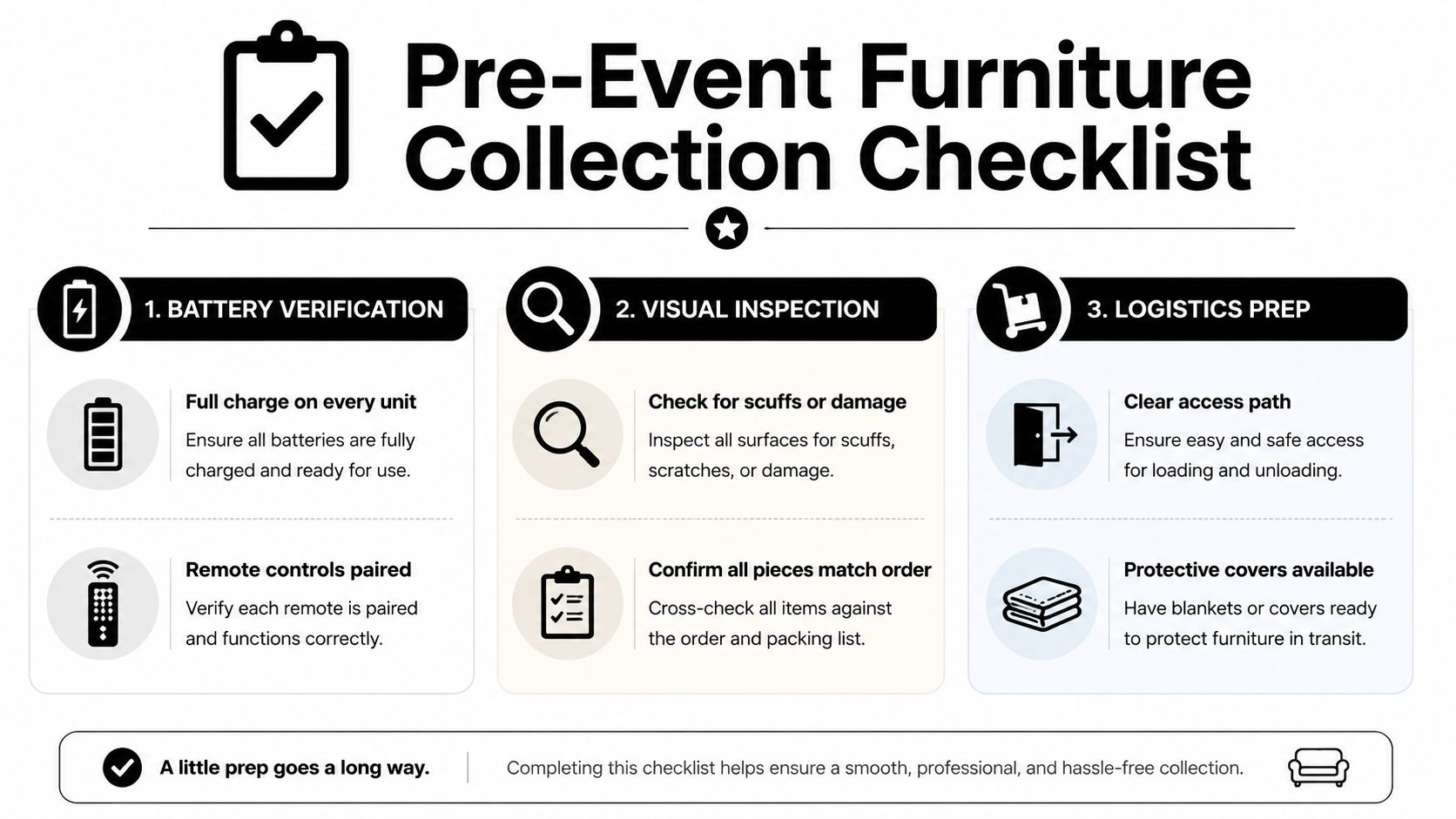
Run the verification routine before collection or delivery. Don't wait until the furniture is on the lawn, guests are arriving and the planner is answering calls from the photographer.
Battery verification comes first
Every unit should be fully charged and switched on before it leaves the warehouse. Test the selected colour mode, pair the remotes and check that the controls operate the intended pieces. If the supplier uses an app or DMX, confirm the device, account access and controller are available on site.
Tape a spare battery to each remote or keep clearly labelled spares with the event kit. A flat remote on the dance floor late in the evening is a small failure with an outsized effect because the furniture may still be powered but impossible to control.
Inspect the furniture, then inspect the route
Use a simple condition check:
- Furniture condition: Look for cracks, deep scratches, damaged diffusers and loose fittings.
- Charging ports: Confirm that rubber bungs and protective covers are present.
- Order accuracy: Match every piece against the signed quote and delivery note.
- Outdoor protection: Reconfirm the IP rating for each outdoor zone and keep units away from standing water.
- Wind exposure: Use weighted bases or move lightweight pieces into sheltered courtyards when conditions change.
- Weather plan: Know whether the furniture moves under cover, returns to the truck or stays in place during light coastal mist.
Venue paperwork can prevent a failed delivery. Confirm access for the delivery vehicle, loading-bay time slots, lift dimensions for upper-floor city venues, estate gate codes after dark and the route from parking to the reception area. Tell the supplier about gravel, stairs, narrow paths and any security check that could delay unloading.
Build a power contingency
Charge the furniture before the event and confirm the supplier's emergency contact in writing. Keep a torch plan for walkways and service areas, because decorative LED furniture isn't a replacement for venue safety lighting. If load-shedding threatens the event, make sure the sound, catering, refrigeration and general illumination plans are handled separately.
On arrival, photograph visible condition and count the pieces before the supplier leaves. Get the venue contact to sign the delivery note, store the remote controls somewhere dry and keep the supplier's number both online and offline.
ABC Hire supplies LED furniture for Cape Town events, including illuminated tables, bars, ottomans, cubes, balls and swing chairs, with collection or delivery to the venue. If you're planning a wedding, matric dance or activation in the city or Winelands, visit ABC Hire to discuss the furniture mix, access route, battery plan and setup requirements before you confirm the booking.