
You're probably staring at a venue layout, a mood board, and a supplier list, trying to decide whether to buy one of the many wine barrels for sale around Cape Town, or just rent the things and move on. That's a smart question. Too many planners get seduced by the look of a barrel and ignore the headache attached to it.
A wine barrel can be brilliant event décor. It can also become the most annoying item on your job sheet. It's bulky, awkward, heavy, and rarely as “simple” as the listing makes it sound. In the Cape Town and Winelands market, where delivery routes, farm roads, venue access, and storage all affect cost, the buy-versus-rent decision matters more than people admit.
My view is blunt. If you run frequent events, have storage, and want a consistent rustic inventory item, buying can make sense. If you're styling a once-off wedding, a brand activation, a matric dance, or a private celebration, renting is usually the cleaner call. The barrel itself is only part of the cost. Handling it is the primary consideration.
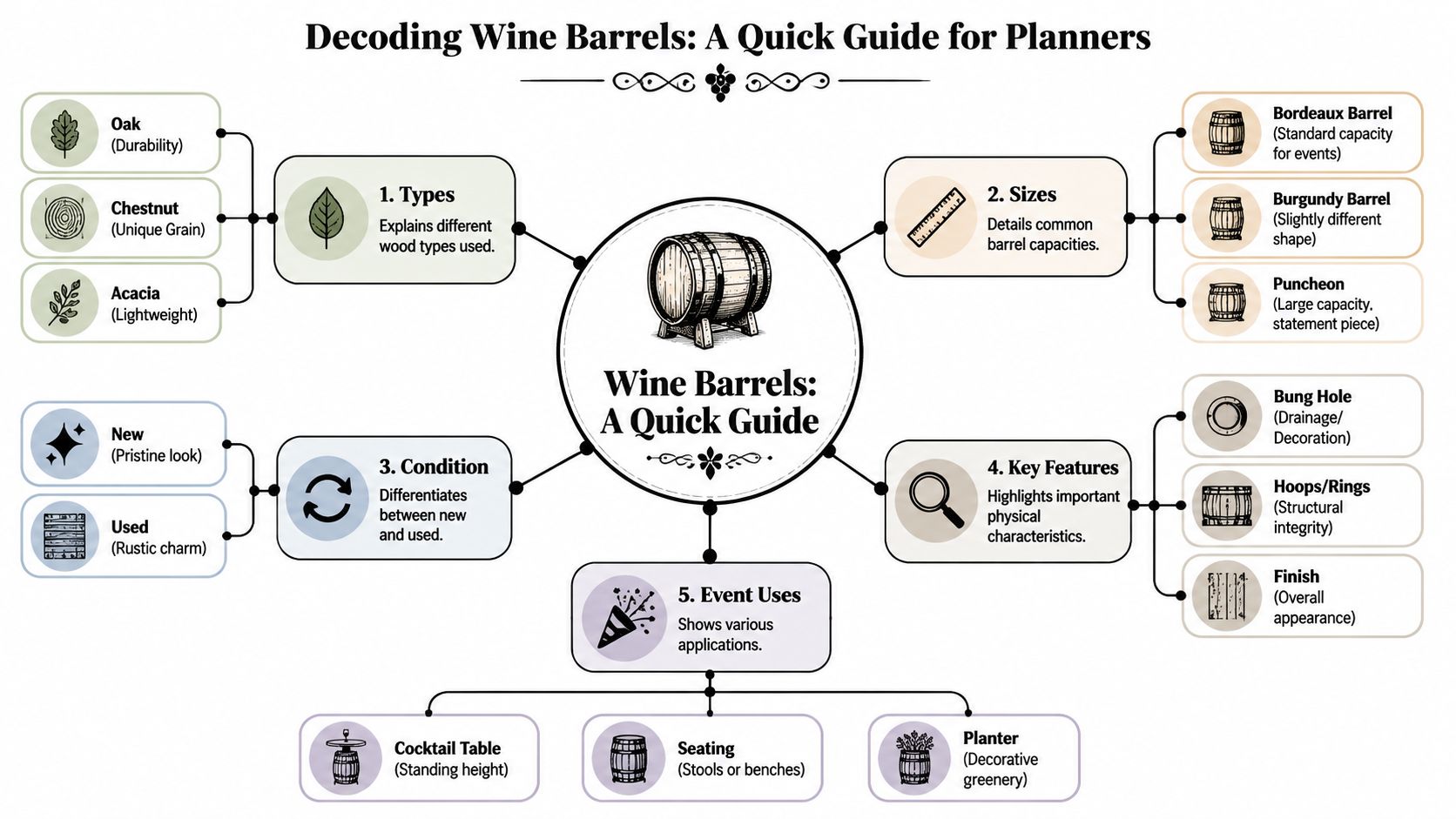
Decoding Wine Barrels A Quick Guide for Planners
Before you even compare quotes, learn the language. Most buyers searching for wine barrels for sale don't need a “wine barrel”. They need a specific look, a specific size, and a barrel in a condition that suits the job.
Start with the standard event barrel
The barrel you'll see most often is the 225L Bordeaux-style cask. It's the workhorse shape for décor because it looks familiar, photographs well, and suits weddings, tastings, bars, and entrance styling. According to Social Vignerons' barrel anatomy guide, a standard 225L barrel is about 95 cm long, has a 56 cm head diameter, uses 27 mm wood thickness, and weighs around 50 kg empty. Filled, it reaches roughly 275 kg.
That matters immediately for planners. An empty barrel already needs proper loading, safe carrying technique, and a venue team that knows where it's going before it comes off the vehicle. If somebody tells you “we'll just move it around on the day”, they haven't worked with barrels enough.
Practical rule: If you haven't checked access ramps, floor surfaces, and final placement in advance, don't confirm barrel décor yet.
Know the words suppliers use
A barrel listing can sound polished while saying almost nothing. These are the terms that matter:
- New barrel means cleaner lines, fresher timber, tighter branding, and a more polished finish.
- Used barrel usually means visible wear, staining, patina, and more character.
- Neutral barrel means an older barrel with little flavour impact left for wine use, but often still very good for décor.
- Décor grade or furniture grade usually signals that appearance matters more than watertight performance.
- Watertight matters only if you want functional use, such as a display involving liquid, ice, or planting.
Size and look aren't the same thing
For events, people obsess over litres and forget visual scale. A standard barrel works well beside harvest tables, ceremony aisles, lounge areas, and bar installations. Larger formats create more presence but also eat floor space and can feel clumsy in a tight room. If your event is in a compact city venue, oversized barrels can make the room feel crowded fast.
Wood choice also affects the conversation. If you want a deeper understanding of how oak shapes wine vessel choices, Res Fortes on wine vessels is worth reading. For planners, the practical takeaway is simple. The type of barrel influences both appearance and cost, so don't ask for “any barrel” if your client cares about finish.
The True Cost of Buying a Wine Barrel
Buying feels cheaper because the first number is visible. Ownership is where the bill grows teeth.
The purchase price is only the first hit
Barrel economics vary sharply by oak type. Data Bridge's wine barrel market report notes that a 60-gallon American oak barrel might cost about USD 395, while a 60-gallon French oak barrel can sit around USD 900 before shipping and import costs. That's a big gap, and it matters if you're buying multiple units for an event stockholding.
For wineries, that difference is part of production planning. For event people, it's a warning. If you're paying up for a prettier barrel without a clear reuse plan, you're tying money up in an object that may spend most of its life in storage.
The hidden costs are what catch planners
Owning barrels in the Western Cape comes with predictable friction:
- Transport means more than delivery. You need collection, loading help, vehicle space, tie-downs, and a route that suits farm roads or city loading zones.
- Storage sounds easy until you realise a barrel is awkward to stack, awkward to clean around, and always in the way when warehouse space gets tight.
- Maintenance never disappears. Wood moves. Hoops loosen. Surfaces dry out. Stains deepen. Pests and mould are real concerns if barrels sit badly stored.
- Disposal or resale is often messier than expected. A tired barrel still takes up the same amount of space while you wait for a buyer.
Buying a barrel for one event is rarely a one-time purchase. It's a long tail of handling decisions.
The South African context matters
The broader market is active. One market summary projected the global wine barrels market at USD 3.1 billion in 2023, rising to USD 4.9 billion by 2033 at a 4.8% CAGR, according to Market.us wine barrels market news. That tells you barrels remain a live category, not a dead tradition.
But don't confuse industry demand with event practicality. Wineries buy barrels because they use them operationally. Event planners buy them because they look good in photos. Those are not the same economics.
When buying does make sense
Here's my hard line. Buy only if most of these are true:
| Question | If yes, buying may work |
|---|---|
| Will you use them repeatedly? | Yes, across multiple events and seasons |
| Do you have dry, secure storage? | Yes, without displacing higher-value stock |
| Can your team move them safely? | Yes, with proper vehicles and labour |
| Does your brand use rustic inventory often? | Yes, not just occasionally |
| Can you tolerate wear and upkeep? | Yes, it's built into your operations |
If those answers are shaky, don't romanticise ownership. The barrel won't become easier just because you own it.
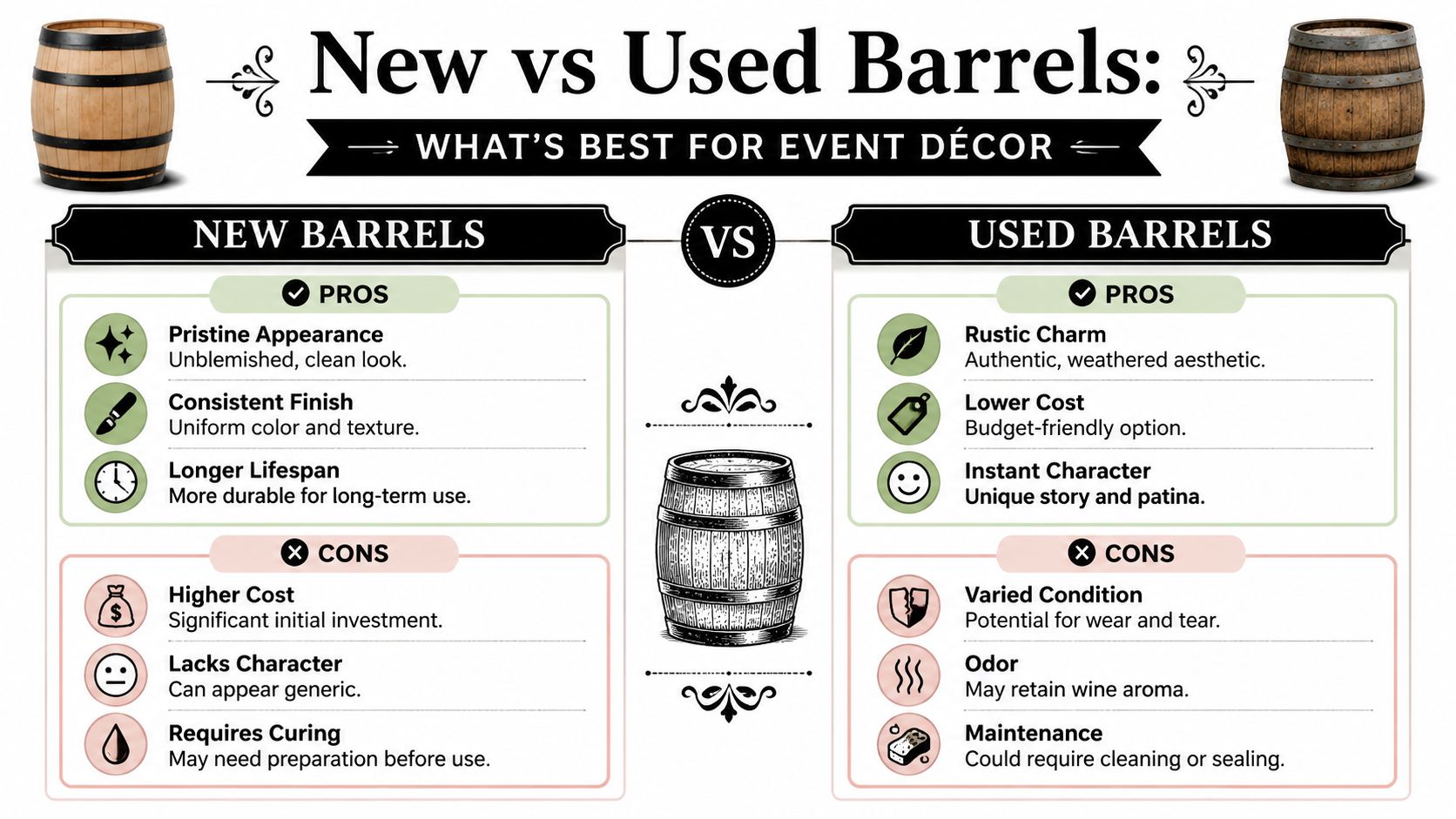
New vs Used Barrels What's Best for Event Décor
Most event clients don't need the “best” barrel. They need the right one for the brief.
New barrels suit polished styling
A new barrel works when the event needs a cleaner finish. Think luxury wedding, premium product launch, cellar opening, or a styled tasting where every surface is intentional. New barrels tend to look more uniform, and that consistency matters in corporate settings where roughness can read as messy rather than charming.
The downside is obvious. You pay more, and sometimes the look is too perfect. In a rustic setting, a pristine barrel can feel like a prop rather than a real piece with character.
Used barrels usually win for atmosphere
For décor, I prefer used barrels most of the time. They look honest. They bring texture into a room. Their marks, staining, and age do half the styling work for you.
WinemakerMag's guide to your first wine barrel notes that barrels sold as neutral for décor purposes have often been used for 5 to 10 years. They no longer contribute much oak flavour, but their structure is still sound, and their aged look is often more appealing for rustic event use than a brand-new barrel. That's exactly why planners chase them.
What to inspect before saying yes
Don't buy a used barrel off a photo alone. Inspect it like a venue manager, not like a Pinterest board.
- Check the hoops: If the metal rings look loose, badly rusted, or uneven, expect trouble.
- Test the stability: A barrel that rocks on a flat floor is a nuisance for table styling and unsafe in guest areas.
- Smell it: Wine aroma is fine. Sour, mouldy, or chemical smells are not.
- Look at the timber surface: Splitting, soft patches, and insect damage are red flags.
- Ask about treatment: If it's going outdoors or into a food-adjacent environment, you need clarity on condition and handling.
The best used barrel for events isn't the oldest one. It's the one that looks weathered but still feels solid.
My recommendation by event type
| Event type | Better choice |
|---|---|
| Luxury wedding | New or very clean used |
| Farm wedding | Used, with authentic wear |
| Brand activation | Cleaner barrels for consistency |
| Birthday or private party | Used is usually enough |
| Permanent venue décor | Buy the best condition you can afford |
If your event style leans romantic, rustic, or wine-country casual, used barrels are usually the smarter visual choice. If your client wants crisp luxury, don't try to fake it with a tired barrel and a tablecloth.
The Smart Alternative Renting Barrels for Your Event
If you only need barrels for one date, renting is usually the grown-up decision.
Renting removes the annoying parts
For the South African event market, Northeast Barrel Company's collection page is useful for one reason. It highlights the primary issue: total ownership cost often makes renting more viable for single-use décor, especially when transport and setup can rival the item cost. That logic lands hard in Cape Town and the Winelands, where distance, labour, and timing affect everything.
When you rent, you're not paying to become a barrel owner. You're paying to solve a styling need for a defined event window. That's a much cleaner transaction.
Why planners usually regret buying for one-off use
The barrel arrives. Then what?
You still need to:
- get it to the venue,
- unload it without damaging floors or backs,
- place it,
- protect it if rain hits,
- move it again after the event,
- store it somewhere that won't ruin it.
That's the part couples and first-time organisers underestimate. Experienced planners don't. They know the décor item is never the full story.
Renting gives you flexibility, not baggage
One month you need weathered barrels for a Franschhoek wedding. Next month you need cleaner pieces for a city tasting event. Then you need none at all. Renting keeps your options open and your storage area clear.
It also helps you build a broader styling plan. If you're comparing overall event furniture strategy, Cape Town furniture hire ideas are worth reviewing alongside statement décor pieces like barrels, because the best event spaces balance hero items with practical furniture.
Good planners spend their time designing flow, guest comfort, and atmosphere. They don't spend it babysitting bulky props after load-out.
My opinion on the buy-versus-rent split
Rent if:
- the event is once-off,
- the budget is tight,
- the venue has awkward access,
- you don't have storage,
- the client only wants the look.
Buy only if:
- you'll reuse them regularly,
- you can manage transport properly,
- your business already carries rustic inventory,
- you've got a plan for upkeep.
That's not glamorous advice. It's profitable advice. There's a difference.
Sourcing Barrels in Cape Town and the Winelands
If you're set on finding wine barrels for sale, source them with your eyes open. The Western Cape gives you options, but not all options suit event work.
Where to look first
You'll usually find barrels through three channels.
Wineries often release older stock when they refresh cellar equipment or change ageing needs. These barrels can be excellent for décor because they already carry that wine-country patina clients want.
Coopers and barrel suppliers are where you go for cleaner stock and more predictable specs. If you need consistency across several barrels, this route is stronger than buying random singles from scattered sellers.
Event rental and décor suppliers make the most sense if your priority is ease, not ownership. They've already solved the condition and logistics issue.
Ask better questions than “how much?”
Poor sourcing starts with vague questions. Ask these instead:
- Is it watertight or décor only? That changes how you can use it.
- Has it been cleaned and inspected? You need clarity, especially for indoor venues.
- What does the barrel smell like? Wine residue can be charming. Mustiness is not.
- Have the hoops been checked? A pretty barrel with loose hardware is a liability.
- What are the delivery and collection terms? In the Cape, distance and access can swing the practical cost.
- Has it been treated for insects or outdoor wear? Essential if it's going to a garden venue or permanent display.
Don't ignore the local transport reality
Cape Town sourcing isn't just “where is the barrel?” It's also “how does it get from there to here, and then back again if plans change?” Farm venues, gravel roads, narrow service entrances, and tight loading windows all change what looked like a good deal online.
That's why broad décor planning matters. If you're building a full venue concept rather than chasing isolated props, Cape Town event décor hire guidance can help you think in systems instead of single objects.
If a supplier can't explain delivery clearly, they're not ready for event work.
My local sourcing advice
In the Winelands, used barrels often look better than city-sourced stock because they fit the environment naturally. In Cape Town corporate venues, condition consistency matters more, so cleaner units tend to work better. Match the sourcing channel to the event style, not just the cheapest listing.
And never assume a seller understands event standards. A barrel that's acceptable in a yard or cellar might be completely wrong in a ballroom, hotel foyer, or polished brand activation.
Inspiring Barrel Décor Ideas for Any Occasion
Barrels earn their keep. Used properly, they don't just fill space. They anchor it.
The best uses are practical and visual
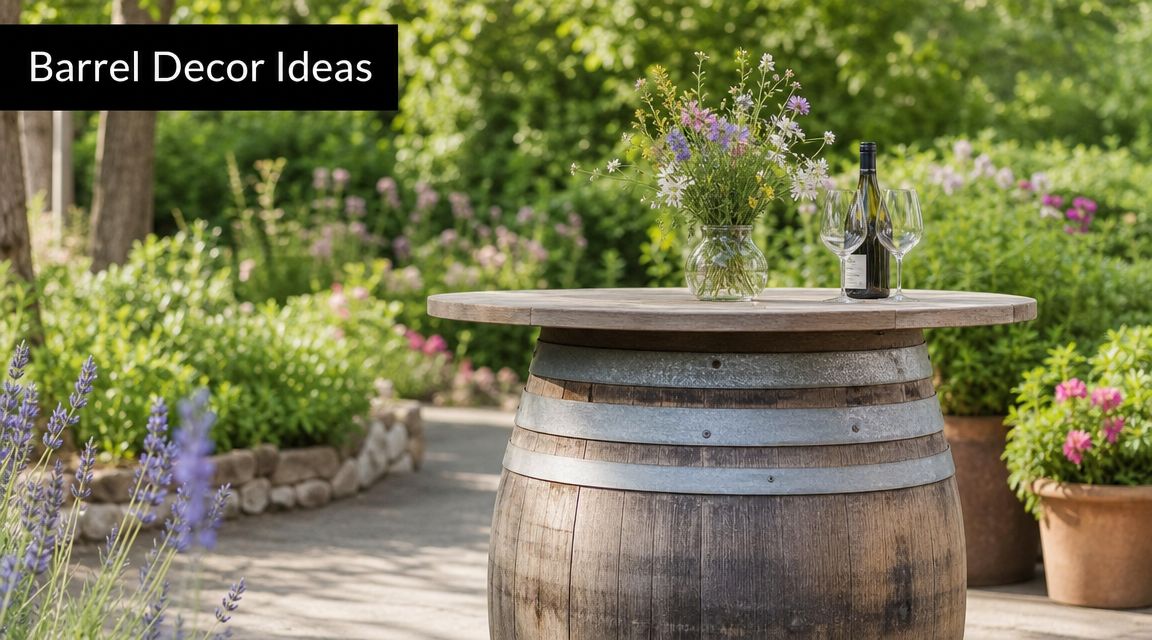
A growing local style trend is versatility. Evans Family Barrels' rustic used barrels page reflects a familiar event pattern: oak barrels are being used as cocktail stations, photo-op props, and statement décor pieces. That fits exactly what works in Cape Town and the Winelands. The best barrel isn't a passive ornament. It should do a job.
A barrel at the right spot can become a welcome table, a plinth, a drinks point, a floral anchor, or a visual marker that pulls guests through the venue.
Barrel ideas that actually work
Cocktail corners
Two barrels with a timber top create an instant standing drinks station. This works beautifully on lawns, under stretch tents, or beside a mobile bar. Guests understand it immediately, and it photographs well without trying too hard.
Ceremony styling
At outdoor weddings, barrels can mark the start of an aisle or frame the ceremony area with florals and candles. In the Winelands, this works because the barrel doesn't feel imported into the surroundings. It feels native to the setting.
Cake and dessert displays
One barrel can carry a cake table moment. A grouped set can support a dessert installation with varied heights and layers. Just make sure the surface is level and the styling team secures anything delicate.
Photo moments
A barrel paired with signage, florals, or branded elements gives guests a natural pause point. That's useful at weddings, launches, and tasting events where you want one strong visual anchor instead of clutter everywhere.
Use them with restraint
Barrels are statement pieces. Treat them like statement pieces. If you scatter too many around the venue, the room starts feeling themed instead of styled.
I prefer one of these approaches:
- Entry feature: a pair at the welcome zone
- Functional cluster: grouped at bar or dessert area
- Ceremony framing: placed with floral design
- Single hero piece: one barrel used deliberately, not repeated to death
If your look leans vintage or rustic, Cape Town vintage furniture inspiration pairs naturally with barrel styling. The key is balance. Timber, linen, glassware, and lighting should work together. The barrel shouldn't carry the whole concept alone.
Your Final Barrel Checklist Before You Commit
If you're still deciding between renting and buying, strip the emotion out of it. Run through the checklist like a production manager.
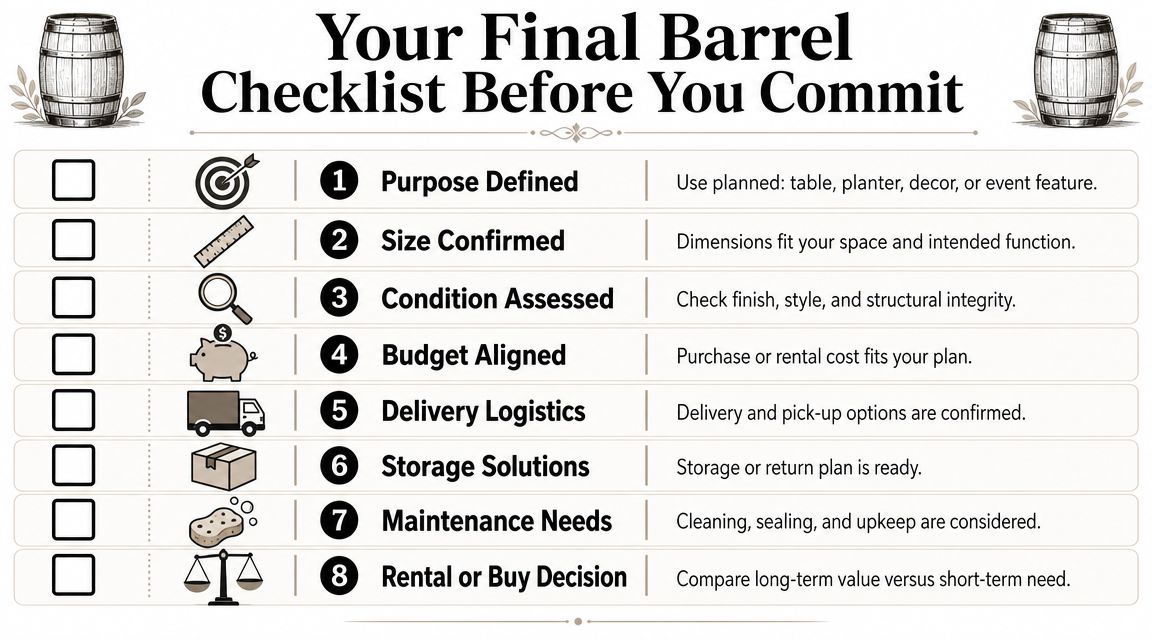
Ask these questions before you spend anything
What is the barrel doing? If it has no function beyond “it looks nice”, rental is usually enough.
Does the event style justify the effort?
A barrel suits Winelands weddings, rustic celebrations, tasting events, and some brand activations. It doesn't suit every venue just because it's fashionable.Can your team handle the logistics?
This is not a lightweight prop. If transport and placement already sound awkward, trust that instinct.Have you checked the condition properly?
New, used, neutral, décor grade, watertight. Those words change the decision.
Then ask the harder operational questions
| Checklist item | What matters |
|---|---|
| Frequency of use | Will you realistically use it often enough to justify ownership? |
| Storage | Do you have dry, secure space that won't create clutter? |
| Cleaning | Who's dealing with residue, dust, smells, and upkeep? |
| Venue fit | Does it suit the floor, access points, and room scale? |
| Client brief | Is the look polished, rustic, branded, or casual? |
My final filter
If you answer “no” or “not sure” to several of these, renting is the better move:
- Repeat use: Will I use this often, not just hopefully?
- Handling: Do I have people and vehicles to move it safely?
- Storage: Can I keep it without damaging it or losing space?
- Condition control: Can I maintain the look my clients expect?
- Time value: Is managing this asset the best use of my time?
A barrel is only a good buy when it keeps paying you back through repeat use. Otherwise it's a bulky souvenir from one event.
The decision in plain English
Buy when the barrel becomes part of your operating kit.
Rent when the barrel is part of the look.
That's the cleanest test I know. It saves money, cuts stress, and keeps you focused on what matters most on event day: a room that works, guests who feel looked after, and a setup that doesn't create unnecessary drama behind the scenes.
If you'd rather skip the storage, transport, and condition gamble, talk to ABC Hire. They help Cape Town and Winelands clients build stylish events without turning every décor choice into a logistics project.