
You're standing in a Cape Town warehouse with a wedding only days away. The venue wants long communal tables, the couple wants a warm natural finish, and the forecast is making an outdoor setup feel risky. The practical question isn't whether pine dining tables look good. It's whether the chosen tables can handle transport, crockery, leaning guests, wine spills, damp air, repeated assembly and the budget.
I've seen pine work brilliantly at Winelands weddings, formal school events and corporate dinners. I've also seen poorly specified tops flex under service loads, absorb stains and arrive at a venue looking tired because the buyer focused on colour instead of construction. This guide evaluates pine dining tables as an event-hire professional would, including grading, maintenance, rental economics, styling and the South African supply chain behind the material.
What Pine Dining Tables Are and Why They Matter in South Africa
Before sunrise at a Stellenbosch wedding, a crew may be carrying solid pine trestle tables through a vineyard while the ground is still cool and damp. The tables need to be light enough for efficient handling, visually warm enough for photographs and practical enough to accept linen, crockery and floral arrangements without demanding the formality of polished hardwood. That's where pine earns its place.
Pine is a softwood from coniferous trees, commonly supplied in South Africa as solid boards or laminated panels. Furniture makers select, machine, join and finish the boards into dining tops, farmhouse designs and trestle systems. The natural honey colour and visible knots suit rustic venues, farm-style receptions and relaxed family dining, while a painted or stained finish can move the same material towards a cleaner contemporary look.
Why South African supply matters
Pine isn't a niche furniture input in South Africa. It accounts for 49.6% of cultivated tree species, and it's the main softwood feeding furniture production, according to the South African forestry and manufactured timber products factsheet. The same source connects wood products, paper products and furniture manufacturing with about R134 billion in local economic contribution, while the furniture industry consumes about 250,000 to 300,000 m³ of industrial timber each year, including timber used for dining furniture.
That scale supports local availability, repairability and a broad range of table formats. A planner can usually find rustic tops, laminated boards, trestle bases and custom dimensions without relying on an imported supply chain. The country also has a long pine-furniture tradition. A TIPS policy brief on South African furniture records pine as the main wood input for furniture producers, including household tables and other knock-down furniture.
Where pine fits among other timbers
Compared with imported oak, pine is generally easier to handle and more forgiving on a hire fleet's repair bench. Eucalyptus can offer a different grain and a more substantial feel, while oak brings a harder surface and a more formal appearance. Those alternatives may suit a permanent dining room or luxury installation, but pine often makes more sense when a crew must move, store, sand and refinish stock between functions.
The important distinction is that pine's value comes from the complete specification, not just the species name. Board quality, thickness, joinery, sealant and intended placement decide whether a table is suitable for a family meal, a wedding service or semi-outdoor use.
How Pine Grade and Density Affect Table Performance
A pine tabletop's behaviour under event loads depends on stiffness, strength, span and joinery. Two tables can look almost identical while responding very differently when guests lean across them, caterers place heavy serving platters at the centre or the table ends carry concentrated loads.
South African structural grading provides useful reference points. Under SANS 10163-1, SA pine grade 5 has a mean modulus of elasticity of 7,800 MPa and a minimum density of 360 kg/m³, while grade 10 reaches 12,000 MPa and 475 kg/m³, as documented in Basic Timber Specifications and Design Tips. Modulus of elasticity indicates resistance to bending. Density gives a practical indication of how substantial and mechanically capable the timber is, although it doesn't replace proper design.
What that means at an event
A lower-grade board may machine easily and still produce an attractive table, but it can flex more noticeably across a long unsupported span. Knots and grain deviations create local weak points, particularly when the tabletop's load path runs through a narrow apron or lightly built trestle. Higher-grade material offers more stiffness for the same basic layout, which helps reduce sag and protects joints from repeated movement.
Finger-jointed or laminated pine can be a sensible rental choice when it has been properly manufactured and sealed. The construction can make it easier to obtain wide, consistent tops, but the joints, adhesive lines and end treatment still need inspection. A thick laminated top with well-positioned supports can outperform a thinner solid board with attractive but poorly managed knots.
Practical rule: Don't judge a table by the top surface alone. Push gently at the centre, inspect the underside, check the apron connection and ask how the supports are positioned.
Pine grade versus event performance
| Grade | Bending strength | Typical knot limit | Behaviour at events |
|---|---|---|---|
| Grade 5 | Not specified in the verified data | Lower-grade character may be present | More likely to flex across a long span if support and apron design are weak |
| Grade 10 | Not specified in the verified data | Higher structural selection | Better resistance to tabletop sag and joint loosening when the load path is concentrated |
| Laminated pine | Depends on the selected boards and construction | Varies by lamella selection | Consistent results are possible when joints, adhesive and support layout are well executed |
The provided South African specifications describe a stiffness and strength trade-off, rather than a universal “good” or “bad” grade. For a broader material comparison before selecting a permanent table, choose durable hardwood for your table offers useful context on why harder woods may suit intensive daily use.
For event planners, the correct question is specific: what span, load profile and support system has the maker designed? The ABC Hire guide to choosing wooden tables and chairs can help frame that conversation before you compare finishes.
The Real Pros and Cons of Pine for Event Use
Pine's strongest event-hire advantage is practical rather than romantic. It's relatively light, widely available and straightforward to sand, patch and refinish. A competent crew can often deal with small dents or surface marks without sending the entire table to a specialist workshop.
That matters when tables travel between farms, hotels, school halls and city venues. Pine can absorb ordinary operational wear without turning every repair into a major capital decision. Its warm grain also works across multiple design briefs, from exposed rustic boards to painted farmhouse furniture.
The advantages that show up on site
- Handling: Crews can move pine tables more easily than many heavier hardwood alternatives, especially when access involves stairs, grass or uneven paths.
- Repair: Minor scratches, dents and dull patches can often be sanded and recoated rather than treated as permanent failure.
- Visual flexibility: Pine accepts clear, tinted, painted and whitewashed finishes, so one basic material can support several event styles.
- Budget control: South African listings show a wide market range, from basic pine dining tables around R1,300 to R1,450 to premium solid pine tables around R3,180 to R4,980, with larger dining ranges above R6,000, as reflected in the verified market review of South African pine table pricing and suitability.
The weaknesses a planner must price in
Pine is soft. Heavy plating service, charger plates, chair arms and guests leaning on the edge can leave marks faster than they would on a harder timber. Red wine and other strongly coloured spills can stain unfinished or poorly sealed surfaces, and moisture can create movement if the table is stored or used carelessly.
For that reason, I wouldn't specify an ordinary indoor pine table for open exposure and assume a coating will solve everything. One South African pine maker specifically says its pine tables are no longer offered for outdoor use, a useful warning for anyone planning a coastal lawn reception or semi-outdoor dining area.
A pine table is economical because it can be maintained and repaired. It isn't economical if you treat it like weatherproof hardwood.
The rental calculation also changes with use. A purchase can look attractive for a household or venue with dependable storage and controlled handling. For a planner who needs varied sizes, transport, insurance, repairs and reliable presentation across different dates, hiring transfers much of that operational burden to the supplier. The material works. The wrong finish, unsupported span or outdoor placement doesn't.
Caring for Pine Tables Through Cape Town Seasons
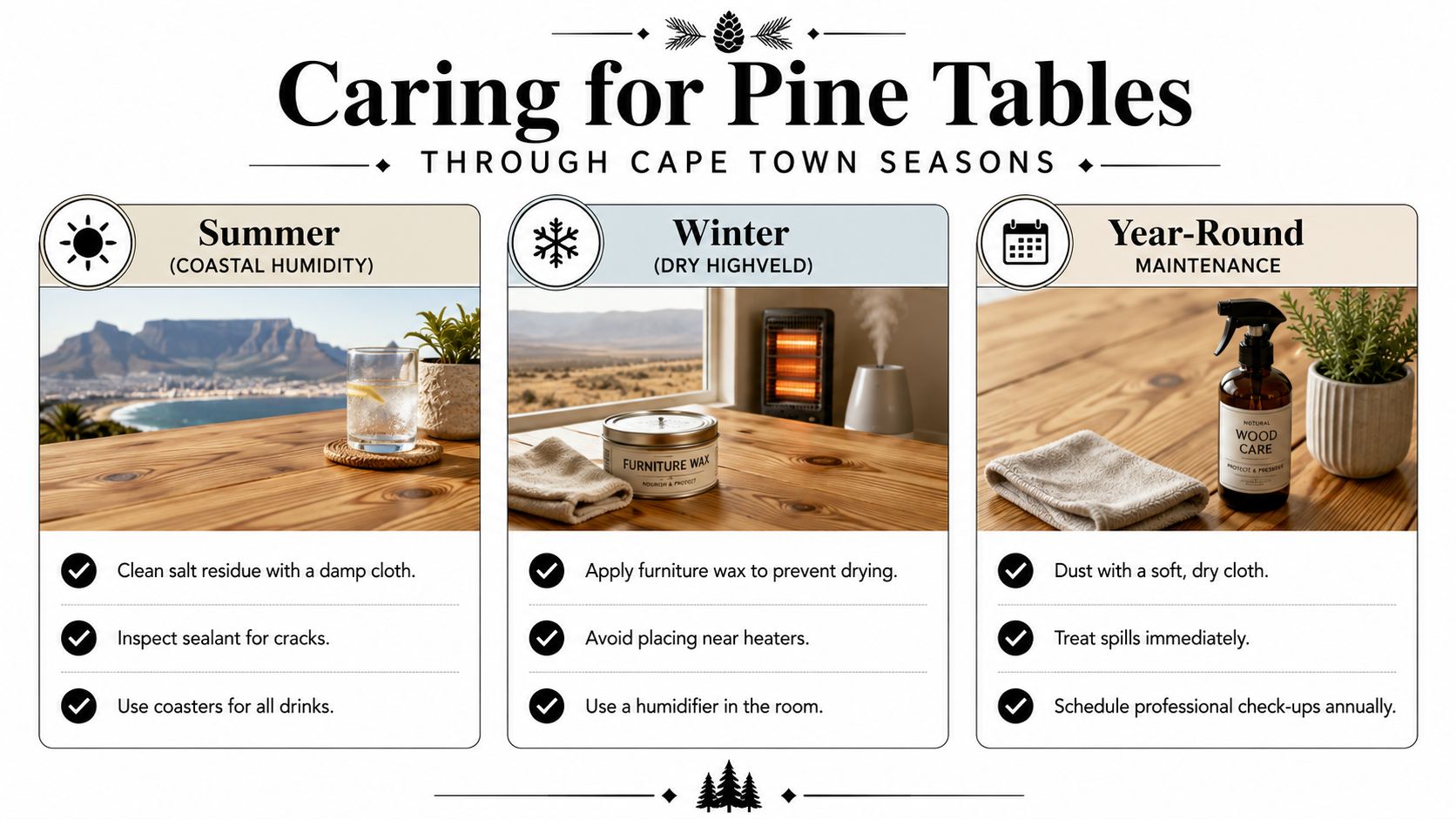
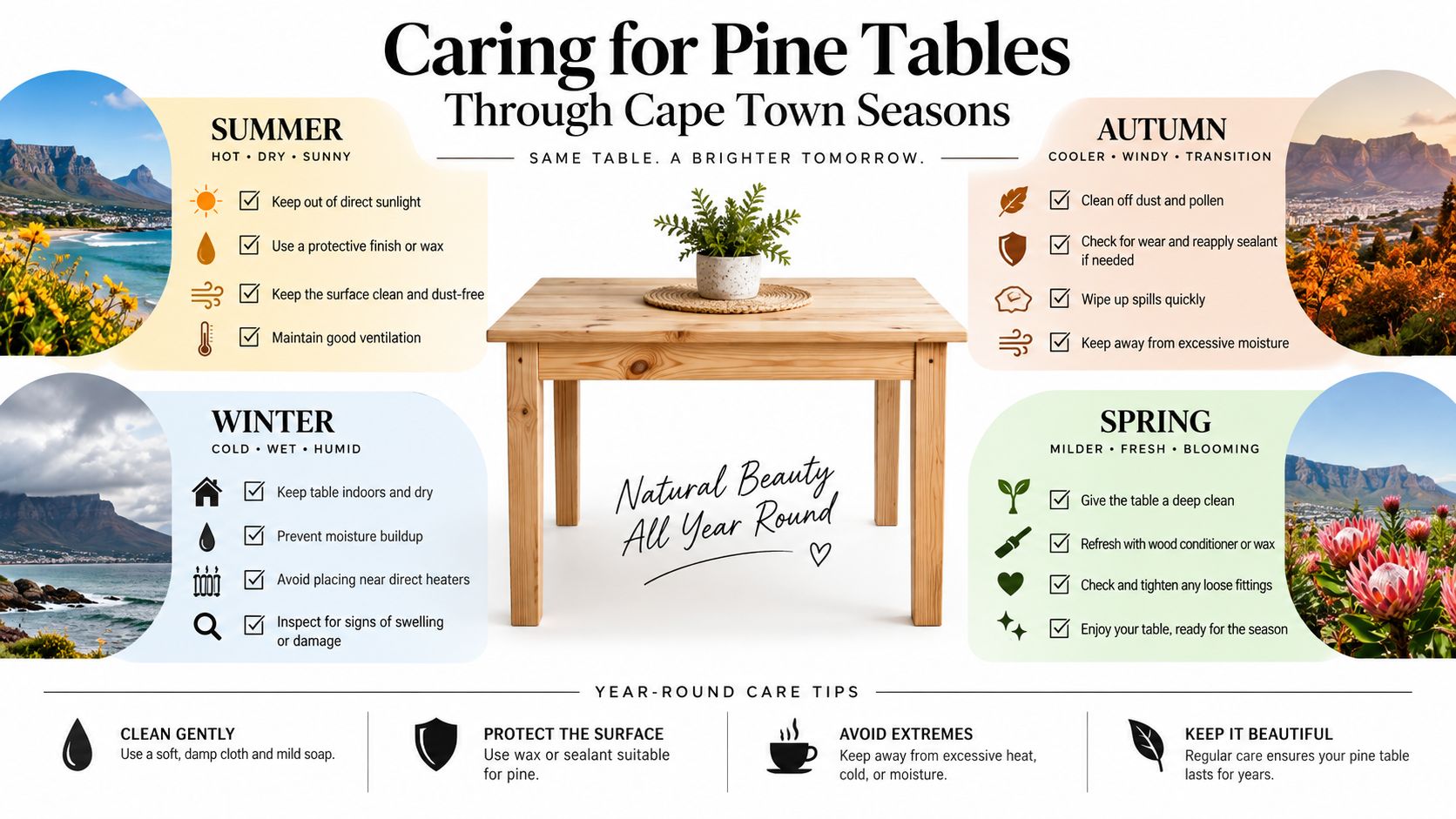
Cape Town conditions punish vague care routines. Salt air near the Atlantic seaboard, damp winter venues and dry indoor heating can all affect a pine table differently. The timber's response is linked to moisture movement, not just visible rain.
Government timber data records 13.1% average green-to-oven-dry shrinkage for Pinus pinea, while equilibrium moisture content varies between coastal and inland South African locations, according to the South African timber shrinkage and density publication. Wider tops need room to move. If fasteners lock the board rigidly, seasonal changes can contribute to cupping, splits or opened glue joints.
Seal the surface, but don't trap bad construction
A polyurethane system creates a more resistant film and can suit tables exposed to frequent spills. Hard wax oil gives a more natural touch and can be easier to refresh locally, but it still needs disciplined spill control. Whichever finish you choose, seal the top, underside, edges and end grain consistently. A beautifully coated top with vulnerable edges is not a complete protection system.
Avoid aggressive scouring pads and harsh household chemicals. Use a soft cloth with a mild cleaner, then dry the surface rather than leaving moisture standing around joints or trestle fittings. Coasters and placemats aren't decorative extras for pine. They reduce heat, liquid and abrasion at the exact points where repeated event use causes trouble.
A working maintenance routine
- After every function, remove food debris and liquid residue before folding or stacking the furniture.
- Inspect the underside and joints, not only the visible tabletop. Loose aprons and racking bases often reveal problems before the top does.
- Treat small dents early. Light sanding can level a mark, but don't aggressively thin the surface around a knot or joint.
- Use movement-friendly fittings on wide tops. Slotted fasteners, figure-eight connectors and similar table-top connectors allow seasonal movement instead of forcing the board to remain fixed.
- Store tables flat or securely supported, with air able to circulate around the boards. Keep folded trestle bases aligned so repeated handling doesn't twist the hardware.
For broader guidance on choosing and caring for natural timber furniture, the 2026 natural wood dining table buyers guide is a useful comparison resource. Outdoor specifications require a separate standard of scrutiny, so consult the ABC Hire guide to weather-resistant outdoor furniture before placing pine in an exposed setting.
When Hiring Beats Buying for Event Planners
Buying tables feels sensible when a planner sees the daily rental rate and multiplies it across future bookings. That calculation leaves out the warehouse, loading crew, transport, cleaning, repairs, insurance, replacement risk and the fact that one event may need a different table format from the next.
For a single wedding, buying can also create an awkward asset problem. You may own a group of long trestles after the event, but the next corporate activation might require smaller rounds, branded cocktail furniture or a different finish. The tables still occupy space and still need care, even when they aren't earning.
The decision is operational, not just financial
South African market listings show basic pine dining tables around R1,300 to R1,450, premium solid pine options around R3,180 to R4,980, and larger ranges above R6,000, according to the verified pricing review linked earlier. Those figures describe purchase tiers, not complete ownership cost. They don't automatically include delivery, storage, protective covers, refinishing or the labour needed to keep a hire fleet presentable.
A rental quote, by contrast, usually gives the planner a defined event cost and access to stock without requiring a permanent home for it. The ABC Hire guide to renting furniture for events is a useful starting point when you're comparing ownership with supplier-managed logistics.
| Event scenario | Rental cost per event | Purchase plus storage over two seasons | Break-even events | Verdict |
|---|---|---|---|---|
| One Winelands wedding | Depends on supplier quote and table selection | Includes unused ownership after the event | Must be calculated from a written quote | Hire usually avoids an unwanted asset |
| A large matric dance | Depends on quantity, access and setup | Requires space, handling and post-event repairs | Depends on repeat bookings | Hire is practical when the format is occasional |
| A corporate activation series | May become attractive across repeated dates | Ownership may work with steady storage and identical layouts | Compare total operating cost, not purchase price alone | Buy only when utilisation and storage are dependable |
Situations where ownership can work
A venue that hosts regular dinners, has dry secure storage and uses the same table dimensions may justify ownership. So might a furniture supplier with its own workshop, transport and repair capacity. In those cases, pine's ability to be sanded and refinished becomes a genuine asset.
For most planners, hiring wins when the event is occasional, the venue is difficult to access, the design changes frequently or weather exposure is uncertain. It also gives you a clearer route to consistent presentation, because damaged or unsuitable pieces can be flagged before the event rather than discovered after you've committed capital.
Styling Pine Tables for Weddings, Formals and Brand Activations
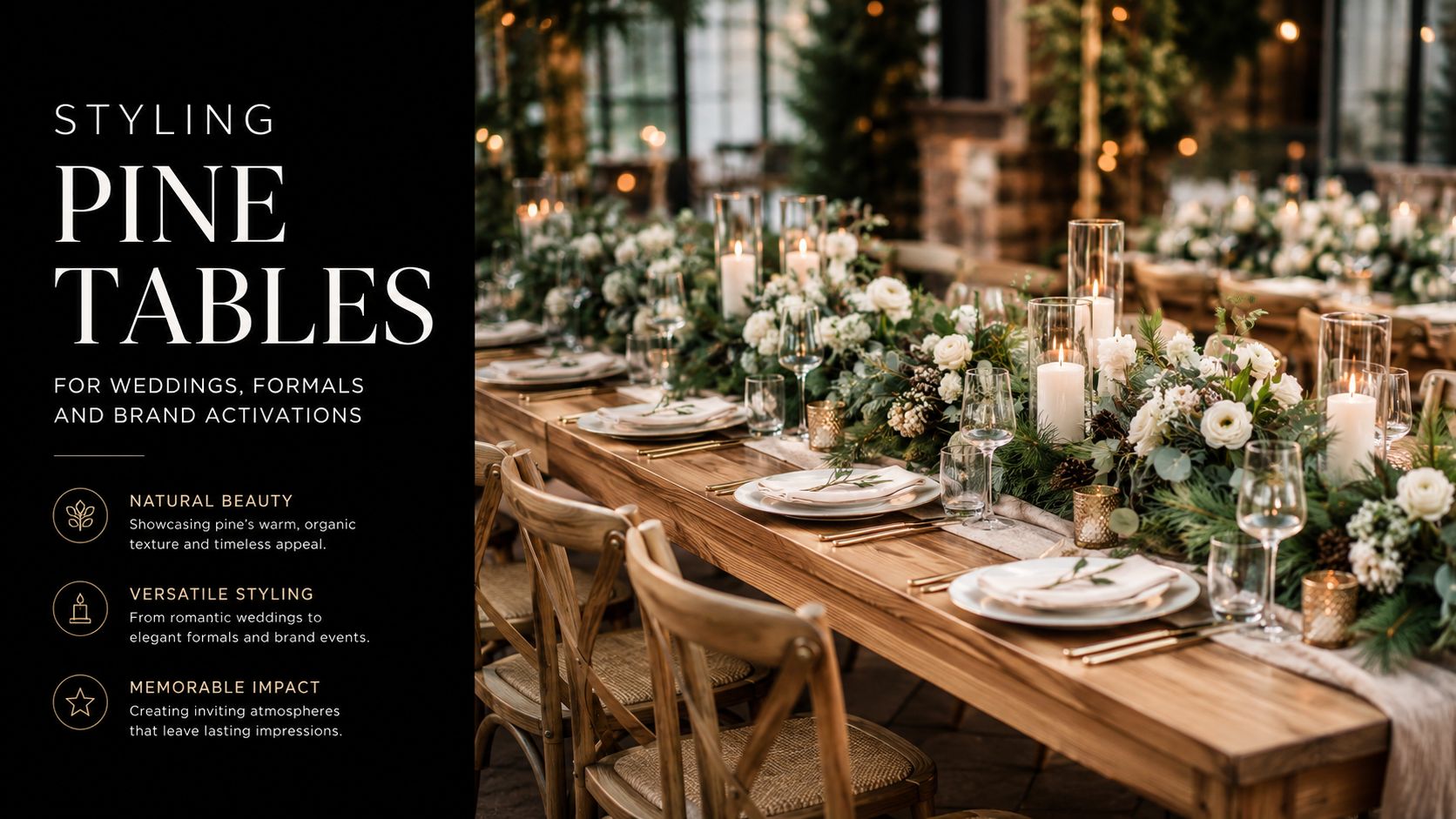
Pine takes direction from its surroundings. Leave the surface exposed and it reads as relaxed and rustic. Add crisp napery, controlled lighting and disciplined centrepieces, and the same table can support a polished dinner. The styling needs to respect the timber's warm colour rather than burying it under too many competing textures.
At a Winelands wedding, raw linen runners work well because they echo the informal grain without making the table look unfinished. Whitewashed pine suits a lighter palette, while charcoal napery creates contrast for an evening reception. Keep the centrepiece scale proportional. A long low arrangement preserves conversation, while tall narrow forms can make a communal table feel crowded.
Match the table to the event brief
Weddings: Use candles, soft florals and warm white lighting to bring out the honey tone. Glass votives and ceramic vessels add texture without competing with knots and grain. For outdoor vineyard settings, protect the table from direct weather and avoid assuming that a clear finish makes pine suitable for exposure.
Formals and matric dances: A floor-length cloth can turn a rustic trestle into a clean formal base. Choose a controlled colour scheme, use charger plates to establish place settings and keep décor repeatable across the room. Hidden or covered bases often look more appropriate than exposed trestles in a ballroom.
Corporate dinners: Treat the tabletop as part of the brand environment. Neutral linen leaves room for branded menus, place cards and controlled tableware, while darker napery can support a premium evening palette. Coloured gels may exaggerate the yellow in pine, so test the lighting on the actual finish before approving the full look.
Details that protect the finish
Use felt or soft protective pads under heavy décor, especially when arrangements will be moved during service. Put coasters beneath drinks and avoid dragging ceramic serving pieces across the top. If you're using candles, select stable holders with a catchment base rather than placing open wax directly on the timber.
Pine also pairs naturally with relaxed braai and hospitality environments, but accessories should follow the event's function. A resource such as MODERN LYFE's Weber accessories guide can help when you're coordinating food-service accessories and outdoor entertaining details, although it doesn't replace a proper furniture specification.
The final visual test should happen under the venue's actual lighting. Warm whites usually flatter the grain. Strong cool or coloured light can make knots and finish variations more prominent, so approve a sample setup before committing to a full room.
Choosing the Right Pine Specification for Your Event
The right pine dining table starts with the event's operating conditions, not the catalogue photograph. A planner needs to identify how the table will be loaded, where it will stand, how often it will move and what visual role it must play.
South African forestry data supports pine as a major local furniture input, while the SANS values discussed earlier show why grade and density affect stiffness. The purchase market also spans basic tables around R1,300 to R1,450, premium solid pine tables around R3,180 to R4,980, and larger ranges above R6,000, based on the verified South African market review. Treat those as broad market tiers, not guaranteed quotes for a particular build.
Four questions to ask before ordering
- What load will the table carry? Light place settings and a simple meal are different from heavy crockery, serving platters and guests leaning along a long span. Ask about grade, tabletop thickness, apron construction and support spacing.
- What climate will it face? Coastal humidity and inland dryness create different movement risks. Specify properly dried stock, consistent sealing and movement-friendly attachment where the top is wide.
- How often will it travel? A permanent venue table can prioritise finish and room fit. A hire table needs strong bases, accessible fasteners, repairable surfaces and a design that crews can handle safely.
- What look must it deliver? Knotty character-grade pine suits rustic weddings. Cleaner laminated or more carefully selected stock works better for formal dinners and brand environments where surface consistency matters.
Pine specification decision matrix for South African events
| Event profile | Recommended pine spec | Indicative cost (2024 ZAR) | Buy vs hire |
|---|---|---|---|
| Rustic Winelands wedding | Character-grade solid or laminated pine with a sealed natural finish | R1,300 to R4,980 purchase tiers, based on listed market examples | Hire for one-off events |
| Formal school function | Cleaner laminated top, stable apron and covered or refined base | R3,180 to above R6,000 purchase tiers, based on listed market examples | Hire unless the school has repeated use and storage |
| Corporate dinner | Consistent selected boards, durable finish and concealed or tailored base | Premium solid pine tier and custom quote required | Hire when layouts change |
| Venue with regular dining use | Higher-stiffness stock, properly supported top and repairable finish | Quote according to specification | Buy can work with secure storage and workshop support |
| Semi-outdoor reception | Only a specifically rated system with confirmed weather limitations | Quote after placement and finish review | Hire a suitable outdoor product rather than assuming pine qualifies |
For a family table used indoors, a well-built pine design can offer warmth, repairability and local material relevance. For repeated event work, prioritise stiffness, finish quality and logistics over the cheapest purchase tier. For exposed outdoor service, ask for written confirmation of suitability. If the supplier can't explain the grade, support layout, finish and movement strategy, the table isn't ready for a demanding booking.
ABC Hire supplies tables and other event furniture for weddings, corporate functions, formal events and private celebrations across Cape Town and the Winelands. If you need pine dining tables matched to your guest layout, venue conditions and styling brief, visit ABC Hire to discuss the available hire options and plan the setup before your event date.