

You've set the tables at a guesthouse in Franschhoek, the flowers are in place, and the evening light is beginning to soften. Then someone asks where the nearest socket is. A cable appears across the table, another lamp loses its position, and the warm, relaxed mood starts to feel like a technical exercise. A rechargeable bedside lamp solves that small but important problem by bringing light to the table, bedside, welcome station, or quiet corner without tying the design to a wall outlet.
South Africa's lighting story makes this especially relevant. Statistics South Africa reported that the share of households connected to mains electricity rose from 76.7% in 2002 to 90.2% in 2024 (Statistics South Africa household electricity data). In other words, a rechargeable lamp usually isn't replacing a home's main lighting. It adds flexibility, atmosphere and resilience where fixed lighting can't deliver the right experience.
Introduction to Rechargeable Bedside Lamps for Modern Hosting
For a wedding host, a cordless lamp might begin beside the guest book and later move to the dessert table. In a boutique room, it can sit on a nightstand without forcing the bed, side table and charging point into one fixed arrangement. At a birthday dinner, several small lamps can create pools of warm light between floral arrangements, helping guests see one another without flooding the room with overhead brightness.
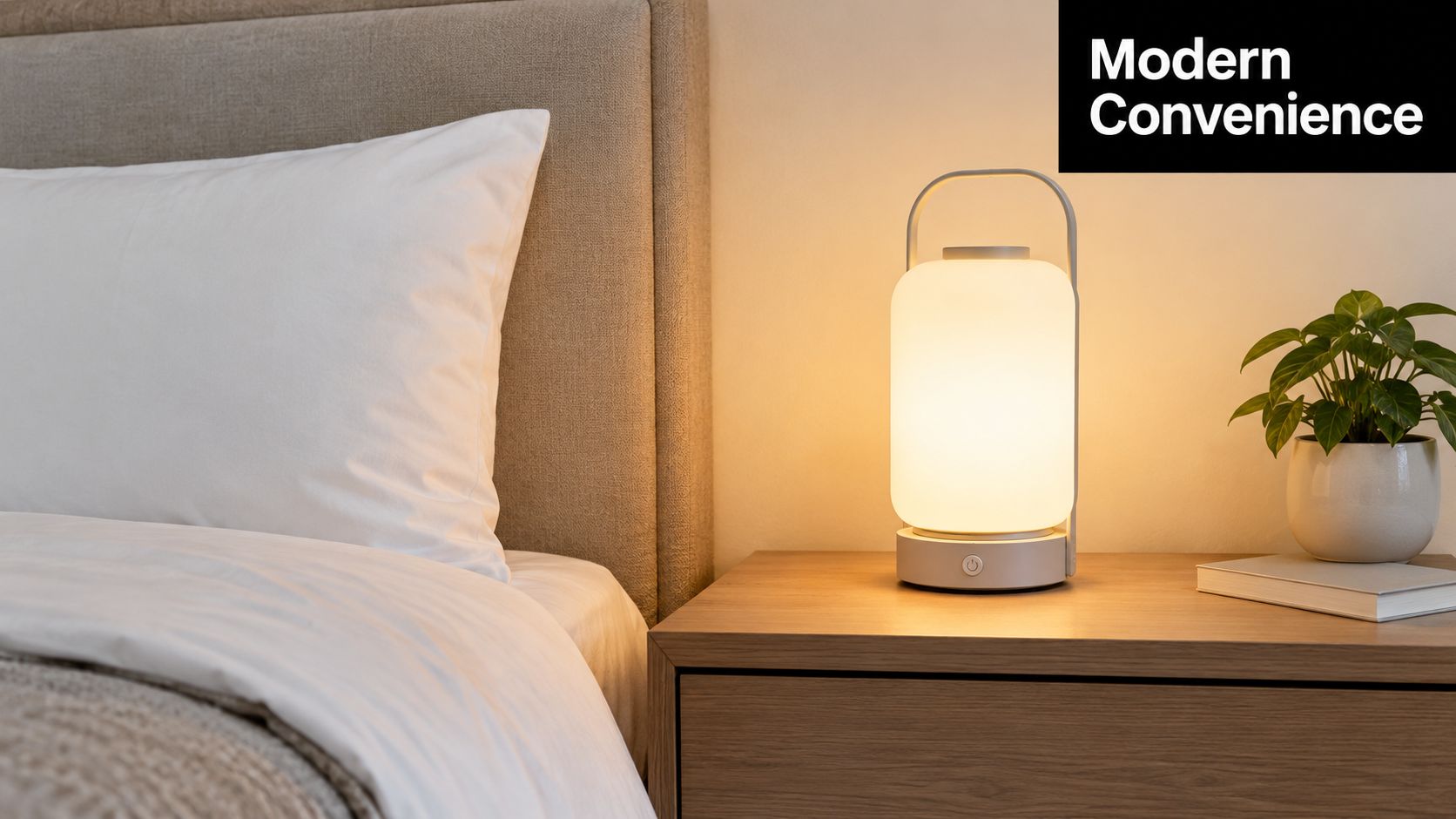
That freedom changes the way you plan a space. A mains-powered bedside lamp has to remain close to its socket. A rechargeable model can be placed where the guest needs a gentle glow, where the photographer wants a detail to read, or where the table needs a little visual rhythm. You can also remove it quickly when the room needs to be cleared.
This matters during power interruptions too, but load shedding is only one part of the story. The 2022 Census recorded electricity as the main lighting source for 94.7% of South African households, up from 84.7% in 2011, with Western Cape at 96.5% and KwaZulu-Natal at 96.7% (Census 2022 statistical release). A rechargeable lamp fits the next stage of that journey. It gives an electrified home, venue or guest room a portable layer of light for interruptions, reading, arrivals, dining and styling.
Hosting principle: Use the lamp to shape how people feel in the space, not merely to fill a dark patch.
For accommodation owners, lighting also contributes to the small details guests remember. A calm bedside glow, an uncluttered nightstand and a lamp that can be moved to a reading chair all make a room feel considered. Practical guidance such as After 8 B&B profitability lessons can help owners think about guest comfort as part of the wider operating experience.
If you're planning a Cape Town event, review rechargeable table lamps alongside your table layout, rather than treating lighting as an afterthought. The important choices include brightness, colour, runtime, charging habits and whether hiring or buying gives you the better fit.
How a Rechargeable Bedside Lamp Actually Works
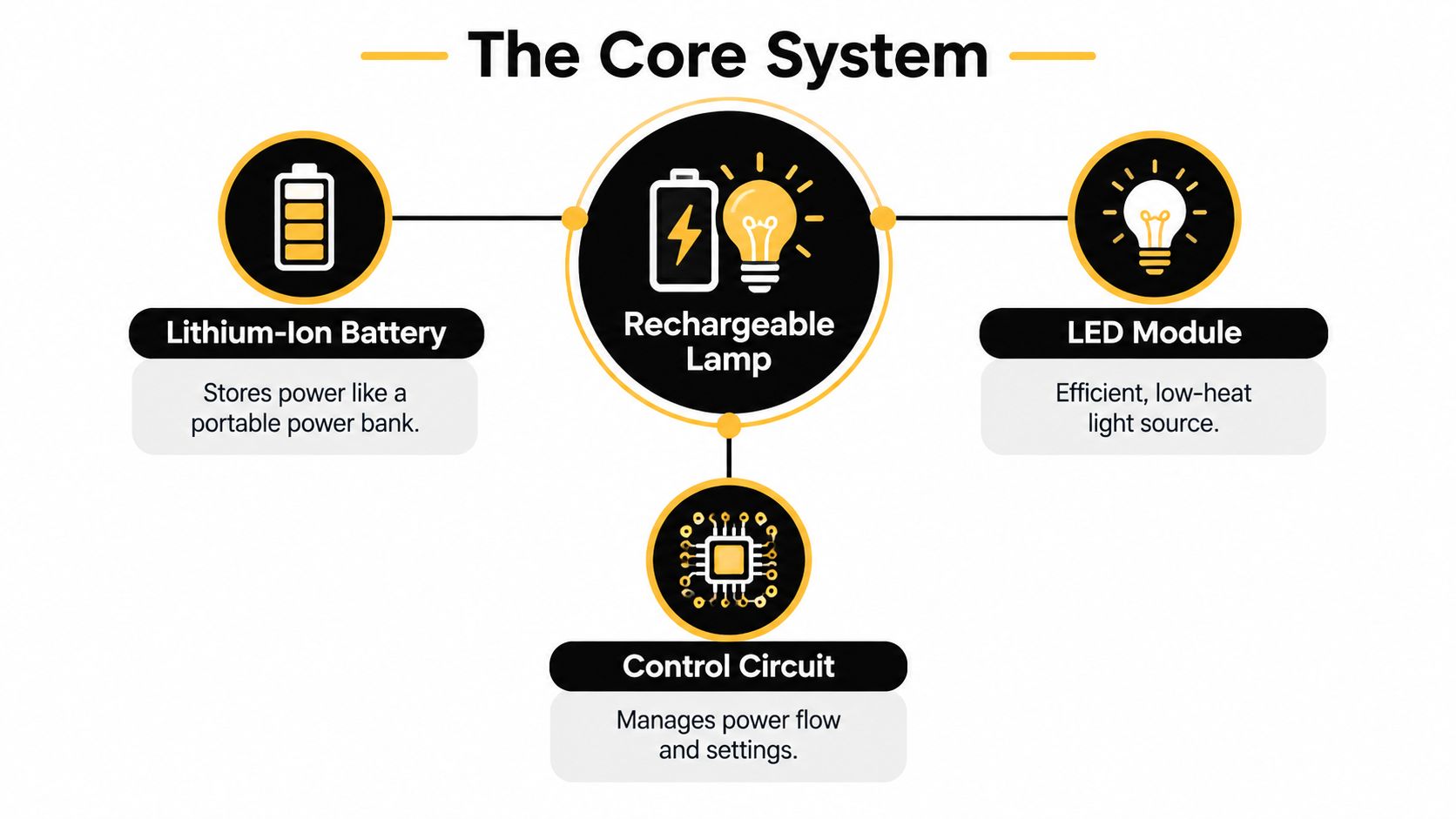
A simple way to understand the product is to think of it as a power bank joined to a lantern. The battery stores energy, the LED turns that energy into light, and the control system decides how much power reaches the light source.
The battery stores energy
Inside the base or body is a rechargeable battery. You connect the lamp to its charger while power is available, and the battery holds that energy for later use. Once charged, the lamp can operate away from a socket, which is what makes it useful on a dining table, reception desk, patio or nightstand.
The battery doesn't produce light by itself. It supplies electricity to the LED module, much as a power bank supplies electricity to a phone. The lamp's available runtime depends on the battery, the brightness selected and the way the model manages power.
The LED creates the glow
An LED module is the light-producing part. It uses electricity efficiently and gives manufacturers more control over the character of the light than older bulb designs typically allowed. For hospitality, that control matters because a guest room, ceremony table and late-night walkway don't all need the same intensity.
A warm setting can make timber, linen and florals feel softer. A cooler or brighter setting may be more useful when a guest is reading, a venue team is checking place settings, or staff are clearing tables.
The control circuit manages the experience
The control circuit links the battery, LED and user controls. It regulates power, responds to a switch or touch control, and may allow dimming or colour adjustment. A touch button is convenient beside a bed because the user can change the light without searching behind the lamp.
Charging behaviour is just as important as the visible design. Some models charge through USB, while others use a dedicated charger or charging dock. Before an event, confirm which cable is required, how many charging points are available and whether the lamps can remain safely connected between uses.
Key Features to Look For Before You Choose
A lamp can look beautiful in a product photograph and still be awkward for a venue. Start with the job it must perform. A soft bedside glow has different requirements from a lamp that will sit on a busy reception table throughout an evening.
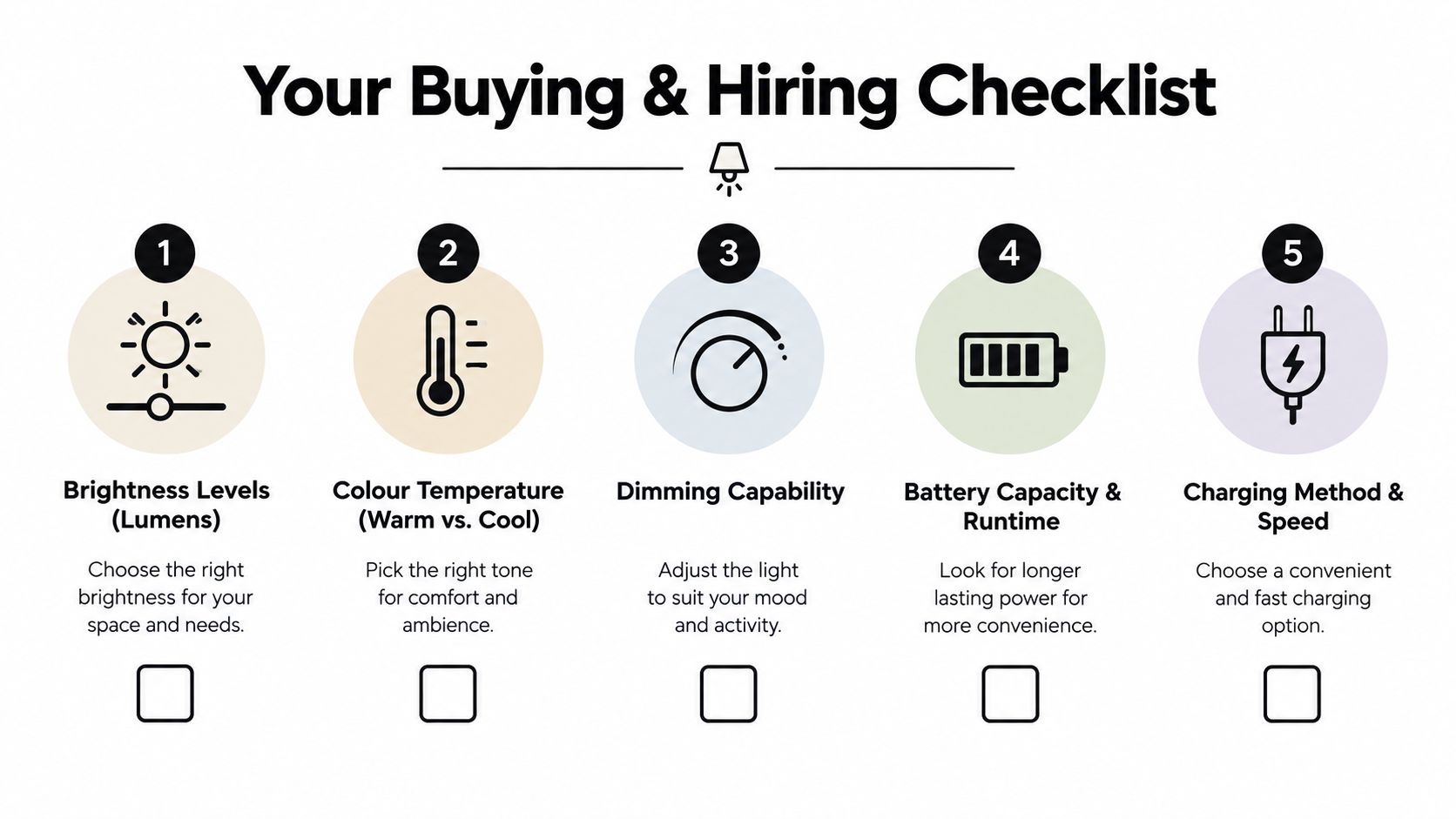
Brightness should match the setting
Look for adjustable brightness rather than a single output. A guest room may need a low level for winding down, while a welcome table needs enough light for names, menus or cards to remain readable. If a supplier describes brightness in lumens, use that figure for comparison, but test the actual lamp if possible because shade shape and diffusion change how the light feels.
A small light can create a strong visual effect when several are spaced across a long table. One very bright lamp may be less comfortable than multiple dimmer points.
Colour temperature sets the mood
Warm light generally supports an intimate, restful atmosphere. It works well with candlelight, timber furniture, neutral linen and evening celebrations. A cooler setting can feel clearer and more functional, but it may fight the relaxed character of a wedding dinner or boutique bedroom.
Ask whether the colour temperature is fixed or adjustable. For a hire collection, consistency matters. Lamps that produce noticeably different whites can make a carefully styled table look unplanned.
Dimming gives you control
Dimming is valuable because the room changes during the event. During arrivals, guests may need more visibility. Once dinner begins, you may want the lamps lower so conversation and décor take centre stage. A gradual dimmer is easier to style than a lamp with only a bright and a dim preset.
Battery indicators prevent guesswork
A battery indicator helps the person managing the venue identify which lamps are ready and which need attention. This is particularly useful when lamps are distributed across bedrooms, tables and service areas. A lamp that gives no warning before switching off can create unnecessary pressure during a live event.
Build, stability and storage matter
Choose a stable base for tables where guests, children or staff may brush against the furniture. Smooth, wipeable materials are practical for hospitality use, while heavier finishes can give a more substantial appearance. Check whether the lamp's handle or body makes it easy to carry between rooms.
Portability doesn't mean every lamp needs to be tiny. The right size depends on the table, the arrangement and the visual weight of the décor. If you're comparing compact designs for tight rooms, these space-saving lamp options offer useful inspiration for thinking about footprint and placement.
Before hiring, ask a rental partner:
- What is included: Confirm chargers, docks, cables and replacement arrangements.
- What has been tested: Ask how runtime was assessed and at which brightness.
- What happens on collection: Clarify whether lamps need to be returned charged, clean or packed in a particular way.
- How consistent the set is: Check that the lamps share the same style and light character.
Battery Life Charging and Load Shedding Realities
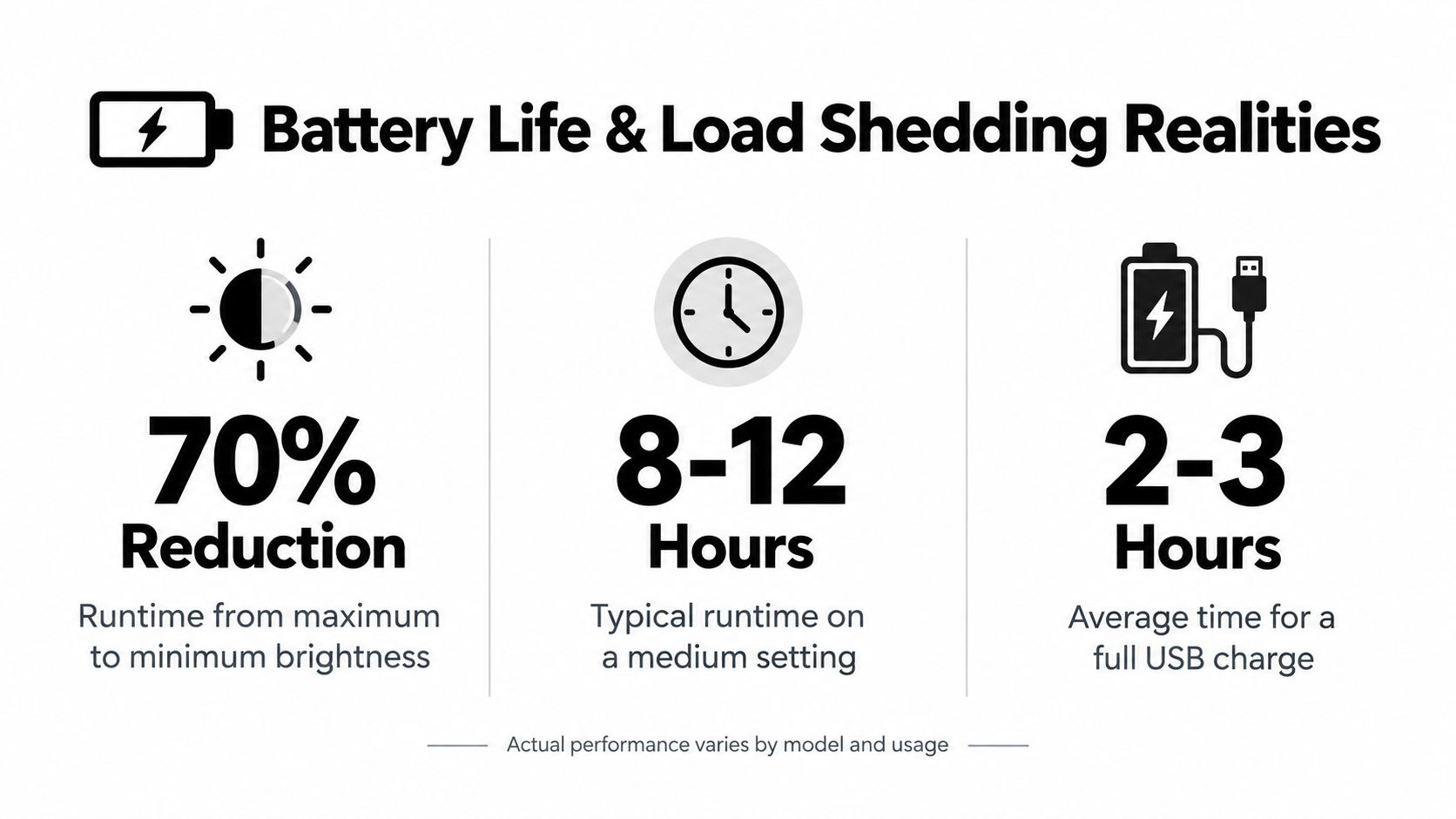
Runtime is never a single promise that applies to every evening. A lamp consumes more energy at maximum brightness and less energy when dimmed. Independent South African testing found that rechargeable bulbs lasted about two hours at full brightness, while dimming to 50% or 25% extended operation to roughly three to five hours (MyBroadband runtime testing).
That difference changes the planning question. Instead of asking, “How many hours does this lamp last?”, ask, “At the brightness my guests need, how long will it remain useful?” A lamp used as a gentle bedside glow may last longer than one run at full output to light a preparation area.
Charge before the event, not during the panic
Many rechargeable lamps charge only while the switch remains on and mains power is available. That detail is easy to miss. A lamp may be plugged in beside a bed, but if its wall switch is off, it might not be gaining charge.
Charging times vary widely, from about three to 24 hours, according to South African product pages and testing discussed by MyBroadband (South African rechargeable emergency-light guidance). For a venue, that means a same-day charging plan can be risky, especially when you're preparing several rooms or a large event set.
Use a written charging routine:
- Charge as soon as the lamps return from use. Don't leave the task until the afternoon of the next event.
- Keep the switch and power source active. Confirm that the indicator shows charging.
- Label or group the lamps. This makes it easier to identify a lamp that missed the charging cycle.
- Test a sample at the intended brightness. A brief real-world check is more useful than relying only on packaging.
- Stagger use when necessary. A few lamps can remain in reserve while others provide light.
Practical rule: Plan for the brightness your guests will actually use, then keep a reserve rather than treating the advertised maximum as the event plan.
A bedside lamp for an overnight stay needs a different approach from a short dinner. In a guest room, leave the lamp charged and explain its controls clearly. At an event, assign responsibility for charging and collection. For broader battery-operated lighting ideas, see battery-operated lamps, especially when you're coordinating several cordless light sources.
Hiring Versus Buying for Events and Accommodation
The hire-or-buy decision depends less on the lamp itself than on how often you'll use it. A couple hosting one wedding may not want to store, charge and maintain a coordinated collection. A guesthouse that uses bedside lamps every week may value ownership, provided someone manages the batteries and keeps the set consistent.
| Decision Factor | Hiring Best For | Buying Best For |
|---|---|---|
| Event frequency | A one-off wedding, launch or formal dinner | Regular accommodation or repeated functions |
| Quantity | A coordinated group needed for one date | A small collection used across rooms |
| Storage | Hosts with limited cupboard space | Businesses with an organised storage area |
| Style changes | Events requiring different looks | A stable house style |
| Maintenance | Users who prefer a rental partner to prepare the items | Owners able to charge, clean and inspect lamps |
| Flexibility | Large occasions where extra pieces may be needed | Everyday use where lamps must always be available |
Hiring also reduces the pressure of matching every lamp yourself. A rental partner can supply a group that suits the table plan, while you focus on furniture, linen, florals and guest movement. For one-off events, that coordination can be more valuable than owning the objects afterwards.
Buying makes sense when the lamp has a clear second life. A guesthouse can use it in rooms, move it to a breakfast area, and keep it available during maintenance or power interruptions. A venue might buy a small core collection and hire additional pieces for larger celebrations.
Think about the complete workload, not only the purchase price. You'll need somewhere safe to store the lamps, a charging system, a way to identify missing cables and a process for checking performance before guests arrive. For a wider view of must-have family event items, consider how lighting fits alongside seating, serving equipment and décor.
ABC Hire offers rechargeable table lamps for hire as part of its event and wedding lighting options. If you're building a broader styled setup, decor for hire can help you consider lamps within the full visual arrangement rather than as isolated accessories.
Real World Uses From Weddings to Guest Rooms
At a Winelands wedding, the strongest use may be at the reception table. Place a cordless lamp near the centre of a long arrangement, leaving enough space for guests to see menus and one another. Its low position creates a more intimate layer than overhead venue lighting, while the lack of cables keeps the table clean.
For a ceremony moving into dinner, portable lamps also make the transition easier. The same pieces can be collected from the ceremony signing table and placed on the reception tables without asking the stylist to redesign around power points.
Guesthouses and boutique stays
A rechargeable bedside lamp suits rooms where the furniture arrangement changes between guests or where the nightstand has limited cable space. It can provide a soft reading light, a welcoming glow for late arrivals and a practical option during an interruption.
Leave simple instructions beside the lamp. Guests should know how to switch it on, how to dim it and where the charging connection sits. If the lamp is intended as emergency lighting, staff should check its charge as part of room preparation rather than assuming that the previous guest left it ready.
Matric dances and formal school events
A formal school event often needs atmosphere without fragile open flames. Lamps can sit on registration tables, lounge furniture, gift tables or quieter seating areas. Their portability helps organisers shift the visual focus as guests move from arrival to dinner, photographs and dancing.
Use stable models on surfaces that may receive frequent contact. Keep brighter lighting near entrances and service areas, then use softer settings in lounge zones where the purpose is conversation.
Home celebrations
At a milestone birthday or intimate dinner, place one lamp on a drinks station, another beside the cake table and a third near the seating area. Varying the positions creates a connected visual thread without making every surface identical.
For children's rooms or family gatherings, a rechargeable lamp can offer gentle, movable light without a cable trailing beside the bed. Keep the lamp on a stable surface and follow the manufacturer's guidance around charging, heat and placement.
Hospitality and brand activations
A brand activation can use cordless lamps to guide attention to a product display, sampling counter or conversation area. The light doesn't need to be dramatic. A carefully positioned warm glow can separate a small activation from a busy venue without competing with the brand message.
The same principle works for caterers and venue teams. Portable lamps provide a quick styling tool when the room feels flat, the weather changes, or a table must move away from its planned socket.
Choosing the Right Rechargeable Bedside Lamp for Your Next Event
Start with the space, not the catalogue. Mark the tables, beds, welcome points and service areas that need light, then decide where you want guests to feel relaxed, where they need to read, and where staff need practical visibility. This separates mood lighting from task lighting, which prevents one lamp from being asked to do everything.
Next, choose the operating plan. For a small home collection, you may prioritise compact storage and simple USB charging. For a wedding or corporate function, you'll need a consistent set, clear responsibility for charging and a backup plan if the event runs late. For accommodation, ease of cleaning, reliable controls and repeatable room presentation may matter more than decorative novelty.
Use this short decision check:
- Placement: Can the lamp stand securely where guests will use it?
- Light quality: Does the colour suit the room, tableware and décor?
- Control: Can users dim it without confusion?
- Runtime: Has it been tested at the brightness you need?
- Charging: Can your team charge every lamp before the next use?
- Ownership: Will you use the lamps often enough to justify storage and maintenance?
- Hiring: Would a coordinated rental set give you a more polished result for a single date?
The best rechargeable bedside lamp is the one that supports the guest journey. It should appear effortless, even though someone has planned its brightness, position, charging and collection carefully. That quiet preparation is what lets a Cape Town venue feel warm at dinner, restful at bedtime and ready for changing conditions.
For a one-off wedding, hiring can keep the style cohesive without creating another item for your storeroom. For a guesthouse or frequent host, buying a small, reliable set may give you useful everyday flexibility. Either way, treat cordless lamps as part of the design language, not merely as emergency equipment.
ABC Hire can provide rechargeable table lamps for Cape Town events, weddings and styled functions, with rental planning that fits your tables, décor and guest experience. Visit ABC Hire to discuss the cordless lighting and event hire items you need for your next gathering.