
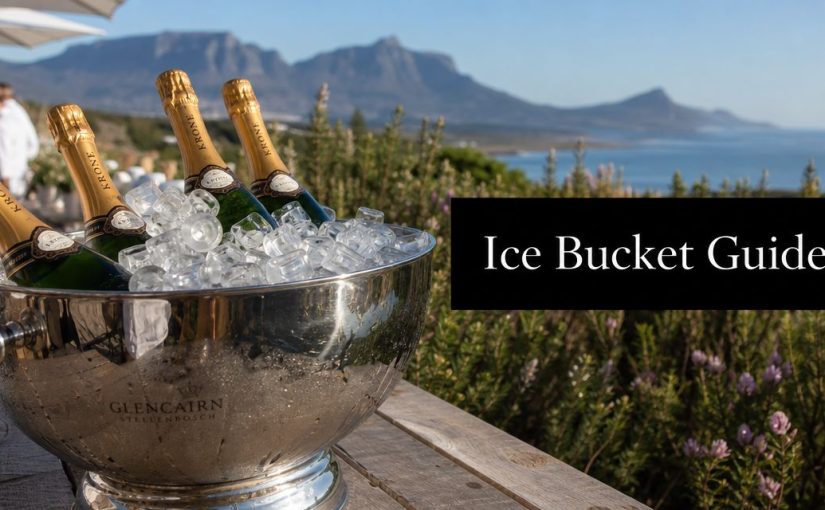
Warm drinks ruin good events faster than almost any décor mistake. You can recover from a late floral install. You can recover from a missing candle or a crooked seating chart. You can't recover gracefully when guests walk up to the bar, grab a bottle, and realise it's barely chilled.
That's why a large ice bucket isn't a styling extra. In Cape Town, it's part of your service infrastructure. If you're dealing with a Winelands wedding, a rooftop launch in the city, or a private party with full sun and patchy shade, your beverage setup has to work under pressure, not just look polished in supplier photos.
Planners often leave this decision too late. They focus on glassware, bar menus, staffing, and layout, then treat ice buckets as filler stock. That's backwards. If drinks aren't kept at service temperature, the whole bar operation starts slipping. Timing gets messy, staff start improvising, and guests notice.
Good planning fixes that early. If you're tightening your run sheet and service flow, this practical resource on steps for planning corporate events is useful because it forces the same discipline you need for beverage staging, staffing, and backup equipment.
Keeping Your Cool The Event Planner's Essential Introduction
A large ice bucket earns its place when refrigeration can't do the whole job on site. That's common in Cape Town. Venues look beautiful but don't always give you ideal back-of-house access, enough cold storage, or short service distances. Beach properties, estates, schools, and private homes all come with constraints.
The job of the bucket is simple. Hold temperature at the point of service. Not in the kitchen. Not in a prep room. Where guests are being served.
Why this matters in the Western Cape
Cape Town events put pressure on cold service in very specific ways.
- Outdoor exposure: Sun, warm air, and wind all speed up service problems.
- Long distances: The bar may be far from the catering prep zone or fridge bank.
- Intermittent demand: Guests often arrive in waves, which means chilling needs spike hard, then settle, then spike again.
- Visual standards: Weddings and launches need beverage service to look intentional, not improvised.
If you only rely on fridges, staff spend the event running stock back and forth. That wastes labour and slows service. A proper large ice bucket turns one service point into a controlled cold station.
Practical rule: Use the bucket to reduce bar movement, not to replace all refrigeration.
It's not just a container
South Africa's modern hospitality setup sits on a long shift from old-fashioned ice storage to widespread refrigeration. A refrigeration history source notes that mechanical refrigeration became widespread in the early 20th century, and that plastics-based coolers and ice containers became common in the 1950s, with many portable coolers later shifting to polypropylene and expanded polystyrene because they're insulated and low cost (history of refrigeration and cooler materials). That matters because modern event equipment in the local market favours lightweight, insulated designs over heavy metal-only pieces.
That's the lens you should use for every decision in this article. Don't ask, “Does this bucket look premium?” Ask, “Will this bucket help my team keep drinks cold, move fast, and maintain a clean setup?”
If the answer is no, it doesn't belong on your event floor.
Choosing Your Vessel Materials and Insulation Explained
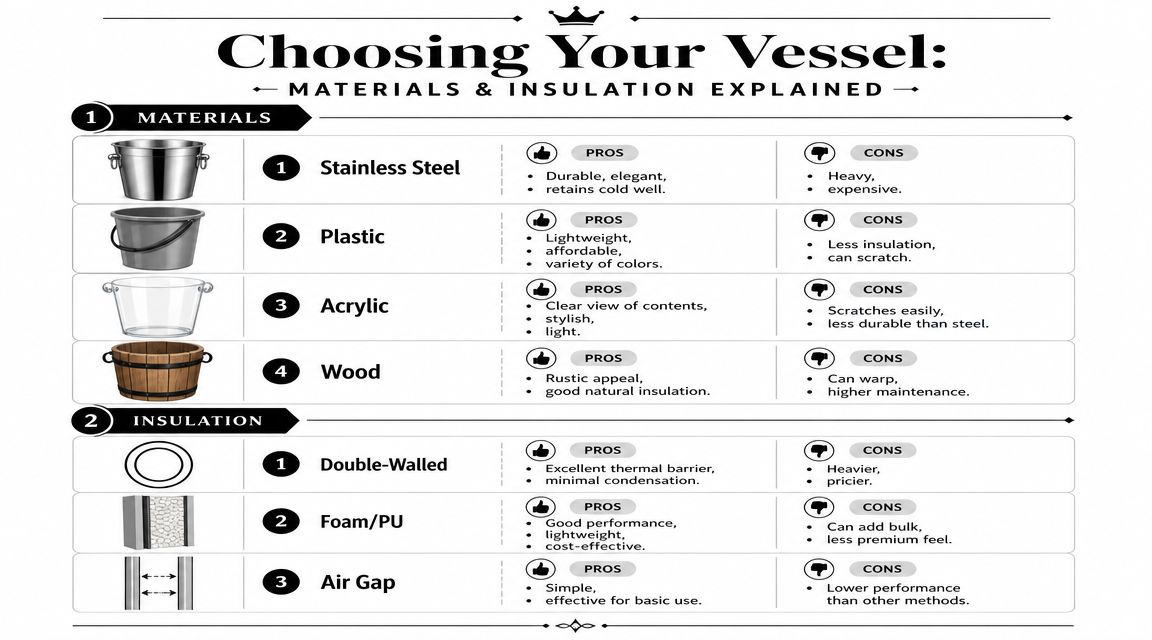
Material choice affects three things immediately. How long the ice lasts, how awkward the unit is to move, and whether the setup still looks controlled halfway through service.
Cape Town planners often get this wrong at quote stage. They approve a bucket that looks good in a catalogue, then discover on load-in day that it is heavy, slippery when wet, awkward to stack in transport, or useless once the wind picks up at an outdoor venue. Choose for service conditions first. Finish comes after that.
What the materials actually do
Stainless steel is the best hire choice for formal events and longer service windows. It handles repeated use well, cleans up properly, and looks right on a serious bar. The drawback is obvious. It is heavier, louder in transport, and more expensive to replace if staff dent it during strike.
Acrylic is useful where guests need to see stock fast. That makes it practical for casual bars, launches, and self-serve points. It is lighter than steel, but it scratches, clouds over time, and looks tired quickly if the hire fleet is not maintained.
Basic plastic earns its place on busy jobs. It is lighter, cheaper, and easier for crews to carry in volume. For back-bar chilling, school functions, sports events, and support stations, it often makes more sense than paying premium rates for a prettier finish.
Decorative metal tubs and timber-wrapped options are styling pieces first. Use them only if you have confirmed the lining, drainage, and insulation. If not, they sweat badly and burn through ice.
Food-grade plastics also matter if you are sourcing utility stock for prep areas or beverage support. If you are comparing polymer options, these 10 gallon HDPE food buckets give a useful reference point for the kind of material commonly chosen when durability, washability, and cost matter more than presentation.
Insulation is what saves your service
Insulation and lid design decide whether a bucket performs for an hour or for a full service cycle. Double-wall builds hold temperature better. Lids slow warm air exposure. Rubber bases help on slick floors and bar counters that get wet early in service.
One insulated stainless steel unit on the market shows the principle clearly. It is sold with a floating lid and rubber base, and the product spec focuses on bottle capacity plus heat control rather than looks alone (7 L insulated bucket specification).
That is the right way to assess any large ice bucket. Ask how it handles heat gain, condensation, grip, and refill speed. If you also need backup cooling nearby, match the bucket plan with the right bar fridge size for event service so staff are not crossing the venue every time stock runs low.
What to choose in real event conditions
Use this comparison before you sign off on hire quantities:
| Material or Build | Best use | Main trade-off |
|---|---|---|
| Insulated stainless steel | Formal service, outdoor weddings, premium bars | Heavier and usually pricier |
| Acrylic | Self-serve stations, casual parties, display-focused setups | Scratches and can feel less durable |
| Basic plastic | High-volume utility use, back bar support, school functions | Less visual impact |
| Decorative metal tub | Rustic or themed styling | Often weak at temperature control |
My recommendation
For seated service, brand launches, and any event where bottles need to stay cold without constant staff intervention, hire insulated stainless steel with a lid.
For fast turnover, lighter transport loads, and self-serve setups, use acrylic or plastic and accept that function matters more than polish.
Do not pay for a material that creates extra labour. If the bucket is hard to carry, hard to reset, or quick to lose temperature, it is the wrong vessel for the job.
Capacity Planning How Big is Big Enough
A common mistake is asking the wrong question first. They ask how many bottles fit. You should ask how many people need cold drinks from this station before staff can reset it.
That's how professionals size a large ice bucket.
A practical guide to bucket selection makes the key point clearly. Choose by guest throughput, not just bottle count, because an ice bucket is a point-of-service temperature-control vessel. One bucket suits a small table or bar station, while larger beverage tubs make more sense when many bottles need chilling at once in high-traffic service (guide to choosing the best ice buckets).
Start with the service style
A seated dinner needs something different from a launch party.
If bottles are being opened and poured by staff, a large ice bucket can support a focused service point very well. If guests are grabbing drinks themselves in waves, the bucket may become a bottleneck. In that case, you need multiple stations or a switch to larger tubs.
Use this sequence:
- Map the bar points: Count every place guests can reasonably collect drinks.
- Decide who's serving: Staffed bars can work with fewer, better buckets. Self-serve setups need wider access.
- Match bucket type to traffic: Small focused station equals bucket. Broad high-volume station equals tub.
- Check cold backup: If the event already has solid fridge support, buckets can stay on the floor longer without chaos. This guide to choosing the right bar fridge size helps when you're balancing front-of-house chilling with back-of-house storage.
Ice Bucket Capacity Quick Guide
| Bucket Size (Litres) | Approx. Bottle Capacity | Best For |
|---|---|---|
| 7 L | Roughly 3 to 4 wine or champagne bottles, or 6 to 8 beer bottles | Small table service, focused bar point, VIP section |
| Large tub format | Qualitatively suited to many bottles at once | Self-serve bars, welcome drinks, busy outdoor stations |
The 7 L benchmark is useful because it's already marketed for party service, but don't stretch it into a whole-event solution. It's a station tool, not a storage strategy.
Where planners get sizing wrong
They under-spec for movement. Guests don't drink in a neat pattern. They cluster.
A wedding drinks table after the ceremony is different from the same crowd during dinner. A matric dance has bursts. A product launch has dead periods and then a rush when speeches finish.
That's why I prefer to think in zones:
- Low-demand zone: One bucket can work neatly.
- Moderate-demand zone: Use more than one point of service so guests don't crowd one vessel.
- High-demand zone: Move to tubs and fridge support.
If you're comparing utility containers for prep, transport, or non-display holding, it's worth understanding heavier-duty formats like 10 gallon HDPE food buckets. They're not event-facing styling pieces, but they help planners think more clearly about food-safe storage, load handling, and operational separation behind the scenes.
Don't force one attractive bucket to do the work of a proper beverage system.
Strategic Use Cases for Your Cape Town Event
The right large ice bucket changes with the event type. This isn't about taste alone. It's about where guests stand, how they move, and whether the vessel supports the mood instead of interrupting it.
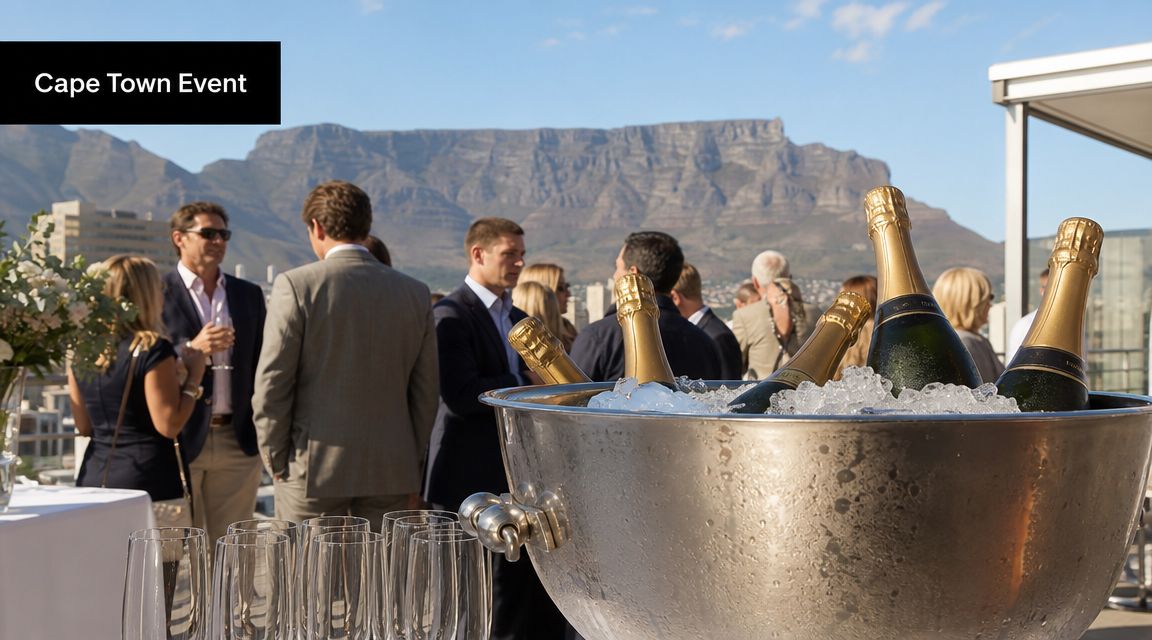
Winelands wedding
At a Stellenbosch or Franschhoek wedding, I'd use insulated buckets for elegant bottle service and reserve bigger tubs for back-up chilling out of sight. The front-of-house requirement is simple. It must look refined and hold temperature without puddling onto linen or timber bars.
Place buckets where they support service rhythm:
- beside the couple's table
- at the welcome drinks point
- on satellite wine service stations near long guest tables
A generic tub at a luxury wedding immediately drags the look down. If the bar is polished, the cold service must match.
City Bowl product launch
For a corporate launch, function beats romance. Guests move constantly, brand teams need clean photos, and staff can't fight through crowds every few minutes to restock.
Use a bar layout that creates obvious pickup points. One bucket can anchor a tasting or premium pour area, while larger high-volume chilling sits behind or beside the main activation. If the event includes a staffed drinks focal point, this guide to mobile bar service options is useful because service layout and chilling strategy should be planned together, not separately.
Clifton beach house or private milestone party
Planners often underdo the equipment. They assume a relaxed party needs relaxed logistics. It doesn't. Private venues often have awkward kitchens, stairs, limited fridge space, and service areas split across decks and living rooms.
For this format, I'd choose lightweight vessels that are easy to carry and reposition. Put one near the primary social cluster, another near food, and keep reserve stock chilled elsewhere. If the event runs into sunset and guests spread out, fixed central service starts failing fast.
The best bucket setup is the one guests barely notice because drinks stay cold and access feels effortless.
Renting vs Buying The Smart Pro's Calculation
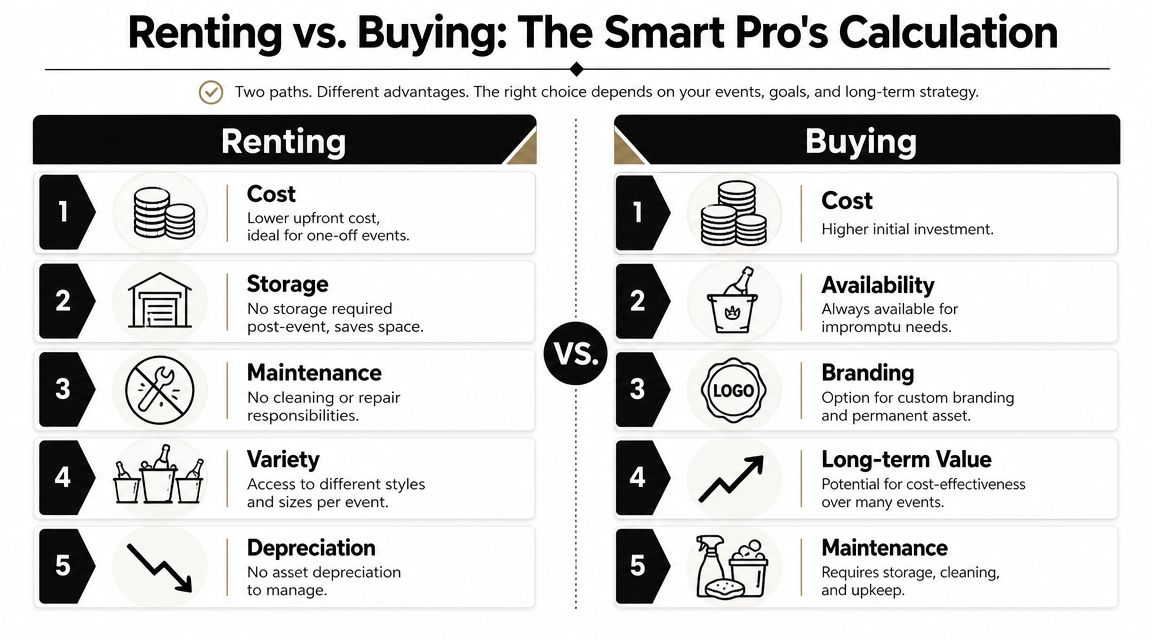
Buying looks cheaper when you only compare the item price. That's amateur math. Real event maths starts after the event ends.
A large ice bucket only makes sense to own if you can store it, transport it safely, clean it properly, dry it fully, and get it ready again without slowing your next job. If you can't do that consistently, buying creates admin, not value.
What ownership really includes
For South African rental businesses, the overlooked issue isn't the purchase price. It's operational efficiency. The primary test is stackability for transport, durability, and how quickly the item can be cleaned and turned around for another hire (event equipment logistics perspective).
That's exactly how planners should think too.
Buying means you take on:
- Storage pressure: Bulky equipment eats shelf and vehicle space.
- Cleaning responsibility: Wet gear can't just be packed away and forgotten.
- Breakage risk: Cheap acrylic cracks. Decorative finishes mark.
- Transport inefficiency: Beautiful pieces that don't stack well become a delivery headache.
- Style lock-in: What suited one client may look wrong at the next event.
When renting makes more sense
Renting is the better call when your events vary a lot in style, scale, or venue type. It also makes sense when the bucket is a visible styling item, because you can match the look to the job instead of forcing one owned set onto every brief.
Here's the clean decision rule:
| Situation | Better choice |
|---|---|
| One-off event or occasional private hosting | Rent |
| Different event styles across the year | Rent |
| Tight storage and transport capacity | Rent |
| Repeated use of the same format in-house | Possibly buy |
| Strong internal cleaning and warehousing systems | Possibly buy |
My blunt view
Most planners should rent the visible stock and only buy utility stock.
Own the things that stay in the back, get used constantly, and don't need to impress anybody. Rent the pieces that clients see, photograph, and judge. That includes many large ice bucket options, especially premium insulated designs.
Buy if the item fits your operations. Rent if the item only fits your mood board.
If you run a venue with repeat bar layouts and reliable storage, ownership can work. If you're a planner moving across estates, homes, schools, and corporate spaces, flexibility wins almost every time.
Staging and Styling for Maximum Impact
A large ice bucket should help the room read better. It should support movement, reinforce the event style, and keep the service area from looking like an afterthought.
That's why placement matters as much as product choice.
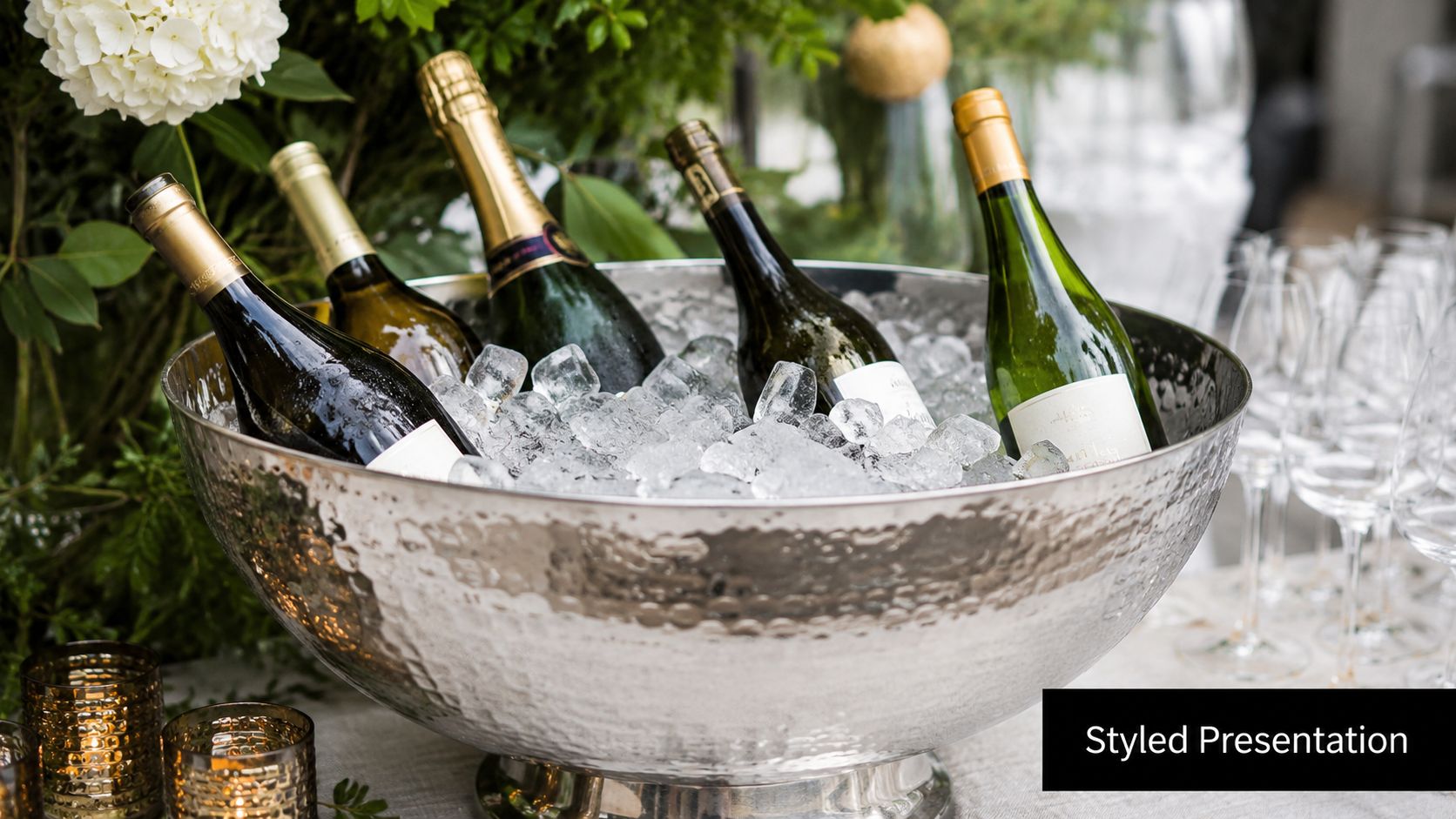
Place it where guests already pause
Don't hide the bucket in a dead corner and expect it to work. Put it where guests naturally slow down:
- At an arrival drinks point
- Near a lounge cluster
- At the edge of a buffet or grazing setup
- Beside a secondary bar where queues tend to build
The bucket should be easy to reach without blocking circulation. If guests have to bend awkwardly, squeeze between chairs, or interrupt table service, the setup is wrong.
Match the vessel to the visual language
The old West Bend Penguin Hot & Cold Server proves a useful point. It was sold from the 1940s to the 1970s, reached its heyday in the 1950s and early 1960s, had a two-quart capacity, and was designed as both an insulated practical server and a statement piece. It could keep contents cold for 5 to 6 hours or hot for 1 to 2 hours, thanks to an insulated inner container that didn't touch the outer shell (history of the Penguin server). Good serviceware has always done both jobs. Function and style can live together.
That still applies now.
- Sleek metal suits formal dinners and luxury weddings.
- Clear acrylic works for modern activations where product visibility matters.
- Rustic finishes suit farm venues, but only if they still perform operationally.
- Branded events can go further with details like custom cubes or logo-led presentation. If that's part of your brief, this guide for brand managers on custom ice is worth reviewing because branded beverage presentation only works when the service setup around it is equally disciplined.
Day-of checklist that actually helps
Use this on event day:
- Pre-position tongs or scoops: Guests and staff shouldn't dig by hand.
- Assign ownership: One staff member must own refills and wipe-downs.
- Protect surfaces: Even a good setup needs moisture control underneath.
- Separate display from reserve: Don't overload the visible bucket with backup stock.
- Check sightlines: Buckets should support the table design, not block florals, menus, or guest conversation.
A well-staged bucket looks effortless because someone planned it properly.
Essential Ice Bucket FAQs for Event Planners
Should I use a large ice bucket or a tub
Use a large ice bucket when you want temperature control at a specific service point. Use a tub when the event needs broad self-serve access and many bottles chilled at the same time. If you're deciding between standalone vessels and more formal presentation setups, these notes on ice buckets and stands for events help clarify when elevation and structure improve service.
Do I really need a lid
If the bucket is outdoors or the service window is long, yes. A lid helps control heat gain and keeps the station neater. It also reduces the visual mess of half-melted exposed ice.
Can I use a large ice bucket instead of fridge support
No. Use it as a front-of-house cold station, not your whole cooling system. Fridges handle reserve stock. Buckets support active service.
What about cleaning after the event
Clean immediately. Dry thoroughly before storing. If you leave moisture sitting in seams, lids, handles, or bases, the item becomes unpleasant fast and harder to turn around for the next job. This matters even more if you own stock.
How do I stop the station looking wet and messy
Choose insulated units when appearance matters, avoid overfilling, and keep one cloth dedicated to the station. Refill little and often instead of letting the bucket collapse into meltwater.
Is a premium insulated bucket worth it
Yes, when the bucket is visible, the event is outdoors, or the service period is long. No, when you only need short-run chilling for a casual self-serve setup and function matters more than finish.
If you're planning an event in Cape Town and need ice buckets, bars, furniture, or practical hire advice that reflects local event conditions, ABC Hire is a solid place to start. Their range covers weddings, corporate functions, private parties, and venue setups across Cape Town and the Winelands, which makes it easier to build a beverage service plan that looks sharp and works properly on the day.