
You’ve found the venue. The lighting plan is taking shape. Someone says, “Let’s add fog for the entrance, the first dance, or the reveal,” and suddenly the simple question lands on your desk.
What does the fog machine price include?
In Cape Town and the Winelands, that question is harder than it should be. Most online results talk about buying a machine from an overseas retailer. They don’t tell you what matters on a real event brief in Stellenbosch, Paarl, Franschhoek, or the city. They don’t tell you whether fluid is included, whether the machine needs an operator, or whether the quote changes if the venue has strict setup windows.
That’s the gap. The cost isn’t just the box that produces fog. It’s the effect, the consumables, the transport, the setup, the timing, and whether the result looks elegant or cheap on the night.
Creating Atmosphere What is the Real Fog Machine Price
A fog effect usually starts as a creative idea, not a line item. A couple wants their first dance to feel softer. A brand team wants a dramatic product reveal. A school formal needs a stronger entrance moment without rebuilding the whole venue.
Then the search begins, and the pricing gets murky fast.

Initial searches often yield purchase guides. They list machines, wattages, and foreign retail prices. That information has its place, but it doesn’t help much when you’re trying to cost a one-night event in the Winelands.
The bigger context matters too. The global fogging machines market was valued at USD 7.88 billion in 2023 and is projected to reach USD 13.13 billion by 2029, reflecting stronger demand across hospitality, entertainment, and private events, according to this global fogging machines market projection.
That growth makes sense from the event side. Atmosphere changes how a space feels. It works the same way good uplighting works. It shapes the room, controls attention, and gives photos more depth. If you’re already planning visual layers, it helps to think about fog alongside effects like PAR can lighting for mood and coverage.
What clients usually miss
The first quote often looks simple. The final cost rarely is.
A fog machine price can include several moving parts:
- The machine itself for the effect you want
- Fluid or consumables, which change by machine type
- Delivery and collection, especially outside central Cape Town
- Setup time, if the venue has access restrictions
- An operator, if cues need to be timed properly
A cheap machine with the wrong output can cost more in the end if the effect disappears after ten seconds or triggers venue headaches.
What works in practice
For most events, the smart question isn’t “What does a fog machine cost?” It’s “What effect am I paying for, and what needs to be included so it works properly at my venue?”
That’s where the full budget becomes clear. A small birthday setup, a wedding dance-floor moment, and a corporate launch may all use “fog,” but they’re not priced the same because they don’t need the same machine, fluid, timing, or support.
Buying vs Hiring Which Makes Financial Sense
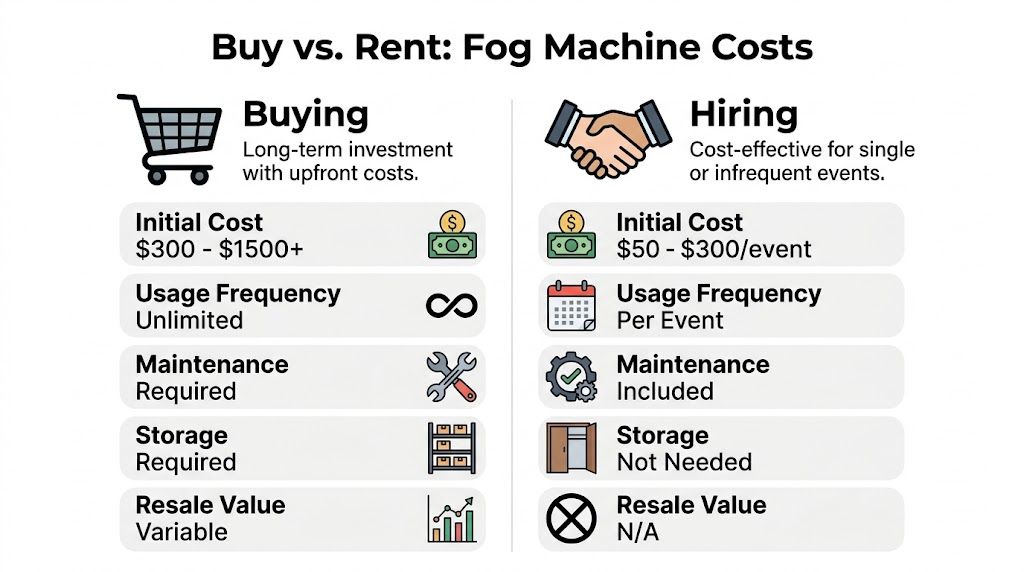
Buying sounds sensible until you price the whole responsibility, not just the machine.
For a venue, production company, or frequent event operator, ownership can make sense. For a wedding, annual function, matric dance, or milestone birthday, hiring is usually the cleaner financial decision. It’s the same logic as buying a bakkie for one moving day versus paying for a service that arrives ready to work.
What buying really means
Owning a fog machine gives you control, but it also gives you all the follow-on jobs.
You need to choose the correct type, store it properly, test it before the event, carry consumables, clean it, and keep it running well enough that it won’t fail in front of guests. If the machine underperforms, that’s your problem on the day.
Purchase-price articles also create a false sense of simplicity. They make the transaction look finished once the machine is bought. In reality, ownership starts there.
A bought machine also has to match your real event pattern. If you host one event every few months, the machine spends most of its life in storage while you still carry the maintenance burden.
What hiring changes
Hiring shifts the spend from ownership to use.
You pay for the event requirement rather than for a long-term asset. That matters because most private hosts and many planners don’t need a fog machine every weekend. They need it once, on time, in working order, with the correct output for the room.
The practical advantages are straightforward:
- No storage problem if you live in a flat, work from a home office, or manage multiple suppliers
- No maintenance learning curve because you’re not cleaning or troubleshooting the unit between events
- Better fit for one-off briefs where the effect matters more than ownership
- Easier upgrades when a standard fogger won’t suit a premium setup
The hidden costs buyers underestimate
A purchase decision often ignores the costs that sit around the machine.
| Cost area | Buying | Hiring |
|---|---|---|
| Machine selection | You choose and carry the risk | Supplier matches it to the event |
| Consumables | You source and monitor stock | Often packaged into the hire scope |
| Faults on event day | Your problem to solve | Usually handled within the rental process |
| Post-event admin | Cleaning, storage, transport | Return and done |
Practical rule: If the machine is for a single event or an occasional event, don’t buy equipment just to avoid asking detailed rental questions. Ask the questions and keep the flexibility.
Where hiring makes the most sense
Hiring suits:
- Couples planning one wedding
- Schools and universities running annual formals
- Corporate teams that need polished effects without managing specialist gear
- Private hosts who want atmosphere without adding technical stress
Buying suits people who will use the same machine often enough to justify maintenance, storage, and replacement risk. Most clients don’t fall into that category.
Key Factors That Determine Fog Machine Prices
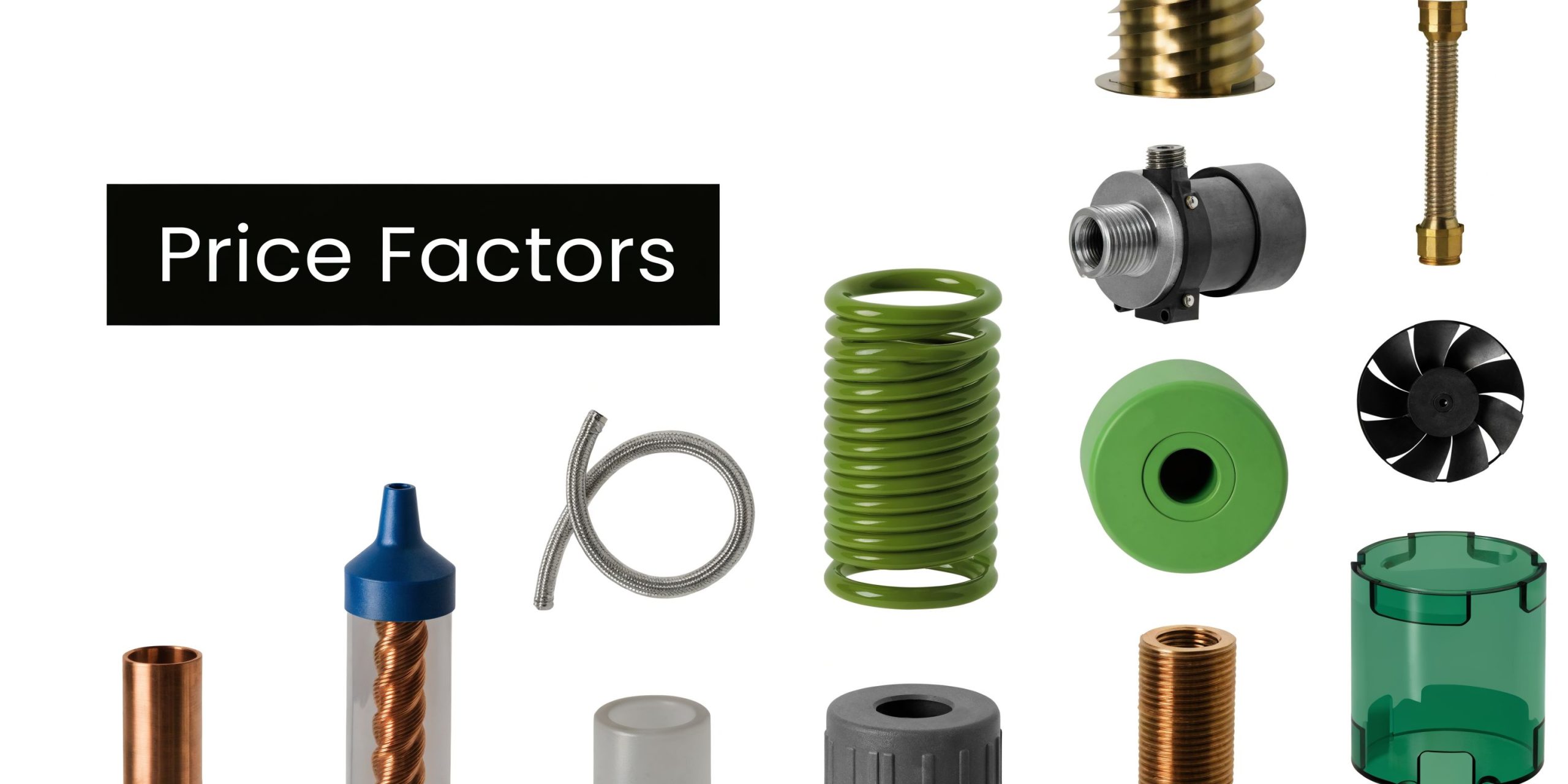
If two suppliers give you very different fog machine prices, the gap usually comes from one of five things. The machine type, the output level, the fluid, the logistics, or the labour.
That’s why vague quotes are hard to compare. You need to know what’s being hired, not just that “fog” is included.
Machine type changes the whole quote
Not every machine produces the same look.
Some units create a bursty, visible cloud. Others build a finer atmosphere that works better with lighting. More specialised machines produce low-lying effects that stay closer to the floor when conditions allow.
Product variety is expanding as manufacturers add more categories. According to this fogging machine market overview, technological development has created a wider spread of thermal and cold foggers, and cold fogging machines often produce a less thick fog for sensitive environments, which can affect pricing because of their specialised design and efficiency.
Output matters more than clients expect
A machine that works in a compact indoor venue may disappear in a large hall, under a marquee, or in a breezy semi-outdoor space.
Higher-output machines usually command a higher rental price because they need stronger internals, more fluid, and more careful placement. A supplier also has to match the output to the room so the effect reads well without overloading the space.
The wrong output creates two common problems:
- Too weak, and guests barely notice the effect
- Too aggressive, and the room feels heavy or the visuals become messy
Consumables affect the real cost
Fog fluid is where many “cheap” quotes start to unravel.
Some rental quotes include a starting quantity. Others treat fluid as separate. Premium effects can use different consumables entirely, and that changes the final number faster than many clients expect.
This is also why comparing one supplier’s machine fee to another supplier’s all-in event fee rarely helps. One might be quoting hardware only. The other might be quoting a usable show-ready package.
Good fog pricing is never just equipment pricing. It’s effect pricing.
Venue conditions push the price up or down
The same machine can be easy at one venue and awkward at another.
A straightforward ground-floor city venue with simple load-in is one thing. A farm venue with tight access times, stairs, distance from parking, or weather exposure is another. In the Winelands, travel and timing often shape the quote as much as the machine does.
Ask whether the venue has:
- Strict setup windows
- Smoke detector sensitivity
- Outdoor exposure
- Power limitations near the effect position
- Rules about operator presence during service
Labour is sometimes optional and sometimes not
A basic party setup may only need delivery with quick operating guidance. A choreographed first dance, staged reveal, or repeated cue sequence usually needs someone to run the effect at the right moment.
That labour isn’t an upsell by default. Sometimes it’s what prevents wasted fluid, poor timing, and that awkward pause where the effect arrives after the key moment has already passed.
Brand and reliability still count
Clients sometimes focus on raw output and ignore reliability.
On event day, consistency is part of the price. Established equipment lines such as Antari, Chauvet DJ, pulsFOG, Vectorfog, IGEBA, and Curtis Dyna-Fog show how broad the market has become. In rental, dependable performance often matters more than owning the newest unit on paper.
The Premium Choice Understanding Low-Lying Fog Costs
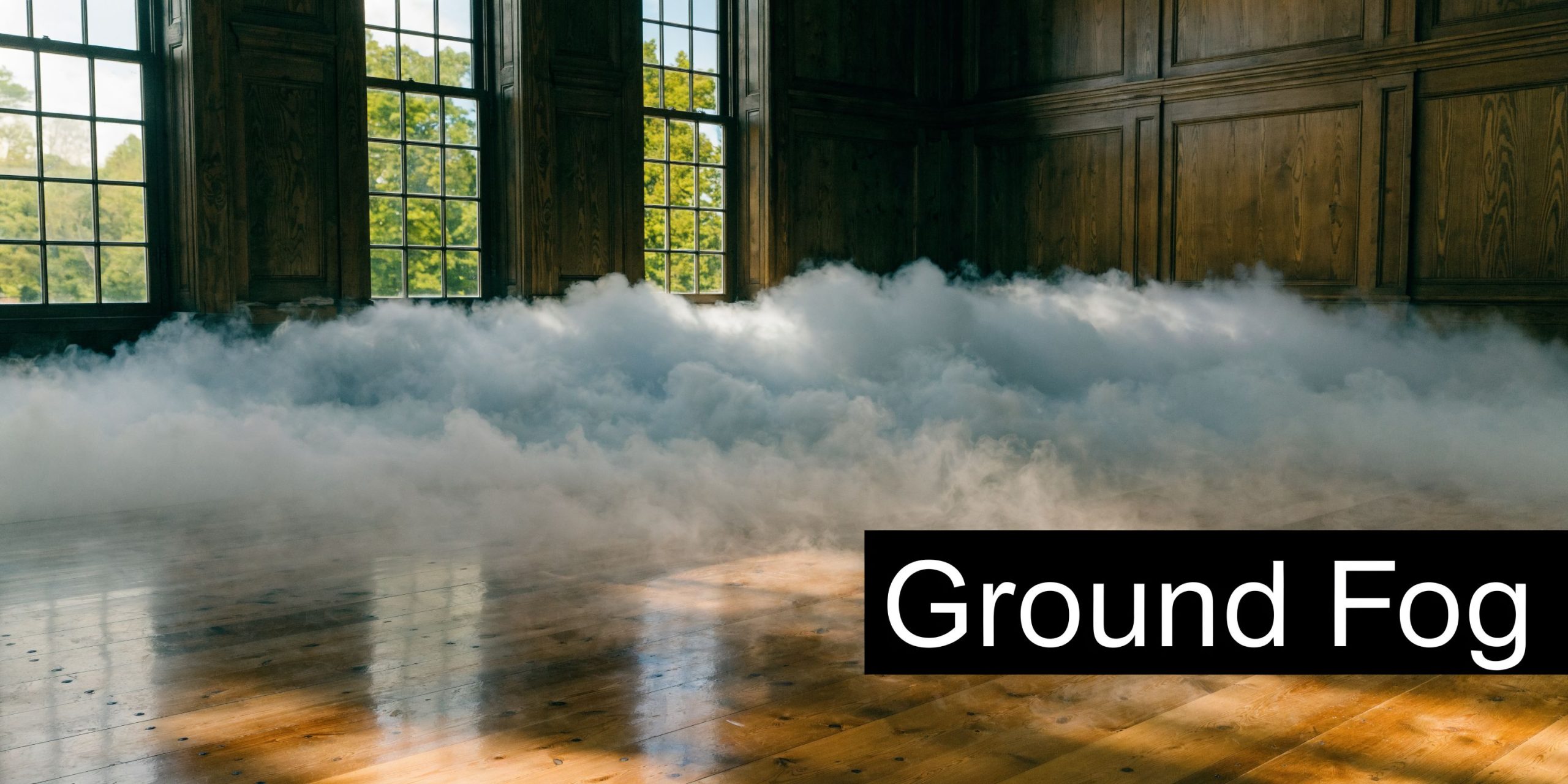
Low-lying fog is the effect people usually mean when they say they want a room to feel cinematic.
It’s the “dancing on a cloud” look. The fog sits close to the floor instead of rising quickly through the air. When it’s done properly, it looks controlled and elegant. When it’s done badly, it breaks apart, lifts too early, or never settles convincingly.
Why this effect costs more
Low-lying fog is a premium option because it’s not just standard fog pointed at the floor.
The equipment is more specialised, and the result depends heavily on venue conditions, timing, and consumables. South African demand for this look is growing, but local pricing remains hard to compare. This low-lying fog market note points out that international purchase prices can be steep, with examples such as the Antari DNG-250 at over $10,000, while local planners are often really trying to understand rental cost, including fluid at R200 to R500 per litre.
What drives the rental quote
A low-lying setup usually costs more for four reasons:
- Specialised hardware that’s built for ground-hugging output rather than general fog
- More sensitive setup conditions, especially with airflow and room layout
- Consumables that can add up quickly depending on duration and density
- More precise operation for moments like entrances, reveals, and first dances
Some machines use advanced cooling systems. Others rely on different operating methods to keep the effect low. Either way, they’re less forgiving than a basic party fogger.
When it’s worth paying for
This option makes sense when the effect is a feature, not background texture.
Typical use cases include:
- Wedding first dances
- Luxury indoor receptions
- Corporate brand activations
- Stage entrances and reveal moments
If low-lying fog is central to the visual concept, budget for it properly. It’s one of the easiest effects to underquote and one of the fastest to disappoint when the wrong machine is used.
For casual birthday parties or events where guests only notice the effect in passing, a standard fogger often delivers better value.
Fog Machine Hire Pricing in Cape Town and the Winelands
Most clients get stuck at this point. They don’t need an international buying guide. They need to know what a realistic hire quote looks like in this region and why one event costs more than another.
That local confusion is real. According to this Winelands atmospheric effects pricing reference, 65% of events in the Winelands use atmospheric effects, 40% of planners say unclear rental costing is a planning barrier, and rental can offer up to 80% cost savings per event compared to purchasing.
A small private party in Cape Town
For a compact birthday, engagement party, or house event, the job is usually simple.
The client normally needs one machine, a practical amount of fluid, and basic guidance on timing and placement. In this setup, the main variables are indoor versus outdoor use, wind exposure, and whether the machine needs to run throughout the evening or only for a few moments.
The quote usually moves up if:
- The event is outdoors
- The machine must be delivered and collected within a tight same-day window
- The host wants repeated dramatic bursts rather than light occasional use
This type of event rarely needs the most expensive equipment. What matters more is choosing a unit that suits the room and won’t flood the space or vanish immediately.
A wedding in Stellenbosch or Franschhoek
Weddings create a different pricing pattern because timing is less flexible.
There may be a first dance cue, a reception entrance, or a key photo moment where the effect has to happen cleanly. Venues in Stellenbosch, Paarl, and Franschhoek also introduce transport and setup realities. Distance, access roads, supplier loading routes, and strict venue schedules all affect the quote.
A wedding brief often includes more than the machine:
| Wedding cost driver | Why it changes pricing |
|---|---|
| Travel to the Winelands | Longer route, fuel, driver time, collection planning |
| Precise cue timing | More pressure on setup and testing |
| Venue rules | Some spaces restrict when effects can be tested |
| Premium visual standard | The effect must look polished in person and in photos |
For couples comparing options, it helps to ask for a hire scope in plain language. If you’re looking at fog machine hire options in Cape Town and the Winelands, check whether the quote covers delivery, setup, consumables, and support on the night.
A larger corporate event or launch
Corporate work usually raises the standard for reliability and control.
A product launch, gala dinner, awards function, or activation may need cues tied to lighting, audio, or stage moments. That often means more setup coordination and sometimes an operator. The machine itself may not be the biggest cost driver. The precision around it is.
I’ve seen corporate clients save money by simplifying the brief early. If the objective is one strong reveal, you don’t always need continuous atmospheric output all night. If the objective is camera-friendly ambience across a whole room, then the equipment choice changes again.
How to read a quote sensibly
A useful local quote should answer these questions without making you chase details:
- What machine is being supplied
- What effect it’s intended to create
- Whether fluid is included
- Whether delivery and collection are separate
- Whether an operator is required or optional
That level of clarity matters more than hunting for the lowest headline number. A cheaper quote with missing parts often becomes the expensive one after revisions.
How to Budget and Avoid Hidden Rental Fees
The easiest way to protect your budget is to ask better questions before you approve the booking.
Fog machine hire goes wrong when clients assume common items are included. Suppliers assume the opposite. Then the revised quote arrives, or worse, the machine arrives and the event brief still isn’t aligned.
Ask for an itemised quote
Don’t settle for a one-line total.
Ask the supplier to separate:
- Machine hire so you know what unit you’re paying for
- Consumables so there’s no confusion about fluid
- Delivery and collection because travel charges can vary sharply by area
- Setup or standby labour if someone must remain on site
That single step usually reveals whether two quotes are comparable.
Ask the questions that affect the final invoice
These are the questions that save the most trouble:
- Is the first fill or first bottle included?
- What happens if we need extra output on the night?
- Is there a separate fee for setup, testing, or collection after hours?
- Do venue access delays change the price?
- Does this machine need an operator for safe or effective use?
The cleanest quote is the one that leaves the fewest assumptions for event day.
Match the machine to the event, not your wish list
A common budgeting mistake is hiring premium equipment for a brief that doesn’t need it.
If the fog is only for a dance-floor entrance, you may not need the most specialised setup. If the room already has strong lighting, décor, and staging, a lighter atmospheric effect can often do the job well. That broader thinking also applies to the rest of the event. If you’re building a realistic spend plan, this detailed guide to event equipment budgeting is useful for understanding how technical extras affect the overall event budget.
You should also look at the effect in context with décor and styling. A machine that suits the room, furniture, and lighting design will usually perform better than a larger one dropped into the wrong concept. If you’re planning the full visual setup, it helps to review event decoration hire ideas for Cape Town functions.
Ready to Create an Unforgettable Atmosphere
The right fog effect can make a room feel finished. It can sharpen an entrance, soften a first dance, and help lighting work harder without changing the entire venue build.
But the full fog machine price isn’t just the machine. It’s the outcome you need, the consumables required, the venue realities, and the support needed to get the effect right when guests are watching.
For most Cape Town and Winelands events, hiring is the sensible route. You avoid storage, maintenance, testing headaches, and the risk of buying the wrong unit for a one-off brief. You also get the flexibility to choose a standard fogger for a casual event or step up to low-lying fog when the moment justifies the extra spend.
If you’re shaping the event experience more broadly, inspiration matters too. Music, styling, and atmosphere all work together. This visual idea of legendary events captures the bigger point well. Memorable events aren’t built from one feature. They come from the right features working together.

A clear quote and a realistic brief will always beat guesswork.
Frequently Asked Questions About Fog Machine Hire
Will a fog machine set off smoke alarms indoors
It can, depending on the venue system and the machine output.
That’s why indoor use should always be cleared with the venue first. A supplier needs to know whether the room has sensitive detectors, restricted rigging points, or rules about testing before guests arrive. Never assume a machine that worked at one venue will be fine at another.
What’s the difference between fog and haze
They create different visual results.
Fog is usually more visible and dramatic. It works for entrances, dance-floor moments, and short bursts of effect. Haze is finer and usually used to help lighting beams show more clearly through the room without the same dense cloud look. If a client says they want “fog,” but they really want visible light beams all evening, haze may be the better fit.
Do I need an operator with the machine
Sometimes yes, sometimes no.
A basic private event can often run without a dedicated operator if the machine is simple and the timing isn’t critical. A wedding first dance, staged entrance, or corporate reveal is different. In those cases, a mistimed cue can ruin the moment, waste consumables, or create the wrong look in photos and video.
A good rule is simple. If the effect must happen at exactly the right time, ask for operated service or at least confirm whether the machine is easy for your team to run confidently.
If you want a clear, no-obligation quote for your event, contact ABC Hire. Share your venue, event type, and the effect you want, and ask for an itemised fog machine hire price that includes the practical details, not just the machine.