
You're standing in a showroom or scrolling a website, trying to furnish a room or stage an event without wrecking your cash flow. The price tag looks manageable until you realise the offer is really about access today and a lot of fine print later. That's the trap with rent to own furniture. It can solve an immediate problem, but only if you understand the true cost, the contract terms, and whether you need ownership at all.
What Rent to Own Furniture Actually Means
A couple in Cape Town needs a lounge suite before guests arrive for the weekend. A school organiser needs chairs and tables for a formal event. A family moving into a new place wants furniture now, but the bank balance says later. That's the kind of pressure that pushes people towards rent to own furniture.
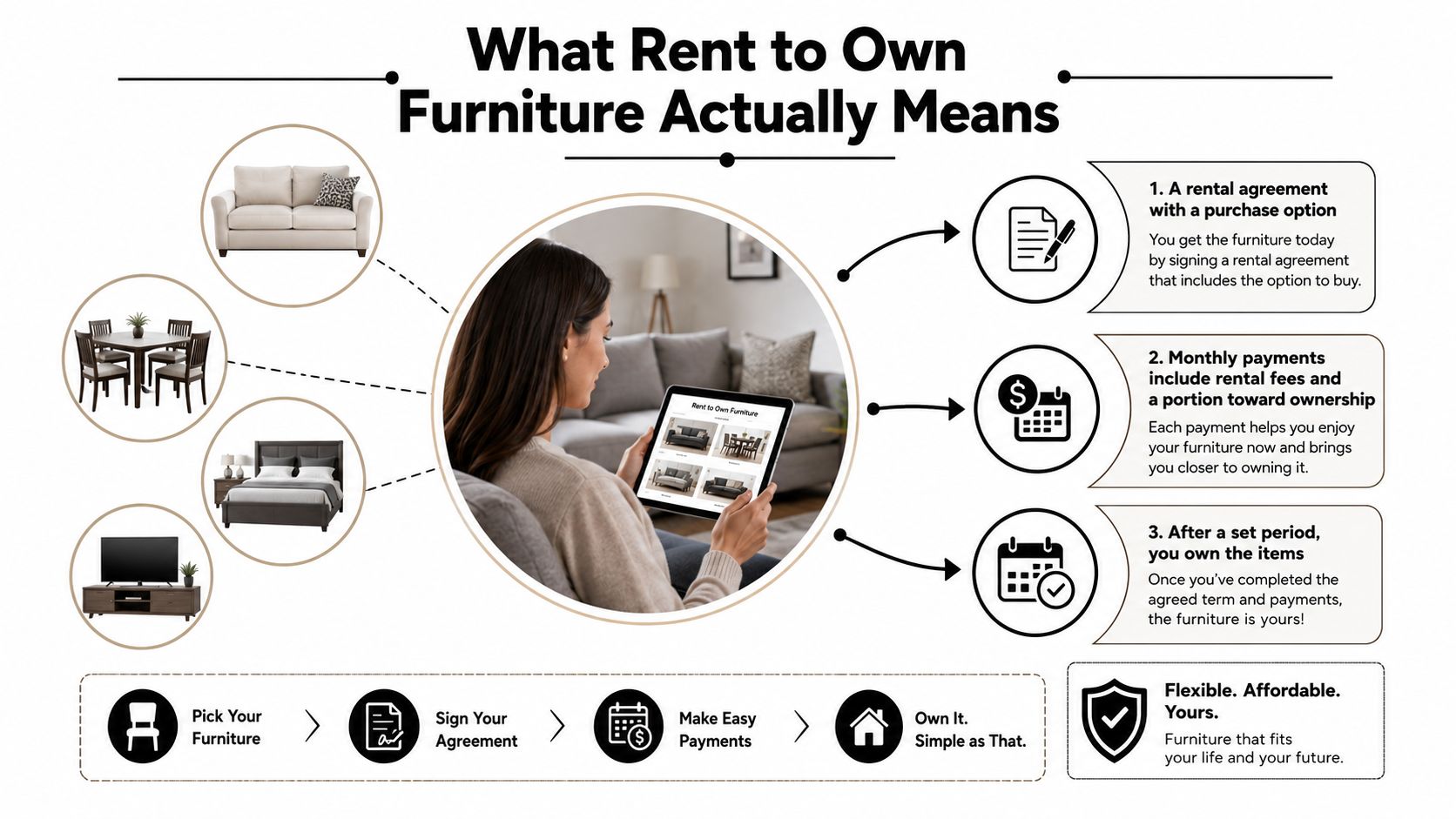
The basic idea
Rent to own sits between rental and credit. You get the furniture, you make regular payments, and the contract gives you a path to ownership if you keep paying and meet the terms. If you stop, you usually hand the item back, and you may lose what you've already paid.
That's why the model appeals to households under budget pressure and to buyers who want flexibility more than ownership. South Africa's retail environment still tracks furniture, household appliances, and equipment as a distinct spending category, which matters because rent-to-own operators are competing for the same household budget. The broader consumer-credit environment also affects durable-goods buying decisions, so these access models stay relevant when households don't want a large upfront commitment. Stats SA's retail trade release makes that spending category visible, and the South African Reserve Bank has repeatedly flagged household credit conditions and cost-of-living pressure as important context for durable-goods purchases.
Why people choose it
People do not choose this model because it's cheap. They choose it because it lowers the cash barrier. That's a meaningful difference.
Practical rule: If the main problem is upfront cash, rent-to-own can help. If the main problem is total affordability, it usually isn't the best deal.
South Africa's population was estimated at roughly 63 million in 2024 as noted in the industry reference, so the addressable market is large enough for furniture access models to stay active across households, student housing, events, and temporary accommodation. But size doesn't make the contract good. It just means the product is easy to find.
How Rent to Own Contracts Work in Practice
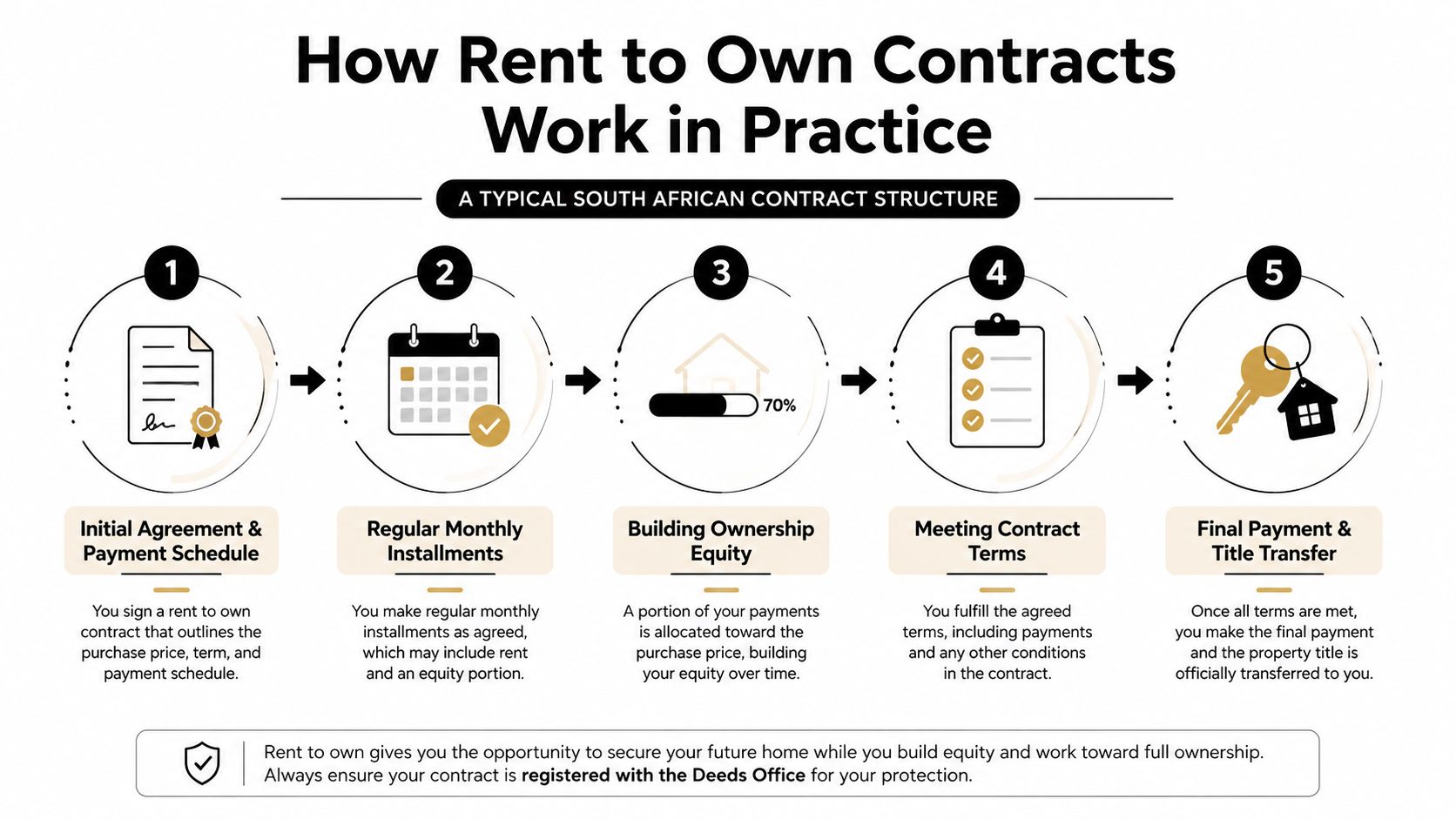
A rent-to-own contract gives you possession now and ownership later, if you keep up the payments and follow the terms. In practice, it sits between rental and credit, which is why South African buyers should read it like a finance agreement, not a casual furniture hire form.
What to look for before you sign
A clean contract makes the trade-offs obvious. A poor one hides the cost in language that only becomes clear after a missed payment or a dispute.
- Agreement term: These contracts often run 12 to 24 months, so check whether the term matches how long you need the furniture. VRTO's guide
- Payment frequency: Some plans use weekly payments, others monthly. Choose the schedule that fits your income cycle, not the one that only looks smaller on paper.
- Early purchase window: Many agreements include a same-as-cash window of about 90 days. That only helps if the discount and buyout terms are written clearly.
- Return rules: If you stop paying, the provider can usually take the item back, and previous payments may not come back to you.
- Ownership transfer: Do not assume you own the furniture until the contract says so in plain language.
The National Credit Act 34 of 2005, which came into force on 1 June 2006, changed how regulated credit is handled in South Africa. That matters here because rent-to-own often behaves like credit even when it is sold as rental. Disclosure, affordability checks, and the wording of the contract are not side issues. They are what decide whether the deal is fair.
Read the contract like a finance document, not like a sales brochure.
If you are comparing a home furniture package with a venue setup, look at ABC Hire's guide to tables and chairs rental. Short-term hire is priced and structured differently, and for event planners that difference usually matters more than the promise of ownership later.
Calculating the Full Price Tag Over Time
Many customers only notice the extra cost after they have already signed. The payment looks manageable, the furniture is available right away, and the contract hides the true bill until later. Rent-to-own usually works more like a high-cost consumer lease than a normal instalment sale, because you pay for use now and the chance to own later.
Why the sticker logic fails
The listed weekly or monthly amount is only one piece of the cost. Delivery, installation, financing margin, and the length of the contract all push the final price higher. Consumer guidance notes that rent-to-own plans commonly cost 2 to 5 times regular retail pricing, and missed payments can lead to repossession or forfeiture instead of equity building. Financial Consumer Agency of Canada
That is why the cheapest-looking payment is often the most expensive way to furnish a room.
| Access Model | Monthly Outlay | Total Paid Over 24 Months | Ownership Outcome |
|---|---|---|---|
| Rent to Own | Lower upfront monthly payment structure | Can rise sharply once fees and contract length are added | Ownership only if contract terms are completed |
| Cash Purchase | Highest upfront payment | Lowest total cost if you can pay once | Immediate ownership |
| Lay-by | Spread before collection | Usually closer to cash pricing than rent-to-own | Ownership after final payment and collection |
| Short-Term Rental | Ongoing access fee | Best for temporary use, not ownership | No ownership |
A fair comparison starts with one question, what will the item cost you in total by the end of the contract? If you cannot answer that clearly, do not sign yet.
The costs that catch people out
South African buyers and event planners get burned when they focus on the instalment and ignore the exit cost. A lounge suite for a long-term flat, a temporary wedding setup, and a corporate activation all have different cost logic. If the furniture is only needed for a short period, the payment trail matters less than storage, transport, and what happens after the event.
For temporary use, short-term hire usually wins because it removes the long tail of ownership. For a closer look at value in lounge suites, ABC Hire's fair price furniture lounge suites guide is useful because it keeps the focus on what the piece is worth, not just what the monthly amount seems to promise.
A good comparison also includes the cost of holding furniture you no longer need. If you are trying to work out whether to rent, buy, or keep items between uses, it is worth a look to find Sydney furniture storage options because storage quickly becomes a hidden cost whenever ownership outlives the occasion.
Rule of thumb: If you would not buy the item at full retail today, do not sign a contract that could push the total far above retail over time.
Comparing Rent to Own Against Buying and Short-Term Rental
The key question is not which option sounds cheapest. It is what the furniture will cost you over its full life, and whether you will still want it after the event, the lease, or the season ends.
A long-term home setup and a short-term event setup follow different rules. If you are furnishing a flat you plan to keep, ownership can make sense. If you are staging a wedding, a corporate activation, or a weekend function, ownership is a drag on cash flow and storage.
Decision matrix by use case
| Situation | Best-fit option | Why |
|---|---|---|
| Permanent home furnishing with limited cash flow | Rent to own or lay-by | Spreads the cost, but only if the total price still works |
| Can pay now without strain | Cash purchase | Lowest overall cost and immediate ownership |
| One-off event or short-term use | Short-term rental | No long contract, no storage problem, no ownership burden |
| Need flexibility and want to avoid credit stress | Short-term rental or lay-by | Keeps obligations lighter |
For South African event planners in Cape Town, Stellenbosch, Franschhoek, and Paarl, the answer is usually clear. A weekend wedding does not justify a long payment contract for tables, chairs, or lounge pieces. A corporate activation does not need furniture sitting in storage after the brand walls come down.
That storage bill is where ownership starts to look expensive. If you are trying to work out whether to rent, buy, or keep items between uses, it is worth looking at find Sydney furniture storage options as a reminder that storage becomes a hidden cost whenever ownership outlives the occasion.
Why event hire usually wins for temporary needs
Event hire solves the actual problem, which is access on a fixed date. You choose the pieces, they arrive when needed, and they leave when the event is over. There is no multi-month obligation, no guesswork about resale, and no cash tied up in furniture you will barely use.
The same logic applies to specialist event suppliers that build around a single occasion. If you need a broader event experience, create immersive event experiences shows how temporary hire is designed around the event itself, not around ownership.
For a South African perspective on the furniture side, ABC Hire's guide to renting furniture for events is a useful reference point. The lesson is straightforward, if the need is temporary, a long-term finance product is the wrong tool.
Red Flags and Consumer Protection Tips
The first red flag is a deal that sounds simple but hides the actual price. The second is a contract that makes it easy to lose money and hard to walk away. You don't need to be a lawyer to spot trouble, you just need to slow down and read like someone who expects the provider to protect its own interests, because it will.
The clauses that should make you pause
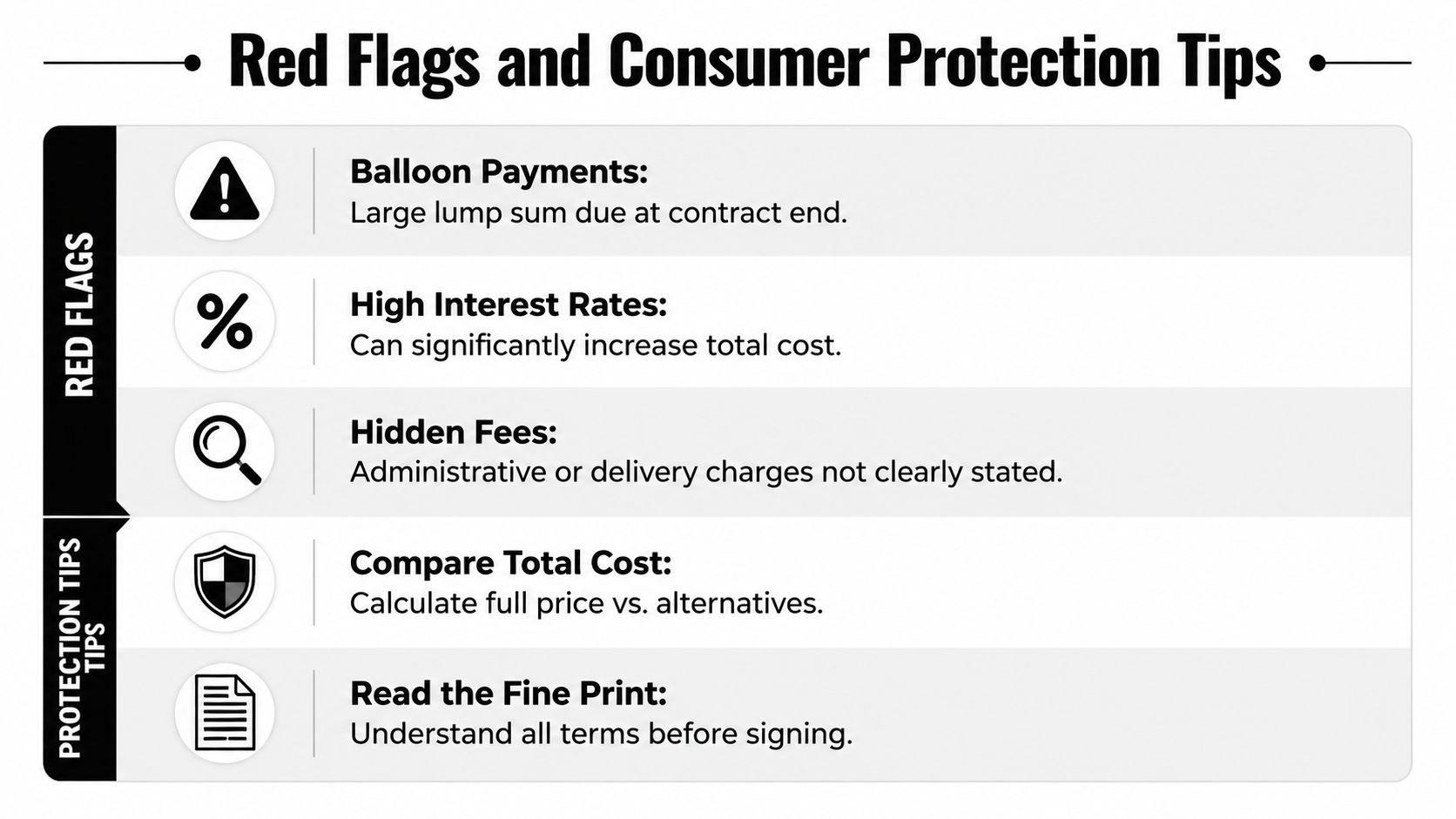
Watch for a balloon payment at the end of the term. That can turn a manageable payment plan into a nasty surprise. Also watch for vague condition assessments when the item is returned, because “damage” can become a convenient excuse to keep your money and the goods.
Other pressure points are obvious once you know where to look:
- Late fees that stack quickly: Ask for the exact cost of a missed payment in writing.
- Automatic renewal language: Make sure the contract does not automatically roll forward on terms you didn't expect.
- Hidden delivery or administrative charges: If they're not written clearly, treat them as a warning sign.
- Repossession clauses: Confirm what happens to previous payments if the item is taken back.
Consumer-protection guidance from the Federal Trade Commission survey on rent-to-own customers highlights a simple reality, these agreements can be expensive and the payment history may not translate into ownership if the contract breaks down. FTC survey on rent-to-own customers
What to ask before you sign
Ask for the total cost, not just the payment amount. Ask for the early-purchase discount schedule in writing. Ask whether there's a payment holiday clause for emergencies. If the provider won't answer clearly, walk away.
The National Credit Regulator is the place to go if a provider ignores disclosure or treats you unfairly under regulated credit rules. Under the National Credit Act, affordability and clarity are not optional decorations. They're part of the consumer protection framework that makes these contracts defensible in the first place.
When Event Furniture Hire Makes More Sense
If the furniture is for one event, rent-to-own is the wrong conversation. You don't need a payment plan that runs across months when you need chairs for a Saturday, LED furniture for a night function, or a lounge set for a corporate launch. You need the right items on the right date, then you need the floor space back.
Temporary need, temporary solution
That's why event hire wins for weddings, brand activations, matric dances, private parties, and venue setups. It matches the purchase to the actual use pattern. A long contract for a one-off event just adds cost, paperwork, and storage headaches.
The practical advantage is simple. You don't own the burden after the event. You also avoid the ugly middle ground where you've paid for furniture, but now you need to store, transport, clean, and protect it.
For planners who want the broader playbook, ABC Hire's event furniture rental guide is a useful reference because it focuses on temporary access rather than ownership. That's the right mindset for one-off occasions.
What event hire can cover
A good hire partner can handle tables, chairs, bean bags, LED furniture, slush machines, and climate control equipment. That matters in the Cape because outdoor functions and evening events often need more than just seating. You're solving atmosphere, comfort, and logistics at once.
If your event also needs themed entertainment and layout ideas, PSW Events' casino tables page shows how a hire model supports a complete event experience. That's the point, hire should build the function, not lock you into a long ownership cycle.
Straight answer: If you need the item for a weekend, hire it. If you need it for years, buy carefully. If you can't answer which one it is, don't sign yet.
Making the Right Furniture Decision for Your Situation
Start with the question, not the marketing question. How long do you need the furniture? Do you need ownership, or just access? Is this a home purchase or an event requirement? If the need is temporary, choose hire. If the need is permanent and you can afford it, buy. If you need flexibility and can handle the full cost, rent-to-own can work, but only with clear terms.
The trap is judging the offer by the smallest payment. That tells you very little about the true cost. The better approach is to compare total outlay, contract length, and what happens if life changes before the final payment is made.
For anyone still balancing furniture choices against budget and style, insights from Lott's Furniture are a useful reminder that good furniture shopping starts with fit, quality, and timing, not just price tags.
Choose the model that matches your timeline, not the one that looks easiest in the moment. That one decision saves more money than any slick payment plan ever will.
If you're planning an event in Cape Town or the Winelands, or you need furniture access without taking on a long contract, ABC Hire has the hire options to match the job. Use the right solution for the right timeline, and keep your budget working for you instead of against you.